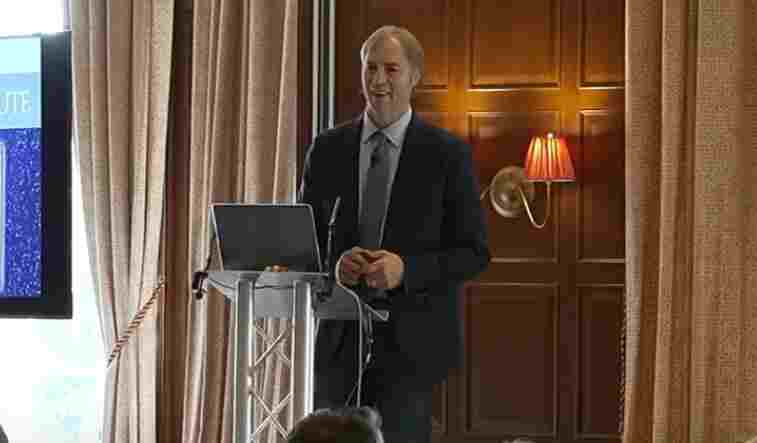
Read the full transcript of author Stephen Meyer’s talk titled “Return of the God Hypothesis” at a Discovery Institute event in Cambridge, UK in August 2024.
Listen to the audio version here:
TRANSCRIPT:
The Return of the God Hypothesis: A Cambridge Perspective
STEPHEN MEYER: Dan, it’s wonderful to be here. I’m going to be speaking today about the return of the God hypothesis, my recent book, with a Cambridge twist. Because I realized as we were preparing for the conference that nearly all of the major events and discoveries that have been made—there we go. Why does it do that? Don’t know.
Voice recognition software. It’s too good. Yeah, so I’ve just been realizing that many, many of the really significant discoveries that have been made that are bringing the God question back into the center of the culture because of scientific work have been made here, and that nearly the whole story that I told in “The Return of the God Hypothesis” could be told here. Caltech and California had some things to do with it too, but it’s pretty exciting. And so for me, it’s been kind of a great opportunity to reflect on God’s providence in my life and having brought me here.
I felt the call to work on this very topic and to develop this case. And so it’s been really fun just to prepare this talk. Cambridge can be a very intimidating place, and when I first arrived, we found out there were all these things that we didn’t know, and we kept running into this phrase, “Well, it’s not the done thing.” And the question we wanted to ask was, “Well, where do you find out where the done thing is done?” Because there was no orientation material.
Navigating Cambridge Traditions
So the very first high table dinner in my college, I arrived maybe thirty seconds late, but the bells were ringing on the—it was 7 bells, and our porter, who was named, I kid you not, Mr. Monument, came out in his bowler cap. And as I was hurrying to get into the high table dinner, he shouted across the quad, “Maya, you’re late!” which terrified me. I thought I’d really messed up. My—no one cared when I sat down, so that was fine. But it was intimidating. Then at the dinner, I was seated across kitty-corner from the master of the college, which was kind of intimidating, and I was just a wet-behind-the-ears American student.
I had just arrived, and I was only doing a master’s degree, and they served these little tiny Cornish game hens. And so I had gotten good instructions about how to make sure I did my manners right, and I was trying to cut them. And as I pressed too hard on one side of the Cornish game hen, it skittered across the table right to the master’s plate. And I was mortified, and this is surely going to be the end of my Cambridge career. He looked up and he said, “Well, don’t worry about it, son. There’s no meat on it anyway.” So it was a rather intimidating start, but it wasn’t just not knowing the done thing that was intimidating, it was also ideologically intimidating.
Ideological Challenges
So at one of the first seminars in our department, we adjourned then to the pub to discuss, and there was this—there were several people in our program who had been to Ivy League schools, which was also intimidating, because I went to a small college out in the West, and one of them—this guy from Yale decides that he’s going to really impress our Cambridge Supervisors, and he announces that, well, that recently, because of his deep investigations, he had become an atheist. And, well, the—this really hip young supervisor in our department leaned across the table, and he said in a loud voice that everyone can hear, he said, “Well, of course you’re an atheist, but what else are you that makes you interesting?” So I decided I was going to not share my worldview, at least not right out of the chute, but interestingly that same supervisor in tutorials about Newton told me, wagged his finger at me, and he said, “If you miss Newton’s theism, you’ve missed everything.”
And even though my department was dominated by people who had an atheistic or materialistic or some sort of secular worldview, as far as I knew, there were no Christian lecturers or professors in the department. They were very honest about the Christian origins of modern science, and there was evidence of it all around. And so even though I felt outnumbered, I took comfort and encouragement from all the markers, all the signs all around me of this deep Christian inspiration for science. And it wasn’t just at Cambridge, of course. One of the key founders of modern science, someone that Newton said—Newton used to say that it was upon Kepler and Galileo’s shoulders that he stood.
The Christian Inspiration for Science
And Kepler said, “I was merely thinking God’s thoughts after him.” Speaking of his work in astronomy, he said, “Since we astronomers are priests of the highest God in regard to the book of nature, it benefits us to be thoughtful, not of the glory of our minds, but rather above all else, the glory of God.” And some of you may have found or seen there’s a wonderful book by a Baylor professor who’s recently passed away, Rodney Stark, about the Scientific Revolution, and it’s titled “For the Glory of God.” This was the inspiration for modern science. And we saw this a bit yesterday when I was talking about John Ray in his book, “The Wisdom of God Manifested in the Works of Creation,” and how the title itself was merely a paraphrase of the famous passage in the book of Romans: “For since the creation of the world God’s invisible qualities, his eternal power and divine nature have been clearly seen, being understood from what has been made.”
So the inspiration for science, what we call the natural theological tradition, was not a deviation or a side eddy in the scientific enterprise.
William Harvey and the Book of Nature
There’s a little statue, and this is something I’m showing you some things that you’ll want to see as you’re walking around Cambridge and which we will spotlight in the self-guided walking tours that we have produced for you to take with you. And this is a little statue of a man named William Harvey. He was a physician, had a very long life for the time period, and in the early seventeenth century, he was the first person to prove the circulation of the blood, and he did so by doing a whole series of very ingenious experiments. I know we have a lot of physicians here. We always seem to attract to Insider’s Briefing, so lots of physicians, software developers, and engineers.
Because in all three of those professions, design is crucial to understanding what’s going on. And Harvey was the first one to think in Keplerian terms. Johannes Kepler had another concept. This idea of the book of nature was a metaphor that goes back to the late middle ages, but Kepler loved it. And it was the idea that nature is intelligible.
We can—it can be read. There’s the book of scripture that reveals God’s plan in written form, and there’s the book of nature that reveals his ideas in how he made the natural world. And so Harvey was taken with this idea of what’s called intelligibility. It was the watchword of these early scientists, that nature could be understood, and it could be understood for a theological reason. God had made our—the God who made the world in a rational, orderly way, who built design into it, also designed our minds so that we could understand the natural world, the order, the design he’d built into the world.
There’s a principle of correspondence. We were made in the image of God, and because of that, we could understand the works of God. And Harvey applied this in thinking about the human body and assumed that there must be some sort of design system, and so he set out to figure out what the design of the body was. And in the process of doing his experiments, he discovered that there is this beautiful circulatory system for the blood, and the heart pumps it out, and it comes back through the veins, out through the arteries, back through the veins, and he was the first one to figure this out. I spoke yesterday about this amazing sequence of mentors here at Cambridge.
Newton’s Theism and the Mystery of Gravity
John Ray had mentored Isaac Barrow, and then, of course, Isaac Barrow mentored Newton. And Newton’s great work, the Principia, was the work that in many ways culminated this intense period of scientific development called the Scientific Revolution. Now in my first year of working here, I was working with the same supervisor who said if you miss Newton’s theism, you’ve missed everything. And I got deeply interested in Newton’s work on the idea of gravity because it was so mysterious. It’s so mysterious today.
If you drop a ball and it falls to the earth, you’ll say—and I used to do this with my students. “Why does it fall?” And they would say, “Well, because of gravity.” And I’d say, “Well, what is gravity?” And they would say, “Well, it’s the force that makes things fall.”
So yeah. But what’s pushing the object down? And this was—this was a profoundly mysterious discovery. Newton showed that this was—that what he called—there was action at a distance, that the tides were being moved by the moon. Is it—and you could correlate the movement of the tides to the movement of the moon, and he could even precisely describe the strength of the force that was involved with his famous equation.
But neither he nor anyone else knew how this force was being transmitted across all those miles from here to the moon. It’s still a mystery. We don’t know what causes gravity. We can describe it mathematically. And even with new theories of gravity, they turn out to be equally mysterious.
I got fascinated with this. And it turned out that Newton, though he was somewhat loath to admit it because even at the time, there were natural philosophers like the famous German, Gottfried Leibniz, who didn’t want to bring God directly into scientific inquiry. And but it turned out that Newton actually thought that the ultimate explanation for gravity was what my supervisor called constant spirit action. If gravity acts everywhere and always instantaneously at a distance without material mediation, Newton thought there must be something immaterial that was ubiquitous, omnipotent throughout the whole of the universe that was the ultimate explanation for gravity. I was fascinated with this.
A Poignant Moment at Newton’s Rooms
In the break, the Christmas vacation, which the British students called the Christmas vac, everyone went home, but Elaine’s parents were desperately missing her, and so she went home for a few days at Christmas, and I stayed furiously working on my essays, including one on Newton. And one night in the middle of the Christmas vac, it was deeply foggy. There was no one in the university, and I walked down and I sat right here in front of Newton’s new rooms, and I just sat and thought for about two hours. It’s not a very great and dramatic story, but for me, it was just a poignant moment to think that I was sitting right where Newton had worked on all this. And you folks can see as you walk by on Trinity Lane or Trinity Street today, there’s a wonderful apple tree that they planted.
The myth about the apple falling is probably a myth. He didn’t think of gravity because of that. But there was an apple tree at his family home in Lincolnshire, and they got a cutting from that and planted it. Here it—there it is in front. But in the corner of that little courtyard, you can see his rooms, First Floor, Second Floor, where he was actually working on this.
Newton’s Theology of Nature
And so this is fascinating because what Newton developed was actually a profound theology of nature. For him, the laws of nature were a mode of divine action. In fact, just as the book of nature is a metaphor that tells of the works of God, the idea of the laws of nature was also such a—one historian put it—a juridical metaphor of theological origins. There are laws of nature because as John Lennox likes to say, and he’ll be with us tomorrow, there are laws of nature because there was a lawgiver. There was a divine legislator.
And what so what Newton thought the laws of nature were was a mode of divine action, like in the book of Hebrews where it says “he sustains the universe by the word of his power.” The regular concourse of nature was a consequence of the handiwork of God, the constant supervision of God over the natural world he designed. But Newton also made beautiful design arguments, and this is a passage from the general scholium to the Principia, which was his theological epilogue to the greatest work of science ever written. A number of years ago, I had an opportunity to testify before the United States Commission on Civil Rights, and they were investigating whether or not there was viewpoint discrimination in the teaching of biological origins. When I was summoned for this, I just had to laugh.
Intelligent Design and Early Scientists
It was obvious if anyone had read a biology textbook. There was only one theory of biological origin taught, it was Darwin’s theory. Anyway, I gave my testimony, and I talked a bit about intelligent design. And one of the commissioners said, “Well, isn’t this idea of intelligent design very similar to what the early scientists, like Kepler and Galileo and Newton thought?” And then I when I heard Newton’s name, I brightened.
I said, “Well, yes. Of course.” And I started to talk a bit, and my office at number interrupted me and said, “Well, what young Doctor Meyer”—and I was younger then—”What young Doctor Meyer has said is right. Newton was very religious, but he took great pains to keep his science out of his religious or his religious beliefs out.”
She said, “He took great pains to keep his religious beliefs about intelligent design out of his scientific work.” And I had just written an essay on Newton’s understanding of gravity and his design arguments, and on the front page of that essay, I had the block quote that’s on the screen, and so I nearly memorized it. And I said, “Well, that’s not true. In the general Scholium to the Principia, arguably the greatest work of physics ever written,” and that sounded pretty impressive, I think, you know, the general Scholium. And general Scholium just means introduction, but no one there knew that.
So, you know, it was or, actually, it was more like an epilogue. And, so I quoted this, and it’s a beautiful quotation. He was talking about the design of the solar system, and he said:
“Though these bodies may indeed continue in their orbits by the mere laws of gravity, yet they could by no means have first derived the regular position of the orbits themselves from those laws. Thus, this most beautiful system of sun, planets, and comets could only proceed from the counsel and dominion of an intelligent and powerful Being.”
Then the commissioners all sort of smiled, like, well, this is going to be a lot more interesting than we thought. This intelligent design idea may be completely crackpot, but there’s no denying that it played a role in the history of science.
James Clerk Maxwell and the Cavendish Laboratory
And it continued to play that role even in here in Cambridge. We talked about James Clerk Maxwell just a little bit yesterday, and, again, I would highlight this beautiful door on the original Cavendish Laboratory. And you can see it. It’s on Free School Lane. It happened. It was just a few hundred steps from the front door of the department where I was studying. So when I felt outnumbered among my colleagues, my contemporary colleagues, I would gain encouragement by walking down the street and seeing that, well, some pretty great scientists have the same worldview that I did. And on the door, you can see this wonderful inscription.
It’s in the Latin, but you can make it out. And it says the translation is “Greater the works of the Lord, sought out by all who take pleasure therein.” What is Maxwell saying? This is the motivation for doing science. We want to bring glory to God.
The Shift to Scientific Materialism
So that was the Christian origins of modern science, and that perspective continued into the nineteenth century. But during the nineteenth century, especially the late nineteenth century, there began to be a dramatic shift. And that too was presaged by work that took place here in Cambridge in, Charles Darwin hit was here right before his voyage on the Beagle, and he was studying theology. He read William Paley and his works on natural theology. But one of his, he was also doing natural history, and one of his natural history professors named Henslow suggested he take up this voyage on the Beagle.
And while he was there, his ideas about the origin of species, his theory of evolution by natural selection began to germinate. And then years later, in 1859, he publishes that work. Darwin, when he was here, was at Christ’s College. It’s just walking distance from where we are, just a little bit north. If you head out, you type in your Google Maps, you’ll be able to find the entrance.
The college is often open. There are many plaques to Darwin there. And, also, the first court through the first courtyard and up the stairs is the room where he was. So another very important figure. And what was important about Darwinism was that it not only was a theory of how life changed, but it was a theory of how life changed in a completely undirected and unguided way.
So one of our American textbooks that is completely not biased in any way, says this. He puts it this way. It says, “By coupling the undirected, purposeless variations to the blind, uncaring process of natural selection, Darwin made theological or spiritual explanations of life superfluous, unnecessary.” And so with Darwinism, we get this rise of what sometimes was called scientific materialism or atheism, and with the idea that there’s no need—there’s no guiding hand behind evolution. It’s not theistic evolution. It’s not teleological. It’s not—there’s no purpose behind it. It’s a completely undirected, unguided process. And that, as Richard Dawkins would later say, made it possible to be an intellectually fulfilled atheist.
The Appearance of Design
We can now explain the appearance of design in living organisms as a result of an unguided, undirected process, and therefore there was no need to invoke a designing intelligence or a creator of any kind.
He was later—Dawkins has been quoted most famously in his book, “The Blind Watchmaker,” saying that “Biology is the study of complicated things that give the appearance of having been designed for purpose,” where the key word is appearance, the illusion. Why is it an illusion? Because there’s this unguided, undirected process called natural selection that can produce the appearance of design without being guided or directed in any way. It can mimic, it’s often said, the powers of a designing intelligence, but it’s not intelligent. There’s no intelligence allowed.
Scientific Materialism in Popular Culture
And so this perspective has given rise to a lot of intellectually fulfilled atheists, and many of them are kind of very popular, and they’ve had a very strong voice in the culture. Lawrence Krauss, unfortunately, even Stephen Hawking got into this act late in his life. Bill Nye, the science guy, even though he’s not a scientist, and then, the really great physicist, Steven Weinberg, have all been exponents of this idea of scientific materialism or scientific atheism. And Richard Dawkins had a lovely way of framing this even if he got, in my view, the issue wrong. He says, “The universe we observe has precisely the properties we should expect if at bottom, there is no design, no purpose, no evil, no good, nothing but blind, pitiless indifference.”
Blind, pitiless indifference for him is kind of shorthand for an unguided, undirected process. Materialism. Matter and energy are eternal and self-existent and self-organizing, and they can generate all the intricate designs we see in the universe without there being a guiding hand behind it. This is the Darwinian and scientific materialist perspective.
Challenging the Materialist Perspective
Now it turns out that there are at least three major discoveries that are not what you would expect if the universe were the product of blind pitiless indifference. Dawkins says that the universe has exactly the properties we should expect if it was only materialistic processes at work, but there were three major discoveries, and I’ve written about them in my book, “Return of the God Hypothesis.” What I’m going to do today, and which is kind of fun, is to highlight the Cambridge angle on each of these discoveries because it’s non-trivial in each case.
Edwin Hubble and the Expanding Universe
If you read some of my work or if you’ve heard one of my talks, I won’t belabor all the things I usually talk about, but you probably remember I talked about Edwin Hubble with the astronomer—the lawyer who went into astronomy in the—He began to use these at the same time as he went into astronomy. They were building these great dome telescopes. And as a result of the one in Southern California at Mount Wilson, he was able, for the first time, to verify that the nebular, smudges that we—the nebular structures in the atmosphere were actually galaxies beyond our Milky Way.
And further, he was able to show that those galaxies are racing away from our Milky Way galaxy, and they’re doing it in every quadrant of the night sky. And so he was able to show that the further out you look, the faster those galaxies are moving away. And the best explanation of this idea of an expansion where the things further out are moving faster out, the things further closer in are moving a little less fast, was a kind of spherical expansion, like a balloon—a balloon being blown up. How many people have seen me illustrate this with just puffing on the balloon? Is this—oh, so okay.
So if you just think of a—I’ve got one, but I don’t want to belabor illustrations that people have seen a hundred times. But you just think of a balloon blowing up, and you think of—I usually draw galaxies on the surface. And as the universe is going in the forward direction of time, the universe is getting bigger and bigger and bigger. The volume of the universe is getting bigger. It’s like a balloon expanding.
And what Hubble realized is that his observations meant that we had an expanding universe. But if you wind the clock backwards in time, that expanding balloon would have been smaller and smaller and smaller at each progressive point, each successive point in the past till, eventually, all that matter would have had to have been in the reverse direction of time. It would have congealed to a starting point, marking the beginning of the expansion of the universe, but also, arguably, the beginning of the universe itself.
Einstein’s Theory of Gravity
Now this was a discovery that was made mainly in The United States by Hubble, a colleague of his, Humason, an earlier US Astronomer named Vesto Slipher. But there was another angle on this that was really interesting, and it was a consequence of the work of a German scientist with very bad hair, with a very thick accent, who typically did not match his socks, and was therefore a hero of mine.
This is Albert Einstein. And, John is going to give a little test on this equation afterwards, so don’t worry. You don’t have to take it down now. But he had this new theory of gravity, and it was slightly different than Newton’s. And it was the idea that gravitational forces caused as massive bodies curve the fabric of space-time.
Now this is no less mysterious than Newton’s theory because how does matter curve space? And then the other part of the theory was the curvature of space causes the other matter to move in and take curved trajectories. But since space is empty, it’s no less mysterious than Newton’s theory, but it kind of worked. The math was better. But it also had an implication.
You could think of it as like putting a bowling ball in a trampoline, how it will create a divot. Right? It curves. It creates a contour in the trampoline. Well, that was the idea that the massive bodies would create a kind of contour in space.
And, but if that was true, Einstein realized that if gravity—if his idea about gravity was true and it was the only force operating in the universe, then eventually, all the balls would come to the center. Okay? And all the matter would congeal, and there would be no empty space in the universe. We’d just be in one giant black hole. But we don’t live in that kind of universe.
We live in a universe where there’s empty space. Empty—and so he thought there must be some other kind of force at work that’s doing some pushing, an outward pushing force that counteracts the theory of gravity. And he called that idea the cosmological constant. And then he made one other move that was—it was completely arbitrary. He assigned a precise value to that outward pushing force that was equal and opposite to the inward pulling force so he could depict the universe as being completely static, not expanding outward from a beginning and not collapsing backwards either.
Einstein’s Cosmological Constant
And the reason that he chose that value was that he found the idea of a beginning to the universe rather distasteful. It kind of triggered him. He thought, if there’s a beginning, then what comes before that? That sounded like the Genesis account. And at this point in his career, he was a pretty staunch scientific materialist.
And so he sort of inserted this fudge factor into his equations, and it preserved for the time being the idea of a static universe, not one expanding outward from the beginning. Well, meanwhile, there was a young Belgian priest who started to work with Einstein’s equations, and he was working here in 1923 at St. Edmund’s College. He was Belgian. He did most of his scientific career across the channel, but he had a really crucial year here where he was working on what are called the field equations, Einstein’s field equations.
And he showed that Einstein’s idea of precisely balancing the outward push to the inward pull didn’t ensure that the universe would be static because even the slight alteration, perturbation in the distribution of matter and energy in the universe would throw that balance off and cause everything to go into a black hole or into a heat death. And so at a physics conference in 1927, he meets Einstein, and they’re in a taxicab together going to the conference, and he confronts him with this. And Einstein, of course, doesn’t like it too well and tells Lemaitre, he says, “Well, your mathematics is admirable, but your physical intuition is abominable.” And, you know, the scientists are always so measured in the way they speak, you know, because and so there was this, you know, he—Einstein basically, I don’t like it. Your math is right.
The idea of precisely balancing things is unstable, but I just don’t like where this leads as far as a theory of physics—theory of the origin of the universe. We’re back to a beginning, and that sounds like the Genesis text. Well, there are other scientists who didn’t like this idea as well, the idea that the universe had a beginning, and one was Sir Arthur Eddington, who was also here in Cambridge. And he was famously quoted as saying, “Philosophically, the notion of the beginning of the present order is repugnant to me. I should like to find a genuine loophole. I simply do not believe the present order of things started off with a bang. The expanding universe is preposterous. It leaves me cold.”
Well, this alternate theory, in psychology is known as denial. And you see—can you see what the evidence is that he’s citing? Why he doesn’t like it? He says, “Philosophically, I don’t like it.” It’s challenging his worldview. It’s challenging scientific materialism. Now to his credit, Eddington has a meeting with Einstein here.
Eddington and Einstein
And he doesn’t like the idea, but he tells Einstein, “Hey, look. We gotta get with the program, and you gotta get with the program. Because out in California at the Mount Wilson Observatory, they’re seeing the evidence of this expansion.” And so Eddington, despite his own personal reservations and distaste for what later became known as the Big Bang Theory, tells Einstein he needs to go meet Hubble. And so Einstein does subsequently go out to Pasadena, to the Mount Wilson Observatory, 1931.
Fascinating newsreel footage we have of this encounter, moving pictures. And, Einstein goes into the telescope. He takes a peek. And then two weeks later—this is Hubble in the background with a pipe. And two weeks later, he does an interview with The New York Times and admits that the universe is not static, and then he says the three hardest words to say in the English language, “I was wrong.”
Okay. And he later, to his credit, I mean, he said that his fine-tuning of the cosmological constant to obscure the evidence for the beginning of the universe was the greatest blunder in my book, I said it was the greatest blunder of his career. I misquoted him. It was stronger. He said it was the greatest blunder of my life. Okay? He let his philosophical predilections distort his evaluation of the evidence.
Stephen Hawking’s Contributions
Now this whole issue of the beginning resurfaced again, and it did so here in Cambridge. In the while doing a PhD, began to think about Einstein’s theory. He was doing something. He was doing black hole physics. And he began to think more about this idea of general relativity and how massive bodies curve space, and he was thinking, well, in the forward direction and he would really—by this time, he was also aware of what the observational astronomers were discovering about the universe expanding outward in the forward direction of time. And he realized if that was true, then the mass of the universe would be getting more and more and more diffuse. And if the mass of the universe is more diffuse, then since matter—the concentrated matter curves space, then the curvature of the universe should be getting less and less, less pronounced.
But by the same token, he realized if you back extrapolate and go in the reverse direction of time, the matter would be getting more and more and more densely concentrated as you go further and further and further back in time. But if the matter is getting more densely concentrated, then the space would be getting more tightly curved, and then more tightly curved, and then more tightly curved, and then and finally, you would reach a limiting case where you couldn’t go back any further because the curvature—the matter would go to an infinite density and the curvature would become infinitely tight. Well, an infinitely tight curvature corresponds to zero spatial volume. And, question, how much stuff can you put in no space? No thing fits in no space. Okay?
And so this is a profoundly anti-materialistic consequence of modern physics. In fact, it ends the picture of the universe that’s painted by this idea, it eventually—Hawking eventually proves this and is part of his 1966 PhD dissertation. And, but a consequence is that the universe is then portrayed in terms that are very similar to what the medieval theologians described as creation out of nothing physical, because there’s no space to put anything.
And if you’ve seen the little film, “A Theory of Everything,” about Hawking’s life, they depict his PhD dissertation. And he’s standing at a wooden table across from Roger Penrose and Dennis Sciama and these very prominent established Cambridge and Oxford Physicists. And they’re picking this poor thesis apart in chapter 1, and he’s got an error in a derivation. In chapter 2, he’s got spelling errors. In chapter 4, he got—but then they say, “But, Steven, this third chapter, this is a black hole at the beginning of time, a space-time singularity? This is genius.” And then they shove the book across the table and say, “Congratulations, Doctor Hawking,” and they use the title. He’s passed. It’s a really dramatic thing.
The Big Bang and Its Implications
In any case, this kind of really, really focuses people’s attention on the consequences of this idea of the Big Bang. That is we’re not talking about a primeval atom that’s been sitting around forever waiting to explode. We’re talking about the origin of matter, space, time, and energy itself.
And in 1985, I attended a conference in Dallas that completely changed my life. It was a conference of atheists and theistic scientists debating the origin of the universe and the origin of life. And in the first session, one of Edwin Hubble’s former PhD students, by this time a very prominent astrophysicist himself, Alan Sandage, a well-known Jewish agnostic who was pretty much a scientific materialist, ascended to the podium and sat on the wrong side. He sat down with the theists instead of his fellow materialists. And in his talk, he then explained how the evidence from his own field that he had helped verify—he’d helped Hubble verify that the universe was expanding in every quadrant of the night sky, and he announced that he had become not only a theist, but a Christian.
And he had done so not in spite of the scientific evidence, but because of it. And in describing the evidence for this singularity at the beginning, he said, “Here is evidence for what can only be described as a supernatural event. There is no way this could have been predicted within the realm of physics as we know it.” I have the footage of this, and I watched it later many times. He didn’t seem too pleased to be saying this. It was a kind of gravity about him that he’d come reluctantly to this position. But I was 27 years old and kind of blown away, and there was a similar talk about the origin of life in between these two things. This ended up sparking in me a desire to study this more deeply, and it’s the very thing that led me to this place a year later.
And, it’s not hard to see why this is so troubling to a scientific materialist because after all, the first words of the book of Genesis are, “In the beginning.” In the beginning. So whereas Dawkins has said the universe has precisely the properties we should expect, if there’s no design, no purpose, nothing but blind, pitiless indifference, in cosmology, it didn’t turn out that way. It hasn’t turned out that way. The universe we see is not what we’d expect if we had an eternal self-existent—if matter and energy were eternal, self-existent, self-creating. There was a beginning. They weren’t around forever.
There need—and this whole idea of a beginning suggests the need for an external cause beyond the material universe. When I was on the Piers Morgan interview, the way I explained it to try to get it across to a popular audience was to say, “Before the origin of matter, there was no matter to do the causing. There had to be something outside of the material universe.” Okay.
Fred Hoyle and the Formation of Heavy Elements
Second big discovery. Also, there’s a Cambridge angle on this. One of the scientists who resisted the Big Bang Theory most vigorously was a man named Fred Hoyle. He said, very overtly, it smacks way too much of the Genesis account. He also said that he was a Democritean, which was an ancient Greek philosophy that said that atoms were the fundamental thing from which everything else came. And he said, “I simply don’t like to think about a cause that I cannot verify,” was the way he put it.
A cause beyond the physical universe. He was also very opposed to religion early in his career, and he was quoted as saying, “Religion is but a desperate attempt to find an escape from the truly dreadful situation in which we find ourselves. Many people feel the need for some belief that gives them a sense of security. And no wonder that they become very angry with people like me who say this is all illusory.” It’s all an illusion.
But Hoyle himself had a dramatic change of view. As an astrophysicist, he was trying to account for the formation of the heavy elements, in particular carbon and oxygen, which he knew were necessary to life. And there was a problem that physicists recognized as they thought about how the heavier elements might have gotten built up. If you remember your high school chemistry, remember the periodic table, and the lightest elements were helium and or hydrogen and helium. And the idea that they came up with was that the protons and neutrons that make up those atoms would have been added one by one, and then you’ve gotten heavier and heavier and heavier elements—the rest of the periodic table would have been filled in.
But the physicists working on this discovered a problem, and that was that if you add, say, to helium one more neutron or one more proton, that structure is unstable, and it unravels really fast. And they called it the 5 nucleon crevasse. The nucleons just refer to protons and neutrons, the parts out of which atoms are made. So you can build—you can go from 1 to two and two to 4 okay, but if you add a fifth thing, it’s not stable. So Hoyle was trying to figure this out.
He was scratching his head, and he finally came up with an idea. And he—and the idea was, well, what if 2 heliums collided and made a beryllium, and then a beryllium and a helium collided, and that made a carbon? And, basically, it sounds—if you don’t remember all this chemistry, it doesn’t really matter. It’s basically the idea of 2 plus 2 equals 4. That gets you to the helium.
The Formation of Carbon
4 plus 4 equals 8. That gets you to a beryllium. And 8 plus 4 gets you to 12. Voila. We have carbon.
Okay? But when he did all the nuclear physics on this, he discovered that the carbon that would be produced that way had a higher energy level than the carbon we know today. And so he went out to Caltech, and he got some physicists to do some tests to see if there were any carbons that wobbled, that had what’s called a resonance, that had that energy. And it turned out that the energy level he predicted didn’t exactly exist, but that turned out to be amazing. It was an amazing prediction, but it also raised a deeper question because for carbon to form in the manner that he suggested, there had to be a whole lot of parameters of the universe that would be precisely finely tuned.
Gravity would have to be really strong to overcome the forces of repulsion, electromagnetic forces of repulsion of those atoms inside stars. But the electromagnetic force would have to be exactly balanced to gravity, and the masses of those elementary particles had to be just so. And so there were all these what are called fine-tuning parameters that he discovered. We live in, it turns out, a Goldilocks universe, where the forces are not too strong, not too weak, where the speed of the expansion of the universe is not too slow, not too fast, where the masses of the elementary particles are not too heavy, not too light. Everything was just so. That’s the big take-home if you didn’t follow the chemistry bit.
The Fine-Tuned Universe
And so Hoyle then begins to think, well, what kind of a universe is this where all these parameters are just right? And there was another Cambridge Physicist. Hoyle was here, by the way, from 1939 to 1972. He did all this work at Cambridge, and he just got it tested out at Caltech. But there was another physicist here named John Polkinghorne.
Both of them were later knighted, so Sir John. And he came up with a nifty little illustration to get this idea across. He called it his universe-creating machine. And he used to ask his students. In fact, he came and gave a talk to a student group that I was a part of, and he used this illustration.
And he said, “Imagine you’re on a spaceship, and you go out into outer space, and you dock at a space station, and you get out for a little rest. And it turns out that, woah. This is a really important space station because inside this space station, there’s a room. And in the room, there’s this console, and the console is the actual machine by which the universe was created.” He said, “It’s a thought experiment.”
He said, “Just go run with me for a bit.” And so he says, “You know, it would be like this. It’d be like there’d be all these possible values for the strength of gravity, but it’s set just right. You click it one way this way or that way, and the universe collapses back on itself. Force of expansion, that cosmological constant, same thing. The mass of the elementary particles, same thing. Everything is just right.” So he has this little visual aid of a thought experiment imagining a universe-creating machine where all the parameters are set just right. And he used to ask students without answering the question, “Well, what do you make of that?” And he’d just leave it to people to think about.
Well, later I had a chance to interview him, and I said, “Well, Sir John, what do you make of that?” And he said, “Well, I don’t say that the atheists are stupid. I just say that theism provides a more satisfying explanation.” And interestingly, that’s exactly the position that Fred Hoyle came to. He said, “A common sense interpretation of the data, the fine-tuning data, suggests that a super intellect has monkeyed with physics as well as chemistry to make life possible.”
And so he shifted from this really strident form of atheism to a belief in intelligent design and a kind of rudimentary theistic belief as a result of, again, these discoveries that he had made here in Cambridge.
The Discovery of DNA
Now maybe the most exciting of all the discovery stories for Cambridge is the Watson and Crick story and the whole story of what’s called the molecular biological revolution. And this is the third big discovery that I talk about that’s not compatible with the scientific materialism of Richard Dawkins. The fine-tuning isn’t, by the way, as well. It’s not a property you would expect if you were trying to explain the universe by reference to blind, pitiless indifference.
The go-to atheistic explanation now is that there’s a gazillion other universes out there, and we just happen to be in the lucky one where all the fine-tuning parameters got just right. We can talk about that in the Q&A if you like. In any case, the big discovery—perhaps the most famous of all the discoveries with God-friendly implications—was the discovery of DNA and not just the structure of DNA, which was first discovered here in 1953, but also the discovery that DNA contains digital information, information in an alphabetic or digital form.
The discovery was first made by Watson and Crick—the elucidation of the DNA structure was first made by Watson and Crick in 1953, and their famous model involved what was called a sugar-phosphate backbone and then what were called bases that were carrying information along the inside of the molecule. On Feb. 28, 1953, they walked into a pub, the Eagle Pub. Some of us have been talking about going there and having a pint to celebrate. This is also the watering hole of William Wilberforce, by the way. And it’s just steps away from that Cavendish door, which I think is lovely because inside the Cavendish laboratory, you can look in the window where Watson and Crick were doing their modeling. And so if you find the door, look in the window to the right, and you’ll see where they were working out the structure of the DNA molecule.
The day they figured it out and all the pieces clicked into place, Crick stood back and said, “It’s so beautiful. It’s got to be right.” And so they walked down the street just a few hundred steps to the Eagle Pub and announced to the people there drinking that they had discovered the secret of life. I don’t know if it was drinks on the house or not, but it was, you know, quite an atmosphere. And today, right outside the pub, you’ll see a plaque, and you can see that if you go on the—well, these pictures are in your self-guided walking tour.
The Sequence Hypothesis
Now I think an even more significant discovery was made by Francis Crick five years later. In 1958, he formulated something called the sequence hypothesis. And what he realized was that along the interior of that twisting double helix were chemical subunits of the molecule that were functioning like alphabetic characters in a written language or digital characters, zeros and ones in a section of machine code. You may know that Bill Gates has said that “DNA is like a software program, but much more complex than any we’ve ever written.” Pretty suggestive remark.
We’ll come back to that. And Crick was the first to realize that DNA is containing information in a digital form. And what he thought the information was doing was providing instructions for building the big protein molecules that are crucial to keeping living cells alive. You may have seen some of my visual aids on this, but proteins are made of smaller subunits called amino acids. And if they’re arranged just right, then the forces between them will cause these long chain-like molecules to fold into very specific shapes.
And then those shapes will perform—if the shapes are right, then they have a hand-and-glove fit with other molecules in the cell, and then they’ll do a job. And they do lots of jobs. They do all the important jobs. You can think of proteins as like the toolbox of the cell, just as in the toolbox, we have a hammer and a wrench and a saw, and they do jobs in virtue of their three-dimensional shape and structure. Well, the same thing is true in the proteins.
Some of them catalyze reactions. Some of them express the information on DNA. Others of them form the parts of miniature machines that cells need to stay alive. So there’s all this intricate machinery in cells, and it’s all made from—and the machines are made of the proteins, and the proteins are constructed as a result of the information on the DNA molecule. So a good analogy would be, are people familiar with digital printers?
Are you familiar with those? The way now we can, yeah, we can use digital code, and the printers will print—they don’t print out paper. They print out, you know, pieces of garage doors or physical objects that do things. Or engineers here will be familiar with the CAD/CAM technology, computer-assisted design and engineering. In Seattle, we have Boeing.
And at Boeing, the engineers will write code, the code will go down a wire, it will be converted into another machine language that can be read at the manufacturing apparatus, and then the manufacturing apparatus will put the rivets on the airplane wing in just the right place in accord with the specifications of the code written by the engineer. So we use—we do this all the time now. We have digital information directing the construction of mechanical parts and systems. That’s what’s going on inside cells, and that’s what Crick first realized, and it was later confirmed by a whole series of really fascinating experiments. Now one of the other scientists who was here at Cambridge was the guy who figured out what the proteins were doing.
The Protein Guys and DNA Guys
And so you have the DNA guys and the protein guys right here at the same time figuring it all out, and now there’s a laboratory that—and then the guy that would—one of the key guys here was named Max Perutz. He got the Nobel Prize in 1962 for his work on protein structure. Watson and Crick got their Nobel Prize about the same time. And now this period of immense scientific creativity, which is almost all happening here, although Rockefeller Institute got into it, some people in France as well. But it was—it’s an amazing story how they uncracked this.
What’s really fun is that Francis Crick was a code breaker in World War Two, and he ended up breaking the ultimate code. The irony is that Crick and Watson were also strict scientific materialists. They were atheists, and they were looking for the material basis for life. And they thought they found it in 1953 until Crick realized it’s not just a molecule. It’s a molecule that contains code, and that discovery ends up being foundational.
It provides evidence of what we’re going to call intelligent design. And it’s created a complete impasse in evolutionary theory. People cannot account for the origin of the information needed to build the first life or subsequent forms of life. I don’t know if Doug is here in the room. We’ll hear a little bit later in the week from Doug.
He’s another great Cambridge Scientist, and I don’t say that just because he’s my friend. He did an amazing bit of work here for fourteen years, and he interacted with Max Perutz. He was in the laboratory that Watson, Crick, and Perutz, and others founded called the Laboratory for Molecular Biology right here. And so we’ll hear a bit more of Doug’s story later in the week. But in any case, even though Watson and Crick were looking for the material foundation for life, what they actually found was something more like software.
The Information in DNA
And Bill Gates has said that DNA is like a computer program, but far more advanced than any we’ve ever created. And this is where sort of this part of the story intersects with my story. I attended this conference that I mentioned in Dallas in 1985. I heard the cosmologists talking about the evidence for a creation event, but I also heard scientists talking about the question of the origin of life and how the new discoveries in molecular biology about the information-bearing properties of DNA had completely changed the terms of debate. Turns out, no one could understand where this information had come from.
That was the thing they couldn’t explain. If you want to explain the origin of the first life from simpler nonliving chemicals, well, that’s all great. You can imagine the chemicals knocking into each other. But how are chemical undirected chemical reactions going to get you code? That didn’t seem very plausible. And one of the scientists at this conference had just written a book called “The Mystery of Life’s Origin.”
And in the epilogue to that book, he suggested that the information that was proving so perplexing to everyone trying to explain the origin of life was not evidence of an undirected chemical process, but rather possibly the product of what he called an intelligent cause. And this was Doctor Charles Thaxton who was in Dallas. And his reasoning was very straightforward. He said, “In our experience, information is a mind product. Software comes from programmers, after all.”
So maybe, you know, we’ve been working for two decades trying to explain the origin of the information in DNA as a result of chemical reactions, and the chemistry doesn’t want to do that. The chemistry is—Jim Tour, you may have seen him online, says chemistry doesn’t care about life. It doesn’t want to move in a life-friendly direction. And so Thaxton suggested, well, maybe what we’re seeing is evidence of an intelligent cause. Well, I attended the conference, friends introduced me afterwards, and I started going to his office late at night.
The Origin of Life Question
And over the ensuing year, I received some very, very consequential mentoring. And by the time I got to applying for a rotary scholarship to come to Cambridge, I already knew what I wanted to work on. I wanted to work on this origin of life question, specifically with wondering whether there might be evidence of actual intelligent design. Was it possible, I was wondering, that you could formulate a scientific theory or scientific argument for intelligent design? Now arguably, the person that helped me think this through most was another Cambridge person, again, Charles Darwin.
And even though I disagreed with his theory about the origin of new forms of life, because he had developed a method of reasoning that directly applied to this origin question. It was a method of historical scientific reasoning. Rather than sitting at the laboratory bench and trying to get some process to occur under controlled laboratory conditions, what historical scientists try to do is look at clues and reason back to what might have caused those clues to emerge. My PC thesis ended up being called “Of Clues and Causes.” And so how do you get from the clues back to the causes?
And Darwin said, well, there’s a way. What you want to do is you want to infer the best explanation. We don’t get to see what happened, but we know something about cause and effect. And so we can figure out what is the most likely cause of a given effect that we’re looking at in the present if we know how cause and effect works. And while I was working at that, there was a young professor from The United States who came to do a job talk here to candidate for a position in my department, the Department of Philosophy of Science here at Cambridge.
Inference to the Best Explanation
He ended up getting the job, and he left behind a manuscript for me called “Inference to the Best Explanation.” And he later came and actually rose to become the head of the department. And, what left—Peter Lipton was his name, and what he highlighted was a question philosophers were asking. Yes. We see the scientists are doing this inferring to the best explanation method, but what makes an explanation best?
And as I got deeper into his work and some of the work of the nineteenth-century philosophers and scientists, I found that consensus was actually already present. That the best explanation is the one that posits a cause, which is known to produce the effect in question. I found this in the work of William Whewell, for whom we are naming our center, and also in the work of Charles Lyell, a famous geologist whose work Darwin read on the Beagle. And when I saw the title page of Lyell’s book, a light went on for me. Here’s a long Victorian title.
It says, “The Principles of Geology Being an Attempt to Explain the Former Changes of the Earth’s Surface by Reference to Causes Now in Operation.” Lyell said, causes now. Oh, we explain what we see today by reference to causes that we know produce that thing, causes we see at work today. So I ask myself a question. What is the cause now in operation that produces digital code?
And I realized there was only one. It was a mind. It was an intelligence. Whenever we see information, especially if it’s in alphabetic or digital form, whether it’s in a hieroglyphic inscription like the Rosetta Stone at the British Museum or a newspaper headline or a section of software code or information embedded in a radio signal, it always comes from a mind, not a material process. And so by and by, after I finished the PhD and no less than nineteen years later, I finally produced a book making this case.
The Case for Intelligent Design
It was called “Signature in the Cell.” And I found in making it, it was—this was an important part of our case for intelligent design, but people wanted to know, well, who do you think the designer is? Because I simply argued that a mind of some kind would be necessary. So I wrote another book called “Return of the God Hypothesis” that marshaled these other evidences that we’ve been talking about, that the universe had a beginning, that has been finely tuned since the beginning, and, yes, there have been infusions of digital information in the biosphere since the beginning. And I’ve argued that when you draw all those lines of evidence together, it’s not a space alien.
Okay? Because, a space alien might, in principle, explain where life came from. Some scientists have said, well, maybe our life was designed on another planet and was seeded here on this planet. But no space alien could explain the origin of the universe itself or the fine-tuning of the universe that would have made its future evolution possible. And so as a result of all these developments that the material universe had a beginning, that the universe has been fine-tuned since the beginning, and that we see evidence of design arising long after the beginning, thus not a deistic creator either.
Deistic creators only act at the beginning of the universe. They couldn’t explain where the information came from in DNA long after the beginning. As a result of all those discoveries, I’ve been able to draw together those three lines of evidence and make a case for what I call the return of the God hypothesis. The really fun thing for me, and I think it would be fun for us as we are having this wonderful visit to Cambridge, is that many of those discoveries about the beginning of the universe, about the fine-tuning of the universe, and about the digital code were all made or elaborated and developed here in Cambridge. And the landmarks are all around the city of where these things took place.
So I’ll stop there and open it up for questions, and thank you very much.
Q&A Session
AUDIENCE: Steven, given that we know that the universe is expanding, and, obviously, we’ve calculated the angular dimension of that expansion, if we work backwards, what is the point within our current universe where it all started?
STEPHEN MEYER: Yeah. It’s completely unknown. It’s a great question. We don’t know where we are in the universe in the expansion. We just know that all the other galaxies are moving away from us in a manner that suggests a spherical expansion, but we could be near the center, on the edge. We don’t really know. And so by the same token, we don’t really—we can’t point to a place in our current universe that represents where the universe—where the expansion began. We just know that it is expanding, and if we back extrapolate, eventually, everything would have had to reach that starting point.
So yeah. Yeah. Maybe it was here at Cambridge.
Related Posts
- Andrew O’Donohue’s Graduate English Address – Harvard Commencement 2026 (Transcript)
- Zohran Mamdani’s BMCC 2026 Commencement Address (Transcript)
- ‘I Am The Son Of Immigrants’: Astronaut Jonny Kim At Harvard Alumni Event (Transcript)
- Hamza Masoud’s Speech: Harvard Class Day Ivy Oration 2026 (Transcript)
- Daniel Pink 2026 Commencement Address: Columbus College of Art & Design (Transcript)