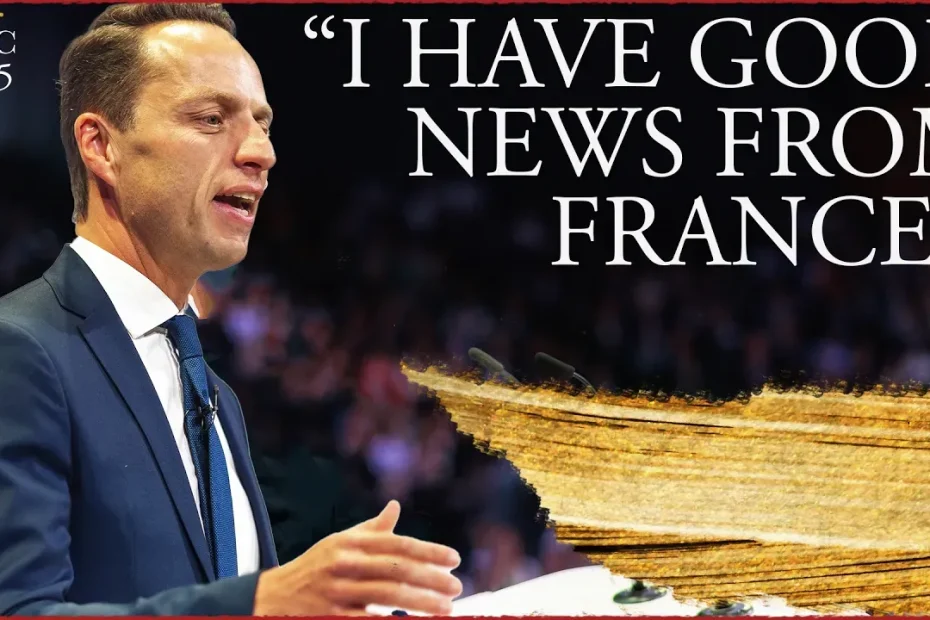
Read the full transcript of Entrepreneur Alexandre Pesey’s talk at The Alliance for Responsible Citizenship (ARC) 2025 on Feb 19, 2025.
Listen to the audio version here:
TRANSCRIPT:
ALEXANDRE PESEY: I have great news to share from France. A new wind is blowing, the wall of political correctness is cracking, and free speech is coming back. Don’t get me wrong, we have the same problem that in your countries, and on some we’re even better, we got the gold medal for taxation.
And during the last Olympic Games, you may have seen the creativity of our leadership. You know, our state coffers are near empty, but they were able to find some taxpayer money to get us in the Guinness Book of World Records. Yes, we won the ugliest world record for the worst opening ceremony in history.
So when I told you I had good news, I was not being ironic. The topics, the tone of the debate, the new faces are changing deep and fast in my beloved France. And why is that?
Reasons for Change
First, reality. Our leadership cannot hide it anymore.
Second, a few entrepreneurs joined forces recently to make a difference for our culture.
Third, a totally new media landscape has been designed in the last 10 years.
Fourth, a civil society is blowing, is emerging. New independent schools, new media, new think tanks, new single issue groups, new beautiful cultural projects.
Fifth, and that’s the most hopeful and happy news to share, we have a new leadership, a new generation of young leaders emerging.
And I’m very happy and proud to share with you that 50 of them are here with us today.
The Institut de formation politique (IFP)
So what did we do to participate in our modest way in the awakening happening in France?
You know, we didn’t invite or re-invite the will, we just listened to wise and successful entrepreneurs like Morton Blackwell, the founder of the Leadership Institute, who once told me, “Alex, you want a new leadership from France? Just train today Turmo’s leader.” Genius idea.
So I quit my PhD, left my position at the university, because I think that we don’t need more ideas in France, we needed action.
So with two great friends, and my day and night partner, my dear Kate, wife, we created the Institut de formation politique, the Institute for Political Training, IFP, whose goal is to identify, select, train, connect, and place in key positions any young leaders who want to serve our country, our civilization. We had 16 students in 2004, we have trained today 4,000. At that time, we created two total new model of school for France.
First, a new business model, no public money, only private money, using American technical fundraising, and you know what? It’s working.
Second, we organized weekend seminars for students, high schoolers, and also young professionals, so they can follow our program on the side of their job or study.
Third, we offer a program that does provide intellectual and technical training, because we all know having good ideas and not being able to defend them is useless, and being a professional in communication without being rooted in strong principles is dangerous.
Fourth, we incubate projects, carried by young civic entrepreneurs. We help them design their business plan, find their teammates, raise their funds.
We advise networking and coalition building. We know in a group, division can be very harmful, and France paid a high price for that in its history.
Historical Context
You know when the Roman, the English, the German came to our souls sometimes thinking they feel a little bit too much at home? They were benefiting the clear division of the inside France. There is another reason why they came to France for a few years. Not many historians will tell you that, but we all know why here.
These guys wanted to know what is the best way of life on earth. They wanted to approach paradise. And I’m not being arrogant, everybody knows it. Benjamin Franklin and others said, you know, every human being has two countries, is horn and France.
IFP’s Impact
So let’s get back on track. You understand that we gather all the force of freedom and mentor them. And last things, we place our young talents in politics, in the media, in civil society, in any key position that a good guy or a good girl with a good brain, with a good heart should be to serve. For what reasons?
So today, we have hundreds of them who are congressmen, staffers, journalists, media guests, think tankers, civic leaders, professors, priests. At least half of the young you see emerging today went through our program.
But let’s be clear about that. We never, ever make these young have talent. They had it. We just help as a catalyst. We give them ideas, techniques, connection, inspiration, and maybe very new at that time, a long-term perspective.
The idea that if they want to serve full-time, they can. And we organize to help them to do so. So when we started 20 years ago, we were a few dozen serving full-time the cause.
Now there are hundreds. And believe me, you can see the direct impact of such a difference in numbers. And I would like to give a special thanks to a man who is here, an economist called Charles Gavre. Not only him and his family are sponsoring ARC, but he’s the first one, one of the first ones who believe and support our project.
So thank you, Charles.
Journalism and Media
So what about journalism? Wasn’t I supposed to talk to you about how retrieving the fourth power? Yes, and we are precisely on the key question, human resources. I have several media owners or media directors who told me, you know, I have difficulty to find young journalists who want to think out of the box.
And the main reason is they come from schools who are all of them, 100% of them, hold by 68ers.