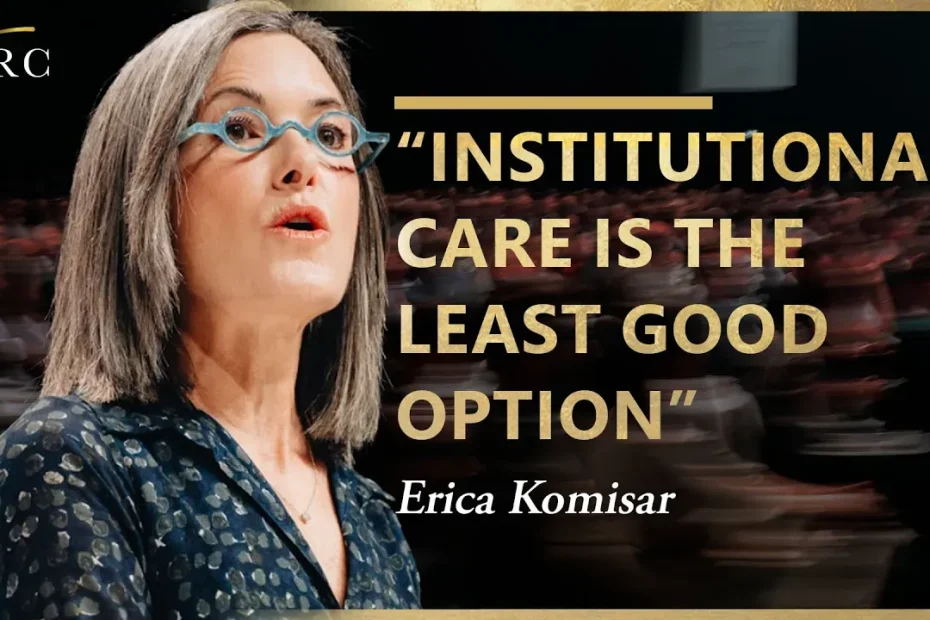
Read the full transcript of Psychoanalyst Erica Komisar ‘s talk titled “Children Need A Childhood!” at ARC Conference 2023 [Oct 31, 2023].
Listen to the audio version here:
TRANSCRIPT:
Introduction
ERICA KOMISAR Thank you, Miriam, and I just want to say how grateful I am to Kalippa and to all of ARC for having me come and speak today on raising healthy, happy, and resilient children. Raising resilient children is every parent’s goal, and yet there is a worldwide epidemic of mental illness in children and adolescents. It’s disturbing and should make us pause to understand both its origins and its solutions. We’re here today to focus on the solutions, to repair the social fabric, but there is no social fabric without healthy families. But first, we need to understand the underlying causes of this epidemic.
As a social worker, psychoanalyst, and author, I have spent the last 33 years working with parents and children. I saw this epidemic coming at me like a tidal wave. Feeling helpless to address it in a bigger way, I wrote books, hoping to get the attention of parents, educators, and policy makers. In these books, filled with research from neuroscience, epigenetics, attachment, and psychoanalytic theory, I am going to express to you the connections that I found today.
The Five Key Factors
Children have irreducible needs, which when left unmet, leave them more vulnerable to mental illness. In my professional view, this crisis is multivariable, not caused by one piece of a very big puzzle, as some may tell you.
In the 1990s, I was already seeing an uptick of younger and younger children being diagnosed and medicated. These children were entering adolescence more susceptible to mental illness. This crisis has been caused by a combination of factors, and there are many, which I discuss in my ARC paper, but I will reduce it to five of some of the most important factors today.
Children are born neurologically fragile, not resilient. Based on their vulnerability, they need attachment security as a foundation for future mental health. Zero to three is a critical period of brain development, where mothers serve a unique biological function, and yes, I did say mothers, they serve a unique biological function of regulating children’s emotions from moment to moment, buffering them from stress and providing them with a feeling of safety and security through their emotional and physical presence.
It is only after that three-year period that children can begin to internalize this feeling of security, which helps them to cope with adversity in the future. We have a rash, an epidemic of disorders of emotional regulation. That is what we are seeing. Sixty percent of mothers in the U.S. and 66 percent in the U.K. would stay home in those early days if they had the choice and resources. Remember, children need attachment security for mental health.
Children need their parents’ presence physically and emotionally as much as possible throughout childhood. Adolescence, which is nine to 25 years of age, is another critical period of brain development, where children are again vulnerable and still need their parents to help them to process experiences and feelings.
So more is more. The more we can be there physically and emotionally in these two critical periods of brain development, zero to three in adolescence, the greater the chance your children will become mentally healthy and resilient to stress. I can’t state enough how much children need their parents’ presence.
Children need mentally healthy parents who are self-aware, sensitive and empathic, and who can regulate their own emotions, are resilient to stress, and who do not see children as the problem. Parents need to look deeply at themselves, their own past losses and traumas, and take responsibility for their children’s mental health issues. The mental health of parents is critical to the mental health of children.
Children need stability and community, whether it comes from the ideal, and I said the ideal, of two loving married parents, or an alternative family structure, extended family, grandparents, aunts, uncles and cousins, are critical to children’s mental health. Faith-based communities also have a part to play in children’s mental health. According to a Harvard University study, children who grow up in families who attend faith-based services on a regular basis do better in terms of long-term mental health. Without community, children feel untethered.
Children need a childhood where technology use is regulated. Although my colleague Jonathan Haidt would tell you that social media is the piece, I will say right now, it is a piece of a very big puzzle, an important piece, but it is not the only piece.
Technology and particularly the smartphone and social media have a negative impact on children’s mental health. The smartphone, video games and social media all have the same impact on the developing brain. They stimulate the pleasure centers of the brain at a time and in such a way that can easily lead to addiction. They create more virtual connections than real ones, which isolates children from their peers and promotes a mindset of perfectionism and comparison, which is toxic. It is critical to regulate the use of technology if we want children to be healthy.
Solutions and Challenges
So what is needed to turn this epidemic around and create that bright future with resilient children?
There are solutions and there is a role for parents, health care providers, governments, educators, lawmakers, employers, non-profit organizations and media to play. This is my challenge to all the players here today, to step up and this is where you take out your pads and your pens, because this is going to get into the nitty-gritty and it’s going to get really practical in terms of solutions.
How Parents Can Step Up
In Hebrew we say, “Yisra’ah Havah,” which means the sacred obligation of love. Parents are the most important part of this equation. They play the most influential role in children’s lives and bear primary responsibility for their upbringing.
Parents need to seek help for themselves from therapists, parent guidance experts and faith-based leaders.
They need to educate themselves before they have children to assess their readiness to become parents. Parents need to make better choices and make the sacrifices, I’m going to repeat that word, the sacrifices, something we don’t like to do today, necessary to raise their own children when they can and when they need to use child care, reorient their child care options to prioritize their own time with children, secondarily to rely upon extended family support and lastly with alternative attachment figures such as loving nannies, which they can share with other families if money is an issue.
Institutional care is not and never will be a good option for children under the age of three. There are so many studies which link institutional care from zero to three with increased cortisol, stress hormone levels, behavioral issues, anxiety and increased aggression. There is no point in beating around the bush.
You have to get your own house in order before you bring children on the scene and there is no substitute for healthy parents spending time with their children. Mental health is generationally transmitted from parents to children.
How Communities Can Step Up
Community centers, faith-based communities can provide affordable and accessible mental health services and coaching for parents. These services could help parents to understand the underlying causes of behavioral symptoms in children rather than focusing on the symptoms, labeling and medicating away children’s distress, which is what we are doing today. It only causes more illness and more distress.
It is only through understanding the underlying causes of mental illness that sustainable change will happen.
How Educators Can Step Up
Schools can exercise their influence to become more responsive to the emotional needs of children, focusing on social-emotional right brain development rather than cognitive learning in the very early years. Play-based experiential learning from three to six years of age helps children to regulate their emotions and learn frustration tolerance so they can cope with the challenges of cognitive learning later on. Schools can also reduce the pressure on children academically. Our children are under the worst academic pressure that we have ever seen in history.
Redefine success as love of learning, robust self-esteem and leaning into children’s strengths rather than on grades and tests alone. Schools can create safe spaces for children who are facing adversities through peer and professional-led groups and by assigning them a trusted adult at school who they can confide in. Schools can advocate for later school start times to accommodate to something that most of you have probably never heard of, something called sleep-wake phase delay. Adolescents produce melatonin later in the evening than adults. That means when your teenager doesn’t want to go to sleep until one in the morning. There’s not something wrong with your teenager.
There’s something wrong with our society that makes kids get up at six in the morning to go to school. And studies show that when adolescents get sleep, they’re less mentally fragile, so we should start school for teenagers later. And lastly, schools can take responsibility for students on and off campus with a code of ethical behavior which demands a zero bullying tolerance and social media hygiene.
How Healthcare Providers Can Step Up
Healthcare providers are the first line of defense for families in crisis and with intergenerational trauma. Pediatricians have to stop focusing on the child as the problem and focus on the parents and family dynamics, as well as moving away from quick fix symptom relief as solutions to this mental health crisis.
Pediatricians need to be re-educated that psychiatry should be the last resort when a child is showing signs of anxiety, depression, ADHD, or behavioral problems, unless there is a severe crisis or they fear for the safety of that child. Making the correct referrals in a timely manner to parenting coaches, play therapists, and psychodynamic therapists is key to stemming the tide of this crisis. Educating parents about the importance of breastfeeding, being physically and emotionally present from zero to three, attachment security, and the dangers of institutional daycare is a priority for doctors, nurses, and home visitors.
How Media Can Step Up
Media has an important role to play in helping to turn around the narrative that work outside the home is more important than mothering. Mothering is the most important and valuable work.
Conventional media, newspapers, TV, and radio, as well as podcasters and influencers who reach a younger demographic, are critical to changing the societal narrative. Media has, for too many years, focused on the needs of parents and not on the needs of children. And too often the lens is focused on the economic perspective rather than the mental health perspective, highlighting women in the workforce rather than the importance of women at home. Media can emphasize that marriage is the best environment to raise children in. Two-parent families, when possible, provide emotional and financial security important to the stability of children. Programming and public service announcements can educate parents that institutional daycare is the least good childcare option if you have any other choice.
Lastly, media can educate parents that social media is toxic and regulation of it by parents is critical to the health of children.
How Employers Can Step Up
Employers have a role to play in allowing parents the space and time they need to be present for their children and to invest in their own mental health. Giving employees who are primary attachment figures paid parental leave of one year, adapting work schedules and norms to embrace part-time work for the next two years, providing options of flexible hours and hybrid working arrangements is critical, as is creating a corporate culture where employees take their paid leave rather than fear it will sideline their careers long term. Lastly, encouraging career pauses to parents raising children with the option of returning to work at a later time, as well as providing re-entry points for women who choose to take longer breaks after having children.
How Non-Profit Organizations Can Step Up
Non-profit organizations can partner with governments to create and implement preventative parenting education programs, as well as mental health services for parents and children who are at risk and in crisis. Early intervention, which brings programs into homes, schools, community centers and businesses, are the kind of social entrepreneurship we need in these times of crisis. Non-profit organizations can train women to work in fields which offer part-time opportunities, where they can work on their own terms. Mothers need flexibility and control. They need to be able to work cooperatively with other women who are raising young children.
Yes, I do believe government has a role to play. Governments need to support primary attachment figures financially when they do not have resources available from employers. Governments need to give all mothers the option to stay home for a full year and to support them with resources so they can work part-time for another two years until their children are out of the zero-to-three critical window of development, because the cost of neglecting families is far greater in the long run. Governments need to give flexible spending money to families to use in any way that is best for their family, rather than providing state-funded institutional care. These stipends could be used by mothers to stay at home, pay a family member or to pay a nanny.
Families should be supported through tax benefits and incentives to raise children in two-parent married families to prioritize family stability. Governments can hold employers accountable regarding their parental leave policies and setting minimum leave at a level which ensures children form that secure attachment to their primary attachment figure. Governments can protect children from exposure to substances and sexual content that jeopardizes their mental well-being. They can provide stricter regulations regarding the legalization of drugs and alcohol, as well as online and print content which glorifies drugs and alcohol for adolescents. Legal psychopharmacological drugs are over-prescribed and governments can play a role in limiting and regulating that abuse. Last but not least, governments can make mental health services affordable and accessible to all who don’t have the resources.
They can provide a tax credit system to incentivize parents to invest in private mental health care for their families through therapy, parent coaching and group support.
Conclusion
To conclude, it is only by looking directly at and acknowledging a problem that we have any chance of addressing it or changing the outcome. When we avoid the pain in the present, we cause much more pain to our children in the future and to society. We can reverse this narrative that our children are doomed to generations of mental illness and emotional fragility, but this will require that we all work together and take responsibility for each of our parts in creating a brighter future for our children. What we cannot do is to look away or wait for things to get better on their own because they will not. The goal of raising healthy, resilient children is bipartisan, apolitical and indivisible and one that is achievable and attainable.
If you feel like turning away because you’re overwhelmed by my paper and my talk today, don’t. Please don’t turn away. For the good of our children and the good of society, turn toward these solutions. If there is one thing you remember from my paper, it is a quote from Terry Reel:
“Every person is a bridge spanning two legacies. The one they inherit and the one they pass on. Family pathology rolls from generation to generation like a fire in the woods taking down everything in its path until one person in one generation has the courage to turn and face the flames. That person brings peace to their ancestors and spares all the children that follow.”