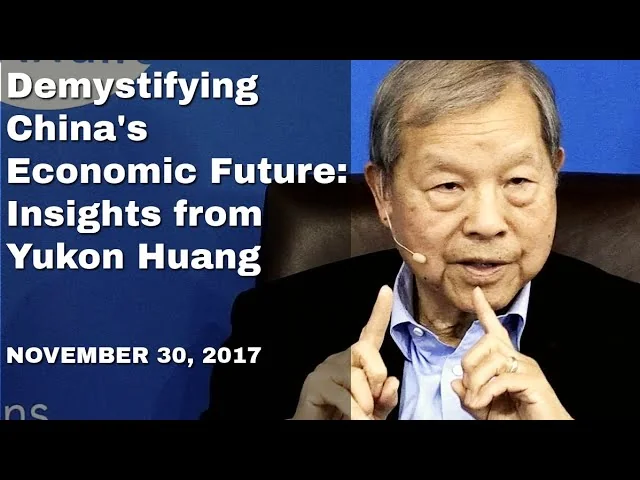
Read the full transcript of N. Bruce Pickering interviews Yukon Huang, former Country Director for China at the World Bank on “Demystifying China’s Economic Future.” This interview was recorded on November 30, 2017.
Listen to the audio version here:
TRANSCRIPT:
Introduction
N. BRUCE PICKERING: It’s my great pleasure to introduce tonight’s guest, Yukon Huang. Yukon is an expert on China’s economy and its impact in the East Asian region and the world. He was country director at the World Bank from 1997 to 2004 and currently serves as a senior fellow in the Asia program at the Carnegie Endowment for International Peace. His most recent book is “Cracking the China Conundrum: Why Conventional Economic Wisdom is Wrong.” Yukon, it’s great to have you here.
Think if your subtitle is why everybody else’s thinking is wrong, it means you have something to add to this conversation and tell us why it’s right. I’d like to ask you just to sort of hit the high points for a second. And I will say that having read the book, it’s clear to me that you, in fact, have a really interesting story to tell. So if you could give us a little bit of an insight as to what the primary purpose of writing the book was, that would be great.
Why Conventional Wisdom About China Is Wrong
YUKON HUANG: When I was living in Beijing, working for the World Bank for seven years, and then I continued to live there since I have an apartment, came back to Washington, semi-retired, joined Carnegie. Carnegie wanted me to write about China. And I said, well, I’m not sure. I never wrote for the public.
I started reading what people talked about, what they were writing about in Washington. And the first thing that struck me, Bruce, is what people in Washington worry about, I didn’t worry about at all in China. And what I worried about in China, people in Washington didn’t worry about. And that made me wonder, how come? Why is that? Location obviously matters.
But when I got into it and thought about it, and I’m an economist by training, I used to teach economics. I’ve traveled throughout China, every single province in China for many weeks. I said to myself, there’s a lot that people are right that’s actually just basically wrong. At first, I thought it was a Western problem, a problem in Washington, probably in New York or London. Frankly, when I got into it further and further, I realized I had a problem. I had gotten it wrong. I was working under a framework that was very Beijing-centric, very World Bank-centric.
So that’s the title of my book, “Conventional Economic Wisdom is Always Wrong.” And the question is, who is conventional? It could be the general public. It could be commons and financial people working in China. It could be Chinese specialists. It could be Western policymakers. It can be Chinese policymakers. So in my ten chapters, I cover topics where each of these audiences, the people who have a vision of China, are basically wrong.
Public Perceptions of China
I start off with public perceptions. There are two fundamental questions that I start off with. Pew and Gallup survey Americans every year for twenty years. The question is, who is the world’s leading economic power?
Fifteen years ago, seventy percent of Americans would say we are. Only ten percent would say China. Today, seventy percent of Americans say China is. Very few people think America is. Thirty percent think America is. Now if you ask the same question to the Chinese, who is the world’s leading economic power? They will overwhelmingly say America is. So who’s right? Who’s wrong?
And this is ironic. They usually try to boast about yourself, not about the others. And the Chinese are right. America’s leading economic power. But why do Americans not realize this?
Now if you go back fifteen years, same time period, the question is slightly different. Essentially, do you like or dislike China? Are you unfavorable or favorably disposed to China? It’s hard to imagine, but fifteen years ago, overwhelmingly, American views of China was positive. And today, it’s quite negative.
Even five or six, seven years ago, it was quite positive. But I’m sure everyone in the audience today, anyone who knows China fairly well, would actually find it kind of hard to imagine that views were so strongly positive. And my book is basically saying, why? Because much of these views are wrong.
And why are they wrong? Because there are economic factors shaping these views, which are totally misunderstood. So I begin with public perceptions, and then I go on to technical issues, debt, trade, foreign investment, corruption, political liberalization, foreign policies, and here’s what people think. Western views, American views, very important point, it’s always wrong. And if it’s wrong, the policy recommendations are wrong.
No wonder the US-China foreign policy dialogue is so messed up. You begin with the wrong perceptions, you’re going to have the wrong policy recommendations.
Regional Differences in Perception
N. BRUCE PICKERING: And, you know, it’s a regional thing too. I mean, I think, generally speaking, the coast, particularly the West Coast, understands, I think, a little more in-depth why China matters so much. We just did a major study on inbound investment from China and innovation.
And one of the things that was interesting in that discussion when we had roundtables in Washington, I mentioned privately, it was very negative. People were like, you’re giving way too much away to the Chinese. Out here, it was the opposite. In DC, they said we were too positive, and it was a much more negative situation.
On the West Coast, they said that we were actually too negative, that we should be more welcoming of Chinese investment and more positive. And I said, I must be doing something right because both sides were unhappy. But the truth of the matter is I think this coast has a much more healthy relationship with China and what China represents.
Foreign Investment Misconceptions
YUKON HUANG: Well, just take the point that you mentioned. You’re talking about Chinese investment into the United States. Let’s talk a little bit more about US investment going to China. What is conventional wisdom? If you’re in Washington where I live, conventional wisdom says that too much of America’s foreign investment is going to China. This leads to job loss. It leads to loss of competitiveness. It’s not good for the American economy.
So the question is, what percent of America’s foreign investment goes to China? How large is large? Now to give you a hint, Japan, Taiwan, South Korea, next door, they invest twenty to twenty-five percent of their foreign investment in China. That is large. So how much of America’s foreign investment goes to China on average over the last ten years? The answer is one percent. Practically nothing.
The conventional wisdom thinks it’s very large, but the reality is it’s almost negligible. Then the question is quite different. Why is there so little foreign investment going to China rather than too much?
Trade Deficit Misconceptions
Same thing is true about trade. US runs a five hundred billion dollar trade deficit with China. Three hundred billion of that bilateral deficit is attributed to China who accounts for sixty percent of this deficit because it has a huge surplus. So the average American would say, if I could just deal with China’s massive trade surpluses with us, we can solve the trade deficit here in the US and the economy will be much stronger. That’s conventional wisdom.
So in my chapter on trade, I basically explain why there is no relationship, no connection at all between America’s trade balances and China’s trade balances even though everybody thinks there is. Now how do I explain that to an average audience? Because economists do a terrible job on this. It’s so technical. It doesn’t make any sense. You have to learn all sorts of principles that you go to graduate schools for. So I make it very simple.
Go back to the year 2000. America didn’t have significant trade deficits back then. And then it got really large, like 2003 or 2004, 2005, really big, almost destabilizing. Look at what was happening in China. China wasn’t even running any significant surpluses for that period from 2000 to 2005.
America’s huge deficit became the largest they’ve ever been, but China hadn’t been generating any surpluses at all. So how could China be actually causing America’s trade problems when they didn’t have any surpluses?
If you take this iPhone that we all have, six hundred and fifty dollars produced in China, exported to America. How much of that iPhone, because Apple produces all its products in China, how much of that iPhone actually stays in China or is attributed to China? The answer is twenty-five dollars. Two hundred and fifty dollars, parts, components, cameras, the computer cells in there come from South Korea, Taiwan, Japan, and then two hundred, three hundred dollars comes from pure profit for Apple.
Now if you think about the foreign investment question I posed to you earlier, Apple produces everything in China that it sells here, the iPhones, the iPad, whatever, the watches. How much does Apple invest in China? You think it’d be huge. The answer is zero. Apple has no foreign investment in China. All those plants, equipments, factories are financed by a Taiwanese company that produces this.
So we have these kinds of conventional wisdom about trade and foreign investment, which is totally wrong. And because it’s totally wrong, we talk about the policies that the US should be having to deal with these economic issues. It’s totally wrong also.
Artificial Intelligence and Automation
N. BRUCE PICKERING: One area that I think is interesting to me is artificial intelligence. The recent party congress just laid out artificial intelligence as one of the areas they want to go in. That includes robotics and automation. I think one of the questions I’d ask you is, how does that factor in both the trade deficit and this idea of job loss in both America and China? One of the points you make is China is the world’s first country to get gray before it basically gets rich. It’s done both simultaneously. But wouldn’t automation be for the Chinese a necessary way of maintaining an older, graying population?
YUKON HUANG: For China, the labor force in sheer absolute numbers has been shrinking for three, four, five years. It has no choice in the future except to become more innovative and to become more automated. The number of people who are employed in manufacturing in China has been declining for five or six, seven years. The interesting thing is the numbers of people who are employed in manufacturing in the US has been increasing for five to six years.
But conventional wisdom would suggest the opposite, that we’re losing industrial jobs to China. Actually, the reverse is happening. And reverse is happening for a very peculiar kind of a reason. China has now gotten to the income level where services are starting to take off. The manufacturing sector is starting to shrink.
The services sector is growing very rapidly. So for the foreseeable future, manufacturing is going to decline. And what they have in manufacturing is going to have to be heavily automated because they basically don’t have the labor force for it anymore.
Unbalanced Growth Strategy
N. BRUCE PICKERING: Would you go in a bit to explain? One of the things you talk about in the book is the unbalanced growth that was essentially pioneered by Deng Xiaoping. And can you talk a little bit about why that’s actually not such a bad thing in your opinion for China and for the global economy?
YUKON HUANG: Perhaps I should explain the term first. You know, Deng Xiaoping is seen as the person who triggered the economic opening up in China. In my book, I call him the unbalanced reformer. It’s a very strange term. What do I mean by unbalanced?
Deng Xiaoping around 1980, basically said, we’ve had decades of communist socialist development. We’re very evenly developed. We spread our industries, our people everywhere. We spread our poverty everywhere. We’re very poor, where we have equality.
So he deliberately unbalanced the country in a sense of saying, I’m going to concentrate all my incentives, my resources along the coast. I’m going to open up China to the external market. I’m going to promote trade. So he channeled practically seventy percent of the government budget to three or four provinces, essentially ignoring the other twenty-five. This is very unbalanced. This created a highly competitive specialized economy geared to the external market. So this is geographically imbalanced.
It also led to what I would call economic imbalances. Investment shares of the economy soared. The consumption share of the economy fell. China grew extraordinarily rapidly. Now this was very good for China because the so-called unbalanced growth—geographically unbalanced, economically unbalanced—has led to wage increases of twelve percent a year compounded for twenty years.
We in the United States are quite happy if our wages go up by two percent to three percent for a couple years. But think about it being compounded for twenty years. So it didn’t penalize the average Chinese. Their incomes and their welfare has soared. It also made China incredibly productive.
So what I say in my book is in the West or other economists, they tend to view an imbalance as somehow bad. And I basically write it’s actually the key to China’s success.
Mega-Cities in China
N. BRUCE PICKERING: One of the things you point out or talk about is the fact that the mega cities in China such as Beijing and Shanghai, both have a population, each has a population of well over twenty million, particularly Shanghai. You basically say that, in fact, not only are these cities not large enough, they need to grow a bit more. It’s an interesting perspective and one that I actually think would be worth exploring. Can you give us a little bit of an insight into that?
YUKON HUANG: Well, I don’t know how many of you have been to China. If you have, you probably went to Beijing. You probably went to Guangdong. You probably went to Shanghai. So these are, or Shenzhen if you’re a business person. These are cities with populations of twenty million or more. And you go back fifteen years, there are ten or twelve. And then the image is too many people. Traffic is terrible.
China’s Urban Development Paradox
YUKON HUANG: Pollution is horrendous. Government planners view is our megacities are too big. We’ll control the migration of people into the big cities. We want them to move to the smaller cities in China. So in my book, I say that’s conventional wisdom.
This is the view of the Chinese leadership. This is actually the view of many people who travel and visit China, that China’s big cities are too big. And by now, you know the theme in my book, conventional wisdom is always wrong. China’s big cities are actually too small. If they had more people, if these cities were thirty, thirty-five million, and they were located in the right way or developed in the right way, there’d be less pollution, less traffic problem, less congestion.
So what do I mean? China has a very unique policy. It’s a very strict residency policy. You cannot move easily. And if you go to the big cities and you do it without a formal blessing, you don’t have formal residency rights.
Forty percent of the people in China’s major cities along the coast are illegal migrants in a sense that they don’t have residency rights. That means they can’t buy homes. They can’t drive a car. Children cannot go to local schools. They don’t have social services.
Okay? So you’re heavily discouraged if you go to these big cities, but you are encouraged to go to small. So Beijing and Shanghai, if you go to Beijing and Shanghai, very few people realize that the core center of Beijing and Shanghai today, after all this growth and the size of the cities, there are twenty percent fewer people. They’ve been moved to the suburbs, moved out. So Beijing, when I went there in the late nineties, they had the third ring road, a Beltway.
Now the fourth, the fifth, the sixth, the seventh. They’re on the eighth now, aren’t they? They’re all moved out. When you move further out and you gotta get to your job, what do you do? You drive in. Okay?
It’s costly. It’s pollution, congestion. It’s horrendous thing. The core center of Beijing actually has fewer people, twenty percent fewer people today than it did have ten years ago. My basic point in my book is China’s big cities are actually too small.
They need more people, but they need to be able to live in the center because globally, that’s what big cities do, like a New York or whatever or London or Tokyo. And in fact, a key characteristic of China’s big cities is that they’re less dense than big cities elsewhere globally. And China’s small cities are actually more dense than small cities elsewhere. It’s the complete opposite of what a normal kind of urban development would give you.
Corruption and Economic Growth
N. BRUCE PICKERING: So I’d like to hit a bit here maybe on the intersection between politics, policy, and economics. It’s actually, I think, one of the great strengths of your book. One thing I’m curious about is the role of corruption, which is I think if you talk to your average American, they would probably tell you that China is a very corrupt society. We all know that China’s in the middle of a major Xi Jinping’s anti-corruption drive has been a major feature of China’s domestic policy for at least the last three years. I’d like you to chat about that because you again take a contrarian view on that one too. So what is conventional wisdom about corruption?
YUKON HUANG: We teach everybody that the more corrupt you are as a country, the slower you grow. And this is particularly relevant for developing countries. So you look at Egypt or Indonesia or India or the Middle East or whatever. You see very corrupt situations in Latin America. And you see that it seems to be causing the country to grow slower.
It inhibits investment. If you don’t invest, you don’t grow. That’s the first conventional wisdom. The second conventional wisdom we all have is that the richer you are as a country, the less corrupt you’re likely to be. So Europe, United States, rich countries are less corrupt than developing countries.
That’s conventional wisdom. So what do I say? Wrong for China. I’m shocked. Okay?
Why is it corruption in China has directly made or allowed China to grow more rapidly than normal? Why is it that the richer it gets, the more corrupt it gets? It directly contravenes these two principles. Nevertheless, the general conventional wisdom as it applies to other countries is correct. So what is it about China that makes it different from an India or Indonesia or Egypt?
Okay, or Argentina or Ukraine? And the answer in my book is this is a mixed economy. The state controls the ownership of all key resources, but the private sector is able to generate higher returns if it could use these resources. So when Deng Xiaoping faced this problem, the problem that the state controlled everything, and this is a social state, and you can’t privatize it. That would go against the ideology.
But he realized that to get better returns, needed to get it into the hands of private entrepreneurs. But politically, you couldn’t privatize these assets. So corruption is the means by which these resources, the use of these resources are transferred from the state ownership to be used by the private sector. And then the question is, what about the government officials and the party? Are they supportive of this?
And the answer is yes. Because when they transfer it over for use, they share in the benefits. And the faster the country grows, the more you have to share. Now that’s different from other countries. If you’re in India, these resources are already in the private sector.
The private sector wants to do something. What it needs is the permission of a government official or somebody. Okay? And so what is the incentive for the government official? The incentive for the government official is, gee, how do I make some money out of this?
Well, I need a bribe, but I hold something back. And more I hold it back, the more he’ll pay me. So, basically, I will get a bribe by stopping something. That’s corruption impedes growth. In China, the official is motivated to share in the transfer and to encourage greater production, and you’re better off.
This is truly unique to China. But this is also a problem because Xi Jinping, as you said, wants to curb corruption. Why does he want to curb corruption? Because corruption carried to such extreme becomes unsustainable, morally an unacceptable. Inequality is created.
So he’s clamping down on this. But there’s a problem. If it’s been a primary force for driving faster growth and you curb this, what do you substitute that with? And this goes back to your point. The implications for political liberalization, the rule of law, the nature of institutions in China, which have not yet been grappled with.
So this is in my book highlighted as a major big issue that needs to be dealt with in the coming years.
Political Liberalization and Economic Growth
N. BRUCE PICKERING: Well, speaking of political liberalization, it does seem to me that this is one of those topics. I mean, we’ve associated growth, especially kind of rapid growth in sophisticated technological society with democracy, openness, and liberalism. In fact, there are arguments that been made by a number of thinkers that you really can’t have true innovation in an authoritarian regime because it goes in too many unpredictable ways. So I’m wondering if you see China’s growth in the long term as being constrained by the fact that the system is not showing any effect of anything. It’s showing terms or showing signs of becoming more authoritarian. So do you see this as a long term impediment to China’s growth? Or do you think it’s going to overcome it?
YUKON HUANG: China’s going through an evolutionary process. Think about this. Here’s a country that’s been growing at almost ten percent a year for three decades. What does conventional wisdom say in our textbooks about growth and development? It says you need the rule of law. You need strong institutions. You need inclusive institutions to grow rapidly.
Valid data across many country experiences. So how come a country with, frankly, limited development of rule of law, relatively weak, or what I call institutions which are not quite right. Limited accountability in some ways grow at ten percent a year for three decades. Okay. So what is it that makes China different from an India, Indonesia, Bangladesh, Colombia, or African, or Nigeria?
Two things. Extraordinarily competitive economy because it competes externally, very always open in terms of trade. Secondly, extraordinarily competitive internally because the provinces compete against each other. You have twenty-five, thirty provinces. They both operate. They invest. They do businesses. And you have state enterprises and you have private firms. They all compete. In India, the states do not compete with each other.
Now how does a province compete? A province competes because it supports economic activity, but it competes because the head of the province, the party secretary of a province, or the governor of the province doesn’t come from the province. He’s appointed from Beijing with the mandate that he needs to basically develop, improve, and do something to get the conditions better. He’s competing with leaders elsewhere. And if he succeeds, he gets promoted.
So somebody like Xi Jinping has worked in four or five major leadership positions in different parts of China. And if he does well, he gets promoted. This creates a competition that you do not see. That’s very different. Now your question about whether this can continue is a very interesting and difficult question.
Social Tensions and Stability
There’s a lot of what I call issues of social tensions. China measures or records the numbers of social incidents. A social incident is when more than two or three people get together in protest. It could be trivial. It could be a family argument if you have a big enough family. It could be an argument of a firm, whatever it is. Ten years ago, that number would be something like thirty, forty thousand protests a year. That’s a lot, but you have a big country. Okay? And it got close to a hundred thousand, and they stopped publishing this number.
Okay? It’s very large. Social protests and the cost of dealing with social protests in China is expensive. So the cost of the internal security, maintenance of the internal security grows rapidly. It’s an economic issue.
It’s an economic issue because that cost is greater than the cost of supporting China’s military. So here we are in the West. We worry about these battleships, these planes, these other things. What we don’t realize is the money that’s pouring into that, which is monitored by the Washington Authority, the defense department. Internal security costs in China now exceed the army and military costs.
So this is a big issue. So many protests going on. Now here’s the interesting question. What does conventional wisdom say about protests? When we talk about protests, Arab Spring, Thailand, Indonesia, we ask the question, is this going to be destabilizing? Is this going to bring down the regime? So you see lots of articles which talk about potentially destabilizing situation in China. And the great irony is this kind of view is wrong. Protests in China, in a historical view, has helped strengthen the top leadership. Protests in other country tends to weaken the top leadership.
How can that be? Okay? And the answer is because China’s a huge country, which is regionally decentralized. So protests tend to be against local officials who are accused of being unfair, not behaving properly or corrupt or whatever it is. So you’re protesting against local officials.
And in desperation at the very end, you actually appeal to the leadership in Beijing to help. This actually strengthens. They tend to be seen as the savior of the country rather than the force which might be driving the consequence. So this is what I could call why the regime has been very, very strong actually, very successful in keeping the system going. A protest is actually the substitute for, in some ways, the rule of law or demonstrations because it gives a signal to the government of what is the problem, and then they can deal with it.
So this is very unusual. The question, however, is can this continue?
N. BRUCE PICKERING: Right. And it’s also, I think, the question of what kind of a drag it produces for China’s economy over time.
YUKON HUANG: And as I said to you, the economic cost of this is significant. The frictional cost now as the economy becomes more complicated. It’s because more services oriented, less industrial oriented. It is an issue.
In my book, I basically talk about what are the likely forces that would drive what I would call political liberalization over the longer term. And I spent a lot of time reading about political scientists writing about democracy, human rights, and case examples of what might be the path for China. And, again, my book says that’s conventional wisdom. It’s totally wrong. What would be the right comparators for China?
State-Owned Enterprises vs. Private Sector
N. BRUCE PICKERING: So one question, I think I’ve danced around a little bit. I should just address it directly. It’s this whole issue of social stability, which I think is acknowledged to be every country in the world has issues of social stability. We have it certainly in the United States. But we have different mechanisms, elections and things that release that tension.
In China, I think social stability is of greater concern to a one party state. So a couple of questions. One is, what’s the role of state owned enterprises in that? Because an enormous amount of China’s economic power is tied up in SOEs, state owned enterprises. And yet much of the innovation, I think, comes from the private sector. You don’t expect a lot of innovation out of SOEs. So I’m wondering if you can address that, that’s something of that conundrum. Because I do think in the long run, if China is going to be an innovative country, it’s going to have to focus more on the private sector now.
YUKON HUANG: My book basically highlights this is a country which is increasingly dominated by services less by industry, increasingly dominated by private companies rather than state companies. There will be state companies in the strategic areas.
China’s Technological Advancement
N. BRUCE PICKERING: Areas like the use of the Internet, banking, China is advancing much faster than we would have ever expected. When I went to China and if you go to China, you probably will say, I need to open my bank account. I need to make sure my credit cards are fine. And I suddenly realized people don’t use checks.
People don’t use credit cards. It’s actually quite difficult to travel there because everyone pays all their bills with their phone. They’ve skipped a generation. We are way behind in some ways.
And this is happening in their Alibaba as compared to the Amazons. They’re doing all sorts of things. So in my book, I actually highlight this kind of question. Will this drive what I call, the need or forces for what I call more systemic political liberalization?
My answer to that is it probably will in some form. But how long will it take? I compare China with other authoritarian regimes which are economically very successful because that’s my comparator. And the answer is there are very few of them, authoritarian and economically successful. But South Korea and Taiwan are two examples.
And I find it kind of interesting that Taiwan and South Korea became politically liberal in the same year at the same income level, at the same level of urbanization, at the same levels of services, highest value services. Why is that? In my book, I speculated about the information flow, the need to disseminate and link up. And this is where I think is a pressure on the system, and it’s going to be increasingly felt over, I would say, the next ten years.
China’s Debt Problem
N. BRUCE PICKERING: So I’ll take some questions from the audience here. When will and how will China address its debt problem? How successful will it be? And what are the implications for the global economy?
YUKON HUANG: Conventional wisdom says that China has a financial problem, a debt problem. Ninety-nine percent of the financial papers will say that. So I have a chapter, thirty pages I have on there. And my point is debt is not a problem in China. It’s actually a good thing, not a bad thing.
So how do I turn a concern that everyone has into a good thing? Well, first of all, let me just point out. What is China’s debt ratio? That is household, government, corporate debt as a share of GDP. The number is two hundred and sixty percent, and it’s very high because it used to be a hundred and fifty.
So it’s gone up a hundred percentage points. It’s two hundred and sixty percent of GDP. Is this good or bad? It’s exactly the same as America’s. It’s the same as England’s.
If you rank the top eighty countries, it’s right in the middle. It’s lower than most developed. It’s higher than most developing. And then the question then is, what is China? A developing or developed country?
And the answer is neither, really. It’s something in between. It’s exactly, therefore, what I would predict it to be. So its level is not the issue. What is the issue is it increased so rapidly.
So why did it increase so rapidly? Because the analysts say every country where it increased this rapidly over a ten year period, every one of them has collapsed. Why not China? And I basically argue there’s something very different about China that is not true in any of these other countries, but no one realizes it. And it is the role of land prices.
Now here in San Francisco, you’re very familiar with land prices and property. So your property prices double over ten years. You start worrying about whether it’s too high. You worry about a bubble. Right?
So what happened to property prices in China over the last ten years? They went up six hundred percent. Six time increase. Now when the property prices go up sixfold, it affects not only houses, new shopping malls, even roads because it’s a land value.
Debt surges. Right? And the issue then is, is this sustainable? Is a crash coming? And the conventional wisdom would say if some property prices go up six hundred percent, you surely have a crash.
And the answer in my book is, you don’t have one. Why is it? Because there was no private property ten or fifteen years ago. So this surge is going from practically nothing to something which is what you’d expect for Asia. So the question now is, if you go to Beijing, property prices are high.
But are they too high? So what is the right comparator? So I use India. Let’s compare property prices in India, New Delhi with Beijing, Bombay with Shanghai. Now India per capita incomes are one third China’s.
Its growth rate over the last fifteen years is about half. Conventional wisdom would say that India’s property prices today would be somewhat lower than China’s. In fact, they’re twice as high. But no one writes about India having a property bubble, but everyone writes about China. So my book points out that this is a country where the debt surge is largely because of the surge in property.
And it’s a catch up because it didn’t have private property. It’s really just bringing it up to what is normal, but no one actually realizes that because it’s the only country that has this phenomenon. Every other country has had private property forever. So this is a very unusual situation.
Income Inequality and Social Stability
N. BRUCE PICKERING: Are you worried about social stability, especially from an income disparity point of view?
YUKON HUANG: Well, China’s Gini coefficient – Gini coefficient is a measure of inequality. Right? So a coefficient of one means that one person owns everything. A Gini coefficient of zero means that everybody’s income is exactly equal. So a good number is something like point four.
And when it gets to point five or point six, it gets very high. So China’s indicator of inequality, when it started off under Deng, it was like point two five, very low. Social economy, very equal. It soared to point four five, close to point five, became very unequal, very much like Latin America numbers, very unequal. But it is exactly the same as America’s, by the way.
It’s the same as Singapore’s. It’s the same as Malaysia. That’s not unusual. What is unusual in China is the distribution of wealth is very unequal, the ownership of assets and the people who have property. But even that is a bit strange because the people who are billionaires are those who have somehow got into property.
Somewhat, that’s true in the United States, but not so much. United States, I think, is the Internet. It’s the e-commerce. That’s where the real wealth is. In China, it’s the property.
But the interesting thing in China about property and that kind of wealth, unlike America, is that maybe ninety-five percent of the Chinese own their homes. And that’s because in the late nineties, the state gave the rights to their homes to everybody. Whether you’re in a rural or urban area, you could buy your property from the state for a fairly nominal amount. So you have a very interesting situation in China.
A very large number of what I call average people have built up equity that Americans don’t have, unless you were lucky in the US to have owned a home. They do. So there’s a wealth buildup that is pretty broad, but there’s also a concentration of wealth buildup from those who happen to have a much greater access to property.
One Belt, One Road Initiative
N. BRUCE PICKERING: I have a question here that says, can you explain the One Belt, One Road initiative and its effects on the American economy?
YUKON HUANG: One Belt, One Road is this proposal to essentially take the Silk Road, land roads connecting Asia with Europe, the maritime roads that go through Southeast Asia, the Malacca Straits, the Middle East, the canal to Europe.
So there’s a maritime route. There is a land route. China under Xi Jinping has made this, I would say, their major foreign policy economic venture, the biggest one. I think Xi Jinping thinks that this will be the defining foreign policy initiative for the coming three or four, five decades, and it’ll reshape relations. Think of China.
People call China the middle kingdom. And what Xi Jinping basically said is, for a middle kingdom, all we’ve been dealing with is the Pacific, Japan, Taiwan, South Korea, US, Canada. And when they look that way these days, they just see a lot of problems.
So he says, let’s look the other direction. Central Asia, Southeast Asia, the Middle East, cross Russia to Europe. And they said, I think I see friendlier faces. So the One Belt One Road is a program that supports the building of infrastructure, power plants, connectivity, logistics, connecting sixty-five countries, potentially costing maybe one or two trillion dollars.
And China says, this is good for everybody because if we can link up, it’ll improve investment, trade. It’ll be good for everybody. And it’s infrastructure. And why is infrastructure so important? Because China basically says that’s how we made it.
People don’t actually realize it, but it was building of infrastructure that made China such a great economic or trading nation. And if we can just increase these links. So the issue for the US is the following. Is this bad or good? Now the good aspect is global growth stability, if it happens, it’s good for everybody.
Eighteen billion dollars has been allocated to Pakistan from China for this program. And several corridors, China’s view is the following. If I could actually stabilize Pakistan, basically bring development and deal with this issue of rising terrorism and disaffected communities, everybody benefits. I can’t deal with this in terms of a military security approach. But if I could channel and create trade channels, maybe that will be my contribution to the problems in the Middle East.
So I personally think that as long as these projects make sense, as long as countries know what they want and they’re doing it properly, the One Belt One Road is, in theory, good for everybody. Now how can the US benefit directly? Well, the money in the flow is up to anyone who wants to participate and join. So American designers, transport logistics, engineers, people who are dealing with any of these kinds of trade issues, the financing issues, those opportunities are open to everyone.
China’s View of Western Democracy
N. BRUCE PICKERING: Chinese media, the Communist Party, has been using the Trump administration in the 2016 US elections as an example of a failure of the West and in particular the US, especially US democracy. It’s also used to praise and portray China’s political system and economic policy vis-a-vis other countries in a more positive light. Can you comment on the effectiveness of this?
YUKON HUANG: I think that certainly with the elections here in the US as well as what I would call political maneuverings in Europe, whether it’s Brexit or the challenges in Germany or other areas, are basically raising questions about stability and the direction of democracies globally. I think it’s an issue that everyone has to wrestle with. And they are obviously saying that the weaknesses and strengths of the Western systems are now being exposed.
And what we have in China in comparison looks a little bit better for the Chinese themselves. Let’s go back a little bit further. Go back to the global financial crisis. For two decades or three decades, China was saying our model for economic development and growth and financial development was the West, but they turned out to be also vulnerable to instability. Now having said that, if you poll the Chinese, the average people, you see in their results tremendous admiration for what I would call the US, its values, its systems, its institutions, the things that we all take for granted here in many ways.
That’s why you see so many Chinese trying to send their children to school here. So whether you’re here in the US or whether you’re in Europe, the thing that I find striking is how many Chinese are going overseas for schooling, not just for graduate school, but for elementary school and high school. So you have a president who sent his daughter as an undergraduate at Harvard. That is a very unusual fact.
So this what I would describe it is both a love-hate relationship in terms of the views of what America stands for is a big issue of discussion. I think this is an issue that both sides have to think about for the future.
US-China Trade Relations
N. BRUCE PICKERING: Well, that leads into my next question, which is what will happen to the US-China trade relationship because of the US leaving the TPP? We actually never joined it, but withdrawing from the TPP. And we have now a Chinese analogue to it, or some people think of it as a Chinese analogue to it. So where do you think the US relationship with China at least in the trading world is going to go during and after Trump’s administration?
YUKON HUANG: Well, as an economist, I basically say to myself that we economists have done a terrible job in trying to explain the benefits of trade. We’ve always tried to say that free trade or open trade or globalization is going to be good for everybody. And the answer is it won’t be good for everybody. There will be winners and losers.
In theory, there are more winners than there are losers, but there are definitely losers. We do not have a good way of compensating losers in a democracy. We can’t just say, you are losing your job, and please move here and get something else. It isn’t that easy. So we don’t have a good system for dealing with this.
So we fail miserably in accounting for that. We don’t know how to deal with productivity increases, which leads to job losses. So much of the trade tensions in America is because of productivity increases. Some estimates of maybe seventy percent of the job losses have been productivity increases.
Trade Tensions and Global Economics
YUKON HUANG: But, nevertheless, it is true that trade creates jobs here, destroys jobs there, and they’re not the same people. So we don’t know how to deal with this issue. I think the trade tensions between China and United States are certainly going to get worse in the coming year. When President Trump came back from his visit in China, most people had a big sigh of relief because their visit went reasonably well in terms of the press forecast and no tensions. But now most people who are close to the ground realized that there’s going to be what I call a lot of provocative actions probably coming in terms of the administration certifying China’s behavior as not being fair and equitable.
Potentially levying of punitive tariffs just declared China as a nonmarket economy a couple days ago. Why is that significant? It allows more flexibility for US policymakers to slap punitive tariffs on China. So a system of retaliation is going to occur. So in my book, I basically say, of course, this is really bad for everybody.
I emphasize that America’s trade problems and trade deficits have nothing to do with China. If you think about it, America’s had a trade deficit every year for forty straight years. And you go back far enough, China wasn’t even significant. But America’s had deficits for forty straight years. So how do you explain that America can have a deficit forty straight years?
Because you in the audience, you run a household, you would realize, of course, you can’t be totally borrowing or spending more than you earn for forty straight years. Somebody would stop lending to you. Your bank would not let all this happen. The answer is very simple. It’s because America’s dollar is the global currency.
And this is something that nontechnical people do not understand. If the dollar is the global currency and people want to hold it globally, America must run a trade deficit because that’s the only way that you can get the US dollar out there globally. You run a deficit, you pay your bills in dollars, the world uses these dollars for trade or for whatever purposes. So as long as the dollar is the global currency, America will always have a deficit. It has nothing to do with China or Japan or Mexico or Canada.
Nevertheless, policymakers and the general public constantly think that it is being caused by somebody. And then we have this issue about foreign investment. We think there’s something wrong that we invest too much in China. We actually don’t invest enough. So the solution to this is, what about the TPP?
The TPP and Trade Agreements
And, clearly, America should have been in the TPP, should have stayed with the TPP. It’s good for America. But here’s the great irony. It was being sold as something to sort of like contain China because China wasn’t part of the TPP. And think about what the purpose of the TPP is, is to set high level standards in trade, environmental labor practices.
If you really want to influence China, you want China to be part of the TPP. You want them to be bound by these rules. You want to change their behavior. You want to up the ante. So my book basically says, not only should America be in the TPP, leading the TPP, but America should ask China to be in the TPP because America’s goal is to set the standards for the world.
Now China’s leading another trade discussion called the RCEP, which does not have the US in it. My message for China is she should ask the US to be part of this. I think they did, didn’t they? And America’s not quite ready for this.
So trade issue is kind of funny. You only succeed if you can get everybody to be part of it. Yet we constantly talk about excluding people or making it bylaw. It doesn’t make any sense. And I think there’s also a lot of legitimate concerns about American companies not being received in an impartial and open fashion in China. There are many areas where American companies cannot invest. And, certainly, my book basically says China needs to realize that by opening up those sectors to more foreign companies, both sides will benefit. It will generate jobs for Americans or generate jobs for Chinese.
N. BRUCE PICKERING: What’s the incentive for them to do that?
YUKON HUANG: China has actually realized that. They’ve already started saying, I’m going to open up. They’ve already opened up certain financial sectors. They’re going to open up more sectors. So they made the decision, but things are very slow in China.
N. BRUCE PICKERING: Well, I think they may be moving kind of slowly here in the United States too. One of the things you were mentioning earlier about this, I think one of the interesting issues for me in the Trump administration is who’s running the policy on commerce, on trade. Is it Wilbur Ross? Is it Peter Navarro and Lighthizer? There are some serious issues now. And, I guess it’s not really in the realm of your book, but it’s worth noting. I mean, would you say, a, the Trump administration’s approach to China so far has been effective? And b, who’s going to win this tussle in Washington to decide kind of how we do interact with the Chinese and with the rest of the world?
Political Views on Trade
YUKON HUANG: Well, the first thing I would point out is that what I call anti-China sentiments in terms of trade and foreign investment is not exclusively a Republican view. The Democrats have always shared this. After you go back historically, the Democrats were more protectionist than Republicans. And now to me as any comments I’m just made by the fact that both Democrats and Republicans, they all share this kind of protectionist kind of sentiment. And, what we were relying upon actually was the leadership, whether they are at the presidential level or at the advisory or economist levels, that they would understand a little bit more of what’s going on and get above this kind of view that trade or investment is bad for jobs and that kind of problem.
So I think that collectively, both sides have a problem in terms of trying to recognize this. But the irony in China, of course, is that Xi Jinping now sees the virtue of pushing or supporting globalization of free trade because China has benefited enormously from this process, and America now is seen as being protectionist. And the great irony, of course, is, you know, twenty years ago was exactly the opposite. The US, Europe were arguing for free trade. Developing countries were saying it’s not fair. We lose jobs, etcetera, etcetera. Now it’s exactly the opposite. It’s a tremendous turnaround in events.
N. BRUCE PICKERING: I think we’re in for a very difficult period. The Western economic political systems have not been able to deal with the issue of how do I deal with the people who lose out with globalization in an effective manner? Either in our tax systems or our social infrastructure, we don’t have the means of doing so. How do we deal with productivity changes? How do we deal with the fact that wage increases in the US have not been more than one percent a year for ten years now in some ways? It just doesn’t happen anymore. We haven’t been able to deal with this in a constructive fashion. You could argue that I think it’s interesting. I mean, if you look at American policy now, which is to reduce taxes, to theoretically put more financial decisions in the hands of the individual. And then you take a country like China or even Canada or France, which has a much more socialized medical system, a pension system, you could probably argue that, in fact, in some ways, Chinese may be better prepared for this than the United States. That’s a leading question. I recognize that.
Long-Term Planning
YUKON HUANG: I think they are better prepared for it a particular way that’s not so obvious sometimes. When Xi Jinping talks about his strategies programs for example, he came out with this industrial program and this, at the party congress, he launched the vision of China. That vision is thirty-five years, broken into two fifteen-year periods. So his vision of what he wants China to be is defined by vision of what he thinks China should be in the year 2049 with streams of policies and things that should be implemented.
If you contrast that issue, being able to think long term with the problem we have in America, where we’re essentially motivated by a congressional election or a two-year election or a presidential cycle, and everything is geared toward winning that and what you have to do about it, it really makes it difficult to think about long term issues in a more neutral and balanced way. We’re just heavily catering to what I call conventional wisdom. And as my book says, if conventional wisdom is actually wrong, then the strategies and recommendations that we actually pursue in a long term sense tend to be wrong. And but I also will say that my book, I point out the same thing as a problem for China, but in different ways.
Environmental Concerns
N. BRUCE PICKERING: So turning to environmental concerns, pollution makes it hard to breathe in China, I’ll say. Major cities, it affects health and longevity of the population. Is this a problem? Can it be solved and when? I think there’s a bigger picture here too, which is that, of course, it too feeds into social stability. But an important point to make is that it’s way worse in India than it is in China now in the major cities. But I guess the question is twofold. One, are the Chinese going to address the issue? And two, if they are going to address it, what are the motivations for that?
YUKON HUANG: I think this is a very good question. When I went to China in 1997 first time landing in Beijing, I saw the sun maybe twice a month. And maybe once a week, planes couldn’t land in Beijing. So pollution is a problem in Beijing today. But relatively speaking, it’s actually a lot better than it was fifteen, twenty years ago. So it’s actually improved.
Why is it that Xi Jinping is willing to sign on to the climate change initiatives? Why is he willing to basically say we are trying to deal seriously with environmental concerns that will set targets? Why is he experimenting with carbon taxes and other kinds of issues that we won’t even talk about in this country? Why is there such a big difference between the leadership views in China today compared to ten years ago and compared with America? Because when I first went to China ten or fifteen years ago, I don’t think the leadership wanted to talk about climate change, didn’t want to talk about pollution. They didn’t want the particulate readings to be publicized because the citizens become unhappy. So what has fundamentally changed?
One, the middle class is now more prosperous. They’re breathing this air. They’re worried about pollution. It’s a serious issue. So politically today, they worry more about the environment than they worry about jobs because the number of people in the labor force is actually shrinking. So it’s not jobs that’s an issue. It’s the quality of life.
Now the second thing here is it’s kind of interesting. What is the leadership? How’s the leadership deal with this issue of environmental concerns and climate change in a different way than we have here in America? And the difference is in China, they see dealing with climate change and environmental issues as a growth strategy, that you can make money from this, that you can develop new technologies, produce better equipment, you can sell it to yourselves, you can sell it to others. It’s a growth driver. Here in America, for whatever reasons, we see environment and climate change as inhibiting growth, as a cost burden. Obviously, we spread it among policymakers and the public in a way that makes it sound like this will cost us jobs, whereas in China, they think it will gain jobs.
N. BRUCE PICKERING: Is a really, really important point. And we’ve done a lot actually on this issue of sustainability. And I think one of the interesting things about the Chinese is that they’ve actually, that twofold process of one wanting to deal with it. But the second point is really important, is it is a business opportunity. It will save companies in the long term. And I think China has really recognized that.
Traditional wisdom in the US believes that a growing middle class will challenge the authority of the party, the Communist Party and the ruling elites. And the question is for comments. This is this flows a little bit from my earlier questions about, you know, authoritarianism and liberalization. But, what are your views on that?
China’s Middle Class and Political Liberalization
YUKON HUANG: Well, issue here, if you’re talking about political liberalization and the growing middle class is what is the middle class what do they aspire to? And for three decades, the view was that Chinese were aspiring for a better life, and they’re coming from poverty. So if your incomes are increasing by ten percent a year for every year and jobs are relatively abundant. You don’t worry too much about political liberalization. That was what Deng Xiaoping was operating under. Xi Jinping sees this quite differently now.
In the nineteenth party congress last month, he dropped references to growth targets. He talked much more about the quality of growth. He talks more about this concept of a harmonious society, both internally and externally. And he sees this as the issue or where China needs to go over the next several decades. So it’s not something you achieve in one year. It’s basically a view of China, prosperous, harmonious, innovative, and also globally powerful country.
So there’s also a nationalism in this. Remember two hundred years ago, China was by far the world’s globally most powerful economy. That is sank to nothing. So this is a different kind of power. In my book, I call China the abnormal economic power, the abnormal power, the abnormal great power, the first developing country to be a global power, the first great power that gets old before it gets rich, the first returning great power.
China’s Unique Great Power Status
YUKON HUANG: There are all sorts of things which are different about China’s great power than normal great powers. It also means that you operate differently. And if you don’t truly understand that, it gets more difficult to deal with a great power. So this is all part of the issue. Nationalism comes in, a different kind of quality of life.
Economic prosperity continues in some ways through innovation. And then your question about political liberalization, representation, freedom in various different ways. I personally think that that is a natural aspiration of people. And within the system, they talk about greater representation, greater flexibility in this, but coming from within the party. So the key for them is therefore also preservation of the party.
The reform has to come from within the party. So any question of looking at China’s evolution in a political sense has to look at that evolution as what kind of evolution do we see that comes from within an authoritarian regime rather than being coming from the outside. And if one studies that more carefully, one has a better idea of what are the possible mechanisms. And I talk a little bit about this in my book, where that kind of pressure point might emerge from.
Historical Perspectives on China and the United States
YUKON HUANG: I thought, and we talked a little bit about this before the event, it is interesting. The last two hundred years has been for the United States since its inception, largely a climb to global prominence. For China, there’s a fascinating economist, an English economist, Angus Maddison, who looked at global GDP. China and India together, I think, in 1500 accounted for about sixty to sixty-five percent of the global GDP. I think in 1950, it was down around four percent. So the change was enormous.
So China, in most of the time the United States has been a country, China has not been a major part of the economic system, the global economic system. But if you’re Chinese, you look at the last two hundred years and you say, that was not such a great two hundred years, but we’re back. For the United States, though, it changes its perception because we don’t have that history.
N. BRUCE PICKERING: I’m wondering if you can just briefly, because we’re pretty much running out of time here, comment a little bit on that. If as an American, I see a rising China and people write about Thucydides trap, you know, rising major power confronting the dominant power, you’re going to surely have a conflict.
Relative vs. Absolute Growth
YUKON HUANG: I don’t see that as being an appropriate analogy. There’s two things we have to realize. Emerging market economies, including China, are going to grow at three or four or five percent, six percent faster than developed countries. So they’re going to converge. China is a very big country, so it’s going to be the world’s biggest economy.
That shift is going to happen. And it’s going to be a change in political power relations of some form. But what is really important for America? What’s important for America is not that this relative convergence doesn’t happen. It will happen.
Just a question how long it takes. It’s that America continues to grow because of its income levels. Here we are. We have sixty thousand dollars per capita GDP. China’s is around ten or twelve thousand – five times as small.
Even if China grows at five or six percent, as long as we grow at two and a half or three in a sustained fashion, in an absolute sense, America’s prosperity, its global role can continue in what I would call a reasonably useful and powerful role.
So what is really important, therefore, is for America to get its own act together. Don’t worry too much about them growing at four or five or six. We have to worry about making sure that we continue to grow two or three.
And if we do this and our income is six times as large, the absolute increase in America’s GDP, frankly, is still going to be greater. So this is what I call relative as opposed to absolute convergence. We’ve focused too much about relative issues. We just need to make sure that in absolute sense, the US continues to prosper and prosper in the right way.
Future of US-China Relations
N. BRUCE PICKERING: So, Yukon, we’re out of time. One last question, really brief. Are you bullish or bearish on the relationship between the US and China moving forward?
YUKON HUANG: My view as an economist always is that we all have incentives for improving our lives. That’s true for the Chinese. It’s always true for Americans. The question is whether our systems have the structures and incentives so that they can see that and they can understand that. I think that we are in a difficult period right now in America. We’re focusing too much on narrow things. We don’t think long term.
I think to me, that’s the biggest challenge. The biggest thing I’ve learned from working on China since 1997, before that I worked on other countries. The biggest thing I learned about China was the power of long-term thinking and being able to act on long term. We don’t act long term. We don’t have any long-term plans on anything, actually, as far as I can see, whether it’s education or infrastructure or health.
We don’t have any long-term views about what we want to be fifteen years from now. They do. In the beginning, it’s easy to sort of deride this and say it’s unrealistic. But the reality is that China, when they develop these long-term plans, they pretty much follow these things very carefully. And the issue for me is how do you introduce that kind of strategic long-term thinking?
How do you get that validated in America? And then for the US in dealing with China, get China in terms of the same wavelength, in terms of what are mutually compatible paths. And what does this – how do you define this both economically and politically? I mean, to me, frankly, if both sides are doing well economically, there’s a lot of flexibility to have what the Chinese would call win-win solutions. Right now, we tend to focus too much on win-lose.
I do something which is actually going to benefit me, it’s going to hurt you. And that’s what we’re doing right now under protectionist kinds of discussions with China.
N. BRUCE PICKERING: Well, on that, I’m going to end the program. But, the book is called “Cracking the China Conundrum” by Yukon Huang. And you can get it here tonight. He’ll sign copies. And Yukon, thank you so much for what was a really interesting insight into the relationship between the US and China.
YUKON HUANG: Thank you for moderating this. Thank you.
Related Posts
- Transcript: The Other Side of the Bitcoin – Crypto & Corruption w/ Ben McKenzie
- Tokenized Gold vs The Bitcoin Standard: Peter Schiff vs Saifedean Ammous (Transcript)
- Mel Robbins Podcast: w/ Shark Tank star Barbara Corcoran (Transcript)
- The SILENT Financial Collapse Nobody Sees Coming: Lyn Alden (Transcript)
- Is Another 1929 Crash Coming? w/ CNBC’s Andrew Ross Sorkin (Transcript)