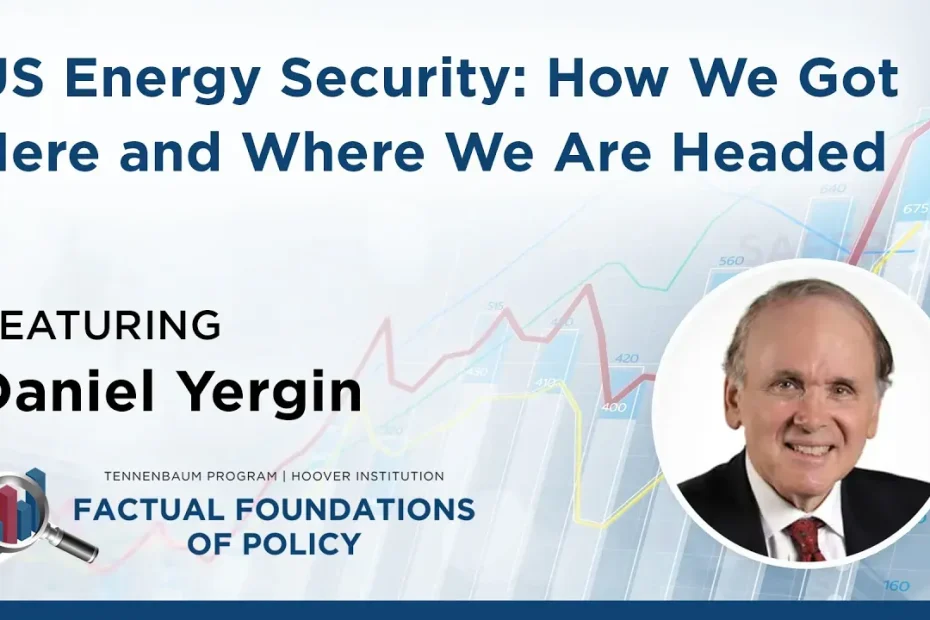
Read the full transcript of a conversation between host and interviewer Michael J. Boskin and interviewee Pulitzer Prize-winning energy expert Daniel Yergin on the topic titled “US Energy Security: How We Got Here and Where We Are Headed.” [Feb 25, 2025]
Listen to the audio version here:
TRANSCRIPT:
Introduction
MICHAEL J. BOSKIN: Welcome, everyone, to a very special podcast from the Tannenbaum Program for Fact-Based Policy at Stanford University’s Hoover Institution. I’m Michael Boskin, Senior Fellow at Hoover, Director of the Tannenbaum Program, and Professor of Economics at Stanford, and I chair the President’s Council of Economic Advisors under Senior Bush.
I’m joined today by a friend and a great thought leader, Daniel Yergin. He is the Vice Chair of S&P Global, Chair of CERA Week. I assume that grew out of your founding of CERA, Cambridge Energy Research. His newest book is “The New Map: Energy, Climate, and the Clash of Nations.” Dan’s a Pulitzer Prize-winning author of “The Prize: The Epic Quest for Oil, Money, and Power.” Among his other books, “Commanding Heights,” and several others that are not only a wise investment of your time, but are the definitive work on energy and its interaction with geopolitics and economics.
Dan is basically the guru of that subject. He was a Marshall Scholar at Cambridge, where he got his PhD. He was an undergraduate at Yale, and he’s just widely known as not only a great thinker, but a wise thinker, someone who bases his analysis in facts and lends a great air of reality to a subject many people try to ignore the basic facts about, and that’s what we’re all about, trying to get to some basic facts.
America’s Energy Position Today
MICHAEL J. BOSKIN: Let’s start with a simple question, Dan, maybe let you elaborate for a few moments on an overview of American energy, our production, our consumption, our trends, our challenges, and how we’re doing right now.
DANIEL YERGIN: Thank you, Michael, and thank you for that more than gracious introduction. The position of the U.S. in terms of energy is much better. If we went back less than two decades, we’d be really quite worried, because the U.S. was just importing more and more oil. Its energy security was really getting undermined, but we’ve had this shale revolution, which has basically made the U.S. essentially self-sufficient in oil and gas, and indeed has made the U.S. a force in global markets, not as an importer, but as an exporter. So it’s been a radical change in the position of the country, and one for the better.
MICHAEL J. BOSKIN: This has sort of upended, or at least throws some sand in the gears of OPEC’s tremendous power. They still have power, but we have some countervailing power to some extent. Is that correct here? Am I overstating?
DANIEL YERGIN: No, no. Absolutely. At one point, I remember writing many years ago an article called “OPEC Imperium,” where the Middle East was basically where the world was going to get most of its oil. That’s changed now. The United States is a significantly larger oil producer than either Saudi Arabia or Russia, and if you look at the current numbers, the Western Hemisphere currently actually produces more oil than the Middle East. So there’s been a big rebalancing that’s gone on. The Middle East continues to be very important, but as you put it, there are countervailing forces now.
The Evolution of U.S. Energy Security
MICHAEL J. BOSKIN: Yeah. This is quite remarkable. As you mentioned, it’s very hard to imagine this a couple of decades ago. Your essay for the TANBAUM program, you mentioned that nine consecutive presidents worried about energy security. Do you want to say a little bit about that history and how we got to this much better position?
DANIEL YERGIN: Well, now it’s really a broad sweep of history because for decades and decades and decades, the U.S. was the world’s largest producer of oil. In fact, out of every seven barrels of oil used by the Allies during World War II, six came from the United States. But over time, that changed. The U.S. production was going down, demand was going up, and we had, going back to what I think is in a sense the beginning of the modern age of energy, the energy crises of the 1970s.
And that was when America suddenly woke up and discovered it’s a big oil importer and not energy-independent. So starting with Richard Nixon, you had one president after another promising energy independence, and it seemed that that was just going to be impossible to achieve until you had a major technological breakthrough called shale.
The Shale Revolution
MICHAEL J. BOSKIN: You want to say a little bit more about shale? I’m not sure everybody, all of our viewers are understanding. They’ve heard the word, but they don’t quite understand what’s involved.
DANIEL YERGIN: Good point. So the idea of shale is that basically oil and natural gas were trapped in very dense rock and while it was there, there was no way to get it out and commercially produce it. And the textbooks, the petroleum textbooks said you can’t, there’s no commercial value to it.
Well, some entrepreneurs, some risk-takers, some experimenters said there’s got to be a way and there was one named George P. Mitchell and spent, you know, over 15 years of his company’s money trying to find a way to do it. And so the breakthrough was what’s called hydraulic fracturing and horizontal drilling, which were this sort of merger of two technologies at the end of the 1990s and the beginning of the 2000s and that enabled this oil and gas that was locked in these rocks to come out.
And, you know, it upended the textbooks, it upended the global markets. And today about 75 percent of U.S. oil production is produced, if I can use that term, fracked at shale and about 85 percent of our natural gas. And that was a technological revolution driven by need and incentives and experimentation that has really changed the world, the global energy map.
MICHAEL J.
BOSKIN: I think it’s probably significant that this was done by the private sector. It was not primarily a government program that did this.
DANIEL YERGIN: That’s right. There was research money starting in really the 1970s by the Department of Energy and various national labs that provided understanding or experimentation. And so I think we need to give credit to the government spending on R&D. Absolutely.
But the big breakthroughs were driven by the private sector and to a considerable degree by the conviction of this one man, George P. Mitchell. People said to Mitchell, who controlled his company, “George, you’re wasting your money.” And he said, “Yeah, but it’s my money. And if I want to waste it, I will.” And he just kept at it for about 15 years when even people in his own company were telling him it was a fool’s errand. Turned out it really was not a fool’s errand. It really just changed the picture.
MICHAEL J. BOSKIN: There’s another important point I think that tends to get lost or not emphasized enough, which is how much more efficient fracking has become since those early days. The cost per barrel of oil or per million BTUs of gas has fallen dramatically. So it’s become more economically viable.
DANIEL YERGIN: Yes, technology, you know, people are constantly looking to improve, to increase efficiency, to improve processes. And now this kind of horizontal drilling where the drill goes down 5,000, 6,000, 7,000 feet and then goes another 5,000 feet horizontal underground, two miles. That wasn’t possible at the beginning.
And the understanding of how to do, how to frack, how to open up the rocks, the knowledge has improved. So costs have come down and companies would find that they can accomplish more with less, with less drilling because they’re more capable. So it’s been a steady process of improvement since around 2000.
Economic Benefits of Energy Independence
MICHAEL J. BOSKIN: Well, we’re all better off by the fact that America now has assumed this position, has regained substantial production and in this sense, we are not a large importer anymore. In your paper, you mentioned something like several hundred billion dollars a year of costs of those imports that we were shipping to these other countries.
DANIEL YERGIN: If we went back to about 2008, we were spending upwards close to $400 billion a year to import oil. Now we’re basically spending zero. I mean, we import some oil, but that’s because we import lower cost oil from Canada, for instance, but that enables us to export higher value oil to other places in the world. So you get economic efficiency from that. But on what you call a net basis, we saved $400 billion.
And by the way, actually writing the paper for the Tannenbaum Project led me to another question which is what about LNG, liquefied natural gas, because the U.S. is now the world’s largest exporter. And when I was writing the paper, there were no numbers on, well, how much is that value? And so we did subsequent research on that and that’s been worth several hundred billion dollars to the U.S. economy as well. So it’s not only oil, but this natural gas export capability has also been very significant for the U.S. economy.
DANIEL YERGIN: Liquefied natural gas, which is natural gas cooled to minus 260 degrees Fahrenheit and exported, has become a major U.S. export industry. And just to give you the scale of this industry, which didn’t exist in 2016 but exists today, the value of U.S. LNG exports are half the total value of all semiconductor exports from the United States. It’s more than soybean exports, which is a big export product to China and other countries. And by the way, the value of U.S. LNG exports is twice that of all Hollywood and television entertainment exports altogether.
So this is a major new U.S. export industry that simply didn’t exist less than a decade ago, and it’s because of the shale revolution. This is a remarkable success story. Just to repeat, we have many hundreds of billions of dollars staying in or returning to the American economy that were previously flowing out to other countries. It’s really quite a remarkable change.
And, you know, Michael, to me, it’s so striking that it’s kind of just taken for granted and a lot of people in Washington just didn’t pay any attention to it, and yet other countries would love to be in the position we are in. Take China, which imports 75 percent of its oil. They would love to be in the position of the United States, yet we were just kind of taking it for granted or even forgetting about it or even, I think some in the last administration being quite ambivalent about it.
MICHAEL J. BOSKIN: Let me pick up on this in two directions. First is staying with LNG exports. We saw with Russia’s invasion of Ukraine and the cutoff of Russian gas to Europe that there was a desperate short-run need for a lot more imported natural gas and now rebalancing in Europe. They have some storage. They have some of their own production, but they were trying to get a lot more natural gas. We were supplying some. The Aussies, I think, were supplying some, Qatar was supplying some, et cetera. But maybe you could just fill us in for a minute on the importance, the geopolitical strategic importance of us being able to export LNG to our allies in need.
LNG’s Geopolitical Impact
DANIEL YERGIN: I think it’s not only a rebalancing of global energy markets, it is a rebalancing of geopolitics. You know, Mr. Putin, when he launched his invasion of Ukraine, made several errors. He overestimated his army. He underestimated the Ukrainians. He doubted the resolve of the United States. And he assumed that he could use the energy weapon. He could use Europe’s heavy dependence on Russian gas as a weapon, cut it off, shatter the coalition because of the economic impact and shatter the coalition supporting Ukraine.
And it failed. It was one of his major miscalculations. And the major reason it failed was because of the availability of LNG in the world. And in particular, the development of U.S. LNG. U.S. LNG replaced over 40 percent of that Russian gas, which Mr. Putin cut off to Europe. And he didn’t expect it.
In my book “The New Map,” I described a scene in 2013 when I was in St. Petersburg at Putin’s large economic conference, and this was before the annexation of Ukraine. After he spoke, I had the opportunity to ask the first question and I started to ask him about the perennial question about the over-dependence of your budget on oil and gas. I mentioned shale. And he exploded in rage. He called it barbaric. He said it was terrible. Because I think he recognized that shale had the capacity to undermine Russian hegemony in terms of its position in energy. And that is exactly what happened when he invaded Ukraine and cut off the gas and thought he had the high cards. It turned out we had some of the most important high cards in terms of our ability to export LNG.
MICHAEL J. BOSKIN: President Trump has now said that he wants to go beyond energy security, energy independence to energy dominance. What are the obstacles for us to become an even more important player in LNG and crude oil production in the world? What are we capable of? We’re already producing a lot. So is this a question of sustaining it for a long time or boosting it or removing some regulatory obstacles or permitting obstacles?
DANIEL YERGIN: I would say all of the above. There were a lot of regulatory and administrative obstacles, making things take time or preventing things from getting done again and again and slowing it down. I think that obviously the last administration had put a pause on development of new LNG projects and that pause is gone.
Energy dominance is a term that’s used and what it’s really just saying is the U.S. is the world’s number one producer of oil and gas today and that’s an enviable position to be in. I think our production has capacity to continue to increase. It requires continuing investment to do that and obviously if you look back at President Trump’s first administration, he was a big promoter of LNG and I think he will continue to be a promoter of other countries taking U.S. LNG. By the way, that’s one way to address the trade deficits that he’s so focused on in terms of the Europeans.
Pipeline Politics and Permitting Challenges
MICHAEL J. BOSKIN: Now we saw some stop and go in some major energy projects domestically. Perhaps the most famous one is the Keystone XL pipeline. Maybe you could talk a little bit about that but it was on and it was shut and then it was put back on and stopped again. What’s been going on?
DANIEL YERGIN: Well I think that those who are opposed to energy development have realized that pipelines are a spot where you can really seek to prevent things from happening. So Keystone XL would have brought additional oil down to the United States to our refineries in the midcontinent and to the Gulf Coast.
The ironic part was that the lower part of the Keystone XL was actually dedicated by Barack Obama who showed up in person, but the upper part became very controversial. The State Department did this long review of it and said it could go ahead because it needed government approval to cross the national boundary between U.S. and Canada from Alberta, the province of Alberta in Canada which is a big oil producer. But on climate grounds the Obama administration said it can’t go ahead. The Trump administration said it can go ahead and then finally the company promoting it just gave up on it because of this regulatory back and forth. You’ve spent billions of dollars and you just give up, so it gave up.
But it does highlight one big issue that this country needs to address which is the ability to get things permitted and built. We just did a study on how long it takes, on average, to get a new mine from discovery to production. We found that around the world the average is 20 years; in the United States it’s 29 years.
MICHAEL J. BOSKIN: That’s remarkable especially given we have these issues with respect to China having a very large say in some critical minerals and the need for many rare earths, for lithium, for cobalt, et cetera, much of which has to come from elsewhere at least for the time being. We have some of those deposits but it’s a big investment with a very, very long horizon before you actually start getting any revenue. So the fact that there’s this instability in permitting that whipsaws back and forth when administrations change makes it very, very difficult.
DANIEL YERGIN: That’s right. And any of these projects transcend the four or eight year term of a president, so you’re making commitments. I was talking to the CEO of a major mining company and he said he’d just been down in a Latin American country finally trying to get a green light for copper deposits they discovered from the government. And I said, “Oh, when did you make the discovery?” And he said, “1997.”
MICHAEL J. BOSKIN: Oh, my.
DANIEL YERGIN: Well, there’s a lot of stuff out there that could be developed but there’s a lot of opposition. Some of it localized – “we don’t want it in our backyard.”
MICHAEL J. BOSKIN: …our community, not in my backyard. Some of it on grounds of damage to the environment, climate, et cetera. I want to get to climate in a moment but you mentioned China and I thought we might just dwell on that for a moment. You mentioned they’re massive importers of oil to run their economy. They also depend heavily on coal. We haven’t heard much mention of coal but maybe you could fill us in on the role coal is still playing in global energy.
DANIEL YERGIN: Well, actually, that gets us to the issue of energy transition and here’s one way to think about it. In the 1960s, oil finally overtook coal as the world’s number one energy source. Today, world coal consumption is three times what it was in the 1960s and last year was the highest consumption of coal ever. Coal continues. It used to be 50% of U.S. electricity generation, now it’s under 20% but in other parts of the world like India or Southeast Asia, it’s a very major part of electric generation and it’s still the largest source of electric generation for China despite their advances with solar and wind and liquefied natural gas. They keep building new coal-fired power plants and this is a big source of emissions.
MICHAEL J. BOSKIN: We all know in the pantheon of how dirty different types of fuels are in terms of carbon dioxide emissions that coal ranks at the bottom relative to natural gas and the like but there’s still a lot of other stuff. There’s still a lot of biomass being consumed, et cetera. Maybe you could talk a little bit about the energy needs and the energy uses and sources and what’s commonly called the global south, broadly speaking, the developing world.
DANIEL YERGIN: Well, it’s remarkable to think, Michael, that there are 3 billion people in the world who each of them uses less electricity every year than an American refrigerator and I think a lot of the discussion-
MICHAEL J. BOSKIN: Stop me for one second and just have you repeat that and dwell on it because I think it’s a remarkable fact and it’s something that is really underappreciated by most people in the United States.
DANIEL YERGIN: So, I’ll say it very slowly, 3 billion people on a per capita basis, each of them uses less electricity every year than a standard-sized American refrigerator and what that tells you is that there’s a huge gap between, call it the global north and the global south. I found, and that was one of the impetuses for our new Foreign Affairs article, that in the global south, the developing world, they have a different set of priorities than the global north.
We put on a conference in Malaysia called Energy Asia and the prime minister there opened the conference and he said, you know, we have our concerns about climate but we’re not going to have the agenda set by people in northwest Europe and in North America. We have to worry about economic growth, we have to worry about poverty reduction, we have to worry about health, so we have a different set of priorities.
There’s the case of a pipeline being built in Uganda to Tanzania and this is part of an economic development that people think could double Uganda’s per capita GDP but in Europe, you have environmentalists, you have the European Parliament denouncing it. Then you look at per capita incomes in Europe and it’s $50,000, $60,000 a year and you look at per capita incomes in Uganda and it’s something like less than $2,000 a year. So very different perspectives about energy and meeting energy needs and economic growth and I think that difference has not been taken into account enough in the global discussions about energy and climate.
The Demographic Reality of Global Energy Needs
MICHAEL J. BOSKIN: There’s kind of a demographic and economic growth underpinning of all this, that is, the places that still have pretty high birth rates, for example, in Africa whereas in the developed economies, the fertility rates are below replacement so populations are growing slowly and then they’ll probably stabilize. But there’s going to be a large increase in the global population in the south where the energy needs are greatest and the gap between something approaching modern life as we know it in North America and Europe versus how they’re living at the moment is immense. There’s going to be a huge energy demand growth in those places. Maybe you could say a word about that.
DANIEL YERGIN: You know, Africa in not so many years will be a quarter of the world’s population and again the energy levels there, the energy use is very low and they need energy for economic growth. They need it to create jobs. They need it to raise the standard of living and if they don’t have it, the migration issues that we see now, particularly facing Europe, will only become worse. So energy is a very important factor for stabilizing the situation and, I think, again, Europe really – many in Europe just haven’t seen the connection but they need economic growth and you’re not going to get economic growth without energy.
MICHAEL J. BOSKIN: I think you say in your terrific Foreign Affairs piece, which is just out, that for better or for worse, there’s going to be some carbonization before net decarbonization.
DANIEL YERGIN: Yeah. What that means is that in particular in Africa, you’re going to need natural gas and even in India, which has very ambitious renewable goals, it also has a $67 billion program I think is the number to expand its natural gas usage and building natural gas pipelines is a very important way to get energy and tapping the resources and to get economic development. That’s what we mean by that.
At least until recently, you’ve had the multilateral banks that have been under great pressure not to finance anything that involves a hydrocarbon which includes natural gas and that stunts economic development.
MICHAEL J. BOSKIN: Very interesting because you mentioned earlier about fracking having grown out of necessity and incentives and entrepreneurship and insight and grit would be another way to describe Mitchell, right? He stuck to it for a long time despite all that.
DANIEL YERGIN: We could even say as his granddaughter – I mean I knew him but his granddaughter said grit and stubborn, stubborn.
MICHAEL J. BOSKIN: Well, he wouldn’t take no for an answer until the answer was finally yes and we all benefited from that. But we see some of the same things going on in a variety of areas but I want to get to the so-called green transition for a moment because certainly, we’ve seen a decline in the prices and the cost of renewables.
The Complexities of Energy Transition
MICHAEL J. BOSKIN: Some places here in California were extremely aggressive with renewable goals that comes with a high cost and it also comes with some risk of the grid, et cetera, but we saw in Europe when they had problems after they decommissioned some nuclear facilities in Germany and started importing lignite that they wound up including natural gas as a renewable if they’re lost briefly. So, sometimes you just have to be a little flexible in this regard rather than just being so stubborn about things of that sort.
DANIEL YERGIN: Right. I mean I think the advance of wind and solar are – those are major innovations and it’s really around 2010 when the cost of both of them really started to come down and of course with solar, it’s really Chinese manufacturing at a massive scale that does it.
But there’s one country which is really putting up quite a lot of solar but what they’ve noticed is that a difference between the cost of solar generation and the cost of integrating solar into your power system in terms of what you need to deal with the intermittency, the backup and so forth, the grid connections and so forth – that’s a different cost and that cost is not so well recognized. Because you look at it and say why is electricity so expensive in Germany or elsewhere in Europe or in California, the highest electricity cost of any of the 48 states because you’re told it’s supposed to come down.
So, I think there’s been a kind of – people haven’t looked at the total system cost and right now that’s suddenly on the agenda where in a way we have energy security now in terms of oil and gas and now the focus is wait, we don’t have energy security in terms of electricity, in terms of reliability because electric power industry uses the term reliability but it’s really security and that we’ve underinvested in it.
And then with what seems to be the roll out of data centers and AI, suddenly electric power generation which people thought the demand would be very flat or might even decline a little, now we’re…
DANIEL YERGIN: We’re looking at substantial increases and something between anxiety and panic about how you’re going to generate that electricity and meet the needs and maintain the reliability of the system. That’s on the agenda. It’s certainly an issue in California and as data centers are built. We were doing some analysis that data centers could by 2030 require 10% of all the U.S. electric generation. I saw the U.S. Department of Energy had some numbers that said by 2028, it could be 12%. We’re not in a position to do that.
MICHAEL J. BOSKIN: Absolutely. And that’s leading many companies to announce very large data center projects with co-located power sources, looking at small nuclear, large nuclear reactors. Microsoft’s looking at Three Mile Island, Oracle, as far as Stargate has—
DANIEL YERGIN: Michael, I think there are certain things that are symbolic, and Microsoft making that deal with the part of Three Mile Island—the famous reactor that was not damaged but was shut down in 2019—to bring it back into operation, that’s kind of a dramatic symbol, as well as being a very practical solution to the fact that there’s a big rethink going on now about electricity.
MICHAEL J. BOSKIN: Absolutely. And there’s also a concern about the cost. We’ve seen in California some bills being introduced in the legislature to require certain types of pricing on new data centers as opposed to residential, etcetera. We have a history in California of the state government trying to get involved in this and causing problems. We have that now with our homeowners insurance and fires and the refusal to—recently adjusted—but the refusal to let insurance companies project future losses rather than have it based on earlier losses when fire damage wasn’t so great, for example.
Also, clearly in California, you would know much better than I do, but there is a real clash between fire safety and certain environmental policies.
DANIEL YERGIN: Absolutely. We have California Environmental Quality Act, which is used to delay a lot of projects, sometimes perhaps quite ostensibly, but other times it just becomes a vehicle for obstruction.
MICHAEL J. BOSKIN: And also management. I mean, management of forests.
DANIEL YERGIN: Forest management is a big problem. Of course, we have a lot of federal land and they’re trying to work some joint improvement to that. But it’s clear that even if it’s the case that climate change has contributed to the prevalence of the fires, even though they’ve existed for recorded history in California, even if that’s the case, California alone is not going to do a whole bunch about climate. No matter what we do, we’re a tiny part of global emissions and it’s global emissions and global concentration of carbon that matters for the climate. But we could do something about fire and that would have its own benefit also. Those fires are emitting a lot of carbon dioxide as well.
MICHAEL J. BOSKIN: So, there’s a lot of tension about how to work through all this. We have a very different administration with different goals in Washington than we do in California. There are political antagonisms, but also policy antagonisms. California has often gotten waivers from federal policy and it’s unclear that the Trump administration will continue that.
What do you see as the biggest obstacles now to moving at a sensible pace for a green transition? I think you wisely have emphasized full cycle analysis from well to wheels, and emphasized the full system, including distribution. But you’ve also been a leader in understanding that previous energy transitions, and so far this one, have been energy addition rather than energy replacement. You want to…
Energy Transition as Energy Addition
DANIEL YERGIN: Well, it was interesting when I was writing “The New Map,” already then people everywhere were talking about energy transition. So I said, well, got to learn a little bit, go back in history. What do we mean by energy transition? And I went so far and put on my economic historian hat, but the energy transition actually began in 1709 when an English metal worker figured out that you could make iron better using coal rather than wood charcoal.
But these transitions all took a century. And as you say, it was just always an energy addition. Over time, no source went down, including biomass, by the way. So when we looked at these goals for 2050, and by the way, there were five countries that represent about 45% of emissions that never signed on to 2050—they signed on to 2060, 2070—but when they looked at 2050, it just seemed, how are you going to do this? You’re going to change what today is a $115 trillion world economy in 25 years with technologies you don’t really know.
And by the way, you also get a backlash. In Europe, they call it “greenlash.” Look at the populist parties. Immigration is a big issue for them, but so are climate policies.
So I came to the conclusion in our Foreign Affairs article called “The Troubled Energy Transition,” that this notion that you just draw a line on a graph and you get to 2050 and everything works perfectly just is not the way it’s going to be in the world. It’s going to be multidimensional with different mixes of technology, different priorities, different timing, different regions that can unfold over a longer period of time. And just to keep saying, “all we need is more ambition” became an empty phrase finally because it wasn’t working and it’s not going to work. It’s just a much more complicated world.
A couple of years ago, there was huge excitement about hydrogen as though that would be an answer. And of course, renewables are part of the answer, but it’s a big complicated system to provide the energy that a world economy runs on.
The North-South Divide and Climate Financing
MICHAEL J. BOSKIN: That’s a really fundamental point. And I don’t think it’s appreciated widely enough by a typical citizen thinking about this, maybe voting on issues in this regard. So your wisdom is greatly appreciated in that regard.
I want to come back again to this North-South divide. We’ve got a lot of poor countries that want economic development and are going to probably use, for example, a lot of natural gas before they, if and when they wind up transitioning to more renewables, or they’ll do it simultaneously, but the natural gas will become dominant for a while.
In what’s envisioned in Net Zero 2050, there would have to be a massive transfer from the rich countries of the global north, primarily Western Europe, North America, especially the US and Canada, Australia, New Zealand, etcetera, to the global south or to the poorer countries. And that’s just not a technical issue or an energy issue. It’s a massive geopolitical fiscal issue.
Getting citizens to agree to have very large, as I think you mentioned in your Foreign Affairs piece, several percentage points of GDP per year is going to be needed and there’s going to be a need for very, very large transfers to the global south to meet any of those goals. And getting agreement inside any country, let alone a group of countries to fund something like this, there have been some attempts with the Paris Accords and so on and there’s a modest amount that’s been done, but it’s really quite small.
DANIEL YERGIN: Yeah, and obviously guessing how much it’ll cost is a lot of guessing and estimating. We use the projections of the costs that were used as the kind of foundation document for the last COP summit that took place in Baku a few months ago.
MICHAEL J. BOSKIN: The UN Climate Conference.
DANIEL YERGIN: Exactly, the UN Climate Conference. And it said to actually achieve these goals, it’s about 5% of GDP. Well, the global south doesn’t have 5% of GDP to spend on this. So that says it’s going to be the global north. And you start to look at the numbers and say, you’re talking about to fund this, assuming you have the technology and capabilities and people and everything to do it, is going to be roughly 10% of GDP.
MICHAEL J. BOSKIN: Really?
DANIEL YERGIN: I mean, which budget-constrained country is going to do that? So there’s just this discontinuity between the ambitions that are out there and the economics in terms of doing them.
MICHAEL J. BOSKIN: Yeah, that 10% of GDP is a sizable multiple of what any country, including the United States, spends on defense. Three times what we spend—
MICHAEL J. BOSKIN: And probably something like the combined entitlement budget, something like that.
DANIEL YERGIN: Yeah, it’s certainly bigger than Medicare, Social Security. I mean, the numbers are just there, and we can tell right now with what’s happening, at least some part of American policy doesn’t want to spend any money on anything outside the United States.
MICHAEL J. BOSKIN: Well, it’s going to be a challenge for sure. And let me just conclude by saying, if there’s anybody that can keep us well-informed about what’s going on and what to look out for in the energy sector, and especially its interaction with geopolitics and global affairs, it’s Dan Yergin. And Dan, I can’t thank you enough for joining us. We’ll look forward to more insights from you and from S&P Global and your team there. And we’ll look forward to having you back again. It’s been a pleasure having you join us on the Tannenbaum Program.
Conclusion
DANIEL YERGIN: Well, thank you very much, Michael. I think the Tannenbaum Project and what it’s seeking to do, which is fact-based analysis of these very difficult and very important issues is a real contribution. And so I was very pleased to have the opportunity to be part of it. And I thank you and the project for being able to be engaged in it. And I have to say writing the paper for the project was great for me because it really enabled me to bring together kind of a broad sweep of understanding of how U.S. policy and U.S. energy has evolved over the years. So many thanks to you and very glad to join you today on this podcast.
MICHAEL J. BOSKIN: You can find more on the Tannenbaum Project for fact-based policy at hoover.org, where we post informative essays, books, podcasts, and other materials about important public policy issues. If there are other topics you wish we had covered, or if you have any questions, please send them in and we will make every effort to follow up in additional podcasts down the road.