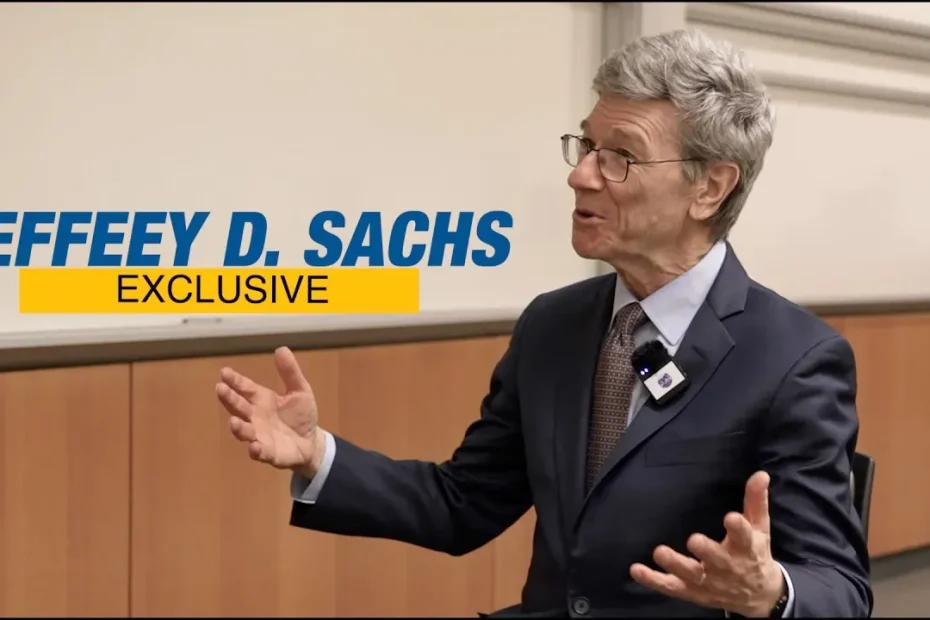
Read the full transcript of Max Ren of Dragon TV interviews Professor Jeffrey Sachs on China Economy, US Trump Tariffs, African Aid and ‘sides-picking’ for ASEAN… [March 6, 2025]
Listen to the audio version here:
TRANSCRIPT:
Making Peace in the World
PROFESSOR JEFFREY SACHS: Today I talk about how to make peace in the world because my view is that all of the conflicts that we have, whether it’s the Ukraine war, the conflict in the Middle East, or the tensions between the U.S. and China can be resolved rationally and cooperatively.
MAX REN: China has been maintaining GDP around 5% in the past few years. What do you oversee China’s economy and its contribution to the whole world economy growth?
PROFESSOR JEFFREY SACHS: China is not only very dynamic, it’s the main trading partner of most of the world, but it’s also technologically extraordinarily dynamic. And this is very, very important, whether it’s AI and deep-seek, of course we all know about that in the world, but also China is now the leader, by far, of electric vehicles. China is going to be the leader of the new robotics generation, the humanoid robots that are coming. China is the leader of renewable energy technologies. China is the leader in fourth generation nuclear power.
The point is, these are the technologies that are needed all over the world for the green transformation, for climate safety, and for the digital transformation. So in my view, China is playing a role not only as a world major economy, of course, but also as a technological leader.
The Impact of Trade Wars
MAX REN: What do you foresee for going on trade war, right, tariff war, do you think that harms global growth, that harms bilateral relationship between U.S. to Canada, U.S. to Mexico, particularly U.S. to China? How do you foresee the effect of this trade war?
PROFESSOR JEFFREY SACHS: I think, unfortunately, Trump believes in protectionism. I don’t. I’m an economist. I believe in open trade, open markets, mutual gain. I believe that the U.S.-China trade over the last 40 years has been hugely beneficial, both for China and the United States. But I do believe that Trump is a protectionist, and he’s likely to pursue this course.
What does it mean for China? It means that the rest of the world, China and the rest of the world, should say, okay, if the U.S. wants to be protectionist and isolate itself, that’s one thing, but we are going to continue our open trade policy. So I’m hoping that China and, of course, the other countries of the BRICS, and I’m hoping the European Union, very important, and I know that the emerging markets and developing countries of the world all want to say, if the U.S. is protectionist, it doesn’t stop the rest of us from still having an open, dynamic trade and finance relationship. That’s how this should be approached.
Of course, I’m trying to talk the U.S. out of protectionism, because I don’t think it’s good for the U.S., but for China, rather than anguishing or saying, well, now we have to just boost consumption or something else, China can also expand exports to other regions of the world and also expand investments in other regions of the world for Chinese technologies to be producing in ASEAN or to be producing in companies in Africa, in Europe, I hope, and so on.
The Future of Globalization
MAX REN: Well, it sounds like you are such a blessing to American economy, to the world economy. Do you think that the world is going to track globalism or protectionism or global cooperation or individualism? What do you foresee?
PROFESSOR JEFFREY SACHS: I think that, broadly speaking, we’re still in a globally interconnected world with the benefits of globalization. The United States has lost its nerve a little bit. China’s rise has scared the U.S. Now they’re protectionist. Not a good idea. I hope that the United States returns to normal openness with more confidence and just, yes, go out and compete, make business, but don’t be protectionist. This is what I’m hoping. But I do believe that most of the world wants an open economy and trading system and cooperation.
I should add that I’m a very big fan of the Belt and Road Initiative, because the Belt and Road Initiative brings technology, trade, jobs, finance, all together to expand the world economy. And so I think what China is leading with the Belt and Road Initiative is extremely important for the world, but also excellent for China in building those strong economic relations with the rest of the world.
Belt and Road Initiative
MAX REN: Talking about Belt and Road Initiative, are you optimistic about Belt and Road Initiative for the next four years? What is your…
PROFESSOR JEFFREY SACHS: I’d say go for it and expand it. My one little piece of advice is for the poorer countries, I hope China makes the loans longer term, because if the loans are short term, well, then these poor countries won’t be able to pay. But if they’re long term, what China’s going to do is promote economic growth, rapid growth in Africa, rapid growth in Southeast Asia. Give enough time, and then that’s going to be good returns on all of that finance.
China’s Role in Africa and the Middle East
MAX REN: Historically, the Chinese has been acting as peaceful peacemakers and business merchandisers across the Silk Road. But some media networks claim that China is playing a threat to certain countries in Africa and the Middle East. Do you think that Chinese companies are making constructive improvements, such as infrastructure constructions, right, technology transfer in those continents, Africa, Middle East?
PROFESSOR JEFFREY SACHS: Not only do I believe it, I see it on the ground with my own eyes. I was recently in Ethiopia, and I was visiting farmers that were making far more money than they were before.