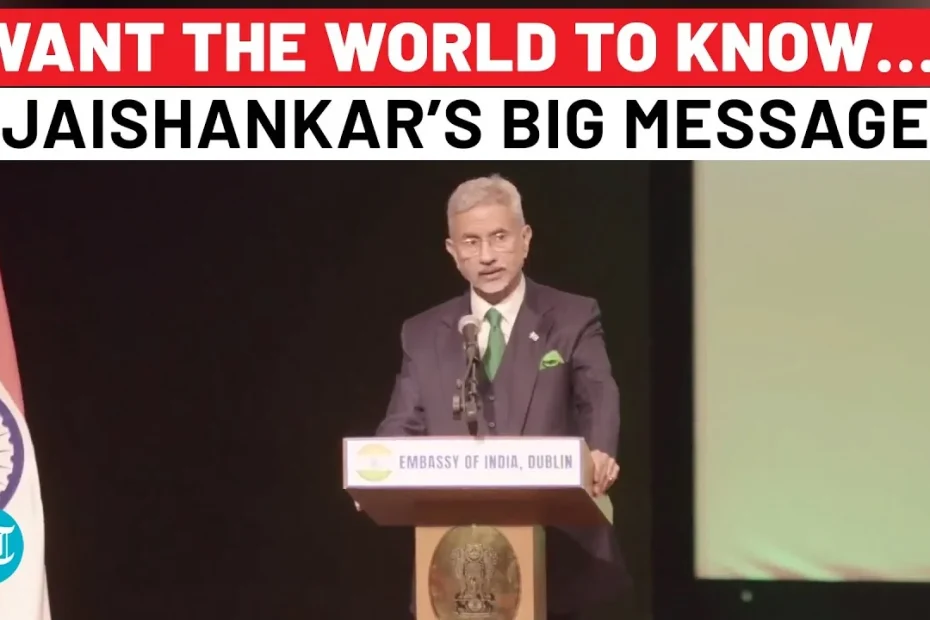
Read the full transcript of India’s External Affairs Minister Dr. S. Jaishankar’s speech during a community interaction in Dublin, Ireland, March 6, 2025.
Listen to the audio version here:
TRANSCRIPT:
Opening Remarks
[DR. S. JAISHANKAR:] Namaskar. Namaskar. Good evening. Good to see you all. Ambassador, friends, it’s been a long day, but I can’t think of a better way of ending the day than to be with all of you.
I want to begin by thanking you and also saying it took a little while for a foreign minister to come. But now that I’m here, I’m trying to make the most of it. But I really want to thank you, and I will tell you why. All over the world, it’s very normal that wherever you go, people say good things about Indians. I always tell others that when we speak of the image of India, others don’t look at a map to have an image of India.
They remember a person. They remember somebody they know, some experience with them, a face, a relationship, a feeling. And while I have experienced this across the world, I must tell you, I felt it very, very strongly so I can fully understand what the ambassador was trying to convey.
Meetings with Irish Leadership
I’ve just come a little while ago from a meeting with President Higgins. Earlier in the day, I met a collection of people, including the former Taoiseach Prime Minister, Leo Varadkar, some of the ministers in the cabinet. Tomorrow, I will be meeting my counterpart, Prime Minister Simon Harris.
But in all the meetings, for me, it was a great sense of pride. They brought up the Indian community. They mentioned the contribution of the Indian community. Exactly what the ambassador said, that the professionals out here, the people who have contributed to not just development, but especially the health sector in this country.
So I want to really sincerely give a very big thank you on behalf of the nation because you make my job and my life easier.
India-Ireland Relations
Now, when you prepare for a visit, you take your job reasonably seriously, professionally. They give you a lot of folders. They will say, these are the problems. I must say with Ireland, the preparations were very easy. There were no big problems. There were mostly good things which they told me.
I found trade was reasonably good, about sixteen billion dollars at least, maybe higher. The Indian community, I’m now told, is almost a lakh, that the number of students is about, I think, thirteen thousand was the new number that they gave me. And with Ireland itself, we have a very good tradition, and a very old tradition.
In fact, before I came here, my immediate engagement was in the university college. And I was telling the students there that if any of you check Wikipedia, just go into Wikipedia, do “India-Ireland relations.” Something very interesting pops up. It’s a 1920 lecture given by the person who became president of Ireland, Éamon de Valera, in New York, making a case why India should be free.
When we look at this part of the world, Europe, there was no other country, no other political force, political leadership, that took that position at that time. In fact, most of this region largely stood with the colonial power. And Ireland, in many ways, was an exception because it was itself occupied. So we’ve always had this very special connection with Ireland.
Historical and Cultural Connections
When we look at how the Irish themselves have built the nation, their freedom struggle, how they have revived their culture because the colonial period, you know, colonial power tries to erase the culture. In fact, there is so much which is actually worth knowing, worth learning, worth thinking about.
And so even though I had official meetings, I still did two things today, which I’m sure many of you have done, but if you have not, I would recommend it. One, I went to the General Post Office, which was the center of the Easter Rising in 1916. But I would say in the twentieth century, if there was one symbol anywhere in the world of people rising up against the colonial power, the most potent one was the General Post Office in Dublin. And as a country which fought for its own freedom, for me, that was an important first stop.
And then somewhere in my programs, I found time for one other thing, which I had promised myself I would do, which is to visit a site or a place, which for them in terms of their cultural revival was very important. Because here is a country whose actual language was under threat, not just culture. And I went to see the Book of Kells, which is a UNESCO World Heritage site here.
Bilateral Partnership
I do want to tell you that for us, Ireland has been a very good partner. There are people with whom I have worked with multiple ministers including the current one and many of his predecessors. So for all of you, do be assured. In fact, make the most of this relationship because I think we think well of this country, they think well of us. We work together in multiple forums. In fact, our soldiers are even deployed together in Lebanon in the UN force.
So there is a lot going for us here and I’m very sure with all the contributions and everything that you do, it will only get better. Now having said that, I also want you to know one other important development, which is that Ireland, as part of the European Union, will naturally get many of the advantages which will happen when our relationship with the European Union will improve.
India-EU Relations
We just last week had something unprecedented in our history, which was there is a new European Commission.
So the President of the European Commission, Ursula von der Leyen, and twenty-one out of the twenty-seven commissioners came together to India. They have never done a visit like this. And it says something today that because, eventually, I do want to share with you what is happening at home, and I know all of you obviously are interested in that.
But when twenty-one European commissioners come together in a very rare gesture, clearly, there is a shift, there is an improvement in the world’s interest in India. And it’s not a one-off. A day after that, in fact, we had a big business delegation led by Princess Astrid who is the King’s sister in Belgium. So she led a business delegation of I think about 350-360 companies from Belgium.
And I mentioned this to you because we are today attracting the interest of the world. There are things happening in India.
It’s important that you know this. It’s important to talk about it, because at the end of the day, if people in Ireland have to have a better sense of what is happening in India, they will get it best from you. People like me may come give a speech, others may follow us or not, but those who work with you, those who are your neighbors, those who are your friends, those who are your colleagues, they are the people who will listen to you, who when you take pride in your country, some of it will rub off onto them, and that’s what I would like you to do.
India’s Democratic Success
So I do want to speak a few words about what is happening in India. Last year, we, as you all know, did our general elections. And today, in the world, you will see many countries are worrying about democracy. They’re worrying about elections. They’re worrying about stability. They are worrying about extremism in politics.
So for us, this election which we did last year, actually in the history of the world, is the largest ever democratic election if you look at the number of votes which people cast. And the good thing about our elections, we argue intensely. But once the elections are over, once the results are out, whoever wins, the great thing about our country is people have accepted.
And you will get very hot arguments, but what will happen is from time to time, the opposition parties will complain and then the opposition will win an election. Then they’ll feel very happy till the next election where they may or may not win it. So why I mentioned this to you is sometimes what happens regularly, something which is so obvious, we take it for granted.
I do want you all to take pride in India’s democracy. It is so hard that our elections are clean, they are not disputed.
I mean, there are today, we are way even in application of technology, we are way beyond much of the world. I mean, it’s a paradox that many developed countries are using voting techniques which we put behind us many decades ago.
Digital Transformation
The second is actually the embrace of technology. Now I don’t know how often you go back to India, but I’m sure with each visit you will discover that more people take their phones for shopping rather than their wallets.
And the reason is, if you look today at cashless payments, you look at every government service which is based on some kind of digital delivery. Even tomorrow if any of you have to renew your passport. Look how fast passport renewal happens because there is a database. In the old days, anybody who wanted a passport would go to an embassy. So the poor ambassador would have many of you coming there.
You’ll have to fill in a form. He will send it back to the regional passport officer. Somebody will check something. It will take you months to get a reply, and the reply may not even be a good reply. So today, look at it. Embassy has access to an integrated database. They are able to verify your particulars literally in a matter of minutes. I mean, almost every service today which is rendered by the embassy again is moving that much faster.
Now the embassies are not an exception. It is actually happening pretty much in every government office in India. So if you look at filing income tax and how fast your income tax returns are validated, approved, processed. Look at driving license. Look at any service which any government office gives today, from giving rations to allocating houses, to issuing health cards, to giving loans to people.
So the digitization of India, the embrace of technology is actually transformational. And I say this to you because if in this region there is any country which has an IT prowess, which has a digital reputation, it is Ireland. And those countries who live must speak, must spread this, how much actually today India is changing in terms of the embrace of technology.
Infrastructure Development
The second change which is much more physically visible is, of course, in infrastructure. That I think today, I could probably say without fear of contradiction that the greatest amount of new infrastructure being built anywhere in the world today is probably in India.
And if you again, it’s happening in front of our eyes. Because it is happening, we take it for granted. In fact, we not only take it for granted, all of us including me, sometimes even complain, that road is blocked. Why are they digging here? Why do I have to go through that inconvenience? But in every part, something is happening.
And if you look back, I mean, sometimes when we reflect on the last ten years, ten years ago, we had seventy-five airports in India. Today, we have a hundred and fifty. That means in ten years, seventy-five new airports have come. So if you go to any other country and say, you know what, guys? I build seven to eight new airports a year. I don’t think they would believe you.
Now it isn’t just the airports. It’s the highways. The highways, the quality of roads, any of those who are going back to India. We are building about twelve, fourteen kilometers of railway track daily. If you see again, any of you who uses the railways today, you look at the change in trains. I’m not even talking of logistics or goods delivery, because average citizens cannot get involved in that. But if you look at the trains, look at the air, look at the airports, look at the roads, look even at the education, look at the number of medical colleges. Look at the number of hospitals.
So the physical infrastructure, the facilities available to people, that is taking place at a great rate.
Change in National Attitude
But for me the biggest change is actually attitude. That there is today a sense in India that we are capable of doing good things. If you look at the big challenges, and the ambassador mentioned COVID, I can tell you we were talking maybe in March 2020, and I was sitting behind him. And I still remember the thrust of that meeting was we have this terrible thing which is going to hit the world, this pandemic.
Millions of people are going to die. I mean, this is unstoppable. It’s going to spread everywhere. And the country of the greatest cause of concern in the world is India. This was actually said at the briefing, and it was said in all honesty, in all seriousness.
Because we ended up actually as one of the largest vaccine suppliers. We actually ramped up our medicine production that, sometimes I was not sure whether I was a foreign minister or I was an agent for fielding medical inquiries from the world. We sent medicines to a hundred and fifty countries, and interestingly, a lot of them were European countries who were calling you up and saying, and they were running short of very basic things like paracetamol.
That medicine shortage, later vaccine shortage, the PPE, the gloves. So what it showed us was that we had the ability to rise to a challenge, a once in a century challenge.
India’s Global Stance and Achievements
And then if you look with that kind of attitude at many other things that we have done, you know, we had soon after COVID a challenge on our borders with China. Now again, if you think back, a lot of people said, you know, this is very serious, which was true. It was a very big challenge, which was also true. But the fact was we stood our ground. Our military was deployed. We stood there.
We took a long time. We stood our ground. We were very patient, determined about it, and we finally had it. So what we have discovered today, even when the Ukraine conflict took place, the Ukraine conflict actually had very interesting repercussions across the world. There could—there was immediately an energy oil crisis.
Oil prices, gas prices went up. Actually, food prices went up because Ukraine was a very big supplier of wheat and even cooking oil to the rest of the world. Fertilizer prices went up because Russia and Ukraine between them were the two biggest producers of fertilizers for the rest of the world. Now again if you see there, we not only took care of our needs, in many cases most of our neighbors actually got their fuel, their food, their fertilizer from us just like they got their vaccines from us during COVID. This willingness to take responsibility, this ability to rise to challenge, this is a kind of a different India with a much stronger willpower and spirit.
And that is something that all of you who today are living abroad, but whose heart and mind is so much in India. It is something that you should all appreciate. And when we see our other achievements, like going to the moon, you know, what Chandrayaan did. Or as I said during COVID, we used to be a country which would actually get vaccines at the tail end of the world’s production. Yes.
We made a lot of vaccines. We actually also invented vaccines. We created our own vaccines during this period. We were a country on telecom, which is so critical for our existence today. We got our two G, three G, four G technology from Europe and China.
But today, our five G technologies are in India stack. And the fastest rollout of 5G today, which is happening anywhere in the world, is actually in India. And we are very confident that when it comes to six G, we’ll be among the early movers rather than one of the laggards.
The Spirit of Young India
But, you know, one part of it is what is happening in India, and I see a lot of young people here. I also want to say, for me, as a person who travels in India, goes to universities, goes to professional meetings, I also see the spirit, this can-do spirit very strongly in young people.
That when I look today at any event which involves innovation, which involves invention, which involves patents, in fact I find even in universities, lot of universities take you to introduce you to students not by the marks that they’ve got, but actually by the patents that they have got. And I think that’s a very interesting mindset change today in India.
India’s Response to Global Challenges
But beyond that, I think there is also the issue of how we react to the world. And here too, we’ve had challenges. For everybody, as I said, the Ukraine conflict was a big challenge.
Now the challenges took had different dimensions. One of which was that we had this almost twenty thousand students who were stuck there when the war started. Now the reality was most countries in the world actually left the students to fend for themselves. You know, they told them, we warned you that this conflict is coming. You didn’t get out in time. So now you figure out a way what to do for yourself. We were one of the few who actually took out our students. And as we have done in many other cases, I mean, we have done that thereafter in Israel when the October attack happened. We’ve done it in Afghanistan. We also brought our people from other countries.
So when the world sees a country looking after its citizens, and this for us is a very big message that it can be the normal day. As I said, making it easier for your passport or, you know, if someone has some kind of professional issue, personal issue, community issue, the willingness to back you up, to stand by you, or in a crisis. We want today Indians going abroad, whether they are tourists, whether they are students, whether they are professionals, whether they are people who live abroad, to have that confidence that the government thinks about you, the government has your back. If you are in a jam, we are there. This is not just a statement.
It is a commitment which is backed by a system, which is, as I said, based on applications of technology and creation of a certain structure of action.
Standing By Others
There is also, of course, you know, we live in a world where countries depend on each other. I think again, we have in many ways in recent years gained a better reputation not only for defending our own interests but also for standing by others. Now standing by others can have again different kinds of examples. We had a neighbor, Sri Lanka, who got into very, very serious trouble.
I have, early in my career, lived in Sri Lanka for a few years. I know that society. And, you know, in front of our eyes, you could actually see a country running out of food, running out of fuel, literally running out of money. And our stepping in at that time, I think, actually turned Sri Lanka around. Now again, there is a message in that to our neighbors as well that we are today seen as a country on whom the region can depend.
I’ll give you a very different example. We had the G20 presidency. You know, for years, in the G20, there is one African member, South Africa, and there are fifty-four African countries. So there was a long-standing feeling that, look, there should be more countries and the African Union at least should have a seat. For ten years, I have myself been attending G20 meetings.
Every meeting, they would say, yes. This meeting, we should do it. Then they’d say, yes. You know, somehow, sorry. You know, Africa, we got very busy. So the next guy would do it. This went on ten meetings one after another. And the one before us, the head of the African Union actually came to Prime Minister Modi and said, look. Every meeting, you people make this promise and you don’t do this. And he promised them, and we actually delivered on that promise of getting African Americans.
And if any of you go today to Africa, you have to understand how important this is for Africa’s sense of pride. That they feel that, look, they’d actually got cynical about these empty premises.
Vision for Viksit Bharat
So I want to give you that feeling today that India is a country where things are happening, where there is progress on pretty much every front. Of course, we have problems. You know? How can we not when we are that larger country which is still on the recovery path after two centuries of colonialism? Incomes will have to grow, facilities will have to increase, quality of life has to go up. But you have a government which is very committed. You know, when we put this vision of Viksit Bharat, this is not just a phrase. It is in many ways a motivation.
We are confident. Viksit Bharat is not the government’s aspiration. It is actually the people’s—it’s the nation’s aspiration. That we are so capable of doing so many things, and we have today the technology, the resources, the access, the leadership, the motivation to think bigger, to think bolder, to move faster. And most important, and I say this in a country, as I said, where you all feel every day how much the Irish value their culture.
It has been a defining part of their national revival. I would say the same about us. That for us today, when we take—you know, when we say International Day of Yoga or we speak about the benefits of Ayurveda abroad, when we display different aspects of our culture, our language, our heritage, I think all of this today is also part of imprinting India much more deeply in the consciousness of the world. We have to do that because the rise of India, the journey towards Viksit Bharat is not just another nation rising. We are at least a five thousand year old civilization. There are very few civilizational states left in the world today.
So when we come to the front ranks of the world, which we will, it will be the arrival of really a very different kind of player. And that too is something which all of you need to understand, you need to appreciate, and most importantly, you need to project.
So once again I do want to thank you all. I know it may be a long late day for me but it is for you too. So you have all taken the trouble to come here. I very, very deeply appreciate it. But again, as I said, I’m very hopeful that by coming here, by engaging my counterpart, I’m able to sort of give a certain additional energy into this relationship. This is a government. This is a country. These are people who are very natural partners of India.
You can feel their goodwill and their hospitality and their welcome every day in your own lives. So you don’t need me to tell you that. But, I do need all of you to ensure that this relationship keeps growing, that the understanding of India keeps increasing, and that the respect for India and the value which India brings for the world is increasingly recognized here. Thank you once again.
Q&A Session
[UNIDENTIFIED SPEAKER:] Thank you, sir, for your very inspiring message. Dear friends, the Honourable Minister has very kindly agreed to take some questions. So please raise your hand and also okay, please. Nakul Ji?
[AUDIENCE QUESTION:] Namaskar, Dr. Jaishankar Ji. Welcome to Ireland, and we want you to come back again. First of all, I would like to congratulate you on your book, “Why Heart of Matters?” I think it’s a pivotal time for India as a nation because everybody wants to come to India for economic reasons and for peacemaking. The question I wanted to ask you, sir, is that India and Ireland both is an innovation hub.
So we are India’s thriving ecosystem in the start up with one of the largest unicorns creator, it was over seven hundred last year, and Ireland as the technical hub for research and development. How do India and Ireland as a nation take steps towards a deeper collaboration with the start up ecosystem, research institution like you mentioned and companies growing? And the second question I want to ask in terms of the follow-up question, just a follow-up question, is that Ireland is seen as the gateway to the EU, European Union of trade, and India is on the path of digitization like you mentioned. So how are the two countries and the government is going to work to ease the business for the market accessibility, for making it better for both the companies to lead companies in expansion? Thank you so much.
[AUDIENCE QUESTION:] Thank you. Honorable minister, welcome to Ireland. We cannot thank you enough. I think we—it’s been a long wait. I’m councilor Phunom Rani. I have been the first elected representative in the audience in twenty nineteen. And today, I stand here a proud Indian. So this means a lot to me and to I thank everyone who’s present here. My question to you is what took you—what took India so long to be here, but also I myself can see a big change in the current economic system in Ireland and as well as in India. But what can India do to increase their profile in Ireland? Because we have done a lot here. But like you said, it’s taken a long time. How can we increase this more and more because it means a lot to us. And like I said, we only hope for the best.
[AUDIENCE QUESTION:] Namaskar, sir? My name is Rishi. I work with Microsoft here. And first of all, this is a big fan moment for me to see you in person. So my question is as AI artificial intelligence is emerging as a technology, which is impacting all the sectors, be it private or public, how does AI factor into India’s diplomacy strategy and our bilateral relationships?
[UNIDENTIFIED SPEAKER:] Honourable sir, welcome. Welcome to Ireland. Diplomacy is generally seen as an art of neutrality till now. But in your regime, diplomacy is all about national interest. So first of all, thank you for putting India on the forefront. We do really feel much safer and much more prouder in your national interest. First, I would like to ask a question about in the current political landscape where the powers are so unbalanced, how do you see India’s role in kind of balancing out this power, which is quite unbalanced? So I’d like to know more about that from you.
[DR. S. JAISHANKAR:] Indian knowledge system, IKES, casteism, Aryan invasion theory. Significant lack of recognition of India’s scientific contribution to the world for last five thousand years. Let me respond to the first five. I think your first question about innovation. You know, again, look, there is a lot that all of us can learn from the world.
I think if one looks at Ireland, what Ireland has done in economic terms and technology terms and positioning itself, becoming a research hub, attracting global companies, it’s definitely something that which needs to be looked at very, very seriously. So how can it possibly impact on us in a good way? I think there are a variety of ways. One, of course, there is a trend today for global capability centers that’s growing at a fairly rapid pace in India. It’s being welcomed.
Jaishankar on India-Ireland Economic Collaboration
I think people are encouraging it in different ways. And it’s already actually making progress – I’ve seen estimates that its annual revenue today would be somewhere about a hundred fifty billion dollars, but this is still at a very, very early stage. So the more we are able to link up corporates, we are able to link up startups. That’s one part of it.
The other part which I actually have spoken about today in my official meetings, but I definitely intend to do tomorrow, is we are very keen now that foreign universities set up collaborative or standalone campuses in India.
Some of that has started to happen. We’ve had a few Australian universities. I’ve had a very high ranking British university, more in the pipeline, I think a few American universities which will be coming in. Ireland has a very strong education system. So if we can get the universities linked up and especially we can actually get Irish universities to set up shop in India, it would make a big difference.
So any of you who actually have any influence or say with the university, if you can steer them towards India, I can tell you we’ll be very, very appreciative of that. But most of all, we need those multiple level connections at different professions, different institutions, at different levels for lot of the innovation practices to rub off onto each other.
On India as a Gateway to Europe
Your follow-up question about gateway. We are very keen to bring now the FTA with Europe to a conclusion. I am reasonably confident after last week that this is now getting very, very serious, serious in a good way.
And we may actually – our target is to see if we can do it by the end of the year. But think about its implication. There will be the moment an economy like India actually has an FTA with Europe, there’s going to be a big spike, a big increase in economic activity. Indian companies will be looking actually for location. And historically, they used to go to UK in many ways for, you know, various reasons – language, history, whatever.
Now with that out of the equation, they will be looking at locations and I think it is conceivable actually and again that is some point which has come up in my discussions, what is the play that Ireland can actually make here to attract Indian businesses and also serve because it is one of the more business friendly members of the EU, and that is something people in India would appreciate.
On His Delayed Visit to Ireland
The your question, what took you so long? Well, look, I can only answer for myself. And, honestly, I unfortunately missed coming with Prime Minister Modi. At that time, my predecessor Sushma ji came, but it was a short visit, and she was there as part of the delegation.
When I became foreign minister, I actually had an interest. I’ve been here twenty years ago when I was, I would say, a middle ranking diplomat. So I always had an interest in coming. I started my schooling in a school called Saint Patrick’s. So I was hoping somewhere that some of you may notice the color of my tie.
But in that first term, to be honest, we lost really two and a half, three years on COVID. I mean, it took so much out of all of us because I was part of a group of ministers who were tasked with dealing with COVID. So, we went through the oxygen crisis, the vaccine demands, the creation of a medical infrastructure.
But now we have today, I think, a very unique possibility of an India looking outwards, willing to do more, much more capable, engaging Ireland at a time when our EU relationships are growing very strong. So I suspect that you may see me more frequently than you may think.
On India and Artificial Intelligence
On the AI factor, here’s an interesting thing about India. We are huge data generators. Partly because our data costs are the cheapest in the world. But we are not just huge data generators.
You look at the diversity of Indian society. The diversity of what we generate is itself of extraordinary value. My sense is just like the digital has enabled the quality of governance to go up very sharply. We are very hopeful that actually the AI era would allow the economy to be fast tracked. One thing in India, people take to new tech practices with a great deal of confidence.
It’s actually quite interesting as a cultural trait. We are conservative about many other things, but not when it comes to learning, to exploring. I mean, these are things which sort of naturally come to our mind.
When you spoke about AI and diplomacy – two weeks ago, Prime Minister Modi was in Paris for the AI action summit.
And it’s very clear today that there are different models of AI – more statist models, more privacy centered models, more guardrails models, more free enterprise models. I think we would like to be among the people who get the balance right. That you don’t worry about the consequences of technology to a point of stifling it, but at the same time, you’re respectful about or sensitive to the different aspects of it so that it’s not completely left unsupervised and unchecked.
I think there’s going to be a big – there’s not going to be – there’s already a very big AI safety, if you can call it, or AI growth and safety debate going on in the world.
So my expectation is we will actually end up as a very balanced considered player in this. And I’m very confident of the aptitude and the enthusiasm of our country in adopting it.
On Neutrality and National Interest
On the neutrality – neutrality national interest, look, diplomacy is not about neutrality or need not be about neutrality. Neutrality is usually happens when either you’re too weak or under confident. So you say, look, there’s a fight between you. Don’t involve me. I’m neutral in this fight. Or neutrality can happen when you frankly don’t care. I mean, please go fight. Good luck to you all. I’m out of this fight.
I would say today, yes, there are conflicts going on in the world. There are very sharp competition and contestation. I think today we have the confidence to look at different players, different situations, and do what is good for the country, but also try to do what is good for the world.
It doesn’t automatically happen. It doesn’t happen so easily. It’s not always sometimes the most popular thing to do. You can be at the receiving end of difficult arguments. But once you have that confidence, once you have a sense that in this situation, this is my interest and I’m going to back it up and I will stand firm, I think confidence is a sort of self-generating energy.
If you pull off one of these, then you become stronger and firmer as you go along. And we have, precisely because of all the changes that I shared with all of you, I think the mood in India is a very, very confident mood.
And I say this in all objectivity. I think it is so visible in the persona of the Prime Minister that today when people look at the Prime Minister in different settings, hear him, that feeling is there that, here’s a person who carries our hopes, who we trust. That his judgment, his understanding, his confidence, I think, is a huge source of strength to the nation.
And frankly, it’s like if you are a member of a team and you have a great captain who’s scoring runs prolifically, the rest of the team shapes up. So it’s very infectious in a good way.
The last question – community organization. So I don’t know enough about how the community is organized here. But in many other places, in many cases, it is actually community which has been the upholder of the Indian knowledge system.
[UNIDENTIFIED SPEAKER:] Unfortunately, you will have to leave for your next commitment. Dear friends, it has been a great pleasure, great honor for all of us to listen to Dr. Jaishankar in person.