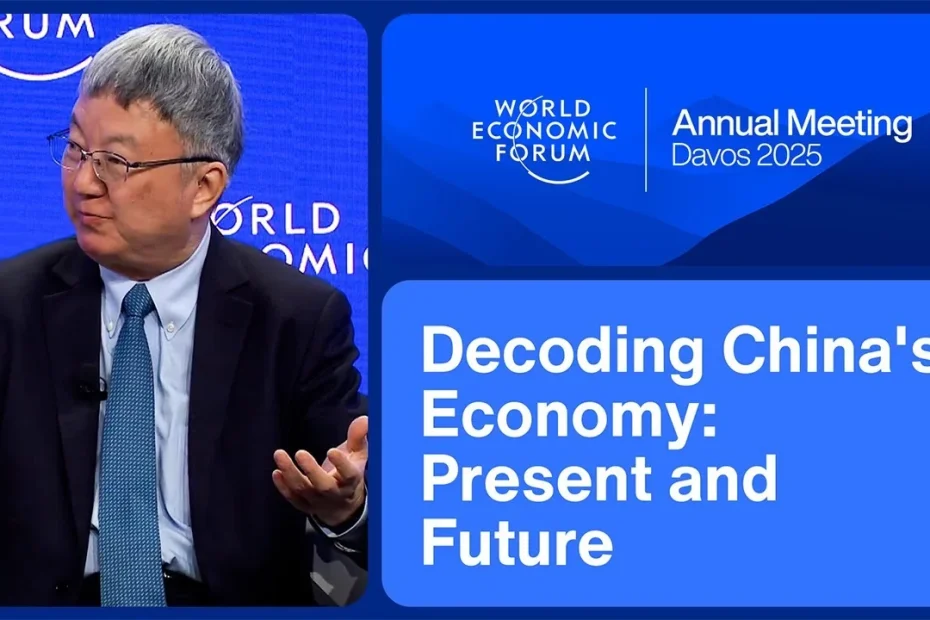
Read the full transcript of a panel discussion titled “Decoding China’s Economy: Present and Future” at World Economic Forum Annual Meeting 2025, [Feb 21, 2025]. Speakers include: Michael Süss, Bonnie Y Chan, Zhu Min, Hou Qijun, and Tian Wei is the moderator of this session.
Listen to the audio version here:
TRANSCRIPT:
Introduction
TIAN WEI: Good morning, ladies and gentlemen. Thank you for being the early birds, fighting the morning traffic and being here on time. Thank you so much. We are really impressed. With that strength and energy, the economy is no problem.
Good morning. My name is Tian Wei. What a pleasure to see you here in Davos at the Annual Meeting of the World Economic Forum. It’s such a pleasure. And we all know the topic today has been at the headline and in everybody’s heart for a long time.
What is going on with the Chinese economy? Well, in exact terms, “Decoding Chinese Economy: Present and Future.” This session is a joint session between the World Economic Forum and CGTN from China. As we know, over the past few months, one after another, stimulus policies or related measures have been made public from China. We see some impacts already, but many are expecting more to happen in the coming year, especially during China’s annual parliamentary season.
However, what do stimulus policies mean? And how will they work with the growth potential, especially in the transformation of the Chinese economy? That is the question to be asked. Meanwhile, are the Chinese consumers really spending? I’m sure everybody is asking that question.
Panel Introduction
Well, I’m no expert on either of these questions, but I’m so happy here to be joined by such a strong panel representing very different sectors who can bring us from the ground some really fresh information and insights. So it’s my great honor to introduce our panelists. I will start from the order of sequence given by the organizer.
Lady first, of course, Bonnie Chan, Chief Executive Officer of the Hong Kong Exchanges and Clearing from Hong Kong SAR. Bonnie, good to see you.
BONNIE Y CHAN: Thank you so much. Morning.
TIAN WEI: Hou Qijun, President of China National Petroleum Corporation, otherwise known as CNPC. Good morning, Mr. Hou. Thanks very much for being here.
I’m joined by someone who everybody knows here at the World Economic Forum, Mr. Zhu Min, member of the Senior Expert Advisory Committee from the China Center for International Economic Exchanges from China. Meanwhile, he also served as a member of the Board of Trustees for the World Economic Forum. Mr. Zhu, good to see you, Dr. Zhu.
Last but certainly not least, the gentleman sitting on my immediate left, Michael Süss, Executive Chairman of Oerlikon Switzerland. This gentleman has been working with China for more than twenty-five to twenty-six years, I just learned this morning. Good to see you.
China’s Economy and Trump 2.0
I remember Professor Schwab at the very opening of the forum this year said we all need to have a spirit of something called constructive optimism. Did I remember that right? Constructive optimism. With that in mind, let’s share that the number of China’s GDP reached its target around five percent. That’s the latest news. But even with that number, many are thinking… Dr. Zhu, since you are a great friend, I’ll tap on you first. Is China ready for both the opportunities and the challenges of Trump 2.0, the Chinese economy?
ZHU MIN: Wow. That’s a wake-up question. Is everybody awake? I mean, number one, Trump is unpredictable, right? Prediction is almost impossible. But it’s morning, so I’m still in half of my sleep, so I can say something I cannot remember maybe later.
I think number one, Trump is unpredictable. But Chinese say, you not only listen to what the people say, you watch what they do. So this is very important. He says so many things, but we’ll see what he will do. Yesterday, he announced he will impose ten percent tariff on China sometime next month, so we don’t know.
But the second point is also important. I think there’s a huge room for these two countries to work together and create a huge benefit for both countries. It’s much, much bigger than two countries who fight each other, having a winner or loser. We even don’t know who will win, who will lose. China still has a $320 billion trade surplus with US. This is a lot of room to work with. Chinese companies would love to invest in U.S. Now we are doing the reverse technology transfer like EV, batteries, all those other things. Fentanyl is another issue, right? There’s a lot of concerns.
So there are a lot of things that both countries can work together on. I do hope—I do believe the two countries will and can work together to find a mutual way. It’s good for both and good for the whole world. Chinese economy is already… Yeah.
But you never know, right? So third point, we’re looking for 2.0. We have to go back to what is 2.0 or what is Trump 1.0’s impact on Chinese economy. Trump’s 1.0 created three direct impacts.
The first is on trade. The US tariff before Trump launched 301 against China was 3.75%. So this is in line with the most favorable nation tariff. At the end of last year, it’s 19.7%. So the tariff actually in seven years increased 15%. So this is really a big impact. But China keeps exports roughly $450 billion to $500 billion US dollars to the US. China keeps roughly $350 billion trade surplus with US. So China really maintained its competitiveness. I think that’s important.
But still, on another side, China doesn’t have trade growth because all the growth is moving to other Asian countries and Mexico and others. So Chinese market in the U.S. import share shrank from 21% to 15% now.
So it does have impact on trade. I think that’s one thing.
The second issue is the impact on the equity market. If you look at 2018, Chinese equity market dropped 28%. We did a study on the post-review. We found this drop was very much linked with Trump’s trade war because of the confidence shaking and because of uncertainty, and because the capital moved out. It’s also very interesting. If you look at the US capital market, US capital market also slimmed at the beginning, but both went back.
And the third issue is Chinese companies started to move overseas to third places because to avoid the tariff. So if you look at these three issues, but in eight years, China remains strong in exports and the economy growth. You mentioned last year, 5% is still well. So China managed to go through the whole thing.
So we’re looking for 2.0. I will say China understands much better now, I think. So the first thing, the whole strategy is to make sure we do our own business well and right. So you see China announced, as you mentioned, a big stimulus package last September, which stabilized the market, boosted confidence, supported the equity market, which is sort of preparation for Trump to come back.
And now we focus on the economic side more on domestic consumption, more on manufacturing, sort of digitalization and more on the green transformation. So more on domestic market, more on the tech and make sure we focus on domestic market. We focus on competitiveness regardless of what happens outside of China, we’ll be able to survive.
Market Reactions to Stimulus
TIAN WEI: Well, you mentioned several points regarding China’s economy in terms of resilience, whether it’s Trump 2.0 or other changes happening around the world. I guess some of those points, we have to go to the experts sitting here from very different sectors about the market, the capital market. Bonnie, you have really a big say here. We are not here to do any personality assessment of any politician, by the way. We are here to talk about what would all of this mean for the economy.
From the market’s perspective, how are they seeing the latest interactions between the two presidents, President and President-elect at that time on the seventeenth of January. And also earlier in November—in September rather, when the huge package came out of a press conference, how did the market react? And what about the personalities now?
BONNIE Y CHAN: Thank you for that question. And I think actually you’re right. Capital markets are always a good bellwether to gauge sentiment. And Professor Zhu mentioned the stimulus package, which was announced in late September 2024. So let’s wind the clock back one year. I was at Davos 2024, January. And what I picked up at the time and a lot of you would have heard the same, “China is uninvestable,” right? We will remember we went through that phase.
Now fast forward to now or fast forward to September 2024. As a result of the stimulus package, which I think took quite a lot of international investors by surprise, all of a sudden, they felt, “Oh, need to get back in and very quickly because the momentum was so ferocious.” And let me put that in context.
So take Hong Kong, our exchange as an indication of the level of activity and I would say it’s spectacular. For the first six months of 2024, our average daily trading volume was around HKD 100 billion. Immediately after the stimulus package was announced, in the short course of two weeks, the Hong Kong Stock Exchange broke records three times in terms of the average daily trading volume. The first time we broke it, it was around 450 billion. A few days later, 506 billion. The third time we broke it, which is the current record, 620 billion, six times what we did for the first half of 2024.
And if you look at it in a more granular fashion, there were two forces in action. One, it’s the fact that overseas investors have to come in. Remember, this is end of September, early October, the beginning of Q4. Fund managers around the world are looking at it and say, “Oh, finally, the stimulus package that we asked for for a long time has arrived and the stock market has corrected positively so ferociously that if they don’t come in, they fear that they’re missing out.”
And therefore, we saw huge amount of what we call Northbound trading. This is foreign investors taking advantage of the Stock Connect program to invest into the domestic Chinese stock market. The record was broken again and the current record of northbound trading is actually RMB 510 billion. This is a high number. That’s the first force in place.
The second force in place was actually what we call southbound investment. And what is meant by that is retail investors, mainly retail investors in Mainland China taking advantage again of the Stock Connect program to invest in the Hong Kong stock market. And I’ll tell you that the current record is 40 billion dollars. That was on the eighth of October, right after everyone has come back from the National Day holiday.
And it’s actually a very good phenomenon. I think where you mentioned consumption, right? The reason that we are seeing consumption being a little anemic in China is because people are saving, right? They rather just hold on to the saving in terms of deploying that money into either consumption or investment. And that’s a problem. But I don’t think that’s a huge issue because I prefer that, right, saving and not consuming to borrowing and consuming. That’s my personal view.
TIAN WEI: Interesting. We’re to come back to you about that consumption question because everybody wants to have an answer to that.
BONNIE Y CHAN: Yes. Let me just quickly finish. I do want to leave time for the other speakers. I think if imagine you are a retail investor in China right now, it is frustrating as well because you need to generate return. And if you’re not buying real estate, if you’re not investing in the domestic market, if you keep your money in the savings account, it’s yielding you very, very little.
And therefore, I think what we all need to do is to bring back that confidence. I think once that confidence is back and people are now willing to take the money out of the bank account, put it in either consumption or the capital markets investment, that will generate the return, which will create that virtuous circle. And I think that’s when we can see the momentum grow.
Green Transformation in China
TIAN WEI: We see China is going through a transformation, structural transformation, especially when it comes to green transformation. Earlier, you have heard from the Vice Premier from China yesterday at the opening ceremony talking about how large that transformation has been and what it means for everybody. I guess there’s no better person to go among this panel than to Mr. Hou, coming from a leading energy company, not only in China, but also globally.
Mr. Hou, though, this morning was trying to tell me once and again in the green room that we are in the green transformation. That’s the keyword he always wants to tell me this morning. So Mr. Hou, I would like to ask you a couple of things here. China has this green transformation. You are a multinational. What is the speed, efficiency and direction like for you? And what is it ultimately going to mean for the Chinese economy?
HOU QIJUN: Well, that’s a rather good question, actually. President of China National Petroleum Corporation, our main business, of course, is oil, but we plan our own transformation, and that’s ongoing. We’re transforming into an oil, natural gas and geothermal generation, electric power and hydrogen company.
China is a developing country. And so industrialization and urbanization are still ongoing in the country. Energy is a driver of this process under primary product, and the demand continues to evolve for it. In the first quarter of the twenty-first century, China’s GDP has been at an annual average of about 8%. Energy demand has been growing at about 6%. In 2024, China’s energy growth was 4%. GDP growth was 5%.
Now what we have here is a large developing country with an interaction between energy and GDP growth, especially growth in electricity demand, which is a bellwether. And electricity growth last year was 7% in manufacturing.
Energy Transition and Manufacturing in China’s Economy
TIAN WEI: And services, you had a lot of Internet demand and data center demand, which was running at over ten percent in terms of electricity. Now energy is going to be playing a key role in the green transition.
HOU QIJUN: So obviously, as a petroleum company, we have a sense of crisis. And we are approaching the low carbon green transition with a three step plan.
Firstly, clean replacements. We are not only a big energy producer but also a big energy consumer. We can replace a lot of consumption with electrification and green electricity. We can replace a lot of petroleum demand with that.
Secondly, we are working hard to develop new energies. CNPC in Northwest and Northeast China has a lot of mineral resources. Now we have geothermal, solar and wind resources, which are quite rich in these places. So we’re trying to develop them in tandem with oil and gas. Our goal is by 2035 that oil and gas and new energy each take up about one-third of the pie.
By 2050, we have the goal that China’s carbon emissions peak. And so our third step of the process is the green transition. We aim at that point that all types of green energy, including hydrogen, account for about fifty percent of the mix by 2050.
We are developing a lot of wind and solar in Northeast and Northwest China. Also, have a lot of geothermal resources, and we’re starting some pilots with hydrogen. We’re transforming some of our petrol stations to places where you can also refill with hydrogen, and we have some pilots in cities of Beijing and Shanghai.
TIAN WEI: So talking about speeding up the transition transformation, you talked about three steps. Now how are they going now? Can you briefly introduce that?
HOU QIJUN: We have a very heavy sense of crisis. So we’re speeding up our new energy layouts. We are accelerating or increasing our investments. In the past, we increased invest not enough. Over the past years, our investment mainly in the sector of new energy, clean energy, and we also invested in the nuclear fusion in order to achieve a second or third growth trajectory. So we are implementing a lot.
TIAN WEI: Mr. Süss, go to you. Your company is one of the most advanced in terms of technology in your sector. But maybe not many people know that you are also a leading name in manufacturing machinery, especially concerning tech stock. You told me earlier that you’ve been in China twenty-six years, you yourself, because the textile industry interacted with you intensely. Can you tell us more when China is going through this structural reform, mainly the traditional manufacturing sector are leaving while the new transformation like Mr. Hou were describing are taking place. How is the manufacturing sector doing, in this case, the textile? Can you provide more specific picture for us?
MICHAEL SÜSS: So first and above, let me say that our company, EarlyCon, is even sixty years in China active. And I was participating in different areas of manufacturing in China by working in jet engines and in power plants. So in Siemens Energy, we built almost all gas fired power plants in China. I did a sixty-five thousand megawatt coal fired power plants there in my period.
So the amazing part is, and that’s the challenging part as well, China has developed impressive. And we have to be aware that the world would not have created that wealth without the Chinese growth in the last thirty years. Vice versa, China would never have achieved that only on their own without all the interaction with Europe and the U.S. mainly.
So this gives me this challenge towards, first, open borders. But that was where companies like ours and my previous companies always participated in this open sky and these open borders to exchange technology, not in a naive way. There was always certain geopolitical questions even thirty years ago, but in a way that you can work and trust together. So trust and confidence is, as you have said already, it’s the base for all economy.
What I have seen I’ll give you an example in AM at Advanced Manufacturing, 3D printing. When it was 2014 in Tinshaw University, it was basic. When it was 2019 there, it was already equal to that what we did in Europe and U.S. And actually, it’s full top notch what China is doing there.
Manufacturing, I was a year ago last time there, I was not there last year, I have to say, but it was so busy in other areas. A year ago, when we visit my customers, on the coating part where we do cutting, coating for cutting industry, cutting tools, molds, medical, all these other all these industries, they’re top notch. There is no distance to anything what you find in Europe or in U.S. That was maybe ten, fifteen years ago was different.
The big challenges for China on the energy sector, for example, which leads into manufacturing, because you need a lot of energy and you have to grow there, that the last ten years, China reduced the coal fired based electricity from eighty percent to sixty percent, but it’s still sixty percent. And the economy is growing. So sixty percent from something bigger is maybe not eighty percent of something smaller, but maybe seventy percent of the past. So the percentages, the coal impact in China is still massive. And it’s strategic because China has top notch coal in huge amounts.
So from a strategic perspective, you have to get out of a source, which you have on your own, and you have to get in other sources, and it’s not renewables. Renewables is today eighteen percent in China. Nuclear is only four percent. So this challenge is, on one hand, to grow economy, to build back consumer trust and to compete internationally in a new world where there is more competition.
There is not with the fall of the iron fence, some of the old behavior, bilateral, whatever, walked away. President Trump, businessman, but he is a dealer. He wants to have bilateral relations. So countries, we had a discussion on Sunday on about Asia European relation. It’s multipolar. So you have to find we as a company have to find our way in which areas we can do work in China without conflicting our work in Europe or in the U.S.
So can I do defense activities in China? Actually, no, I cannot. Can I work on energy? Yes, I can. Can I work in medical? I can do. So we have to find our way how we keep working together because only then we can grow wealth. And we have to grow wealth because there are still a lot of people very poor on this planet.
And we have to develop manufacturing because in the end, don’t take me wrong, but bits and bytes you cannot eat and you cannot sit on. If you don’t have a manufacturing sector, you don’t have a sector who is creating a lot of jobs. And in the end, it’s about jobs. People need to work where they can rely on and where they can spend money out of their salaries. When you don’t work on this manufacturing sector, we lose a huge opportunity.
TIAN WEI: One could tell from which sector Mr. Süss is coming from. Dr. Zhu, having said that though, that debate is vibrant, not only in China, but also all over the world. You see that reflected in so many elections last year, almost half of the world’s population went to elections, and there’s incumbent and there’s coming parties, and that’s certainly reflected. Having said that, though, how do you see the discussions, All of the answers coming from the other three panelists really reflect that, the lively discussions going on in China about the directions of the economy and the speed of making that change, given the fact there are external uncertainties, there are also internal factors that needs to be improved. Dr. Zhu?
China’s Economic Transformation
ZHU MIN: I think I’ll take another three hours. Know, but the first question already could take three hours. If I can do, I mean, the China growth model usually based on three things. The first infrastructure investments, which will account more than fifty percent of the GDP. Return is so low, it’s gone. The second engine is very much on the exports, right, given the external environment is more or less gone. The third engine is on real estate. It’s overcapacity. It’s really big issues. It’s gone, right? So all gone.
So what China do? So given the situation China think of focus more on domestic market, I think this is very important. We need three new growth engines. Domestic consumption is number one. Number two, make sure the Chinese manufacturing becomes stronger. This is the key competitiveness of China’s economy.
China’s manufacturing account roughly thirty point three percent of global GDP. It really is equal to total of the U.S. plus Japan plus Germany plus South Korea together. So it’s a huge manufacturing. The whole thing is the weather. We can make sure it’s part continue the move up the value chain.
So in the forty years China economic reform, in the first twenty years Chinese people working so hard, labor cost so low. We made made in China as cheap. So in the next twenty years, because we improved the quality. So made in China means cheap and good. Now we try to digitize the manufacturing. So in the next twenty years, we’ll make sure made in China means cheap, good and high technology.
The third is a green transformation as Mr. Hou just mentioned. I can tell you it’s very interesting that China’s green transformation story is very different from here, from whatever. I mean, people talk climate change more in international arena, but China think the green transformation is a real economic growth thing because it solved China’s energy security issue. Well, we import a quarter of global oil, a quarter of global gas, which is not sustainable. Right? We pollute air, water, and the soil, which is not sustainable. So green transformation give China a window opportunity to move to a sustainable approach. This is important.
Move very fast as Mr. Hou mentioned. I can tell you today, the solar power cost is only fifty percent of a coal power cost today. Coal power will come because the cost everybody talk about Chinese EV. Chinese EV roughly half cost of whatever comparable same level European cost. It is the cost. It is efficiency. So the green transformation has really become the growth engine now.
TIAN WEI: But Mr. Zhu, the more you talk, member of our audience feel more threatened because China is so much, as you said, efficiency, low cost and what is job for everybody else?
ZHU MIN: That’s a good question Because today, manufacturing before the manufacturing is a scale. Scale is the cost. Right? It’s efficiency. But now it’s also technology because iteration, because everything is digitalized. So you have a scale. This means you have a low cost efficiency and also high price margins. So I think that’s the real thing. So I think that’s the reason China need to open the wall to invest in the whole world. The whole world would love to work with China. China can do the technical transfer investments. I think this has become ever more important.
TIAN WEI: Yeah. Just to be fair, I give Mr. Süss a little bit more time also to respond to that. And then I, of course, go to Mr. Hou and Bonnie as well. So please, Süss, you only have limited time, please.
MICHAEL SÜSS: So I don’t want to jump on that. I think to have this growth in China, we participate on that. And you mentioned the textile industry. Textile industry China is leading and is employing millions of people. The case is we create these whole customers. As more as we do as we grow manufacturing sector, we create customers in China as well. China has one point three billion people, but not all of them are rich people. There is still a lot of poverty there.
So with growing of manufacturing sector, then this is what we have seen after Second World War as we in Europe. To grow with the manufacturing sector, you grow customers. With the customers, you grow demand. And with this green energy change and you’re right, China paid a high bill on solar and air and water within the last thirty years to do this industrial development they have done.
So and we participate with technology. And it’s not a there will be always competition, but the competition in a way that if you compete each other in total, we all will win. If we try to exclude competition, we get lazy, get poor, we rely on ourselves. So protectionism, and you can study that the last one hundred years. Wherever society tried to keep their work by protectionism, they lost.
In the end, they lost. Maybe you can say five or ten years, but then you lose. The only answer is be innovative as our company has done since one hundred and twenty years, otherwise we wouldn’t exist. Question whatever you do and make it better every day, every morning, which we could learn in China the last thirty years, but not only in China.
Europe as the seen as the museum of the world is still one of the big innovation, areas in this in this planet, and they only limit themselves sometimes by the targets they are giving them. But U.S, Europe, China, the big blocks, they can drive so much together if they work together. They may have different political opportunity, opinions. We have to deal with that. Different views, we have to deal with that. But if you stop the competition in a positive sense, if you stop the openness to work together, we will not develop the next twenty years in a way how we have developed the last twenty years.
TIAN WEI: Got it. Okay. Mr. Hou, this is very interesting about how In Chinese. Chinese. But I will it’s very interesting how we are seeing this discussion about how China fits into the global landscape and the other way around. I wish to raise a question to Mr. Hou. As a big company, as a champagne company, and how does your company position yourself at the international level? And how do you face competition and opportunity?
HOU QIJUN: Thank you for your question.
Chinese Companies Going Global
TIAN WEI: Did you take the jobs of everyone else? Did you take the opportunity of other people? Or do you only earn profit for yourself? Or do you think there can be some collaboration and win-win? We are an SOE, but also we are an international company in oil sector.
HOU QIJUN: Domestically, we supply fifty percent of oil and thirty percent of natural gas. And also in accordance with the Belt and Road Initiative, we have been investing overseas for the past three decades. At present, we have invested in over thirty countries in oil sector and also we are investing in eighty countries in manufacturing sector and so on. So we are an example of Chinese companies going international over the last thirteen years.
First of all, we have been learning from our peers at the international level and we are trying hard to comply with international standards to respect local laws and regulations to compete in a fair, transparent manner. We are also cooperating with big oil companies in Africa, in Middle East and Russia. A lot of projects are going on there. So we are trying to be rule-based. And secondly, we’re working to try to achieve a win-win.
When we’re investing in, for example, in Africa, in Middle East, we pay much more attention to our social responsibility of the company of enterprise. We pay much attention to religion and culture and livelihoods. We have been donating, investing for some small but nice projects. We try to maintain with the local population to garner their support. And apart from investing in oil and gas, we are also investing in, for example, renewable energies in Africa, in Middle Asia, for instance, the PV projects.
TIAN WEI: So what kind of opportunities did you create for local people?
HOU QIJUN: We took a stock. Our localization rate achieved eighty-five percent, which means we hired over one hundred thousand local people overseas, and we also contribute to the social development in the countries where we invest.
TIAN WEI: Earlier, you really want to comment. Would you like to do that? Or should I leave you with your—
BONNIE Y CHAN: No, I’ll make a comment. I think going back to that term, that phrase constructive optimism, I want to first echo what Michael mentioned. And I think Professor Pauschard picked those words quite carefully, right? Optimism, I think we sort of know what it is.
What do we mean by constructive? My personal interpretation, two things, okay? Both competition and collaboration. And those two can actually go hand in hand. In Chinese, there’s a term called “competition and collaboration going hand in hand.”
Now going back to Mr. Ju’s comment on the three things, which China wants to focus on, domestic consumption, uplifting manufacturing quality and green transformation. And that green transformation is an area I feel that this spirit of collaboration and competition could be best manifested. Why do I say it? I actually issued an article on the web forum a week ago, which talks about how China can help the world in the green transitioning.
Now of course, China is doing it for its own reasons as well. And by the way, I’m sure every one of you in the last few days have heard a lot about AI. And AI, one critical ingredient to make it successful is obviously energy, the computing power that consumes a lot of energy. So I’m sure with the work that, for example, Mr. Hao is doing, that gives a very guaranteed source of energy, which will help in that AI journey.
However, more importantly, I think as China is going to do all things to achieve the targets, the carbon neutrality targets, we have not forgotten about the rest of the world. I mean so many countries where you are all from have already stated targets to achieve carbon neutrality by 2050 or 2060, whenever it is. The one million dollars question to me is still how do we get there? How do we get there without the technology, without the innovation? It’s very difficult.
And the cost, right, it could be prohibitive. And therefore, I think in the course of competing, let’s also not forget about how we can, on a collaborative manner, come up with a solution that everyone can actually make use of so that we don’t just throw these objectives out. And by the time we get to 2050, everyone just struck their shoulders and say, well, we missed the—
Chinese Consumer Confidence
TIAN WEI: Right. Earlier, we promised everybody we’re going to talk about the domestic consumption. Are the Chinese consumers really buying? Are they really consuming? So we have very limited time. If you could just within thirty seconds give your perspective, we’ll be really welcome. Maybe we start from Mr. Süss.
Thirty seconds only because we also want to give some time for the audience to ask questions. Okay. The clock is on.
MICHAEL SÜSS: Can I ask how 2025 will still be difficult in the consumer attitude? What we see clear indication about growing out of the textile industry again in 2026. So orders are picking up, and orders can only pick up if there’s some trust. But 2025 still will be somehow a little bit flat year.
TIAN WEI: Mr. Ho, are Chinese consumers out to consume? How do we get them to consume more?
HOU QIJUN: 2025 is going to be a year where the key task is to stimulate the economy through consumption. I’m quite confident about that, particularly with people’s desires for a better life. There’s going to be demand for new products. You have to give people real support, so employment, pensions and so on. You have to increase their income.
TIAN WEI: Bonnie?
BONNIE Y CHAN: No, just one word, confidence, okay? You need to bring back confidence then people will start consuming. It’s a whole lot of discussion as to how to bring back the confidence. Thank you very much.
TIAN WEI: We’re going to follow on that in the future. Doctor Zhu?
ZHU MIN: Chinese consumers is way low from macro level, right? Total fifty-two percent is way low. I mean it’s very clear. The Chinese consumer goods is not necessarily low. They count thirty-two percent of GDP, which is very much in line with Chinese GDP in terms of thirty thousand dollars per capita. Actually the thirty-two thousand will drop gradually because the world consume less material, consume more service. We need a development of service, of conservancy.
What is service? Health, education, tools, culture, sports, all those things is so small. Alright then. Well, we are having a great potential in those sectors.
Audience Q&A
TIAN WEI: We have two and a half minutes left. I’m so sorry, ladies and gentlemen. Very limited time for Chinese economy. Anyone raise your hand, we collect the question, then we let them answer. Please. Yes.
AUDIENCE QUESTION: Thank you so much. Can you do a very quick question? Yes. My name is Cavilo Masyke from Eskom South Africa. The need for renewable energy in Southern Africa, quite massive. Opportunities to collaborate with Chinese companies, but the domestic requirement to uplift domestic production and industrialization. Is it now a conflict between collaboration and competition? Or is there some way there where we can meet?
TIAN WEI: Got it. Especially with the global south in a way, right? Okay. Any other questions? This lady in the very front row.
AUDIENCE QUESTION: Can AI help in the research of nuclear fusion? Because as we know, nuclear fusion can give us a lot of energy, but everyone is afraid of the devastation.
TIAN WEI: AI and nuclear together. Okay. How would what kind of chemistry would that come out? All right. Any other question? No? Well, it seems that we are covering all issues. Very quickly to respond to China’s collaboration or competition with the global south. Anyone want to touch on that? Doctor Zhu?
ZHU MIN: Well, I’ll just give you one example. One Chinese company set up the solar power company in Saudi. It’s close, but not in South Africa anyway. The cost is one cent of a US dollar, one kilowatt an hour. Take the nuclear new one. It’s absolutely stunning lowest level in the world. The only thing we need to do is to make sure it’s a small scale, independent, solo, storage, grill, distribution, and the usage, you put them together financed by the waste system. So then the model can expand the whole continent.
TIAN WEI: Got it. Let me ask Mr. Ho to come in on this because you’re active in very many parts of the global south.
HOU QIJUN: Well, talking about Africa, there’s a lot of resources that can be used for new energy in Africa. We have a lot of projects and a lot more that we have under discussion in African countries to develop new energy in Africa. There needs to be more commitment to infrastructure, particularly to power grid development in Africa, but we’re ready to work together with African countries.
TIAN WEI: So it’s whole ecosystem collaboration. The other question, AI nuclear? Yes, briefly, So, and also Mr. Zhu, please.
MICHAEL SÜSS: So short term, not? Short term, very short. On short term, you will not have the fusion solution with or without AI. There will be a nuclear comeback. The question will be, are we doing that on the third generation as we had? And do we get the supply basis? Or are we ready to go for the first generation? If we go for the third, we still have to answer what happens with the nuclear waste, which is still not answered.
ZHU MIN: Another whole set of fascinating questions to come as a result of that. If I can add one thing, because this is absolutely important. I think AI is the most important instruments to support fusing nuclear today because in the U.S. You know NIF, right? Because AI is the laser beam, we first time produce the power more than input power, the first time. In China, there are two models, laser based model, Tomac based model, also supported by AI system.
So with the AI, I’m now become more optimistic to see the fusing nuclear is coming. Yeah. But competed with one cent of a dollar, one kilowatt of solar power, It’s not all clear, futures fusing nuclear or solar. I just said a year ago, everybody say future is fusing nuclear, but today, it’s not all clear.
TIAN WEI: All right. Thank you very much. Bonnie, I think you really need to touch on that question as well. How will the stock exchanges and others encouraging these new options of technologies? Very briefly please.
BONNIE Y CHAN: Very brief. Okay. Whatever we do to you need funding, you need funding so that people can innovate, can create new technologies, can cooperate, can collaborate, can compete. The stock exchange does one simple thing. We match capital with opportunity. So if we can do our part to bring the capital so that all these economic activities and innovation can continue, we’re very happy to.
TIAN WEI: Thank you very much. On that note, we are wrapping up this discussion, forty-five minutes about Chinese economy. Can we really do that? Well, mission seems to be quite possible, at least for now. But there are many other questions we haven’t touched on about the real estate issue, the local government debt, many of those already in a way related to the answer.
We hope we’ll have future opportunities to discuss them. Hopefully, there will be great results a year from now. Thank you so much, ladies and gentlemen, once again. And thank you so much for everyone in the panel.