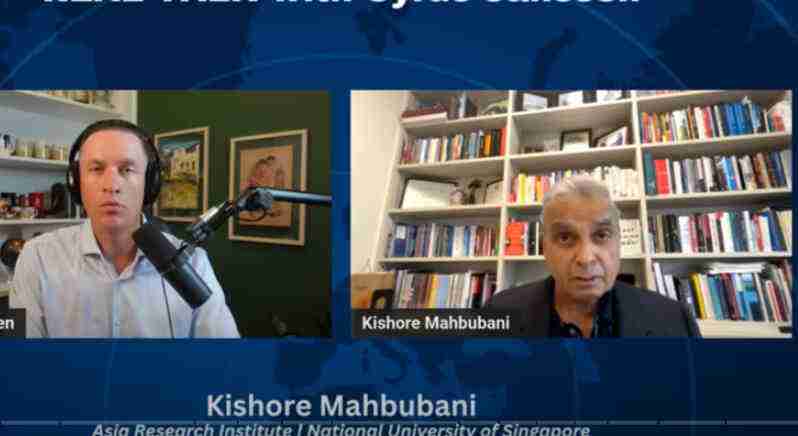
Read the full transcript of a conversation between geopolitical analystCyrus Janssen and Professor Kishore Mahbubani on Ukraine and Future of Europe, [Mar 8, 2025].
TRANSCRIPT:
Introduction
CYRUS JANSSEN: This is Kishore Mahbubani. He is one of the most accomplished geopolitical experts in the world, the former President of the United Nations Security Council, and a distinguished fellow at the Asia Research Institute. Professor Mahbubani is the author of several books, including “Living in the Asian Century” and his groundbreaking book about China’s growing influence in the world entitled “Has China Won?”
In today’s interview, Kishore and I dive into the European role in the negotiations surrounding the end of the war in Ukraine. As tensions rise, European leaders find themselves sidelined with no clear voice in the negotiations between the US and Russia. Professor Mahbubani recently authored an article for Foreign Policy entitled “It’s Time for Europe to do the Unthinkable.” And in today’s video, we go through Europe’s three options for the future and how the war in Ukraine can effectively end.
Later in our interview, we shift focus to China. And I asked the professor to share his thoughts as a Singaporean on how China is increasing its influence throughout the world. We discussed China’s latest developments in AI and renewable energy. And I bluntly asked the professor the same question of his book title, has China won?
Finally, we end our discussion debating the most dangerous issue in the world, which, in Professor Mahbubani’s opinion, is the future of Taiwan. Trust me, you’ll want to hear every minute of today’s conversation. And make sure you watch to the end as Professor Mahbubani reveals his exact strategy on how Western countries should handle China. Let’s begin.
Well, ladies and gentlemen, it is a great honor to welcome into the studio Professor Kishore Mahbubani. Kishore, thank you so much for joining us today. And we look so forward to this discussion.
KISHORE MAHBUBANI: My pleasure. Thanks for having me.
The Ukraine War and European Pragmatism
CYRUS JANSSEN: Absolutely. Professor Mahbubani, I want to start off discussing the biggest geopolitical conflict that’s in the world right now. Of course, the Russia-Ukraine war. And I’m sure that we could have a very long discussion on what triggered this war. A lot of people saying it’s NATO expansion, but you recently had a very interesting comment that said that the absence of pragmatism in European culture is a big factor. I’d like you to explain a little bit more about that.
KISHORE MAHBUBANI: Yes, I mean, the tragedy about the Ukraine war is that this war was eminently preventable. It was an accident that need not have happened. And the reason why it happened is because the Europeans have become geopolitically incompetent. And I say this with some confidence because the person who gave me this insight was Henry Kissinger. I had a one-on-one conversation with him about a year before he passed away in October 2022. And he was lamenting the fact that the European leaders are no longer thinking big picture long term and looking at the overall environment before making political judgment.
So, for example, I want to emphasize one fact so that there’s no misunderstanding. The Russian invasion of Ukraine is illegal. Nothing can justify that invasion. That’s very clear. But at the same time, that invasion could have been prevented if the Europeans had shown any kind of geopolitical competence and acknowledged that since they have to live with Russia over the next hundred, maybe a thousand years, maybe they should take into consideration Russia’s security concerns and especially if Russia feels threatened by some moves that they’re making.
And the Russians made it abundantly clear that the continuous eastwards expansion of NATO was endangering their security. And they gave all kinds of warning signs. And American scholars like John Mearsheimer and Jeff Sachs have actually provided a lot of data that shows that these warnings were very, very clear. And it’s very puzzling that the European leaders chose to ignore these warnings and continue to push for the expansion of NATO.
And I think, of course right now, as you know, the Europeans are paying a very heavy price for their geopolitical incompetence. Because the one lesson of history, and this goes back 2000 years, never put all your geopolitical eggs in one basket. And the Europeans put all their geopolitical eggs in one basket, called the United States of America, on the assumption that the United States of America would always, in one way or another protect European interests, even by sacrificing American interests.
That was an absurd geopolitical assumption because all great powers will always put their interests first. So in a sense, whatever Donald Trump is doing now is behaving like a logical great power leader. Whereas the Europeans have been behaving as incompetent leaders by not considering worst case options when they enthusiastically supported this expansion of NATO.
CYRUS JANSSEN: Yeah, that’s a very good insight there. So do you think with Donald Trump’s pivot now and really changing 180 degrees from the previous administration, would you just say that that is more him acting in United States best interest and like you said, acting like a superpower? So this has really come to be expected, this Donald Trump’s move?
Great Powers and Their Interests
KISHORE MAHBUBANI: Well, unfortunately, geopolitics is a very cruel business, and people who are naive and simplistic in the analysis of geopolitics always suffer. And yet at the same time, some of the rules of geopolitics are also very clear. All great powers, including the United States, will always put their own interest first. It will never sacrifice its interests for even the best of friends, including its European friends.
It was very naive for the Europeans to believe that the United States would always put European interests first in dealing with Russia. Why should the United States do that? The United States has got its own interests and the United States is now trying to work out a new relationship with Russia.
And this could have been anticipated some time ago.
And so I think it’s important for the Europeans to sit back and reflect and ask themselves, why were we so naive? Where did we go wrong? And what can we do to make sure that we don’t make the same mistakes again?
In my article, I gave three specific suggestions for the Europeans: 1. Consider withdrawing from NATO to send a signal that you’re autonomous and independent 2. Work out a new grand strategic bargain with Russia 3. Also consider working out a grand strategic bargain with China
So in a sense, act in your own interest and not in the interest of any other great power.
Europe’s Three Options for the Future
CYRUS JANSSEN: Absolutely. I love that. And the article that you’re referring to, we’re going to put a link down in the description. It was an article published in Foreign Policy entitled “It’s Time for Europe to do the Unthinkable.” And you hit on each one of those three points. I wanted to dig a little bit deeper into those, though, because you say the first thing that Europe – one solution. You’ve given three practical solutions here for Europe, and I love the way that you frame that. They’ve made some mistakes. They’ve got to really think about their future because they were very naive geopolitically. So what would that look like if Europe were to leave NATO and for example, your first suggestion, what would that actually look like?
KISHORE MAHBUBANI: Well, I think it would send a very clear signal that Europe is declaring its geopolitical independence. And hence, from now on, Europe will act as an autonomous strategic actor on the world stage putting its own interests first.
And as I even concede in the article, Europe may not necessarily have to pull out of NATO, but by just declaring that it is prepared to leave NATO, it is sending a signal that if you don’t take my interest into consideration, why should I remain a member of this club?
And the best way for Europe to be treated with respect is to declare that it is willing to leave NATO. Because its insistence on staying on in NATO, even though the United States has completely set aside European interests, gives the impression that the Europeans, as I say, in a somewhat cruel fashion, gives the impression that the Europeans are licking the boots that are kicking them.
And that’s very unwise, extremely unwise in geopolitics, because in geopolitics you got to be equally cruel and canny and shrewd if you want to protect your interests. And the best way to do that is to declare that if European interests are not taken into consideration, Europe is prepared to leave NATO.
CYRUS JANSSEN: Right. Professor, tell us about the second option. I think you’ve been – a very interesting thing is actually, I like what you said earlier is that Europe, knowing that they’re going to have to live next to Russia for the next hundred years or one thousand years, is actually working closer with Russia. And I’d like you to expand upon that. I mean, we know before the war, for example, most of the natural gas that was going into Germany, obviously going through Nord Stream pipeline, that was a very, very key element to Germany’s manufacturing prowess. I’d like you to expand upon the second point. You know, is it possible for Europe to actually move closer to Russia after this conflict and after what we’ve seen.
Learning from Southeast Asia’s Pragmatism
KISHORE MAHBUBANI: Definitely. In geopolitics, you must always put all options on the table, including, as I emphasize, the unthinkable options. And people forget. I mean, this is why I wish the Europeans would study Southeast Asia for a bit.
You know, when ASEAN was set up in 1967 in the Cold War as a pro-American organization, its creation was denounced by both Moscow and Beijing in 1967. And one would assume that, okay, because of that, ASEAN will forever be caught in an antagonistic relationship with its neighbor China. But the ASEAN countries are extremely pragmatic. They said, hey, we have to live with China for the next 1000 years and we got to make sure that we find ways or means of getting along in such a way that on issues that are important to us, we stand up with China. And yet on other issues that are important to China, we find ways and means of getting along with China.
So, this is what pragmatism is all about. You adapt and adjust, and you negotiate a fair compromise, and then you have a good relationship for the long term. And I’m astonished that the Europeans didn’t make any such effort at all to understand Russian concerns and to work towards building up the trust of the Russians with Europe.
And this is an obvious thing that the Europeans should have been doing because, right now, the United States is clearly the number one power in the world. No question whatsoever. One of the biggest lessons of history is that no one power remains the number one power forever and hundred years from now, United States may not be the number one power, may not be the number two power, may be the number three, number four power.
If geopolitics is going to change, you must always keep your options open. But one thing that doesn’t change are your neighbors. Your neighbors never go away. And a strong country like Russia, a resilient country like Russia, is not going to disappear anytime soon.
So at the end of the day, the Europeans have to live with Russia over the next 1000 years and live with Russia even when the United States is no longer the great power. So why not work out your own autonomous arrangements with Russia instead of saying, oh, when it comes to Russia, we’ll just loyally follow whatever the United States does. And that’s very unwise of the Europeans. And I say this as a friend of the Europeans. I’m trying to say, hey, take care of your interests first.
CYRUS JANSSEN: Yeah, absolutely. I think both of these options are fantastic and very, very insightful. I’d like to talk about the third one, because this one specifically involves China. And I think you bring up a very interesting point here. We see a tremendous amount of migrants moving away from Africa, going into Europe, and why? Because they’re searching for a better life. They’re wanting more opportunity. As we know, Africa has a tremendous amount of potential, but has not been as developed as it probably should have been.
But there’s an opportunity now, potentially to move closer to China. And I think we saw very interesting – the German trade minister had said that, for example, if they get caught in a tariff war with Donald Trump in the United States, you could potentially see Germany combating that by actually shifting closer to China. So I’d like you to talk about option three, that Europe can actually move closer to China and what that would mean.
The Demographic Challenge for Europe
KISHORE MAHBUBANI: Well, I think, you know, one of the key points I emphasized about geopolitics is that you got to be very cold and calculating in trying to assess where your next big threat is going to come from. And in the case of Europe, the next big threat is not going to come from Russian tanks at all. It’s going to come from the demographic explosion in Africa.
I think here’s one statistic that every European should know. In the year 1950, Europe’s population was twice the size of Africa. Now Africa’s population is more than 2½ times more than Europe. By 2100, Africa’s population will probably be 10 times the combined population of the European Union. 10 times.
So if you have a lot of Africans, and unless you promote the growth and development of Africa, there’ll be more and more Africans trying to cross the Mediterranean into Europe. So how do you prevent a major migration from Africa to Europe, assuming that you’re not going to start killing people at your borders?
The only way to do that is to support the economic development of Africa and support any country which invests in Africa, because every piece of investment in Africa is a gift to Africa and a gift to Europe at the same time.
So if the Europeans were smart, they should welcome Chinese investment in Africa. But what I find quite shocking is that leaders like Ursula von der Leyen and Annalena Baerbock are sacrificing European interests by criticizing Chinese investments in Africa. This goes against European interests. Why are you doing that?
Actually, China is doing European Union a favor by investing in Africa. And the European Union, in fact, should be working with China to promote more Chinese investment in Africa rather than trying to oppose it because the United States opposes it. So again, this is another example of geopolitical naivete on the part of the Europeans.
This is something that I hope that the Europeans will consider seriously. And I understand that the Spanish government, in addition to the German trade Minister, the Spanish government has also come out to say that it’s time for Europe to forge its own independent policy towards China.
CYRUS JANSSEN: Yeah, I think that’s a very big shift that we’re seeing from Europe. And I think they’re going to have to shift closer towards China.
The Belt and Road Initiative
I want to segue. I think this kind of segues perfectly into our next point, which I want to talk specifically about the Belt and Road Initiative. The Belt and Road (BRI) is over 10 years old now. We’ve seen trillions of dollars invested from China, over 150 countries now around the world have signed up, which is an incredible number if there’s 193 nations in the world.
I’d like to get your thoughts on the BRI in general. Has it been successful? What does the future of that look like? And your thoughts as a Singaporean, as you’re looking at China’s investment, not just in your region, in your backyard, but really all over the globe. I mean, they have a massive footprint now. Please share your thoughts.
KISHORE MAHBUBANI: Well, I think you’re absolutely right. It’s quite remarkable that over 150 countries have signed up to join projects affiliated with the Belt and Road Initiative, or BRI. And the reason why that’s remarkable is that the Biden administration actually went door to door to every country in the world and said, don’t join the BRI, don’t join the BRI, don’t join the BRI.
And, you know, so countries had to choose between taking the advice of the Biden administration or joining the BRI. And most countries in the world said, the BRI is going to give me an opportunity to improve the infrastructure of my country, improve the trade links of my country. Why should I say no to it, right? Just because the United States asked me to say no to it.
So it was very unwise of the United States to try and persuade countries not to join the BRI. The fact that 150 countries had joined showed that the American campaign against BRI has essentially failed.
Now, of course, there are some countries that have refused to join the BRI, and they have every right to do so. I mean, Japan hasn’t joined, India hasn’t joined, Australia hasn’t joined. But that’s fair enough. They can do so. But the fact of the matter is that most countries in the world have decided to do so because it has led to concrete benefits.
So you take, for example, Singapore’s neighbor, Indonesia. The Indonesians, as you know, work with China to build a fast train between Jakarta and Bandung. And the Indonesians are elated that they have this incredibly fast train. And Indonesia, as you know, is, in relative terms, still a developing country. Its per capita income is much lower than that of the United States. But Indonesia now has a much faster train than United States does, a train that is called Swoosh, if I’m not mistaken.
And, you know, so it’s remarkable. So this is not just about infrastructure, because when you build a fast train and people in Indonesia say, wow, my country can have a fast train. Guess what else my country can do. It also enhances the psychological confidence and also the psychological well-being of the population to see successful infrastructure projects being built and completed in their countries.
And therefore it was very unwise of the United States to oppose the BRI. And I think the United States frankly should now try to do the opposite, which is to welcome the BRI investment in United States because frankly, much of United States infrastructure looks pretty third world. If you go to United States airports, if you take a fast train in the United States, and in fact, if you see some of the bridges collapsing in the United States, it would make sense for United States to work with China and BRI rather than to oppose the BRI.
Now, I know it’s not going to happen anytime soon, but it’s an unthinkable option that the United States should consider for the future.
Has China Won?
CYRUS JANSSEN: Wouldn’t that be amazing, the United States signing up to be on the BRI? I mean, I completely agree with you as far as the infrastructure and how this country is operating right now.
I’d like to talk a little bit more about China because I know this is a country that you’ve studied tremendously and traveled there many times. I’d like to get your thoughts because in 2020 you authored a book called “Has China Won?” And I think 2025 has been a very interesting year.
You know, we’ve seen these TikTok refugees, millions of Americans being frustrated with the US Government wanting to ban TikTok and then go to Xiaohongshu, which is Red Note, the Chinese app, and having these amazing cultural exchanges. Millions of Americans, millions of Chinese exchanging and learning more about each other’s culture.
We then saw Deepseek come out and completely revolutionize the future of AI. Almost overnight it seemed like, but really a breakthrough. Just last week we’ve seen China launch this animated film that grossed a billion US dollars in the first 11 days in the box office. I asked you five years later here in 2025, has China won?
KISHORE MAHBUBANI: Well, as you know, in my thesis, in my book called “Has China Won?” there is a question mark there at the end of the question. The title is not “China Has Won.” But there’s no question that a lot of the key points I made in the book still remain valid, even though the book was published in 2020.
The first point I emphasize is that the United States has launched a geopolitical contest against China. And I said, American presidents may come, American presidents may go. It makes no difference, because this contest is driven by structural factors. And fortunately or unfortunately, my predictions have come true.
You’ve had two very different presidents, Trump and Biden, since the book was written. But despite their differences, the consistent American policy of trying to stop the rise of China has continued.
And secondly, I do have to make a key point that whatever the United States does, it must never underestimate China, because China, at the end of the day, still represents the world’s oldest continuous civilization. It’s been around for over 4,000 years. There’s a reason for that.
And in fact, all the remarkable achievements that you point to, whether it’s Deepseek or China’s manufacturing prowess or China’s work in battery technology, EVs, and so on and so forth, China is a remarkable country, and I think many Americans make a serious mistake of underestimating China.
But a third and equally important point I make in the form of a fictional memo to President Xi Jinping in chapter one of my book is that now that the geopolitical contest between the US and China has begun, China, of course, must believe that it’s going to win. But whatever China does, China must never underestimate the United States of America, because the United States of America is a remarkably successful society and has achieved wonders.
I mean, just to give you one statistic, in the year 2000, the European Union and United States economies were about the same size. Now, the European Union is only about 2/3 the size of United States. So, you know, the European Union clearly, as I’ve indicated in my earlier remarks, has lost its way. But the United States still remains a formidable great power, and it has a culture of innovation and entrepreneurship that keeps its economy very, very strong.
And that’s why I encourage the Chinese to also treat the United States with respect, just as I encourage the Americans to also treat China with respect.
The Taiwan Issue
CYRUS JANSSEN: That’s fantastic advice. I completely agree with that. And I’d like to get your thoughts. Being a Singaporean and being right in the middle of Asia, and we have these two great powers, the US and China, what is really the one geopolitical conflict or situation that you would fear the most for the future of our world?
Is it potentially a US-China conflict happening somewhere in the Taiwan Strait, for example? Is it the continuing problems that we see in Europe? Is it something else that we’re not aware of? What is, given your analysis and your location in Singapore, for you, that one big event that you’re looking for in the future?
KISHORE MAHBUBANI: Well, I think the most dangerous issue in the world, bar none, is the Taiwan issue. No question whatsoever. And in fact, I explained that, of course, in my book “Has China Won?”
Taiwan at the end of the day is a very hot potato politically because it is the last living symbol of the century of humiliation that China suffered from 1842 to 1949. And I think it’s very important for every American policymaker to study what this century of humiliation means for the Chinese mind.
And that’s why I came out with an EDX course, a short four-lecture course on the century of humiliation so that Americans could understand it better. And as you know, Taiwan was first separated from China when China suffered a humiliating defeat at the hands of Japan in 1895. And from the Chinese point of view, until Taiwan is reunified, the century of humiliation has not been closed.
And that’s why you have to manage the Taiwanese issue very, very delicately. Now this doesn’t mean that Taiwan should be returned to China tomorrow, overnight. In fact, the best way to preserve peace in the Taiwan Straits is to not change the status quo.
And as part of the status quo, this is a very important point. You have both countries, both of which claim that they’re representing China. So Taiwan declares itself as the Republic of China. And it’d be wiser for Taiwan to continue to call itself the Republic of China and to continue to claim all of China, because that reaffirms the fact that Taiwan is China.
But if Taiwan declares independence, then it may force China to declare war on Taiwan, which would be very, very dangerous. And at the same time, even if the Taiwanese did that, they would find themselves completely isolated in the world. Because while the passport of the Republic of China is now accepted in over 150 countries in the world, any passport issued by Republic of Taiwan will be recognized by barely a handful of countries in the world. So the Taiwanese will be isolating themselves if they change the status quo.
So therefore the wisest thing to do on the issue of Taiwan is to leave the status quo alone as much as possible and not change it. And this is where I thought from time to time, some of the things the Biden administration did was a bit dangerous. Like for example, when Joe Biden gave an absolute security guarantee to Taiwan without any qualifications.
And that was dangerous because the strategic ambiguity prevented the Taiwanese from declaring independence. But once you give Taiwan an absolute security guarantee, you’re also saying, go ahead and declare independence and you will have my support. And that’s a very unwise thing for the Biden administration to have done.
Understanding China’s Perspective
CYRUS JANSSEN: Right. Thank you so much for that expert analysis. That’s a very good point. I think a lot of people haven’t thought about is that the fact that the Republic of China, Taiwan, right now, they do claim all of China. They do claim mainland China as well. And it reaffirms that one China policy, if they were to declare independence, very few countries would be recognizing that. That’s actually a very interesting point that I think a lot of people don’t understand.
Professor Mahbubani, I have one final question. On our YouTube channel here we focus, we bring in experts to talk about China and we really try to help a lot more people understand China. I think there’s a lot of people in Western culture that haven’t been exposed, don’t have the knowledge. I know that you’ve traveled to China extensively, you’ve studied it for many years. What is one thing that you want the world to know about China that would be useful for them in the future?
KISHORE MAHBUBANI: I think the one thing that everyone in the world, especially every American, should understand is that China represents the world’s oldest continuous civilization. And why has China survived for so long? Why has it demonstrated that it is the most resilient civilization?
The reason for that is that there is a lot of wisdom in the Chinese body politics on how to manage their affairs domestically and how to manage their affairs with their neighbors. So clearly, I think it’s important for all of us who deal with China to deal with it on the basis of respect.
Americans especially should stop pouring scorn on China, should stop demonizing China, should stop speaking of China in such insulting terms. And, you know, I wish the Americans would go around the world and listen to how other countries speak about China and they’ll find that the vast majority of countries in the world treat China with a great deal of respect.
And I would say that that’s one thing that Americans should learn to do, to treat China with great respect even when they disagree with it, and to find ways and means of getting along with China. Because at the end of the day, China has been around for 4,000 years. It’ll be around for another 4,000 years.
Americans must remind themselves that the United States of America has only been around 250 years. It is still a child in world history. And a child in world history should show respect for their longest continuous civilization of humanity.
Closing Thoughts
CYRUS JANSSEN: Those are such powerful words, professor, and I want to end there because that is just a perfect conclusion to our conversation today. I want to thank you so much for your time and you want to tell everybody how they can follow your work. We’d love to continue to follow you. I know we can follow you on Twitter anywhere else or anything else that we should be aware of.
KISHORE MAHBUBANI: Fortunately, I have active links in Twitter, in Facebook, in LinkedIn, and I also have a website called www.mahbubani.net and also a Substack page, so I guess you can follow me.
But what I have found, actually to my absolute astonishment, is that videos of all my interviews seem to be circulating widely without any intervention on my part at all. And I don’t understand how they’re circulating or who’s circulating them. But I’m nonetheless happy that, for example, my Harvard University lecture on what happens when China becomes number one has now been viewed over 4 million times.
And my book “The Asian 21st Century,” which is a free open access book, has been downloaded over 3.9 million times. And this is happening without any effort on my part. And so for all those of you who are circulating my work on your own, I want to say a big thank you to all of you.
CYRUS JANSSEN: Oh fantastic. Well, professor, you have such amazing insights. We just love to listen to you speak and to hear your insights. So thank you for sharing your message. Thank you for everything you do for our world. And we’re going to make sure to put all those links down in the description.
And everybody please make sure that you drop a comment down below. And you know, like the professor said, let’s keep circulating this conversation today to help get that message out. Thank you all for your continued support. We’ll see you all in our next interview soon.
Everyone, thank you as always for your incredible support. I’m really grateful to invite guests like Professor Mahbubani on the channel to help us all understand the fast changing world of geopolitics. If you enjoyed today’s discussion and made it to this point of the video, please make sure you subscribe to my Geopolitics newsletter to stay up to date on the latest developments around the world. I’ll drop the link down below. Also, make sure you check out our other interviews. Thank you all for your continued support and I look forward to seeing you again in a future video soon.
Related Posts