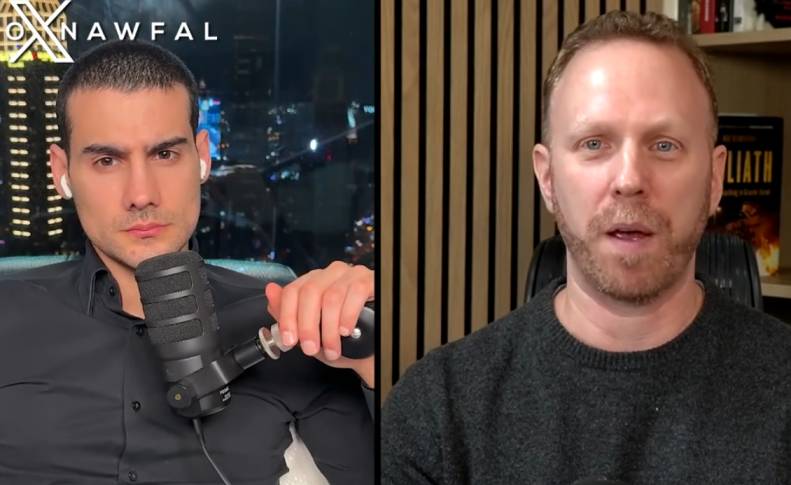
Here is the full transcript of journalist Max Blumenthal in conversation with Mario Nawfal on “Venezuela, Drug Cartels, Regime Change & CIA”, Premiered December 15, 2025.
Brief Notes: Journalist Max Blumenthal joins Mario Nawfal to argue that the U.S. narrative about Venezuela as a “narco-state” is a WMD-level lie masking a classic regime-change operation, not a genuine war on drugs. He traces how the so-called “Cartel of the Suns” began as a CIA–DEA construct in the late 1980s, created to “let the dope walk” through Venezuela into the U.S., and was later revived to frame President Nicolás Maduro as a narco-terrorist with a multimillion-dollar bounty on his head.
Blumenthal contrasts the failed 2002 coup against Hugo Chávez with the 2019 Juan Guaidó fiasco, explaining why the Venezuelan military and a loyal Chavista base have repeatedly blocked Washington’s plans despite crushing sanctions and media campaigns. He also highlights how U.S. allies like Ecuador under President Daniel Noboa are far more central to today’s cocaine trade, why Florida’s “Miami clique” is driving Trump’s Venezuela policy, and why a full-scale invasion would backfire with civil war, mass migration, and a spike in oil prices—making negotiation the only rational outcome.
The Cartel of the Suns: A CIA Creation
MARIO NAWFAL: I want to discuss Venezuela, and we literally had an argument. They’re like, Mario, no, we got to talk about Epstein. And then when you said, no, guys, I prefer to talk about Venezuela, I was celebrating.
MAX BLUMENTHAL: Good. Well, I thought you were the man in charge over there, so.
MARIO NAWFAL: Well, yeah. Talking about Venezuela, let’s start with—I want to dig into the history of kind of one of the main scapegoats being used for the regime change, or at least what I see as a scapegoat, and that’s the Cartel of the Suns. You’ve covered it pretty extensively of how it started in the 1980s, I think late 80s, and how it became what it is today, if it is anything today. Can you tell people about the Cartel of the Suns, which has been designated by the US as a designated global terrorist group and as a foreign terrorist organization as well?
MAX BLUMENTHAL: Well, yeah. The Cartel of the Suns was completely unknown to Americans until the designation by former Attorney General—he was Attorney General in the first Trump term—William Barr, who happens to have been a CIA officer, a CIA kind of legal adviser who wrote the pardons for the Iran Contra felons.
And Barr finagled a—or finessed an indictment or, sorry, finessed a bounty for Nicolás Maduro and several other figures associated with his government, Diosdado Cabello, for drug trafficking. This is part of a wider agenda to reshape the regime change program under the auspices of the familiar war on drugs, which has always been cover for US Imperial control, particularly in the Western hemisphere.
So the bounty started out on Maduro, I think, at $25 million. That said, he was the head of something called the Cartel of the Suns. And what they did at the DOJ, working with US Intelligence, was just dust off the name of an old cartel that US intelligence had actually created.
The CIA created the Cartel of the Suns during the Reagan administration alongside the DEA in order to supposedly allow the DEA to monitor drug trafficking routes and identify major drug traffickers inside the United States by, in their words, “letting the dope walk.”
So that meant going to Venezuela, tapping two of the main contacts from inside the Venezuelan National Guard—one of them named Ramón Guillén Davila. He was sort of the whistleblower on this. And this was before Chávez was elected president. This was under the old kind of Punto Fijo pro-US Government.
And they asked them to allow shipments of cocaine to pass through Venezuela in order to reach the United States. This is something the DEA and CIA were doing throughout Latin America. But this got exposed. Two CIA officers were fired. Tim Weiner, who’s now sort of the preeminent historian of the CIA, exposed this in 1990 at the New York Times.
Then three years later, Mike Wallace did a special on it for 60 Minutes featuring General Guillén speaking on camera about how they shipped actually much more cocaine into the US than was previously thought, over 20 tons. So this actually had an effect on the drug market in the United States and on the population of the US.
And then the Cartel of the Suns sort of slipped away and disappeared out of the public’s attention. Venezuela had not been thought of as a major drug trafficking route, or it’s certainly not a producer of cocaine like Colombia, and definitely not a place where fentanyl is produced or trafficked. It tends to—you know, the ingredients, the base level ingredients come, according to the official story, from China and are trafficked through the U.S.-Mexico border.
But Hugo Chávez, when he was president of Venezuela, he had a discussion program every week, sometimes more than a week, called Aló Presidente, where he would just address the nation through fireside chats. And in, I think it was 2007, he mentioned in one of these broadcasts that he had learned of a Pentagon proposal to label Venezuela as a major narco trafficking entity in order to promote regime change.
That didn’t happen at the time, but it was prescient because after the failure of the 2019 scheme to install Juan Guaidó as president and the failure of the military coup that Guaidó and his mentor Leopoldo López staged in Caracas in April—
The 2019 Regime Change Attempt
MARIO NAWFAL: Before you—I don’t want you to skim through. I think a lot of people don’t know what happened in 2019, the attempted uprising with barely two dozen soldiers that defected. So it wasn’t really an uprising. Can you break it down to the audience of the regime change attempt by the US in 2019?
MAX BLUMENTHAL: Well, I’ll quickly go back further.
Four years later, the same forces, including María Corina Machado, that are being weaponized by the US to do regime change in Venezuela, staged a military coup that removed Chávez, briefly took him out to an island. They signed something called the Carmona Decree, named after the person who was supposed to be the new president, who is just a Venezuelan business executive with no popular base, Pedro Carmona.
And then the population marched on Miraflores Palace and basically surrounded the palace demanding Chávez return. And he was brought back. And that was the end of that.
And after that, there were a series of regime change attempts. La Salida was a major attempt, starting with María Corina Machado’s party, Sumate, which was funded entirely by the United States government through the National Endowment for Democracy, to depose Hugo Chávez through a popular voter referendum that failed. There were riots.
MARIO NAWFAL: What year was that?
MAX BLUMENTHAL: That was 2000—her attempt started in 2004 at the height of Chávez’s popularity. It never came to a vote. However, I mean, it’s worth mentioning because it’s always said Chávez was a dictator and Maduro was a dictator. Chávez held a referendum to grant him greater powers under the constitution in, I believe, 2008, and that lost.
So there were all these—there were votes that went the opposition’s way, but every time they tried to do something undemocratic, they staged these riots called Guarimbas, inspired by La Salida. Throughout 2013 and 2014, they really damaged the Venezuelan economy. Hundreds of people were killed on both sides. That ultimately failed.
Then the National Assembly, which was elected, dominated by the opposition, backed by the United States, started enacting a series of measures in order to bring about US military intervention. They actually called for intervention, declaring Venezuela to be a humanitarian emergency after US sanctions started coming in in 2015. And they then began to make way for an alternative government.
The figure who was previously unknown, who was sort of placed at the fore of the Venezuelan National Assembly in 2017, was Juan Guaidó. And the US in 2019, in the first Trump administration, decided to recognize Juan Guaidó as president of Venezuela, declaring that Nicolás Maduro’s administration was illegitimate because he had instituted a Constituent Assembly in place of the National Assembly. It gets very complicated, and it wasn’t constitutionally valid.
Guaidó was unknown, unpopular in Venezuela, but the point of making him an alternative government was that it allowed the United States to begin seizing Venezuela’s embassies around the world, to deepen the sanctions, and then to deploy a series of legal maneuvers to steal Venezuela’s largest foreign asset, Citgo, which was worth over $80 billion, claiming that it was the alter ego of Venezuela’s state oil company, PDVSA, which they had put under sanctions.
And this is part of the economic strangulation of Venezuela, which was only possible by recognizing a figure like Guaidó as president. It also led to protests.
The Failed Humanitarian Intervention
And then in February of 2019, the United States, through USAID, working with Juan Guaidó, staged the first attempt at a kind of invasion of Venezuela. But they called it a humanitarian intervention, claiming that conditions in Venezuela were so bad they needed these USAID trucks to ram across the Colombian border and save them.
The trucks had barely enough aid to support a small town for a couple days. I was in Venezuela at that time. There was no humanitarian emergency. Although the sanctions were causing economic pain, you could still get food—it wasn’t an issue. It was just a stunt in order to embarrass Maduro and to shatter Venezuela’s sovereignty.
And it wound up blowing up in the opposition’s faces. The trucks never made it through. And at the end, all of these hooligans who had been brought into Colombia by narco cartels like Los Rastrojos, alongside Guaidó, set fire to the aid and then attempted to blame Maduro.
I was the first journalist to call this out in English and to expose how they burned their own aid. And the New York Times ultimately corroborated my story. So this is hugely embarrassing for the opposition. But photos emerged of Guaidó posing with cartel members from Los Rastrojos. It looked very bad for him. And, you know, he started getting negative press in the U.S. The Washington Post had a headline, “Juan Guaidó is losing momentum.”
So he stages a coup in April 2019 with his mentor Leopoldo López, one of the figures who signed the Carmona Decree and was in Miraflores for the military coup in 2002. He comes from a very wealthy oligarchic family. His father is a member of parliament in Spain.
And they managed to recruit, as you said, like 20 to 40 soldiers, who were all quickly captured and imprisoned. And that was pretty much a wrap. Although Guaidó stayed around for a while. He’s now supposedly a professor at Florida International University.
Why Maduro Didn’t Arrest Guaidó
MARIO NAWFAL: Why didn’t Maduro arrest him in 2019 when the coup failed?
MAX BLUMENTHAL: Because Maduro—if you’re a leader and—
MARIO NAWFAL: There’s someone attempting a coup, you’d expect to be arrested.
MAX BLUMENTHAL: Because Maduro’s such a brutal dictator that he allows Guaidó to ride around all over the country on a motorcycle and allows María Corina Machado to be there, while they’re both involved in a plot to steal Venezuela’s assets and to support military strikes by a hostile foreign country on Venezuela. Yet they’re still free.
It was because if Maduro or his security forces arrested Guaidó or María Corina Machado, it would have played into the hands of the United States and the narrative they wanted of them as these dissident freedom fighters who are languishing in Venezuelan torture chambers.
So they allowed them to organize and allowed them to even run election campaigns under harsh sanctions, things that the United States would never allow or European countries would never allow to happen inside their own borders.
MARIO NAWFAL: And the person that was helping Juan Guaidó in 2019 in that coup was also involved in the 2002 coup as well?
Leopoldo López: The Mastermind Behind Multiple Coups
MAX BLUMENTHAL: Absolutely. I mean, at every step of the way, Leopoldo López was there. He was the architect, the mastermind of this radical opposition that the United States trained, funded through CIA assets like Gene Sharp’s Einstein Institute, CANVAS, which helped train various architects of the color revolutions in Eastern Europe.
USAID was funding them to the hilt, and the National Endowment for Democracy, the regime change arm of the US Government, was funding them. So they created this radical opposition out of whole cloth in place of the traditional Venezuelan opposition, which the US saw as too weak.
They thought, oh, well, they’re just going to play within the confines of the system under Chávez and vie for elections. They’re not in favor of sanctions, and we need to remove this socialist-oriented government before they start making an impact across the continent.
There are opposition figures in Venezuela today who are not with Nicolás Maduro, do not agree with his agenda, are not of this kind of socialist mindset—like Henry Falcón, who was a governor, has a popular base in Venezuela. And the United States actually threatened to sanction him, personally sanction him if he ran for president simply because he opposes sanctions.
He’s part of what I would call the patriotic opposition. And so the US tries to ice out anyone who isn’t from the radical opposition that López controls. And López is really the bridge between Madrid, Washington and Caracas, bringing together the traditional neocolonial forces to bear on Venezuela.
He was also—his first cousin is a very influential figure who it appears he helped orchestrate the spectacle of María Corina Machado in Oslo receiving the Nobel Prize. His name is Thor Halvorssen and he’s from Norwegian-Venezuelan aristocracy. He heads a group called the Human Rights Foundation, which is sort of a more hardline version of the human rights industrial complex.
Mainstays like Amnesty International or Human Rights Watch, which focuses exclusively on promoting regime change in countries where the US and Europe want it. So that’s what—
Why the Regime Changes Failed
MARIO NAWFAL: Why do you think the regime changes in 2002 and 2003, 2019 failed so miserably? I’m not saying failed as in the country collapsed like we saw in Libya, Syria, but failed as in they weren’t able to depose Chávez and then Maduro.
Venezuela’s Military Loyalty and the Chavista Base
MAX BLUMENTHAL: Well, there is one common thread between 2002 and 2019 which was a major factor. Hugo Chávez came from the military. Hugo Chávez comes from a very poor background in the Venezuelan llano, the flat plains where the kind of traditional Venezuelan llanero music comes from. And he managed to work his way up into an officer level position in the military and earned a lot of respect at the highest levels of the military, while he was also kind of becoming a self‑educated autodidact to ultimately earn two master’s degrees.
And in 1992, Hugo Chávez staged a coup within the military that was actually very popular in Venezuela, in contrast to these coups, because it was a response to the horrible conditions that Venezuelans were living in under the more neoliberal pro‑U.S. government, which was sort of a fake procedural democracy in which two centrist parties controlled by the U.S. exchanged power.
And every few years in 1989, there was a major riot in Caracas called the Caracazo, which was an uprising against an IMF austerity package in which the poor and working class in the cities particularly started to really feel the pinch. And Chávez said, “We have to have a new system that will take our oil wealth and begin to distribute it to people, to lower the price of transportation, to pay for education, to improve the healthcare sector,” and so on.
And so when Chávez came in, that was his agenda. And before U.S. sanctions were imposed on Venezuela, he had reduced extreme poverty by 60%. So in 2002, a part of the military removed Chávez, working with these upper class elements that are represented by Leopoldo López. But Chávez had a lot of respect within the military and the population. The working class majority, the poor majority in Venezuela was with him.
Flash forward to 2019. Nicolás Maduro, while he was not a member of the military, he himself was the head of the bus drivers union in Caracas. He had a lot of credibility within the unions in poor neighborhoods of Caracas like Petare. But most importantly, the military had been consolidated as a force that supported the government. There was no way to kind of infiltrate the military any longer and pit it against the government. And the military stuck solidly with Maduro in 2019, despite the fact that economic conditions were much more dire because the United States that year sanctioned Venezuela’s entire oil sector.
Comparing Opposition Support: Guaidó vs. Machado
MARIO NAWFAL: But Maduro doesn’t have the popularity that Chávez had, at least early on. Based on all the polls and the difference now between Juan Guaidó at the later stages after the uprising, before the uprising, some polls showed they had some support, at least more than Guaidó post‑uprising. But María, the opposition leader today, also has significant support.
Based on all the polls I was looking at, I was going through, got like 15 of them here, 68% support, based on ORC, Delfos, 74%. I’m sure you know the polls more than I. Is that support enough for this regime change? And by the way, I’m very critical of regime changes. Historically, it’s failed. The only successful ones I could find was Panama successful and one other. All the others were a failure in which they did not help the U.S., did not reach the U.S.’s goals, or the country just collapsed like we saw in the Middle East.
But I want to try to look at this one objectively. María does have more support than Juan Guaidó, and it seems the U.S. is a lot more committed for a regime change. With all the warships and the troops near the Venezuelan border, what do you expect to see this time around? How would you compare it to 2002 and 2019?
MAX BLUMENTHAL: Well, I’d like to see the polls you have, because one of the polls that I’ve been looking at, which was taken on November 24, I believe was taken by an independent Venezuelan polling firm called Data Analysis. And it found that María Corina Machado and her wing of the opposition have about 14 to 15% support. Maduro hovers like around 20% or below. And then the rest of the population is undecided, and most of the undecided disproportionately are young people.
I can tell you just anecdotally or from personal experience, I was in central Caracas for a referendum in early 2019, and it was a call for people to come and just sign a petition against U.S. intervention. And I saw an endless line of people coming down from the hillsides of Caracas where the poor live to sign this petition. And they were disproportionately older people, people, I would say people over 45, for sure, but mostly over 50.
And these are people who lived through the period that I mentioned where there was the Caracazo, the IMF austerity packages. And they felt that they had been lifted out of, if not lifted out of poverty, their conditions had improved and they’d been given a modicum of pride as Venezuelans under Hugo Chávez. And they are the Chavista base. They’re mostly older, they’re mostly poorer. And then you have like rural campesinos who just marched with Nicolás Maduro two days ago. So there is a popular base there. It’s a very strong.
MARIO NAWFAL: What about the younger generation? That’s undecided. What’s their perception of the U.S.?
The Generational Divide and Rally‑Around‑the‑Flag Effect
MAX BLUMENTHAL: Their perception is social media. They want a different reality. They’re very influenced by media coming from the outside. And they don’t have the same political consciousness of that generation that lived through what’s known as the neoliberal period. You see it in a lot of Latin American countries where there was like a left‑wing transformation.
And so they’re more, I think they’re more susceptible to pro‑U.S. messaging, but at the same time they’re not as supportive of the old radical opposition. And right now what you’re seeing and what I’m hearing from people in Caracas, including people who don’t support Maduro, is an increasing rally‑around‑the‑flag effect because the U.S. is threatening them so much.
MARIO NAWFAL: Not only saw in Iran, yeah.
MAX BLUMENTHAL: You saw that in Iran, but it was much more severe because civilians were actually being killed. I mean, if that happens in Venezuela, for sure there will be a noticeable rally‑around‑the‑flag effect. But just based on the Data Analysis poll that I mentioned, only about 20% of Venezuelans support U.S. military intervention. Over 55% oppose it. And it’s the same for sanctions. Overwhelmingly Venezuelans oppose sanctions because why would you support being economically immiserated and being cut off from the global financial system?
I mean, I remember I was hanging out with someone who supported the opposition, who is a video editor in eastern Caracas one day and he was complaining about losing access to Adobe and Pro Tools and all these because the sanctions were blocking access. So why would you want that? You don’t.
But María Corina Machado’s in Oslo supporting the seizure of a Venezuelan oil tanker containing something like a million barrels of oil. This is, you know, unfathomable to Americans that an American politician would support Russia or China seizing American energy. And the Venezuelan public’s largely against it as well.
Venezuela is a much more complex society than we are allowed to understand. And the spectacle we see on display from María Corina Machado, it really doesn’t represent the feelings of Venezuelans across the board who’ve lived through this kind of struggle for the last 20 years or so.
The CIA’s Historic Use of Drug Cartels
MARIO NAWFAL: I want to go back to what we started with this, the Cartel of the Suns that was created in the 1980s. How common is it? Because I was speaking to John Kiriakou about Venezuela and he talked about how the CIA let drugs flow from Afghanistan to Iran and Russia intentionally to weaken those two countries.
So I started wondering, looking at the Cartel of the Suns, the John Kiriakou story, with the U.S. doing the same thing there in Afghanistan, how common is it for the CIA to use drugs as a weapon or to create these cartels for various purposes? And does it sometimes work as a strategy?
MAX BLUMENTHAL: I mean, it continues to this day. And we’re seeing key U.S. allies be implicated in the drug trade to this day. The Organization for Organized Crime and Corruption Reporting Project, which has been funded by the State Department, is in many ways an instrument of U.S. soft power. But it’s an investigative journalist outlet has a new report out about the Noboa family’s ties to the Balkan mafia.
The Noboa family controls Ecuador today. Daniel Noboa, he’s the president, born in Miami, U.S. citizen, billionaire, and his family owns Noboa Shipping Company and he has been the director of the shipping company. And the shipping company keeps getting rung up for sending bananas through the Noboa family’s Bonita Fruit Co. packed with cocaine to Europe through routes that are overseen by the Balkan mafia.
Ecuador is also the largest drug export center to the United States, according to the United Nations Office of Drugs and Crime. Meanwhile, Venezuela is only responsible for like 5% of drug transit. But Kristi Noem, the DHS secretary, was just in Ecuador to meet with Daniel Noboa and to campaign for a referendum to bring U.S. military bases back to Ecuador. This had been banned under the constitution ushered in by the exiled president, Rafael Correa.
They lost that vote. It was resoundingly rejected by the Ecuadorian public. But you can see why Noboa is valuable to the U.S. He’s friendly with Marco Rubio. Rubio has held him up as this great partner in the war on drugs, but it’s really not about drugs. It’s about geostrategic interests. And here you have someone who has replaced a, like ended the legacy of the Social Democrat Rafael Correa and is supporting U.S. military bases on Ecuadorian soil, will do anything the U.S. wants.
And even as Ecuador plunges into one of the most dangerous countries in the world and a center of narcotics trafficking where cartels have destabilized large parts of the country, the U.S. values Noboa as a strategic and military partner.
U.S.‑Cartel Collusion in Mexico and Beyond
In Mexico under Vicente Fox and then Felipe Calderón, who is the author of Plan Mérida, which was a U.S. military‑directed plan to supposedly fight drugs in Mexico, Mexico’s top cop, like the head of their version of the FBI, was named Genaro García Luna. He’s now in a U.S. federal prison for life for his role in a deep and long‑standing conspiracy with the Sinaloa cartel to ship drugs into the United States. And the State Department has acknowledged that they knew what Luna was up to, but that he was such an important partner politically that they kind of just looked the other way.
Then right after that, you have the Fast and Furious scandal under Obama where the U.S. was literally arming Mexican drug cartels because they supposedly were tracking the guns. But then when one of Chapo Guzmán’s lieutenants was brought to a federal court in the U.S. in 2011, he testified that actually the U.S. was arming the Sinaloa cartel as a kind of proxy to defeat other narco cartels like the Guadalajara cartel, the Jalisco cartel.
Just a few miles from where I’m sitting, last week there was a raid on a kind of like suburban McMansion in Northern Virginia that I visited in the town of Oakton on the home of Paul Campo. He was the director of the DEA’s financial division at that time. So he was in charge of fighting money laundering, discovering how the cartels were laundering money using crypto and all these other mechanisms.
And he was arrested and raided by federal agents who have indicted him in a scheme working with a veteran CIA asset named Robert Sensi to launder $12 million on behalf of the Jalisco New Generation cartel. So this is happening today, and we’re just kind of scratching the surface of what’s happening. I could go on for the next hour about the historic links between the CIA and narco traffickers.
Historically, what the CIA has done is they’ve worked with narco cartels in order to fund black operations because all the money that they can bring in is off the books. So that’s how a lot of the proxy wars in Central America were funded. And the greater goal is we’re defeating socialism in the Western Hemisphere. So it’s for a greater good.
The Guadalajara cartel was a source of that money in the 1980s to fund the Nicaraguan contras, their profits. And a DEA agent who was especially enterprising named Enrique “Kiki” Camarena discovered that the Guadalajara cartel was involved in these black operations. And he was captured, tortured by cartel members. And his torture was apparently monitored by CIA operatives, including Félix Rodríguez, the CIA agent who oversaw the capture of Che Guevara, a Cuban American famous or infamous CIA agent. This is according to a documentary that anyone watching this can watch. It’s on Amazon called The Last Narc.
Ecuador’s Economic Decline Under U.S. Partnership
MARIO NAWFAL: I’ll check it out. Actually, I’ll just tell the team to note it for me. By the way, I was surprised to find out that Ecuador, which is a U.S. ally now, is currently poorer than Venezuela based on purchasing power parity. That’s surprising because obviously Venezuela portrayed, which is Venezuela, is very poor people, they are not making a lot of money. But surprised to find out that Ecuador is doing worse than Venezuela.
MAX BLUMENTHAL: Well, that’s an interesting point. Venezuela has been experiencing fairly high levels of growth for the last four years.
MARIO NAWFAL: It’s coming out despite the sanctions.
MAX BLUMENTHAL: It’s coming out of a period of contraction and that’s very threatening to the United States that Venezuela, through economic partnerships with China—China also Iran has helped supply them with infrastructure to start pumping oil again.
MARIO NAWFAL: What about Russia?
Russia’s Strategic Interests and Regional Instability
MAX BLUMENTHAL: Russia’s got deep partnerships in the Orinoco belt, which is the oil-rich region of Venezuela. Lukoil, Rosneft—they have contracts, so they’re active there. And the United States doesn’t want to see a country in its own hemisphere come out of sanctions and begin to demonstrate that actually you can be politically independent.
Ecuador was one of the safest countries in the Western hemisphere under Correa. It is now one of the most dangerous places in the world and is host to several of the world’s most dangerous cities. Guayaquil is now popularly referred to as “Guayaquil” because of its high homicide rate.
We saw the same phenomenon in Honduras after a U.S. coup backed by Hillary Clinton under Obama removed a fairly popular center-left president, Manuel Zelaya, and installed a pro-U.S. de facto military dictatorship with stolen elections. And the final president of that regime or that era was Juan Orlando Hernández, who was basically transforming his country through the institutionalization of the cartels into the Federal Republic—into one of the most unsafe places in the Western hemisphere.
San Pedro Sula—I mean, that city was one of the most dangerous cities and also had massive migration. So we saw these caravans come out of Honduras of poor, desperate people during the Juan Orlando period. And it fueled a lot of anti-immigrant sentiment in the U.S. I mean, it’s just not comfortable for working class Americans to see these large caravans of poor people coming north seeking jobs. And I think that helped actually fuel the rise and return of Donald Trump.
And we haven’t even talked about the Venezuelan migrants and the Venezuelan gang situation. But that’s another factor here in this whole regime-change scenario.
Comparing U.S. and Russian Interventionism
MARIO NAWFAL: It’s fascinating. We criticize—the West loves to criticize Russia for their interventionism in their region of influence. And seeing what the U.S. has done in Latin America is just incomparable to what Russia’s done in their orbit. And obviously China’s done very little in their orbit beyond Taiwan and Hong Kong.
I was also researching the Panama coup to kind of compare it to what’s happening now in Venezuela as another coup. That’s a crazy story as well. The leader there, the president, was a CIA asset that went rogue, and that led to a coup as well, which is just insane to imagine.
Looking at Venezuela today, kind of bringing you back to what’s happening now, what do you think will happen? How do you think this coup will compare to others? Because there’s a lot more military infrastructure that’s being placed around Venezuela, much more than any other coup that’s happened in Latin America in recent history.
And the problem, though—Venezuela is a very densely populated region, but also similar to Vietnam. It’s got these jungles, it’s got these mountainous regions. It’s a very, very large country. So I just think a military coup would work. Militarily speaking, there’s only what, 18,000 troops there in Venezuela. I had Larry Johnson on the show yesterday. He made the comparison: in Vietnam, there were like 500,000 troops, total U.S. troops in that war. In Venezuela right now, around Venezuela, there’s 18,000 troops that were stationed.
Would you agree that a military intervention—as in a mass military intervention, an invasion of the country—is off the books as an option?
The Unlikelihood of a Full-Scale Invasion
MAX BLUMENTHAL: I’d be shocked. I don’t want to say anything’s off the books, especially with this administration, but I would be shocked if they sent boots on the ground into Venezuela. The first U.S. soldier that is killed will lead to massive political backlash in the U.S. This war is already more unpopular in the U.S. than it is in Venezuela, where it’s very unpopular.
Over 70% of the U.S. public opposes military action against Venezuela. Less than 20% of Americans—this is according to a November 2024 YouGov poll—less than 20% of Americans see how Venezuela is a threat to the United States. And it’s not.
But the Trump administration doesn’t really care about the American public. It cares about this tiny clique in South Florida, the Cuban-American and Venezuelan-American right wing that control a few important districts. That makes Florida a swing state that keeps turning red. That’s all they care about.
And that clique is led by Maria Elvira Salazar and Carlos Jiménez, two members of Congress who are the only members of Congress that the Trump administration’s listening to. Marco Rubio comes from that world. He comes from Doral, Florida, and that’s his life dream. It’s like Netanyahu’s dream is to see regime change in Iran, to close the Iran file. Marco Rubio’s dream—it’s actually not Venezuela, it’s Cuba. He wants to come back to Cuba on the back of a white horse and march in and be hailed as a liberator, which won’t happen. But Venezuela’s key to that.
That’s why the oil tanker that was seized was one that was heading to Cuba. Because this is ultimately about deepening Cuba’s energy crisis and deepening Cuba’s blackout crisis and tormenting the population of Cuba even further. Because Cuba has depended heavily on energy and support from Venezuela. They also would like to see regime change in Nicaragua.
Now, can they achieve this with the military force that’s there? Politically, as I said, if U.S. troops are lost, this will be a disaster for Trump and for all the Republicans who support it. Will they do targeted strikes? They may do that and attack some military bases. It may have no effect at all on Venezuela’s deterrence capacity. It may have no effect on the population or make the population rally to the government side.
But the bigger issue is that Trump, to the extent that he’s thinking acutely, doesn’t really see how this works on the day after. Can Machado just come back after her country’s attacked and receive the support of a population that was just assaulted? Will they support her?
What will happen with the strong base of Chavistas, the part of the population which numbers in the millions that solidly supports what they consider to be the Bolivarian revolution that occurred under Hugo Chávez? What will happen with them? There will have to be some kind of purge which could lead to a civil war. This is an armed population and it would be an absolute disaster.
And if civil war occurs, you will see a real consolidation of narco-trafficking control of Venezuela. They will exploit the void and you will have another wave, a massive wave of migration to the north.
So there’s really no good outcome here. The best outcome I could see is someone like Rick Grenell, who’s the U.S. envoy to Venezuela, who had wanted to negotiate and who has overseen several deals which have had positive benefits for both sides. For the U.S., Chevron gets to come back in and drill, and U.S. oil prices can be stable, and Americans who are prisoners in Venezuela for various reasons were released.
So Grenell’s still an active figure in all of this. He represents the pro-diplomacy side, and I think Rubio is losing cache the longer this goes on. And Trump is wavering and is not really clear how this ends up.
Maduro’s Willingness to Negotiate
MARIO NAWFAL: What is the objective, though? What I’m trying to understand is that Maduro reportedly offered to step down, asked for amnesty, which was not granted. But also he’s already offered a long time ago access for American companies to Venezuelan oil. He’s also offered to move away from China and ally himself with the U.S.
And similar to what we saw with Juan Guaidó, he did not arrest him. He took the path that led to his regime surviving. And if the path right now for his regime to survive is to get closer to his arch-enemy, the U.S.—
MAX BLUMENTHAL: I think he would do it.
MARIO NAWFAL: Wouldn’t that be a good solution, a good result for the U.S.? But what’s the purpose of the regime change then?
The Ideological Agenda Behind Regime Change
MAX BLUMENTHAL: You would think so, and it would be. And most of the American public would support it. And Maduro, having interviewed him, having interacted with him on several occasions, been to his press conferences—he’s a deal maker. He’s a pragmatic figure. He’s surrounded by pragmatists like Delcy Rodríguez, who I’ve also interviewed. They want to do deals with the U.S. because the U.S. is the main historic trading partner of Venezuela.
There is oil infrastructure in Texas that’s ready to refine Venezuelan heavy crude. They need that oil refined in order for it to work. So they’re happy to work with the United States.
The problem for the extremists in the U.S.—including figures who are representative of ExxonMobil, I’m thinking of Rick Scott, the senator from Florida who’s one of the main advocates of just military assault, regime change, blow everything up. All of his campaigns are funded to the hilt by Exxon. You have the think tank here in Washington, the Center for Strategic and International Studies. They’re a front for Exxon.
They can’t go and work in Venezuela because by law in Venezuela, the state owns the main oil company, PDVSA, and uses it to fund social programs and communes and so on. That’s part of the appeal of Chavismo to the poor. And so you can only be a minority partner in a win-win deal with PDVSA. But it would still be—it’s still good enough for Chevron. And there are many business interests in the U.S. that would like to go in under the current conditions.
The reality also for the oil industry is—and you see this acknowledgment in industry journals like OilPrice.com—regime change, the instability it will bring, will cause oil prices to surge inside the United States. And they won’t come down until sanctions are fully removed. And you can see how hard it is to remove sanctions with what’s happening in Syria, where there’s been regime change. There’s now a kind of U.S. puppet administration there or pro-U.S. administration willing to do whatever the U.S. wants. But they still are struggling to get all of the sanctions out and open up the sanctions.
MARIO NAWFAL: There’s still a lot of sanctions, U.S. sanctions on Syria? I thought they’ve been removed. Al-Sharaa was in the White House not long ago, praised by Trump.
MAX BLUMENTHAL: It took almost a year to do that. And all of the degradation of Syria’s oil infrastructure and business community is going to take many more years to repair. So I’m saying it would be much easier to do this, but there are ideological interests within the oil industry.
And then you have this South Florida, Miami mafia. And if you really want to know what the agenda is, just read the tweets of Maria Elvira Salazar or Carlos Jiménez. They say it openly, that it’s not about drugs. They’ll throw in, “Oh, yeah, they’re drug traffickers.” But they openly say this is about toppling the governments of Venezuela, Cuba, and Nicaragua. That’s what this is about. And once Venezuela is toppled, then they can move in for those other—
The Confusing Logic of Regime Change
MARIO NAWFAL: But I still don’t understand. I’m trying to really figure out the logic there, why a regime change, if that is the objective. I’m happy to even question that, even though it looks obviously like a regime change, especially with the oil tanker now being seized.
David Marcus put out a post on Fox News just a few days ago. I’m not sure if you’ve seen it, where he says Trump’s aggression towards Venezuela is a warning to Putin. His goal was to warn, to show Putin that the U.S. could target his allies around the world. And within minutes of that being posted, Trump reposted it on his Truth Social. Got a bit of attention, but not too much.
It didn’t make too much sense to me. I’m trying to fish for something because I really still don’t understand the value of a regime change when Maduro is happy to open up the Venezuelan market to the U.S. I just see that oil prices are up, inflation’s up, goes against Trump’s goal of keeping the stock market humming and keeping interest rates or getting interest rates lower. It just does not work for Trump economically. It does not have the support in the U.S.
MAX BLUMENTHAL: There’s no political—there’s no political or economic value. Ultimately, it only serves the ideological zealotry of a fifth column in the United States based in South Florida that sees the United States simply—
MARIO NAWFAL: Sorry, you think they have that much influence now within the GOP?
MAX BLUMENTHAL: They hold the key to Florida. But I still think it’s possible for Donald Trump, a singular figure like Donald Trump, to just turn the U.S.—to turn this aircraft carrier battle group around and make a deal. I still think it’s possible. And the political consequences will be more severe if he does what they want, because there will be a massive migration wave, civil war, and oil prices will surge.
The Deal-Making Scenario and Military Pressure
MARIO NAWFAL: And if they do so, I think you’d agree with me that some sort of deal—Trump likes to see himself as a deal maker. He’s trying to be the peace president. So some sort of deal is the most likely scenario.
Despite all the military presence that’s there, having that many, having obviously Gerald Ford there, having 18,000 troops, having 12 warships in total around Venezuela, including a nuclear subject, is a lot. And John Kiriakou said, whenever you want to see what the intentions are of the US, just look at the naval movements.
But it seems that you’re also leaning that Trump is seeking some sort of deal with Maduro, is trying to place as much pressure on Maduro as possible. And now we’re seeing economic pressure with the seizing of the vessel, the Venezuelan vessel with the oil, to be able to reach that deal.
So you still think that is the most likely scenario? And what would you say second, if that’s the case, what would you say is the second option? If there is some sort of regime change, could we see some sort of decapitation strike by the US and could that work? If we look at historical examples.
MAX BLUMENTHAL: When you start moving towards decapitation strikes, you’re moving towards the apocalyptic scenario of destabilization and civil war. And we can also see from the Iranian example that decapitation strikes don’t necessarily achieve their goal and produce massive political backlash.
Iran was easily able to replace their top generals, their off-duty commanders who were killed in their homes by Israel in this unprovoked surprise attack. I interviewed Masoud Pezeshkian, the Iranian president, who said that there are seven people who are prepared to fill his position in the next conflict, and Venezuela has contingency plans as well. So what does it achieve?
But Donald Trump, we have to recognize Donald Trump got rolled by the neocons here. He got put in a very difficult situation. There’s nothing this can achieve except disaster. And those who rolled him, Marco Rubio, operate like a fifth column in the United States. They see the US as an aircraft carrier for their own interests and their former countries. This is not an America First agenda.
And as soon as Donald Trump authorized the Gerald Ford to set sail for Venezuela, he set himself up in a situation where he’s deployed over 10% of US naval assets to the coasts of Venezuela. And that creates this momentum for the interventionists, the neocons, the Cuban fanatics in Miami, that Trump has to do something, otherwise he will look weak.
So there’s the possibility—we’ve seen this before in many administrations, including in the Iran 12-Day War—where the President stages some kind of targeted or symbolic strikes just to save face so he can call it a day. And that’s also a possibility that the Venezuelans are aware of.
And then you have this report in Reuters yesterday that the US will continue to seize oil tankers, which means they’re escalating their policy of—this is a long-standing policy of economic siege and piracy. And it’s not particular to Trump.
We have to remember, under the Biden administration, the US seized an airliner belonging to the Venezuelan President Nicolás Maduro and justified it simply on the basis that this is, according to a Biden official, “Maduro is a bad actor.” So they just steal in order to weaken Venezuela in hopes that it will cause them to cry uncle or make a bad deal.
The Broader Global Picture: Trump’s National Security Strategy
MARIO NAWFAL: I want to get your thoughts. We haven’t spoken in a while, just a general state of affairs right now. We’ve seen the peace deal or the ceasefire deal, whatever point plan now that we’re going through a phase two in Gaza that is not being abided by, by Israel still striking Gaza. We’re seeing attempts to reach a similar deal in Lebanon, trying to disarm Hezbollah.
Obviously we’ve seen the 12-day war in Iran, talks about a second phase, a continuation of the war. We’ve got attempts to reach some sort of peace deal in Ukraine with the envoy visiting Putin. And now Zelensky responding to Trump’s 28-point plan yesterday, I think it was.
And lastly, we’ve got the national security strategy, which I’m sure you’ve gone through, where the US clearly shows probably the most drastic change in strategy in modern history. And that’s shifting away from kind of the mindset of a unipolar world where the US intervenes everywhere, to now focusing on its own sphere of influence.
We’re seeing that in Venezuela, treating China as an economic rival rather than an enemy, trying to look at Russia as a potential partner, trying to move Russia away from China and criticizing the EU and their stance on Russia as well as their stance on free speech and their limited defense spending.
Would love to get your thoughts on where you think the world is heading now and whether you think it is heading in a better direction with Trump trying to pull out of different wars, even though it’s not perfect. We’ve seen the clashes in Cambodia, Thailand, but at least Trump’s trying to intervene less in Europe and Asia and focus more on Latin America as we’re seeing now.
MAX BLUMENTHAL: Well, I can’t say the world is heading in a better direction or that the Trump administration, for however long it will still hold power, will be able to implement its National Security doctrine. But I think the Venezuela intervention is a reflection of the thinking in the Trump administration that went into this doctrine.
It’s the thinking of Elbridge Colby. It’s the thinking to some extent of Marco Rubio, who made some really unexpected comments about the need to recognize that we live in a multipolar world. They don’t want to confront Russia. They see it as sort of a distraction that Russia can be worked with.
They believe Israel—Colby, for example, sees Israel as a hindrance on US Imperial interests and that it’s dragging the US into conflict with Iran so there can be a deal with Iran and that China cannot be militarily confronted and must be seen as a near-peer economic competitor.
And then you have the Western Hemisphere and that’s their pole, that they see that as their domain. So they have ushered in a kind of Monroe Doctrine 2.0, misinterpreting the meaning of the original Monroe Doctrine, which was intended to make sure that none of the major colonial powers from Europe could seize territory in Latin America and use it to threaten the United States.
This was at a time when the United States was not a major naval power, was not one of the great powers in the world. John Quincy Adams was one of those who supported the Monroe Doctrine at the time and would have been deeply opposed to every intervention that we’ve lived through in our lifetimes.
So this is a delusional concept of the Monroe Doctrine, and they justify it by saying we’re keeping China out of the Western Hemisphere by attacking Venezuela, but we’re going to see more war and more hostility in the Western Hemisphere under this doctrine.
Trump’s Interventions in Latin America
Donald Trump’s direct intervention in the Honduran election and his pardoning of the convicted narco-trafficker Juan Orlando Hernández are also part of that mentality. Honduras is a very strategically significant country, the first banana republic, home to the largest US base in the hemisphere outside of the United States, the Soto Cano Air Base. And so they want to keep it under their control.
So Trump is just more nakedly, openly interfering than any US President. He threatened to completely destroy the Honduran economy if they didn’t elect his chosen candidate, Tito Asfura. Same thing happened in Argentina. The bailout to Javier Milei—20 billion from the US taxpayers and 20 billion more from private finance—has been justified as a means of keeping China out of Argentina.
And Argentina was threatened with the decimation of its peso unless Milei’s party performed well in parliamentary elections. So the Argentinian public was basically voting with a gun to its collective head.
So I don’t see this as a good result for the Western Hemisphere. I don’t believe the doctrine can be implemented unless a figure like J.D. Vance wins in 2028. And there’s so much in the National Security Doctrine about wokeism, about cultural issues that really have implications for Europe. I think if immigration—if a figure like Vance wins, the EU is in trouble and there will be tectonic shifts within the West.
But the Trump administration is looking very weak right now. A bellwether, just a bellwether we can look at is the mayoral election in Miami. Miami has been held for 30 years by Republicans because of the Cuban American vote and because of the anti-communist bloc. And a Democrat just won. She’s a centrist, she’s not Zohran Mamdani, but she’s now being attacked as some kind of communist.
How does that happen? There’s a huge backlash building against Trump and you can feel it out in the streets, just talking to people from all walks of life because of the affordability crisis and the sense that he’s just enriching and pardoning all of his cronies.
And so how much longer will this clique even be in power? And if the Democrats come back in, you’re going to have these kind of transatlantic fanatics like Jake Sullivan coming back into control of the National Security Council and the Pentagon and I mean, they would like to wage war on Russia through Ukraine for the next generation.
The Challenge of Shifting US Foreign Policy
MARIO NAWFAL: It’s just funny. Obviously I’m a supporter of democracy, but it’s just funny when you have the President shifting every four years. You got the policy of the US shifting, and then people like President Putin will just wait for the next president that fits their requirements better, fit their requirements.
And it makes it very difficult for countries, again, like Russia or other countries, including Venezuela, to make a deal with the US knowing that Trump’s going to be gone in three years and no one knows who’s going to replace him.
So while a democracy is great for not centralizing power, again, not talking about the swamp, the establishment and the government, it just makes it very difficult to have—and that’s why people don’t take the national security strategy seriously. That’s going to completely shift, maybe in three years. We just don’t know.
MAX BLUMENTHAL: Yeah, I mean, also within the United States, where is our democracy when it comes to foreign policy? This is an area where the American public is not supposed to have any say. It’s one reason why I founded The Grayzone and I’m doing this work, is to democratize this issue.
Because the American public tends to be non-interventionist, it tends to favor diplomacy. The JCPOA deal with Iran, which Trump shattered, was popular among the American public, including among American Jews. So when do we get a say? We should have a national referendum on going to war with Venezuela, but we’re not allowed to do that.
And I think the American public also, because of our declining economic status and because of the fact that our population is just simply more international now, they’re looking to the outside world and paying attention more to world news than they have before. And that makes them, I think, even more inclined toward diplomacy and toward a multipolar political perspective.
MARIO NAWFAL: Max, always a pleasure to have you. It’s been a great discussion. I didn’t know you’re that deep into Latin American politics. I really enjoyed this discussion, learnt a lot.
MAX BLUMENTHAL: Thanks a lot, Mario.
Related Posts
- Transcript: President Trump Hosts a Cabinet Meeting, Jul. 31, 2026
- Transcript: President Trump’s Remarks at Sen. Lindsey Graham’s Funeral
- Transcript: Trump’s Michigan Rally Speech Ahead of Midterm Elections
- Transcript of Nick Fuentes Interview ft. Hunter Biden – Channel 5
- Transcript: Trump Remarks at White House Correspondents’ Association Dinner