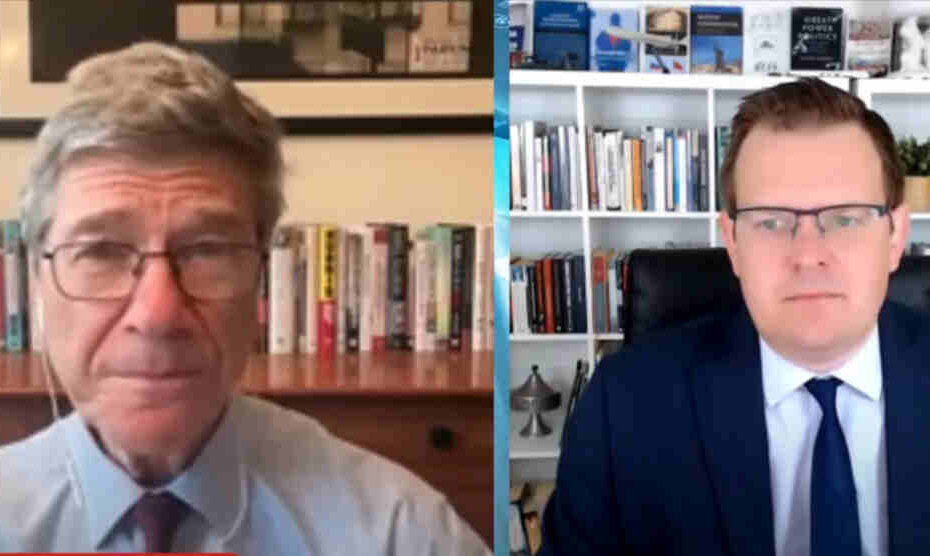
Read the full transcript of world renowned economist and public policy analyst Professor Jeffrey Sachs in conversation with Norwegian academic, writer and politician Prof. Glenn Diesen on “Trump-Putin Meeting – Peace or Deception?”, August 11, 2025.
The Surprise Alaska Meeting
GLENN DIESEN: Hi, everyone, and welcome back. We are joined today by Jeffrey Sachs to discuss the upcoming meeting between Trump and Putin in Alaska. So, welcome back to the program.
JEFFREY SACHS: Great to be with you again. Thanks.
GLENN DIESEN: So, I was a bit surprised by, well, everything about this meeting that would take place, how soon it was, and also that it’s in Alaska for that sake, but most of all because Trump doesn’t always, I guess, communicate his ideas appropriately.
Indeed, he used to blame NATO expansion for the war. However, for the past few months, he treated it as a Ukraine-Russia conflict where he is the mediator. And only last week he was threatening Russia to accept this unconditional ceasefire. That doesn’t address the issue of restoring Ukraine’s neutrality. And now there’s a meeting in Alaska. I was wondering, what is your take on these developments?
Trump’s Chaotic Approach to Diplomacy
JEFFREY SACHS: Well, I think you’ve said it exactly right. There’s a lot of confusion for us in trying to understand this. Trump does not give speeches to explain his point of view. The government does not put out documents to explain the official policies, if there are such things. Truth Social is not a substitute.
It’s really a chaotic environment where Trump throws out contradictory, short, ambiguous or meaningless or incorrect messages on the fly. So the truth is we see an incoherence in general in American policy now. It reflects, according to some people, a tactic of Trump. According to me, it reflects his personality, which is extraordinarily short term, not based on detailed knowledge. He says that he makes decisions “from the gut.” It’s not much of a way to run the world, in my view. It’s extremely dangerous.
So to answer the question, in short, I don’t think we really understand this meeting. I did not expect it. Diplomacy was not operating on the surface, at least for many weeks. Suddenly, there’s this visit of Witkoff to Moscow. The next thing is there’s a hastily announced meeting. The venue was uncertain until a couple of days ago, then it decided that it’s going to be in Alaska.
As usual, there’s a cacophony of voices and contradictory messages and claims circulating around the social media and the mass media. Europe and Zelensky are making their demands. Rumors are flying about who’s made what concessions, who agreed to what. It’s all extraordinarily unsatisfactory, undignified, improperly managed, childish, dangerous.
I would say maybe something good will come of this, but the process is simply not acceptable from the point of view of a world of nuclear armed nations that are at each other’s throats. So this is, I think, the basic situation we can surmise. We could make recommendations about what should be done, but to try to guess what Trump is doing is very, very difficult.
The Opportunity for Transformation
GLENN DIESEN: Well, the whole thing. Well, I’m always struck a bit by some optimism because it does seem like an opportunity if there’s a genuine desire to end a century of US-Russian hostilities and really transform relations because their interests do not need to collide all the time and again transition from containment to cooperation.
But then my optimism is sometimes held back by the fact that the political establishment in the United States doesn’t seem to have changed that much. Or do you see US intentions, that is its position in the world and its position towards Russia has changed fundamentally over the past 30 years?
The “Win-Lose” Narrative Problem
JEFFREY SACHS: There is a narrative that the US must win and Putin must lose in any outcome. That is a very common narrative in US political circles and it’s a shared narrative in European circles. Well, if you take that as given, first of all, it’s almost meaningless concepts. What is “win” and “lose”? We’re not playing a board game. We’re trying, or should be trying, to achieve peace and well-being in a dangerous world. But “win” and “lose” are the concepts that are used.
Washington is a very unimpressive place from the point of view of foreign policy thinking towards the common good. Maybe it’s very impressive in that it mobilizes more than a trillion dollars a year of military spending. It has a freedom of maneuver for the military industrial complex in the United States that is unparalleled. It’s impervious to US public opinion, which would definitely like this war to end. But it’s not an impressive operation from the point of view of logic, coherence, certainly not transparency, certainly not explaining anything.
You and I agree completely that there is no basis for this war and there’s no basis for an ongoing enmity of the United States and Russia. But the fact of the matter is the CIA doesn’t share our view. The military industrial complex doesn’t share our view. Lindsey Graham, who is a fool, nasty man, he doesn’t share our view. And Biden didn’t share our view. And Trump, I don’t know if he has a view. He wants accolades. That’s good. Maybe he wants applause.
But what will bring him applause right now if he settles with Putin as he should? A president of the United States should say straightforwardly, “NATO will not enlarge, we don’t have an interest in encircling Russia, we’ll stop playing games.” Will that bring him accolades? No, it probably would bring him attacks of appeasement, of weakness, of Munich once again. And since Trump is no thinker, he has no knowledge and he’s pretty gutless actually, in my view also, he doesn’t know how to stand up to any of that.
The Roots of the Conflict
So the answer to the question: I was optimistic when he came in because the underlying logic is that this was a war that never should have happened.
This was a war based on NATO enlargement, a war based on a US coup, a US-led coup in Ukraine in February 2014, a war based on the Western countries having failed to support and endorse the Minsk II agreements. It was a war based on failures of diplomacy.
And Trump said he wanted a Nobel Peace Prize. So I thought, okay, we’re going to come in and he’s going to get this right. And there was a glimmer of hope for a moment when he told the truth. And then as soon as he told the truth that NATO was a provocation, everybody landed on his head, from the US Senate to his own advisors, his generals to Starmer, Scholz at the time, now Merz, Macron. Who wants to tell the truth? Who wants peace?
So it’s really an odd situation. Zelensky, who’s he? He rules by martial law in a regime that everybody regards as utterly corrupt, in a society that is exhausted. They can’t fill, they can’t expand the cemeteries fast enough. An overwhelming majority of Ukrainians want the war to end. None of it matters right now.
The Deep State Question
And it raises the question, it’s your field, it’s my adopted field. What are these motivations? Because you and I are correct, from a logical point of view, this war should stop. There was no reason for the United States to have to push its nose right up against Russia’s borders in Ukraine. But that was a plan. That was a plan of the CIA, which I regard as the most dangerous and failed institution of American history. It’s probably still the plan.
So this is really the issue. A president of the United States should stand up and explain the truth. Trump does not do that. He doesn’t know it’s his job or feel it’s his job or he doesn’t have the guts to do it. And there are so many other politicians, who in Europe is a leader standing up and saying, “Make peace right now.” You can hardly find a voice. It’s incredible. I don’t know what these people want.
And also in Europe, the claim is ceasefire. Nobody wants to talk about why there was a war, where it came from, how it should stop permanently. What is that all about? It’s a deliberate and sustained evasion that is remarkable and the opposite of what is really needed to sustain peace.
Public Opinion vs. Leadership
GLENN DIESEN: Yeah, this is something that’s been troubling me about Europe even now. You mentioned the majority of Ukrainians wanting to end the war. I think the last poll by Gallup was 69% want an immediate end to it, against 24% which want to keep on fighting. But for the European leaders, they still refer to “helping Ukraine,” which is why they don’t want to have any diplomacy with the Russians and why weapons is the only solution to peace, to paraphrase Stoltenberg.
JEFFREY SACHS: And, Glenn, I think it’s interesting. The opinion polls show Ukraine wants the war to stop. The opinion polls show the American people want no more American support for this war. The opinion polls show that Starmer is at 20% approval rating. Merz is plummeting to something like that, a little bit higher. Macron, 20% approval rating. None of these leaders has any public backing.
This is basically a conspiracy of a few people. What are they doing? Nobody wants this war. Not the publics, not the Ukrainians, not the Americans. Mainstream public opinion is, yes, settle it, compromise, finish this thing. But a few leaders say no, continue to fight. And they say it in the face of public opinion. And supposedly these are democracies and these democratic leaders run right into the opposition of their own public.
So what is going on? I ask that as an honest question, not as a rhetorical question. Is it just the corruption? Is it the madness of trillions of dollars of military spending? Is it the deep state, which I’m inclined to believe it is, by which I mean the CIA and the rest of the military industrial complex. What is it?
It’s also true, I have to say, I often refer to the one president who aimed to make peace in my lifetime that really aimed for it, and that was John F. Kennedy. The truth is they killed him for it in the end. Maybe that’s the story, that it’s as simple as that, that these are bought people. They are suborned. Maybe they’re blackmailed, as we think also, but maybe they just don’t have the guts to follow through. What is an underlying pressure for constant war?
European Panic and Contradictions
GLENN DIESEN: Washington Post wrote something along the line that the European leaders, and I’m trying to be careful with the language as you pointed out, we often say Europeans, but obviously the leaders in Europe no longer really represent the people if they’re running down with 20% approval. But Washington Post said the European leaders are scrambling to respond to this meeting in Alaska. So they’re not happy.
But also the demand to take part in this peace talks, but they don’t want to talk to Russia. So I’m not sure how to make this thing fit yet. It is remarkable because most are now recognizing that NATO will lose this war. The front lines are collapsing. The majority of Ukrainians want an end to the war, yet there’s a panic in Europe. Do you make sense of it?
I guess, is it all about America’s position in Europe? Do you think that alliance systems strengthen during conflict and often the threat of peace breaking out is that alliance is also weakened? And the Americans have expressed quite a lot of desire to not just leave Ukraine, but also Europe in its pivot to Asia. But again, the Europeans were very much gung ho on war before the Trump presidency as well. So what is the panic about?
Europe’s Self-Imposed Corner
JEFFREY SACHS: Again, it’s a question. Europe has backed itself into a corner. It’s a shrinking corner. In other words, Europe is more and more against the wall. Why?
First, Europeans refuse to talk to Russia. Why? It’s the shared continent. Why aren’t they in normal communication? Doesn’t have to be love, but just diplomacy. No, no, “we must not talk.” This is the first absolutely weird thing.
Second, Europe has backed itself into a wall with China because these completely incompetent so-called leaders of Europe, von der Leyen, Costa and others, go to China and then insult the Chinese. What is that trip about? They want to break relations with everybody.
Then third, they humiliate themselves vis-à-vis the United States because Trump could care less about Europe. This is obvious. And yet the Europeans bow down as low as they can and apologize for anything and make unilateral concessions. So Europe has completely backed itself into a corner without diplomacy.
Then they’re worried that, yes, “we’re weak, we’re falling apart, we depend on the United States.” Look what it’s getting Europe. It’s getting Europe trashed, actually. Strange. Europe has more people, I mean the EU, than the United States. Europe is a big sophisticated place. But it has completely lost the idea of what used to be called “strategic autonomy.” It’s just desperate for the US to be there, it seems.
And then people like Rutte, the Secretary General of NATO, calling Trump “daddy.” Okay, it says everything. You couldn’t say it more clearly. It’s very odd, but where is one leader in Europe that says, “Why don’t we talk about the root causes of this? Why don’t we get to an architecture of stability and collective security?” We don’t.
European Subordination and the Collapse of Assumptions
GLENN DIESEN: Yeah, I think it was so easy to subordinate to the United States because for almost 30 years the assumption was always the US would have a final say. So as long as you’re on the good side, then this will be a partnership where playing the junior partner will be beneficial.
So I think a lot of this shattered the reality of the European leaders because the assumption was if the Russians went against Americans on this, if America really decided to destroy Ukraine now, then they would succeed and it didn’t succeed.
And now to see that Americans indeed trying to do well, breaking with a European policy which they committed to fully, but also the role of Europe, sorry, Russia, I think, because for 30 years all diplomatic ties with Russia included creating European institutions which Russia shouldn’t have a seat at the table, but they were expected to abide by all the decisions.
So, yeah, kind of tucking Russia out in the corner of Europe, trying to subordinate it to whatever decision making was done in NATO and the EU. But the whole thing is falling apart and I don’t think anyone has any solutions besides just let’s try to destroy Russia or defeat them.
So again, doesn’t mean Russia has to be innocent in anything but just if you can’t, there’s no consideration of diplomacy. How can we learn to live with them? Because we are on the same continent as he said. But no one wants to, I guess, go down this path because we for 30 years more or less made plans for making Russia almost a colony at the periphery of Europe.
And now, yeah, it’s dictating the future of Europe with the Americans and the Europeans are on the sideline. This is a very different reality than the “end of history” that we were waiting for or hoping for for 30 years.
Brzezinski’s Grand Strategy and the Pattern of Aggression
JEFFREY SACHS: I think it’s very important for people to understand the underlying long term idea of all of this. And I thank Zbigniew Brzezinski for spelling it out clearly in 1997 in an essay that he wrote for the Council on Foreign Relations called “A Geostrategy for Eurasia” and in his book of that year, “The Grand Chessboard.”
And it’s clear the plan from the 1990s was a weakened Russia, maybe even a Russia that is broken apart. Because Brzezinski in his Foreign Affairs article talked about three different countries replacing Russia in a loose Confederation, what he called a European Russia, a Siberian Russia, and a Far East Russia. And he opined, “Yes, maybe it’ll break apart into three, not just one.”
And in “The Grand Chessboard,” after a lot of analysis, he concludes that Russia will simply have to accept an expanding Europe and an expanding NATO and just accede to it. So to my mind, this was always the plan. It was harebrained, it was antagonistic and aggressive.
Since you and I face the overwhelming daily narrative that everything is Russia’s aggression, people should just systematically put down on a piece of paper, if they still use paper. They could put it on an Excel spreadsheet if they want. All the things that Russia did aggressively and all the things that the United States and Europe did aggressively.
The list actually is that all of the aggression is on the European U.S. side. It was Europe and the U.S. that expanded NATO eastward. It was the U.S. and Europe that bombed Serbia and broke Serbia apart. It was the US that left the Anti Ballistic Missile Treaty. It was the US that insisted that Ukraine and Georgia should become part of NATO. It was the US that instigated the Maidan coup.
It was the US, Germany, France that said Minsk 2 need not be observed, even though it was a UN Security Council unanimous resolution. It was the US and UK that blocked the April 2022 peace agreement.
Yes, and in that context, on February 24, 2022, Russia expanded what was already an eight year war by its invasion of Ukraine. Yes, it did that, but in the context of 30 years of forcing Russia to accede to a NATO enlargement and European expansion aimed at surrounding and breaking Russia. That’s the situation.
Trump’s Moment of Truth and Continued Provocations
Trump referenced that once in a glimmer of truth earlier in the year, and then got the sky to fall in on his head through attacks by everybody for having told a moment of truth. In Europe, basically, no leader tells the truth, with the exceptions of Fico and Orban. But other than that of the major countries, nobody tells the truth.
Now, we have the meeting coming up on Friday. Maybe we should say something optimistic about it. This war could be ended. This war could be ended on simple, straightforward terms. Trump merely has to say publicly, “NATO will not enlarge” publicly, not in some message that Witkoff carries in private to the Russians, but publicly.
He needs to say, “We don’t want any more confrontation. The fighting should stop, and the idea of surrounding Russia and so forth is off the table.”
By the way, one reason for pessimism that will come anywhere close to that is that just as we talk, the US is playing a new game in the South Caucasus. Unbelievable. More provocation. A Trump highway through Azerbaijan and Armenia. Are you kidding? Does the United States have any capacity of self restraint? Would the US like a Russia, a Putin highway through Mexico?
But just as we’re talking and trying to find a glimmer of hope, the US is playing in the South Caucasus as it has for 30 years, by the way, because that was part of the strategy to attack Russia in its soft underbelly. That was part of the CIA strategy from 1945 to 1991, by the way, to attack Russia along the Islamic southern rim of the Soviet Union.
So they can’t stop playing games. It seems nobody wants peace. Everybody wants to make trouble. Maybe the real expression of all of this is the most idiotic article by the RAND Corporation in 2019, “Extending Russia,” an article written by our military think tank which lists what are all the ways we can create trouble for Russia? This is how a responsible nation acts to make lists of ways to provoke another superpower. That is what passes for foreign policy in the United States.
Sorry, I started out optimistically and I thought I’m ending pessimistically because I don’t see the United States actually being responsible. And Europe, to my deep chagrin, has lost any kind of coherence at all.
The Armenia Highway and European Media Narratives
GLENN DIESEN: Yeah. Leasing the scenic road in Armenia for 99 years to the United States. This is, yeah. Now, well, it looks like the red flags in Iran are much stronger than in Russia as well. So this is just going to be another crisis.
JEFFREY SACHS: Yes, exactly.
GLENN DIESEN: But you’re right. As it’s covered in the European media, it’s, “Well, this means less influence of Russia. This is good. This is peace.” It’s a very, it’s the same formula for peace. The weaker Russia is, the better for us. It doesn’t really take into account the security competition. The whole assumption is, “Well, Russia, I guess, will have to capitulate them because now they will accept one side is dominant.”
The Problem of Hubris
JEFFREY SACHS: That’s exactly right. By the way, I see in the back, over your left shoulder, the book by Haslam. “Hubris.”
GLENN DIESEN: Yeah, I did an interview with him. That’s, yes, a book review.
JEFFREY SACHS: So hubris is the essence of the problem. Brzezinski displayed that hubris. The idea of the Europeans that you just quoted is hubris and that we can do whatever we want. Russia needs to be put in its place. Good luck with that.
Predictions for the Alaska Negotiations
GLENN DIESEN: Just as a very quick final question then. Do you have any predictions in terms of this? What was called peace negotiations in Alaska.
JEFFREY SACHS: Well, I don’t have predictions. Again, I’m hoping that the reason this meeting is taking place is that Witkoff said to President Putin that the US will acknowledge the underlying causes of the conflict and work with Russia to end them.
So the reason for optimism is that it is perfectly correct and within the power of the President of the United States to say “NATO will not enlarge. We are stopping the provocations. We are not destabilizing Ukraine through coups and through that massive CIA operation in Ukraine that the New York Times told us about last year, as if we needed to be told. We are aiming for restoring normal relations between two superpowers and not playing a game with the proxy war in Ukraine that has killed a million Ukrainians.”
If he says that the war will end, the second thing he should say is, “I don’t care what Zelensky says. He doesn’t represent the Ukrainian people. He rules by martial law. His regime is corrupt. The Ukrainian people want this war to end by an overwhelming margin, as Gallup has just told us.”
And he should say to the Europeans, “I’m not listening to you. You’re ridiculous. Maybe we created you as a monster because the US promoted pro deep state politicians for 30 years, but it’s the US and Russia that are ending this conflict. And that’s for the benefit of the whole world. Us, Russia, but also Ukraine and Europe. And we’re not going to let warmongers who have no public approval rating in their countries stand in the way.”
That’s what I hope will come out of this.
GLENN DIESEN: Professor Sachs, thank you so much for your time.
JEFFREY SACHS: Great to be with you. Thanks a lot.
Related Posts