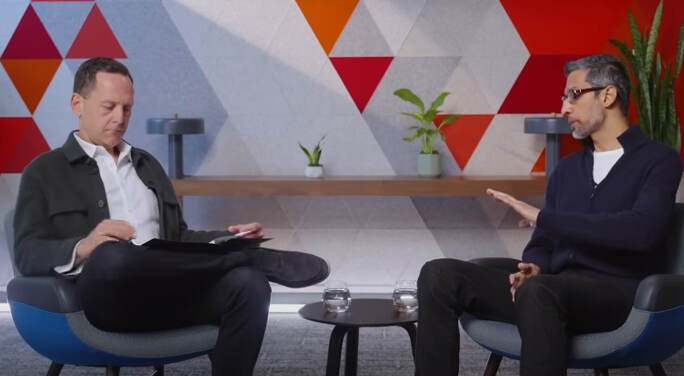
Read the full transcript of Alphabet’s CEO Sundar Pichai’s interview on The All-In Podcast with David Friedberg, [May 16, 2025].
Listen to the audio version here:
Introduction and Background
DAVID FRIEDBERG: We’re sitting here at the Google Tech with the CEO of Alphabet. Sundar, thanks for being here.
SUNDAR PICHAI: Great to have you here, David. Look forward to it.
DAVID FRIEDBERG: I’m really excited for this conversation. You and I started working at Google on the Same Day in 2004.
SUNDAR PICHAI: I didn’t quite realize that we’re both.
DAVID FRIEDBERG: In the same time, same Noogler class. We had the hats on that same week on the Friday all hands. I’m now a podcaster. You’ve done a little bit differently.
SUNDAR PICHAI: You’re more than a podcaster, but you’re very good at podcasting. I appreciate it. I think I respect other stuff you’ve done as well, so.
DAVID FRIEDBERG: No, I appreciate it. But in your tenure at Google you ran Chrome, Chrome OS Drive, Google Maps, and it’s been 10 years now since you’ve been the CEO here at Google Now Alphabet. Amazing. And congratulations. Under your tenure as CEO, the stock has gone up by 4 1/2 x to a $2 trillion market cap. Today you’ve grown revenue from 20 billion a quarter to nearly 100 billion a quarter. It’s been a really incredible run to see someone that kind of started as a PM and grew your way into this incredible role. So congrats. How have you liked the job?
Leadership Philosophy and Company Culture
SUNDAR PICHAI: No, look, I mean I love building products and in some ways Google was really set up. I think the founder set up this kind of a deep computer science approach and you take that and applied to build things which can impact people on a day to day basis.
Google’s AI Strategy and Disruption Question
DAVID FRIEDBERG: You’re at a pivotal moment in the company’s history today. Have you read the Innovator’s Dilemma?
SUNDAR PICHAI: You know, I’m obviously very, very familiar with the concept. I don’t think I’ve read the book actually. But, you know, it’s one of those things which is so much in the ether, you think you know it.
DAVID FRIEDBERG: You know, I say it in jest because that’s the talk of the town, the talk on Wall street, the talk in Silicon Valley is Google getting disrupted. In this moment, AI seems to create a fundamentally different paradigm for human computer interaction. Consumers are asking AI questions through chat interfaces. They’re getting complete answers. They’re engaging with AI systems in a way that they traditionally didn’t do with the classical search interface. Is Google at risk of being truly disrupted from AI is the core search business, which the ad revenue on search is about a $200 billion run rate out of 360 billion of your total revenue, most of your profits. And it seems like Google’s in a really challenging quandary where if you disrupt yourself too quickly, all of that revenue can go away, can be really impactful. So is Google being disrupted by AI at this moment or is Google leading?
SUNDAR PICHAI: It’s a good framework, good question to talk about. You know, I’ve definitely, you know, for almost a decade. You know, one of the first things I did was to think of the company as AI first. It was very clear to us. We had Google brain underway in 2012. We acquired DeepMind in 2014, 2015. When I became the CEO, I said, look, the technology is really evolving. The reason we were excited to approach our work as AI first is because we really felt that AI is what will drive the biggest progress in search. I think even the last couple of years, I viewed this as an extraordinary opportunity for search. I think if you look at how much information means to people, I think they’re going to. Each person is going to have access to information in a way they’ve never had before. So it feels very far from a zero sum construct to me.
And we are seeing it empirically when people are using search, obviously There are a couple of major things we have done with search. Transformers drove some of the biggest innovations in search with Bert and Mom dramatically improved search quality. We launched AI Overviews about a year ago. It’s now being used by over one and a half billion users in over 150 countries. It’s expanding the types of queries people can type in. And we see it empirically. The nature of queries has expanded. So there are whole new use cases coming into search. We find for queries where we trigger AI overviews. We see query growth and the growth continues over time.
Getting the feedback from AI overviews. Recently we are testing it in labs. There’s a whole new dedicated AI experience called AI mode coming to search. We’ll speak about it more at Google I O And in AI mode you can have a full on AI experience in search including follow on conversational queries. And we are bringing our cutting edge models there where the models are actually working to answer your questions. Using search as a real native tool. Right. And there the queries people are typing in queries like literally long paragraphs. The average query length is somewhere two to three times is what we seen search as it existed two years ago. So we are seeing people respond.
Search is always from the outside. People look at it and say search kind of looks easy to do. The craft of search is very hard. Over two decades I think we’ve had a real North Star of understanding what users want in search. And you’ve been here. We are kind of a very metrics driven company. We kind of know what works. Users are our north star and empirically we see that people are engaging more and using the product more. Right, so.
So all that to your question about innovators dilemma. I think the dilemma only exists if you treat it as a dilemma. For me all along in technology you have these massive periods of innovation and you lean into it as hard as you can. It’s the only way to do it. When mobile came, everyone was like, well it’s like you’re not going to have the real estate. How will ads work, all that stuff. Mobile was a transition which ended up working great. I can give great examples like TikTok has come in. YouTube has thrived since the moment TikTok has come in. It was a whole new format. We did shorts when we launched Shorts. Shorts absolutely didn’t monetize anywhere near long form. But we just lean into the user experience and over time and we figured out monetization to follow. So to me you don’t think about it as a dilemma because users, you have to innovate to stay ahead and you kind of lean in that direction.
DAVID FRIEDBERG: It’s like one of the original principles of Google follow the user, all else will follow.
SUNDAR PICHAI: Yeah, there you go.
Gemini vs. Competitors
DAVID FRIEDBERG: And I think the Google is dead disruptor narrative has, as you point out, been kind of repeated a number of times today. People are pointing specifically and I appreciate your points about there’s new search experiences coming. The search experience, it sounds like, is going to evolve as people look at standalone apps. They compare Gemini as a standalone app to chatgpt to the meta experience. The stats that came out in the recent court testimony that had some data revealed from March. I don’t know where the data came from, but it said the Gemini AI app had 350 million monthly users compared to ChatGPT at 600 and Meta AI at 500. Is that the wrong way to think about it, that the Gemini standalone app isn’t the future or the AI bet that Google’s making? But it sounds like there’s going to be much more of a kind of timed out integration into how the search experience evolves and what happens to Gemini in search.
SUNDAR PICHAI: Maybe the most widely used gen AI product today might be search with AI overviews. Right. People are using it intensely. Obviously we have a standalone Gemini app. I think we are making progress there. Particularly with the introduction of Gemini 2.5 Pro. We have seen a real uptick in engagement and usage growth in the product. We have a lot more to come. Just in the last few weeks we have shipped Deep Research, an updated Canvas, audio overviews. You can now go and generate do video generation with VO2 straight in the Gemini app on Android phones. With Gemini Live you can screen share, it can talk to what’s on your screen. So there’s a lot coming that way and users are responding.
Look, ChatGPT obviously had phenomenal success, but I think it’s still early days and we are definitely seeing traction, seeing growth. To me what matters is if you innovate, are users responding and using it more? And that seems to be the case. So it’s in our hands to continue innovating. I think it’s a fiercely competitive moment, but I would say across our products, people are coming and using and consuming information across search, using the Gemini model, increasingly in YouTube, in the Gemini app and so on. So I think it’s a much broader view we have.
Economics of AI Search
DAVID FRIEDBERG: If I were to think about the unit economics of Google’s business, there’s a cost to serve a search query and there’s revenue per Search query, ad revenue per search query. How is that number changing or how will that change in this kind of evolution and search towards more of an AI interface? Because I’ve got to assume that to serve an AI driven query is much more expensive than to serve a search query.
SUNDAR PICHAI: Look, this is something I think people are really worried about two years ago, but always felt to the extent that something is about the cost of serving it. Google with its infrastructure, I’d wager on that, on our chances to do that better than pretty much anyone else. We have actually seen for a given query. The cost to sell that queries fallen dramatically in a 18 month time frame. What is probably more of a constraint is latency. I would say so it’s less the cost per query. I think our ability to serve the experience at the right latency, you know, search has been near instant. So how do you think about that? Frontier has been more of a question. The cost per query is not what I think will end up, you know, I think, I think we’ll be able to, we’ve done the transition well, that’s, that’s not a primary driver of how it’ll impact things.
DAVID FRIEDBERG: And do you have a point of view on ad revenue per AI query?
SUNDAR PICHAI: You know, we already, with AI overviews, you know, we are at the baseline of, you know, it’s the same as without AI overviews. And so we’ve, we’ve reached that stage but from there we can improve. Right. And I think, you know, I’ve always felt, you know, the reason ads have worked well in search is because commercial information is also information. People in, when they have that intent are looking for that most relevant information. So I don’t see any reason why AI, you know, just from a first principle standpoint, why won’t AI do a better job there as well? Right. And, and, and, and so I think, I think, you know, I think we are comfortable that we can work the transition through. Some of it may take time, but all indicators are that we’ll be able to do it well over time.
DAVID FRIEDBERG: Over time. But you know, it’s already, you know, already AI overviews, when we show ads we’ve kind of reached the baseline.
Leadership Challenges During Transition
DAVID FRIEDBERG: Do you feel that pressure on Wall street and the board and like what’s the tension that you feel as a leader in trying to manage this transition on the product, on the revenue model for an organization of this scale? I don’t know how many leaders have done it successfully in the history of business. Where do you feel the tension? Where do you feel the pressure and how much leeway are you being given by the founders and the board to do what’s needed here?
Google’s Infrastructure Advantage and AI Strategy
SUNDAR PICHAI: Two things. I mean the main, it’s a moment of acceleration, right? So if anything, the good thing about these moments is you don’t even have time a lot of times to think about some of those questions. I think a lot about making sure we have the best models. We are pushing the frontier as a company and I think the last few months have shown the breadth and range of what we are doing. We are there and we have to continue to stay there. So for me, you think and you worry a lot more about execution from within, that’s all. Are we executing? Are we moving fast, are we innovating? And I think over the past 12 months I think we’ve really picked up pace as a company to meet the moment. So that’s where I do spend a lot of time.
Look, as a CEO, one of the first things I did in 2015, in addition to being AI first was to really bet big on, you know, we had great products like YouTube, we had workspace and cloud, but really turning them into robust businesses, right? As well as great products. Last year we exited a combination of YouTube and Cloud at $110 billion. I think, you know, people don’t internalize that. Google is one of the largest enterprise software companies in the world now. And so look. And the largest media company, you know, in some ways, right. And you know, definitely we are doing a podcast. I think we are the largest podcasting service in the world.
And so, you know, so I feel like, you know, as a company we are set up well for the first time you have this cross cutting technology, you know, to our earlier point, thinking of us as a deep computer science company. What better technology than AI which horizontally can impact all aspects of our business? Search, YouTube, Cloud, Waymo and the other new things we are doing. So it feels like an exciting time. So not a lot of what we’ve continued to do well in search, we are doing well in these other businesses. And so to me it feels like one of the biggest opportunities ahead as a company too. I think the next decade ahead looks to me as exciting as the past.
DAVID FRIEDBERG: Decade as I think about my time at Google. Right below us in the garage, Urs and his team were building these super secret shipping container data centers. They had these data center in a box that you could ship anywhere as long as you had access to water and power. It could connect to the Internet and you could scale data center capacity all over the world. That was 20 years ago, it’s always seemed to me that one of Google’s core and not well understood advantages was its infrastructure advantage. Something that Google’s invested in to its core from the beginning. Can you tell me a little bit about where you view Google’s infrastructure advantage playing out in the AI competitive landscape today? How does it translate into cost, speed, product quality? And where do you guys think about investing the 70 billion of capex this year? In the chip layer, in the networking, the data center.
Google’s Infrastructure and TPU Advantage
SUNDAR PICHAI: We can unpack both, right? Like where our CapEx is going. But on your first part, one of the ways we look at the Pareto frontier of performance and cost, Google literally is on the Pareto frontier. So we deliver the best models at the most cost effective price point. Right. Like, you know, and our Flash series of models are a real workhorse in the industry. Right. And part of why we are able to do that is because, you know, we train and serve our models on our infrastructure, including TPUs. Right. And we are in our seventh generation of TPUs and we built our first version in 2017. I remember talking about it at Google I/O probably people didn’t pay attention to it because like, you know, why are you building a specific machine learning accelerated chip?
Look, it plays out everywhere to your earlier question on cost per query in search. The reason we feel comfortable we can serve it at that scale because we are constantly innovating through E generation, including chips which are really, really good at inference. Right. And Ironwood, which is our latest in our TPU series. A single pot of Ironwood is over 40 exaflops. Right. And so the scale of these things are incredible. And we have thought about our info all the way from subsea cables to the scale at which we do infrastructure is unparalleled.
And I’ve always viewed that full stack approach, deep infrastructure, foundational, fundamental R and D on top of it and then you build and innovate on top of that. And I think that approach will serve us well over time. But it really empirically plays out in the cost at which we are able to provide our models. Part of the reason we’ve had a lot of traction with Gemini 2.5 series is not only are they great models, but we are offering it at a very attractive value. And we can do that because we are driving our infrastructure costs down.
On the $75 billion in capex for 2025. Obviously majority of that goes into servers, data centers and so on. Servers being the vast portion of it. I would say on looking at 2025 and looking at the compute, part of the Spanish half of that is going towards our cloud business in 2025. And obviously there is a very different, it’s a very different business to search and so on. So a lot of it is to power the innovations from Google DeepMind pushing the frontier. And we’re doing it across many dimensions, right? Not just large language models, but even there doing it across not just text, images, video, et cetera, building world models. Right? So there’s just a lot of innovation which we are pushing on the frontier obviously to support our core products like search, YouTube, Gemini, et cetera. But 50% of the compute goes towards Google Cloud.
Google’s Chip Strategy and Nvidia Relationship
DAVID FRIEDBERG: Let’s just talk about chips for a second. This is a big part of the conversation as Nvidia’s got the real market monopoly in AI is what everyone says. Do TPUs provide a wholesale replacement for your need for Nvidia in the supply chain or is Nvidia still a core part of the mix in the data center for training vs inference in LLMs vs other models? Maybe just share your understanding of where the mix evolves to for you guys.
SUNDAR PICHAI: Look, first of all at a high level, Nvidia is a phenomenal company. Jensen is awesome. We have been working with Nvidia now for a very, very long time and we continue to do so. Right. And we serve a lot of the Gemini traffic on GPUs as well. Right. And so we give customers choice, et cetera. Internally, we train our Gemini models on TPUs. Right. And we serve it that way across our products, but we use both.
And I do think, look, I do think everyone in the industry is going to try and do something like that. But you know, it’s, you know, Nvidia’s R and D and their ability to drive that innovation, their software stack is world class. So they have a lot of advantages as a company and have extraordinary respect for them. But we’ve always had, we are committed, we are actually deploying GPUs internally as well. I think I like that flexibility. But we are also long term committed to the TPU direction as well. So I think it’s a good combination to have both and I think we push each other and drive the frontier.
The Future of LLMs and Google’s Advantage
DAVID FRIEDBERG: Forward just going back. So there’s an infrastructure advantage inherent in all of the investment that’s been made for 20 plus years and the continued investment. A lot of folks have said that some of the performance in foundational LLMs is kind of starting to plateau and as a result we’re seeing a less kind of differentiated landscape amongst the competitors and that’s should be a consideration for Google. That’s the outside kind of narrative. Can you share a little bit about. And then I want to come back to non LLM models where there’s other advantages for Google in a minute. But maybe just on this point, how much more of an opportunity to continue to evolve LLMs is there? Where does Google’s advantage lie in maintaining better performance in the models over time?
SUNDAR PICHAI: I think maybe it was Andrej Karpathy who used the term aji, which is like he called it artificial jagged intelligence. Right. So I think the progress is not going to be always smooth. Right. Like you go through these periods, it looks like something slow and then you see a paradigm breakthrough, etc. And it’s been going like that for a while. I think obviously over the last couple of years all of us scaled up on pre training and then there was a lot of momentum at post training and then with inference compute and now you know, this progress with how do you take all that and stitch together in agent workflows and you know, and so on.
So I do think there’s a lot of progress and it feels pretty continuous to me. Right. I think it’s both true progress gets harder, which I think will distinguish the elite teams, at least on the foundational side. You know, I think, I think, I think that that might be a factor. I felt the heart of the problem is I think we are well set up for that. I think we are well set up for that. I do think we are pushing the research frontier in a much broader way than most other people beyond just LLMs, transformer based models, diffusion based models. All those areas we are exploring in a deep, deep way. Right.
So, and you know, there’s always the chance that we may reach a point where, you know, you quite don’t get that returns to the additional compute you’re going to put in. But I quite haven’t seen it yet. Right. The progress looks maybe harder because you’re now dealing with a lot more compute. So you’re really running into the loss of like can I actually get as many electricians as I can to build the data centers at the speed, you know, all that stuff. But I haven’t seen, or at least talking to our researchers haven’t seen anything fundamentally, hey, we are not going to be able to move past this point or something like that.
Google’s Data Advantage and Future of Human-Computer Interaction
DAVID FRIEDBERG: Does Google have a Data Advantage with YouTube or other products or services? Are you able to train on that data in a way that others can’t?
SUNDAR PICHAI: I think we have the opportunity to create much better experiences for people. I think people use products like Gmail, calendar, docs, YouTube, search, etc. So with their permission, taking that personal context into account, I think we can deliver much better experiences. We are working on that, but it’s something on which we have to deliver. But I view that as one of the differentiated innovation opportunities we have ahead as a company. But it’s something we are thoughtfully working on, will make progress there.
DAVID FRIEDBERG: That makes a lot of sense. If search evolves and I’ve been using a lot of voice AI tools, I find them incredible. I can have a conversation, access the news, dive deep on a topic. It’s just, it’s so incredible. What do you view the future of human computer interaction being five to ten years from now, as AI evolves, as computing evolves, Am I looking at a screen? Am I typing in a chat? Am I using an AirPod and just getting audio? Am I doing audio plus a screen? Is it just a personalized interface? And there’s no even concept of the web? What does the future look like for accessing information and pursuing my interest in life as a human using compute?
SUNDAR PICHAI: That’s a great question. I do think the answer has got to be humans have adapted to computing and it’s always been that way. But over time the answer will be that you need to do less of the hard work, less of the adaptation and computing kind of works for you. Right? And that’s the holy grail, I think. And we are making progress, right? Be it touch, be it voice, everything inches us towards this future.
For example, when I wear AR glasses, I already wear glasses, so it’s not that, you know, but the AR glasses aren’t quite as comfortable as my normal glasses, but they’re getting there. It’s obvious to me that that will push it to the next level of seamlessness where it kind of is ambiently there and doing stuff for you. So I think that’s the arrow, the arrow of how it’ll. It has to be more seamless and just be there for you. Will it be like Neuralink down the line? Right. Like when I want to understand something, is it that seamless? Right. I think all of that is a possibility.
But I think in the immediate world, given you’re going to have really natively multimodal models which can take audio vision, language, all of that, and be there in your line of view. So I think when AR really works, I think that’ll wow people. I’m not talking about immersive displays. I’m talking more about AR glasses. Right. And I think that paradigm looks very interesting to me. Having used it. You can kind of feel that next leap. Right. Where I think we’ll all enjoy using it in a way. But you still have a little bit of system integration challenges to work through. So we have maybe couple cycles away to get to that sweet spot what smartphones were in around 2006, 2007. But maybe that’s the next leap. Right. And so probably that’s what’s exciting for me.
DAVID FRIEDBERG: Are you spending a lot of time on hardware?
Sundar Pichai on Google’s Physical Products
SUNDAR PICHAI: Yes. Right. I think we are definitely excited about AR glasses and the next form factors. Robotics is another area all that and we obviously build Pixel phones, people, vast data centers. So we are definitely in the physical world. You can think of Waymo as a big robot. We are driving around everywhere. So we’re making with our partners cars that way. So definitely yes.
On Google’s Founders and Competition
DAVID FRIEDBERG: I just want to zoom out and look at. There’s this competitive landscape that’s emerged for Google that maybe it’s always been challenging, maybe there’s always been competitors, but they’re getting a lot of money and they’re investing a lot of money more than ever to compete with Google. How have the founders of Google? I’ve seen both of them recently. Sounds like Sergey’s spending time here. They both independently shared with me that this is the most exciting thing they’ve ever seen in computer science and it’s transforming everything. How engaged are they, how much time do you spend with them and what’s your relationship like there?
SUNDAR PICHAI: They are obviously fortunate to have both of them involved in their own unique ways. Deeply. I talk to them all the time. Look, I think both Larry, Sergey credit to them, they always envision where AI would be. I think their ability to understand trends and I swear I’ve had conversations maybe 30 years, like 15, 20 years ago about moments like this with them. I think they both would argue that this is the most exciting time in the field and they both engage in their own ways.
I think Sergey is definitely spending time with the Gemini team in a pretty hardcore way like sitting and coding and spending time with the engineers. And that gives the energy to the team, which I think it’s unparalleled to have a founder sitting there looking at loss curves, giving feedback on model architectures, how can we improve post training, et cetera. I think it’s a rare, rare place to be.
But you know, my favorite conversations are sometimes when the three of us sit and talk, the combination of. I mean they’re very non linear thinkers. So I feel like it expands the conversation into ways which you always don’t expect, and out of it, which comes interesting ideas. So I think I always have access to that, but I think I worked with them for such a long time. You know, there is friendship, respect, the mutual dialogue. We love doing that, and I think I’ll always have that.
DAVID FRIEDBERG: Your competitors out there have active founders. OpenAI has Sam, XAI has Elon, Meta has Zuck, and Microsoft has Satya. Are you willing to kind of share your perspectives on those four competitors, both the companies and the leaders?
SUNDAR PICHAI: Look, it’s obviously about. By definition, it’s a very impressive group. Right? And I think you’re talking about some of the best companies, some of the best entrepreneurs, all that. Look, it shows both how much progress we are going to see, because you’re basically talking about many people who are working hard to drive that progress. So to the earlier question, when you were talking about are we going to see progress? The answer has got to be yes, because of the unique types of people here pushing progress.
Look, each of them, they’re different people. I’m fortunate to know all of them, and I think maybe only one of them has invited me to a dance. Not the others, but I just. Look, I spent time with Elon maybe two weeks ago when I talked to him, and his ability to build future technologies into existence, I think it’s just unparalleled. So, like, look, these are phenomenal people. I respect all of them. There’s partnerships involved, there’s competition involved.
But if I were to step back and say, at the end of the day, I love driving technology progress in a way that impacts people positively. When you think about areas like healthcare and other important areas, education we are now talking about, this is why AI is so profound. So the opportunity is what excites me. I think all of us are going to do well in this scenario. That’s how I think about it.
DAVID FRIEDBERG: Right. I think that’s what a lot of people don’t grok. And I think this is an important point. Everyone out there says there’s competitors, there’s a winner, and everyone else is a loser. But this is an entirely new world that’s going to be a lot bigger than the world we had last year. And everyone’s building down their own path, but there’s going to be a lot of success. Success. It’s not just that. Who’s going to beat whom in the marketplace?
The Future AI Landscape
SUNDAR PICHAI: When the Internet happened, Google wasn’t even around. Right. So we obviously. So the other thing you can say is there are companies we don’t even know, haven’t been started yet, their names aren’t known, might be extraordinarily big winners in the AI thing. Right. So it’s going to be. AI is a much bigger landscape, opportunity landscape, than all the previous technologies we have known combined. Combined. Which is why I think it’s all about the companies which will end up doing well or you will do well because you’re able to innovate and execute with the best talent that ends up being the driver.
DAVID FRIEDBERG: Well, let’s talk about that. And let’s talk about the unknown competitor. Deepsea popped up. Tell me about your impressions of the model, the performance, the rumors about the next model. And what does that tell you about what’s going on in China and what’s going on that we’re not seeing?
SUNDAR PICHAI: Look, I think the main moment from Deep Seq was, look, always if you follow the AI research and scan through papers and read them, nobody who does that would underestimate China. So when you look at the amount of research output from China. Right. They have extraordinary talent. But I do think all of us had to adjust our priors a little bit after the Deep Seq moment, which was like, wow, they are even closer to the frontier than most people maybe assume.
And so I think there was a moment, I think internally for us, I think externally, people are very impressed, and rightfully so, with how efficient their models were. Interestingly, for us internally, we benchmarked it to Flash and Flash was as efficient, or you could argue, in some ways better. So I think to our earlier conversations, I do think this is more maybe internal baseball for us. We were benchmarking and saying, look, it’s good to see, because they had to work in a hardware constrained way, I think, which is what drove a lot of their innovations and efficiency improvements.
And so I was pleased with that. But it tells you that the frontier is evolving rapidly. There are more players closer to it than people fully realize, and it’s going to be a very dynamic moment in the industry. I think China will be very, very competitive on the AI frontier is just.
The Energy Challenge for AI
DAVID FRIEDBERG: What I always assumed and much of the narrative. And I think probably the fact around the ability to deploy AI at scale is one that is predicated on availability of electricity. Even Elon, and I’ve been talking about this for a while on my podcast, but Elon this week is saying, hey, I need a terawatt of compute. Terawatt is roughly the power production or the electricity production capacity of the entire United States. US is going from 1 to 2 between now and 2040. China’s going from 3 to 8. And there’s probably upside given all the new electricity production technologies that they’re rolling out now, which will be additive to that. How much is electricity generation going to play a role in who is going to economically benefit from AI over the next 10 to 15 years? And where is the US compared to China? And maybe where is Google?
SUNDAR PICHAI: Well, look, you are definitely hitting on what is. When you look at any system, you want to find where the constraint is because that’s what dates the whole system. And you are rightfully identifying the most likely constraint for AI progress and hence by definition GDP growth and all that stuff. Right? So I do worry about it a lot.
But the answers are sometimes you run into challenges which are you have to solve, you’re running into physics barriers or something like that. This is not a problem like that. Right. Like we already know the technologies that can work to supply the demand we need. So it’s more to me an execution challenge, right. I would phrase the energy problem as it’s obviously multifaceted, but I think be it really embracing, we shouldn’t have innovator’s dilemma in the energy sector. Right. So we should lean into all the possible innovations ahead.
And there are many of them obviously. First of all, people perpetually I think will underestimate solar, right? Solar plus batteries will end up being huge. Obviously the amount of innovation that’s going into nuclear, geothermal, all of that are opportunities to embrace and more. I’m not mentioning but I think upgrading the grid, solving for transmission, permitting to make all of that progress faster then actually I think we may be workforce constrained.
To my earlier point, I think we are all, if you look at the number of electricians leaving the workforce versus suddenly all of us and you project out this demand, there’s a huge mismatch, literally. How do you make sure there is incentives and workforce development to address shortages like that over the next decade will end up being important policies. I think we are fortunate people like Secretary Wright and Secretary Burgum, they are very deeply aware of the issue and I think they are hitting the problem hard. But I definitely think it’s solvable. But I think we all have to put our mind towards it.
DAVID FRIEDBERG: But for your business today, you don’t see electricity constraining growth in the business in this moment or in the projectable future?
SUNDAR PICHAI: No, I won’t say that.
DAVID FRIEDBERG: Right.
SUNDAR PICHAI: Like just for example, we are supply constrained this year in our cloud business, right? And when we are all of us are simultaneously looking to scale up data centers, right? We are running into real constraints. The way the constraints play out today is delays in projects because of permitting or not having access to electricians. All of that is realities all of us are dealing with.
So if this trend line continues, the pace at which we are all ramping up and obviously for it to continue, we all have to generate the returns on it. And so it has to really impact the economy in a more substantive way. So they go hand in hand. If the trend continues, these constraints will be much more visible. I think today we are all working through these constraints. So I think there are real constraints today. But I expect it to for us to be competitive with China, etc. I think we have to solve these constraints in the near future.
DAVID FRIEDBERG: What does that look like then? Fast forward 15 years. The US has 25% of the electricity of China. Is China just bigger GDP in that moment? Is the pie going to grow for everyone? How do we kind of think about.
SUNDAR PICHAI: The way I’ve assumed is US always. There’s never been a time where US just doesn’t meet these moments, right? So to me I look at it and say it just means that the capitalist solutions will innovate through this moment, right? That’s why people are working hard to build SMRs and nuclear fusion, et cetera. So I’ve kind of assumed we will meet that moment. And if we don’t or if the lines don’t match, I think the conversations will get louder and louder till we meet the moment. That’s the way I internalize it.
Google’s Long-Term Investments
DAVID FRIEDBERG: There’s a history of Google investing in innovative technologies and being ignored or being told that they don’t make much sense. Good luck. The TPU is a great example. The acquisition of DeepMind is a great example. The investment in infrastructure is a great example. The insane continued investment forever in Waymo is a great example. And suddenly it looks like Waymo is on track to be a hundred billion dollar business. And this is actually going to work. Mind blowing persistence and patience by the way.
SUNDAR PICHAI: We are doing the same patient approach in many other areas.
DAVID FRIEDBERG: That’s my next question.
SUNDAR PICHAI: Quantum is one.
DAVID FRIEDBERG: So tell me about Quantum. Because everyone ignores Quantum. Quantum. You’ve had this investment for some time. Why is quantum so important? Because again, I want to use the historical data that it does. It seems like a small bet. Good luck. But what does quantum evolve to from a compute perspective for humanity? And when does that happen, do you think?
Quantum Computing: The Next Frontier
SUNDAR PICHAI: Obviously, Quantum has gotten a lot more attention in the last 12 months or so. But we have been working just like Waymo. We work through these things whether there’s attention from the outside or not. Because we are working on these things out of conviction on the long term trends. Right. So it comes from those first principles. Obviously the universe is fundamentally quantum. You know, to do any kind of large scale simulations in a way that truly represent nature, you know, you would need some versions of quantum computing.
I think to me Quantum feels like where AI was around 2015. So I would say in a five year time frame you would have that moment where a really useful practical computation is done in a quantum way far superior to classical computers. And that’ll be that aha moment I think, which will really show the promise of the industry. I’m absolutely confident that we will get there when I see the progress and I can pattern match to progress in the other fundamental areas we have worked on.
So it really doesn’t feel like—obviously look, these are very challenging areas, you may hit a constraint. I do think a lot of people are making announcements in Quantum, so in some ways it’s tough to distinguish them. We had the same scenario in self driving maybe three years ago. There were so many people doing self driving it looked like everyone was roughly the same, but they weren’t. I could internally tell the difference that how far ahead Waymo was. I feel that way about our Quantum effort too. I think there are a lot of announcements, a lot of noise in the industry. There are a few good people but I do think we are at the frontier there. And so, you know, I’m pretty excited about it in a three to five year time frame. But we’ll be patient and get there.
DAVID FRIEDBERG: Yeah. Do you want to speculate on a business in Quantum?
SUNDAR PICHAI: Look, we are committed to—in almost all these cases our goal would be to demonstrate more and more useful practical algorithms and show progress on that and give access to it through cloud. I think I always say it’s tough to project innovation on top of a platform. Nobody could say just because you had smartphones and GPS and payments, something like Uber would get invented. You couldn’t linearly sit and project Uber from the underlying innovation. That’s how the world works. And so for me, Quantum is that foundational again, just like AI, there’s going to be extraordinary innovations on top of it.
DAVID FRIEDBERG: We don’t know the algorithms yet. It’s almost like trying to predict how people would use personal computers in 1977 or something.
SUNDAR PICHAI: That’s right.
DAVID FRIEDBERG: We’re very early and you know, some of the constraints in quantum are that there aren’t quantum computers to test them out, new algorithms test them out. There’s a lot of theory in quantum algorithm development, but not a lot of testability experimentation.
SUNDAR PICHAI: At this point we are working on all of that too. I think we’ll have more exciting moments to share this year, so look forward to making.
DAVID FRIEDBERG: I think that that’s what’s interesting. It will expand people’s minds of the potential of what you can actually do. Right now, no one really knows how to think about quantum, where it’s going to take us. But those announcements I think are going to be really prescient and then I’m assuming all your friends will show up and say we’ve got a quantum effort now too.
The Future of Robotics
DAVID FRIEDBERG: Tell me about robotics. I think this was going to be the year of the robot. We see so many models being trained on simulation data or real world kind of observational data that are then being used to control physical systems. Call it physical AI, call it robotics. Lots of startups, lots of big companies. Google bought Boston Dynamics and a bunch of other robotic companies. I think Andy Rubin was overseeing these for a while and then you sold them off and decided it was too early. What’s your point of view on the opportunity in robotics today? How does Google play here?
SUNDAR PICHAI: We are definitely for robotics. We again have probably one of the most advanced frontier R and D teams in the world now, you know. And the Gemini Robotics efforts around vision, language, action models, et cetera are world class. I do think robotics, you know. So we are now thinking through how we either partner or where we actually bring products out.
You are right. We tried the application layer too early where I think robotics wasn’t really being influenced by AI as much as. But now it’s really the combination of AI plus robotics that gives that next sweet spot. We are making plans there—nothing to share today, but you will see us make more announcements in the space. But we are definitely foundationally driving the underlying models and we are building state of the art models there. We are working with partners and testing it.
When I look at the progress of humanoid robots, et cetera, in the past, I would say, well, this is obviously you can see how janky they are. Now I have to take five seconds to look at it and say closely and say, is this fake or is this an actual robot doing it—already I’m in that moment. You can see the progress in the field underway. I think we are probably two to three years away from that magical moment in robotics too. And so that’s the next exciting phase.
DAVID FRIEDBERG: Is a good way to think about it that Google could potentially develop the Android for robotics and ultimately have a broad play here.
SUNDAR PICHAI: Yeah, we have Intrinsic. So one of our bets is effectively doing that. So supporting robotics manufacturers, you know, we are committed to having the Gemini as a model. You know, we’ll take all modalities into account, work very, very well for robotics. It’s definitely something we are committed to being on. How we actually bring products out, first party versus third party, etc. Is where we are thinking.
Google’s Culture and Evolution
DAVID FRIEDBERG: I want to talk a little bit about culture, which seems to be a key differentiator on the kind of competitive landscape. I go back to thinking about Google offering free food, massages at work, 20% time as a way to attract and win in the early days of the talent wars in Silicon Valley, early 2000s. And that persisted. But what happened is it grew and it became more amenities. And the narrative is that Google ended up creating a culture that kind of moved away from more accountability and performance and was much more about coddling employees. Can you just comment on kind of your observations on the evolution of Google over the 20 years that you’ve been here and what you’ve tried to do lately as a leader, how you think about the culture you want to foster and what you’re doing about it.
SUNDAR PICHAI: Look, I think it’s important to step back and say the underpinnings of a culture in which you really invest in employees and you empower them. And even some of the perks was to create a culture where it’s positive, optimistic, you’re in an innovation mindset, people are talking to each other. Maybe by giving lunch here, people are all sitting and talking ideas through lunch. You’re cross pollinating, imagining. So that is the thesis of it, not that we are trying to give lunch to people. Right.
And so I till today feel we still get a lot of innovation in the company at all levels of the company. And I think people wake up and say, well, I can go do this. Notebook, LM, et cetera are great examples. Right. And so people do that all the time. So I think empowering employees has been and is and will be a source of strength for Google. Right. I think we can attract higher caliber people who feel like they have agency to do that.
But that doesn’t mean like, you know, I think people shouldn’t confuse that with—like today, for example, you can take something like Google DeepMind. I think there is all the way from Demis and others, you know, extraordinary leadership team be it Corey, Jeff, Oriol, Nando, Pushmeet, all these leaders have strong opinions on how to drive that frontier forward and that’s happening too, right? So I think it’s important to strike a balance between the two.
I think when you empower employees a lot, in some ways, like, you know, we have allowed for more free speech than other companies, that’s one way you can think about it. So you’re going to hear voices. Sometimes you can hear like what is effectively 500 people in the company, but that doesn’t represent the company as a whole. So in some ways we are different from other companies and can confuse it on the outside, I think.
But I think overall, look, we have a clear sense of where we are going. I think we want to empower people all in the service of our mission. So if anything, over the past few years, and you are right, there are moments, not just us, but as an industry, I think, I think some of the other things became more of the focus than the mission of the company and why we are all here, we are not all here in the company to resolve our personal differences or something. We are here because you’re excited about innovating in the service of the mission of the company and the impact you can have bringing that focus back.
That’s something I’ve been very deliberate about for the past few years and I think it needs reinforcing. I think one of the lessons for me was we all grew so much that you assumed everyone always understood those underpinnings. But then when you added so many people, you realize you have to go back and repeat that a lot to help people internalize that. We’ve done that and we do that all the time.
I think moments like this help a lot too. The current moment is just genuinely both so exciting and so intense. It actually reminds me a lot of early Google. Right. You know, when I walk into the GDM building, some of our earliest engineers are all sitting there working together. People come in five days a week at a minimum. Right. And so you have that intensity and you have that excitement and I feel that same sense of optimism. So that’s what I’m focused on.
Right. To me, that’s the hardcore-ness which matters. Are people, smart people, really working with a passion and that’s where that intensity comes from. And you have to work hard to create that. And there are pockets of the company. If that doesn’t happen, you figure out what are the changes you need to make to do that.
Sometimes, for example, I recreated the notion of Labs. Right. And because I said, well, there are things that are possible with 10 person teams and so we need to go and do that again. And there are quite a few projects, both we have shipping and are underway to come, which will be an outcome of those efforts as well. So, you know, your culture, your values are enduring. Culture is something you’re constantly tweaking to make sure you’re true to your values. And so by definition there’s going to be drift and you work hard to snap it back.
DAVID FRIEDBERG: Was there a moment in the last 10 years where you said I’ve got to spend more time on this?
SUNDAR PICHAI: Oh, for sure. Look, I think Covid was such a big distortion to our way of working. So fundamentally Google was designed to be a culture in which people were seeing each other, engaging with each other. So losing that continuity. Right. I think definitely impacted our culture.
So when we have gotten people back in a 3-2 model and some teams work beyond that, I think it’s been important I’ve spent time to get those connections back. Like for example, GDM. We were intentional in creating a physical space where we can get all of them back in the same building. Both in London, both in Mountain View. And taking our newest building with that kind of a tent like roof structure and putting all the people in and being intentional about it has made a massive difference.
DAVID FRIEDBERG: Have you found a shift in your ability to recruit top talent? A lot of great talent has started other great companies, other great companies in Silicon Valley have recruited folks. I know there’s always a talent war going on, but has there been a tenor shift for Google in the last period of time because of some of the underlying advantages in AI or some of the cultural changes that are underway?
SUNDAR PICHAI: The talent market, we go through these fierce moments for talent. AI is one of them. And whenever there are these Google, obviously we are fortunate to have some of the most talented employees. So we are a source. I’m equally proud of the fact that I think Google is left to start over 2,000 companies. And, and so there is a virtuous cycle. I think people come back, we acquire companies. I think all of that keeps the company fresh.
But in the current AI moment, look, I think we are both holding on to critical talent. We are recruiting. I always look at the tip of the tree of are we able to attract the best PhD researchers coming out of the top programs. And the answer is yes. And there are people who have left, we’ve come back. And so I feel good about the position we are. But you work at it hard every week, every month and so on.
AI’s Impact on Education
DAVID FRIEDBERG: Do you think this is going to change in the future with how we do education and how AI plays a role in education? Are you going to be able to identify, recruit and then teach and train talent out of high schools and at an earlier age? And the traditional kind of college education system is going to change because of AI on the job training?
SUNDAR PICHAI: There’s a lot of potential to change. I just… There’s a part of me which feels maybe we’ve all misunderstood what colleges are about and maybe colleges are about that community and people getting together and exchanging. So there may be intangibles which still maybe make it more valuable than we all perceive it to be. But the way I think about it is you’re going to get extraordinary talent at more places around the world. So that’s the way I think about it. Because people have access to AI, so you don’t need to be in a few certain places to be that great talent. So I think the nature of that changes.
By the way, I think it’s an important thing to internalize. We often talk about talent. We’ve always been able to recruit the best talent in the country, but now there’s extraordinary talent emerging in other parts of the world too. So I think it’s something not to lose line of sight and maybe that’s the way I would think about it.
The Future of Alphabet as a Company
DAVID FRIEDBERG: So just taking a step back, zooming back, I had a conversation 10 years ago with Larry Page where he talked about the transition from Google to Alphabet. Alphabet is going to be this holding company. It’s going to discover or develop the next $100 billion revenue business. At the time, I think Google wasn’t quite at 100 billion. There have been a lot of these investments and other bets since that time. Do you still think about Alphabet as a holding company? Are there still multiple businesses that you want to kind of stand up and foster and have this kind of holding company model? Is that still hold or is Google really the core engine that’s going to continue to evolve and continue to have ancillary businesses that are somewhat adjacent to Google?
SUNDAR PICHAI: Answer two ways. Right. So I think the way we are not a holding company in the sense that we are not just like looking to invest capital in other attractive businesses. That’s not who we are. We are from a foundational technology basis. If we can take that technology and that R and D we do and identify problems in which we can innovate and bring a differentiated value proposition, we’ll do that. So that’s the way we approach and so the structure is an outcome of that, which means you will have businesses.
On paper they may look like very disparate, but there is a common strand underneath them. Waymo is going to keep getting better because of the same work we do in Gemini and AI over time as Google Cloud to search to YouTube to isomorphic to robotics, etc. So that is the unifying layer and then it’s a continuum. Is Google Cloud a Google business or an Alphabet business? We segment it out so the branding matters less.
I think we’ll have a range of companies, some of them will leave an IPO out because maybe that’s the best way they can make progress. So all of that is a possibility. But what I think I the founders think about is like the underlying innovation by which. So we think of the units of quantum alphafold and hence isomorphic self driving and building the way more driver and hence all the businesses on top of it. So it’s more. Maybe that’s how we think about it.
DAVID FRIEDBERG: Does X still play a big role in driving innovation and you continue to invest there?
SUNDAR PICHAI: Yeah, look, I think if anything X over time a lot of these innovations did come out of X. Right. And so including Waymo, the early incarnations of Google Brain. Right? Yeah. So I think X as an incubator allows us to push the boundaries. They’re thinking about tapestries, thinking about the grid problem that are extraordinary. But it’s all rooted in computer science, physics, kind of a deep technology R and D. And I think that’s the foundation across everything we do.
Reflections on Leadership
DAVID FRIEDBERG: As we wrap up, I want to ask you one last question to hopefully frame your experience of the last 10 years as CEO. Biggest regret, biggest mistake, and what you’re most proud of.
SUNDAR PICHAI: Proud is obvious. Look, I think we have as a company, I think there aren’t that many companies which can push the technology frontier. Like you don’t hear of companies winning Nobel Prizes often that level of foundational R and D, we do and then apply it to create businesses and value. I think we have done an extraordinary job at that and we aspire to do that. I’m really proud of that. I think we’re pretty unique as a company that way.
There are a lot of small regrets by nature. I tend to look forward and I learn from mistakes we make. But look, there are acquisitions. We debated hard, came close and some of them are just give me one.
DAVID FRIEDBERG: Name.
SUNDAR PICHAI: Or get in trouble. Maybe Netflix, Right. Like we debated Netflix at some point super intensely inside. So you go through these moments, right? And so I wouldn’t call it regrets, but you always look back and like in a world of butterfly effects, there were alternate paths, but maybe they are in a different part of the multiverse.
DAVID FRIEDBERG: Yes, yes. I always tell people I think they under appreciate the role that Bell Labs played in driving innovation and ultimately human prosperity in the early 20th century. And I do think a lot of people under appreciate the role that Alphabet is playing in driving innovation across so many different lanes, which drives prosperity, businesses, competition, all that stuff aside, the innovation that’s being driven out of Alphabet continues to impress and benefit us all. And so I want to thank you for your leadership and the time.
SUNDAR PICHAI: Thanks David.
DAVID FRIEDBERG: Real pleasure.
Related Posts
- Protect Your Data In 2026: A Comprehensible Guide To Set Strong passwords
- The Diary Of A CEO: with AI Pioneer Yoshua Bengio (Transcript)
- Transcript: Intercom’s Eoghan McCabe on Triggernometry Podcast
- Mustafa Suleyman on Silicon Valley Girl Podcast (Transcript)
- NVIDIA CEO Jensen Huang on China, AI & U.S. Competitiveness at CSIS (Transcript)