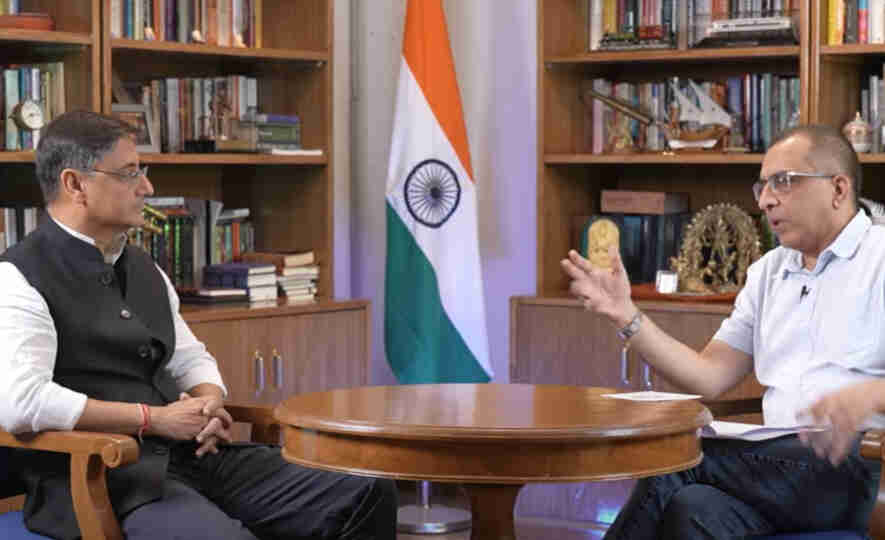
The following is the full transcript of economist, and author Sanjeev Sanyal’s interview on Money Konnect by Edelweiss Mutual Fund Podcast, on India’s path to becoming a Viksit Bharat by 2047.
Joining Public Service
INTERVIEWER: Hello and welcome to this very special episode. I am in conversation with Sanjeev Sanyal, someone who’s been a leading economist at global banks. He has been a prolific author, someone who’s followed by millions of Indians for his sheer approach to India and its future. Currently he is the member of the Prime Minister’s Economic Advisory Council. Thank you very much, Sanjeev for joining me today.
SANJEEV SANYAL: Pleasure to be here.
INTERVIEWER: You were somebody I followed and interviewed a few times during your stint with a global multinational bank, Deutsche bank, and were a chief economist there. What prompted you to one fine day first decide to take a break and write a book. Come back the same position, if not higher. And then one day in 2017, you decided to work in public service.
SANJEEV SANYAL: Well, I mean I was sounded out in 2016 by the Honorable Prime Minister and the Honorable Finance Minister of that time, Arun Jaitley Ji, whether I would be willing to come back and work as part of the Finance Minister’s team. So, you know, it’s not often that your country asks you to come and walk the talk. So I had been lecturing everybody on how to improve the country. They said come in now you go on and do it. So here I am.
Personal Journey and Inspirations
INTERVIEWER: Is it to do with your genes?
SANJEEV SANYAL: Well, I do certainly take great amount of pride in my ancestors, grand uncles, the great grandfather and so on. But you know, eventually everybody takes their own journey. In my particular journey, I did not start out trying to be a policymaker. I became a financial guy. I then wrote books. I did all kinds of things. I even got involved in urban design. I did everything other than policy making.
I keep making the point when I go to universities and I talk about my personal journey that look, life will take you in many, many random directions. A lot of the joy of life is to take it as an adventure and let it happen and it will throw opportunities at you and it will throw problems. It’s really about how you deal with both that end up adding to that adventure.
INTERVIEWER: Who inspired you most when you were growing up?
SANJEEV SANYAL: I personally read very eclectically, so there are many inspirations depending on which universe you talk about. I have had many inspirations in life from historical characters, for example, like Shivaji or Vivekananda or Mihir Sen. So there are many, many historical characters that certainly inspired me. And then through my life I have been inspired by people like my own father, my own family, as we discussed, and people I have met along the way.
INTERVIEWER: We always are nationalists believed in India.
SANJEEV SANYAL: Absolutely. I’m not a reformed Marxist, as many latter day Bengali economists are. I definitely did not arrive at my economic and political ideology later in life. I grew up in Jyoti Basu’s Bengal. I could clearly see what various grades of socialism did to you. And you know, I’m witness to the decline and then final collapse of Kolkata, which was the city of my birth. So I had no illusions about the wonders of socialism and communism.
Passion for Ships and Maritime History
INTERVIEWER: Yeah. The reason I chose the song by the way was one, of course, you’re a descendant of a very great revolutionary of India, but the other also because you love ships. Yes, that was the reason I chose that song because it has kashti and it has Desh ki azadi. So where did that come from?
SANJEEV SANYAL: So my interests in ships is in its current form is relatively recent. I was interested in sort of boats of some sort from a long time. I have a fully certified kayaking and canoeing person. I have participated in national level events when I was in college. I have an instructor grade, probably at that time very few people had instructor grade certification for kayaking and canoeing. So I do have an interest in that subject.
But my interest, which is my current interest in what I think you’re referring perhaps to, was in this ancient ship that I am currently trying to put together that is more recent. It came partly because of research that I did about a little over a decade ago into writing a book called the Ocean of Churn, which is the history of the Indian Ocean.
And as a part of that research, I discovered that Indians had a peculiar technology for building ships which goes back thousands of years in which they didn’t use nails, but stitched them together. And then I discovered that this technology has basically disappeared, except for building some small coastal fishing boats and so on. But it is repeatedly mentioned in ancient texts.
So I said, before the technology completely disappears, let me attempt to build a ship using this technology. So I found that there were some artisans still in Bepur, for example, who still remember some part of this technology. There is some text like the Viuyukti Kalpataru which mentioned these ships. There are some depictions in art.
I began to put all these things together and then came up with a design for an ancient Gupta period ship. And then I managed to take this idea to various parts of the government and ultimately it got the blessings of the honorable Prime Minister. And the Culture Ministry then has funded the navy to build such a ship. So that ship is now being put together in Goa.
INTERVIEWER: You put out a picture of it?
SANJEEV SANYAL: Yes, I keep putting out pictures.
Yeah. It is a beautiful piece of work.
INTERVIEWER: Fantastic.
SANJEEV SANYAL: And we intend to do a voyage with a couple of voyages with this. So it’s not just a museum piece. The idea is to then, end of the year, hopefully, if it is all goes well, to sail it to Oman first and if that works out, then to attempt to sail it from Orissa to island of Bali in Indonesia.
Urban Planning and Walkability
INTERVIEWER: Sanjeev, one of the things that you have, one of the many things you are very passionate about is urban planning, urban design. You’ve made the point in the past about how, unlike the older cities, where there was so much of focus on walking, the entire urbanization is now all about. And it’s not just India, maybe it’s global cities as well. Well, it’s all about, let’s put more flyovers, let’s put more mass rapid transport systems. And the whole walkability, I think that’s the word you use, seems to be going away.
SANJEEV SANYAL: Yes, I’m quite passionate about this particular issue. So let me explain what I mean by this. You see, much of what is called town planning in India is about basically laying out straight roads for cars to be able to go in and out and essentially not allowing for the human interaction. This is true in multiple ways, but I mean, this is also true of creating, for example, hardly any new cities create town squares.
Why don’t we create town squares? I mean, why do cities exist? Is for human interaction, you know, face to face. If it was just about driving around, then we would all live in villages much cheaper to live in. The people come to cities to be able to interact with other people. So cities exist for interaction and we don’t allow for this interaction in any meaningful way.
One part of that is actually simply walking around. I mean, we. Everybody loves talking about public transport. But be clear, all public transport is based on the first mile and last mile being walked. There is no other way to do public transport. Now we are building all these metros all over the country. Delhi has one of the biggest networks. You come out of any metro station, then you typically have to take an auto. Even if you have to go 1 km. Now, in any other place in the world, you would just walk that 1km.
And when I make this point, say, no, no, it’s too hot. I’m sorry, it’s not. Singapore has literally the worst weather possible for walking. Okay, it rains there and it’s humid and it is hot. And yet people walk in Singapore. If they can do so, they can certainly walk in Delhi because we have that kind of weather only for two and a half months. July, August and part of September. Rest of the time, even extreme heat is perfectly fine for walking. Right. At least a kilometer is not a very big deal for walking. And if you make it pleasant with trees covered or whatever and have a decent place to walk, it is perfectly fine. After all, when you go to Varanasi and walk around, it’s not a problem.
Or you go to even the older parts of the city, Connaught places. Even in the height of summer, Connaught Place is not a bad place to walk around. I mean, I remember, but it is terrible. You look at Mumbai. Some of the older parts, 30 years ago, it was perfectly nice to walk. So we don’t pay any attention to this walkability aspect.
So we will say we have broadened the road. What does broadening the road, it’s euphemism for narrowing the footpath. And even the footpath that is there, we will allow all kinds of encroachments on it as if there is no price to be paid for it. But in fact, what is happening is that the few people who do want to walk will then end up walking on the road. And of course, then you will car crashes of various kinds. And then you will blame the pedestrian for it or the driver. In fact, neither the pedestrian nor the driver. But the municipal commissioner is responsible for this message.
Clean Energy and India’s Approach
INTERVIEWER: Sanjeev, way back, I think about 20 years ago, when we weren’t even discussing clean energy ESG, you and one of your colleagues were actually or had founded an entity which was really looking into this whole aspect of green. And I know that recently we’ve even made a point that India will go at its own pace when it comes to meeting these standards. That’s again another area you’re very passionate about. Tell me a little more about how important this is because certain people I’ve interviewed, they say that already a lot has happened, whether it’s solar, whether it is moving towards electric, what is your overall.
The Environmental Accounting Journey
SANJEEV SANYAL: So there’s one part is the bigger discussion, which is a longer discussion. But I think the specific thing you’re talking about relates to the work I did with a senior colleague called Pawan Sukhdev. So he and I, going back more than 20 years ago, almost 25 years ago, began to say that look, we need to begin to put values to environmental degradation or social and other kinds of capital.
We set up something called Green Indian States Trust and began to do green accounting and attempted to do what was then considered a very ambitious thing to do, which is to try and calculate contributions to GDP of various natural and social capital. And we did some interesting things. You know, put values to the water resources of the country, to our forest and the forest produce and so on and so forth.
India is the first place where we did this on a mass scale. And so many of those green accounting techniques have now got incorporated over time into academia and so on. And Pawan, to be fair to him, remained on that track and he’s become a very well known figure in this green accounting universe. I have continued in finance and I have drifted into other spaces. I haven’t lost interest, but I will not claim to be at the cutting edge of this. I mean I may have helped found its original principles and done some of the original work but now the field has gone somewhere else.
But let me say that both Pawan and I are somewhat disconcerted by some of the uses these technologies have been used for, for example, ESG. What has happened is that environmental, social and governance norms are needed. I am in favor of having certain kinds of norms but unfortunately they have been completely hijacked worldwide, not just in India, but worldwide by essentially the NGO consultancy complex.
They have converted this in the case of the consultancies into basically a way of extracting rent, and by the NGOs for basically doing some sort of blackmailing. And between them they have created this whole network of environment, social and governance norms.
As I keep repeating, I’m not against them. My problem is the format in which they have been done with no discussions with anybody is now being entirely hijacked and misused. So for example, you have the Europeans using CBAM, which is basically a derivative of this line of thought, as essentially non-tariff barriers or for example various kinds of financial flows and regulators, including here in India, are beginning to put this.
But in fact if you dig a little bit deeper, you will see that there is no methodological rigor, there is clear misuse of this to reach certain ideological or corporate ends which have nothing to do with environmental or social or governance goals. So I have become actually rather skeptical of this.
So either you have some sort of a global conference, you decide on certain norms which are fair and everybody uses it. But what you really have today is that basically a small number of mostly North Atlantic institutions, whether NGOs, think tanks or consultancies have captured this space and essentially are milking it in multiple ways. And I am extremely skeptical about this.
So although I am one of its founding fathers in a sense of this entire line of thought, and Pawan by the way too, I would say that the direction it has gone and the way it has been captured by this entire international NGO crowd and then also by these international consultancies, they don’t care about the environment at all. They will certify anybody if they are paid enough.
Advice for Young Indians
INTERVIEWER: A lot of young Indians, Sanjeev, follow you. You have a huge social media presence. When I was reading up about you, what I figured is that you’ve repeatedly said that you, I mean, which is kind of what the Bhagavad Gita says, that Karam Kar Falki Chinta mat kar. It’s been your constant belief, if I may say so, in your own life, and that’s what you’ve been telling young people to do, that just do your work. I mean, don’t get so obsessed about which way it goes. Everything else will follow. What is your one word of one sentence or one thought of inspiration for these young people today who are following you, who are tomorrow’s India, we talk of demographic dividend. They are really the ones who are going to be probably the richest generation ever.
SANJEEV SANYAL: I think that unfortunately our expectations of the next generation are making them too anxious and this anxiety is not only bad in its own right, but in forcing them to try and live life in a planned way, we have ended up curtailing their risk-taking ability.
And one of the places where this manifests itself is this utter madness about upscale exams. Why? Because, you know, we have told them you should be ambitious, but then put them on some track where the only way you shall achieve some ambition is by writing this exam in which you have 0.01% likelihood of succeeding. And it’s a zero-sum game. I mean the same number of people will be employed at the end of the game as if more or less people applied, it doesn’t matter. The number of entrants are the same.
And you have literally lakhs of people giving up years of best years of their life sitting there trying to live life in this particular rigid, planned way. My view of this is completely absurd. We have worked, our generation has worked to create a platform from where they should be taking big risks.
And by the way, who knows what those opportunities are? I mean, what will be the jobs in the world of AI? I have no idea. Just like 20 years ago I could not have told you that social media personality was going to be a profession in the same way. I have no idea what those professions will be.
But what I am trying to say is, look, there are all these opportunities there and many of them will work out, some of them will not work out. It is perfectly fine. I mean, many of the things I do work out wrong, they work out right after many iterations. As I said, I had no intention of being a policy maker, but here I am. In fact, I had no intention of even being an economist or in finance. I mean, I started out wanting, originally wanting to be a physicist.
So, you know, it’s all random stuff. So if you asked me at the age of 17 or ask teachers or my friends what sort of person I was, I was very much a math science type. And to this day, you know, I’m known now as a writer. But ironically, I am definitely not an artsy, fartsy type. I mean, you would never get me to sit through a slow moving art film in black and white. I’d rather kill myself. So, you know, life has turned out that I am actually today known as a writer. That’s how it is.
INTERVIEWER: So innovators must take risk. And if you’re young, go ahead, take the risk, take the plunge, do what you want to do. Something may work, something may not work.
SANJEEV SANYAL: Lot of the things will not work. That’s why it’s risk taking.
INTERVIEWER: And what will save you is the other thing that you said, power of compounding.
SANJEEV SANYAL: Power of compounding. And I think people don’t get it.
INTERVIEWER: You love math. The power of it, whether you’re a country.
SANJEEV SANYAL: Yes.
INTERVIEWER: And I’m going to talk about the economy.
The Power of Compounding
SANJEEV SANYAL: China became the world’s second largest economy through compounding. It didn’t become in one shot, it just kept compounding, compounding. We should then do the same thing as India. We need to remember, don’t have to become the greatest economy in the world tomorrow morning. You won’t. Any attempt to do it will just blow your system up.
But keep compounding. If you are compounding faster than the other guy, then over time it will suddenly blow up at some point. Because that compounding at some point has additively reached a point, multiplicatively reached a point where it will really begin to work. But in the beginning it seems like you are, you know, doing a little bit, a little bit.
INTERVIEWER: And that’s true for the country, true.
SANJEEV SANYAL: For an individual, true for an individual as well. And so the point is that. And of course there will be deviations along the way just in the country. I mean, suddenly two years of the country’s life went because of COVID. That will happen to individuals also. You know, a few years will be thrown off because you fell ill. Something other happened. The first attempt at business that you did went wrong or you wanted to be a sports person and you had an injury.
I meet people who would have been fantastic. But you see, the point I’m making to them is that the fact that you’re good in the sport and you really worked hard at it, etc. The skill that you have is not that you played football or cricket or table tennis. The skill that you have is that you were willing to take a risk and work at it. That is what is the real skill.
That is a fungible skill. That exact same ability to take something and hammer away at it. That made, that would have made you a great cricketer till you got that injury will also allow you to become a great poet or an entrepreneur or great doctor. Who knows what other things are there.
And by the way, why do you have to think about life as one career as well? I mean, most of us in this room are going to live into our 80s. The profession that I may have started out may end up being defunct by the time I am in my 50s. What is to say that I shouldn’t have another career? The point is to have this lively engagement with life and to therefore, as I keep coming back, the importance of thinking of life as an adventure.
On Foreign Investment and Market Turbulence
INTERVIEWER: Why according to you have FIIs been selling the way they’ve been selling. I’m not asking about the market.
SANJEEV SANYAL: See, right what’s happening globally. So globally we are in a disrupted world. We are in a turbulent world. And I think one of the important things is that Indians get Indian investors or policy makers, etc. should be much more relaxed about money coming in and going out, just like I am asking people to be relaxed about risk taking and some of it being failures.
We have to be much more comfortable with the turbulence of the world. And here in some ways I derive this idea very much from my own religious beliefs, which are anchored in Shaktism. Shaktism does not see the world as some static perfect place or even some satwik ideal that one has to aspire for. The Shakta view is that the world is a chaotic, somewhat messy place, right? We worship Kali, the goddess of time. And what does she do in the end? She destroys everything.
So in this somewhat messy world that is continuously evolving in multiple ways, the engagement with that world is what I am interested in. I am not trying to reach some ideal endpoint at all. I am trying to engage with the messiness of the reality of life. So this is what I am trying to tell people to do. Whether it’s in my economics, in my personal life or in my history writing. This is the point I’m trying to make showing this churn.
So for example, if you, any of you engage with my economics, it is all about creative destruction. It’s all that derives directly from my religious beliefs. That, you know, one of the big things I did as soon as I joined the government, people may not realize this is actually clean up the banks. Okay? So this was what was given to me by Arun Jaitley ji to do.
Now there were many ways of cleaning the banks. The received wisdom of that time was that let’s clean up the banks by creating a bad bank. So you put all the bad stuff into the bad bank. Then you recapitalize the banks and they can go out and do whatever they’re doing. And we meanwhile try to revive these companies.
Now you can see from my philosophical view this is absolutely a bad idea. I am of the view if the company went wrong, then you bankrupt it and sell off the assets. Insolvency and bankruptcy code. So you will remember that we targeted the top 12 companies. We gave them the name the Dirty Dozen and we basically sold them off. And that is how we clean the banks now that’s a creative destruction worldview.
That is the Kali’s view of how a bank should be cleaned up as opposed to the static view of creating a bad bank and then try and improve them etc. I don’t care, just bankrupt them. Let another round of… so going back to your point about FIIs and they will sometimes come. They are useful as in money. But you have to allow for this the flow to go back and forth and the game is that your system should be resilient enough to be able to deal with markets when they go up and the markets when they come down. Sometimes the domestic investor will be the driving force, sometimes the foreigners will be the driving force and there will be a continuous churn. What’s wrong?
INTERVIEWER: Will we be Viksit Bharat by 2047 and what will it take to get there economically?
India’s Path to Becoming a Developed Nation
SANJEEV SANYAL: I’m not in the business of predicting whether we’ll get there, but let me say that we have an opportunity to get there and we will be rather amiss not to give it a good shot. Our demographics are in position for the next 25 odd years which is as it happens to be that Viksit Bharat period. So at the end of that period we too will begin to age just like China is aging now in 2047 we will also begin aging. But this period is demographically good.
We also have reached some level of platform. After all these years of reforms and growth etc. We are now reached a point where we will be the fifth largest economy. In the next 24 months we will be the third largest economy. So we have also got a platform that is there. So now the opportunity is there to make it.
Key Areas for Development
So what do we need to do? So there are few things we need to do. The first thing that we have been so far trying to do is at least the basic infrastructure has to be of some quality. So the first round of infrastructure that was built is to basically inter city infrastructure. So build out the highways, build out the airports, etc.
Now the next round is now beginning to be done with intra city infrastructure is being invested into Mumbai is one of our first experiments in this the coastal road, the metro system that’s coming on stream. Hopefully you will it will demonstrate by the end of this year so that you can transform a city through infrastructure. Something similar needs to be done by Delhi as well. I mean Delhi has sure the metro system has expanded but some of the other things need investment. There are other cities as well where we are doing similar experiments.
So build out the Infrastructure, second thing, create an environment for risk taking, innovation and so on. Again, we have worked very hard to simplify rules. You know, there were all kinds of things in the way, retrospective tax angel, tax attack, etc. Removed all of them, lowered the tax regime, hopefully simplified some of it. It’s of course two steps forward, one step back. Because continuously you have to push back against the encroachment of bureaucracy everywhere. But slowly but steadily, we are making some progress in that direction as well.
So that is something that we need to do, is to make this a place with ease of living, ease of doing business, and something I work in very hard, you know, doing lots of process reforms. But in the end, I would say the single biggest reform that we need to do would be to make our judicial system work. And I have said this over and over again, and I’m saying, repeating it here, that if you want to be a developed country, the single biggest hurdle now is our ability to enforce contracts and deliver justice in time.
In the end, after a decade long, you may be able to do. I mean, look, the anti Sikh riots are now getting resolved. I mean, you’ve got to be kidding me. So this is now, I would say the judicial process is now the single biggest constraint to India’s progress. And at some point in time, I know the judicial system is kept separate from the government and the legislature and other organs of the state. But we, the people of India have at some point to stand up and say that, you know, this organ of government is now has to be referred to.
INTERVIEWER: In fact, most of these ease of business rankings, it is this one factor.
SANJEEV SANYAL: That, no, no, why do we need somebody else’s ease of doing business in anybody’s life? You see, every single person in this room will have some family court case, somebody going on for 30 years. What madness is this?
Growth Projections and Challenges
INTERVIEWER: Especially civil cases. So many of the experts, I mean most recently IMF also came out with it projection talk of a sustained 8% growth over the next 20 years. Is that something you think is doable?
SANJEEV SANYAL: So it’s not doable or doable. It depends on the time that you have and what is the context in which you are playing. So everybody lies, of course. Why 8%? Why not 20%? Point of the matter is, is it something that we can conceivably do in the environment means we are in.
So it’s like this. There are two parts to driving fast. The quality of your car and your driving and the quality of the road. Right now the reforms that we are doing is hopefully improving the quality of the car and hopefully the quality of my driving that is internal to the machine. But the quality of the road is something that the world is giving me. Now. It is not a good idea for a driver to simply push his car on any road that happens to be there because he’ll have a car crash or he’ll break the, or damage the machine. So at this point, unfortunately, the road that we have is a rather tricky one.
INTERVIEWER: You mean the global world? I mean, there is wars going on, military wars.
SANJEEV SANYAL: And there are all kinds of things going on. So is it a time where we should attempt to accelerate growth? And I would argue we should keep it growing as fast as we can, but while maintaining stability. This is not the time to push it as hard as possible. I think with good policy making we can make this system grow by about six and a half to seven percent. I would prefer to be at the seven percent level, but this year we are doing six and a half. But I think we can do little bit better than this.
But can we do 8, 9% at this juncture? I don’t think today, because if I did try to grow the economy at 8% today, let’s say I would not be able to export fast enough to be able to keep up with the imports. I would begin to suck in at that speed. So I would keep it at about six and a half, seven percent today.
That does not mean I should not prepare for a time when the road will be smooth as well. After all, China isn’t that it grew at 10% all the time. There was a phase in the 2000s when for about six, seven years it grew at really fast double digit growth. But by the way, those were peculiarly good times. Those are the Goldilocks years. We also were growing at very high rates, 7.5-8% in those years. So we also actually didn’t do too badly in those times. It’s just that China did better, extremely well.
So we will at some point in the next 20 years get a phase, seven, eight years where we will really hit it. And at that time, whoever is the guys in charge have to be willing to press the accelerator and make it go. But my job meanwhile is to keep fixing the car and keep it going at the fastest pace I can do without blowing it up.
Now let me give you the example of those who have not done this. If you go back to the 90s, everybody thought that, you know, the countries of Indonesia, Thailand, Philippines, those were the high growth tiger economies of that time. And for a while they grew really well. But then you see, they, they then had the Asian crisis and they have never quite recovered from that shock ever again. I mean, it’s not that they didn’t grow ever again. They did. And some of them have done a little bit better afterwards over time. But you see, they have never had that kind of dynamism ever again.
So the same thing is true of India. If you try to overdo it, yes, you’ll get some good years, but then at the other end you’ll damage the system. I mean, we took a lot of effort cleaning up the banking system. If I now go and say, okay, let’s get the banking system to just expand without paying attention to anything, yeah, we’ll get a few years of really high growth. But let me tell you, at the end of that, we will have a banking system that will blow up, which is something that happened to us after the last global financial crisis. We did give too much loans. We did get a short period of growth. And then what happened it just then, you know, spend many years cleaning up the banks. We will end up with that as well. Again.
Long-term Economic Outlook
INTERVIEWER: Do you feel, Sanjeev, that this just last question. You know the kind of pace that you’re talking of that it’s not like 20 years, you’ll grow every year at the same pace.
SANJEEV SANYAL: Right.
INTERVIEWER: You might have the slog overs, so to speak.
SANJEEV SANYAL: Yeah. But you have to see that the bowling is good for you to step out of the crease.
INTERVIEWER: But if I were to take your power of compounding math, if we are Today, I’d say 4 trillion because people talk 30 trillion, 33 trillion, 34 trillion, 40 trillion.
SANJEEV SANYAL: Look, you can do whatever you want. One of the joys of excel sheet forecasting is that you can pull the cursor anywhere and then it will give you any number. I think we have a reasonable chance of getting somewhere in the 29 to 31 trillion range. Yeah. But do remember it is not a real number. It is a nominal number I am taking, allowing for inflation as well. But still it will be a good number. I think we can do it.
But it requires the following things. One is all the, all those reforms I talked about, you know, keep doing reforms, ease of bringing business reform, the legal system and all of that. Two, you have to be clear that all of this has to be done by maintaining macroeconomic stability. So don’t go and blow up your fiscal on various kinds of freebies, which has now become popular across the political spectrum. Do not waste resources on, you know, expanding the government in everything that happens to come your way every, every buzzword that happens. Don’t expand the government. You know, keep taxes reasonable and low and limit the government in areas that is not needed. So where needed, shut down outdated departments and agencies and keep the, you have to keep this thing ship shape, literally.
INTERVIEWER: Absolute pleasure talking to you, Sanjeev.
SANJEEV SANYAL: Thank you. Thank you very much.
INTERVIEWER: I wish you all the very best.
SANJEEV SANYAL: Thank you so much.
Related Posts