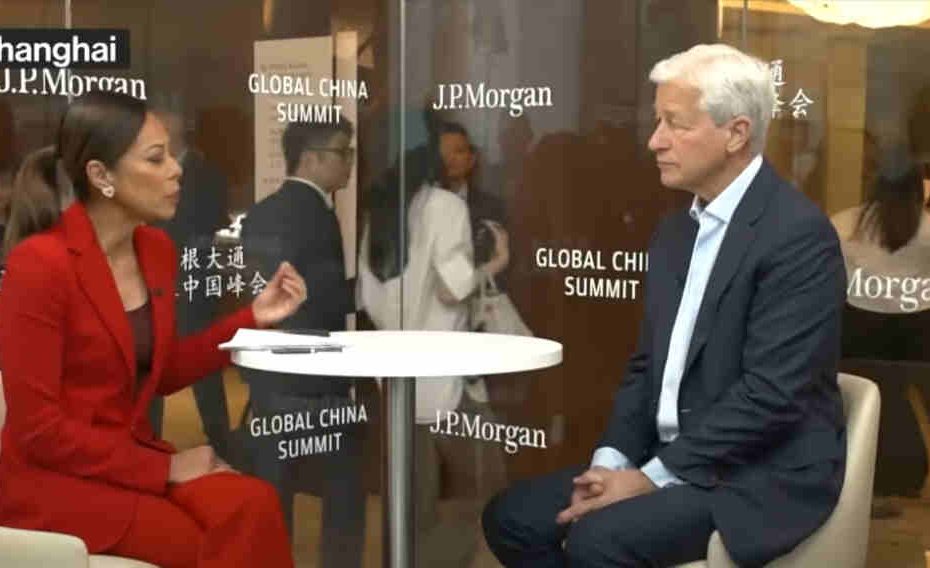
The following is the full transcript of JPMorgan Chase & Co. CEO Jamie Dimon in conversation with Bloomberg’s Haslinda Amin on the sidelines of the JPMorgan Global China Summit in Shanghai, (May 22, 2025).
Market Risks and Economic Outlook
HASLINDA AMIN: You’ve always talked about how there’s been extraordinary complacency that markets are not pricing in the risk. With what we saw in yields overnight, is that a reflection of risk being priced in?
JAMIE DIMON: Yeah, so I talk about that kind of complacency. I’m talking about the asset price in United States. And it’s a long list of things. It’s QE, it’s fiscal deficits, global fiscal deficits. It’s potential trade wars. It’s these huge complex geopolitical situations. And I look at all of those probably not being properly priced into the marketplace, but we don’t know what’s going to happen. And I saw last night’s reaction. You know, I don’t worry about one day move in bond markets.
HASLINDA AMIN: So you don’t worry about one day. But when you take a look at yields, they are at higher levels than they were before Liberation Day. I mean we talked about how 3 is higher and some are talking about tens getting to five, studies getting to 7%. How are you assessing that? I mean, how high do yields have to go before they reach breaking point?
JAMIE DIMON: Yeah, I don’t know the answer to that. We assess the way we run the company. We prepare for a full range of outcomes regardless of what you think. I just think there’s a chance that things will have stagflation. So I’m not saying it’s going to happen. I don’t want the reason he’s predicting, I’m not. But we have to be prepared for something like that.
I think the global fiscal deficits are inflationary. I think the remilitarization in the world is inflationary. The restructuring of trade is inflationary. And this is not all an American thing. And the infrastructure needs are inflationary. Now you have offsets, you have oil prices down quite a bit which is quite deflationary.
But with all those things taking place, you may be surprised. And I love to read economic history so you can look at models. I think it’s also very important to look what happened in ’72 and ’74 and ’80 and ’82 and 1990. Surprises happen. And you know, most economists and most models don’t pick those inflection points. Those inflection points are often driven by geopolitical complexity, things you don’t necessarily know. And we had the oil crisis in ’74, so we want to be prepared for everything. So we continue to serve our clients through thick and thin.
U.S. Fiscal Policy and Debt Concerns
HASLINDA AMIN: You talk about how concerned you are about debt. And of course add to that the tax bill that’s being voted tonight. They say that’s going to make it a lot worse. Your take on that?
JAMIE DIMON: Yeah, well, the United States is running the largest trade deficit that we’ve ever had in peacetime, almost 7% of GDP. And how the tax bill gets done will probably add a little bit to that. I still think it’s better that we get certainty around tax bill. I’d rather get that done. But I do think at one point America needs to attack its deficit problem. So do a lot of Republicans think that. So do a lot of Democrats think that.
And that attack isn’t just raising taxes. It’s having proper policies around incentives and growing business. And I just got back from Europe last week and everyone there talks about growing the economies, getting more investment, reducing the regulatory environment that slows down growth, keeping everything safe for food, water, banks, etc. But I think governments have to do a better job at that. And so pro-growth, pro-business is a very good thing and hopefully that can offset some of the extra spending one day.
HASLINDA AMIN: As we said, it is a higher yield environment. And you have said before that we could see some sort of rebellion in markets around the world. Is that still a possibility? How might that look like?
JAMIE DIMON: Yes, I would not call it a high yield environment. If you look at economic history, rates have been far higher than this and they surprise people over time. And I think a lot of the longer term trends have inflationary attributes too.
The other thing for your TV viewers – credit spreads are low. So you know you can have two things go against you as credit spreads gap out and rates are going up. And so we’ll see how it plays out. I don’t want to guess how it plays out. I’m on the cautious side. I’m a little skeptical that we’re going to have kind of a just an ongoing soft landing here.
China Strategy and Investment Approach
HASLINDA AMIN: Let’s turn our attention to China where we are. Is it still a priority market? Because even as your rivals de-risked from China and pull back, you actually boosted your resources here. How are you looking at China in the next 12, 24 months?
JAMIE DIMON: Yeah, so we invest for the long run. So I don’t look at, you know, we’re not buying a China stock. When you say invest next 12 or 24 months – look at this conference. When I first came here 21 years ago, the first one, we had a couple of hundred people here. Now we’ve got almost 3,000 people here. I think 1,300 companies, investors from 33 countries, we do research now I think on 400 Chinese companies.
We’re a long term investor here. Yes, there’s all these other issues causing consternation, but we have to deal with the world that we have, not the world we want and we’ll continue to grow. We cover, I think the number is 1,700 multinationals around the world in China and these are clients of ours from Latin America, from America, from Europe, etc.
And we take a lot of Chinese companies around the world.
We have Mandarin speaking folks in Brazil who speak Portuguese and Mandarin so that we can facilitate commerce between Brazil and China. So we’re long term investors concerned about the current environment. But I think hopefully it will all sort out. We’re not going to pull back. I mean I know, I gathered the story that came out that somehow we’re pulling back in China. That’s completely false. But we understand we have some political pressure until all these things resolve.
HASLINDA AMIN: So you’re looking at China as one of the priority markets to invest in in the next 12 months perhaps. Is that consensus within the leadership that this is the place to be? You talk about taking a longer term view.
JAMIE DIMON: Yeah, the consensus is that companies are going to be doing business here. There could be some adjustments because of the trade negotiations but I don’t think the American government wants to leave China. We just had our Secretary of Treasury meet with the authorities here and they’re talking about having a good relationship. I’m glad that they engaged, talking about what we can do to improve things. I hope they have a second round and a third round or fourth round and I’m hopeful they’ll end up in a good place.
In terms of China, if you look at China going way back, they’ve done an enormous job over the last 20 years lifting up their people. That doesn’t mean I personally agree with everything they did. I’m a full throated red-blooded American patriot capitalist. But I understand that they’re doing what they can to lift up their country and here, you know, I’ve seen their cars and their AI. They’ve done a pretty good job, and we should look at America – we have to compete too. And so I’ll leave foreign policy to the experts in the government.
Navigating US-China Tensions
HASLINDA AMIN: Companies get caught up in the crosshairs of the US-China trade tensions. I think JP Morgan got caught up in the SAIC listing in Hong Kong. You maintained your position. Why?
JAMIE DIMON: First of all, foreign policy is set by the government, it’s not set by JP Morgan. And the government did not sanction SAIC. There are people who didn’t want us to do it for a bunch of reasons. And they may have somewhat legitimate reasons, but I think the government should decide what to do.
We aren’t going to do that. If they had told us we couldn’t, I would salute and move on. I would have no choice. And there are legitimate issues around national security. So if you went through all those issues – yeah, I understand that. We don’t think it really applied to this particular thing. We and other investment banks did a lot of due diligence around all the issues that people raised. And I’m sure I’ll be criticized about that too. But if we thought it was wrong, we wouldn’t do it.
HASLINDA AMIN: So do you expect more pressure?
JAMIE DIMON: We’re getting pressure from governments about everything. We’re not green enough. We finance oil and gas companies. We get it. We get it from mayors and governors. I understand that. We try to answer them all rationally and serve our clients. If there are legitimate complaints, we try to adjust ourselves and every now and then we make an adjustment.
HASLINDA AMIN: It is a volatile relationship. Right. And that volatility is expected to persist. Do you see JP Morgan and your peers continue to be pressured by the government to perhaps move away from deals?
JAMIE DIMON: I’d be very careful. Both governments have export controls, import controls, investment controls. I do think those things will take place and they’ll morph over time and we’ll adjust to that.
Asian Investment Strategy
HASLINDA AMIN: What’s your strategy in Asia? Bearing in mind that has been so much pressure on the Chinese government and people increasingly talking about diversification. How are you looking at your business in Asia?
JAMIE DIMON: We look at every country with its own population, its own education, its own culture, its own growth, its own natural resources or lack of them. We pretty much invest in all of them. And all these countries, we network with them. So we’re banking companies here, around the world. You’re from Singapore. We bank Singapore companies and they go all around the world. So almost every one of the countries is growing. And that’s how we do it.
We look at each one. We don’t go in and out. We don’t look at investing in a country like a stock. Like “Oh well, we think Vietnam’s going to have a bad year.” No, we look at how they’re growing their population, how they’re growing their companies, how they’re growing their economy. And then of course, sometimes we simply follow clients already into those countries.
A lot of companies that we bank from America want us to be in more countries. They can consolidate more of their payment systems and then we build those things and we enter new countries for that reason sometimes. So my view is that’s going to be going on for my life and for many years after that. And there’ll be ups and downs due to trade and the economy.
HASLINDA AMIN: I guess the premise of the question is Trump’s tariffs and the trade war. Is that influencing, shaping your investment decisions and where you grow?
JAMIE DIMON: Not really and not directly. Like I said, I’m an American patriot and I think there are legitimate national security issues. I think America could have done a better job focusing on national security issues. Like think of it – we should never get all of our rare earth from one country, much less a country that might be an adversary. That was a mistake we made. It should be fixed.
So there are a lot of legitimate issues that have to be dealt with. But the government is doing that. We talk to them. We just announced the Center for Geopolitics and we help other companies look at their supply chains, their cyber resiliency, all of those things and I think at the end of the day it’ll be okay. Even President Trump has been out there saying he likes President Xi, he wants open trade, he just wants to fix the trade that is unfair. And you know, if it’s unfair, it should be fixed.
Center for Geopolitics
HASLINDA AMIN: You talked about your Center for Geopolitics, let’s talk about that. What’s the thinking behind it? How will it help navigate? How would it help your clients, customers navigate?
JAMIE DIMON: So first of all, we do it for ourselves. You can look at JP Morgan. We’ve always extensively analyzed every country, every potential risk. We look at hundreds of risks to make sure we can handle them. JP Morgan’s got to survive just about anything. And we try to make sure we do that.
This Geo Center helps us, but also helps to educate our clients because a lot of clients ask us all the time about what should we do about this country, what should we do, how do we look at risk. So we just help them look at various risks they have. And I would remind people we actually help clients with cyber risks, geopolitical risks, governance in addition to raising capital and M&A and things for them. It’s just kind of another service we provide.
HASLINDA AMIN: And of course, that center is in the Middle East. Is there a sense that the importance of the region in the world is growing exponentially?
JAMIE DIMON: Which region?
HASLINDA AMIN: Middle East.
Middle East Growth and Prospects
JAMIE DIMON: I think it’s growing exponentially. And we’ve been in Saudi Arabia for 80 years plus. So yeah, it has wealth, it has sophistication, and I think it’s had leadership that wants to do a good job at trying to grow their economies and diversify their economies a little bit.
HASLINDA AMIN: Is this the moment for the Middle East?
JAMIE DIMON: I hope so. I mean, look, the Middle East is a very complex place and I think, you know, the terrorism is terrible, but I do think that you’ve seen a complete sea change in how they view. I think they want peace there. I think all the big players in the Middle East, one actually want peace. I talk about Saudi Arabia, UAE, Qatar, Egypt, and I think it would be their interest to bring real long lasting peace, including for Israel and hopefully eventually for the Palestinian people.
HASLINDA AMIN: Of course, we’re talking about the Middle East. On the back of Trump’s successful trip to the region, do you think that trip marks a turning point in relations? If you take a look at the—
JAMIE DIMON: Amount of deals, I couldn’t evaluate that quite yet. I do think if you go back to Trump won that. I do think there was a sea change with Trump won and how they were looking at Saudi Arabia, et cetera. I think Saudi Arabia has changed a lot. I mean, it’s dramatically different from when I first started going there. Like, women can drive cars and go to schools and don’t necessarily have to wear burqas, etc.
Federal Reserve and Interest Rates
HASLINDA AMIN: Jamie, I’ll be remiss not to ask you about the Fed, given the higher yield environment, which you say it’s not, but it is still higher than what it was before.
JAMIE DIMON: It could go higher.
HASLINDA AMIN: Will it go higher and also will it force the Fed’s hand?
JAMIE DIMON: Yes. I mean, there’s always a notion that somehow the Fed is omnipotent and could do whatever it wants. And they do set short term rates, but those have to follow the facts. So they raise rates because inflation went up, you know, and they can’t control control. Even today, you know, trillions of dollars, these bonds are sold every day. That’s done by investors around the world. They cannot control all that. You know, foreigners own $35 trillion of US financial tradable assets. And so, you know, they have to react to reality, which they that’s not a criticism. They and they say they’re data dependent but they have to wait and see exactly what happens and then do the appropriate thing.
HASLINDA AMIN: But the thing is their reality is different from the reality you have in mind. If you take a look at what Neel Kashkari said, he said economy is on solid footing and some other Fed officials have said that in terms of Fed policy it is in a very sweet spot. So their reality is quite different.
JAMIE DIMON: I think. I don’t agree we’re in a sweet spot. Okay. And I think you have to separate two things. The economy has been doing well all the facts, you know, we have been effectively been in a soft landing. That does not tell you what the future is going to be. To worry about the future. Look at all the things that affect the future. Kind of work your way back back to the current day. And I’ve already mentioned huge deficits. We haven’t finished quantitative tightening yet. There are huge geopolitical issues. There are these inflationary factors out there and they have to react to all of that. So I think they’re doing the right thing to kind of wait and see before they decide.
Dollar Strength and US Assets
HASLINDA AMIN: And one final question and I promise that is the final question.
JAMIE DIMON: Okay.
HASLINDA AMIN: The dollar, right. Usually when you have a high yield environment, the dollar gets a boost, but it’s the other way around. How are you reading into dollar weakness?
JAMIE DIMON: Yeah, well I can say foreigners own $35 trillion of US securities. The US still is the most prosperous, innovative nation on the planet. That’s not going to change, but I think it might be reasonable people looking at and also asset prices are high. So if you go around the world, you look at stock price in the US are up here, P/E ratios or other parts of the world are much lower. So people legitimately say well maybe a little bit less dollar assets and a little bit more of that. So you may see some kind of adjustment. I think at the end of the day the important thing for America is that we do the right things to grow our own economy. And that includes affordable housing and for business and innovation and growth and R&D and all those things. That’s the important. You know, I don’t worry that much about short term fluctuations in the dollar, but I do understand that people might be reducing dollar assets today.
HASLINDA AMIN: Coming from a patriot. Jamie Dimon, thank you so much for joining us.
Related Posts