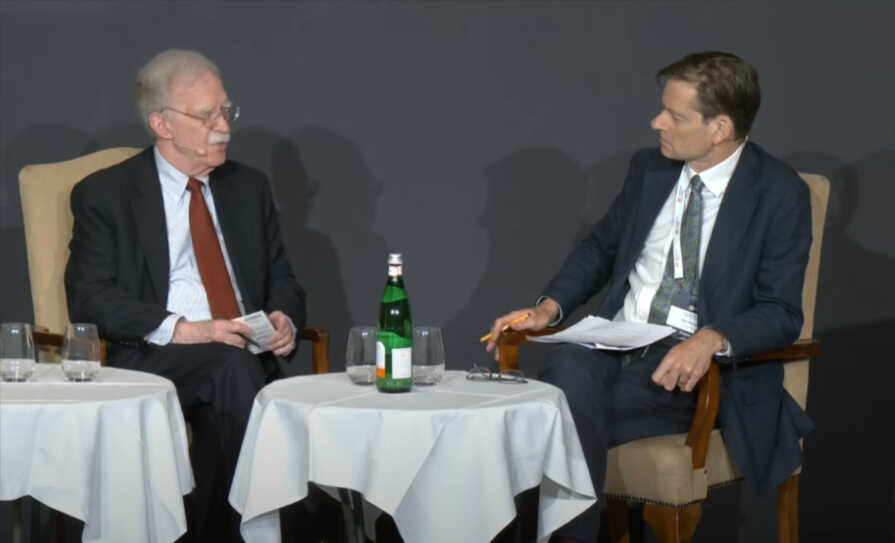
Read the full transcript of former US National Security Advisor John R. Bolton in conversation with Alec Russell, foreign editor of the Financial Times, on “Trump, MAGA, Israel And His Dilemma Over Iran”, at FT Global Affairs and Business Council at Berlin, 19 June 2025.
Opening Discussion on Trump’s Iran Policy
ALEC RUSSELL: For our final session, we are going to turn to the Disruptor in Chief. We’re going to effectively to Donald Trump to discuss his approach to the world, to discuss America’s role in the world and indeed the state of the world. I’d like to invite Ambassador John Bolton onto the stage. Ambassador, come up.
Ambassador Bolton, as you will know, has served in every Republican administration since and including Ronald Reagan in a number of different and important decisions roles. Most recently he served in the first Trump term as National Security Adviser.
Ambassador, Donald Trump was elected on a platform of avoiding wars. Just a few days ago, he was talking about talks with Iran. And then after the G7, we see a slip, a shift calling for Tehran’s unconditional surrender. He says his patience is wearing thin and has boasted that Ayatollah Khamenei is an easy target. So you’ve been in the room with him for discussions on Iran. How do you interpret this seeming contradictory position that he’s been taking?
JOHN R. BOLTON: For Donald Trump, talk is cheap. And what he says in the morning may or may not be what he says in the afternoon. And what he says on the campaign trail doesn’t necessarily reflect the choices he’s faced with. He’s just looser with words than most politicians because he’s had a very successful career of never been called to account for them.
ALEC RUSSELL: That said, where do you think he stands now on Iran? There’s a carrier group that has moved from the South China Sea towards the Middle East. There are a number of reports, as you will know from Washington, coming out, seemingly well sourced reports suggesting that he has decided to join Israel in taking action against Iran. Where do you think he’s going to come down on this?
Trump’s Decision-Making Process on Iran
JOHN R. BOLTON: Well, I’d distinguish between two separate questions. Whether we take voluntary action militarily against Iran or whether we have to respond to something Iran does to us.
On the question whether we voluntarily join Israel, which I think we should do, I don’t think Trump has made up his mind yet and I don’t think he will because he still holds out the hope that the Iranians will start negotiating, which, if I were in Tehran, I would certainly be advocating. Not that I would have any intention of ever honoring the agreements, but it’s much better to talk, string things out and avoid attack. He will be confronted within a number of days with the reality of having to make a decision one way or the other. But I can’t project what he’s going to do. It doesn’t bother me because, as I say, he doesn’t know what he’s going to do.
On the other hand, if Iran is foolish enough to attack American deployed forces in the region or civilian targets like our embassies and consulates, or ramp up their campaign of terrorism in Europe and the United States and we are damaged in some way, then I think Trump has no alternative but a massive response. And I would hope that he would feel the same way if the Iranians also mistakenly attacked the Gulf Arab countries going after their oil infrastructure or whatever the targets might be. And I think that should produce a comparable response from the United States. That I think is much more certain.
MAGA Influence on Trump’s Foreign Policy
ALEC RUSSELL: You have observed him in decision making action, as it were. Steve Bannon, who is a very prominent MAGA advocate, ideologue, he said last night, he said that effectively, if America joins Israel in attacking Iran’s nuclear program, it would tear America apart. And other MAGA supporters have delivered this line. How much do you think does that sort of position impinge on Trump’s thinking when he’s weighing a decision like this? Is he weighing it in terms of the geopolitical risks or is he thinking of the domestic political factors?
JOHN R. BOLTON: Mostly he’s thinking about Donald Trump and he wants to be center stage. And frankly, the past 48 hours have been wonderful for him because what are we talking about? What is he going to decide?
I’ve known Bannon for a long time. He’s very bright. I think he’s an astute observer of the American political scene. And he’s trying to say to Trump, your base is going to be unhappy. But I think the bulk of the real MAGA Trumpers will support Trump if he decides to take military action. I think the threats of Tucker Carlson and some of these other nutcases are hollow. The MAGA base will stay loyal.
But there is interesting evidence just out this morning in a Washington Post poll, and it’s only one poll, but it shows why those who say that Trump has completely changed the Republican Party are wrong. This is a poll taken on should the US Support Israel and take military action at a time when Trump himself is obviously publicly undecided. Poll shows overall, 25% are in favor of military action. 45% are against, 30% unsure. Which I find a little surprising that it’s so negative on the use of force.
But here’s the really interesting thing, which is the party breakdown. Democrats, 9% support the use of force. 67% oppose the use of force. 24% unsure. Republicans, Republicans. With Trump publicly unstated. Republicans, 47% support the use of force. 29% opposed, 24% unsure. That is the breakdown of the American parties before Donald Trump. Republicans taking a more assertive line, Democrats taking a more pacific line. And to me, that’s confirmation that the Republican Party will not just survive Donald Trump, but we will move beyond them.
Trump-Netanyahu Relationship Dynamics
ALEC RUSSELL: Trump’s relationship with Netanyahu is obviously very important for all this. In your memoir that you wrote after your time serving in the, in the first Trump administration, I think you said something like that on one occasion. You were asked, and you say Trump would back Bibi. Can you just explain the nature of their relationship? Because this is obviously pivotal to where we are now.
JOHN R. BOLTON: Well, as they say on Facebook, it’s complicated. Trump has a lot of support from evangelical Christians in the United States. And of all the different communities in the American electorate, the strongest, most pro Israel community is the evangelical Christians. So he heard during the first term from, from Mike Pence, from David Friedman, our ambassador in Jerusalem, from a lot of us, why support for Israel was important to him politically.
But at the end of the Trump administration, you could see strains in the relationship already that Trump just didn’t get along with Netanyahu as much as people thought. He was very upset that Netanyahu quickly called Joe Biden to congratulate him on winning the election, because as we all know, Biden didn’t win the election. Trump is jealous of Netanyahu because of all the politicians in the world, the one better at getting press attention is Netanyahu. And I think this grates on Trump.
So right now, he sees Netanyahu as being at the head of the parade. And that’s where Trump should be in Trump’s view of the world. And I think this has also shown the indecision in Trump’s own mind. On Thursday night, when the Israeli attack started, Marco Rubio issued a statement that was notable in two respects. It said, this is a unilateral action by Israel, meaning no U.S. involvement. And there was no customary statement of support for Israel. Now, I don’t know that Trump read it before Marco Rubio sent it out, but I’m sure he approved the substance of it.
By the next morning, when it looked like things were going pretty well for the Israelis, Trump issued a statement of support for Israel. Later in the day, he said the results were excellent. Of course, I suppose that depends what side you’re on. And then later in the day, he said the stock market will go up because of the attacks. Desperately crawling to get to the front of the parade. And now he’s just, he wants to be on the winning side because Donald Trump is always a winner. As you all know, there are winners and losers in the world, and Trump is always a winner. He can’t decide which side is going to win now, but he’s coming to the point where he does have to make that decision. As the saying goes, in the US when you come to a fork in the road, take it. And that’s what he’s going to have to do.
Timeline for Decision Making
ALEC RUSSELL: How long has he got to make that decision, do you think?
JOHN R. BOLTON: I think it’s a matter of days, because I think the Israelis are progressing at a relatively rapid rate in their efforts. We don’t know for sure. We don’t at least publicly know what the full extent of the damage they’ve caused. But, and they do have the leisure of time. They’ve eradicated, as far as we can tell, Iranian air defense capabilities. So they can pick and choose. But I think there’s a lot to do and they’re going to want to know whether and to what extent Trump is going to get involved.
Military Capabilities and Nuclear Facilities
ALEC RUSSELL: You’ve been following this issue for a very long time and have long been an advocate for, for intervention against Iran’s nuclear program. If America doesn’t join Israel’s campaign, can Israel take out the Fordo center complex without America? Or are some of these reports have been coming out true that it does need America’s bunker busting bomb? I just ask you because I know that you’ve been looking at this for many years.
JOHN R. BOLTON: Well, there certainly is a lot of information. I mean, the bunker busters will finish Fordo and they will also conclusively finish Natanz. But Israel has capabilities just on the tons. The International Atomic Energy Agency has reversed its initial assessment of the impact of the Israeli attack to say that they believe that the centrifuges deeply buried at the Tanz may have been very substantially damaged. I don’t think we know. Personally, I would say if Trump did get involved, I’d drop a few bunker busters on the tons just to be sure that we’re right.
But what Israel can do at Fordo, which is buried under a mountain, is close the entry shafts and close the air shafts. And if you can’t breathe, you can’t enrich uranium. Now, that would require preventive maintenance every so many months to stop the Iranians from digging the entry tunnels open again.
The problem, the, the risk here that we’re not talking about is the potential that our intelligence is not perfect, that has happened from time to time, and that there are facilities that we don’t know about, that obviously we’re not going to be destroying. The facilities that I worry about most are center around whether Iran has aspects of its nuclear program buried under a mountain in North Korea, of which I think there’s a real possibility. So that’s obviously out of question of reaching at this point.
Russia’s Role and Limitations
ALEC RUSSELL: And Russia’s support for Iran, is that going to be a factor or is Russia holding back, do you think?
JOHN R. BOLTON: I think Russia is overwhelmed with Ukraine. I don’t think they can come to Iran’s defense. They couldn’t come to the defense effectively of the Assad regime when it was overthrown recently. I think the fact that Putin called Trump to wish him happy birthday, very nice way, wished him a happy birthday in a very nice way because they’re good friends and they have such a good personal relationship and really out of the goodness of his heart to offer to mediate between Iran and Israel. That’s about the limit of Soviet, of Russian power here.
The Question of Regime Change
ALEC RUSSELL: Ambassador, we are generous types at the Financial Times. I’m going to read you all a summary sentence from the Wall Street Journal. It’s a column that appeared this week in which near the end of it comes these two lines. The only lasting foundation for Middle east peace and security is overthrowing the ayatollahs. America’s declared objective should be just that. This was written by Ambassador Bolton. Unfortunately not for us. But there you go, Ambassador.
I mean, I think you could argue that it’s one thing to take on Iran’s nuclear program. It’s obviously, I would say obviously it’s another thing to push for regime change. The world has seen how regime change ended in Iraq. It was pretty messy, and how it ended in Libya. Why are you so confident that regime change is the right thing to do?
Trump’s View on International Relations Through Personal Relationships
JOHN R. BOLTON: Well, I’d encourage everybody to read the whole op ed, which, fair enough, lays all this out at somewhat greater length. But as I say in the piece, there’s no question here about ground troops being involved. The fact is the ayatollahs are weaker than at any point since the revolution of 1979.
Ever since 2018, 2019, they’ve had severe economic difficulties caused only in part by the sanctions, mostly caused by bad economic policy. You’ve got massive amounts of discontent, really, across the country. Young people, 60% of the population is under 30, know they could have a different life. They can see it across the Gulf, among the ethnic minorities, Kurds, Azeris, Belluchis, Arabs, there’s widespread discontent and a search for autonomy.
Persians, depending on your estimate, are only 50 to 60% of the total population. And with the murder two years ago of Masi Amini, a young Kurdish woman who was not wearing the hijab and which provoked some of the most extensive demonstrations around the country under the Woman Freedom Life movement, you’ve got a challenge there that represented not just an objection to the dress code, but a fundamental assault on the legitimacy of the regime.
Because if the ayatollahs do not speak the word of God on the dress code, they don’t speak the word of God on anything. When you add all that together now with the pummeling that the terrorist surrogates like Hamas, Hezbollah and the Houthis have taken with the fall of the Assad regime, a huge setback to Iran, and now the destruction of its ballistic missile production capabilities and the ongoing destruction of the nuclear program, all of this represents to Iran untold billions of dollars spent over decades, lying in ashes now with no benefit whatever to the people of Iran.
This is what ought to fragment the regime at the top and bring about the possibility of its downfall. It’s far from certain. But the level of opposition inside the country, the weakness of the regime, the absence of a clear succession plan for the Supreme Leader, who’s 85 or 86 and sick, all indicate that it’s very close to falling.
ALEC RUSSELL: To be fair on the ambassador, he did also end by saying, success is far from guaranteed, but the moment is auspicious. I’m not going to read any more of our Rivals columns, but thank you for amplifying that. I appreciate, obviously, the context, and I’m sure that many people, most people, probably, possibly everyone in the room, would agree that it’s a pretty unattractive regime with a pretty dire record of, should we say, governance.
But nonetheless, just to return to this, there is also, though, isn’t there a sort of huge risk that you end up with this regime overthrown and a country that tears itself apart and becomes a source of colossal instability for the region and that, that absolutely outweighs the advantage of seeing the end of the regime.
JOHN R. BOLTON: Well, the risk of the country splitting is real. I think that’s a possibility. The risk of the ayatollahs being replaced by a military dictatorship is possible. But you know, in 1979, at the time of the Islamic Revolution, Iran was approaching modernity. And that was one of the reasons the Shah was so vulnerable.
So I think the population is well educated, it’s sophisticated, you can’t say for certain. But I think the worst case scenario is extremely unlikely. And in any event, the real question is, what is your tolerance of risk to have the kind of regime we have now have nuclear weapons? My tolerance is zero. And the only way that you achieve that objective is overthrow the regime.
Trump’s Relationship with Putin
ALEC RUSSELL: I want to turn to another, another regime that you’ve, you’ve been thinking about for some years, the one in Moscow. If I may, we heard some rather depressing insights into it last night by the conversation with Max and Michael. Maybe I should start by posing the very question that I think it was Mike Calvi suggested you should be answering, which is effectively, what is it that shapes Trump’s position on Putin? I mean, we saw just last week, this week, he was regretting the expulsion of Putin from the G8. How do you explain his seeming sympathy for Putin?
JOHN R. BOLTON: Well, it’s in large part because of the way he sees international affairs. He sees it through the prism of personal relationships. He thinks he’s friends with Putin. I don’t think that’s how Putin sees him. I first met Putin in October of 2001, right after 9/11. I accompanied Rumsfeld to Moscow for talks about what we were going to do in Afghanistan.
And he struck me at the time, even though he’d only been president for a year or two, as one of the most cold blooded individuals I’d ever met. I’ve met with him any number of times since then. My opinion hasn’t changed. But Trump admires Putin as he admires other strong leaders. And he believes that if he has a good personal relationship, then the state to state relations between the US And Russia are good.
He thinks he’s friends with Xi Jinping. He, after he met Kim Jong Un in Singapore for the first time, he said to the press, we fell in love. That’s how he sees things. That’s not how they see things, but that’s how he approaches it. And even in his comment on Russia being expelled from the G7, he put it that Putin was personally insulted that Russia had been expelled. It goes a little bit beyond that, but that’s the lens that Trump sees it through.
By contrast, if he has bad personal relations with a foreign leader like Zelensky, it’s hard to see how you get good state to state relations. The implicit question is, all right, so look, is he a Russian agent or isn’t he? I don’t think so. I am his longest serving national security advisor as of today and may well be by the end of it, but I didn’t see anything in 17 months that suggested that to me. I think rather he is what Vladimir Lenin once called a useful idiot.
ALEC RUSSELL: On Zelenskyy. His dim view of Zelenskyy. Does that all go back to the sort of conspiracy theories about Ukraine and Zelenskyy and Biden and all that sort of stuff?
JOHN R. BOLTON: Geez, you’re so cynical. Ukraine campaigned against Trump in 2016. He believes this. He knows that Hillary Clinton’s computer server is in Ukraine, and he still hasn’t gotten it from Zelensky. And he remembers that the perfect phone call in the summer of 2019 led to his first impeachment.
Now, I give Zelensky a lot of credit, particularly in the months since the humiliation in the Oval Office, for trying to develop a relationship with Trump. He has no other alternative. But I’m afraid for Ukraine, that in Trump’s mind, they’re still out to get him.
The Failure of Sanctions Strategy
ALEC RUSSELL: So do you see any chance of Trump putting pressure on Putin? I mean, he’s done this. He’s had the same sort of back and forth over Russia in his public comments that he has recently over Iran. Any chance of Trump backing more sanctions on Russia, for example, or something more serious on Russia?
JOHN R. BOLTON: I think it’s very unlikely. When we impose sanctions on Russia in his first term, it was over him kicking and screaming, and we convinced him that he was basically required to do it. But I want to say a word here on sanctions, because we’re in the situation. We are in Ukraine now in part because neither the Biden administration nor the European Union had an effective strategy for military assistance or economic sanctions for three years. And that’s left us with not very good alternatives.
The EU is now considering what I have read to be the 18th package of sanctions since the Russian invasion in February of 2022. Why did it take this long to get 18 packages of sanctions? If one could imagine this level of sanctions, why didn’t they occur the week after the invasion?
When Saddam Hussein invaded Kuwait In August of 1990, the Security Council imposed a universal sanctions ban on everything except food and humanitarian assistance, which were exceptions I thought were too broad at the time. And they were enforced. And what they proved was the sanctions weren’t going to get the Iraqis out of Kuwait. If you, if you, and that’s, that’s the most effective case for sanctions.
If you imply sanctions a little bit, the target doesn’t sit there and say, this is just terrible. The target evades the sanctions, the target mitigates the sanctions, the target neutralizes the impact. Then you put another package of sanctions on and they do the same thing. Wash and repeat 18 times. The sanctions have failed to stop the Russian or even significantly impair the Russian military activity in Ukraine.
I will say this about Woodrow Wilson. I can summon a few good words about him occasionally because he is really the author of the modern doctrine of economic warfare through sanctions. And he said, this is a form of warfare, and we do not, we, the west, do not administer it as a form of warfare. And to the extent we do not, it’s not going to succeed.
The Future of Ukraine and US Military Assistance
ALEC RUSSELL: So in the event of our failing to enforce economic sanctions as a form of warfare, how do you see the war unfolding then in Ukraine? It’s pretty bleak.
JOHN R. BOLTON: Well, I’m pessimistic. I think the big unknown, and we have the NATO summit coming up in a few days, is what Trump will do in terms of permitting or endorsing additional US Military assistance to. I think it’s a pretty safe bet that for quite some time he’s going to give up on the diplomatic front. It’s been a failure. Everybody can see it. He doesn’t want to revisit the failure. He wants to bring peace to the Middle east or maybe war to the Middle east, whatever he’s going to bring to the Middle East.
But it doesn’t tell you anything about the level of American assistance. Secretary of Defense Hegseth has testified to Congress it would come down. I don’t think he has a clue what, what’s on Trump’s mind. But I think, because I’m doubtful that Europe can make up the difference. If there were a zeroing out of American military assistance, it’s obviously critical we find a way to keep it going and not just what we conventionally think of weapons, ammunition and the like, but US Intelligence assistance, which I think is vital to the Ukrainians.
ALEC RUSSELL: So you think that it’s still in play, then, American assistance, that it’s not a given, that it’s, it’s done and it’s going to be pulled out.
JOHN R. BOLTON: Right. But I think it would be helpful if Europeans and others were speaking to members of Congress and stressing why perhaps in the next six, seven days before the summit. It’d be nice to impress that on.
The Damaged Transatlantic Relationship
ALEC RUSSELL: Trump NATO summit next week, as you say. How damaged is the transatlantic relationship, do you think?
JOHN R. BOLTON: Well, I think Trump has, by all of his actions, I mean including tariffs and trade policy and diplomacy and geopolitical issues, has shredded decades of painful effort by Americans, sometimes successfully, sometimes less successfully, to build up relationships of trust, good faith and the like that are intangible and therefore unrecognizable by Trump. He doesn’t care about them. He doesn’t see the transaction cost of his behavior. He doesn’t care about the feelings of uncertainty and betrayal in some sense that people here and other parts of the world feel.
I think Trump is an aberration in American politics. I don’t see this repeating itself. I don’t think there’s a successor to Trump because he has no philosophy to pass pass along. But there’s a lot of damage that’s been done and it’s important to try and repair it as we go, as it were, and try and forestall more of it.
But it’s however aggravating it is in Europe or elsewhere, we need to remember that during the Cold War it was one of the Soviet Union’s principal objectives to split the Western alliance, which they failed to do. It was one of the reasons they lost a Cold War. It would be tragic if at a time when there are rising threats worldwide, we did their job for them.
Trump as an Aberration in American Politics
ALEC RUSSELL: You say Trump is an aberration. I find that very striking because there’s been an awful lot of commentary across the board suggesting that whatever you think of, of the president that he marks as something of a sort of line in the sand in terms of America’s role in the world, that effectively the US Led global system, certainly the post Cold War global system is over and whoever succeeds him, America will not resume full on the same role as before. You seem to think then that I may be wrong. Forgive me if I misinterpret you, but that America could return to playing a more sort of outward facing role in.
JOHN R. BOLTON: The world after Trump almost certainly will. And forgive me, but you know, one of the problems with the media, of which there are many, is that they.
ALEC RUSSELL: Are you saying of which there are many problems or many media?
The Media and American Foreign Policy Cycles
JOHN R. BOLTON: Both. The media is too quick to draw over broad conclusions from insufficient data. And this notion of a line in the sand that Trump has drawn is one of them.
In the aftermath of the Vietnam War, there was a huge threat of a return of American isolationism, primarily from the Democratic party left. George McGovern’s refrain in his acceptance speech at the Democratic national convention in 1972 was, “Come home, America. Come home, America.” So that’s what Tucker Carlson sang. And we’re going through phases of it. There’s no doubt about it. It’s inescapable.
But it doesn’t mean it’s any more permanent than what happened at the end of Vietnam. After George H.W. Bush expelled Saddam Hussein from Kuwait, one of the things that he and many others said was a key consequence of that was that the Vietnam syndrome had finally been laid to rest.
And so there are cycles in politics, and we’re going through a cycle now. America’s had isolationist impulses for a long time, but it has never been the isolationist country, even in its infancy, that people said that it was. And I don’t think it’s going to be after Trump leaves either. In fact, depending on what Trump does in the next seven or eight days may show that we’re not isolationist at all, and maybe even Trump isn’t an isolationist.
The Future of the Republican Party
ALEC RUSSELL: And by the same token, then, do you think that the Republican Party can at some stage move on from the MAGA infection, the MAGA infusion, and that the Republican Party that you grew up in and whose administrations you worked for, while always a bit of an amalgam of different ideas and instincts and so on, you think that can actually return?
JOHN R. BOLTON: Well, I don’t think the MAGA thing is an infection. I think it’s the last evidence of the collapse of working class support for the Democrats that over a series of elections, Democrats have… you know, Hillary Clinton called these people deplorables in the 2016 election. You know, it turns out they don’t like that.
This really began with the Reagan Democrats in 1980. Blue collar workers who felt abandoned by the Democratic Party. And one of the reasons that I think Trump is so aberrational is that he ran against three of the worst possible candidates in 2016, 2020 and 2024. He was fortunate enough to beat Hillary the first time and Kamala Harris the second time, and Biden squeaked by in between.
If the Democratic Party would get up off its back, which there’s no sign of them doing in the past several months, then the Republican Party would have to look at the future, too. And I think it’s going to be because Trump has no philosophy, he has no legacy.
Questions from the Floor
ALEC RUSSELL: I’m going to open it up to questions from the floor, so raise your hand and we’ll get you a mic as soon as possible. I see a hand here on the table in front of me.
AUDIENCE MEMBER: Thank you. Milos Vatnpal. Mr. Ambassador, in March, when testifying in front of Congress, Tulsi Gabbard said Iran is not developing nuclear weapons and Ayatollah hasn’t authorized restart of the program. A couple of days ago, president said, “I don’t care what she said.” Do you care what she said?
JOHN R. BOLTON: I think she’s an idiot. She’s not qualified for that job. She never should have been nominated. She never should have been confirmed. If Trump authorizes the use of military force, my dearest hope is that she will resign in protest.
Advice for European Security Policy
ALEC RUSSELL: Any other questions? I see a hand at the back there.
AUDIENCE MEMBER: Very short question. What would be your advice to Europeans…
ALEC RUSSELL: For their security policy?
JOHN R. BOLTON: Well, I think it’s important to understand that as of tomorrow, Trump has only 43 months left. We will be over 10% of the way through his administration. He’s still a new president, but remember, he’s also a lame duck president and every day that goes by, the lame duck aspect will become more important.
If you thought the world were going to end in 43 months, then I would make very separate plans for European defense. But it’s not going to end in 43 months. And I think as hard as it is, we’ve all got to grit our teeth to a certain extent and recognize that at the end of the 43 months, we will all be in a more secure position to the extent we can recreate the progress NATO was making.
And contrary to some European leaders from Paris who said that the alliance was brain dead three or four years ago, we’ve now admitted Sweden and Finland, which many people thought wouldn’t have happened at all.
I think that European leaders should be careful, and again, I understand this is imposing on them, but they should be careful in how they characterize Trump. I think Chancellor Merz made a mistake, frankly, when he said he wanted German independence from the United States. I think Kaja Kallas made a mistake when she said we need a new leader of the West. I don’t know who that would be, but I think they were both mistakes because what they do, comments like that give Donald Trump a permission slip to leave NATO and he can say, “Well, we’re not going to force ourselves on the Europeans. If they want to provide for their own defense, fine.” If that’s what you really want, go ahead and say you want independence because he’ll give it to you. That would be a mistake.
European Role in Middle East Conflicts
ALEC RUSSELL: More hands at the back. Norbert Rodkin from Germany. Do you see any political role to be played at all or better by the Europeans in the Middle East and particularly regarding the imminent and current war?
JOHN R. BOLTON: War that is ongoing, candidly at the moment, no. I understand what we used to call the EU3, what I guess you now call the E3, are about to go off to try and negotiate with the Iranians. I don’t think it will have any… I don’t think it will have negative impact. I just don’t think it will have any impact at all.
So, you know, I think the better thing, frankly would be to get behind Chancellor Merz so I can say a good word about him now, who said yesterday or the day before that Israel was doing the West’s dirty work here. He’s exactly right. And the reality is Iran is not Israel’s problem. Iran is our problem. Iran is a global proliferation threat and we for 25 years have let them get away with it to the point where they verge on being a nuclear weapons state.
We did the same thing with North Korea and they’ve detonated six nuclear weapons. We have made this mistake before. We should not make it any longer. And that includes everybody that benefits from a world with fewer rogue states with nuclear weapons.
NATO and Eastern European Concerns
AUDIENCE MEMBER: Hello, I’m Pierce Kirby from Martha’s Vineyard. I was wondering about your view about the fact that NATO as a coalition might be in fact compromised by some of the Warsaw, former Warsaw Pact countries where Putin has gone in and made some investments in their energy companies, bought their energy companies, their politicians. What’s your view on that?
JOHN R. BOLTON: Well, you know, I think it’s one of the reasons why by failing to force a strategic framework on NATO’s assistance to Ukraine, we lost an opportunity to gain advantage over these voices like Orban and others that dissent from the idea that a Russian threat is something that the West should stand together on.
I don’t think we’ve lost the opportunity. I think we’ve had some pleasant surprises that a number of Eastern European leaders and some Western European leaders have done a lot better than we thought. And I think we’ve just got to keep it up and not relent.
Trade Policy and Technology Export Controls
ALEC RUSSELL: There’s a hand there, I see. And then the gentleman with the baseball cap.
AUDIENCE MEMBER: Thank you. My name is Ludwig van Reiche from the Nvidia Company. The Biden administration levied some of the strictest export limitations on certain technologies, semiconductors and also related software. I would be interested in your views on the effectiveness of that going forward and what you might expect from the current administration.
JOHN R. BOLTON: Well, I think I just… I will give my 32 second view on the trade issue. I mean, I think the Trump tariffs are insane. I think there are problems in the international trading order that could be fixed by negotiation. And I think there’s one big problem in the international trading order that requires concerted international action. And that problem is China, which has been stealing our intellectual property for four or five decades, which subsidizes and protects its own companies, which has never really opened its own domestic market.
And I think concerted action by the industrial democracies and any others who want to join us against China is the way to do it. But you don’t go to a trade war by declaring war on everybody else, including your biggest trading partners. And this is giving China a free ride on a whole range of issues, including the continued theft of intellectual property, which is what sustains them.
I’m not worried about China passing the West intellectually or technologically in that space. What I worry about is they copy us and we don’t protect our property and we don’t retaliate against them. But to do that, you need a united front. You don’t need to be going to war with your major trading partners. This is just totally counterproductive.
The Iran Nuclear Deal and Its Consequences
ALEC RUSSELL: Here in the middle.
AUDIENCE MEMBER: I’m wondering whether you think exiting the Iran nuclear deal in 2018 has made Iran more or less of a nuclear threat in 2025?
JOHN R. BOLTON: Well, I think the 2015 deal itself made Iran more of a nuclear threat because the fatal mistake was to allow them any enrichment capability at all. When the EU3 began negotiating with Iran in 2003, their position was Iran can have a civil nuclear power program, but it must renounce any uranium enrichment and any reprocessing of plutonium from spent fuel and that the fuel supply would be controlled by an international consortium. That was their consistent position. It was consistent with one the Bush administration joined. It was consistent during the first four years of the Obama administration and until John Kerry became Secretary of State and said, “You know, we’re not going to get a deal with Iran unless we allow them to enrich.” That position was given up. That doomed the deal from the beginning.
And it was based in part on a misconception of what uranium enrichment to reactor grade levels of U235 means. People say, “But reactor grade uranium is only 3 to 5% U235, whereas weapons grade uranium is 90% U235. That’s a big difference.” They said it is not. Enriching uranium from its U235 from its levels in uranium in the ground to reactor grade does 70% of the work, 70% of the work to get to weapons grade. So every bit of enriched uranium at reactor grade could easily be enriched very quickly to weapons grade.
Moreover, having a civil nuclear program gave Iran enormous opportunity for gaining total mastery of the nuclear fuel cycle. This was a way of then becoming a full nuclear power. The Gulf Arabs complained to the United States at the time, saying, “When you license American nuclear technology, you require no uranium enrichment and no plutonium reprocessing. We, the Gulf Arabs, ask for your licenses, and you won’t give them to us without those conditions, but you’re giving it to Iran.” And Iran took full advantage of it. And I think that’s why we’re suffering the consequences now.
This is existential for Israel. It’s a small country. Six, eight nuclear weapons. There isn’t an Israel anymore. It’s existential for us because you take one nuclear warhead and put it on a tramp steamer and sail it into New York harbor and that’s the end of lower Manhattan. So I just want to say what I said before. What’s your tolerance of risk for nuclear weapons capable Iran? Mine is zero.
American Democracy and Constitutional Durability
ALEC RUSSELL: Last question. Maybe second last.
AUDIENCE MEMBER: Thank you very much. John Kampfner. I asked the question last night about Trump and Putin. Is it not the case that one of the reasons Trump admires Putin so much is his ability to stay in power for as long as he would like to, or for as long as he can survive and to ride roughshod over constitutional norms, such as they ever were in Russia?
So therefore, my question, which I’m sure you will dismiss out of hand, is I’m struck by how sanguine you appear to be about the durability of American democracy and the American constitutional settlement. You seem pretty convinced that Trump’s only got 43 more months, and then off he goes and everything returns back to normal and the grown ups will be back in the room and democracy will be as strong as it ever was. Is that really your position?
JOHN R. BOLTON: 100%. Look, we fought a civil war in the United States that killed 2% of the population, and we’re still around. Trump will cause damage to the country. I’ve said it repeatedly, I’ll say it again. But in the first term, he caused damage and it’s basically repairable. Some damage may not be repairable. If he withdraws from NATO, I don’t know how we ever fix that again.
But the American Constitution was not written for only good times. It was written by people who had seen the troubles with unfettered government as they saw it in those times and written to constrain government. It’s lasted a long time. We have the oldest written constitution continuously in use in the world. Not bad.
And besides that, you have to look at the nature of the threat to the Republic as it stands today. And I’ll tell you, Donald Trump is no Catiline, he’s no Sulla, he’s no Pompey, he sure as hell no Julius Caesar. We have withstood worse and we will withstand Trump.
Trump’s Understanding of NATO
ALEC RUSSELL: That’s quite an answer to refer back to Catiline and Sulla and Pompey and Caesar. John, that should satisfy you. I’m just going to follow up on one thing you said in that answer, Ambassador. I think then we’ll have to draw to a close. You said if he withdraws from NATO. So you think that is still a possibility, then?
JOHN R. BOLTON: Yes. I don’t think he understands the nature of the NATO alliance. His basic perception is the United States defends Europe. We don’t get anything out of it and they don’t pay for it. So I suppose if that’s the way the alliance actually functioned, I’d probably be against NATO, too. But that’s not the way a successful collective defense alliance works.
And I think if people understood in the United States better that the U.S. benefits the United States, we’re not doing this out of the goodness of our hearts. We’re not doing it because we’re nice people, although we are. We’re doing it because we are all more secure together, that that’s a better justification for the alliance than just saying we’re a bunch of nice democracies.
And I think the Western world as a whole has been harmed since the collapse of the Soviet Union by political leaders who are able to make the case that having a strong defense against these external threats is critical for protecting our societies and our economies at home, and that if we’re not prepared to do it, then we will suffer the consequences. And that’s something we need more of a debate of in the United States and need more political leaders to make the case. I think the same is true in Europe.
Closing Remarks
ALEC RUSSELL: Well, thank you very much. I suspect everyone in the room would agree with those remarks. I want to close by reading out a line that you wrote in your memoir. You said, I think of Donald Trump’s thinking it’s like an archipelago of dots, leaving the rest of us to discern or create policy.
Well, in the last 45, 50 minutes to slightly distend your metaphor. You’ve wonderfully taken us across this archipelago of dots of his worldview and the state of the world, and we’re immensely grateful. Thank you very much for all your insights.
JOHN R. BOLTON: Thank you very much.
Related Posts
- Transcript: Timothy Snyder on Orbán’s Defeat, Christian Nationalism, and What Trump Is Really Planning
- Transcript: Prince Harry’s Speech @Kyiv Security Forum 2026
- Transcript: President Trump’s Remarks on Regeneron Deal – April 23, 2026
- Transcript: What to Expect From China w/ Pepe Escobar
- Phil Giraldi: Donald Trump Pulls the Trigger (Transcript)