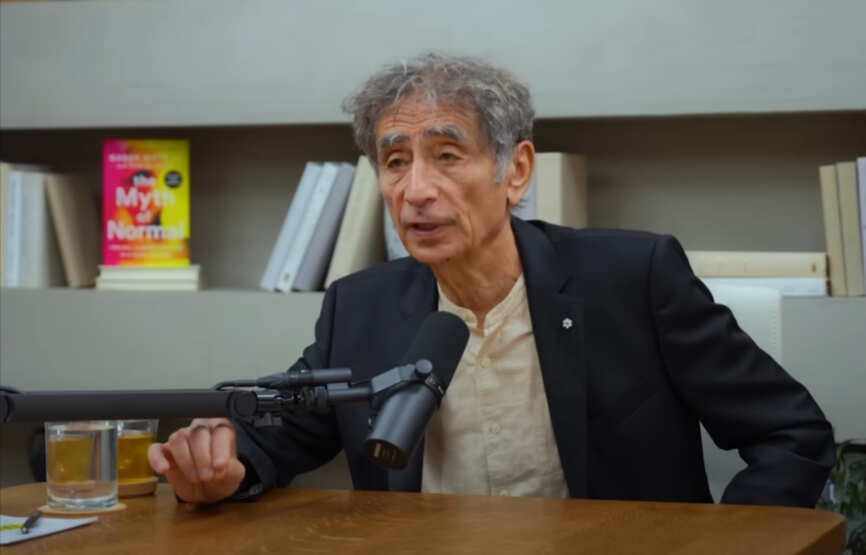
Read the full transcript of renowned addiction expert, speaker author Dr. Gabor Maté’s interview on The Mel Robbins Podcast titled “Why You Feel Lost in Life: Dr. Gabor Maté on Trauma & How to Heal”, March 24, 2025.
# Introduction: Understanding Your True Self
MEL ROBBINS: Hey, it’s your friend Mel. I am so thrilled that you’re here with me. It is always an honor to be able to spend time together with you. If you’re brand new, welcome to the Mel Robbins podcast.
I know because you chose to listen to this episode that you’re the type of person who values your time and you’re also interested in learning about ways that you can improve your life. I love that. I love that you’re listening to this episode and you want to know what else I love? I love that you and I are going to get to spend time learning from the extraordinary Dr. Gabor Maté.
Dr. Maté is a world renowned physician and best selling author whose work dives deep into childhood development and the impact of trauma on how it shapes your mental and physical health over your lifetime. Dr. Maté has completely transformed how the world sees, talks about and understands trauma. He has absolutely had that impact on me and it’s been life changing.
I promise you this episode is going to shift the way you see everything. How you show up for yourself, how you connect with the people you love and why you experience life the way that you do. It’s going to help you understand why coping has become your default and how you can move toward true healing. I am so excited for both you and me.
So please, please, please help me welcome the extraordinary Dr. Gabor Maté to the Mel Robbins Podcast. Before we dive in, Gabor, I would love to have you speak directly to the person who’s listening to us and just share with them what they might expect to experience if they really take to heart what you’re about to teach us and share with us today.
DR. GABOR MATÉ: Well, a lot of people are facing challenges. A lot of people are very hard on themselves. A lot of people think there’s something wrong with them. My fundamental understanding and what I’ve learned is that underneath there’s nothing wrong with anybody, that everything you’re dealing with came along for a reason.
There were adaptations or there were responses to difficult situations. The more you can understand where your issues came from and even when your negative self view and the shame and the self loathing and the self criticism and the perfectionism that you experience, that there are actually responses to some kind of life experience and that fundamentally there was and there is nothing wrong with you.
Those things can be looked at and you can understand them and you can transform that and really become yourself. Who you are, that’s available to you. It’s available to everybody. So nobody’s damaged goods.
MEL ROBBINS: I love that. No one is damaged goods.
DR. GABOR MATÉ: Yeah.
# Dr. Maté’s Personal Journey: From Trauma to Understanding
MEL ROBBINS: We are going to unpack this in this conversation at length, but I think it might be helpful for someone who is not familiar with your work, if we could go back and can you share, if we go all the way back to your childhood, just what was happening in your life and in particular how finding your mother’s journal really impacted you and sent you in a certain direction in terms of your life’s work.
DR. GABOR MATÉ: Well, so I was born 80 years ago this year in Budapest, Hungary, January 1944, to Jewish parents whose lives were already impacted by the Second World War. My father was in forced labor with the Hungarian army. A Jewish man had to go into forced labor when I was born, so he wasn’t there when I was born.
In March, the German army occupied Hungary. Then the genocide, the Holocaust that had obliterated the Jewish population of Eastern Europe, but not yet that of Hungary, began in our country. Within three months between March and June, they murdered half a million Jews, including my grandparents. We came very close to being deported ourselves, my mother and I.
So I spent the first year of my life under Nazi occupation with the mother who was terrorized and grief struck, didn’t know if my father was dead or alive for most of that year. When I was 11 months of age, to save my life, mother gave me to a complete stranger, Christian woman in the street. She conveyed me to some relatives living in relative safety and hiding. I didn’t see her for five or six weeks.
All this is recorded in the journal that she kept. I didn’t discover the journal. I always had her journal. But for many years, when I tried to read it, I’d get dizzy. It’s almost like something in me knew that this is too painful for me to handle. So it wasn’t until some years ago, when my mother was still alive, when I asked her to actually read the journal to me so I could really read what happened. She wrote in the journal that “I’m writing this because if my son grows up, I want him to know what happened.”
So that’s it in a nutshell. But those events left a deep imprint in my nervous system, in my body, and in my psyche. Those traumatic events created a lot of psychological wounds in me that took me some years to even recognize, let alone to heal. It wasn’t till I was into late adulthood or middle age that I really began to deal with it and to recognize the subsequent impacts that then I passed on to my kids without meaning to, but just for the lack of awareness.
# From Personal Struggle to Professional Understanding
MEL ROBBINS: Well, that’s a big nutshell.
DR. GABOR MATÉ: Well, before it shaped my work, it shaped me and how I functioned in the world or how I dysfunctioned in the world in so many ways. So it’s when I began to experience challenges in my life. I was a successful doctor in my early 40s, respected, but depressed and unhappy. I was married to the love of my life, and we had a very strained, conflictual marriage. My kids had issues. In some ways, they were afraid of me because I was very unpredictable.
All those issues then made me start looking for some answers. So the work began by having to look at myself and trying to understand the sources of my behaviors. That coincided with me noticing things as a physician in my medical practice. That’s how I began to look at childhood development, the impacts of early years, the concept of trauma and what that represented, and its impacts on adult or childhood mental health, physical illness, and so on. So both my personal experience and my professional work led me in this direction of exploration.
# How Childhood Experiences Shape Adult Life
MEL ROBBINS: And what have you learned about how childhood experiences shape who we become as adults?
DR. GABOR MATÉ: They’re largely decisive. This begins even before birth. So already the emotional states of the mother while carrying the baby will affect a child’s brain development.
MEL ROBBINS: I just want to make sure that the person that’s with us in this conversation really gets this, because I didn’t first learn that your emotional state and your physical state when you’re carrying the child impacts the nervous system and development of the human being inside you. It makes sense. But can you explain more about that? Because this is an idea that was brand new to me just a couple of years ago.
DR. GABOR MATÉ: Sure. What we have to nail down first is we’re not blaming mothers here. They do their best. We’re talking about the stress acting on the pregnant woman. That’s no fault of their own.
But speaking of stress, when people are stressed, they release stress hormones, adrenaline and cortisol. When the mother is stressed in pregnancy, those stress hormones go through the placenta of the umbilical cord to the baby. That affects the child’s nervous system and its development. Cortisol has a huge impact on the development of important brain circuits. You can look at the heart rate of infants in the womb as it changes as the mother is more or less stressed. So these are just physiological facts.
There was a study done after 9/11, after the tragedy of 9/11, women who were pregnant at the time and who suffered post traumatic stress disorder in the third trimester of pregnancy as a result of 9/11, their infants had abnormal stress hormone levels a year later. Now, abnormal stress hormone levels have an impact on brain development and on physiology and physiological health as well. So you can expect those kids, unless something is done to correct it, to face more challenges later on.
We know that mothers who are stressed during pregnancy, depressed during pregnancy, their children are more likely to have ADHD, attention deficit disorder, other mental health challenges. So it’s just… Now, what’s interesting here is indigenous people have always known this. I was talking to a native group in British Columbia, where I live, and this guy comes up to me and says, “You know, doc, in our community, when a woman was pregnant, there was a rule that if you’re stressed or upset, you are not permitted to go near them. We didn’t want your stress and upset to affect the baby.”
So this modern science has only confirmed indigenous wisdom. But it’s a huge issue in this country, in this culture, because people are so stressed for so many reasons.
# Understanding Trauma Without Blame
MEL ROBBINS: Well, it’s interesting to listen to you explain all this because for me personally, your work has impacted both me and recognizing the way that childhood experiences and in utero experiences when I was inside my mother’s body impacted…
DR. GABOR MATÉ: Sorry, in utero.
MEL ROBBINS: In utero, Is that what it is? Okay, see, I’m not a medical doctor.
DR. GABOR MATÉ: No, in vitro means in the laboratory.
MEL ROBBINS: Oh, okay. You’re right. In utero, exactly.
So impacted me when I was inside my mother, developing into a baby. Then I think about your work in the context of me as a stressed out mother and the state that I was in when I was carrying any one of our three children and how that absolutely impacted their development. There’s this kind of conflict that I feel between, oh, gosh, you know, I hurt my kids and I didn’t mean to. And also this understanding that I think this is part of the human experience on some level.
DR. GABOR MATÉ: Well, first of all, when my mother was carrying me, I don’t think she even wanted to be pregnant. I mean, what Jewish woman really wanted to be pregnant in the middle of the Second World War when her husband is in forced labor? I already knew. The kids can feel if they’re not wanted. I’ve seen this show up in many, many, many, many ways.
Now, the thing that I would take up with you is, on the one hand, there’s the awareness that this is what happened. But the way you formulated that you hurt your kids, no pain flowed through you to your children, but you didn’t hurt them. You didn’t. It’s not that you did something deliberately or consciously to hurt them. It’s just that the way it worked is that trauma is transmitted transgenerationally, but that’s not to blame anybody.
It’s really important to remove blame because parents feel so guilty already. Parents with kids who are challenged have challenges. Believe me, I’ve been one of them. There’s a tremendous sense of guilt, which is entirely unwarranted and undeserved, and it doesn’t even help. So let’s just agree that the trauma does come to us, but we don’t do it as such.
MEL ROBBINS: That is incredibly helpful way to think about it. When you said that it’s pain moving through you.
DR. GABOR MATÉ: Yeah, yeah.
MEL ROBBINS: That made my shoulders drop. How do you define trauma, particularly for somebody who isn’t aware whether or not they’ve experienced it?
# Defining Trauma: The Wound Within
DR. GABOR MATÉ: The way I define it is very straightforward. Trauma comes from a Greek word for wound or wounding. So trauma is a wound. It’s a psychological wound. In this case, could be a physical wound. But here we’re talking about psychological wounds.
The important distinction to make is that trauma is not what happened to you. It’s what happened inside of you as a result of what happened to you. So in my case, my trauma wasn’t that my mother gave me to a stranger. The trauma was the wound, which is that I perceive myself as not wanted. I perceive myself as abandoned. Who gets abandoned? Somebody who doesn’t deserve to be loved.
So then I develop this sense of not being good enough, not being lovable enough. Now that means I spend much of my life trying to prove that I’m good, that I’m lovable, that I am important, which then drives all kinds of behaviors, which then create more problems. But the trauma is not the event, that’s the traumatic episode, but the trauma is the wound that happens inside you. So if I get a blow on the head, that’s not the trauma. The trauma is the concussion that I developed.
Understanding Psychological Wounds and Childhood Trauma
MEL ROBBINS: Now in that case, it’s physical. And I want to kind of hover here because for a long time I just assumed trauma was something that happened to people who were at war or were in a country that was occupied by a fascist government or country coming in like your parents were and that you were, or somebody that was the victim of a violent crime.
I never understood that experiences that may seem insignificant on the surface, somebody’s mood, somebody criticizing you, feeling left out, that these are things that can also leave a mark. Just like a blow to a head can actually leave a concussion.
And I would love for you to explain to us what actually is a psychological wound. Because one of the things that I see happening a lot is people either shame themselves for being stuck or they say “I’m just too emotional” or “I should just get over it.” And there is something deeper that you mean when you say it’s a psychological wound.
DR. GABOR MATÉ: Well, that self talk, that negative self talk that you just articulated is itself a psychological wound. It’s a sign of psychological wound, it’s a sign of self rejection, which is one of the deepest impacts of trauma, is that people traumatized, they develop a shame based view of themselves. So they begin to think that there’s something wrong with them. That itself is a wound.
Now when you talked about seemingly insignificant things, we have to make a distinction here. There are what we call the “big T” traumatic events. Those have been well studied. Physical abuse, sexual abuse, emotional abuse of children, neglect, a parent being addicted, a parent dying, a parent being jailed, violence in the family, a rancorous divorce, a parent being mentally ill, to which we need to add social factors such as poverty or racism. These are “big T” traumatic events that can wound kids.
And we can talk about the ways ammunition happens, but you can also wound kids not by doing bad things to them that you shouldn’t, but by not doing the good things that they need. In other words, children have certain needs. A human child is born with certain evolution determined needs. Those children whose needs are not met that way. For example, for unconditional loving acceptance. And I’m not talking about the parent’s love, I’m talking about the capacity of the parent to unconditionally accept a child and to see the child.
The Need for Unconditional Acceptance
MEL ROBBINS: What do you mean when you say unconditional acceptance? Because I think most of us it’s revelatory to hear no, no, no, no. There’s a biological hardwired need that you have as a child to feel unconditional acceptance and safety from the adults around you and in your environment. And if you do not feel that way, it creates a response inside your body. There is a reaction to that.
But most of us, I think we even just skip over that fact, Gabor, that there’s a fundamental need that a child has to feel accepted. And so what does that mean? If you could unpack it for us.
DR. GABOR MATÉ: Sure. Children get to experience and see themselves the way they are seen by the adults. So if a child gets emotional and they get criticized, then there’s nothing wrong with their emotions. If a child is very sensitive and they’re told “don’t be so sensitive,” they think there’s something wrong with them.
If a child, a young toddler, is behaving a certain way and the parent thinks that the way to correct this is to punish the child and the child is just being a two year old, then the child begins to believe that there’s something wrong with them and they have to compensate for that by meeting the parents expectations. So now the acceptance is no longer unconditional. “I’ll accept you if you look this way, talk this way, behave this way,” and then all your life you’ll be worried about how do people see you. That’s a sign of a childhood wound. Because fundamentally we need to be connected to ourselves. And when parents don’t see us, we don’t see ourselves. That’s just a fact.
And if you look at human evolution, we didn’t evolve under the conditions that kids are raised now. We evolved under conditions for millions of years. Until 15,000 years ago, living in small communities where there were many adults. It takes a village to raise a child. The kids were always with the parents. There was no separation. Kids were carried everywhere, they were not put down to let them cry it out. They were just unconditionally accepted and not punished. Actually not hit. It’s a totally different paradigm of parenting. That’s how we evolved, which means that the human child expects to be treated that way unconsciously. When those needs are not met, kids are hurt.
Children have another need, which is we’re wired to have certain emotions. Along with other mammals, we’re wired to have anger. Anger is essential for survival. Fear. We’re wired to have fear. We’re wired to have curiosity seeking. We’re wired to have separation distress so that if the adult’s not around, we should be upset, we should panic, so we cry, so the parents come and get us. We’re wired for play.
And children have this need that when those emotions arise, parents should understand those emotions and not necessarily do what the kid wants them to do, but to understand the child’s feelings. And when children are denied that kind of understanding, they think there’s something wrong with their emotions. Then they start telling themselves, “I’m too emotional, I’m not good enough, I’m too sensitive, I am not lovable.”
Or when children don’t get the attention that they need, guess what? They develop. They need to be attractive so they can attract attention. Now look at the damage done in this culture by people thinking that they need to meet certain standards of physical looks and the trouble that people go to. It’s all because they were not accepted just for who they were. And now they’re trying to attract attention.
The Universality of Trauma in Modern Culture
MEL ROBBINS: Is there a human being on the planet that doesn’t have trauma from their childhood? Because I’m sitting here listening, and it’s an interesting conversation because you listen to it both from your experience. And I love that you said, we’re not going to blame mothers. And pain is moving through people. This is why trauma passes through your family and through cultures generationally. And learning about this helps you understand the responses to your childhood that helped you survived. And it also helps you feel empowered to take responsibility.
DR. GABOR MATÉ: That’s right.
MEL ROBBINS: To change those now subconscious responses that you have.
DR. GABOR MATÉ: Yeah. So going back to your question about is there anybody on the planet? Yeah, but in this culture, that would be the exception, because there’s so many features of this culture that don’t meet human needs that make human life difficult.
Look, the United States is the richest country in history. 70% of adults are at least on one medication. 40% of adults are at least on two medications. More and more kids are getting medicated for all kinds of conditions, from ADHD to self cutting to aggression, to so called oppositionality to anxiety.
We can look at this two ways. Either human beings are just innately troubled, or there’s something wrong with the environment in which we’re raising our kids and in which we’re trying to striving to doing our best. But we’re facing conditions that are inimical to healthy human development.
So in this sense, when we talk about trauma, we’re talking about the conditions under which parents have to function. These days. If I was functioning in a laboratory trying to grow microorganisms, the word is called culturing. We’re trying to culture organisms, laboratory culture. If in that laboratory culture a lot of those microorganisms began to develop pathologies or die off, you’d have to say this is a toxic culture. Well, it’s the same thing with human beings.
So rather than looking at the source of people’s problems strictly within themselves, we have to actually look at the conditions for any creature in the world, whether it’s a plant or animal. You have to look at the conditions under which people are living and raising kids and trying to function. So that’s what I’m doing here.
Identifying and Understanding Childhood Trauma
MEL ROBBINS: When you think of childhood trauma, how do you identify it?
DR. GABOR MATÉ: Well, again, I mentioned those 10 conditions, the “big T,” the “big T’s” ones adding to it, poverty and racism. Those things actually affect the physiology of the body. So people who are traumatized that way, they have a much higher risk. For example, people who’ve had several of those big experiences that I talked about, they have a higher risk for autoimmune disease, high risk for cancer, much higher risk for addiction, much higher risk for mental health problems, and so on.
MEL ROBBINS: Why? Can you explain from a medical reason, in the body? This show has listeners in 194 countries.
DR. GABOR MATÉ: Sure.
MEL ROBBINS: And this might be the very first time as you’re listening to Gabor, that you’re actually starting to go, “Wait a minute. Everything that he’s saying is what I experienced, or at least pieces of it. I’ve never considered that this could be trauma,” and we’ve talked about it as a psychological wound. But I think it’d be really helpful if you also explained how does this create either programming or conditioning in your body that starts to define who you become as an adult and create behaviors that you never intended?
The Physical and Psychological Impact of Trauma
DR. GABOR MATÉ: So that happens on both the physiological and the psychological level. Okay, on the physiological level, trauma incites inflammation in the body. So people who are severely traumatized in childhood, you can measure the level of inflammatory particles in their bloodstream. They’ll be abnormally high, which makes them more at risk for cancer, more at risk for autoimmune disease, more at risk for depression, mental health problems and so on. That’s just a physiological fact.
Trauma can affect the way genes are turned on and off. So genes don’t function independently. There are very few conditions that are purely genetically determined. There are some. One runs in my family, muscular dystrophy. If you inherit the gene, you’ll have the disease. But that’s very rare, relatively. But genes are turned on, off by the environment. So the wrong genes can be turned on and the right genes can be turned off by trauma.
Then trauma can dysregulate the body’s stress mechanism. So people are secreting more cortisol and adrenaline. These are the stress hormones, which in the short term are life saving. Because if I was threatened or you were, we would generate cortisol adrenaline from an adrenal gland, and we would be stronger and faster and better able to counter the threat, either to escape or to fight back.
But in the long term, those same stress hormones thin the bones, create more clotting in the blood, narrow the blood vessels, elevate the high blood pressure. Elevate the blood pressure, you get hypertension, suppress the immune system, put fat on your belly, creating higher risk for heart disease, makes you depressed, ulcerate your intestines. These are the stress hormones. So there’s all that on the physiological side.
And I could say more about it, but if you, for example, I mentioned racism. So if you look at the chromosomal aging of black people in this country, they age faster than Caucasians. And black kids already have higher blood pressure measurements than their Caucasian counterparts. It’s got nothing to do with genetics. It’s got to do with the stress of racism. A black woman in this country, the more episodes of racism they experience, the higher the risk for asthma. Children whose parents are stressed are at higher risk for asthma. This has been known for decades. I could go on a great length about that. So these are some of the physiological impacts.
Then there are the emotional impacts. So in my case, being given to a stranger gives me the sense of not being wanted, not being important. Then I develop behaviors where I try and prove my importance. So I become a workaholic doctor. So I drive myself too hard and I don’t pay so much attention to my family because I’m out there trying to prove my importance in the world. Now that has impact on my kids, that has an impact on my marriage. So there’s these behavior, emotional impacts which result in certain behaviors, then we can talk about addictions. Addictions is a huge consequence of childhood trauma of all kinds. And there’s all kinds of science behind that.
So one more thing, if I may say. When people get the message that their emotions aren’t acceptable to the adults, children will push down their feelings in order to be accepted. And they’ll try to be nice and cooperative and they’ll try to fit in with other people’s expectations, which then means they’ll be stressed all the time, which then potentiates all kinds of illness.
Recognizing Trauma’s Subtle Effects
MEL ROBBINS: I am sitting here thinking about ways in which I can try to distill down what you’re saying. Because the information has been so life changing for me in my own life to really accept, acknowledge and seek to understand how childhood experiences created a traumatic response inside of me.
And I want to focus on the, I guess you would call it the smaller T stuff, which is that you have fundamental needs as a child and when they are not provided to you, that it creates trauma inside of you. And is it fair to say that another way to think about trauma is that it’s something happening outside of you that creates this almost alarm or bracing in your body. It’s like it kind of flips you into that fight or flight.
Because I have this experience of not going back through my childhood and not seeing anything that’s massive related to my parents, but just having this sense of constantly being on edge, constantly feeling like, you know, it’s my job to make everybody happy. “Don’t say the wrong thing.” This hyper vigilance and I never knew where it came from.
The Impact of Parental Stress on Children
DR. GABOR MATÉ: Yeah, well, the child is very sensitive to the parents’ emotional states. And even if, for example, you can… One of the ways you can tell if a marriage is troubled is you can ask the parents or you can measure the child’s stress hormone levels. So the stresses of the parents are directly affecting the child’s physiology and the child’s psychology.
So you may not have articulated and clearly see what was going on. But especially if you’re a sensitive person genetically, and that is genetic sensitivity, you’ll feel exactly what’s going on and you’ll think it’s all about you. And then you also develop the belief that it’s your job to fix it. And then when you can’t fix it, you develop to cement a sense of guilt and shame because you failed at your job of making your parents happy, which never should have been the child’s job in the first place.
MEL ROBBINS: What is a child supposed to do?
DR. GABOR MATÉ: About what?
MEL ROBBINS: Just as you’re growing up. It’s interesting because I think so many people, at least in my life and my lived experience is that that’s my job, to protect myself, to make everybody happy too.
DR. GABOR MATÉ: But you see, that’s how you survived. Because what you needed most of all is a relationship with your parents. And one of the needs of children that I haven’t mentioned is what we can call rest. Which means because in a rest state we can develop and grow and unfold.
Now, rest means the child doesn’t have to work to make the relationship work with the parent. The relationship is just there. There’s nothing the child can do to break the relationship. Now in a situation where that’s not the case, then the child necessarily has to work to make the relationship work. Because without that relationship, they know they can’t survive.
So that adaptation, the hypervigilance on your part, remember I said in the beginning that nobody’s damaged goods. So that hypervigilance on your part, and I believe that it’s your job to make the situation peaceful. That’s an adaptation on your part.
MEL ROBBINS: So that’s a form of trauma?
DR. GABOR MATÉ: That’s an outcome of trauma. The problem is that that becomes then wired into your personality. But children don’t have any choice in the matter. They have to adapt to this situation. Those adaptations, they become wired into their personalities and that’s who they think they are. That’s not who they are. Those are their adaptations, their trauma showing up in their behavior and in their emotional functioning.
Why Siblings Experience Different Childhoods
MEL ROBBINS: One of the ways that I’ve seen people really deny the existence of trauma inside a family is between siblings. Where two siblings will grow up in the same household and be like, “Well, that never happened,” or “Mom wasn’t like that.” Or “You’re just being too sensitive” in your work. What have you discovered about how siblings can grow up in the same house?
DR. GABOR MATÉ: No siblings grow up in the same house. No siblings have the same parents. No siblings have the same family. No siblings have the same childhood. Why not? There are a whole lot of reasons.
Number one, there’s the birth order. Parents don’t relate to the first child the way they relate to the second child. Then there’s gender differences. Parents don’t really… I’m not talking about whether parents love the kids or not. I’m talking about what actually happens. The child doesn’t experience the parent’s love, the child experiences the way the parent shows up.
So number one, Number two, the parent’s relationship might be in a different phase, one child and another. Then the parents might be in a different economic situation, the parent’s lives might be different. Then each child will evoke a different response from the parent. Like with my three kids or your three kids? Yeah. You have three children? Yeah. You have two daughters and a son? I have two sons and a daughter.
It’s not that I loved or we loved any one of them more than the other, but we responded to them differently. And there’s one more factor, which is children are born with different temperaments, which is they experience the world differently. So even if I could be the same parent to all my kids, which I couldn’t be, they still have three different parents because they would experience me differently.
Birth Trauma and Its Long-Term Effects
MEL ROBBINS: Well, you know, I am sitting here listening again kind of from two places. One as a mother. Right. And one as a human being who was a daughter, who has recognized that there were lots of small things that happened. And one big thing that created a tremendous, like a traumatic response inside me that created hypervigilance and anxiety and probably ADHD.
And I’m also thinking, and I’m going to share this because I think it’ll be really helpful that I had a wildly traumatic birth. I was two weeks overdue. They had to induce me here in Boston. And my daughter Sawyer, who is sitting outside this studio and worked on the “Let Them” theory book with me, she did not want to come out. So it was 36 hours. They had to use a forceps, didn’t work. They ended up doing a vacuum extraction. And then I tore and I got rushed to emergency surgery and lost two and a half liters of blood.
DR. GABOR MATÉ: Oh gosh.
MEL ROBBINS: And they sent Sawyer home with Chris. They kept me in the hospital and by the time I went home, my skin was as gray as a dolphin and I had severe postpartum depression. And the kind Gabor where I could not be alone with her because I was in such a depressive and scary state. And I was on medications that made it completely unsafe for me to breastfeed her.
DR. GABOR MATÉ: I understand.
MEL ROBBINS: And for the first 10 weeks of her life, I was a zombie on medication. And oh my God, it just kills me to think about this. And she’s recently gone into therapy and has started doing EMDR. And one of her visions when they kind of trace responses to stressful things in the moment. And it goes all the way back to the first vision is a vision that she has where she’s in her crib and she really wants me to come. And it’s my husband and then it’s my mother and then it’s my mother-in-law and then it’s my friend Joni that would sit with me while Chris went to work and I never came.
DR. GABOR MATÉ: Yeah, so we went through the same thing with one of our children. And my wife had a severe postpartum depression. She couldn’t even look at the kid. And so let me say a couple of things here.
One is that sometimes birth trauma happens, you know, but yours was severe. Now, birth was created by nature in a certain way. And during the birth process, there’s natural hormones that are released both in the mother and the infant. It’s been called a “love cocktail.” It’s a combination of internal opiates and oxytocin and other brain chemicals which create the bonding between the mother and the infant.
Now, sometimes medical intervention is life saving and essential, but we’ve medicalized birth so much that we interfere with it so much now that we’re creating a lot of birth trauma where it’s not necessary. I’m not saying that was the case in your situation, but nevertheless, we’re doing it a lot, you know, and that interferes with mother and child bonding, number one.
Number two, the child does have this need to stay with the mother’s body for many months because the human child is the least developed and the least mature and the most dependent of any mammal. And the maturation, like a horse, can run on the first day of life. Human beings can’t do that for a year and a half. The horse is a year and a half ahead of us in terms of brain development.
That’s because we developed these big brains, these big heads. If we waited any more than nine months, we would never get born. Sometimes even now, we barely get born because the head gets stuck, which is probably what happened in your case. Which means that the development that in other animals happens in the womb and human beings have to happen outside the womb. That’s been called exterogestation. There’s gestation in the womb and exterogestation outside the womb.
Now, that means the mother’s body, the mother’s skin, the mother’s heartbeat close to the baby for many, many, many months. So when that doesn’t happen, and in the US 25% of women have to go back to work within two weeks of giving birth, which is a massive abandonment. Now, they don’t do it because they want to. They have to do it for economic reasons. It’s a massive abandonment of children.
So there’s the birth trauma and its impacts, which then there’s the mother’s depression and that has an impact on the infant. So people, kids whose mothers were depressed postpartum have a higher risk of ADHD. And we can talk about why that’s the case.
The Connection Between Maternal Depression and ADHD
MEL ROBBINS: Why is that the case? Because all three of my children have ADHD.
DR. GABOR MATÉ: Well, I can tell you what I… the first book I ever wrote, “Scattered Minds,” was on ADHD after I was diagnosed. And we can talk about that, but let me just say it now, that’s just the case and we can discuss it.
They’ve done electroencephalograms on 6-month-old infants whose mother was depressed and whose mother was not depressed. You could tell from the EEG of the infant whose mother is depressed and whose is not. Not because the depressed mother loves the child any less or is any iota less devoted than the non-depressed mother, but because depressed mother can’t respond to the infant with the same smiling, playful, attuned interaction which the child needs for healthy brain development.
It’s a sacred thing and society needs to hold it sacred. Now how mothers used to develop or raise children is in the community where they gave birth, in the community where they were doulas, where no, mind you, they didn’t have the advantages of modern medicine, which again, I’m not dismissing, I’m just talking about how we evolved. And there was such a thing as allomothering. Other mothers would come and support the mother when the mother needed to rest, other women would come and hold the baby.
And mothers are left very much on their own in this society. And that depression in the mother then affects the child’s brain development. Not only that, given that we develop a sense of ourselves based on how the adults look at us, when the mother or the parents can’t look at the child or they can’t hold the child again, the child begins to feel there’s something wrong with them.
MEL ROBBINS: It feels like there’s a million ways for this to actually happen.
DR. GABOR MATÉ: Well, there is, and I share the story because it’s true. I was a completely different mother when I gave birth to our second child, Kendall, just 19 months later. And her birth was different and Chris and I were different. And so I can see how without any ill intention, you are a very different parent.
DR. GABOR MATÉ: Absolutely.
MEL ROBBINS: And the child is a very different child.
DR. GABOR MATÉ: And the child is born with a different temperament.
MEL ROBBINS: Correct.
DR. GABOR MATÉ: So they experience you differently to start with.
How Trauma Affects Adult Stress Response
MEL ROBBINS: So how do you… how does this sort of unresolved trauma from childhood that I would imagine a lot of us learn about this as an adult and then we start to recognize that this is an explanation for a lot of the patterns of behavior that you don’t really like, but you’re not quite sure how to get control of them. How does unresolved trauma impact the way that you deal with stress as an adult?
DR. GABOR MATÉ: So the body’s stress regulation apparatus, which is physiological, it has to do with the connection between certain brain centers down to the adrenal gland, which is the stress gland. You might say, no child is born with stress regulation. Infants don’t know how to regulate their stresses.
MEL ROBBINS: Well, neither do adults.
DR. GABOR MATÉ: Well, as you say in your book, most adults are 8 years old, if that, but I thought that was pretty generous. This might have been three or four years old.
Well, stress regulation, like other functions, has to develop so that when something stressful happens, I know how to face it without being overwhelmed. And that depends on the development of these brain circuits and receptors for brain chemicals.
Now, trauma interferes with the development of the body’s stress regulation apparatus, so that become adults, and we don’t know how to handle stress, and then we seek escape. So one of the ways that people escape from stress is addictive behaviors. You know, for example, so if you talk about or talk to addicts, I feel like at my own addictive behaviors, even if I go “sober” for a while, and then I relapse. What usually happened is that I got stressed, and then I reach for that addictive outlet as a way of soothing my stress. So that’s how it shows up.
But physiologically, it shows up by a dysregulation of the body’s stress regulation apparatus. So there’s not just psychological. We’re talking physiology. And you’ve done these studies in laboratory animals where the way the mother handles that infant rat puppy in the first few days of life will have an impact on the adult rat’s capacity to handle stress. And if you take the rats, by the way, whose mothers don’t handle them as well, and you put them with mothers who do, their brains develop normally. So it’s not a genetic effect. It’s what’s called an epigenetic effect. It’s the environment acting on the genes.
Understanding Trauma Responses and Healing
MEL ROBBINS: Which is why we come back to your original point. No human being is damaged goods. The good news is that if you can recognize that your response to stress and traumatic situations and overwhelming emotional situations is something that you can identify and change that that’s what the opportunity is here in terms of being able to heal and resolve trauma.
DR. GABOR MATÉ: Absolutely. And especially if you begin by recognizing that it’s not your fault, there’s nothing wrong with you.
MEL ROBBINS: You know, when I think about my husband, who absolutely experienced trauma by having a dad that was a workaholic and never around and narcissistic personality style and lots of drinking and stress in the marriage. Right. And his response to stress is to just shut down. The man goes silent and stoic.
And in our marriage, one of the things that have come up a lot, which you can direct line to his response to his own childhood, is he doesn’t really know what his needs are because they weren’t met.
DR. GABOR MATÉ: That’s right.
MEL ROBBINS: And for him, it took a long time to call that trauma from his childhood because he’s like, “Well, I had food. My parents were there. I went to school. It’s not like they beat me.”
DR. GABOR MATÉ: I know.
MEL ROBBINS: And for me, I am the opposite. I’m a reactor. Like, I’m a human volcano. And when I get dysregulated or triggered or upset or overwhelmed, I’m like… And it’s… Even though I know this and I’ve been working on it, and I am a completely different human being, I feel that way over the last three years. I still erupt.
DR. GABOR MATÉ: Well, join the club.
MEL ROBBINS: So how do you personally navigate your daily challenges and when you get overwhelmed by stress?
Recognizing Childhood Trauma
DR. GABOR MATÉ: So let me say something about Chris first, if I may.
MEL ROBBINS: Yes, please.
DR. GABOR MATÉ: When he says that “I wasn’t beaten or we weren’t starving, I had food, and therefore I wasn’t traumatized,” here’s what I would say to him. So listen, Chris, let’s take one of your kids and let’s say you were an alcoholic, which means that you came home in different moods all the time, and the kids couldn’t rely on who dad was going to be for one minute to the next. And your mom was constantly stressed.
And if you were this way, do you think your kids wouldn’t be hurt by that? So just plug your kid into the situation that you’re in. You see how you… And if one of your kids came to you and said, “Dad, I don’t like it that you’re drinking and you’re behaving this way or that way, and you’re a workaholic, ain’t never around,” what’d you say to your kid? “Well, there’s food on the table. What are you complaining about?”
MEL ROBBINS: No, but I did.
DR. GABOR MATÉ: Yeah.
MEL ROBBINS: No, that happened in our house, like, 15 years ago.
DR. GABOR MATÉ: Okay.
MEL ROBBINS: And he felt bad, and I was an asshole. Again, more trauma and more pain passing on to our kids.
DR. GABOR MATÉ: Yeah. I’m just saying that when people look at their own childhoods, they kind of minimize.
MEL ROBBINS: Why do we do that?
DR. GABOR MATÉ: Because it was too painful to accept in the first place. So that people dissociate and they disconnect from their bodies and their feelings. Now, you said that he had a hard time feeling what he feels. That itself is a trauma impact. It’s a protection. It’s not a flaw, it’s not a damage. It’s an adaptation.
If I was hurting you right now and you couldn’t escape and you couldn’t fight back and you couldn’t ask for help, then dissociating and not experiencing your feelings would be your only protection. But then it gets wired into you and then all your life you go through not knowing what you feel and not knowing what your needs are.
So again, it’s an adaptation. That’s what I’m saying is that nobody’s damaged goods. These are just adaptations. The abnormality is not in the individual. It’s in the circumstances to which the individual had to respond that way. So that his response, or yours, or mine for that matter, were perfectly normal responses to abnormal circumstances. I say abnormal in a sense. Circumstances that did not meet human needs.
Taking Responsibility for Healing
MEL ROBBINS: One of the things that’s coming to mind is thinking back to my own life and the moment where I first bumped into your work and I learned that the seemingly little things created a lasting impact. And that even though I wasn’t to blame for the emotional volatility or the emotional shutdown in my parents when I was growing up, that it impacted me. It was real.
And it was my responsibility to heal and to decide whether or not I wanted to do the work to change the way that it impacted me. Because it did have a massive impact on my behaviors. Constantly feeling on edge, people pleasing, anxiety, ADHD, drinking too much, chasing success as a way to prove that I was worthy of something and to make other people happy. It was everywhere. It honestly just defined how I ran on default.
And I remember the moment, though, when I started to truly accept the fact that these were all indications of trauma. And that if I wanted my life to feel different, that I needed to lean into everything that you’re saying. And I felt a lot of conflict about that moment because I felt guilty for identifying it that way. Because I know my parents were just doing the best that they did.
DR. GABOR MATÉ: They did.
MEL ROBBINS: And that there was a lot that I didn’t remember.
DR. GABOR MATÉ: Yeah.
MEL ROBBINS: And I’m wondering if you could just talk to the person who’s listening, who is having that awakening for the first time where they’re really accepting that some of the behaviors and the negative self talk and the anxiety that this is a result of experiences that you had as a child where you were not given the things that you needed.
Default vs. Fault: Understanding Patterns
DR. GABOR MATÉ: Mel, there’s a lot in what you said, okay? First it said you behave that way by default. There’s a difference between default and fault. Okay, Default, you didn’t know you were doing it. You didn’t know any better. You were just following patterns that were programmed into you. But it’s not your fault, okay? There’s a huge difference. Important distinction, number one.
Number two, it’s never the child’s job to make the parents happy or to create peace in the family. And the child invariably fails, which instills a huge sense of guilt and inadequacy for not having fulfilled a task that never ought to be in yours, never should have been yours in the first place. It’s a reversal of roles, because whose job it is to hold who emotionally to create peace.
And so when a child is forced into that position again as an adaptation to maintain a relationship with the parents, she’s given an impossible task that she’s bound to fail at and bound to feel shame over it, which means that any shame and guilt that you feel is completely undeserved.
When we start to noticing these patterns, we can start asking ourselves questions, but it depends on how we ask them. So I could say, “Why am I behaving this way?” Is that a question?
MEL ROBBINS: No, it’s an indictment.
DR. GABOR MATÉ: It’s an indictment, Baba, I said, “I wonder why I’m behaving that way.” So we need to begin to develop that compassionate curiosity towards the self where we start looking, not to worry, not this indictment, as you say, but genuine curiosity.
And from that perspective, everything, pretty much everything anybody thinks is wrong with them is actually because it’s an adaptation or it begins as a failure of development because the conditions for development were not adequate. And so then we can understand now it’s not a question of being victims. That’s the last thing we want to do, is to foster victim mentality. “They did this to me, and now I can’t help it.” No, that happened. And it’s your responsibility and it’s your capacity to change that now.
So you have to drop the victim mode altogether. But that doesn’t mean that we don’t recognize what happened. So to say that stuff happened to you, and I get the sense that something big happened that you haven’t articulated yet, but something big happened to you at some point, to recognize that is not to say that you’re a victim. It’s just to say that whatever happened had certain impacts and fostered certain adaptations on your part that made you behave and undermine your development in a certain way.
Sharing Personal Trauma
MEL ROBBINS: Oh, I’ll share it with you. When I was in the fourth grade, I woke up in the middle of the night on a family vacation and an older kid was on top of me.
DR. GABOR MATÉ: Okay. All right.
MEL ROBBINS: And that had massive implications on my life.
DR. GABOR MATÉ: When were you…
MEL ROBBINS: I was fourth grade.
DR. GABOR MATÉ: Yeah.
MEL ROBBINS: And I was sound asleep. So I was in a safe space, wake up to an older kid on top of me who was fondling me. And in the scheme of things that can happen, it was… Here I go, dismissing it. You’re looking at me, you’re like, “No.”
DR. GABOR MATÉ: No, no, don’t go there.
MEL ROBBINS: Okay. Okay. But it’s almost like I’m shaming myself for having trauma about this.
DR. GABOR MATÉ: Now, can I unpack this for you a little bit?
MEL ROBBINS: Sure.
DR. GABOR MATÉ: Are you open to it?
MEL ROBBINS: Oh, I’m so open to it, yeah.
DR. GABOR MATÉ: Okay. Here’s the question I’m going to ask you.
MEL ROBBINS: Okay.
DR. GABOR MATÉ: How did you feel when this happened?
MEL ROBBINS: I felt very confused and scared.
DR. GABOR MATÉ: Confused and scared. Good enough. Who did you speak to about it?
MEL ROBBINS: No one.
The Real Trauma: Being Alone
DR. GABOR MATÉ: Okay. Now, if something like this happened to one of your daughters, was it grade four?
MEL ROBBINS: Yeah.
DR. GABOR MATÉ: Okay. If one of these things happened to Sawyer or Kendall in grade four, and if they didn’t talk to you, how would you explain that.
MEL ROBBINS: I’d feel… How would I explain it? I would explain it. And I’m about to go intellectual. I personally, as the mother, would feel heartbroken.
DR. GABOR MATÉ: I understand how you’d feel, but really, I’m not asking how you’d feel. I’m asking how you’d explain it. Why wasn’t my daughter talking to me about feeling scared and confused and violated? Why she…
MEL ROBBINS: Because she didn’t feel safe talking to me.
DR. GABOR MATÉ: That’s the trauma. The trauma began before that happened. Because if you had been able to talk to your parents and they would have said, “This is awful. You must feel terrible. Come here, let me hold you. And let’s deal with the situation.” So the trauma is not only in what happened, it’s that you were so alone with what happened.
And that aloneness was yours before this traumatic event ever occurred. As a matter of fact, abusers can tell with almost laser like accuracy who is defended and protected and who’s not. Who can be victimized and who cannot. So that your primary traumatic event was not this event. Not that this wasn’t traumatic. Of course, it was hugely traumatic, but it became hugely traumatic because you were alone.
And that sense of lack of safety and lack of protection. Furthermore, you may not even have wanted to bother your parents because they were already stressed enough already, you were protecting them. That’s the primary traumatic situation.
MEL ROBBINS: I’ve never looked at it like that.
DR. GABOR MATÉ: Yeah. Do you see that when…
MEL ROBBINS: Oh, a thousand percent. And I can also see when I think about experiences that friends have shared with me where they did say something and then there was denial, there was dismissal or “We’re not going to tell anybody” or “This stays within us,” or even if they then go after the person and confront it, it blows up and somehow you’re to blame. And so I can see how that’s right.
DR. GABOR MATÉ: Yeah.
MEL ROBBINS: And of course, when you shove it down, you then think you’ve done something wrong. And that was the other thing that happened for me, is that I felt like I had done something wrong.
DR. GABOR MATÉ: That’s one of the impacts of trauma is that shame based view of the self. People start blaming themselves that somehow you invited it or deserved it or you didn’t fight back hard enough, which if you didn’t, was also self protection.
MEL ROBBINS: I think that was one of the original moments that at least that I remember where I literally left my body and disassociated, which was a defense. Yes.
DR. GABOR MATÉ: So again, it’s an adaptation. So that’s what I would say about that incident.
MEL ROBBINS: It makes perfect sense.
DR. GABOR MATÉ: Yeah. But again, the problem is in the environment, in the lack of being held and being seen. So there’s nothing… And then you’re… And your initial impulse when you began that narrative about how “It’s not as bad as what?”
MEL ROBBINS: Right, right, right.
DR. GABOR MATÉ: Would you say that to your daughter?
MEL ROBBINS: Oh my God, no.
DR. GABOR MATÉ: If your daughter comes to you and says “it’s not so bad, think of all the kids that are being beaten,” you know, so that lack of self compassion is one of the ways that trauma shows up. And that’s why I’m saying the healing needs to begin with some compassionate curiosity towards the self. Not “why,” but “why.” It’s a totally different conversation.
MEL ROBBINS: And then I can also see and take responsibility and have a lot of compassion for how my volatility emotionally…
DR. GABOR MATÉ: Absolutely.
MEL ROBBINS: Just passed that on to my daughters.
DR. GABOR MATÉ: Absolutely.
MEL ROBBINS: And so there are things that happen to them that in the time they didn’t feel comfortable coming to me.
DR. GABOR MATÉ: Yeah, yeah.
MEL ROBBINS: Because the exact same thing.
DR. GABOR MATÉ: Exactly.
MEL ROBBINS: And you know, it, of course, just makes me… it makes me sad that I didn’t know this sooner. But I feel very grateful for your work because I know it now and so do our children and so does my husband.
And that knowledge gives you the ability to truly address the things that happened and the response that happened in your body and how that has created these default patterns and this inability to manage stress or emotion or conflict in a way that is healthy and that keeps you connected to yourself instead of constantly abandoning yourself and feeling disappointed in yourself and shaming yourself.
And so while I can reflect on that with a lot of sadness and grief and regret, I feel more empowered, honestly. Well, that’s the whole point about what’s possible.
Breaking Free from Default Patterns
DR. GABOR MATÉ: That’s the whole point is that we all want to be free, but as long as we’re running on default mode and we’re just reacting to stuff, there’s no freedom in it. We’re actually like puppets on a string.
And if you remember Pinocchio, you know, when he becomes a real boy, he says, “how silly, how foolish I was when I was a puppet.” Well, we’re all puppets in that sense. As long as these traumatic impacts are running our lives, we’re puppets on a string, and those strings are unconscious.
So it’s the whole thing about becoming really free. And that real freedom depends on looking at how it was and getting in touch with our capacity to take responsibility now, you know, so really, the work is for all of us is how to become free so it can be in the present moment connected to ourselves.
The great trauma psychologist Peter Levine says, “no longer living under the tyranny of the past.” And it’s totally available. It’s totally possible.
MEL ROBBINS: It is totally possible.
DR. GABOR MATÉ: Yeah.
MEL ROBBINS: And it’s possible for you. It’s possible for your children. It’s possible for anybody that you know and love. It’s possible for your parents, if they accept the invitation to look at themselves.
DR. GABOR MATÉ: If they choose it? Yeah.
The First Steps to Healing
MEL ROBBINS: Yes. What is the first step? Is it asking the question, “why?” Just being curious, with a level of compassion, “why am I like this?” Because if I reflect on your question, that’s what happened for me. I started to say to myself, it’s no longer tolerable for me to operate like this. I don’t want to be this person. I don’t want to feel like this. I don’t want to feel disconnected from other people. I don’t want to have this level of anger inside me.
DR. GABOR MATÉ: So that’s actually the first step, is to recognize one’s suffering rather than taking it for granted, which, incidentally, is the Buddha’s first teaching, is that life is dukkha. Life brings suffering, you know, and then the second question is, okay, why?
You know, so it does begin with recognizing the suffering rather than denying it and running away from it. And there’s many ways to run away from our pain through certain behaviors and addictions. And the point is, stop running from your pain. Accept that it’s there and be curious about it without blaming yourself for it. So those are the first steps.
And then you ask for help. I mean, if help is available. The natural we are born seeking help. You’ve never met a one day old infant who doesn’t know ask for help. But let me ask you a question. How easy it has been going back for you to ask for help?
MEL ROBBINS: You mean if I think about when I was in fourth grade then, and…
DR. GABOR MATÉ: Even decades later, can you ask for help or is that a challenge for you?
MEL ROBBINS: Well, I asked for a lot of help.
DR. GABOR MATÉ: Now? No, I don’t mean now. Before your transformation.
MEL ROBBINS: Absolutely. When you just said that I had this epiphany that I’ve always felt like I got to do it myself.
DR. GABOR MATÉ: Exactly.
MEL ROBBINS: I’ve always felt like it’s on me. I’ve always felt like, I’ll just take this on, I’ll just do this.
DR. GABOR MATÉ: Which was an adaptation because there was no help available, but you were…
MEL ROBBINS: You know what’s interesting.
DR. GABOR MATÉ: Sorry, go ahead.
MEL ROBBINS: Is you just said there’s no help available and I felt this knee jerk need…
DR. GABOR MATÉ: Yeah, to protect your past. Yes, I understand.
MEL ROBBINS: Because I do know. I mean, I know my mom well enough to know that she would have picked up a shovel and probably clocked the kid into next week.
DR. GABOR MATÉ: Yeah, yeah. That’s not what you needed your mother to do. You needed your mother to say, “oh, gee, that’s awful. Come here, let’s talk about it.”
You weren’t born not knowing how to ask for help. You were born with the supreme capacity to ask for help. I mean, as we know, any infant knows how to ask for help. So something educates it out of us. Something compels us to suppress our capacity to seek help.
So if the first step is recognizing our suffering and the second step is getting curious about it, then the third step is, I need some help here. It’s beautiful, but it’s only the simple truth.
MEL ROBBINS: It is so simple when you lay it out like that. And it’s also so freeing.
DR. GABOR MATÉ: Yeah.
The Importance of Play and Joy
MEL ROBBINS: One of the things that you write about that I think is so important that I would love to have you explain is this idea that we are naturally wired and have a fundamental need for joyfulness, playfulness, creativity, and that we sacrifice that. Can you talk more about that?
DR. GABOR MATÉ: Well, so there’s a book written by a palliative care nurse in Australia. And I used to work in palliative care. And it’s called “The Top Five Regrets of Dying People.” And she’s talking to people who die before their time, you know, from cancer. Usually one of the regrets is that they worked too hard. They didn’t play enough.
No playfulness is built into our brains. All mammals play. Bear cubs play, lion cubs play. Puppies, kittens, they all play. We’re wired for play. Why? Because play is essential for a number of things. One is essential for brain development. It’s much more important for brain development than academic learning. I’m talking about scientifically, brain, physiologically.
So play is important. Play is also important to form relationships, because in play you can kind of roughhouse a bit, but you’re not actually being enemies, so you’re making friends that way. So play is essential. Winnie the Pooh, which is one of my all time favorite books.
MEL ROBBINS: Why is it one of your all time favorite books?
DR. GABOR MATÉ: Well, it’s so playful, but at the very end, I know you’re married to Chris Robbins, which is Christopher Robin, you know, I mean. Anyway, there’s a passage at the end of the book Winnie the Pooh, where Christopher, the boy, by the way, him and his father had a terrible relationship, which is a whole other issue. I’m talking about the real Christopher Robin, but the fictional Christopher Robin is now growing up and he has to go to school, which means he won’t be able to play with his animals anymore.
And he’s trying to explain this to these animals, including Winnie the Bear. And the book ends with this statement that I’ll paraphrase, where it says, they go off walking together, hand in hand. And the book ends with, “but whatever they do and wherever they go in the Enchanted Forest, a little boy and his bear will always be playing together.”
And that passage, as an adult, would bring me to tears because as a kid, as an infant, I wasn’t played with. My mother was way too terrorized and depressed to play with me. And kids peek a boo, play starts so early. It’s essential for mental health. It’s essential for our brain development.
So these poor people who were looking back on their lives and saying, “I wish I had played more,” play is just essential. And I have to say that one of the things that has kept our marriage going 55 years now is that we play so well together. We’re just playing all the time when we’re not fighting, which, by the way, is long gone. Not long gone, but gone. So play is just essential.
MEL ROBBINS: And you weren’t played with. So did you play with your kids?
DR. GABOR MATÉ: It’s interesting. I have two brothers. They’re both intuitively playful with young kids. They just know how to be with them, how to pretend, how to just get into their space. I watch them, and I don’t know how the hell they do it because I didn’t know how to play with my kids. Not really. I kind of faked it.
But I always kept waiting for them to develop minds that I could engage with verbally. Because on that verbal level, I’m very comfortable. On the play level, I wasn’t. I was rather stiff. I wish I was a grandfather. I’m not yet. Because I’d learn how to play. I let that infant teach me how to play.
But no, I didn’t know how to play. I didn’t know how to play. I really lacked that because it wasn’t given to me when I was small. My brothers had it now. They grew up under very different circumstances. They didn’t have the same parents, you know, the way we talked about it. So they know how to play. I don’t. But kids, I mean.
Learning to Be Affectionate
MEL ROBBINS: Well, a very surprising insight for me as I’ve been working to resolve issues from my past, is noticing that I’m a very warm person, but I’m not affectionate. And it’s this epiphany of going in more for the hug, being more physical in terms of embracing my kids.
And it’s something that I definitely did not receive. And I come from a long line of farmers and hard workers and “pull up your big girl panties and let’s move on.” And that’s the way that my mom is, even though she’s warm and amazing and loving, but not physically embracing.
And so I really relate to that because it’s something as an adult that I recognize that I truly want to change. And it takes effort. It takes effort for me to go, “oh, I noticed. I’m just standing here. I got to put my arm around…”
DR. GABOR MATÉ: Just gone to five.
MEL ROBBINS: That’s true.
DR. GABOR MATÉ: And then hug somebody. I used to be hug phobic.
MEL ROBBINS: And I embraced you when you walked in.
DR. GABOR MATÉ: Yeah, you did. But honest to God, when people in a room would start hugging each other…
MEL ROBBINS: I’d stand there like this, and is that a response?
DR. GABOR MATÉ: It’s a response to really not being held. And it’s also a kind of a protective shell. I don’t want to make myself that vulnerable. I don’t want to open up.
Surprising Signs of Unresolved Trauma
MEL ROBBINS: What might be some surprising adult behaviors that are an indication of unresolved trauma from your childhood?
DR. GABOR MATÉ: Well, sometimes it’s attributes and behaviors that the world respects you for. So great success can sometimes be an outcome of childhood trauma because you’re working so hard to prove something to the world.
I talked about my own workaholism and, you know, because I had to prove that I was important. Now that made me a very successful respected physician from the outside, on the inside, different story. And in my family, a different situation altogether.
People who are very attractive and who put a lot of effort into being very attractive, the world admires them. But it’s very often, as I said before, they’re trying to attract the attention that should have been their birthright. And they don’t feel good if they’re not attractive. And you see this as people age, this desperation to keep looking young because they’re not acceptable the way they are.
So sometimes it shows up in success, in what the world considers success and other ways.
MEL ROBBINS: You talked about kind of not being the kind of person that is open to hugging or. My husband shuts down.
DR. GABOR MATÉ: Well, my response to a sense of disruption in my relationship with my wife is to shut down. So I just go sullen and non-communicative. I mean, I talk about that in the first chapter of the book.
I arrive home from a speaking trip and she texts me that she hasn’t left home yet to pick me up from the airplane. And I go into a sullen withdrawal stage because I’m reliving my abandonment unconsciously, but I don’t realize it.
And when I saw my mother again after that five or six weeks separation, I didn’t even look at her for several days. Which is the typical response of the child because the child’s brain says, “You are so hurt when you’re abandoned that you will not open yourself up again.”
So your husband is exhibiting the same thing. That has been very dominant problem in my relationship, in my marriage, is my tendency to shut down in response to any sense of hurt. Even if the hurt has nothing to do with the present moment, but it’s a reaction, triggering of some old wound.
Final Thoughts and Parting Words
MEL ROBBINS: You’re so amazing. What are your parting words?
DR. GABOR MATÉ: You know what comes up for me is that beautiful movie with Robin Williams and Matt Damon, Good Will Hunting.
MEL ROBBINS: Good Will Hunting here in Boston.
DR. GABOR MATÉ: Yeah, that’s right. Where the psychologist Robin Williams grabs this very dysfunctional, dysregulated client played by Matt Damon, and he says, “It’s not your fault.” If you can only get that. That’s the biggest takeaway I would say – just get it. It’s not your fault, but there’s reason for it. It can be worked through.
MEL ROBBINS: Well, thank you. Thank you. Thank you for being here, for sharing all of your wisdom and your research, and for not only validating our experience, but giving us three simple things we can do to reconnect with ourselves and truly take our power back. You’re amazing.
DR. GABOR MATÉ: My pleasure. Thank you.
Related Posts
- Call Her Daddy: w/ Esther Perel on Cheating, Codependency, & Connection (Transcript)
- Baby Customization w/ Kian Sadeghi on Tucker Carlson Show (Transcript)
- Transcript: Scrolling Is the New Smoking w/ The Minimalists @ TEDxFargo
- I Quit Social Media – Here’s What Happened: Gabriela Nguyen (Transcript)
- Small Details That Make Assisted Living Communities Feel Like Home