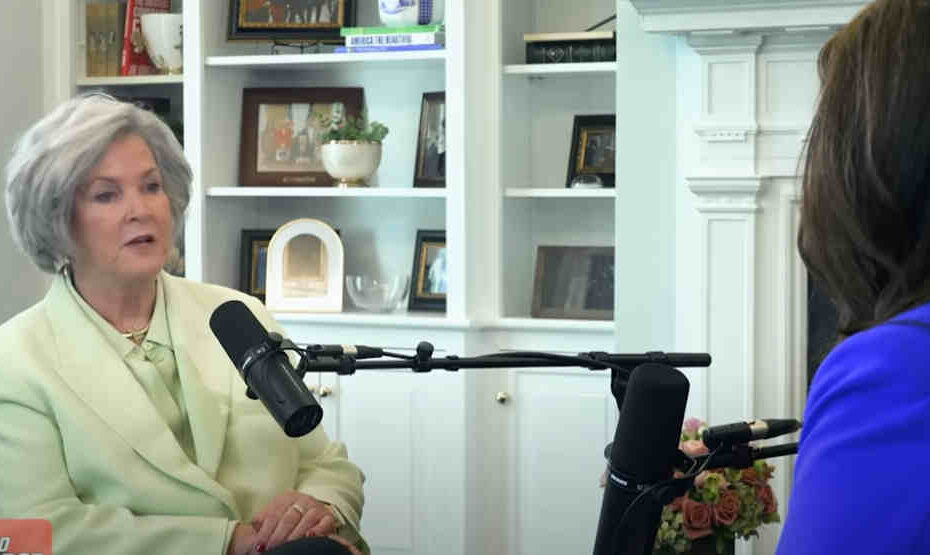
Read the full transcript of White House Chief of Staff, Susie Wiles’ interview on Pod Force One with Miranda Devine, July 9, 2025.
INTRODUCTION
MIRANDA DEVINE: Hello and welcome to Pod Force One. I’m Miranda Devine. Today I’m in the West Wing speaking with one of the most powerful people who you might not have heard of, White House Chief of Staff Susie Wiles.
Thank you so much, Susie Wiles, for having us in your office. I know that you’re not a big fan of doing interviews, especially long form interviews. So I really appreciate that you’ve come to Pod Force One to talk to us a little bit about your job and what makes you tick.
Particularly I wanted to ask you about these last couple of weeks have been momentous in terms of achievements in any president’s term. What to you has stood out really?
SUSIE WILES: Soon we’ll be six months here and looking at the accomplishments in totality, it’s unfathomable. And the last two weeks have been even more so between foreign leaders and peace and increased defense spending and a very strategic action on Iran and soon to be, we hope, peace in Gaza, passing the one big beautiful bill.
I mean, the list is too long for even your long form podcast, but it’s just been remarkable.
Achieving Success at Trump Speed
MIRANDA DEVINE: And is that something that surprised you that you were able with President Trump to achieve so much so quickly?
SUSIE WILES: No. Because the way the 2020 election went, he had four years to think about exactly what he wanted to do when he got back here and was ready to begin on the first day and has never stopped since.
As you probably know as well as anybody, he never stops working. And so when you combine a work ethic that’s unparalleled with a wish list that’s very long and an appetite for success for the American people, this is what you get.
MIRANDA DEVINE: Yeah, hit the ground running. But I guess we see that Donald Trump works in Trump speed, warp speed. But that also means that the people who work for him do the same. Do you ever find it hard keeping up?
SUSIE WILES: I don’t know of another mortal who could really keep up. I work as hard as I can and I think I do fine. Or at least if I don’t, he hasn’t told me that yet, but it is superhuman pace, there is no question.
And if you look around at the staff, they’re all young but me. So there’s a reason for that.
The Role of Chief of Staff
MIRANDA DEVINE: And what actually does a chief of staff do?
SUSIE WILES: Oh, boy. I gave some piece of advice to myself when I started this job. I am the chief of staff. I’m not the chief of Donald Trump. And if I keep remembering that, then I know to facilitate what he needs and wants to be the President of the United States, leader of the free world.
We assemble, I think, the best staff that’s ever worked in a White House, bar none. I am in charge of all the administrative stuff that nobody would want to be in charge of. And also the big picture that I do want to be in charge of.
It’s a jack of all trades in some ways. In government, and particularly in the White House, the chief of staff is fairly prescribed. There is a responsibility for the military office, responsibility for the continuity of government, all that sort of thing that I didn’t know I would be handling when I got here, because it is different than the campaign in that regard.
But I have a long background in local and state government, and so it’s not a complete shock. But the protocol that’s associated with the West Wing is beyond anything I really expected.
MIRANDA DEVINE: And what do you mean by that? What do you mean, protocol? You mean rules?
SUSIE WILES: Rules. I mean, it’s protocol, not law. But things have been done a certain way for a very long time, and you can do some things differently, and I do, but you can’t upset the whole apple cart at once.
And also, these protocols are here for a reason. It does make the machine work more easily, and people already understand how things are supposed to be. So in many ways it’s good. In fact, in virtually always, it’s good. But it was something for me to get used to.
The Big Picture Responsibilities
MIRANDA DEVINE: And you said you’re involved in the big picture. What does that mean? I mean, I heard that you helped negotiate the release of some hostages. At one point you had dinner with the president of ABC News a few days before that George Stephanopoulos settlement happened. Is that the sort of thing you’re talking about?
SUSIE WILES: I didn’t negotiate any hostages release. I’m a cheerleader for it, yes, but that’s a Steve Witkoff amazing achievement.
I do get to do really amazing things and meet people that I would not meet in any other walk of life. And I hope to, when I do that, I hope to bring the sensibilities of this administration, why he ran, what he’s doing, and how quickly to every executive, or in this case, a head of a network that I meet.
It’s our job to broaden as best we can his message and his views everywhere we can do it. And oftentimes that in my case includes political people, but it also includes CEOs and that sort of thing. So it’s a real joy to be able to do that.
First Meeting with Donald Trump
MIRANDA DEVINE: And what about your relationship with Donald Trump? Tell us about the first time you met him. I think it was 2015 in Trump Tower in New York.
SUSIE WILES: A mutual friend arranged a meeting because I looked around at the field of then 17 Republican primary candidates and said, you know, I’d been a traditional Republican all my life, and I thought, this just not working, not for the American people.
We need a disruptor here. We need somebody that thinks about how to serve the American people differently.
And I looked at the disruptors, and he was the one that I had the most interest in. My dad had a passing friendship with him, so I heard about him a bit. And of course, you can’t be raised in the New York area and not know who Donald Trump is.
And we had a great meeting, and he wanted to pick my brain about Florida politics. We shook hands and he said, “Thank you very much,” and I left. And I didn’t hear anything for quite a bit.
And then when he got ready to announce his leadership team in Florida, he called and said, “Will you be a part of this?” And so that was my. I was the co-chairman of the state, not working then, but as time went on, Florida needed a little bit of a boost. And so then I went from sitting in the VIP section at the rallies to knocking on doors and we did well. We did very well.
Recognizing the MAGA Movement Early
MIRANDA DEVINE: Yes, you did. That’s amazing. So you actually perceived MAGA before most Americans did and certainly most Republicans did. You perceived that Donald Trump had what he is now to be this transformational president.
SUSIE WILES: I did. I didn’t know MAGA as what we know. I just knew that what we’d been doing for all these many years was not working for the country and certainly not for middle America.
And after talking to this billionaire who I didn’t really go into the meeting thinking would have his finger on the vein of the middle class, I realized he did. And then that decision was easy after that.
MIRANDA DEVINE: Because you had worked for Ronald Reagan previously and Jack Kemp, but you actually worked in the White House when you were a young woman. So you had seen a lot of Republican politics.
SUSIE WILES: I had. I took a decade, a little bit more than a decade off of it. And then when my children were little, I stayed home because I couldn’t go jetting off to Washington when we lived in Ponte Vedra, Florida.
And then when they were grown and out of the house, it was kind of 2015, and even before that. And so I thought it was time to leave home. So I did it all in reverse. Most people start at the local level and then they move to the state level, and then if they’re fortunate, they get a job at the federal level. I did it in reverse. And now I’m back.
Balancing Career and Motherhood
MIRANDA DEVINE: I just wanted to pick up on what you said about staying at home with the children, because I think that’s something that’s very important, especially to young women when they look at successful women who’ve had an amazing career that you’ve also been a mother, now a grandmother. I know your girls speak very highly of your motherly skills, but you did sort of ratchet down your career for a period, but that wasn’t the end.
SUSIE WILES: I don’t recommend it.
MIRANDA DEVINE: Oh, really?
SUSIE WILES: Reentry is hard. I had a really specific skill, so it wasn’t as difficult for me as it would have been maybe for others. But I did take 11 years pretty much out of this business. And so getting back into it, I didn’t know whether I could or whether this career had passed me by. And it hadn’t. But it’s not the easiest thing to do.
MIRANDA DEVINE: No. I did this too, though. I feel it’s a good template for young women.
SUSIE WILES: Good.
MIRANDA DEVINE: Have their children young and come back into the careers and blossom when they’re older teenagers.
SUSIE WILES: Minor. Well, adults. Yeah. They have a different perspective of what mom does and why mom does it. And hopefully they’re proud of us, which they wouldn’t have had as a five year old. So it’s very different to do what we did. But looks like it’s worked for both of us.
Supporting Working Parents
MIRANDA DEVINE: That’s right. And do you feel that, you know, you’ve got a lot of young women who work for you, who are young parents, got children. Do you make accommodations for that?
SUSIE WILES: You can’t be your best at work if you’re worried about your children, worried about your daycare, worried about whether the nanny’s sick on a given day. So I live that. I understand that. And I want these women involved. So hopefully we make it as comfortable as the White House can be for young moms, young parents, young dads, too.
MIRANDA DEVINE: Yeah, that’s right. Carolyn Levitt comes to mind. She’s amazing.
SUSIE WILES: Yeah. Amazing.
Defending Trump’s Support for Strong Women
MIRANDA DEVINE: And I know that people have said Joy Behar, for instance, has said, “Oh, Donald Trump, he can’t stand strong women.” And, you know, what do you say to that? Considering your…
SUSIE WILES: I never tweet, I have virtually no social media. But that called. It was actually Mark Cuban that said it. And I said, “Wait, wait, wait. Linda McMahon, Brooke Rollins.” I forget all the strong women around Donald Trump, starting with Melania Trump and Ivanka Trump. It’s just an urban myth that could not be more wrong.
Understanding Donald Trump
MIRANDA DEVINE: Why do you think people get Donald Trump so wrong? I mean, you work with him. I’m sure you wouldn’t do that if you didn’t respect him and like him. So why is he so misunderstood?
SUSIE WILES: Change is hard for people. A disruptor is hard for people. We expect things to go a certain way, certain decorum, certain sort of way to be. We have a view of our president that was rooted maybe in the 50s and 60s.
And Donald Trump’s gift, in my view, is the thing that makes people uncomfortable sometime, which is that he says what so many people think but never had the nerve to say it. And that is how he reaches Americans. Well, the world, but certainly Americans.
And yet it’s different than the prescribed protocol of how a president should talk. He just says what’s on his mind, and people say, “Yeah, I think that, too.” So it’s different, but it’s working. He’s in his second term, and as we started this interview, he has done more in six months than many administrations, certainly the last one did in four years.
The “Ice Maiden” Reputation
MIRANDA DEVINE: And he calls you the Ice Maiden. He’s also said you’re rough and tough. You know, that’s…
SUSIE WILES: What do you think? I don’t think so.
MIRANDA DEVINE: It’s not the image that you project, but I don’t think you could do this job and get to where you are without having a bit of true grit.
SUSIE WILES: I do, but that’s not my preferred way to be. If you cannot get what you want with respect and logic, sometimes you have to be a little tougher. I don’t have to do that very much here. Everyone here is so devoted to what we’re trying to do. I don’t have to be tough very much, which is sort of a gift to me.
MIRANDA DEVINE: Right. When was the last time you had to be tough?
SUSIE WILES: This morning.
MIRANDA DEVINE: Oh, really? What happened?
Managing Cabinet Independence
SUSIE WILES: But not very often. The cabinet is—they each have what in other places would be a government or a company or whatever to manage. And they’re—this cabinet is unparalleled in its diversity, in its strength, in its understanding of its issues, you know, person by person. And that breeds some independence sometimes that you have to pull back up.
MIRANDA DEVINE: That’s good. So you sort of do that so that Donald Trump doesn’t have to do it.
SUSIE WILES: Right.
MIRANDA DEVINE: Right. And so that everything seems smooth to him. I think he had four chiefs of staff in his first term. Does that ever give you pause, or do you just think they were the wrong people?
SUSIE WILES: I don’t know. I don’t think—I wasn’t here, so I don’t really think too much about the first term. I’ve been here since, well, February of 2021. So I’ve seen, you know, this evolution and tried to adapt here, to meet who he is now. I don’t know what happened before. I know they came here with very little Washington experience, and I think, in some cases, very little understanding of Donald Trump, the man. We work on that very hard here to make sure what we do can adapt to the way he wants to do it.
MIRANDA DEVINE: Right.
SUSIE WILES: And so far, so good.
Trump’s Work Style and Expectations
MIRANDA DEVINE: As in, everything has to be done—
SUSIE WILES: Quickly and quickly, thoroughly. And by quickly, I mean before you leave the office. And thoroughly. And, you know, with a light touch whenever possible. Despite what might be said out there, he’s a kind, understanding, warm person, and he does not prefer to be as strong as he sometimes is forced to be. So that expectation goes to us, too. We can get it done immediately and nicely. That’s always going to be the preferred route.
MIRANDA DEVINE: Right. And as a boss, what’s he like? You must spend hours with him every day.
SUSIE WILES: People ask me, what’s it like? What’s hard about your job? Here’s what’s not hard about my job: Donald Trump. Right. He is predictable and open and approachable and honest and honorable and committed and all of those things, which does not mean he can’t be irritated or frustrated. But I view my job as trying to keep as much of that away from him so that he can think clearly about the big picture. We’ll take care of the back office, if you will.
MIRANDA DEVINE: Interesting. What a great way to be. And what’s been—how do you handle him when he is irritated or angry?
SUSIE WILES: Well, I’ve never found him to be irritated or angry for no reason. So solving the underlying problem is where I focus. And he’ll be angry. He’ll say so, but again, at the end of the day, what he wants from me is to fix whatever made him angry. So I try to go to the root cause, do it that way.
MIRANDA DEVINE: Good idea. And does he have any annoying habits?
SUSIE WILES: He’s known to be tardy and so the day gets out of control pretty quickly. But no, that’s—he is what you see is what you get. And that’s a blessing for a staff member because then I don’t wonder, when I come in on Monday, what’s it going to be like? I know what it’s going to be like. It’s going to be breakneck speed to get as much done as fast as possible for the people that need it and matter. And that’s really what we do here every day, all day, seven days a week, by the way.
MIRANDA DEVINE: And so you’re sort of creating order out of what, a natural chaos.
SUSIE WILES: There is a natural chaos, and he prefers it. He prefers as many inputs on any given topic as he can possibly get. And I prefer that for him. It makes for better decisions, but at a certain point, you’ve got to reign it all in. And he’s got to make a decision, and he does, and then we execute.
Trump’s Reading Habits and Media Consumption
MIRANDA DEVINE: And he seems very tidy. His desk is always tidy. He seems to like order.
SUSIE WILES: Very tidy. He’s a collector of paper and—but we have a great system to make sure we comply with all the records requirements here. But he reads—a voracious reader. Reputation is different, but I can tell you, a voracious reader. How many times have you gotten notes from him, Miranda, or you read something?
MIRANDA DEVINE: 100. He reads the New York Post cover—
SUSIE WILES: Yes, he does. And the Wall Street Journal and the New York Times and sometimes the Washington Post and anything else that comes his way. Financial Times and all of the periodicals. So if you read the day’s newspaper, the day’s news, you can almost predict what the day is going to bring. And that is on top of whatever was supposed to be going on that day, too. So it’s—I feel like I play catch up all day, every day. But the progress that he’s making is so enormous. I mean, it’s worth it. It is worth whatever we have to do to get him to a place where he can achieve what he’s achieved in six short months.
MIRANDA DEVINE: And I guess his being on top of what’s current in the news means that he’s more adaptable with whatever policies he has or how he messages them.
SUSIE WILES: Yeah. And he’s—he’s always been sort of a TV guy, but now he’s truthing and tweeting and being on podcasts like yours. He’s a very adaptable communicator. And in these times, you know, you don’t just, with all due respect to CBS, you don’t turn on CBS and watch Walter Cronkite and you’re done. It is all day, every day, in every mode that’s available. And frankly, that was a big key of success to success in the campaign. He spoke in every way somebody could receive his message, and it’s still like that now.
Loyalty Through the Dark Days
MIRANDA DEVINE: And you were there, I mean, in his really dark days.
SUSIE WILES: I was, yeah.
MIRANDA DEVINE: So, I mean, obviously he must appreciate the loyalty because a lot of people didn’t stick with him then. Why did you do that?
SUSIE WILES: I believe fundamentally, thoroughly, completely in what he believes. And I believed he could and would come back. I believed he would overcome everything that was thrown at him, which was everything. And then when we got to an actual formal campaign, we—all the campaign activities, we had a great team, I had great partners. But it’s pretty prescriptive. You know, you figure out what your policy is. You talk about him everywhere you can. In his case, you have rallies of tens of thousands, in some cases, hundreds—
MIRANDA DEVINE: Of thousands in between courtroom appearances.
SUSIE WILES: That was a bad couple of months. But he managed.
MIRANDA DEVINE: Did you ever sit down?
SUSIE WILES: Never. Never in the dark days when truly they were persecuting him, he put a suit on and a tie on and came to the office and worked all day, every day.
The DeSantis Chapter
MIRANDA DEVINE: Right. And now during this period, you had worked for Ron DeSantis, and then there was quite a nasty falling out, which I only realized recently. They were very nasty to you and tried to really destroy your career. Is that right?
SUSIE WILES: Yes, that’s right. But it’s in my rearview mirror. And I think he’s governing Florida, which is my home state. He’s a good governor. And whatever personal differences he had or whatever deficiencies he thought I had are long past my thinking about them.
MIRANDA DEVINE: And what went wrong with his campaign? I mean, he seemed to start off with so much promise, and then Donald Trump pretty much demolished him, pretty comprehensively.
SUSIE WILES: Yes, he did.
MIRANDA DEVINE: So what was wrong? Apart from having lost you?
SUSIE WILES: No, it had nothing to do with me. It was the president’s time, and he did the things that a candidate has to do to get through those early primary states, the first four in particular. The president had done it before. He knew what was involved. We had an organization and apparatus that supported him, and frankly, there was never any question that it was going to end up like it did.
Turning Florida Red
MIRANDA DEVINE: And you managed to get Florida. I mean, I think he got triple the Florida vote. He managed to turn Florida into a Republican state from—it was a blue state. What’s the secret?
SUSIE WILES: So it’s the influx, benefited by the influx of people moving to Florida. So there’s more to work with.
MIRANDA DEVINE: Right. All those New Yorkers.
SUSIE WILES: All those New Yorkers, people from New Jersey and California that came to Florida came because they weren’t happy with where they came from in so many cases. So it’s pretty easy when you come from a blue state that’s failing you to say, “Well, you should think about this thing becoming a Republican.” And in Donald Trump’s Republican world, the sell was incredibly easy.
In fairness, he had three campaigns there to register voters. And also Ron DeSantis and most importantly, Rick Scott, in his eight years of being governor, really made a difference. These individuals prioritize voter registration and then if you register them, they’re the most likely to vote. And you know who they are because you registered them. So getting out the vote is a little bit easier. So it all kind of worked synergistically in Florida. And now it’s red for sure.
Growing Up with Pat Summerall
MIRANDA DEVINE: Now let’s go back to your childhood. Your dad, Pat Summerall, was a legendary sportscaster, also a talented athlete. He’d also had a very difficult childhood, I think, and which then later came back in the form of alcoholism. Tell me about your growing up, you know, under the shadow, I guess, of this amazing father that everybody loved and how would an impact that had on you. I know you were very sporty as well.
SUSIE WILES: I was, yeah. Back in the day. I grew up in the 60s when in most families the daughters, the girls didn’t have all the same opportunities that the boys had. And in my family we did. He would never have thought of giving my brothers an opportunity that he didn’t give me and that I didn’t realize at the time that was unusual. But I look back at it now and realize I don’t think I would have been able to do the things I’ve been able to do, really gender blind, because that’s how I was raised and my mother was the same. So I grew up in a household where everybody was equal and it was a merit based household. 100%. And that’s just kind of who I am because of it.
MIRANDA DEVINE: And you were the oldest with two younger brothers.
SUSIE WILES: Right.
MIRANDA DEVINE: So did that make you a bit of a tomboy? What was your attitude?
SUSIE WILES: Not so much. You know, I did the whole home EC thing and all that, but everybody in the family was very athletic and punishingly so. Well, you know, in Florida, when nobody—you could always get a tennis court at noon because what fool would play? But we did, and we all played every sport and did everything. And when my brothers misbehaved, my mother would send them out to run it off. And we just sort of grew up that way. We grew up competitively, but it was a healthy competition. And because you earned what you got in our family, we all earned it. And it was an unusual thing. Maybe it’s unusual now. It was certainly unusual in the 60s.
MIRANDA DEVINE: Tell me what your memories were of your father growing up.
SUSIE WILES: You know, he made it a point to take us to work. So I’ve spent lots of time in the broadcast booth at various golf and lots of tennis and some football over the years. Again, I don’t think there were lots of daughters in those boxes back then. And we knew he was successful and he grew in success and stature over the years and we watched it happen. And I think I was afforded opportunities that others would not have been. So my memories of my dad are of a driven, smart, kind person.
MIRANDA DEVINE: He did, I think, a master’s in Russian history, didn’t he?
SUSIE WILES: He did, yeah, he did.
MIRANDA DEVINE: That’s surprising.
SUSIE WILES: Perennial learner back in the day. Now everything is, you know, online you can—anything you want to know about any athlete or what number they’re wearing on any given day or when they catch a pass, you have to know who it is and who they are. You had to learn that back in the day. Now you just look at your phone. But he studied very hard. He worked very, very, very hard and ushered in sort of the modern broadcast booth environment in his 25 years with John Madden.
The Voice of Sports
MIRANDA DEVINE: Yeah, yeah. I mean, he was just the voice of sport. It wasn’t just NFL, it was golf and tennis.
SUSIE WILES: Golf, tennis, football. A little bit of ABA when I was young. Basketball. Yeah. Pan Am Games. So, you know, the quasi Olympic things. And, you know, he was limited by the network he worked for. If the network, whether it was CBS or Fox, had a particular contract for a sporting event, he would work it. He didn’t work the Olympics because that was always in. Well, back in those days, it was always an NBC presentation, but there was no sport. He wouldn’t volunteer to work and he always had a good time. He always seemed funny and just humorous.
MIRANDA DEVINE: And too good sometimes.
SUSIE WILES: Yes.
Overcoming Alcoholism
MIRANDA DEVINE: Well, which brings me to the sad alcoholism, which he got over. But that was because of you, in part, wasn’t it? You had to write him a letter.
SUSIE WILES: Well, if you become sober and you live another 30 years sober, it’s not sad.
MIRANDA DEVINE: No, it’s a great triumph, and it’s conquering something that many can’t, unfortunately. But yes. When my mom decided that he needed professional treatment, the part of the prescription was for each of the children to write a letter, which he didn’t read until he got into, in his case, the Betty Ford Clinic. And so he says it was meaningful enough to really make him think.
MIRANDA DEVINE: And what did you say in the letter?
SUSIE WILES: I talked about one of my daughters who was a toddler, and how he, in a state, wouldn’t recognize her or see her when she would be running around. And that was horrifying to me because he’d been such a good dad. When I was a little girl, I talked about my own health scare that he never sort of asked about, because you don’t. It’s a disease that clouds your judgment.
MIRANDA DEVINE: And the alcoholism.
SUSIE WILES: Yes, alcoholism. Or addiction, generally.
MIRANDA DEVINE: Addiction, yeah.
SUSIE WILES: And then I said that sometimes I didn’t really want to share the same name because he was doing so much that I didn’t respect. I don’t remember the precise words, but that’s kind of what I said to him. And it got his attention, apparently.
MIRANDA DEVINE: Well. And then you got your dad back.
SUSIE WILES: We did, yeah, we did.
MIRANDA DEVINE: And it takes an enormous amount of willpower to get over that. So hats off to him.
SUSIE WILES: He’s very unusual. Typically, the smarter you are, the more you think you can outthink addiction. You can’t. It’s a disease, and you have to just get to the point where you resolve never to partake again. And when he left treatment, he never had a relapse. He never had even a temptation. We would go to their house and there’d be beer or wine in the refrigerator, and he just didn’t. There was no temptation there. When he beat it, he beat it.
Trump’s Drive to Succeed
MIRANDA DEVINE: Amazing. Why do you think Donald Trump has got such a will to succeed? I mean, he’s got so much money. He doesn’t have to do this, as you say. And he didn’t. He wasn’t born poor. He didn’t have anything to escape from.
SUSIE WILES: He cares. So he is truly a patriot and cares so deeply about this country, and that’s not something that he came to in 2016. It’s always been there. I didn’t know his dad or his early life, but I have to believe that it comes from there. And he, this country’s given him everything and he believes this is his chance to begin to give back. And I think he’s right.
The Elon Musk Situation
MIRANDA DEVINE: And he’s had a few. I mean, this has been a pretty smooth presidency, but one little hiccup was Elon.
SUSIE WILES: Yeah, little hiccup.
MIRANDA DEVINE: Little hiccup, Yeah. I mean, I saw Elon Musk here, very comfortable coming in and out of the Oval Office, you know, had sleepovers in the Lincoln Bedroom. It seemed almost as if he had a sort of fatherly fixation with Donald Trump that I guess inevitably was going to blow up at some point. How did you see that relationship?
SUSIE WILES: Similar. The President was very, very kind to him and Elon had so much to offer us. He knew things we didn’t know. He knew people and technologies that we didn’t know. It was a great thing when it was a great thing and had a very troublesome ending.
MIRANDA DEVINE: Why do you think that happened?
SUSIE WILES: I don’t know. I don’t understand it. I know that what has been said doesn’t ring accurate to me, but I don’t know. I enjoyed working with Elon. I think he’s a fascinating person and sees the world differently and I think that’s probably what the President saw too, and just a little bit different than the average Joe, but certainly came to not a good ending.
MIRANDA DEVINE: Yeah, the President seemed to be very interested in him. I mean, he would spend a long time at dinners and things talking to him closely. Obviously there was something there, but.
SUSIE WILES: Well, he’s the world’s richest man, might be the world’s smartest man, honestly. And he does have a quirky, my word approach to the way he views virtually everything, but certainly business and organizations and government and insight into people that were really important, I think, in the very early days, particularly during transition.
MIRANDA DEVINE: And do you think he got, I don’t know, jealous because he wasn’t getting Donald Trump’s full attention or was it something else?
SUSIE WILES: No, that doesn’t sound like Elon. I don’t know.
The Cabinet Team
MIRANDA DEVINE: And apart from that, I mean, the rest of the cabinet seemed to be working together like a well oiled machine. Scott Besant, I guess, has been a rock star. Who are some of the others that you get on well with if it’s not too hard.
SUSIE WILES: Yeah, they’re all great. But I was sitting in a cabinet meeting one day and they do tend to go on a while. And so I was jotting down in my notebook how I saw the cabinet and these numbers are wrong, but order of magnitude correct. Five published authors, seven billionaires, 11 lawyers, a couple of minorities, a Democrat or two. It is an amazing group of people that he put together and what Bobby Kennedy’s done. President took some criticism, not so much for Bobby, but what has he run before? And he has recruited a team that’s unparalleled. He’s doing great.
Brooke Rollins is doing great. Linda McMahon has an impossible job that she’s done with great grace and achieved a lot, actually. Marco Rubio was born for this. And has just been quickly assimilated over here in his NSC position. It really. There’s not one who I would say is not a complete success in what they’re doing in their area.
MIRANDA DEVINE: And they’re young and energetic too.
SUSIE WILES: They are. Even the ones that are not young are still energetic.
The Biden Transition
MIRANDA DEVINE: Yeah. And just lastly, last couple of questions, but I wanted to ask you about any view you had about Joe Biden and the way his office was run. I think he had two chiefs of staff, but it was a very low energy presidency.
SUSIE WILES: He was a low energy president and I think that’s actually harder on the staff than what I have. They were pushing, I’m pulling. They could not have been more kind to me as we were transitioning. Really wonderful at telling us what to expect, what resources were at our fingertips. They were terrific. The presidency, not so much, but the individuals that I worked with and I knew were spectacular. And I actually call on them from time to time now.
MIRANDA DEVINE: That’s really nice to hear that. They were so generous and bipartisan.
SUSIE WILES: Yeah.
MIRANDA DEVINE: It’s not what you think.
SUSIE WILES: No, not what I expected, but it was welcome.
MIRANDA DEVINE: And did you get any clues about what Joe Biden was doing during the day?
SUSIE WILES: I didn’t. We had one meeting right after the election. The president and I came and President Biden and his chief, Jeff Zients had a sit down in the Oval and he was. It was a great meeting. And I kept thinking these two have been just saying horrific things about each other and they’re like old golfing buddies here now. It was very pleasant and very professional and Jeff, I just thank him for all he did to get me ready for this, but I don’t know. I don’t have any insight into the presidency per se.
It’s kind of hard for me to believe. The whole thing is hard for me, sitting here now looking at that. I don’t know how that happened. I don’t know.
MIRANDA DEVINE: To hide it is amazing.
SUSIE WILES: To hide it. Yeah.
MIRANDA DEVINE: It’s probably because he had good moments.
SUSIE WILES: When he did, and he had good people.
MIRANDA DEVINE: Right.
SUSIE WILES: Maybe we’re not philosophically aligned, but I think they’re good people.
Divine Intervention at Butler
MIRANDA DEVINE: And now we’re coming up to a year since the Butler attempted assassination. I mean, you know, I guess you don’t really like to think about it too much, but it was so close that he could have died and history would have been changed just a millimeter. Do you ever look back at that and think that it was divine intervention?
SUSIE WILES: 100%. And I think in a candid moment, he would say so. The way the rally itself unfolded, the chart he had them put up on the screens, on the big LED boards came. It was always the last chart in the rotation, and it was always on the other side. So to have him ask for that chart eight minutes in and to have it come on the side that is opposite caused him. Well, it’s this way. Caused him look in a different direction and lift his head just a little because it was higher. And that just doesn’t happen because it happened. It happened because I believe God wanted him to live.
MIRANDA DEVINE: I mean, were you there and what was the feeling for you?
SUSIE WILES: It was such a. It was. We were just crazy. At the minute he was hit.
MIRANDA DEVINE: Did you think he was dead?
SUSIE WILES: I did, yeah. You think the worst. You cannot. It’s human. You can’t think otherwise. And when he stood up, I thought, oh, my gosh. And then they raced us to the cars and we went to the hospital, and it was clear very soon that he was going to be okay. But it was a scary time, and it changed everything for us.
The security became front and center where it hadn’t been before, which is not to take away from the Secret Service. It’s just that they became on steroids then. And we couldn’t do outdoor rallies, which had become sort of the hallmark of the campaign. We couldn’t go to buildings that had lots of windows. It really did change the couple of months of the last of the campaign. We adapted, but it seared in my memory, and I think everybody that was there that day.
And did it change him? I would say I think he believes that he was saved. I do. And he would never, even if he thought it before. I don’t think he would have admitted it. And he will now.
MIRANDA DEVINE: Interesting. So it’s brought him maybe to a closer understanding of God.
SUSIE WILES: I think so.
MIRANDA DEVINE: Do you ever talk about that with him?
SUSIE WILES: Not often. But when one. To deny that is impossible, then I’ll say something about it. But it’s a. You know, our relationships with God are personal. And I notice he more often says things that are perfunctory. Every president says “God bless America.” Well, it’s more profound with him now, and it’s more personal. And I do think. I mean, you’d have to ask him. But I do think he recognizes that being saved that day was for this, for a reason.
MIRANDA DEVINE: For a reason.
SUSIE WILES: Right.
MIRANDA DEVINE: And is that the way you feel? That you’re doing something?
The Impact of Butler
SUSIE WILES: I do. I think so much that happened led us to where we are and what. And Butler was a big part of that. It really was. And for the American public to see a person who was such a fighter as he was that day, I think as awful and tragic as it might have been, it turned out to be something that showed people his character. And that’s helpful.
Philosophy of Life and Success
MIRANDA DEVINE: And lastly, your philosophy of life. What is it? What’s the secret of success?
SUSIE WILES: Right now it’s survive.
MIRANDA DEVINE: Survive, but success, you know, what advice would you give to people and what do you see in successful people?
SUSIE WILES: Highly successful people share a couple of mutual characteristics. I don’t know somebody who has risen to the top of their profession that doesn’t have an unbelievable work ethic. It might not be apparent. Might not be the way I exhibit it or you do, but they are working all the time.
People that succeed are good listeners. That old rule about, you know, “listen three times and act one time,” I believe. And I also think people are ready for the time. If I had been in this environment in my thirties, I wouldn’t be sitting here.
You do. Life has a way of steering you if you let it. On a good path to get you where you should be when you should get there. And it doesn’t hurt to work really hard along the way.
MIRANDA DEVINE: Wonderful. Thank you so much, Susie Wiles.
SUSIE WILES: Thanks, Miranda.
Related Posts