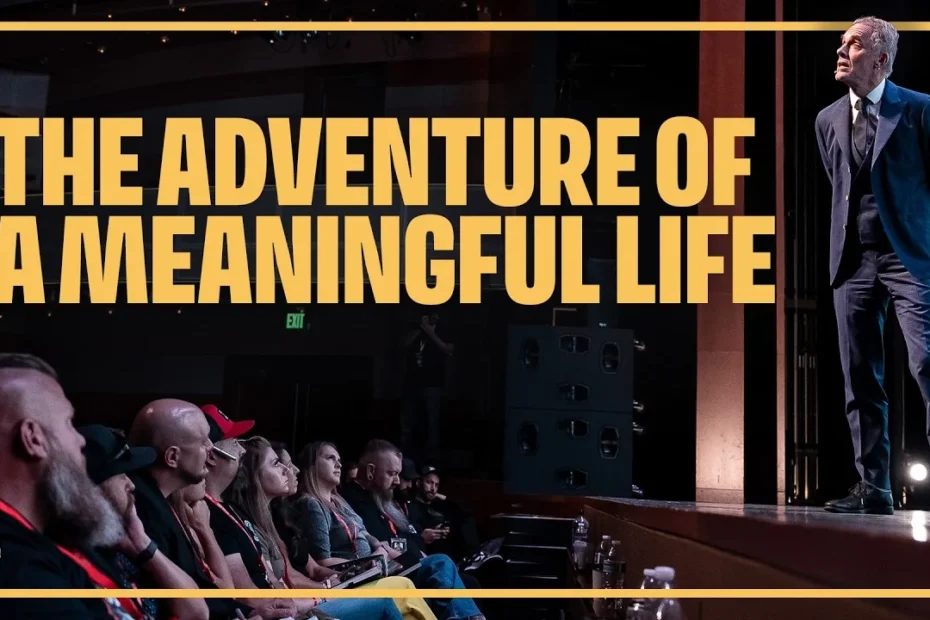
Read the full transcript of Dr. Jordan B. Peterson’s lecture at from Omaha, Nebraska, on October 21st, 2024.
The Necessity of Sacrifice in Devotion
DR. JORDAN B. PETERSON: Thank you, everyone. So imagine that if you have the ambitions to accomplish something, that you have to be devoted to it. You have to concentrate on it. You have to attend to it. You have to make it a priority.
And what that means is that other concerns, other things you could attend to, other destinations towards which you might direct your actions, you have to sacrifice those to that thing you’re devoted to. If you marry someone, you declare your devotion to them. You put them above all other men or women. You sacrifice the relationship you could have with all other men or women to that person. You put them at the pinnacle of the hierarchy of your relationships, and you do that when you start a new business or when you take on a new job.
If you are in it wholeheartedly, if you’re in it in the manner that would most assure your success, you devote yourself to it, and you make the relevant sacrifices. Now imagine that as you go through your life, you prioritize one thing, and then perhaps that comes to its conclusion, and then you prioritize another thing. Or perhaps while you’re prioritizing one thing, as you move towards it, your understanding of where you’re heading transforms, and so your direction shifts. And imagine you repeat that continually, and you do that in good faith, and you continue to pursue your object of devotion. But you observe that what it is that you’re aiming for transforms across time.
Now that doesn’t mean that the things you were aiming for along the way were improper, although it does suggest that as you move towards your destination, your understanding of the nature of that destination transforms as you accrue wisdom as you move forward.
Tolstoy’s Vision: Suspended Above the Abyss
I remember reading the autobiography of Leo Tolstoy called Confessions. Tolstoy, at the height of his fame, he was the most well known author in the world and a master of literature on par with Shakespeare. He was an aristocrat in czarist Russia with immense estates. He had a large family.
In many ways, he had everything, even by his own admission, that he could possibly ask for, and he was desperately unhappy and suicidal. He sometimes when he was walking on his estates, he would carry a rope with him on the off chance that he would finally make the decision to hang himself from a rafter. And during that time of immense fame and productivity and abundant life and his associated descent into despair, he was searching and wrestling, wrestling with God, you might say, wrestling to understand the meaning of his life, to understand his despair in the face of everything that had been granted to him.
Tolstoy’s attention turned more to religious matters as he became older, but he ends his book, the Confessions, very short book. It’s very much worth reading, with a vision, a dream.
He had a dream, and he dreamt that he was suspended in midair. And when he looked down, there was an abyss of infinite depth beneath him. And to be suspended in midair with an abyss of infinite depth beneath you is a daunting experience, and you can understand that experience. It doesn’t take much literary analysis to comprehend the meaning of that vision. It means that when any of us look down, we can see the abyss in front of us, and we can easily become, we can easily despair in consequence of that sense of vertigo that the unknown spread out in front of us might produce.
But then he looked up, and what he saw was he realized that he was suspended by a rope above this abyss and that the rope extended upward farther than he could see. So the rope above him extended into the infinite space above as far up as the abyss below him reached down. And then he woke up, and that is the end of his book. And he understood that something invisible and transcendent supports us above the abyss that extends below us. But the book ends there, and the reader is left with some resolution of the problem that Tolstoy was facing, but with no real explanation.
The resolution was the hypothesis put forward in the dream image that we’re suspended by something that supports us above everything that threatens us. But what supports us? What is the nature of what supports us?
The Transcendent Nature of Ultimate Value
So one of the things you want to understand about the way that that which should be put in the highest place is characterized in the Judeo-Christian tradition, is that in the final analysis, whatever God is, whatever is to be put in the highest place, whatever is transcendent, is outside of time and space. It’s not to be found within the confines of anything that presents itself immediately to us, and that in the final analysis, its nature transcends our understanding.
And so that begs the question, first, does something like that exist? And second, if it does exist, yet it’s incomprehensible, ineffable, and transcendent, how are we to understand it, and what is the nature of our relationship to it?
So imagine that you’re devoted to something, and you pursue it. And as you pursue it, your understanding of what it is that you should be devoted to transforms and broadens. So what that implies is that what’s good and motivating calls you as that which grips your attention and motivates you.
But as you approach that destination and become wiser in consequence, your understanding of where you’re headed broadens and deepens or becomes higher and more significant. So then you could posit that behind the things that call you is that which calls to you as such, which makes itself manifest as you approach it, but continually recedes.
The Endless Ascent of Mountains
So the idea would be, well, there’s always another mountain to climb, and that there’s a sequence of mountains that never end and that the peak of each successive mountain is higher than the peak of the mountain previously and that the ultimate destination is the vanishing point of all those peaks.
Right? That’s a representation of the sacred tree at the center of the cosmos that humans have been climbing for a hundred thousand years. That which is at the peak of that, that recedes as you approach it and that calls you continually to what’s better and better, that’s what’s properly put in the highest place. That’s the good as such. It’s another way of thinking about it.
Now that phenomenon of ultimate value, it’s that phenomenon of ultimate value that shines through everything of value that attracts you in your life.
Moses and the Burning Bush
This is what happens to Moses, for example, when he encounters the burning bush. So Moses is going about his business as a shepherd. He’s a good shepherd. He has a couple of wives. He has a good life. He’s attending to his flock one day, performing the duties of a typical productive and protective man, and something beckons to him that’s off the track. Something calls to him. It captures his attention, and he goes to investigate.
And as he approaches it, he realizes that it’s a tree that’s on fire. The tree that’s on fire, that’s the tree of life. A tree has been a symbol of life forever, and there’s many reasons for that, not least that life itself has branching forms that make themselves manifest in the morphology of trees, but in the branching relationship between kingdoms of animals as they progress through time, in the branching structure of the blood vessel system that keeps you alive, that replicating and differentiating structure that’s tree-like is central to life itself.
And a tree that’s on fire is something that is and is becoming at the same time. It’s something that exists and is transforming at the same time. Of course, life has that characteristic because you are what you are, but at the same time, you are what you are becoming.
And it’s the combination of those two things really that makes you alive, form plus possibility transforming itself into form. And what Moses encounters is a manifestation of that central pattern of life.
A Personal Note on Resilience
Greer and Catherine, their four-year-old son, was diagnosed with a degenerative illness. That initiated the discussion about resilience in children, resilience in general. It’s a challenge for any parent to figure out when to nurture, when to push, when to comfort, how that works.
It sounds like your son is social, and he’s verbal, and he’s smart, and he’s imaginative. Certainly. Your task is going to be to help him find his way. He’s going to have to be the person who figures out how much he’s going to be willing to fall on his face. I want to be an oak tree, but also a source of light.
My daughter was very ill for several decades. She was doomed with her illness and she figured it out and she’s firing on all cylinders. So who knows what you can manage if you maintain your upward orientation. You don’t have to have all the answers. You just have to have answers to the questions he’s asking.
The Call to Sacred Ground
When something calls to you, that’s what you encounter too. When something makes itself interesting to you. When you find yourself compelled by something, when you fall in love with someone, when you’re motivated by forces outside yourselves to pursue something that interests you, the same thing has happened to you that happens to Moses. And Moses follows this. Moses has the faith to investigate what it is that fascinates him. And he approaches it and investigates it.
And as he does so, his experience becomes deeper, and he begins to understand that he’s starting to tread on sacred ground. And he takes off his shoes, which means he’s not going anywhere, which means he abandons his specific identity. The shoes are emblematic of identity, which is why you can walk a mile in someone’s shoes in order to understand them. He abandons who he is in pursuit of what he could be.
And the consequence of that is that a voice speaks to him out of the depths of the burning bush and then announces itself as the spirit of being and becoming itself.
The Transformation Through Deep Pursuit
And what that means is that if you pursue that which calls you deeply enough, the voice of the spirit that gives rise to order itself will make itself known to you. And we know that because we know all of us know that if we pursue something deeply, if we pursue something with commitment, if we are devoted to something and pursue it, that our understanding of that deepens. That makes us deeper. And that as our understanding of that particular phenomenon deepens, we start to understand its connection with everything else. And the deeper and there’s no limit to the depth of that.
And the consequence of that, and this is the consequence for Moses, is that the revelation of the spirit of being and becoming to Moses transforms himself into the sort of person who can lead the enslaved out of tyranny into the desert and toward the promised land. And so what that means is that that’s what makes Moses into a leader, is that he takes what compels his attention with all due seriousness, investigates it wholeheartedly, allows his identity to transform as a consequence, and transforms himself with the help of what it is that’s calling to him, transforms himself into the sort of man who can stand against tyranny and overcome the proclivity to slavishness, who can navigate through the desert, and who can find the final optimized destination.
And that’s a pathway that is open to everyone and that’s indicated by the fact of calling and interest. That’s a characterization of God. That’s a characterization of God.
The Biblical Characterization of the Divine
Now what happens in the biblical corpus is that the spirit that recedes and it calls forward is characterized in the biblical stories. And the reason for that is so that the nature of that spirit can be made clear so that individuals and societies can organize themselves in productive harmony. The biblical stories are a library of characterizations of God. So God is the spirit that calls us forward is represented as a character and as the character to whom ultimate devotion should be paid. So that’s a definition. It’s something very much worth understanding.
The hypothesis is that imagine that you are devoted to something. It might even be devoted to your own self interest, but let’s assume that it’s devoted to an enterprise or that it’s devotion to your family or it’s devotion to your wife or your husband or to your friends. There’s something that’s the spirit of devotion itself that lurks behind that. Because you think about it this way, is different people are devoted to different things, but that doesn’t imply that they’re not devoted.
And so there’s something common about the fact of being devoted across instances of devotion. And there’s something lurking behind what makes you devoted that’s the spirit of devotion itself, and that’s the spirit that makes itself manifest in the burning bush, and that’s the spirit that’s characterized in the biblical corpus.
Introduction to the Tower of Babel
So let’s walk through the characterization, and I’m going to tell you a very specific story tonight. I’m going to just tell you the story of the Tower of Babel. But I want to put it in context so that what it means is a very short story, but what it means can be fully understood.
The Tower of Babel is Genesis chapter 11. There’s 11 chapters of characterization that precede it, and I’m going to walk through you through the characterizations. Each of the biblical stories is a characterization. Now we might want to investigate what it means for something to be characterized first so that you understand that. That’s what happens that’s what you’re trying to experience when you go see a movie or when you read a work of fiction or when you listen to any story is you’re immersing yourself in a characterization.
The Call to Romantic Adventure
Now if you go see a James Bond movie, you’re going to see a characterization of the spirit of romantic adventure. And the reason that you do that is because you want to understand that spirit because there’s part of you that would like to be devoted to the spirit of romantic adventure. And you can tell that there’s a part of you that would want to be devoted to that because you wouldn’t go see the movie otherwise. You wouldn’t find yourself compelled by the romantic adventure that unfolds. And so you could think of the romantic adventure that’s encapsulated in a James Bond movie as a call to movement in a particular direction.
And you could think of the James Bond character as a reflection of that which calls to you as such. Right now, I’m not making the claim that the James Bond character is the ultimate characterization of what calls to you, but it might be a sufficiently—it might be a characterization that’s sufficiently beyond your current ability to act as a mediator between you and what’s behind it. And you know that even in a characterization that’s as associated with popular culture as the James Bond hero, that the characterization is a call to romantic adventure.
It’s a dream of romantic adventure. It’s a dream of a mode of being, which would be a characterization. It’s a call to a mode of being that’s beyond the limited confines of often all too dull normality. And the fact that you’re compelled by it, at least sufficiently to pay for the movie, is an indication that there’s a part of your spirit that’s yearning to be released from the prison walls of insufficient normality. And the reason you’re called to that is for the same reason that Abraham is called by God to leave the comfort of his father’s tent even at his advanced age and to journey into the world and to have his terrible adventure.
And the reason that that’s compelling to Abraham is because we’re called to have the terrible adventure of our life. And to the degree that we fail to do so, then our heart yearns in that direction, and we will seek out substitutes and pathways forward to attempt to move us toward that goal.
Why the Call to Adventure?
Why the call to romantic adventure? Why the high order and dangerous adventure that’s characteristic of an action adventure movie? And the answer is, well, it’s related to the vision of Tolstoy: that the abyss that lays itself out beneath us is so deep. The suffering and complexity of life is sufficient that only a noble adventure can justify it. And so without that devoted striving toward what’s ineffable and transcendent, the abyss makes itself so manifest that it’s dispiriting and disheartening.
We’re not after security. That’s why God calls Abraham out of his security, his infantile security. We’re not designed for security. We’re not designed for infantile safety. We’re designed for a romantic adventure.
The Nature of Consciousness and Possibility
In the first book of Genesis, God is characterized as the spirit that confronts possibility with love and truth and makes the order that’s habitable, the order that is good and habitable. And what does that mean? Well, people are made in that image.
So what are people like? People are conscious characters. And what is it that you’re conscious of? And the answer is you’re conscious of possibility. And in fact, that’s what your consciousness is for.
Those things that you can predict that are familiar and stable, because they’re predictable and familiar and stable, you don’t have to be conscious of them. In fact, you aren’t. The things that don’t change, you don’t attend to. It’s the things that transform and transmute in front of you that you attend to. And that’s because you have the opportunity in the face of that which is still only possible to wrestle with that possibility and to transform it into, optimally, the order that is good.
And it’s in so doing that you find your identity with the spirit that called forth order from chaos itself, not only at the beginning of time, but now and forever.
It’s participation in that process that puts you—that makes you able to walk unselfconsciously with God in the garden and that establishes with God the order that is good or very good.
The Story of Cain and Abel: The Spirit of Conscience
In the story of Cain and Abel, God is further characterized as the spirit that requires the best of all possible offerings in relationship with man. That’s the spirit of conscience. That’s a good way of thinking about that.
Cain is the man who offers what’s second best to himself and other people and the world and to God. His sacrifices are second rate, and they’re rejected. God is characterized as the spirit that rejects anything but the offering of what’s best. And you might say, well, I don’t believe in that spirit. And I would say, don’t be so sure that you think that you know what you believe.
People are very complicated, and it’s a very rare person indeed who isn’t subject to his own conscience. In fact, the rare person who isn’t subject to his own conscience is someone that you don’t want to be near and somewhere you don’t want to be with him. Your conscience is that which calls you out when you offer what’s less than your best to yourself and to your fellow man, to society, to the world, to God. And there’s no difference between that and the indwelling voice of conscience. And that’s a characterization of what should be put in the highest place and a definition of God.
Conscience has an autonomy. It’s something we wrestle with. It’s something that appears to be part of us, but acts in a manner that’s only dependent on its own will. If you transgress against your own conscience, you’ll call yourself out and inescapably. You can strive to ignore the betrayal of the relationship that the rebellion of your conscience indicates. But the more you attempt to silence what it is to know what it is that you know to be true in relationship to your own shortcomings, the worse things will become for you.
And the hypothesis in the story of Cain and Abel is that what is to be put in the highest place, the source of all devotion, that to which all sacrifice should be devoted, is the spirit that speaks in the voice of conscience. It’s also the Spirit that rewards proper sacrifice.
The Spirit That Rewards Proper Sacrifice
And you can ask yourself too, do you believe in the existence of the Spirit that rewards proper sacrifice? Well, so ask yourself this. If you have a son and you love your son, isn’t it the best part of you that offers him reward in proportion to the integrity of his offerings?
Isn’t it the encouragement that makes the best of him make itself manifest? Isn’t it the encouragement of the best in you saying to him, I’m impressed by what it is that you managed? Do more of that. Isn’t that the most fundamental basis of the best relationship you could possibly have with them? Isn’t that the basis of the best relationship you could have with yourself or with the people that you love to observe what it is that they do when they’re wholeheartedly devoted to something, when they’re all in in their sacrifices, and they’re wending their way up the sequence of mountains forward.
And isn’t it exactly what every son wants from his father for that relationship to be the case? God says to Cain, if you do well, you will be accepted. And God is therefore the spirit that accepts if what is good is done, but also the spirit that judges and rejects if what is best is not being offered. And that’s represented in that story as the ultimate manifestation of a combination of mercy and justice that makes up what is ineffable and divine.
The Pathway of Degeneration
Cain rejects all the guidance that spirit could possibly provide, becomes bitter, resentful, and murderous. His children and grandchildren become corrupt and genocidal. That’s the pathway of degeneration away from adherence to the call of the spirit that moves people endlessly upward.
Cain’s children, they’re also the builders of the first cities. They’re the artisans who first make musical instruments. They’re the craftsmen and metallurgists who make weapons of war. They’re the engineers who offer technological solutions to spiritual problems. That becomes relevant in the story that I am going to tell you.
Cain’s descendants, who’ve turned away from direction by the ineffable, multiply and fill the earth and propagate the sin of Cain everywhere, producing a society that’s bitter and resentful and deceitful and self-centered and unwilling to offer its best and prideful and narcissistic and technologically obsessed and hedonistic, and that’s where the flood comes.
The Story of Noah: Preparation in Good Faith
And in the story of Noah, God is characterized further as the spirit that calls to the wise even in times of trouble to prepare in good faith to shepherd their family through the inevitable flood. And that’s what you do as a wise man and woman if you have maintained the clarity of your vision and the integrity of your thoughts so that your intuitions in times of trouble can warn you when it’s time to prepare so that you do that not in fear, but in good faith.
And that when you do that, you thereby protect yourself, shelter your family, keep society thriving, and act as proper steward to the natural world, which is what Noah does when he preserves the animals on the ark, his family, himself, his wife, his family, a microcosm of society, and the natural order itself on the arc he constructs as a consequence of attending to the manifestation of the ineffable speaking within that warns him that chaos is about to descend.
The Tower of Babel: Technology as False God
And that brings us to the Tower of Babel. I don’t know if you’ve been following the news in recent days. I said that the children of Cain were the engineers, but more particularly, they’re the builders who put what they build in the place that’s reserved for God. They’re the prideful intellect’s temptation to elevate the technological enterprise to the highest possible place, to look for salvation in the technological realm.
What happened to Google in the last two days? The Google engineers, along with computer engineers everywhere, are madly engaged in the construction of superintelligences that have mapped the domain of the word. And Google devoted its AI project to unholy ideological propositions and produced a superintelligence whose image making capacity instantly falsified not only the present, but the past in the service of those delusional presumptions. That’s the Tower of Babel.
Unity Under Proper Vision
This is the story. And the whole earth was of one language and one speech. That’s the symbol on the back of the dollar bill. What does it mean? Means there’s a hierarchy of value, and that everything within that hierarchy of value should be devoted to one thing, which is at its apex, which isn’t part of the thing but rises above it, that’s associated with clear eyed vision. That’s the symbol of value that your economy is predicated upon, this ancient idea.
Why is that of one language and of one speech? Because a hierarchy of value that has the appropriate attentive eye at its pinnacle unites people psychologically and socially to the degree that your country is united. It’s united because you all act out and implicitly believe the same story, and the story is symbolized in that image.
What’s at the top? What does Christ say in the gospels? There are none so blind as those who will not see. Well, that’s the opposite. This symbol is the opposite of that. The story that unites man and society properly places the eye that is willing to see whatever is in front of it at the pinnacle of all.
To the degree that a person or a society unites itself under that singular vision, then it maintains its orientation, allows people to maintain their hope in relationship to a direction, stops people from experiencing the anxiety that a multitude of competing directions produces, and ensures a productive, generous social unity.
When Words Lose Their Meaning
Everyone speaks the same language. What does that mean to speak the same language? It means there’s no dispute about what is a woman. When the Tower of Babel becomes too deviant, when it aims itself sufficiently far off the mark, words themselves lose their meaning, and everything collapses.
In Babylon, the Tower of Babel, Babel means Babylon. Babylon in the biblical corpus stands for the presumptuous civilization. Babylon, Rome, Canaan, Sodom, Gomorrah, they’re variants of the idea of civilization gone astray.
What’s a Tower of Babel? Well, at the time in the Middle East, at the time of Babylonia, there were literal competitions between kings to build the highest structure, the highest ziggurat, the highest pyramid, not for the glorification of God, not to further technological development as such in the service of life more abundant for the citizens of a given polity, but to provide the emperors, the kings, the tyrants who funded the construction with means of self-aggrandization.
The Tower of Babel and Centralized Authority
The higher the tower, the more the king justified his presumption that he could challenge the divine order. The Egyptians raised their pharaohs to the level of gods, as did the Romans when their society deteriorated. It’s in the nature of an overweening tyranny to elevate its earthly representative to the status of what should be ineffable—to the status of the ineffable and transcendent guiding spirit. And the consequence of that is always that the tower comes crashing down.
It came to pass as they journeyed from the East that they found a plane in the land of Shinar, and they dwelt there.
Now there’s a backstory to this, and the backstory is something like this: the people of Shinar decided to centralize, and to pass all authority into a centralized authority. That’s a good way of thinking about it. Instead of maintaining responsibility and authority in a distributed manner, they centralized. So you can think of these towers as the attempt to build a top-down utopia.
That’s a good way of thinking about it—a top-down utopia with the wrong spirit constructing it and at the pinnacle. That’s the continual technological proclivity of the pridefully obsessed intellect.
The Pattern of Improper Sacrifice
Cain establishes the pattern of improper sacrifice. Cain becomes fratricidal and murderous. His descendants become genocidal and chaotic and technologically obsessed. The consequence of the chaos is the flood—that’s the destruction of the world by the return of chaos. The Tower of Babel is the destruction of the world by authoritarian presumption. And those are the two sociological or political catastrophes that are associated with the sin of Cain.
So what does that mean? If you refuse to offer your best, and in consequence, your offerings are rejected, you’re unsuccessful, you’ll become bitter and resentful. If you determine to nurse that bitterness and resentment and let it take you where it wants to, you’ll become the murderer of your own ideal, the destroyer of your own hope, and a rebel against the cosmic order.
Your descendants will either bring about the flood that eradicates the world or construct the authoritarian tower whose inevitable consequence is the degeneration of society into incomprehensibility.
The Nature of Totalitarian States
So what’s a totalitarian state? Let’s take the Soviet Union. Who’s God in the Soviet Union? Well, clearly, Satan. But under him, Stalin, let’s say. It’s Stalin. Well, what does Stalin worship? Power.
How is language demolished under Stalin? Well, what’s a totalitarian state? You might say, well, it’s the top-down imposition of pathological order by a handful or even a sole actor. But that’s naive because one person cannot control 20 million people. It’s not possible. You need an army of willing slaves. If you’re going to be a tyrant, you need an army of willing slaves.
What sort of slave do you have to be to be tyrannized by a single tyrant? How about the kind of slave that abandons the meaning of his words?
The Loss of Voice and Truth
You’ve all watched Pinocchio. Pinocchio is enticed into pleasure seeking by the offer of a vacation that he deserves because of his neurotic suffering. The figure that entices him to the vacation paradise is the coachman who drives the chariot, let’s say, full of delinquents to the island of hedonistic pleasure.
What happens on the island of hedonistic pleasure? The juvenile delinquents destroy the culture, and they turn into jackasses who can’t say a word. And underneath the palace of pleasure are the slavers waiting to enslave them in the mines.
Why do the boys turn into jackasses? Because if you sell your soul to the devil in return for cheap pleasure, your voice will be stolen. You’ll sacrifice your voice as an offering. Well, that’s why the words decay. Because words with no truth have no meaning. They’re nothing but babble.
The totalitarian presumption is not so much the dominance of otherwise freedom-loving citizens by a tyrant, but the willingness of every single person who dwells inside that tower to use every word they ever utter only to represent falsehood to maintain the tyrannical tower and to enslave themselves.
The totalitarian state is the total grip of the lie. And the grip of the lie is no different than the descent of words into incomprehensibility.
The Consequences of False Speech
So you might want to remember that the next time you’re called upon at your workplace, let’s say, or even in the company of your friends to utter words that you know to be false or to remain silent when you’re called upon by your conscience to say something that you know to be true.
You wonder why we can’t agree on the most basic facts, let’s say, such as what is a woman? The answer could well be that we’ve built Towers of Babel that are a little bit too high and a little bit too presumptuous.
Centralized authority taking to itself the right to reshape the world as a consequence of nothing but technological prowess in the service of false gods generates a technological nightmare that destroys meaning itself.
Technology Without Wisdom
And they said to one another, “Go to. Let us make brick and burn them thoroughly.” And they had brick for stone and slime they had for mortar.
Now you have to understand that this story is not about the dangers of technology per se. It’s not about the evil of the technological enterprise or the evil of knowledge. It’s about the willingness to put the technological enterprise—it’s about the willingness to make the technological enterprise take the place of God.
You could think about it this way: We have hydrogen bombs. That’s a pretty close technological approximation to God. Do we have the wisdom to use them or not use them wisely? That’s not a technological question.
A technology that’s not in the service of what is put in the highest place becomes the spirit that builds the Tower of Babel and makes it impossible for people to live together or to communicate. And that’s happening around us with incredible rapidity.
The Replacement of the Transcendent
And they said, “Go to. Let us build a city and a tower whose top may reach unto heaven.” That’s the motif of the displacement of what is properly ineffable and transcendent. That’s the replacement of the transpersonal cosmic order with the doctrines that currently dominate.
There is a reason the communists attempted to eradicate the religious enterprise. The reason was that the communist dogma and the prophets of the communist dogma wanted to replace the entire enterprise devoted toward transcendence with themselves. And we all know the consequences. All of us who want to know know the consequences of that.
All of us who want to know know that the consequence of that was the descent of an entire civilization into a hell that destroyed tens of millions of people. And not just in Soviet Union, in Maoist China, still in North Korea, still in communist China for that matter, because everything that’s going to happen in communist China has not yet happened. You can be sure of that.
Modern Surveillance and Control
Do you know that the Chinese engineers have built Skynet? Do you remember Skynet from the Terminator? Do you know that the Chinese called their 700 million closed-circuit TV camera monitoring system that recognizes everyone’s faces and everyone’s gait? You know they call that Skynet? Do you know the engineers who were asked about that said, “We’re building the good Skynet”?
You know how close we are to that here? The technology’s there. We copied the Chinese during the pandemic. If you don’t think that we could do that again, you’re sadly mistaken.
And you might ask, well, what would protect us against that? And the answer is something like the willingness of each of us, the devotion that each of us must manifest to what should be properly put in the highest place. And it’s not the technological utopia that the power-addled engineers present us with.
That’s what’s happening in China. They’re going to produce a totalitarian state that’s so complete that George Orwell himself couldn’t have imagined it in his worst nightmares. 700 million closed-circuit TV cameras watching absolutely everything you do. Every single thing you purchase tracked. Every place you go monitored. Every word you say recorded, analyzed, assessed by artificial intelligence.
Well, you saw the artificial intelligence that the Google engineers just produced. How would you like that monitoring absolutely everything you do for the rest of your life?
Divine Punishment of Presumption
“Let us build a tower in a city whose top may reach unto heaven”—Luciferian presumption. “Let us make a name, lest we be scattered abroad upon the face of the whole earth.”
And the Lord came down to see the city and the tower, which the children of men built.
How is God characterized in this story? The God we wrestle with, let’s say. How is God characterized in this story? God is the spirit that punishes presumption. God is the spirit that punishes intellectual presumption.
The sin of Adam and Eve is the sin of pride. The sin of Cain is the sin of pride. Cain believes that he can offer what’s second best and benefit and escape from notice. He believes that he can offer what’s second best to fool himself and fool the people he’s around and adapt to the world and pull the wool over the eyes of God.
Pride. Pride goes before a fall. What punishes pride? That’s part of the biblical characterization.
Do you believe in God? Do you believe there’s a spirit that punishes pride? Has that spirit made itself manifest in your own life? Are those times that you overreach yourself, especially when you know that you’ve overreached yourself and you fail in consequence—is that the just and merciful unfolding of the cosmic order? If it’s not, then why does your conscience call you out when you in the aftermath of that error, of that overreaching, of that presumption?
The Collapse into Incomprehensibility
And the Lord came down to see the city and the tower which the children of men built. And the Lord said, “All the people are united, and they all have one language, and this they begin to do. And now nothing will be restrained from them. Go to, let us go down there and confound their language that they may not understand one another’s speech.”
For centuries, the casual interpretation of the Tower of Babel is that this is the attempt by superstitious people to hypothesize about the origin of multiple languages. That’s not what it means at all. It means that the consequence of centralized, unidimensional, prideful, mad, power-seeking is a fractionization and atomization of a society that’s so complete that no one person can understand anyone else.
That’s a vision of hell—the collapse of the Tower of Babel. And it’s a vision of inevitability because the idea is that any system of unified totalitarian power will inevitably degenerate into mutual incomprehensibility and collapse.
And you can ask yourself, well, do you believe that that’s the case? How else do you approach the history of the twentieth century? What happened repeatedly to the various towers of babel that we built politically? What happened to the Soviet Union? What happened to Nazi Germany? What happened to Maoist China? What happened to Cambodia?
What happened every single time people in their intellectual pride attempted to build a structure that was oriented toward some destination other than what should properly be placed in the highest place? The answer is people degenerated into mutual incomprehensibility, chaos emerged, and we built hell—not the hell we could still yet build, and that’s for sure.
The American Alternative
So what does that mean with regards to you Americans? Your society is remarkably robust and resilient, and it’s remarkably free. I don’t think it’s any exaggeration to claim that you have the freest and most resilient society in the world.
So what’s great about your country? Well, your country is predicated on the notion that you are each created in the image of God and that you have a domain of intrinsic worth that manifests itself in two ways.
One, it manifests itself as your rights in relationship to the state. Not that the state grants them, but that the state is to find its limit at the border of the rights that are intrinsically yours as a consequence of your essentially valuable nature.
And associated with that is a commensurate responsibility. With every right, there’s a responsibility. And so the responsibility that each of you bear as sovereign citizens is the responsibility to maintain order within your lives, maintain and produce the order that’s good within the confines of your life, to take care of yourself and to find the adventure of your life in that ability to be the captain of your own ship, the master of your own destiny.
To do that well enough so that you can dare marry, to do that well enough so that you can take care of a family, so that you can be of service to your community, so that you can serve your state and your country under God.
That distributed responsibility—that’s the alternative to the Tower of Babel. That’s laid out very clearly, by the way, in the book of Exodus where the concept of subsidiarity emerges.
The Foundation of Distributed Authority
The concept of subsidiarity is a vision of a hierarchy of distributed responsibility that’s the antidote to slavery and tyranny. You can see that reflected in your political structure because it resists centralization. You have a division of power, but more than that, you have a state of states. And the states themselves, like the towns and the cities, have their domains of power and responsibility. And so the authority that could be centralized in a single entity is distributed across the entire pyramid all the way down to the individual, and that makes your society remarkably robust.
One of the things that I’ve observed as a Canadian watching you Americans for fifty years: I can remember the nineteen eighties, there was a widespread fear that Japan was going to emerge as the reigning financial master of the world. And that threat seemed to be credible for about five years, six years, something like that, and Japan centralized. And you Americans didn’t. And there are plenty of places in your country that weren’t doing the right thing, but there were plenty of places that were doing the right thing. And out of those places that continued to do the right thing, new abundance flourished.
And you do that all the time. You did that again in the nineteen nineties. And it’s a consequence of the manner in which your state is structured, right from the individual upward.
The American Character and the Dream of Productive Competence
It’s a consequence also of your willingness as individual citizens, and I also see this as characteristic of The United States. One of the things that characterizes your society that’s very unique and maybe unique even among Western countries is that you wholeheartedly admire productive, generous competence.
That’s at the core of the American dream. If people in this country, people who make it in consequence of their own honest and upward striving efforts are genuinely admired. And that’s your wealth, really. And that’s also your recognition that technological prowess and even material abundance can be positive goods if they’re put in the right place. That’s like anger, and that’s like sexuality, and that’s like fear.
All of these things can be beneficial in the right place. That ambitious striving that makes your land rich and rife with opportunity and possibility and beauty and cultural richness is a consequence of the positioning of that material ability and security and opportunity in the proper place in the hierarchy of values that strives properly upward.
The Judeo-Christian Foundation of Rights
The founders of your republic knew this because they understood that your rights were self evident as a consequence of the embeddedness of your culture in the underlying Judeo Christian tradition that produced that positioned what was properly sovereign above everything that was political and beyond, above and beyond everything that was merely political, and that simultaneously called upon each citizen and the leaders of the citizens to pursue their individual pursuits and their political endeavors in light of their commitment to what was properly put in the highest place. And that is precisely what’s made your country rich.
The Resource Curse and the True Source of Wealth
I don’t know if you know of an economic phenomenon called the resource curse. People, especially of the leftist persuasion, believe that countries are wealthy because of natural resources, but there is no relationship between the natural resources of a given country and its wealth. In fact, the relationship statistical relationship is slightly negative. Why? Because unearned wealth is an invitation to corruption and instability, and that’s what happens in resource rich countries.
Your country is rich because your people are, by and large, ethical. Your country is rich because, by and large, the default transaction between individuals in The United States is honest. There is no other natural resource than the truth that makes honest trade between strangers possible. With that in place, every desert can bloom. That’s why LA exists. Well, I mean it. It was a desert. The entire western part of your country was uninhabitable. It’s the cooperative, productive generosity of your citizenry that made that harsh environment not only habitable but wealthy. That’s a consequence of the orientation of your society, not towards these towers this tower of babble gigantism, but towards its distributed responsibility and rights and its orientation towards the proper uppermost goal.
The Biblical Foundation of Order
Therefore is the name of it called Babel, because the Lord did there confound the language of all the earth, and from thence did the Lord scatter them abroad upon the face of all the earth.
The fundamental characterization of God in the opening chapters of Genesis is that God is the spirit that orients itself upward and transforms chaotic possibility into the order that’s habitable and good. That’s the garden in which man is placed. Man and woman, because it’s insisted upon in the text that this characterization applies to both sexes. Men and women are made in the image of God, and so they are reflections of the proclivity to bring order to chaos.
The Practice of Proper Sacrifice
We bring order to chaos through the practice of proper sacrifice. What does that mean? To put things in their proper place, to aim up and to let go of everything that interferes with that aim, to make the proper sacrifices. That establishes the appropriate order. We deviate from that sacrifice at our peril. The pathway of insufficient sacrifice leads to murder and chaos and totalitarianism and genocide.
The pathway upward eternally produces the order that’s benevolent and good, that allows us life more abundant and the freedom to pursue it, to steward the garden properly and to walk on self consciously with God as we proceed our way up Jacob’s ladder.
So thank you very much.
Related Posts
- Andrew O’Donohue’s Graduate English Address – Harvard Commencement 2026 (Transcript)
- Zohran Mamdani’s BMCC 2026 Commencement Address (Transcript)
- ‘I Am The Son Of Immigrants’: Astronaut Jonny Kim At Harvard Alumni Event (Transcript)
- Hamza Masoud’s Speech: Harvard Class Day Ivy Oration 2026 (Transcript)
- Daniel Pink 2026 Commencement Address: Columbus College of Art & Design (Transcript)