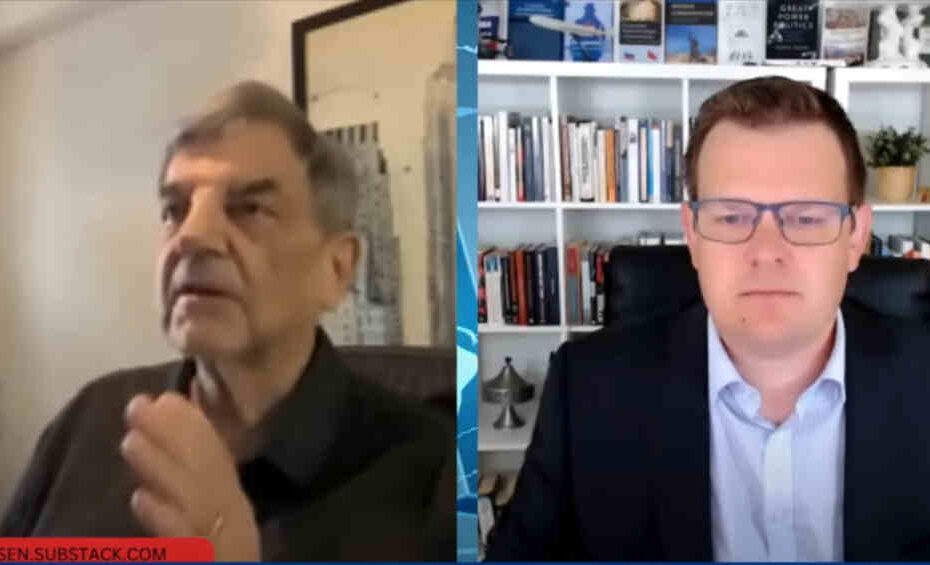
Read the full transcript of world-renowned classical economist Prof. Michael Hudson in conversation with Norwegian writer and political activist Prof. Glenn Diesen on “EU Capitulation to the US & Geoeconomic Suicide”, July 31, 2025.
Introduction
PROF. GLENN DIESEN: Hi everyone, and welcome back. We are joined again today by Professor Michael Hudson, excellent economist and a prolific writer, to discuss this trade agreement between the European Union and the United States, whether or not this signifies further subordination by the European Union. So, yeah, welcome back to the program.
PROF. MICHAEL HUDSON: Thanks. Good to be back, Glenn.
The EU’s Failed Bargaining Strategy
PROF. GLENN DIESEN: Well, a key objective of the European Union for it to exist is to use collective bargaining power of the 27 member states to negotiate more favorable trade agreements. And a key motivation has been to have more symmetry in the relationship between the United States and Europe as two equal partners, the two pillars of the political West. Again, this has been the ambitions never really achieved.
Yet in the recent agreement between the EU and the United States, we saw that von der Leyen effectively capitulated completely. That is, the United States got everything and the EU got nothing. The meeting even took place at Trump’s golf course. And this also took place not long after NATO Secretary General Mark Rutte referred to Trump as “Daddy.” And it seemed almost as a deliberate effort to display the relationship between the master and the vassal.
Indeed, the prime minister of France even referred to it as a “dark day for Europe and submission to the United States.” I was going to ask from an economic perspective, how do you make sense of this trade agreement between the US and the EU?
The Geopolitical Nature of the Agreement
PROF. MICHAEL HUDSON: Well, first of all, the political setting for the agreement, you said that it was the member states that were negotiating. It wasn’t the member states, it was one person, Ursula von der Leyen, head of the European Commission, one person. And her main objective is to fight the new Cold War against Russia.
The New York Times in the United States, which is the right wing spokesman for the deep state, for the neocon interests, summed up what was saying that whereas you say, and everybody, almost all the other newspapers say, yes, it was a giveaway. It was one sided. The New York Times quotes Morrow Sevove, if I’m pronouncing his name right, the European Trade commissioner said on Monday in Brussels, “It’s not about the trade, it’s about geopolitical volatility.” In other words, it’s all about fighting with Russia.
And von der Leyen of the EU Commission said that what this really was was locking the United States and Europe into the new Cold War against Russia, that all of this is part of basically fighting to the equivalent of fighting to the last Ukrainian, except in this case it’s Europe fighting to the last bit of profitability for what it’s doing. You could look at it as the Ukrainianization of Europe.
Trump’s “Let’s You and Russia Fight” Strategy
Trump has said to Europe “let’s you and Russia fight.” And America is not going to pay the money for that. Basically Europe is going to pay the money and it’ll pay it largely by buying American goods and American products.
The problem is that the EU has, the countries have subordinated their economic interest, that of their industry and also the interest of voters not to get involved in the Ukrainian war, subordinating it all to a very right wing EU commission that is best viewed as a branch of NATO. And this really is a NATO agreement rather than an agreement by all of the European countries.
The Failure to Negotiate
So looking from America, I don’t know the extent to which other European countries may try to block the agreement. I think if there’s a majority, then it binds all of them. That’s awful. But also there’s the idea of did von der Leyen make, acting really all by herself, did she make any attempt at all to bargain?
Europe had a whole panel play of supposed responses that it was going to do in case they turned down Trump’s agreement and Trump imposed the tariff. Europe was going to begin subjecting American Internet companies and the other companies to the minimum global tax. It was going to block US exports to Europe. It was going to essentially reorient its trade toward Russia, presumably to get its gas from Russia instead of the United States. It didn’t have to do any of this, but it just surrendered. And the question’s why?
The German Approach to Negotiation
I think partly it’s just the logic of how the Germans are known not for bargaining. And I had some friends, German friends, PhDs, professors, going to Marrakesh and they wanted to buy presents and they wanted to buy some clothes in the Marrakesh market.
The whole idea of Arab markets is very much a strategy, like Donald Trump. They set a ridiculously high price for the customer, for the Arabs in the souks. It’s a game and they enjoy the game. And the way they play it, they’ll set a very high price just to sort of give, trying to get the customer think in terms of a high order of magnitude.
And what happens then? They expect the customer to bargain down. But the Germans didn’t bargain down at all. They didn’t know that what they’re supposed to do is say, “No, that’s a ridiculous price.” And they offer maybe one tenth of the price. And then they try to say, “Well, we have alternatives. There’s someone else selling it cheaper. I can’t pay more. Look, they’re over there.” There’s a whole bit of negotiation.
Trump’s Negotiation Tactics
And I think what I’m told is that a lot of the Arab stalls expect the Europeans to feel that there’s a victory if they can get them down to half of the ridiculous price that they’ve asked.
Well, this is what Trump does basically. He sets a ridiculously high price. You may notice a few days ago, earlier in the week, Trump said, “I’m giving President Putin 15 days to have a ceasefire in Ukraine so that the Germans and the French can all rearm Ukraine to reinforce their positions and give the missiles to shoot against Russia. Russia has to agree to my agreement.”
Well, Russia simply ignored the whole thing and obviously it has no intention of surrendering to Trump. They’re just going their own way. Von der Leyen surrendered. There was really hardly any attempt, as far as I know from bargaining.
The Tariff Reduction Illusion
And Trump had first talked about 30% tariff on European goods. He got it all down to 15% tariff on European goods. And so von der Leyen acts as if, “Look, I’ve got down to half price.” Well, we’re back in the Arab market of Trump style negotiation.
And the fact is that America got Europe not to have any tariffs on US imports at all. It got to zero. Europe could have had a much better deal in any negotiation just by saying, “Do you really want to force us into the arms of Russia? If you’re really closing off the American market to us, which is what you’re threatening to do with your 30% tariffs and all of the special things that you’re demanding that we spend $750 billion on buying American goods and relocating our industry to the United States by investing in the United States, if the price is pushing ourselves into depression, if the price is increasing our military spending from 2% of GDP to 5% of GDP, that extra 3% is the entire growth of GDP is going to be spent on supporting America’s military costs of fighting the Cold War with Russia.”
Europe’s Economic Sacrifice
Is Europe really willing to sacrifice all of its growth, which is not even as high as 3% these days? It’s already being stifled into maybe 1.5%. With Germany showing negative growth, it’s already sacrificing everything.
Europe could have said, “Well, what you’re doing by closing off the American market is really forcing us back to the pre-2022 agreements. When the 2022 Russian fight with Ukraine, we’re going to have to rethink that. We simply cannot afford to buy your high priced gas and liquefied natural gas if we also are unable to earn the dollars to buy this gas, we can only earn enough to buy from Russia.”
Well, none of that was on the table. They didn’t call his bluff. And that’s the amazing thing.
Trump’s Bilateral Strategy
Trump said, “Instead of negotiating my tariffs with the whole world and a big tariff conference through the World Trade Organization, I’m going to go country to country to country. I’m going to make everything bilateral and we’re going to work with country.” That way he gets to indulge his psychological pleasure of fighting with other countries. He loves to fight.
For Trump, the whole idea of a presidency is to give him a chance to enter one fight after another after another, trying to be a winner every time. And that means making other countries the loser not to achieve a mutual gain.
The Undemocratic Nature of the Decision
Well, Germany could have done this, but that’s not what von der Leyen wants. It may be what some German industries want. It may be what French industries want. It may be certainly what many voters in Europe want. But von der Leyen wanted to secure this new Cold War against Russia. And as I said, when Trump said “let’s you and Russia fight,” that’s exactly what von der Leyen wanted to do.
So this really isn’t an agreement by all of Europe. There was no group of European industrialists or European politicians, just the European Parliament head the European Union. So it was. This is not a democratic decision and it’s not a decision that’s made on the basis of economic self interest or even what normal bargaining process would have been able to accomplish.
The Shrinking American Market
Von der Leyen and the European generally took Trump’s ridiculous demands on Europe as if it was take it or leave it not. Well, let’s bargain them down and let’s have a hard line. Let’s really outline what the alternative European policy could be. If we had to go it alone without the United States and if Europe had to go it alone without the United States, it would have to reorient itself towards that part of the world, East Asia, Russia and East Asia that is growing instead of tying its economic links to yes, it’s got the US market but the US market is actually shrinking.
The US market is not growing except for military industrial products. The American consumer market is shrinking because it’s already so heavily indebted consumers are that they’re defaulting on their automobile loans, they’re defaulting on their mortgages, they’re defaulting on their bank credit card loans. This is what the economy to which Europe is tied its fate to. And I think that’s very self destructive.
Europe’s Self-Imposed Isolation
PROF. GLENN DIESEN: But when you say that the EU could have had some leverage in these negotiations by threatening to go back to the Russian market if the American market is closed, they could also have threatened to link themselves closer to the Chinese market. And indeed this is what many medium sized powers are doing these days. They’re diversifying their economic ties so they won’t give too much power in negotiations to the leading state.
Now this is often recognized as the opportunity in a multipolar world that is that America isn’t the only game in town. So it doesn’t have that same leverage. And this is why countries are diversifying. And the key rule in geoeconomics is all countries want to have to manipulate the asymmetry of interdependence. That is you want others to be more dependent on you and you diversify so you’re less dependent on others. And this is how you extract political power. Now this is why diversifying ties is so important. Diversifying economic connectivity.
But we see the Europeans, they kind of undermined their own position because they cut themselves off from Russia, increasingly from China. And when the Americans put the sanctions back on Iran, the Europeans follow along. The main problem is the Europeans seem to cut themselves off from other centers of power.
And the assumption has been if we just prioritize America on everything, then we show our loyalty or obedience, then we will be rewarded. America will then see us as a true friend. Because this is the mentality that, it’s not about interest, it’s about friendship. The problem is when you cut yourself off from all centers of power, only link yourself to the US, you don’t have any hand to play. You can’t negotiate, you can’t say “we’re going to go to the Russians.” When the Europeans are foaming at the mouth every time they speak about Russia. It’s, I mean they cut themselves down in size.
Converting Security Dependence into Economic Control
And making matters worse, I think as the United States is. When you’re in a war, as we are now against Russia, you become very dependent on the security reassurances or security guarantees of the United States and the US. Again in geoeconomics you want to convert the security dependence into political and economic loyalties and America is cashing in on it now.
I mean as you said and also as the trade commissioner from the EU confirms, this is not only about economics. We sign horrible trade agreements so America will stay in Europe and ideally continue this war against Russia. It’s, has this become a war to the last euro as well?
The Fantasy of European Security Under US Protection
PROF. MICHAEL HUDSON: But this idea of security with the United States is a fantasy, Glenn. President Putin has already said that if Germany sends its missiles to Ukraine, long distance missiles able to hit Moscow or even easier St. Petersburg or other Russian territories, that Russia is going to retaliate not simply against Ukraine, but they realize this is a war with Europe. Ukraine is only a battlefield in it.
“We will go against the country that supplies the missiles. We will bomb Germany and if it’s an English British missile, we will bomb Britain, we’ll bomb France.” The United States is not going to go to war with Russia and risk an atomic war if Russia bombs Germany. It’ll only do that if Russia bombs US forces or the United States itself.
I don’t know what the United States even would do if Russia bombs the US army base in Germany. But Russia, without using atomic bombs can already use its missiles to blow up the main, Germany’s main military arms producers. It can do to Germany what it’s done to Ukraine. The United States wouldn’t do anything. And I think Trump has already said, “Well, they’re on their own.” He’s disassociated himself.
In Washington, there is a phrase among politicians: “If you want friends in Washington, get a dog.” Well, international diplomacy isn’t about national friendship. I know that America is that Russia followed that policy. The Soviet Union did for many years after World War II. It spent almost bankrupted itself building the Aswan Dam in Egypt. It spent an enormous amount of money thinking this will make friendship. But it didn’t buy it control of Egypt at all.
It thought that it was getting a friendship with Israel because so many Russian Jews immigrated to Israel. That didn’t help at all. Nations don’t have friends, they have interests.
NATO’s Limited Commitment to European Defense
So the idea of friendship really meant is it a military treaty commitment? Well there’s no NATO does is not really a treaty committing the United States to support Europe. If Europe or Germany on its own supplies missiles to attack Russia and Russia retaliates, this is not defense action. Germany is to be the aggressor.
Very important to realize that Merz in Germany, Von der Leyen in the EU Commission want Germany to fight against Russia specifically. And the cost. I think President Putin has already said they tried that in World War II. They tried that in World War I. Look what happened to them. Do they really want that to happen again?
Well, this immediately has led the European press to make an absolutely silly cover story. And I can’t believe that the European voters take this seriously. The pro war neocons in Europe saying, “Well, Russia may invade us again. We have to defend ourselves against the Russian invasion.”
The Impossibility of Modern Land Wars
An invasion of Europe would take 20 million men of who maybe 10 million would die. There’s no conceivable way in which President Putin would do that. No leader of any country that has the support of its population can wage a land war against another country.
In today’s world, wars are not fought by infantries invading. This is 50, 75 years out of date. Wars are fought by bombs. It’s the only kind of war that a democratic country can afford because no country is, will be able to impose a military draft.
Germany is trying to recruit an army, but it’s not a draft. You’d have what happens in Europe, exactly what happened in America in the Vietnam War. The students protested the war because they didn’t want to be drafted and die in Vietnam. I don’t think any European population would stand for a military draft for a war that’s completely unnecessary.
There’s no economic or political reason to attack Russia except for the fact that Von der Leyen. And quite frankly, the resurgent German Nazi movement wants to break up Russia in conjunction with the United States to do to Russia what the United States neocons did to it, the Soviet Union in the 1990s, to break it up into parts to privatize its industry and its natural resources, its gas and its oil and its nickel all over again, but this time with greater German, French and European participation that occurred in the 1990s.
This is a pipe dream. And there’s no way in which Russia would let itself be broken up into the parts that the US scenario has been handed over to. Europe is saying, “Well, we can all break up Russia. We can once again have Europe, have Western Europe conquer Russia as we’ve been trying to do ever since the Crusades, moving eastward.”
The Instability of Trump’s Agreements
America’s holding out this last hope of a military confrontation with Russia and as you just said, with China. What capped all of this discussion is when Von der Leyen came out and said, “Well the one thing on Sunday at the meeting, the last thing she said, well, what we’ve now settled at is stability and dependability.”
Well that’s crazy. No, because Trump, there’s no stability with any agreement that President Trump makes. He can change the agreements and does so at will. Suppose that Germany or Europe now begins to import more Chinese electric vehicles and Chinese cars and begins to trade with China. Suppose it would even begin exporting chip engraving equipment from Holland.
Well, Trump can say, “Well you’ve violated the agreement. Part of the agreement that we’ve made.” It may not be written down on paper, but Russia, the European Union was to join our fight not only against Russia, but NATO is now no longer an Atlantic organization, it’s a Pacific organization. The big fight of Europe is going to be in the China Straits between China and Taiwan.
Well, what on earth. Why would Europe have any interest in trying to fight against the equivalent of Hong Kong to prevent the symbiosis between Taiwan and China that it’s been developing by mutual investment for the last few decades?
This is a fantasy. How could the European voters be and media be persuaded that somehow fighting against the enormously growing China market, the Chinese technology, Chinese underpricing of ability to produce much less expensively than the US economy, how can they believe that NATO should get involved in a fight between China and Taiwan, not to mention Russia?
This is what doesn’t make any sense from any materialist approach at all. And I don’t understand why there must be some European politicians that have been able to gain office without the blessing on promotion of the United States and its non governmental organizations and its subsidies and its outright bribery.
The Coming Political Upheaval in Europe
Well, I guess what you’re seeing already is a nationalistic reaction against all this. If there’s a nationalistic reaction but no elections yet, we’re in a kind of interim between the current governments that are in power, Macron and France. Can he, will he be voted out of office party be voted out of office by the right wing in the next election? Same thing in Germany. Will the alternative for Deutschland and other parties take over? Same thing in England.
We’re in a state of affair Interregna where the governments in power and the subordination of national governments to one person in the European Union. Von der Leyen, with her Nazi background and pro war proclivities and desire for military war with Russia along with Merz in Germany, where somehow they’re in charge of committing Europe to a policy that is not in Europe’s interest, not supported by most voters, and is leading to a political upheaval.
So one of the upshots of this may really be is this the straw that broke the camel’s back. Is this agreement with Trump, the lever that has finally said the European Union as it’s structured now as subordinating its interest to NATO, the US Dependent Defense Department, the US State Department and to the pro war neocons. Is this really the road on which European countries want to go or are willing to go?
What can Europe do? You tell me, since you’re in Europe, what can Europe do to avert this fate?
The Problem of Permanent Allies and Shared Values
PROF. GLENN DIESEN: Well, first, let me just say that this idea that you have permanent allies, I think the language is part of the problem we have in Europe because we keep referring to allies and friends, assuming that the interests are identical. And I guess key part of the problem is that all interests these days are framed as values and that kind of brushes over the different interests of the state.
So by subordinating foreign policy completely to the United States, it’s assumed that somehow we will still be in the same camp, we have the same interest. I think some of this is leftover a bit from again since World War II, because in the bipolar world of the Cold War, everything was either us or them. So it was interests were more aligned simply because there’s only two centers.
And under the unipolar order, I think the goal of pursuing a collective hegemon also aligned interest. But I don’t think the Europeans are prepared or understand what multipolar distribution of power entails because the interest will be much more diverse now and the US will not have focus on Europe.
The Europeans can only have certain negotiation power with the US again if they also have alternatives, so they don’t have to accept whatever they put on the table. It reminds me of the British Prime Minister, Lord Palmerston, who said that “We have no permanent allies, we have no permanent enemies, we only have permanent interests.”
And I think this is a truth which has been concealed over the alliance systems we had after World War II. But it’s all coming apart. And I think the Europeans have to learn again to speak in the language of interest and finding how to harmonize interest because it’s just brushed over.
Europe’s True Interests vs. Propaganda
But the thing is, for the Europeans now, it is in their interest to end the war in Ukraine, because if you end the war, then there won’t be this huge security dependence which the United States can use to extract these unfavorable trade agreements. We would also then have the ability to diversify our trade to a greater extent. But none of this is being done.
So if you say again, what our interest is, national interest, especially for Germany, is to link its economy closer to Russia. But you’re not allowed to say this because then you’re pro Russian. It’s not pro German, it’s pro Russian. So it’s this very simplistic, propagandistic way of looking at the world.
And I think the Indians are also concerned that they might go down this road because Trump now is going to punish India, because India trades with Iran, they get punished. They trade with Russia, they get punished. And of course, the same will be applied if they trade with China.
So the logic is, if you don’t want to be punished by America, you have to cut yourself off all these other centers of power. But at the end of the day, they’re not going to be rewarded for this. No. They’re going to have only one partner, the United States. US will hold all the cards. And the US can extract whatever trade deals or political concessions they want from the Indians. So they will become subordinated like the Europeans.
This is why it’s important to not fall into this trap. But it does appear the Europeans have, though, and it’s very disappointing to watch because the point of departure is never what is pro. What is good for Germany, what is good for France is always, are you pro Russian or against Russia? And you’re not allowed to be pro Russian. So there is no debate, I think.
And, but as you said, when you don’t pursue national interest, a huge opposition will begin to emerge. And I think the efforts to marginalize the position, this can only be done for so long before political stability begins to unravel.
The Alignment of Interests and America First
PROF. MICHAEL HUDSON: Well, this alignment of interest has nothing to do with the kind of world that the United States said it was introducing in 1945. There was supposed to be an equality of nations. And the idea was that there was really a convergence of interests between the United States.
What Trump has said is the exact opposite. He said, in terms of interests, any negotiation I make with another country, America has to win. There’s winners and losers. For Trump, it’s a zero sum game. And he says, “We’re going to win in any deal.” And he presents any deal that he makes, whether with England, with Europe or Israel or other countries that America has won and come out the victor. That’s how he views diplomacy as a fight between who’s going to win, who’s going to lose and he’s a bully.
These are not the rules that Europe thought that it was signing to in 1945. And in 1945 these rules were very US in the sense of Europe had to open its markets to US goods. It couldn’t protect its industry to rebuild it.
The British Precedent and European Capitulation
The dress rehearsal for the agreements that the United States made with Europe in 1945 were America first went to England, went to Britain and it negotiated the whole future with Britain with the British loan, with the IMF loan. It got Britain to agree to this structure of world trade and investment. And once it achieved this control over Britain, it then faced continental Europe with a fait accompli. It said, “Okay, Britain’s done it. Here’s the situation” and Europe went along with it.
Well, fast forward to the last few months. The first trade deal that President Trump made was with Britain and it called for 10% tariff on British goods. Well that shocked – if you go back and read the European press at the time, they said, “Well we can certainly do much better than the deal that America’s made with Britain. Britain always knuckles under to what the United States asks it to do. But we’re Europe, we don’t have to agree to the same thing that England has done.”
But what’s happened is that the deal that Trump has made with the European Union or with Ms. Von der Leyen, I should say speaking for it, is much worse than the deal that it made with Britain. The tariffs on European goods were 2.5 percent. This is multiplied sixfold – 600% increase in the tariff rates. This is a giant quantum leap.
The Economic Impossibility of the Deal
The amount of exports – US exports to Europe that Europe’s agreed to take – are four times as large as the current natural gas exports. Nobody can figure out when you do the math, how can Europe afford to spend this much money on importing more natural gas? There’s not even the port capacity to do that. How on earth can it do all of this?
And for European investment in the United States, what’s going to happen? Is the German auto industry going to offshore its production and move out of Germany and set up affiliates in the United States? That’s not possible because if continental Europe or Japan or any other country relocates into the United States, it’s going to be subject to America’s 50% tariff on aluminum, on steel and other products.
This is going to make American industry so high priced. Yesterday, steel prices already began to go up in the United States as a result of the steel tariffs. Trump’s policies have made American industry even more uncompetitive with that of Europe, China, Japan, other countries than it was before.
So there’s no economic rationale for individual companies to say, “Okay, we’re going to move out of Europe, we’re going to downsize to the United States.” If there has been any movement by German car companies or French industry, it’s been to China and Asia. That’s where the growth is, that’s where the technology is. That’s where the markets are. That’s where the increase in markets are, not in the United States, where the markets are going to be shrinking. It just doesn’t make sense.
Currency Devaluation and Investment Losses
And as Trump says, “We’re going to lower the value of the exchange rate of the US dollar by lowering interest rates,” already down 12% vis-à-vis the euro. That means that European investors, European parent companies that have established affiliates in the United States, as measured in euros, their capital investment has lost 12%. That far exceeds any profits that they could have made in the United States. And the profits are not being made really at all here because of the conditions of the US economy.
So the whole structure that is envisioned by the European agreements or surrender or capitulation with the United States are economically unachievable in practice. And you’d think that that would make the whole set of agreements unsustainable in political practice. How long can political arrangements be constrained with so much economic deformity of these arrangements? I don’t see how it can be.
The Japan Example and Shifting Agreements
And you can see the effect of Trump’s changing the rules with what’s happened in Japan. A few weeks ago, Trump made an agreement with Japan saying, “All right, okay, we’re going to give your automobile exporters at least an advantage over European exporters, if not over US producers. We’re going to impose a 15% tariff on Japanese goods, automobiles, computers, etc. But look, Europe, we’re charging Europe 25 or 30% tariffs. So you’re going to have an advantage over European automobiles. And people are not going to buy Volkswagens or BMWs or Porsche. They’re going to buy Japanese cars.”
Well, now, with the agreement that he’s just made, 15% tariffs on Europe, Japan no longer has the advantage that it was promised just two weeks ago. What’s going to happen in Japan? You’re having all of these international agreements not only between the United States and Europe, but between the United States and other bilateral countries that it’s negotiated with being threatened by all this and everything is in a state of flux.
There is no stability at all. And yet this is being sold by Ms. Von der Leyen to the Europeans as “now we have stability and dependability and at least we know the kind of market and environment that we’re operating in.” Well, she doesn’t have a clue. Nobody has a clue because that’s how Trump operates. So again, we’re living in very largely a fantasy world. How long can the current state of affairs remain without falling apart?
The NATO Spending Charade
PROF. GLENN DIESEN: Fantasy world is the right word for it. I did think a bit about the comparison as well with this 5% Europeans will now spend on American weapons – that is the deal under NATO. It reminds me of the Soviet joke that “you pretend to work, we pretend to pay” because it’s a dishonesty from both sides.
That is, for the Europeans, they’re not really going to pay 5%. They can’t. They don’t have the money. Some might try, but mostly they will just cook the books, put some infrastructure projects in there or just give future promises, which they won’t hold. So they get to pretend to Trump they’re going to increase it and Trump gets to pretend to the American public that the Europeans are paying for their own security.
But at the end of the day, it looks like this: If the Europeans pay for their own security, this gives the Americans a reason to reduce their presence in Europe. While the Europeans think that if they pay more on security, they’re going to get the reward or the thanks from America, that they will keep staying in Europe. So they keep lying to each other and to themselves. But at the end of the day, it’s resulting in very different objectives.
Germany’s Military Keynesianism Dream
But on the topic of militarization and increasing it, part of this deal was also this foreign investments in the United States and also the promise to buy more American weapons. Now, this German goal of becoming the greatest military power in Europe – a crazy goal, by the way – but part of the idea was not just military power. They wanted this as a source of industrialization, a bit like they had under Hitler. This armament would be important component of developing key industries.
But as Germany aims to return to this military Keynesianism, it begs the question: what if the weapons are to be bought by the Americans? Does this mean that the dream of building a powerful military base, production facilities in Europe is going to suffer?
Cooking the Books and Ineffective Weapons
PROF. MICHAEL HUDSON: Well, you’ve talked about cooking the books and I’ve read reports of what they’re going to do. One way of cooking the books is for the Europeans to say, “What is national security? Yes, we’ve agreed to spend 5% on national security, but what is national security? Global warming is certainly an issue of national security and so we’re going to include the global warming budget in that.”
But if Europe cares about global warming, look at what the United States is doing. The fighting that US has done militarily contributes as much to global warming as if the US army, the US military was the 29th largest country in the world contributing to global warming. It’s the global warmer. Trump has pulled America out of all of the global warming agreements and he’s abolished all of the regulations against pollution by the coal burning utilities in the United States. He’s the anti-environmentalist president.
But regarding what is spent on US military arms – they don’t work. Is there any discussion in the European press that the American missile protection in Ukraine doesn’t work? The Russian missiles go right through. The American protection doesn’t work. The Patriot missiles don’t protect Ukraine from Russian attack.
The military blogs and the military reports not only from Russia but from Ukraine itself say that they’re complete, they’re defenseless with the American weapons to fight. The strategy is still based on tanks – German tanks, American tanks. The tanks, basically they’ve all been blown up by drones. And in today’s warfare where the new weapon that has been introduced are drones, drones knock out tanks. Tanks are no longer the way to fight militarily.
But that’s what the military spending is supposed to be on: tanks that don’t work, missile protections that don’t work, Patriot missiles that don’t work. What is the point of spending money on military defense that is not successful in defending the country?
Europe’s Vulnerable Position
Europe may indeed send a missile, a German missile to Ukraine to send against Russia. And when Russia retaliates against Germany, it will have no means of protecting itself from Russian supersonic missiles that can get through any defense that NATO has now erected there. So Europe is in no position to engage in a fight with Russia. It’ll be like Bambi meets Goliath as we say in the United States. It’ll be kaboom. Don’t the Europeans understand that?
Media Manipulation and Political Crisis
PROF. GLENN DIESEN: Oh, seemingly not. Well, if you go through the media of any German, Scandinavian, French, British newspaper, you see the language has been very much simplified and dumbed down. But again, I think there’s a reason why there’s a bit of a political crisis. And as the economic problems will begin to pile up, it will create more political problems because you can only live so long in fantasy world before reality catches up with you.
The EU’s Survival Question
But it kind of takes me to my last question: to what extent do you see the European Union being able to sustain itself under this current path? I mean, this looks as if it’s going to intensify the deindustrialization. And once the EU really shows that it’s not able to deliver benefits, but instead becomes a liability, one has to ask where will it get its powers from?
So, for example, when the Germans went to China to try and negotiate some good trade deals, the EU comes along, and while the Germans wanted to get some trade deals, the EU bureaucrats stand there and issue threats and try to lecture the Chinese. So one has to ask, do you think EU will survive this?
The Future of the European Union Under NATO Subordination
PROF. MICHAEL HUDSON: I don’t see how the European Union as it’s organized now can survive. The way it was organized was to tie it in to NATO, to commit it to NATO. And so the whole politics of the European Union, and hence the economic organization, has all been dictated by NATO. And that’s really the key – this subordination of Europe to the United States.
I don’t see how long Europe can subordinate the interests of its industrial companies, its economy, its populations to the United States. And especially when the first bombs begin to fall on Germany, when Russia bombs the factories that are making the missiles or the tanks or the other German armaments, and America says, “Well, you know, you really shouldn’t do that. I’m really angry at Mr. Putin for doing that,” but that’s it. We’re not going to go to war with Russia over this. It was Germany that dropped the bomb, dropped the missile.
Other Countries Standing Up to US Dominance
I don’t see how Europe can survive, especially if they look at other countries. Even little Canada has stood up to the United States. Mexico has stood up to the United States, Brazil has stood up to the United States. Europe has succumbed to the United States more than any other part of the world.
There must be some media coverage of how other countries have been able to realign their trade. Brazil has said, “All right, we’ve lost the US market, we’re going to adjust.” China has adjusted. It no longer imports soybeans from the United States. It’s drastically cut its trade with the United States and is trading with other countries.
The same thing for Brazil. Mexico has decided, “All right, we can’t export and trade with the United States anymore. We’re reorienting our economy towards China.” China’s investing in building new ports in Mexico. So for us to begin to relink there, there’s no longer the Monroe Doctrine connecting, subordinating us to the United States. Same thing in Canada.
America’s History of Breaking Deals
So there must be some media coverage in Europe of how other countries are coping with Trump’s bullying and realizing that it doesn’t have to be the way that von der Leyen outlined things. Well, tomorrow on August 1st, there’s supposed to be the written version of the meetings. And so far, every negotiation that Trump has made with other countries, the US version of the documents is very different from the version that his counterparties have written up.
There seems to be a misunderstanding. Or else whatever Trump has verbally promised these countries is very much like what America promised Gorbachev and Russia before 1990: “NATO is not going to move one inch to the east.” America doesn’t keep its word. Trump made his billions of dollars by “the art of breaking the deal.” That’s how he negotiates. That’s how America has negotiated for the last 250 years, ever since independence, ever since its treaties that it’s made with the Native American tribes for their land. It’s willing to break deals.
The Neo-Nazi Question and Russia’s Red Line
So we’re back to the German tourists in Marrakech. There’s something that makes them hesitate to negotiate in the spirit of the American bullies. I don’t know. Do you explain that in terms of national character psychology or the fact that Europe really is run by neo-Nazis wanting a new Cold War with Russia? As Putin and Lavrov have said, they said, “This is not Europe negotiating. This is the old dream of the Nazi party.”
And as Merz said, “We’re going to rebuild the Wehrmacht this time.” And Putin has said, “Well, what happened to the Wehrmacht last time? Is this really what Europe is going to do?” Yes, it is. And this is the red line. The red line for Russia is German missiles in the Ukraine battlefield, meaning this is now a war of NATO against Russia. It’s not Ukraine against Russia. It’s not the European Union, Germany, France and Britain backing Ukraine. It’s fighting Russia.
Ukraine is only a battlefield where this fight between NATO and Russia is occurring with the United States. And Trump says, “Well, I’m not going to be actively involved in NATO anymore. I’m focusing on the fight with China – that’s our number one rival.” That’s the real context that any agreement should be framed in terms of.
Europe’s Dependence on American Leadership
PROF. GLENN DIESEN: Yeah, I think why Europe is unique is because of the partnership they’ve had with the US for the past 80 years. Because Europe really only had some cohesion under American dominance. That is as the often referred to “pacifier.” So if the US leads, then the British, French, Germans, they won’t compete, have this security competition or even compete for leadership in Europe. So it has this mitigating effect which made it possible to brush tensions aside.
And I think there’s simply no other political imagination how to organize Europe outside of the American pacifier. So when the world now changes, the US signals it has its priorities in other parts of the world, I think they just engage in wishful thinking, a bit of bunker mentality, hoping that if you return a little bit to a Cold War, America will see the value of staying here.
This is why you have people like Kalla saying, “Oh, if you cannot defeat the Russians, how can we defeat the Chinese? You have to defeat…” So they’re really doing everything they can to tie the Americans into Europe.
The Choice Against Russia
And also, if they don’t have America, then they are going to have to reconsider their entire relationship with Russia. Because once the Cold War came to an end, we made a choice. We said, “Never mind Gorbachev’s common European home. Let’s create a Europe without Russia,” where the largest country in Europe – in terms of population, territory, military, economy – should be the only country that doesn’t have a seat at the table.
You can only sustain this model if you have a collective hegemon in Europe. There is a powerful United States that’s willing to do its part to marginalize and weaken Russia. But again, all of this is falling apart.
The Language of Values vs. Interests
But instead of addressing the core of the problem and taking the point of departure, how to enhance our own interest, everything is just colored in the language of values. Well, it’s “liberal hegemony.” So it’s our “liberal democracy” and the “Russian authoritarianism” – we have to fight them, otherwise we will be engulfed in chaos.
So it’s really strange times in Europe. The media has gone beyond absurd. And I think, as you see now, the economic problems and then this translates into political instability and new alternatives emerging, it’s going to be a lot more authoritarianism as well, because they’re not going to allow the alternatives to emerge.
Rising Authoritarianism in Europe
I think you saw this in France with what they did to Le Pen. In Germany, they’re going to maybe ban the main opposition party. It’s across the board. It’s what happened in Romania. It’s going to be very hard to cripple the political opposition once the political establishment begins to crumble.
So it’s not good times for Europe. And at the same time, of course, the Germans are casually talking about nuclear weapons, having the largest army in Europe. And all of this is premised on the idea that, “Well, they’re not like in the past, they’ve changed.” It’s not going to end well, I think. But anyways, any final thoughts before we wrap this up?
The End of Democracy
PROF. MICHAEL HUDSON: No, you’ve summed it up. It’s chaos and I don’t know. There’s no way of forecasting what’s going to happen. You’re right. The vested interests have such control over the media and over the existing parties in power and the ability to block any democratic attempt to vote for an alternative, as occurred in Romania and as the Europeans are trying to isolate Hungary and other countries that may not go along.
This is not democracy anymore. This has nothing to do with the kind of world that was promised in 1945. It’s the reversal of that world. And it’s as if we were to take Putin seriously – it’s a revival of Nazism. And the Russian press says, “Well, we’re not going to lose 22 million people again. We’re going to end this very quickly if there’s any attack on us.”
PROF. GLENN DIESEN: As the Reshniks have gone into mass production, I don’t think the Europeans know. I think they’re overestimating how far they can push Russia before Russia decides to take decisive actions. But again, in Europe, recognizing this is considered to be pro-Russian, so we can’t have the conversation to begin with.
PROF. MICHAEL HUDSON: Yep, that’s it.
PROF. GLENN DIESEN: Thank you so much for letting me pick your brain. The economic dimension of this, I think, is also going to be of growing importance as the EU undermines its own economies and industries. So yeah, thanks again.
PROF. MICHAEL HUDSON: Thanks for having me, Glenn.
Related Posts
- Daniel Davis: Iran Reopens the Strait of Hormuz (Transcript)
- Tucker Carlson Show: w/ Russell Brand (Transcript)
- Transcript: Denmark and the Future of NATO: What Comes Next for Western Security? @ Today’s Battlegrounds
- Transcript: President Trump Remarks on Tax Week in Las Vegas – April 16, 2026
- Transcript: The Real Puppet Masters of America – Tulsi Gabbard @ Modern Wisdom