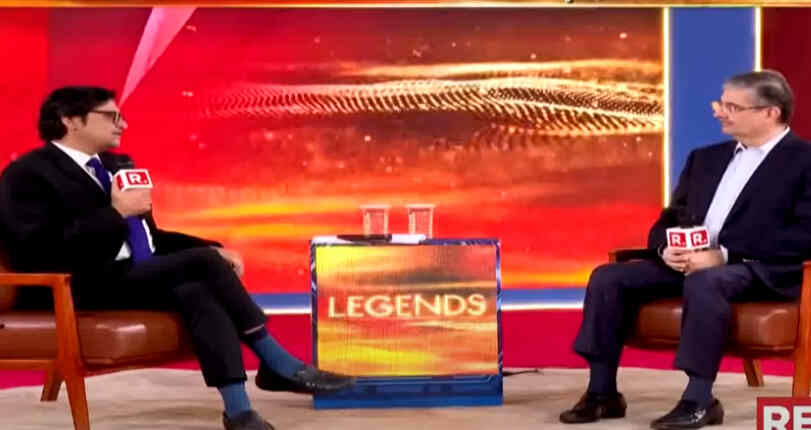
Read the full transcript of Indian billionaire banker and founder of Kotak Mahindra Bank Uday Kotak’s interview On ‘Legends’ With Arnab Goswami, August 2, 2025.
Opening Remarks and Introduction
ARNAB GOSWAMI: Sir, it’s an absolute honor. Privilege. I’m so happy. I’m delighted. I’m personally very moved that you flew down in your schedule from Mumbai. I’m sure you got other engagements in Delhi, but that you flew down to be with us I think is a great thing. And to have a legend of the Indian corporate finance sector with us means a lot to us at the Republic Media Network. So let’s give him a bigger round of applause and thank him for being with us.
So a little bit of a personal angle I’d like to start with. In October 2016, I went to the office of Kotak Mahindra Bank, not for a loan, but I had a piece of paper in my hand which I had made five copies of. And I walked in and I said, I have an appointment with Mr. Uday Kotak. And they took me straight in there. I was so nervous because those were five copies of my proposed business plan for the Republic Media Network.
And I told myself that if this man says no, because I was told, meet a neutral person who has no agenda. I said, if this man says no, I’m not going to do it. And I am grateful that you spent two hours with me. He gave me life lessons. He gave me a very neutral picture, and then he said, go ahead and do it. So whatever you’re seeing here today, in a way, you play a big role in making Republic happen. Thank you so much, sir.
Whatever you say today will be quoted. But first, I wanted to start by asking you, sir, that when you are recognized across as a legend today of the Indian corporate banking finance sector, how do you react to it?
UDAY KOTAK: First, I have to congratulate my fellow founder and entrepreneur in many ways. And we all go through the pangs and the pleasures and the journey of starting something and building it. So congratulations on what Republic TV has become in eight years, making us all very proud of a truly national communication company which hopefully is going global.
And for me, the most interesting part of my journey is to see budding entrepreneurship succeed in every nook and corner of India. In our days, it was much tougher when I started in 1985. Since then, there has been more capital available, private equity available. Therefore, you’re seeing a flourishing country of entrepreneurs. And what can make India great is entrepreneurship.
And the big challenge in entrepreneurship, Arnab, as you would have gone through in your own journey, is from the excitement of doing creative things to building and managing processes, procedures, motivating talent to join you, and consistently being passionate to create something along with a certain purpose in your life. And I am very proud when I see fellow entrepreneurs succeed in life. So congratulations on behalf of all of us to Arnab Goswami and Republic TV.
Family Values and Early Life
ARNAB GOSWAMI: You are very kind, sir. So we want to get to know you better in this series. The most exciting thing for a lot of our people who are here today is to know the person behind the headlines, know the person behind the name. Uday Kotak is a very big name and we want to get to know you better.
If I were to say the top three people in the world of Indian business and corporate sector, he would be one of the three. Anyone who knows you knows that family is very important to you. So I want to start with non-business questions. You grew up, as was mentioned, in a joint family, a bustling one, 60 people under one roof. Something which is near impossible to comprehend for the nuclear family generation of today. And you’ve always said that you’re a firm believer in the family concept. So can you just expand on that and how that has shaped your life?
UDAY KOTAK: So I was born in a home with 60 family members and one kitchen. For many people who know how tough it is to have so many people in one kitchen, you understand the challenges of a joint family more than anything else. But family gave me a deep sense of culture. It gave me a sense of learning to live with contradictions between family members. Uncles, aunts, parents, grandparents, cousins, sibling rivalries.
We all would go to school in the same car. For a while it was the bus. Then we got upgraded to a car, an Ambassador car, where four or five of us as kids would be hustled in together. But the bonding and the pleasure of being together was awesome.
And when I started Kotak, there’s one thing I said. I want to bring the family culture to the fore in how we build the culture at Kotak. And if I have to say, there is one point which I would strongly consider as an important aspect in our journey. It’s the bonding, the family culture and the people sense which is at the core of successful institutions.
Leadership Philosophy
ARNAB GOSWAMI: Does it help you deal with challenges also?
UDAY KOTAK: Of course. And differences. Because I think one of the most important aspects of people is how open is the leader to listen to a point of view which is different from what is a standard point of view. An openness to listen and have people who are reasonably critical of a particular point of view is extremely important for a leader. But the leader may agree or disagree. But the ability to listen to a contrarian point of view is crucial for leadership.
ARNAB GOSWAMI: Are you patient?
UDAY KOTAK: I think I’m patient. But let me tell you one thing.
ARNAB GOSWAMI: Why is that?
UDAY KOTAK: I think I no longer run the business day to day. I’m non-executive. I have to adjust more. I’ve changed and therefore I don’t have to manage large teams as I used to. And when I left Kotak, we were more than 100,000 people.
ARNAB GOSWAMI: 100,000 people, that’s incredible.
UDAY KOTAK: That’s the thing. And therefore you had to manage this. And I’m sure as you grow your people and any entrepreneur grows people, the ability to have a different perspective, different points of view. But finally taking the decision which you have conviction, it is extremely important. But weighing the opposing views as well.
The Cricket Injury That Changed Everything
ARNAB GOSWAMI: That’s very interesting. Life lessons. I saw that part on cricket. Now what is your relationship with cricket? It seems to me you have still not made peace with the fact that you did not become a professional cricketer because you had that head injury. That was a Kanga League match. Tell me about the day when the ball hit you on the head. When you had surgery at the age of 19. I was told you were captain of your college team when you were starting to do your MBA at the Jamnalal Bajaj Institute. Tell me about the day and how did you reconcile with what happened that day and what impact that day had on your life?
UDAY KOTAK: So cricket was like a passion for me. I started from school, this was at the fifth standard or the sixth standard. And I went to the Azad Maidan for the first time. And there was a coach who was supposed to be teaching us. And in the first few days of teaching, in addition to net practice, batting and bowling, he would make us do fielding. And the coach was Ramakant Achrekar, well before he started coaching Sachin Tendulkar.
And he was a very tough coach. And on fielding, if you dropped a catch, you got a big stump hit on your bum, it would just hit you hard and say you cannot drop catches, catches win matches. And from that training to actually batting, I am very grateful to Ramakant Achrekar for the early lessons. The man is no longer with us. And of course he’s now produced one of the greatest cricketers of India, Sachin Tendulkar.
So cricket was very much in the blood for me. Studies was a byproduct. I loved sports and playing cricket was fun. And therefore after I completed college and I was playing this match, I was hit by a cricket ball while running between the wickets. A fielder from extra cover threw it and hit me on the head. Within an hour or so I was fully unconscious. My left side was paralyzed. Rushed to hospital, brain surgery. And next morning I was alive. So it was like a second life for me.
But since then my grandfather particularly said no more cricket. And I just joined the Jamnalal Bajaj. And I hold the unique distinction because I lost a year because of cricket that I completed my two year MBA in three years. So it took me longer but I moved with the same passion into what I did at college.
The Mentor Who Changed His Life
And this is again a very important lesson. You need some mentor. So one of my professors was a corporate finance professor called Professor Mankekar. And he was a finance manager in L&T. But every day after his class he would be going to the stock exchange. So I literally, holding his finger, started going to the stock exchange with him. And he was a very smart finance man. He’s probably one of the most successful investors. Many people know about him. Professor Shivanand Mankekar.
ARNAB GOSWAMI: Yes, much has been written about him.
UDAY KOTAK: Yes. And some people say he is like the Buffett of India. And I learned finance from him.
ARNAB GOSWAMI: What is it that you learned that others did not learn?
UDAY KOTAK: And he said P&Ls don’t matter. Profit and loss account doesn’t matter. What matters is cash flow and discounted cash flow. You must make sure that you are focused on cash flow in the ultimate analysis because that’s what will count. And these are some very simple principles which Professor Mankekar taught me and I’m grateful to him.
The Cash Flow Philosophy
ARNAB GOSWAMI: Can you explain that in layman terms? In this day and age where everybody wants to be a dollar billionaire within six months of getting the first round of funding and everybody wants to be a unicorn, what does that mean? What you said, what does it mean?
UDAY KOTAK: In simple terms, if you get money in the initial stages, of course you invest money and you’re investing more than you’re earning. But you must have a game plan to see over time what is the cash generation happening in your business. Therefore, there may be year one, year two, year three, year four, when you’re investing money, you’ll be negative cash flow. But you must reach a point where you become positive cash flow. Because ultimately cash generation from business is a critical part of sustainable business.
The Birth of an Entrepreneur
ARNAB GOSWAMI: Tell me about the day you thought of starting your own bank, your own venture. Where were you placed in life? How old were you? How financially secure were you? What did you want to do it for? Did you want to make more money? Did you want your name on your bank like you’ve got it now? What gives you a bigger thrill today? Let’s go back to the day you started, why did you start a bank of your own? What was the risk and what was the reward?
UDAY KOTAK: I was in the second year of my MBA class which was Jamnalal Bajaj and you know you have all the companies coming to campus. I had done my summer job the previous year at Hindustan Lever. So one of the attractions was joining Hindustan Lever on completion of my two years. My father sat with me and said son, what do you want to do? I said my passion is finance but I think I’ll start a career professionally. He said what if I convince the family to give you 200 square feet of office space at Flora Fountain and you start on your own?
ARNAB GOSWAMI: What business?
The Early Journey: From Bill Discounting to Banking Empire
UDAY KOTAK: So originally it started as a financial advisory consulting business, converted to quickly build discounting. And there was a gentleman called Mr. Sydney Pinto who actually made a big difference. He started merchant banking in India in Grindlays. He said, “Start your own bill discounting business.”
And we started with bill discounting for a company called Nelco which was a Tata Company where Mr. Ratan Tata started his career. So Nelco suppliers had a long way to get the money because of the working capital cycles. So we started discounting bills for suppliers of Nelco which is 90 day bills.
And in those days India was a closed economy. You would borrow money from a bank normally at 17%, this is mid-80s, this is mid-80s, 1983 or so. So you would borrow money at 17% and if you gave money to your bank as a fixed deposit they would pay you 6%.
So I went to some family friends and said that “What if I gave you a Tata company risk and instead of 6% you made 12%.” And I went to Nelco and said “I will give you significant amount of money at 16% instead of 17%. So send all your suppliers to us and we’ll finance them at 16%.”
So we would buy a bill of exchange at 16% and sell it to savers at 12% with a Tata name on due date. So the Tata company was paying on due date and this 4% spread is what built our business.
Pioneering Consumer Finance in India
After that another very interesting thing happened. And this is the story of Indian consumer and the Indian industry. Till 1989 in India nobody financed cars and consumer finance did not exist. For the first time in India, Citibank started financing cars.
In those days there was a concept of a higher purchase lending rate which was 13%, which is you pay 13% on the original amount even as your installments come down. So effective IRR was 39% and Citibank would finance people for cars. And 39% looked like a phenomenal rate. There was a shortage of cars. There was a waiting period of six months.
So I remember going as a relatively young professional to Maruti meeting then I think Mr. Bhargav was the CEO then telling him that “What Mr. Bhargav, if we gave you an advance booking for 5,000 cars at a time interest free, will you take that booking for cars through your dealers?” He said “If I’m getting money interest free for six months, I’m very happy.”
So we would be able to get cars for our customers once we started this as soon as they wanted because we had a continuing delivery and we had only one condition. We are very happy to give you cars. We will not charge you a premium but you will have to take the car on finance from us.
And we were very reasonable people. We said same terms as the great multinational Citibank. So our lending rates were the same as Citi. We would give an immediate car on delivery. We will take the hit of six months booking interest which would come out of our spread. And our car business flourished.
Expansion into Investment Banking and Beyond
Then we went into the investment banking. I felt India was just changing. There was no concept of global capital markets. So I sought after Goldman Sachs partnered with them, learned how capital markets work, gave them a 25% stake in our business and started investment banking and securities. 75% us, 25% them.
Then we came to late 90s. We started a mutual fund business in 2001 when Dr. Jalan was the RBI governor. We applied through the front door for a banking company. The RBI asked us to convert our existing NBFC into a banking company. So we became a full fledged bank in 2003.
Thereafter, both Goldman and Ford who were our partners in the car finance business we bought them back and became 100% owners of that business. And thereafter we grew as a bank.
Learning from the Global Financial Crisis
2008 happened Global Financial crisis. My lesson from global financial crisis and very important lesson. Be very careful when you’re reading a global newspaper. It colors you. About your strategy in India, okay? Your strategy in India has to be based on your facts here. Don’t get carried away by the headlines of the Wall Street Journal, okay? Extremely important. Be yourself in India and grow.
In 2014, we acquired ING Vaishya which was owned 44% by ING and merged it into Kotak Mahindra. And we became a larger company. Therefore, in many ways it’s a journey of great exhilaration. It’s a journey of India’s financial sector reform over time and it’s a fascinating journey.
And then India went into significant challenges because of the bad lending which happened between 2008 and 2011 by Indian banks. And we fortunately were more cautious so we did not have the same pain and the marketplace rewarded us.
So it’s been phenomenal. I’ve really enjoyed the journey and my message to every entrepreneur and every potential entrepreneur is start up, be at it, pursue with passion and as you grow and as your creativity grows, keep on making sure you’re having outstanding people work for you and build process along the way.
The Early Believers and Risk-Taking
ARNAB GOSWAMI: That’s a fantastic 35 year period. You’ve recapped so well. What was it that those who believed in you when you were 25, 26 saw in you?
UDAY KOTAK: I think they just felt that give this kid a chance and financial sector was, has to be.
ARNAB GOSWAMI: Financial sector does not work on giving a kid a chance. They must have seen something in you. They must have bet on something.
UDAY KOTAK: I think, or rather let me put.
ARNAB GOSWAMI: It this way, what were you betting on? Because you were taking significant risk to say I’m going to sell 5,000 cars to go to Citibank and say I’m going to make sure this happens and then go back and have a percentage of interest. And then your margin was only 4% but you were keen on getting the business first. What were you betting on?
UDAY KOTAK: What I was betting on was India’s story in 1983.
ARNAB GOSWAMI: You were betting on India’s story. Was there a story to tell then?
UDAY KOTAK: It was a story of a very insecure India. The story of most of my friends wanting to fly overseas and settle down overseas. I took the contrarian bet and having taken the contrarian bet, I bet on the financial sector and that’s what worked. It’s fortunate because of a very closed economy. The financial sector was closed, it was just opening up and we were lucky to be at the right place at the right time.
ARNAB GOSWAMI: Was that all?
UDAY KOTAK: I mean for me to say anything more, it’s not fair.
Strategic Partnerships and Independence
ARNAB GOSWAMI: No, but you were taking the decisions very quickly. Like when you gave 25% to Goldman Sachs. Did you think, I’m going to let Goldman Sachs in and they’re going to try and tell me what to do, I lose my independence? Was that a thought?
UDAY KOTAK: No.
ARNAB GOSWAMI: Did they try to do that?
UDAY KOTAK: No. Which is why they were 25 and we were 75 and Goldman was betting on us rather than us betting on Goldman.
Understanding Opportunity
ARNAB GOSWAMI: I find your bet taking very curious and I want that to be one of the learning lessons of this Legends episode because you know, you are from a business family but they were into I think cotton business and you got into a completely different area of business. So we still want to understand what made you take that plunge.
And I found a quote very relevant in this regard. To put it in your own words, you said “The trouble with opportunity. The trouble with opportunity is that it never announces when it comes to. It’s only after it’s gone that you realize that you missed it.” What did a 26 year old Uday Kotak think about opportunity at that point of time?
UDAY KOTAK: I think my view was that India’s financial sector will open up. Therefore get into each and every area of financial intermediation. One second very important along the way and something I followed all the way that whatever you do, make sure it is within the law. Don’t do anything which is outside the law.
Therefore, even in bill discounting we had a thorough examination that what we were doing was something which was permissible as an activity of buying and selling bills of exchange. So every step of the way, stay within the law and make sure that you’re building a business on sound principles.
But keep on taking the opportunity as it comes. Therefore, when, if you go step by step. When India was opening up on consumer finance, we were there in investment banking. Controller of Capital issues went in 1991. We got into investment banking, mutual funds, we got into in 1998, life insurance in 2001 and banking in 2003.
Therefore the view was clear that India is opening up. Get into any aspect of financial intermediation as soon as it opens up and don’t use your head too much. Buy talent, buy expertise, but get into the business.
The Growth Philosophy
ARNAB GOSWAMI: So get into the business, get market share, keep your cash flows going. Be conservative and yet be audacious when it’s required. Which is why you say always go for growth. Quotation is go for growth. Let’s get enterprise and animal spirits firing. Can you explain that comment of yours which you’ve always repeated on many occasions?
UDAY KOTAK: I think very important this in my early journey and I would like to say that Indian spirit for the first 20 to 25 years of our journey we could, we really had the spirit. And even in the last 15 years if I say I would like to believe that that spirit has been enhanced, especially in the last 10 to 12 years, that you can do things, you must aim big and go after it.
However, one of the challenges is that as the Indian financial sector has grown, we also have had significantly more regulatory guardrails, which is fully understandable and required.
ARNAB GOSWAMI: Yes.
UDAY KOTAK: Having said that, as we grow, we must always keep the development and enterprise aspect alive and kicking. We should not reach a situation where, if I give an example that if we should not move to a situation of zero accidents, a zero accident policy is a high risk to growth.
Minimizing accidents is important, but a zero accident policy actually curbs growth. And in the backlash of what happened to the Indian banking sector between 2008 and 2013, 14, when Indian banking really went berserk in the terms of credit, made us cautious to be lending boldly. Fully understandable, but going forward, we need to make sure our focus is development and enterprise and minimizing accidents, not zero accidents.
The Startup Ecosystem and Deep Tech Challenge
ARNAB GOSWAMI: Yeah, I find that very interesting because, you know, recently I was talking to someone, he said, I said, why did we not move our defense industry fast enough? And the person said, well, you people in the media are responsible. I said, how are we responsible? They said, you were reporting so many scams so the government wasn’t clearing the budgets for defense, thinking that everything would be seen to be a scam.
So I found that very self contradictory because if there’s nothing to hide, there’s no reason to not move. The fact that you stopped decision making means that you were doing something wrong. So I find that very interesting.
Now in the present situation, we are in a very uniquely poised situation. We heard the Prime Minister say fifth, fourth, third largest economy. He said that in the US Congress and I’m sure not everybody was happy about it. They may applaud it.
So in the present context, I’m trying to now get you into the present context in which we are. When Mr. Piyush Goyal was speaking at a startup event recently, that comment went viral where he said, “Where are India startups of today? We are focused on food delivery apps turning unemployed youth into cheap labor so that the rich can get their meals without moving out of the house.”
Now that comment was seen a bit out of context. He was making a deeper comment on the need for us to have an economy that is focused on research, development, innovation and manufacturing. It was not just a critique of the gig economy.
Now we have a gig economy versus deep tech issue going on in our country. How do you view this? Because we have to understand the message that needs to go across to India’s youth, to India’s startups. They’re not about making money. It’s about doing businesses that grow your country as well. You’re constantly talking about betting on India but then we need to bet on those areas which will make our country great. Are we doing that enough?
UDAY KOTAK: Sir, I think I will add a couple of points. First, I actually believe the next generation of business families is becoming too much of financial investors. Instead of going out there and building.
ARNAB GOSWAMI: Businesses, operating businesses, they’re investing existing money.
The Manufacturing Imperative
UDAY KOTAK: Yes. Created by the family and saying, oh, I’m running a family office as a young guy of 30 or 35 instead of saying I’m out there in the trenches building something. What India needs is middle manufacturing. We have done a lot for MSME. There is a large amount of big business or at least there are very big players.
What we need is middle India in manufacturing. And entrepreneurs of today, startups of today don’t go into middle manufacturing, which is sizes or project sizes between 50 crores plus which is the MSME limit to thousand crores. This is the area where we must make it interesting for fresh entrepreneurs and provide capital, including startup capital and if necessary support from government to build middle manufacturing in India.
India’s manufacturing share of our total GDP is now 14%. For us to become a truly global power, we need that to be in the 20s. And I would go all out to support technology related to manufacturing along with research in a whole host of areas to get a better balance. In addition to the huge growth in services, I think agriculture will come with its challenges, we should still build it. My father is a great believer in Indian agriculture.
But as a financial services person I passionately believe India needs middle size mid sized manufacturing. And entrepreneurs must be encouraged to go out on the streets. And it’s a tough life. You’re dealing with inspectors, setting up factory approvals, policies, state governments, central governments. Arnab, I would strongly encourage through your channel to push for entrepreneurship to go into building manufacturing and operating businesses for the future.
ARNAB GOSWAMI: So let’s say this is 2025, right? And it is 31st July 2025 and 20 year old Uday Kotak has gone into bat at Azad Maidan. Unfortunately, 20 year old Uday Kotak gets hit by a ball on his head while trying to take a second run and wakes up in the next morning out of paralysis and alive. And then he tells his father, “I’m going into business.” And suppose your father says beta, go to any business but not finance and not cotton. In the context of what you just said, what business would you have gone into? Which will be indicative of what the India story you view is likely to be.
UDAY KOTAK: I would certainly consider manufacturing and mid size manufacturing in whichever space it could be engineering, it could be pharma, it could be a whole host of areas of manufacturing. I would go into that. The way to build success is to be able to do things which other people think at that point of time is not doable or very difficult.
ARNAB GOSWAMI: Such as today, such as starting Republic.
UDAY KOTAK: TV, starting Kotak when we did.
ARNAB GOSWAMI: Right.
UDAY KOTAK: Because people said financial services in 1985 in a closed economy. What a stupid idea.
ARNAB GOSWAMI: Impossible, they say.
UDAY KOTAK: And 97% of Indian banking was public sector.
ARNAB GOSWAMI: Yep.
UDAY KOTAK: But that was the opportunity.
ARNAB GOSWAMI: Yeah.
UDAY KOTAK: And you take it. As I say, when others find it uninteresting or don’t even think about it.
The ROTI Concept: Return on Time Invested
ARNAB GOSWAMI: I find your concept of ROTI very interesting. I want you to talk a little bit about it. Your concept of ROTI, return on time invested. Return on time invested is a concept which fascinates me a lot. Right. We need to use it in our daily lives in every way. And who better to learn this from than Mr. Uday Kotak himself? You’ve often said go relentlessly for productivity. But believe in ROTI return on time investment. Can you expand on it with any real life examples?
UDAY KOTAK: How do we increase return on our time invested? Each of us has a limited time on our planet Earth, professionally or otherwise. For every moment we spend, are we feeling that we are making progress at the speed at which we need to. And let us measure. And this actually comes from the point concept of discounted cash flow. It’s discounted cash flow of a lifespan.
And I do believe India can do a lot more in this area of ROTI. We need to get our judicial system, our overall administrative system, the reform system to make return on time invested for every Indian better. Relentlessly focus on ROTI and change the destiny of this country. Why should cases in courts take years? It moves. I think it’s one of the most fascinating intergenerational stories about how the court case of a grandfather.
ARNAB GOSWAMI: 100%. Absolutely.
UDAY KOTAK: And similarly in many areas, ROTI is what is holding back even say manufacturing. Why do people go into services or food delivery and all that? Because ROTI in manufacturing is difficult. How do we make ROTI easy? How do we make it attractive? Therefore, that is what we really need to crack.
ARNAB GOSWAMI: Day to day life. Sir, what would it be?
UDAY KOTAK: Day to day life is when you are doing your business, your work, take your calls based on how you will get return for what you’re doing. Return in not just financial terms. It could be pleasure, it could be satisfaction, it could be completion of something.
ARNAB GOSWAMI: Learning, learning.
UDAY KOTAK: Measure. Measure what you do. And how can you do it more productively? Because finally there’s a finite time each of us have in our lives and if we don’t measure return on our time, ROTI will really hurt us in terms of our long term future.
Dealing with Trump’s America
ARNAB GOSWAMI: Yeah. A personal observation. You’ve served corporates, you built companies. People like Uday Kotak should be serving the country. My personal view, do you agree with me? Ladies and gentlemen, in today’s day and age of Donald Trump Trumponomics, we have to come to the subject of the day and it’s so interesting. Yesterday when this happened, I said to myself that Donald Trump probably knows that Uday Kotak is coming to Republic so he can get a headline out of him.
Now the question we need to know and the question the world wants to know, how do we deal with Donald Trump? You know, yesterday I could not believe it when he says in the way he speaks. So there are many things. There are the way he speaks and the decisions he takes. 25% plus 10%. And then as if that is not enough, then you go and call the Indian economic policy, trade, tariff issues obnoxious. As if that is not enough, you say, “I am going to help dig oil in Pakistan. I think Pakistan will one day export oil to India” and that is not enough.
Then he another what is it post on Truth Social saying that “I don’t care about the dead economy of India and the dead economy of Russia, good luck to them,” etc. You know, so it’s, yeah, it seems, it seems petty. Of course. You know, there are a lot of people who say ignore him, but then we can’t ignore the economics behind it. So can I have your overall understanding and sense of the situation and how you would have dealt with it, sir, if you were in government and how what you feel about the way the Modi government is dealing with this present situation? Sir. Thank you, sir.
UDAY KOTAK: Arnab, I believe in a first principle, simple line. Power is power and Donald Trump has inherited US power. It is the power of the US dollar, it’s the power of the US financial system, it’s the power of the U.S. military, it’s the power of U.S. hegemony in terms of being the largest economy in the world. It has happened over a long period of time. Donald Trump is sitting on that seat and leveraging that. You can do it in the short run and he’s doing it in the short run.
I genuinely believe over time there’s a very important aspect of trust. Why do people put money in dollars? They trust it and trust takes a long time to build, but can be eroded very fast. And I genuinely feel that the approach which the US has taken may serve it in the short run, but in the long run, it will have a price which the United States of America will pay to the world. And I genuinely feel the US in many ways, is playing into China’s hands.
And what we have to watch out for is in this battle, we are still an emerging power. There is a large power, which is the US the second largest power, which is China. How do we, as an emerging power, do not get caught in this crossfire and find our own journey independent of these two, at the same time realizing that this is a global chessboard? One of our challenges is we have a certain important agenda, which you I always call as the domestic political economy political agenda.
ARNAB GOSWAMI: Yes, yes.
UDAY KOTAK: And then there is a global agenda. At times, the narratives between the two have to be distinct, and we should not be caught in the middle of these two narratives in terms of deciding what is right for us. And Donald Trump knows what India does not like. He has kept on poking that hyphenating Pakistan and India because he knows what is irritating Indians. We should not fall to his bait. We should be clear that there are areas we may have to agree and there are areas we will have to take a position.
But either way, I think we also got to be clear. The man has huge ego. Somebody is going to take care of that and make sure that we are playing to it in a manner which is not inconsistent with our domestic objectives. But playing to his ego is an important part of the narrative. You’re seeing a world of strong men, and in many countries. And you just saw the way he annihilated Europe in the negotiation. Europe gave away a lot to, say, zero duty for U.S. goods into Europe against 15% duty on European goods into U.S. I don’t think Europeans are happy, but they gave in.
The only people who are standing tough against Trump at this stage, and I’m keeping India as a separate discussion, is China, because China has something to give us needed the rare earths US needs things from China because otherwise the domestic economy slows down. Therefore, I am a genuine believer that finally, power is power. And India has to dramatically increase its speed for building our raw power. And we on the economic side have a lot to do to turbocharge India’s growth.
India’s Leverage and Strategic Options
ARNAB GOSWAMI: What do we have leverage with vis a vis Trump? There must be something he wants from us. Now, we can’t give in on everything on agriculture because we have our own domestic Interests, not just our domestic politics to take care of. And he’s pushing agriculture, he’s pushing dairy products. We have our farmers, we have our Amul, we have our. We have our local interests which we also need to protect. How do we balance it out? Because he’s going to be unrelenting here on. And how much can this hit India if this continues unresolved?
UDAY KOTAK: This is a game of chess. What stops India from posturing for a better economic relationship with China?
ARNAB GOSWAMI: Our strategic relationship has not been seen to be very good.
UDAY KOTAK: I’m talking about economic relationship.
ARNAB GOSWAMI: Can you separate the two?
UDAY KOTAK: My view is we have to play the cards which will make the US uncomfortable. And economics. China has a hundred billion dollar trade surplus with us. We have taken a strategic call that we will get closer to the US and to that extent be a little distant from China. But if US is going the way it is, we have to find what makes sense for us. Finally it is self interest.
ARNAB GOSWAMI: But if they have $100 billion trade surplus with us, is it Chinese leverage on us or our leverage on China?
UDAY KOTAK: But China already has that.
ARNAB GOSWAMI: They already have it. Aren’t we supposed to reduce it?
UDAY KOTAK: How will you reduce it now you will have a.
ARNAB GOSWAMI: Shouldn’t we do that?
UDAY KOTAK: But that is back to domestic manufacturing.
ARNAB GOSWAMI: Yes.
UDAY KOTAK: I mean India imports Ganeshas and rakis.
ARNAB GOSWAMI: Yes. Shouldn’t we stop doing that?
UDAY KOTAK: But then we have to produce cheaper here.
ARNAB GOSWAMI: Can we produce cheaper?
UDAY KOTAK: We should.
ARNAB GOSWAMI: Bladders, grinders, Ganesha, rakis.
UDAY KOTAK: What can India do to make things in time, that is return on time invested and more productively and cheaper.
ARNAB GOSWAMI: But that will take time. But you have to start. But do we have that time with Trump also breathing down our neck from the other side?
UDAY KOTAK: What’s our choice?
ARNAB GOSWAMI: What’s our choice? Do we have a choice?
UDAY KOTAK: We have to go whole hog. Turbocharged if necessary. The government has to give steroids.
ARNAB GOSWAMI: For what steroids would that be?
UDAY KOTAK: I would say give capital support to mid sector.
ARNAB GOSWAMI: Do we have that level of capital available?
Macroeconomic Stability and Government Spending
UDAY KOTAK: I think the government has to give it out of the budgets. One of the great things India has done in the last few years is phenomenal macroeconomic stability. Great control over fiscal deficit. We got to manage that. I think there have been many areas of success on our macroeconomic side. We have to use that leverage to turbocharge India’s businesses.
ARNAB GOSWAMI: But you’re also walking a thin line geostrategically. You mentioned domestic politics to be one thing and international economics on the other. May I add a third dimension which is geostrategic stability. We’ve been through operations in… We don’t like the hyphenation with Pakistan. It’s unfair. But the fact is that we have a long border with China. We have a long troublesome border with Pakistan. Right. And a line of control. We have to hold our own. We are in no camp. Right.
And we are still a few years away from getting to that level of defense production and capacity that we should to counter China completely. So what do we need to do? I mean, I think this government’s got a lot to do in the next two or three years.
UDAY KOTAK: Arnab, the biggest strength India has is its domestic part of the economy. Our international part of the economy is much smaller than a China, a Japan, Middle East or any other country. And fortunately oil prices are low. So we are in a reasonably good macroeconomic situation. And this is the time to turbocharge at steroids India’s domestic economy, finance it, grow it and relentlessly focus.
ARNAB GOSWAMI: Keep buying oil from Russia.
UDAY KOTAK: I don’t know the impact of that. That’s a matter of negotiation.
ARNAB GOSWAMI: What would you do?
UDAY KOTAK: It depends on what the terms of sanction are. So that’s a simple trade call.
ARNAB GOSWAMI: But then you’ll spoil the relationship with Russia if you relent that you have.
UDAY KOTAK: You have to figure out what it costs. Finally we have to do our self interest. Go back to cash flow. How much is the cash flow you’ll give up for what? And that’s the trade. You have to calculate very carefully and very smartly and succinctly.
Preparing for Rough Weather
ARNAB GOSWAMI: Do you think we’re in for rough weather in the next two, three years?
UDAY KOTAK: I would like every Indian to assume we will be in rough weather and prepare to do very well in rough weather. Men and women and strength are built not in good weather. It’s built when the going gets tough.
ARNAB GOSWAMI: That’s amazing.
UDAY KOTAK: The going gets tough, tough get going. Indians must wake up. We should get out of our comfort zone that everything is great. Even if it is. Let us have a sense of paranoia. India is going to be getting attacked from the global side. What are we doing? How are we shaking ourselves?
And it takes me back to the 80s and 90s when many of us were very insecure about India’s future.
ARNAB GOSWAMI: Yes.
UDAY KOTAK: And we were convinced we’ll build it. You remember in 1992 when India first started opening up there was this so called Bombay Club. Worried about being attacked by the foreigners.
ARNAB GOSWAMI: Yeah.
UDAY KOTAK: But that same Bombay Club and manufacturers, whether it’s Tatas, Mahindras, Bharat Forge and Kalyani’s Bajaj. They all woke up. And by year 2000, Indian manufacturers started competing with the best in the world. So where is that sense of paranoia in every Indian?
I genuinely believe Indians should get out of their comfort zone. Yeah, this is the time for Indians to wake up and say next two or three years are tough for us.
De-dollarization and Global Economic Shifts
ARNAB GOSWAMI: I almost think you’re like a prophet. Do you see this coming two years back when you came to my event? Mr. Kotak came to my event two years back and he said de-dollarization. And I said, is he… Many people said is Mr. Kotak overreacting when he said that? And his words were, “The US Dollar is acting like a vacuum pump sucking capital out of the emerging markets. Stop being dependent on the US Dollar.”
Now this is what he said two years back. And so he’s like, you know, I thought, is he being paranoid? But now when I see Trump doing the kind of things that he does, probably you factored in that a day will come when India’s growth will be disliked by other countries. We have been in the wrong view that the world will like our growth because when we move from middle to great, the world will see us not with curiosity, but as an enemy.
UDAY KOTAK: Yes.
ARNAB GOSWAMI: And that is beginning to happen. So, and we saw that when the BRICS meeting happened recently, Trump immediately reacted. All of you people in BRICS will be given 10% plus penalties. You spoke about these alternate financial instruments, Trump, you mention an alternative financial instrument like a BRICS currency and he throws a fit.
You know, we’ve seen this happening. So something interesting is happening to the world where Trump is saying America, America MAGA MAGA, and the rest of the world is saying, no, we need to come together because we are not here to make America great again. We are here to make Indonesia great again, to make India great again, to make Malaysia great again.
So what is your take on where you stand on the de-dollarization idea in layman terms, what would it mean in today’s context, 2025?
UDAY KOTAK: I think every major sovereign in the world is concerned about his or her surpluses in the US Dollar. Unfortunately, there are not too many alternatives. But if the US does not play its cards well and people start losing trust. Say for example, inflation goes up and that creates some pressure and US does not increase its US interest rates as much or the dollar goes, it’s a very heavily over borrowed country.
We have to play to our strength. And the world is looking for alternative currency as a safe haven. Therefore the money is moving in gold. That’s why the money is moving in crypto. To a certain extent people are looking for alternatives outside the US dollar. Build our strength, build our domestic economy. I don’t think we should be satisfied with growth at six or six and a half. Time has come for us.
ARNAB GOSWAMI: What takes us to nine, ten, which we need.
UDAY KOTAK: That’s what we need. And we need to… Every Indian needs to get out of his or her comfort zone. Even if we are doing well, let us shake ourselves that next two or three years we have to really go after it on the assumption that we will have tough times. I’m not saying we will have tough times but if we assume we have tough times it will harden us and wake us up to shake us up. That India needs the mojo seriously.
Defense Spending and Manufacturing
ARNAB GOSWAMI: Operation Sindhur saw that in the defense sector. It was that, you know like… It was like the COVID moment in another context that we never expected coming but it came. So we saw the four day conflict with Pakistan. What is your view on defense spending? What is your view on what do you think we should do for the defense industry? I have said why wouldn’t you do more in that regard?
UDAY KOTAK: I would say I’ve said this at least two or three years ago. India’s defense percentage spend is much lower than what it should be. Around 2% or below 2%. We need to dramatically increase that. India, I mean Europe is talking about 5% and with the kind of neighborhood we have and if we believe we are building domestic defense strength I would want India to build India’s defense by half percentage point of GDP higher every year for the next five years. Keep on increasing your defense rate.
That builds your domestic manufacturing. People forget and I’m not suggesting like that but World War II created huge number of manufacturing. Post World War II as well. All the defense companies became great manufacturing companies. Most of the German car companies were defense companies in World War II. So what does India do in defense? That’s a way of building on manufacturing. And I don’t think we can trust other countries defense weapons because they may not give it to you at the right time.
ARNAB GOSWAMI: Right time or they may not give you the complete key or they may switch off when we don’t want them to.
UDAY KOTAK: If India has to be atmanirbhar, defense spend and defense domestic manufacturing has to be one of the core pillars of the next five years.
Breaking Out of Cruise Mode
ARNAB GOSWAMI: Absolutely. So you’re saying we need an institutional change overall. We’re going to open up for a few questions. Also in the course of this, can you tell me what do you think India is not doing right now from an economic perspective where we should be doing much better because we can’t be in this self congratulatory mode. You know, there must be something that we need to reset immediately. Given what’s happened strategically and economically, operations in the Trumponomics and everything. What do we need to figure out and change fast?
UDAY KOTAK: India is too much in what I call the cruise mode. Cruise. Like we’re all, we believe, we are all cruising along.
ARNAB GOSWAMI: Okay.
UDAY KOTAK: And too much easy money in the stock market.
ARNAB GOSWAMI: Everybody wants to be in the stock market.
UDAY KOTAK: Why should I build a run or operate a manufacturing company when I can make 15% in the stock market or 20% in the stock market by investing in small and mid cap stocks?
ARNAB GOSWAMI: I don’t need to do anything.
UDAY KOTAK: I just need to roll money, change the narrative. We have to get out of our comfort zone.
ARNAB GOSWAMI: What is the comfort zone?
UDAY KOTAK: Comfort zone is we are now all much more secure. And we need to shake Indian business, Indian entrepreneurs, Indian professionals from a mindset where everything is okay to a mindset. God, we have big challenges next five years. Shake up and wake up.
The Power of Paranoia
ARNAB GOSWAMI: Yeah. You know when you were coming. One of the people we invited who couldn’t come today is the founder and the CEO of Jannah Bank. You know him very well, sir. And he sent a message and I’ve seen you repeat this word paranoia so many times. Ajay from Jannah Bank. So you know him, sir, he said, “Arnab, in one of the leadership talks to the team, I had asked Uday what kept Kotak bank in such a healthy shape. And he said it was because he was always paranoid. You know, paranoia for something which will go wrong. Which kept him alert. I liked his candidness so much that I named our conference room in the office with the same name.”
And he sent me a picture of a conference room with the word paranoia. So I’m taking this away from you because it means a lot. It could mean to somebody, journalist at Republic. It could mean something to a reporter, an anchor, a producer, a journalism student. Paranoia. You know the book “Only the Paranoid Survive.” You’ve repeated this word at least 20 times in this conversation. I love it because you know, this keeps me going. But can it drive a person crazy as well? On a lighter note, I think if…
UDAY KOTAK: We don’t drive ourselves crazy, we don’t succeed.
ARNAB GOSWAMI: That’s beautiful. Okay, that’s for you.
UDAY KOTAK: And one of the biggest things which I caution every one of us. And it could be the businessman, it could be the politician, it could be a leader in any field.
ARNAB GOSWAMI: Yeah.
UDAY KOTAK: Complacency of success.
ARNAB GOSWAMI: Beautiful.
UDAY KOTAK: The danger of short term or medium term success is it makes us complacent. And that’s the beginning of the failure cycle setting in.
Longevity vs Success
ARNAB GOSWAMI: That’s beautiful. See, you know, in a front row we have a group CFO and a group CEO. We are going to rename their rooms. We will call Mohit Dhamne the group CFO’s room. We will title it Cash Flow. And we will title our Harsh Bandari CEO’s room Paranoia. But this is beautiful. These are real life lessons. You can’t learn this in a B school, you know, this is what I love about the Legends series. It’s real life lessons. This is wonderful, wonderful.
50 years. My last question and then I’ll throw the mic open for a few 50 years of Kotak Mahindra Bank 1984. No, 40 years.
UDAY KOTAK: 40 years.
ARNAB GOSWAMI: 40 years. Long time. Is longevity, success or something else?
UDAY KOTAK: No, don’t take longevity for granted.
ARNAB GOSWAMI: No, no. There are people who say, my company has been on for 20 years. That is my success. Somebody says my company is 50 year old. That is my success. You don’t think that’s success?
UDAY KOTAK: If you take the S&P 500 and take companies which were there 100 years ago versus today, I think the number is less than 10%.
ARNAB GOSWAMI: Then what is success if not longevity?
Success and Longevity in Business
UDAY KOTAK: Success is how do you ensure that there are some things which must change and some things which must never change. Things which must change is changing with the times. For example, we are moving to a digital world, a creative world, the design world, the AI world. Those things must change in your company.
There are some things which must never change, which is culture, a family, values, believe that always follow God made laws. We know what God made laws are. Truth, trust, things like that. And those must never change. So longevity is about getting it right between what must change and what must never change.
ARNAB GOSWAMI: This is a wonderful learning experience for me. Round of applause for him, sir. This is inspiring. It is real life. You are a grounded and earthy man.
UDAY KOTAK: Thank you.
ARNAB GOSWAMI: Yeah. The beauty of the Legends series. And we have Asha Bosley coming up soon in a few days. You know that the beauty is when you meet the Legends, they appear so real. They appear so real. They appear so grounded, they appear so humble. And I loved it the way you spoke to our people in the newsroom today. You made them so happy. They’ll remember that moment.
Shall we throw the mic around for a few questions? Do we have questions? Shall we take four or five questions? You already see five. Hands up. Can we keep the questions short? Quick, to Mr. Kotak. If you can introduce yourself, sir, please. And then throw the question here. Sir.
Q&A Session
AUDIENCE: Good afternoon, sir. I’m a business consultant in aerospace and defense field. You mentioned about strong economic relation with China. Is there any other option as well?
ARNAB GOSWAMI: Is there any other option than a strong economic equation with China.
UDAY KOTAK: I think I look at three powers today. Big powers. China, Europe, US. We have to decide how we play our games with each of them. And of course, the fourth power, which is becoming more powerful is the Middle East.
ARNAB GOSWAMI: Middle east, yeah.
UDAY KOTAK: Okay. But the Middle east normally doesn’t want to take on any of these.
ARNAB GOSWAMI: Yes, okay.
UDAY KOTAK: But these three powers are the key powers, and we have to play our game with each of them for what makes sense for us. And we have to be clear that we should not be in a situation which puts us at odds with all the three. We need some friends. And how do we get that?
AUDIENCE: Sir, I’m Dr. Anjit Kumar and I’m a new entrepreneur into IT services business. I run an IT company, Indy Corp. You talked a lot about coming out of the comfort zone and entrepreneurship and startup businesses and all. So I believe that most of the people who are actually coming out and going for the entrepreneurship, they are all already coming out from the comfort zone.
My only question is to you, is that being a new entrepreneur or a startup business, many a times we feel that we need some mentor. And you said that in life you need some mentor as well. So sometimes you need certain business coaches which can help you to look for the dimensions which you do not have, that you have. You are doing the business with a gut feeling. But you need certain guidelines as well.
So do you feel that any startup businesses or new entrepreneurs need some business coaches? On the other hand, we need to understand that the business coaches are charging heavily for their coaching as well. So what is your suggestion on to all those people who are the new entrepreneurs?
UDAY KOTAK: My answer is simple. A coach is a good support, but the batting style should always be yours.
ARNAB GOSWAMI: Yeah. Absolutely. Yeah. Thank you. Excellent. That’s beautiful. Thank you, sir. Thank you.
AUDIENCE: Good afternoon. Mr. Kotak used to work with Maruti. I worked very closely with RC Bhargav and Mr. Jagdish Qatar. But I wanted to share with you something very interesting. There was another entrepreneur who belonged to a very small village in Haryana, Mr. J.K. Sharma. And back then when you gave example of financing cars, which was one of the earliest thing to do finance for any company, you also started financing trucks.
And he was a person who was a school dropout from Ginger and he worked closely with Kotak and he borrowed money for trucks from Kotak and he went on to set up one of the largest company. And I discovered all this when I was writing his biography. And fortunately we have his son here today, your Mr. Ajit and Mr. Later, Mr. Deepak Gupta financed and okay. They always, he always used to say and he was successful because of inspiration from you. Thank you. Thank you very much.
UDAY KOTAK: Thank you. And I’ll certainly pass on this back as a success story.
ARNAB GOSWAMI: We’ll share the clip with you sir. Absolutely.
Banking Systems and Manufacturing
AUDIENCE: Hi sir, I am Ashu Kansal. I’m part of robotics and warehousing automation company Adverb and I’m a CFO there. I have a question to you. How do you differentiate between a Chinese banking system versus Indian banking system? How they have been able to fund their startups so well right from niche stage.
So recently I went for a 900 km trip via Jaipur, then Manassar and back. It was an excellent highway, everything wonderful. But there was not even a single industry either on the left or on the right side. I was so shocked. What is happening? On one hand we are creating such a wonderful infrastructure, but actually either government failure is there or banking failure is there. Where are we lacking? Thank you.
UDAY KOTAK: I think it’s less about banking, it’s more about entrepreneurs finding it easier to do businesses in the non manufacturing sector. Therefore we have to analyze what are the pain points. But as Arnab said, trying to analyze and answer the pain points takes time in the short run.
I am a great believer that the government must come out with a superb capital support scheme for middle manufacturing to turbocharged manufacturing in our country. So essentially what a capital support scheme, what I’m talking about is say the State says if 100 rupees is the equity required, 200 rupees debt, project cost is 300 out of the hundred equity, the government provides 40 as support equity which is like a preference capital repayable over 10, 12, 15 years.
So you make return on your 60, but you’ve got capital of 100 for the purposes of setting up your plant. Okay, so some support scheme which turbocharges Indian mid manufacturing is what I would strongly advocate for India to get back. And in the meantime, remove all the hurdles.
Leadership and Entrepreneurship
AUDIENCE: Good afternoon, sir. I’m Avriti Raturi and I’m an entrepreneur. I started my own wellness brand. I just wanted to ask you what is your message to young entrepreneurs and what do you feel is a better leadership style in general?
UDAY KOTAK: I think it’s a very wide question. My advice is be bold. Go into enterprise. If things do not work out, you will be even more valuable for a job.
Dealing with Challenges and Family Support
AUDIENCE: Thank you first of all for such an insight experience that I’ve just got. My question is precisely going back to your childhood where you mentioned that you were under the roof sharing with 60 family members. And I understand. I’m a wellness practitioner and I’ve been into this industry for 16 years.
And when I meet the youngsters these days talk about traumas a lot, that’s become a very buzzword and they’re taking it into their advantage. And I’m sure the kind of traumas that you would have got living with 60 people would have definitely taken a toll on your mental well being. And how had you been dealing with it thus far?
And also pointing out what Arnab said, that you know, you’re being disliked by people because who do not want your growth. So from that angle, how have you been dealing this disliking and also giving a message to the young entrepreneurs how to take these traumas into their sort of for their benefit? Thank you so much.
UDAY KOTAK: I think the question I have to ask is that all the people who have had traumas, how many of them were born in a family of 60 people? Yeah, that’s the irony actually.
ARNAB GOSWAMI: That’s well said.
UDAY KOTAK: And actually the wellness culture came from within the family.
ARNAB GOSWAMI: Yes, yes, yes, yes.
UDAY KOTAK: It’s a very powerful social instrument. Yeah, I know a 60 member family is unsustainable in today’s times. But the cocoon of a family is such a powerful Indian concept. And lot of traumas get out of control when people don’t fully believe in the family culture. Yeah.
Stock Market Philosophy
AUDIENCE: Hi sir. Being a stock market mentor, I love the line you said about stock market investing. Right. And I love the way you taught us what the real expectation we should have from stock market. Right. That our booking industry, what can our booking industry actually convey to the people and what can it do to actually make the youth of India today realize what is actually the real expectation we should have from stock market?
UDAY KOTAK: I think think about the stock market not as a casino. Think about it as a place where you have capital formation for the country. That’s great. And price discovery, the core of a stock market, is capital formation, place for the country and price discovery for investors. And when you forget these two, there is a challenge.
And there’s a very famous John Maynard Keynes statement that “speculators are like bubbles on a steady stream of enterprise.” That’s fine. The problem arises when the enterprise becomes a bubble, and we have to avoid that. Thank you so much.
ARNAB GOSWAMI: Such good life lessons. Sir, thank you very much. Ladies and gentlemen, a big round of applause for Uday Kotak. Sir, this has been a total honor to have you. I don’t know if you understand, but in this period we’ve spent on stage together, there’s been lot of learning for people beyond the world of finance.
And when this is broadcast, I think lot of people will love it. Personally, for me, a great delight to meet you again, sir. More power to you, sir. Thank you very much. Thank you, sir.
Related Posts
- Transcript: The Other Side of the Bitcoin – Crypto & Corruption w/ Ben McKenzie
- Tokenized Gold vs The Bitcoin Standard: Peter Schiff vs Saifedean Ammous (Transcript)
- Mel Robbins Podcast: w/ Shark Tank star Barbara Corcoran (Transcript)
- The SILENT Financial Collapse Nobody Sees Coming: Lyn Alden (Transcript)
- Is Another 1929 Crash Coming? w/ CNBC’s Andrew Ross Sorkin (Transcript)