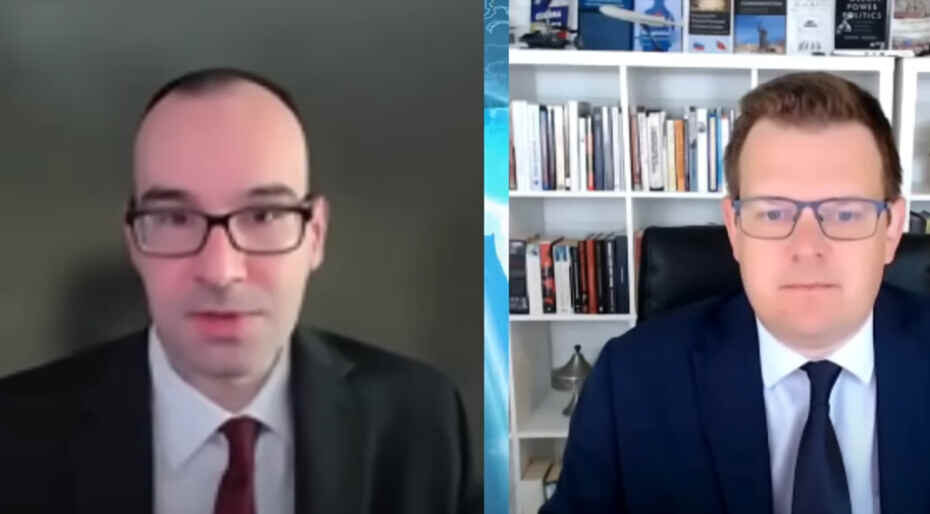
Read the full transcript of Eurasia Research Fellow Mark Episkopos in conversation with Norwegian academic, writer and politician Prof. Glenn Diesen on “Last Chance – Terms For Ukraine Peace Agreement”, August 5, 2025.
Introduction and Welcome
GLENN DIESEN: Hi, everyone, and welcome back. We are joined today by Mark Episkopos, research fellow at the Eurasia Program at Quincy Institute, to discuss the US Russia relations. So welcome to the program.
MARK EPISKOPOS: Glad to be here. Thanks for having me on.
The Closing Window for Peace
GLENN DIESEN: So you have written lately some articles about the possibility for a peace agreement, but also normalizing relations between the United States and Russia, which is obviously of great importance for both sides as the world becomes multipolar. And I would argue it’s better for the world overall as well.
But it does seem that the window of opportunity for a peaceful agreement to end the Ukraine war and also normalizing relations between the United States and Russia appears to be closing. Now, I’m growing more pessimistic as it appears that war will likely end by either the collapse of the Ukrainian military or the collapse of the Ukrainian military establishment, which I would expect would result in a very ugly piece.
So I’m happy to see that there’s some optimism coming from people like yourself, George Beebe, and others at your great think tank. But I’m also therefore interested in what kind of ideas are out there to bridge this huge gap between the expectations for what a peace actually requires, as we now see in the talk of a ceasefire, how far apart the different sides actually are.
So I guess a good place to start would be what do you see being required in a peace agreement? I mean, what do the different sides fear and what do they want?
Security Guarantees and Creative Solutions
MARK EPISKOPOS: Well, thanks, Glenn. It’s a difficult and multi-layered process that I think has been reduced unfortunately by many people looking at this. And some of them, I think, are well meaning, genuine people who want to see this conflict end.
But there is an unfortunate tendency to reduce this, what’s going on in Ukraine, to a bilateral confrontation between Russia and Ukraine. And if you proceed from that premise that this is really a war between Russia and Ukraine where they’re fighting each other and it would be better if the fighting stopped, you end up missing a big piece of the overall puzzle.
Because, yes, this is a bilateral war between Russia and Ukraine, but there is also a sense in which this is a confrontation between Russia and the west that is unfolding on Ukrainian soil. And my view has always been that both of these prongs have to be addressed simultaneously in order for us to end up with a durable, meaningful peace settlement.
That certainly doesn’t mean throwing Ukraine under the bus. And I think everyone is invested in helping Ukraine get the best deal possible. At the same time, we have to be realistic about where things are, about the battlefield conditions, about the difficult situation Ukraine finds itself in.
Russia is winning on the battlefield. Russia has a massive advantage in latent power, latent resources. It’s a much larger economy, much larger manpower pool, et cetera. And Russia maintains escalation dominance over Ukraine. And these are real factors that we simply cannot reverse, no matter how much stuff we send.
And in fact, the amount of stuff for us to send is rapidly dwindling and it’s certainly not going to be reversed by these secondary sanctions on China and India, which will actually hurt the west and the United States more than they end up crippling the Russian war machine.
The Need for Comprehensive Negotiations
It’s so the full breadth of what’s on the table between US Russian and Ukrainian negotiators is not something that I can predict. I hope that the talks will be as expansive as possible and touch on as many areas as possible. Economics, diplomatic relations, nuclear talks. I think all of that there, there linkages have to be established for us to get to a place where a real peace deal can be struck.
So this isn’t something that any of us can pre-negotiate sitting here. What I can tell you is the Russians have made abundantly clear over the past several months of dialogue between us and Russia, partly through direct conversations between President Trump and President Putin, partly as a result of special envoy Steve Witkoff’s ongoing visits, and it’s my understanding that he’ll be in Moscow on Tuesday to continue the talks.
The Russians have made it clear that they have no intention of agreeing to an unconditional 30 day ceasefire. Why? Well, because you’re asking the Russians to relinquish their primary source of leverage, which is on the battlefield. It’s the fact, as I said, that they are winning. You’re asking them to give this up for nothing concrete in return.
So you’re looking if Russia agrees to this kind of unconditional 30 day ceasefire that can be extended indefinitely, you’re agreeing for a recipe for freezing the war in a way that allows Ukraine to pursue NATO membership, that allows NATO forces to be stationed in Ukraine or Western forces or a coalition of the willing composed of the E3 countries, Germany, France, the UK any kind of formula along these lines.
And Ukraine is free to build up its arsenal in any way it wants. It’s free to station long range strike systems on its territory, capable of striking Moscow and St. Petersburg. Because that’s the whole point. If the Ceasefire is unconditional. We’re, there are no restrictions on any of this and the Russians will simply not agree to this.
And we don’t have the leverage, the punitive leverage to force Russia to strong arm President Putin into this kind of war termination framework.
Understanding Russian Motivations and Western Leverage
So you have, I think, this mistaken belief on the part of some that this is just a bilateral war and that the war should end.
Which is, look, we don’t have a lot of negative leverage, punitive leverage over Russia, but we do have tremendous leverage when it comes to other things that Russia seeks and wants in terms of sanctions relief, in terms of reintegrating Russia into the global economy.
You know, President Putin wants to be remembered as the man in history who solved the issue of Ukraine in terms of threats to Russia stemming from Ukraine, Western threats, but he doesn’t want to be remembered as the man who plunged Russia into a generation of isolation.
And Russians, I was in Moscow in May. Russians see themselves in many ways as Europeans. Russians see themselves as part of this broader Western civilizational inheritance. And they don’t want to be in a situation where they have, are completely cut off from access to Western markets, the Western cultural sphere, tourism, all of that matters. And all of that is a source of real American leverage. So that should be on the table.
And then nuclear questions, strategic stability. The architecture of the arms control agreements set up after the end of the Cold War has largely whittled down and dissolved into nothing over the past several decades. And I think it’s in our mutual interests to restart some kind of a productive dialogue on restoring strategic stability in Europe, but also more broadly.
Expanding the Scope of Negotiations
And then there are lots of other potential areas. The Middle East. You know, Russia is the only major player in the Middle east that maintains a good, relatively good relationship with all the other actors in the region, the Arab states, Iran and Israel. Russia, Israel relations are actually pretty good. And that is, you know, Russia is in a position to be a really constructive player when it comes to the larger USA of preventing Iran from developing nuclear weapons cooperation in the Arctic.
Really, I mean, the opportunities are myriad and potentially attractive to both sides. And so all of that should be on the table when we talk about how to end this war, because Russia has very little reason to stop if the only Issues being discussed are deconfliction and delimitation in Ukraine, the territorial question, and all the other questions stemming from the territorial question.
Because if that’s the only set of issues on the table, well then there’s little we can give Russia that Russia cannot take by force if the war goes on another half year, year, year and a half, depending on how much stuff we send. Certainly Ukraine is on a trajectory of military collapse and then Russia will be free to impose some kind of a capitulation scenario which no one wants, not Ukraine, not the West.
And actually, and this is a little provocative, but I think this kind of scenario of Ukrainian capitulation would create a lot of headaches for Russia because Russia doesn’t want to conquer all of Ukraine, to annex Ukraine. This would present lots of headaches, lots of challenges in terms of Russia’s relations with NATO’s eastern flank, potential for escalatory spirals with Poland and the Baltic states. It would lead to an ugly situation for everyone.
And so actually it would be in Russia’s interest as well for the war to stop before that happens, before we get to that capitulation scenario. And the only way for us to get there, Glenn, is to have a wide ranging discussion, part of which involves Ukraine, but not all of it because certainly Ukraine doesn’t necessarily have to be present for talks on nuclear stability between the United States and Russia. That’s a bilateral issue between Russia and the United States.
Wide ranging talks to come up with a framework deal for rules of the game, for how the US and Russia compete, but also cooperate in areas of mutual concern. And Ukraine should be one of those issues, but it should not be the main, the only and the existential issue.
Because if again, if we focus everything on that, on ending the war, then the talks will break down because there is simply little we can offer. So, but it’s the old Eisenhower dictum. The President Eisenhower said “if you can’t solve a problem, make it bigger.” And the way to make this problem bigger is to expand the set of issues between the US and Russia. And that way you create real incentives for Russia to play ball and for us to come to some sort of a deal.
Core Elements of a Peace Agreement
And that’s a long winded way of getting to the heart of your question, which is what can this agreement actually look like? Again, no one can pre-negotiate this because it depends on all the linkages that we create in other areas. Certainly one does not have to listen to the Russians very long or very hard to realize that they care seriously about the issue of threats stemming to Russia from Ukraine or from Ukrainian territory.
So how do we handle this issue? Well, the first set of agreements that I think has to be struck is over Ukrainian neutrality and non-block status. So NATO, Ukraine cannot pursue NATO membership. And actually that is something that we conceded very early on. Defense Secretary Pete Hegseth said this at the outset, but putting it down on paper is important and NATO forces cannot be in Ukraine.
Because certainly, and actually President Putin has mentioned this many times, Ukraine doesn’t have to be a NATO member in order to host NATO forces on its territory. And that too is unacceptable to Russia. And that too has to be addressed as part of a broader framework deal. So Ukraine cannot be in NATO and NATO cannot be in Ukraine. I think that has to be the bedrock element of any stable, durable deal.
Certainly we should not ask, we should not offer this unilaterally without getting anything in return. And at this point, the only real major victory that Ukraine can secure from this awful tragedy that has drawn on for three and a half years now is a pathway to EU membership.
And Russia previously has signaled that they are open to this. As part of the 2022 Istanbul talks, Russia gave a green, explicitly said that it has no objections to Ukraine pursuing EU membership. Russian rhetoric on this has hardened lately in the past several months, I would say. But still I think the window has not closed. And that is something we should secure as a concession from Russia as part of this neutrality framework, this Austrian state treaty model that we’re looking at for Ukraine.
So that’s the question on military alliances. And by the way, I should hasten to add, all we’re saying is Ukraine should have a path to EU membership. Whether or not or when Ukraine becomes an EU member is of course a question between Ukraine and the European Union. And there’s a whole book on guidelines and regulations called the acquis communautaire that you have to follow. It’s very complex. And Ukraine as far as I can tell, is very far from meeting all of these qualifications. But that again should be something between Ukraine and the European Union. And Russia simply should say that it has no objections to Ukraine pursuing this European path.
The Security Dilemma and Creative Solutions
Then the other element is the question of security guarantees. Because if you put the issue of EU membership, NATO membership in this kind of package and you say we’re going to trade NATO membership for EU membership, that leaves open the question of how will Ukraine defend itself against a possible future Russian re-invasion.
And here it’s very difficult because we’re presented with this kind of classic security dilemma in international relations, where anything Ukraine does to develop a deterrent against Russia will be perceived as a potentially aggressive move by Russia. And this leads us to a situation where Russia will have a hard time agreeing to Ukraine developing a capable, robust domestic deterrent of its own.
This is why, you know, Europeans talk a lot about the “steel porcupine” model for Ukrainian deterrence. I’m very skeptical that the Russians would agree to that. And creative solutions are needed to break this logjam.
Now, certainly, you know, drones are a major part of how this war has been waged. Very important. And I think the Russians understand that you can build drones in your garage, you can buy drones off Alibaba. There is really no way of regulating the how many drones Ukraine has. So that is an area that is a huge benefit to Ukraine.
And then there are, there’s defensive weaponry like mines that I’m sure Ukraine will invest heavily in, especially in, you know, the possible areas of Russian advance in the northeast and the east and perhaps parts of the southeast.
But that leaves open the question of heavy weapon systems, main battle tanks, fighter jets, air defense systems, missile systems, all of that. And so my proposal for helping us get around this security dilemma is why don’t we set up a system of off-site weapons stockpiles that will be housed in different European countries, not in Ukraine itself.
And these will not be Ukrainian weapons. These will be European weapons that will be lent to Ukraine, rented to Ukraine in the event of a possible future Russian re-invasion.
The Off-Site Stockpile Proposal
So, and there’s a lot, but I’m summarizing here just to save us time. A Russian re-invasion will trigger a consultation period of 24 to 48 hours. If the conflict is not resolved within this window, then the stockpiles, which will have missile systems, F-16s, Leopard tanks, Abrams tanks, and other heavy infantry fighting vehicles, all of that, the stockpiles will be unlocked and their contents will be surged to Ukraine for the purpose of helping Ukraine’s military defend itself against a Russian re-invasion.
And after the invasion ends, these weapons will be returned to the stockpiles and locked up again. And there will be verification mechanisms in peacetime to work with the Russians to ensure that these weapons are not being leaked to Ukraine and so that the Russians have some degree of confidence that these weapons are purely defensive and that these stockpiles will only become a threat to Russia in the event of a Russian re-invasion.
But they have nothing to. So this is basically a creative idea for helping us get around the security dilemma. Because this proposal guarantees that Ukraine has a real mechanism to defend itself in a way that does not actually increase Ukrainian or Western offensive power against Russia.
And I’ve had good discussions with my Ukrainian counterparts about this. With my Russian counterparts, I’ve seen a lot of positive signals that this is something people are willing to look at on pretty high levels. And that has been really encouraging to see.
But that’s the kind of creative thinking that will help us get out of this, the security dilemma, and provide Ukraine with reasonable assurances about being able to defend itself while also addressing Russia’s concerns, which Russia certainly is in a position to enforce. Right. We don’t have to agree with Russia’s threat perceptions, but Russia nonetheless has something that amounts to veto power over a lot of what Ukraine can do in a post-war setting simply because of the power dynamics between Russia and Ukraine.
So that to me is, are sort of the main elements of an agreement. And then there’s a lot more about how do you monitor a ceasefire, how do you enforce a ceasefire? Is there a role for the UN or for other multilateral institutions? All of that I think is secondary to the main issue, which is the security issue and the territorial issue, which is also very difficult. And I’d be happy to get into that as well.
EU Membership as a Consolation Prize
GLENN DIESEN: I find the EU membership proposal interesting because it’s, as I said, George Bibi, he mentioned the same thing, just so the Ukrainians get something out of it. Because the way this war will end, no matter if it’s on the battlefield or through diplomacy, it’s going to be a very humiliating defeat for the Ukrainians. So if there’s some, what is called consolation price, something they can get, I think EU would be good.
The problem is that the longer this war goes on, the more difficult it would be for this to happen for, I guess two reasons from, as you suggested, from the Russian perspective, given that the EU is going more from an economic project to what the EU calls a “geopolitical project,” which makes it difficult for Russia to accept, but also for the member states in the European Union, because the more destroyed Ukraine will be and its infrastructure being more and more destroyed every day, the more difficult it will be for countries like Hungary, Slovakia to be willing to pick up or Poland for that sake as well, to be able to take the bill for this, to try to bring its economy up to EU standards. So it’s going to be a very costly project if Ukraine is completely destroyed.
Also, I think there’s a problem within the EU because for the past 30 years we’ve been repeating this mantra that, you know, Russia doesn’t have veto power over what NATO does or EU does. Essentially the project since the Cold War has been to create a Europe where Russia doesn’t have a seat at table. So we always say Russia shouldn’t have a veto power for anything. But you know, we slowly learning, I think that if we don’t give Russia veto power in institutions, they will use hard power to assert their veto. And, but this is a very difficult thing for the Europeans to accept this.
It’s very hysterical mood in terms of even recognizing there is a security dilemma because the Europeans have really, I guess embraced this idea that NATO, you know, is never any concern. Russia was all fine and then it was purely out of empire restoring the Soviet Union. So again, this was unprovoked. This is the thing. Everyone had to kind of repeat the slogans in order to have a legitimate space in media government. So everyone locked themselves into this very strange position. So there’s very little room for maneuver now.
Three Layers of Conflict
But of course I do think the security dilemma is important to reach. But it seems this conflict has three layers though. You have obviously the main part is the geopolitical one, that is Ukraine being pulled into NATO’s orbit, which triggers a massive security dilemma with the Russians. Second would be the bilateral ones now that between Ukraine and Russia as well. Nothing needs to be said there. And the third one is domestically in Ukraine. That is you have, well, given that they have such a significant Russian speaking minority that the derussification which was increased by the war has led to. Yeah, the reduced freedom of language, political rights, religious rights. So across the board.
So all of this kind of has to go into one big deal. Is it possible to do everything in one go or would you have to do a Russia, NATO deal? Russia. Because at the heart of it, it seems it’s Americans and the Russians who really have to come to an agreement. If you can get the big pieces in place, the other pieces can perhaps fall into place. But is there any political willingness in the United States to go to such an extent? Because as I said, this requires us to go back on what we’ve been saying for 30 years, that you know, this NATO expansion is no worse for the Russians. So it comes with a big political cost within Washington as well, doesn’t it?
Putin’s Unilateral Solution to NATO Expansion
MARK EPISKOPOS: Well, it does and I’m glad you brought up this issue of the Russians have been protesting NATO policy for many decades now and our response has been “suck it up, you don’t get a veto, NATO will do whatever it wants.” And in some way, Putin has unilaterally, successfully closed NATO’s open door policy by signaling to everyone else in the region, Armenia, Georgia, Moldova. What will happen if you pursue this course? Well, we will come and we will bash you over the head with a cudgel and you will remember the pain for decades or generations to come. And that is a, you know, a solution, albeit a rather inelegant one, to this issue of NATO expansion.
Now the issue is what happens after Putin, right? This threat of Russian force is relevant and salient in the current political context, but what happens in the coming decades if or when the political landscape in Russia changes? So I think Russia still has an interest in, despite obviously using its coercive power to deter other countries, its neighboring countries from pursuing integration in Western security structures. I think Russia has an interest in coming to some kind of an understanding with NATO itself and with the US itself about, about this question about NATO expansion and about the broader set of rules, the rules of the game for how Russia relations between Russia and the west are to be arranged not just over the coming year, but over the coming decades.
Long-Term Dialogue Required
And I think the Russians have a real interest in engaging productively with, with us, with the United States on this. And you’re absolutely correct that this will be a long term endeavor. This is not a set of issues that can be negotiated in a week or even in a month. We’re talking about a long term dialogue that will have to take place through various channels between Russia and the United States, but also between Russia and the European Union eventually, although the European Union of course now is in a very, is not in a mood to talk to Russia about anything. And also between Russia and NATO. And all of these layers will have to be established and pursued simultaneously on top of each other over a longer span of time.
So we are talking about a restarting a long term dialogue on an underlying set of issues, geopolitical issues that I think is in everyone’s interest to address. And you know, we talk about concessions now. It is, I suppose, in a technical sense a concession to Russia to say that NATO will not expand. But really we’re doing something, if we go down this route, we’re doing something that is in American interests.
NATO Expansion Not in American Interest
It’s not an American interest to extend the American security umbrella to Moldova or to Armenia or to Georgia. This issue, I think is deeply ideological one, and it has been an ideological project for many in Washington to pursue this concept of a “Europe whole, free and at Peace,” by which they mean a Europe fully united under the European Union and perhaps eventually NATO. And this policy has been very costly, I think, deeply counterproductive to real, actual American interests.
And so American interests are, I think, much better served by drawing a clear line and by foreclosing the possibility of horizontal expansion. Vertical integration is a different matter. And I think there’s a lot more NATO can do. And we can talk about the Europeanization of European defense and Europe being able to play more of an autonomous role in defending itself. But in terms of horizontal expansion, this region is really not vital to American interests as the Indo Pacific is, or even as parts of the Middle East are.
There is nothing. There is no real reason for America to fight Russia, not just over Ukraine, but also over any of these other countries, Azerbaijan, Armenia, Moldova, Central Asia. And it’s first and foremost in American interests to come up with a different way of engaging the region. And that is to say we want good relations with everyone. You know, we want to trade with Armenia, Georgia, Moldova, sure, we want to have cultural, social relations, all of that, and we encourage these countries to have good relations with the European Union. But there is no reason for the Western security umbrella to be extended into this region because this feeds into an escalatory spiral with Russia.
The Real Priority: Pivot to Asia
It sets the conditions for potentially another major conflict with Russia, and we don’t get anything in return. The United States doesn’t get anything out of expanding its security umbrella in this way. So in a way, in one sense, it is a concession to Russia to say that no more NATO expansion. But in another way, we’re doing something that we should have done a long time ago, and we’re doing something that I think is squarely in America’s interest.
Because the bigger picture of all of this is how do we retrench? How do we reprioritize our posture on NATO’s eastern flank and in Europe more broadly to allow us to divert our attention to other theaters that are more pressing for American concerns. You know, the future of the world will not be decided by who controls some part of southeastern Ukraine. The future of the world is being decided in the Indo Pacific and by the course that the US China relationship takes. And that I think will have to eat up a lot of our resources, a lot of our political attention, a lot of our defense resources. And that has to be really the sole guiding focus.
And in order for us to get to a position where we can truly pivot to Asia, because we have spoken about a pivot to Asia now for many decades. And it hasn’t happened. The only way for us to truly pivot to Asia is to arrive at a stable situation on NATO’s eastern flank. And part of that, part of how we get there is through deterrence. But deterrence without engagement is a recipe for escalation. And so, yes, Europe should defend itself and should invest more in its defense. But at the same time, there has to be a meaningful security dialogue with Russia about preventing spirals and agreeing for some format where we not only compete but also cooperate in areas of mutual concern. And so all of that has to be part of the larger discussion when it comes to ending, ending this war that’s going on right now, but also preventing a future flashpoint in some other part of Eastern Europe, for example, Belarus.
European Resistance to Peace Negotiations
GLENN DIESEN: What I liked in the article, though, one of the things where the focus on the weapons being European weapons being stored in Europe that can potentially be sent to Russia. Again, it’s not a perfect solution, but it does remove some of the problems and pains, especially for Russia.
But it kind of takes me back a bit to what you said before with Hegseth’s comments a few months ago when he essentially outlined the three things, recognizing the three things that the Russians wanted. So the first was he recognized that the Ukraine would have to be neutral, so no NATO. Again, this could be difficult to get political support for and also what neutrality entails, because I think what we’ve seen since 2014, or at least also what I think conclusion the Bush administration had in 2008 when the Europeans didn’t want to push the membership Action Plan, was there’s not, it doesn’t have to be either. Or you can do this incremental pulling in Ukraine into the NATO or becoming a de facto member of NATO before the formality becomes a much smaller commitment or a little speed bump.
So the extent of what neutrality encompasses could be a very difficult thing to agree on. Especially the Europeans who are still seem to think that Ukraine might end up in NATO one day. So at least it’s the rhetoric we have on this side of the Atlantic, the territorial issue, one could also get some solutions. I mean, how much territory and does Ukraine have to recognize all of it? There’s enough. There’s some room for maneuver here at least.
And I think at least my impression is that there are people in Moscow who do recognize that territory they’re not even holding yet, that this there has to be some flexibility and I’m assuming they left some space for maneuver if there is some possible agreement at the table but the, perhaps the most difficult area in terms of the security dilemma would be security guarantees because this is, this goes into the neutrality issue.
And again at the heart of the security dilemma is this for defensive or offensive purposes. So to have this huge amount of missiles which would then be delivered quickly to Ukraine if it would be needed, it seems it could have problems on many areas. One would be if these missiles must be managed by well, American or NATO soldiers in terms of striking Russia. This would be considered almost legitimizing a NATO attack on Russia.
But also if this is in place there would be an incentive perhaps on NATO if it in the future needs to bring, well, cut the Russians down in size. They would have this almost ready Ukrainian army which they just have to arm on short notice. Again from the Russian perspective if they see this offensive potential. And last would be if the Ukrainians would one day want to get lost territories back or whatever the motivation would be. They would have an incentive to revive the conflict if they know that there’s thousands of missiles waiting to be shipped which they can use against for example Moscow.
So how, I guess given that Russia is winning, as you said, and then we have to convince Russia that this deal is better than it being able to dictate terms through a military victory. How would we overcome these key problems that the offensive potential NATO. Because simply discussing it in Europe is very difficult because you know we’re almost obliged to refer to NATO as a defensive alliance every time we go to war. Like the idea that there is a security dilemma that you know, we can be, you know, we undermine their security, they undermine our security. It’s kind of dismissed. It’s almost falls under the category of disinformation these days. So Russian propaganda. So how would we address that issue of this weapon depots not being used for offensive purposes?
Defensive Weapons Framework and Historical Precedents
MARK EPISKOPOS: Well, you know, there is no perfect solution. Even NATO membership is not a perfect solution. You can ask any Estonian or Latvian. There’s a lot of anxiety in these countries about will NATO actually, will the United States actually fight Russia over us. So you know, perfection is not of this world. We have to make do with the trade offs and the hard choices that are available to us now.
So I think it would have to be established very clearly that this weapon stockpile will only be unlocked in the event of a Russian re-invasion. It will not be unlocked if Ukraine decides of its own volition to recapture territories that have been lost. Now does that require Ukrainian, the Euro recognition of all the territories? My answer is no, because there are recipes for stable territorial disputes that can be resolved diplomatically, peacefully, through dialogue over the long term. Cyprus is one example.
And certainly I think it would be extremely difficult politically for any Ukrainian leader to recognize these territories in a theory way. I don’t know if it’s. I’m not an expert on Ukrainian politics, but I’m just not sure if it’s in the cards politically for Ukraine.
Now, we did in April get close to a very interesting format with Steve Woodkoff’s framework for a ceasefire where the United States legally recognized Crimea as Russian as a way to set the stage for a meaningful improvement in US-Russia relations and removing a lot of the sanctions that we’ve put on Russia since 2014. And then the rest would be recognized in a de facto way. And as any international lawyer would tell you, there is such a thing in legal terms as de facto recognition or de facto occupation. And this can lead to a stable situation if we set in place certain guardrails.
And one of those guardrails has to be that it has to be communicated very clearly to President Zelensky and any future Ukrainian leader that these weapons are purely for defensive purposes, for helping you fend off a potential Russian re-invasion that takes place on the territories that you control after a settlement goes into effect. The territories that you do not control after a settlement goes into effect are not covered by this security guarantee. And the stockpiles are not meant to be used for that purpose.
And then to your point about strikes into Russia, that is I think, certainly a concern on Russia’s part. And limits will have to be put in place on how these weapons can be used. And it has to be clearly conveyed that these weapons are purely for defensive purposes and not to be used for anything that can spark a serious escalation between Russia and the West.
And you’re going to have parts of the Ukrainian military that are trained ahead of time in advance to use these weapons so that no Western operation will be required beyond intelligence sharing and the kind of stuff that we’re doing already. Because of course, as we all know, a lot of these missile systems simply cannot be used without data, without real time information provided by Western militaries. That’s simply a reality of how this technology works. If you look at HIMARS, ATACMS, Storm Shadow missiles, there has to be Western intelligence sharing in order for these weapons to be used effectively.
But because we’re the ones sharing the intelligence, we can choose not to share intelligence for strikes on Moscow or strikes on St. Petersburg that is fully in our purview to do, because we’re the ones providing the aid, and therefore we have the right to impose limits on how the aid can be used. And I think that should be conveyed to Russia as part of this deal.
And the other component of this, and I mentioned this in my piece for Responsible Statecraft outlining this proposal, is any attack, any Russian attack on the stockpiles themselves would be treated as an act of war on the host country, on Romania or Poland or Denmark or any other country that chooses to take part in this. And that would be grounds for activating Article 5. And so that’s simply to remove any temptation on Russia’s part to launch some kind of a preemptive strike on these stockpiles prior to some kind of a re-invasion.
And, you know, if you look at the broader issue, and you pardon this historical diversion, but I am, of course, after all, a historian by training. If you look at the Minsk agreements in 2014 and 2015, it’s very interesting to me that, you know, these agreements were basically imposed at the barrel of a Russian gun. Russia had huge advantages and was free to really impose any terms it wanted. And the Minsk format had nothing about any Russian territorial designs on Ukraine. In fact, this was a model for the federalization of Ukraine, for the return of Donetsk and Luhansk under Ukrainian control, under a federalized Ukrainian government.
And to me, that tells us a few things. The first thing that it tells me is that Russia’s chief concern has always been preventing Ukraine’s drift into the Western security architecture. That has always been the goal. The goal has never been to simply grab more Ukrainian land. And I think that does tell us about what Russia would be looking for in this negotiation. And it should be a signal to U.S. negotiators, to the White House, that this focus on territory, to the extent that the White House is focused on territory as the only major issue, I think this focus is misplaced and we instead have to look at the broader security questions that got us to this point, that got us to this point of acute crisis between Russia and the West.
Certainly territory is important and cannot be divorced from what’s going on. But to make this all about territory is missing the forest for the trees and will prevent us from getting a stable, meaningful settlement.
The Security Dilemma and European Perspectives
GLENN DIESEN: No, I agree. I think viewing the territory as the cause rather than the symptom or the consequence of this war is definitely a mistake. And it’s interesting, though, if the weapons are placed in Europe, it could be sold to Ukraine as actually being beneficial and as they would be better defended, as they would be out of reach for Russia or at least the cost for Russia of knocking out Ukrainian weapons in Europe would be much higher than it would be knocking them out in Ukraine in terms of possibly triggering Article 5.
But on the other hand, one also, I don’t know if I can imagine if there was a direct war between the United States and Mexico and the peace agreement would entail Russia and China promising to pump a lot of weapons into Mexico missiles to strike Washington if conflict would be revived. Again, it would be hard to imagine it being acceptable to the U.S. especially if the U.S. was winning the war. Again, it’s not a perfect example, but again, I guess as you began saying, there is no perfect solution here.
But so I think similarly the Russian demand that the Ukraine completely demilitarize, build down its army and makes itself completely defenseless. I think at some level they also have to recognize that there is a security dilemma. Now that yes, perhaps dilemma is triggered by the NATO moving east, but now obviously Ukraine has every reason in the world to be very fearful of Russia. And if they, if there is no weapons, no security, then it might bring some very ugly political forces into power in Kyiv as well. So I guess the Russians would have to give something as well.
I did want to ask though about Europeans because you focus on the United States, Ukraine and Russia as I guess the three most important parts of this conflict. But in Europe, the willingness to end the war is, well, there’s very little willingness. And as you suggested, America would like to this war to end so it can refocus on Asia. But here in Europe, I get the impression that we don’t want the war to end for that exact same reason. If the war ends, America leaves Ukraine. It also leaves Europe.
And I think the continuation of this war is a way of anchoring the United States into the continent. Indeed, the recent disaster of our trade agreement would also, by EU’s own admission, not have gone through if it wasn’t for security issue. They say it’s not an economic issue. We need to link them Americans in, in Europe, make sure they don’t leave.
Now, I think this is a foolish thing to attempt. America will have to pursue its own interest and its interest in Europe is simply not the priority it used to be. But how do you see the European role in this? Because they don’t want America to go to the extent that we’re willing to continue and prolong the war.
European Obstruction and Energy Solutions
MARK EPISKOPOS: Well, look, I think the crisis in Ukraine is inextricably linked to our broader posture in Europe. And you’re absolutely right that the Europeans are using this as a kind of hook to keep us in Europe, which I think is actually short sighted on their part and foolishness because they should be investing in their own defense, they should be building up their own capabilities.
And to the extent that massive amounts of European weapons are being pumped into Ukraine, that is compromising Europe’s own military readiness for a cause that cannot be won, for prolonging a war where the results are, you know, the writing is on the wall, unfortunately for Ukraine and for the West.
So there has to be a carrot and stick approach. And the way we deal with Europe, I think we have to reassure the Europeans that we’re not completely pulling out, that the American nuclear umbrella will remain over Europe. And that is a big part of Article 5, right, the American nuclear weapons.
We do want the Europeans to spend more on their defense, but that can be done in conjunction with American companies. There can be joint investments, there can be mutually beneficial projects for helping the Europeans develop some kind of an autonomous capability.
But tying all of this, linking all of this to some vision for Ukrainian victory the way that unfortunately many Europeans have done, I think is deeply counterproductive. And I think we should convey quite strongly, and I think, I hope that this is being conveyed, that Europe is not going to get what it wants from us by prolonging this conflict.
And you know, my own view, and I know there are different approaches to this. My own view is the Europeans are certainly trying to prolong the conflict. That’s abundantly clear from all the rhetoric we’ve seen up to this point and the continued European commitment to Biden’s, to President Biden’s “as long as it takes” mantra.
You still hear European leaders repeating “as long as it takes” this awful, meaningless phrase that actually is really cruel to Ukraine because we’ve never specified as long as it takes to do what. And Ukraine is being bled white is being robbed of a future of the possibility of being a prosperous, flourishing sovereign country in a post war setting by cynical European politicians who see it as in their interests for the war to go on another year, another month, another week.
And that I think has to be called out and has to be condemned very strongly. Now we have to, I think, provide Europeans with reasonable assurances that Europe remains an important security partner, that the Article 5 guarantee remains rock solid. We’re not reneging on the core commitments of Article 5, although, I mean, Article 5 itself is. There are nuances here that I think should have to be looked at.
European Leverage and Settlement Dynamics
But nevertheless, at the same time, you know, in my view, Europe’s ability to really sabotage a settlement, if there is a settlement on the table between Russia, the United States and Ukraine is very limited. Because as we’ve seen over the past few weeks with these negotiations over tariffs between President Trump and Ursula von der Leyen, we have colossal leverage over Europe and Europe has very little leverage over us. By us, I mean the United States.
So if there is a real agreement that the Russians are in principle willing to accept and the Ukrainians are willing to accept, I think it would be very difficult for the Europeans to exercise some kind of a veto over that.
And even the April framework for a ceasefire, the Europeans were unhappy about it, but the Ukrainians were unhappy about it, but the Ukrainians, and this is what I’ve been hearing from the people I’ve been speaking to, the Ukrainians basically accepted Witkoff’s framework for a ceasefire in April, and the Europeans had no choice but to accept it as well at that point. And it was the Russians who ended up torpedoing it because of their reservations that this doesn’t fully address their security concerns.
So I share this in order to impress that, yes, the Europeans are an actor in this equation. Really. We’re not talking about a triangle. We’re not talking about Russia, us, Ukraine, we’re talking about Russia, US, Ukraine and Europe. Of course, this conflict is unfolding in Europe, but Europe’s ability to influence the terms of war termination is really not significant.
And if we get serious about engaging the Russians and the Ukrainians in working out a meaningful, substantial compromise in the way that I and many of my colleagues have described, then the Europeans will be presented with a fait accompli that would be very difficult for them to reject.
So I’m not discounting Europe’s ability to be an obstructive actor, but I also worry about us hiding behind Europe as the reason for why a settlement hasn’t happened. You know, the 30 day unconditional ceasefire was proposed by us. It wasn’t proposed by the Europeans. This was our idea.
And we have, you know, we shoulder a large share of the. I don’t want to say the blame because President Trump has done a lot to end this war, but certainly we, that approach has proven to be unproductive and the ball is in our court. We can’t hide behind European obstructionism as a reason for why the negotiations have stalled.
We have all the tools, I believe we have all the tools at our disposal, we as in the United States, to affect a meaningful, viable settlement. And I hope we redouble our efforts in this window that we have. And I think the window is shrinking, by the way, in this window that we have to get this war settled.
Economic Impact and Energy Solutions
Yeah, I think it’s possible. And I think it’s not only in American interests, it’s actually in European interests, even if they don’t realize it. And just one last point. You know, Europe has suffered economically on a colossal scale as a result of this war.
And the full damage to European economies since 2022 I think still has not been fully understood by Americans because it’s difficult for us from across the Atlantic to understand just how sharply European, British, German, French standards of living have fallen, how bad the inflation has been, how far the prices have risen.
And the energy issue to me is at the heart of it. You know, we, the United States has an interest in selling Europe our LNG. We have an interest in exporting more energy to Europe. And Trump has been very clear about that. But the reality is we simply don’t have enough energy to service Europe’s energy needs.
Europe is a huge market and Europe has no other buyer to make up the massive windfall left by Russia because Azerbaijan, none of these countries can supply Europe with the energy it needs to continue growing its economy and to continue being a productive economic actor.
I think part of the settlement has to be, and this is again purely in European interests, some kind of a reset of energy relations between Russia and Europe. The Germans have been working furiously to block Nord Stream 2 to make it impossible for Nord Stream 2 to be restarted. I think that is a very short sighted and unwise move.
And you know, we can’t be more Europeans than the European. If the Europeans want to pursue this kind of self destructive path, then in some sense there is little we can do. But I propose, and I was one of the first people to propose this a long time ago during, I proposed this back during the Biden administration.
Why don’t we simply buy Nord Stream 2? Why doesn’t an American company simply buy a majority stake in Nord Stream 2? And so that way you have Russian energy flowing into Europe and an American company is making a profit of it. And so that way we’re not necessarily competing with Russia as a supplier of energy, but we’re working, we’re collaborating with Russia on a mutually beneficial economic venture that also is in Europe’s interests.
So if the Europeans are afraid of buying Russian energy for whatever reason. We have heard a lot of this talk about Russian energy blackmail and I am personally quite skeptical of this as a concept, as far as I know, and correct me if I’m wrong, Gazprom has always been very good at upholding its contracts. And I haven’t seen Russia weaponize energy in this way, at least not prior to 2022.
But if the Europeans are uncomfortable with buying Russian energy, then let’s work with the Russians on this mutual venture so that the Europeans are buying Russian energy from a US owned pipeline between Russia and Europe. So there are all kinds of creative solutions for getting the Europeans out of this economic mess that they’re in. And I hope that the Europeans work with us in pursuing this.
European Diplomatic Rigidity
GLENN DIESEN: Yeah, that might be a bit too optimistic. I had a debate here with our former foreign minister and Defense Minister and the debate was supposed to be, I was suggesting we should restart diplomacy and not send weapons. She said we should not have diplomacy and send weapons. And there was no debate. It was just hysterical outburst about how any diplomacy or any reduced shipment of weapons is propaganda and it’s serving Russian cause.
So this, they dug themselves very deep in the commitment to this war. So, yeah, this might be a. Yes, you suggested a good solution just to keep the Europeans away from the table, but still have them engaged in another way. But I guess isolate the ability to spoil.
But you said that the Witkoff deal, the Ukrainians were more or less on board, but the Russians wanted more. I just had two questions around it. What was it that the Russians couldn’t accept or what was it that was missing for the Russians and how did we end up going from that Witkoff deal to Washington now, speaking of an unconditional ceasefire, which is, well, it was very obvious never going to be acceptable to the Russians, now it doesn’t deal at all with the underlying causes of this war.
The April 2025 Peace Proposals
MARK EPISKOPOS: Yeah, those are very good questions. So to take us back to April, there were two draft treaties with Russia on the table. There was the Witkoff proposal, which involved the recognition of Crimea as Russian territory, de facto recognition of all the other provinces, massive sanctions relief on Russia, and unilateral guarantees extended by the United States that Ukraine would not become a NATO member. Those were the big things on the table at that point.
But then there was also a European version of this proposal that the British had a heavy hand in drafting along with the Ukrainians themselves. And this proposal was very different. It did not offer these assurances surrounding NATO. It did not involve immediate sanctions relief. Instead, it said, “Well, you know, we can maybe lift some sanctions at a future point after the war ends and Russia demonstrates its goodwill,” whereas the Witkoff proposal involved lifting sanctions almost immediately.
And then the big thing, I think the real sticking point is the European, Ukrainian version of this proposal did not explicitly forbid Western troops from being stationed in Ukraine. And as we know, that is a clear red line for Russia. And that, I think, is why the Russians ultimately felt that their security concerns were not adequately addressed.
So the Witkoff proposal and the European proposal ended up being kind of merged or semi-merged at some point and it became unclear which is which. And we simply didn’t get, unfortunately, we didn’t get that kind of follow through, diplomatic follow through that would have put us over the finish line.
But I do firmly believe that the Witkoff proposal had some very good ideas that should be at the core of any future negotiation with the Russians, especially this kind of hybrid format for the de facto recognition. I think Witkoff was onto something in pursuing this framework. So that to me is in many ways tragic because we were on the right track, but we simply, there wasn’t that final push to help us get across the finish line.
Current Administration’s Approach and Frustrations
And to your other question, you know, I would say that the administration really wants to end this war. This has been going on now for half a year and there is a growing sense of frustration. Initially the frustration was leveled at Zelensky and we saw the culmination of this in the Oval Office confrontation between President Trump and President Zelensky. And subsequently this frustration has increasingly been leveled at the Kremlin because, you know, we’re kind of looking for who is being the obstructionist here. Initially we thought it was Ukraine, now the thinking is that it’s Russia.
And the ceasefire idea, I think, is driven again by this notion that this is a bilateral conflict about territory and about how do we properly delimitate borders in a post-war setting. And in that sense, unfortunately, we’ve seen really a step back from where we should be, where instead of talking about these larger issues that are at the heart of why this war began and how it should end, we’re back to talking about how do we immediately stop the fighting, how do we monitor a ceasefire, how do we freeze the conflict.
That to me is not a productive or promising approach. The Russians have repeatedly signaled that they’re not willing to play ball when it comes to an unconditional 30-day ceasefire. And we are going to have to go beyond that if we really are serious. And I think we are about ending this war in a viable, effective way, which, you know, again, the window is open, I think right now, but it’s not going to be open forever.
The Problem with Sanctions Strategy
And I really hope to see another diplomatic push around some kind of a framework deal that gets us away from this talk of unconditional ceasefires, because conditional ceasefires is certainly something that the Russians are willing to look at. But to simply tell the Russians, “You have to stop fighting and if you don’t, we’re going to impose massive sanctions on India and China for doing business with you and we’re going to send more weapons to Ukraine” is to me not a promising recipe for ending this war.
Because, I mean, I’ll just give you the quick spiel on this. But, you know, so if you look at the sanctions, the Lindsey Graham sanctions that we’re now looking at implementing, proposed by Senator Lindsey Graham, there are two things that can happen. Either China and India can agree not to buy Russian oil, in which case this would have massively destabilizing effects on global energy markets and the price of oil would spike tremendously. And this would have a hugely counterproductive effect to what we’re trying to do, which is to starve Russia of the resources needed to fight this war.
Or China and India could pay the tariffs, in which case, as we know, economics 101, if they do pay the tariffs, then consumer prices in the United States will rise tremendously because Chinese and Indian producers now have this massive barrier for doing business with the United States. And this barrier will be translated into higher prices for American consumers. So whichever way we go, this will backfire on the U.S. economy.
And it’s my understanding that President Trump agrees with this, which is why in the past several days, when asked about the sanctions, President Trump has said pretty explicitly that he does not believe the sanctions will be effective, but that we’re kind of boxing ourselves in to doing something because we’ve ourselves have imposed this deadline on Russia and we’ve shortened the deadline now from 50 days to 10 to 12 days, and that’s due to expire, I believe on August 8th or something like that.
We are now in a position where the concern is the White House will have to do something punitively, some retaliatory measure against Russia in order to save face. And that will make it even more difficult for future talks to proceed. So, you know, we have to, and I think we still can get away from this mentality of getting a short-term deal by getting the two sides to stop fighting and instead look at this as the systemic larger issue that this is.
Russian Perspective on Trust and Betrayal
GLENN DIESEN: Yeah, the 10 days. Well, I think one thing we often leave out of the assessment is that Russia, there’s a lot of anger now growing in Russia because they, well, not only saw that they were shortchanged and robbed of this common European home after the Cold War and having this NATO expansion, but also what they see as the betrayal of the Minsk agreement. And again, if one wants to know, I guess, why the Russians wouldn’t accept the Minsk now the Witkoff deal is they fear that any deal will be another Minsk agreement that is to freeze the conflict, buy some time to fill up Ukraine with weapons, train its army and then fight another day on better terms.
MARK EPISKOPOS: But also the Russians are afraid that they’re being sold a bill of goods, that we’re telling them all of these attractive things in order to get them to stop fighting and then none of it will actually happen. So the challenge now, the major diplomatic challenge is to signal to the Russians that we are serious about sustained long-term engagement. Not to become best friends, not to become allies, but to meaningfully improve relationship between the US and Russia and between Russia and the west where opportunities for improvement exists and where such opportunities are to our mutual benefit.
And that involves serious long-term diplomatic work that will, you know, we can make some real progress in the short term. But really we’re talking about a process that will stretch over the course of Trump’s presidency and if successful, will extend beyond Trump’s presidency.
The Need for Comprehensive Political Settlement
GLENN DIESEN: Yeah, I agree. Because all over the past few years now, all we heard was “bleeding Russia,” “strategic defeat on Russia,” “destroying,” “breaking up,” now casually talking about invading Kaliningrad, which is again part of Russia and all this escalation, sabotage of peace. There’s just, there’s so much. We often focus on the, how we no longer trust the Russians and our anger. But this is very much mutual though. There’s a lot of resentment being built up and also, yeah, lack of belief that it’s possible to actually find an agreement with us.
So, but again, I think it’s necessary because, and also tied to a bigger thing. If this was just Ukraine, it would be one battle in larger war, I think, because you’re going to have similar tensions then emerging, not just Georgia, Moldova, but you can, as you said before, the Arctic pressure on Kaliningrad. There’s a lot of avenues for reviving tensions in which it could be very tempting on our side, that is NATO side, to reuse Ukraine as instrument to pressure Russia or punish Russia.
So there’s, I do think there’s a lot of reasons why the Russians would want to finish this off and find some wider political settlement. This is why it’s very frustrating to see, as you said, all this work which is ahead of us in order to come to this wider agreement to resolve a broken European security architecture. Instead we’re talking about unconditional ceasefire and “unconditional” sounds like such a wonderful word, but all it means is we’re not going to actually address any of the political problems, which is extremely frustrating.
But, yeah, here we are. So thank you so much for your time. I’m very glad some people are putting some real serious work into the need for a peace. As I began saying, if we don’t get it, I think, well, it’s quite obvious it’s going to end with a Russian victory. But I think this is going to be a very ugly peace as even might not even serve Russian interest if it destabilizes Europe to too great of an extent. So thanks again.
MARK EPISKOPOS: Thank you very much.
GLENN DIESEN: And yes, I will leave a link to the article in the description and where else people can find you.
MARK EPISKOPOS: Well, you can find me on X just by searching my name. I write for Responsible Statecraft a lot. It’s our Quincy Institute’s publishing arm. And I also you can find my work at the American Conservative and some other places where that feature me.
GLENN DIESEN: Okay, thanks again.
Related Posts
- Transcript: President Trump Addresses the 81st Session UN General Assembly
- Maggie Haberman: Trump’s ‘Unreality Bubble’ Meets the Midterms (Transcript)
- Transcript: President Trump Remarks on Healthcare, Sep. 18, 2026
- Transcript: Jonathan Swan’s Dive into Trump’s Reality: The Weekly Show
- Transcript: President Trump Remarks in Dublin, Ireland – Sep 12, 2026