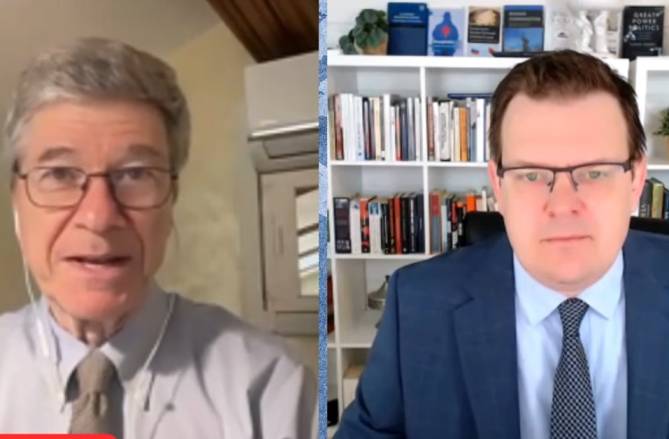
Editor’s Notes: In this episode, Glenn Diesen is joined by Professor Jeffrey Sachs to discuss the collapse of U.S.-Iran negotiations and the subsequent naval blockade of the Strait of Hormuz. Sachs offers a scathing critique of what he describes as a “deinstitutionalized and irrational” foreign policy process driven by Donald Trump’s personal delusions and “bluster”. The conversation explores the chaos of the current administration, the influence of Israel on U.S. escalation, and the dangerous failure of Washington to adapt to a multipolar world. Ultimately, Sachs argues that the breakdown in statecraft is a symptom of a declining hegemon led by “amateurs” who are unable to recognize the limits of American military and economic power. (April 14, 2026)
TRANSCRIPT:
GLENN DIESEN: Welcome back. Today is April 14th, and we have the great pleasure of being joined by Professor Jeffrey Sachs. So thank you as always for coming back on the program.
JEFFREY SACHS: I’m delighted to be with you, Glenn. Thanks a lot.
The Chaos of US-Iranian Negotiations
GLENN DIESEN: So we see that the US-Iranian negotiations appear to have failed, and largely because the US set conditions which more or less amounted to capitulation. And as a result, the US is now starting a naval blockade on the Strait of Hormuz even before the ceasefire has expired. So I was wondering, how do you make sense of this?
JEFFREY SACHS: The events day to day, of course, make no sense, or it’s very hard to discern. A few days ago, Trump was going to destroy a civilization. In the evening, suddenly there’s an announcement of a ceasefire. The next moment, Israel is essentially carpet bombing Beirut. The Straits don’t open. Then the US vice president goes for a marathon session of negotiations, completely unclear about the format and the organization, and to my sense, completely inconsistent with the statement that had been made 2 days earlier that the basis of the negotiations would be Iran’s 10-point plan, which we never heard of during the visit of Vance or the aftermath.
Then the negotiations fail. Then the US blockades a blockade. This must be a first. We object to the blockade, so we blockade you. Then we hear statements made by Trump that Iran is begging for further negotiations. So honestly, this is not either linear or very transparent or very clear.
I don’t think that there’s a deeply profound cleverness beneath all of this. I think there is a chaos that is part of this story. Part of the chaos is that there are two partners on one side of the war, Israel and the United States. Israel doesn’t want a ceasefire. Israel wants the full destruction of Iran. It’s not hidden, that fact. So the moment there is a supposed ceasefire, Israel goes into escalation mode in Lebanon.
And then we have a weird day of debating whether Lebanon was part of the ceasefire. The intermediary. Pakistan says definitely yes. Iran says of course. Israel says of course not. The United States hems and haws. So this is not deep. This is simply that one partner in this war, Israel, does not want a ceasefire and does not want a negotiation.
Then there’s a question of what the negotiations are about. The United States had put its maximal demands before. Iran had rejected them. Iran had put back a counter list of objectives. Donald Trump had posted that those were acceptable as the basis of negotiation. Then we didn’t hear of those again. Okay, what’s going on there?
Well, in some sense, obviously, the United States — and it’s a strange term to use — Donald Trump, because it’s not the United States, it’s one person, believes that he can bully and bluster his way to some kind of outcome. And this is the overwhelming idea that he has had all along, that he could demand, huff, puff, bluster, post, bomb, whatever it is, that that will yield an outcome. This is partly a delusion.
It may be, strangely enough, the Iranians are very polite in their public demeanor in the negotiations. This may be taken as a sign of weakness by the United States, which does not believe in politeness or expressions of hope for trust and other things. If Iranian negotiators say “We would like trust with the United States,” Trump thinks these people must be idiots. I’m trying to kill them. What are they talking about? And so it may be this kind of bizarre, even cultural, absolute lack of contact that is taking place.
Trump, whether delusional or for whatever reason, believes that he can force his way through this, that he, to put it in his vernacular, has all the cards. And the Iranians, I think, at the core, believe that they have a lot of the cards to use. That strange expression in this context. But I don’t think that they are simply acceding to US demands. If that were the case, they would have acceded to US demands a long time ago.
If anything has become clear in recent weeks, it is that the United States cannot actually militarily defeat Iran. That’s the overriding lesson. So why the bluster and demands and bombing and threats and killings by Trump, which didn’t work before? Why would they work now? But clearly, Trump believes that they will work. And I don’t think he’s bluffing about that. I think he believes that he can either bluff or bomb his way to success.
It seems to be the case — I wasn’t there and I only heard it, of course, secondhand — but that Trump was calling constantly to Vance during these negotiations. If that’s true, it’s also a little pathetic and very bizarre, but it could actually be the case. It would certainly underpin what I believe is a fact. I may be wrong, but I believe that this is really individualized behavior. This is not the US government in some institutional way rolled out to accomplish something.
This is a one-person show.
I think a delusional, incompetent one person. But my interpretation, Glenn, is that it’s one person, Donald Trump. Maybe that’s wrong. Maybe that’s naive. Maybe I’m just reading superficially the reality, but I don’t see a deeper reality in this than an incompetent, delusional old man blustering and shouting and bombing and killing, trying to get his way with a partner who doesn’t want to have any way other than complete destruction. So that’s why it looks so weird. It is weird. That’s my interpretation.
Questioning the Rationality Behind the War
GLENN DIESEN: Well, it’s certainly very confusing statecraft. You used the word delusion. And I often wonder if there is some lack of rationality behind this, because when we heard the reasons to go to war, be it nuclear weapons or Iran being these irrational mullahs which can’t be deterred, or this assassination attempt on Trump, which was also attributed to the Iranians for some reason, then this was the reasoning. I didn’t see this, this wasn’t very convincing.
And then of course the reaction was this regime change war. And they seem to have severely overestimated how fragile the government in Iran is. And also the assumption that the regime change could be done with an air campaign. Also the Iranian reaction that Trump made a point that they couldn’t have predicted that they would start to strike all the bases, shut down the Strait of Hormuz, and essentially pursue a long war.
But in advance of the war, this is what we were discussing on my podcast. This was the likely thing they would do because they see this as an existential threat and they need to deter. It just begs the question about the rationality behind the whole thing. How are you assessing this? Because none of the reasoning or reactions or assumptions seem to be based on anything that makes much sense.
A Deinstitutionalized and Irrational Decision-Making Process
JEFFREY SACHS: As best I can judge, again, we’re outside the room, as it were, but from all accounts, this seems to be a deinstitutionalized and irrational process, meaning that as you and I are close observers of governments and how they act normally, how they behave, how they process information, how decisions are made, it’s usually with files, bureaucracy, options, deliberation, memos, and then final decisions that have a character of a group decision.
And in the US political system, on paper, it’s more complicated because we have at least two branches of government that would normally be involved. The judges not, but the legislature certainly. There would be deliberations. The president of the United States would meet with senators and congressmen. Senior administration officials would be routinely briefing key members of Congress and congressional committees. Congressional staffs would be engaged. There would be not quite an all-of-government process, but a very extensive process.
We sometimes have the absolute detailed records of such a process, the most famous example being the Cuban Missile Crisis, when the executive committee of President Kennedy met repeatedly and it was taped, and it’s been studied by historians for decades. And that executive committee had principals from each of the key departments of the government, from the Pentagon, from the CIA, from the Justice Department, from the State Department. And so the principals would go back to their own headquarters, to their own ministries, and then there would be process there as well. And there was written documentation. There were verbal arguments. There were diplomatic back channels and so forth.
When we look at the current process, it’s very hard to discern any of this right now. What is reported, and it’s pretty widely reported, is Trump and a few people around him, mostly yes people, listening to Trump opine and make decisions. This is not a rational process.
We’ve now heard repeatedly, and especially I want to commend a paper I often criticize, The New York Times has had inside accounts that have seemed very credible, detailed, and not denied in any way by anybody involved, that have portrayed this as Netanyahu and the chief of Mossad pitching a war to Donald Trump in a small group where the rest of the group — from Vance, the CIA director, the chairman of the Joint Chiefs of Staff — were all skeptical of this. Some thought it was farcical. But Trump said, “Yeah, this sounds good.” And Mossad played the card that the Iranian leaders were all meeting together. “Let’s kill them all.” And so they went for it, with Trump making the decision. Vance reportedly saying, “I disagree with this, but I will support you, Mr. President,” with the others expressing various degrees of doubt and skepticism about the likelihood of success.
This seems to me like Trump’s show. That is not a normal process for grave decisions such as this.
Signs of Mental Instability
We can then add the absolutely bizarre behavior of Trump in the last couple of weeks. He’s bizarre for his whole public life, but especially in this second term. And I would say especially in the last 6 months where something even seems haywire compared to previous bizarre behavior. Trump seems to be unhinged. He is making statements and posts that are outside of, let’s say, not just 3 standard deviations, 4 standard deviations of the normal kinds of statements that we have never seen in American history by a president.
“Open the f*ing strait, you crazy bastards,” was Trump’s attempt a few days ago at public diplomacy, let us say. “Your civilization will end to never return,” I’m paraphrasing. This evening was another. Trump’s attack on Pope Leo yesterday, his posting of Trump as Christ and then saying, “No, that wasn’t Christ, that was the Red Cross.” Of course, that was just Trump trying to get out of a PR disaster. But the rest is absolutely bizarre.
And we have to factor in the real possibility that not only is there no institutional process, but that this man has lost his mind. It’s not a partisan statement. The previous president of the other party, Joe Biden, lost his mind too in the last year, something that was denied by those around him. A bad sign for the US, but we should remember it because it was just 2 years ago. Many of us heard from people meeting Biden that he wasn’t all there, but this was strongly denied by his team until one evening in a debate, he had to stand there by himself. And then we saw that he wasn’t all there. And then some people rather disgracefully said, “Oh no, he was on medicine, he had a cold that day,” and so forth. They hid his dementia during the past year or two of the government.
Well, Trump shows profound signs of mental instability right now. They can’t hide Trump because in the middle of the night he starts posting on his Truth Social. These seem to be unfiltered. They are not put on by staff. They are put on by Donald Trump, the one and only. And they are irrational and they are a sign of some kind of serious mental problems.
This is being widely talked about in the last few days in Washington right now. So this is not me piping off. This is something that has become the common currency in Washington as well. None of it looks like normal government at the moment.
The saddest part for me is that even if everything else were true about what I have just said — and I’m not sure, but that’s how it looks — we would normally have members of Congress taking some action in this context. It’s their constitutional obligation. It’s their assignment under the Constitution, war and peace. And they’re not acting because it’s the party in charge, because Trump is even more dangerous to Republicans than he is to Democrats, because with Republicans he can wipe out his own partisans more easily than he can the opponents. And so they are paralyzed and terrified and repeatedly vote not to say anything about anything. “If we don’t want to be bothered, leave us alone. We just want to hold our jobs.” So they duck their heads, take no responsibility, and we’re off to the races, as it were.
A Broken Political System
GLENN DIESEN: I think definitely with Trump, we see there are some deficiencies with his personality. There might be some mental problems adding on top of this, and the fact that he divorced himself from key institutions also, of course, undermines rational statecraft. But as you said, we saw similar things with Biden. That is not just a cover-up, but that also begs the question, who was essentially running the White House when he was not mentally present?
So you could point to maybe a polarized society and political system where you don’t only hate the opposing side, but you make excuses for your own because you have to protect them and because the alternative is someone you think is the enemy.
The Collapse of U.S. Institutional Competence
JEFFREY SACHS: But I knew, by the way, during the Biden period, since it was more typically my former colleagues or friends that were in the administration, I knew that even the most senior people in the administration barely saw the president of the United States. So even the most senior people in departments were telling me, “Oh, we don’t really know what’s going on. It’s the White House. There are a couple of handlers, his wife, couple political advisors, couple insiders.” That’s how the administration was run.
We had the same phenomenon in the aftermath of World War I when Woodrow Wilson had a stroke. And this was known inside but kept hidden from the public by the wife. And so this is an American tradition, actually, of incapacitated presidents. We’re not a parliamentary system, where there’s a prime minister who’s head of the lead party of the coalition of a parliament, or a presidential system where one person is vested with the profound powers. And when that one person is incapacitated, the first instinct of the powerful around that person, whether it’s the wife or somebody else, is to hold on to the power and hide the fact of the incapacity. And I think that there is a reasonable chance that this is what’s happening right now.
GLENN DIESEN: But it just seems the problem is wider because, just very briefly, that is under the policies against China, the assumption, the intelligence suggested that if we just cut them off semiconductors, their economy will begin to falter. We saw the Europeans, they were shocked that China would respond with sanctions because they assumed that China would think the discipline would be legitimate. We saw the same with the Russians. The assumption everyone bought into that it was unprovoked, even though all evidence suggested otherwise. We assumed that they would be beaten on the battlefield, that they had a hopeless economy that would collapse within a week. They would be isolated internationally. All these things which were very easy to realize were not true. We still base our policies on it. And when the reactions come, you see the politicians are genuinely baffled. It’s just, “I don’t understand anymore what is, how this is real.”
Amateurism and Deinstitutionalization in Washington
JEFFREY SACHS: The incompetence of the administrative system in Washington is extremely high now. First, remember that in the U.S. political system, when a new government comes in, the top 6 or 7 levels of the hierarchy actually are political. People are vacated. The people that come in, especially these days, are incompetent. This is a corrupt political system in which money buys the office. And so the people that are coming in are not people of deep professional talents. They are people that are either placed in the position by a powerful interest that has paid for the campaign, or perhaps they’re a friend of Trump or Biden. But we have a deinstitutionalization.
All of the issues you mentioned have been handled by amateurs of the most amateurish kind. The entire trade war last year was again, just like this war with Iran, handled by a few people completely out of knowledge or professional experience or training for these issues. Trump is, whatever else one says about him, completely illiterate economically. He has no concepts of what he’s talking about, no formal training and no understanding of even basics like trade deficits.
Then he picked Howard Lutnick, an incompetent business friend from New York. Peter Navarro, I think the worst PhD my economics department ever issued. An utter incompetent with no professional reputation or experience, but an ardent protectionist. And it was a handful of these people that implemented last year’s illegal, destabilizing, confused, and failed trade policy, including with the retaliation by China, which in two days told the United States, “You can’t win, you just lost.”
And so, yes, this is exactly what has happened with Biden. I saw the same thing, the same issue that you just raised, that they thought Putin would fold or fall immediately. “Our sanctions, the nuclear threat of cutting Russia off from SWIFT, this will bring down the Russian economy,” and so on. My God, are you kidding?
A Would-Be Hegemon Flailing in a Multipolar World
JEFFREY SACHS: This has been simply a deinstitutionalized process, not competent people, and with an objective which is impossible to achieve. And the objective is a hegemon, a would-be hegemon that has lost a tremendous relative amount of power and influence, flailing around to protect its dominance. And that is the story of Ukraine. It’s the story of China, and it’s the story of Iran in three different cases, each one of which is the assertion by these amateurs in a failed process that the United States can simply pound its way through anything.
And this is Trump’s M.O. until this moment, which is, “I make the demands, and the other side folds.” None of it works. He was going to settle the Ukraine war in a phone call. He was going to show China who’s who. He was going to choose the next leader of Iran. So that’s a personal-level delusion. It’s an institutional failure. And the backdrop is a failure of the United States to recognize a multipolar world. That’s the fundamental failure, because if there was the overarching idea, “Hey, we have to deal with other people, we have to deal with other governments,” you’d have already a different kind of response.
But the basic point is, “We don’t have to deal with anybody. We’re the United States of America. We have the most powerful military in the history of the world. We can do what we want. They’ll fold. I demand 100%, not 95%.” All of the backdrop thinking comes from the broader structural factor of a decline of U.S. relative power. But then it runs through this collapse of our governmental processes, the corruption of Washington politics, and at this point, the personalization of decision-making.
The Decline of Empires and the Resistance to Reform
GLENN DIESEN: Well, through history, one often sees that large empires, they often build these complex bureaucracies. Then when they come in decline, you see this bureaucracy becoming slow, corrupt, and also very hesitant to, or resistant to, reform. And the elite competition, it continues to intensify. So it’s not unprecedented, but I’m not sure where this is going, to be honest.
JEFFREY SACHS: Yeah, in the U.S. case, just to say, the U.S. bureaucracy has always been less of a structure in most of the government than in other governments because of this very high turnover and politicization of the senior levels. The one place where that’s basically not true has been the CIA, which is a core to U.S. foreign policy, which has been structured. And you put in a director who was quickly, quickly owned by the rest of the organization. So the deep state has been there.
But for what’s happening now, it’s people like Hegseth or Lutnick or Trump really making decisions. They happen to be awful and ignorant and unstable, delusional, but they’re really making decisions. So that is, actually, the surprise, as it were.
GLENN DIESEN: Well, thank you for taking time. I know you have a busy day there, so thanks.
JEFFREY SACHS: Great, great to be with you. Good, thanks a lot. Bye-bye.
Related Posts