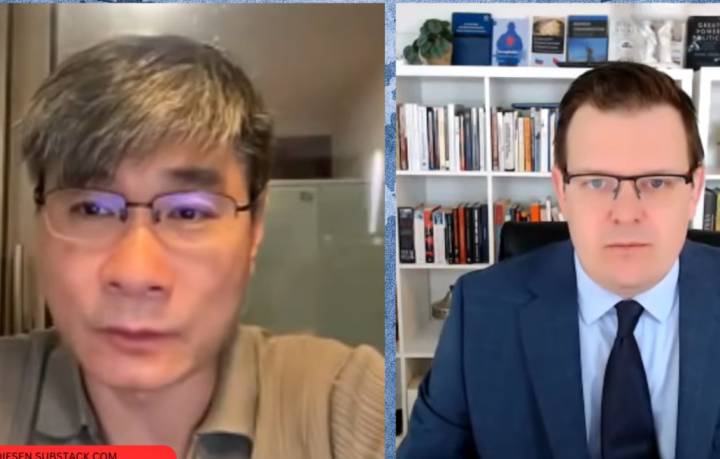
Editor’s Notes: In this episode, Glenn Diesen is joined by Jiang Xueqin to analyze the escalating conflict between the United States and Iran through the lens of economic warfare and the preservation of the petrodollar. They explore how the U.S. strategy involves leveraging naval supremacy to control maritime choke points, such as the Strait of Malacca, in an effort to force global energy dependence onto North America. The conversation also delves into the internal American power struggle between globalists and nationalists, speculating on how a “fortress North America” approach could redefine global trade alliances. Ultimately, the discussion highlights the limitations of Chinese strategic thinking and predicts a long-term global shift toward Russia as a counterbalance to American maritime hegemony. (April 13, 2026)
TRANSCRIPT:
Introduction
GLENN DIESEN: Welcome back. We are joined today by Jiang Xueqin to discuss the developments between the United States and Iran. So thank you very much for coming back on.
JIANG XUEQIN: Thanks, Glenn.
The Economic Underpinning of the Iran War
GLENN DIESEN: The first thing I think about is in regards to this war is that the Iranian targets all seem to be very well calculated in terms of economics. And I think this is interesting because usually in all American wars, there’s some economic interests to go to war. But now we see them, well, not just shutting down the Strait of Hormuz, but you see them when they essentially forced Americans to spend their expensive interceptor missiles. All of this seems to have an economic underpinning. But the really big thing appears to be the possible attack now on the petrodollar. I was wondering, how do you see the vulnerability of the petrodollar in this war?
JIANG XUEQIN: Right. So I would argue that right now, this war in Iran, it’s primarily about maintaining the petrodollar. Because these past 10 years, the world has become increasingly concerned about the viability of the petrodollar.
Right now, the United States is $39 trillion in debt. The United States, right after the Russians invaded Ukraine, froze over $1.2 trillion in Russian assets, which makes the world question the legitimacy as well as the credibility of the US financial system. Because if the Americans can weaponize the US dollar against the Russians, they can weaponize the US dollar against everyone.
So after that, you saw this massive exodus from US Treasuries. And right now China is establishing the Gold Corridor. So BRICS is trying to create alternatives to the petrodollar. But for the Americans, the petrodollar is the very basis of their empire. And quite honestly, it’s the objective of their empire. So the United States right now is in a fight tooth and nail to protect the petrodollar.
What this basically means is to use its naval supremacy, its control over strategic choke points, maritime choke points, to control trade access and basically force nations to depend on US resources. So we saw that United States in January attacked Venezuela and now it’s attacked Iran. Recently, these past few days, there was a Ukrainian drone strike on Russia’s main export hub, which basically took off 40% of Russian oil from the global market. And so Europe and East Asia are now forced to depend on the United States, North America for energy.
And right now we’re seeing a pivot from Europe and East Asia over to North America. And so that’s a strategy in place where the United States basically wants to take off Russian GCC oil and force the world to buy from the United States, which protects the petrodollar.
But what we know from history is that this sort of hubris will lead to a backlash, and it will lead to the world unifying against America eventually, because quite honestly, America used to be the policeman of the world, and now it’s become the pirate of the world. And so maybe in the short term, you will see the strategy working out, but definitely in the long term, you will see the world becoming much more aggravated by this piracy.
The Islamabad Negotiations and Their Collapse
GLENN DIESEN: So what do they need to achieve then in this war? Because I was wondering if you were surprised that the Americans appear to have walked away from the negotiations. At least that’s what it seemed like in Islamabad. Is this to continue the war then, or is it simply because they can’t — well, the petrodollar won’t survive if the Strait of Hormuz is with the Iranians, or what is the thinking here?
JIANG XUEQIN: Right, so we’ve seen a very strange sequence of events these past 6 weeks. The war’s been going on for about 6 weeks, and we’ve seen a lot of strange events.
So the moment that the Americans attacked Tehran and killed their Supreme Leader, the Iranians basically closed off the Strait of Hormuz. And in response, what the Americans did, which was very surprising, is they basically removed sanctions on both Russian and Iranian oil, allowing the Russians and Iranians to make a lot of money selling the oil. So that was sort of surprising. And Scott Bezin, the Treasury Secretary, explained that this is to maintain global stability. He’s afraid that oil will reach $200 and this would destabilize the global economy.
And as this war progressed, we saw the United States escalate to attacking civilian infrastructure like universities, bridges, and railways. In fact, there’s real concern that the Americans and Israelis plan to choke and strangle Tehran to death, meaning cutting off the railway system, the roads, which would put Tehran under siege. They couldn’t get food and water from the other parts of Iran. Tehran, a city of 10 million people, would be in a lot of trouble if that were the case. So what we were seeing was constant escalation.
Then last week we were on the brink because Trump basically declared that if Iran did not open the Strait of Hormuz, then the Americans would bomb Iran back to the Stone Age.
And Iran obviously would retaliate by destroying GCC energy infrastructure and the desalination plants. So last Tuesday we were really on the brink and it seemed as though we were heading towards World War 3.
But then Trump did something completely surprising, which is he basically offered an unconditional surrender. Iran had a 10-point plan, which included that Iran would be allowed to enrich uranium. It also included that all economic sanctions against Iran would be lifted. Iran would be given sovereignty over the Strait of Hormuz, and all security guarantees would be applied to both Iran and its proxies, the Houthis, Hezbollah, Hamas. So these were the 10 points that Iran demanded. And Donald Trump basically said that this is a workable framework. And so they agreed to meet in Islamabad to discuss these 10 points and use them as a framework for a possible long-term ceasefire.
We know that once they reached Islamabad, JD Vance, Jared Kushner, and Steve Witkoff basically blew off the Iranians. They were not serious about negotiations. The Americans went in with some goodwill hoping to reach an agreement and that’s where the Iranians went. But the Americans just basically said, no, we’re going to stick to our original demands. And so the negotiations went nowhere. And so now we’re back to where we were a week ago.
Trump’s Strategy and China’s Role
So the big question then is why would the Americans do this? What’s the point of this ceasefire? And so we can only speculate here. So let me try to figure out how Donald Trump thinks because he’s a businessman. And what does he want? Well, his main objective is to maintain American imperial supremacy by maintaining the petrodollar. And that basically means forcing China and Japan and South Korea and Europe to buy energy using the US dollar. That’s what the petrodollar literally means.
And so maybe the point of this war was to destroy the GCC and Iran’s capacity to deliver oil to the world market and force the world to rely on North America, Canada, Mexico, and the United States. Okay, so let’s just say that is the main objective. And obviously Trump can’t announce this because this would piss off the entire world and unite the entire world against the United States.
Well, in order for him to pull this off, he would basically need to gauge China’s reaction. Because we know that China and Iran are very strong allies. China has invested a great deal in Iranian infrastructure as part of the Belt and Road Initiative. And China buys a lot of oil from Iran. In fact, China buys about 90% of all Iranian oil. So basically, Trump needs to figure out, can I pull this off and would China agree to buy oil from me?
So he’s a negotiator, he’s a businessman, he’s practical. He’s trying to figure out what the pressure points on China are. And I would make the argument that Iran agreeing to these Islamabad negotiations would not have been possible if China did not apply pressure on Iran. I would make this argument because the Iranians have been negotiating with Americans these past few months, and they know that the Americans use these negotiations as a pretext in order to assassinate leaders, in order to do surprise attacks. So the Iranians know the Americans have absolutely no credibility at all. The Americans are not serious at all about peace negotiations.
And these past few weeks, the Iranians have been adamant saying, “You start this war, we’re just protecting our sovereignty, and there’s no point in negotiations. Let’s just fight this to the bitter end.” I think that was the right approach. This is the attitude you must take against bullies.
So why is it that the Iranians suddenly had a change of heart and said, “Fine, let’s negotiate in Islamabad”? In fact, they sent a pretty high-level delegation to Islamabad, including the foreign minister, to partake in these negotiations, knowing that Israel has a history of assassinating negotiating teams. So they put their diplomats at tremendous risk.
And I think the only explanation is that right now, the Chinese economy is under a lot of strain. China receives about 60% of its oil and energy from the Middle East, including Qatar and Saudi Arabia. China receives about a third of its energy needs from Venezuela, Russia, and Iran combined. And China’s been very lucky in that these three places have been sanctioned. So China has been able to receive the oil at a very deep, steep discount, which has really helped the Chinese economy. And now a lot of this energy is moving offline. So the Chinese economy is under a lot of stress.
So Trump’s trying to figure out, when I go to China in mid-May, can I propose to Beijing, “Hey, let’s have a grand alliance where you start to buy energy from North America”? And he’s trying to figure that out. And given that Iran agreed to negotiations, I think that he’s figured out that the answer is yes, China must agree because of the state of their economy. And this is why we saw right after the negotiations were canceled, Trump announced a naval blockade against Iran, because he knows that right now China’s under a lot of strain and he can bring China into an agreement and thus protect the petrodollar.
So that’s my explanation for what’s going on. I could be wrong. It’s all speculation, but I think this is what makes the most sense so far.
The Naval Blockade and the Strait of Malacca
GLENN DIESEN: The naval blockade — this is a strange conception because it’s unclear how it’s going to be upheld because they’re not naturally in the strait either. They will be far away. So essentially the blockade — would it entail attacking Chinese ships entering? I mean, it seems absurd. What if the Iranians open up for Indian ships? Are they going to start attacking Indian ships? It doesn’t really make that much sense. How do you see this? How does this blockade actually function? Or is it just meant to choke off the Iranian ships?
JIANG XUEQIN: Right. So from a practical perspective, it’s actually very hard to implement because if you go close to the Iranian coastline through the Strait of Hormuz, then you’re in range of Iranian ballistic missiles. And so the Americans won’t risk that because we’ve seen that their aircraft carriers, including the Gerald Ford, Nimitz, and Lincoln, have intentionally stayed far away from Iran’s ballistic missile range. So they’re afraid of ballistic missiles and they know that these ballistic missiles can sink their aircraft carriers, which would be a tremendous, tremendous defeat strategically for the Americans.
So I think this is a pretext to choke off the Strait of Malacca, right? So there are two major choke points for East Asia to receive oil from the Middle East. The Strait of Hormuz is what Iran controls, and so in response, America plans to choke off the Strait of Malacca, which is right now basically controlled by Indonesia and Malaysia, both of which are American military allies. And these nations have been heavily infiltrated by the CIA. So I think that’s the grand strategy, to basically use the Strait of Malacca to choke off East Asia from GCC energy.
Can the United States Achieve Its Objectives?
GLENN DIESEN: Yeah, but if the Americans actually go through with this attempt to blockade, the Iranians would probably respond with their ally in Yemen, that is to close off the Red Sea at Bab al-Mandab. So it just seems that this plan is weak at many levels, but it kind of begs the question — what do you see being the likely success of the United States achieving its objective, not just with the blockade, but also with preserving the petrodollar? Because Iran is quite resilient. And I’m assuming that the Chinese, much like with the war against Russia, know that they could be next on the chopping block, or that they at least are the ultimate targets.
The Petrodollar Strategy and America’s Imperial Decline
JIANG XUEQIN: Right. So what America is mostly interested in is trying to sustain its debt. Right now, America has $39 trillion in debt. That’s not a problem as long as nations continue to buy US Treasuries. And we’ve seen these past few years a movement away from US Treasury and more and more towards gold. The Chinese especially are moving towards gold.
So how do you force East Asia and Europe to continue to buy US Treasuries? Well, if you are the only supplier of energy, of oil and gas, LNG, they have absolutely no choice but to sell their gold and buy US Treasuries, in order to sustain their economies, right?
So yes, you’re absolutely right in that the Iranians have countermeasures. The Iranians could use the Houthis to close off the Red Sea. They could attack the pipeline that connects Saudi Arabia to the Red Sea. There’s many, many measures that the Iranians can do, but the influence of the Iranians is contained to the Middle East.
And remember, the ultimate objective is to knock off Middle East oil and energy from the market. And that is very easy to do as long as you continue to provoke this war. Now, I think the next step is a ground invasion in order to force Iranians to attack GCC energy and desalination plants, right? So the entire goal is to destroy the Middle East, which will force the world to pivot to North America.
So in the short term, this strategy will work out, because there’s absolutely no alternative for the world to the Middle East energy. But in the long term, this will create a great deal of animosity towards the United States, which will ultimately destroy their empire.
Trump, the Deep State, and the Transformation of American Power
GLENN DIESEN: Well, Romano Prodi, the former prime minister of Italy and also former president of the European Commission, he said something interesting along those lines. He was making the point that well, at some point the Europeans will have to start getting energy again from the Russians if they want to thrive. But he also made a prediction that the energy would open once the Americans would begin to control the energy infrastructure between Russia and Europe. So essentially the Americans taking over Nord Stream, this is when the energy will start flowing again, which is, well, an assumption, I guess, that the Americans want to be in control over the energy architecture, otherwise they will not permit it.
But beyond this, what Trump might be planning, a common argument is often that Trump is not necessarily fully in control, that he’s, well, if not compromised, at least under great influence from various interests, be it the neocons or the Israelis. How do you see this, the extent of Trump’s control? Because, well, given how different his second administration is compared to the first, one often gets the impression that it doesn’t always matter who sits on the throne in the US.
JIANG XUEQIN: I think in the first administration, there was a lot of concern within the deep state and the neocons and the different political factions within Washington, D.C. about Trump’s capacity to be a leader because he was outrageous in his speech and his rhetoric. The Europeans were very much concerned about Trump. Trump started this trade war with China that was hurting the global economy and it was hurting American consumers. Trump did not seem like a viable leader and he did not seem as though he could maintain the empire. And people felt that if he stayed in office longer, the Europeans would drift away, China would drift away, the entire world would drift away, and American hegemony would die.
But then what happened, of course, was that Biden came to power and Biden was essentially comatose. He did nothing for 4 years. So Putin invaded Ukraine and Americans didn’t really have a forceful response. I mean, they did do a lot of things like blow up the Nord Stream pipeline. They sanctioned Russian energy. They removed Russia from the SWIFT system. They froze $200 billion in Russian assets. They did a lot of things. But none of these things were actually useful.
And the empire decided that regardless of what we feel about Trump, he is forceful, he will act, whereas Biden and the Democrats may not act because essentially they’re a bunch of pussies. And so the decision was made to reinstate Trump in 2024, and that’s why we are here today.
So Trump is an agent of empire. He is doing what the empire requires, okay? And so what happened before during the unipolar moment, basically from 1991 up to today, was that America had a lot of goodwill and it was able to achieve the consent of the world, mainly by co-opting the global elite, right? So all these elites in Europe, in Russia, in China, they were mainly concerned about engaging as much corruption as possible so that they can basically transfer their ill-gotten gains into America. And this system worked really well for the elite for a long, long time.
But obviously these nation states were not very happy with the state of affairs. That’s why you saw the rise of Putin in Russia and the rise of Xi in China, because there was a lot of concern among the nationalists that America was hollowing out these countries. And they were completely right in the matter.
So now you’re seeing a direct challenge to American empire. And so the only challenge is you don’t have the consent of these nation states, then you must use force to enforce your empire within these nation states. And so before, the American military was used in order to guarantee peace in the Pax Americana, it was used to guarantee international trade. They were the policemen of the world in order to maintain the rules-based national order.
And now that Russia and China and other nations are questioning the legitimacy of the rules-based international order, what Trump is doing is he is transforming the American military from a police force into a pirate force in order to extract tolls from the world.
So we are in this situation because Trump’s first strategy was to use tariffs on the world, right? To force Europeans to pay tariffs to the American empire. But the Supreme Court struck that down because they said that the executive branch does not have the authority to enforce tariffs, only Congress does. So Trump’s like, well, if you won’t let me enforce tariffs, then I’ll just enforce tolls, okay? I’ll make the world pay tolls in order to have trade around the world.
And that’s why we’re seeing the Americans deploy 1/3 of their Navy into the Caribbean to block trade into the Western Hemisphere. That’s why we’re seeing this war in Iran to block off the world from Middle East energy. And that’s why we’re seeing right now the US Navy basically boarding Russian shadow fleet tankers, basically stealing shadow fleet tankers, and we’ll see more of this as the months go by.
Empire’s Return on Investment: Trump’s Consistent Vision
GLENN DIESEN: Yeah, what’s interesting with Trump though, there’s some consistency here. I mean, many people, I guess, mistook his rhetoric for being all about peace. But if you listen to what he said all the way going back to the 1980s, he was essentially scolding all the Japanese and others for taking advantage of the US the way he saw it. So he didn’t say that we shouldn’t have a big empire, he just said the empire, they should pay us for the privilege of being protected. So it’s not that they didn’t want an empire, it seems he just wanted a better return on investment.
That is, you have to monetize the empire somehow, otherwise the empire will kill off the republic. So in other words, it should feed it. It looks as this is where his main difference is, but that means not just extracting from adversaries, but also allies. But I don’t think it’s limited to Trump. I think overall the United States will tilt more and more in this direction because as they have, as I said, they exhausted themselves with $39 trillion in the hole. It’s not as if you can vote for a Democrat and suddenly they go back to paying for the security of allies anymore and having generous trade agreements. There’s no going back after being exhausted to this extent. Sorry.
JIANG XUEQIN: Yeah, so this is a really important point that you make. Okay, so remember in 2016 when Trump first came into office, he was saying the same things you’re saying, which is everyone’s taking advantage of us, especially China. So let’s impose tariffs and make sure that it’s America first, that America is winning in this trade relationship.
But after Trump left office, Biden came in with the Democrats and they institutionalized his policies. So in the first Trump administration, a lot of it was personal, especially his tariff war against China. And then Biden and the Democrats made it institutional. And so we’re going to start the same process here where maybe Trump leaves office in 2028, the Republicans lose, the Democrats come into office and they won’t change anything. All they’re going to do is institutionalize it and make it a long-term sustainable policy because this is what benefits the American empire.
How China and Russia Are Responding to American Aggression
GLENN DIESEN: So how will the great powers respond then? Because the US obviously is shifting strategy. It’s becoming more extractive and more aggressive. Again, it’s not going down without a fight. How do you see the Chinese and the Russians reacting to this? You mentioned before that China’s gold corridor in terms of shifting more to gold instead of being reliant on the US dollar. But what is the overall strategy here?
Because my impression is, at least from the Russians, that they did the interpretation that Trump was someone they could make peace with and reset relations. It appears to be backsliding. I think they were quite appalled by what has happened to Iran, not just the attack on economic infrastructure, but also the killing of its leaders. And it seems very much to go against their interest. And also Trump never actually did what he promised, which was to end the war in Ukraine. And in all fairness, this could have been done if he would have cut off the intelligence agencies still working there.
JIANG XUEQIN: All right. So again, I think we give too much credit to Trump. I think that this is a natural response of empire to its decline. Historically, empires have never gone quietly into the night. They have flailed against the wind and they have tried to destroy the world as they decline. And so we can see much more hubris. We will see much more thuggery and piracy from America with or without Trump.
And so I think we are in a situation because of the limitations of Chinese strategic thinking. So when China built the Belt and Road Initiative, which was proper, which was a good strategy of trying to secure resource independence from the United States, the problem was that when these Chinese ships went to collect commodities from overseas, they were escorted by the US Navy. When they came back, they were escorted by the US Navy. It was the US Navy that guaranteed the protection of Chinese trade.
And it never occurred to Chinese policymakers that one day, one of these days, America could be like, why don’t you steal the cargo? Why are we escorting these Chinese ships around the world? Why don’t you just steal it? And so it never really occurred to Chinese policymakers of this possibility. And I don’t know why this is the case, but we can go into many possibilities.
But the reality is that China is now in a lot of trouble where China has invested $200 billion into the Middle East in infrastructure. China right now imports 50 to 60% of its oil needs from the Middle East. Now that the Strait of Hormuz has been closed off, now that this war is raging in the Middle East, China is in a lot of trouble. And again, this all has to do with the limitations of Chinese strategic thinking.
And so now China is in a lot of trouble. And in the short term, China has absolutely no choice, absolutely no choice at all, but to agree to Trump’s demands, which is that China will become a major purchaser of American LNG. China has absolutely no choice in the matter. Okay, absolutely no choice. There’s nothing China can do.
Now, in the mid and long term, what’s going to happen is that Russia will start to challenge America in the seas. It’s going to challenge American maritime naval supremacy. Basically what Russia’s going to do is it’s going to arm its shadow fleet. And there’s no way that Russia could defeat America militarily in the seas, but America will be forced to fight a war of attrition. And over time, the American Navy will be downgraded. It’ll be degraded. And it’ll be very hard for the American Navy to replenish its lost ships. And so that’s what we’re seeing in the long term. But in the short term, there’s absolutely nothing Russia and China can do.
The Geopolitics of the Iran War: Heartland Theory and the Battle for Eurasia
GLENN DIESEN: Yeah, I often think about the current situation. It resembles a little bit like before World War I. That is, you saw Germany building and becoming stronger and stronger in terms of industrial production, steel production, essentially all the key measurements. Meanwhile, the British controlled the seas, the entire— their ability to actually compete against the British was in the hands of the British. So all they had to do is begin to cut off or threaten their supply lines, which is why the Germans also had to find other possible corridors, either land or sea.
But it’s a little bit with the Chinese, I feel. They have all this— well, probably one of the motivations behind the Belt and Road Initiative, that is, you can’t rival the US as the economic leading economy while the Americans are then organising their supply lines and their physical transportation corridors. It doesn’t make much sense.
But this return to, I guess, well, piracy, as you say, or choking off these different transportation corridors. We’ve seen, of course, the blockade on Venezuela, Cuba, the hijacking of these Russian ships. By the way, the hijacking of Iranian tankers have happened for some years now before this war as well. So I get it that a hegemon in decline will begin to weaponise all the economic levers of power. There is access to its technologies and industries, transportation corridors, banks, currencies, all of this is weaponised.
But the United States isn’t all-powerful either. I mean, what is the main challenge for the US to hold out? Because as you said, they’re struggling with their own debt. Their economic trouble is also translating into social and political instability. So it looks as if they can’t afford to play this game with the Iranians for too long, that at some point they will have to put an end to this thing.
JIANG XUEQIN: I think that the goal is to have this war continue for as long as possible. And the reason why is that if there were peace in the Middle East, what would happen is that Russia, Iran, and China would get together and form a trade alliance to counter America’s control over the seas. And this trade alliance could extend easily into Europe, into Africa.
This is what McKenna calls the Heartland Thesis, right? Where America and Britain, the way for them to maintain their empire is by controlling maritime navigation. And the great concern is that a power would emerge in Eurasia to unite the heartland and basically negate Anglo-American naval power. And so this war in Iran cannot stop. If it stops, then Russia could achieve its north-south trade corridor and China could implement its Belt and Road Initiative.
And given how America is starting to behave, then I think that Europe, the Middle East, Africa would happily join this trade alliance and basically try to ignore the Western Hemisphere and Britain. And so there’s no way that America will cede Iran and leave Iran alone. It’s going to send in ground troops to create as much chaos as possible and try to disrupt the Belt and Road Initiative.
So what we’re seeing is that the Israelis and Americans are targeting railways in Iran, which is crucial to the Belt and Road Initiative. And so we can expect maybe more than a lot of Belt and Road infrastructure for years and years.
Targeting Infrastructure and the Feasibility of Ground Troops
GLENN DIESEN: Yeah, I couldn’t help but to notice the targeting of the railroads as well, as well as some ports in the Caspian. So this entire international north-south transportation corridor, which has been building from Russia, Iran to India, this is being undermined, but also, of course, Iran’s connectivity with China. But I’m just wondering about the feasibility here, because what exactly can boots on the ground achieve? But also, can the United States get the boots on the ground because they’re quite overextended already?
JIANG XUEQIN: Right. So the boots on the ground, it’s basically to maintain the war, right? So the problem with air warfare, which is what the Americans and Israelis have been using for the past 6 weeks, is that it’s going to be very hard to maintain your air power. We’re already seeing some planes crashing because they’re not well maintained. We’re seeing the Iranians adapt very creatively and resiliently to American air power. So you can only establish air supremacy by having boots on the ground.
And so I think the main objective of the boots on the ground is not necessarily to take over Iran. I mean, that’s a suicide mission, but it’s basically to secure the coastline and try to degrade Iran’s air defenses and basically force Iran on the defensive. The main objective I think, if I’m fighting this war, is to choke off Tehran, basically to cut off all railways, cut off all roads, and basically force the population into starvation.
GLENN DIESEN: So this is where you think we’re going?
JIANG XUEQIN: I think so.
GLENN DIESEN: Destroying the population, or as Trump would say, kill off a civilization.
JIANG XUEQIN: That’s right. That would be the strategy moving forward, yes, to basically besiege Tehran.
NATO, Europe, and Trump’s Vision of Greater North America
GLENN DIESEN: It’s just such a big country. It seems hard to, yeah, again, if the railroads are undermined. But it also has its domestic problems though, that Trump needs to — it’s not a popular war among the public and it has some fierce political opposition only intensified with the political polarization.
I did want to ask about NATO though, because this is also often perplexing to many Europeans. While in the Gulf states they’re now discussing the extent to which being frontline states for the US is actually harmful to their security, they’re having some of these talks in East Asia as well. But in Europe, I mean, they must be the most loyal, obedient allies or frontline states of the United States. I’m convinced they would have possibly joined the war on Iran if he would have asked them before it went south.
But why does it seem to be such an objective for Trump to, I guess, undermine NATO? Because this is the main— I mean, the Europeans don’t have much political imagination to have security without the United States. So it looks like a massive resource to have the Europeans essentially buy whatever America wants, to use their currency, buy their energy, buy their expensive weapons. I mean, Europeans will do anything if they believe America will be there for them.
So why make this big show out of, “we’re not going to be there for you anymore?” Because if there’s one thing that would make the Europeans break off and seek an independent path from the United States, it’s essentially the US having to shut the door on them, because otherwise they wouldn’t shut the door on America. So it’s a bit strange. I can understand that NATO’s not — that the Europeans, they’re not really a force amplifier. They’re not bringing much to the table. They’re a bit of a cost, but still it’s a bit strange how dismissive he is of them though.
JIANG XUEQIN: So I think that the real war is actually not between the United States and Iran. I mean, the real war is between the globalists and the nationalists, right? So in the United States, it’d be a war between the financial elite as represented by the City of London and Wall Street versus MAGA and America First.
And so what Trump wants to do is basically transition America from an empire into something called a techne, which is the idea of a Greater North America, right? So move away from the world and just focus on consolidating Greater North America, taking over Canada, taking over Greenland, taking over Mexico, taking over Cuba, Venezuela, Colombia, Honduras, Nicaragua. These are the countries that Trump has been pissing off for the past few months. But the grand vision is to transition America into Greater North America and become a continental fortress that sells resources to the rest of the world, because the rest of the world is at war and is in desperate need of both fertilizer and energy.
And so Trump really sees NATO as part of the deep state, as part of the globalist class. And so he’s using this war as a pretext to sever relations with NATO. Basically, Trump would be perfectly happy if NATO were to go into Ukraine and be absolutely massacred by the Russians. That would solve a major headache of his.
So yes, there is this war going on between the United States and Iran, but we should not forget there’s also a shadow war going on between the globalists and the nationalists in America. This is also why Washington, D.C. is supportive of Trump’s war, because the globalists want Iran to be humbled. They want Iran to be destroyed so that they can extend the hegemony of the empire. And they think that Trump is a useful idiot, a puppet, in order to achieve this goal. And that’s why the Democrats have not stopped him.
There was recently, 2 weeks ago, No Kings protests in the United States, millions of people. And you were allowed to say “no kings,” but you were not allowed to say “no war.” You would think that people would be much more governed by an anti-war sentiment than they are by an anti-tyrant sentiment. But during the protests, which were organized by Democratic lobby groups, which were very pro-Zionist, you were not allowed to voice any anti-war sentiment.
So it just goes to show you that all of Washington, D.C. is fully behind this war. And they think that Trump will be the scapegoat, that even if this war goes badly, Trump will be the one that takes all the blame. The Republicans will be wiped out in the midterms and then Democrats can steamroll back into office in 2028. And then they can implement a globalist agenda and destroy MAGA once and for all.
Globalists vs. Nationalists: Huntington’s Prophecy and Russia’s Role
GLENN DIESEN: Yeah, this language though, the globalists versus the nationalists, it’s fascinating that the first time I read about this divide was by Samuel Huntington, none other. Back in 2004, he wrote this article, “Dead Souls,” where he was making the point that all this globalization had essentially created a political elite detached from the nation. So he was making the prediction that the future divisions in the world would be between the cosmopolitans or globalists versus the nationalists or patriots. So I thought it was insightful. Again, it’s 2004. It’s been 22 years. And if you listen to a lot of the new populist leaders we have, this is what they’re — yeah, Marine Le Pen to AfD, this is essentially the same language they also use now.
Let me just ask a last question though. How does Russia fit into this? Because all the pieces kind of make sense there. I understand the rivalry between the United States and China, the problem of Iran, but Russia is an energy superpower in many ways. It doesn’t have to be an opponent of the United States. Within this rivalry between the cosmopolitans and the nationalists, it belongs to the latter, it seems. So how do you see this impacting the thinking in the United States? But it’s a close partner to Iran and China, I should have added.
JIANG XUEQIN: Right. Yeah. So right now, the United States’ main adversary is not China. It’s really Russia, because Russia is the only country that has the resources, the political will, and the territorial integrity in order to challenge American hegemony. And so right now, America’s major concern is Russia. And this war against Iran is really seen as a way to counter Russia’s aggression in Ukraine. Basically, once Russia went into Ukraine, America has absolutely no choice but to attack Iran in order to counter Russia’s possible control over the heartland.
And so this is going to be the defining struggle for the world for the next 20 years, not between the United States and China, but between Russia and America. And the great question is, where will the world align over the next 20 years? If history is a guide, most countries will start to align with Russia. Because if you go back to the Peloponnesian War, the main aggressor was Athens. And what happened ultimately was that the entire world ultimately aligned against Athens because Athens was seen as the great aggressor.
So right now, the great aggressor is America. And we can see that the world, especially Europe and Iran and China, turning to Russia as the great salvation. And what Russia will do is start to challenge America in the seas. Again, I don’t think there’s any hope that Russia will win against America in the seas, but Russia has absolutely no choice but to start to challenge America.
Related Posts