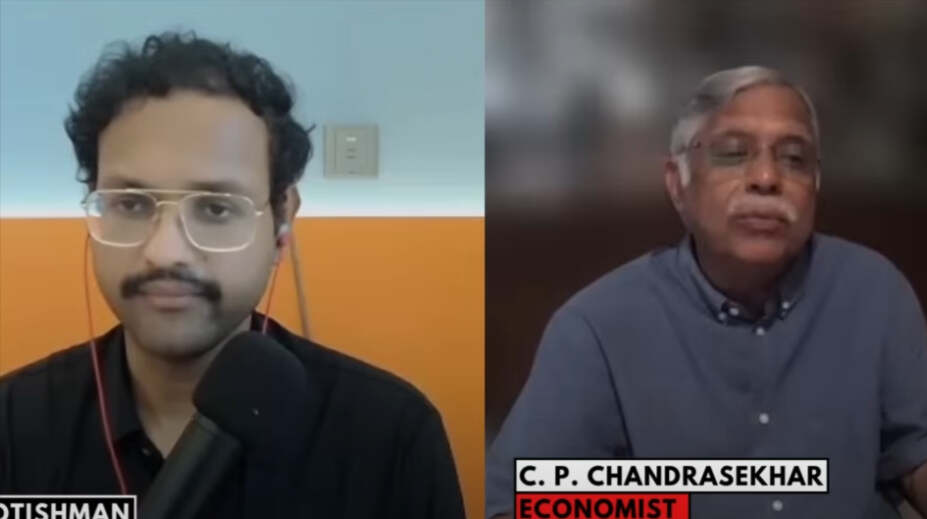
Read the full transcript of economist CP Chandrasekhar’s interview on India & Global Left podcast with host Jyotishman Mudiar on “U.S. Sanctions on India: Economist Explains What’s Really Behind It”, premiered on August 7, 2025.
U.S. Sanctions on India: Economist Explains What’s Really Behind It
JYOTISHMAN MUDIAR: Hello and welcome to another episode of India and Global Left. If you are new to the show, please smash that subscribe button. Also consider becoming a YouTube member, a Patreon or donate small amount given in the link in the description box. But the least you could do is to watch this show like share and please comment.
Without further ado, let me welcome our guest today, Professor C.P. Chandrasekhar. Professor Chandrasekhar retired from Center for Economic Studies and Planning, Jawaharlal Nehru University, New Delhi after teaching for decades. Officially his areas of interest include the role of finance and industry in development, but actually he writes on practically all major areas of economy, including agriculture. Professor Chandrasekhar, welcome back to India and Global Left.
CP CHANDRASEKHAR: Thanks. Thanks for having me again.
India’s Economic Integration with the U.S.
JYOTISHMAN MUDIAR: India is in the news thanks to President Trump in the U.S. has imposed 25% tariffs which is based on its economic reasoning, and then 25% extra based on geopolitical reasoning which is buying of Russian oil. I want to stick to economic discussion for the time being, but before we deep dive into India the tariff issues, if you could tell us a little bit about the patterns of Indian integration with the U.S. Economy.
Because quite often ideologues of neoliberal globalization or free markets, they argue they show trade deficit numbers as this evidence for tremendous gains by emerging economies. And in this context, President Trump and the U.S. administration is presenting this 40 to 42 billion U.S. dollar as this evidence of India being oppressive in a way.
But we see in India U.S. Corporations from Amazon to Meta, Facebook to Microsoft, Apple, all kinds of consumer brands from Cafe Coffee Day to McDonald’s, institutional investors in the form of FDI or qualified portfolio investors. They are all over the Indian economy and they gain enormously from all out of this.
So to understand this U.S. India relationships which many are arguing that it must be rethought of at this moment. If you could tell us a little bit about how India got entangled with the U.S. Economy as part of this larger neoliberal globalization, that would be great.
The Reality of Trade Deficits and Manufacturing
CP CHANDRASEKHAR: Well, you know, I suppose using the metric of a trade deficit really is not going to help us understand the way in which India is integrated and possibly doesn’t even explain the reason why the United States administration under Trump is targeting India.
And I think if you look at the integration really first of all, you must realize that India is not an economy which despite years of effort and much rhetoric on the part of the state, has not been able to diversify into manufacturing and become either in itself a manufacturing hub or become a manufacturing hub for foreign investors, using it as a location for world market production, including for the United States, like, for example, would be true for a country like Vietnam.
Nor is this trade deficit so damaging for the United States economy. And if you actually look at it from the point of view of India, the more important areas of integration would be in areas like software, services, exports, exports of IT enabled services of various kinds, which obviously don’t fall just now under the kind of restrictions which have been put because we’re really looking at trade in goods largely.
So I would say that if you say that, is there an immediate impact which is going to happen across the Indian economy, there’s no reason to believe that this would be excessively damaging. But how it is damaging is in two ways, I think.
One, of course it is damaging because India has given up any effort to try and really build a manufacturing base which of its own, which is geared to largely a production either for the domestic market or for diversified international markets to other countries in the global South.
And secondly, there are specific areas in which India, not necessarily only on the basis of its own strength, like for example, in pharmaceuticals or textiles maybe, in which it finds the United States a significant market or an important market. So there would be particular industries in particular industrial lobbies. And of course that would include some producers of oil, I mean, oil downstream products, who’ve actually been trying to get access to cheap oil in order to process it and actually export, including to international markets, including the United States.
So there might be specific entities which get hit. But the real thing is that this forecloses any effort to try and pursue the kind of strategy which in fact has been unsuccessfully pursued for a long period of time, of course, ever since in some sense, you know, globalized, I mean, economic reform, if you want to call it that, neoliberal reform started in India in the mid-1980s and after, but particularly under the current administration which has actually looked at this whole argument of India becoming “China plus one.”
And if these tariffs actually hold, then would actually mean that that opportunity has been significantly foreclosed because an important market for that would have been possibly the United States market.
Finally, even though you say that you want to get into the politics of it, we must recognize that in terms of the imposition of tariffs for one or two reasons, one, of course, if the relative level of tariffs imposed on them is higher than tariffs imposed elsewhere. And two, if actually, as far as all countries are concerned, the price elasticity of imports into the United States is significant, and the increase in prices which occur as a result of the imposition of these tariffs results in a fall in the demand for imported commodities in the United States.
So if you look at it like that, if it had been just 25%, the base tariff, which was announced, the risk tariff which was announced in the first instance, of course it would still be higher than 20%.
India is not a successful exporter in most areas yet, so it would have affected India.
But if you actually move from 25% to 50% because of the fact that you’re using tariffs now not merely as an economic, but also as a weapon to push countries into accepting certain political positions, then that affects India definitely in a very significant way. If it lasts, we don’t know if it’s going to last. In any case, the Indian government has been given some time, but if it lasts, that can affect.
And the way it would affect, I think, is in terms of a necessary reorientation of the kind of growth strategy and manufacturing strategy that you have. And if this is the way it goes, we don’t know, next time around, using H1B, using visas, whatever it may be, you might actually have the services sector also affected, which of course would be a major effect on India.
Impact on Specific Industries
JYOTISHMAN MUDIAR: The jewelry industry in particular. The U.S. market is a huge market, and the representatives have said today that they could have still thought of surviving 25%, but 50% is just impossible. And they are talking about shifting some of the production lines to Middle Eastern countries where the tariffs are lower, or using Mexico as a third destination to ship into the United States.
Now, of course, there are other sectors, garment, pharmaceuticals to some extent, electronic and chemicals. My question to you is how much of these tariffs can affect the employment generation in terms of overall industrial sector?
CP CHANDRASEKHAR: You know, let me put it this way. You really are in a situation where if you think it’s a sector like gems and jewelry and there’s very little value added. You’re importing a lot of the stuff and you’re processing it. So really what you’re getting is a small amount of value added in which a significant part is the profit of those who are producers. Some of them might be smaller producers, of course, so you’re generating employment, but this is not really employment of a kind which you would consider to be decent enough to be able to sustain some kind of a growth in the domestic market to have multiplier effects which can be significant in the domestic market.
So we have to recognize that this is bad because we are in a situation in which underemployment is huge and therefore any employment, adverse employment effect is bad. But I would think that if…
JYOTISHMAN MUDIAR: What about the garment industry? Sorry, what about the garment industry which is assumed to be garment industry?
CP CHANDRASEKHAR: The garment industry is not dependent on imports of clothing. Clothing and yarn. I mean garment industry. We’ve got our own textile industry which is significant. In fact, the problem with the textile industry was that it couldn’t utilize all of its capacity in full. So there might be specific industrial fabrics or something which we still import in order to be able to process. But really much of it, but gems and jewelry doesn’t fall within that category.
So I mean the way I look at it is, if in such an industry somebody says that we can take 25%, where is this 25% squeeze going to come from? If already you’re in a situation where you’re saying it’s a low value added industry, how much is it going to be for the profit and how much is it going to be for the wage? So it might be adverse employment implications, but it’s adverse employment implications in a 25% situation in which actually that employment is even worse than the current bad employment that you have many of those units.
So we need to, you know, the point is instead of being stuck in this structure of thought in which people think that the only way you can grow in today’s world is on the basis of global markets, when you actually haven’t been able to do too much of it in any case accepting in services, then you’re in a bit of a trap.
I mean the question has to be that, listen, is it possible for you to realign your strategy to actually have, you know, it’s a large country, even with low per capita incomes, we have a significant domestic market. You can have a process of wage led growth, but that would need a change in the way in which you look at the growth strategy itself rather than sit and cry about the fact that they put 50% instead of 25%.
Trade Deals as Tools for Market Opening
JYOTISHMAN MUDIAR: Right. I’ll come to the alternative. Some of the possibilities about alternative ways of engaging or taking an alternative path. But if I could start with your colleague, Professor Jayati Ghosh. She wrote an article about Trump’s larger goal through these tariffs, and she discusses the case of Indonesia, where the United States has “successfully negotiated” a deal and the Indian recent trade agreement with the UK and her argument is that both the UK and the U.S. are using these trade deals effectively to open up emerging markets even further, tearing apart restrictions from quality control to patent rights to carry barriers and so on and so forth.
The overall argument is that it is a further escalation of free market ideology to the extent that emerging economies had resisted. Do you see it the same way as your colleague professor Ghosh?
The Weaponization of Tariffs
CP CHANDRASEKHAR: I told you, supposing we forget these political tariffs. You put tariffs on Brazil because you’re not happy with the way they’re treating Bolsonaro. You put tariffs on India because they’re importing crude from Russia, but it’s not really because they imported crude from Russia. The oil imports from Russia directly and indirectly is happening to the United States as well as to Europe. So that’s not really the issue.
What you’re really saying is that if you look at basic reciprocal tariffs, the amount you’re going to get depends upon two things. One is, it depends upon the import elasticity of the price elasticity of imports in the United States, which in the case of certain commodities, and given the class distribution of the consumption of these commodities can be significant in certain areas.
But the second, of course, is which so far seems to have got reflected only in the undocumented deal with Vietnam in which you’re saying that, “Listen, if you actually are treated as a hub by a country like China, which can be very competitive, then we’re not going to be satisfied with 20. We can actually put 40 on it.” So then what you’re saying is that I’m going to actually use the tariff as a device to prevent you from becoming the base of location from anybody who I want to prevent imports from abroad.
The third thing which you’re saying is, of course, is that if the benefit you’re going to get is therefore limited because you’re imposing it on all, there could be only two other reasons why you’re doing it. One is you’re going to use it as a weapon for other purposes. And they need not be only political. I completely agree that what you try and do is to actually say, “Come to the table and discuss.” And when you discuss, we are not going to actually only look at how much are you going to give us in terms of tariff reduction or quantitative restriction reduction so that we can bring it down.
You’re going to say that, “No, you have to give us the following additional concessions.” And that would enter. It could not only be in areas like intellectual property, foreign investment regulations, it could be on imposing digital taxes, digital service taxes. It could be anything. You can bring anything to the table when you decide to use it, when you weaponize tariffs.
And of course, you can weaponize tariffs for political reasons. So there’s one thing that you actually are doing is you’re weaponizing tariffs. And in the process, you could demand a whole host of things. You could tell Vietnam, “Stop being a hub for Chinese production.” You could tell Indonesia that, “Listen, change your laws with respect to intellectual property.” You can do anything.
Revenue Generation Through Tariffs
But the second thing is, I think that there is this perception that the Trump administration has, is that they’re going to get a significant amount of tariff revenues from this. So he’s going to try and use this in some sense to extract revenues in order to be able to cushion his “big, beautiful bill,” where he wants to give these large tax concessions to corporations and otherwise within the United States in the name of ostensibly helping with white working class or whatever it is he wants to cut.
He’s gone through with cutting Medicaid and such things, but he is also hoping to extract revenues and he doesn’t want to tax within the United States. But the point is that is forgetting that somebody has to pay for these additional taxes. So is it actually going to be something which gets passed on in the form of inflation and therefore has an adverse income distribution effect within the United States, but it’s something which it appears as if you’re not taxing directly, you’re doing it in this disingenuous, insidious way in which you’re getting yourself revenues?
If that is true, but this is unclear, it depends upon, we’ll have to wait and watch. Is it just going to give us some inflation without too much revenues, or is it actually going to give the Trump administration a significant amount of revenues? So there could be multiple things that once you decide to weaponize tariffs, you’re not staying where you started from, which is to say that “I want to bring manufacturing back to America.” You moved into a completely different terrain, a terrain which has multiple economic implications and of course, political implications as well.
JYOTISHMAN MUDIAR: So what you were saying is that once you start moving in this direction, you can literally bring anything to the table. And you can use that as a bargaining chip to say that “Just give us this or else we are imposing tariff.” And then secondly, you were saying that part of it is also getting the revenue, given the big beautiful bill and his deficit and given a section of its own constituency is so ideologically driven about the deficit problem. And then also the shift in the bond market, which I’ll come later, which is also another worry.
If I could ask you a little bit about these three sectors. A, the agriculture sector in the United States, which seems to be falling behind in terms of overall development. The rural base. There is data that the rural base has fallen behind. And this is a significant constituency for the right wing political shift in the United States. So they want to dump their highly subsidized, highly mechanized agriculture goods into emerging economies like India.
Then there is the defense market, which is of course enormously bloated, but yet it wants more. It wants to sell more into India without any technology transfer or outdated previous generation weapons, despite all the delivery delay. And then finally also the oil market. It wants to sell more oil and substitute some of those discounted oil that’s coming from Russia. Is it also about these three things? Because that’s what the Trump administration is pushing forward.
Historical Context of US Agricultural Policy
CP CHANDRASEKHAR: As far as agriculture is concerned, this is not a Trump issue. Agriculture subsidizing agriculture in multiple ways has always been the American policy, even though they managed to get themselves an extremely good deal in the agreement in agriculture under the WTO, which of course now they find inadequate and therefore they want to move beyond the WTO.
But let’s face it, what was PL480? PL480 was a deal by which you were saying that “We would give you wheat because you wanted to get rid of the surplus wheat in order to protect farmers there. And you said we’d give you wheat in your local currency terms. You don’t have to pay in dollars. And if you don’t have to pay in dollars, you’ll pay us in rupees or pesos or whatever it is. And we have that money and we need about a certain degree of freedom to be able to use that money.”
So you use that money to set up the USIA, to set up US educational foundations. You set it up to fund all sorts of covert operations in many, many countries because you had this, what in many cases called the “coolie funds” because it came from PL 480, came with the crude provision. And you use those money.
But why did you have those monies in the first place? You had it because of the fact that you were trying to dump the surpluses of American farmers. And it did have the effect of keeping down agricultural prices in many developing countries leading to, may not be the best term to use but to simplify, leading to an urban bias in policy that you actually discriminated against agriculture in order to be able to get the surpluses to feed the non-agricultural workforce which you were trying to use to build industries successfully.
And then we had the agreement on agriculture where you basically converted all the subsidies that you are providing to agriculture into something which can be put in something called a “green box.” And then you had an “amber box” and a “red box” and you put all developing countries, including India for example, into much of a trade. You had a reference price which was a stupid reference price which isn’t in absolute terms which became the price at which you calculated these subsidies.
So this idea of having to woo the agricultural population in the United States or the farming community, whatever you want to call them, has been true. Whether you take the period much earlier, even before the rise of neoliberalism and Ronald Reagan and so on, or you take it later, it’s intensified, you’re seeking new forms. And I’m sure that that is one good thing, one thing which would be tried. And in all the demands they are making, it’s very clear that they do want their farmers to have a better deal, whether it’s soya or wheat or whatever it may be. So you’re right.
The Military-Industrial Complex and Energy Exports
The military industrial complex, the core of the military industrial complex is located in the United States. It’s not that it ends in the United States, but it’s located in the United States. Which is why he’s so transactional. Trump is willing to change his attitude towards Ukraine. He now doesn’t want a settlement with Ukraine. He just wants the Europeans to buy military defense equipment from America and provide it to Ukraine. That’s what he wants.
So he says, “Up your defense spending. Use that defense spending money to buy from us and please give it to Ukraine. And we won’t raise any objection. We won’t say that, no, no, this war shouldn’t be fought and should be settled and so on.” So you can just change your approach.
And of course it’s true that from being a gas importing nation which actually had a problem, which let’s face it that one of the reasons, and that was not the only reason why you had the 70s inflation but whatever be the internal reasons which I don’t want to go into here which led to the inflation after the late 1960s and early 1970s, it was significantly aggravated by the oil shocks, the 1973-74 and 1979-80 oil shocks and the rise of monetary policy, the coming of Volcker, the use of the Volcker shock, the creation of recession all over the world.
In order to be able to deal with the fact that you were the gas importing nation which now was being forced as opposed to when the industry was dominated by the Seven Sisters, is being forced to pay a price which is reasonable. You ended up actually bringing down the real price of oil. But also you then moved into a strategy and particularly as technology developed, prices remained moderately high. You went into fracking and so on, so forth. So you now become an exporting country. So of course oil would matter. That’s just identifying the areas in which it exports.
India’s Resistance to US Demands
JYOTISHMAN MUDIAR: Well, I wanted to hear your thoughts about why India resisted. I mean to my mind it seems that a significant part of it should be the farming agitation which was one of the reasons why the Modi government didn’t do so well.
CP CHANDRASEKHAR: It’s, I think it’s also, despite the undermining a whole set of institutions which makes dissent increasingly difficult to express in the Indian context, there is, particularly after the result of the last election, the last parliamentary elections, there is a fear that you shouldn’t actually adopt a set of policies which could actually lead to a further erosion of your electoral base. Independent of whatever else you might try to do to neutralize that.
Plus of course it could also mean that within what is very clearly not anymore completely monolithic set of institutions which constitutes the, whatever you call it, the Sangh Parivar, whatever it is, there would be sections within that which actually say that, “Listen, you can’t accept these things.” Maybe I don’t have contacts in these organs. But maybe the RSS or the Swadeshi Jagran Manch, God knows who it is.
So it possibly is, the demand which is being made for it, a country which actually, or for an administration which is trying to, within a sort of diluted and substantially undermined representative democracy wants to maintain complete control, that you possibly are still a bit sensitive.
JYOTISHMAN MUDIAR: And even the military might have sent a signal that because otherwise they would…
CP CHANDRASEKHAR: Have been, they would have definitely been willing to give the concession unless there was something domestically which is holding them back.
JYOTISHMAN MUDIAR: Right.
CP CHANDRASEKHAR: Also the military, we abstain from voting on most things to do with Palestine at a point of time in most countries on the other side. So you are going with the US. So not you, but the Indian state.
Global Trade Alternatives and Financial Implications
JYOTISHMAN MUDIAR: Yes. I wanted to come to what options emerging economies, developing countries, global south countries should actually take in the face of this aggravated, let’s say global class war. And I think this is very critical. Because given this so called tariff war is so extensive and we haven’t heard about a lot of countries because quite often than not the EU talks and the one with Japan and South Korea and Vietnam are presented as the conclusion of these tariffs.
While we haven’t heard from what’s going on with the African countries or now we are seeing it’s being weaponized against Brazil. So it’s very important for emerging economies, its leaders and people to have an idea about what could be an alternative to move away from the dependency relationship from the United States.
And it’s not an easy thing for one reason, the financial market is completely dominated by US centered capitalist bloc. But I want to ask you, within the trade, what are the options? And quite apart from the trade within the domestic economy, I assume it has to be then moving away from neoliberal austerity by a great degree because we are talking about wage related demand related growth, demand driven growth and so on.
One final point I wanted to add here is that the July numbers, but earlier numbers of Chinese export data are higher than even previous data which suggests that even the London Metal Exchange data, they are all up aluminum, iron, which says that there might be ample space for global trade outside the demand that is generated by the United States.
So what are your thoughts about a shift in global trading away from the United States? Is that even possible? Because then there is the question about what would be the financial structure that would be driving this demand. But also talk about whether a retreat from this unrestricted globalization would allow some domestic demand driven growth as an alternative part at the face of this assault from the imperial core.
CP CHANDRASEKHAR: Well, you know, I think as I was saying, it’s early days. We don’t know which way this thing is going to go. We are not talking about a set of forces which are very clear and convinced about what they’re trying to do. But setting that aside, if this persists, what you’re basically saying is that we’re entering an era in which the ability to be able for both the, whatever you want to, for imperialism or states which fall within the imperialist modes, plus the elites in developing countries of less developed countries which go along with that kind of a strategy to perpetuate this myth that the only way in which you can grow is actually to grow on the basis of being a successful exporter.
And you use the only two examples we have of success outside. I mean, that is within pure market economies, I repeat, within pure market economies there’s only two. I mean, Hong Kong and Singapore. And Hong Kong is not a country itself. And Singapore is, you know what it is, it’s a city state in anthropoport and so on.
So you basically have South Korea and Taiwan which under very specific circumstances. And I do think that because of that experience in which they were incorporated into the process of capital accumulation in the period after the mid-60s and therefore became successful as basically junior partners of not really as and frontline states. You know, they were even, I mean, after all the Vietnam War was fought in this part of the world. After all, you know, China has borders or seas with these countries.
So even, you know, the idea that you could perpetuate this myth on the basis of the second year, newly industrializing countries that is also, you know, came to an end in 1997 and after, you know, when the dynamism was lost.
The End of Export-Led Growth Illusions
So if you’re not going to be able to do that. And that is established now because you’re saying that I’m not even going to try and create the illusion that you can use our markets. Iron, meaning imperialism, says that we, you know, you’re not even going to be actually, because it’s very difficult in a situation where each one of those countries has a deficit partly because of the fact that, you know, America has a deficit.
And other countries, because of American protectionism, will soon end up having a deficit with America as well. So there’s no surplus to neutralize the deficits of the rest of the world. So, you know, this protectionist way will spread across the metropolitan core.
Now, if it spreads, you’re basically saying that the possibility of having this kind of a strategy is completely undermined. Not that it was a viable strategy, but you could keep the illusion going for so long.
So if that comes to an end, you can have two ways in which you go first, because of the control which the elites have and the benefits that they derive from this system, other than in context, when the elites themselves are in some sense, I mean, cannot secede from their own nation because Trump doesn’t want that, you know, for other reasons, you know, for whatever, because of Russia or because of Bolsonaro, whatever it may be.
You know, if that becomes the case, then, you know, if the elites themselves cannot secede from their nation, that’s different. But otherwise you can have a situation where the elites continue to use control in multiple ways and some of it can be not very savory and can be brutal in order to be able to continue on a strategy which only intensifies inequality, you know, has all sorts of immiserizing effects on some sections of the population.
Requirements for Alternative Development Strategies
The other is that leads to a change because you need a state with the willingness and the social sanction to actually say, “No, we’re going to depart from that.” Now, in the aftermath of the decolonization after the Second World War, it was easier in some sense to depart from that because the experience with imperial domination was an imperial particularly, I mean, leaving out Latin America because of the fact that Latin American countries became independent much earlier than the period we call it.
Whereas now you’re talking about the fact that you actually have been through decades in which you integrated because of this illusion, because of this myth. And if you are there very, very basically said that solo, as long as the state is able to do certain things, I mean, a lot of people bought it. If the state can be like the South Korean state, if the state can be like the Taiwanese state, then your problem is solved in forgetting the historical and social circumstances in which that occur.
So if you have this long period of integration, as you said, what we have is you have a backlog of legacy capital, large part of it footloose capital, particularly in the poorer countries after 2008 when there was this huge infusion of liquidity. There is this legacy capital sitting there which is fruit loose.
And the first thing it will do the moment you try and think of a strategy which in some sense to use a very strong, you know, partly at least dealings your market from the international market in order to grow on the basis of your own market, to pull yourself up by your own bootstraps, as it were, you can have an exodus of capital.
So you must have a state which has not merely the willingness and the strength, but also the social sanction to actually say that we have to weather this storm with its adverse effects in order to be able to get onto a trajectory which works.
So I mean, the alternatives are there. It have been spelled out in the past, but it requires significant institutional change and it requires mass support and the coming to power of states which have, as I said, both the willingness, the political sort of consistency because many, many, many governments get elected on the basis of particular manifesto, but don’t implement it once they are in power because of the fear of the flight of capital, for example.
So, you know, that’s what you need and that’s not an easy call. It’s actually saying that you actually, this has to lead up to a situation where it triggers internal, internal movements and contradictions to an extent whereby you have a social transformation which can give you the institutional change and the strength to bear a period of transition which can be painful in order to be able to do this.
But the situation is, I mean, you know, people took the pain of transition in the Soviet Union, in Eastern Europe like hell. It was very painful transition. And what did they get, they didn’t get a transition which is worth their while. But so it’s not that you can’t have transitions which are painful, but you need, as I said, the social sanction. And it can’t be just a dependence on any elite which is in power at any point of time.
Global Financial Structure Trends
JYOTISHMAN MUDIAR: If you could tell us a little bit about the trends within the global financial structure because that’s all this news and noise on trade, the financial structure somehow gets lost out of gates where they are moving towards. I mean one of the things being discussed is the strength and weakness of the dollar.
I think a lot of these talks about decline of the dollar is a bit misleading given with all the insecurity capital continues to go into the core and that, that we are seeing tremendous weakening of rupee and all the projection says that it will continue to fall. During the Iran war even east Asian currencies and Southeast Asian currencies took a beating. Although now they’re regaining again with this sort of good news, so called on tariffs.
You wrote an article recently where you said that even though there is this very erratic trends of up and down since 2008 in terms of aggregate outflow of capital from imperial court to emerging economies economies, you did recognize two patterns. One is the shift towards the bond market and the other is this local currency denominated lending. And you said that part of the reason that the capitalist in the imperial core is taking that exchange rate risk is because the interest rates are higher here.
If you could tell us a little bit about what is your thought about where the financial structure, global financial structure is heading towards and how could this disruption in trade affect that financial structure?
The Financial Structure and Path Forward
CP CHANDRASEKHAR: Well, you know, that’s a big question. So let’s forget the history of what happened after the 1970s, the Volcker shock and so on. But basically what we have now is we have hugely liberalized financial structure in the metropolitan core dominated of course by in particular by U.S. financial institutions and U.S. markets.
And you have a situation in which the structure of macroeconomic policy is one which constantly feeds the sort of explosion of finance. So if it was true that under when you’re faced with the inflation of the 1970s, which is why there is this deep fear of inflation. Because when you’re faced with the fear of inflation in the 1970s, what you had to do, which is what Volcker did, was not only to push up interest rates – we are talking about 5% now, you know, and it’s coming down – at that time, you know, we were talking about double digit inflation in the interest rates and we were talking about huge monetary convergence contraction.
But having resolved that inflationary episode through this huge contraction, because it’s even from the point of view of contraction, it’s an absolutely inefficient way of generating the amount you get for a certain degree of monetary contraction in terms of real contraction is much less. So you really have to go the distance, which is what Volcker did.
The Rise of Financial Dominance
Now after that, what we’ve basically seen is that not only has there been a sort of decline in the significance of fiscal policy backlash against Keynesianism, but there’s also been this rise to dominance of monetary policy of a kind where the norm – the norm because of the fact that through relocation through globalization, etc, you’ve been able to hold down inflation, etc. – the norm is to actually have large quantities of liquidity into the system and as low interest rates as possible.
If that is the norm, then what you’re basically saying is that you have over a period of time accumulated within a deregulated financial structure a huge amount of financial which has then got entangled in a set of instruments which gives the financial structure a degree of independence from the real economy, but an independence which is fragile because of the fact that finally you need to rest on some kind of surplus production in a real economy.
But that’s what happens. And every time there is a problem, the state steps in to prevent significant erosion in the value of financial assets. And when you don’t have enough to do that, you discover new kinds of assets too.
The Cryptocurrency Example
I mean, you know, everybody, whether it be Trump himself or whether it be Jamie Dimon or whether, you know, they all basically said, and most central banks, almost all central banks said that all this cryptocurrency is no go. This is rubbish. You know, it’s just a speculative asset which is being used by people for all sorts of illicit transactions, etc. But you know, now what, you brought it to center stage. Crypto has become the new alternate asset of this decade than later. So you constantly prop up this entity.
The Dollar’s Strength and Global Wealth
Now if you’re doing that kind of thing, you know, there are two ways in which you can look at the strength of the currency which underlies this, which is the dollar. One, of course you can look at it in terms of America’s competitive prowess in manufacturing, for example, or services trade. Two, you can look at it in terms of the willingness of central banks outside of the United States to hold the dollar as a reserve currency. And these are the things which are normally discussed.
But the third thing which I think is quite crucial is that in this process where this liquidity found its way across the world, you got into a situation where you not only created wealth holders among the elites across the world, but those elites basically hold their wealth in dollar denominated assets substantially. Some gold, some land, whatever, real estate and so on. But basically you hold it in terms of dollar denominated assets.
Now if the world’s wealth holders are holding their wealth, the undermining of that currency is possible only if you either undermine the world’s wealth holders or something happens that the world wealth holders lose faith in the dollar. But there is nothing else that they can. They’ll speculate on the cryptocurrency, they’ll make more money on the cryptocurrency, but they want to put it into dollar denominated assets, which is what is this real safe asset is not their treasury bills.
The Need for Southern Policy Initiative
So if you look at it from that point of view, I think that from the metropolitan core there is no reversal in the near future or in the foreseeable future, I would say from a world dominated by finance. So if because the world is dominated by finance, you actually have got into a situation in the less developed countries of the world in which you’re not able to actually even provide the minimal growth necessary and thus becoming more and more difficult because of the way in which the finance dominated metropolitan code is beginning to behave, then any effort to sort of cut off from finance, from global finance has to come from policy in the South.
It cannot come because of the fact that there’s an implosion in the metropolitan core. Because the state and the metropolitan core will always come and save finance. You can have crisis, you’re not going to have stability, you’re going to have crisis. Some of the crisis can be deep. You could go to onto a crisis which takes you almost to the Great Depression, but the state will step in and save finance in the metropolitan core. And that’s the only form of accumulation that one can see in the foreseeable future, not by bringing factories back to the United States.
Breaking Financial Dependence
So if that be the case, then as I said, the only way you can break from this is you need to break this dependence on international finance. So you have to start with significant capital controls. But when you go that way, there is an element of path dependence. You’re going to see some flight of capital, accumulated legacy capital is going to run. And you must have a social circumstance and a social situation and a social sanction. And it can’t be just one country stands.
JYOTISHMAN MUDIAR: And for that path to happen, there must be a significant shift in political mobilization in the emerging economies, which may not necessarily. We have seen in most of the countries, isn’t it?
CP CHANDRASEKHAR: Yeah, because, you know, a crisis can take you two ways. It can take you towards neo fascism, that can take you towards a progressive alternative. In recent times we haven’t seen too much of a shift to the left, but we’ve seen a significant amount of shift to the right. I mean, there are examples. Sometimes it comes in such complex forms. Look at the Sahel. It’s the military which is the progressive force, you know.
JYOTISHMAN MUDIAR: Right, we’ll leave it there. Professor Chandrasekhar. This was a wonderful discussion and thank you so much for your time.
CP CHANDRASEKHAR: Thank you.
Related Posts