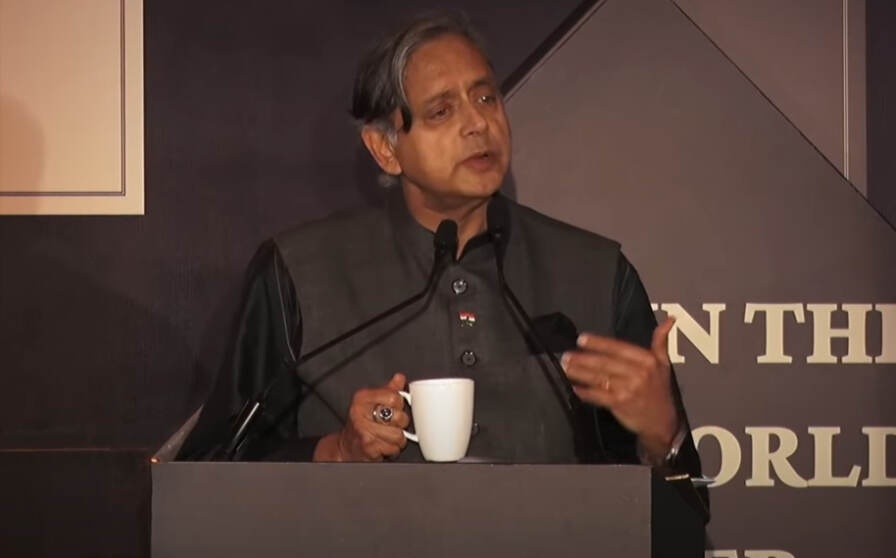
Read the full transcript of parliamentarian and author Dr. Shashi Tharoor’s lecture on India and The New World Order at the Literature Live Evening hosted on August 2, 2025 at the Trident, Nariman Point, Mumbai.
Welcome and Introduction
DR. SHASHI THAROOR: Thank you, Quasar, for that wonderful introduction and good to see you all here. It’s always good to be back at Literature Live, not least because I’ve been involved with it since its inception, since Anil Darkar first had this idea, invited me to speak and has thereafter, of course, not just had me come to the annual event, but also had a number of standalone occasions like this.
Sadly, he’s not with us, but it’s a tribute to his extraordinary contributions to this city and to the world of ideas that I allowed myself to be press ganged into giving you this talk. Now, Quasar, I have bad news for you. You don’t have to wait till next week for the book. I’ve already written it. It’s called “The New World Disorder and the Indian Imperative.” To its great misfortune, it was published just as COVID was breaking out. So it more or less sank without trace.
It was also a co-authored book with my good friend Samir Saran, the president of the Observer Research Foundation. It has some sort of shelf life in libraries, but it’s around. I gave it the title “The New World Disorder,” Samir added “and the Indian Imperative.” So it covers the ground. But unfortunately for me, in terms of preparing today’s lecture, the world has changed a lot since we wrote that book. That was five years ago. But I will try and cover some basic ground in the talk. Then Anuradha Sengupta is going to be in dialogue with me and then you’re going to be in dialogue with me. So we’ll try and see if we can deal with the main issues from whichever perspective you’re interested in.
A World in Uncertainty
There’s no time like the present, but the present is, I’m afraid, a world convulsed by war, challenged by increasing fragmentation and confronted by the erosion of the shared principles that have sustained the world order. So the certainties of yesterday are giving way to uncertainties today. One of which was I thought I had turned off the sound on my phone, but I had to keep it near me because Yashaswi Jaiswal is nearing his century. It wasn’t on. So once in a while, if you see me taking a quick look at the phone, it’s not because anyone’s giving me tips as to what to say to you. It’s because Jaiswal is 97 not out and I’m fingers crossed, okay? Right. So that’s one of the uncertainties, but I hope it’ll be fine.
On the coattails, as Quasar mentioned, of the resounding success of Operation Sindhur, India has once again found itself the center of global attention. We’d been a sort of diplomatic dark horse for some time, but in many ways, the multi-party delegations made a point and did so rather interestingly. I mean, even the composition of our delegations represented the kind of image India was starting anew to project. My team, for example, had eight people representing eight different states, five political parties and three religions. And that’s what India is. That’s what it’s all about. And that’s the message we try to convey with that.
India’s Strategic Position in a Shifting World
But I’m not here really to talk about that. I mentioned it only because Quasar did. If you want to ask questions about that, I’ll address it in the Q&A. I’m more struck by the fact that we inhabit a world so fluid that it’s very difficult for any nation, not just India, to entirely pinpoint where we stand in the shifting geopolitical order. And in some ways, we’re good with ambiguity. There’s something about the Indian mind that deals rather well with ambiguities.
And at a time when all the old verities are being stretched thin and new fault lines are emerging, India occupies a rare strategic space. In some ways, it’s a fulcrum between East and West and between North and South. And in a world that’s increasingly defined by polarization, we have a potential role to play as a balancing force, urging dialogue, keeping open communications or lines of contact with both sides in every one of the world’s major conflicts. And at the same time, forging partnerships that in many ways seek to transcend the business and the binaries of zero sum geopolitics.
The Origins of the Liberal International Order
So let me just briefly take you back to where all this began, since the topic I’ve been given is about the New World Order. Let me say that the broad superstructure of what was called the liberal international order was the order that was established at the end of the Second World War, when the victors of that time essentially imposed their rules upon the rest of the world. The UN was the carapace under which this order was supposed to run.
And in many ways, lots of good things happened under it. Certainly, we avoided World War Three, which is not a bad thing, considering what World War One and Two were like. And we were able not just to secure a certain degree of global peace. I mean, the world was not completely at peace, but a lot of the conflicts were outsourced to the likes of us, outsourced to the margins, as it were, whereas the central global system divided between these two superpowers remained nonetheless at peace.
There is no question, of course, that global coexistence and cooperation rested on some common sets of principles and values, the sovereignty of states above all, but also the need to avoid, for example, the use of force in settling international disputes, treating borders as sacrosanct, and finding common ground on a whole host of issues that my late boss, Kofi Annan, used to call “problems without passports” – problems that transcended all borders, that crossed, essentially, the planet’s everything from the environment and the need to sustain it, to human rights issues, to urban living and the whole phenomenon of urbanization taking place, conversely, the challenges of desertification, the challenges of global warming, all of these things which required countries to cooperate because no one country could fence off its climate or fence off its rights or fence off its own interests in these areas.
Those became the common ground for the liberal international order.
And at the same time, this could not mask the cold reality of a superpower confrontation underneath.
From Bipolarity to Unipolarity
In that period that I’m talking about, there were essentially two superpowers. If you look at the world from 1945 to about 1990, it was a world divided in this binary between the United States and the Soviet Union, and only they possessed the structural heft to shape the international order, the geopolitical order.
This, of course, unfolded or unraveled, I should say, with the end of the Cold War, the collapse of the Berlin Wall, and suddenly the era of bipolarity was succeeded by what was called for a while the unipolar moment, where the only power, the only superpower that mattered in the world was the United States. If you want me to put a date on it, say roughly 1990 to about 2010.
During this time, the Soviet Union disappeared essentially and became 15 countries, and the survivor state, the successor state of Russia, wasn’t a shadow of what the USSR had been. It still had nuclear powers, it still had a permanent seat at the UN, but now rising quietly, unobtrusively, and with the cooperation of the existing superpower, there was rising China.
And I must say the period that I’m describing to you, those 20 years or so, the US was not just unrivaled in terms of power, but it dominated global affairs politically, militarily, economically, and technologically. But today, let’s say from about 2010, the US no longer remains uncontested in any of those four categories.
The Rise of China and the End of the Unipolar Moment
So you have the financial crisis of 2008-2009, collapse of Lehman Brothers, all of that stuff, and suddenly people looked around and found that in fact one country was doing better than the rest, and that was China. The peaceful rise of the last quarter of the previous quarter of the century, fueled by American investment in its industries, and of course its own burgeoning export economy with the vast market in America and so on, had culminated in its supplanting the US as a global manufacturing and industrial powerhouse, rivaling it in economic scale, surpassing its trade surpluses, and beginning to challenge it even in cutting-edge technologies.
Now that era of the Cold War, as I said, replaced by a unipolar moment, and now by something one might call a cold coexistence. COVID-19, which we all remember now as a bad memory, marked the end of also
It’s not quite there yet. The many, many differences between the peak of the Cold War and the era today, yes, China has become a rival, one can use the word superpower, but unlike, for example, the old Cold War, the Russians and the Americans had no contact during the old Cold War. The Americans and the Chinese have extensive contacts, trade relations, hundreds of billions of dollars of trade relations. The Chinese own vast amounts of American treasury securities, there are American scholars crawling all over China, there are Chinese scholars on American campuses. It’s very different from the Cold War.
So we can’t really think of it as a repeat of history, but there is now an ongoing tussle between the multilateralism we celebrated, let’s say, till Covid, and a sort of renewed transactional bipolarity, when everything depends on what the Americans and the Chinese will do to each other, or with each other.
The Rise of the Rest and the Global South
And this is happening at a time when the rest of the world is also rising. So the rise of the rest is also happening. And very often, in fact, the rest includes countries like us, the so-called emerging market economies, who wanted to assure the West, “it’s not the decline of the West, it’s the rise of the rest.” And therefore, we can all rise together, which doesn’t always entirely work.
Now, from climate financing to digital infrastructure, global public goods, the developing world now suddenly realized it could find its own space and the capability to make its voice heard. So the Global South suddenly became a term of art. And the prowess of the Global South in innovation, in sustainability, in entrepreneurship, combined with the significant demographic advantage that it holds, because the South is much more youthful than the aging North. All this gives countries the leverage to be non-West without needing to be anti-West. And they’re carving out their own space in the process. India is a very significant player in this process.
Now… Sincerely, oh yeah, thank you very much. Well, now I don’t need to look, but that is very good news. I see 104. Excellent. Well, now, long may it thrive and continue.
India’s Multi-Alignment Strategy
Now, having played a foundational role in shaping the non-aligned movement under Pandit Nehru, India has in recent years sort of reimagined its policy under what I’m proud to say I first dubbed multi-alignment. If you’re looking for it in one of my books, it’s in my book, Pax Indica, published in 2012. I started using the term in speeches for a few years before that, I must say to a very cold reception from the Indian foreign policy establishment. We thought it was sacrilege to speak about it. So there’s a certain particular satisfaction I get that the current foreign minister uses the term as if he was born to it.
But the fact is that what I’m talking about is maintaining a series of relationships in different configurations, some overlapping, some not, with a variety of countries for different purposes. So to give you an example, every year our foreign minister meets with his Russian and Chinese counterparts in something called RIC. Then we add the Brazilians and the South Africans in something called BRICS. Now of course BRICS is 11 but let me talk about the original one. Then we subtract the Russians but we keep the Chinese in something called BASIC for environmental negotiations. And then we knock the Chinese out too and we have IBSA for South-South cooperation with Brazil and South Africa.
And India is the only one in all these configurations and not merely because our name conveniently begins with that indispensable acronym, elements in any acronym, a vowel, but because actually these institutions all matter to us. We have contributions to make to them and they are useful to us as well. And that’s the kind of multi-alignment I was talking about which goes along with the World Wide Web kind of world we’re in where networks are in every direction. And just as I may be connected to you on the Internet and you may be connected to him but I may not be connected to him, similarly we can have these relationships that cut across various lines. We’re not confined to the binary of the Cold War or to just one set of relationships.
Now that’s basically the key change. It’s one that involves active engagement and strategic balancing. It does give us an opportunity to be more assertive in India sometimes. We’re not just seeking to exist between competing powers as non-alignment helped us to do but to shape the space between these competing powers. We are navigating an increasingly networked world with agility and clarity and we’re forging coalitions that advance both national interests and universal principles.
The Indo-Pacific Strategy
Now I’d like to say that this kind of relationship or set of relationships that India has been going, have given it a very influential role in global geopolitics. And of course one of the areas where in particular we saw a significant uptick under the then benign inspiration of the US was in the so-called Indo-Pacific. A term about because it always used to be called the Asia-Pacific by Washington. They started calling it the Indo-Pacific precisely because they wanted to give us more importance in it. And we find that the pivot to Asia strategy that successive American presidents announced actually turned India into a significant player putting us for example into the Quad and don’t forget that the Indo-Pacific isn’t just a PR label. It’s home to nearly 60 percent of the world’s population. It has over two-thirds of its megacities and about 30 percent of global arms spending as well.
So for us the Quad actually guided as it is by a vision of a free and open Indo-Pacific represents a sort of strategic choice we’d made and a cooperative set of relations with a bunch of partners. We don’t call anybody allies yet because we don’t have any treaty alliances with anyone but we call them partners. And this is an important strategic partnership for us with in which India is not a peripheral participant but a key pillar even of the security architecture that’s a debatable thing. And we can talk about that some more if you want but we’ll be hosting the Quad summit later this year and all eyes are now on the rather unpredictable Mr. Trump to see whether he will continue to give the Quad the importance that he himself did in his first term and that other American presidents have done in recent decades.
From G77 to G20: India’s Evolving Role
The other thing that I want to mention of course is India’s presence. We used to be known as it were for heading or being a major voice of the global trade union of developing countries the so-called G77. Now we are a major voice of the global management system the G20 and we as you know hosted the G20 a couple of years ago with great fanfare and much public attention while at the same time seeking to serve as a voice of the global south which is kind of developing country 2.0 notion that the global south is much more than just a bunch of developing countries. It’s an entire attitude to the world to a transforming world in which we are players with our own active voice and whose center of gravity itself is changing.
Look at BRICS, I mentioned how we’ve gone from five now to 11 members. We’ve got a wide variety of new members in it and with countries like Egypt, Ethiopia, the Emirates, Iran coming in suddenly BRICS has acquired a pan-planetary dimension which clearly some people in Washington have decided to take a good hard look at and apparently don’t like judging by Mr. Trump’s comments about it and we’d have to see in some ways.
Yes, it’s fair to say that some in the BRICS would have liked to see it as an alternative to resist a global hegemony on the part of powerful western countries but on the other hand while India is about to assume the presidency of BRICS next year there is a moment of both momentum and concern with as you know Mr. Trump threatening extra tariffs on any members of BRICS. We already had one dose of tariffs a couple of days ago. He hasn’t yet announced any additional tariffs on BRICS but that’s something we’ll have to think about. And at the same time we have some heft of our own because the collective BRICS economy actually stands at a larger GDP number than that of the G7 which used to be the seven largest economies in the world and no longer is.
So all of this gives you a picture of the somewhat confused world order that we are now confronting. As I said when I wrote my book about the new world disorder I was talking about other things pretty much everything I’ve summarized for you now has evolved literally in the last few years.
India’s Economic Growth and Projections
Economically we’ve continued to grow. We are the fourth largest economy in dollar terms. We’re already the third largest economy in PPP purchasing power parity terms. And we will be the third largest in dollar terms as well by 2030, some say 2028. And that’s because we have our projected growth now of 6.4 percent and even though that’s less than many would have liked. If we sustain that we’ll end up overtaking Japan even in dollar terms. We have of course a vast and skilled workforce — skilled I’m exaggerating a bit. I think a lot of the workforce is not adequately skilled to take advantage of the opportunities available in the 21st century but we’re now developing some of that slowly, too slowly for my taste. But it’s happening. We’ve got new deepening industrial corridors and of course we have this web of diplomatic and trade linkages which is being augmented by newly signed trade agreements.
The Indo-UK agreement has just been signed comprehensive economic and trade agreement. We are talking to the Europeans about another agreement, and Japan might be coming down the pike for us. And suddenly we’re looking at seeing significant increases in trade with all these potential partners. Imagine 99 percent of our exports for example can now enter the UK duty-free and everybody here with any business idea in mind should be start selling to the Brits not to mention the fact that scotch whiskey is going to get a lot cheaper and as the evening wears on I’m sure we’ll all turn our thoughts to that particular British product.
Technological Sophistication and Defense Capabilities
Now in many ways when you thought talk about India in this particular context there are other aspects of India’s emergence that are worth mentioning. There’s technological sophistication which is something the world is really sitting up and taking seriously from indigenously developed anti-drone systems and air defense capabilities to precision guided munitions and supersonic BrahMos which already made a tremendous impact in the 88-hour war with Pakistan. We have cutting-edge capabilities which are getting better by the day.
We are also accompanying that kind of technology on the military side with a new approach in a new doctrine shifting from reaction and restraint to intelligent scalable deterrence and to signal to the world we’re not going to turn the other cheek if terrorists come across and kill our civilians. We will respond in a precise calibrated but highly effective manner and all of this is certainly going to be of some value. I know many of you will want to ask more about that. I’ll save that for the Q&A.
But I will say that we’ve had a couple of good developments after Operation Sindoor that are worth pointing to the U.S. declaration of the resistance’s front the so-called the Lashkar-e-Taiba’s proxy group that claimed credit for the Pahalgam massacre on the 22nd of April. They claimed credit within 45 minutes which makes it authentic because no one had reported the news by then when they claimed credit for it. That was a very good development that the U.S. has now condemned it whereas China had succeeded in getting the Security Council not to mention the resistance front and their statement condemning Pahalgam. Now the U.S. has collected enough evidence and decided that they know this is a terrorist group and they’ve condemned it.
And a different note when the Colombian government which I visited had issued a statement at the time of Operation Sindoor expressing “heartfelt condolences to the civilian victims in Pakistan” after we went and talked to them they withdrew that statement and issued one of great sympathy and understanding for India so there is a global interest there.
India’s Digital Economy Revolution
But it’s not just in defense I want to talk also about our extraordinary digital economy. Officially we have over 800 million people using the internet, the real figure might be even closer to a billion. Our technological momentum is just amazing. I don’t know how many of you saw that video by a Pakistani visitor on WhatsApp that expressed astonishment at the fact that chaiwalas now had QR codes that people could actually use their mobile phones to scan with, that’s now a part of India’s image just as much as snake charmers and fakirs lying on beds of nails used to be.
And what else is happening? We have Aadhaar which has been universally admired, we have UPI. UPI is the United Payments Interface that is completely indigenously developed and that is actually swifter than SWIFT the American invented state-of-the-art technology for transferring payments from bank to bank. Suddenly UPI is better faster swifter and people are sitting up QR code and two taps and you have your money gone. And it’s become global, 19 countries have signed up for it already and Namibia being the most recent. And I suspect before too long it will be the payment method of choice across much of the global south and the global north will probably have to sit up and say hey why don’t we get in on this too.
India’s Role in AI and Technology Leadership
So there’s going to be a lot of things happening. I’d like to see more initiatives on the AI race but all the right things are being attempted to begin with. We have already 16 to 20 percent of the world’s AI professionals. And then if you look at the Silicon Valley AI crowd, about 40 percent of those are actually Indians, expatriate Indians working in Silicon Valley developing AI. So Indian brains are very much at work here and I would like to think that we can continue doing well in that field. We are already by the way the top country of origin for foreign-born billionaires in the US, the number doubled from five such in 2022 to 12 in 2025. And of course more significantly for us as those guys are there and paying taxes there and not here or evading taxes there and not here.
Let me say that what’s striking about our digital economy today is that it’s now generating nearly one-fifth of India’s GDP which is something most people don’t realize. It’s truly transformative. I mean I don’t know I’ve got my good friend Nathan Goddard sitting here who may have a different view about traditional industries. But I do think that there are some significant challenges now to the sort of bricks and mortar solid visible tangible projects and products kind of businesses from the transformation and the valuation of the digital transformation that’s taking place.
Global Health Leadership and UN Peacekeeping
And you know there’s the technology not just in military, not just in bank transactions and UPI and mobile phone payments, even in things like vaccines India has made a mark. We were able to give vaccines to over a hundred developing countries during COVID-19 at a time when many of the rich countries are far too busy stashing up and stocking up vaccines for their own population most of which they ended up throwing away after the pandemic was over and which could have actually saved lives in Africa and elsewhere. India might never have actually been able to help as many people as the West could have but the fact that we did what we did and we got some help out there is something that is noticed and appreciated by a number of developing countries.
Then there’s a traditional Indian engagement with the UN. We have given almost three lakh two hundred and ninety thousand peacekeepers in over 50 UN missions around the world. Even today we are the fourth largest troop contributing nation but cumulatively we have been by far the first. Today we have only about five thousand peacekeepers.
I’m not going to get into great length on the subject of the quest for a permanent seat at the UN Security Council. If any of you is still really interested, I’ll be very happy to address it in great detail. But what worries me now, apart from the fact that this has been dragging on for three and a half decades and shows no sign of resolution, is the bigger concern that the institution of the UN itself is being increasingly questioned for its effectiveness or lack thereof in some of the major conflicts facing the world today.
After all, when a permanent member of the Security Council, whether it was the US in Iraq in 2003 or the Russia and Ukraine in 2022, essentially disregards the UN Charter that it has pledged to uphold, violates the sovereignty of a member state by disregarding the rest of the UN Security Council, and just goes ahead and acts, then you ask for what exactly is the UN worth. It’s there to prevent this kind of thing happening, and yet its own custodians are doing that. And that’s something else that we could possibly talk about, because if the UN is reduced to a series of hollow declarations and ineffective resolutions, while suffering on the ground, whether in Ukraine or Gaza or anywhere else, continues unabated, then those questions are indeed reasonable to ask.
Building Multilateral Alternatives and Self-Reliance
Now I’m not somebody who urges us to give up on multilateralism. I’ve spent too much of my life defending and advancing it myself. But I do believe more and more that for us to be able to take advantage of multilateralism, we have to be incredibly capable of protecting ourselves, strengthening our own capacities, building coalitions of consequence, investing in regional and plurilateral groupings as well as we’ve been doing with QUAD and BRICS and all of these other acronyms I tossed at you, and enhancing our own economic and military self-reliance. So yes, we have to be prepared to lead in our own areas where it directly affects us even when global institutions falter and where others merely pronounce.
Now at the same time, we have some challenges. For example, of all the QUAD members and all the BRICS members, we’re the only ones who actually face a direct military threat across our own borders from China. So we can’t be deterred from safeguarding our sovereignty by talking about restoring world institutions and peace if those provide a cover for an unfriendly neighbor to gradually nibble away at our own territory. So we have to have the capacity to engage economically with a country like China where we must, but at the same time, bolster our military deterrence so they’re not tempted into any irresponsible adventures and defend our geopolitical and economic interests on our own terms.
Trade Dependencies and Economic Challenges
Now we also have to seriously look at our own trade dependencies. After Mr. Trump’s Liberation Day tariff strategy, which has imposed 25% on us as opposed to 19% on Pakistan, as opposed to 20% on many of our competitors, Vietnam, Indonesia, and others, and on top of that, there’s going to be apparently an unspecified penalty because we’re buying Russian oil and gas, that threatens about $90 billion in Indian exports, and according to some experts, could shave half a percent of our GDP. So that’s not a small matter. And for us, therefore, we need to negotiate skillfully to find a way forward without compromising any of our core national interests. We have to show adequate flexibility and adequate common sense to know what’s worth defending and what we can afford to give in on in order to get some of this onerous burden lifted.
Now, there’s no doubt in my own mind that our diaspora has been an asset for us, but we have to still ask ourselves, are we going to continue to rely on them completely in countries like the U.S. and so on, or are we going to try and keep them at home or attract them to come back because we need their talent, their abilities, their experience, and their money back in India? It’s a tough question to answer. As one who lived and worked abroad myself, I would not discourage or deny anyone the right to do that, but I do hope that we’ll be able to get the benefit of all of those qualities that I just mentioned. If we can make our own conditions at home attractive enough for them to be able to work for us and serve us here.
Avoiding Cold War Dynamics and Building a Multipolar World
I think I’ve covered pretty much most of the key issues I’d like to cover. I have far too many pages of notes for the time available, but what I’d like to do is, of course, engage in further discussion with Anuradha and then with you on some of these in more detail, but let me stress, we are not at all keen on seeing another Cold War. We’re not at all keen either on seeing a condominium of the two of them, the sort of so-called G2 idea that was floated 10 years ago where the two of them would get along lovey-dovey and then boss the rest of us. We don’t want that either.
What we want, of course, is a multipolar world, one in which each has its own space, and that’s why about a week ago I wrote an op-ed in The Hindu, for example, advocating very strongly that we start cultivating Europe as we haven’t really done before because Europe is emerging as a new pole in its own right and that we start diversifying our partnerships, our trade agreements and increasing the space we need ourselves to deal with these global contradictions I’ve tried to describe to you. Pragmatic partnerships are what we will need to do in this turbulent and uncertain world order.
Global Governance and International Cooperation
One final thought, of course, relates to the structures of global governance. As somebody who spent nearly three decades of the United Nations extolling the virtues of globalisation and multilateralism and their unifying power, I’m sorry to say that I find myself much less certain of their prospects today. In this increasingly volatile world, nations have been largely left to fend for themselves, navigate crises on their own, while the machinery of global governance has often been found wanting. So I think it’s important that we see what role we can play in leveraging our influence to get these new big superpowers to cooperate on everything from future pandemics to environmental disasters on all these other problems with our passports I talked about, on the grounds that global cooperation is better for all of us than intensified rivalry would be.
And I think very clearly these are not amenable to being treated with a unilateral brush. Subjects like terrorism, migration, climate change, cyber security, and even the rise of AI require more international cooperation, not less. So that’s pretty much where I think I would like to leave it in this increasingly fluid global order, marked by the relative decline of rigid bipolarity of the past, but the rise of a new kind of bipolarity potentially, let’s look at ourselves as uniquely positioned with rising economic weight, with a conviction of the importance of our own strategic autonomy, with some credibility across geopolitical divides, with the only country, for example, with ambassadors in both Tel Aviv and Ramallah, with a Prime Minister who can hug Mr. Putin in Moscow and one week later hug Mr. Zelensky in Kiev.
India’s Unique Position and the Path Forward
So there are some signs that we can play a useful role within the shifting contours of the new world order. I will say, though, that there is no doubt that harnessing this new environment to tackle not just the great global challenges of our times, but the challenges we face in growing and developing and pulling our own people out of poverty and in finding our place in the sun in the 21st century, we will have to find a new way forward from the ones we’ve tried in the past, leveraging influence, fostering cooperation, bridging divides, and shaping to the extent we can even the rules of engagement for others. This is not a moment for retreat.
It’s a moment for strategic ambition. It’s at the same time one guided by principle and conviction, not just by opportunism. And we must, of course, always keep our own national interests, which is the interest of all Indians, paramount in the way in which we conduct this role. Nehruji famously asked the question to all of us, “Who lives if India dies, who dies if India lives?” A united India in this environment is not just a political slogan. It’s a prerequisite for us and for global leadership. When we are united, we are far more than the sum of our parts. We’re not just capable of responding to the world. We can be ready to shape it. So let’s hope that things go in the way that we are capable of making them go.
Thank you for listening to me so patiently. And Jai Hind. Thank you.
Related Posts