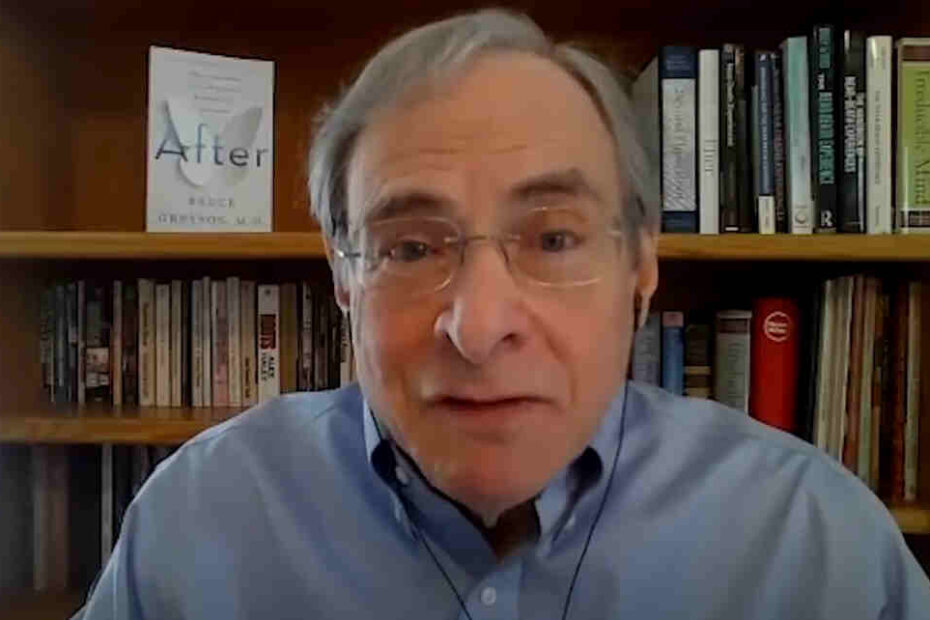
Read the full transcript of psychiatrist and near-death experience researcher Dr. Bruce Greyson’s interview on The Broken Brain Podcast with host Dhru Purohit, on “Near-Death Experiences: The BEST EVIDENCE Of Life After Death”, March 4, 2021.
Introduction to Dr. Bruce Greyson
DHRU PUROHIT: Hi everyone, Dhru Purohit here, host of the Broken Brain podcast. Today we’re talking all things near-death experiences with the world’s foremost expert in this area, Dr. Bruce Greyson.
Dr. Greyson is a professor emeritus of psychiatry and neurobehavioral sciences at the University of Virginia School of Medicine. He served on the medical school faculty at the Universities of Michigan, Connecticut and Virginia. He was a co-founder and president of the International Association for Near Death Studies and editor of the Journal of Near Death Studies.
His award-winning research led him to become a distinguished Life Fellow of the American Psychiatric Association and to be invited by the Dalai Lama himself to participate in a dialogue between Western scientists and Buddhist monks in India. His new book, which is called “After,” which is what we’re talking about today, is the culmination of almost half a century of scientific research. The title of the book is “After: A Doctor Explores What Near Death Experiences Reveal About Life and Beyond.”
If you care about this category, this podcast is for you. Stay tuned.
Growing Up as a Materialist
DHRU PUROHIT: So, Dr. Greyson, I’d love to start off at the beginning. You know, a big part of your message – you’ve been studying near-death experiences for 50 years, right? 50 years of experience with that topic. And one thing that I’ve seen you say in a lot of your talks and other podcasts and in some of your writings is that you brought this sort of healthy skepticism to this category.
And a lot of that influence came from not only being a medical practitioner, but your life growing up. So let’s talk a little bit about your life growing up. You use a term a lot called a materialist.
DR. BRUCE GREYSON: Yes.
DHRU PUROHIT: And explain that term and how your early life experiences and the background of your parents shaped that view of the world.
DR. BRUCE GREYSON: Well, materialism is the philosophy that the only thing that exists that is real is the physical world. Nothing else. Nothing spiritual, nothing religious, nothing non-physical. And that was the world I grew up in.
My father was a chemist, he was a scientist, and he taught me that science is the way we learn everything about the universe. And if you can’t measure it, then it probably doesn’t exist. So in my household growing up, we never talked about anything that was non-physical, anything spiritual or religious. It wasn’t that we were opposed to spiritual things. It just never occurred to us to talk about such things. They just weren’t part of our lives.
So I went through college and medical school with that materialistic mindset that what you see is what you get and that when you die, that’s the end of your life, that’s the end of it. And that’s how I approached everything.
Now he also taught me that an important part of being a scientist is being skeptical, which means questioning everything, especially everything you believe. So that you should always be open to new evidence that may contradict your own beliefs.
The Two Layers of Skepticism
DHRU PUROHIT: And I love that about – you know, I’ve heard you share that about your father in the past, and I love that because it’s almost like there’s really two layers of skepticism. The first layer is people tend to be skeptical of things that they haven’t been taught. So I want to be skeptical of any intervention or any topic that I haven’t been taught about in sort of a formal academic setting.
But a next level, which is what I really feel that you got from your father is the next level of skepticism is also to be skeptical of what you think that you know.
DR. BRUCE GREYSON: Right.
DHRU PUROHIT: And I think that’s very powerful and the full circle complete skepticism is that we have to universally apply it 360 to our life.
DR. BRUCE GREYSON: That’s right. That’s right. Because we know that everything we know is based on our senses and we know that our senses are fallible. They can be fooled.
The Life-Changing Patient Encounter
DHRU PUROHIT: Let’s talk about some of the early experience, or specifically the early experience that you had that started to have you open up and maybe question some of what you know. So just setting the time and place for our audience. You were in your first few months of your internship, right?
DR. BRUCE GREYSON: Right.
DHRU PUROHIT: Psychiatric medicine.
DR. BRUCE GREYSON: Right.
DHRU PUROHIT: And I’d love to turn it over to you to talk about that time.
DR. BRUCE GREYSON: Well, you know, there I was, a green intern, not very sure of myself, trying to look more professional than I felt. And I got called one evening to go to the emergency room and evaluate a patient who had been admitted with an overdose.
So I went down to see her and she was completely unconscious as far as I could tell. I tried to speak with her, I moved her limbs around and she had absolutely no response at all. So I assumed she was out cold based on whatever medication she had taken.
However, her roommate had brought her into the hospital and was waiting down the hall, in another room to talk to me. So I went down to the other room and got from the roommate information about the patient, what stressors she had been under, what she might have taken, and so forth.
And then when I finished talking with the roommate, I went back to see the patient, and she was still apparently totally unconscious. So she was admitted to the intensive care unit overnight, and I arranged to see her the following morning after she awoke.
When I went there the following morning, she was barely awake.
Well, that kind of surprised me, because I didn’t think she had any memory of me from last night. So I said to her, “I’m surprised. I thought you were unconscious when I came to see you.”
And then she said to me in a very clear tone, “Not in my room. I saw you talking to my roommate.”
Well, that kind of startled me because I couldn’t imagine what she was talking about. So I said, “Do you mean the nurses told you I talked to your roommate?”
She said, “No.” And then she opened her eyes, looked at me straight in the eye and said, “I saw you.”
That made no sense to me at all. The only way she could have done this is she had left her body and come with me down to the other room. And as far as I could tell, I was my body. How can you leave your body?
So she could see my skepticism. And she then proceeded to tell me about my conversation with her roommate. Everything we said, what we were wearing, where we were sitting, and she made no mistakes. It just blew me away.
But I couldn’t deal with my confusion. I was there to do a job, to help her with her confusion, to deal with her feelings of being suicidal and her future suicide risk. So I had to kind of push that out of my own feelings, out of my mind for a while, and try to deal with her.
I didn’t dare tell anyone else about this. They would think I was crazy. So I just kept it to myself. And as the days went on, I started thinking, “Nah, that couldn’t have happened. I must have been mishearing her, or maybe she was playing a trick on me somehow.” I couldn’t imagine how, but I kind of assumed this couldn’t really have happened. And yet it did.
So I kind of tried not to think about it, not very successfully, for a few years. And then eventually, Raymond Moody joined me at the University of Virginia. And Moody, in 1975, had written a book called “Life After Life,” in which he gave us the term near-death experience and described what they are like.
And that was my first inkling that this experience the patient told me about was not just one isolated event, but as part of a much larger phenomenon that happened to a lot of people. I still couldn’t understand it, I still couldn’t explain it. And to me as a scientist, that means you need to study this, you need to find out what’s going on here. And here I am 50 years later, still trying to understand it.
Why People Don’t Share Their Experiences
DHRU PUROHIT: It’s powerful and it’s amazing that your own experience of – you didn’t have a near-death experience, but your experience of somebody relaying that information to you is very similar to, as you write in the book, the people who have gone through it, that they often don’t, at least many years ago.
And still it’s getting a little bit better because near-death experiences are in popular culture. It’s a little bit more, it’s not as – it’s a little bit more politically okay to be able to talk about them, but it wasn’t so back then. And many people who have these experiences don’t talk about them.
DR. BRUCE GREYSON: Right.
DHRU PUROHIT: What did you find is the reason why? Why didn’t you talk about it? And why don’t many people who have gone through it talk about it?
DR. BRUCE GREYSON: Well, we’re talking about back in the early 1970s when no one had heard about these things and they just sounded crazy, like you were imagining things or delusional. And if I told people about this, they might think I was crazy or at least very gullible, falling for some fantasy a patient had told me. So I kept it to myself.
And you know, I’ve talked to many patients about why they’re reluctant to talk about it. And back in the 70s and 80s, it was mostly because they were afraid they were going to be called crazy or they were just embarrassed to admit that this strange thing had happened to them.
They also sometimes resist them because people expect things of someone who’s had a near-death experience. They may expect them to be weird or bizarre, or they may expect them to be on a pedestal and be saintly and not do unpleasant things. And of course, they’re still people, they still do all sorts of unpleasant things.
And beyond that, many people say that their near-death experience was just so personal they can’t share it. It was meant for them and not anyone else. And they also say that it was something that is very difficult to put into words. You can’t describe it. So if I tell you about it, I will sort of profane it or distort it by putting it into words.
DHRU PUROHIT: It almost seems like for many people, it’s the combination of feelings, sensations, you know, visions. It could be a whole host of things. And it’s hard to use 26 letters in the alphabet to try to encompass all those aspects.
DR. BRUCE GREYSON: Right.
Raymond Moody’s Approach and Influence
DHRU PUROHIT: You know, you’re a pioneer in this space. And in reading about your story and how you came across this book, “Life After Life” by Raymond Moody and him joining in Virginia, you got a lot more confidence because of his own writings. Now from knowing a little about his story, what sort of backlash, if any, did he get when he published his books and started talking about this, especially in a university setting? Any stories that you can share with us or what your perception was of what he went through?
DR. BRUCE GREYSON: Well, of course he got a lot of skepticism, but Raymond was basically a philosopher before he went to medical school, and he approached the experience as a story, like a myth, and described these as just something that people report. He didn’t make any claims about what they really meant, what their ultimate meaning and origin was. So he didn’t get the kind of skepticism and criticism that you get if you are claiming to know what causes these experiences.
DHRU PUROHIT: And it seems that part of that approach matched the way that you wanted to approach it as well is that let’s not presume to know what all this means, but…
DR. BRUCE GREYSON: Right.
DHRU PUROHIT: It doesn’t mean that we cannot investigate it, that we can look at it like a scientist.
DR. BRUCE GREYSON: Exactly.
Beginning the Scientific Investigation
DHRU PUROHIT: So take us from there. When you had this experience with this woman who overdosed and told you that she essentially had an out-of-body experience where she saw you communicating with another person in detail, which is whether people want to call that astral projection or something like that in the traditional spiritual language, you have that experience, kept it to yourself for a few years, and then came across a book that really opened your world. What did you decide to do from there in terms of investigating this a little bit further?
The Scientific Approach to Near-Death Experience Research
DR. BRUCE GREYSON: Well, I don’t take any one experience as being evidence. I’m too aware of how faulty our perceptions are and our interpretations are. So I started collecting as many experiences as I could.
And when you start getting hundreds of these, then you can look at what are the recurrent patterns among the different experiences, what are the commonalities so that you’re not just looking at one person’s idiosyncratic interpretation based on his or her belief system, their religious beliefs or their cultural beliefs.
And by looking at a whole group of patients with different backgrounds, you can see what things are really common and which things are just unique to one individual. Once we started getting more publicity about the near death experience, people started coming forward with hypotheses to explain them. And then we started collecting the physiological data to try to prove or disprove some of these hypotheses. So there’s a lot of different areas of research that we can go into to study near death experiences.
Building a Research Network
DHRU PUROHIT: On a practical level, can you tell us about the early days and how you ended up collecting these? How do you actually spread the message back then? Is it a press release? I can imagine there can be some trepidation in terms of how do you both collect these experiences, but put out a call that’s wide enough for people to come and find you?
DR. BRUCE GREYSON: Right, right. Well, to begin with, Raymond Moody’s book quickly became a best seller, and he was getting flooded with letters and calls from people who had these experiences, and he shared those with me. And we started responding to those people collecting their stories.
Soon after that, I started publishing articles in medical journals about this phenomenon. And when those got picked up by the popular press, people started hearing about my name and they started writing to me and calling me. So I was starting to collect these stories from a variety of sources, but I was aware that these are people who chose to come to me, and they might therefore be a biased sample of all the near death experiences that are out there.
So I also decided to look at a whole cohort of patients in the hospital who had come close to death and interview them to see what the typical experience was like. So I studied, for example, people who were brought to the hospital with a cardiac arrest, whose hearts had stopped, people who had committed attempted suicide and had come closer to death that way, and so forth. So I had both the sample of people who chose to come to me with their stories and people who were in the hospital because they had come close to death and didn’t choose to come forth with their story until I asked them.
The Story of Jack and Anita
DHRU PUROHIT: Speaking of stories, I think this is a perfect time to bring in one of the stories that’s incredibly powerful. I mean, there’s so many stories inside the book that you share. There’s one story that really just builds on top of that early experience that you had, and it’s a story of a gentleman who went in for surgery, who had a relationship with a nurse, who read MGB. Can you tell us a little bit about this story?
DR. BRUCE GREYSON: Sure, sure. I should say also that first experience I had, I didn’t know anything about near death experiences at that time, so I didn’t know to ask her about other features she might have had in her experience. And so there’s a lot of information about her experience that I just don’t have. So I tended not to pay a lot of attention to experiences like that.
Now the gentleman you’re talking about, his name was Jack. I interviewed him probably 25 years later and at that point I knew a lot about what near death experiences were like. He had his experience in the 1970s. He was at that time a 25-year-old technical writer who was hospitalized with severe pneumonia. And he had repeated episodes of respiratory arrest where he just could not breathe.
And he had one particular nurse who got very close to him, who was a young attractive nurse who used to try to flirt with her. And at one point she told him that she was going to be taking the long weekend off. And he said goodbye to her, wished her well. And shortly after she left, he had another respiratory arrest and had to be resuscitated.
And at that point he had a near death experience. And he said that he found himself in a pastoral scene and he was very peaceful and he was enjoying being there. When he saw this nurse Anita, come walking towards him, he was startled to see her there. So he said, “Anita, what are you doing here?” And she said, essentially “this is where I am now, but you have to go back and I want you to tell my parents that I love them and I’m sorry I wrecked the red MGB.”
And then she turned and walked away. And then he later awoke in his hospital bed having been resuscitated, with full memory of his near death experience. And he told the first nurse he saw about the experience and she immediately started crying and went out of the room.
It turned out that this nurse had taken the weekend off to celebrate her 21st birthday with her parents who had flown in from the country to celebrate with her. And they gave her for her birthday a red MGB. She was very excited, jumped in the car and took off down a hill, lost control of the car and smashed into a telephone pole, dying instantly. And this was a few hours before the patient’s cardiac arrest, his respiratory arrest.
And yet he knew that she was dead. There was no way he could have expected to have met her because he had no idea, no way of knowing that she had died. And he certainly couldn’t have known how she died, and yet he did in great detail. We have just no explanation for how that could be.
The Mind-Brain Connection
DHRU PUROHIT: Incredible story. And really what you’ve dedicated your life to is, first, anybody who’s listening to that story and me having read about it, it gives you chills because there’s a sensation that we don’t know what is going on. But what we do know is, well, what we maybe know is that the world that’s in front of us isn’t our only experience.
DR. BRUCE GREYSON: Right.
DHRU PUROHIT: There’s something else that’s happening. You said in the early days that you approach this as a scientist and you would try to come up with hypothesis.
DR. BRUCE GREYSON: Yes.
DHRU PUROHIT: Try to break down the different types of themes and experiences that were there. And one of the things that you were exploring is this idea that some of these near death experiences that people went through seemed to show that there was that the mind and the brain weren’t always intertwined.
DR. BRUCE GREYSON: Right.
DHRU PUROHIT: Can you add a little bit more about that?
DR. BRUCE GREYSON: Sure, sure. Well, let me define things. First, the brain is this 3-pound mass of gray pink tissue inside your skull. And the mind is that part of you that thinks and perceives and feels and makes decisions and so forth. And we usually think that the mind is simply what the brain does, that all our thoughts and perceptions and memories are created by the brain.
Because that’s the way it seems in everyday life. When you get drunk, you don’t think very clearly. When you get hit on the head or have a stroke that affects your thinking. So it seems in everyday life as if the brain does create the mind or is the mind.
However, in certain circumstances, like the near death experience, the brain seems to be getting diminished in its abilities. It may be totally offline. And yet our thinking and our perceiving are more vivid than ever. And this cannot be if the brain is actually creating the mind.
I should say that the near death experience is not the only example of this. There’s something called terminal lucidity in which people who have advanced dementia like Alzheimer’s disease and haven’t been able to communicate for years and don’t recognize their family suddenly become completely lucid again in the hours or sometimes days before they die, and they carry on coherent conversations and recognize people again.
And the family gets very excited thinking, oh, they’re recovering. But of course, the brain cannot recover from something like that and they end up dying shortly thereafter. And we have no medical explanation for how that can be.
We also have some neuroimaging studies of people having psychedelic drug trips in the last decade that have shown something very interesting. We always assumed that the way psychedelic drugs worked was by stimulating the brain to produce hallucinations. And what these studies, which are done primarily in Johns Hopkins University in the US and Imperial College in London, have consistently shown that with a variety of psychedelic drugs, the more elaborate, mystical experiences people have under these drugs are associated with a decrease in brain activity.
So the brain activity goes down and then the consciousness goes up. And that just doesn’t fit what we usually think of as the brain creating the mind. So it suggests that the mind is not part of the brain.
Now how do we explain that? It seems as if the mind is something else, and if it is something else, what is it and where is it? And I don’t have an answer to that. But it raises all sorts of questions, like how does this non-material mind interact with the physical brain? And we don’t have any answer to that.
However, the materialistic explanation that the brain creates the mind also has equally large holes in it. And the most basic problem is how does a physical, chemical or electrical impulse in the brain create a non-physical thought or feeling or perception? And we have not the hint of the suggestion of the slightest idea of how to ask that question. We have just no idea how a brain process can create a thought.
So it seems as if the mind and the brain are not the same thing. And this is not, by the way, a new idea. Hippocrates wrote about this 2,000 years ago. He said the brain is the messenger or the interpreter of the mind. And this has been a minority opinion throughout the last 2,000 years among scientists.
The Filter Theory of Consciousness
And many use an analogy of a filter of some sort. An example is your cell phone. Your cell phone receives radio waves. And there are thousands and thousands and millions of radio waves out there. And if you tried to listen to all of them at the same time, if your phone didn’t filter them out, you wouldn’t be able to understand any of them.
So your cell phone filters out all the signals except the one frequency you want to listen to. And if it didn’t do that, you wouldn’t be able to understand anything. You’d be flooded with all this miscellaneous material.
And in the same way, they say, the brain selects all the contents of your mind, all your consciousness, and filters out the irrelevant parts and just lets in the information that you need to survive in the physical world. The brain, after all, evolved in the physical world to help us survive in this realm. And it lets in that information that’s important to surviving here, how to find shelter, food, a mate and so forth. It doesn’t need information about deceased loved ones or deities in order to survive in the physical world.
This should not be surprising to scientists because all our senses are like this. There’s lots of wavelengths out there that we don’t see when we look. We just see a small portion of the visible spectrum that’s relevant to our survival. And our ears filter out a lot of sound frequencies that we don’t need and just lets in those few frequencies that are essential to our survival. So it makes sense that the brain may do the same thing with our thoughts.
DHRU PUROHIT: On top of that is it, would it be also fair to say, and I know language is so important here, but would it be fair to say that it seems that if we use the term consciousness in terms of awareness, the perception of awareness, it’s there, that consciousness, based on these collection of near death experiences, it seems that consciousness could be bigger than our immediate physical body. Would that be fair to say or would you say that in a different way?
The Liberation from Physical Limitations
DR. BRUCE GREYSON: Well, that’s what almost every near-death experiencer I’ve talked to has said, that once you are, quote, “free of the brain,” you’re able to appreciate everything else is going on around us. And that when you come back into the brain, you feel restricted again. They talk about trying to squeeze themselves back into this inadequate shell.
And many of them say that there were things that happened in the near-death experience that were crystal clear to them. Their thinking was faster and clearer than ever. And when they come back to this realm, they have trouble understanding it because their brain limits their understanding.
Let me give you a specific example of that. Most near-death experiencers say that in this other realm that they were in during the near-death experience, there was no sense of time. That time is just something that we impose on the physical realm. But in the other realm, there was no sense of time. That things happened at the same time and things happened in eternity and there’s just no concept of how long something took. It was all eternal.
And yet when they tell me about what happened in the near-death experience, they describe it as a sequence of events. This happened and then this happened and this happened. So, you know, I say to them, “How can you have a sequence of events if there isn’t a time? Because events happen in time.” And they just kind of shrug and say, “I know that when I try to explain it to you in terms of this world, it’s a paradox. It doesn’t make sense. But on the other world, it made perfect sense.”
DHRU PUROHIT: Yeah. And when you, you know, I’m by no means trained in this area at all, but when you read as a layperson like myself about some of the elements and discoveries of quantum physics, you start to see that with different dimensions and coexisting states, there could be some truth to that. We don’t know exactly how it works, but there does seem to be some validity for it.
Beyond Newtonian Physics: A New Model for Consciousness
DR. BRUCE GREYSON: Exactly. You know, the old Newtonian mechanics that we use for hundreds of years works very well for everyday life. But in the early 20th century, when we started exploring very, very fast speeds and very, very small objects, subatomic particles, the Newtonian mechanics we’ve been using for everyday life did not work anymore. And we needed to add to our sense of physics the ideas of relativity and quantum mechanics.
In the same way, the idea that the brain creates the mind is a fine model for everyday life. But when you get to extreme situations, like when the brain is going offline, you need a new model. So I think just as we’re finding that physics as we know it doesn’t apply to all different circumstances, so too the materialistic conception of brain and mind doesn’t apply in all circumstances.
Life-Altering Transformations
DHRU PUROHIT: You know, you brought up the work at Johns Hopkins in terms of psychedelics. We’ve previously had Dr. Roland Griffiths on the podcast talking about his work, which was a great episode. And you make the parallel between, just as you did earlier in the interview, that there are a lot of similarities. There are some parallels between these psychedelic experiences and these near-death experiences.
And one of the key parallels, which is really, I feel the big punchline of the book is that after going through significant psychedelic experience or a near-death experience, it seems to be based on the surveys that you’ve put together as well as Dr. Roland Griffiths and the collection of these stories, that people are forever changed. And can you tell us some of those examples or areas of life where you collected in your stories where they were forever changed, they could no longer see things in the same way.
DR. BRUCE GREYSON: Sure. This is almost universal among near-death experiencers, that they come back with altered attitudes, beliefs, values and behavior. And they tend to become much more spiritual, for the lack of a better word. They become much more compassionate, much more altruistic, much more concerned with interpersonal relationships, and much less concerned with material things, with physical possessions, with power, prestige, fame, competition.
And this does not go away. You know, I’ve talked to people in their 90s who had the experience as teenagers, and they say it’s like it happened yesterday. I’ve never gone back to the way things were. And people change their careers. Sometimes marriages break up because of this.
Let me give you some examples. One fellow I knew was a career Marine. He had been a schoolyard bully, real macho guy. And he always wanted to be a Marine. And he ended up going to Vietnam and was a sergeant, leading his platoon into battle. And he was shot in the chest and had shrapnel throughout his lungs. And he was aerovacked to a hospital in the Philippines where he was operated on. And during the operation he had a very elaborate near-death experience.
And when he awoke from that experience he found that he could not tolerate the idea of violence, of hurting someone else. He was of course sent back into the field, into Vietnam and tried to lead his platoon, but he found he could not shoot his gun. So he ended up leaving the Marines and coming back to the States and retraining as a medical technician.
I talked to another fellow who was a policeman who had a near-death experience when he bled out during surgery. And he too found that he just could not shoot his gun. After this near-death experience ended up becoming a high school teacher. I’ve talked to people who were drug addicts who after a near-death experience turned their lives around, never had an urge for a drug after that. I’ve talked to cutthroat businessmen who found that competition trying to get ahead at someone else’s expense no longer made sense to them.
They come back with the sense that we are not separate individuals. We’re all part of the same greater thing that’s greater than any one of us. And therefore hurting somebody else is basically hurting yourself as well. And they come back with basically the Golden Rule that you should treat other people as you want to be treated. Now there’s a reason why every religion we know has some version of the Golden Rule as its basic precepts. That’s because most of these religions came out of mystical experiences like near-death experiences.
Seeing Beyond the Veil of Illusion
DHRU PUROHIT: When I read that part in your book, I also thought about, you know, modern day, for lack of a better word, spiritual teachers like Eckhart Tolle and Byron Katie, who I really look up to in their work, has influenced me a lot. Both of those individuals having some version of a dark night of the soul or near-death type of experience. It wasn’t a death experience, but it felt like a dying inside and an awakening, for lack of a better term that took place after that where there was this recognition of wholeness.
You know, when we use the word materialist and we think about materialism, I often think of input and response. And one of the things that shapes our worldview in terms of what we tend to prioritize as a society and what we don’t, it can be our external surroundings, family, friends, and often society in the media. And so if everybody’s telling you your whole life from the time that you’re young, that it’s all about success and how much money you have in the bank account and all the things that you can build up, those inputs shape your vision of the world. They do, and then determine your actions.
And then you go through one of these near-death experiences or in some cases for people, as Michael Pollan has talked about a lot in his book, these psychedelic experiences, there’s recognition of almost you have, you know, in my background and tradition from India, you know, there’s a term called Maya. And Maya describes the veil of illusion. You sort of look behind the veil and you see something that you never saw before.
DR. BRUCE GREYSON: Right, right. And that can be very distressing. People come back to this physical world and they don’t fit into the way they lived before and they have to make drastic changes in their lives. And now imagine a family where one member of a marriage suddenly has this conversion experience, the other one doesn’t. That can be very difficult to deal with. And many people have a hard time coming back to normal, quote, “normal” life.
The Dark Side: Unpleasant Near-Death Experiences
DHRU PUROHIT: As I imagine anybody would. When you see on the quote, unquote, “other side” of it, can you tell us about some of the other themes that you noticed, if there’s any, that we didn’t get a chance to touch on, that near-death experiences encompass, and I’m thinking specifically some of the misconceptions that people have, and I’ll toss in one that you talk about in the book, is that not every near-death experience is positive. There are a minority of them that people perceive to be, lack of a better term, maybe traumatic.
DR. BRUCE GREYSON: Right, right. Well, as you suggested, the vast majority are pleasant. And the typical features of near-death experiences include a sense of leaving the physical body, feeling very good, feeling peaceful, a sense of well being, sometimes encountering a warm, loving being of light which makes you feel welcomed and loved, maybe going through a review of your whole life and at some point coming to a decision to return to life or being sent back against your will to life.
But there are a minority of experiences that are unpleasant rather than blissful or pleasant. And these were hard to collect at first because people were unwilling to talk about these things. And for many years we didn’t know there were unpleasant experiences. Back in the early 1980s, my colleague Nancy Evans Bush and I collected about 50 of these unpleasant cases and it took us a long time to find that many. And we tried to look at what they contained.
And there was a very small number that had typical hellish imagery, fire and brimstone and demons. And these were only described to us by people who had a religious background that would lead you to expect something like that. Roman Catholics or fundamentalist Protestants. We never heard that from someone who didn’t have that type of a background.
There was a larger group that found themselves in a black void with nothing. And there was no sights, no sounds, nothing but your consciousness and nothing else for eternity. And that for most Westerners is a terrifying experience. I should say that I’ve talked to a few people who had their near-death experiences in their native India, where they were raised in a Hindu or Buddhist culture, and they talked about the same black void and experienced it as blissful. They said this was like nirvana, this is not unpleasant. So your culture kind of determines how you interpret what you experience.
And that will bring me to the largest collection of unpleasant experiences, which sound phenomenologically just like the pleasant ones, but they’re experienced in a terrifying way. People will report being ripped out of their bodies and thrust down a tunnel at lightning speed and confronted by this bright light, and they’re fighting against it no matter what a near-death experience contains. One invariant feature is that you’re not in control of it, that something else is controlling the experience. You’re a passive recipient of it.
And if you’re the type of person that needs to be in control, that can be a terrifying experience. So people resist having this thing thrust upon them and they fight and fight against it. And that’s a very unpleasant experience. At some point, many of them get exhausted trying to fight it and just surrender to it. And as soon as they do, it becomes a blissful experience. So it seems as if what’s frightening about these experiences is your reaction to it, not the experience itself, but you’re feeling out of control and terrified by that.
I should add that we don’t really know how many unpleasant experiences there are. Most researchers who try to find a number for this come up with between 1 and 5% of near-death experiences being unpleasant. But the truth is these experiences are so much harder for people to talk about that there may be more that we just haven’t heard of.
Death as Liberation
DHRU PUROHIT: Philosopher and teacher who was early in the world of psychedelics and probably led to some of that backlash of psychedelics being banned and, you know, being called a Class 3 drug is the spiritual teacher Ram Dass, who passed away a few years ago and he had this great quote that I always remember. He said, you know, in the space of awakening, there’s this recognition of death is like, is simply like taking off a tight shoe.
DR. BRUCE GREYSON: Yes.
DHRU PUROHIT: And I thought about that quote when I was reading through your book because one of the things that you highlighted from the folks who had gone through these near-death experiences is that as you say, largely they were pleasant experiences and they were left with this feeling of a reduction of fear of death. Can you share any more about that?
The Most Common After-Effect: Loss of Fear of Death
DR. BRUCE GREYSON: Yeah, that’s probably the most common after-effect of a near-death experience. No matter what people say this other realm is like, they report almost universally that it is not something that is unpleasant or something to be afraid of, that they welcome it and that leads them to be no longer afraid of death or dying.
Now when I heard about that as a psychiatrist, I immediately thought about, oh, is this going to make people more suicidal? Because I deal with suicide all the time as a psychiatrist. So I did a study of that, you know, being a scientist. So I interviewed people who were admitted to my hospital with a suicide attempt and tried to look at those who had a near-death experience as a result of that attempt and those who didn’t have a near-death experience.
And I compared their suicidal thinking afterwards and what I found was that those who had a near-death experience were much less suicidal than those who didn’t have an NDE. And when I asked them to explain that to me, what they said was essentially that when you lose your fear of dying, you also lose your fear of living to the fullest because you’re not afraid of taking risks and losing something, because you’re not afraid of what comes next.
And they say that once you have this near-death experience, you realize that you’re not alone. You’re part of something much greater than yourself. Which means that the problems of this bag of skin are not all that important. There’s a lot more going on and you tend to see your problems not as something to be escaped from, but to something to struggle with and learn from and grow from. And that gives them a sense of meaning and purpose in their lives that they didn’t have before.
Benefits Without the Experience
DHRU PUROHIT: As your book is approaching launching, you know, been getting fantastic press. Congratulations. I hope this podcast can add to that but there was an article that was published yesterday in the Daily Mail. You know, not typically a website that I read, but I’m always happy when people that I look up to are getting featured in there because I know they have a wide reach.
And the title of the article I’m just paraphrasing here is that, you know, a doctor writes a book about near-death experiences and the bottom line is they make you a happier sort of more whole person. And I think that when people, you know, pick up your book or are new to your work and they’re reading it, there’s the question of like, okay, I’m living, I haven’t had a near-death experience right now. How can maybe I benefit from some of these findings that are there in my own life if I want to get some of the things that these people have had, what can I do to benefit from that?
DR. BRUCE GREYSON: Yeah, well, actually the good news is that you don’t have to have a near-death experience to have some of these same side effects. There have been six studies at this point of people who took classes in near-death experiences. Four of them were in college students who had a course in near-death experience. One was in nursing students and one was actually in high school students who learned about near-death experiences.
And in follow-up studies, they found that up to a year after the course, these people were more compassionate, more altruistic, more loving, more concerned about other people than they had been before. So some of this information that comes through a near-death experience can be transmitted without actually having the experience. And that frankly is one of the reasons I wrote my book after hoping that people who read about this may share some of the same beneficial after-effects as having a near-death experience.
DHRU PUROHIT: And when you talk about these classes, for example, for those that are listening, are there resources or places out there that people can actually look up that you feel comfortable to mention?
DR. BRUCE GREYSON: Well, those classes were at colleges mostly where you have to be enrolled in the college to take the class. But one of the best resources is the International Association for Near-Death Studies and their website is www.iands.org. And they provide a lot of educational programs, a lot of accurate information about near-death experiences. They publish a newsletter, a journal, they have conferences and a lot of resources available to study about near-death experiences.
Overcoming Academic Resistance
DHRU PUROHIT: Can you talk a little bit about some of the hurdles that you had to go through along the way to really make sure that this topic got the attention it deserved? I think at some point in time there were some questions of people that were above you telling you whether you should or shouldn’t be looking into this.
DR. BRUCE GREYSON: Right, right, right, right. Well, you know, doctors and academicians are just like everybody else. They have a variety of opinions and they come to this field with a variety of biases. And some think it’s the most fascinating research in the world and some think it’s an embarrassment and I shouldn’t be doing this, wasting resources on it.
And I have had some, some chairman, some supervisors who thought this was going to be dangerous to my career and I should stop doing it. So yeah, you have to make choices at some point of what feels right to you. And I certainly could have turned away from this research and studied something that was safer for a psychiatrist to study, basically treating mental illness and so forth.
But since I knew about these experiences and couldn’t understand them and wanted to, it seemed intellectually dishonest to me to just turn away from it and not study it. So I pursued it. And I did pay some cost at first, but I’ve seen over the decades that I’ve been doing this research that it’s been more and more accepted.
And some of that comes from the fact that I have published all my research in respectable medical journals where it gained some credibility and some. It’s just that it’s been so widespread now. It’s in television shows, it’s in movies, even comic strips now have near-death experiences in them. So everybody knows about them.
When we first started talking about near-death experiences in medical conferences in the 1980s, very few doctors had heard about these things and most just listened and politely nodded or shook their heads and didn’t say much. And now when we talk in medical conferences about near-death experiences, we often get doctors in the audience standing up afterwards and saying, “Let me tell you about my near-death experience.”
So it’s becoming increasingly common. You know, doctors still disagree on what causes the experience, what the ultimate meaning of it is, but they generally recognize that these are important experiences that happen to a lot of their patients and affect the patients’ lives and therefore they want to understand them.
Historical Accounts of Near-Death Experiences
DHRU PUROHIT: We’re almost returning back to rediscovering and openly talking about these things after having been sanitized from our sort of westernized experience for a while. But you talk about inside the book and in past articles and talks that you’ve given that these are not new cultures, have been exploring them for a long time. Are there any examples that you want to share with the audience?
DR. BRUCE GREYSON: Well, one of the earliest ones is in Plato’s Republic where he talked about Er, a soldier, a Greek soldier who was killed in battle. And on his funeral pyre he suddenly woke up and sat up and told a story about having been to the afterworld and described a lot of adventures.
A scholar named Gino Plathy wrote a book several years ago about was called “Near-Death Experiences in Antiquity.” And he collected about 30 different near-death experiences from Greek and Roman literature. And some, like Plato’s story about Er, are presented as stories or as myths, whereas others are presented as real events with documented names and people involved in it.
Pliny the Elder in the first century wrote about a Roman soldier, not a soldier, a Roman patrician who had died and was put in a funeral home and was about to be prepared for his burial when he suddenly woke up. And he told the startled mortician that he had just been to his brother’s home and saw that his brother had died and said, “I want the arrangements made for my funeral used for him.”
And he also said that his brother had told him before he died where he had buried the family treasure in the backyard. And it turned out that as he was telling this, his brother’s servant comes running into the funeral home and says, “My master has just died.” And it proceeded as near-death experiences in today’s world do, with verifiable information coming from apparently some other realm.
And there are dozens and dozens of these cases throughout history. In the 19th century, they started appearing in medical journals in France and Germany and eventually in the United States. But it wasn’t until Moody wrote his book in 1975 that research in the US started getting serious about this and we started collecting more and more cases.
Near-Death Experiences and Reincarnation
DHRU PUROHIT: In the Indian tradition, there is a lot of sort of belief and dialogue about the reincarnation. And often a lot of times when people think about near-death experiences, there’s sometimes a topic comes up that’s not particularly your field of, you know, you looking into that. But you did come across some information on the topic of reincarnation. Can you share that?
DR. BRUCE GREYSON: Yes, yes. All my colleagues at the University of Virginia have studied very young children, usually preschool age 2, 3 and 4 years old, who claim to remember a past life. And when they give enough specific details about, you know, names and dates and places, we try to track that down and see if we can verify the information. And in a lot of these cases we can.
And it turns out that the child often has a lot of accurate information about some past life, and we don’t know how that can happen. Certainly the hypothesis that comes right to mind is it’s a reincarnated person. But there are other explanations as well that may be more or less plausible in different situations.
An interesting question is, what’s this got to do with near-death experiences? And there are some near-death experiences in which people have a life review in which they review various things from their lives and also things that seem to be from a past life. And some of those, in fact, have been corroborated, but they’re a small minority, and most people do not, in the near-death experience, talk about a past life or anything about reincarnation.
Psychologist Kenneth Ring did a lot of the early research on near-death experiences in the 1970s, 1980s, and one of his students did a study of reincarnation beliefs among near-death experiencers. And he found that that about a third of near-death experiences reported a firm belief in reincarnation. However, when you looked at a control population about the random sample of Americans, they also reported about a third of them had a firm belief in reincarnation. So the near-death experiencers didn’t have any more or less belief in that than everyone else did.
DHRU PUROHIT: When you talked about some of the earlier, when you were talking about reincarnation and some of the work that your colleagues had done, what were some of the other plausible explanations that you were hinting towards? You were saying that one idea would be that maybe this could be somebody who was reincarnated. Obviously, there’s no way for us to know in sort of our, in our current, you know, world of science, what would be some of the other things that you thought that you were hinting towards that would be plausible answers to that?
DR. BRUCE GREYSON: Well, it depends on what you think is plausible. Some people don’t think reincarnation is plausible. One hypothesis is that the deceased spirit somehow possesses this individual. So it’s not like you are that person being reincarnated, but you’re being possessed by that individual who gives you this information.
Another thought that’s come up to people is that the information about this person’s life is uploaded to some universal cloud, and somehow this child is able to access that information and internalizes it. So there are a variety of theories that can be used to explain this phenomenon, but they all assume something that we don’t know for sure. We’re just making assumptions that determine whether you think it’s reasonable or not. The bottom line is that we have no idea how these kids can get such accurate information.
Family Reactions to the Research
DHRU PUROHIT: As you got deeper into your work in the early days, what were, if any, some of your conversations with your parents? Did you ever talk to this about your dad and your work and what kind of dialogue and how receptive were they to what you decided to concentrate and focus on?
DR. BRUCE GREYSON: My father was actually startled that I went into psychiatry because he didn’t, he didn’t think much of that. He was, you know, basically a materialist and didn’t think there was anything to a non-physical realm. And I was talking about your thoughts and your feelings affecting your physical body. And that didn’t compute with him.
My mother had sort of a more of a spiritual bent, although she didn’t have any religious background, but she was more interested in this. As it turned out, my father died before I got very far into this and I don’t know that he ever knew about my interest in near-death experiences. He was scandalized enough about my interest in the mind. But my mother ended up finding it very fascinating and enjoyed hearing about my research.
The Challenge of Generational Perspectives on Mental Health
DHRU PUROHIT: Yeah, it’s tough for that generation because even at that time mental health wasn’t really even openly discussed. So there was no validity to why go down this. And a lot of mental health challenges that people would go through were often seen as a character crisis or being brought up in a bad home. So I can understand through your father’s upbringing and what was talked about and not talked about in society that that would be the viewpoint that anybody would have in his situation.
DR. BRUCE GREYSON: Well, actually his perspective must have been that all these mental illnesses are caused by defects in the brain, that it’s basically the brain that’s causing it all. And now we know that the brain certainly does affect mental illnesses, but also your emotions and your thoughts can affect the physiology of your brain.
And that direction of causality would have been totally unthinkable to him. But it’s all research that’s been developed in the last few decades after he passed and he didn’t know about any of it. I suspect that he would have gotten along with it if he was convinced by the evidence. He was that kind of a skeptical guy that would challenge his own thoughts.
The Evolution of Scientific Understanding
DHRU PUROHIT: And you talk about that healthy skepticism and that’s kind of how we started off the interview that you have to, we have to remember that also if we look back, even 20 years ago, there was thoughts and beliefs inside of medicine that now we would think that that’s crazy that people would have believed that back then. So it’s not unlikely that some of the stuff right now that’s being looked into near death experiences or other categories of medicine and science would be also perceived that same way in the future.
DR. BRUCE GREYSON: Every generation of scientists has looked back with amusement at previous generations at how naive they were. And I’m sure everything we believe now will be looked back upon 100 years from now as being ridiculously naive. We have no way of knowing what’s going to happen in the future.
But one thing we can be sure of is that what we’re thinking now is not right. It may be closer to the truth than what we thought 100 years ago, but it’s still not close to the truth.
The Future of Near-Death Experience Research
DHRU PUROHIT: You have paved this way in this field on top of the work that you’re crediting Raymond Moody doing. And I’ve heard you in previous interviews say that now the baton is being passed on and there’s a whole new group of researchers that are coming into this world. What are you seeing and what is your hope for the future of research in this space? Things that we can explore in the future that maybe we just don’t have the resources for, maybe the technology or the total number of minds that are working on it?
DR. BRUCE GREYSON: Yeah, well, as I mentioned before, with the psychedelic research, we have neuroimaging techniques now that we didn’t have 50 years ago. So we can do all sorts of research now we couldn’t do then. And that is going to be proceeding much more in the future.
The people that were my students and were my students’ ages, come to this field with very different backgrounds and skills than I was brought up with. And they have ways of looking at cross cultural aspects of near death experiences and the neurophysiology of these experiences that I didn’t have.
And I think that in the next 20, 30, 40 years, as we develop more sophisticated neurotransmitters, imaging techniques, we’re going to understand a lot more about these experiences and how they relate, how the mind and brain relate.
The Question of Meaning in Near-Death Experiences
DHRU PUROHIT: You can’t talk about near death experiences in sort of modern pop culture without people now starting to ask the question of meaning. And I’m sure you get this a lot and there’s this wonderment where individuals are looking for and it’s human nature to explore the context of what does it mean? Whether that’s a classic question of what’s the meaning of life or some other variation of that?
What did you find that both for yourself and maybe some of the stories you collected and the people that have went through it? How do they look at that word meaning in the context of their experiences or being at least even aware of near death experience?
DR. BRUCE GREYSON: Well, let me come back to the fact that these experiences really can’t be described in words. And when you ask a near death experiencer, you say, “Tell me what happened,” one of the first things they usually say is, “I can’t, words can’t describe what happened to me.” And then we say, “Great, tell me about it.” So we know we’re making them distort the experience by putting it into words.
So they use whatever cultural or religious metaphors they have at their availability to describe it to us. So for example, people will often encounter this warm, loving being of light. And a Christian or someone in the Judeo-Christian tradition may say that was God or that was Christ, whereas someone from a Hindu or Buddhist culture would not use those terms.
But even those who do say it’s God often qualify that. They say, “I’m using that word because that you will understand what I mean when I say that. But it wasn’t the God I was taught about in church. It’s much larger than that.” And they may say, “You can call it God, you can call it Krishna, you can call it Buddha, you can call it Allah, it doesn’t matter what you call it, it’s all there is.”
So we’re dealing with something that’s very difficult to put into words. And most near death experiencers, close to 100% will come back saying, “One thing I learned in the experience is that we are not alone, that we are all part of something larger than ourselves.”
And many talk about feeling like a wave in the ocean. The wave may be discrete from the rest of the ocean, but it’s really the same material and it’s absorbed back into the ocean repeatedly. And because of that, they feel that it makes no sense to put yourself ahead of others because we’re all basically the same thing and we need to treat other people as we treat ourselves.
And they come back with a sense that all this presupposes there is some meaning or purpose to everything that’s going on. And they often say, “I don’t know what it is here. When I was over there in the near death experience, it all made perfect sense to me. But now that I’m back here, I can’t remember what my purpose was, but I know there was one. But it doesn’t compute with my brain right now. But I can tell you I do believe there is meaning and purpose to everything that happens.”
A Calling or a Choice?
DHRU PUROHIT: When you look at your work and this body of writing and studies and papers that you put out there, do you think that you chose this area of near death experiences or did it choose you?
DR. BRUCE GREYSON: Well, there are certainly times in this career where I have made a conscious choice to stay with this when I was given options and in fact encouraged to abandon it. And I thought about it seriously because there were material consequences to continue with it.
But I decided that as a skeptic, I had to pursue it. If I’m really worthy of that name, skeptic, I need to challenge what I thought I knew, what we all think we know, and see if it’s really true or not. So I pursued it.
And I’m very glad that I did because it ends up helping me as a psychiatrist work with my patients. As startling as some of the features of a near death experience are, what’s most important to me as a psychiatrist is how they change people’s lives.
Working as a psychiatrist, I know how hard it is for people to make small changes in their lives. And here’s an experience that occurs in a fraction of a second or a few seconds that can totally transform someone’s personality. And I don’t know of anything that has that much power. So this is a really unique experience and it does change people in very dramatic ways. And that to me is the most important part of the experience.
Personal Transformation Through Research
DHRU PUROHIT: Being so close to this work and these incredible stories that you’ve documented in your book, which really I encourage all my listeners to go check out and read. Have there been elements and themes, whether they be practices or experiences that you’ve had in your life that have given you some of those same takeaways that people have had in those near death experiences have you been through?
I know it’s tough as a scientist to be talking about your own personal story and journey, but do you have anything in your world that you do that gives you a sense of oneness, gives you a sense of there’s a bigger the world and the universe is much bigger than just my own day to day challenges and troubles? Wondering if you have any thoughts on that.
DR. BRUCE GREYSON: Well, I can’t say that there was one aha moment in my life, but it’s been a gradual process of being exposed to these experiences and others like them that have persuaded me that there is a lot more going on in this world than just the physical realm.
I started off as a convinced materialist trying to think that there is obviously a physiological understanding of these experiences. And after studying one after another hypothesis that ended up being disproven by the data, I come to the impression that there is not a physiological explanation for this. There are physiological correlates that go along with the experience, but they don’t cause the experience, the explanation must be something that is not rooted in our physiology, in our physical makeup, and that changes your outlook on the world.
And most near death experiencers say not only is there a non-physical realm, a spiritual realm, but that’s the most important part of it. The physical part of you is the least important part of who you are. And when you hear that thousands of times, it starts affecting you.
I haven’t had an experience that makes me feel like I’m not afraid of death, but I don’t think I am afraid of death now because of all the things I’ve heard about what happens to near death experiencers. As I said, they all say words can’t express what happened to me. So I don’t take literally what they say about an afterlife. But they all have convinced me that death is not the end. That no matter what happens after death, there is something, there’s not something to be afraid of.
And that’s changed my life. Because if you’re not afraid of dying, that takes a lot of fear out of everything else in life as well. And you can approach life much more calmly than you could otherwise.
This research has also made me much more comfortable with not knowing the answers. I started off thinking that science was the be all and end all and that would eventually give us all the answers. And now I’m thinking that the science we have now is not going to do that. I don’t say that science will never be able to do that because science also grows and evolves and it’s going to get better in the centuries ahead of us.
But at this point I think I’m not going to get all the answers and humankind is not going to get all the answers in this physical realm. And that’s okay with me. I no longer need to feel that we’re going to know it all. It’s fine with me if we don’t have all the answers. That’s made me more relaxed with life as well.
Beyond Labels and Philosophies
DHRU PUROHIT: So if you were a self described materialist in starting off your being a young man and starting off your academic career and then becoming a medical doctor, is there a term that you use now? Or do you even find the need for a term or a bucket to put your views of the world in?
DR. BRUCE GREYSON: No, I can’t say that I believe in anything. I no longer believe in the materialist dogma. But that’s not science, that’s philosophy. The materialist is a philosophy. The opposing philosophy is dualism that says there is the physical and something else the non-physical, the spiritual.
And even though I see the big holes in the materialist philosophy, I see equally big holes in the dualist philosophy. So I don’t think I understand the explanation for how is this world put together. None of the philosophies that I have studied seem to fit all the data, which says to me that we’re just not looking at it correctly or not asking the right questions because in our cognitive understanding we don’t have way of making sense of it all.
So I can’t say I’m a materialist, I’m not a dualist. I’m just agnostic. I don’t know what the answer is.
DHRU PUROHIT: You just are. And I think that’s the same experience that the people that are going through these near death experiences is. It’s less about the definition and the form of these buckets that we see in this three dimensional world.
DR. BRUCE GREYSON: Yes.
DHRU PUROHIT: And there’s something bigger. What is that thing? We don’t know. But as you said, that’s okay.
DR. BRUCE GREYSON: Exactly.
Closing Thoughts and Gratitude
DHRU PUROHIT: Dr. Bruce Greyson, this was a fantastic interview. I want to thank you for coming on the podcast and really dedicating your life to a topic that you were so generous in the way that you said. Yeah, I went through a little bit of bumps and hurdles here and there, but I’m sure there was a lot more that you went through in the process to get the work funded, to have the attention, to be able to do it, to have the support staff, the countless nights that you put into this topic, to document all these stories.
And I want to thank you for really dedicating your purpose and your message to this topic that so many people have questions on and really gives the context for what is life all about. So I just want to express that gratitude to you and what you’ve stood for in the world.
DR. BRUCE GREYSON: Well, thank you, Dhru. I’m delighted to be here talking to you today. Thank you for inviting me.
Book and Contact Information
DHRU PUROHIT: And our audience can find the link to the book. It’s out there. “After: A Doctor Explores What Near-Death Experiences Reveal About Life and Beyond.” By the time this interview is out there, it will have been published. Please get it, please order it. And if the audience wants to keep in touch with you, are you active on any social media or do you have a newsletter that people can subscribe to?
DR. BRUCE GREYSON: The best way is through my website, www.brucegreyson.com and that’s B-R-U-C-E-G-R-E-Y-S-O-N.com and there’s information about my book, about me, about near-death experiences and links to a lot of resources there.
DHRU PUROHIT: Powerful. We’ll link to all that. Again, Dr. Greyson, thank you so much for being here on the Broken Brain Podcast.
DR. BRUCE GREYSON: Thank you, Dhru.
Related Posts
- Call Her Daddy: w/ Esther Perel on Cheating, Codependency, & Connection (Transcript)
- Baby Customization w/ Kian Sadeghi on Tucker Carlson Show (Transcript)
- Transcript: Scrolling Is the New Smoking w/ The Minimalists @ TEDxFargo
- I Quit Social Media – Here’s What Happened: Gabriela Nguyen (Transcript)
- Small Details That Make Assisted Living Communities Feel Like Home