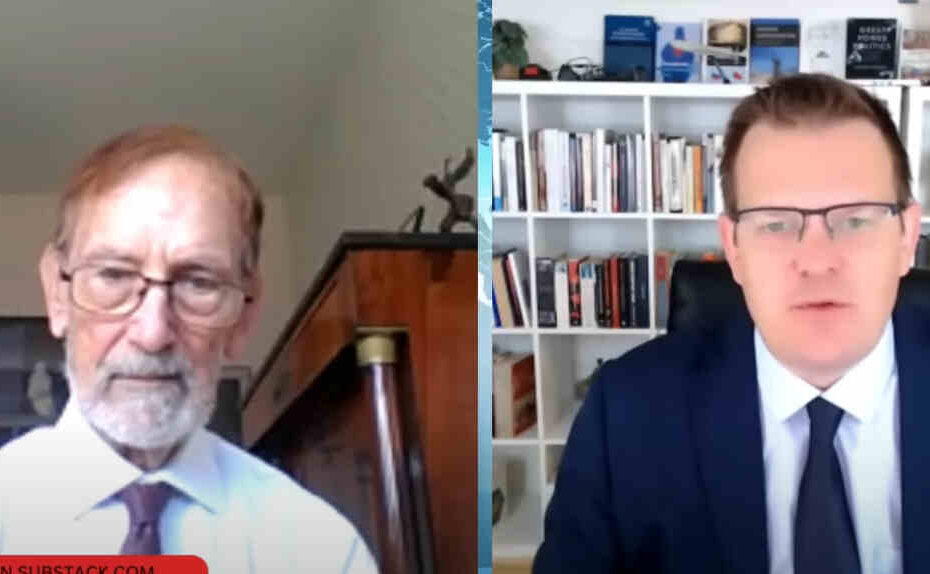
Read the full transcript of historian and international affairs analyst Dr. Gilbert Doctorow in conversation with Norwegian political scientist Prof. Glenn Diesen on “China, Russia & India Build New World Order”, September 1, 2025.
The Historic Nature of the SCO Meeting
GLENN DIESEN: Hi everyone and welcome back. We are joined again by Gilbert Doctorow, a historian, international affairs analyst and author of “War Diaries: The Russia-Ukraine War.” So welcome back to the program.
DR. GILBERT DOCTOROW: Well, it’s my pleasure.
GLENN DIESEN: So we now see that we’re watching the SCO meeting in China – that is the Shanghai Cooperation Organization. And of all the members attending, I think the most important aspect of this meeting is now India, China and Russia coming together. These three Eurasian giants.
Indeed, we have now all these pictures and videos of Modi, Xi and Putin looking extremely friendly. And I know optics isn’t everything, but Modi, of course, is traveling to China for the first time in seven years. We have pictures of Modi hugging Putin, reassuring each other that this is an enduring partnership between India and Russia. They’re not going to walk it back. If anything is underutilized, they have to build on it further.
We also see Modi shaking hands with Xi. After all these tensions over the past years, both calling for improving China-India relations as these two Eurasian giants recognize that they should perhaps sort out their relationship. Now, this seems very historic to me. What do you make of this huge meeting?
India’s Rise and Regional Dynamics
DR. GILBERT DOCTOROW: The meeting is historic. I agree completely. And I find that perhaps some observers in India, not only in the west, are missing that point. I have been receiving multiple phone calls starting at 6am this morning from different Indian broadcasters and I have participated in their programs.
These were not just one-on-one interviews, but panel discussions with various prominent Indians in the country and outside, and Western experts invited to speak. What I heard was a bit surprising, a bit disappointing because I don’t think that they – India of all places, with their experts – are fully appreciating what’s happened in the past two days.
I believe that Mr. Modi has, and if he has, then he will be regretting that he is not going to be at the Beijing military parade on Wednesday. What I think we are witnessing is the rise of India.
The Indians themselves are exulting over what they see as the humiliation of Pakistan in one of the points in the joint declaration adopted by the SCO at its closing. That point being the condemnation of cross-border terrorism and the attack on India. We know where the cross-border came from – it came from Pakistan. So the Indians are celebrating that the SCO has just put Pakistan in its place.
That is exaggerated. Let us remember that Pakistan is a protégé of China, and this slap on the wrist for Pakistan could not have been approved without Xi approving it. Furthermore, the situation overall is much more complicated than these several Indian journalists would have us believe.
After all, Pakistan is a close supporter of Iran. Iran is an important transit country for the north-south corridor which India wants very much because it would give India access to the whole of Central Asia, which under the present conditions where everybody is scrambling to find new markets is all the more important to India’s economic future.
Complex Relationships and Hidden Dynamics
There are complications here of many kinds. One of them, which I’ll just mention here to seed our discussion, is the presence of the Prime Minister of Armenia – Pashinyan – and his warm discussion with Vladimir Putin, which was featured on yesterday’s wrap-up of the week’s news hosted by Mr. Kiselev.
This shows how all of these countries that are members or observers or guests of the SCO have interests that are intertwined, and some of them are conflicting. When you have 25, 26 countries, it’s not surprising that there will also be conflicting interests.
You have a summit like the one of the last two days which provides a platform, a venue for these various parties to get together in quick sequence so that discussions between two can then be extended to their circle. That is what’s happened in the last two days.
I believe that Armenia was roped into this probably by the Indians. As you may be aware, Mr. Macron of France has done his best to ruin relations between Russia and Armenia. What you had and was shown on Russian television yesterday was the two of them – Putin and Pashinyan – sitting next to one another. Pashinyan said, “Oh yes, Vladimir, you are my good friend,” and this was lapped up by the Russian news commentators.
SCO vs BRICS: Different Missions and Scope
Coming back to the question of India and what the SCO stands for, because there’s a lot of confusion in the broad public: How is this different from BRICS?
BRICS is a global organization and it has in its membership key founding members – countries like Brazil or South Africa – which are not terribly interested in issues that move Russia and China, for example. They hold up progress in the integration of BRICS because they have their own concerns about relations with the United States and whether not to tip too far against the United States.
The SCO was founded about 30 years ago and had as its job description, as its mission, to bring security to the East Asian region. It was founded by Russia and China primarily, first of all to moderate their competition for the Central Asian countries, and also for the two of them to coordinate actions to keep the United States and other interlopers out of the region efficiently. Its task was to combat terrorism and to combat narco-trafficking.
Economic Expansion and New Banking Initiative
What we saw in the last two days is a vast expansion of its remit, of its self-definition.
It is taking on features of BRICS – that is, an economic dimension. Mr. Xi rolled out the plans, already announced plans, to create an SCO Bank – a bank for development. This is remarkable.
We see the attempt to integrate this vast region financially and economically, recalling that its global contribution of GDP is 24 trillion dollars. It does not do away with the importance of the United States as a global trade influencer, but it is very significant.
The concentration is on Eurasia. There are at the margins Belarus – Mr. Lukashenko was there and was warmly greeted. There is the entrance of the Middle Eastern countries, and that is Iran, the United Arab Emirates. I think they fit into the financial dimension as possible supporters, backers of this new bank that is planned for the Shanghai Cooperation Organization.
Who Really Runs the Show
The working languages of the Shanghai Cooperation Organization are Russian and Mandarin. That tells you who runs the show. This is a point that somehow commentators in the west just don’t talk about. They talk about 25 countries, but who is running the show is Russia and China.
I think for India, judging by the body language between Xi, Putin and Modi in the final hours when they’re all together and they were conferring together, we see the prospect or the invitation for India to rise as one of the governing countries of the SCO. If that is fulfilled, it’s a dramatic change.
Modi’s Missed Opportunities
At the same time, coming into this, I think Mr. Modi missed opportunities. I think his stopping in Japan was a mistake. Obviously it was a message – he was giving a message to the Chinese that “don’t think that we’re going to fall into bed with you tomorrow, we have our own options.”
His decision not to participate in or not to witness the military parade in Beijing, I think that was a bad decision. After all, the parade is celebrating the end of the war in the Pacific. India was not a country in 1945, but there were a lot of Indian soldiers who fought the Japanese in the Pacific as soldiers in the British Empire. The Indians on both fronts, both in Europe and in Asia – one and a half million soldiers in World War II.
I think it was a mistake for Modi not to honor the memory of those compatriots who died putting an end to World War II in the Pacific. By the same token, I think it is very sad that Donald Trump will not be there because, of course, the Americans had a decisive role also in liberation of island after island of occupied territory from the Japanese. The United States will not be represented at the proper level at this landmark event.
The Chinese have very few military parades – they are not like the Russians every year. This is a big deal. So for Modi not to be there, for Trump not to be there, I think is a big mistake.
A Different Model of Security Cooperation
GLENN DIESEN: You mentioned the SCO developing because originally it was intended as focusing on security – that is terrorism and such – managing Russia and China so they wouldn’t have the security competition and the power competition in Central Asia. But once it began to take on economic competencies, that would mean to hand over some of the leading role from Russia to China.
When they brought in all these other large powers – be it India or to a lesser extent Pakistan, but Iran – then I think the Russians became more comfortable because the Chinese would still be the leading one, but they wouldn’t be in a dominating position with all these other giants.
That being said, it seems often that when I read the Western commentary on the SCO, it’s often focused on “well, look at all these competing interests they have. They’re not aligned.” But this is a very different form of organizing security. It’s not the alliance system where you have a group of countries working together for security against an external non-member of the block.
Instead you have a security arrangement where you seek security with other members of the grouping. China, India, India-Pakistan – there are tensions between these countries. But the whole point is that if they’re able to solve the political differences, then they can have some mutual economic benefits.
It seems that often in the west we tend to assess everything based on whether the interests are completely aligned. But often the way we achieve it in the west is by framing everything in the language of ideology, which often results in countries not being able to pursue their national interests as we see in Europe.
If you have all these countries with competing national interests all pursuing their national interests, which at times is in competition – the goal surely isn’t some utopia where everyone agrees on everything, is it?
Sovereignty and National Interests
DR. GILBERT DOCTOROW: No, there isn’t. These countries have their diverse interests and some of them, of course, understand this is sovereignty and are unwilling to compromise on it, as India has shown by its refusal to follow the diktat of Donald Trump respecting their trade in Russian petroleum.
This subject has been much in discussion among the commentators on the Indian broadcasters – these are NewsX, News18, they are two different companies – and they are talking about what Trump has done only in terms of what is obvious and evident: that they’re being treated in a discriminatory manner, that China buys more oil from Russia and it’s not being penalized, that this is double standards and so on.
They are not looking at what was in the last paragraph of the Financial Times discussion of the impact of the tariffs on US-Indian relations a couple of days ago. They were talking about the impact on the Indian economy. In point of fact, the impact is on manufactured goods and precisely textiles – textiles for export mostly to the United States. That’s 2% of the Indian workforce. That’s not a great number, but considering the size of India, it still has to be said.
GLENN DIESEN: It’s to what extent the SCO arrangements and the cooperation between India and China and Russia should be assessed based on the extent to which competing interests are eliminated, or simply how the differences are addressed, because it has a very different system than this assumption we have in the west that everything has to fit in this alliance system.
As we know from political realists, permanent peacetime alliances are not very attractive always because they lock in countries and prevent them from pursuing national interest. John Herz even wrote in 1950 that these alliance systems, peacetime alliances, remove the right to make war and replace it with responsibility to make war.
There’s a kind of – this is why the Chinese don’t want aligned systems. Essentially they want to be in a more loose organization where they don’t have to push national interests aside in order to align policies.
Trump’s Foreign Policy Vision: Breaking Up Blocks
DR. GILBERT DOCTOROW: Well, now I understand why I was jumping to the following issue of where Mr. Trump stands on this. And this was something which I expressed with several of these broadcasters to their surprise. But I hope it gives them reason to reflect.
They were all focusing on the superficial side of what Trump has done, just as the Financial Times in its article on Indian relations with the US focused on the economic side of the tariffs. What this means to their trade – after all, it is only on manufacturers, particularly textiles. It doesn’t affect the very big and important $80 billion trade in IT where India is a major supplier of programming and business intelligence to American corporations, or the pharmaceutical industry.
So it affects a lot of people and has a political impact because these are textile workers after all, and they are going to lose their jobs. But at the very last paragraph, the Financial Times said “and by the way, this is going to really damage the quadrilateral arrangements that the United States has constructed carefully over the last 25 years to bring India into containment policy directed against what’s said to be China’s aggressive ambitions and expansion – destroyed in several weeks.”
And my point is this was not an accidental consequence. It was the reason for the tariffs to be imposed. Because the tariffs are illogical – everyone knows that – and they are discriminatory. Why is India being hit and China isn’t? It was precisely because Mr. Trump, insofar as he has a foreign policy concept, is exactly what you’re describing. And he didn’t think it up. He got it from Henry Kissinger, who was closely advising him during his presidential campaign in 2016 and whose ideas were reflected in Trump’s first national security strategy papers in December of 2017.
The Kissinger Influence: Competitors, Not Adversaries
This is about relationships between competitors and not adversaries. It rejects completely the fundamental principles of neoconservatism. And people who think that Trump doesn’t have an idea in his head had better reread Kissinger’s 1994 “Diplomacy” and reread the 2017 American National Security Strategy papers. It’s one and the same idea.
The idea that Kissinger was promoting in ’94 was a world of pre-World War I nature of several major powers who were competitors, but no blocks. Well, I say pre-World War I because by the 1890s there were blocks, of course, but earlier than that and certainly going back to the period that Kissinger loved most – 1815, the Concert of Powers, the balance of powers notions that predominated at least until 1870.
That is the vision that Kissinger had in 1994 when people like him were making roadmaps for the post-Cold War period. And that was his vision. And I believe it’s a vision that he passed along to Donald Trump who is trying his best within the limited possibilities he has to break up the blocks.
GLENN DIESEN: Yeah, the ’94 book on world order – he also always made the point that the world order, if it’s going to be stable and sustainable, needs to balance both power and legitimacy. And I guess this was always the problem of unipolarity. It’s not durable in terms of the distribution of power and it’s not going to have the legitimacy of one center ruling.
And also in order to have this, he also recognized you need the balance of having what the Chinese called civilizational diversity and also agreeing on some key principles. But you know, how do you balance this? Some ways we’ll always be different – the nationalist idea – and then some principles we need to have the same.
I think under the liberal hegemony, we tilted too much to the idea that everything has to be shared principles and we forgot the cultural distinctiveness, which kind of lays the foundation for sovereignty. From my perspective, this also built into Trump’s perhaps domestic ideas because he sees that this liberal hegemony is eating up some of the values in terms of America’s own civilizational distinctiveness and turning into this what he would consider liberal blob, I guess.
But do you think he’s still working according to Kissinger’s manual? I know they did speak after he won the election. But how much do you think he’s influenced by these ideas?
Kissinger’s Evolution and Trump’s Implementation
DR. GILBERT DOCTOROW: Well, we can ask: did Kissinger follow his own recommendations of ’94? Of course not. There is a big change in Kissinger between what he wrote in “Diplomacy” and what he wrote in “World Order.” And that was that he got beaten up over his vision of ’94 by the neocons for being an unforgiving realist who was discarding values. And of course, Americans make a great deal out of values to drive foreign policy.
So in the end, in 2014, after saying that foreign policy would be interest-based, he threw a bouquet to his opponents and said, “Yes, and of course there also should be democratic values uniting some parts of the world community.” But that is not such a big concession when you consider going back to his dissertation work on 1815. It all ended – yes, there was the realist approach, but it was all framed by monarchical principles, which were the values of the time. So these ideas which are in competition did not completely rule out the other side of the story.
The question is: where is the basic thrust? The basic thrust of Kissinger’s thinking was realism and steering away from ideology. And I believe that Donald Trump remains in that camp.
And people who say, “Oh, he surrounded himself with neocons” – well, if you’re going to look for people who have shared that view, he wouldn’t have anybody. There are very few realists in high position or with recent government experience whom he could have as counselors and implementers. So he manages as best he can, and he does within the limits that one man can do when he is in a power situation surrounded by many other forces.
After all, there are limitations on the President’s power, however much the New York Times would like to say he’s overriding it all. And he pursues a destruction of blocks. NATO is hard to get rid of. To really get rid of it, he needs two-thirds of the Senate backing him, which is not available. The quadrilateral arrangement never received that kind of formal formation where it cannot be undone. He’s undoing it.
So I firmly believe that Trump has an idea or two in his head, and I believe that the ideas that he holds closest to his heart are coming from Kissinger. Remember that Kissinger was very pleased to have the ear of Donald Trump because for the first time in 30 years he was not admitted by Obama to the Oval Office, who simply despised Kissinger and didn’t want to hear his advice, whereas Trump was very glad to receive advice.
Of course, the role of Kissinger lasted almost a year. I wouldn’t say long – that’s understandable. There were many other competitors for Donald Trump’s ear, but I don’t believe that he has forgotten those lessons from Kissinger and that he is trying to implement them within his powers.
The Risk of Pushing India Toward China
GLENN DIESEN: But on the topic of Kissinger though, one of the great achievements in geopolitics was in the 1970s splitting the Soviets from the Chinese. The General Mackinder idea that you shouldn’t allow two Eurasian giants to get too close, same with Germany and Russia. But the key criticism of Trump was always of Biden, that the hostility towards Russia meant that the Russians were pushed into the arms of the Chinese.
But these recent pressures from Trump against India – his administration in terms of the tariffs and also the threats of pressuring India not to trade with Russia – it appears to now be pushing India also towards the arms of China. Again, despite accepting the premise that Trump is very hostile to all these alliance systems as a way of locking in America and preventing the reforms it needs, from every aspect though, this seems to have been a colossal mistake because America needs India if they want to have some balance against the Chinese or just some good relations in the East. This just seems like a disaster though, isn’t it?
DR. GILBERT DOCTOROW: I think it’s a temporary situation. I think this was a body blow intended to end India’s involvement in the containment policy against China and the formation of a new military block in Asia.
The situation between Russia and China and India and China cannot be compared. India and China do not have the common economic interests that Russia and China have. As the Indians say openly, “What do we have to sell to the Chinese? Nothing. All we can do is buy from the Chinese.” So that is not a prospect to be compared with the Russian situation.
This was mentioned yesterday on Russian state television as they were discussing these various relationships. Russia is probably the only major country that has a surplus, not a deficit, in its trade relations with China. And it is not just that they are supplying hydrocarbons and also more recently, a lot of agricultural commodities. They also are about to supply the jet engines for China’s newest middle-range passenger airliner which is left engineless because of sanctions by the United States.
Yes, as they said yesterday, you can count the world’s producers of advanced jet engines for passenger airliners on one hand and Russia is one of them. And this is now being finalized. So the Russians are not just selling commodities, they’re also selling some high tech and some pharmaceuticals. Russian pharmaceuticals are now entering the Chinese market.
Nothing like this, not of this scale, can be anticipated for India with respect to China. What is in prospect is not a full unlimited friendship or partnership, but an end to enmity, an end to these border skirmishes and cooperation on a common development of economic and security interests in eastern Eurasia.
The Significance of Reduced India-China Tensions
GLENN DIESEN: Well, that in itself seems quite important because whenever you have two great powers – of course, if you choose to put India in that category, or at least an aspiring great power – once they have some tensions between them, these tensions or conflicts can be exploited by external parties who want to get some concessions from one or balance against the other.
But I guess, as a last question, going back to the beginning, how much do you think this is, if not a change in world order or development or shift away from the unipolar system? How significant – how should we interpret the direction we’re going now? Because I see the lack of trade compatibility between India and China. I don’t expect any alliance systems to come out of this, but the ability to deal with the competing political conflicts is quite significant in order to organize an alternative international economic architecture, given that there’s less trust in both the ability of the United States to hold this role.
I mean, even the US now seems to be recognizing that the dollar can’t be the only reserve currency – it will surely have a very leading role, but alternatives have to come in place to actually reflect the distribution of power as it is.
The Rise of Sovereignty and Multipolar Acceleration
DR. GILBERT DOCTOROW: There is an acceleration in the movement towards a multipolar world. And what we saw in these last two days are significant landmarks in that trail. So it is – we should not exaggerate, as you’re saying, the prospects for a rapprochement or warming between China and India.
But what comes out of this, as I was hinting a moment ago, is the raising of the flag of sovereignty. India did that by its refusal to take phone calls from Donald Trump and demonstration in every way that it’s not going to submit to the American efforts to break its reliance on Russian hydrocarbons. In fact, it’s intending to increase by 10% its import of Russian hydrocarbons in the coming months. This is a declaration of sovereignty.
The Russians were talking sovereignty a year ago, and I was saying that this is the word of the year. But I think now we’re witnessing it spreading to other major powers. Sovereignty dictates against formation of participation in a military alliance or block. The Chinese were the first to realize that and to practice it.
Just to take one comment on your remark with respect to Kissinger and the cleavage that America drove between Russia and China for its own benefit – I think you’re being unkind to Richard Nixon. I believe that was his idea and that Kissinger was the implementer. Of course, Kissinger would not bring that fact out in his memoirs – who could blame him? But Nixon was no fool.
And from the perspective of today, Nixon – the man who was unpleasant with the press – well, he looks like a gentleman, a dignified man by comparison. On YouTube, I saw a year ago the Kennedy-Nixon debates. Remarkable. These people were civilized. It’s been a descent from civilization ever since. So Nixon looks a lot better in that optic, and he was smart enough to see that opportunity and to have a very good implementer in the person of Henry Kissinger.
The Decline of Western Diplomatic Standards
GLENN DIESEN: The decline in decency, it’s quite remarkable. If you go back a few decades and look at those presidential debates, hopefully we reach the bottom of the barrel. There will be some improvements coming.
But no, it is interesting because when I saw Peter Navarro making this comment that is advisor to Trump, that in India is the largest democracy, how can you cozy up with the Chinese? You should be loyal to us. In other words, bent to our pressure. I think it kind of exposes how much of the world actually sees it.
Whenever someone refers to liberal democracy, it’s often translated almost always into sovereign inequality, which means in the name of liberal democracy, you should not pursue your national interest. But India keeps saying, “Well, our national interest has to come first.” And that means, yeah, taking into consideration the neighborhood they live in also, of course, and not cutting themselves off from very vital partnerships.
India’s Strategic Independence vs. European Compliance
So, no, this could be a huge shift. I’m just curious if it’s going to change American policies because so far the US appears to be doubling down on this, that how dare China go continue along this path. They should fall in line. Maybe the problem is we haven’t put enough tariffs on them. This is kind of the logic, what else can be done? As opposed to reflecting a bit on what the actual Indian position is, that they see this, this being an issue of, yeah, sovereignty.
And you know, it pains me to say this is European, but if you look towards the ones who are bending too much to fall in line and compromising on their national interest, it’s the Europeans. And whenever the Europeans bow and, you know, to daddy and to do as they’re told, they, you know, every time you ignore your national interest, you’re going to come out in a weaker position. And so it doesn’t seem like a model that the Indians would like to emulate.
But yeah, I guess, yeah, sorry, that was just my last question. Do you see any changes coming from the US position now given the pictures coming out of China of Modi and Putin essentially being defiant and not responding in terms of allowing divisions but instead further decoupling and diversifying their ties?
Trump’s Expected Policy Shifts
DR. GILBERT DOCTOROW: I think we have to give this a bit of time. As I’ve said, I don’t think that Donald Trump has any intention of severing commercial ties with India or of maintaining his present punitive tariffs for long. I believe that he is fully expectant that Putin will destroy Ukraine in the coming weeks to months and therefore these punitive times will not go on all that long. This is a message to break up the quadrilateral NATO information in the Indo Pacific and Russia.
As for China, of course they read the riot act to the Americans. They explained how they will destroy American industry by cutting off rare earth metals and other vital supplies to American industry. And that is what, that’s what caused the drawback from imposition of punitive tariffs on China and delaying it and moving along with horizon on when they will be imposed.
So let’s give this a bit of time. Let’s look beyond two weeks or three weeks. I believe that relations will foot back. The Indians are very keen to maintain relations with the United States because as we just said that China is not a replacement for the American market and that there is no replacement for India in the immediate, even in the medium term future for the American market. So of course they’ll find common ground, but that will be after the Americans drop their belligerency over whom India trades with.
India’s Non-Aligned Strategy
GLENN DIESEN: And I think that’s the main point that the Indians don’t want to join an eastern block against America. They literally just want to be non-aligned and diversify their trade and no. Which is why I think if the United States walked this back and doesn’t tell India what to do, I think India’s greatest interest would be to also trade have close relations with the US.
Indeed I would put Russia in the same category. They always saw this as a balance of dependence. That is yes China might be the most important but you have to balance out and diversify. So trading with the Europeans and Americans will always be important which is why I think they’re putting so much efforts to restoring bilateral ties with the United States. It’s just they’re not going to be lured into an anti-Chinese camp and I think that dream has to be dropped with the Indians as well.
Yes. Thank you so much. This is fascinating. Fascinating times. And indeed, the weakening, if not the sabotage, of these alliance systems altogether is quite revolutionary in terms of changing the international system. So thanks again.
DR. GILBERT DOCTOROW: My pleasure.
Related Posts