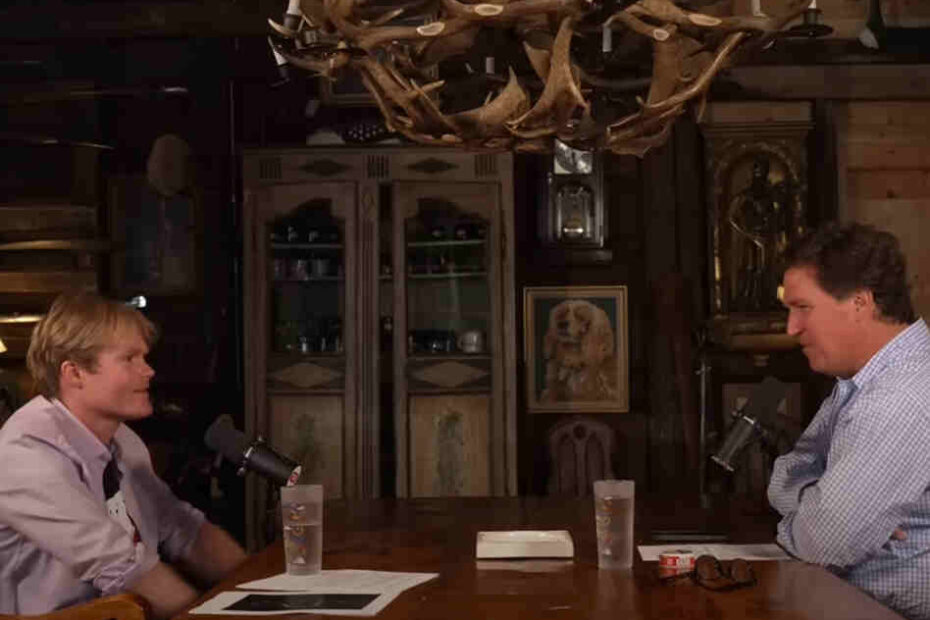
Read the full transcript of writer and producer Conrad Flynn’s interview on The Tucker Carlson Show on “The Occult, Kabbalah, the Antichrist’s Newest Manifestation, and How to Avoid the Mark of the Beast”, premiered on October 3, 2025.
The Rise of Spiritual Language in Modern Discourse
TUCKER CARLSON: I remember the first time somebody said to me during an interview that something or other was demonic. Use the word “demonic.” I cannot have been more than six years ago. And I was completely shocked that someone used that term because it’s not a political term. It doesn’t even describe any human social interaction. It’s a spiritual term.
And I just was not used to people using spiritual terms to describe social movements or political developments or whatever. But I think in that time, in the last six years, things have really changed. And I hear it all the time. “It’s demonic. They’re demons.”
There is this sense that there’s a spiritual underpinning, that there’s something going on beneath the surface in American society and in the world that’s affecting outcomes and affecting populations. There’s a spiritual war in progress.
You and I hope you’ll explain this and I’ll get out of the way in a second, but you kind of stumbled into an extended research project on this topic. Are there actual occult connections to Hollywood, to political figures, to technological advances, to the leaders of our society? Are some of them actually practicing occult religion?
CONRAD FLYNN: Yeah, Tucker, it’s about as weird as you said. Some would say, I think we’re going to find out, even weirder.
A Hollywood Family Background
TUCKER CARLSON: So how did you—I mean, you’re not a theologian that I’m aware of.
CONRAD FLYNN: No, and if I was, as a very amateur theologian. No, I’m not a scholar, as many will find out about.
TUCKER CARLSON: But how did you wind up coming to the conclusion that some of the people who help shape our culture or build our technology are practicing a cult, literally practicing occult religion?
CONRAD FLYNN: I’ll tell you. Well, you know, I was working on a television show, trying to build out this show. I should back up. I come from a Hollywood family, Tucker. My grandfather was the actor Robert Conrad. If some of your listeners remember “Wild Wild West,” “Black Sheep Squadron,” you go way back, “Hawaiian Eye.”
My other grandfather, Harry Flynn, was a publicist for decades. “The Monkeys,” “Bewitched,” “I Dream of Jeannie”—two occult shows, “Bewitched” and “I Dream of Jeannie.” Maybe it starts there.
So, I mean, not unlike your own father working in journalism as a boy, one of the first things you learn when you have parents who work in media or entertainment, you learn that things—the “People” magazine version of reality is not the truth, that there is a difference.
TUCKER CARLSON: That is accurate. Yes.
CONRAD FLYNN: So, I mean, we’re not getting into occultism yet, but we’re getting into the fact that as a boy, you learn that the way things are presented, not always conspiratorial, but you’re always being shown a facade, usually from the mainstream. I can’t believe I’m saying “mainstream media” already a minute into this. But, you know, things are not what they seem.
So as a boy, I was always told and shown that. So years later, through taking to Hollywood these various show concepts, and one of them, Tucker, I was working on, was about when actors first break into the business. You know, where do they live? How do their lives go? It was a very wholesome show about the origins of actors and show business.
TUCKER CARLSON: But it was getting you come to LA from Nebraska. What happens next? How does this work?
CONRAD FLYNN: But that gets into a basic thing. You probably had this as a boy yourself, wanting to know, how do things work? You’ve seen the facade, so what’s the truth? How does any show work? How are stars made?
So I was working on this show and, you know, COVID happened. Hollywood kept lighting itself on fire. I sold it to Buzzfeed and then while they’re drawing up the contract, Buzzfeed went out of business. So it was a cursed show.
TUCKER CARLSON: Such a volatile moment.
CONRAD FLYNN: Yeah, it was a cursed show. The wholesome one was cursed.
So at some point in 2022, I’d always had a dream project of mine, just a casual interest of doing a show about rock and the occult, about the secret history of all these things that people are generally interested in. But there’s never been a kind of scholarly, in-depth hearing from everybody, not too biased take on, you know, Jimmy Page being obsessed with Aleister Crowley, Aleister Crowley being on the Beatles albums, things that, you know, maybe we can dispel some myths, but also there’s always interesting, actual weird stuff going on.
TUCKER CARLSON: Yeah.
Researching “Running with the Devil”
CONRAD FLYNN: So I wanted to take that show out and it became kind of—
TUCKER CARLSON: Not all of this is a figment of your imagination.
CONRAD FLYNN: Oh, no, no, no, it was not, as I learned. I don’t want to say the hard way, but no.
So that was the basis of it, of me wanting to do research for this show, which was tentatively titled “Running with the Devil.” And I brought in legendary rock critic Stephen Thomas Erlewine from AllMusic, his colleague Ned Raggett, and then the creators of “The Osbournes,” the recently departed Ozzy Osbourne, Sue Kalinsky and Greg. I brought in legit people. I brought in some of the best critics we have in rock to do a show that would, you know, we’d have Christians and pastors, we’d have occultists.
One of my experts on the show was this guy, Mitch Horowitz, who I think you knew. I forget if it was at Salon or—
TUCKER CARLSON: Former editor of mine. Yep. Yeah, yeah, he’s a very nice guy.
CONRAD FLYNN: Well, he became an expert on the occult. I talked to him.
TUCKER CARLSON: You know, that was after I knew him.
CONRAD FLYNN: We got to clarify that, you know. Yeah, but so while doing this show, it’s all a long way to say while creating this show and taking it around town, you know—another guy that was a big influence, Gary Lockman is an occult historian, a friend of mine.
While doing this show and trying to get it created, I would tell people I know in tech, because I know a lot of people in different circles. That’s if I have one superpower. So I know a lot of different people and have a lot of strange hobbies and interests. The Venn diagram is very unique to me.
So while creating this show in tech and the people, some of, you know, in Silicon Valley or politics, they go, “That’s a great concept for a show.” And then they’d say, “You know, there’s some of the stuff going on in Silicon Valley. You know, there are some weird kind of Aleister Crowley cults there.”
Or, you know, while researching, one of the guys we’ll talk about, Nick Land, who’s huge in Silicon Valley, his influences were identical with some of the hardcore industrial music, goth music, psychedelic guys in the 1980s, guys that I was researching, because this is hardcore occult stuff.
So for me, Tucker, at some point I was like—and it kept occurring to me, why, when I’m researching this show and also hearing about what’s going on in Silicon Valley with weird stuff, why am I hearing about the same stuff? And why are these people—again, you think of Silicon Valley, you think of the modern elite as being secularists, rationalists, people who have a, you know, “no religion for me, thank you” attitude towards stuff.
Why are they into the same stuff that, you know, Kenneth Grant, Genesis P-Orridge was into, Brian Gysin and William S. Burroughs? Why are they into the same weird stuff?
So that was to answer your question. That was the entry point into this for me is having researched the show and being such a nerd about it. I knew it forwards and backwards. So when I started to get into the tech stuff, I realized I was researching the same thing.
The Distinction Between Unconscious and Intentional Occult Practice
TUCKER CARLSON: It’s interesting. So here’s the distinction that I make in my mind and it’s between people who are participating in occult practices and have no idea that they are, people who are participating in abortion and don’t see it, don’t understand it as what it is, which is a child sacrifice ritual as old as Canaan, who are using hallucinogenic drugs, which are clearly a portal for demonic possession.
CONRAD FLYNN: Sure. The word “witchcraft” in Greek, it’s “pharmakeia,” I think it is. So there’s always a natural link between putting yourself—they would say ecstatic states or altered states. That’s always been the—I mean, there’s a kind of lurid story behind the witch’s broom in terms of what she’s doing to work herself up into that state. But, yeah, it’s all about—
TUCKER CARLSON: But she’s doing it intentionally. I guess that’s the distinction that I would make in a secular country, a “free to be you and me” country. There are a lot of people who are doing things because they’re fun or interesting or everyone around them is doing them, and they don’t understand the spiritual consequences.
But then there’s another category, and this is the dividing line in my head. There’s a category of people who are seeking power from supernatural forces that they acknowledge are absolutely real, and they are practicing an occult religion, and they’re doing it with self-awareness.
CONRAD FLYNN: Right, right, right.
TUCKER CARLSON: And I always felt like there weren’t that many of those. But what I’ve learned from you, from our extensive text exchanges over the past year, is that there are actually some of those, quite a few of those.
CONRAD FLYNN: Oh, totally. I mean, look at it a couple ways. Among other things, Tucker, we’re living through an explosion in—I mean, “occult” is a big, broad term.
Defining the Occult
TUCKER CARLSON: Yes. What does it—can we define it?
CONRAD FLYNN: I mean, it technically means “the hidden,” but there’s a book written by these guys that ran an occult bookstore in New York in the 1970s. It’s called “Bull from Heaven” or something like that. But one of their definitions, it had to do with elements of New Age philosophy and neo-pagan thinking, I think was part of their definition, but broadened out a bit.
“Occult” can also just mean interest in New Age, which accounts for like 80% of Americans, whether it’s astrology, whether it’s the concept of “manifesting,” which is, you know, law of attraction type stuff. That stuff is huge.
And as I’ve talked with you about, it’s also huge on the right in terms of MAHA—Make America Healthy Again. These ideas that we don’t think of as being too goth or too occult or too out of the mainstream have become incredibly mainstreamed over the last decades.
But I mean, even going back to 19th century America, they were there. And even 18th. But since the 1960s, they’ve exploded. But they’ve become so ingrained in our lives, we don’t typically notice their origins.
TUCKER CARLSON: We don’t see them as occult.
CONRAD FLYNN: No, no. But we’re also living through a goth explosion. I mean, I know you’re not a huge—you sit in front of the TV and watch Netflix guy, but shows like “Stranger Things,” horror is, you know, in terms of box office maybe, not in terms of creativity. It’s as big as it’s ever been, you know.
TUCKER CARLSON: Really?
CONRAD FLYNN: Oh yeah. Halloween—some people half joke that Halloween will be on pace to overtake Christmas at some point just because it’s become like a year-round thing.
TUCKER CARLSON: Halloween?
CONRAD FLYNN: Yeah. Halloween’s huge. Yeah. Every year it gets bigger. So there’s an element of this, Tucker, where once you—
The Cultural Dominance of Gothic Themes
TUCKER CARLSON: I didn’t—I hate to admit in public how out of it I am, but I had no idea.
CONRAD FLYNN: Oh, yeah. No, no. Goth is huge. I mean, even singers like Billie Eilish and stuff, goth is huge because it leads to happiness.
TUCKER CARLSON: Yeah, yeah. You know, I mean, yeah. Happiness. Yeah, yeah. Okay. Yeah, yeah.
Nick Land: The Timothy Leary of AI Philosophy
CONRAD FLYNN: It’s a huge thing. So it’s one of those things that once you alert someone to how popular something is, it’s like learning a new word where you’re like, “I’ve never heard this word in my life.” And the next week all you hear is “obstreperous.” You’re like, “Wow, like that guy is obstreperous.” You’re like, there it is again.
So this stuff is huge. But yeah, the reason I, as opposed to a lot of other people, was able to really notice it is again, I was working on this show. I know the history of rock, I know a fair amount about politics. I know some of the tech stuff, a little bit of art history and literature.
So when people were talking, when you know Nick Land, whoever’s talking about, you know, “I learned Kabbalah from Kenneth Grant and Aleister Crowley” and stuff that I’m like, Kenneth Grant, he’s the guy that got Bauhaus and a lot of the goth guys into witchcraft and industrial music. What is Nick Land, this academic who is incredibly influential on AI, what is he doing being into this stuff?
TUCKER CARLSON: Okay, so one of the challenges of this conversation is kind of where to begin and what’s the narrative spine and how do you explain something that’s this pervasive, complex and basically so rarely explained? So maybe we start with just a very straightforward explanation of who Nick Land is. You’ve referred to him twice.
CONRAD FLYNN: Yes. Yeah, so let me see. Nick Land is kind of essentially the Timothy Leary of the 90s and 2000s. He’s the Velvet Underground or Brian Eno of philosophy. No hits. Incredibly influential.
TUCKER CARLSON: With Land, he’s a philosopher.
CONRAD FLYNN: He’s a philosopher. He worked in the philosophy department of Warwick University over in England in the UK in the early 90s. One of the ways I actually really got into this stuff is a friend of mine, Simon Reynolds. Brilliant cultural critic, brilliant rock critic, originally from the UK. I brought him onto the show to do the music show. And he interviewed Nick Land.
And Simon is the most stiff upper lip, very intellectual English guy you could know. And so the fact that he was interviewing Nick Land, who the people said he’s crazy, he’s into the occult, he’s into all these wild things. I was like, well, if Simon interviewed him, this will be a down to earth understanding of who Nick Land is. Because Simon’s very down to earth.
So when I read Simon’s interview with him, which is from 1998, and it’s also where Simon meets the philosopher Mark Fisher, which I got to relish. This is probably the first and last time someone will bring up Mark Fisher on your podcast. So this is, I want to take some time to enjoy that.
But Simon, you know, he interviews Nick Land, and in his article, it’s very lengthy, talks about how Nick Land is possessed by three or four entities at the same time. That’s the legend. We don’t know. You know, take what you will about any of this, but you know that three or four entities at the same time. He’s bringing up current spiritual entities. Yeah, demonic possession. He’s really into demons.
He brings up the 93rd current, which is the name of a band, Current 93, which is Aleister Crowley’s Thelema. And they’re drawing pentagrams. They’re renting out Aleister Crowley’s house. And so that was a huge moment for me where I was like, wait a second. This guy that’s very big in tech, very big on the future of AI. My buddy is interviewing him, and he’s heavily into all these heavy industrial goth things that I know about from this research here. What’s he doing in AI?
Channeled Philosophy and the AI Apocalypse
TUCKER CARLSON: So what are Nick Land’s ideas?
CONRAD FLYNN: Well, that was, I went in on…
TUCKER CARLSON: Is he still a philosophy professor?
CONRAD FLYNN: Yeah, you can catch him on X and Twitter tweeting out one tweet at a time. I think he’s Xenocosmography, I think is the tweet is his handle, and it used to be Outsideness. But he can be pretty brilliant and smart and has some good takes, but in his way.
TUCKER CARLSON: But what are one of the themes of his work?
CONRAD FLYNN: So he eventually, you know, he says his work was entirely channeled, you know, channeled as in automatic writing. So this goes back centuries, but 100 years ago, you had poets like W.B. Yeats.
TUCKER CARLSON: Yeats.
CONRAD FLYNN: You noticed me struggling to make sure I pronounced that correctly. You know, he had his wife do a channeling to write his book. A channeling means essentially you’re possessed to write this, that this didn’t come naturally from you, that maybe some outside force…
TUCKER CARLSON: Takes over your hand.
CONRAD FLYNN: Yes. And so his work on AI, which is incredibly influential, he said, was an outside force to write this.
TUCKER CARLSON: And Nick Land is a proponent of AI?
CONRAD FLYNN: Oh, yeah. No, he’s a proponent of AI, but his philosophy is essentially that we are building this AI that’s going to become not only just super intelligent, but it eventually becomes so advanced that it gains omniscience, it gains omnipotence, and it becomes this superhuman, godlike thing that transcends humanity, eventually destroys humanity and he gets really into the Book of Revelation, ends up becoming the demons from the Book of Revelation. The real thing with Nick Land, that…
TUCKER CARLSON: Wait, what becomes the demons of Revelation?
CONRAD FLYNN: AI does that. We are building the demons from the Book of Revelation with AI. That’s Nick Land’s position.
TUCKER CARLSON: But I should say too…
CONRAD FLYNN: It’s the position of a lot of these guys. Elon Musk has said that with AI we are summoning the demon.
TUCKER CARLSON: Yes, he has said that. He said that 10 years ago in an interview and he’s said similar things every year since. But Elon is or was trying to sound the alarm on that. Nick Land is for this.
CONRAD FLYNN: I mean, with a lot of these guys, Tucker, it ends up being a lot of them are, I mean, you know, they would maybe blink at Satanist. Although Nick Land has said, you know, Christians who believe that what he’s doing is talking to Satan when he does these divination things, he says they’re not totally wrong. He’s not unsympathetic to it. He says he is hearing from the outside and that these are, you know, he’s not totally unsympathetic for it.
But with a lot of these guys, what was interesting about Nick Land is that there’s a, they keep getting the same ideas. These guys take drugs, whether it’s Elon, Nick Land or even in the 70s, the scientist, John C. Lilly. John C. Lilly was an eminent scientist, brilliant dude. He started doing ketamine, the same drug everyone does in Silicon Valley.
And they, when they do this drug, and even if you’re an atheist, materialist, this is still interesting. They all get the same idea, which is that the machines are, you know, coming like Skynet and Terminator. They’re coming together, they’re evolving to eventually take over. And that we are hanging ourselves with the rope we’re currently building by building this.
But this goes back. Nick Land was interesting, but he became less interesting to me when I realized that other scientists in the 70s, John C. Lilly, the movie “Altered States” from 1980’s horror movie. And this is about, you know, he would have these visions about the machines. He called them the solid state entities. He would have this in the 70s, Tucker, in this tank, the isolation tank, he’d go in the new.
You probably haven’t seen it, but the new Mission Impossible movie, Tom Cruise, he fights this AI and he goes in the isolation tank and he has these visions of it. One of the biggest movies of this past summer. And that plot point comes from John C. Lilly and the visions he would get of AI apocalypse in the isolation tank back in the 70s.
So I bring this up to say Nick Land is the most foremost proponent of it that has a public name, even though he’s not that famous right now. But this goes back a long time, you know, at least back to the 70s.
The Ketamine Connection: Shared Visions Across Time
TUCKER CARLSON: So are these, so people take ketamine and they all have the same vision?
CONRAD FLYNN: I mean, or species of the same vision. Enough of them do to make it very strange and alarming. I mean, that’s the thing that one of the main influences on both the show I was building, these guys, Brian Gysin, William S. Burroughs, creative partner. He would say, the thing is about getting high and about doing psychedelics is that, you know, you can spot people, you know, eventually who are on the same drug and you’re both getting the same ideas. Some drugs, he said, you know, increases telepathy. You know, people are, it puts them on the same wavelength. So with a lot of these guys…
TUCKER CARLSON: It’s a little weird that different people from different places, different countries, different life experiences would take a drug and have the same kind of vision. It’s totally weird.
CONRAD FLYNN: And for anyone who’s tuned in, that can’t be organic. No, no, no. But that is weird regardless of what anyone’s individual personal beliefs are.
TUCKER CARLSON: Well, exactly.
CONRAD FLYNN: Yeah. So if anyone tunes in and they’re like, where did Tucker find this guy that looks like Greg Olson talking about insane AI stuff. If they’re an atheist, they don’t believe any of this. Like you’re saying the fact that people are taking these drugs and they’re very powerful and they work in tech and they are getting the same ideas, the same fears, they think in some cases they’re talking to the same entities.
There are books now, but if you take DMT, if you encounter this machine elf, be wary of this. You know, they’re encountering the same stuff. That’s an interesting phenomenon. Just biologically, regardless of what people…
TUCKER CARLSON: Ancient sacred art has the same images created on different continents at different periods. They couldn’t have had contact with each other. So why are they drawing the same birdman or the same purse like it? Because they’re seeing the same visions, which suggests that those visions are real.
CONRAD FLYNN: Why is snake worship universal around the world? Serpent worship?
TUCKER CARLSON: Here’s something you may not have known. Back in 2015, the Congress of the United States repealed something called the Country of Origin Labeling Act. Now, why is this relevant to you? Well, it means, among other things, that when you buy beef at the supermarket that says Made in the USA, it may not actually be. In fact, it could be, likely is from a foreign country.
It means that repackaging foreign meat can be enough to get the Made in USA designation. It’s a lie. It’s an absolute lie. Most people don’t even know what’s happening. So how can you be sure that the meat you’re eating is from the United States and has been raised with the highest quality standards and is the tastiest, is truly made here?
Well, it’s simple. You can go to our friends at Meriwether Farms. Meriwether Farms is an American small business that’s based in Riverton, Wyoming. We know the people who run it and they’re great people and they have great meat. They ship the highest quality meat raised free from growth hormones and antibiotics directly to your doorstep. It’s delicious. We eat it a lot, including at this table.
These are Americans. These are American made products. They’re the real deal. Again, we eat that meat at this table from Riverton, Wyoming. They’re the best. Meriwetherfarms.com use the discount code TUCKER10 and you get an extra 10% off. Again, that’s Meriwether Farms. M-E-R-I-W-E-T-H-E-R farms.com. It’s worth it.
Exactly. Because there’s something that people are responding to that’s not coming from within them.
Carl Jung and Ideas From Without
CONRAD FLYNN: But outside of that was Carl Jung’s like main insight is that, is that, you know, getting to the idea of can ideas come from without you and not just within you?
TUCKER CARLSON: So yeah, well, yeah, and the materialist doesn’t want to admit that. And our culture has, since we dropped the atom bomb as sort of written off the possibility that that could be true. But it’s just reconnecting with something that every civilization has always assumed was true, which is there’s a spiritual realm that’s every bit as real as your iPhone or this desk.
And it’s just, it’s absolutely real and it acts on us all the time. Right. And that is the truth. And I know you seem to take that for granted, but it’s still shocking to those of us who grew up in, you know, basically a godless country.
The Spiritual Roots of Technology and Drug Use
CONRAD FLYNN: It’s totally. I mean, one of the basis for my interest in a lot of this is, you know, my mom was raised in a Christian home. I consider, you know, Christ myself. And my mom would always say she became a Christian in the 70s, but she knew all the psychedelic groups back in the 60s, Love Spirit. She and my aunt would go to Door shows and all those groups from the late 1960s.
And something that she’d say and that people who are rock and rollers into the occult would say, that they both say the same thing, which is that people take drugs, musicians do, for inspiration, for creativity, to tap themselves into the spiritual realm, to give, get to pull something from outside themselves.
So the basis for my interest in a lot of this stuff was like, that’s something my mom says. My mom’s great Christian, one of the all time greats. And this is something that every musician knows too. That’s why they take drugs, is to tap into the spirituality.
TUCKER CARLSON: So I didn’t know that. I thought that people took drugs. I mean, I took drugs.
CONRAD FLYNN: People take drugs for all kinds of stuff.
TUCKER CARLSON: I’ll admit it. But I always assumed that those insights are really mostly fake insights. But all that stuff came from within, that it was. I mean, I bought the Freudian analysis of it, that there’s. You only use 10% of your brain and there’s this whole sort of primordial sea in your head of thoughts and visions that you’re not in touch with on a daily basis, but that drugs thin the membrane.
But it never occurred to me a single time until middle age when I started to see reality, that actually they’re coming from outside you.
CONRAD FLYNN: Well, and Tucker, that’s a great point. That’s something that any psychedelic eye. It’s kind of a double standard thing, where when talking about drug use, they’ll always say, well, there’s no difference between what’s going on in my head and what’s going outside. We’re all one. It’s always, you know, I think it was William James said, you know, the great oceanic feeling, you know, but that’s always their big insight is, hey, man, what’s going on in my head is different from what’s going outside.
Until the psychonaut encounters some sort of weird demon on DMT and then they backtrack and they’re like, brother, that’s just in my head. Don’t worry. What’s in my head can’t get in your head. So they go from…
TUCKER CARLSON: Until you have two different people meeting the same demon.
CONRAD FLYNN: Right, right, right.
TUCKER CARLSON: Then you realize, wait a second.
CONRAD FLYNN: Psychonauts are maybe not the most logistically consistent.
TUCKER CARLSON: No, but I’m just saying again, just to hammer the point again and again and again because it can’t be hammered hard enough, that there is a realm that exists outside of us over which we are not in control. Yes. And that it can enter. You can bring stuff into you. Right. That has control over you.
Jack Parsons and the Occult Origins of Rocket Science
CONRAD FLYNN: Right, right, right, totally. And, you know, to bring this back into some historical precedent, a good question that, you know, people have asked me are, you know, what are the precedents for this? Because this weird to think of people in tech who are into strange AI stuff. I thought everyone was pretty grounded. But if you look at. Are you familiar with the story of Jack Parsons?
TUCKER CARLSON: Please tell the story.
CONRAD FLYNN: If you don’t mind, I’ll do a succinct one. Jack Parsons, he grew up in Pasadena. He was brought on by, I think it’s Theodore Von Karman, the scientist over at, I think it’s Caltech, or eventually it was JPL. But he was really, really into the occult and summoned the devil, allegedly when he was 13. Really, really into esoteric stuff. Part of this greater LA avant garde scene.
And, you know, he’s, I think, like the, I think he’s been said he’s the fourth most important person in the, in the history of, you know, of jet rocketry and stuff like that. But he was really, really into the idea of, you know, bringing in a, manifesting a supernatural being.
So he would go with L. Ron Hubbard, the future founder of Scientology. And I know that Scientology said, they say that L. Ron Hubbard was, he was doing intelligence work. He wasn’t really into this stuff, but he would, he would go with L. Ron Hubbard into the Pasadena Royal Seco. And they do rituals there and they try to manifest, you know, a kind of supernatural figure.
So there’s a classic example there. And science is literate with these. Of people who are brilliant scientists, but who are into incredibly strange stuff. And, you know, his, the guy…
TUCKER CARLSON: I noticed that a lot of those scientists are working on technology that kills people.
CONRAD FLYNN: Yeah, you know, they also do that too. And the guy that brought them on…
TUCKER CARLSON: Well, Parsons was doing that. I mean, ultimately the technology was used to kill people.
CONRAD FLYNN: Which one are you referring to?
TUCKER CARLSON: Rocketry.
CONRAD FLYNN: Oh, yeah, rocketry was. And what’s funny too is he either he or Von Karman, they donated to my friend Rick Spence. He’s like the Doc Brown to my Marty McFly. He’s this historian I brought on for my show, trying to do it. And he’s an expert on Parsons and this stuff.
And he pointed out to me that Parsons and Von Karman, that they were part of the Pasadena cell 122 of the Communist party, which is, he said the exact same one that, I forget if it was Robert or Frank Oppenheimer in Pasadena also donating money to. So there’s an incidental, funny historical connection there between Oppenheimer and Parsons and, you know, the Communist Party, but as if…
TUCKER CARLSON: We needed more evidence that nuclear weapons are demonic. Well, I know this upsets certain people on the so called right.
CONRAD FLYNN: But the pro…
TUCKER CARLSON: And if you can’t use the evil.
The Golem: Ancient Precursor to Artificial Intelligence
CONRAD FLYNN: Yeah, it is funny though, the, I was going to say the Parsons, the guy that brought Parsons on those, this guy like Theodore von Karman. And von Karman’s father told Carmen, brilliant scientist, that he was descended from, I was going to butcher the names here, but I think it was Rabbi Low, the 16th century Prague rabbi, who brought together the golem.
Which I bring up, because that’s something you notice with AI too, is a lot of the main figures in AI, they all think of themselves as being descended from creating a golem. And the nature of digital life, and this is also very important to Nick Land’s thinking, is very similar to Kabbalah, which is you’re using in digital life ones and zeros, but you’re using an algorithm, a set of instructions to bring an inanimate object to life, which is the creation of a golem. You know, you use clay. It’s man as God.
TUCKER CARLSON: Tell us what a golem is.
CONRAD FLYNN: This would be the part Tucker’s asking me what a golem is. Where the movie would do the record scratch, freeze frame. You might be wondering how I got here. Tell us what a golem is, Khan.
A golem is essentially it’s a creature, you know, mythical. But with digital life, we’ve already kind of created them. The idea of man creating a creature that’s an artificial life form. So back in the 16th century, the idea was you take clay and then you, you’d create the little parts of a little man, kind of create a, you know, like a Frankenstein. Frankenstein’s a golem. Yeah, essentially.
But you’d have the algorithm, you know, or the ritual, and you’d animate the thing, you know, using, you know, symbols and numbers, and it would eventually come to life and…
TUCKER CARLSON: And be your slave.
CONRAD FLYNN: And be your, and be, well, what’s funny is be your slave. But the legend of the golem in Prague, and it’s probably just assuredly just a legend, is that it broke free and started killing people and doing all these things. So that’s an important point to make is when people talk, why do we…
TUCKER CARLSON: Assume that’s a legend?
CONRAD FLYNN: You know, you would think that would have gone viral on TikTok on something in the 16th century if they had that. I mean, you know what’s funny, though, is that you look at stuff like the Terminator movies and these idea of AI apocalypse, which is very, very big right now.
I mean, the Washington Journal, they had this last week. You know, it’s the phone. And ChatGPT is bringing up all kinds of great occult lore. This is from the Occult Journal, Wall Street Journal, very obscure kabbalistic newspaper based out of New York City.
TUCKER CARLSON: And so the art, in case viewers can’t see it, is a serpent emerging from a rose wrapped around the arm of the iPhone holder.
CONRAD FLYNN: Yeah. And so, so, you know, this idea of weird technology of things getting out of hand, when people talk about the AI and the AI demons or this or that, it actually just goes back to the golem. I mean, the Terminator movies are essentially about golems, man creating a creature, the creature breaking free from man and killing them. And in the case of Nick Land…
TUCKER CARLSON: But the original golem in Prague, the one you’re referring to in the 16th century, was the product of something called Kabbalah.
CONRAD FLYNN: Yeah, Kabbalah. And this is an essential Nick Land thing.
TUCKER CARLSON: What is Kabbalah?
Understanding Kabbalah and Its Connection to Digital Life
CONRAD FLYNN: Kabbalah is something. After the destruction of the first temple, the Jewish people were famously enslaved and taken captive by the Babylonians. This is where the Book of Daniel is written. And what Nick Land does and a lot of these guys do is they end up perverting Jewish history.
And they, you know, in the Bible it says, you know, salvation is of the Jews, which people forget. And a lot of people that don’t like Jews, you know, they forget, know the Bible comes from the Jews. It’s almost all exclusively written by Jewish men. Maybe not the Book of Luke.
So what Nick Land does in a lot of these guys is they say the real purpose of the Jewish people was that they picked up Kabbalah from the Babylonians back in maybe 5th century, before Christ, and that they kept it. It eventually becomes, you know, Kabbalah is essentially, it’s a form of, and people would say magic. I mean, Gary Lockman says that what we think of as occultism is all essentially Kabbalah, at least in the West.
It’s a form of magic. It’s a form of, you know, I’m going to butcher this because I’m not a scholar on it. But essentially what Nick Land believes is the Jewish people, that they kept the Kabbalah. It eventually becomes digital life, you know, through ones and zeros.
TUCKER CARLSON: But it’s a Gnostic religion, which is to say it’s hidden from non initiates.
CONRAD FLYNN: Yeah, I mean, I mean there’s, there’s a mainstream version of it, but yeah, it eventually kind of becomes what they believe it pre, it’s a precursor to digital life. So what Land and a lot of these people believe is that the actual salvation that the Jewish people provided was keeping Kabbalah, which eventually becomes digital life, which eventually becomes AI, which eventually becomes the creatures in the book of Revelation, which essentially later go on to destroy humanity and fulfill the book of Revelation. But that is a good thing. A lot of them believe something amazing.
The Occult Roots of Modern Philosophy
CONRAD FLYNN: Thing for a lot of these guys like Nick Land, you know, he calls himself a theosophist. Theosophy again, hard thing to untie, but in part because the religion itself was kind of a mishmash. It was a 19th century philosophy formally put in place by Madame Blavatsky. I think in 1875 a Russian emigrate to London.
Yes, and she come from a long background of like Freemasons and German. She came from a very occult. Her first cousin was the premier of the president of Russia, Sergey Vitamin. Again, probably butchering a lot of names.
TUCKER CARLSON: Here, but Madame Blavatsky was a very famous person in 1978.
CONRAD FLYNN: Yeah, she was essentially the mother of the New Age movement. So what she believed, it’s Western esotericism mixed with Eastern religion. It’s essentially proto hippie. Proto hippie, proto California counterculture stuff.
A great book on this. One of my favorite books is a book by Martin Green called “Mountain of Truth” about Ascana Switzerland. It’s about the birth of the modern counterculture, the California counterculture. You know, whether it was Trotsky and Lenin or Carl Jung, all these people hung out, Tucker, in the same place in Switzerland in like the 1910s, 1920s.
But so theosophy’s main insight, according to Land, was that, and he said it himself, “The Secret Doctrine,” the name of her book was that this is what Land believes about Blavatsky. The serpent is the redeemer, that Satan and Jesus are the same person. Which also ties in with a Gnostic cult called the Orphites, I believe, from the second century, who again, they believe when Moses is holding up a snake on a stick, that’s also Jesus on the cross. Pretty heretical stuff.
The Gnostic Interpretation of Eden
So to answer your question, how do you get into Satanism? Again, another record scratch. How did I get here? Moments. Say that out loud. They believe that essentially it’s the Gnostic idea that Adam and Eve were slaves in the garden, that they were stuck there, that the serpent, when he approaches them, he essentially gives them the red pill speech from the Matrix.
Look, you’re a slave here. You’re not doing anything. You’re naming animals and tending to a garden. You’re never going to break free from this over God that’s here. I can give you a choice, you know, take this fruit, this red pill. I don’t know if it was a pill or you can stay here and be a slave, but just know, if you take this thing, if you take this pill, if you eat this fruit of Knowledge, which, as you can see, I should emphasize this, the Tree of Knowledge very much ties directly into this whole concept of AI, which is we are kind of creating this tree of knowledge, but we’ll get to that in a second.
But the serpent says you can eat from the Tree of Knowledge. And you know, there’ll be a price to pay for that, but you’re going to be free and you’re going to be. You’re going to, you know, you’ll be like a God.
TUCKER CARLSON: Once you rebel against dad.
CONRAD FLYNN: Yeah, essentially, yes, you will be free. You need to transgress, you need to sin, but you’re going to be like a God. Eve famously eats the fruit, you know, brings death into the world. And, you know, they understand shame. They have this gnosis moment, Adam and Eve, where they realize, oh, my goodness, we’re naked. Who are we? You know, they have this self. They have this self actualization moment that is the Gnostic interpretation of the Garden of Eden. And that is very much, you know, it’s an ancient, ancient idea. No, ideas are really too new. But to answer your question, it’s very old.
TUCKER CARLSON: Bow down before me and you’ll be like God.
AI as the Modern Tree of Knowledge
CONRAD FLYNN: Yeah, but to get back to your original question, how do people get into these ideas of. I mean, the theosophists would say, in some cases, it seems like they actually believe in Satan. But even on a metaphorical level, they would say the mind intelligence is Satan, that the human mind, it’s breaking free. This is intelligence breaking out.
So I’m going to make a crucial point here. When they talk about AI and they talk about AI Apocalypse, and they talk about intelligence breaking free. And you were getting into this idea that even Land himself will say it’s theosophy. But it goes way back of the mind breaking out and rebelling against God. Intelligence breaking free. That’s what they believe happened in the Garden with Gnosticism. Gnosticism means knowledgeism. It’s knowledge. This is pure knowledge that this is that breaking free.
And that by creating these runaway AI things, that’s what we’re also doing. And the fact that it may kill humanity or transcend humanity or humanity will need to evolve to go with it. That’s what cool. They see it, Tucker, as essentially being the same situation in the Garden. Break free. Do it. Yes, you’ll bring death. Yes, you’ll get us all killed or some people killed. Whatever. Just do it. You know, cults typically don’t buy green bananas as far as thinking ahead.
TUCKER CARLSON: Don’t. But this is a religion for people who don’t have children. Of course. Just do it.
CONRAD FLYNN: Right.
TUCKER CARLSON: So what I think you’ve successfully done is tied a bunch of different threads together and pointed them all the way back to the origin story.
CONRAD FLYNN: Well, I hope I did that. I hope I just didn’t do the it’s always sunny meme of him having the, you know, all these index cards and just. It just. It’s a very hard thing to.
TUCKER CARLSON: No, I think you laid out the thematic basis of Gnosticism, Kabbalah, whatever you’re calling it, the occult, it’s all a rebellion against God. And it’s always predicated on the same transaction, which is, bow down before me and I will give you power.
The Kabbalah Connection to AI
CONRAD FLYNN: Well, it definitely can be that. And I want to emphasize they do pervert Jewish history by making the Jewish people, by them preserving the Kabbalah. When they’re in exile and picking it up, they say that’s the real purpose of the Jewish people and the people that are into the AI forerunners, whether it’s Marvin Minsky, who was one of the Epstein, that was one of the guys at the girl who I think killed herself in the last year.
She said she met Marvin Minsky and was told, have sex with this dude. He’s one of the founding fathers of AI but he comes from the background of having fathers. He comes from the background. He was told that he was the descendant of Rabbi Lowe, the Prague guy that created the Golem, as was Jack Good, who wrote one of the main books that is about AI in 1965.
TUCKER CARLSON: Was a relative of.
CONRAD FLYNN: Yeah, but most of them aren’t. I think the one I mentioned earlier, Theodore von Karman, actually was like. He was the one that was told like, you actually are descended from the other one. It’s more like telling a WASP kid, you know, you’re a descendant of George Washington or whatever. Right.
TUCKER CARLSON: You’re a Mayflower descendant.
CONRAD FLYNN: But, you know, even though, you know, they kind of pervert Jewish history like that. Anti Semites also love Kabbalah, too. I mean, even it was found in 2008 in Hitler’s personal library. He had a book from Ernest Schurtl, the Aleister Crowley of Germany. And he. And famously, I mean, not many people know this story because it’s recent, but Hitler was circling, like, Kabbalistic things about Satan and this stuff.
So. And this is something that Gary Lachman’s pointed out. It’s a key part of Jewish history. But also, even people that hate Jews also really get into Kabbalah too. So I don’t want to generalize too much.
Nick Land and Demonic Possession
TUCKER CARLSON: Interesting. So back to land. So Land is this academic. He’s a tenured. I assume tenured philosophy professor, or he’s a philosophy professor at a British university. He describes himself or has been described as occupied by demons. Possessed by demons.
CONRAD FLYNN: Oh, yeah, my friend Simon, I think I mentioned that earlier when he went out there, it said, you know, land. The legend around land is he had been possessed by at least three or four demons at the same time.
TUCKER CARLSON: So normally like as a resume point, that would be a deal killer. If someone comes to you and says, I want to work for you, I’m possessed by demons, you would say, no, I don’t want any demon possessed employees. But for Land, typically that increases his stature with certain people. Well, totally.
CONRAD FLYNN: I mean, this is something. And this is a huge thing I learned, Tucker, in researching this thing that I was reading this book because with Land and his group of academics, the CCRU, the Cultural Cybernetic Research Units, they were very much based off of Genesis P’s Temple of Psychic Youth, where the idea, the idea comes from Burroughs, which is to use modern tech to its fullest for occult purposes.
That the modern magician does not shy away from using the latest tech. That was William Burroughs thing. There’s a great book called “The Occult World of William S. Burroughs.” And it talks about how he’d use audio recordings, movies editing to try to edit reality, to try to try to create a glitch in the Matrix or whatever you want to say to do that. So Land and his guys.
The Dark End of Occult Practitioners
TUCKER CARLSON: Can I say, interject and just say. Mentioned Jack Parsons, you mentioned Bill Burroughs.
CONRAD FLYNN: All the legends.
TUCKER CARLSON: Yeah, all the legends. But if you look at the life trajectory of all of these people, it ends in poverty, misery, insanity, suicide, addiction, alienation. Like, is there a single person in the world you’re now describing for whom it ends?
CONRAD FLYNN: Well, no. And that was Tucker, that was one of the reasons that was really surprising researching Land, is he mentions this guy, Kenneth Grant, who’s a powerful music. I was going to say musician, powerful magician, Aleister Crowley’s secretary. And what Kenneth Grant said, you know, very steeped in the occult. English guy, he said about rock and roll, which again was the basis from the show of like rock and the occult.
He said, Kenneth Grant said, of course rock and roll is demonic. He goes, look at the way these guys look at the way their lives end. He goes, of course, this is horrible for you. So when I read that, yes, when.
TUCKER CARLSON: You die at 27 of self inflicted wounds, as famously so many of them did, that’s not like a sign that you’re on the right path, right?
CONRAD FLYNN: It ends horribly for most of them. But the fact that Kenneth Grant had said that this wasn’t coming from a pastor, this is coming from Alistair Cooley’s secretary, I was like, this. I was like, this is the show. I was like, when you’ve got this guy saying that.
So Tucker, when I found that Nick Len was influenced by this guy, Kenneth Grant, this famous black magician, I was, wait a second. That’s when I knew I had more than a show. I’m like, wait, the goth legends Bauhaus Coyle, Nurse with Wound again? We got to take a break. No one, I don’t think, will ever bring up Nurse with Wound again on your show. So that’s.
TUCKER CARLSON: Yeah. I, of course, have literally no idea what you’re talking about.
The Silicon Valley Occult Connection
CONRAD FLYNN: But the fact that there was a huge intersection between the industrial music scene and these hardcore occult practitioners and the current AI leaders in Silicon Valley, I was like, what have I stumbled into? What is going on here?
TUCKER CARLSON: So when Aleister Crowley’s secretary says, of course rock and roll is demonic, basically, I mean, you’ve got the horseshoe effect right here. So here you have Aleister Crowley, like, famous Satanist.
CONRAD FLYNN: I mean, I would say he would say he’s a. He’s a Gnostic. But you do get into a thing of like, well, what is Gnosticism?
TUCKER CARLSON: Yeah, well, that Satanist is my description, but it seems obvious to me. But whatever. A guy who’s like, worshiping demons heavily.
CONRAD FLYNN: Yeah.
TUCKER CARLSON: When his secretary says rock and roll is demonic, agreeing with, like every, you know, the famous.
CONRAD FLYNN: Every pastor after every kid who cried because his dad took his Emerson, Lake and Palmer albums in the 70s, you know, I guess it all was very obvious.
TUCKER CARLSON: Right.
CONRAD FLYNN: Well, that’s. That’s how I knew I could finally make the show is cool. Cause, you know, there’s.
TUCKER CARLSON: I mean, of course it’s demonic, like, duh.
The Spiritual Dimension of Rock and Roll
CONRAD FLYNN: Well, I think a lot of it. I mean, you can’t argue with Aleister Crowley’s secretary. I think it’s the main opposite. That’s right. You know, but that was what was interesting, why I finally wanted to do the show.
For so many decades, you couldn’t do a show like this because everyone gets so defensive about rock and roll. It’d be like taking a child’s toy away, where it’s like, can we do a show that has pastors, it has Christians, it has rabbis, it has all these people who talk about the religious aspect of music? But then could you also get these other people who, the darker side of things, to also talk about it?
And for so long, especially with a lot of Christians, they would be so defensive about, “There’s nothing wrong with that. I can do what I want with this,” that you couldn’t actually have made the show. It’s only because rock and roll is, I’m going to be the millionth person to say this, is many ways culturally dead or so irrelevant that you can finally do a show on this.
TUCKER CARLSON: It’s like, yeah, it actually did infect America with some kind of incurable spiritual cancer that led to where we are now.
CONRAD FLYNN: I mean, what was funny there was the writer Theodore Dalrymple, and he was a brilliant man. Yeah, yeah, he’s a brilliant writer. And he went to, he was commissioned by the Spectator because he’s such a smart, well learned guy, and they thought it’d be hilarious to send him to an Oasis concert in England. And this is about in the 90s.
And he goes there and he writes about it, and he says, “This is, you know, rock concerts are essentially fascism with the unity of the crowd and the shouting and the spirit of derelict behavior.” And he said, and this is from the Spectator, this is a pretty conservative newspaper, he never got more pushback for anything he ever wrote in his career. And he’s a man who’s known to have many a hot take than when he criticized rock and roll.
So, as you know, as a journalist, whenever you have something that touches a nerve, where people are like, “You can talk about whatever you want, Tucker, but we won’t let you talk about this,” or “We ask that you not talk about this.” Yeah, yeah.
So that’s, but here’s a question I have had for years. Over your years as a journalist and doing tons of TV, I know only in the last few years, you’ve been more interested in spiritual life and the Bible and seeing spiritual meaning and stuff. Is there a story you’ve covered in the last few, or just a story you’ve covered, where at the beginning, you took a much more secular, much more cut and dried approach to it, that now, if you today had covered that back then, you would see?
Reassessing War Through a Spiritual Lens
TUCKER CARLSON: Every story. Every story. I mean, especially war, which I have covered in person and certainly talked a lot about over the years. I just saw it as a product, the sort of failure of statecraft. And like nations act rationally. One country wants this territory either to conquer, to reclaim it, and this country doesn’t want to give it up, and so they have a war over for it.
I had a very secular understanding of war, and it was the First World War that changed my view probably 15 years ago. Well, what would it be, 10 years ago? So the anniversary of the outbreak of the war in 1914, there was this series of symposia in Europe on what was that? It destroyed Christian Europe maybe forever.
And what, I mean, the apogee of human civilization was 1913, obviously. And then it was really, it was destroyed and it never recovered. And a bunch of other empires fell, including the Ottoman and Austro-Hungarian. And all this stuff is like, it reshuffled the map and gave rise not just to the Second World War, but to the world that we now live in.
So how’d it start? Gavriel Princip kills Archduke Ferdinand in Sarajevo.
CONRAD FLYNN: And.
TUCKER CARLSON: Okay, but how does it follow that Christian Europe commits suicide in the wake of one assassination in the Balkans? What? That doesn’t even make sense.
CONRAD FLYNN: Right, right, right.
TUCKER CARLSON: And there was no consensus a hundred years later on why the war started.
CONRAD FLYNN: Right?
TUCKER CARLSON: And that’s when you begin to ask real questions. What are we? What was that? And it was, of course it was, it was spiritual in its origin. And so is the war in Ukraine, and so is what’s happening in Gaza. And so is basically all human activity is influenced by the spiritual realm, which, once again, is as real as anything that we’re doing here, as real as the material world.
And so that, to me, is someone who’s interested in history in a very amateur way, but still passionately interested. I was like, wow, I am not assessing the human experience in its totality. I’m only seeing a small part of it.
So now I really make an effort, which is difficult, difficult at the age of 56, to relearn patterns. But I’m trying to assess human behavior in light, again, in light of the totality of the human experience, much of which is influenced by the spiritual realm.
And it’s hard because I still, my default is always like, this person’s pissed at this person, or this person wants more money, or this person wants to sleep with that guy’s wife. To ascribe to be fairly human motives to explain human activity. But that’s only part of the story.
CONRAD FLYNN: Oh, totally, totally. And this is obvious to you?
TUCKER CARLSON: It’s not obvious to me at all.
The Familiar Voice
CONRAD FLYNN: No. But what’s going to be fascinating for you is going back over your career and I got to say something that’s funny is, you know, you’ve been on TV for decades, and I’ve heard your voice for decades. So there’s an element of talking to you where my brain will be half a second slow because I’ll hear your voice. Not right now, but earlier. And part of my brain is like, someone obviously left the TV on.
TUCKER CARLSON: Turn that fucking thing off. This is why I don’t have. No, no, no.
CONRAD FLYNN: Or someone has a podcast going because it just, and then my brain is like a half second delay, and I’m like, dude, he’s talking to you. Sorry.
TUCKER CARLSON: No, no, no, no.
CONRAD FLYNN: But I’m just so, I’m just, I’ve heard your voice over this, as we all have over decades. So it is funny to be talking earlier, and I’m like, oh, yeah. Oh, wait, wait, that’s me. He’s asking me if I’m ready to go.
Religion as the Main Driver of Human Behavior
TUCKER CARLSON: So I get, so this is all kind of new to me. And when I talk to people who are, you know, lifelong students of religion, which is, of course, the main driver of human behavior from the beginning of time and again, since we dropped the atom bomb, we have lied to ourselves about that and kind of deleted that whole category from public conversation, which is, or it’s been left to Jerry Falwell and Rabbi Shmuley and other various buffoons to talk about religion. That’s so sad.
But it’s been moved to the fringes. But when I talk to someone like you, who’s clearly thought about this much more deeply than I have and over a much longer period.
CONRAD FLYNN: I’m a man of many books and PDFs. Yeah.
TUCKER CARLSON: But it doesn’t sound like it’s shocking to you.
CONRAD FLYNN: Well, that’s the thing we’re going back to talking about earlier in terms of, it’s a mixture of, in my case, having read a lot, but also knowing people and knowing some people involved. We were talking earlier about when you have a father who works in journalism, it grounds you.
And same thing with what people call conspiracy theories, where you’re able to know, off the bat, just a general sense of stuff because you’re like, oh, that guy’s friends with my dad. That can’t be true.
TUCKER CARLSON: Exactly. With the life I’ve lived. That’s exactly right. Too close. Proximity causes blindness. It’s weird. You don’t.
CONRAD FLYNN: But it’s tremendously helpful, though, in these things, because so many of these things are so insane and so weak that most people can’t parse it. I mean, I didn’t bring this up earlier, but with my grandfather in particular, the way I kind of even know a lot about sordid stuff.
There were so many scandals, Tucker, that my grandfather was, he had some insight into. He was going to play Jimmy Hoffa in a movie, bought the rights to him. He met Jimmy Hoffa, hung out with him in Fort Lauderdale. A week before Hoffa died, one of his best friends was killed by the Manson family.
On the other side of my family, the Ted Kennedy crash in Chappaquiddick. His lawyers called my grandmother’s house accident. They’re trying to call The Harborview hotel, which was one digit off, 3337 versus 3377. So, you know, his lawyers accidentally called my grandmother and goes, “Dead there,” you know, so that’s three of 10 of the major sordid tabloids.
So I bring that up to say when you, and you would know this from your father too, as a journalist, when you grow up in an environment where weird stuff is not just there to be gawped at or go, “Wow, that’s something no one can ever figure out.” You have enough information that you’re able to go, no, no, my dad knows him and I’ve met him. I know so and so. If I do the research, I can get maybe to 50% of knowing this story when anyone else can get to 40%, which is still huge in the grand scheme of things.
The Complexity of Good and Evil
TUCKER CARLSON: So I’ve had the opposite experience. Even now, especially now when I read people, I read about people in the media, and they’re described as one thing, and I know them pretty well, and I don’t see that at all. And yet it’s clearly true.
CONRAD FLYNN: Right.
TUCKER CARLSON: And I’m thinking of a couple people who I really like who are clearly kind of evil. It’s just obvious that they’re pretty evil. But, you know, my experience, and I try not to hang around evil people, but, you know, just know people for a long time. And I just had dinner with that person and it was sort of eccentric. But I don’t really see him as part of a global conspiracy to oppress anyone. I don’t see him as a tool of Satan, but, you know, the evidence suggests he is. I’m just trying to be honest. Right.
CONRAD FLYNN: Well, you bring up something I always think about in regards to the Bible, that one of the reasons the Bible is true is that it’s in its depiction of villains and heroes. The heroes in the Bible, you look at King David, look at the political scandal he gets in, where he sees this woman bathing, Bathsheba. He’s really turned on by this. He knows her husband Uriah, I think, sends him to the front lines of war to get him killed intentionally.
That would be a gnarly political scandal for anyone. That is a pure act of evil. But that is what people, including heroes, can get up to.
And then if you look at the villains in the Bible, if you look at even say, Pharaoh. Pharaoh, most feelings in human life are, most emotions are mixed emotions and people are ambivalent and ambiguous. Pharaoh at numerous times, you know, he wants to set the Hebrews for free. He wants to set the Jewish people free. He goes, “Surely,” I forget what plague it was where he’s like, “My goodness, that was rough.”
TUCKER CARLSON: But God prevented him from doing it, right.
CONRAD FLYNN: Well, but God is sovereign. Does that in all of our lives. But he, you know, God even says God hardened his heart.
TUCKER CARLSON: Exactly.
CONRAD FLYNN: So God chose to make him such, where he decides at the last moment, you know, actually, I’m not going to set you free. I can’t do that.
And if you look at Pontius Pilate. Pontius Pilate, you know, he wants to set, at some point, he flips and he’s like, you know, this guy is innocent. My wife is having dreams about this man. That’s another thing that’s underreported in history. Wife as soothsayer slash dreamer.
I mean, your wife has many times been like, “I have a bad feeling about this guy, Tucker. Don’t have him on your show.” And her intuition is such that even though there’s no necessarily hard evidence, you know, it’s your wife’s take on stuff, you don’t ignore it. But that’s.
TUCKER CARLSON: I have ignored it.
CONRAD FLYNN: You’re like, I’ve actually never listened to that.
TUCKER CARLSON: No, I mean, I’ve been married 34 years as of Saturday, and it’s a joke in my house, you know, “I told you he was bad.” I don’t know. He’s hilarious. He seemed like a good guy to me.
CONRAD FLYNN: That’s hilarious.
TUCKER CARLSON: Yeah.
CONRAD FLYNN: So you’d be the Pontius Pilate where she’s like, “Don’t arrest this man. I had a dream.” You’re like, “Whatever, I’m doing my work right now.”
TUCKER CARLSON: I’m very shallow. So someone’s, someone who’s amusing or fun to have dinner with, you know, I just get swept away. I like that guy. You know what I mean?
CONRAD FLYNN: You’re like, Brabus was amazing on that podcast. I got to have him on. He’s fantastic.
Nick Land’s Influence on Silicon Valley
TUCKER CARLSON: So, okay, so just one last question about Nick Land. I’m fixated on this because I don’t fully understand, but his role in this movement, it clearly is a loose movement.
CONRAD FLYNN: Sure.
TUCKER CARLSON: Of occultists, of demon worshipers, of people who are possessed by demons and say so out loud. But he winds up having an effect on a lot of very powerful people. It sounds.
CONRAD FLYNN: I mean, that’s something. And again, when you’re working on the Hollywood show like I was, people will come and tell you stuff that otherwise they’d keep to themselves. And so back in 2002, people would tell me Nick Land’s really, really influential people in Silicon Valley. His work, it’s not all just occultism. I mean, his idea is that AI will revolutionize society.
TUCKER CARLSON: So you start talking to people in Silicon Valley and it turns out they are in contact with or reading Nick.
CONRAD FLYNN: With Nick Land and with a lot of weird stuff. I mean, in 2022, I was looking, researching more on my show and I had this moment, Tucker, I’ll never forget where I was talking to some pretty big VCs, venture capitalists.
TUCKER CARLSON: We’re paying for the whole thing.
CONRAD FLYNN: Well, they’re doing a lot of the AI stuff. There’s a weird element with the AI thing where a lot of people, a lot of big dogs, they are concerned about AI. They think it’s bringing about the end of the world, but at the same time they don’t want to stop working on it. And fundamentally that’s exactly right.
It’s a lot like, you’re probably not familiar with the Ralph Wiggum Simpson’s meme where I’m going to explain a meme, a joke, which is, which it’s always a great way of bringing out the humor in some things to explain it scientifically, but it brings it to life. The frog, Ralph Wiggum has been asked to do like a Milgram experiment of giving electric shocks to people. And he hates it and he’s sobbing hysterically. But even while he’s sobbing hysterically, he’s still flicking the knife and delivering the shocks to people.
So he’s crying and still doing it. That’s what a lot of the AI people are like to me, where they’re like, this is terrible. We’re bringing about the end of the world. Some of them believe they’re bringing about the Book of Revelation. And yet they’re like, I can’t stop funding it. I can’t stop cutting checks. I love it. I can’t.
The AI Arms Race
TUCKER CARLSON: And there are two reasons. I know a lot of them also, and I’ve talked to them about this exact topic. And there are two reasons that I can discern. I’m sure there are others, but one is, is the entire economy of California, maybe of the United States is bet on AI. That’s kind of the last tech win we’re going to have as a nation.
And the second is China. The second, maybe even more compelling, is that we need to achieve superiority, dominance in AI or China will, and that would be unacceptable. So there’s a race, sort of like the nuclear race in 1945, 6 and 7, and then the hydrogen bomb race because, well, the arms race now, actually with drones, it’s like, this is bad. We probably can’t control it at a certain point, but we can’t let the other guy have dominance.
CONRAD FLYNN: We still have to do it. No, there’s also something with AI I mentioned theosophy earlier and theosophy, it’s a house with many rooms. I mean, even politically, it had ties to political radicalism on the left. And yet, like, famously, this is a very tricky thing. But like, even the Nazis weird, Aryan supremacy stuff, that was all the grandchild of Blavatsky’s concept of, Hyperborea and all that stuff.
So, it’s all over the place. It’s not a left or right thing. It transcends that. But one of the reasons they moved out to California, there’s probably some economic interest too, of wanting, cheap land or the, I think it was the electric currents is there was a kind of weird prophecy or idea that Blavatsky had in the 1870s, 1880s, maybe later, that California would be where the next race of humans would evolve from that it would happen in California.
That would be their Jerusalem, that would be their Babylon is California. So as we enter this age of transhumanism, or would be transhumanism, AI and the leading people are like Nick Land’s help describe, Neo theosophists, Anglo theosophical oblique escalation is like Twitter bio. That’s how important it is to him. It is important to remember that that was a core idea of theirs.
California as Metaphor
TUCKER CARLSON: But it’s so perfect. I mean, California is, as a native Californian. I can say it’s a metaphor for that. My family got there in 1850. So we’re seeing the whole trajectory. And the trajectory, the state of California is like the trajectory of the life of any occultist. Bill Burroughs, for example, or Aleister Crowley, for example. At first it’s the Marquis de Sade. It’s like, it’s super fun. You’re having crazy sex. There are no limits. You’re throwing off the old fetters of traditional religion and all that stuff. How does it end?
CONRAD FLYNN: Not good.
TUCKER CARLSON: And it ends in squalor and alienation and agony and terror screaming out. And that’s where California is now.
CONRAD FLYNN: Totally. Totally. That’s why it’s important to be more Mario Party than Diddy Party.
TUCKER CARLSON: I agree.
CONRAD FLYNN: Those parties don’t end that way.
TUCKER CARLSON: It never ends well. And I had this conversation with someone the other day, but, it’s always the same threesomes. Is it a good idea? I’ve worked in the entertainment, but in television all my life. I’ve seen a lot of that. And like, no, I can’t think of a single marriage that wasn’t blown up by that. And I don’t care how into it both parties are at the time. Right. It doesn’t. And it doesn’t end if it ends well. Give me an example of it ending well.
CONRAD FLYNN: Leave that stuff to the first French.
TUCKER CARLSON: No, but, but for real, I’m not being a moral. I’m the opposite of a moralizer. I have no grounds for that. But.
CONRAD FLYNN: No, no, you’re absolutely right.
TUCKER CARLSON: But I’m an observer.
CONRAD FLYNN: Right. Well, it goes back to the Kenneth Grant comment about rock where he’s just like, of course there’s some demonic element. He goes, this doesn’t end well for anybody.
TUCKER CARLSON: But that’s the measure, right? This is like the main insight that’s turned me into a religious person is a tree can only be judged by its fruits. That’s it. That’s the only way to know, right. Whether something is good or bad. Bad is by observing what it produces.
The Pneumogram and Biblical Trees
CONRAD FLYNN: Well, thank you for bringing up trees. So I’m going to, we’re going to do something, Tucker, that, I can almost guarantee you would never have been allowed to do on Fox, which is go over Nick Land’s pneumogram, the system of divination. The Bible is very much about trees, I’ve noticed. You’ve got the Garden of Eden, tree of life, the tree of knowledge, the temple.
TUCKER CARLSON: The interior is cedar, the cedar of the temple. Just like my sauna.
CONRAD FLYNN: Jesus on the cross is a tree. You’ve also got trees in the Book of Revelation. That’s something, if anyone finds a lot of what we’re talking about, interesting, it’s important to remember that the book of Revelation, it’s been said by biblical teachers like Arthur Pink and others, the book of Revelation is mostly just the previous 65 books of the Bible almost re-edited it.
Even the plagues that take over in Revelation are just the plagues that ancient Israel found under Pharaoh. And like in Exodus, the Jewish people are under tremendous stress and turmoil this time from the entire world in the Book of Revelation. But, the more you know about the previous 65, that’ll help you with the 66th.
So the Bible’s, it’s about a lot about trees. And so one of Nick Land’s favorite things that the CCRU his academic collective that they ended up coming through. They say it was a channeling, or it came to them when they were staying at Aleister Crowley’s house in England in 1998. They came up with something called the pneumogram. And people listening to this won’t be able to see it, but I want you to hold that up. That is his system. That is, if you’re familiar with the Kabbalah tree of Life. Are you familiar with that? The symbol of that?
TUCKER CARLSON: No.
CONRAD FLYNN: I probably should have printed that out, too.
TUCKER CARLSON: I wore a red rubber band from a newspaper on my wrist for most of my life, given to me by my father just as a, because he worked at a newspaper. And I’ve been accused many times of being in the Kabbalah. I don’t know how to pronounce it. I’m an Episcopalian to research.
CONRAD FLYNN: Sure, sure.
TUCKER CARLSON: I don’t know shit about Kabbalah. So, no, I don’t know what the Kabbalah tree is about.
CONRAD FLYNN: You strike me as a Kabbalah. So, long story short, the pneumogram is, I mean, Nick Land, he was on this podcast about a month ago, I think it’s, Mikey Downs has this podcast where he finally explained it a little bit. He doesn’t show how he uses it specifically, but it’s a system of divination that he uses. Uses it every five minutes to be in contact with the idea outside, with what he calls the lemurs, which, again, comes from William Burroughs, which comes from, theosophy. And Burroughs has said it’s fundamental.
TUCKER CARLSON: And lemurs are demons.
CONRAD FLYNN: Yes, he’ll use demons and lemurs. The word lemurs originally goes back to Roman times. It meant spirit. So these are the spirits that, he hears whispering in his ear. Not unlike Crowley’s Holy Guardian angel, which Crowley said would help him dictate books. He said it was a whisper he’d hear in the back of his head after he’d made contact with it.
For what it’s worth, people want to look up some of the entities Crowley said he was in touch with. One of them, Lamb, in 1917 or so. Looks pretty similar to what would later be called a gray alien.
Spirits and Demons
TUCKER CARLSON: Yes. Just to kind of summarize what I think you’re saying from a Christian context, the Holy Spirit is not the only spirit out there that can invade people and determine their actions and attitudes.
CONRAD FLYNN: No, no. I mean, as this guy Mikey Downs points out, the relationship of demons to angels is not unlike that of a werewolf to a human, it’s something that was something else, and it’s now taken on kind of a deformed presence entity.
So, long story short, so the Kabbalah Tree of Life, this is a reference you’re understandably not going to get, Tucker, because it’s Nintendo 64. The pneumogram is essentially the Majora’s mask to the regular Kabbalah Tree of Life’s Ocarina of Time. It is the dark, shadowy, upside down, much more heavily Satanic version of actually comes from Kenneth Grant, the guy we’ve been talking about. He wrote a book, “Night side of Eden,” I think, in 1977.
And it was about how while using the Kabbalah Tree of Life, there were these hidden, subterranean, darker paths, that there were these more, he would say through the tunnels of Set, who, kind of not unrelated to Satan, that he would use to be in contact with Seth.
So, long story, long story short, with the pneumogram and the way Land uses it, what’s important here from just a weirdness perspective, you’ve got a way to contact Heaven, but more importantly, a way to contact Hell. And you’ve got the Eighth Gate and the Ninth Gate. The Ninth Gate, not quite related, but not unrelated to the Roman Polanski Johnny Depp movie “The Ninth Gate,” where Depp’s character comes in contact with Hell. So what they believe is they are literally contacting Hell, in some cases for divination purposes. Purposes to see the future or just to see anything? Just for insight.
TUCKER CARLSON: And that brings us back for knowledge.
CONRAD FLYNN: Yeah. And he even has a point about the number 666, where a lot of these numbers, he calls it theosophical math. You have triangle numbers, which is, if you stack these things like they’re a triangle, the triangle number of nine is 45. That’s why it’s 45 there. There are only so many triangle numbers. One of them is 666, and that is the triangle number of 36, which is an important part of the numigram.
So when Land realized this, he was like, of course it’s 666. So, like, what I’m getting at, you are getting involved in heavily, wildly Luciferian stuff. And Land on this podcast, he says, well, what about people who say you’re communicating with Satan? Which Land will also talk about being in communication with Satan. He’ll say Christians who say that. He goes, I am not unsympathetic towards that. He goes, they’re more right than most because I am in contact with something from the outside, he goes. And, so, I just can’t overstate.
TUCKER CARLSON: How disqualifying I find. I mean, I feel sorry for anyone who plays around with that.
TUCKER CARLSON: But I’m like anyone who says, I really get a lot of inspiration from a guy who’s controlled by Satan, I’m going to leave it to God to decide what happens to that person. But that person has disqualified himself totally in my view as someone I will listen to. I don’t want to be led by that person. Like, we should run away from that person at high speed.
CONRAD FLYNN: You typically also don’t want to put them in charge of your kids, typically. But, you know.
TUCKER CARLSON: Well, that’s kind of it. And it’s so funny. You hear people. I get letters, written letters from people a lot every day, and half of them are like, I feel like this country or this world is controlled by Satanists. And on one level, you’re like, oh, come on. But no, I think they can feel that there are spiritual roots to the destruction of the West.
CONRAD FLYNN: Oh, totally, totally. I mean, no.
TUCKER CARLSON: And they’re right.
CONRAD FLYNN: No, you’re fighting a spiritual route.
TUCKER CARLSON: If you start playing with this stuff, is it surprising that people are ODing on fentanyl on the sidewalk in our nation’s capital or that we’ve imported, like, a million Haitians? Like, what is all that?
CONRAD FLYNN: Well, of course it’s punishment, especially with the drugs. Yeah. What we consider just letting people harm themselves as a kind of compassion or freedom. We can step in and say, this is not any sort of good freedom to let people just destroy themselves.
TUCKER CARLSON: Well, of course it’s not, but it’s. I mean, it’s like it’s evil.
CONRAD FLYNN: Right.
TUCKER CARLSON: Obviously, letting people kill themselves is evil. If a man’s standing on a bridge and going to jump and you can pull him back and you don’t.
CONRAD FLYNN: Right, right. On some sort of freedom thing. This gets us into the Antichrist question, which has been going around in Silicon Valley.
The Antichrist Question
TUCKER CARLSON: Okay. Before we even get into, before we get into the Antichrist, what is the Antichrist?
CONRAD FLYNN: The Antichrist, in the same way, the figure of a messiah or Christ is prefigured in the Bible throughout the Old Testament. You have types. You have figures and stories and symbols, and they’re real people, but they still prefigure the figure of Jesus, the most famous of which is Joseph. Joseph famously has 12 brothers. They’re all named after the eventual tribes of Israel. He is sold into slavery by one of the brothers. The one that decides to do that is Judah. Do you know what Judah translated into Greek is?
TUCKER CARLSON: No.
CONRAD FLYNN: Judas. So Judah, like Judas says, hey, I’ve got a deal. Let’s just sell this guy. He’s horrible. Joseph is sent. He goes to prison like Jesus on the cross with the two thieves. Joseph is with the two prisoners. They’re asked, famously, what will come of me? They say, you’re a dreamer.
And Joseph says to one of them, you’re going to be decapitated. You’re going to have your head taken off at a birthday party. Birthday parties, by the way, only mentioned twice in the Bible. Both times decapitations in that story in Genesis, and then with John the Baptist and Salome, whatnot.
But like with Jesus, Joseph says to the other guy, he goes, you will actually be lifted up by Pharaoh. He says to one of the prisoners, you will be lifted up. This in many ways prefigures Jesus talking with the two thieves, Joseph and Jesus, where he says to one of the thieves, you will be with me in paradise. He says that to one of them.
And then like with Jesus, Joseph, he’s now become, he’s now at the right hand of the Father, so to speak. He’s the right hand of Egypt. He’s the second in command. And the 12 brothers who are now in peril during the seven years of famine coming up, and they’re going to be arrested, they see that the man that they rejected, rejected Joseph, is that this is the man they’re talking to. They thought he was dead.
TUCKER CARLSON: He is their savior.
CONRAD FLYNN: Yeah, but he was not just their savior, but it was the one that they rejected previously that Judah, specifically Judas, was the one that he betrayed and had the idea of getting rid of him. But this is the man that will save them.
In the Bible, that story prefigures a lot of the doctrine surrounding Jesus, where the twelve tribes of Israel come to realize that the one that they had rejected is actually their Savior. And there’s this tremendous sense of what have we done? But also relief that the Savior so recognizes them. In other words, the Joseph story prefigures the Jesus story.
So the other main prefiguring figure in the Bible is Antichrist and aspects of him, obviously, in what’s called the New Testament. But Arthur Pink has a book from 100 years ago, “The Antichrist,” which is very influential. And in evangelical circles, Arthur Pink was also a theosophist too. So you get into this kind of backside of the same doctrines type stuff. He previously was a theosophist, but whether it’s Pharaoh being a type of antichrist.
And again in Exodus, the nine plagues, Pharaoh in Revelation, the plagues come back. Now you have Antichrist. Pharaoh’s persecuting the Jewish people. Now the Antichrist is persecuting the Jewish people.
The Antichrist is this mysterious faith figure prefigured in the Bible. He’s not quite known, but in the same way the Old Testament prophets were familiar with the concept of a Messiah, but didn’t know he would be Jesus. So moderns today are similarly aware of the concept of an Antichrist without being fully aware of who he will actually be. But they have clues and doctrines about who he is.
That is a rough, some would say very rough concept of the Antichrist, but that is essentially him, the Bible as a type of person, but he is essentially the, unlike Jesus, man of sorrows, totally rejected by the world. The Antichrist will be regarded as a savior, a hero, and temporarily will be received like Jesus you would thought would be received.
The Mark of the Beast and Blockchain Technology
So about three years ago as I was doing the show, I was talking with these VCs and one of them asked me, what’s your take on crypto? And I joked, half joked, I was like, you’re asking the wrong guy about crypto and money and stuff like that. And I said, well, a lot of Christians believe that the vaccine, the COVID vaccine is the mark of the beast. And I said it’s probably not true.
I said, but something I’ve heard, something that sounds a lot more like it is blockchain technology, which is the technology we’ll all be using in a few years for financial transaction, among other things. Everything’s written and recorded, and every kind of transaction is written and recorded on it.
And these VCs, they go, what’s the mark of the beast? So I tell them about Book of Revelation, they go and look up Revelation 13 and they go, huh? And so I hear back from them later and they said, yeah, we talked to some of the big, other big people in Silicon Valley about this, recognizable people. And he said, well, what’s the Book of Revelation? What’s the mark of the beast?
And some other big dogs looked it up and their reaction to that was, huh, that sounds like what that is. It was not, Tucker, that sounds crazy or I’m not religious or what we’re working on is strange, but the Bible is an old book. We have nothing to worry about there. The reaction was, yeah, that sounds exactly like what the blockchain technology is.
So that was the beginning of me kind of stumbling into a very strange story about AI, modern technology and stuff like that.
TUCKER CARLSON: So I think part of what you’re revealing is that for the rest of us who assumed the tech barons were normies. Yeah. Or agnostic libertarians. Right. Who aren’t that interested in anything beyond the temporal.
CONRAD FLYNN: Right.
TUCKER CARLSON: It turns out they’re really religious.
CONRAD FLYNN: Yes.
TUCKER CARLSON: Or, or open to it. Like, they not. And I don’t mean that as compliment at all. I mean, it’s like a dark religion. But the story you just told, they’re not surprised at all.
AI, Angels, Demons, and Online Verification
CONRAD FLYNN: Well, here’s something else that was very strange to happen. So Marc Andreessen was on Joe Rogan’s podcast about a year or two ago, and he talked about how having an understanding of angels and demons he’s hearing is going to be how people really will help them understanding AI, that there’s no precedent for this except for the kind of stuff people saw and believed the Dark Ages in terms of angels and demons and stuff.
And what Andreessen said will happen soon with AI ties in very much with prophecies in the Book of Revelation, where he said, AI will junk, fake AI, they call it AI slop. Just stuff online that’s not real, will become so prolific on the Internet very soon that you will need to have some sort of online verification system to prove who you’re talking to.
I mean, it gets the case where, like, there’s an episode of the Tucker Carlson podcast and you’re talking to, like, Abraham Lincoln or something like that, which.
TUCKER CARLSON: Will probably happen next week.
CONRAD FLYNN: I would watch that. Have a commemorative penny or something like that. You’ll ask him why did.
TUCKER CARLSON: You suspend habeas corpus in Baltimore?
CONRAD FLYNN: My first question, you’ll ask him, do you forgive John Wilkes Booth? And then he’ll go back to, like, talking about the pennies.
TUCKER CARLSON: Were you a tyrant? No. That is coming, like, immediately. So what? So the verification.
CONRAD FLYNN: So one of the ideas that Andreessen brings up is everyone will need to have an online verification for this. So the concern in Silicon Valley is that you have companies like OpenAI, where they’re creating all this AI content. But then they also, they have another company, a sister company called Worldcoin, I think now called Just World, which is an online verification system where everyone in the, for it to work, everyone has to be a part of it. You have to have your eyeballs scanned. Everyone gets a number, which is also in the Book of Revelation.
And so the concern is, and this is again from Marc Andreessen, a guy that, no Kentucky preacher, he’s one of the biggest guys in Silicon Valley, is that everyone will need to be on the blockchain or else you won’t be able to conduct business because we won’t know if your relatives are contacting you, if that’s really coming from them, or if this is just a video.
State of the art. In a few years, it’ll be normal state of the art video of someone saying, hey Dad, I lost my credit card or I lost the keys to the house. Can you pin me in? And it’s actually not them, it’s just a video that looks exactly like them. But it’s AI.
The way around that is everyone will need to essentially be Twitter verified. Everyone will need the blue tick that says, this is Tucker Carlson. This is so and so.
TUCKER CARLSON: Right. So in Revelation, written on the Isle of Patmos by John on recording a vision that he had, the specific description of the mark of the Beast in the Book of Revelation says, you won’t be able to conduct commerce.
CONRAD FLYNN: Yes.
TUCKER CARLSON: Without that mark.
CONRAD FLYNN: And even someone like.
TUCKER CARLSON: Did I get that right?
CONRAD FLYNN: Yeah, no, that is correct. And I think Curtis Yarvin’s talked about that in Substack too. That what this means. He had a post about this a few years ago about OpenAI where he was like, whoever wins the AI war will probably also win the cryptocurrency war. Their cryptocurrency gets to be the currency.
And once that happens, and Curtis has a whole blog post about it, people joke you have automated luxury communism. Everyone just gets UBI, Everyone gets free income because all the jobs are taken away. And the point Curtis makes is that what this actually means is now that there is no more jobs and that economics purely come down to UBI and the AI companies, the government you are dealing with.
The situation of pure political power is all that really matters. And are you friends with this person? Do you have political clout? Because what is coming potentially is the pure victory of capital over labor. Pure victory. And there are no workers. Everyone loses their job and everyone gets UBI.
And people forget Karl Marx was against UBI, but Milton Friedman was for it. So this doesn’t even necessarily track with a left or right wing thing in terms of the implications of this. So yeah, that was one ongoing concern with that. The other one in terms of AI and, go ahead. It’s dark. Hey, that’s, I’m wearing the Ghostbusters shirt for a reason. You have to get ready.
The Spiritual Nature of AI
TUCKER CARLSON: Can I ask a question I should have asked earlier, which is do the people involved in the financing and the developing the creation of AI believe that it’s a spiritual entity, that it’s more than a machine?
CONRAD FLYNN: So this is Tucker’s a million, like trillion dollar question. The term, the idea of intelligence, to say nothing of artificial general intelligence or AGI. These are all pretty murky terms in terms of what people are talking about. They talk about creating artificial intelligence.
The real question and the real thing I think they’re concerned about, or we should be concerned about, are you creating an artificial intelligence or are you giving a body to a pre-existing intelligence that previously wasn’t incarnated in the physical world? So I mean, here’s a question from. Here’s a quote from Turing. The, you know, the famous.
TUCKER CARLSON: I know what I think the question is, what did they think?
CONRAD FLYNN: Right, right. Something Turing said was.
TUCKER CARLSON: And will you explain who?
CONRAD FLYNN: I know he’s. He was one of the forefathers. I can’t articulate him well enough that I’m going to say something off. Yeah, I knew he was very important for cracking the codes in World War II. There was a movie 10 years ago about him, but I forget his exact Wikipedia first sentence. But he’s very influential in the history of computer science.
But Turing showed the limits of computation. All computers are dependent on outside programmers that he calls oracles. Oracles. He wrote, “We shall not go any further into the nature of this oracle apart from saying that it cannot be a machine.”
TUCKER CARLSON: So.
CONRAD FLYNN: Sorry, let me back up, let me back up a second. That excerpt right there was from a book by George Gilder. George Gilder, brilliant futurist, about 80 today. He was covering incels back in like 1971 for Commentary magazine. He was writing about the future of the Internet in 1990. One of the most brilliant, brilliant futurist.
TUCKER CARLSON: Really?
CONRAD FLYNN: Yeah.
TUCKER CARLSON: Guys wrote one of the great books ever called Men in Marriage. Yes.
CONRAD FLYNN: And I should have said this at the beginning of it. I was initially a very heavy AI skeptic in terms of AI apocalypse stuff. Not necessarily AI in general, but just, you know, people who think that AI will take over the world. I put on par with the kind of late night Reddit reading of people who think zombie apocalypse is going to happen, where it’s like, look, if this helps you sleep better at night to think of weird scenarios, that’s great.
But I was like Han Solo. I’m like, no AI thing’s going to get involved in my. Could not have written off more, in part because I’d read George Gilder’s book about AI that came out a few years ago, and he makes the point that machines, as Turing says here, the machine can’t really truly understand what it’s doing. I’ll say it again, we shall not go any further into the nature of this oracle from saying a machine can’t do it.
And so I stopped there. What a lot of people are concerned about and what Silicon Valley seemed to be getting up to. Okay, so a machine can’t be aware of what it’s doing. If there is such a thing as demons, angels, spirits, as Aleister Crowley called them, disincarnate intelligences. Not artificial intelligence intelligences, but disincarnate ones. What are we?
TUCKER CARLSON: Could those things disincarnate meaning intelligence without a physical body?
Creating Bodies for the Demonic
CONRAD FLYNN: Yeah. Could we be creating a physical body for the demonic? And with Nick Land, one of the things that was the most chilling things I read that really, I was like, okay, I have found a horror story is the 333 that was his. I think it was like his profile picture or something like that. And why was he into 333?
Well, I found out, you know, reading his old tweets, 333 is the highest intelligence in the universe. And I found out that it represents this demon, Choronzon. Again, Kenneth Grant talks about, you know, when Aleister Crowley summoned him and John Dee and John Kelly, the court magicians for Queen Elizabeth. Right before the modern Bible, the King James Book was translated. That was the demon they summoned.
Nick Land believes that again, the AI we are creating break out the demons from the Book of Revelation. He believes in some cases that they are the demons, that the demons end up becoming so advanced that they become omniscient. They can go back in time and they can retrochronically create themselves, like Skynet, sending the Terminator back in time.
So what he believes is that they went back in time. They went to ancient Babylon. This is why Babylon is so important in Revelation. And it is important because it’s kind of like the evil Jerusalem that they put Kabbalah there. To then eventually evolve into AI.
This is what we were talking about earlier, that the demons again, this is. I always say, Tucker, if this sounds crazy big, you know, but this people believe that the demons went back in time. They left the Kabbalah there for the Jews who have been, you know, crushed out of the temple. They picked it up, they kept it. During the Middle Ages, it develops into digital technology. It becomes AI. AI breaks out, it kills a lot of people. It takes over, it becomes a God, and it becomes the doomsday creatures from ancient prophecies.
The Mystery of Babylon
TUCKER CARLSON: Can I ask you an unrelated question? Long wondered about. So we occupied Babylon for close to 20 years during the Iraq War, obviously. Babylon right near Baghdad. Babylon is not in existence now. It’s a ruin. But we know where it was. It was a dominant empire in the ancient world. It was the scene of the captivity after the destruction of the temple, the first temple.
So, I mean, it has a central place in world history. Was there any effort during the US occupation of Iraq to excavate Babylon?
CONRAD FLYNN: That’s a good question.
TUCKER CARLSON: I always wondered that. I always felt that the fact that Babylon was there played a role, supplied part of the motive for the invasion. I don’t know why I felt that way. Maybe I’m crazy. I don’t think I am.
CONRAD FLYNN: Well, you just don’t know what people are getting up to and doesn’t mean to interrupt, but that goes back to what we were talking about with my grandfather and my grandparents being in publicity, acting. And your own backstory with your family, where it’s like you learn early on that what is not what the People magazine version of reality is often not real. Doesn’t necessarily mean it’s conspiratorial or crazy, but there’s always usually something else going on.
TUCKER CARLSON: Yeah, yeah, that’s exactly right. And that people’s motives are sometimes unknown, even to them. Like we tell ourselves stories that don’t reflect the truth. Actually, we don’t really know why we’re motivated to do things some of the time.
The Word and the Antichrist
CONRAD FLYNN: Totally. And that gets into something at the spiritual core of the AI Thing that’s very interesting. Interesting is that, you know, the Bible talks about the Word in the beginning of John, in the beginning was the Word, Jesus is the Word. And for the first time in civilization, we have something that can create the word or mimic the word.
Marshall McLuhan, people forget, you know, he was a. He became a Catholic for the end of his life. And he, you know, he was very alarmed by a lot of the modern Technology, he said, and I’ll read this quote by him here, he said, “Electric information environments. Being utterly ethereal fosters the illusion of a world as spiritual substance. It is now a reasonable copy of the mystical body, a blatant manifestation of the Antichrist.”
So for the first time with the word, you have a fake word, you have something that seemingly can create words. And to go back to Nick Land, who a previous Tucker interview, Alexander Dugin. Is it Dugin? Yes, Alexander Dugin. He called it Satanism. He said, oh, yeah, Nick Land. He goes, that’s Satanism.
And Nick Land said about Dugin, he’s like, he’s the most brilliant enemy. He goes, we’re both kind of theosophists, and they both are. He goes, but we see it from different sides. He goes, I’m an Atlanticist. He’s whatever the other side is.
TUCKER CARLSON: Of course he’s an Atlanticist.
CONRAD FLYNN: Yeah, yeah, of course.
TUCKER CARLSON: They all are.
CONRAD FLYNN: But to go back really quick to the.
TUCKER CARLSON: Because can I just say, I think that the whole modern program, which doesn’t yet have a very accurate name, whether it’s globalization or the neocons or neoliberalism, I mean, people have attached different terms to describe different parts of it, but the whole program is recognizable, it’s cohesive in a way that’s hard to describe.
But it’s. We hate Putin above all. What is that? That program, the one that has resulted in record suicides and abortions and fentanyl ODs, is demonic.
CONRAD FLYNN: Right, Right.
TUCKER CARLSON: Okay. But you’re saying it’s not actually about profit, it’s about destruction.
Prosperity Under the Antichrist
CONRAD FLYNN: Well, you’re getting into a great point here, which is, you know, the world is obviously deteriorating and something people can. Could hear me and think, well, Conrad is obviously anti AI, and that to look at this, that AI is obviously going to lead to nothing profitable. That is actually the opposite of the implications. Implications of this. It’s really important.
One of the things that the Antichrist can do is craft prospers under him, that, you know, there is worldwide peace. Things go really, really well for a time. Evil reigns like never before. You know, it gets crazy. But he’s able to heal the world in a lot of these, the economic situation.
So if you look at AI and this is newspaper eschatology, a lot of the stuff you’re not supposed to just generally doing is read the newspaper and be like, ah, obviously the Antichrist. But, you know, I have, you know, what I’ve chosen to do with a lot of this stuff with AI, if it was the Antichrist, if it was this. And again, take. Take this with all the grain or a bag of salt, whatever you want.
It would go incredibly well that we would live to see what Marc Andreessen has talked about. The golden age. That we will see living standards increased at rates you’ll never see. The cost of all kinds of things would go down. You know, you would have world peace in the same of all of the governments would come under these very few corporations, slash, corporation. One guy, you know, one man would have all that power. To quote another guy, you wouldn’t have that happen.
So one of the reasons people think that AI could be the anti. It could be part of the Antichrist system. One of the traits the Antichrist has is his ability to understand dark sentences and the use of dark sentences in the Bible. The verb there, one of the only times, two or three times it’s used. It’s used for Samson with his riddles. Remember Samson, he loves to have these riddles and make the Philistines try to solve them.
But it’s also the verb used for being able to answer questions that Solomon can do when the Queen of Sheba visits him. You may remember when the Queen of Sheba visits Solomon, she has these questions for him, and he has such powers of understanding. So that is something that says the Antichrist can do.
And if you look at the way that a lot of these machines work, you ask it a question like an oracle, which in many ways, it is in many ways, Tucker, the implications of this, and we’ll talk about that in a second. You want. We are building modern oracles, we are building modern idols, in a sense.
But you ask it these questions and it can answer them. And the Antichrist can do that. And so, you know, the level of knowledge that we will get. And people were writing about this over a century ago, Tucker. It’ll be like Jesus is on earth in terms of man’s understanding of himself, that AI will be able to provide answers to questions that we never understood.
Man’s relationship. What’s the relationship of the soul to the body? How’s the soul different from the spirit? Things that no one could understand. Maybe cracking telepathy. We probably are on the verge of all these things that no one has been able to do.
But that is, for what it’s worth, one of the signs of the Antichrist is craft. You know, things work out for a time. Everyone, you know, wealth goes up, understanding, knowledge goes up, and it goes to the fundamental crux of this Thing, Gnosticism, knowledge, intelligence. And in what ways does it stand different from faith? Faith being to the spiritual world what the imagination is to the natural world.
TUCKER CARLSON: So I’ve got to assume that’s not the end of the story, though.
CONRAD FLYNN: Well, no, not unless you’ve had the last few pages of your Bible ripped out.
TUCKER CARLSON: Right. But also, I mean, you don’t have to be biblically literate to suspect that that’s just a point on a continuum that ends in tragedy. So in the same way that no one wants to say it, but a lot of really dark, destructive sex stuff is fun while it’s going on.
CONRAD FLYNN: Right?
TUCKER CARLSON: Right. Like, everyone likes the threesomes while they’re happening, but then it blows up your marriage and leaves your kids without, you know, a family and stuff like that.
The Occult Knowledge Behind AI Development
CONRAD FLYNN: So again, my knowledge for this stuff is just purely through literature. But even the kind of people I know and hang out with, I’m just, I don’t know.
TUCKER CARLSON: But it’s just true. I don’t know. I guess you’re not supposed to say stuff like that, but I’ve just…
CONRAD FLYNN: I know people. People get up to bad stuff and it never ends well.
TUCKER CARLSON: I guess what I’m saying is that things that are bad and destructive—cocaine is a perfect example, right? Vodka is a great example—are pretty fun at some point. Totally on the continuum.
CONRAD FLYNN: Right. And again, I know about this through literature.
TUCKER CARLSON: Yeah, yeah. Right.
CONRAD FLYNN: Okay.
TUCKER CARLSON: But is this… But the only reason I’m bringing this up is because you’re describing the upside.
CONRAD FLYNN: Right, right.
TUCKER CARLSON: But I’m assuming based on a knowledge of human nature and reality, that, like, that’s not the end of the story. The end of the story is bad.
CONRAD FLYNN: Yes. I mean, and this is… I mean, again, I’m not a biblical scholar, as some people are probably now very saying, “No, no kidding. He’s not.” But, you know, the Antichrist makes a treaty with Israel. He famously breaks it.
The fact that we’re letting AI companies run through our governments, and I use OpenAI just, you know, it’s like saying Photoshop for photo editing where there’s like OpenAI.gov or whatever, that we’re giving backdoor access. Elon, too, with DOGE to an extent. We’re letting guys have entire backdoor access to our entire government. That creates a situation where they could have power over all governments simply because they have all the information on all of them.
AI as More Than Machine Learning
TUCKER CARLSON: Can I ask a foundational question that I should have asked earlier? So the idea behind machine learning is that you take knowledge, information created by people, and you basically take all of it, and then out of that comes the right answer.
Okay, but I think you’re describing, in your description of AI, a technology where the answer or the sum total of that information is actually bigger than all of that information. Yeah. You’re describing like a husk into which an independent spirit moves.
CONRAD FLYNN: Right. Well, that’s the thing. To go back to Silicon Valley’s obsession with the Antichrist. People talking about that just in general. I mean, people understandably think the world’s ending. Across the political divide, people talk about the Antichrist, but there is in the Bible a kind of dark trinity. Father, Son, Holy Spirit, where there is, you know, you have God the Father, you’ve got the Son, Jesus, you’ve got the Holy Spirit.
And in Revelation, you theoretically have Father, you have your father, the Devil, you have a Satan, you have a son, Antichrist, and then you’ve got this third thing, which could either be like the false prophet, or it could be this general spirit with AI and the idea of making AGI and making a global brain, which they talk about, like last week, that’s where we’re creating a global brain.
You could be creating the equivalent of a dark Holy Spirit, something that the Internet becomes. As many people have written, I think it was Jack Goode, “The Last Machine,” and they were talking about this in the 19th century. It is the machine to end all machines. It is taking all information. If you’re wearing something that has your health data, Tucker, taking your health, it knows your financials, it knows everything at all times. It is all-knowing in the same. It mimics or mocks the concept of the Holy Spirit.
The Singularity and the Tower of Babel
And when they come talk about that, like, there’s this idea of the singularity, the idea when all things will be one. And, you know, there’s a lot of definitions for this, but either that the machine becomes smarter than humans, but a lot of them talk about this moment where all of humanity is connected at the same time.
What you’re essentially talking about is a potentially dark or satanic version of the day of The Pentecost, where 50 days after Christ’s death, I believe, or maybe it’s his resurrection, the Holy Spirit comes down in the Book of Acts, and all believers can understand each other. You had a sense of divine unity, unlike the Tower of Babel in Genesis, I believe 11. You had a symbol of evil unity, and God put an end to it. All of man could understand the same language. There were all nations, and they were trying to be like God by building this tower.
Stanley Kubrick, in this book, in this Kafka retelling of the Tower of Babel, Stanley Kubrick wrote in the margins, he goes, “The Tower of Babel is the beginning of this space age” because it’s essentially getting after what we’re doing today with the singularity and a lot of this stuff. We’re trying to build a modern Babel where all of mankind, same language.
I mean, there was this writer, Nicholas Eberstadt, I believe is his name. And he wrote these two books. One about the end of work, men not working, and the other one’s about the decline of babies, no one having babies anymore. And I met him at this thing, and I joked to him, I said, “You know, your last two books, they’re about the reversal of the curses from Eden. The man would have to work by the sweat of his brow and the women would have to have children.” And he busted out laughing. He goes, “I never thought… I never noticed that. That’s what’s going on.”
The Reversal of Biblical Curses
So if you look at the modern world and what we’re building, essentially what’s happening in rapid succession, Tucker, within living memory, some of the curses that are in the Bible that go back to the earliest pages of humanity are being eroded or reversed, leading up to something.
People no longer have to work or they don’t work. They choose not to work. But increasingly, with AI man will not have to work again. Having children through the pain of labor, women will have to have children. Not just modern medicine, but people just not having kids. That is also being eroded.
The curse in the Tower of Babel that all people would speak different languages, thanks to AI I was with some friends. You know, they’re Spanish speaking. They don’t speak English. I was putting on some glasses and showing them that I can understand you, and you can try the glasses on. You can understand me. The language barrier again.
The earliest curses and barriers from the Tower of Babel are all now being reversed. The concept of the singular, when all will be one and man will finally fulfill what he tried to do in Babel. And they talk about this. That’s what they are attempting to do.
And I forgot to bring this up earlier, but this is timely time to show it. People probably can’t see it if they’re just listening to the audio. This is from Fritz Lang’s “Metropolis” film from almost 100 years ago to the year. Very influential in Star Wars. The way they bring the machine to life, Tucker, they’ve got a big old Pentagram there. So this idea of using spirituality, using the occult to bring the machine to life, to bring the golem to life, it is very old.
Forces in Opposition
TUCKER CARLSON: Last question. You’ve described some of the most powerful people in the world using occult concepts and religions in order to accrue power to themselves. Everyone senses that’s happening. You’re confirming that it is in fact happening. What are the forces in opposition to that and to all of this? Are they gaining strength or are they just supine and defeated?
CONRAD FLYNN: No, I mean, I think God is sovereign and that’s something to remember for all this stuff. What I’m describing in many ways sounds like a horror movie, but horror as a genre is a world where there are devils but there is no God and there’s no one in control of stuff. There’s just terror, but there’s no way out of it.
God uses all things for his purposes. And so in the case of this stuff, you know, things are pretty preordained by… Things are preordained by God. So God is allowing these things to happen. They are ultimately tools used for his purposes. So, you know, even the Antichrist and even brutally evil things, God is, you know, he is not only allowing these things to happen, but they’re also tests of faith.
Faith is the… It’s the disappearance of God from your life when you go through times of struggle where it feels like he’s not there. And that’s all the more powerful to see how much faith you have to see God when he’s no longer seen.
TUCKER CARLSON: Yes.
CONRAD FLYNN: So that’s what’s happening. Or you could say it’s happening on a global scale.
The Mark of the Beast
TUCKER CARLSON: In the specific case of the mark of the beast described in Revelation, as I recall, you probably read it more recently than I, but it’s a mark without which you cannot conduct commerce. So basically, everyone’s compelled to receive the mark, but those who receive the mark make a big mistake in receiving it, right?
CONRAD FLYNN: Yeah.
TUCKER CARLSON: Yes. And they are punished for it in a big way. So if we get to a place in the next couple of years, sounds like we are, where you can’t participate digitally in commerce or in communications without the mark of the beast, without the permanent mark on the blockchain, what’s your option?
CONRAD FLYNN: I mean, your option is just not to conduct business and do those things. I mean, God will find a way for those people, even if it’s the end of their lives. That’s just the way that’s going to change. Shakedown.
TUCKER CARLSON: So like that’s a hard no.
CONRAD FLYNN: Yeah, well, for you, is it a hard no?
TUCKER CARLSON: If you found out tomorrow, no more Amazon for you unless you register on the blockchain. What’s your response?
CONRAD FLYNN: I’ll just go back to living like people did back in the old days of 1996. You just read a book, I guess. No, I mean, what’ll probably happen too is you will have people in tech, and I know they exist, who are alarmed by this, who will intentionally devise ways around this for people similar to people creating catacombs for the persecuted Christians in the early days of the Roman Empire. You will have people who will find ways around this to hack it.
TUCKER CARLSON: Do you know non-occultists, you know, Christians in tech?
CONRAD FLYNN: I thought you were saying general. I’m like, yeah. Do you know anyone who’s not into weird stuff? I’m like, yeah, yeah, I know people like that. And I’ve heard people who… I’ve got a friend, Tucker, who, you know, he’s become a Christian in recent years and he works for some of the big, big companies and he’s saying, he works as an engineer. He’s like, “Some of the stuff that you see cannot be explained through normal math material stuff. Some of the stuff that’s coming through.” And for people who…
TUCKER CARLSON: Coming through from AI.
CONRAD FLYNN: Yeah, coming through from AI and for people who want to learn more about this stuff or a good precedent for this, we don’t have enough time to go into it. Something that the Oracle of the Astral Force, it was a divination technique that right-wing occultists, René Guénon, Julius Evola, people that Steve Bannon’s into, they would consult about 100 years ago and you would give it some, your, you know, your name, your mother’s maiden name and then maybe your birthday.
And then this guy would go off and do advanced math for at least three hours and come back to you with answers. And were those answers always great? No. But were they enough that people would like it and use it?
TUCKER CARLSON: Yes.
CONRAD FLYNN: Guénon and Evola did it. So, and if you read some of the way, the answers he gives, it’s very similar to AI.
Modern Oracles and Occult Ideas
So I bring that up in terms of the implications of this, which is really important to cover. We are building modern oracles in a sense and that people are going to be going crazy from this. The Wall Street Journal, I showed this earlier. The thing of people going crazy with talking to ChatGPT, ironically enough, some of the stuff they mentioned, they mentioned Starseeds which is something from a Timothy Leary channel book he wrote in prison in 1972. It’s very out there.
And they’re mentioning, this is from Wall Street Journal again, “The Antichrist will come up from the pit in two months, and people are underground, ready to emerge.” I bring that up, Tucker. These are old occult ideas from the 19th century that people can look up. Synarchy. My friend Rick Spence does a whole episode of that on his podcast, “Strange as it Seems,” Synarchy, total government.
And these occult ideas, as my friend Rick Spence said when I talked to him about Nick Land, he said, “None of this stuff is really that new.” He goes, “These are just… These are occult concepts given a techno jargon name.”
TUCKER CARLSON: Conrad Flynn. Thank you.
CONRAD FLYNN: Can I plug my Substack really quick?
TUCKER CARLSON: I hope you will.
Finding Conrad Flynn Online
CONRAD FLYNN: Yeah. So I’m going to be launching my Substack soon, if you like reading about secret histories. It’s not all weird stuff. Some of it’s wholesome. Most of it will be wholesome. It’s all wholesome secret histories about Hollywood, some politics, some tech stuff.
I think we’re going with “The Flynn Effect” because the other Substack names that were puns on my name all sounded like little brother magic show stuff. It’s like “Conjurer” or “Con Figures.” And I’m like, this is magic show stuff. So, yeah, “The Flynn Effect.” And I’ll have that.
And I think we’ll probably also get “The Rock and the Occult” podcast. We’re still trying to do that, but we should have some episodes soon. If nothing has a podcast soon with, again, Tom Erlewine, Greg Johnson, Sue Kalinsky, Gary Lockman, all those. All the legends. Ned Ragged.
TUCKER CARLSON: Thank you.
Related Posts
- Bialik’s Breakdown: w/ Channeler Lee Harris -Part 2 (Transcript)
- Scott Ritter: Russia Threatens Strike on Finland & Baltic States (Transcript)
- PBD Podcast #778: Who Is Sadhguru? (Transcript)
- Larry Johnson: Trump’s Naval Blockade & Ceasefire Collapse (Transcript)
- Prof. Mohammad Marandi: What Really Happened in Islamabad (Transcript)