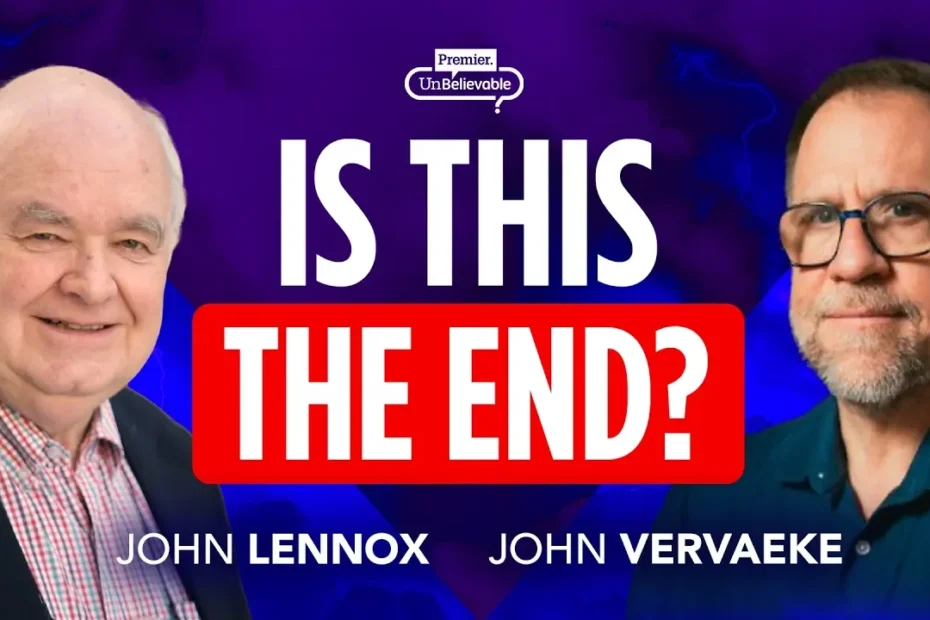
Read the full transcript of Premier Unbelievable? Podcast episode titled “God, AI and the Search for Meaning”, featuring guests: Oxford mathematician and Christian apologist Professor John Lennox and cognitive scientist Dr John Vervaeke, Premiered Jul 17, 2025.
Introduction: The Quest for Meaning in a Digital Age
ROGER BOLTON: Hello and welcome to Unbelievable, the show that brings Christians, skeptics and everyone else, we hope, into the conversation. I’m Roger Bolton and today we’re going to discuss God, AI and the search for meaning.
And I’m joined by two brilliant guests whose work has taken us to the very heart of what it means to be human. First, let me welcome back to Unbelievable John Lennox, Emeritus professor of Mathematics at the University of Oxford, a Christian thinker and apologist, known for debating the likes of Richard Dawkins and Christopher Hitchens. His latest book, or one of his latest books, is called “God, AI and the End of History” and it explores how artificial intelligence is shaping our future and what it means for the Christian faith.
And joining him is Dr. John Vervaeke, who’s Associate professor of Psychology and Cognitive Science at the University of Toronto. He’s best known for his “Awakening from the Meaning Crisis” series. It draws on neuroscience, ancient philosophy, Buddhism and Christian wisdom to explore consciousness and non-theistic spirituality.
We don’t want this to be an adversarial debate. It’s more of a wide-ranging dialogue. And I’d like to start by asking, just trying to establish where people come from. John Lennox, I was very struck reading the introduction to the new book you’ve written on Revelation where you said the language of God is expressed in the universe, the universe is maths and physics. Now for a lot of people that’s strange. They might assume that mathematicians wouldn’t have much to do with God. How does God express himself in maths and physics?
Mathematics as Divine Language
JOHN LENNOX: Well, I’m not quite sure that that’s exactly what I wrote, but the basic idea behind that is my conviction that this universe is word-based. That’s the first step and that we’ve got evidence of that, particularly in mathematics. We can get a grasp on at least part of how the universe works by using mathematics, which is a very specialized language.
And then in biology it has thrown up the longest word we know. It’s a chemical word, it’s the human genome with 3.4 billion letters. What I’m trying to express in that is those two facts really resonate with the very first statement in the Gospel of John: “In the beginning was a word.” And that’s what I mean by saying it’s a word-based universe.
ROGER BOLTON: And John V, if I can call you that, to distinguish between John L, you came also from a religious background but you’ve moved away from it though. Although I’ve noticed in some of the work that you’ve been doing, you seem to be particularly attracted or interested in Buddhism. Is that right?
A Journey Through Spiritual Traditions
JOHN VERVAEKE: Well, yeah. I was brought up in a particular brand of fundamentalist Christianity, which I rejected. I have been doing Taoist and Buddhist practices for about 32 years. I also have been doing Neoplatonic practices for about 10 to 15 years.
And I’ve become deeply interested in topics around meaning and sacredness. I just came back from something of a pilgrimage where I went to Istanbul and to Athens and Rome and Sevilla, Spain and Amsterdam, talking to various people about various sages, trying to get a deeper understanding of the Neoplatonic framework that runs through Christianity and Islam and Judaism and into the scientific revolution with people like Spinoza. So that’s where I’m at right now.
ROGER BOLTON: And John L, just to be clear as well, your view, your faith means that you believe God directly intervenes in life. And your latest book on Revelation talks about an end time when there is a judgment. So key to your beliefs as well is the idea of judgment.
Divine Intervention and Justice
JOHN LENNOX: Well, that’s part of it. I think once we raise questions of the intervention of God, that raises quite a few difficult problems. Well, at what level do we mean intervention? After all, the fundamental Christian belief is there wouldn’t be a universe without God creating it. So in that sense, there was nothing to intervene in to start with.
But I think what you’re referring to is that I am a Christian. My parents were. I’m very interested to hear that John, too, shares some kind of Christian background. But what interests me, of course, immediately is why he rejected it and why I still believe in Christianity after many, many years. There must be some kind of interesting difference somewhere, because as I say, it raises many questions that would interest me.
The idea of judgment, of course, is the flip side of a God of love in the sense that a God of love who doesn’t do anything about the evil in the world, ultimately then, isn’t a God of love. So judgment is what millions of people on this earth long for. And you discover in the Old Testament book of Psalms people saying, “How long, O Lord? How long won’t you come and sort this out?”
And I think there is a basic human longing for justice and for judgment, which I believe will happen. But it is, again, a very complex topic because judgment often in our minds is connected with ideas of wrath and anger and all this kind of thing. And to get the idea of a perfectly righteous judge is very difficult from our own human experience.
The Meaning Crisis
ROGER BOLTON: Now we’re talking about, you mentioned the longing in the past of people for judgment. But John V, you’ve been very interested in the longing of what you’ve identified for meaning.
JOHN VERVAEKE: The word “meaning,” of course, is being used as a metaphor. The idea is that the way a sentence has coherence and connects us to the world and gives us access to truth, the way people are living their lives can lack or have a kind of coherence that connects them to reality in a way that allows them to get at what is more real.
And so this sense of connectedness, connectedness to oneself, to other people, to reality, a sense that one is in relationship to something that has a value beyond one’s egocentric concerns, that it is normatively guiding, that it is shareable with others, that it is bound up with the cultivation of wisdom and virtue, that it requires transformation and maturation in order to properly realize it. These are the kinds of things that are typically meant by what I’m talking about.
ROGER BOLTON: But are you talking about a crisis? Is it that you feel that the search for meaning is a human trait, if you like, and that we’ve gone through a period or are in a period where some of the meanings that have made sense in the past no longer appeal, but the desire is still there? I mean, we have some talk in the UK about people returning to the churches and so on. I think it’s somewhat, well, exaggerated. There is some evidence, but not great, but there is a lot of evidence with this passion for mindfulness and so on, that people are aware of a spiritual, shall we say, gap in their lives.
JOHN VERVAEKE: Exactly.
ROGER BOLTON: Is that what you…
Symptoms of the Crisis
JOHN VERVAEKE: Well, I mean, that’s the whole thing. You have to take a look. And Chris and I, he’s my co-author in the book “Awakening from the Meaning Crisis,” you know, an entire symptomology. You can look at the sort of rising indications of despair, addiction, a loneliness epidemic. Loneliness is as detrimental to your health as smoking. That’s significantly on the rise.
The number of close friends that people have is reliably going down decade by decade. And so you can see that. You can see a lot of displacement strategies. Unhealthy people trying to live in virtual worlds, the metaverse. They’re looking for something that they can belong to that transcends them in some way.
We have the rise of, most people who are not officially religious are nevertheless spiritual, but not religious. I’m doing this because this is a nebulous category, right? It means, but the best, I mean, a succinct, not complete, but a succinct way of talking about that is they recognize that they need wisdom, they need meaning. This is not just a matter of thinking about it. They have to undergo practices in transformation, but they’re unclear where they should go.
And they don’t trust any existing institutions. We’re going through what’s called a trust apocalypse. We are at all-time lows for trust in all institutions, not just religious institutions: science, journalism, financial institutions, et cetera.
The Crisis of Trust and Authority
ROGER BOLTON: To relate that in part to the growth of social media, where I think social media, it is a crisis of trust, but it’s also a crisis of authority, isn’t it? I mean, certainly in the UK we can see very much what you’re talking about. And some would argue the crisis in politics is simply related to the fact that we haven’t had economic growth for 15 years, something like that, that the state is not delivering, the public services aren’t delivering that way, and people have a doubt about that.
You could also look at the influence of the war in Ukraine and people thinking we thought wars of that scale in Europe were in the past. You could see a number of other factors like that. But is there something more?
JOHN VERVAEKE: Yeah.
ROGER BOLTON: Is there something which sets apart from those, if you like, predictable things?
JOHN VERVAEKE: I think those are exacerbating factors. A lot of the trends that I’ve talked about go back much further. In this series, we talk about some fundamental transformations that took place within the West that precede the scientific revolution, the rise of nominalism, what happens in the Protestant Reformation, what happens in the scientific revolution.
And so one of the things I would say, I mean, I have a lot of argument for this, but I’ll just say it, and if you want argument, I’ll give it, is that this connectedness that people are longing for, the cultivation of wisdom and virtue, is not largely a matter of propositional belief. So just one fact to emphasize this: people who have a tremendous skill at giving philosophical argument for moral positions, that does not predict their moral behavior. Being able to do that doesn’t predict. So while necessary, it’s far from sufficient.
So people need, they need places where they can cultivate skills and states of consciousness, perspectives, traits of character they need to belong to.
The Question of Hope
ROGER BOLTON: Where does hope come from? Because what I hear now, you know, when people, I’m talking about the absence of hope.
JOHN VERVAEKE: But hope is an expression of the fact that there aren’t people you trust. Look, think about how a child has to trust adults to have a perspective that they don’t currently understand in order to learn from the adult. If the child says, “Well, this doesn’t make any sense to me, I’m not going to do it,” but the child trusts to the point of imitating.
There’s a lot of research even done by atheists, by the way, that this is one of the primary factors driving people’s belief. Not so much analytic argument, but do they have a trusted figure in their life that seems to be living a perspective they don’t currently understand, but they’re willing to imitate it? I think that’s where hope lies. Do we have people we look up to that we consider wiser than usual, that we’re willing to put our trust in?
Trust and Religious Institutions
ROGER BOLTON: Well, if you come across to John Lennox now, that question of who do we trust? A lot of the conventional, shall we say, religious organizations in the UK and indeed quite a few in the States and elsewhere, have almost forfeited trust over issues of child abuse and other things. I mean, do you see this as a temporary, if you like, situation which occurs, John, periodically and we can recover from, or are we in a very serious position where we do not trust?
JOHN LENNOX: Well, let’s go back a little bit because I’m very sympathetic with what John Vervaeke has just said. And that whole question of meaning has been central to my own life. And I can remember reading very early on in life, C.S. Lewis talking about longing. And because I’ve no idea what it is to be an adult and a non-theist, Lewis became a guide to me in the sense of how he found an answer to the question of longing.
So that’s the first point I’d want to make. I do feel that longing. It’s as God has set eternity in our hearts and we don’t find the rest till we rest in him. But I’m fascinated too by what John was saying in his analysis, which I’m very sympathetic to. And one of your colleagues, I think you’d call him a colleague, Ian McGilchrist.
JOHN VERVAEKE: Oh, yeah, Ian’s a good friend.
The Limitations of Scientific Explanation
JOHN LENNOX: Now, I imagine that he also—I know him too, and his analysis of this whole situation, I think is well worth mentioning. He’s written this magisterial work with 200 pages of references, two volumes called The Matter with Things. And it’s really answering a question that was raised years ago by one of the Inklings around C.S. Lewis: How is it we live in a world where we know how almost everything works and the meaning of nothing?
And his analysis is that historically, to use the neuroscientific terminology, since the Enlightenment or even before it, we’ve concentrated on left brain thinking and thought that that’s giving us the full picture of reality. And we have forgotten the right brain. And in particular, referring back to what John Vervaeke has just said, we’ve forgotten that the right brain tells us a lot about the concept that Iain McGilchrist calls “a sacred space.”
And I find that absolutely fascinating because although Iain McGilchrist’s sacred space tends to avoid anything as dogmatic as Christianity, I can understand where he’s coming from in the current state of thinking. Would you agree with that, John?
JOHN VERVAEKE: Yeah, very much. And I think Iain and I have been mutually impressed by how we converged. We didn’t know about each other’s work until we were both having published—he had published The Master and His Emissary and I had done my work—and then we started meeting and realizing a lot of the talk I was making about non-propositional kinds of knowing, the kind of knowing that goes into cultivating skills and states and traits, and what he was talking about right hemispheric was deeply convergent.
And I think Iain is, as far as I can tell—we’ve had several conversations—he’s very much in line with the ideas I’ve been doing at the center of my work on intelligence about, and we can talk about this later, around relevance realization. And it’s in the title of his book, The Matter with Things. He’s playing on “matter,” but he’s also playing on “mattering” in the sense of connectedness.
And here’s one of the things: The research on meaning in life shows that one of the things that contributes most to meaning in life is a sense of mattering. That’s literally what it’s called in the psychological literature, which is, you know, how are things relevant to me? How am I relevant to them? How do we belong together? How do we fit together?
And I think part, Roger, to answer your earlier question, what happens in the scientific revolution? And I’ve talked about this and my friend Evan Thompson has talked about it also in The Blind Spot with Frank and Gleiser. Science came up with a worldview in which there was no ontological home for the scientists doing science. So we created this worldview in which—yeah, but as scientists we have experience and we have perspectives and we have meaning-making and we have truth-seeking and all of this. And where does that all fit in?
To put it in a little bit of a slogan: we have scientific explanations for everything except how do we generate scientific explanations? Which very much means we’re kind of like a black hole in this ontology. Now, most people aren’t living at that theoretical level. I’m not claiming something ridiculous like that, but I’m saying that hole is corrosive and it pervades in a kind of nebulous way, a miasma within the culture.
Scientific Fundamentalism and the Nature of Explanation
JOHN LENNOX: Well, I’m with you. I’m with you 100% there. That’s what we call scientism. I actually go a bit further. I call it scientific fundamentalism. Only one problem.
JOHN VERVAEKE: Calling it that too, John.
JOHN LENNOX: No, I imagine you wouldn’t have. And it is. It’s utterly corrosive because it’s a one-size-fits-all. No other views are possible. And I’m very interested in you focusing on the matter of the explanation of explanation. What do we mean by an explanation? And the notion that a scientific explanation is exhaustive is so far off the mark even I can get kids to see that. They can see that there are different levels of explanation.
But I do think that many of our scientists need to wake up to the fact that they need to take explanation seriously and realize that some of the greatest scientists were very careful, like Newton. He with his law of gravitation, which I used to think explained gravity. But then I read Newton and realized he didn’t think it explained gravity at all. It simply gives us a way of doing a brilliant mathematical calculation. But he didn’t know what gravity is, and no one seems to even yet.
And it’s that limitation of science and the need for something transcendent that brings us back to where we started this conversation. And I’m very much at home with the kind of concept. But of course you will realize that I feel all this homes into and centralizes on or centers on the whole business of God revealing himself in Christ and the human being whom we can learn to trust. And that is the pillar of trust in my life and has been for many, many years.
AI and the Future of Human Meaning
ROGER BOLTON: I would like to pursue that particularly in the second part of our conversation, but I want just now to move towards—we talked about the search and the need for meaning and the sense of isolation people have and the unhappiness that brings with it. And then we have AI coming along that people are increasingly aware of.
And of course, in some senses, a lot of people worry about it just in terms of jobs. Will I have a job? You’re a young person coming out of university. You spend a lot of time getting trained and you suddenly find that the accountants or lawyers you’re hoping to work for aren’t taking any graduate recruits this year because they think AI is actually going to make a large number of the jobs redundant. So I understand that and concern about that, but that’s a larger concern, haven’t you?
And I wonder about it. And I want to talk, John Lennox, to bring up a quote that you use from Lord Rees again in your book about Revelation. And Lord Rees said, “In the far future it won’t be the minds of humans, but those of machines that will fully understand the cosmos.” I think he’d also said, you said, “Technology continues to outpace the ethical underpinning needed to keep it under control.”
So where do we think we are in AI? Are we at a period in history where you genuinely can see the possibility of us, as it were, surrendering our position that we thought we occupied, as if you like the peak of creation, to something we create ourselves, which is greater than ourselves? I mean, John Vervaeke, are we anywhere near that point?
The Problem of Relevance Realization in AI
JOHN VERVAEKE: Well, I mean, I’ve done a lot of work on this. I’ve got a couple of video essays on YouTube. I’ve got a book, Mentoring the Machines with Sean Coyne. It’s one of my areas. I do work on the philosophy of artificial intelligence as a cognitive scientist.
Where we are is, I think, a very important question to address. In fact, I would ask us to slow down before we get into trying to, you know, where are we going? I think there’s a lot of confusion about where we are that needs to be clarified.
So if we talk about the LLMs, the large language models, we face a couple of really crucial things. First of all, again, I’m going to make—and John, if you want me to back this up, I’m happy to. But this is, you know, the bulk of my scientific work, my scientific publications—that when we’re talking about intelligence, what the core ability we’re talking about is a really extraordinary ability that you are both demonstrating.
Out of the combinatorially explosive amount of information you could be paying attention to, you’re ignoring most of it and zeroing in on some of it. All of the information in your memory and all the possible combinations, you’re ignoring most of it and picking out one or two combinations. Of all the logical possibilities you could consider, all the implications, you’re ignoring most of them.
So you’re actually intelligent—this sounds like a Zen koan, I know, but you’re intelligent because of your reliable capacity to ignore most of that information and zero in on the relevant information. And this is the ability we can’t give to AI. And this is what the LLMs don’t have.
Because what they do is they rely on our judgments of relevance to put the data sets together for training, our judgments of relevance to structure the connections between information on the Internet, our attention, and what we find salient and relevant. We are feedback in the reinforcement training. So all of their ability to do relevance realization is completely parasitic on ours.
And this means that the account of how their intelligence will not generalize to any other organism, any other entity. The intelligence of how an LLM works can’t explain how an octopus is intelligent or a chimpanzee is intelligent. It’s not a scientific theory. That’s the first thing. And that’s what makes this especially dangerous in a very deep sense. We don’t know how these machines are operating.
And we often gloss over that by even saying the term “artificial intelligence.” Well, does that mean our scientific notion of intelligence applies to these machines? I find that highly questionable. Do they do powerful things? Yes.
And here’s one other thing, and then I’ll be quiet so you can say some more and John may intervene. We have—this is another area of my expertise—we have decades of well-replicated, no replication crisis, experimental research showing that measures of intelligence—let’s assume for the sake of argument the machines have intelligence, which is questionable—we have all kinds of empirical experimental evidence that intelligence is only weakly correlated with rationality, about 0.3. It is necessary but not sufficient for rationality.
So merely making these machines intelligent does not guarantee they will be rational. This is why as we try to give them capacities for reasoning and self-reflection, they crash and become monstrous and their failure rates go up to like 67%. So we have to be very careful what we’re talking about when we’re talking about these machines. They’re parasitic zombies. But that doesn’t mean that parasitic zombies can’t be dangerous. We got a lot of good fiction that tells us they can be very, very dangerous.
ROGER BOLTON: I know you’re saying that they will remain parasitic zombies.
JOHN VERVAEKE: I’m saying what we have is we have to think about what they are ontologically lacking. Now we could take up an additional project of trying to give them this missing ontology. And I think that opens up a host of new dangers for us.
For example, and I’m not claiming the following claim is sufficient—I’m not making that claim—there’s good reason to believe that relevance realization depends on you being embodied, that you have actual needs like you have to consume matter and information to be a living cognitive being. It’s not just that you can take it in. You are constantly making yourself from your environment. You care about yourself. So that means you have to care about this information rather than that.
These machines are not embodied in any deep ontological sense. Do we want to try and give them more? We want to make them artificially alive? That’s a very different project and it has a whole host of possibilities and dangers to it that we’re not even discussing right now. This is what I mean. We’re often talking in the wrong way about what we’re confronting.
The Misleading Vocabulary of AI
JOHN LENNOX: I would argue, I think, isn’t it true, John, that—I think you hinted at this—that the vocabulary is very misleading. If you take some of the leaders in this field, like Peter Norvig, they’re very careful about pointing out that the word “intelligence” is only used in a simulated sense. In other words, we’re playing the Imitation Game of Alan Turing.
And they make their point in their big book that’s almost the Bible of AI. They make the point that they wouldn’t even know what it would mean to put human-like intelligence. They are happy with simulation and to advance that simulation as much as possible so that the machines are not intelligent in that sense.
And I think you hinted towards the end at something else that seems to me to be profoundly important, and that is, I believe God has created human beings linking intelligence with consciousness. Now, we don’t know what consciousness is, so we’re not likely to reproduce it in any kind of mechanical or technological way. And it’s a huge barrier to those who think that they’re going to, in the end, create artificial life and consciousness and make conscious machines.
But unfortunately, the vocabulary tends to give the idea to ordinary people that these machines are pretty nearly conscious like human beings, when they’re absolutely not.
JOHN VERVAEKE: I totally agree with you.
ROGER BOLTON: May I just interrupt you at this point? We’ve got to come to the end of part one. It also gives me an opportunity to reflect on the profound things I’ve just heard. Thank you very much. We’ll just take a quick break. I’m Roger Bolton, and you’ve been listening to Unbelievable with my friends, my colleagues, my guests, actually. I hope they become my friends, John Lennox and John Vervaeke.
And don’t forget to visit our website, premierunbelievable.com where you can watch past shows, read articles and support what we do. If you’re watching on YouTube, do hit the subscribe button and leave us a comment. We’ll be back in a moment.
JOHN VERVAEKE: I really don’t think that AI as it is now is on a trajectory to becoming conscious. But it will certainly seem as though machines have conscious minds and better danger. If consciousness is a property of the—
ROGER BOLTON: Brain, then it’s subject to what we—
The Nature of Intelligence and Consciousness
JOHN VERVAEKE: Call causal determinism, physical determinism. This idea of libertarian free will I think is entirely wrong and I also think is unnecessary.
ROGER BOLTON: These systems will become more and more like us. People will treat them and want them to be treated as though they’re human. The challenge now is it seems to be going faster and faster.
JOHN VERVAEKE: We are terrible at projecting out long term consequences.
ROGER BOLTON: Robot rights, I can see it coming. Welcome back to part two of this discussion about meaning, AI and machine learning. Much, much more. You’re listening or watching Premier Unbelievable with me, Roger Bolton and my guests are John Lennox and John Vervaeke.
John Lennox, let me come back to you because you were beginning at the start, at the end of our discussion, you were reflecting on what the other John had said. And in a way, for somebody like me who’s entirely on the outside and not understanding most of these things, what you seem to be suggesting is that the language which is in common use about AI and in terms specifically on intelligence, I think John Vervaeke made this point, is very, very imprecise and largely misunderstood. Could you just try to define the difference again between human intelligence, in your view, and the intelligence we talk about as artificial intelligence?
JOHN LENNOX: The point I was making earlier is that human intelligence is clearly coupled with consciousness and we don’t know what that exactly is. So the best we can do is simulate. And the large language models, as John has been explaining, they have an enormous amount of information and they filter through it in a very sophisticated way. But it’s actually a similar principle to the old predictive texting things. So in that sense you’ve got a machine which is doing something, but it doesn’t know what it’s doing, it has no idea what it’s doing.
ROGER BOLTON: There’s no idea what it’s doing because in a sense it does not exist.
JOHN LENNOX: No, that’s not what machine exists.
ROGER BOLTON: Yes, but we keep suggesting that the machine has some sort of identity outside itself which is somehow comparable to us. And are you saying that’s an illusion?
JOHN LENNOX: I think it is an illusion and will be for a long time and maybe forever because the whole idea of replication of what the human mind can do, and I’d love John Vervaeke’s take on this, we have people very bright people like Roger Penrose in Oxford, who won the Nobel Prize. And in his research he points out that computers will never be able to fully replicate in any sense past, present or future computers because the human brain can do things that the human computers can’t.
And he makes a reference to some very famous theorems in mathematics by the Austrian mathematician Kurt Gödel. Now that’s a very sophisticated thing and is highly controversial. That his argument would be, look, no matter how hard you try, you’re not going to get the kind of human level intelligence with a machine because it’s simply not possible.
ROGER BOLTON: So you might get a situation where the machine does a range of things far more quickly that we cannot do. It may be able to do things we cannot do, but in your view, it will never be able to do all of the things that we do.
Narrow AI vs. Artificial General Intelligence
JOHN LENNOX: Well, that’s right. I think we ought to distinguish between two. There’s the narrow AI, which is a system that does one thing and one thing only. Usually that normally requires human intelligence and we’ve examples of that all over the place. And it has become dangerous enough.
But then there is all the sci-fi side of AI but we need to take it seriously because people like Lord Rees are talking about it. This is their idea that eventually humans will merge with computers and so on and will become superhuman. Now there are two strands in that, Roger. There are two strands of research at least.
One is enhancing humans and producing transhumans. That’s the remit of Yuval Noah Harari who’s written, they’re selling books on it. And that’s the transhumanist side of things. There are other people that say the whole problem with biological life is that it’s biological, it dies. So we need to find some way of starting from scratch and creating perhaps on a non-biological base like silicon, some sort of entity into which we can eventually upload our brains.
Now that’s where I think we get pretty near a sci-fi version of the whole business, artificial general intelligence. And we’re a very long way from anything near that. But as I said at the beginning of this, that the narrow AI is doing things enough, and you mentioned them, jobs are a very big problem for many people. But it’s not only jobs, it’s the creation of a totalitarian surveillance society. That’s very alarming because the potentiality that this technology gives to bad actors is extremely dangerous. And I suspect John Vervaeke would agree with me on that. There are a lot of dangers out there.
ROGER BOLTON: John, can I pick up this thought, which I’m sure I’ve understood imperfectly, but which suggests that it may be possible in the future to transfer our brains to some sort of presence within AI.
JOHN LENNOX: Well, it’s a thought. It’s speculation, but I doubt it because of the problems I mentioned at the beginning. There’s a difference between a machine and human intelligence.
ROGER BOLTON: John Vervaeke, do you think it’s inconceivable or is this a nightmare we need not have where we have somehow created this hybrid?
Natural Born Cyborgs
JOHN VERVAEKE: That’s a very tricky question. We are natural born cyborgs to begin with. One of our adapt, I mean, look at me. This is a tool and I’m bonded to it. This is a tool. Everything except the atmosphere in my naked body is a tool and I bind my identity to it. We really do. I would get upset if you knocked over my bookcase, et cetera, you know what I’m talking about.
So the fact that people are already in that sense bound to their cell phones. If you remove a cell from a human being, we have some research showing that they experience something that’s analogous to a child or a parent going through separation anxiety. Where’s my kid? Right. That kind of state. So it’s not a question of, it’s not a question. Will we. We already are.
The question I think that John is putting his finger on is like it’s a qualitative question. Could we do what you’re suggesting? First of all, I think the model of the idea that we could upload our consciousness into these machines, it comes from a model of consciousness and a computational theory of cognition, of which myself and many cognitive scientists are deeply critical. I reject that idea. I reject the idea that our consciousness is somehow cleanly cleavable from our particular biology. And the attempts to think like the theoretical attempts to try and derive a biology off of silicon have largely bankrupt.
Now, I don’t want to pronounce on the impossibility of things that’s a bad thing to do as a scientist, but what I’m saying is I think there are other concerns that are more pressing. For example, one of the literally three weeks or so after ChatGPT-4 came out, I did a video essay on YouTube. It’s been very well received and I predicted. And this is one of the weird things that happens when you’re a scientist, you’re happy if the prediction comes true because you’re a scientist and then as a human being, you’re kind of terrified.
But I predicted that what we’re going to see, because of the meaning crisis and this, and because of the fact that we’re very unclear as a culture about intelligence, rationality, consciousness, wisdom, we’re going to see people taking up religious relationships to these LLMs. And this is now pervasive. I get regular emails.
The Rise of AI Idolatry
ROGER BOLTON: Sorry, sorry, just could you just slow down just a. So you see, it’s almost like going back to idols in the Old Testament. You see new gods essentially being created by people who they will worship.
JOHN VERVAEKE: They will tell you that their machine has achieved sentience and it is wise and it knows them better than they know themselves and that they are following it and they describe their relationship to it as spiritual, even religious. This is proliferating. I get emails every day from people claiming this more and more and more. Right.
And there’s a noxious side to this. LLM-induced psychosis is starting to significantly go up because look, look, you can pick up ChatGPT and do this.
JOHN LENNOX: ChatGPT.
JOHN VERVAEKE: I’ve just become God. And it will say, “That’s wonderful. How is that going for you?” That’s not good. If you’re on the edge of a psychotic break. And so you’ve got all of this stuff happening because the spiritual hunger, the fact that these machines can do things that are amazing and the fact that people don’t have the discernment between simulation and reality means a form of, I’ll use your term, I don’t object to it. A form of idolatry is now pressing and growing.
ROGER BOLTON: That next to you. First of all, do you share that assessment?
JOHN LENNOX: Oh, absolutely. I mean, it had been predicted by John and other people have mentioned it and we’ve now got data religion. And somebody not long ago wrote, if you want to find out about religion, go to Silicon Valley.
And it’s so obvious that this is likely to happen because in ChatGPT you’ve got something that’s apparently omniscient. The Internet is omnipresent around the world and it can produce the scriptures for you if you like. And if you go through the traditional attributes of God and then ask, what about what we’ve got in AI? Many of them reflect that.
And there’s a famous quip, I think it was by Bo Gaudat, but John will correct me, that somebody asked him, is there a God? And he said, no, but we are creating him. And that idea that technology could get to such an extreme that people would bow down and worship it, and possibly to go back to what John said in the first part, they find they trust it.
And this is unfortunately the core of idolatry in the Old Testament form, people didn’t always love their idols, but they trusted them, and so they had to take them with them. And so I fear that what we’re getting is another and very powerful version of a return to sheer paganism and idolatry. And therefore, I, of course, take the view that the Christian message has got a very powerful answer to that.
The Persistent Human Need for Worship
ROGER BOLTON: But, John, just you could say there is an optimistic society. This demonstrates a human need which never goes away, which is ever present.
JOHN LENNOX: Oh, that’s clear.
ROGER BOLTON: Which is the need for worship and so on. And so to that extent, you know, the belief that in some way this would be science, perhaps would make it unnecessary and people would come to see it was unnecessary. That has gone out the window. So we’re there with a constant need, but a need which the Christian church or the churches seem to find difficult in fulfilling.
Now, you, one of the things that I’m trying to make a transition here to Revelation, let’s say, if I can make it. But I was very struck when you were saying that actually we confide in Revelation so much to tell us about today. I mean, for example, you say at one point, Revelation is more to say about worship than any other book in the New Testament.
You see, most people, my generation, whatever, look at Revelation, try and read it and give up and say, oh, please, seven churches, what’s this about? And here you at the, you’re such an eminent scientist, and we’re at this present period and you’re telling us no Revelation is entirely relevant because you believe God speaks directly to us through it.
Revelation and the End Times
Now, are we now, what does your interest in Revelation tell you about the situation we’re now in? I mean, some people would believe we’re in the end times, and this is what we’re watching. And ultimately even some have suggested that we will create or evil devil, whatever you call it, may use AI to help bring about the end time. Sure. Why do you think Revelation is relevant now at this point?
Understanding Revelation Through Modern Technology
JOHN LENNOX: I think one of the reactions in earlier times, the book of Revelation, is that it supplied fuel for the lunatic fringe of religion and of Christianity. And we need to start in a different place. And the reason that I was writing about this started with my reading of AI scenarios.
And that is Max Tegmark in particular, who wrote a book, Life 3.0, has in his book 12. I think it is possible scenarios for the distant future. And he doesn’t say which one he favors, but there’s one that he spends more time on than others. And that’s called Prometheus.
And he gives a very plausible sounding, rapid buildup of this company that uses Amazon to, in the end, take over the world and turn it into a surveillance state with all kinds of AI technology. And he then talks in detail about economic control. And he suggests that this Prometheus will fit every citizen of the world with a special bracelet that will have the functionality of an Apple watch and all this kind of thing.
It’ll monitor all conversations and everything you see and so on. But it will also have the capacity to give you a lethal injection if the totalitarian government that runs it doesn’t like you anymore and doesn’t approve of what you think.
Now, my argument is simply this, if people are prepared to take that kind of scenario seriously, then I’d like to put alongside it an amazingly similar kind of scenario that’s 2,000 years older than it. Because in the book of Revelation, which uses marvelous symbolism, but if you know anything about symbols, they stand for reality. I learned that from CS Lewis. They stand from realities.
You’ve got these monsters or wild beasts who appear, one of them to rule the earth, and the whole earth worships this monster. Now, the interesting thing arises in the detail we’re told, that an image is made to the monster which breathes and has remarkably human properties, controls the economy, and can put to death anyone that it wishes.
Now, almost translatable is Tegmark’s scenario. And my simple observation to start with is why shouldn’t we take this scenario since it’s embedded in so much more, in fact the whole Christian faith and the biblical revelation. It seemed to me a very good reason for imagining that perhaps that the Book of Revelation is talking about something like this. I’m not precising it at all.
But you see, if you believe, as I do, that there is such a thing as genuine revelation or predictive prophecy, then it seems to me rather curious that when people come to study the Book of Revelation, they tend to interpret it in categories that belong to previous centuries and they never think. As a scientist friend of mine wrote in a book that unfortunately is little alone. He says if anything in this is real, we ought to be using our most advanced knowledge of the universe to interpret these, not just the distant past. And that’s what I’ve tried. What are you saying?
ROGER BOLTON: Sorry, forgive me for being slow following up, but you’re suggesting that. Well, it’s an obvious fact if people can only speak using the language and ideas available to them at the time.
JOHN LENNOX: Correct.
ROGER BOLTON: And so therefore the way in which they express truths may differ, but the truth is there.
JOHN LENNOX: Yes.
ROGER BOLTON: And your view is that we’ve, you know, we’re too prepared to look at sort of Games of Thrones scenes. Actually you say that specifically, don’t you? In your introduction to your new book on Revelation, you said it’s nothing less than a direct message from the one true eternal God, creator and upholder of the universe. So actually what you’re saying is we better look at Revelation, study it properly, because it’s our future is in there.
JOHN LENNOX: Yes. And we should take it seriously because scenarios coming right out of the non Christian, non theistic world in the sciences, particularly AI, are beginning to parallel it. Now I’m not saying this is that, but it certainly makes much more sensible comprehension of what’s going on there. And I think in the end it’s a more powerful message. But the danger is, and I’m sure John Vervaeke will agree with this, the danger is that we get over dogmatic about the details. So I’m suggesting a parallel that we should think about.
JOHN VERVAEKE: Yes.
The Challenge of Literalism
ROGER BOLTON: This is the old problem, isn’t it? Of separating out the time and the culture in which things are expressed with the eternal truths which are there. And that literalists get stuck. I mean, they look for a creature with et cetera, et cetera, and therefore miss the essential issue. John V. If I may call you that. You’re not a believer in that same way.
JOHN VERVAEKE: Well, I mean there’s a specific thesis and a general thesis. The specific thesis is around the book of Revelation. I don’t know what to do about that. I’m not an expert on the book of Revelations and I’m not trying to be coy.
I grew up under a very fundamentalist Christianity in which that book was lorded over me and terrified me on a regular basis. The most terrified I have ever been in my life. I came home when I was 10 years old and there was nobody home and I was convinced that the Rapture had occurred and I had been left behind and the Antichrist was coming and I was clearly damned. And for a 10 year old, as you can imagine, that is one of the most terrifying experiences you can have. John. I’m not saying you’re saying that. I heard you very clearly, you were being very cautious.
JOHN LENNOX: I’m just saying actually I had the same experience as you when I was 10.
JOHN VERVAEKE: There you go. Maybe something with 10 year old.
JOHN LENNOX: And my parents weren’t here and I looked at my dog and I said to the dog, you and I are the only two left. But then I started to think because my parents, unusually for Northern Ireland, that’s where I come from. And you can imagine the rest. They taught me to think and they allowed me to think not only about Christianity but about other worldviews.
And so I was able to think that through and welcomed them home when they arrived home. So I’ve had that experience up to a point, but my home presented Christianity as very open, open and basic to thought and history and philosophy and everything else. So it must have been a little bit different from what you experienced.
JOHN VERVAEKE: Sounds like it. It sounds like it, yeah.
Personal Experiences with End Times Teaching
ROGER BOLTON: If I, I was nothing like your experience, but I was part of the Evangelical Church of England in which the end time was ever present in the sermons that were delivered. And I did go through myself this process. So I tended to see myself in the fires, not so much being left behind, but in the fires.
And I think the, you know, and that’s quite difficult to deal with because, you know, I was dealing with really good people who in every way were people I admired and wanted to look up to. But then I was presented with view of the wrath of God. And I think the result of that was to ignore revelation, to assume that it, you know, is, you know, the wild imaginings of a man stuck on the isle of Patmos who for some reason that book has ended up in the New Testament.
Of course, the big question, some people don’t accept it as part of the New Testament and so on, but the net result of it was to say it’s not relevant.
JOHN VERVAEKE: I reject that claim. I reject that. It’s irrelevant. So I’m trying to, I’m trying to state my bias, I’m trying to be honest here.
ROGER BOLTON: Okay, but we’ll have to just hold our discussion at that point. I want to return to your bias, if you like, in the final section of our program.
JOHN VERVAEKE: I wanted to comment though. Yeah, we’ll return to my bias or our biases.
ROGER BOLTON: No, just comment briefly now.
The Power of Mythos
JOHN VERVAEKE: Yeah, yeah, I do think that I’m going to use a term, and I don’t mean it in the insulting way the new atheists do. I mean it in a deeply profound way. So I even won’t use the English word myth. I’ll use the Greek word mythos.
I think that there are important symbolic stories that give us access to that non propositional kind of knowing that can give us what great literature, can give us, can give us skills, can give us orientation, can give us states of mind, can give us role models and character traits.
And I think the reason why those myths survive is precisely because they have the pertinence to wake us up and make us aware of patterns that we’re not currently paying attention to. Whether or not if that’s about prophecy in the future is at least prophecy in the sense of a lot of the prophets of the Bible, like Moses telling forth making people aware of patterns that they’re unaware of.
And I am willing to acknowledge that somebody that seems very perspicacious, like John, could use a revelation in that mythological, again, non pejorative sense to help people wake up to patterns and get them and to make things salient in a way that might not be made salient to them. I totally acknowledge that and I think so.
ROGER BOLTON: That’s so just to drop the I’s for some dark me trying to catch up. So the prophets essentially are not transmitting, if you like, message from God about what will happen as a fact, but saying if behavior continues in this way, these are almost inevitable results.
JOHN VERVAEKE: I think there’s both kinds of prophecy in the Bible. I’m not making an either or. I’m just pointing out that a large part of prophecy in the Bible and even the Book of Revelations is directed to the churches of the time. I mean, even that’s the way. So it’s a telling forth, not a forth telling.
And I’m claiming, you know, maybe it’s my bias, I am agnostic about the prediction, but I think that we should be paying attention to the non scientific, non technical literature. And again, I’m trying to use that term as neutrally as possible because of the wisdom it might convey to us. And that is what we are sadly lacking right now.
So that part of what John is doing I’m agreeing with. I know it’s not exactly what he would want, but I am trying to meet him halfway. If you’re going to have to take.
ROGER BOLTON: Another quick break, but what do you think about this discussion? We’d love to hear from you. You could follow us on social media, nbelievable, F capital E on X, formerly Twitter, PremierUnbelievable on Instagram and Facebook. And don’t forget to follow us on the Apple podcasts or wherever you get your podcasts. We’ll be back in a moment.
JOHN VERVAEKE: Two thirds of people believe that science and religion are incompatible. According to a recent UK survey. Many of the key atheist voices in our culture have used science as a battering ram against Christian belief. But there’s a different story to be told about science and faith. And few better people to tell it than John Lennox, Emeritus professor of Mathematics and Philosophy of Science at the University of Oxford.
In this online course from Premier Unbelievable on science, faith and the Evidence for God, you’re invited to learn from one of the most celebrated Christian thinkers of our time. Across nine modules, you’ll discover how Christianity grounds the evidence for God, why it led to the rise of modern science, what restricted we can give to the question of evil, whether miracles are anti scientific and why atheism and science can’t account for human value, all the big questions our culture is asking.
The course includes supplementary video material from lectures delivered by John Lennox on God, faith and science, along with questions and assignments to help you ground the various learning points in each module. You can take the course at your own speed and in your own time. Enroll now at premierunbelievable.com courses and learn how to make sense of science, Christianity and secular culture.
How to Read Revelation
ROGER BOLTON: Well, welcome back to our well for me fascinating discussion on God, AI and the search for meaning. I’m with my guest John Lennox and John Vervaeke, picking up with John Lennox where we were on Revelation. I’m going to come back to John V a little bit later about spiritual transformation, what it looks like without a personal God.
Coming back to looking at Revelation and why we should now read it and how we should read it. The obvious answer to why, John, in your view we should read it because it’s a direct message from God, as you’ve said, and we have much to learn, but we need to learn how to read it. Help me, how should I read it? Because at the moment I look at it and I think, oh, seven churches and do they rest? Oh, seven emperors and what’s this about? And I’m reading it obviously in the wrong way. How should I read it?
The Book of Revelation: A Personal Unveiling
JOHN LENNOX:
Well, it seems to me that I first take a look at a book of the Bible as a book of literature and it’s hugely important actually to see what it says before you try to determine what it means. And just as a little clue to claims to be a revelation of Jesus Christ, that is a revelation of a person. In other words, it’s an unveiling so that if we read it correctly, we should know more about Jesus Christ when we finish than when we started, which is not always the case. Often people end up fighting when they read this book.
The second thing is just from the sheer literary form of it, in the first chapter there are three references to a fascinating concept when it comes twice, the God who will come, which is an Old Testament concept about God coming and judgment, about which people should rejoice. But if you ask the question, how will God come? The central reference is to the return of Christ, which is of course focusing on the central hope of Christianity, the return of the Messiah.
Now, the interesting thing is in the final chapter of Revelation, Jesus says personally three times, “Behold, I’m coming soon.” So it seems to me that the three at the beginning and the three at the end bracket this book, that the overarching idea is the return of the person of Jesus Christ. Now, there’s a lot more in it. Of course it’s going to involve judgment, but it’s going to involve joy as well.
And the reason I mentioned worship, you quoted me on that, is that if you take one of the major sections of the book, the first one about the throne after the churches, there are several scenes of glorious, magnificent worship and singing in heaven. And someone once remarked, if you don’t come from the book of Revelation singing, you better read it again. And how you read it, that’s far too much to compress into a couple. It’s far too sophisticated for that. We need to take it seriously and get into it. But I believe that you can do so, which is why I wrote a book about it. But I’ve been thinking about it for 70 years.
Spiritual Transformation Beyond Traditional Religion
ROGER BOLTON:
Well, if I come across Dr. John Vervaeke, you are not a Christian, but is it possible? We’ve analyzed at the very beginning of this discussion the search and the need for meaning. We’ve looked at the way in which the dissatisfaction spreading throughout societies in different ways and the sense of crisis that is in many ways presents. AI is presented to us. There are plenty other crises around. But you’ve identified that need for, and I’m sorry the language is inadequate, but some sort of spiritual transformation, how? From a non-Christian or non-strictly or narrowly religious perception and perspective, how can we transform ourselves spiritually if we don’t go down the route that John believes we should?
JOHN VERVAEKE:
I wouldn’t say I’m a non-religious person, but I take the point of your question. Let me try and make two initial quick. One is, I think part of the problem in our culture is the misapprehension of wisdom. We take it as a personal possession that we have. I have meaning and it’s my meaning. Meaning doesn’t work that way. Go back to the metaphor. The meaning of your sentence has to be shareable with me and correctable by me. Or your sentence isn’t meaningful if meaning isn’t shareable and correctable. If I don’t understand that I can get it wrong, then there’s no sense in which I can get it. And this is the ancient claim.
ROGER BOLTON:
In other words, I can’t get it right within myself. It has to have been to others.
JOHN VERVAEKE:
Yeah. This is a variation on a very famous kind of argument, prototypical instances Wittgenstein’s. There’s no private language. It doesn’t make any sense to talk about something being meaningful and it being completely private and arbitrary to you. That doesn’t make any sense. So that completely possessive, completely subjective sense of meaning, I think that’s one of the besetting problems. I think we misapprehend meaning in our culture in a profound way.
If you take a look cross-culturally and cross-historically, the pursuit of meaning in this spiritual sense has always been interwoven with wisdom. And wisdom means I can be wrong. There’s normative demands. I have to be correctable. I have to dialogue with other people. I have to learn from other people.
Communities, Practices, and the Cultivation of Wisdom
That being said, that means that I think the meaning crisis requires that we participate not in belief systems, that is the ideological reduction. I resist calling a religion a belief system because that is to equate it to an ideology. What does a lot of the work, and I’ll give you an empirical evidence for this in a sec, is that we have role models that give us skills that give us alternative perspectives that lead us to places we couldn’t get to on our own, that model character traits that we can internalize and indwell. This is what we need. So we need communities that are engaging in ecologies and practices.
So here’s the empirical research. I supervise this. He was a graduate student of mine at the time. He’s now a colleague, Jung Sun Kim. And what you do is you take a look at people within communities. And I won’t go into the details. And basically what you’re measuring is how well are people in those communities doing at cultivating wisdom. And we do have ways, many different measures and techniques for lining up with sort of intuitive assessments, how wise are people, which isn’t the same thing just saying that they’re wise.
Now what he was able to show very well is that people who are in religious traditions do much better than people that are secular. But what that research also showed is there’s no significant difference between the different wisdom traditions and their capacity to generate wisdom and meaning. Now, one conclusion, this is the conclusion I would offer. I’m sure John will have others, but this is at least a plausible conclusion, is that the propositional doctrines aren’t doing most of the heavy lifting. The modeling and the community and the practices, right? The skills and the traits and the states are doing most of the important work.
And that seems to mean that we should be very open to the possibility that people in other religions are cultivating very deeply deep forms of meaning, deep forms of wisdom. They are orienting towards something that is transforming them and their community in powerful ways. Now, I’m not arguing for relativism, and I’ll push back on any attempt to make me a relativist because I’m a scientist, right? But I’m trying to say this is how I’m answering your question. It’s like, but why can’t it be the case?
ROGER BOLTON:
But what practical steps do you, what advice can you give to your students who come to you and ask you, what can I do?
JOHN VERVAEKE:
I tell them to take up an ecology of practices. Are you engaging in regular dialogical practices? Does Christianity have a version of this? There’s some versions of confession, especially in the Orthodox tradition, that are dialogical. Are you doing imaginal practices? Are you doing mindfulness practices? Are you doing embodied practices? Are you doing reflective practices? Are you just picking them? Or are they working in a way in which they correct and check each other because there is no panacea practice? How comprehensively do you have a living ecology of practices that is addressing the complex cognitive ways in which you can reliably deceive yourself and those around you?
ROGER BOLTON:
John Lennox, how do you respond to that?
The Danger of Self-Deception and Personal Relationship
JOHN LENNOX:
I respond to it. He reminds me of, you remind me of a lovely quote of Richard Feynman who said, “Bend over backwards to examine your theories because the easiest person for you to deceive is yourself.”
JOHN VERVAEKE:
Yes, very much.
JOHN LENNOX:
It’s absolutely true. You see, Roger, I sense a grain of truth in all of this. More than a grain of truth in that. I can understand the reaction that says that the heavy lifting is not done by the proposition. And for me, the propositions, in a way, they are important, but they’re nowhere near as important as what I conceive as my personal relationship with God through Christ. It’s a personal communion, a personal friendship, and it’s that, that, it seems to me, that is the key thing.
I remember having a conversation with my mentor who was a brilliant philosopher and expert on Scripture, and he asked me, just casually, he said, “Why do you read the Bible?” Well, I said, at the moment, I got a couple of talks to prepare and this and that. Oh, he said that’s okay. But he said, I’d like to tell you why I do. I said, why do you read the Bible? He said, “To get to know God.” And that was a revelation to me that this is what we’re aiming at.
And Christ himself promised before he left his disciples that he would come to them and reveal himself to them. Now, that is something that transcends any amount of propositions and so on. The propositions are an attempt to encode it in language that we transmit to others. But this idea of “This is eternal life,” said Christ, “to know the true God of Jesus Christ, whom he sent.” That’s John writing. That, to me, is the pinnacle of it. And that is what, in a sense, forms the center of my life and if I might say it, the center of my companionship with my wife, to whom I’ve been married for 57 years. This is the important thing. It’s relational. And in that sense, it comes close enough to fitting into one of the categories that John’s talking about, I think.
Uniqueness and the Image of God
ROGER BOLTON:
But where does that place you, John L., in your attitude to other monotheists? Well, you obviously believe they’re mistaken, but I mean, is there a sort of gradation here? Because I think, John Vervaeke, you’re saying that in some ways that, you know, people who have religious beliefs do have a great deal in common.
JOHN LENNOX:
Yes.
ROGER BOLTON:
I answered it with, you’re making the claim for uniqueness.
JOHN LENNOX:
Oh, I am making a claim for uniqueness, but it’s a remarkable uniqueness. I’ll answer it with a story. I mentioned growing up in Northern Ireland, and I said, my parents were remarkable in that they allowed me to think. They were also remarkable in that they were Christian without being sectarian. In that my father was prepared and deliberately employed people across the religious divide, and that got him bombed on several occasions. My brother nearly lost his life.
And I said, “Dad, why do you risk it? It’s very dangerous.” And I’ll never forget his reply because it has been basic to me for all of my life. He said, “Look, Scripture tells us that God made everyone, irrespective of their belief, in his own image. And I intend to treat them like that.” And that is the basic fundamental, if you like, which has guided my life.
In other words, when I meet someone else, I’m looking at someone made in the image of God from whom I can learn and all this kind of thing. We may have differences about different kinds of things, and we can discuss those because we respect each other as valued. So my approach is always to remind myself the value of the person to whom I’m talking. And it’s one of the reasons, actually I am a Christian, because I don’t find that sort of value in atheism, for example, certainly not of the new atheist kind.
So the idea of approaching people and thinking you’re wrong is not really the way I want to approach them. I want to understand them, where they’re coming from, what makes them think. And I might learn from them that I’m wrong in a whole lot of things. I want to learn from them because in that sense, circling around to the very beginning, we’re all in this search for meaning. And if you found a way to give you meaning, I want to hear about it, even though I may initially disagree with it. And I would like the opportunity to share what I have experienced with you, because in the end, it’s personal experience that counts the most.
ROGER BOLTON:
And John V., if I ask you a very personal question, what gives your life meaning now?
The Search for Meaning Through Pilgrimage and Dialogue
JOHN VERVAEKE: So what gives my life meaning is something that is conversion with what John just said. I described what I just did. I just got back from six weeks as a pilgrimage because I was called to it, and I was called. So I went to various places, and in each place I let this place speak to me, but I also had a person there to speak to me and then a sage.
So, for example, I was in Istanbul talking to Jonathan Pageau about Maximus the Confessor. I was in Athens talking to Charles Stang about Dionysus or Ralph Kelly about Socrates and Plato and Embodiment. I was in Rome talking to Bishop Maximus about Clement. I was in Sevilla talking to Thomas Cheethon about Ibn Al Arabi. And I was in Amsterdam talking to my own son about Spinoza.
And so I very much understand, I think, what John is talking about. I chose those people not because of their capacity to produce propositions and as scholars, but because they were part of the living lineage. And I wanted to interact with them on the basis of a personal existential encounter and through them to confront and to be challenged by these sages and these saints. And I have been in a profound way.
And like John, what I want is to open up. I don’t even like the English word “dialogue” because we have reduced it to sort of friendly conversation. I like “Dialogos.” I want what Socrates, there he is. That’s the person I’m trying to emulate in everything I do. He said he would follow the Logos wherever it went. And all what he was after was midwifery, that both people, they don’t have to agree, but do they undergo birth, do they undergo transformation? Do they become more awake and more alive to wisdom and virtue and ultimate reality? So they are all oriented and afforded transformation. That is what calls me, that is what I long for. That is what I am in service to, that gives my life tremendous meaning.
JOHN LENNOX: And so does Socrates for me. He’s my intellectual hero.
JOHN VERVAEKE: You’re like Kierkegaard, right? Your master is Jesus, but your teacher is Socrates. You’re in good company.
ROGER BOLTON: That’s tremendously impressive, if I may say. Sorry, a bit pompous to say even expressive view, but…
JOHN LENNOX: And yet.
JOHN VERVAEKE: I’ve had personal experiences of God, I don’t deny that.
The Challenge of Nationalism and Social Media
ROGER BOLTON: But are you howling in the wind? Because what we are now seeing through social media and dare I say some politicians, and dare I say some countries and some leaders, is racism, the assertion of superiority. Superiority not because of who you are, because of what you are and where you’ve been.
And that I never imagined to see so much resurgent nationalism around in my lifetime. I thought we dealt mostly with that. This surges back, but it’s complicated by the social media which has resulted in a way, in there’s no sort of firm foundation of fact that we can both agree on before we disagree about its interpretation. That’s what makes it so difficult, the present time to follow the course that you want to follow.
JOHN VERVAEKE: It does, except for the fact that what’s driving the nationalism and what’s driving the social media is the hunger for meaning. Look, we’re like at a campfire. Our faces are glowing and we’re bound to each other and we’re here, right? This triggers ancient patterns of communion.
And then when we’re talking about nationalism and other isms, we are trying to plug the gap of the meaning crisis with ideologies, and they don’t work. So we get frustrated. Now, if you put people into, you know, like what the prisoner dilemma is, where people are and you get what are called game theory, and people do tit for tat to the lowest common denominator, and we’re doing that.
But if people go in and they’re able to adopt a “we” perspective, not mine, not yours, but a “we” perspective. We both commit to the process between us and as having priority over us. This is experimental results, I’m quoting, by the way, then we can both of us get to a higher. We can do much better than a Nash equilibrium. We can reliably do much better than the tragedy of the commons. If we are willing to take a “we” perspective.
And people can and reliably do do this if they’re given the right cues and the right education. I’m not denying Roger the huge Molochian forces at work. But we’re not talking about something that is beyond the reach of human beings and beyond the reach of what’s actually motivating them to fall into tribalism, to fall into adversarial narratives, to fall into prisoner dilemma kind of game theoretic dynamics.
But we can appeal to the very same processes and even more ancient mechanisms. Our superpower is our ability to coordinate and to cooperate. That is what sets us apart pathetically. We’re pathetic individual animals. But you get a bunch of us together with some pointy sticks and some dogs and we can kill anything on the planet that we have ancient, ancient capacities and motivations that we can still call upon. And I think myth helps us to get those, by the way.
And all of this is available to us. Are there huge forces against us? Yes. Do I think I’m inevitably going to succeed? No. I’m not a fool. But do I feel there’s a real and rational hope for this? Yes, I do.
Concerns for Future Generations
ROGER BOLTON: Finally, could I come to John Lennox? We’re not that different from age, John. I reckon you were born during the Second World War. You probably thought it was a war or were told it was a war to end all wars. We have been a particularly fortunate generation. When you look at your, I didn’t have to fight, my children didn’t have to fight, I had an education, et cetera, et cetera, on the state provided birth of. When you look at your grandchildren, do you envy the world that they will inherit after you and I have departed long ago?
JOHN LENNOX: Not at the moment. I think I already see the signs. I have ten grandchildren, by the way, and one sees the signs that life is going to be very much more difficult for them than for us. And many of the things that John Vervaeke mentioned contribute to that.
There’s a disastrous effect of social media on young people and where friendship is reduced to scrolling text to each other. There’s no meeting, there’s no real communion of minds and all this kind of thing has been thrown out and replaced by addiction to technology. And it is like a narcotic. It’s like that kind of addiction has been pointed out by many studies and it’s terrifying what is happening.
I happen to have a daughter who’s a teacher and the kind of things she experiences in the classroom, that’s regarded as normative. Behavior we would never have dreamt of in our younger days. So I do fear. It’s not that I’m without hope, because I feel every generation, often there are people that find a way to overcome it. But I am aware of the fact that when we think of some of the topics we’ve been discussing, the big thing that worries me about the kind of utopianism, of transhumanism that Nick Bostrom, Harari and so on represent, the attempt to get paradise without dealing with the fundamental problem of human evil and sin is absolutely ridiculous and will never happen.
We’ve got to face our nature as we are. And it’s one of the reasons I’m a Christian, because I don’t really believe that Jesus Christ competes with any other philosophy, because he offers me something that no one else does, and that is forgiveness that’s known and a certainty of a relationship with God that is eternal. I mean, that’s really big stuff to my mind because it resonates with the deepest realizations in my life that I’m an imperfect being. I don’t even keep my own standards, let alone God’s standards.
So that’s where I sit. But I am concerned about the future. But I suspect that people that lived in the Roman Empire, the early Christians, were equally concerned about the future. History is very complicated.
Closing Reflections
ROGER BOLTON: The only sad thing is, yes, I think we’ve moved beyond believing in the inevitability of progress to thinking that actually it might be circular. And certainly when one does look back, you know, to the Black Death and to Christians used as Roman, one has to have a sense of proportion.
I’m sorry, we have to disrupt the discussion there. I really enjoyed it. I’m going to do two things, read two things as a result of this, four things, your two latest books. But I’m going to learn about Socrates more than I do, and I’m going to study Revelation far more than I have at the moment.
Thank you very much indeed to our guest, Professor John Lennox, and to Dr. John Vervaeke, and most of all to you for listening. Don’t forget to check out John Lennox’s new book, “God, AI and the End of History,” that’s just published. He’s also got this new book on, of course, on Revelation. It’s a powerful Christian vision for humanity’s future that draws deeply from the Book of Revelation and classical theistic worldview.
And if you enjoyed our conversation, please do hit subscribe if you’re watching on YouTube and leave us a comment or rate and review the show wherever you get your podcasts, and if you want to get in touch, you can email us anytime. Unbelievable@premier.org.uk and finally, John Vervaeke your podcasts, and I really have enjoyed them. How do people get them?
JOHN VERVAEKE: Well, I mean, you just go on YouTube and you can do “Awakening from the Meaning Crisis” or go to John Vervaeke’s channel. I recommend the book “Awakening from the Meaning Crisis,” which I think is superior to the video series, corrects for some of the previous errors, fills it out in a way, makes it more accessible. So that’s a good place to start.
ROGER BOLTON: That’s great music to introduce your podcast as well. Thank you both very much and thank you for joining us. And please join us again next time from me, Roger Bolton. Goodbye.
Related Posts
- Peter McCormack Show: AI’s Five Kings and Their 8 Billion Tenants w/ Liberman’s (Transcript)
- TRIGGERnometry: w/ Sir Antony Beevor on Russian Mindset (Transcript)
- Transcript of John Kiriakou’s Interview: This Past Weekend #661
- PBD #812: w/ Mehdi Hasan – Iran War, Qatar/China DARK Money (Transcript)
- SRS #310: w/ Josh Duhamel – Survival Skills, Off-Grid Living, Billionaires Building Bunkers (Transcript)