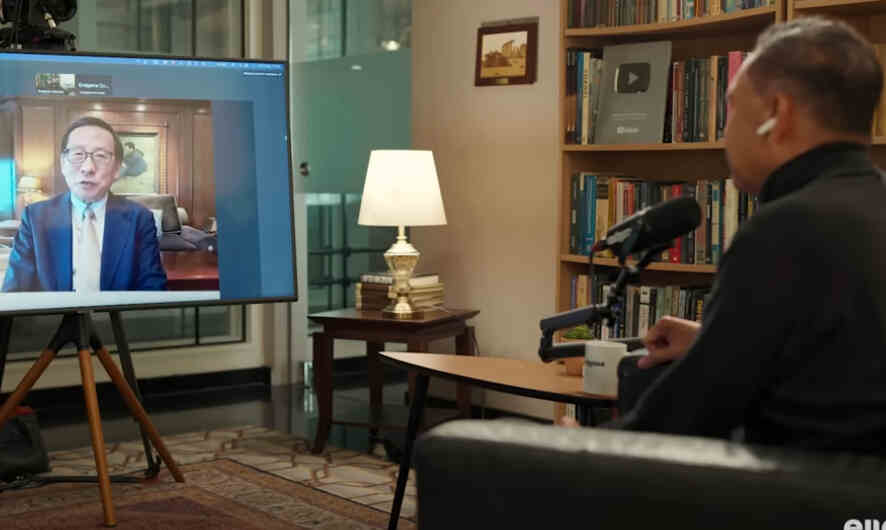
Read the full transcript of international relations expert Victor Gao’s interview on Endgame Podcast with Gita Wirjawan #236, Premiered Oct 8, 2025.
GITA WIRJAWAN: Hi friends. Today we’re honored to be graced by Professor Victor Gao, who is the Vice President for China and Globalization and he’s also the Chair Professor at Soochow University. Victor, thank you so much for gracing our show.
VICTOR GAO: Thank you very much. It’s a great honor to be on your show.
Early Years with Deng Xiaoping
GITA WIRJAWAN: I want to start off with your early years spending time translating for the great legendary Deng Xiaoping. Could you share with us how that experience would have been?
VICTOR GAO: Thank you very much for mentioning that. First of all, Mr. Deng Xiaoping was the paramount leader since 1978 all the way till when he passed away in 1997. And he was really the transformer of China. He not only changed China, he also changed the world.
I started my career at the Chinese Ministry of Foreign Affairs back in 1983 when I was only 21 years old. But I already finished my college as well as a two-year graduate program at the Beijing University of Foreign Studies. So in a sense, I was very lucky to be chosen as one of the interpreters for the top Chinese leadership, including, amazingly, more than 20 meetings I interpreted for Deng Xiaoping in the 1980s.
I was lucky to be able to observe him at very close range and listen to him very intently and very carefully, and also communicate with him whatever I learned or understood from the foreign visitors. So in a sense, I played a key link between Deng Xiaoping, the paramount leader in China, as well as more than 20 visiting global dignitaries, all coming from English-speaking countries, of course, in particular focusing on the United States.
In that sense, I think I was very much privileged by this historical chance to sit just next to him and listen to him intently as to what he had to say about China and talking about his vision for the world and how important development should be and how he described China’s present as well as its future.
He normally would talk about China, for example, back in 1983, 1984, about the end of the 20th century. That’s more or less about 25 years from the time of his meeting with different visiting dignitaries. Then he would talk about the first quarter of the 21st century. That’s more or less about what we are right now. And then he would even further look forward into the future to roughly about the middle of this century, that is about 25 years from now.
So I think his sense of history, about China’s past, about the present when he was the paramount leader of China, as well as about China 20 years from the time when I was working for him, 50 years from the time when I was working for him, as well as about 75 years from the time when we were together, really changed my sense of time and space.
And he had such clarity of what China was before, what China was at that moment of time, and what China should be and could be projecting forward at different time horizons into the future. I think Deng Xiaoping more or less predicted all the transformation that China had gone through over the past several decades, ever since the beginning of China’s reform and opening to the outside world, starting in 1978.
And I think it truly transformed China, that’s for sure, because China is, as of today, already the largest economy if we use purchasing power parity, and the second largest economy if we use official exchange rate. And China was also very much in the league, no matter how you measure, using different criteria or benchmarks.
But Deng Xiaoping also very much and very profoundly changed the world for the better in that sense. Thank you for this opportunity, asking me to recall my personal experiences with a great man. And I think whatever you can understand from Victor Gao is very much deeply imprinted by what I learned when I was just inches away from the great man, the wisest man in the world of today.
The Force of Preservation and Innovation
GITA WIRJAWAN: China has been a great civilization for thousands of years. What Deng Xiaoping did was rather different from the past. And it just seems to me with an intuition that he’s a man that was able to combine, as you aptly pointed out, knowledge and recognition of history and what I call the force of preservation with the force of innovation.
Does that symbolize the large degree of open-mindedness within a leader such as Deng Xiaoping? And is this what had catapulted China to where it is today, recognized as the largest economy in the world, a very modern nation, a very geopolitically influential nation around the world?
VICTOR GAO: First of all, the Chinese civilization is the longest continuously surviving and developing civilization in the world. Because when we think about the ancient Egyptian civilization, for example, and Babylonian and Assyrian civilization and quite a few others, they either have disappeared or they have barely left any traces behind.
However, the Chinese civilization has been continuous, even though there were the Mongols and the Manchus, for example, but they didn’t interrupt or bring the Chinese civilization to a halt. And China today is very much connected with China thousands of years ago. We call the Chinese civilization as of 5,000 years. Now, with more and more archaeological discoveries, we are confident that our civilization dates back to probably 8,000 years ago, if not even longer.
But suffice it to say that the Chinese civilization is truly unique because it has continued till today without major interruption and has been enriching itself over the millenniums, and I think is destined to continue for the coming 5,000 years, if not much longer than that.
Now, I think what Deng Xiaoping brought about to the Chinese people, the Chinese nation and the Chinese civilization is very unique.
And he basically believed that whatever the developed countries could have achieved for hundreds of years through wars and conquests and colonizations could be achieved by China through peace, through peaceful coexistence with the rest of the world.
Now, he also talked about development should always be the hard truth for China, because if you try to indulge in the fantasy that you can rest on your laurels, for example, you will basically be something bygone in no time. So you need to constantly improve yourself, constantly innovate and recreate yourself.
And in that sense, I truly believe Deng Xiaoping changed China for the better and also changed the world, because by today, China is very much a part of the world, even though there are countries talking about isolating China. But I cannot help but chuckle when I hear people talking about isolating China, because China is not to be isolated.
China is such a major factor in the world of today that anyone talking about isolating China will do that to his or her own peril. Because China changed. Because things have been changed to China and things have been changed of the world. We are living in a highly interconnected world and very much integrated into one small global village.
And I truly believe Deng Xiaoping played a crucial role in this regard, and he contributed to this irreversibility of the globalization of the world. Now you hear people in certain countries talking about reverse globalization, or they want to create world walls and trying to hide behind all these fortresses. Let me tell you, if you know Deng Xiaoping’s vision of the world, if you had the benefit of listening to him uttering all these wisdoms, then you will know the world will continue to march forward, and globalization is the megatrend.
No one can really refragment the world into small pieces or into opposing blocs, for example, because that’s not in the fundamental interests of the people in the world. We need to think about each country’s best interest, of course, but you cannot do that in a rational way without having an overarching view of mankind as a whole, of the globe as a village, and all of us—countries, regions, blocks—fundamentally, we are all interconnected.
China’s Vision: Equality Among Nations
I think in that sense, I truly believe I was one of the luckiest persons in the world of today, because I had the benefit of sitting just behind Deng Xiaoping when I listened very carefully and I translated whatever he had to say for the benefit of the visiting foreign dignitaries about China at that time, about its vision about the world, about how the world is marching into an interconnected, a multipolar world, a multilateral world, where different countries, people in different parts of the world, and civilizations of all different colors and shapes and forms have an equal chance to perform, and no one should be allowed to dominate the world.
Deng Xiaoping even said back in 1974, when he was Vice Premier of China at the extraordinary session of the United Nations General Assembly in New York, that China will never seek hegemony. He even declared if a future government of China ever tried to seek hegemony, he urged all the delegates gathered in the hall of the General Assembly in New York that your countries should unite with the Chinese people and get that Chinese government overthrown if it wants to seek hegemony, launch aggression against other countries.
I don’t think you can get a clearer declaration than that, that China’s vision of the world is not to dominate above other countries, and China’s future rests with the rest of the world. And China will always view other countries—now we have about 200 countries in the world, big or small—as an equal.
We want to be brothers and sisters with everyone else in the world, and we will never dominate other countries. And we will never allow other countries to dominate above us. I always tell myself and tell whomever I meet in the world, the philosophy for China is very simple: your God for you, my God for me. Let’s respect each other.
We not only respect each other as human beings, I also respect your God. But you need to respect my God. And your God and my God should not fight a war between them. And we as humans should respect each other and we should get along with each other. I think few people in the world of today carry as much of an imprint of Deng Xiaoping as I do.
The Principle of Reciprocity and Future Interconnectedness
GITA WIRJAWAN: Victor, in your recent discussion, you amply pointed out that the United States was able to take advantage of cheap labor in China as early as the 1980s and 1990s for purposes of producing goods and services for the Chinese. But then it evolved to a different level where the Americans have been taking advantage of the supply chain capability of China to produce goods and services for the world.
This would have been arguably on the back of this interconnectedness between China and the US, but also between China and the rest of the world and the US and the rest of the world. And I would argue that this would have been on the back of, as you aptly pointed out, some sort of hegemony that would have been one of magnanimity.
But April this year, the declaration of the principle of reciprocity seemed to be somewhat of a repudiation of how the interconnectedness has been. And I’m just curious what your views are with respect to China’s view on the future in the context of this interconnectedness or the international world order.
The Principles of International Relations and Free Trade
VICTOR GAO: Well, several things I deem as very important. One is that countries, big or small, should respect each other and deal with each other as equals. No one should really believe or indulge in the fantasy that I can dominate above you. I can hold a gun at your head and demand your surrender. For example, call me uncle or call me grandpa. It’s not the best world. That’s not rule of law in the world. That’s rule of the jungle.
That will turn all the countries into banana republics. And it will be chaos, for example. It will be truly a debasing of human dignity and the sovereignty and territorial integrity of the more than 200 countries in the world of today.
Secondly, I would say free trade is very important. Free trade is a very empowering, enabling force in the world and we all need to do our part to defend free trade. Now for the so-called global reciprocal tariff war launched by the US Government against the rest of the world and against China in particular, I think that’s really undermining free trade.
Some Americans now claim we do not want to have free trade, we want to have fair trade. But let me emphasize one point: there will be no fair trade without free trade. So free trade is the starting point for any fair trade. Because otherwise, if you do not have free trade, I may declare this trade as fair for me, but in reality may be unfair to my counterparties.
There should be no agreement unless you have two willing parties agree to something. You cannot say I will issue a letter to the head of state of another country, and by virtue of receiving my letter, that means that country has entered into an agreement with me. No, things do not work in that simplistic form.
So I think free trade is very important. Mutual respect of each other is very important. And the world of today is composed of sovereign nations. And each sovereign nation has its respectability which needs to be fully recognized and fully respected.
China’s Vision for Global Development
So I think China’s view of the world is very much what I just now described. We want to be friends with all the countries in the world. We want to emphasize that development should be the hard truth. We want to emphasize free trade is something very important and connectivity will be the enabler.
That’s why China keeps building and building and building. We have the best high-speed railway system in the world. If you travel here to China, you’ll see the highway system, one of the best, if not the best. And then the airports, the seaports of all kinds, power stations of all kinds.
China now produces electricity 250% that of the US power generation. And China’s power use for industrial purposes is more than six times as much as electricity for industrial use in the United States. And China’s industrial output is more than the combined amount of the United States, Japan, Germany and quite a few other leading manufacturing countries in the world.
Now, I mention this not just to impress you, no, just to show you this is the megatrend of the world of today. And China has achieved this not by firing any single shot at any country in the world, not by colonizing any country, for example, not by engaging in slavery or exploitation, power politics, geopolitical rivalry against each country.
No, by simply following the principle of free trade, by working very hard in very disciplined way, making sure that the world we are living in is a world based on peace and stability and development. And I think that will be a better world for mankind as a whole. And we want to make sure that no country should really dominate against other countries and no country should be allowed to throw a wedge into free trade. And free trade is something that all of us, mankind as a whole, should defend.
The Reality of Tariffs and American Consumers
GITA WIRJAWAN: The imposition of tariff is something that’s going to have to be shouldered by the American consumers. And I guess my observation is that China would be open-minded to the idea of collaborating with the US if the intention of the US were to really re-industrialize. Now, to the extent that they are open to inviting you to collaborate and cooperate for purposes of re-industrialization in the US, why do you think the US is not asking China to help them in re-industrializing?
VICTOR GAO: You are raising a very interesting point. Allow me to make several observations. First of all, either Trump 1.0 for four years, followed with Biden administration for another four years and now we are in the first year of the Trump administration 2.0, neither President Trump 1.0 nor President Biden nor President Trump 2.0 have the courage and the decency and the honesty to tell the American people that the tariffs they are talking about are fundamentally going to be paid by the American people.
China will not pay the tariffs charged by the United States. Japan does not want to pay. EU does not want to pay. Countries like Malaysia, Indonesia, they are not going to pay these tariffs. The tariffs eventually will be paid by the American people. Eventually, the tariffs are an additional tax against the American people.
Now then you will ask why the presidents of the United States do not tell the American people the truth. They probably have some other ulterior motives. They want to use tariff as a weapon and they want to mislead the American people saying, “Oh, we will be richer, we will have enough income so that the American people will eventually not need to pay the income tax.” Things do not work like that. Economics does not follow that kind of distorted logic.
So I think America needs to first of all figure out what exactly is the fuss about the tariff war other than disrupting international trade, as we understand that.
The Path to Re-Industrialization
Now President Trump also says that his real purpose is to re-industrialize the United States, to bring the manufacturing jobs back to the United States. I want to tell President Trump in a very straightforward sense that if you are really interested in bringing back manufacturing jobs to the United States, talk to China.
China is the most successful country ever since 1978 in achieving rapid rate of industrialization. And by today, China is the most important industrialized country in the world. And China can produce everything recognized by the United Nations system, more than 200 different items, for example, and China is the largest producer. China’s production is not only larger than that of the United States. China’s production normally is more than 50% of the global production.
So if President Trump is really serious about bringing back manufacturing jobs to the United States, he needs to talk to China. And I think between China and the United States we can really do many things. For example, identify which areas are really important for the United States, how China can contribute, how much money can China put onto the table, the technical know-how, the industrial experiences and expertise, and how to line up all the resources, the supply chain as well as the products and where and how they can be distributed and marketed.
So in Chinese we have a saying, “Don’t ask for direction to a person who is blind.” So President Trump needs to talk to China, who is not blind in terms of industrialization, about how to achieve a real sense of industrialization and manufacturing in the United States.
The Prerequisites for Manufacturing Success
But I’m afraid President Trump is not really serious about remanufacturing in the United States. Because my advice to President Trump is that if you are really serious, you need to line up several preconditions. You need to make sure that the power generation in the United States will be minimally doubled, if not increased by three times. You need to make sure that the American container ports will be very, very efficient.
Now you know about the Chancay port in Lima, about 100 kilometers away from Lima to the north. That Chancay port, worked upon by China and Peru, is the most sophisticated and most advanced port in the totality of North America, Central America and South America because it’s highly automated. And no container port anywhere on the east coast of the United States or the west coast of the United States can match against the efficiency and the productivity of the Chancay port in Lima.
Now I use this example to show that to really achieve re-industrialization and bringing back manufacturing jobs to the United States, you need to increase power generation. You need to improve connectivity of all kinds: highways, high-speed railways, airports and seaports of all kinds.
You really need to make sure that the American people are willing to work as workers in a factory. I think the American people sometimes no longer have that discipline or training or professional know-how to want to make themselves available as workers in factories. And how can you convince the American people to do so? How can you provide vocational training for them to catch up with technical know-how and the skill basis? That’s a key because otherwise you’re talking about a castle in a kind of digital way, in a virtual way, without any real touch of the sense of the word.
Now, China will always do a lot of homework whenever they think about building a factory, adding production capabilities. It’s a very detailed work, and you need to really tap into all resources, do all your homework before you really want to put any blueprint onto the ground to be executed. I think this is where the United States is lacking. You need to do very solid homework and talk to countries like China to really bring meaningful jobs back to the United States. So let’s talk to President Trump as to what exactly is his real strategic goals.
The Cost of Decoupling on the Global South
GITA WIRJAWAN: To the extent that we’re likely to see a continuation of this decoupling, call it bifurcation economically between the US and China, technologically between the US and China, it’s only going to add on more cost to both sides and particularly to the Global South. Keep in mind that the Global South is representing about 84% of the planet. Those are countries that earn less than $13,000 per capita per year. How do you see this evolving going forward at the rate that things just seem to continue bifurcating economically, geopolitically, and technologically?
The Fallacy of Decoupling
VICTOR GAO: First of all, I always believe that decoupling is a misnomer. It’s kind of like talking about decoupling the Earth from the moon. First of all, you should never talk about it. Secondly, you should never try that. And thirdly, if you try that, you are doomed to failure. And if you suppose you are lucky and you are succeeding in decoupling the Earth from the moon, then you will be hit with a greater disaster. So don’t move in that direction.
It’s the same thing about decoupling China from the United States. Don’t even think about it. Use common sense. Don’t try that, because you will not succeed. And if you succeed in decoupling China from the United States, do you really know what will happen? Mankind will be hit with a greater disaster and peace may disappear and war may be initiated.
I always talk about the inevitability of peace between China and the United States. Both China and the United States respect each other, deal with each other as equals, and we can always do whatever we can to make sure that China or the United States are not losers, but both of us are winners.
Now, if China and the United States are decoupled or bifurcation is really achieved, then mankind will be plunged into a crisis because they will find themselves in opposing blocs meant for war rather than peace. Is that right?
The Strategic Implications of Decoupling
Secondly, when the United States talk about decoupling from China, they probably haven’t done their homework. Can the United States really continue with its national defense strategy if they decouple from rare earth, especially with the refined industrial level rare earth that China is providing? No, they cannot survive that. They can no longer produce the advanced military planes, the vessels, the phantom planes of all kinds. They will really decimate their defense industry.
So have they really thought about what they are talking about? Are they really prepared to do what they really want to achieve? If they decouple from China, where can they get the rare earth? How can they make the sophisticated weapons, for example?
So I think Washington probably has been advised by some people with very short-sightedness and with very shallow level of knowledge base, for example, who really do not understand what China is all about and who really does not know that a decoupled world with us on the one side and China on the other side will make the United States less safe and more vulnerable. And that will be the crisis for mankind as a whole.
The Global South’s Choice
Now you mentioned about all the other countries, the Global South, et cetera. I hope they will not be forced to make that choice between us versus China. I think the real choice for all the other countries in the world is whether the United States is doing the right thing or the wrong thing and whether China is doing the right thing or the wrong thing.
If the United States is doing the right thing, for example, why should you not follow the leadership of the United States and why should you choose not to work with the United States? But if the United States is doing the wrong thing, for example, launching this global tariff war or launching this anti-China tariff war, why should you join the United States? Why should you work with the United States? You should do better by defending free trade rather than joining the United States in undermining free trade. Is that right?
The same thing, same logic to China. If China is doing the right thing, for example, promoting connectivity of all kinds, constantly improving efficiency and productivity of the goods and services produced and made available in China, why shouldn’t you work with China? Because it’s a better strategy. You will get development faster and better.
If China does the wrong thing, as I mentioned, Deng Xiaoping back in 1974 at the United Nations General Assembly extraordinary session said if ever China wants to be a superpower and seeks hegemony and launches war of aggression against other countries, occupy other countries, then you should do the right thing to overthrow the Chinese government if it wants to do the hegemonistic pursuit in the world. Is that right? But China will never do that because as I mentioned, China wants to respect all the countries in the world.
Independent Thinking for Nations
Therefore, if the United States wants to abandon the World Health Organization, UNESCO, for example, you want to follow suit, you want to follow their leadership. You also want to bail out of UNESCO and WHO. No, that’s not in the fundamental interest of your people.
So I think the Global South and all the other countries, including for example, EU countries and including amazingly, NATO member states, you need to use your own independence of mind to think about all these critical issues mankind is faced with and come up with your own decision. You should not allow yourself to be blindsided and losing your brain and only know instinctively to follow the footstep of the United States.
That may lead you into an abyss and that may really destroy the fundamental interest of your own people. Therefore, I think we all need to use our own judgment, use our brain power to think about all these issues and do the right thing rather than doing the wrong thing, either with your own volition or being forced by another country, especially the largest economy by current day measurement, for example, with a lot of guns, especially when they hold a gun at your head and you made the wrong decision.
Understanding China: The Student Exchange Gap
GITA WIRJAWAN: The lack of or seeming lack of understanding of China and the Chinese by the Americans, from a policymaking standpoint, or call it misunderstanding of China and the Chinese by the Americans, could that be correlated with the fact that if you take a look at the number of Chinese students studying all across the universities in the US and the west, it’s staggering. There’s more than 300,000 Chinese students studying all across campuses in the US, whereas the American students studying in China, they don’t number more than 700. Could that be part of the explanation as to why there’s not enough understanding or worse yet, misunderstanding about China as a civilization, as a country, as a nation, and also as a culture?
The Benefits of Educational Exchange
VICTOR GAO: Well, ever since China’s opening to the outside world and economic and political reform launched back in 1978, I think the latest data shows there are more than 2 million Chinese students studying in the United States at different historical times for different degrees, academic programs, including me. I spent four years at Yale. I got a Master degree in Political Science from the Yale Graduate School and I got a JD Degree from Yale Law School. I went to the same law school as His Excellency Vice President Tim Walz did. I was class of 1993, he was class of 2013. Is that right?
So I’m one of the examples to show how the Chinese, including people like me, really treasure the educational opportunities in the United States. And after finishing our education in the United States, I think in my case I’ve become such a strong advocate of friendship and goodwill and cooperation between the Chinese people and the American people. I’m always appalled by anyone talking about war between China and the United States. And I’m always excited about peace and cooperation and good friendly relations between China and the United States.
So I hope the United States will continue to keep its door widely open to the Chinese students. In a sense, the United States gains all the benefits by all these Chinese students studying in the United States. I think according to one statistical analysis, up to more than 85% of all the Chinese students studying in the United States eventually decide to stay behind in the United States. Only about 10 or 15% of the people like me voluntarily chose to come back to work in China.
Now I respect both those who decided to stay behind in the United States. That’s their personal and family decisions to make. And I hope you will also respect people like me who chose to come back to China to contribute to China’s modernization.
China’s Global Educational Presence
So I think we want to make sure that more and more Chinese people can continue to study in the United States and not only in the United States. I think China is the largest source of students, international students studying, for example, in Britain, in Canada, in Australia, in New Zealand, in Germany, in Netherlands, you name it. There are Chinese students everywhere in the world.
In a sense, they demonstrate this high level of curiosity, this high level of determination that knowledge is the savior and knowledge is the enabling force. And sometimes, and on many occasions, the Chinese families saved and saved and saved and paid for the education of their kids traveling to different corners of the world.
And I think eventually China benefited, of course, but countries like the United States and many other countries also benefited because it didn’t pay for these people’s childbearing costs. You didn’t pay for their kindergarten education. You didn’t pay for their primary and secondary school education. In many cases, you didn’t pay for their college education. What you got eventually is a highly educated, well-trained person in the prime of his time, in his 20s or 30s, for example, ready to work as a professional, as a really well-trained professional of different topics and different subjects.
Not a Brain Drain, But Mutual Benefit
Now, from the Chinese perspective, we don’t consider that as a brain drain. There are some narrow-minded people in my country who claim that this is a brain drainage. We should stop the outflow of the Chinese students going to the United States or other countries because eventually if you adopt one level of calculation, you say, wow, China is on the losing side.
No, I think we need to look at mankind as a whole. We need to really be very philosophical about how you look at the interflow and exchanges of students from one country to another country. And I believe between China and the United States, both China and the United States benefit. And if you use this narrowly defined tactics to view which country wins more or loses more, I would say the United States definitely gained more because you really got the best of the brains in China, well-trained in China as well as in the United States, ready to work in different positions and ready to contribute to peace and stability and prosperity in the United States.
So I hope on this point I will never hear screams in Washington again to stop Chinese students going to the United States. They don’t know what they are talking about. They are making universities and colleges in the United States more miserable because they now depend on the tuitions and living costs paid by these Chinese students to their colleges and universities, to their local communities. And they don’t know that these people really contribute in a great way to the development and scientific and technological breakthroughs of the United States.
But we have very balanced view. We also believe China is benefiting because eventually people like me, Victor Gao, can move to the United States, move back to China very freely and eventually it is our personal decision as to where we want to work, where we want to grow our families. And I hope especially people in the United States can really believe I’m always a force promoting for peace and cooperation between the Chinese people and the American people. In that sense, both countries win. Both countries benefit from such people-to-people exchanges between our two great nations.
America’s Post-Cold War Trajectory
GITA WIRJAWAN: Victor, the United States fundamentally seems to be blessed with power, wealth and favorable geography. It doesn’t seem to have any real serious enemies nearby. And it seemed to have attained a position of primacy at the end of the Cold War in the early 90s. Since then, it embarked on this, what I call the ill-structured campaign to spread democracy, markets and other liberal ideas as manifested in the quagmires we saw in Iraq and Afghanistan. And now we’re seeing tragedies in a number of flashpoints, one of which is Gaza. I’m just curious what the views are in China or Beijing, more particularly with respect to what the United States has been embarking upon the last few decades. And it seems to not end up nicely in the eyes of many within humanity.
Southeast Asia’s Economic Performance Compared to China
VICTOR GAO: Thank you very much. First of all, I studied history with Professor Paul Kennedy at Yale Graduate School History Department, and I took his courses and I became a research assistant to Professor Paul Kennedy when he was writing about the book “Preparing for the 21st Century.” He even cited my name in his book about the things I did for him.
Now, in his history book, he always emphasized one concept: overreach. He basically said great countries or great empires eventually will reach a point where they start to overreach. And more and more they overreach to a point of inevitability of their decline or eventually leading to their collapse.
Now, he studied many cases throughout human history and he alerted that countries should avoid overreaching. In that sense, if we say overreach and look at the United States, especially after the end of the Cold War, has the United States overreached? Have they really fought one war after another? One trillion over here, another trillion over there, 1.4 trillion in Afghanistan, another 4 trillion in Iraq and Iraq 1.0, Iraq 2.0, et cetera.
Or, for example, spending so much money with Israel for what? Not for peace and construction in Gaza or in the West Bank, but to destroy Gaza, to destroy people, the Palestinian people in Gaza, for example, or try to undermine Iran, et cetera.
So I would say Professor Paul Kennedy, my teacher, my professor, said the right thing: avoid overreach. Don’t overreach. Because if you keep overreaching, you eventually come up with a recipe for your own demise.
China’s Focus on Building vs. Destruction
Now, for China, China always emphasizes building, building, building, construction, construction, connectivity, education, training, et cetera, achieving real modernization and industrialization. So we want to build and we do not want to destroy. And by overreaching, the United States probably has been on a stampede to destroy many things.
Now, you talked about the Palestinian people. Allow me to mention one thing. I think the Palestinian people in Gaza, in the West Bank, anywhere else in Israel or the occupied territories, they are as much human beings as you or me. They are as much human beings as the Israeli people, especially the Jewish people in Israel.
If anyone believes that the Palestinian people in Gaza or in the West Bank or anywhere else in the occupied areas in Israel are less than human being or they are sub-species, for example, then you do not deserve to live in this world. I think by today mankind should have reached minimum decency to know that you cannot deny equal treatment of different people.
Palestinian people are as much human beings as you are or as I am. And I’m appalled to see the treatment by the Israeli government, by their defense forces, by the other entities, to treat Palestinians not as full human beings, but with the intent to destroy them, to kill them, to maim them.
The Human Tragedy in Gaza
And for the more than 70,000 civilian losses in Gaza, for example, and about three quarters of them have been women and many pregnant women, women and children, et cetera. Sometimes one bullet will kill the pregnant woman as well as the fetus, for example. It’s human tragedy. It’s crime against humanity. It’s actually crime against your right and my right.
So I think the United States should really have nothing to do with this. The United States should bear its whole weight on the Israeli government, especially Prime Minister Netanyahu and the Israeli Defense Forces. Do the right thing. Don’t treat the Palestinians as if they are not human beings. And don’t try to drive the Palestinians from their own homeland. Don’t think about possessing Gaza or West Bank and turn it into a property project. No, that’s ethnic cleansing. That’s denying the Palestinians of their inborn inalienable rights as human beings.
On the other hand, if the United States chooses to completely side with Israel in committing all these atrocities to the Palestinians in Gaza in particular, I think this is exactly what Professor Paul Kennedy of Yale University History Department says. It’s overreaching. You are overreaching not to do the right thing, but you are overreaching to do the wrong thing.
In Chinese, we always have a thousand-year-old saying: “The heaven is watching you.” The heaven or the God or the Almighty, spirituality is watching you. Do the right thing. Don’t do the wrong thing. Don’t commit all these heinous crimes against humanity. Otherwise sooner or later justice will come your doorway.
And if you really deny human rights, dignity and humanity of other people like the Palestinians, eventually whatever you do unto others may be done to you. You suffer the consequences.
America’s Choice: Right or Wrong
So I think the United States will really play a very important role in the world to be a very noble leader and to use philosophy, use morality, use rule of law to do the right thing, rather than denying the Palestinians their inalienable rights in their homeland, where they were born, where their forefathers were born hundreds of years ago.
So I think the United States is faced with a real choice: whether they want to do the right thing or whether they want to do the wrong thing. Now, the tremendous amount of resources and the natural endowments in the discretion in the possession of the United States can be used to generate miracles and positivities on the one hand, but they can also be misused to do a lot of harm and damage and carnage, for example, and bring about all the disasters and calamities you can think about.
So this is the time for the leadership in the United States, the people in the United States, to do the right thing. Based on my personal interactions in the United States, I know for sure, and I want to say this again and again, all the American people I met with at Yale University in New Haven, in New York, in the northeastern part of the United States and throughout the country, wherever I travel to, are decent people. They are honorable people. They want to do the right thing and they do not want to do injustice to other people.
So let’s enable the American people to really do the right thing. Don’t allow the government to overreach, because otherwise the tremendous amount of might of the United States may be used for the wrong purpose. For example, denying the basic rights of the Palestinian people in their own homeland.
GITA WIRJAWAN: What do you think explains the absence of accountability? There just doesn’t seem to be any accountability for whatever is happening in Gaza strictly within a policy-making body. And the second part of the question is to what extent do you think China could serve as the conscience to the world so that there is greater degree of morality with respect to what needs to be done in Gaza?
The Question of Accountability and China’s Role
VICTOR GAO: Well, first of all, I think the United States has its own system: separation of power, the checks and balances, et cetera. The federal government versus the state government, et cetera. It’s completely a responsibility of the American people. If they want to keep it as it is, they get it. If they want to fundamentally go through the due diligence or due process to change it, they can manage to do that in due course.
People in the outside world should not directly interfere in the domestic political system of the United States. However, the United States, as you mentioned, is very unique in the world of today. It really has tremendous amount of responsibility on its shoulder. And if it does the right thing, it will create miracles for the good. If it does the wrong thing, it may cause a lot of damage.
So let’s hope sincerely that the American people, through their own legal process, will figure out a way to do the right thing for the people in the United States on the one hand, and for the people in the world at large.
Now, it is easier said than done because I think if you look at the legal process in the United States, it really hinges upon who has the money, who can really sponsor Party A versus Party B, candidate A versus Candidate B, and what is their real ulterior motive behind their political lobbying, for example. And eventually it can be very messy.
And eventually, for example, this decision made by the White House in complete support of Israel, regardless of whether Israel is doing the right thing or the wrong thing, is mind-boggling. I think mankind is fed up with all the atrocities committed to the Palestinian people in Gaza, in West Bank and many other places in the Middle East.
And I think the demand for real justice is never ceasing. They are there. And I’m afraid eventually justice will be done sooner or later anyway. But we cannot wait until the eventuality of justice being done in a decade or in two decades’ time. We need to have justice done today.
We need to on the one hand, for example, have all the hostages freed as soon as possible. But on the other hand, we should call for an instant stop to atrocities, war crimes, injustices committed by Israel against people in Gaza, in West Bank and many other places over there.
China’s Support for the Two-State Solution
And then amazingly, China is a leading force in calling for the two-state solution. And I’m encouraged to see more and more countries, including Britain, Germany and quite a few other leading Western countries, France for example, are now declaring that they will recognize the state of Palestine, partially because of all these atrocities committed by Israel against the Palestinian people.
If you do nothing, you get tainted, kind of being implicated by all these atrocities against humankind. And I hope the United States will sooner or later come to the senses as demonstrated by the majority of the people in the world. And never underestimate the resolute solidarity among the Arabs, among the Muslim people in the world, and always do the right thing to defend the respectability of the Palestinian people.
Now you talked about China. China is unique in always coming up, rising up to the occasion for the defending of the legitimate interests of the Palestinian people. China has never stopped and never wavered in calling for the two-state solution. China has always stood very firmly in the United Nations, in the Security Council of the United Nations, defending the legitimate rights of the Palestinian people.
Now China calls for full recognition of Palestine, the State of Palestine, as a full member of the United Nations with complete and full voting rights. So I think China needs to continue to do the same thing to defend the legitimate interests of the Palestinian people.
On the other hand, China is very philosophic. China can handle very normal state-to-state relations, and we are proud of this kind of diplomatic maneuverability. We defend the legitimate interests of the Palestinian people on the one hand and we continue to promote normal state-to-state relations with Israel.
Eventually I hope the people in Israel will come to their own conclusion as to what kind of Prime Minister they deserve. Israel and the people of Israel will not be well served with a Prime Minister who is bent upon committing all these crimes against humanity because he will bring down the whole nation of Israel down to the drain if, for example, Israel continues to commit all these war crimes and atrocities against the innocent civilian people in Gaza.
And the Palestinian people need to be fully recognized as much as human beings as you and me and rest of mankind. And if anyone believes that the Palestinians are less than the Israelis in terms of their human dignity, no, that’s not the right thing for you to say or for you to think about.
Southeast Asia’s Economic Development
GITA WIRJAWAN: I’m sensitive of time. I want to segue to the last topic, which is Southeast Asia, and I want to provide you with a comparison between Southeast Asia and China in terms of their respective GDP per capita.
In the last 30 years, China’s GDP per capita has gone up by about 9 to 10 times nominally. Southeast Asia’s GDP per capita on average has gone up only by 2.7 times in the last 30 years. This would have been on the back of five essential attributes.
The first one is what I call the under-investment in education in Southeast Asia. Second, the under-investment in infrastructure. The third is the lack of governance, lack of optimum in terms of the intersection between power and talent. The fourth is the lack of competitiveness in terms of our ability to issue business licenses, not as robustly as China can. China can issue about 9 to 10 business licenses on a per 1,000 adult people basis. Southeast Asia on average, only one business license.
The last bit, which is quite paradoxical: China as a centralized political system has been very successful in decentralizing its economic activities. Whereas most countries in Southeast Asia, which are democracies, politically they’re a bit more decentralized, but economically they’re much more centralized. And this I think has been one of the causes to why Southeast Asia has underperformed vis-à-vis that of China in the last 30 years.
I’m just curious what your views are with respect to any of these five attributes or the overall observation as to why Southeast Asia has underperformed.
China-ASEAN Relations and Regional Integration
VICTOR GAO: Thank you very much. I think you are raising a very important question from the Chinese perspective. ASEAN or the 10 ASEAN member states are very, very important. We are neighbors and we are having a lot of common historical background or historical exchanges over the thousands of years of engagement between us.
Now on the other hand, ASEAN-China trade is the largest trade volume as far as China is concerned, and China really values a lot of its exchanges and connectivity with each of the 10 ASEAN member states as well as ASEAN as a whole. China and ASEAN have this Free Trade Agreement 1.0, 2.0 and I think it will be in our joint interest to continually upgrade the China-ASEAN Free Trade arrangement.
On the other hand, if you look at ASEAN from, let’s say, from outer space, I think you need to come to the conclusion that while ASEAN itself is very successful as a regional organization, ASEAN as a whole is one of the most highly fragmented regional groups in the world in terms of different levels of historical economic development, in terms of scientific breakthroughs, in terms of languages, for example, their past experiences.
For example, Malaysia and Singapore had the connection with the British colonial rule. Vietnam, Cambodia and others had this connection with the French colonial rule. Indonesia was ruled by the Dutch. The Philippines had a big impact printed by the former Spanish Empire and in more recent years by the United States. It’s very fragmented in terms of their language or their historical development, their religious beliefs, for example, as well as their natural endowment.
So I think in one sense it will be absolutely in the interest of ASEAN as a whole and of the 10 ASEAN member states to further improve the connectivity and the integration within the organization and between and among all the ASEAN member states. And it’s encouraging to see that East Timor may join ASEAN anytime soon. So you may have 11 member states. So I think internal integration, improvement of connectivity is crucial.
The Importance of Regional Connectivity
Now the other thing from, let’s say, outer space or from Victor Gao’s perspective, is that you really need to improve connectivity. For example, we are talking about building highways and railways and other connectivities from the Chinese border with Myanmar on the one hand, with Laos on the other hand, Vietnam on the other hand, and going south through, let’s say Cambodia, through Thailand and then continuing going south to Malaysia, merging with Singapore, and then across the water to Indonesia.
And then you already have the Bandung-Jakarta high-speed railway, which can be extended westward or eastward. And then the total archipelago chain of Indonesia could be connected from the west to the east. If you look at the Philippines, exactly the same thing. They are not very well connected internally. And theoretically speaking, for example, you can think about the connectivity from the northern edges all the way through the archipelago and linking to the southern region of the Philippines.
So I think connectivity is crucially important. Why do I say this? Because in China we always believe in one thing: if you really want to make riches, build a road. You need to improve your connectivity in order to sell your products to other parts of China or to other parts of the world. And for ASEAN, connectivity is very unique in its own situation and needs to be significantly improved.
Peace, Stability, and Regional Conflicts
Now, the other thing is that ASEAN as a whole and all the neighboring countries of ASEAN should really put a premium on peace and stability. It pains me to see that frictions are building up between Myanmar on the one hand, the Rohingyas in the western part of their country, and then between Myanmar and Bangladesh on the other hand. And other forces are eager to promote, to provoke a kind of conflict between Bangladesh on the one hand and Myanmar on the other hand.
And the recent war involving Thailand and Cambodia is really mind-boggling to me and is really very traumatic from the Chinese perspective because both Thailand and Cambodia are very friendly nations as far as China is concerned. And the fact that Laos joined in fighting briefly, fortunately, and then Vietnam marched its soldiers and military equipment to the border with Cambodia really does not spell well for peace and stability in that part of the world.
Learning from China’s Development Experience
So suffice it to say, from the Chinese perspective, we never want to impose our views or our values on any other countries, especially on ASEAN as a whole. However, from the ASEAN perspective, I’ll be very happy to help ASEAN or any of the ASEAN member states to use China as a textbook to see how China, ever since 1978, has managed to make leaps and bounds and complete transformation for the good of the Chinese people as well as for the whole world.
Deng Xiaoping changed China as well as changed the world. And China continues to march in the direction of greater openness, greater connectivity with the rest of the world. And China stands very firm to defend the legitimate interests of the Chinese people, but also defends free trade for the benefit of all the countries and people in all the countries in the world.
There must be something that China has been doing right ever since 1978. And if we look at China versus India back in 1978, their size of the economy was more or less comparable with each other. But as of today, the Chinese economic size is about five times as big as India’s. Now that must be something you need to observe and analyze. And there must be something that China is doing very well. They have a better recipe, for example, which may be understood better and analyzed better for your own benefit.
Future of China-ASEAN Relations
So I think between China and ASEAN, I’m very confident and very optimistic. And I think even though China-Philippines have some bilateral territorial disputes, I don’t think war can solve any problem. China and the Philippines need to adopt diplomacy and negotiation with each other and solve whatever problems there are, rather than allow the Philippines to become a proxy of another major power which may actually destroy our part of the world.
Other than that, I think by improving connectivity and relationship and exchanges between China and ASEAN and ASEAN member states, we will generate more and more miracles going forward. And we can tell the rest of the world that China-ASEAN can really understand each other better, learn from each other better and make great miracles.
Lessons from Singapore
Allow me to mention one thing. Now China is as big as Singapore is small. But over the past several decades, China has always said we can learn a lot from Singapore and Singaporeans. Why? Because the Singaporean economy is very much state-owned, but they managed to be very clean. Anti-corruption is always a major effort and corruption as a whole is very, very well controlled.
Now China is very mixed. We have still a very important role for the state-owned enterprises, but private enterprises are becoming more and more important. However, in China we do have a problem. Corruption is a problem. We need to come up with better ways to deal with the corruption. In that sense, China learns a lot from the Singaporeans. We use their governance, for example, as a guideline to tell the Chinese state-owned enterprises and private enterprises to improve the efficiency and the productivity of the government regulators, for example.
And I think we can learn things from big countries or small countries, highly developed countries or less developed countries. In Chinese we have a saying: every three persons passing you by, there must be a teacher among the three. So if you open your eyes widely, you can see your teacher anywhere you walk around and you can really learn something new and important from any country in the world. You have 200 countries to check out.
And on the reverse side it’s the same thing. If ASEAN’s 10 countries really want to understand China better, they probably can learn a lot from the Chinese experience.
GITA WIRJAWAN: Victor, I know you have to go. I want to thank you for this fascinating discussion.
VICTOR GAO: Thank you. Let’s keep in touch and if you decide to do another 30 minutes or one hour interview, let me know.
GITA WIRJAWAN: Absolutely. Okay, friends, that was Victor Gao, the Vice President for the Center for China and Globalization. Thank you.
Related Posts
- Bialik’s Breakdown: w/ Channeler Lee Harris -Part 2 (Transcript)
- Scott Ritter: Russia Threatens Strike on Finland & Baltic States (Transcript)
- PBD Podcast #778: Who Is Sadhguru? (Transcript)
- Larry Johnson: Trump’s Naval Blockade & Ceasefire Collapse (Transcript)
- Prof. Mohammad Marandi: What Really Happened in Islamabad (Transcript)