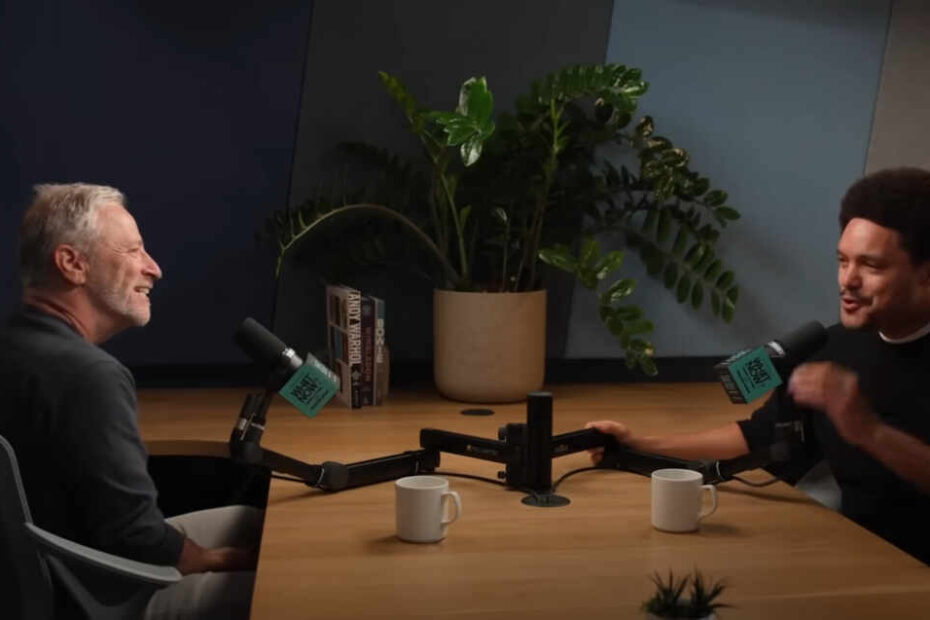
Read the full transcript of The Daily Show host Jon Stewart’s interview on What Now? with Trevor Noah Podcast, Premiered June 12, 2025.
Welcome and Introductions
TREVOR NOAH: Welcome, friend. How are you?
JON STEWART: Thank you. Nice to see you. This is exciting to do this without headphones. I so don’t do podcasts where you go and sit with people.
TREVOR NOAH: I’m shocked that you leave the house, to be honest.
JON STEWART: I don’t do it very often. Yeah, only for you.
TREVOR NOAH: Can I tell you, I really take that as a… Yeah. I was thinking that the other day. I was like, John doesn’t go anywhere.
JON STEWART: That’s correct.
TREVOR NOAH: I met you not going anywhere.
JON STEWART: It’s one of the worst reputations to have, because when you do show up somewhere, people are like, “What? So what’s going on?” It almost feels like your parents have come home. “Why are you here?” And you’re like, “I am allowed to go out. I just mostly choose not to.”
The Introverted Comedian
TREVOR NOAH: Have you always been that way?
JON STEWART: Yes. It’s one of the reasons I think I got into standup. Which seems sort of contradictory, but I’m very introverted, and so I don’t get energy from socializing.
TREVOR NOAH: Oh, yeah, no, I’m the same.
JON STEWART: You’re the same?
TREVOR NOAH: Yeah, I’m the same.
JON STEWART: So when I was younger, I would bartend to give me the illusion of being… So I worked in bars forever. Because you felt like you were out, but you didn’t have the idea where you had to sit with somebody and socialize. You were doing something so you could focus on task at hand.
Comedy, same way. You show up. It’s a Friday night, it’s a Saturday night. People are out there on dates, they’re having fun. And what are you doing? Looking at my notes. “No, no, no, I’m going on in five. I don’t have… I can’t.” So I always prefer that.
TREVOR NOAH: No. So, okay, here’s the thing. I’m like that, but I don’t prefer it.
JON STEWART: Oh, really?
TREVOR NOAH: Yeah. All my friends, I think I’ve strategically chosen because they push me and kick me out of the house.
JON STEWART: Oh, really?
TREVOR NOAH: Every single one of my friends.
JON STEWART: So modern communication has very much, for me, quantified the extent of my isolation. Because your phone will tell you numerically how many people tried to get ahold of you that day on your texts or on your emails. And when I tell my kids, they just feel like, “Do you live in a bomb shelter? Like, what?”
You know, I’ll be like, “I got three texts today” and they’ll be like, “All day. Three?”
TREVOR NOAH: Yeah, but you’ve always been a Luddite.
JON STEWART: Yeah, I know.
TREVOR NOAH: You’ve always, always been around.
JON STEWART: This isn’t going well.
TREVOR NOAH: This is going great. What do you mean this is going great?
JON STEWART: I’m being exposed.
The Call That Changed Everything
TREVOR NOAH: No, no, no. You know what I think it is? It’s funny. Look, I mean, I only really came to the US properly when you brought me, you know, you called me.
JON STEWART: I called you on the phone.
TREVOR NOAH: It’s still the most random call of all time, Jon, and still the one that I still don’t understand.
JON STEWART: I called up Trevor. I saw your standup. I saw two minutes of your standup and I was like, “That guy could do my job. This is very upsetting.”
TREVOR NOAH: What standup was this? Because I was only doing South African stuff back then.
JON STEWART: No, no, no. It was a special that you had done.
TREVOR NOAH: From South Africa, though.
JON STEWART: I believe it was from South Africa. But I watched it. You know, I’ve been doing this for a long time and we always have tapes and we’re always looking for new talent and there was an authenticity, but also an insight. You had it, son. Let me tell you something. I don’t know how to define it, but you had… Wasn’t the dimples. It was a whole other thing.
No, I just remember the material was so insightful.
TREVOR NOAH: Thank you.
JON STEWART: But, well… And there was a warmth. There was all these things that I thought, “Oh, that dude.” That doesn’t just happen. You can’t fake that. You can’t. There is a certain level of artistry, craftsmanship, those… authenticity, those things that come together and you smell it immediately.
And also the converse. I can pop a tape in and go, “Oh, the audience is nervous for that poor fellow. Oh, yeah, take that out.” It’s sort of like, what is it? Dave Portnoy’s One Bite. Everybody knows the rules. Same thing with comics a lot of times. One bite, everybody knows the rules. You watch it and go, “8, 6, 9, 2.”
You had that. And it’s rare. And I’d watch enough tapes to know that it was rare. And I go, “Who’s that guy?” And they go, “This guy Trevor? No.” And I go, “Let’s have him do this show.” And they said, “Well, he’s not… You know, he’s not from here. He’s from…” And I was like, “I’m Willy Wonka, and I’m about to call this dude and blow his fucking mind and say, ‘Son, your ship has come in.'”
And so we got on Trevor and we’re like “Jon Stewart of the Daily Show, New York City, and we’d like you to come in and do a bit for us.” You’re like, “Well, my world tour doesn’t end for another two months.” And I was like… And it took me a while to figure out, “Oh, this opportunity is an enormous constriction of Trevor’s visibility and a giant pay cut.”
TREVOR NOAH: No, but you know what? You know what it was for me? Actually, I’ll say this. I was ignorant, but I’m happy that I was. I’m really pleased that I was ignorant.
JON STEWART: Right.
TREVOR NOAH: So I’ve never told you this, so I never knew who you were.
JON STEWART: Right, right, right.
The Harrods Phone Call
TREVOR NOAH: So you called me and… which was also crazy.
JON STEWART: I’m having tea with the queen.
TREVOR NOAH: I wish I was. I was looking… I was staring at an underwater scooter thing. Like a moped, you know, the old school…
JON STEWART: Submersible things. Yes.
TREVOR NOAH: It’s like that.
JON STEWART: A thing that only three people in the world have.
TREVOR NOAH: Exactly.
JON STEWART: And two of them are sultans.
TREVOR NOAH: Yeah, I’m staring at this, I’m looking at the price. I’m going, “How long would it take me? But where would I keep it? How? I don’t live near the ocean, but this was just the culmination of my life’s everything.” And almost in a perfect way. My mom always says, “Ask God and God will respond.” I went, “God, how would I ever be able to afford this underwater moped?” And my phone rings.
JON STEWART: Does your mom know God was a Jew in this story? Does she have any sense? She’d been cheering for the wrong team, my friend.
TREVOR NOAH: What do you mean? My mom is… My mom converted to Judaism many long ago.
JON STEWART: What?
TREVOR NOAH: Yeah, my mom been… she might…
JON STEWART: Have taken my place. I got out of the business at 13.
The Comedy of the Conversation
TREVOR NOAH: So you called me and this was… I think what I remember most about it was the comedy of the conversation because you called me like, “Hi, can I please speak to Trevor?” “Trevor?” I was like, “Oh, speaking.” “Hey, Trevor, this is… My name is Jon Stewart. I’m a comedian from New York City. Jon Stewart.” You said, “You may or you may or may not know me.” I said, “I’m sorry, I don’t know you.”
And you said, your wording was so specific and it was so funny. You said, “Nor should you have. Nor should you have.” It was so self-effacing. I loved it. You said, “Nor should you have.” And then you said, “Well, I host a little show. I run a little show in New York City, it’s called the Daily Show.” And I was like, “Oh, pause for applause.”
No, but then I said, “Oh, I’ve heard of that show.” And you said, “As you should.”
JON STEWART: As you should.
TREVOR NOAH: And I remember in that moment thinking, “I don’t know who this person is, but I’ve talked about this with every comedian.” Comedian, there is a silliness that comedians possess. And you know when I felt it is… I remember when I did Comedians and Cars with Jerry.
JON STEWART: Yes, right.
TREVOR NOAH: Jerry said to me, “I am yet to meet a comedian who answers another comedian’s phone call in a normal voice.” We all have a “O Gah. Johnny boy. Well, hello.” There’s just… comedians. It doesn’t matter what it is. Yeah, there’s a silliness.
JON STEWART: I always answer as the queen.
TREVOR NOAH: There you go.
JON STEWART: Hello. No, just do something right now. Don’t see if I can rise.
TREVOR NOAH: This is what I mean. So it’s almost like the badge that we have at work, you know. Can you come in? Yeah, yeah. I’m a comedian. Here’s my badge. So I go, “This man is definitely a comedian. I know nothing about his world. I think I’ve heard of the Daily Show.”
The Daily Show International Edition
And the crazy thing for me was, I think you know this part just from the world, but you don’t know from me. The Daily Show had the international edition, right?
JON STEWART: Yes.
TREVOR NOAH: Right.
JON STEWART: They used to be on CNN, I think.
TREVOR NOAH: On CNN?
JON STEWART: Yes. It was a news show.
TREVOR NOAH: So in my world, you used to come after Christian Amanpour, Richard Quest, and a bunch of other CNN… I mean, the Internet and, you know, the international one wasn’t like the U.S. It wasn’t just talking heads that shout at each other. It was very “Welcome. This is CNN. Hong Kong markets have opened and CNN is on the ground.”
JON STEWART: Right. The actual news that goes on around the world, the thing that Americans are utterly and blissfully unaware of.
TREVOR NOAH: When they were reporting live from Beirut, it was live in Beirut. It was, “That’s CNN.” And then this man would come on. And I think I saw you maybe twice, but you left an indelible impression in my brain because I didn’t know what was happening.
But I remember thinking, “There is no way this man is going to keep his job. I don’t know when I found him in this journey, but he’s not going to keep his job.” Because you… You and the news. And then you told a joke and then the audience laughed. But then at some point, they sort of groaned and they… But I didn’t know there was a Daily Show. And then it went back to normal news. They’re like, “All right, now it’s time for someone. It’s Africa. Focus. Here we go.” And I remember thinking, “Damn, that guy.”
JON STEWART: Who going to lose his job.
TREVOR NOAH: He’s going to lose his job.
JON STEWART: It’s why context is so important.
Cancel Culture and Context
TREVOR NOAH: You know, you say that.
JON STEWART: Yeah.
TREVOR NOAH: But can I tell you, I genuinely believe one of the things that has happened. A lot of people ask me about cancel culture.
JON STEWART: Right.
TREVOR NOAH: Always. I’m sure they’ve asked you hours. And the thing I keep saying is, and I genuinely believe this, I don’t think there’s such a thing as cancel culture. I think people criticize someone if they don’t like them. I think people have more platforms to criticize now.
JON STEWART: Right.
TREVOR NOAH: Before people would write a letter, like my mom used to do, that she would write letters to the broadcaster in upset. Yeah.
JON STEWART: Yes. The ones to the editor.
TREVOR NOAH: One I remember was she wrote a letter. There was a South African, our Arby’s, essentially, in South Africa. And they had a hamburger, and the ad was Handel’s Messiah, right? So it’s “Hallelujah, Hallelujah.” It was that vibe, right? My mom only knew that song as a church song.
JON STEWART: Right.
The Context of Comedy in the Digital Age
TREVOR NOAH: And this woman looked at me and she said, “Did they just sell a hamburger using the Lord’s music?” And I didn’t know it was classical music. Neither did she. She wrote a whole letter. We went, we mailed it together to the broadcaster. They responded very kindly and they said, “Hey, actually this was not a Christian song. It’s been co-opted by religious organizations. Originally,” blah, blah, blah.
And she read the letter to me and we sat there together like, wow. I was maybe 10 years old, 12. But I remember even then being like, damn, we just learned something today. This is new. But to that point, in that world, context is everything.
And when I think of cancel culture and comedy and all these things, I go, most of the time, comedians would be telling a joke in the context of a comedy space.
JON STEWART: Correct? Right, yes.
TREVOR NOAH: You’re on stage, audience is sitting there. We all know this is comedy. So if you look at an audience member and say, “I wish you had died on the Titanic,” they know you’re in a comedy space.
JON STEWART: That’s right.
TREVOR NOAH: Now what happened is they take that joke out of the comedy space. The algorithm sends it to somebody whose grandfather died on the Titanic.
JON STEWART: Oh, that’s dead on. That’s so brilliant. That’s exactly it. And even the people that know the context do that same thing, because they want to weaponize it.
TREVOR NOAH: Oh yeah.
JON STEWART: To hurt you.
TREVOR NOAH: Oh, yeah.
The Weaponization of Comedy
JON STEWART: The other thing that happened in the rise of social media are those whose livings now depend on stirring the pot. So I used to do a bit, this must be 1996, ’95, something. It was about Jewish community, black community, Jews and blacks. You know, why are we so mad at each other? You know, come from the same history, 2,000 years abuse. We just expressed our sufferings differently as people.
Blacks developed the blues. Jews complained. We just never thought of putting it to music. I did a whole thing. My grandmother wrote a blues song: “Gee, it’s drafty in here.” The whole thing. And then there was a bit about Jews and blacks, we shouldn’t fight each other, we should get together and get whitey. “Oh, I’m sorry, wrong crowd.”
You know, I’ll go online now on vdare websites or white supremacist websites. My face is as gray as they can possibly make it in the thing. “Jews and blacks should get whitey,” and then, this Jew thinks that. And they know. Of course they know. But it’s their way of—it’s an intimidation tactic.
But what social media is, is when we do a gig, whenever you do a gig, there’s always people that aren’t digging it. You feel it.
TREVOR NOAH: Yeah.
JON STEWART: You work the seller. There’s always going to be a couple tables that are like, yeah, yeah.
TREVOR NOAH: There’s always the plus ones. The people who came with a friend didn’t necessarily come for you or the comedy.
JON STEWART: That’s right.
TREVOR NOAH: And they’re like, let’s see what happens.
JON STEWART: We’re not down.
TREVOR NOAH: Yes.
JON STEWART: It would bother you in the moment. Then you go upstairs, you have a plate of hummus with your friends, you start goofing off all that stuff, and you walk away. Social media is after that show. Then you have to ride home in the cab with them while they talk about how bad you are. And that’s—so it’s there, man.
TREVOR NOAH: That’s such a great analogy.
JON STEWART: It’s there to get you. It’s there and it works. People say, you should ignore it. It’s like, hey, let me ask you, if you’re walking down the street and someone yells your name, do you turn around?
TREVOR NOAH: Yeah.
JON STEWART: Of course you do. You’re human.
TREVOR NOAH: Yeah.
JON STEWART: So you try your best not to allow it to infiltrate the parts of you that are more stable, but it’s very hard to just—
TREVOR NOAH: Ah, it’s—I think it’s very unhuman.
JON STEWART: Yes. To do that, of course. And that is the economy that’s grown up around it. So what they do is they try to find the thing that they think will be most upsetting.
Now, obviously, it loses its efficacy after a while. For me, the funniest part was my dog Dipper died. I don’t know if you ever met Dipper. I used to bring him to the show, three-legger, the greatest dog in the world. He died. I announced it on the show. I was a blubbering idiot.
And people on social media started responding very positively. So I did a thing I never do, which is post some stuff. Here’s some pictures of me and my family when we first met Dipper. We met him at a shelter down on Crosby Street. And people started in the comment section of those pictures, responding with pictures of dogs they had lost there.
So the first picture was, “This is Coco, our Cavalier King Charles. I hope that she and Dipper are playing at the Rainbow Bridge.” And, you know, “This is Mr. Muggles, our Cocker Spaniel.” Yeah, yeah, yeah. And then the third one was, “Why did you change your name, Jew?”
And I was like, oh, right. It’s got nothing to do with their lives. They’re sick, whatever it is, either financially or emotionally. That’s their job.
The Algorithm’s Role in Outrage
TREVOR NOAH: But some of them—you know what the worst thing is? Some of them aren’t even real. That’s the scariest thing, Jon.
JON STEWART: Quite possibly.
TREVOR NOAH: No, like—
JON STEWART: But a lot of them are.
TREVOR NOAH: Yeah.
JON STEWART: Not only real, but become famous.
TREVOR NOAH: Yes, that’s true.
JON STEWART: Yeah, that’s true.
TREVOR NOAH: But I think that’s what makes it sad for me is when we go to context. Yeah, I’ve seen this happen to you. I spend a lot of time analyzing online. I don’t spend time actually online. I don’t care for it much.
JON STEWART: Right.
TREVOR NOAH: But I love the behind-the-scenes machinations of it, you know? So I sit with engineers, they teach me about algorithms. I said, “Really?” Yeah. I love this. I love, love, love this. Love it to bits.
And one of the things I’ve really loved is seeing how information gets disseminated, but specifically sent to different groups of people for a really, really distinct purpose, you know? And then I started—they showed it to me even on the tiniest things that you and I have done. For instance.
JON STEWART: Right.
TREVOR NOAH: So I hosted the White House Correspondents’ Dinner.
JON STEWART: You have as well.
TREVOR NOAH: Half of my Correspondents’ Dinner was played on Fox News, was played on conservative sites.
JON STEWART: Right.
TREVOR NOAH: Everything I said about Joe Biden, the Democrats, MSNBC.
JON STEWART: “If you’d lost, Trevor Noah, you really were—”
TREVOR NOAH: They were.
JON STEWART: Yeah, yeah, yeah.
TREVOR NOAH: You know, “I never thought I’d say this, but I agree with him. This is quite funny, I guess. I guess that’s what happens when you get him away from the Daily Show writers.” Then, I mean, “Yeah, looks like those woke fuckers, you know, I guess every now and again he can be—” Ironically, it was the Daily Show writers.
JON STEWART: That I was with.
TREVOR NOAH: I mean, you know, you roll with the crew, so. But it was—and then on the other side as well, people got the clips right, but they show who they sent it to.
JON STEWART: It’s so weird.
TREVOR NOAH: It’s not a—
JON STEWART: They send it to people purposefully, yes.
TREVOR NOAH: But they also send partially. That’s the key thing, I think that’s the most insidious. So back in the day, Jon Stewart is at a desk and Jon Stewart says, 1, 2, 3, 4, 5, 6, 7, 8, 9, 10.
JON STEWART: Right?
TREVOR NOAH: You see that, you might not like three, you might not like seven, but you saw that this man counted to 10.
JON STEWART: That’s right.
TREVOR NOAH: Now what they do is they go, take the seven, take the three, send it to all the people who hate Jon for saying those numbers, the other numbers. Let’s get it to these people. And we’re going to split that.
And so now what happens is you have a world where people hate other people not because they know them, but only because they know them by a fraction of the thing they are saying or doing, which I think is—I think that’s even more terrifying because—
Social Media as Ultra-Processed Speech
JON STEWART: Absolutely. Well, it’s also what it tells you is the principle is merely conflict. The principle is outrage and conflict. But, you know, I always wondered where social media fit in. You know those videos of a squirrel decomposing, where the squirrel is the content? And you just see over time, you’re like, every single part is going to be brought back into nature. Some of it’s going to go to the ground. It’s nitrogen.
That’s what the economy that we live in in terms of ideas is—not really an economy of ideas. It’s an economy of fragments of fragments of ideas that are not cohesive or coherent or contextual, but they are monetized, and the aggregators come in.
Something I actually wanted to throw on the show on the Mondays is this idea somehow that social media resembles in any way free speech, or that it resembles in any way the town square. Because those are neutral vessels that you fill with ideas.
So let’s say I go to a town square, and it’s a place where people come together, and it’s an amalgamation of ideas and thoughts and things and a gathering spot. So I come in and I go, “Severance. Oh, my God, Severance is so good.” And then a couple people come over and they hear about it and they want to talk about it because they’ve got some opinions on it.
And then one other person walks by and goes, “You’re a Jew.” And I go, “What?” “Yeah, no, you’re a Jew. You change your name, you’re a Jew.” And I go, “Oh, yeah, no, we’re talking about Severance.” “I go, yeah, no, I just—I was notified that you were here, and I just wanted to come in and go, you’re a Jew.”
That’s social media. That’s the algorithm, right? Yeah. So then I go, “I think I’m going to leave.” And as I’m walking away, the town square goes, “Hey, before you go, there’s someone you might want to check out. It’s the ‘You’re A Jew’ guy.”
And these little tribes, what they’re trying to get you to do is be provoked so that you stop and you engage some more. The town square doesn’t benefit the longer you stay in an argument.
TREVOR NOAH: Exactly.
JON STEWART: And it’s such an interesting idea that we think it’s free speech, but it’s not speech. It’s ultra-processed speech. It’s speech in the way that Doritos are food.
TREVOR NOAH: Hmm.
JON STEWART: It’s something that has been designed by people in lab coats to get past the parts of your brain that protect your mental health. But we don’t think of it in that way. We think of it as a pay into this right that we have, or an example of the highest aspiration of free speech, when in actuality it’s toxic. Designed as such. Whatever the mental version of obesity and diabetes is, that’s what it’s designed for.
TREVOR NOAH: Yeah.
JON STEWART: And I’ve only been thinking about—only because of where we’re at with speech in this country and how it’s been co-opted as this incredible value on the right. Yeah. They’re only allowing it to go on the right because they view it as helpful to their larger cause. Right.
TREVOR NOAH: Yeah.
JON STEWART: You know, societal ideological battles aren’t capitalism, communism or socialism, communism or any of those other kinds of democracy, totalitarianism.
TREVOR NOAH: Yeah.
JON STEWART: It’s woke, unwoke. And for them, social media is a powerful unwoke multiplier. It amplifies that feeling for whatever reason in terms of virality.
Do you remember the—it was another—I think it was a hearing where it was Facebook, it wasn’t Twitter, and they made Zuckerberg turn and apologize.
TREVOR NOAH: Oh, yeah, I remember. Yeah.
JON STEWART: You know, “What are you going to say to the daughters up there?” I think it was that they had purposefully targeted 13-year-old girls at their low ebb.
TREVOR NOAH: Right. And I think it was Instagram that was the worst offender. Yeah. Yeah.
JON STEWART: And now, you know, that was back when he had the bowl cut before—
TREVOR NOAH: He had the swag switch.
JON STEWART: Right.
TREVOR NOAH: Yeah.
Finding Peace Through Purpose
JON STEWART: Give me the Prince Valiant, but not so long, you know, I don’t want to look like a hippie.
And then, and now they’ve given them all permission to just be. Stop pretending like there’s something about this moment that I appreciate. Because the undercurrent of corruption and the underlying quid pro quo and transactional nature of the way the world works is now just—it used to be hidden. And every now and again they would call them and go apologize to the girls and now they’re just like, hey, you’re all right. And they’ve made it explicit.
TREVOR NOAH: Yeah.
JON STEWART: It’s now, and without shame. It’s in some ways, they’ve come out of the closet. They’re finally being themselves.
TREVOR NOAH: They are.
JON STEWART: And now we know what we’re up against, which I kind of—
TREVOR NOAH: You prefer that.
JON STEWART: I prefer it.
TREVOR NOAH: I would say Trump for everything he’s done. Whatever. I go, Trump has been a black light on America’s democracy. Yes.
JON STEWART: Yes.
TREVOR NOAH: You know, so everything.
JON STEWART: For someone who stays in a lot of hotel rooms, that is not—that is not the analogy or metaphor. Whatever. I hope you go for there. And now I got—oh, he is that thing on your hotel mattress that you didn’t know was there but had slept on for two nights.
TREVOR NOAH: We’re going to continue this conversation right after the short break. I remember when I first came to the Daily Show. This is before I was—this is when I came and I met you and we were doing segments together. You didn’t want to be on Twitter. You didn’t want to be on Instagram. You didn’t want—you know.
JON STEWART: No, you.
TREVOR NOAH: You just had, like—it wasn’t even, like, a loathing. It was almost a—no, loathing at least means you’re, like, against it. You almost had a—yeah. This thing.
JON STEWART: Yeah. For me, it felt like socializing. Like, I don’t.
TREVOR NOAH: I like being on social media. Felt like socializing.
The Value of Purposeful Interaction
JON STEWART: Okay. I like purpose. I like purposeful interaction. I like purpose. I like intention. I like projects. I like making things. I like, you know, woodworking, music.
TREVOR NOAH: You still make furniture, by the way.
JON STEWART: I—once we moved, I no longer have my furniture making equipment. Yeah. But I loved it because I heard this about you, and I was like, yeah, this can’t be real. It’s real.
TREVOR NOAH: What did you make?
JON STEWART: Oh, God. Dressers.
TREVOR NOAH: No. John.
JON STEWART: Yeah.
TREVOR NOAH: I thought you were going to tell me, like, a little—you talking like furniture furniture?
JON STEWART: Oh, yeah.
TREVOR NOAH: Like, big on.
JON STEWART: Yeah. Yeah. I made our kids first changing table, and then we took a little bison cut out. We used to have cats, and so we would cut out the shape of cats in the bottom of it so that they could go in and go into their—into their litter boxes.
TREVOR NOAH: Was this—where did you get this from? How do you just go into carpentry?
JON STEWART: The funny thing is you just go into it. So I’m always looking for ways to quiet my mind that are not, you know, in the old days, it was drugs and alcohol.
TREVOR NOAH: Right.
JON STEWART: So, you know, once you wake up in a crack house in East St. Louis at 4 in the morning and go, oh, I think I’m not making good decisions. You try come up with other ways that you can quiet the noise.
TREVOR NOAH: Are you actually saying this or you—
JON STEWART: I—am I actually saying that you woke—
TREVOR NOAH: Up in a crack house and that’s correct?
JON STEWART: Yeah. This was obviously years ago.
TREVOR NOAH: Many, many years ago.
JON STEWART: It wasn’t—it’s been a couple of weeks. No, it was, I was working.
TREVOR NOAH: Like I knew you as a guy who smoked a lot.
Finding Healthier Ways to Quiet the Mind
JON STEWART: Yes. They were all but sort of the product of a mind that I had trouble quieting. Right. And so when I’m busy, I am healthier and when I am not busy, I was very unhealthy because, you know, your mind, it doesn’t take long for your mind to go from, you know, hey, that was a good set to you failed everyone that ever loved you.
TREVOR NOAH: Yeah.
JON STEWART: And trying to find your way. And this is, I mean, I’m talking about early ’90s, mid-’90s, like bad. So I had to find other ways. Now then it was, you know, smoking helped different things, but I found these kinds of hand to material projects helped me disappear for hours. And it was, it’s like, I think what you would imagine a deprivation tank. There’s a peace in it.
And when you have that peace, when you come out of it, it’s not as though the benefit of it evaporates. It stays with you. It keeps you sort of in a grounded state. And so I think that’s why I was always really drawn to it is I could just disappear in it and you would build something. So, you know, the tangible part of having something that was the fruit of that labor was wonderful. It was a fun thing.
But that’s not why. The why is the hours of measuring and sanding and fixing and fitting things together. And now I’m finding that in music. You know, I took up drums like eight years ago, seven years ago. Yeah. And that’s another form of that. The benefit of just experiencing and feeling this other state. Right. My normal state of being vibrates too hot. It just does. I don’t know how to stop it.
So these things, the old interventions, as George Carlin said, like they work for a bit, but after a while don’t work.
TREVOR NOAH: Yeah.
JON STEWART: And, but you find these other ways. And as I’ve gotten older, I think the frequency, you vibrate at a slightly less intense frequency. So that helps as well. But you know, it’s very self destructive to try and stop that. If you don’t do it in a way that, you know, has an idea towards longevity.
TREVOR NOAH: Yeah.
JON STEWART: Like, you can stop it.
TREVOR NOAH: Yeah.
JON STEWART: But the things that stop it are generally the things that also stop you. Like, it’s—it’s in some ways, it’s a chemotherapy. Like, you know, drugs and alcohol can stop you from vibrating like that. But you have to be cognizant of, like, what else am I killing?
TREVOR NOAH: Yeah.
JON STEWART: You know, these other things stop it in a much more sort of positive, productive, sustainable way. So that’s, you know, that’s been great.
Jewish Yoda
TREVOR NOAH: You’ve blown my mind.
JON STEWART: Really?
TREVOR NOAH: Yeah. Because I’ve always seen you, especially in my life, as like a—like, Yoda. I always call you. I call you Jewish Yoda, you know.
JON STEWART: He means that because I’m short and incredibly old, maybe 900 years and slightly green. I don’t know what the lighting’s like in here, but the reflection off that.
TREVOR NOAH: We clearly have very different perceptions of Yoda. For me, it was because here I was, this random straggler in the universe, and I was just, like, doing my thing.
JON STEWART: Yes.
TREVOR NOAH: Yoda comes along and goes, hey, I’m going to teach you how to raise a spaceship out of the mud.
JON STEWART: But I—I go, the Force was—
TREVOR NOAH: Strong in this one, you see, I’m like, I don’t even know what the Force is. I don’t know what the Force is.
JON STEWART: I tapped in.
TREVOR NOAH: Yeah. And then I learn how to use a lightsaber. And then the next thing you know, it’s Darth Vader and Palpatine in my life. I’m getting death threats from the starship Troopers.
JON STEWART: You’re welcome. What did I tell you? I think I told you one second. This is—you know, you’re going to look at this like, oh, what a great opportunity. I’m like, but I know the truth. The truth is, it’s really a Twilight Zone episode where, like, a guy who has been sentenced to guard this one thing finds somebody that he can hand the key to and go, now it’s you.
TREVOR NOAH: Yeah, but you gave me—you gave me something that I think nobody gave you, I think. And that was the wisdom on the other side of it.
Passing on Hard-Earned Wisdom
JON STEWART: Well, genuinely, you gave me whatever I had accrued at that point, because I also—I had gone into it so blind.
TREVOR NOAH: But that’s what I mean.
JON STEWART: Yeah. But I also knew, no matter what, no matter how carefully we crafted it, no matter how much you and I, like, shared about frustrations or look out for this, it’s always going to be hard. Like, it’s not like that made it easy for you.
TREVOR NOAH: Yeah. But if somebody tells you there’s a weight on the ground. And they tell you that this weight will be the hardest thing you have ever lifted in your life when you go to it. And it is the hardest thing you’ve ever lifted in your life. Your expectations have been met. And it doesn’t mean that the weight lessons in any way, it doesn’t lighten the load, but it does mean that you are doing the right thing.
JON STEWART: This is why I knew when I saw you.
TREVOR NOAH: No, you’re doing it the right way. Yeah. You’re doing it the right way. So you don’t—while I was doing it, I wasn’t going, this is going wrong. I was going, ah, man, this is hard. The Daily Show is easily the hardest thing I’ve ever done, like doing in life. Genuinely, I’ve had a hard life, but the Daily Show is the hardest thing I’ve actively done.
JON STEWART: Yes, that is the hardest. Right? In a work environment.
TREVOR NOAH: Yeah. Completely. Completely.
JON STEWART: Yeah. Yeah.
TREVOR NOAH: And so the reason I say it blows my mind is because I go, from the time I met you, like, people would say, oh, man, John used to be rock and roll. But when they said rock and roll, I thought they just meant, like, leather jacket and smoking. Because I’ve genuinely—I’ve met few human beings who are more—let’s put it this way.
JON STEWART: Yeah.
The Art of Seeing What Others Don’t
TREVOR NOAH: First time we were going to do a segment on the Daily Show, you tricked me because you didn’t tell me we were going to do a segment.
JON STEWART: Yes.
TREVOR NOAH: All right. You said, come and hang out. I came to hang out.
JON STEWART: Yeah.
TREVOR NOAH: We just, like, moseyed around the office. I’d see you, you know, pottering from one part to the other. You go down to the field department, you’re going to do blah, blah, blah. And then we chat. In the moments that you had free. We chat, we chat, we chat, we chat. And then one of the conversations, you said, what do you think of New York? And I said, well, I don’t know, man. The potholes. I said, what is this place? And we started talking about—and you were like, what’s it like? Where are you from? I was like, well, the potholes aren’t this bad. And we had this whole conversation. We had this whole—and then you said, great, we need that on the show.
JON STEWART: Yes. That’s a good bit. Yeah.
TREVOR NOAH: But beyond it being a good bit, you saw something that I would have never seen, and it was a deeper commentary on the idea of America’s exceptionalism versus the world and what the—I was just going, hey, man, the road’s here. Not what I expected. So when I hear you saying this, and I think for most people, if they go like Jon Stewart taking drugs, drinking in a hole, and then we see this man who is easily, and I say this to everyone, one of the wisest human beings I’ve ever met.
JON STEWART: Oh, that’s right.
TREVOR NOAH: No, but genuinely. And not wise in like a “I know everything” way, but rather in you can look at a thing you don’t know and go, I don’t know anything. But this is what I think it might not be or be.
JON STEWART: Right.
TREVOR NOAH: You know, which—which is what I think a lot of time, wisdom is based on my life. This is how I’m going to perceive the situation.
The Fragility of Everything
JON STEWART: Right. And take nothing for granted because that’s, you know, and that’s where your upbringing and those things, there is a perspective to be given from. You know, it’s a humility. Right. If you understand the fragility of everything that you experience, you don’t ever get to that place.
It’s sort of like the way I am with conspiracy theorists. Conspiracy theorists will say, like, “Hey man, you know, I’m just asking questions.” And I’m like, “You’re not actually just asking questions.” Because if you were just asking questions, you’d want to listen for the answer and you’d want those answers.
When I talk to those people, they’re like, “Hey, man, you’re controlled opposition now. You used to question things.” And I’m like, “I still question things with conspiracy people.” I’m not in any way objecting to their skepticism. I’m objecting to their certainty. Right. If you remain skeptical, but not just of the narrative, but also of the counter narrative, you have to.
And that is born of, in my mind, instability. I was born of instability. And so, in fact, I’m going to write a book called “Born in Instability.” It doesn’t have the same…
TREVOR NOAH: Where were you born?
JON STEWART: But I was born here, Manhattan, in doctor’s hospital. It’s not even there anymore.
TREVOR NOAH: So you’ve literally just been…
JON STEWART: Well, my parents. My father was from Coney Island, from Brooklyn, and my mother was from Washington Heights. So up that way. I went to City College.
The Paradox of Travel and Perspective
TREVOR NOAH: I struggle to understand a lot of the time. I’ve spent many years trying to process it, but I’ve struggled to understand how you could see me and you when on the surface we have such different lives.
JON STEWART: Right.
TREVOR NOAH: Because I look at what you just did now. You just pointed at your whole life like this.
JON STEWART: You know, by the way, let the record show I am correct directional.
TREVOR NOAH: No, you are. You are.
JON STEWART: I am correct.
TREVOR NOAH: But what I find the paradox of Jon Stewart, for me, is I’ve met few people who have traveled less and yet have gone to more places. No, I mean this. I know people. I know people who have traveled the world.
JON STEWART: Yes. And have not.
TREVOR NOAH: And have no perspectives and have no curiosities and have no learnings from it. So their bodies have gone to another country or another place, but their mind and their spirits has not.
JON STEWART: Right.
TREVOR NOAH: You get what I’m saying?
JON STEWART: Yes. And yet I meet you and I’ve been to Buffalo. Buffalo and Rogers.
TREVOR NOAH: Do you travel more now? I hope so, yes. Okay. This is good.
JON STEWART: I’m just saying that. No, I tried to. Because of the kids.
TREVOR NOAH: Yeah, because of the kids. Okay.
JON STEWART: And the time and all that. And we traveled more in my diaspora. We traveled more and so…
TREVOR NOAH: You mean in your diaspora, when…
JON STEWART: When I wasn’t doing the Daily Show? When I wasn’t doing…
TREVOR NOAH: I’ve only heard of diaspora used, like, as an African thing.
JON STEWART: Oh, really? Oh, it’s a big Jewish thing, the Jewish Diaspora, by the way. We’ll get into that later. I’m… The Jewish Diaspora thing. I’ve been really considering this in my head. It’s something we can talk about later.
TREVOR NOAH: We should definitely talk about it.
Good Jew, Bad Jew: Rejecting the Diaspora Narrative
JON STEWART: All right. You want to talk about now? Who told about a Rachel right now? So I’ve been thinking about this. This is in a larger context of “good Jew, bad Jew.” Right. So I’m clearly not religious.
TREVOR NOAH: Okay.
JON STEWART: I sometimes admire people of faith, but I can’t get there. Like, I know it’s sort of like faking orgasms for me. Like, there’s a certain… Like, yeah, like… And I’ll do… The people will say, like, “Oh, bow your head in prayer.” And I’ll be like… And then we’ll, you know, we’ll do a moment of silence. And I’ll… But in the silence, I’m really like, “I wonder, is anybody… Oh, look at that dude over there.” You know, I’m not really silent, so I don’t. I don’t get it.
But I am Jewish. Like, it just is. It is what it is. And it’s born of that. That’s my family. They were Jewish. Their parents were Jewish, whatever it was. But this idea somehow, and it ties into Israel, that whatever you were born as, you won’t be safe unless you are somehow ensconced in some version of an ancestral home, I think is a really dangerous precedent.
I think the idea that we must go home, like, this is my… Where I pointed. That’s where I’m from. That’s my home.
TREVOR NOAH: Right.
JON STEWART: Like, I can triangulate where I’m at. This is where I feel most comfortable. This is where I’ll always gravitationally come back to. I don’t live in a diaspora. I’ve been to Israel. I was like, “Wow, that’s impressive. I could see why they wrote the Bible here. It looks very… That’s a lot of mountain. That’s a lot of desert,” like…
But I reject the idea somehow that communities of people aren’t whole unless they are able to repopulate some ancient version of where they believe is their source. Does that make sense?
TREVOR NOAH: It does. It does make sense.
JON STEWART: And I don’t know if that’s applicable to the African diaspora, but for me, I think it’s a dangerous precedent to tell people that they will never be safe unless they are somewhere else. I always feel like, well, then the job is to make us all safe here, because this is my home.
TREVOR NOAH: Yeah.
JON STEWART: So that’s what I’ve been…
Making Everyone Feel Safe
TREVOR NOAH: Chappelle said something to that effect, which I really appreciated. He said we have to do a better job of making Jewish… And I paraphrase him, our Jewish brothers and sisters feel so safe that they do not need to defend Israel, regardless of what it does, because they feel like that’s the only place where they will be safe.
JON STEWART: That’s right.
TREVOR NOAH: You know, which… Which I think, because it does…
JON STEWART: It puts you in a moment where you say to yourself, “I have to, because they’re fighting for me.”
TREVOR NOAH: Right.
JON STEWART: But that can’t be, because that’s… Then they have to be forced to dehumanize someone else. And that can’t be. So it’s that cycle of always believing that there is this… This final move that we all have to make. And there is… You know, there is also a little bit of apocalyptic rendering in all that, which is… There are many people who believe, like, all these pieces must be in place for the final fire.
TREVOR NOAH: Yeah, that’s a… That’s a strong incentive that I didn’t know about until I moved to America.
JON STEWART: Oh, they didn’t do that.
TREVOR NOAH: No, that was never a thing. Where I was from, there was no evangelical group who was saying, “We need this to happen in Israel so that the prophecies can come to me.” I only learned about it when I got here.
Religious Traditions and Variations
JON STEWART: What is in terms of, like, African religious tradition? Yeah, right. How similar is it to kind of the different variations that you see here? Is it like… Is it proselytizing? Is it sort of, you know, does it have as many different variations?
TREVOR NOAH: I’m not a religious scholar. My mother actually is, but I’m not.
JON STEWART: That’s why she went Judaism.
TREVOR NOAH: She…
JON STEWART: She actually comparison. She actually…
TREVOR NOAH: No, she actually did. I think one of the reasons… No, really, I asked her about this. I said to her, I was like, “Why? Why Judaism?” And she said, “I was always seeking the source. I always wanted to go deeper.” She’s like, “Okay, if I’m at Christianity, I want to know, but where does Christianity come from? I’m going to go deeper, and I’m going to go deeper.” And then… You know what I mean?
So now, like, week in and week out, it’s like her reading the Torah, sending me little scriptures, and it’s like, I know when Purim is. I know I have to be in the mix. I’m always in the mix in that way. Right.
JON STEWART: You know, my mother sends me messages about knowing when Purim is as well, different reason.
TREVOR NOAH: So it’s definitely as broad because there were so many parts of African religion that were stripped away by colonialism. Right. So colonization comes in. A lot of African religion gets stripped away. And so I think, for the most part now, you have a lot of hybridization.
JON STEWART: Right.
TREVOR NOAH: So there’s still some people who go, like, “I still believe in my ancestors,” even though, like, strict Christianity will say, “You don’t know, there’s no such… God is your only thing you’re worrying about.”
JON STEWART: Right.
TREVOR NOAH: You don’t speak to your ancestors. If you’re Catholic, you can speak to Mary, but no one else. And, you know, it’s that type of thing. So… And that, for me, it was because I went to four or five churches every Sunday. So I lived in this most of my life. We went to… I went to a Catholic school.
JON STEWART: Okay.
TREVOR NOAH: Right. And then I went to an interdenominational church, but then I also went to Anglican Church, and then I went to Methodist church.
JON STEWART: Right.
TREVOR NOAH: But the thing I found across all of them is they just have a slightly different bent on one part of the why.
JON STEWART: Right.
TREVOR NOAH: At some point, they have a nexus that… That combines all of them.
JON STEWART: Right.
Context and Perception: The Jewish Money Conversation
TREVOR NOAH: But the biggest thing I would say that’s a difference when you talk about the African diaspora is I love that you had the bit “Blacks and Jews,” because my mom always says that and because I always grew up saying that. And I remember having to explain this once. I was having a conversation with a friend. It was around the time, I think LeBron James had a clip of himself up and a video clip, and he was saying, like, “We going to make that Jewish money. We’re going to be the Jews.” You know what I mean? It was a whole thing.
JON STEWART: Right?
TREVOR NOAH: And he got… I mean, you can imagine people were just like, “LeBron, come on, LeBron. Anti-Semitic.” And then he put the video down, he apologized. It was a whole thing. It was a whole thing. And I was talking to a friend of mine who lives in LA, and he said… He’s like, “Man, I can’t believe LeBron did this.”
And I said, “I get what you’re saying. And I’m not saying, don’t be offended. However, I think you are missing some context. And some of the context you’re missing is how Jewish people have been perceived, for the most part, not speaking for black people, by black people.”
JON STEWART: Sure.
TREVOR NOAH: Because a lot of black people have gone, “There is only one other group we know of who has also been enslaved, who has also been, like, chased out of different parts and places, who have also been ostracized. We only know one group who’s done that, who we now perceive to be successful on the other side.”
JON STEWART: Exactly.
TREVOR NOAH: And so I know a lot of black people are going, “Man, we need to be… We need to be the Jew. We need black Jews. We need…” And I was trying to explain to him, I was like, “I get it from your perspective, you’re not wrong. But I hope you do understand that a lot of it in, like, parts of hip hop and a lot of it in black culture is when… When we used to get dressed on Sundays and you would go to church, you always had to look good. Your parents would put you in nice clothes.”
JON STEWART: Right. Sunday night.
TREVOR NOAH: And kids in the township in South Africa would say, “Ow,” which means you’re wearing your Jewish.
JON STEWART: And it was…
TREVOR NOAH: They said that because Hasidim were always in, like, a…
JON STEWART: Right, right, right.
TREVOR NOAH: Yo, people would… We would grow up, just be like, “Yo, these people. Yo, these people are dapper.”
JON STEWART: So got your hair on point.
TREVOR NOAH: Go get Jewish. That’s what I’m talking about, you know? So that context, I think, is… Is important. But… But I think the main difference is just go back a little bit. Some of it I experienced. And I say all of this with the caveat that I don’t speak for everyone ever. Right.
But I did notice in… In the United States, there was a similar idea around Africa and African Americans, the motherland. Right. So there was this idea where people would go, “You are not from here.”
TREVOR NOAH: People say, “Go back to where you came from.”
JON STEWART: That’s right.
TREVOR NOAH: And so a lot of black Americans would go, “I will never be safe until I can go back to where I’m from.” In the same way that you’re saying many Jewish people might go, “I will never be safe unless there is a place that is distinctly and specifically made for me.”
And then what would happen was, you know, a lot of African Americans would come to Africa. And I think on the one hand they would be shocked by how it’s not home. But there’s one part of it that they would get which is, “Oh, this is why I eat this food, or this is why I hum like this.” These are my people who have informed me before I even knew I was going to exist. And there’s a certain solace that comes in that.
And to your point, I think sometimes we focus a little too much on the physical thing as opposed to the real thing.
JON STEWART: That’s the culture.
TREVOR NOAH: That is the thing that should never die. Do you get what I’m saying?
JON STEWART: And that’s placeless that you can put in your knapsack when you try, you know, that’s—
TREVOR NOAH: And that’s the thing people try to wipe out, by the way.
The Importance of Cultural Discernment
JON STEWART: Right. And it’s the thing also that when it mixes and when it creates something new and unique, beautiful, and it has so many colors to it. And it reminds me that so much of all this, you know, when you say they view Jews a certain way, or they might view blacks this way, or African Americans this way. No one has discernment for what they aren’t. Your only discernment is for what you are. If I can look at Jews and be, Sephardic, Ashkenazi, reform, I can break down. I was in—
TREVOR NOAH: I love that. No one has discernment for what they aren’t.
JON STEWART: You can’t. It’s the hardest thing in the world because it’s hard enough to have empathy for what you aren’t, let alone discernment.
TREVOR NOAH: It reminds me of someone said this once. We’re having a conversation and someone said, it was a white person and they said, white liberal person. Very liberal. Very, very liberal. Very liberal job. Very liberal.
JON STEWART: Although not for the school, not our school. You shouldn’t. Please.
TREVOR NOAH: Well, that’s different. Because the kids, you got to understand, they know each other.
JON STEWART: They have to be together.
TREVOR NOAH: No, they know.
JON STEWART: It’s very different too, is you don’t want other kids slowing them down.
TREVOR NOAH: It’s because they—unfair to them to be.
JON STEWART: They want to be gastroenterologists.
TREVOR NOAH: It’s really unfair.
JON STEWART: You know, Max, it’s really—he’s so smart.
TREVOR NOAH: And I, Max loves everyone. And Max loves everyone. He loves everyone, loves everyone. I want him to have more black friends.
JON STEWART: He has to.
TREVOR NOAH: You know, he has. He really does.
JON STEWART: We take, you know, we shop at Benetton because of the law.
TREVOR NOAH: And we’re chatting and this person went, “You know, some people cross the road when a black man walks down towards them. It’s 3am and they cross the road. And I would never cross the road. If I’m walking at 3am and a black man, you know what I do? I walk. I keep my head up.”
And it was so funny because it was one white person. It was only black people they were talking to. And then we went, “Well, I mean, sometimes you got to cross the road.” And they’re like, “What?” And we went, “Well, what kind of black person?” And they were like, “What do you mean?”
And we said, “Well, you see, you’re just saying a black person, right? I know for a fact every black person walking down the street will look at a black person and not just see what you just said. Not a black person. You’ll be, I don’t know if I want to take a chance here.” But that discernment is something that a lot of people don’t understand cross culturally.
The Mike Huckabee Story
JON STEWART: Mike Huckabee was on the show once and he was on—
TREVOR NOAH: I thought you said Mike Huckabee.
JON STEWART: Mike Huckabee. My cuckabee.
TREVOR NOAH: My brain for a second. Huckabee. Yeah, Mikeabee. Okay, Mike Huckabee.
JON STEWART: I had a cuckabee. He was on. And he was on one of his jeremiads of culture and how—I think Beyoncé had just come out with—it was the album where she was expressing her physical love for Jay-Z.
TREVOR NOAH: Oh, yeah, yeah, yeah.
JON STEWART: My surfboard, surfboard. All these things.
TREVOR NOAH: He’s writing on that board. Writing, writing on that board.
JON STEWART: This had upset my cuckaby terribly because of the children, Trevor. The children love Beyoncé. And now the children are going to know that sometimes when a man loves a woman very much, they use them as surfboards. You understand? It’s a very dangerous precedent that’s being set.
So he’s talking about the terrible nature of this kind of sexually explicit and suggestive—Mike Huckabee plays bass in a band, right? He had on Ted Nugent. Ted Nugent has a song called “Wang Dang, Sweet Poontang.” And he has another song about banging a 15-year-old girl. “Cat Scratch Fever” or something like that that they played.
And I said, “Mike, you love that Ted. He’s a good old boy. You don’t understand. It’s just—but that surfboard, I mean, come on. Did you—but the sweet poontang.”
TREVOR NOAH: Come on.
JON STEWART: You know, Ted, he’s a good old boy. And what people don’t understand is a car filled with black people with a lot of bass on it might scare the shit out of a white person, but do they understand their pickup truck with the gun rack blasting country is something that other people don’t understand and are fearful of?
But that car could pull up to my cuckoo beach picnic and it’d be fine. Yeah. Ignorance is epidemic. Most people aren’t malevolent, but it’s—we can’t discern the difference.
The Barbershop Conversation
I sat with—I was on LeBron’s show, the Barbershop. You love the show, the barbershop they went through. They were all talking about their barbershop. It’s the—it was me.
TREVOR NOAH: Did you get a lineup or did you actually get your hair cut?
JON STEWART: No, no, no.
TREVOR NOAH: Oh, okay. Okay.
JON STEWART: They don’t know what to—I don’t even know what to. But we’re all sitting around, and it was, I think, Jerrod Carmichael and Draymond Green and LeBron and Maverick Carter and, you know, they’re telling their barbershop stories, and they’re looking at me. And I’m, “I’m only here to collect the rent.” That’s what we do here.
But it was so interesting when we were talking. Draymond said to me, goes, “Jews, man. You look out for each other.” And in the moment, I was dumbstruck of this idea of Jews, we look out for each other. As though, again, somebody who’s been faced with not having discernment their whole life, right. Who so easily passes into the realm of—and, oh, by the way, I don’t either, but that’s fine.
And that’s so much of the issue is we just don’t. It was in the war on terror, where we were bombing the shit out of countries before we even knew. Wait, Shia and Sunni. What? Yeah, there’s different.
What if we were able to understand that lack of discernment without placing such negative value on it? In other words, if we were more understanding of prejudice and stereotype and less tolerant of racism, we’d start to understand that prejudice and stereotype are functions mostly of ignorance and of experience. Racism is malevolent. But the other is way more natural. But we react as though it might metastasize immediately.
And so I think we throw up barriers to each other in a way that we’re crossing the street before we have to. And the anger that that engenders is part of what builds, I think, those walls.
Context and Grace
TREVOR NOAH: I think it’s also because it’s exactly what you’re saying. But again, more than most countries in the world. And I think it’s starting to spread now because of social media, but I think more than most countries in the world, in America, that’s been weaponized.
So when I was doing the Daily Show, I barely got time to really go home to South Africa. It’s a slog. And then you need the time to relax and rest and blah, blah, blah. But now that I’ve had more time to go back and just pop back and pop back, I realized how much nuance I’ve even robbed myself of.
Because America wants a snap judgment, you know, so America immediately wants the—you said it, it’s over. As opposed to, why did you say it? What did you mean by it? Oh, this is how it can be interpreted. It’s slow, it’s laborious, it’s oftentimes boring. But you know what it is, Jon? It’s context. It is completely, completely—
JON STEWART: Did you just do a—young man.
TREVOR NOAH: It’s context.
JON STEWART: You just did a callback. But do you—you just walked us around the park to where we started, for God’s sake. I think that’s right.
TREVOR NOAH: Yeah. And I’ve noticed grace. Yeah.
JON STEWART: I think that’s the missing ingredient of context. Actually is often grace and the forgiveness. Going back to Dave, you know, he said something once. I can’t remember what we were talking about. He goes, “So important man. Forgive yourself. You know how it gets. Lean in. Forgive yourself, give yourself.”
And I was just—I just thought that was such an incredibly, wonderfully foundational concept. Because so much of getting back to sort of the vibration of the brain that you need to calm is a lack of grace for yourself. A lack of forgiveness for yourself for mistakes, for missteps, for—is trying to discern the context of those missteps and what was done, of ignorance and what could be cured and what could you learn, not in a performative way, but in a way that you could—then a seed that you could plant in yourself that you could nurture and grow into something.
And that feels like such an important step of that.
TREVOR NOAH: It’s funny you say that. The most difficulty I had on the Daily Show was when I got into trouble for saying the thing that I wasn’t saying.
JON STEWART: Oh, really?
TREVOR NOAH: Do you know what I mean?
JON STEWART: Yes.
TREVOR NOAH: I could handle someone not liking my opinion. I was, yes, an opinion. We all have that.
JON STEWART: That’s right.
TREVOR NOAH: I don’t agree with this. Okay, good for you. Let’s have a conversation.
JON STEWART: Did you feel it was purposeful that the misunderstanding—because my guess is some people didn’t understand. Some people understood and weaponized it because they saw advantage.
TREVOR NOAH: No, I think some people—it was actually the people who I think I was speaking with or for or, you know, in—oh. It was those moments where you go, “No, no, no, no, no, no.”
JON STEWART: I’m—
TREVOR NOAH: No. What do you mean? You know, it’s—you played soccer. You know what? It’s—it literally felt like sometimes you’re crossing the ball and your team goes—you try to clear the ball for them and you go, “No, I misunderstood.”
JON STEWART: You’re talking literally about your allies.
TREVOR NOAH: Yeah, yeah, yeah, yeah, I get it. I remember saying this to the team at the show all the time.
The Politics of Redemption and Grace
TREVOR NOAH: I’d say if there was one thing I would change about American politics, especially for liberals. Especially for liberals, is liberals have a really, for lack of a better term, it’s like a really black and white system of being in and out. And I find Republicans or conservatives, maybe because they’re more religious, they believe more in the story of redemption. They believe more in, like, you didn’t mean that. Well, atone and you can come back in.
JON STEWART: That’s interesting.
TREVOR NOAH: Do you know how many times I heard very Christian people say, I would say, how could you support Trump? And then they would say to me, and I get it completely, they’d go, he’s not a perfect vessel. And they’d say, go, read the Bible. The Bible is littered with stories of imperfect men delivering a perfect message. And I would be like, damn.
And I would envy that for liberals. Because I would go, you know how many times liberals would not consider the possibility that the person they are in lockstep with slipped or tripped or didn’t.
JON STEWART: Actually be an imperfect person?
TREVOR NOAH: You might find they did something that made sense and it affected you in a way that you thought.
JON STEWART: And here’s how the liberal mind fights back against that very message. So as you’re talking, right, it’s about the grace of faith and how it teaches you to forgive and to feel redemption through imperfect vessels. It’s such an important part of growth.
And as you’re talking the whole time, I’m like, yo, the Bible talks about slavery. I mean, the Bible, you know, it’s literally instructions for slavery in the Bible. So I mean, you know, you use that as a. So you immediately. And it is. It’s a flaw, but it’s a thing in my mind. And it’s why faith. It’s why I’m so faith resistant. I can’t let my brain stop the litigation.
TREVOR NOAH: I’m full of faith.
JON STEWART: Yeah. I can’t.
TREVOR NOAH: You see, that’s a weird one. It’s like, I’m not particularly religious, but I’m.
JON STEWART: Right.
The Soccer Team Analogy
TREVOR NOAH: An example is like, I play football. Soccer every week, right? Play here still? Yeah, yeah, still. The knees are driver. We’re trying our best here, John. We’re trying. You don’t play at all. Yeah.
JON STEWART: Once you hit 60, you said this.
TREVOR NOAH: To me about 40, by the way.
JON STEWART: Once you hit 40.
TREVOR NOAH: No, no, I still play. And I joke. One of my best friends now, I met playing soccer here in New York at Pier 40. And we have this team. It is like the United Nations. I mean, Algerians, Nigerians, Ghanaians, French, South Africans, Moroccans, Australia, you name it. They’re on this team from everywhere around the world, every walk of life. And we play together.
And my friends know I love being on the team that is considered dysfunctional and useless because I have faith that every player is trying to do the right thing. I genuinely believe in it. And I’ve noticed that sometimes what will happen is a player will be on the other team. They will do something that they thought would go well. They try to cross the ball, they try to shoot, they try to pass, they try to tackle. They fail, and their teammates will treat them like they are against them.
And I have such an allergic reaction to this. Because I go, no, we are on the same team. Are we on the same team? Yes. What were you trying to do there? Were you trying to kick it into our goals?
JON STEWART: Right.
TREVOR NOAH: No, you were not. All right, next time then, angle your foot. And if the person’s receptive, I go, yeah, we made a mistake. Let’s move on. I don’t think liberals do that, to be honest with you. I think there’s a real, like, ah. Well, not only. Not only are you out, you’re on the other team.
JON STEWART: Right.
TREVOR NOAH: Which is even crazier to me. Imagine playing a game, John. Imagine playing a sport. Every time your wide receiver drops a catch, every time your point guard passes the ball out of bounds. Not only do you bench them, you bench them to the other team. That is an unsustainable way of growing a coalition.
JON STEWART: Right.
TREVOR NOAH: Do you know what I mean? It doesn’t encourage people.
JON STEWART: The only thing that, that because.
TREVOR NOAH: And again, the grace of the proving.
The Trump Era and Loyalty
JON STEWART: Have that litmus is like, if I’m looking at. So I’m thinking about the. Right now. And before I grant them the redemption arc, I think about the vindictiveness of the Trump era, that there’s very little of it. You know, there are really no deadly sins in the Trump era in terms of that.
When you talk about faith. And he can be convicted of this and evidence of unfaithfulness and sexual harassment, all these different things. And he’s an imperfect vessel.
TREVOR NOAH: Yes.
JON STEWART: But the one cardinal sin is fealty, is if you’re not loyal enough, you’re not wrong. So they do have.
TREVOR NOAH: No, no, you’re.
JON STEWART: That just.
TREVOR NOAH: That’s where religion comes back in.
JON STEWART: Right.
TREVOR NOAH: Thou shalt have no other God but me.
JON STEWART: That’s right. That is a. But that places him beyond the scope of redemption and into the pantheon. Because I. There was a part of me that thought, oh, it is true. Like, I’ve been involved in some liberal movements. Like, we have a rescue farm. So I was involved in animal rights.
The Story of Frank the Bull
TREVOR NOAH: I remember when you were. We met some of those folks chasing a bull. Frank, let me tell you.
JON STEWART: His name is Frank.
TREVOR NOAH: Let me tell you something, John.
JON STEWART: Out in Brooklyn, Red Hook, you.
TREVOR NOAH: You know, this is what I love about our lives is that whether you intended it or not, we are forever intertwined.
JON STEWART: Yes.
TREVOR NOAH: You know, we are trees that have branches that have met and we continue to grow in different directions. We always have those branches that connect us. I remember the day like it was yesterday. I’m at the Daily show and I start getting text messages, all concerned, but in different ways. Some saying is Jon Stewart okay. What is happening to Jon Stewart?
And I remember, some people going, genuinely, some people thought you were having your snap moment.
JON STEWART: Yes.
TREVOR NOAH: Your run down the street naked. Because all some people saw was shaved the head. Jon Stewart running down.
JON STEWART: Yeah, we were in. We were out along about a bull had gotten loose.
TREVOR NOAH: Yes.
JON STEWART: And from where, by the way, that’s an excellent question, Trevor. You know, I try not to ask.
TREVOR NOAH: Okay.
JON STEWART: Those. That.
TREVOR NOAH: Okay.
JON STEWART: The bull. I don’t know where he came from necessarily.
TREVOR NOAH: Okay. Because I was like, I don’t see bulls in New York.
JON STEWART: It’s sort of like they’re like brothels. You know, they’re there, you don’t know the address.
TREVOR NOAH: Okay.
JON STEWART: Slaughterhouses are the same one.
TREVOR NOAH: Got it.
JON STEWART: So there’s a lot of festivals going on where they’re going to need a lot of goats and they’re going to need them fast. And they don’t necessarily want them inspected. So Frank had gotten away from one of these slaughterhouses and was running, apparently.
TREVOR NOAH: Frank’s the bull.
JON STEWART: Frank’s the bull.
TREVOR NOAH: Okay, got it, got it.
JON STEWART: He got out, now he’s being chased. And it’s always that news story, you know, they. A bull running through Brooklyn. Well, I never. It’s a local news catnip. It’s also catnip for my wife who looks at me and looks at our trailer and goes, if we leave now, we can get to Brooklyn in an hour and 15 minutes.
TREVOR NOAH: Or leave where? New Jersey.
JON STEWART: Leave our farm. We can get there and if they catch Frank, we can get him and we can take him to a sanctuary. We can get him so that he’s not hamburgered.
TREVOR NOAH: So I’m assuming this is an animal trailer. It’s like a specific.
JON STEWART: It’s a Datsun, it’s a four door. So as long as you get. No, it’s a trailer. Look, I had to learn all this shit too. And by the way, driving a trailer in New York City is not. It’s no easy game. It doesn’t seem like fun. It’s gigantic. It’s attached to your. We had a pickup. So it’s attached to the pickup.
So you are 25, 30 feet of vehicle. And they don’t necessarily move together. And backing it up is a giant pain in the ass. We get out there to. They finally corral this bull and they bring him in and we are able to get to the facility where they’re holding him. They’re holding him at like a dog shelter. Like he’s literally in one of the crates and able to back through and call the different arrangements and going to.
Maybe you try not to pay the people that the bull has escaped from because that’s considered anathema for the movement or whatever.
TREVOR NOAH: Okay.
JON STEWART: So but we, we get him. There’s a bull in our trailer and I’ve got to drive him through the Lincoln Tunnel. And it’s just, you know, it’s. He, you know, he’s not a happy bull. Yeah, he doesn’t want to be there. He doesn’t, he doesn’t. You can’t say to him like, buddy, you don’t understand.
TREVOR NOAH: Things are going to get better.
JON STEWART: Frank, shits are about to get so good for you.
TREVOR NOAH: You don’t understand how good we are for you, Frank.
JON STEWART: But I have to tell you, in terms of personal satisfaction. Yeah, off the charts. Off the charts.
TREVOR NOAH: It is like the peak of, dare I say, manliness throughout time.
JON STEWART: John, if you had seen me while we were trying to get him into the trailer, I think you would have.
TREVOR NOAH: It doesn’t matter. Humankind is defined by the moments where we have captured large beasts.
JON STEWART: But I think to ride or eat, not to take to a park.
TREVOR NOAH: Still, still for me. All right, you get to say, well, yeah, I captured a wild bull.
JON STEWART: That’s right.
TREVOR NOAH: In the streets of Brooklyn. But let’s go back to what you’re saying about, about the Republic. You said you’ve dealt with some groups. I’ll preface it with this.
JON STEWART: Yeah.
Rewiring Our Political Thinking
TREVOR NOAH: One of my greatest joys about getting to go back to South Africa and spend more time there and come back to the US and, you know, I live in New York, but I spent time there, I spent. Is that it’s reminded me to wire my brain differently. Right. If you live somewhere and if you’ve experienced something the way it has always been, you think that that’s the way it is.
JON STEWART: Yes.
TREVOR NOAH: Right. I find the more you travel, and even this is, even with languages, the reason I like learning languages is because they remind me that the order of words is only what I’ve been told. You are here with me today, you.
JON STEWART: Believe reality has a certain order, but it does completely.
TREVOR NOAH: And in another language it is today is you here with me.
JON STEWART: Me.
TREVOR NOAH: And it’s like, that’s fine.
JON STEWART: That’s fine too.
TREVOR NOAH: Right. One of the big ones I realized for me personally was in South Africa, we spend more time. I would argue most people spend more time shitting on their political party than they do thinking about the other. You know what I mean? And I think to what you’re saying, and I’ve seen. I mean, we’ve both gotten flak for it in different ways.
JON STEWART: Sure.
TREVOR NOAH: There is an. There’s a certain allergic reaction that you get in America when you do that. And this I can argue Republican or Democrat, there’s like a betrayal.
JON STEWART: Oh, no question.
TREVOR NOAH: How could you? Do you understand that we are at war right now?
JON STEWART: Yes. How dare you.
TREVOR NOAH: How, how you. You are undermining. And you go like, no, no, no, no, no, no. I’m saying, yeah, we. Again, we come back to the analogy of sports. Hey, we need to pass the ball. If LeBron says to his team, guys, we’re not defending and someone says, whoa.
JON STEWART: What are you talking about? What are you playing through them?
TREVOR NOAH: Playing for them now? What are you, a Celtic now? What do you mean when, you know, and it’s like, no, I don’t know that. Have you found a solve for that, or do you just take it on the chin and you keep it moving?
JON STEWART: I think you take it on the chin and you keep it moving. I mean, I think the way that…
TREVOR NOAH: You made Biden old.
JON STEWART: I know, but by mentioning it, I handed the election to Donald Trump.
TREVOR NOAH: You did, John.
JON STEWART: I believe his niece, Mary Trump, referred to me after that as “a threat to democracy,” which I thought was an appropriate level of threat assessment. It’s one of those things. There’s two things to it. One is we both operated kind of artisanal shit talkeries. That is what we do. That’s what I do. I have an opinion. I try and frame it within a certain comedic tableau.
So when people want to talk shit back, I don’t have a whole leg to stand on to be like, “What? How dare you talk shit to the man who just talked shit about the thing that I wanted to talk shit about.” The second part of it, though, is the reptilian nature of people. When they feel that fear, they’re very comfortable attacking who they think are the other team.
TREVOR NOAH: Yes.
The Fragility Problem
JON STEWART: And they think that if you give them any solace, they don’t view it as a constructive lens by which to view, like a standup comic. What’s the worst thing that a standup comic can be? Fragile. If the audience is worried for the comic…
TREVOR NOAH: Yeah.
JON STEWART: You’re not going to listen. Well, that’s what Biden was in that moment. He would come out, and I don’t care who you were, you were worried.
TREVOR NOAH: No, you were.
JON STEWART: You felt it viscerally. Mentioning that as a way of maybe saying to people, either A, prove that this is the wrong emotion that I’m feeling, or B, get someone there that has the wherewithal to take on this, I would think would be viewed constructively, but it was viewed utterly destructively.
In terms of it bothering me, nobody likes to be yelled at a lot, but I think I’ve been doing it long enough that the thickness of the skin, I don’t dwell on it the way I would have when I was younger. But the second part of it is I remember the war on terror. I like America in that fight over Al Qaeda. Big fan. But I criticize America quite frequently. That doesn’t mean I wanted Al Qaeda to win or that I think it means that I hold my beliefs and the people that I want to carry the flag for that to a very high standard.
And that standard, if not met, I think in the same way that I try to hold myself to a high standard and when failing to live up to it and very critical and try and grant that forgiveness. But the point being, if you love something, if you believe in the idea of something, you have to stress test it. It’s like anything else, man. What’s the toughest part about comedy? It’s not the writing. It’s the rewriting. It’s the editing. And why do you do that? You do that because you think you can make it better. And that’s the whole of it.
And to have that viewed as the antithesis of that, as though that sabotage, I think is so wholly wrongheaded that I don’t even know what to make of it. The whole “you’re saying they’re the same.” I’m not saying they’re the same at all. And anybody who watches me with any discernment over the course of, forget about one episode, over a career would know that.
TREVOR NOAH: Don’t go anywhere, because we got more What Now?
The Daily Show’s Standards
JON STEWART: Did it surprise you that at The Daily Show there are so many fail states of fairness and context? That’s what people say. “You guys take everything out of context.” Have you met Chodz? Adam Chodikoff, who’s the guy who does our research. Been there forever. He’s an institution at the show.
TREVOR NOAH: These are the credentials of Adam Chodikoff. Chodz was the keynote speaker at the World Fact Checkers Conference. These are the levels we’re talking about.
JON STEWART: This is a person we trust.
TREVOR NOAH: Yes. And this is a person, and you know as well as I, if you work or host The Daily Show, you will at some point have to fight with this man.
JON STEWART: That’s right.
TREVOR NOAH: And he will say, “You can’t really say that because the source that that’s coming…”
JON STEWART: “That’s a liberal. You can’t trust that fact.”
TREVOR NOAH: Let me tell you something. But what he really taught me more than most human beings, he taught me how to deconstruct data. He taught me how to deconstruct information. He taught me how to make the argument stronger as opposed to relying on the first instinct of the argument.
JON STEWART: That’s right. And when he says that, you don’t say to him, “What are you both sidesing it? You’re playing for the other team.” No, he’s challenging you to be better. That’s it.
They thrive in spaces where you can say whatever you want and intimidate others into acquiescence or silence. Where they don’t thrive are places where there are evidentiary standards and litigation and proceedings. An interview is a place where someone’s going to ask you real questions, a place of evidentiary standards and litigation. So that’s not a comfortable space for them because they have a goal in mind and they want to get there.
How else can they be? “George Soros is the most evil man in the world because he spends millions of dollars influencing elections.” And say it with a straight face. How in the world, if you say to them, “Look, the bureaucracy is not the issue with our government. These are individuals, oftentimes really committed, really smart, working to execute the wishes of the Congress.” By you demonizing them, you’re the guy yelling at the Southwest Airlines counter.
TREVOR NOAH: Not realizing it’s corporate.
The Efficiency Scapegoat
JON STEWART: Yeah, but they do know. They do it for a purpose. They need scapegoats to get… So if you say to them, “You’re the department of efficiency, but you’ve just cut 20% of this. What are the metrics that you use to determine waste, fraud and abuse?” And their response is always the same. “Oh, looks like the faucets, the gravy train stopped running. Yeah, looks like you don’t want that gravy train.”
And you’re like, “That’s not what I asked you. What I asked you was show us transparently why this is more efficient.” Their response is always strawman demagoguing because they don’t want to litigate the reality of it. They just want to steamroll to the vision of the world where if you say DEI, they go, “Oh, so you don’t want a meritocracy?”
When did we have a fucking meritocracy? Honestly, when? When has hiring ever not been subjective and done by people that are more comfortable with people kind of like themselves? And by the way, getting back to the stereotype argument, we should have grace for that. Anybody who’s ever been in a high school cafeteria knows there’s a lot of self-sorting that goes on in the world.
Rethinking DEI
TREVOR NOAH: Gladwell was on the podcast. He had a brilliant analysis of that. And he said, people are quick to talk shit about DEI and whether you’re for it or against. I’ve never liked the label of it and I don’t like the intention because I go, you’re not saying we’re going to widen the aperture to catch those we’ve missed. We’re not going to watch the South African comedian and just put him in the pile, because I could have been shit. And you watched it and you went like, “Good luck to that kid.”
JON STEWART: Here’s what I could have said. “You know what we need? Black guy. Oh, wait, that guy’s actual African black guy. Wait, black guy, I think is three points. African black guy, I think that might be seven points.”
TREVOR NOAH: See, but it’s the aperture. And I think that’s where people make the mistake. If you’re actually trying to make sustainable change, you look at what you’re missing, right? If you don’t, you look at the labels of what you’re missing to try and fill up the gaps.
But what he talked about was, and I mean, it was so brilliant, classic Gladwell. He went, “Everyone talks shit about who gets universities. Oh, these black kids are getting in. And these kids, it’s because of admissions that have lowered the bar.” He goes through the sports that get you scholarships. And he goes, “Yeah, lacrosse, fencing, ice hockey, ice skating, squash.” And he’s like, “Who chooses these sports? Who chooses which sport gets you into a college?”
If you’re really slick at what you do, you get around saying the thing, but you make sure you’re doing the thing, right? Do you know what I’m saying?
JON STEWART: Absolutely.
TREVOR NOAH: You find a way to go, “Oh, yeah, let’s…” Do you have an outcome? That’s where, to be honest with you, that’s where I think the Democrats are shitty, actually.
JON STEWART: No question.
TREVOR NOAH: I actually think Democrats as politicians are shitty.
Republicans vs. Democrats
JON STEWART: The Republicans are Malcolm X. By any means necessary, however they have to get it, and they’ve got a plan. And the Democrats…
TREVOR NOAH: You know what I just thought? Oh, sorry, someone’s going to clip that line.
JON STEWART: The Democrats…
TREVOR NOAH: The Republicans are Malcolm X. Someone’s going to clip that and they’re just going to put it up like, “See, even Jon Stewart knows we’re the ones trying to free the people.”
JON STEWART: The Republicans are Malcolm X.
TREVOR NOAH: And they’re going to play you again. The Republicans are Malcolm X.
JON STEWART: The Republicans are Malcolm X and the Democrats are a black square on their Facebook page. There’s a performance to it. The Democrats are the audacity of hope and the governance of timidity. It’s the timidity of what’s possible as opposed to what should be done. So those two things, it’s not a fair fight.
So with DEI, the way I try and talk about it now is in economic terms. Don’t think about it as women, black people, poor people, veterans. Think of it as emerging markets. Oh, I love that. If you’re a businessman who doesn’t want to exploit emerging markets, that’s hilarious.
TREVOR NOAH: Oh, man, that’s hilarious.
JON STEWART: But what they’ll do to that is, again, they’ll strawman it. “Oh, so you just don’t care who flies the planes as long as they’re black?” It’s like when they say, “Can a black man be president?” You’re like, “Barack Obama? Yes. Mr. T? Probably not as easily.” There’s discernment.
But what they’re looking for is to look at where are places, because what does that do when you start to build up these supply lines that have withered? It increases competition. It increases the meritocracy. It doesn’t decrease it. And they like to pretend that hiring decisions in the good old days, that was merit. People didn’t hire their friends or their friends’ sons, or some good old boy that they played golf with at the club. No, it was all merit. And I don’t know if you remember, but the world worked perfectly then.
The South African Connection
TREVOR NOAH: That’s one of the biggest things I try and explain to people about Elon Musk, Peter Thiel, to a lesser extent, but still. The boys who came from South Africa.
JON STEWART: Oh, God, that’s right.
TREVOR NOAH: Yeah. They’ve all been touched. I’m fascinated by it because I don’t think it’s coincidence that these guys have all lived in and around apartheid South Africa and have now gone into the world and are starting to export…
JON STEWART: With a vision of how it should be.
The Reality of Advantage and Competition
TREVOR NOAH: Yeah, yeah, yeah. And many, many of the elements sound exactly like apartheid South Africa. And what you’re saying now is one of the biggest slights that a lot of white people felt in South Africa. The ones who weren’t honest. Because a lot of the honest ones were great about it. But the ones who weren’t honest would go, “You could. You used to be able to get a job in this country.”
And I remember asking my mom once I was very young. And I said, “Mom.” I asked her, she would always say, “Shame.” This is what she’d say. We’d be at the traffic lights, and there’d be a homeless person, black. But the white one, she’d always say, “Shame.”
And I said to her one day, I said, “Mom, you give money to both, but you always say shame when you give it to the white homeless guy. Why?” And she said, “You know why, baby? Because they don’t know how to be poor.”
And I was like, “Damn, that’s harsh.” And she said. And I was like, “What do you.” I said, “What do you mean by that?” She said, “It’s not just that they don’t know how to be poor, puti, but they’ve been told that the world was supposed to work a certain way, and now that it’s not working that way, I can’t imagine what it feels like.”
She says, “But as black people, we’ve been told that our job is to suffer. And so we suffer, honey. We suffer. And we try to not suffer, but we believe as black people, which means we suffer. We are suffering.” And she said, “So I feel so bad for them because the only thing—”
JON STEWART: Worse they should have worked out for them.
TREVOR NOAH: She says, “The only thing worse than being in a bad position is being in a bad position when you were told that there was no bad position,” right?
JON STEWART: That you were the default inheritor of the kingdom.
TREVOR NOAH: And now you go to your point. It’s because of the DEI. It’s because of the. It’s because now we’re. See, with young men, women are going to get jobs. “Oh, it’s because they’re women. Look, now they study more. They—”
JON STEWART: All these women start going to college, Title IX, all that. And all of a sudden, they start kicking the shit out of men academically. And everybody’s like, “See the terrible trials and tribulations of the American male.” And you’re like, right. Because now there’s competition and competition in—
The Academic Gender Gap
TREVOR NOAH: The thing, by the way, that we were never better at them at. We were never better than women at academics. This is every study that has shown it is like, men brain. Throw, run, catch. Very good. Very good. No, we can. There’s some of us who can concentrate, but for the most part, man brain, like, you know, young boys shouldn’t be in class early in the day, right?
They say if a school was designed perfectly, it would be. Boys would go in—
JON STEWART: Yeah.
TREVOR NOAH: All they would do is run.
JON STEWART: Just run nonstop for at least an hour.
TREVOR NOAH: Just run like crazy. Then they would learn. Whereas girls can go straight to learn. So the irony in all of it for me is they were always going to kick ass academically because that is what their brain is designed for.
JON STEWART: Right, Right.
TREVOR NOAH: They just weren’t allowed into it before, you know, so now you go, “Oh, why? Why they suddenly,” like, yeah, they just want to complete.
JON STEWART: The conclusion has to be set up as the default setting. Otherwise it doesn’t work. And I think also the other argument that goes through there is how can you punish people who didn’t create this system in the first place, but just benefited from it and bringing this back to South Africa?
So that’s something that, you know, Elon is now on a thing in other countries. He wants to tell AfD and Germany it’s time to get over.
Elon Musk’s South African Refugee Proposal
TREVOR NOAH: Oh, he’s doing it fully. We’re going to give them refugee status. We’re going to bring them all over. And for, like, a half a day, there were a few white South Africans who were like, “Yeah, this is great.” And then they said, “Refugee.” And then people explained what that would mean. It’s like, you just leave your shit. You lose your citizenship.
JON STEWART: Aha.
TREVOR NOAH: And you just come to America.
JON STEWART: Right. And get temporary status.
TREVOR NOAH: And, like, within a day and a half, some of the biggest Afrikaner organizations came out, and they were like, “Hey, we actually like it here.”
JON STEWART: I don’t know if, you know, we own, like, 70% of the farm.
TREVOR NOAH: They were like, “Look, we don’t want to be rescued. We just. I think you. What you need to understand is it’s not about rescuing us, per se,” like the analogy.
JON STEWART: We’re recognizing we’re the real victims of apartheid.
TREVOR NOAH: There you go, my friend.
JON STEWART: So what do you do?
TREVOR NOAH: There you go. You know what it felt like to me? It felt like people on a cruise ship sending out SOS saying that they were refugees, and then the helicopter flying in going, “Wait, you on the slide. Are you—”
JON STEWART: Wait at the buffet. We’re not a refugee.
TREVOR NOAH: Wait, what? And you’re like, “I thought you were oppressed.” And they’re like, “Yeah, they said it closes at 10, and now it closes at 9.” It’s like, “Wow. I don’t think that’s oppression. I think it’s just got a little—”
JON STEWART: Yeah, so what do they do with advantage like that? Do the white South Africaners now need a Truth and Reconciliation Commission? Do they need to go and cry and go, “Sometimes now when I go places, people look at me funny”?
Social Media’s Role in Amplifying Division
TREVOR NOAH: I think, to be honest with you, you know, to go back to what we’ve been saying about social media, to go to what we’re saying about dialogue, discourse, et cetera.
JON STEWART: Right.
TREVOR NOAH: And I do put a lot of this blame at the feet of social media. And I think the media. Media got so addicted to the teat of social media that it started creating—
JON STEWART: We follow the same circadian rhythms.
TREVOR NOAH: Thousand people tweets. “Jon Stewart offended me. Trevor Noah is an anti-Semite.” The news picks it up, right?
JON STEWART: That’s right.
TREVOR NOAH: Makes it a thing, then brings it back this way.
JON STEWART: That’s right.
TREVOR NOAH: And then now the social media gets bigger than the news goes. It’s similar to weapons of mass destruction. “Oh, we heard there were weapons. The New York Times said there were weapons. We must invade because of the weapons.” But it’s like, “Wait, wait, wait, wait. But this is. Where’s the—”
JON STEWART: You were the guys who told them there were weapons.
TREVOR NOAH: You see, right. So I think in that. So I think there are many. I’m lucky that I get to see them. There are many white South Africans who go, “This is bullshit. We now live in a democracy. Things got fair. And I’m still in a much better position. Even if I’m poor, I’m in a better position than the average black South African in terms of poverty, access to work, whatever.”
But the voices, John, the thing that I get particularly pissed off about is that there’s an insidious voice that knows that this can be used to destabilize so that someone can be enriched.
JON STEWART: That’s the whole purpose.
TREVOR NOAH: So you see Elon Musk. Show me a single cause that Elon Musk is supporting that does not, in the end, benefit him financially. Then I will go, “Okay, maybe he does have a value.” Where is he fighting in Europe, predominantly Germany? Where is the place where he’s come up against some of the biggest union violations and workers rights?
JON STEWART: And what did he get rid of in the government? All the agencies that were regulating his businesses. So, no, you’re dead right. The question is going to be not enough to say that the exclusionary structures of society are no longer operational. How do you repair them in a manner that is still equitable? Right?
So South African, I don’t know at all. But if 70% of the farms are still owned, right?
TREVOR NOAH: Yeah, they are white people.
JON STEWART: You can’t just walk in and eminent domain it. You can’t just walk in and go, “Well, it should be 70, 30 the other way.”
TREVOR NOAH: Right.
JON STEWART: And so that’s what we’re going to do. So what do you do? How do you repair systems without being punitive to those who may not have had a hand in all of that? And is that the key? It’s sort of like, look, we can all, at the beginning of every government meeting, honor the indigenous peoples that came before us, but nobody’s giving the land back.
Questioning Accepted Realities
TREVOR NOAH: So I go again. Visiting another reality with your eyes open makes you realize that there is no one reality, right? Now, if you suggested that in most. Can you imagine if you said to Americans, “Hey, let me ask you a question. All 330 something million of you, this is your country. Why is it that the oil underneath it can belong to one person?”
JON STEWART: Right?
TREVOR NOAH: He has his straw and he has milkshake. Why is that allowed? And some will be like, “No, because you know how hard it is to drill and you got to get them.” And I go, “Yeah, yeah, I get all of that. But I’m just saying, acknowledge that you’ve accepted a reality.”
You know when you’ll realize it is when you follow its ultimate conclusion. Water. Like, if you said, “Okay, Trevor, I’ll give you some oil,” I’m like, “What do I do with oil? I don’t know what to do with oil.” But water. Now the same trajectory has started moving right now. More and more water is owned by corporations.
JON STEWART: Yes.
TREVOR NOAH: And slowly, slowly, the municipal water supplies are getting shittier. They’re not looked after as well. Now your tap water is not as drinkable, getting saltier. Yeah. Less and less American water is. Which, by the way, it was the. A standard. A lot of people may not know this and a lot of people may take it for granted because they’ve always been drinking the water from the tap. It’s not normal everywhere in the world, right?
Quality goes down. At some point you have to buy bottled water. At some point you have to buy water. But no one goes, “Where does the water come from? Why are we even paying for it?” And people go, “Barbara, Trevor, you got to understand.” Then I go, “Okay, let’s play this game and go to the ultimate conclusion. What if I found a way to extract oxygen from the air? What if I found a way. What if I made a machine that could suck all breathable oxygen out of the air? And I now had it in my machine. I had it in my machine and—”
JON STEWART: No one else has it. You’ve cornered the market.
TREVOR NOAH: I’ve cornered the market.
JON STEWART: Breathable air.
TREVOR NOAH: I’ve cornered them. Let’s say the machine’s not. It’s not perfect right now. It can only do like a 100 block radius, right? But in that 100 block radius, I have all the breathable air. Do you think my neighbors would agree with the notion that they should now pay me to breathe?
JON STEWART: Would that be—
TREVOR NOAH: Would that not be reasonable? John, I worked hard for this oxygen. I extracted it.
JON STEWART: And yet if you did it a month later, it would just be the—
TREVOR NOAH: Way it is when people go, “You buy oxygen.”
JON STEWART: Yeah, you buy oxygen.
TREVOR NOAH: The NOAA Corporation, they’re number one provider. We do have a baseball league for kids who are from disadvantaged backgrounds. I hope you know that we sponsor—
JON STEWART: The baseball league and we have a line of blueberry acai oxygen for the very rich people.
The Magic Wand Question
TREVOR NOAH: I know I got to let you go at some point, but if you had a magic wand, what’s one thing you think you’d change? I know one thing won’t change at all. But in this moment in time, I—
JON STEWART: Would use it to make more magic wands.
TREVOR NOAH: Ah, you see, this is why you’re brilliant.
The Magic Wand Question
JON STEWART: Well, the temptation is always with the magic wand is to go global and to do the whole, you know, and we all have a world of plenty. It’s an Eden. And this time in the Eden, we decide, let’s, you know what, how about this? Let’s just not plant an apple tree. Maybe the whole idea is if we don’t put the apple tree, the Eden doesn’t get spoiled.
So I will not take the easy way out, which would be to wave the magic wand as a panacea because I think it just doesn’t. There’s probably nothing for us to have insight with. There’s not much of a meal in that. If I just, what would you do? And it would just be like ice cream and pizza, Trevor. That’s what I would do.
I think what I would focus on is information ecosystems because ultimately people are creatures of free will and that’s the joy of humanity. And so to steal the free will with a magic wand almost makes this entirely an exercise in The Good Place where you’re in somewhere and you’re bored.
There is a beauty in the not knowing. There’s a beauty in the finite nature of all that we have. And there’s a beauty in the resourcefulness that is necessary because life is fucking hard. It just, it’s hard. It’s a challenge.
TREVOR NOAH: Yeah.
JON STEWART: So I think the thing that I would wish for is not an instruction manual, but an information ecosystem that allowed those who would wish to access it and see it to be able to make those decisions about their future and about the future.
TREVOR NOAH: I hear what you mean.
JON STEWART: Yeah, with the good data.
TREVOR NOAH: Yeah, yeah, I’m with you.
JON STEWART: Not the data that’s been co-opted.
TREVOR NOAH: And warped, yeah, I’m with you.
JON STEWART: Because ultimately the machine’s only as good as the input. And so I would probably, with my magic wand, want to clean the inputs so that we’d still fuck up, we’d still make terrible mistakes, but at least we’d all be working off of the good data.
Primary Sources and Information
TREVOR NOAH: I have a friend who works at the United Nations, and I was saying, what is different in how you see the world versus how other people see the world? And this person said, “I know the UN is not perfect and it’s fallen apart in many ways,” and, you know, but they said, “The one thing I do appreciate is at the UN, we get our news from primary source.”
JON STEWART: Yeah.
TREVOR NOAH: Almost everyone in that building gets the news from where the news actually happened.
JON STEWART: Right.
TREVOR NOAH: And they were saying how you’ll be shocked at how different it shapes how, you know, a simple example was, I think it was the US at some point, they proposed a, oh man, you know, all these English words I’d lose. I think it was a treatise to a ceasefire or a preemptive—
JON STEWART: Yeah, I’m sure preemptively, a referendum.
TREVOR NOAH: It was something like that. And then the American news reported and said, “America has supported a ceasefire.” And everyone in the UN was like, “No, no, no. No one knows what that sentence means. You said ceasefire, but you put—” But because they had primary source, they saw it.
And I feel like, would you ever do something like that? Would you ever go into something organizational or would you, I mean, people have asked you. You’d never run for president, right?
Running for President
JON STEWART: Run for president, sure. Let’s do it. Let’s do it tomorrow. Me and Stephen A. Smith.
TREVOR NOAH: I mean, you could. That’s a winning ticket.
JON STEWART: Anybody could.
TREVOR NOAH: That’s a winning ticket, by the way.
JON STEWART: I think, you know, that’s a hell—
TREVOR NOAH: Of a winning ticket, Jon.
JON STEWART: Oh, I, somewhere. Not sure where. Basic cable.
TREVOR NOAH: But you don’t think you and Stephen A. Smith could win the presidency?
JON STEWART: No, I don’t.
TREVOR NOAH: Huh?
JON STEWART: I don’t. I think we could win the news that week.
TREVOR NOAH: Huh?
JON STEWART: We would win the news that week.
TREVOR NOAH: Someone chasing bulls for too long. I don’t know.
JON STEWART: Jon Stewart?
TREVOR NOAH: I don’t know, my friend.
JON STEWART: If you had asked me the magic wand question 30 years ago, in the era that I was in, that we talked about earlier, my answer would have been, “Oh, I think I would have hot and cold running cocaine and blowjobs,” and that’ll probably disqualify me from—
TREVOR NOAH: I think it makes you the perfect candidate.
JON STEWART: Thank you.
Evolution and Happiness
TREVOR NOAH: You are flawed and evolved and can I tell you, you look happier.
JON STEWART: I am happy.
TREVOR NOAH: You look, you look young. You look backward now. You’ve Benjamin Buttoned.
JON STEWART: You know when you leave.
TREVOR NOAH: Yeah, yeah, yeah.
JON STEWART: And then the once a week, I mean that’s, you get—
TREVOR NOAH: Can I tell you, Jon, I feel like you walked so that I could run and then I ran so that you could fly. My friends, you are flying once a week. Jon Stewart, thank you for the time.
JON STEWART: Such a pleasure to see you.
TREVOR NOAH: Truly a joy, my friend. Thank you.
Related Posts
- Bialik’s Breakdown: w/ Channeler Lee Harris -Part 2 (Transcript)
- Scott Ritter: Russia Threatens Strike on Finland & Baltic States (Transcript)
- PBD Podcast #778: Who Is Sadhguru? (Transcript)
- Larry Johnson: Trump’s Naval Blockade & Ceasefire Collapse (Transcript)
- Prof. Mohammad Marandi: What Really Happened in Islamabad (Transcript)