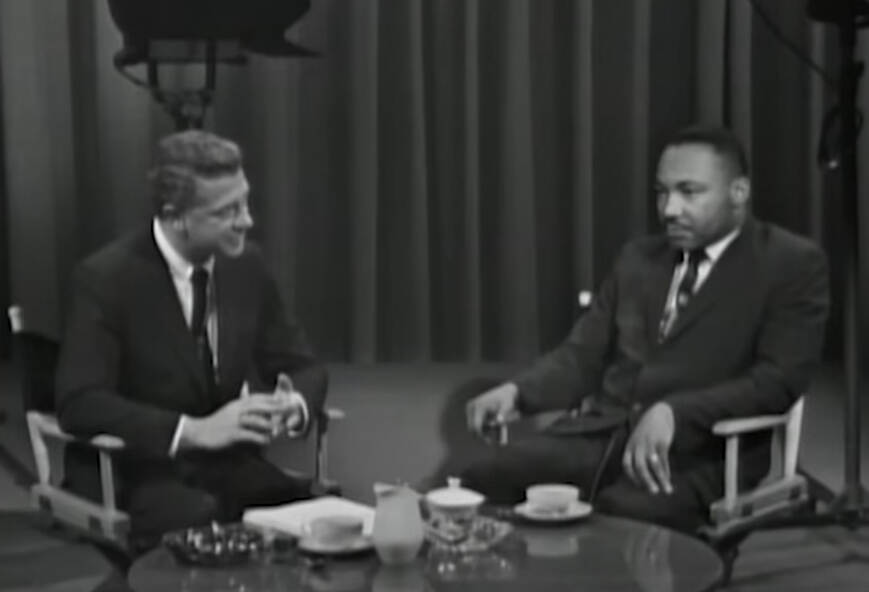
Read the full transcript of Dr. Martin Luther King, Jr. in conversation with host David Susskind on “Open End” on WPIX-TV, New York, aired on June 9, 1963. The conversation covered various topics, including the ongoing American Civil Rights Movement and the then-recent events in Birmingham, Alabama.
DAVID SUSSKIND: Good evening, and welcome to Open End. My name is David Susskind. Tonight, one of the great Americans of our time, Dr. Martin Luther King. Our conversation with him will begin after this brief message. Dr. King, I want to thank you very deeply for taking time out from an arduous schedule to come to New York and do this program with me tonight.
DR. MARTIN LUTHER KING, JR.: Thank you.
DAVID SUSSKIND: I’d like to begin by asking you, what significance does the Birmingham story, the Birmingham struggle that has just been concluded, have, in your view, on the overall Negro-white struggle in the United States?
The Significance of Birmingham
DR. MARTIN LUTHER KING, JR.: Well, I think it has great significance in that Birmingham has been, for many years, the symbol of hardcore resistance to desegregation. And I would say it has been the toughest city in the country in race relations. It’s been the most thoroughly segregated city in America.
It has had a terrible record of police brutality, and there have been more unsolved bombings of Negro homes and churches in Birmingham than any other city. Now, in the movement, in the particular movement that took place, I think we were able to dramatize the indignities and the injustices which Negroes confront in Birmingham and other places in the hardcore South.
And by doing this, I think we were able to bring the issue so much to the surface that everybody could see it. And after we reached the point of getting basic agreements from the economic power structure, I think it said to people all over that the barriers or the walls of segregation are crumbling in Birmingham and they can crumble anywhere. By tackling the most difficult city, it seems to me that we were able to give impetus to other movements and say to people everywhere that it’s just a matter of time.
DAVID SUSSKIND: Now, I wonder if you believe, Dr. King, that the Birmingham issue, the Birmingham violence, was the specific trigger which has set off the explosions around the country, north and south. Was its violence, the attack on children, the use of police dogs and police truncheons—were those the triggers that have ignited Englewood, New Jersey, and other Southern communities and other Northern communities more than any other incident to date?
DR. MARTIN LUTHER KING, JR.: Well, I think it’s a combination of two things. I think, on the one hand, the large number of people who engaged in the demonstrations had something to do with it. In fact, more people were arrested for standing up for civil rights in Birmingham than any other city in the country. Some 3,200 were arrested.
So I think the mass quality of the movement had its arousing effects and its repercussions in other communities, along with the indignities of the brutality and the violence perpetrated against Negroes. I think these two things aroused Negroes all over the country and all people of goodwill for that matter. And I’m sure that things that are happening in other communities, north and south at this very time, to a large extent came into being as a result of the mass quality of the movement in Birmingham and the violence perpetrated against Negroes.
The Role of the Justice Department
DAVID SUSSKIND: Dr. King, subsequent to the Birmingham situation, we have read a lot about the behind-the-scene maneuvering of the Attorney General Robert Kennedy and Mr. Burke Marshall. How effective was our Justice Department, and specifically Mr. Kennedy and Mr. Marshall in effecting a final resolution in Birmingham? You were on the scene, you were the pivot of the action. How effective were they?
DR. MARTIN LUTHER KING, JR.: Well, I would say that they were quite effective in at least making it possible for us to have open channels of communication. We had not had any real dialogue prior to the coming of Mr. Burke Marshall. We had made some approaches and some attempts had been made to open negotiations, but it never got off the ground.
And I do think that with the coming of the Justice Department and Mr. Marshall in the picture, some channels of communication opened that wouldn’t have opened as soon. Now, I’m sure they would have eventually opened because of the persistent power of those engaged in the movement, but I think it helped to bring it about earlier.
DAVID SUSSKIND: Were they, in your view, Dr. King, late in anticipating the extent of the violence? Were they delinquent in getting there soon enough?
DR. MARTIN LUTHER KING, JR.: Well, I think they could have gotten there sooner. All along we had called to the attention of the Justice Department many of the things that were taking place that were symptoms of grave injustices. And we had many things happening. In fact, the whole process, we felt, was a tragic deprivation of basic constitutional rights. And we constantly called these to the attention of the Justice Department.
At first they said that there was nothing that they could do because constitutional questions were not involved, or at least the Attorney General did not have the power, the legislative power, the power backed up by the legislative branch of government, to move in. The Attorney General has the power to move in and initiate suits in the area of voting rights when denials are made in that area. But they contended that they had no power in the other areas.
And it went on like this until things started getting out of hand in terms of the violence on the part of the police force. And this is when they came into the situation.
The Negro Community’s Determination
DAVID SUSSKIND: I wanted to ask you, in your view, is the Negro community of the United States aflame as never before?
DR. MARTIN LUTHER KING, JR.: Well, I think there is no doubt about the fact that the Negro is more determined now than ever before to be free. I think that there is a discontent in the Negro community, a frustration and an impatience, if we can use that word, that we haven’t seen before.
I’ve been around the country for the last few days speaking at freedom rallies, and I don’t think I’ve ever seen the Negro population of our nation more aroused and more determined as I’ve seen on these particular trips. And I think it has reached the point now that there will be no stopping point short of justice and freedom.
And I think the great challenge ahead is for the people of goodwill to see that the Negro is through with tokenism, through with gradualism, and through with “see how far you’ve come-ism.” And he’s determined now to gain these basic rights which have been guaranteed by the Constitution and God-given rights, and yet they’ve not been carried out.
It really grows out of blasted hopes because we all responded to the Supreme Court’s decision of 1954 with a great sense of hope. This came to us as a great beacon light of hope. And yet after eight years or more, we’ve come to see that integration has moved about 1% of students a year. And moving at this pace, it will take 92 more years to integrate the public schools of the South.
And then outside of the South, we see de facto segregation growing every day. The ghetto continues to exist and the endless frustrations that develop as a result of economic deprivation and social isolation will naturally cause the kind of discontent that we now have in the Negro community. And I think it is colliding with another force that must ultimately give and recognize the urgency of the moment.
The Threat of Violence
DAVID SUSSKIND: Do you fear that if the pace of desegregation and integration is not sufficiently swift that violence is inevitable and that your own non-violent movement may be overridden by the militancy of the Negro community?
DR. MARTIN LUTHER KING, JR.: Well, realism impels me to admit that if we cannot speed up the process, so to speak, if we can’t move on and break down these barriers of segregation and discrimination, out of frustration and despair, many Negroes may turn to violence and other courses of action that they wouldn’t ordinarily respond to, that they wouldn’t ordinarily use as a technique.
And I think there is an urgency about the situation and I think if the non-violent movement is not supported, and if there are not attempts made at every hand to give support to those who are trying to work out something through the creative channel of non-violence, then it may open the door for the more extremist groups to come in and really take over to the point that they will serve as the outlet for many Negroes who become desperately impatient.
The President’s Civil Rights Message
DAVID SUSSKIND: Dr. King, we’ve been led to believe the President is preparing a civil rights message proposing new legislation. If this legislation is watered down or insufficient for the Negro purposes, or it is killed in filibuster in the Senate, what would be the aftermath, in your opinion, among the Negro people in this country?
DR. MARTIN LUTHER KING, JR.: I think the aftermath would be a deeper frustration, a deeper discontent, which would inevitably lead to deeper bitterness on the part of many Negroes. And with this kind of bitterness emerging, it can develop into a very explosive situation. I mean, explosive in terms of violence.
And I must make it clear that I’m not advocating this and I’m not predicting this, but I’m trying to analyze the problem realistically and honestly. I think if we don’t get a strong civil rights message and proposal from the President and if we don’t get an actual implementation of it on the part of Congress, we will see ourselves in a deeper situation of chaos.
And I think that this makes it even more urgent for the forces of goodwill to really work hard to get it through. This is why I’ve said in recent days that it’s unfortunate that the President may be out of the country during the period when so many forces need to be mobilized and when the tremendous weight and prestige of the President will be needed to mobilize these forces.
Because I’m sure the South is thinking now in terms of talking the bill away, filibustering, and this will be tragic, it will be unfortunate, and I think it can lead to a darker night of terror.
DAVID SUSSKIND: Dr. King, are you optimistic about the effectiveness of the upcoming message? Will it, in your view, in terms of the political insight you have, will it be sufficient in what it asks of the government, Congress? And are you also optimistic about passage of whatever is proposed?
DR. MARTIN LUTHER KING, JR.: Well, I think the bill will be a fairly strong bill if it follows what has been reported in the press. I do think we need something like the kind of public accommodations bill which would prohibit discrimination in any business that is engaged in interstate commerce. I think this is good. And it would do a great deal to end segregation in many of the hotels and restaurants and other businesses throughout the South.
And I think there is a great need to speed up the process of public school integration. As I said a few minutes ago, this has really been a frustrating and a very slow process and something has to be done. Now, if the bill calls for speeding up the integration process in the schools, I think this will be very good and very helpful.
Now, as far as the possibility of passage, I am not optimistic about it passing if certain things aren’t done to bring the necessary moral and creative pressure to bear so that congressmen will see the necessity of this. For instance, I think, as I said a few minutes ago, the President himself must do more than issue a call, make certain recommendations.
DAVID SUSSKIND: What would you recommend he do, Dr. King? Should he give fireside chats?
DR. MARTIN LUTHER KING, JR.: I think so. I think he should give fireside chats on it. And I think more than one would be necessary. I think the President should also have conferences with congressmen and get them, try to persuade them to see the necessity of passing this bill.
And I think he would need to talk with certain groups across the country so that a climate of civil rights concern will be created and people all over the country will be writing their senators and their representatives in Congress on this issue. I think these things are absolutely necessary.
And I think the devotees of civil rights have to do something. I mean, I think the civil rights leaders and all of the Negroes in the country as well as their allies in the white community will have to do something. And I don’t throw out the idea of the necessity of a march on Washington, even sit-ins in Congress to get this issue dramatized so much that it cannot be ignored.
A March on Washington
DAVID SUSSKIND: March on Washington by Negroes and whites?
DR. MARTIN LUTHER KING, JR.: Yes.
DAVID SUSSKIND: All citizens?
DR. MARTIN LUTHER KING, JR.: Yes. I’m thinking now of all people of goodwill who are concerned about the American dream and the implementation of the basic principles of our democracy. And this would include Negroes and whites. And I think it would have more power if it is an interracial march calling upon our nation to bring into being these just laws which will take us a long, long way toward the American dream.
DAVID SUSSKIND: In the recent meeting between James Baldwin, Lena Horne, Harry Belafonte and other prominent Negroes with the Attorney General, the suggestion was made that the President could make a very dramatic contribution to the issue by taking the University of Alabama Negro applicants to the school himself. The Attorney General was reported to have recoiled at this idea, to have been stunned or horrified or taken aback.
DR. MARTIN LUTHER KING, JR.: Do you think the President—
The Moral Power of the Presidency
DAVID SUSSKIND: United States should go to that dramatic degree by way of using moral power of his office?
DR. MARTIN LUTHER KING, JR.: Yes, I think so. I have said on several occasions in recent days that this would be the kind of meaningful act and the kind of dramatic thrust that would make it clear all over the world that we mean business when we talk about basic human rights and democracy and guaranteeing these basic rights to all citizens.
And I think we have come to the point in our nation that we need this kind of moral witness on the part of the highest official and the most respected citizen in our nation. It would give a sense of hope to the Negro. It would give a sense of support to the many, many white people of goodwill, north and south, who have been working in this area.
And it would do a great deal to lift the image of the United States in the eyes of the world, people of all countries who are looking and they are seeing all of these bad things. But to see this as a great moral act would do a great deal, I think, to give us a better image all over the world.
Presidential Leadership and Civil Rights
DAVID SUSSKIND: Dr. King, we must put pause for just a brief moment. We’ll be right back. Find the President of the United States to date wanting in the way in which he has used the moral power of his office, moral suasion. And if you do find him wanting, and your remarks up to this time seem to suggest that you do, what has been his motive, do you think, in holding back?
DR. MARTIN LUTHER KING, JR.: Well, I must honestly confess that the President hasn’t done all that he could do and that we would like to see him do in the area of civil rights. I don’t want to be unfair in my criticism. I want to say on one hand that the President has done some significant things in civil rights. And I think he is basically a man of genuine goodwill who wants to do the right thing. And I could point to some of the things that he’s done that have been helpful.
On the other hand, President Kennedy has not yet given the leadership that the enormity of the problem demands. He has failed to live up to his campaign promises. He has not gone on record calling for any meaningful civil rights legislation up to now. And if he does, in the coming days, we will welcome this. But he has not done it in the past. And, of course, there is still the need to use the power of moral persuasion to a greater degree than he has in the past. This is one area where the President has not moved with a great sense of urgency.
DAVID SUSSKIND: Why has he hedged, do you think? Political considerations?
DR. MARTIN LUTHER KING, JR.: I think it boils down to a fear of arousing the ire of Southern Congressmen, many of whom hold the leadership in basic and important committees in Congress. And it may be that the president feels that his other legislative program can’t get through if he makes these senators and congressmen too angry on the civil rights issue.
My position has been that this issue is a basic moral issue. I mean, the civil rights issue. And that many of the southerners are going to take a stand against the president’s legislative program, I mean, other phases of his legislative program anyway. And it is better to go down taking a strong moral position than to lose out when you have hedged on a basic moral principle.
And I think this is a choice before the president. He must start now making moral decisions rather than purely political decisions. And I think in the final analysis, he will be supported in the country. It’s very seldom that an individual in the political world has an opportunity to do that which is morally right and politically expedient simultaneously.
But I think this is one issue that is morally right on the one hand and politically expedient on the other. I think the president will discover that if he took a forthright, courageous stand on this issue, he would get great support from people all over the country, particularly in the big industrial urban areas of the north and the west. That, in the final analysis, will elect the President.
The Alabama Crisis
DAVID SUSSKIND: Dr. King, will the coming showdown between Governor Wallace and the federal government on the admission of the two Negro students to the University of Alabama, in your view, will that lead to new violence in Alabama? There are a thousand troops stationed there. The Negro community probably awaits the event. If Governor Wallace were to do a Governor Barnett act and attempt to prevent the entry himself physically with his troops, would that lead to an outbreak of new violence?
DR. MARTIN LUTHER KING, JR.: Well, I think there is this danger. There’s a real possibility. Now, in recent days, Governor Wallace has backed up a bit and he has gone on television calling for nonviolence and calling for peace and orderliness. And how much influence this will have, I don’t know.
I feel now that Governor Wallace has been under so much pressure from the political power structure of the state, the economic power structure of the business leaders and the ecclesiastical power structure. The ministers from all over have said to Governor Wallace, this is the wrong course of action. The attorney general of the state, the lieutenant governor, and I think he’s been under so much pressure that he may change his course of action and try to follow through on some token political promise that he made, yet at the same time try to keep violence from erupting. If this happens, it may be possible to prevent violence.
On the other hand, if the governor over the next few days persists in his determination to stand in the door and place the troops, the state troopers of Alabama, over against the trying to block the entrance of the Negro students, and then the showdown comes between the state and the federal government, there is a danger that the violent forces of the state will become so aroused that they will resort to violence and will unconsciously and consciously feel that they are aided and abetted by Governor Wallace in all that they are doing.
So it’s difficult to say. I think we must realize that it’s a dangerous situation. And Governor Wallace has done a grave injustice, not only to Alabama, but to the whole nation by embarking on such an irresponsible course of action.
Militant Nonviolence
DAVID SUSSKIND: Dr. King, has the pressure of events and the frustration of the Negro in seeking his rights made your philosophy, your doctrine of nonviolence, more difficult to preach effectively within your own people? Is there now a militancy that is damaging your theology of nonviolence?
DR. MARTIN LUTHER KING, JR.: Well, at this point I don’t think so. I must make it clear that I don’t advocate a weak and a sort of complacent nonviolence. I advocate a militant nonviolence, a movement that moves on, a resistance movement that does resist, but it does it nonviolently.
Now, I am as impatient as anybody about the slow pace of the desegregation process. And I feel that we’ve got to move on in a very vigorous, forthright and determined manner. My only insistence is that it would be both impractical and immoral to try to make violence our major thrust or to try to make violence a method that we will use to get to the goal of integration. And as I said, I think it’s just downright impractical, even if one doesn’t take the moral questions under consideration.
Now it is true that because of the failure of the forces of goodwill to rally around the democratic ideal and the whole process of integration, many people in the Negro community have become so impatient that they’ve become bitter. And it is more difficult to get over in a situation like this, the philosophy of nonviolence. It makes the job much more difficult.
When we are moving on and people see this creative outlet, it’s easier for them to remain true to the nonviolent creed. But when things are slow and even those who are leaders in the nonviolent movement are considered rabble rousers and agitators, then it does make the job much more difficult to get this philosophy over.
And I would be the first one to admit that with the growth of the movement and with it rising to such astronomical proportions in terms of numbers and with all of the communities that are now rising up, it means that we’re going to have to spend more time and get more hands to help us work in these communities so that we will be sure that at least we try to get over the meaning of the whole philosophy of nonviolence.
Understanding Negro Discontent
DAVID SUSSKIND: What was your reaction to the reported reaction of Attorney General Kennedy at the meeting with Mr. Baldwin? The reports were in the New York Times and other reliable papers that the Attorney General was stunned at the extent of militancy, anger and impatience that he found among these Negro artists. Was this an ingenuous reaction? Had he so misread the temper of the American Negro?
DR. MARTIN LUTHER KING, JR.: Well, I think this is a real possibility. And I think many white people of goodwill, many who are even fairly close to the Negro community, fail to realize the seriousness of this problem and the mood of the Negro, the impatience and the discontent of the Negro. I think that many people fail to see this.
And it isn’t that they are not people of goodwill on the whole. They understand the depths and dimensions of the problem, but they just haven’t been able to see this new determination on the part of the Negro. And the new determination itself has grown out of this impatience and this great discontent.
So that I’m not surprised to know that some left with the conclusion that the Attorney General didn’t realize this. Because I’ve seen others who have been very concerned about the problem of racial injustice, but somehow had not been able to understand or to see this growing militancy in the Negro community.
Northern Segregation and Its Dangers
DAVID SUSSKIND: Does the reaction of the northern and western Negro against de facto segregation in housing and lack of equal job opportunity contain the same elements of violence potential as we are seeing in the south today?
DR. MARTIN LUTHER KING, JR.: I think so, and sometimes even more. Because in the south the system of segregation is legal and therefore overt. And it’s easier to get at its points. It’s out in the open so you can tackle it legally, you can tackle it through nonviolent demonstrations and other forces. And you can see pockets of progress here and there.
You can look back and say, well, a year ago I couldn’t go to the lunch counters, but now we can go. A year ago I couldn’t go in the hotels in this particular city, but now I can go. A year ago we could not go in the theaters, but now we can go. So you do see progress at certain levels. It’s just token progress, but it can be seen.
Now in the north it’s different. Since segregation is not legal, it has to be subtle, it has to be covert. And because of the growing problems around this, often the Negro can only see retrogression. If he lives in a city like Detroit, he recognizes that he’s about 28 or 30% of the population and yet almost 70% of the unemployed.
Because of discrimination and the fact that Negroes have been limited to unskilled and semi-skilled labor, a force called automation comes into being and these are the jobs that pass away so that the Negroes are the ones who suffer most at this point in the large industrial areas of the North.
And I think because of this unemployment, because of the continued existence of the ghetto, and these things are involved together, you see, the evils of employment discrimination and housing discrimination are caught together. If a man doesn’t have enough money to live, he certainly can’t get adequate housing. And even if he has money, in so many instances he can’t get it.
DAVID SUSSKIND: Is he ready to march, to demonstrate, to do the kind of thing that the Southern Negro has done? Is he at that point in your view?
DR. MARTIN LUTHER KING, JR.: Oh, yes, I think so. I’ve been in several northern communities recently and I would say that the vast majority of Negroes in these communities are so concerned about this issue and so frustrated about it that they are willing now more than ever to take this issue to the point of engaging in mass nonviolent demonstrations.
In fact, we’ve seen some of it in Philadelphia in recent days where they had mass picketing and mass demonstrations, some of it even erupted into violence. Now I think this is a real possibility in cities all over the north where the Negro is just caught up in the crippling shackles of frustration.
DAVID SUSSKIND: You see Washington D.C. as a particular danger point with Malcolm X having moved there, with the Negroes being the majority of the population, with job discrimination and ghettoizing being so deeply embedded in the nation’s capital. Do you see Washington as a particular point of explosion?
The Threat of Urban Unrest
DR. MARTIN LUTHER KING, JR.: Well, this is a community that can explode like many others. And I don’t think it will only be because of Malcolm X moving there. My contention is that if we keep moving and if we can solve the problem by a continued working at it, then Malcolm X and the Muslim have any influence. I don’t think they’ve had anywhere as near, I mean, as much influence as many would think. At points this movement has been a sort of paper tiger.
But I would say that these communities, like Washington and Washington, as you say, is a majority Negro population, has a majority Negro population. These communities can explode into a terrible racial nightmare if something isn’t done. And I think it can be warded off by vigorous programs on the part of the federal government and on the part of local state governments.
In other words, it will be determined by the degree to which the political leaders and other leaders will meet the problem head on. And Washington is a good example. If the leaders in Washington, backed up by the President, will see the dangerous possibilities and set out to deal with the problem of housing discrimination and employment discrimination, and certainly the Negro confronts us in Washington and all over, then there will be a ray of hope.
Now the president is considering doing something about eliminating discrimination in federal construction programs. This is just one level, but it does represent some progress. If he can get an executive order through on that, and this will make new jobs for Negroes and where you have new jobs, and the Negro sees that he’s moving from the periphery of American society to the point of being involved and knowing that he has something to lose, then he will not feel the need of responding with violent reactions.
DAVID SUSSKIND: Dr. King, we have to pause again very briefly. We’ll be back in a moment. Dr. King, you have been reported very recently as saying that you no longer fear the Ku Klux Klan or the white citizen council as much as you have begun to fear the white moderate, that he is the bone in the throat of Negro progress. Would you implement that statement and tell us what you mean by that?
The Problem of the White Moderate
DR. MARTIN LUTHER KING, JR.: Yes. Well, I guess I entered this period, I was catapulted into the leadership of the civil rights struggle during the Montgomery bus boycott. And I entered the struggle at that point having great faith in the moderates in the white community, feeling that the moderates would understand and that we would have great allies in our struggle from the so-called moderates.
But in recent years I’ve come to see that these are often the people who stand in the way of progress because they are committed only in a lukewarm manner. And every time you move to try to solve the problem, they will respond by saying, “You’re moving too fast, you ought to cool off, you should put on brakes.” And they end up more devoted to order than to justice, and more devoted to maintaining a sort of negative peace, which is merely the absence of tension, than gaining a positive peace, which is the presence of justice.
And they can always say to you that you should wait for a more convenient season. And I’ve come to see that these are the people that often stand in the way because they get close enough to you to at least discuss your plans and they become friendly enough to talk with you, you at least have dialogue with them, but they want to stand in the way of every move forward.
And this has been my disappointment. I think at times it is better to have outright rejection and misunderstanding from people of ill will than to have lukewarm acceptance from people of goodwill. It is better to have absolute misunderstanding from people of ill will than to have partial understanding from people of goodwill.
And this is what we’re seeing every day in our struggle in the South. That many of the moderates of the white south, and many of them mean well, and I shouldn’t only say the south, but the moderates all over, stand in the way of progress because they refuse to understand the problem. And they live by the myth of time failing to realize that time will not solve the problem.
And there’s a danger that the moderate will live by this myth, believing that if you just leave things alone and not push too much, time will solve the problem. And it has always been my contention that this is an invalid view because it goes out with the idea that there is something in the very nature and structure of time that will miraculously solve all problems. And time really is neutral. It can be used either constructively or destructively. And at times, I think the people of ill will have used time much more effectively than the people of goodwill.
The Administration’s Response
DAVID SUSSKIND: Many astute and experienced observers of the Washington scene describe the mood of the administration in the area of racial relations as one of bleak despair. Because they feel, the administration, say these reporters, that they cannot possibly legislate or executive order or innovate enough, fast enough to accommodate the surging expectations and want of the Negro community, that they could not possibly keep up with the appetite for progress that the Negroes want in this country. Would you comment on that?
DR. MARTIN LUTHER KING, JR.: Well, I think they can. I don’t think that despair needs to exist. I think the administration must recognize that the harvest of disruption that we now see over the country is here because of seeds of inaction planted over the last several years.
If, for instance, the president had taken a real stand on the moral issues of integration in 1954, after the Supreme Court rendered its decision, things would be different now. But because of the failure of President Eisenhower to take a forthright moral stand, a vacuum set in and the forces of opposition were able to organize and crystallize the opposition. And this set us back for a period.
I think the new administration will have to see the necessity of making up. It’s just as simple as he who gets behind in a race must forever remain behind or run faster than the man in front. And we’ve got to see that we have gotten behind in the race of really following through on the executive and the legislative levels, even on the things that have been done through the judicial branch of the government.
I think through a combination of efforts, this problem can be solved. I think the new administration must see the necessity of moving through executive orders, through legislative channels, and through moral persuasion. And I always keep that at the forefront because I think there’s a great deal that can be done here.
Lessons from India
I was in India some few years ago, and I spent a good deal of time studying the problem of caste untouchability, which is quite similar to our problem here. And it was very interesting to me to notice that India had made much more progress in grappling with this problem than we’ve made. And I came to the conclusion that this progress had been made for two or three reasons.
First, when the new nation came into being, when they received independence, it was placed in the constitution that to discriminate against an untouchable was a crime punishable by imprisonment. But not only that, India always had great symbols standing up in a moral way against it. For instance, Mahatma Gandhi adopted an untouchable as his daughter against the will even of his wife. And when I was in India some six weeks, Prime Minister Nehru made four different speeches in which he morally condemned caste untouchability.
And yet we very seldom, if ever, hear the president of the United States speaking to the nation on the moral issues of integration. When they speak, it’s usually, “This is the law and we must obey the law. We are a nation of laws and not men.” Never saying that James Meredith should go to the University of Mississippi because integration is right, because he’s your brother.
And I think that with all of these forces working together, the legislative, the executive, and moral persuasion on the part of the president, we can do this catching up. But the danger is that we will just do a few token things here and there, and it’s just like applying vaseline to a cancer. We must move away from the approach of tokenism and see the necessity for a vigorous program.
James Baldwin’s Commentary
DAVID SUSSKIND: Dr. King, Mr. James Baldwin has emerged very recently as an important spokesman for the Negro community in America. I’m sure you would attest to his eloquence and his brilliance. But I wonder whether you feel he does damage with such remarks as his comment on the black Muslims: “It’s the only movement in the country you can call grassroots. I hate to say that, but it’s true. They talk and articulate for all the Negro. They articulate their suffering.”
Or this comment on you, on Martin Luther King: “A rare and great man. He has great moral authority in the South. He’s gone through hell to awaken the American conscience. But he has reached the end of the road. Martin is undercut by the country.” Now, is he doing a disservice in his backhanded support of the Muslims? And is he doing a disservice when he suggests that your non-violent credo is passé?
DR. MARTIN LUTHER KING, JR.: Well, I think James Baldwin is certainly an eloquent writer and a profound thinker and I think he has analyzed the depths of this problem in a very fine way. Now this doesn’t mean that I agree with everything that he talks about or says.
I wish he could see not only the negative reaction of the Muslim movement, but the very beautiful and creative way that thousands and thousands of Negroes are using to get out of the dilemma of racial injustice. And I do think that this is the grassroots movement, the real grassroots movement is a movement that has taken place all over the south today where thousands and thousands of people have a new sense of dignity and destiny and they feel that there is a creative channel through which they can channel their legitimate and healthy discontent. And I think it is necessary to be discontent, but I think it is a healthy discontent.
DAVID SUSSKIND: Doesn’t Jim Baldwin seem to be saying on the one hand, destiny dictates progress and equality now, which is fine, but doesn’t he on the other hand seem to be waving a fist in the air and saying if you don’t, the Black Muslim solution is inevitable and beware because it means real serious violent trouble for you. Is that not a disservice by raising the flag of the Muslims?
DR. MARTIN LUTHER KING, JR.: Well, I wouldn’t want to falsely represent him. I don’t know if he’s advocating this. Speaking as a social analyst, I think we would all agree that if something isn’t done and done in a hurry, there is a danger that out of despair Negroes will turn more and more to black nationalist ideologists. I’m not saying all Negroes, but more than have turned in the last few years. Now that’s one thing, but to advocate this is another. And I’m not able to say whether James Baldwin is advocating that the Negro will turn to the Muslim movement seems to be warning.
Negro Patriotism and Military Service
DAVID SUSSKIND: Yes, I wonder. In a recent television interview he said that President Kennedy would have a difficult time enlisting Negroes in an invasion attempt should one become necessary, for they were not prepared to fight and die for a country that would not grant them freedom and equality. In your view at this point, are many Negroes unwilling to support our country militarily?
DR. MARTIN LUTHER KING, JR.: Well, I don’t think that at this point the Negro has reached a position of utter despair. I think the amazing thing is that the Negro hasn’t turned to movements that really thrive on despair. This is the amazing thing to me that out of 20 million Negroes in America, all of the black nationalist movements together haven’t been able to get hardly more than 100,000 members. This is the amazing thing. And this reveals that the Negro has not yet turned to the point of giving up altogether and given up with a sense of hopelessness. I think there is still a great sense of hope and a basic faith in America on the part of the American Negro.
DAVID SUSSKIND: If we were faced with a military crisis at this moment, the Negro would render unto his country that which he has always rendered?
DR. MARTIN LUTHER KING, JR.: Oh, I think so. I don’t think the vast majority of Negroes would turn against the country in the time of war. I don’t see that kind of despair at this point. I don’t know what it would turn out to be if events go the other way and we see more retrogression than progress. But I don’t think that there is this kind of despair at this point that the Negro would turn against the nation.
DAVID SUSSKIND: Malcolm X recently, very recently said that any Negro who teaches other Negroes to turn the other cheek is disarming that Negro. You comment on that?
The Power of Nonviolent Resistance
DR. MARTIN LUTHER KING, JR.: Well, I think he would have to understand the meaning of turning the other cheek and the strength of nonviolence. I think too often we think of this as a weak approach and a sort of philosophy that means you get caught up in stagnant passivity and deadening complacency where you just sit down and accept injustice.
Now there’s a world of difference between non-resistance to evil and nonviolent resistance. Now I do not advocate non-resistance to evil. I advocate nonviolent resistance, which means turning the other cheek in a very powerful and creative way. And really this approach ends up disarming the opponent. It has marvelous strategy even beyond the moral question.
I think the reason one should be nonviolent is for moral reasons in the final analysis, because this is morally right. But it has a power of disarming the opponent. It exposes his moral defenses, it weakens his morale, and at the same time it works on his conscience.
And I think that Malcolm X is altogether wrong if he thinks that we can do this by turning to violence. I’m not saying that he’s saying that, but if this is even implied I think we would get the other results if we would turn to violence. We couldn’t do these other things. It would really lead to the position of having state militias being used by Southern government governors to kill and destroy a lot of innocent Negroes under the pretense that Negroes are inciting a riot.
But with the method that we’ve used up to now, it so frustrates the opponent that he just doesn’t know how to react. If he doesn’t put you in jail, wonderful, because nobody with any sense loves to go to jail. But if he puts you in jail, you somehow, in a creative manner, transform that jail from a dungeon of shame to a haven of freedom and human dignity, and he doesn’t know how to handle it.
The Kennedy Administration’s Moral Commitment
DAVID SUSSKIND: We must pause again very briefly, Dr. King. Richard Rovere, in an article in the New Yorker magazine, said that this is the first administration which viewed racial inequality as morally reprehensible. First, I wonder, is this, in your view, the first administration? It seems to me that the Eisenhower administration equally viewed with alarm, but was equally hedging in its moral use of moral powers.
But Mr. Rovere then went on to say that it’s unfortunate that the Negro rebellion has occurred during such an administration’s reign. In other words, he sort of sanctifies this administration and thinks it’s something of a pity that this explosion has occurred during the Kennedy administration. Has the Kennedy administration been any more morally alarmed than the Eisenhower administration? And is it unfortunate that the violence and dramatic explosion has occurred during the Kennedy administration?
DR. MARTIN LUTHER KING, JR.: Well, I think it may be true that the Kennedy administration has done more in civil rights than the Eisenhower administration. But this still doesn’t say that the Kennedy administration has done enough and that the moral alarm has been—the moral concern has been so great that it doesn’t merit Negroes continuing to press on in a very determined way. It merely means substituting an inadequate performance for a miserable one.
And I think that we all know that there are many areas that have not been touched by the new administration and things that could be done to solve the problem that have not been done. So I would say that it is as necessary to stand up vigorously against racial discrimination now and under the present administration as it was under any other administration.
I don’t think it is true that the Negro can afford to relax his efforts simply because you have a new administration that may have done a little more, but still hasn’t done enough. For instance, I think the President has done some very significant things that touched a certain segment of the Negro population. But now there is need for the kind of strong program that will improve the life of all the masses of Negroes, so to speak.
And this is a great concern of all people of goodwill, because if we don’t get this, it will just be a sort of crystallization of what we call tokenism, where you get token gains here and there. You get appointments of Negroes in positions that they’ve never been in. But the plight of the vast majority of Negroes remains the same. And now we need to lift the life and make better conditions for Negroes generally.
DAVID SUSSKIND: Do you think that the appointment of the occasional Negro to a position of authority and importance in the government—isn’t that political window dressing? It doesn’t really matter. In the deep sense of creating a broad job equality or an all out campaign for voter registration or integration of schools, isn’t that a form of political chicanery?
DR. MARTIN LUTHER KING, JR.: Well, again, I wouldn’t want to question the motives of the administration, the President at this point. It may very well be that, but I don’t want to question that. But I do feel that in the long run it would be much better to grapple with the problem from the causal source than to make a few appointments here and there that may appease Negroes generally and make them feel that a great job is being done.
When at bottom the problem is still there. This becomes little more than a sort of tranquilizing approach that removes the emotional stress for the moment, but doesn’t really get at the basic ill.
The Negro’s Economic Power
DAVID SUSSKIND: Dr. King, you have shaken a warning and righteous finger at the whites of the United States on many counts, and rightfully. But I wonder if the Negro himself has been active enough, intelligent enough, and functional enough in the use of his economic power. If a chain store system in this country discriminates in the South, if a drug chain, if a theater chain discriminates, hasn’t the Northern, Western and Middle Western Negro got enormous power of retaliation by withholding his patronage by boycotting such establishments? Why hasn’t he been more effective in the use of his economic power?
DR. MARTIN LUTHER KING, JR.: Well, I think the Negro is recognizing more and more the power of his own economic resources and the power that develops when he withdraws his economic resources from businesses and industries that discriminate against him on the basis of race. We’ve done this to a degree in most of our movements in the South.
Most of the sit-ins, for instance, have been followed by a strong economic boycott of the particular stores involved. Recently in Birmingham we saw this, and I’m convinced that one of the things that brought about the agreement and the final agreement to integrate lunch counters was that we had a boycott of the downtown stores that was more than 97% effective. And this has existed in many communities where we’ve had several sit-ins.
Now I think that this will be broadened more and more. On the question of employment, I have advocated a nationwide selective buying program whereby we will go down the list from industry to industry, business to business, and we will make it very clear that if our persons are not respected, then our dollar will no longer be.
DAVID SUSSKIND: Are there prime manufacturing offenders, are there prime store offenders that the Northern and Western Negro should know about?
DR. MARTIN LUTHER KING, JR.: At the present time studies are being made. We don’t want to move out and unjustly criticize or victimize anyone. We want to be sure that we have evidence of discrimination. And I have talked with several people about this—people who are in positions of authority and who have the research facilities to determine which industries should come under this kind of attack because of discrimination in employment.
I might say that we aren’t satisfied with most of the industries in terms of their employment policy. Some are certainly doing better than others, but there are very few industries—
DAVID SUSSKIND: Are there some that are implacable, intransigent that you would want to name?
DR. MARTIN LUTHER KING, JR.: Well, I wouldn’t want to name a national one now because we are still in the process of studying. Now we’ve had selective buying campaigns going in local communities for quite a while now. Philadelphia had a very strong economic withdrawal program, a selective buying program. We’ve had it in Atlanta, Georgia, where the Southern Christian Leadership Conference has its headquarters.
And there were one or two—we started with the baking industry and there were one or two bakeries that we had to boycott, but they finally came in line because of the power of the boycott. Now this will be extended on a national level so that there may be, say, 20 cities—we’re thinking of something like this—that will boycott a particular product where there is outright discrimination and they refuse to do anything about it.
Now we will seek to negotiate first. And if through the channel of negotiation we can’t get the situation rectified, we will have no alternative but to tell our people that this particular business discriminates against Negroes in employment. And then we will urge them not to patronize these businesses.
Threats and Personal Safety
DAVID SUSSKIND: Dr. King, a Danish reporter, Hans Rubin in the Reporter magazine said that if Dr. Martin Luther King had been murdered, it would have stopped presses all around the world. But how do you explain to your editor that the most amazing story is that Dr. King is still alive? Do you consider that a miracle? Is that a sign of some form of negative progress as he seems to suggest?
DR. MARTIN LUTHER KING, JR.: Well, I don’t know. I get threats every day and they don’t stop. They even grow greater when movements develop like the Birmingham movement. I don’t know what this can be attributed to. I haven’t—I don’t have any bodyguard or anything like that. I don’t even request protection from the federal government, although when I go into cities for large meetings to speak and things like that, the communities usually provide protection.
DAVID SUSSKIND: Has the federal government ever offered you protection?
DR. MARTIN LUTHER KING, JR.: Yes, in some instances when we’ve been in situations like the Freedom Rides in Montgomery when great threats came—and not in Birmingham, because the federal government hasn’t been in the same sense that they were in Montgomery during the Freedom Rides. They had federal marshals there. In Birmingham, FBI men are usually on the scene when I’m coming in or leaving.
But I can only say that nothing has been done as far as my life being taken. I guess I’m religious enough to say that this is the grace of God. But as I said, the threats continue to come and we continue to go on knowing that this course of action is in line with that which is morally right.
Political Parties and Civil Rights
DAVID SUSSKIND: Dr. King, do you think that either political party has any particular medal of honor to wear in civil rights? The Negro invariably gives his support to the Democratic Party, yet it is the Democratic contingent from the South in the House and the Senate that invariably gives the Negro legislation the most difficult time. This automatic wedding of the Negro vote to the Democratic Party—is that earned and is it a healthy thing?
DR. MARTIN LUTHER KING, JR.: Well, I don’t think either political party can boast of clean hands in the area of civil rights. I think both parties have betrayed the cause of justice. The Democratic Party has betrayed the cause of justice by capitulating to the undemocratic practices of the Southern Dixiecrats. And I think the Republican Party has betrayed the cause by capitulating to the blatant hypocrisy of many right-wing Northern Republicans.
And it has been this coalition of right-wing Northern Republicans and Southern Dixiecrats that has stood in the way of every progressive step in civil rights legislation. So neither party can boast of clean hands in this area.
Now, I think more and more the Negro will vote for that candidate in that party which will take a definite stand on the basic issues of human rights and all the issues that go along with it. And that will do something about it, not just verbal affirmation, but in terms of concrete action. And I don’t think any political party will be able to boast that it has a Negro in its vest pocket. And I think this is good.
DAVID SUSSKIND: But in fact the Democratic Party has and continues to have the Negro vote in its vest pocket. Seventy, 80% of the Negro community in the big cities—Detroit, Chicago, New York—vote straight down the Democratic line. Isn’t the Negro in voting that way doing himself a disservice?
DR. MARTIN LUTHER KING, JR.: Well, I think the Negro is caught in a very difficult position here. On the one hand, the Democratic Party has been a little closer to the masses of people on bread and butter issues. And outside of the South, Negroes have been able to see a degree of progressive liberalism within the Democratic Party.
And here is the dilemma that you have this schizophrenic personality at the center of a party wherein on the one hand you see a progressive liberal thrust and on the other hand you see this backward reactionary thrust on the part of the Southern Dixiecrats. And it presents a dilemma of the Negro choosing between the issue of civil rights and social welfare issues.
DAVID SUSSKIND: Medicare, education bill. But I wonder, for example, whether the Republican Party wins any votes for the effort, for example in the House of Representatives recently of John Lindsay and other congressmen to initiate on their own resources effective civil rights legislation not waiting on a presidential message. Do they earn Negro accolades?
The Republican Party and Civil Rights
DR. MARTIN LUTHER KING, JR.: Well, I think this could become increasingly true if the Republican Party would somehow throw the yoke of division from its own shoulders. Now there again the Negro faces the dilemma. Because just as you have an Eastland in the Democratic Party, you have a Goldwater in the Republican Party who will come down south and make a speech and say that the Supreme Court’s decision isn’t the law of the land and who just yesterday made it clear that he’s not sure whether he will support civil rights legislation.
So it is a dilemma for the Negro. When he looks to the Republican Party he sees the same schizophrenia, he sees the same division between the progressive Javits and the Cases and the in the middle Dirksen and the reactionary Goldwaters.
DAVID SUSSKIND: And the Negro should begin to vote for the man and not the party. Wouldn’t that be the more effective?
DR. MARTIN LUTHER KING, JR.: Well, I think this will happen more and more and this has been true that in many communities Negroes in the north have voted for liberal Republicans over against what they considered a Democrat who didn’t quite come up to this person.
The Philosophy of Nonviolent Resistance
DAVID SUSSKIND: Does your being a minister give you the ultimate conviction that your mission of equality of opportunity, equality of education, and so forth is going to be accomplished peacefully? Where the facts of history are that human rights are almost always won in violence and bloodshed and a manifested impatience by taking up arms. Do you grow a little bit pessimistic about the philosophy of nonviolent resistance, however militant that nonviolence is?
DR. MARTIN LUTHER KING, JR.: No. I am more convinced now than ever before that nonviolence, nonviolent resistance is the most potent weapon available to oppressed people in their struggle for freedom and justice. I think the aftermath is much greater for everybody involved. The aftermath of violence is bitterness. And you’ve got to spend another hundred years getting rid of the bitterness created as a result of the violent revolution, wherein the aftermath of nonviolence is redemption and the possibility of the creation of the beloved community.
Now, in recent years we have seen nations gain their independence where colonialism was a problem. And we have seen groups within nations gain better opportunities without violence. Examples would be India. There are nations in Africa that came into being not out of on the basis of violence, but on the basis of nonviolent protests. Ghana would be an example. Nigeria and many other nations in Africa. They have come into being as a result of the persistent agitation on the part of the masses of people who followed a nonviolent course of action. And I think the best and largest example was India.
Now I think that it is even more urgent to follow nonviolence in a situation where you are seeking to gain your rights within a nation that you’re going to have to live in even after these rights come. In the colonial struggle or the struggle for independence, you’re seeking to drive a force, foreign invader out. Wherein when you’re seeking integration, you’re seeking an adjustment and better conditions in a situation where you will be living with the very people the next morning.
And I think it is even more necessary in such a situation to follow nonviolence. Because the one thing that nonviolence says is that your aim is not to destroy or annihilate the opponent, but to win his friendship and understanding. And you engage in your protest activities in order to arouse the conscience of the opponent and in order to bring the issue to the surface so that everybody can see it and deal with it, but you are not trying to get rid of him. And this is why I think it’s so important to remain true to nonviolence.
North vs. South: Hypocrisy and Honesty
DAVID SUSSKIND: Representative Adam Clayton Powell observed a few days ago that there’s very little difference between the north and the south in the matter of race relations, except that, I would say he said that there is more hypocrisy in the north and more honesty in the South. Would you agree with that?
DR. MARTIN LUTHER KING, JR.: Well, I would certainly say there’s some truth in the idea that there is a great deal of hypocrisy in the north and the Southern white man is more honest in coming right out and saying openly what he feels about the Negro.
On the other hand, I think there is a difference and I would not want to give the impression that the problem is the same in degree in the south and the North. In the south, as I said earlier, the problem is that of getting rid of desegregation. I mean getting rid of segregation and bringing into being a desegregated society as well as an integrated one, so that we’ve got to get desegregation as well as integration.
In the north, by and large you have desegregation and the real job of the north is to become integrated. You have the legal sanction of the system in many areas of the South. And because of this, it means that you have the job of getting rid of the system of segregation which is legal, as well as moving on to that higher system which deals with attitudes, deals with mutual acceptance, genuine intergroup and interpersonal living. So that there is this difference.
Now I do feel that the north must be eternally vigilant and it must not become complacent because if this happens, many of the subtle types of discrimination will continue to grow and develop and they will become as great, the de facto segregation of the north will become as great as the legal segregation in the South.
On Adam Clayton Powell
DAVID SUSSKIND: Dr. King, don’t you honestly feel that Representative Adam Clayton Powell is a terrible millstone in the sense of his appalling absentee record as a legislator, in the sense of his flagrant personal behavior, and in the sense of his almost incessant racial mongering for self-serving political purposes. Doesn’t he do your community poor service?
DR. MARTIN LUTHER KING, JR.: Well, I wouldn’t like to pass judgment on Congressman Powell. I’m sure that there are many things that he does and sometimes things that he says that we would question and there are points of disagreement, but I wouldn’t want to pass judgment on him. I think this is something that he has to face with his own conscience.
DAVID SUSSKIND: And he has a lot of conscience facing to do, you’ll agree?
DR. MARTIN LUTHER KING, JR.: Well, I think that there are some things that he should face and I’m sure there are mistakes that he has made. I think on the one hand he has done some good things and he has been a voice for civil rights and he has tried to keep the issue before the forefront of the national community. On the other hand, he has done some things that there could be improvement on.
But as I said, I’m not one to pass judgment. I think Congressman Powell will have to face this problem with himself. And I think that there are areas of agreement and there are areas of disagreement as far as things that he has recently said.
The Fear of Miscegenation
DAVID SUSSKIND: I wanted to ask you to comment on the most frequent and deepest concern of the average white person in the north as well as the south, that all of this, apart from the morality of the Negro’s strive for equal rights and equal opportunities, at the base of it lies deep sexual concern. At the base of it lies the fear of miscegenation. I’ve increasingly heard supposedly enlightened northern whites say, well, the inevitability of a total integration of the races is extensive miscegenation. Is that really any problem of size or consequence in your view? Isn’t that an old wives tale?
DR. MARTIN LUTHER KING, JR.: Well, I think at many points this is a groundless fear. I always have to determine whether those who talk about this most, and I hear it a great deal in the south, are referring to illicit miscegenation or whether they’re referring to intermarriage on a legal basis.
Now the fact is that we have much more illicit miscegenation in the south where there are rigid barriers of segregation, than we do in the north where you have no such barriers. And sometimes the persons who have talked loudest about intermarriage and miscegenation have actually fathered negro children, which means that apparently they believe in segregation by day and desegregation by night. This has just been the fact of the situation.
And from a psychological point of view, these people may be battling with a deep sense of guilt and a fear of retaliation. The fact is that in communities where you’ve had integration to a degree for many years, there have been very few interracial marriages.
Now I don’t think this question should be a basic one in this period because properly speaking, individuals marry and not races. And I have made it very clear that I don’t think any state should have a law which prohibits individuals of different racial groups from marrying. I think marriage is an individual matter. And in a democracy, in a free, good society, this is right that that society must preserve.
And I think when America rises to its full maturity, this will not be a basic issue that is constantly brought up and constantly mentioned as we hear it today all over the country in general and the south in particular. And I’ve also said that even after making these general statements, as I said in my book, “Stride Toward Freedom,” in the final analysis, the Negro’s basic aim is to be the white man’s brother and not his brother-in-law. And I think that has been revealed by the very events of contemporary history.
DAVID SUSSKIND: There is nothing more specific by way of an overriding statistic, for example? Well, there have been very few intermarriages, but it’s such a basic psychological fear that it seems to me that someone should acquaint the white community with the fact that the Negro community has as much pride of race as Catholics have pride of religion or Jews have pride of religion. That no matter what the degree of integration, isn’t it likely that it would always be the exception that would result in an intermarriage?
DR. MARTIN LUTHER KING, JR.: Yes, I don’t have the statistics on it, and I don’t know whether we can say that. Well, to put it another way, I would have to admit that if you have a thoroughly integrated society, there will be some interracial marriages. There’s no doubt about that. But I do not think this will rise to great and large proportions.
I think that there can be a thoroughly integrated society where you have equality of opportunity and yet the vast majority of Negroes will continue to marry Negroes and vice versa. So that I think this is basically a groundless fear. And I always say that having to bring out the other side, that I have no opposition to interracial marriages. And I think this is a freedom that must be preserved for individuals who wish to engage in them.
Federal Funds and Economic Sanctions
DAVID SUSSKIND: Dr. King, what do you think of the Civil Rights Commission’s recommendation that President Kennedy look into the possibility of finding a way to choke off the flow of federal funds into the state of Mississippi or such other states as may practice rampant discrimination and prejudice?
DR. MARTIN LUTHER KING, JR.: Well, I think this is a good recommendation, and I’m sorry that the President threw it out so soon without giving it some study. In a state where you have no redress through the courts or through other channels, I can see economic sanctions as a very powerful force that can bring about the kind of moral coercion that is desperately needed in the situation.
Now, let us take Mississippi as a point. There isn’t a single federal judge in the state of Mississippi who will render a decision in line with the Constitution of the United States. The Justice Department has gone into federal courts in Mississippi with exactly 18 suits, I believe, to rectify the situation that Negroes confront with reference to voting inequalities. They haven’t even had a hearing on a single case yet. They just refuse. These judges refuse to bring the cases up. They sit on them.
And in a case like Mississippi, I think by withdrawing federal funds, taking these economic sanctions, it will bring about the kind of pressure that will bring the state in line. Mississippi gives, I think, about 32 cents for every dollar it gets from the federal government. New York gives about a dollar and 78 cents for every dollar that it gets from the federal government. It means New York is supporting Mississippi.
Alabama gives 38 cents for every dollar that it gets, where Connecticut gives a dollar, I think 95 cents for every dollar it gets from the federal government, which means that Connecticut is supporting Alabama. And I think the time has come for the federal government to engage in the kind of vigorous action that will cause states like Mississippi, which refuse to do anything in line with that which is right, that which is moral, and that which is constitutional. It would bring a force to bear.
I wouldn’t call on this. I wouldn’t think this drastic step would be taken in other states in the south that are trying to adjust to the inevitable. But I’m speaking now of a state like Mississippi and a state like Alabama.
The Civil Rights Commission
DAVID SUSSKIND: Dr. King, there’s a considerable debate raging now over whether the life of the Civil Rights Commission should be extended for another four years. In your view, has it done an effective job and should its life be extended?
The Civil Rights Commission and Its Impact
DAVID SUSSKIND: I think so. I think it has done a very effective job, and I think its life should definitely be extended. Although this commission has no power to act, it does have subpoena power, and it can bring out to the open and to the public things that are not known and that have not been known.
I think they have made some excellent studies on discrimination in housing and education, in the court system, and in all of the areas where we have glaring expressions of discrimination, both north and South. And I think they have made some very fine recommendations to the President and recommendations to the legislative branch of the government.
I think it’s very unfortunate that the President has not seen fit. And this is true of President Kennedy and also President Eisenhower. They have not seen fit to take a stand for any of the recommendations that have been made by the Civil Rights Commission, Civil Rights Commission that they appointed.
Unity Among Civil Rights Organizations
DAVID SUSSKIND: Dr. King, what of Paul Zuber’s suggestion that the NAACP, CORE, the Urban League and the Followers of Yourself should merge so as to combat the incumbent increasing force of more militant, violent groups within the Negro community?
DR. MARTIN LUTHER KING, JR.: Well, I wouldn’t say that these groups need to merge. I think there are real difficulties in trying to bring all of these groups together into one group. There are problems of constitution, of bylaws and all that.
But I do think there is a need for these groups, these organizations, to move out on a more coordinated basis. I think there is more need for unity among these organizations now than ever before. And I’ve always felt that even where there cannot be absolute uniformity, there can be unity.
I think each of these groups serves a real need. And while there may be differences in emphasis, there is an absolute unity in the goals we seek. So I think that there’s a great deal that we can do on a coordinated basis which will give a much more powerful movement and which will cause us to have a force that will be able to combat other developments that are going down a negative path or going another way.
The Supreme Court Ruling on School Desegregation
DAVID SUSSKIND: I wonder if you would comment on the Supreme Court ruling on May 27 that unwarranted delay in school desegregation will no longer be tolerated. Does this ruling implement to your satisfaction the “deliberate, all deliberate speed” provision in the 1954 decision? Will it take deliberate speed to here and now, in your view?
DR. MARTIN LUTHER KING, JR.: Well, I think this was a most significant ruling, and I think it reveals that the Supreme Court is becoming impatient with the delaying tactics and the evasive schemes that are being used by Southern states to keep from complying with the 1954 decision. And I believe this may be the kind of new course of action from the Supreme Court on this issue that will help speed up the process.
Now, I think it has to be done through getting the president to see the necessity of standing up as firmly as the judicial branch of the government. But I welcome this decision, and I said all along that these new evasive schemes that are being used can just hold us back many, many years, and it will keep us from really reaching the goal of thoroughly integrated schools.
By this decision, the Supreme Court makes it clear that token integration really is nothing but a new evasive scheme covered up with certain niceties of complexity. And I’m sure that as other decisions go up to the Supreme Court, where you have these unnecessary delays, it will continue to clarify its position.
The President’s Role in Civil Rights Legislation
DAVID SUSSKIND: Dr. King, earlier in this program, you commented that you thought the president not being in the country at the point of the civil rights legislation battle getting underway was not right. Do you think, would you go further and say that if the president were to absent himself during this struggle, you would consider it a dereliction of his duty to the basic civil rights struggle in this country?
DR. MARTIN LUTHER KING, JR.: Well, I would say I know the President has to be concerned about foreign policy and our whole stance in international relations as well as domestic issues. But I frankly don’t see what this particular tour will accomplish and I don’t see the need to the point of being so great that he should leave at this time.
And I think at this point that if he leaves he would be doing a grave disservice to the nation and to all of the people that he’s representing and to the civil rights movement. I think he would because there is no basic accomplishment that could take place now, that could not take place later on.
DAVID SUSSKIND: And perhaps the civil rights struggle in the Congress could not be won without him. Would you go?
DR. MARTIN LUTHER KING, JR.: This is my feeling that this bill cannot get through without the total weight of the President and his prestige behind it on almost a day to day basis making it clear that he wants this and that the nation must have it and that it needs it and he can’t do it in another country.
The Root Causes of the Negro Problem
DAVID SUSSKIND: I wonder if you’d comment, Dr. King on a quotation of James Baldwin from his most recent book “The Fire Next Time”: “White people will have quite enough to do in learning how to accept and love themselves and each other. And when they have achieved this, which will not be tomorrow and may very well never be, the Negro problem will no longer exist for it will no longer be needed.” He seems to be suggesting that the Negro problem in the country is a whipping boy for the frictions of whites among themselves. Do you feel there’s a philosophical truth in that?
DR. MARTIN LUTHER KING, JR.: I think there is some truth in that. I would say that the problem stems out of a plurality of causes rather than one. And I would say that this is one of the causes if one would analyze it from a psychological point of view. This is not an uncommon thing in history for one group having internal individual psychological problems to shift all of their ills and all of their disappointments and all of the blame to another group so that the scapegoat becomes the injured party in the process.
But I think there are other things that must be done. I think for instance, there’s an economic factor, the white man at points, and I’m speaking now, the reactionary whites. The white man is seeking to preserve a preferred economic position and to perpetuate a system of human values that came into being under slave plantation system which cannot survive in a day of democratic equalitarianism.
I think also there’s a whole question of social status and the unconscious psychological desire to feel that you are bigger than somebody else or you find a race over here that you make inferior and it gives a sense of bigness and status to the other group. And then along with that is the thing we discussed earlier, the fear of intermarriage.
Now, I think all of these things conjoined to make for a very complex problem. And it means that the forces of legislation and the forces of education will have to be used in a very vigorous way to get many white people to grapple with a problem that they face as a result of the legacy of slavery and segregation, with all of these economic and social overtones.
Alienation Between White and Negro
DAVID SUSSKIND: I wonder if you would discuss for a moment or two a theory or philosophy increasingly apparent in the work of Mr. Baldwin, which work I admire very much, where he feels an increasing alienation, personal alienation from white society. As a man, he says he distrusts the average white, that even the well intentioned one and the well spoken one. On serious matters he views cynically. He doesn’t think they mean it. He’s suspicious of their validity of what they say. He’s suspicious of their intention or their ability or their wish to implement the intention with effective action. Are you equally cynical? Do you feel that there is a growing deepening alienation between white and Negro on the personal, man to man level?
DR. MARTIN LUTHER KING, JR.: Well, I think that there is some alienation, but it’s nothing new. I think it’s only coming to the surface now. It has always been there, expressed more in paternalistic ways in the past and the Negro was often afraid to come out and say it. I think now he’s willing to say things publicly that he didn’t say privately.
On the other hand, I find it difficult to generalize. The world isn’t all this or all that. No race is all one way and another race all the other way. And I cannot push myself to the position of seeing all white people as the same people or the same way and to see all with the same attitudes.
Sure, there are some whites that you can’t trust. There are some who really want to do the right thing and don’t do it. But I have seen many white people who are thoroughly emancipated on this issue. And just as I don’t want to see any white people generalize about Negroes and say that all Negroes are like this, I am becoming very disappointed with Negroes who are trying to make all white people the same way.
There are some white people who are downright prejudiced. There are some of them who are bad. There are some of them who misrepresent all of the ideals of democracy. There are some white people who have an amazing commitment to the democratic ideals. There are some who have great commitment to moral principles. And there are some who are as concerned about solving the race problem as Negroes are. And so that the only point of disagreement that I would see is that of generalizing. I think that it is true that there are some we can’t trust, but I can’t go to the point of saying that about all.
Hope for the Future
DAVID SUSSKIND: A final question, Dr. King. You have frequently said that what we want can be told in three words: “All now and here.” Do you think in your lifetime you will see all now and here in terms of equality of opportunity, equality of education and housing and employment?
DR. MARTIN LUTHER KING, JR.: Well, I’m not at all in despair at this point about the future. I have faith in the future and I believe firmly that with the many forces working together that are now working in our nation and in the world, we will be able to solve this problem.
The rolling tide of world opinion, the growing industrialization of the south, the sense of conscience on the part of millions of white people over this country, and above all, the new determination of the Negro himself to be free. I think with all of these things working together, we will be able in the not too distant future to gain all of our rights.
I’m not going to say that it’s coming tomorrow. I’m not going to say that it’s coming next year. But I think in between seven and ten years, we will be able to see on all over the South a desegregated society. That is, the legal barriers will be broken down. And I believe that before the turn of the century, which is less than 40 years, we will have moved a long, long way toward a thoroughly integrated society in America.
DAVID SUSSKIND: Thank you. Dr. King, I believe that in any period of history, there are very few great men. And I am totally convinced that in our time in the United States, you are one of our great men. It’s been a real privilege and a great pleasure to talk to you tonight.
DR. MARTIN LUTHER KING, JR.: Thank you.
DAVID SUSSKIND: And I thank you very much. Ladies and gentlemen, our guest has been the Reverend Martin Luther King. I have found it profoundly revealing and informative. I hope you have.
Related Posts
- Modern Wisdom: w/ Alex Petkas – The Rise of History’s Greatest Emperor (Transcript)
- Diary Of A CEO: w/ Ian Bremmer on 2026 Top Risks Report (Transcript)
- Transcript: How America Recovers From All This – Yale Conversations w/ David Brooks
- Transcript: Tucker on the New Religion of Trump’s America @ Tucker Carlson Show
- StarTalk: w/ Andy Weir on the Science of Project Hail Mary (Transcript)