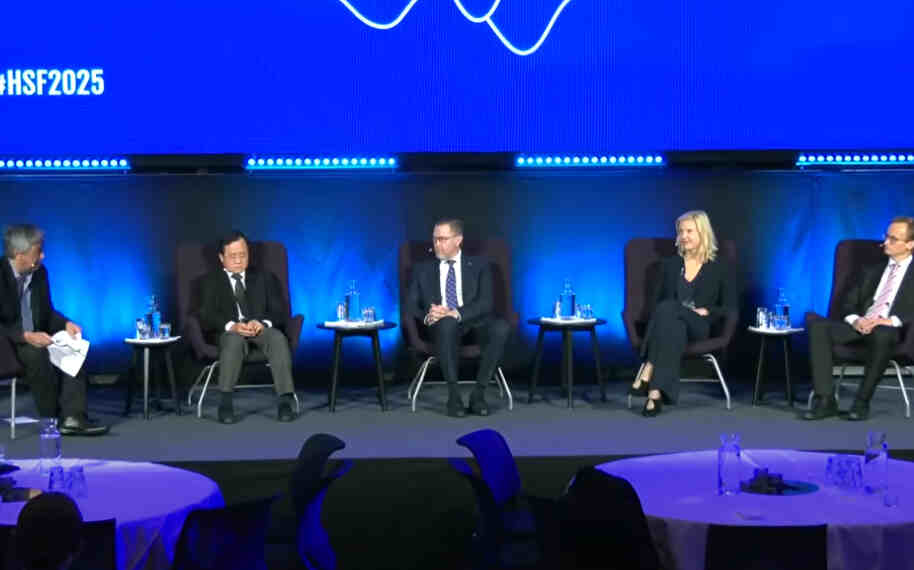
Read the full transcript of a panel discussion titled “Are We Living in a Chinese Century?” at Helsinki Security Forum 2025, September 22, 2025.
Introduction
BOBO LO: Good morning dear friends, my name is Bobo Lo and I have the great honor and pleasure to be moderating this session on the question, are we living in a Chinese century? Before we go into some of the questions, let me first introduce our distinguished panelists. To my immediate left is Steve Tsang, Director of the China Institute of the School of Oriental and African Studies, SOAS, at the University of London. To his left is Rory Medcalf, Head of the National Security College at the Australian National University in Canberra, Australia. To his left is Kristiina Helenius, CEO of Big Picture, which is a Washington-based consultancy. And finally, to her left is Mikael Mattlin, Professor here in Helsinki at the Finnish Institute of International Affairs.
The notion of a Chinese century is quite seductive, but it actually elicits more questions than answers, I think. It’s one of those eye-catching, maybe even extravagant monikers, along the lines of, I remember a book about 20 years ago, Martin Jacques, “When China Rules the World.” But really, the notion of a Chinese century can perhaps be distilled down to, it’s China’s domination or potential domination of the world in multiple dimensions, geopolitical, strategic, economic, normative.
Four Key Questions
And so with this in mind, I wanted to put to our panelists, and to you in the audience, four basic questions. Now the first is, does China even want a Chinese century? Is there a Xi Jinping view of the world? What does China want from global order? The second question is, let’s assume that China does want a China-dominated world. Then what are its chances of success? Is this really a feasible prospect? What do other countries and powers have to say about this?
The third question is the US angle. Now there is a real perception, a growing perception in the world, that Donald Trump is the president that China always wanted. He is the gift that keeps on giving. So is this true? What does this mean for the future of US-China relations going ahead?
And the fourth question is more at home, and it really fits in nicely to the overall theme of this conference, which is the hour of Europe. If today is indeed the hour of Europe, then what is Europe’s role in a so-called Chinese century? Where does it fit? Is it Europe doubling down on its traditional relationships within the West, or is it Europe pursuing maybe a more strategically autonomous, more multi-aligned foreign policy?
Xi Jinping’s Vision of China’s Global Role
BOBO LO: So Steve, I want to come to you first. You’ve got a book coming out next year on Xi Jinping’s global strategy. What is it?
STEVE TSANG: Well, thank you very much. Great to be here. When we say China and what China wants, we’re talking about 1.4 billion people. But I can assure you there is one single view, and that is the view of Xi Jinping, because now it is going to be state ideology. So when one says what China wants is what Xi Jinping wants.
Xi Jinping has also prescribed any version of history apart from his own. So his understanding of history is the single most important view of history in China. And in that view of history, the best of times in the world were times when China was the richest, most powerful, civilized, technologically advanced, organized, and effective power in the world. He thinks that he should deliver that for China and for the world, because it is good for everybody.
From his perspective, China’s interests and the world’s interests exist in concentric circles. The outer circle is the world. The circle inside is China. The circle inside China is the Communist Party. And inside the Communist Party is the core of the Communist Party, who is Xi Jinping. That’s how the world is being looked at.
And what China wants, therefore, is not to destroy the liberal international order and replace it with an alternative to compete with American global hegemony and indeed replace American global hegemony and inherit all that American global hegemony implies, because American global hegemony also implies American global obligations, at least until Donald Trump.
China has no intention of doing what America was required to do since the end of the Second World War. China intends to achieve its own preeminence globally on its own terms, reconstructing from Xi Jinping’s conceptualization of China’s history and that era’s multiple eras of Chinese global preeminence. And by his definition, in that kind of period, China was so magnificent, so benevolent, so advanced, that other countries simply look up to China, admire it, and embrace its leadership. And therefore, it will all be done peacefully.
Now I don’t think I have time to explain how he intends to do that, but at a later stage, I hope that we may have time to do so.
BOBO LO: Steve, there is a widespread perception in the West that China seeks to replace American global leadership, but I come back to the point that you made, that China remains reluctant to assume the burdens and responsibilities of global leadership. And I wonder whether there is a distinction to be made between China wanting to be preeminent or at least a global leader, among two or three, instead of the global leader. And I wondered also whether, what does the world look like in a Chinese century, in the Xi Jinping global strategy, global worldview? Is it a kind of a US-China bipolarity, a G2 or a G2 plus, or is it China being more preeminent than the United States?
STEVE TSANG: Well, preeminence is preeminent. Okay. So not equality with the United States. It means surpassing the United States, does it? If you are the one that can, and you are the only one that can deliver to the world what is best for the world, why would you want to deliver something that is second best, which is a bipolar world or a multipolar world?
Maybe the art of the possible, that maybe you say that Xi Jinping wants to do all this peacefully.
And this is why history has to be prescribed in China, because the reconstruction of historical Chinese preeminence is based on a myth and not based on reality. The historical reality was that when China was the greatest empire in the region that Chinese culture and civilization and technology and communication could reach, China behaved exactly the same way as the Roman Empires did or the British Empire did. When there was resistance, they crushed them. But in that reconstruction, there was no such thing.
The Democratization of International Relations
And in the Xi Jinping conceptualization, this is where the practical implementation side comes into it, and it’s quite clever. He calls it the democratization of international relations. And the logic goes like this: international order in this narrative is an international order by the West, of the West, and for the West. And the West is numerically small, absolute minority in terms of UN member states, and even smaller minority in terms of global population terms. And for that to dominate the global order isn’t democratic.
For it to be democratic, it has to be the global South, which is overwhelming majority of the world’s population and numbers of member states at the UN. And China, Xi Jinping say, is forever a member of the global South, and therefore is natural leader. So with China representing the global South, transforming from within how the United Nations and the international system works, making it democratic and therefore paying first due to the global South as represented by China, it is a better world.
BOBO LO: Okay, well that segues nicely into your area of expertise, which is looking at a much more broadly at the Indo-Pacific strategic environment, and indeed beyond that, the global strategic environment. There is an assumption in the West that, you know, it’s just the West that opposes China’s view of global order, that when, you know, to pick up on Steve’s theme, the democratization of international relations is an assumption that while the rest of the world is with China, it’s just the ordinary, the self-deluding, self-selecting West that opposes China. But you’ve got a different view, and I’d be really interested to learn more about that.
The Indo-Pacific’s Inherent Multipolarity
RORY MEDCALF: Look, thanks Bobo, and it’s great to be here, it’s great to have a session on China and the global significance of Chinese power at this conference as well. Look, my perspective as an analyst from Australia, where we’re in the, I guess, the two-ocean maritime region of the Indo-Pacific, that where I agree with Bobo, China is seeking to dominate, call it preeminence, call it something else, it is the region that has an inherent multipolarity already. And, you know, if you take the broad sweep of history of the Indo-Pacific, not the history, the official history as told in Beijing, but the broad view of history of the region, it’s never been dominated by a single power.
Multiple civilizations, the impact of India and Indian civilizations on Southeast Asia and East Asia is profound, the impact on Islam on the region, the Western influence and the many vibrant and sometimes confronting nationalisms in the Indo-Pacific, think India, think Indonesia, think Japan, think Korea, think Vietnam, means that this is a region that China is actually going to have difficulty dominating.
Now at the moment, in the last 12 months, the Trump effect has been, I think, to damage a lot of the coalition building that has actually quite successfully been going on for the past decade, but it’s a long way from over. And so I think the other interesting, really challenging question for us is to think about what does Chinese domination of the Indo-Pacific region look like?
And this is a region, of course, that is not simply a geographic curiosity. I mean, it’s central to the global economy, it’s central to the economic health of Europe, it’s central to really not only the future of economics, but also demographically and the strategic balance of power. What does a Chinese power play in this region look like? And what are the realistic limits that coalitions can set? And vitally, how much of this can we do with US leadership? But how much can we do this with a reduction of American leadership?
That’s the very confronting strategic situation facing Australia, Japan, some of our more liberal democratic partners in the region. But at a deeper level, I think it’s an unresolved question in South Asia, in Southeast Asia. At the moment, the balance is looking pretty bleak, pretty confronting for those of us who want to limit Chinese power and influence in the region.
But this is a very long game. And I think we’re talking about a Chinese century, question mark here. So I would be looking intergenerationally at the impact, look at China’s efforts to dominate the region, as China’s population shrinks, as the demographic problems begin to bite, as other nationalisms really, like or not find their points of traction. And of course, as the region deals with the potential for strategic shocks, such as an attack on Taiwan. So a lot to ponder there.
But I guess I want to offer a long view that pushes back against the idea of firstly, that China’s rise is inevitable, be that it’s benign. Let’s have a conversation.
Bobo Lo: Sure. But even in, so you painted two scenarios, in effect, where the region is kind of fairly fractured, almost mosaic-like, and naturally multipolar at the regional level, but where things are going to get messy. And then maybe another slightly more optimistic scenario, where there is sort of more coordination, more Western involvement, but US involvement, but also the sort of generally benign, constructive character.
But in both of those instances, we are, the notion of Chinese preeminence or dominance, to use a slightly more neutral word, is going to be challenged. So if I push you in either of those scenarios, let’s say, try and jump, not a century, but five years. How do you see the Chinese efforts or Xi Jinping’s efforts at Chinese leadership going in the region, and actually beyond?
Rory Medcalf: Well look, I think to be fair, things are going China’s way in the region at the moment. What does that mean? Influence over Southeast Asia, the way in which I think the Trump administration so far has quite successfully damaged a quarter of a century of effort to bring India into quasi-alignment with the United States, the mounting pressure on Taiwan, the projection of military force and the impression of military force.
But it’s not, as I said, it’s not inevitable. There’s constant areas of pushback in our own neighborhood, in Australia’s neighborhood, in the South Pacific. It’s very clear we’re in a constant struggle for influence with China. Our foreign minister has said as much, and we win some, we lose some, and that’s a constant game.
Interestingly, local populations, they clearly want options and alternatives for their development, for their infrastructure, for their health, for their education, for their security. Europe has actually just recently stepped up with a very large global gateway development assistance package for the South Pacific. I think many times the amount of funding that the United States has withdrawn.
So I’m not a stark pessimist about this, but for the next few years we are going to struggle to maintain the coalitions that we need, and this is going to require, I think, very clear messages of political will and strategic patience, not only from liberal democracies, and I’m cautious to use the term the West in an Indo-Pacific context, but by maintaining the broadest possible coalitions that we can in favor of stability and some kind of principled order.
So, for example, looking at a nation like Vietnam, not liberal democracy, but a country that recognizes that the international law of the sea, as it stands, is in the national interest and in regional interest. So, the next few years are about holding the line, and I think the big question there is, where is US policy going to go? US-China policy, US-Indo-Pacific policy, will China misstep? Sooner or later there’ll be missteps. Are we smart enough to take advantage of those missteps, and how do we do this without war?
BOBO LO: Okay, that’s very interesting. Christina, from your vantage point in Washington, I’m very interested to hear what you have to say about the US angle, because Donald Trump is sometimes accused of being a Russian asset. Now, I’m not going to suggest that he’s a Chinese asset, but for many people, including in Beijing, they could not wish for a better US president. He is the gift that keeps on giving.
So, how do you see that? Do you think that’s an unfair criticism? I mean, are we missing something in the Trump administration’s approach to China, and how do you see US-China relations evolving?
KRISTIINA HELENIUS: Well, thanks on my behalf as well for the invitation, for being here, and being on this very distinguished panel, and thanks, Bobo, for the question. During this weekend, I’ve been thinking about the year, because that’s when really the US-China relationship changed radically. Until then, they’d been enjoying this mutually beneficial wealth creation for 35 years and hyper-globalization. The US had been outsourcing everything. That was a dream come true, the economic miracle of world history, basically, what China was, from complete poverty to…
And then in 2017, all of a sudden in Washington, Washington woke up to the fact that Fed released a report that China is going to, at this rate, pass the US as the largest economy in the world. China was defined as the greatest security threat to the US, and it was defined as a systemic rival instead of a competitor or a nuisance. So everything changed in 2017, and after that, it was so clear. Both parties were totally aligned. Everybody in Washington was of the same opinion that China is the great threat, and that was the one thing that there was political agreement everywhere.
When I hosted delegations in Washington, it was interesting. Every report when they wrote, what they took away was China, China, China. Everybody was saying, can there just be one topic that’s dominating in Washington, D.C.?
This weekend, I’ve been thinking about a mantra that we learned in business school, “culture eats strategy for breakfast.” And what I’m seeing in Washington is the culture is changing. These six months, I think the strategy is still there, but it’s not really talked about or it’s not acted upon. It looks like the US is all of a sudden seeing that the adversary is domestic or is regional, and that is a huge change of culture.
But what I’m seeing from Beijing is that none of that has changed. They are more determined than ever. They are more open about their goals and their strategy. So I guess I’d like to start with this. There’s not much I could say about this, but I just think that the focus of the US has changed, and that is part of the gift that it keeps giving.
BOBO LO: Because I wonder whether at a strategic level, China still sees the United States as its long-term geopolitical rival. That is different. So strategic goals remain the same, but that the tactical approach can be tweaked because of who is sitting in the White House. In other words, there’s a real opportunity for China to accelerate its strategic gains through tactical means. And I just wonder what your view of that was, or whether you thought there was a way back for the White House.
Once the White House feels confident, once Donald Trump feels confident that he’s sorted out the domestic situation and he will be in power for the foreseeable future, then he may then turn his attention to international issues, not necessarily Europe, but to China, and see in China the number one strategic rivalry to the United States, and it’s good for him as well as for the United States to push back against that.
Do you see him sort of sobering up, if you like?
I don’t see him being interested in that so much. I think he’s building a ballroom to the White House. That’s what he’s excited about. But I think the two parties that were best prepared for Trump year nine, I think it is right now, who used best the four years between the Trump one and two, were China and then Heritage Foundation or Project 2025. So everybody else is kind of being caught off guard about what’s happening. But those two were ready. China was ready for Trump.
Okay. You wanted to come back on something?
Can I just come in and add a small footnote to what Kristiina has said?
Sure.
In competition, if we are looking at it from the Chinese perspective, in contrast to the Washington perspective, is that China is taking the offensive, but it is engaging with the global South, seizing the narrative that we are the friends of the global South, and the United States under the Trump administration is the exact opposite. Absolutely. We are trying very hard to help you in the global South. Uncle Trump has just abolished USAID, which resulted in some of your citizens dying in your own country because the aid that used to save them have been withdrawn. Come back us. Fight your fight. And there’s nothing fighting back from Trump. And it’s very, very difficult for that fight back to start when Trump is still in the White House. Post-Trump, we don’t know.
I totally agree. And actually I was at a wedding last week, and for three days I had a chance to discuss with people from Southeast Asia, from the Middle East, and everybody was just saying that we know who we follow, who we admire, and who is on our side right now. And so that was very, very clear, just to pick up on your point.
We’ll come back to future scenarios, because one of the questions I want to ask later is what happens under a J.D. Vance, a different kind of Republican. But anyway, let’s… Mikael, future of Europe. And it is because a lot of people see a kind of Sino-American world. Not exactly a bipolar governance, but certainly a bipolar confrontation, where everything is in binarisms. And I wondered where Europe fitted in with this, and what European policy makers should do in order not just to be a kind of footnote in this emerging bipolar world that some are talking about.
Europe’s Strategic Challenges
Sure. Well, first of all, I’m really glad that we’re having this conversation to begin with, because in the last couple of years, especially as part of Europe, we’ve been quite much focused, of course, obviously on the Ukraine war, and China has been seen very much through the prism of that, and China-Russia relations and so on. My fear, or my concern at least, has been that we’re missing kind of the bigger pictures, the larger structural realignments going on, in the background. Political realignments, economic, what is happening in science and technology, global opinion, and so on. And that we are woefully ill-prepared, in Europe more broadly, but here as well, to confront these kinds of questions, and the division that Steve has done very well, so presented here, how China sees it, and how Xi Jinping sees the world.
So, two days ago, one of my colleagues talked about how, if you don’t have the same perceptions, you don’t think it’s a very acute thing, certainly not for yourself, it’s really difficult to mobilize, sort of, and your population to do drastic measures. And he was talking about Russia, of course, in that case, but with China it’s even more difficult, I would say. We’re a bit like the proverbial frog, you know, boiling in the water. And I think a lot of people now, when they talk about China and Europe, still think that we’re living in 2010, it seems, at least from the suggestions they’re making.
Just to give you two figures to put things in perspective, if you look at global R&D expenditure, China is currently approaching 30% of global R&D expenditure, whereas Europe is around 20%. We often hear that China can’t afford to lose Western markets, the U.S.
market and the EU, fair enough. So what is the share of that, if you look at all of China’s production, how much of the value added is actually dependent on end demand in the U.S. and the EU? I guess a lot of people would say maybe 10, 20-something percent. I checked the figures, it’s 1% for the U.S. and 2% for the EU. So are they willing to afford it or able to afford it in a Taiwan crisis, for example? I’m pretty sure that it would hurt, of course. It’s not insignificant that they would be ready for this.
So these are the broad issues. We need to first have the awareness that we have an issue here and that our competitiveness is eroding, our industrial base is eroding, we’re not putting enough effort or enough into the core basis, which is really the basic education, basic research and R&D and so on, and we’re losing out.
BOBO LO: You don’t think that realization is beginning to dawn here? Because I get the impression sometimes I read or listen to European voices on China that, in a way, sometimes the problem is the opposite. China is this all-powerful, monolith juggernaut that’s running over everything in its way, so we almost are mythologizing China too much. So although China is spending much more on R&D than we are, do you not think there’s also a danger of overestimating as well as underestimating China, that we really need to kind of right-size Chinese goals and Chinese ambitions and Chinese capabilities. So I wonder whether that awareness is already with us, but now it’s one thing to be aware of, but what are you going to do about it?
MIKAEL MATTLIN: Yeah, it’s a bit paradoxical. We are, on one level, you see this debate, yes, and I agree with you that we see a lot of this debate, but we’re good in Europe in making plans and visions and so on. Who remembers the Lisbon strategy, where we were supposed to be the most competitive economy and put 3% of GDP into R&D, we’re at 2.2, 2.3 now. So China basically implemented our vision, right, or is implementing, so they were under 1% of GDP, or 0.8 at the time, something like that, and now they’re close to 3%.
And the same goes with de-risking, we’ve been talking for five years about de-risking from China. Check the figures, we’re importing more, slightly more, I think, down into 2019. And I mean, if you look at critical areas, critical minerals and so on, I don’t see a sense of, that sense of urgency in terms of implementation, maybe, maybe on the level of thinking and discussion, yes.
European Independence from U.S. Strategy
BOBO LO: Can I flip it the other way and ask whether you think that Europe should not hitch its wagon so closely to the United States when engaging with China, that Europe should be more independent because it can no longer really assume that American and European interests or even values are the same?
MIKAEL MATTLIN: I think this is really one of the big factors here. I mean, a couple of years, two, three years ago, it seemed that we had sorted things out. I mean, everything looked a bit more clear, and we had, you know, the good guys and the bad guys were on the good side. And we were in close collaboration with the US, and as you heard, I mean, this was a talk in the town, it was a bipartisan consensus on China in Washington. So we talked here as well about, you know, the rules-based order and like-minded partners and blah, blah, blah. And we don’t hear much about that right now.
So this is a major, major challenge for us if the second Trump administration is not your first Trump administration, it’s also not the Biden administration. And I’m also a bit concerned that the priorities are quite different with this Trump administration. So that leaves us really hanging in the air. So yes, we have a group of maybe like-minded partners, but the biggest, most important, by far most important like-minded partner is a bit of a question mark at the moment is China.
I would not personally be very surprised, actually, if there is a willingness on the part of President Trump, actually, to do some deals with Xi Jinping. Sure. Sure. Sure.
Audience Questions
BOBO LO: I’m going to open it out to questions and interventions from the floor. I would just ask you to introduce yourself and make sure that your intervention or question is one part. So just over there.
AUDIENCE QUESTION: Thank you very much. My name is Charles Powell. I’m the director of the Alcana Royal Institute in Madrid, Spain.
I’d like to ask, Michael, about the way in which the EU is dealing with China conceptually, right? In 2019, we described China as a partner, for example, in the struggle against climate change, as a competitor in commercial affairs, and as a strategic rival. Now, if I went to my shrink and said, listen, there’s someone in my life who is a partner, a competitor, and a strategic rival, the shrink would probably say, please take the couch, right? Do we need conceptual sharpening, do you think? And how divided are we on China deep down? Thank you.
MIKAEL MATTLIN: Yeah. Thank you. Great question. I’ve said for many, many years, and I still say it, that the EU doesn’t have a coherent and strong China policy. It used to be, if you want to put it very bluntly, that it was the lowest common denominator kind of policy, and ultimately kind of determined by almost, I would go to say that by individual large German companies, if you really go down all the way there, because it was very much Germany having a big influence, obviously, because Germany is much more dealing economically with China than most other. Behind that, you had sort of the industry and those interests and so on.
So we’re a bit at a loss, I mean, and this has been, the way you described it is really a compromise of compromises, because we don’t have a unified view on China, and you see it even now. We still don’t have that. I mean, look at the most recent Pew survey on opinions on the US and China. You have a number of countries in Europe where views on China are more favorable than views on the US right now. So how do you unify that? I don’t know how to do that, frankly.
BOBO LO: But I wondered whether in that case, it’s a matter of form is temporary, class is permanent. And so what will happen is, when Trump goes, whether it’s a future Republican or Democratic president, those views can easily flip, they’re quite soft figures, and it’s just a Trump factor for the moment, but they’re therefore quite short lived.
MIKAEL MATTLIN: I think it may be more fundamental, actually, because if you look at, again, going back to those major realignments that we had, the underlying realignments, on the number of indicators, China is massively bigger already than the US. I mean, the traditional kind of indicators of a great power, you know, on the production of steel and ships and whatever, I think there’s a realization in Washington that they are not ready to go tête-à-tête over Taiwan, for example, on China. That’s interesting.
BOBO LO: Steve, you wanted to come in at this point.
The Case for Strategic Coherence Over Policy Consistency
STEVE TSANG: I wanted to come in because I wanted to say something unpopular, which is that the inherently incoherent EU policy towards China that Charles Powell so elegantly presented, is not something that worries me all that much. Because governments have incoherent or inconsistent policies a lot of the time. The problem there, which I think is underlying your questions, is the lack of a longer term strategy for the EU that defines what does the EU want in its relationship with China in 10, 20, 25 years’ time.
Because if we have a coherent, clear China strategy in the European Union and the UK for that matter, then the application of the three different elements can be adjusted to deliver the strategic goals that is most beneficial to us. And that incoherence becomes something being very smart. But the lack of that strategic guidance means that we constantly get swayed between the three different conflicting demands. And China can take advantage of that. And that is where we have the problem.
Australia’s Experience Managing Cognitive Dissonance
BOBO LO: Rory, just in answering that question, can you bring in Australia’s angle? Because Australia is quite an interesting case where it is China’s main economic partner but the US relationship is at the core of Australian strategic thinking. And that’s true of a lot of other countries in the Indo-Pacific. So talking about strategic coherence, how does it apply to your country?
RORY MEDCALF: I think Steve’s point is not as unpopular as he thinks. I think cognitive dissonance is pretty much at the core of Australian strategic policy in our region and it kind of has to be. But I think there is a fair point there about having a much clearer framework and a clearer long term strategy. That’s a problem we’re grappling with. The current Australian government has this very simple mantra to relay their position with China. We cooperate where we can, we differ or disagree where we must and we always act in our national interest. And it’s the third point that undergirds the choices.
I think just to cut it short, the journey Australia has been on over the last decade, and I agree 2017, for us it was probably 2016 that we had our reality check on China, is one where we did go through a period of really quite intense diplomatic confrontation with China, coercive economic coercion from China, very strong pushback in Australia on very clear instances of foreign political interference in Australian affairs by China, interference in our very large Chinese diaspora, intimidation of parts of diaspora, and of course China’s strategic activities in the region.
In the last two or three years we’ve reached a kind of probably temporary settling point on that, a sort of a stabilization agenda that the government pursues where we do try to maintain the trade relationship. And it’s really important to distinguish that it’s a trade relationship, not an investment relationship. You know, in fact Belgium and the Netherlands are bigger investors in Australia than China is. So in that sense, you know, China is our largest trading partner by far and it’s concentrated in certain areas, you know, iron ore for example, but that is about transaction, it’s not about trust.
And so I think the stabilization point we’re trying to maintain is one where, yes, we are looking to our security. There are new uncertainties about the United States in that regard, and that’s one of the reasons why it’s really fascinating as an Australian to study Finland and the Nordic countries as to what you’re all doing for your own security. We could do a lot more for ours. But at the same time, we know that we can’t afford to put all our economic future in the China basket. Apart from anything else, if there is a strategic shock in the region, Taiwan or whatever else it may be, that’s going to have a massive impact on the regional economy and our own economic relations with China.
So there’s still a diversification push in the long run. It’s just a little bit hard to translate that to individual private sector.
MODERATOR: Kristiina, did you want to come in at this point or shall I bring you in later?
KRISTIINA HELENIUS: I just had one thought on how I think the US is kind of acting also very reactively at the moment. There have been, for example, two big mining bills this spring, and those are all reactions to the, for example, that China is twisting the US arm on rare earth minerals and things like that. So kind of the reactiveness also shows how it’s not, the US really doesn’t have its act together right now.
MODERATOR: That’s really interesting. Mark, can I, just the far end over there.
Audience Questions on Russia and the Global South
AUDIENCE QUESTION: Mark Katz, George Mason University. It was reported in the press recently that the Chinese foreign minister told European counterparts that China cannot afford for Russia to lose in Ukraine. But my question is, can China afford for Russia to win in Ukraine? Because sort of the stronger that Russia is in Europe, it seems to me that this impinges on a lot of Chinese interests and hopes to sort of pull Europe away from the United States. And so I guess my question is, are there, the better Russia does, is this going to mean a contention between Russia and China? Or is China content to allow Russia to dominate Europe and play second fiddle there? Or is it in fact just that they want the war to continue to distract the US, the West and Russia with each other and leave China alone? Thank you.
MODERATOR: Hold that thought. Sir, over here.
AUDIENCE QUESTION: Thank you for a very interesting panel. David Karpela from the Office of the European Union Special Representative to the UN. And I’d like to, of course, working on the Global South, ask about the Global South. How do you see Chinese success in courting the Global South behind this narrative to mobilize them in support of the Chinese ambition to be this preeminent player? And of course historically the Global Gateway was spoken about, the European Union has played as a major actor investing in aid investments in the Global South. Do you see, or how much do you see the EU as an alternative or a competitor to the Chinese ambitions in the Global South in this global geopolitical game that we’re all trying to find allies moving forward? Thank you.
MODERATOR: Who wants to, let’s start off with Global South. Who wants to take on the Global South? I know, Rory, you were talking to me yesterday about the European Gateway Programme and how that was starting to tick off. And Mikael, I’d like to bring you in and Kristiina as well on this.
But Steve, you wanted to come in on this point.
STEVE TSANG: Yeah, yeah. On the Global South thing, I think we have to bear in mind two things. One is that the Chinese approach to the Global South is very, very smart. A majority of countries in the Global South are autocracies and the Chinese offers to the leaders of those countries is quite simply that every country and it’s, I mean, the leaders of every country have the right to choose the political systems they like for their country and no other country or groupings of countries have a right to tell others how to run their own affairs. So it’s a charter of protection for autocracies without interference into how you manage your relationship with your citizens, assisted by China development programmes through the BRI that provide infrastructures and other things that you need that you otherwise would not have in return for you to support us for our positions on Taiwan and at the United Nations.
And in contrast, we also do not have a legacy of colonialism in any part of the Global South, not like the Europeans or the Americans and we have not been telling you what to do and we have not been hypocritical in our ACE programme that they tell you, you citizens of the world have the right to enjoy the kinds of rights that we Western democracies enjoy and yet when you want to come to our country, no, no, no, thank you very much illegal immigrants, out you go. We welcome you. Well, none of you want to come to us, that’s a different matter.
BOBO LO: Steve, I wonder whether China’s approach to the Global South is quite as successful as you make it out to be, because I wonder whether there are two key areas of vulnerability. Number one, China is the largest debt holder and it’s got a reputation for driving a really hard bargain on debt relief and with so many Global South countries being indebted, that is a major source of vulnerability. The second source of vulnerability is climate change. China can dress up all it wants, but its emissions are twice that of the United States. It also hides behind the sort of moniker of developing country, which means that it doesn’t really contribute significantly to climate financing. Now so far it’s been able to get away with this, but I wonder whether that is actually to, you know, excuse the pun, a sustainable strategy in the medium term.
STEVE TSANG: Well, in the long term it’s going to be a much more difficult issue. In the short to medium term it’s not necessarily a problem, because we already have seen bail-and-roll initiatives, early loans coming to maturity and the overwhelming majority of them are being restructured by the Chinese and therefore they have pushed the problems backward. The only case of China taking over is Hambantota in Sri Lanka and you have no other examples from that. So that’s not causing that much of a backlash yet.
On the climate argument, the Chinese are also making a very clever argument, which is that the world was first and foremost polluted by the rich capitalist Western democracies. They have done it, they’re asking you to pay the price. We are saying you have a right to development and we are exporting, if you like, traditional power plants, or if you prefer, green power plants, solar, wind. Who’s the leader in the world? We provide that for you. You choose. We are not hypocritical. They tell you that you can’t have it unless you have the right technology, which you can’t afford. We give you the choice.
BOBO LO: Yeah, fair point. Who else?
RORY MEDCALF: That’s a very persuasive rendering of the line and I think it is part of the challenge. I think we do have to be very careful about the time frame because I think, again, if we have the parochialism of the here and now, there’s no doubt that China is on a roll in terms of influence. There’s no doubt. I think your anecdotal evidence of the wedding is pretty compelling. There’s no doubt that there are populations in many parts of the world, and I’m a bit careful about generalising so much of the world as the Global South, that are dismayed by what they’re seeing from the United States.
It doesn’t mean, though, that elites or young generations necessarily trust China. And so I think there are interesting data points from my region, from Southeast Asia and the Pacific. If you look at the polling of Southeast Asian elites that’s conducted by very reputable think-tank individuals in Singapore this year, even with the Trump effect, there is still intense mistrust of China.
There’s still, interestingly, an institutional respect for the EU and Europe, by the way, which goes against some of those perceptions of colonialism and colonial history that the Chinese like to play to. So I would still argue the game is not lost. I think a really important reality check for all of us is how do we frame our value offering, the value proposition, to the global south? And I think that this is not in terms of liberal democracy, but nor is it in pure interest-based terms. I think if you look at the concept of accountable government, if you look at why are young people violently protesting in the streets of Jakarta or Kathmandu or elsewhere, they’re protesting for something that ultimately our societies can get right, can offer. So I think we have to play a very long game in a very different value proposition to a simplistic liberal democracy versus authoritarian space. But our experience in the Pacific so far is that it’s not over.
BOBO LO: Yeah. Kristiina, did you want to come in at this point?
KRISTIINA HELENIUS: If I wear the US hat in this discussion, I might just, a quick comment to say that we’ve just seen how the US is treating India or Vietnam or Indonesia.
BOBO LO: Yeah, that’s been very good. I mean, if it’s a choice, at least the US is alienating them for a moment. But I would add that India does not trust China and that’s not going to change.
KRISTIINA HELENIUS: Yeah, that’s clear, yeah.
China-Russia Relations and European Strategic Autonomy
On the other question on Russia, China, I think, and I’ve said to all of you that, I don’t think it was kind of set in stone that we would end up kind of where we are now after the Ukrainian invasion. I think China, from Beijing’s perspective, it’s a very complex calculation that they had initially. I don’t think they were entirely comfortable with what happened. They were maybe not completely aware of what is going to happen. They were considering probably the relationship to the EU, the economic side of it, how does this play out with the US, with Taiwan, the traditional fears in the Cold War era related to Soviet Union then, and having that backyard secured. The raw materials in the event of a conflict with Taiwan, there’s a lot of different, also including diplomatic rhetoric. So, and we have seen adjustments now. They have grown closer throughout the war now. But I don’t think it’s been entirely set in stone.
And what I’m trying to say here is that now with the second Trump administration, there was a tiny window of light opening. We saw movements both on the EU side and Brussels side and then Beijing. And basically, Beijing was saying, look, we told you so. This is exactly what we said. This is what the US is going to do. And of course, China has been in favor of European strategic autonomy because it puts a daylight between Europe and the US. The fact that now they’re going closer together, seemingly, China and Russia, I think it’s a reflection of the Europeans were not able. I understand very well we’re not able to do that, but there was some maybe a misperception also on the Chinese side of that the EU has to move closer now to China after what we saw in the spring with the Trump administration. That’s pretty cool, yeah.
China’s Strategic Interests in the Ukraine War
MIKAEL MATTLIN: Just quickly on the China-Russia side of things, just from my own perspective, I don’t agree with people who say that China has an interest in the war continuing. I think China feels that the war has cost it in many respects, not least reputational. I think certainly China doesn’t want Russia to lose the war, that’s evident, but it also doesn’t want Russia to win the war too convincingly because the problem with Russia winning too convincingly or expanding its appetite is that Russia then becomes less controllable, less influenceable and more reckless and brings China into conflicts that it would much rather avoid.
Just on China’s international diplomacy, its so-called mediation diplomacy, the audience for that is not Ukraine, Russia, the United States or Europe, it is the global South. It’s about reputation building, it’s about accentuating the contrast between a delinquent Donald Trump in the White House and a sane, calm, balanced Chinese leader in Zhongnanhai and I think that’s an important distinction that the Chinese promote.
BOBO LO: Now, a couple of last questions. Sir?
UNIDENTIFIED SPEAKER: Yeah.
UNIDENTIFIED SPEAKER: Yes, Takashi Okada, Ambassador of Japan to Finland.
There are hotspots in the Pacific starting from East China Sea, South China Sea, Taiwan Strait and we are faced with a Chinese power play which is not often very peaceful and for the coming years, I totally agree with Professor Medcalf that we have to hold the line to prevent those conflicts and skirmishes from developing into a full-scale war but what would happen after that? My question is, will China with its domestic problems develop into something different or what happens after that Xi Jinping? But Xi Jinping is very young, so it will take many years. Thank you.
BOBO LO: I’ll take two more questions on that table just quickly.
AUDIENCE QUESTION: Thank you, Min Olander. I’m an Associate Fellow at Chatham House. I have a question for you. Like the Chinese vision, where China wants to see Europe, because we’ve talked a little bit about the lack of strategy in Europe but like in this, what you, Steve, outlined how Xi Jinping sees the world, where does he see Europe here? What does he want from Europe in the long run? We’re sometimes a little bit confused about like the Chinese involvement in some incidents of, let’s say, hybrid warfare and like it’s a little bit unclear what the Chinese goals are in that sense. Thank you.
BOBO LO: Can you pass the mic just behind you there across the table, yeah.
AUDIENCE QUESTION: Good morning. My name’s Mark Kozad from RAND. I want to go back to the panel’s primary question which is are we living in a Chinese century and noting that we have 75 more years of the century left. I’ve heard a lot of more of the positive aspects of the balance sheet and then also some of the dysfunction and missteps on the part of the West. I did hear a brief mention of demographics which I think over the next 75 years will have a profound impact on that question but I would be very interested in getting your perspectives on some of the more problematic elements of Chinese development, Chinese internal politics, party control that may have an impact on the way we see that question.
BOBO LO: I think that’s an absolutely crucial point. We have a natural tendency to overemphasize China’s strengths and underestimate its weaknesses. So just in this final round, I’m just wondering where you see China in, let’s not talk about century, let’s talk about even at the end of the decade. So let’s go in reverse order. Mikael.
China’s Weaknesses and Strengths Reassessed
MIKAEL MATTLIN: Yeah, if I had a crystal ball. I mean, I’ve been more, as you were alluding to, maybe also on the side of those who said, we focused very much on China’s weaknesses all the time. I mean, when I started out in the 90s, it was all about these weaknesses relating, weakness in the political system. Was it going to collapse like the Soviet Union? The financial system was supposed to collapse. I remember stories about that and the water was running out in Beijing and whatnot. Arable land was polluted. So I’m more on the side of things where we have been talking so much about this and the coming collapse of China, which is supposed to come every other year and so on, that we’re missing the big picture, which is that China also has the tremendous capacity, the system has had a tremendous capacity of dealing with a lot of these problems.
Having said that, the demographics definitely look very concerning. Of course, it’s still a question mark long-term how this political system is going to evolve. We don’t know about that. There are a number of questions, but so far, I think I would still say that we have been too much focused on those weaknesses and missing that China has completely changed in the sense, at least, of infrastructure and its capacity in terms of producing knowledge-intensive products and stuff like that. It’s a different China, in that sense, from what it was. No, that’s pretty interesting.
BOBO LO: Kristiina.
The Question of Succession
KRISTIINA HELENIUS: Yes, in the US, there’s a strong research track that says that China has already peaked, and then there’s the other side. But I think decisive is who will succeed Trump, who will succeed Xi, and who will succeed Putin. So I think that’s very decisive on what we are going to see. And another side will—
BOBO LO: So just butting in on that. J.D. Vance succeeds Donald Trump in the White House. What happens?
KRISTIINA HELENIUS: Then the two others will, you know, how the dynamics is going to play out.
Long-Term Structural Challenges
KRISTIINA HELENIUS: I tend to go back to, with my husband, we lived in Korea in 1992 and we were there when it turned from a dictatorship or a military dictatorship into a democracy and see how well it’s doing today. So I mean things can happen.
RORY MEDCALF: Look, I’ll talk a little bit long-term and structurally and I think part of the problem is that we don’t have a clear picture inside China now. I think, you know, if you look at the restrictions on the freedom of foreign journalists in China, it’s a starkly different story to 10, 15, 20 years ago. It’s actually difficult even to get sort of the human level picture that we need to form these assessments.
I think that in the near term, in the medium term, you know, we have to take China’s power and capacity very seriously. I agree entirely about that, but we also just have to be careful about not falling in the trap of having more respect for the CCP than parts of the Chinese population do themselves. I mean, it’s still a fact that those that can afford to are moving money offshore, finding boltholes in Western countries, even in Japan these days. So there are sort of subterranean forces that we just have to keep somehow an intelligence picture on and play a very long game.
Xi Jinping’s Leadership and China’s Future
BOBO LO: Wow, that’s great. Steve, take it away.
STEVE TSANG: On the issue of where China will be in the future, it’s all about time frame, as you quite rightly say. The short-term strength that China has, which is the incredibly strong leadership of Xi Jinping, is also a basic factor that is going to undermine the longer-term Chinese capacities to win the century.
We are already seeing, I mean, in addition to all the problems about the demographics and China being caught in the middle-income trap and all that, and part of the reason that China is almost certainly going to be trapped in the middle-income trap is because Xi Jinping absolutely denies that the middle-income trap can apply to China. Therefore, Chinese technocrats cannot devise policies to tackle the issues that China will have to confront to overcome the middle-income trap.
And we are also seeing that the change in the European Union’s approach to China with the multipronged policy was a result of the unleashing of wolf-warrior diplomats by Xi Jinping. That 2017, that Kristiina highlighted about the change in the US, was the year when Xi Jinping consolidated power and changed collective leadership in China into Xi Jinping’s strongman rule and causing all those problems.
The man does not expect to die anytime soon. So we are expecting him to continue to run China for as long as he lives, and that’s going to be a huge threat to China’s capacity to deliver the Chinese century. But that’s not to say it is not important for the European Union and for the United States to get back onto the right track so that we are doing the right things to counter what Xi Jinping’s strategy is anyway. Just in the off chance that he actually gets more leeway out of it and more success out of it, we can’t wait for China to get into difficulty and trouble in order that we do not get ourselves into trouble.
Conclusion
BOBO LO: On that insightful balance note, I think we should call an end to the session. We’ve run over a bit, and I apologise, that’s my fault, but I hope you will agree with me that our panellists have been absolutely wonderful and have given us some tremendous insights on China and its place in the world. Will you join me in thanking them for their great contributions?
Related Posts
- Transcript: Why Adaptability Beats Planning in an Unpredictable World? – Mr. Sanjeev Sanyal
- Transcript of Dr. Prathosh AP Lecture: AI Is Making Intelligence Cheap
- Transcript: Stanford’s Chad Jones on The Future of Jobs in an AI World
- Jared Isaacman: A New Era for NASA and American Space Exploration (Transcript)
- Transcript of Bill Gurley: Searching for Feynman at All-In Summit 2026