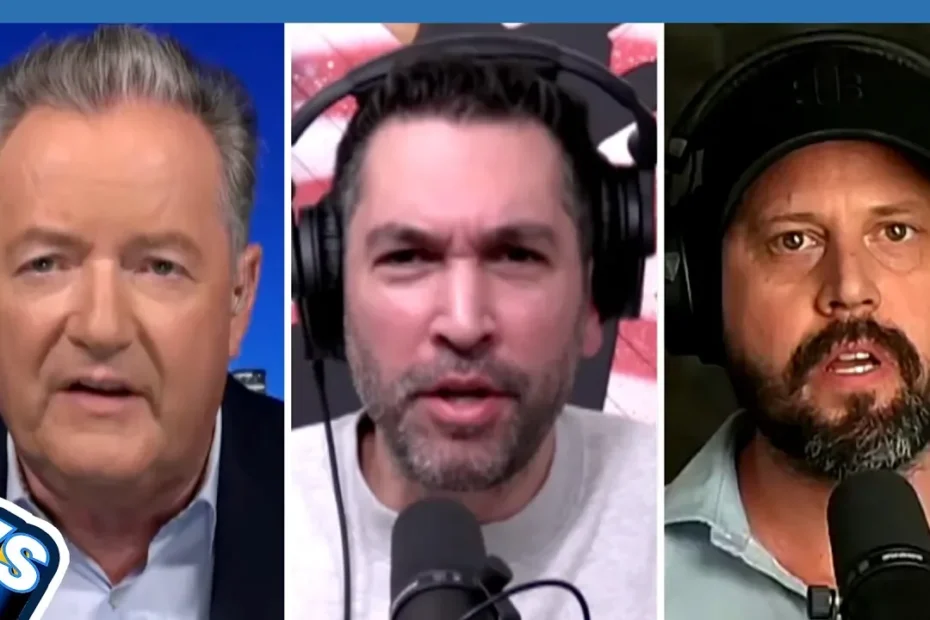
Read the full transcript of a debate between Dave Smith vs Seth Dillon on Piers Morgan Uncensored on “Nick Fuentes, Charlie Kirk, Candace Owens & More”, October 31, 2025.
The Challenge of Truth in the Digital Age
PIERS MORGAN:
Benjamin Netanyahu’s decision to order powerful strikes on Gaza has again thrown the ceasefire into doubt. This flare up may pass, but the underlying issues remain the same. Anger on one side that Hamas is still at large, anger on the other that Israel can effectively switch the missiles on or off currently with the backing of the United States. It all feels depressingly familiar.
And the same can be said of the debates currently rolling digital culture. From the rise of Mamdani to the never-ending frenzy over Charlie Kirk’s allegiances and the sudden prevalence of Nick Fuentes, there is a very consistent theme.
Joining me to debate all this are two not at all depressingly familiar contributors. First of all, Dave Smith, the host of Part of the Problem with Dave Smith, and Seth Dillon, CEO of the Babylon Bee. Welcome to both of you.
Let me start by saying, Dave Smith, there is a lot of misinformation, deliberate disinformation, conspiracy theories, analysis of conspiracy theories, flying around cyberspace in all guises. It’s becoming, before we get into the weeds of any of this stuff, it is becoming increasingly difficult for somebody who’s not absolutely at top speed in dissecting and disseminating all this to work out what is true and what isn’t.
DAVE SMITH:
Yeah, I think that that is true, but I also think that it’s probably easier than it’s been in the past. And the reason we’re in this moment now is partially the technological advances and just the fact that lots of people can have shows and we have social media and they can communicate in that way.
But also that the establishment, the corporate media and the government have been caught lying about every major crisis of the 21st century and you just can’t. There’s only so many you can go through. And we can all in our minds are rattling them off right now. If you go to WMDs or you go to, you know, Covid, I mean, my God, they locked the entire country down. Joe Biden wasn’t senile.
And so, you know, the thing that’s interesting is that there are actually tons of conspiracy theories that just don’t get called that. What was Russiagate, Piers? Was that not a conspiracy theory? What was the idea that Iraq, Iran and North Korea were all involved in 9/11? The only thing those three countries had in common was that they had absolutely nothing to do with Al Qaeda.
And so, you know, there have been so many conspiracy theories that have been pushed from the top that now I think we are in a place where people just don’t believe anything. And so on all sides, they’re more quick to jump onto conspiracies.
PIERS MORGAN:
But that’s the point, isn’t it, Seth Dillon, is that people are finding it increasingly hard to know what to believe. I don’t disagree with Dave’s assessment that social media in particular, and look, people like us who do our own thing now that you can hold everything to proper account, you can debate this freely, you can reveal where corporate and government and media may, mainstream media narratives have been clearly, demonstrably wrong. That is all true.
But it does feel like, particularly with AI, with deep fakes and all this kind of thing in sophisticated hands, the ability to completely con people now in a very convincing way is becoming much easier and more dangerous.
The Role of Free Speech in Combating Misinformation
SETH DILLON:
Yeah, well, I agree with what both you just said and what Dave said, that, you know, obviously there’s been conspiracy theories that came true. There’s been things that were conspiracy theories that were presented as truth. There’s a lot of distrust and a lot of distrust is well founded. It’s rooted in something. It’s rooted in something real.
One of the reasons I’ve been such a strong proponent of free speech is so that we actually have the freedom to push back on false narratives. Things that we shouldn’t believe, things that aren’t true, things that aren’t well founded. We need the freedom to actually hash these things out and have a conversation, have a debate about them. I think debate is the best way to get to the truth.
I do think, though, which, you know, this may be a point where me and Dave disagree, maybe not, is that, you know, a lot of people are exploiting the distrust to engage in a sort of kind of radical conspiracism, where, you know, it’s not really. Some of the conspiracies are more reasonable than others.
Some are just attempts to try to find any dots that you can find that might possibly be connected in some way in order to vilify somebody that you don’t like and reach some kind of predetermined conclusion. We’re using a reasoning method that’s kind of like the inverse of Occam’s razor, where instead of like the simplest, most straightforward explanation is probably the best we’re going for. You know, whatever is the most convoluted and hardest to falsify and that cast your enemies in the worst possible light, that’s what we’re going with, is the truth.
I think that’s a very cynical play. I think it’s very dishonest. And so there is a sense in which the conspiratorial stuff, which has some legitimacy to it, in some cases has been overdone and exploited.
The Alex Jones Case and Platform Accountability
PIERS MORGAN:
Yeah, I don’t disagree with that at all. A good example actually is I had a bit of a falling out with Elon Musk a year or so ago. But Alex Jones and his initial position about Jones was his deliberate defamation of the Sandy Hook families and the subsequent award of a billion dollars against him.
And I agreed. And then he reversed that decision and let Alex Jones come back. And, you know, whatever people think about free speech, to me, if you’ve got a billion dollar defamation, Dave Smith, against you for doing it the way that he did to those families where they proved in the court case that he made hundreds of millions of dollars almost every time he went on a tear about this being staged and set up and they were actors and no kids got killed and so on, you know, I just think there have to be some limits, don’t they? I mean, otherwise the First Amendment, none of it means anything.
DAVE SMITH:
Well, I mean, you know, to your point about Elon Musk. Yeah. He definitely said that and then he went back on it and he never exactly made it clear why he had changed his mind from that. He also said at one point, at the beginning that everybody would be reinstated, nobody would be banned from Twitter except for people violating the law. But yet there still were several people who were banned who weren’t let back on, or people who were shadow banned. So there has been a little bit of a convoluted message there.
That being said, there’s really no question that the censorship of the previous Twitter regime was much, much worse than this one. And so on net, I think we’ve had more protection of free speech. So I’m not really making it my thing to criticize him for that, but it’s a fair enough point.
With the Alex Jones thing, I think he was very wrong for what he did with Sandy Hook. I think he’s acknowledged and apologized for that. I also do think that waving that settlement around isn’t quite as good evidence as you might think, because that was kind of crazy and unprecedented. And it did certainly seem like the Sandy Hook thing was used to take Alex Jones out.
And what concerned me a lot more than, look, there are wild conspiracy theories. I more or less agree with Seth there, and I certainly agree with his spirit. That debate is the antidote to this. I mean, this is what I feel an obligation. You know, I go on a lot of big shows and I say, I think it’s like this, it’s not like this. And I feel an obligation that I’ve got to back that up then. And so I do a lot of debates on all the topics that I talk about. So I agree with that.
But just talking about the Alex Jones situation, the reason why I don’t think he should be kicked off these platforms, or I should say this, I’m much less concerned about a guy spouting conspiracy theories than I am about iTunes, YouTube, Facebook, Twitter, all these organizations all colluding together to essentially unperson somebody, which is what they did with Alex Jones.
And I don’t buy that it was really over the Sandy Hook thing. It was years later. They just kind of use that because it was the best example. That would kind of be indefensible to most people, which it is. But that actually concerns me a lot more. The idea of, like these few companies who essentially control the public square and have been caught being in bed with the federal government, that they can decide who has a voice and who doesn’t. I think that is a real threat to a free, open society.
PIERS MORGAN:
Well, the biggest example of that, Seth, was of course, Donald Trump, who was banned by almost every social media platform. But most of those platforms continued to allow accounts by the Ayatollah of Iran, Vladimir Putin, President Xi, and others. And it was like a preposterous double standard where the leader of the free world was the one who got censored.
Personal Experience with Conspiracy Theories
SETH DILLON:
I have personal experience with this, where, you know, I was recently part of one of these conspiracies where I was named as someone involved in a conspiracy. You know, this, specifically this conspiracy about what happened in the Hamptons with Charlie Kirk and was he blackmailed and was there all this money offered and then when the money was turned down, he winds up dead.
My name was brought up over and over and over again as being in the room and being part of those discussions and being involved in blackmailing Charlie Kirk. And I’m literally receiving death threats as a result of that. I had somebody who was just arrested recently out in Houston, Texas, who was threatening to kill me because they believe that I played a role in Charlie Kirk’s murder.
And so, you know, I have personal experience with defamation and conspiracies targeted at somebody to make him out to be a villain. But I still don’t want to see the people, you know, I still want to see free discourse. I want people to have the right to be wrong.
In the case of defamation, you know, individuals have recourse where they can file suit if they want to and claim that they were defamed and say, you know, these are false statements, they were made with malice. You can make those claims. I don’t think that because someone has done that, you know, that you should take away their right to speak altogether. I don’t think that censorship is the answer. There is recourse for individuals in those cases.
PIERS MORGAN:
Well, the thing about Alex Jones to remember and why they made the award as big as it was, was he wasn’t just making a bit of money by doing what he was doing to those families. And in relation to your point, Seth, about you receiving death threats, Sandy Hook families still mourning the murder of their kids at school started getting threats, started being abused in the street. People were turning up at the graveside urinating on tombstones of their children. Right.
It was despicable and it was being done quite deliberately. Alex Jones’ campaign here, because they showed in court he was literally making hundreds of millions of dollars every time he talked about this on air. They saw the spike of the revenue pouring into him. So that’s why they made the award as big as it was.
The Question of Platforming Controversial Figures
And you know, to me, where it’s an interesting thing, where is the line about who you platform. For example, there are the free speech purists. You say everyone should be platformed. You know, I put it this way. I’ve never had Nick Fuentes on. Tucker Carlson just did a one on one with Nick Fuentes. It’s been very controversial.
But I have sat with serial killers and psychopaths and very dangerous mass murderers and so on for crime documentaries. And people rightly say to me, well, hang on, you’re giving a serial killer a platform. Why would you not let Nick Fuentes on? And it’s an interesting question.
So I mean, Dave, for you, what do you make of Tucker Carlson platforming Nick Fuentes? Should people like Nick Fuentes have free, unfettered platforming across anywhere that people want to have them? Should there be any limits to people in terms of giving them a platform?
The Debate on Platforming Controversial Figures
DAVE SMITH:
Well, I mean, I think that’s a decision for anybody to make of who they want to talk to. I mean, I believe in freedom of association. You know, by the way, if you look at the numbers, I’m not so sure it wasn’t Nick Fuentes platforming Tucker. And I mean, that’s what, like, I love Tucker, he’s a good friend of mine.
But look, the fact, the one that makes it particularly ridiculous with this Nick Fuentes thing, and I agree with you too, by the way, you know, I’ve talked to all types of people. I’ve had conversations with communists on my show and socialists. And weirdly, like, that never seems to be an issue, which is very strange in a way, because it’s like, I don’t. I mean, you could make an argument communism is the worst ideology ever. It’s responsible for like 100 million deaths in the 20th century. It’s still responsible for the oppression of people in Cuba and in North Korea, maybe quasi in Venezuela.
But so anyway, but with Nick Fuentes, particularly in this moment, what’s so funny to me about it is it’s like, guys, we ran the experiment of trying to censor Nick Fuentes. When I say we, I don’t mean me. I never believed in that. And I had him on my podcast, you know, back in the day too. But this guy is huge. It’s just undeniable. He is huge.
So at this point you’re just saying, would you like to not have a conversation about this? Look, I think there are lots of bad ideas all over the place. I always err on the side of sitting down and having a conversation is better than putting people in silence, trying to squash people. And look, Nick Fuentes was one of the most censored people in the country. He’s bigger than ever right now. So clearly that didn’t work. And now we’re having conversations.
SETH DILLON:
Yeah, yeah.
PIERS MORGAN:
And Seth, you know, simultaneously you mentioned the Charlie Kirk thing. Seth, I wanted to ask you specifically about what Candace Owens has been doing around Charlie Kirk’s murder. Many people think she’s deliberately fueling pretty insane conspiracy theories linking Israel to the murder and so on. You’ve been dragged into some of this stuff. I know. What is your response to what Candace has been doing? She has a massive platform. She’s getting these views amplified to a lot of people.
Candace Owens and Conspiracy Theories
SETH DILLON:
I think it’s despicable in the same way that you think what Alex Jones was doing was despicable for the same reason. You have people who are close friends and family members and associates, colleagues of Charlie Kirk who loved him very dearly and are in the middle of mourning and grieving the loss of their friend, somebody that they love.
And the spotlight of suspicion is being shined on them and they’re being accused of playing some kind of role in a cover up. And you need to have, you know, in order to leverage accusations like that, or even just insinuations, if you’re not alleging it, you’re just kind of like, you know, here’s the dodge. You guys, go connect them. You have to have some evidence. You have to have some reason for thinking that’s the case. Not just that you feel it.
You know, “we don’t know, but we know that we know” is something that she said. You know, it’s just, you can’t go by your gut feelings. You can’t go to what you know, your dreams and what your dreams told you and then go down this dark path of trying to vilify and smear people who had nothing but love for Charlie and would have some of them, I know very personally.
You know, Frank Turek was there standing by Charlie’s side. He’s been caught up in some of this stuff, and he’s been in the crosshairs of Candace just recently. And, you know, he would have put himself between that bullet and Charlie if he could have. He loved Charlie like a son. And so, you know, the grief is compounded by all of this.
But just a step back real quick to the thing about, you know, Fuentes on Tucker’s show. I agree with Dave. Maybe you’re surprised that we agree on so much, but I agree with Dave about Tucker having every right to talk to whoever he wants to. I also agree that when you censor people and you try to suppress their voices, in many cases you only make them louder.
I mean, look what happened with the Babylon Bee. I think we’re more popular today than ever. We have a bigger following than ever because there were all these efforts to censor and suppress our voice. It backfired pretty spectacularly. Drag the bad ideas out into the sunlight, engage with them, confront them.
The Tucker Carlson Interview Controversy
And this is my criticism of the interview with Nick Fuentes, is that there wasn’t confrontation. Nick has said terrible things. Nick has said things like, you know, he wants to, when we get into power, all these atheists and these heretics and these perfidious Jews, they deserve the death penalty. They need to be executed.
You know, he’s glorified Hitler and said that he’s really cool, really f*ing cool, actually. You know, he’s in the conversation with Tucker. He talked about his admiration for Stalin, who’s responsible for tens of millions of deaths.
And so, you know, to overlook all, to gloss over all of that, to not challenge it and confront it. Tucker is so good. He was so good when he would have Democrats on leftists, liberals that he disagreed with, he would mock them. He’d make them look foolish. He would ridicule and refute their ideas, and they stopped coming back because they were so embarrassed because he made them look so foolish.
I’d like to see Tucker do that with bad ideas on the right. Why isn’t he doing that? The only conclusion, the only reasonable conclusion that you can draw for not challenging Nick in more substantive ways is that he doesn’t disagree with him.
PIERS MORGAN:
Right, right. I mean, I’ve had a few big toe to toes with Tucker and he is, you know, he’s normally, he comes at you like a firecracker. And what was noticeable about the Fuentes one was he had a very different tone with him. And you know, like you say, Seth, you can take that as tacit agreement with what Fuentes is saying if you don’t vigorously take it on and challenge it in the moment.
SETH DILLON:
Yeah, well, Nick, what Nick is trying to do is become more mainstream. Sorry, Nick is trying to become more mainstream. He’s moderating a little bit. He’s trying to distinguish himself from people who are further right than he is. And Tucker’s helping him with that. Why you want to ask that question?
If we’re asking questions, just asking questions. I want to know why Tucker is trying to mainstream Nick Fuentes instead of saying, look, you have radical, terrible ideas that have no part in the conservative movement. You’re collectivist in your ideology, you’re racist, you’re bigoted in terrible ways. You’ve said horrible, disgusting things. I don’t want you in my movement. Why isn’t that Tucker’s posture towards someone like Nick Fuentes?
PIERS MORGAN:
Today’s show is sponsored by OneSkin, which could help all of us look even younger. OneSkin is redefining skin care with cult favorites like OS-1 body, face and eye built around their patented OS-1 peptide, which is clinically proven to target senescent cells, a key driver of skin aging.
Backed by five clinical studies, OneSkin products improved skin texture, firmness and elasticity over time. They had more than 10,000 5-star reviews. Born from over 10 years of longevity research, OneSkin’s OS-1 peptide is proven to target the cells that cause the visible signs of aging, helping you unlock your healthier skin and hair now and as you age.
For a limited time, try OneSkin with 15% off using code PIERS as P-I-E-R-S at oneskin.co. That’s 15% off oneskin.co with Code PIERS. After you purchase, they’ll ask you where you heard about them. So please support our show and tell them that we sent you.
Dave Smith’s Defense of Open Dialogue
DAVE SMITH:
First of all, I think this is like ridiculous and kind of sloppy thinking at a certain point just to be clear. Again, there’s no evidence that Tucker was trying to mainstream Nick Fuentes. What happened here is Nick Fuentes became mainstream. Like, that’s just the reality. And anybody can look at this like this is just looking at numbers. It’s not like an opinion. He’s about as big as anybody in this world right now up there with them.
And in terms of, no, you cannot deduce. Look, I had a socialist Ben Burgess on my podcast years ago because he wrote this book and it was called something like “Canceling Comedians While the World Burns.” And the book was about how there’s all these left wingers who were caught up in cancel culture at the time, canceling Louis C.K. and all these guys when, look, we still don’t have universal health care or universal, you know, all this stuff.
And I just interviewed him about the books. I thought it was a really interesting topic, and I didn’t argue with him. But you can’t deduce from that that I believe in socialism. And in fact, what Tucker did on the show was make the point against Jew hatred and make the point against racial collectivism at all, and saying flat out that that is just unchristian and that Christians must judge people as individuals and that it’s not a cuck move to say it’s not the Jews that you have to talk about specific.
And the truth is, Nick didn’t really give him pushback on that. Now, you could say that that is Nick trying to moderate his views or something like that, but I don’t exactly know why that’s a bad thing. I think I’d probably rather people say, yeah, it’s not all the Jews. You know, there are different specific people.
But to the bigger point here, I think there’s, look, when you say, oh, there’s these people with conspiracy theories, they’re not connecting dots again. Yes, that’s true. It’s also prevalent everywhere. Every single day, Mark Levin gets on Twitter and tweets, “Tucker Katarlson.” That’s what he calls him every single day. What is that? Other than a ridiculous conspiracy, there’s never been a shred of evidence.
Laura Loomer, the most disingenuous person on the Internet, once produced a document that said that a group in Qatar was trying to facilitate an interview with Tucker Carlson and a Qatari leader. There’s no evidence that Tucker Carlson, the man in his 50s with tons of money, started going on the payroll of Qatar. This stuff is everywhere.
And, you know, I would just say that when you say, hey, there are certain views, like, I find Alex Jones’ view on Sandy Hook disgusting. I find Nick Fuentes, his views on race disgusting or something like that. Okay, you know, look, if I’m being completely honest, I find your views on Gaza disgusting.
But whatever, man, let’s still sit down and talk about it because what else are we going to do? I mean, how many options do we really have here? We can fight, we can go to war, or we can try to argue this like civilized men and see who’s more persuaded by our case.
And for all you guys, say whatever you will about Nick Fuentes. You know, I’ve known him over the years. I don’t know him super well, but I do know him. And full disclosure, I got to admit, I kind of like him. I disagree with him on a lot of things and he disagrees with me on a lot of things.
One thing I cannot say about him, he is willing to debate. So when you sit here, Seth, and you’re like, Tucker should have handled him like this. Tucker should have screamed bigot at him the whole time. Why don’t you give that a shot? I bet he’d do it. Give it a shot. See how that goes. See who can persuade more people. I actually don’t think that’s a very effective way of dealing with anyone’s ideas.
The Question of Gatekeeping
SETH DILLON:
All right, well, a couple of things there. First, yeah, Nick is becoming more mainstream, and the question is whether or not that’s a good thing. You know, I would argue that it’s a bad thing that Nick is becoming more mainstream and that any roadblocks you can put in his path. I think gatekeeping is a good thing. I think it’s what keeps movements healthy. If you keep the rot out, you keep the bad ideas at bay, you know.
And I think that Tucker has a moral responsibility to do that in the position that he’s in. So I would disagree with you that, you know, that it’s just fine that Nick is becoming. You may like Nick Fuentes. I think his ideas are absolutely terrible. I don’t want to see them adopt. And I certainly don’t believe that he’s being honest when he tries them. When he tries to moderate and present himself as more reasonable that he is. I think that’s a ploy. I think it’s a game that he’s playing.
And to act like that’s a good thing. No, it’s actually a really bad thing that we’re letting him get away with that. Instead of challenging that, you have to actually hold his feet to the fire and say, these are the things that you’ve actually said, do you stand by them or not? Tucker wasn’t willing to do that. So I think that’s very problematic.
DAVE SMITH:
Okay. But again, so I’m not exactly clear, because before you said he should be having this conversation. Now you’re saying he has an obligation to gatekeep and he shouldn’t be having this conversation. I mean, look, the way I look at it.
SETH DILLON:
No, the gatekeeping is done with the conversation. The conversation is the gatekeeping. The conversation is saying, look, these, your ideas are bad.
DAVE SMITH:
But look. Yeah, but I think your ideas are bad. So you don’t get to dictate how everybody else has conversations.
PIERS MORGAN:
Sorry.
DAVE SMITH: You don’t have that authority over other people, so you don’t get to do it.
SETH DILLON: Yeah, I’m not claiming to have the authority to dictate. Tucker had no obligation. Tucker has no obligation to do anything that I want him to do. I’m saying I believe there’s a way things should be. I’m saying it shouldn’t be the case that Nick should be mainstreamed.
If I was in Tucker’s shoes, I would have held his feet to the fire. I’m asking the question, why didn’t he? I would like to know why he didn’t. I think that he, I think that we all have a moral obligation to push back on bad ideas. Now you think my ideas are bad, so yeah, you’re going to want to challenge them.
Well, I think that it would have been a responsible thing and a good thing for the conservative movement if someone as prominent as Tucker, with as large of an audience as he has, if he was standing in the way of Nick Fuentes becoming more mainstream. I think that would be a good thing for everybody, and I’m disappointed that it didn’t come.
PIERS MORGAN: Let me just…
SETH DILLON: But he’s free to do whatever he wants to do. I’m free to criticize him for not handling the interview the way that I think it should have been responsibly handled. I think it was extremely irresponsible.
PIERS MORGAN: Okay, okay.
The Israel Issue and Responsibility to Challenge Bad Ideas
DAVE SMITH: Certainly you’re free. You’re free to criticize them. You know, I would say that for all the people, by the way, who are so upset that Candace and Nick Fuentes have become so huge, honestly, dude, talking to guys like you, you have no one but yourself to blame for that.
It’s all over the Israel issue, man. And the reason why they got so much support behind them is because they were against this destruction of Gaza, which is the most just horrible, inexcusable thing ever. But let me ask you a question. Just because I think this is kind of interesting.
So you’re saying you have a responsibility to push back against bad ideas. Just the other week, I know both you and your partner over at Babylon Bee, Joel, I believe is his name.
PIERS MORGAN: Yes.
DAVE SMITH: So you got very upset with me because I said, when I basically had a tweet where I said something like, look, it’s good the ceasefire happened. Less people are dying, there are hostage swaps taking place. That’s great. Let’s hope, you know, for the best. Something like that.
And both of you guys got very upset at me for using the term “hostage swaps.” And Joel said, you’re describing innocent Israelis being held on the… He said, on the Gaza side, it’s nothing but innocent people. On the Israeli side, it’s all terrorists.
Now, I pointed out that 1,700 of the people that Israel released were just people that they grabbed and hadn’t, were holding without charges, something Israel’s been doing for many, many decades. He referred to all of them as terrorists with no shred of evidence. That, to me, sounds pretty bigoted to just assume that everybody, every Palestinian, is automatically a terrorist.
Did you push back on that at all when your colleagues, your partner, said that? See, my point is, obviously, it’s a rhetorical question. You didn’t. But the point is that, yes, it’s easy to say you should push back against bad ideas, but when you start from the starting point that your ideas are correct.
Look, I think Nick has some bad ideas. I think you supporting Israel’s destruction of Gaza is substantially worse than any of his views. And so, you know, him and Tucker had a full crying out, this was them coming.
Israel’s Right to Self-Defense
SETH DILLON: The right of Israel to defend itself against terrorism. And, you know, they’re at war with people who want to see them wiped off the map. I think there’s a distinction between, you know, genocide, which I think is an inaccurate term for what’s being done. Just warfare.
The effort that’s been made to try to reduce civilian casualties has been significant. You know, there’s standards that are applied to Israel that aren’t applied to anybody else in these things. I would distinguish between the hostages that were taken on October 7 and the prisoners that Israel is holding. And, you know, we can have a… That’s not really the topic of this conversation.
But we disagree about what the bad ideas are. No, no, it’s not. Because what we’re talking about is that we all have our own view of what the bad ideas are. We all have the freedom to engage in a discussion about that. That’s what the free marketplace of ideas is. It’s where the good and the bad clash, right?
Where we both voice our own opinion about what that is and try to hash that out and try to arrive at the truth. Those are healthy conversations. I’m not calling for an end to any of those conversations. My criticism of Tucker Carlson, for example, is a contribution to the discussion, not an attempt to end the discussion. And I don’t appreciate it being characterized as censorship by everybody who’s saying that I’m calling for censorship. It’s the last thing I’m calling for.
DAVE SMITH: No, I wasn’t saying you’re calling for censorship. I’m just making the point. Sure, go ahead, Piers.
The Future of the Ceasefire
PIERS MORGAN: Sorry, I was going to just say on this wider question of Israel, we’ve seen in the last couple of days a flare up which has not ended the ceasefire. But it appears that Hamas, or they say it was a group they weren’t in contact with when it happened, killed an IDF soldier and Netanyahu responded with huge force, but has now stopped the bombing relatively quickly compared to what we’ve seen before.
And the ceasefire remains intact. And you have the Qatari prime minister acting as a mediator as part of the process, saying that the fault lay initially with the Palestinian group, as he put it, who killed the IDF soldier. We’re going to see these flare ups. But do you believe that the overarching ceasefire can actually succeed here? And what does the future look like?
SETH DILLON: Wow.
DAVE SMITH: I mean, that is the big question, right, Piers? And it’s tough. I don’t know why, I got little kids, so I don’t know why this is the image I came. But you know, when a little kid has a loose tooth and right before the tooth falls out and it’s just hanging on by the tiniest little thread, I mean, that’s where the ceasefire is right now.
Officially they’re saying it hasn’t been broken, but oof, man, are we really, really close. Look, I wish I could be more optimistic about it. I think that there’s a lot of fundamentals on the ground that make it very unlikely for this to lead to a lasting peace.
But one of the dynamics that I’m most concerned about, probably, and you’ve done a lot of covering this over the last year or so, Piers, but there have been both Netanyahu himself, the longest serving Prime Minister and current Prime Minister in Israeli history, he’s said recently that the Greater Israel Project is near and dear to his heart.
Obviously, Smotrich and Ben Gvir and others in the government have talked about ethnically cleansing the Gazans out of Gaza, taking it over themselves. You know, Donald Trump, there’s this weird standoff right where Donald Trump finally said, I don’t think I’ve ever heard a US President say before, that they would cut off all funding and support for Israel. And he said if they tried to annex the West Bank.
And then when J.D. Vance is in Israel, they hold a vote in the Knesset and vote to annex the West Bank. Now, I think the dynamic here is this. Are those guys going to give up on this plan when they know… These are not stupid people, Piers. They know damn well that they have lost the entire young generation, over here in America.
In terms of people who watch these debates all this time, it’s over. My side has won the debate. The support for Israel has evaporated. And they know that. And so in a way, I think they know that this is their moment. They’ve got the most pro-Israel administration in the history of the United States of America. And they know that in the future they will not have this level of support.
So if they were going to make a move to ethnically cleanse the rest of the Palestinians out of Gaza, if they were going to make a move to officially annex the West Bank, which has already essentially been annexed, this might be the time that they feel like they got to go for it. And so that’s a big question. I’m not saying I know that that’s the case. I hope it’s not, but I am very concerned about that.
PIERS MORGAN: Seth, what’s your response to that?
Hamas Violence and Moral Consistency
SETH DILLON: Well, you know, I have my doubts about whether or not a ceasefire can hold in this situation, because, you know, both sides are, both sides have their own interests to protect. I think that, you know, I don’t know if you did, Dave. I would ask you, because I’m not sure if you did or not, but, you know, were you objecting to Hamas, you know, dragging people through the streets and executing them after the ceasefire was announced and Israel started to withdraw?
And, you know, we’re talking about concern for civilians and people that are being slaughtered in the streets. Did you express any outrage about that when that was happening?
DAVE SMITH: Yeah, I did, but I just… Yeah, well…
SETH DILLON: Right, right.
DAVE SMITH: So just to answer your question, yes, I did. And I find it just hilarious that you guys who have been supporting the destruction of Gaza somehow don’t see your own hypocrisy when you turn around and go, oh, my God, people are dying.
SETH DILLON: I’ve never supported the destruction of Gaza. I’ve never once supported the destruction of Gaza. I wish that none of it had ever happened.
DAVE SMITH: Okay, well, Gaza’s been destroyed, and you’ve been supporting Israel’s right to defend itself the entire time. So what does that add up to?
SETH DILLON: Yeah, that’s not supporting the destruction of Gaza.
DAVE SMITH: I condemn Hamas. I condemn killing people. People should have a right to a fair trial. I treat people with the presumption of innocence. So even if Hamas says that those were collaborators, sorry, they deserve some type of fair trial or something, just like those 1,700 people that your buddy called terrorists. I treat them with the presumption of innocence, too. Okay.
SETH DILLON: Yeah, you also like Nick Fuentes and don’t have anything to say about his bad ideas. So it’s just weird to get a moral superiority coming.
DAVE SMITH: I got a lot. I got a lot to say about his bad ideas. What are you talking about, man? Look, I believe what I believe, obviously, if anyone’s ever listened to me. Do I say the same stuff he does? No, we have different views.
SETH DILLON: Well, why do you like him? Why do you like him? Why do you defend Nick Fuentes? Why do you like him if you hate his ideas so much?
DAVE SMITH: I don’t know. I mean, I hate a lot of Piers’s ideas, and I like him. Piers was for gun control. He’s a dirty Brit coming over to my country, trying to round up the guns. I’d still love to grab a beer with them.
SETH DILLON: Yeah, but he’s never called for the execution of atheists, heretics, and perfidious Jews. He doesn’t say that they should, you know, burn in ovens and glorify Hitler. I mean, he hasn’t gone that far, has he? I don’t think Piers has said anything like that. I don’t know why you’d want to be…
PIERS MORGAN: I have not gone that far.
DAVE SMITH: No, not that far. Not yet. Well, look, I mean…
SETH DILLON: I want to know what Dave thinks about Tucker essentially calling Charlie Kirk a heretic by saying that anybody who’s a Christian Zionist is a heretic. I mean, that was Charlie Kirk, was it not?
DAVE SMITH: Okay, but I mean, I think obviously he’s speaking about evangelical Christians in general and saying that this violates the Bible, to make it about…
SETH DILLON: Yeah, and that’s a circle that fits inside it applies to him.
The Debate Continues
DAVE SMITH: Okay, but he’s… Okay, so he’s criticizing a view that Charlie Kirk had. Yeah, I disagreed with Charlie on that, too. So what’s your point?
SETH DILLON: He said he hates those people more than… He said he hates those people more than anybody else and called them heretics, and yet he spoke at Charlie Kirk’s memorial so glowingly. How do you reconcile those two things?
DAVE SMITH: Yeah, he obviously didn’t hate Charlie Kirk. There you go. This is… Come on. This is, like, ridiculous. Yes. He’s making a point that he thinks that actually the Christians who put Israel above their own government and believe that, like, only Jesus can come back if the Jews control the area, that… that is goofy, and I agree.
SETH DILLON: Yeah. Well, if you say you hate people that have Charlie’s views, then you’re saying you hate Charlie.
DAVE SMITH: Yeah.
SETH DILLON: Okay.
DAVE SMITH: If that’s the argument you want to go with. Okay. I don’t know what that means, but…
Closing Remarks
PIERS MORGAN: All right, listen, we’re going to have to leave it there. I would say… I would say in relation to my bad idea about gun control, actually, I was right. It just turned out Americans didn’t want to hear this advice from an English accent. I think we can probably agree on that.
DAVE SMITH: I don’t agree with you being right, but… I don’t know.
SETH DILLON: But it’s all condescending.
PIERS MORGAN: But, guys, I’ve really enjoyed this. It’s been a very different kind of debate. Come back and do it again, and we’ll do it longer next time. I think it’s important.
I actually think sometimes talking about all the stuff that’s going on in our world is interesting. Millions and millions of people are consuming all this content now, far more than in the mainstream media. It’s where all the action and debate is happening. And debating the debate sometimes is actually in itself a really interesting exercise.
I don’t have all the answers. I don’t think any of us do. But just talking to you guys about it has given me some interesting insight into how I should think about things. So thank you both very much.
SETH DILLON: I appreciate it.
Related Posts
- TRIGGERnometry: w/ Sir Antony Beevor on Russian Mindset (Transcript)
- Transcript of John Kiriakou’s Interview: This Past Weekend #661
- PBD #812: w/ Mehdi Hasan – Iran War, Qatar/China DARK Money (Transcript)
- SRS #310: w/ Josh Duhamel – Survival Skills, Off-Grid Living, Billionaires Building Bunkers (Transcript)
- Diary Of A CEO: w/ Mathematician John Lennox – June 4, 2026 (Transcript)