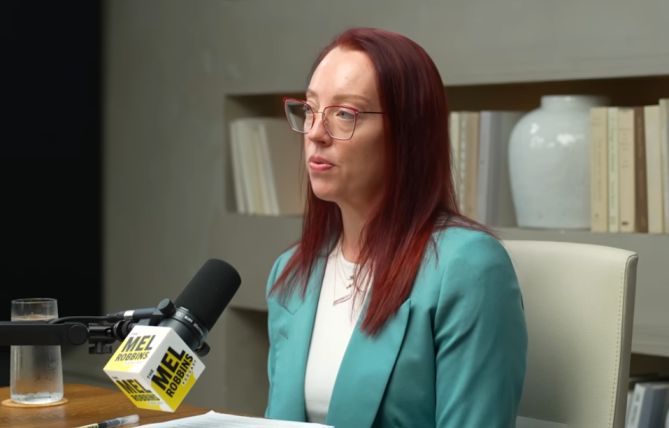
Here is the full transcript of renowned neurosurgeon Dr. Betsy Grunch’s interview on The Mel Robbins Podcast, January 1, 2026.
Brief Notes: In this powerful and practical episode of the Mel Robbins Podcast, Mel sits down with world-renowned neurosurgeon Dr. Betsy Grunch to provide a comprehensive “body reset” for 2026. Dr. Grunch shares her personal journey from being a 260-pound stress-eater to reclaiming her health, offering a relatable and evidence-based roadmap for anyone feeling stuck or disconnected from their body.
From the surprising impact of nicotine on spinal degeneration to the exact sleeping positions and simple core exercises like the “glute bridge” that can prevent surgery, this conversation is packed with actionable advice for building a stronger, pain-free future. Whether you’re navigating the physical toll of postpartum recovery or looking to reverse decades of sedentary habits, Dr. Grunch’s “driver’s seat” philosophy serves as a vital reminder that your body is designed for success.
Introduction
MEL ROBBINS: Today, you and I are tackling one of the most important topics: your health. And we’re going to do it with one of the top spine surgeons and neurosurgeons in the world. Dr. Betsy Grunch is here.
If you’ve ever felt stuck, overwhelmed, or disconnected from your body, I want you to consider this episode your full body reset. Because Dr. Grunch is going to give you a step-by-step, simple approach that is going to help you take control of your health and your life once and for all.
Welcome to the Mel Robbins Podcast
MEL ROBBINS: Hey, it’s Mel. And before we get into this episode, which, by the way, is incredible. You’re going to love this. You’re going to love Dr. Betsy Grunch. But first, my team was showing me that 57% of you who watch the Mel Robbins podcast here on YouTube are not subscribed yet.
Do me a quick favor, hit subscribe so that you do not miss any of the extraordinary episodes that we post here on YouTube. It also lets me know that you’re enjoying the guests and the content that we’re bringing you, because I want to make sure you don’t miss anything. Thanks for subscribing. All right, you ready? Awesome. Let’s dive in.
Dr. Betsy Grunch, welcome to the Mel Robbins Podcast.
DR. BETSY GRUNCH: Thank you so much for having me.
MEL ROBBINS: It is an honor to meet you.
DR. BETSY GRUNCH: I’m so excited to be here. Thank you.
What You’ll Gain From This Conversation
MEL ROBBINS: Well, we are all super excited, and here’s how I want to start. Could you share how my life might be different if I take everything to heart that you’re about to teach us today and I apply it to my own life?
DR. BETSY GRUNCH: What we’re about to talk about is going to change every part of how you think about your life to help you live a better life in your 20s, your 30s. But even fast forwarding into your 50s, 60s, 70s, where you won’t have pain, you maybe have better health, better clarity in your vision of what you want for yourself is what we’re about to talk about.
MEL ROBBINS: I believe you. I believe you. What made you decide to pursue neurosurgery?
A Life-Changing Moment
DR. BETSY GRUNCH: So whenever I was little, I think most young girls look up to their mom and they love their mom. And I was no different. My mom was a cop. She was just the ultimate badass. I watched her get ready every morning, put the bulletproof vest on, and I thought there was no one cooler than my mom. And I wanted to be a police officer.
And I was about two weeks before I was to start high school. And I’m a big softball player, so had tryouts for the junior varsity softball team. Softball was my life at the time. And I went to bed that night, and she was on the night shift. She worked night shift. She told me she was going to take me to practice the next morning to tryouts.
And I went to bed, and when I woke up, she wasn’t there. My aunts had woke me up, and they told me that something had happened to her. And I could tell by just them being there that something was not right. And they said she had been in an accident and we need to go to the hospital.
So we went to the hospital, and I’ll never forget the moment of getting there, going up the elevator, and her doctor walked off. Her neurosurgeon walked off the elevator, and he said, “I’m sorry, she’s broken her neck and she’s never going to walk again.” And then he walked off. And that’s kind of—that was it.
And I just saw her intubated in the ICU, and we were just, what’s happened? What? What is what? I can’t believe this is happening. And that experience, that moment of just your world being completely turned upside down, I thought, you know, softball was my life. Now everything had just caved.
And just going through the rehab experience with her, seeing the teams, the healthcare team, the doctors, the nurses, the therapists. And those months of recovery were really, really powerful and impacting how I saw the world, how I saw my life, how I wanted to help people like her. This experience that I had and how I felt, I’m going to cure spinal cord injury. I want my mom to walk again and by God I’m going to figure it out.
MEL ROBBINS: How did she break her neck?
DR. BETSY GRUNCH: So she was driving her police car down in a semi-dangerous part of our town. So a lot of gang activity in that part of town. And she got called to some people that were on private property. And when she drove by the property, it was gang members and they shot at her vehicle.
And she tried to veer off from the bullets and hit a tree and the roof kind of caved in and broke her neck.
Breaking Into a Male-Dominated Field
MEL ROBBINS: What was it like to just go, okay, you know what, I’m not only going to go into the medical field, but I am going to go into one of the most male-dominated fields in medicine. What was that journey like?
DR. BETSY GRUNCH: Growing up with my mom being a female cop, she always told me, “You can do anything a man can do. You know, women can do everything. Women are strong.” And that’s how I was raised.
And so, you know, neurosurgery—219 board-certified neurosurgeons that are women in the US out of 3,500. So there’s not many of us. So that space isn’t really built for us. It’s a space where you walk into that you automatically look around and maybe feel like you don’t belong.
But I just told myself, I do belong. This is—I can do this. She did it, I can do it. There’s nothing that they can tell me. I’m going to work harder, I’m going to be stronger and outperform any of the guys. And that’s what I did.
The Power of Empathy in Medicine
MEL ROBBINS: Now, how did the experience of caring for your mom and also the experience of being in the hospital as a caregiver to somebody with this kind of injury, how did that shape the way that you approach medicine, the way that you treat your patients?
DR. BETSY GRUNCH: I think when you’re on the other side of the table, as a doctor, we see things totally different, but as a patient, it’s an experience that can be very traumatizing, very overwhelming, very overstimulating. And I think once you’ve had that experience of being on the other side, it makes you more empathetic. It makes you see the patient differently.
What are they going through at home that may impact what I say to them? Who’s there to help them through this? How can I make their experience to where, when they go home, they can deal with what is happening to them? How is their family handling this? How is this going to impact their career, their job, their ability to feed their children?
So I think those are all things that are incredibly important as healthcare professionals, to have that kind of empathy, to be able to give us better care to our patients.
MEL ROBBINS: Well, part of the story that struck me is when you said you walked in, the surgeon walked out, said she’s never going to walk again, and walked away.
DR. BETSY GRUNCH: Yeah, I’ll never forget that moment for the rest of my life.
MEL ROBBINS: How did that change you?
DR. BETSY GRUNCH: I mean, the things that we see as physicians are devastating. I see people that don’t deserve the things that happen to them. Young people that get brain cancer, traumatic injuries, death.
And I realized going through that, that those 60 seconds that I deliver that news is something that’s going to be ingrained in their brains forever. So how can I take that moment and not make it as traumatizing? How can I make it better? How can I make them experience this in a way that it can deliver the news in a manner where they can handle it and process it a little easier?
What You Need to Know Before Surgery
MEL ROBBINS: Now your specialty is back and spine. What do you wish people knew before they ended up on the operating table?
DR. BETSY GRUNCH: I wish people knew that there are things that you can do in your life that can change your future and keep you off of the operating table. I think a lot of people just live their life thinking it’s going to happen. It’s fine. I’ll just deal with it when it happens. And that’s not always true. There are things that we can do to make your life better, and that’s what I’m hoping to really relate to people.
Also, just surgery isn’t a cure. I think people think, okay, problem’s broken. This is a fix. And then they go back to how it was. And especially spine surgery. Things that we do in the OR can really change the rest of your life. You know, the things that if we fuse your spine, for example, you might have up to a 25, 30% chance of having another back surgery in your future. So making that decision is not just black and white.
Making Sustainable Changes
MEL ROBBINS: So what are some of the things that you can do in terms of ways that you can be healthier that keep you off the operating table, making sustainable change?
DR. BETSY GRUNCH: So that means, you know, doing diet plans aren’t just something that you can live by. You really have to kind of change your life in a way that you can live things reliably and sustainably. Crash exercise. You know, it’s the beginning of the year. I’m going to—new me, new year, new me. You know, I’m going to get in the gym every single day. That’s not realistic.
So you have to decide what you can do in your day-to-day life that you can continue in this journey of life to make yourself better. And you can’t push yourself too hard because you’ll give up. I’ve been there and I think that’s really important for everybody to know that we need to make changes that you can live with.
MEL ROBBINS: Well, what have you learned after 12 years as a spinal surgeon? What are the most important things about living a healthy life?
DR. BETSY GRUNCH: I’ve been through all the things in my life in my training. Being overweight, you know, being out of shape, having kids, having back issues, actually. So those things and then seeing what my patients go through, injuries that they sustain earlier in life to their back, and then how that might transform they are when they’re 50, 60, 70 years old.
Those things that we can do in our life that can make us better for ourselves and show up every single day as a better person, as a stronger person, will make you into a person in your future that you want to be.
Dr. Grunch’s Personal Health Journey
MEL ROBBINS: You know, you were talking earlier about how you became the caregiver for your mom. Then you’re pursuing a career as a neurosurgeon, and you yourself were not taking care of yourself. Can you just kind of talk a little bit about what your state of health was, how you let yourself go? Because I think we can all relate to this.
DR. BETSY GRUNCH: Absolutely. When that happened to my mom, obviously, when we have something happen in our life that kind of uproots everything we know, for me, I became very much a stress eater. Food was my coping mechanism. Food was my joy. I would come home from school every day and drink a Mountain Dew and eat some Reese’s peanut butter cups. That was my kryptonite.
And you do that over and over again and it changes you. So fast forward through residency, med school, all those things, that’s how I dealt with stress. And I became very unhealthy. And so here I was this very unhealthy person dedicating my life to improving the health of others. So it was, what am I doing? I knew what I was doing, but I couldn’t change it. And I was just in this cycle.
And it wasn’t until, you know, I really had a moment in which I injured my back that I said, okay, Betsy, things—we’ve got to change. So it’s, I don’t know, it’s definitely eye-opening. And I want everybody to know that that’s how all of us are. We all have these moments where we think that we aren’t in control, but you can change it.
Breaking the Cycle of Stress Eating
MEL ROBBINS: So for the person who’s listening, who either is, you know, nodding along on, yep, Mountain Dew. Reese’s. Yep. Stress eating. I’m with you, Dr. Grunch.
DR. BETSY GRUNCH: Uh huh.
MEL ROBBINS: Uh huh. I see where this train is headed and it is headed for a train wreck. Or they’re thinking about somebody that they love deeply, who is stress eating and caring for everybody else but not taking care of themselves. You know, you said, “I felt like I couldn’t change it.” But what do you know now about your own physical transformation that you would say to somebody who’s chugging the Mountain Dew or they’re just stress eating and they’re saying, I just can’t get control of this. What do you want them to know?
The Journey to Self-Care
DR. BETSY GRUNCH: I want them to know that in order to care best for others, you have to care for yourself. And if I could go back and tell my younger self one thing, it would be that it’s okay to love yourself, it’s okay to take time for you.
We put so much time in our life to caring for others or to trying to do better for others, especially as physicians or as caregivers. We’re all in that situation. And I never thought that taking that time for me—I thought of it as taking away from what I wanted to do, which was take care of other people. And I wish I could go back and change that.
MEL ROBBINS: What was the thing that finally snapped you into place? And you’re like, “I got to change. This is—I’m treating myself terribly here.”
DR. BETSY GRUNCH: Yeah, I think it’s the mental stress that we undergo as caregivers. So we have this focus towards—if we’re doing something, it diverts our attention away from the obvious. So if I am caring for my mom or if I’m caring for whoever that person may be, I can then divert my mind to focus on that task instead of opening my mind up to think about what’s going on with me.
And that’s the change that has to happen, I think, in most people. We don’t want to think about that. It’s overwhelming, it’s stressful. And whatever that moment is that you say to yourself, “It’s time”—that’s the time where that mental focus shifts. And then you realize that to be your best self, you have to make that change.
MEL ROBBINS: You know, what was going on with Betsy at that point, as you’re caregiving and going through school and trying to grind it out through life and just getting through it and getting through it, and the Mountain Dew and the Reese’s and the food becomes these small moments of joy. Like, what was the thing you really needed to look at that you can see now was the issue?
Breaking the Cycle
DR. BETSY GRUNCH: It’s the cycle. So I didn’t want to look in the mirror because I was getting fat. Everyone in my family was focused on my mom and not focused on me. No one was asking how I was doing. I was a smart fat girl. So I didn’t get asked to prom. I didn’t get asked to go do the fun stuff, but I did get asked to help with the homework.
And so all these things—I became everyone’s outlet for help. But then no one asked me how I was helping myself. And that was what you’re taught, right? So no one is asking me, so I must just internalize that behavior. And it became, “How can I find joy?” And for me, that joy was unhealthy. And finding ways to make myself happy just propagated the cycle.
MEL ROBBINS: Put me at the moment where you’re like, “I can’t do this anymore. I’m carrying too much weight. I’ve now hurt my back. I’m in spinal rest.” And it’s like, what was the moment for you? Because you let yourself go for a long time while you were caring for everybody. And nobody’s going to blame you for doing that. I mean, I can’t even imagine the amount of pressure and sadness and just maybe even loneliness you were feeling in what you were dealing with.
The Breaking Point
DR. BETSY GRUNCH: For me, the aha moment was I got the residency, started my job, still living this life, married my amazing husband, had our first child. And I was changing the diaper. My first child was a boy. So, you know, pee goes everywhere, diaper comes off, pee everywhere. So he peed all over the bassinet.
And so I was leaning down to try to wipe it off the floor. And then all of a sudden, a knife went through my back—took me to my knees. The most incredible intense pain I’ve ever experienced. And I couldn’t move. If I moved an inch of my body, this pain was so incredibly intense.
So I screamed for my husband. My son was two months old, screaming his head off. He couldn’t hear me. My phone was on the other side of the room. And so I kind of military crawled to the chair. And I knew I hurt my back. I knew I blew out a disc. My knowledge of being a spine surgeon already for three years through all residency, three years of being attending—my mind was spiraling. I knew what happened and what this could mean for me. And it was that moment that I knew I had to change.
MEL ROBBINS: What could that have meant for you?
DR. BETSY GRUNCH: So a disc injury can be something that—and I know many people that are listening have experienced this kind of pain because it’s very common. Eighty percent of people will have some type of back pain in their life. And often it’s this exact experience that I’m describing.
And it can go many different ways. I mean, luckily, most disc injuries kind of heal on their own. Most people don’t need back surgery. But my mind went, “Oh my God, I’m going to be on the OR table and I’m going to have a discectomy and then I’m going to go down the road and then fast forward ten years, I’m going to have a bad this. And when I’m fifty…” So all these—my mind just went all these different ways. And so I wanted to take that moment and really make a change.
MEL ROBBINS: What did you do in that moment?
DR. BETSY GRUNCH: I called my doctor, got on some anti-inflammatory medications. Got help for my son. Obviously my husband, my family, everyone’s close. And took a few days of rest and then really started making that change.
So I was postpartum overweight, core is destroyed. I just had a C-section, pelvic floor is destroyed. And my son was almost ten pounds, a massive baby.
MEL ROBBINS: Wow. Basically had a basketball.
DR. BETSY GRUNCH: Exactly, exactly. And he still is ten years later. But yeah, I knew that I needed to kind of get my body back into shape. I needed to change the way I eat, to change all the things I tell my patients. Why wasn’t I doing that?
Taking the First Steps
MEL ROBBINS: I want to know what were the first simple steps you took and how much weight did you tell yourself you had to lose?
DR. BETSY GRUNCH: I wanted to lose a hundred pounds.
MEL ROBBINS: A hundred pounds.
DR. BETSY GRUNCH: At the time of my heaviest, I was 260 pounds. So I was at a point where I shouldn’t have been. I should have never gotten to that moment. And I saw on TV an ad for the Peloton. I bought the Peloton, put it down in the basement, doing all this cardio. Alex Toussaint. Yeah. I’m getting after it on the bike. Let’s go.
MEL ROBBINS: I was there with you.
DR. BETSY GRUNCH: Yes. And that was—I mean, that gave me a sense of community, the ability to have an online relationship, I guess, with a group of people who are kind of going through that same thing. Made me feel like I wasn’t alone. So I did that for years, and I loved it. And I lost a lot of weight.
I didn’t—believe it or not, as doctors, they think that we are experts in nutrition, but I’ll tell you, doctors know nothing about nutrition. So I wanted to learn how to eat better, and I didn’t know where to start. I mean, where do I—so I was looking up podcasts, trying to buy books on, “What do I need to do to lose the weight?” Because exercise is great, but, you know, I’ve got to supplement that with better eating habits.
So I get the Diet Coke or Diet Mountain Dew instead of the Mountain Dew. But then not realizing that that’s not actually a great choice either. So I just kind of educated myself, started—I actually started intermittent fasting kind of on a sustainable way, because to me, you know, not eating for a period of time was something that I felt was something that I could do because I’m a surgeon, right? I’m in the scrub, in surgery for hours.
So I read the book, a book called “The Obesity Code.” Jason Fung goes through that scientific explanation of how our body processes food. And I thought, “Wow, why didn’t I know this before? How have I been a physician for almost twelve years now? And I didn’t even understand the basics of that.”
And so I took a lot of those fundamental concepts and kind of integrated it and how I could sustain changes in what I was eating. And I lost a fair amount of weight, but got pregnant with another baby.
MEL ROBBINS: Funny how that happened.
DR. BETSY GRUNCH: Yeah, I don’t know how that happens.
MEL ROBBINS: And so what happened after you got pregnant with your second child?
The Second Pregnancy
DR. BETSY GRUNCH: So similar thing. You know, we go through the baby and I felt better prepared because I’d gone through it once, and my kids are three years apart, so I had time to kind of recover and get back a little bit and be on this journey.
And I felt like I handled my—I was 38 years old, pregnant with the second one. So I had all the just more intense pregnancy back pain than I had with my son and got to the point towards the end of that pregnancy where even standing on one foot, just because of my sacroiliac joint, my pelvis, and all the stretching that happens during pregnancy was crazy.
And I understood. And that second pregnancy, I could empathize, I feel, with my patients more than even when I had my back injury because it was so intense, just—and I couldn’t do anything about it. Right? You can’t take medicines because you’re pregnant. You can’t necessarily go work out because I’ve got this massive abdomen, this thing growing inside of me.
So it was like I felt so helpless and so much pain during—towards that third trimester that I knew that when I was done, when she was born, and I can go back to the ways—but it really, living in that and feeling a little trapped in that was really relatable, I think, to what some of my patients experienced.
Finding Relatability
MEL ROBBINS: One of the things that I really love about you is that you are so relatable, and the fact that you just shared that sort of epiphany, that here I’ve gone to medical school, here I am advising my patients to make healthier choices. Here I am operating on people. I’ve let myself go. And now you’re recognizing, “I don’t know the first thing about what choices I should be making.”
How did you make these changes to your health and to nutrition and to exercise stick? Especially as you make the gains. You’re losing weight, you’re exercising, and then all of a sudden you get pregnant again.
Sustainable Change
DR. BETSY GRUNCH: Yeah. I think every woman understands that feeling of feeling like it’s the best moment of your life, the happiest. But also looking in the mirror is the hardest. And you feel almost guilty for that because you’ve created this amazing creature that you love so much. But you feel maybe disgusted or you don’t look good or you don’t feel good, and all this extra things that have—your body’s changed now. You’ve got stretch marks in places you never knew existed and pains in places you never knew you had.
And it’s just such an experience that I think that every woman can relate to. And things that you think you’ll never get your life back and you’ll never get yourself back. And, you know, that is something that’s really hard for us to kind of decide, “How can—what can we do to get our life back?”
So for me, it was a moment of realizing that, yes, I have two beautiful kids. I’m incredibly blessed, but I’m also—I’m really suffering, I’m really hurting. I’m not happy with how I look. I’m not happy with how I feel. So what can I do to change that?
And I don’t want to make it sound like I was perfect. And I went to the gym and I did this diet, and I, boom, lost all this weight. And I’m feeling—and everybody can do it. That’s not realistic. The reality is that we’re all going to make these little decisions, little crash diets. We’re going to go to the gym every day for thirty days. We’re going to do this Whole30 thing. We’re going to lose 500 pounds in a month, and we’re going to be great. But it’s not sustainable.
Change over time. And change over time is one of the hardest things to do because you have to change your mindset, and you have to do it forever. And so that was something that, for me, I had to come to that realization that I have to make changes in my diet that is sustainable. I have to make changes in how I dedicate time to myself that is sustainable.
And were there times where I did things that I had a setback, didn’t work out for four weeks? Did I go out and eat Waffle House every day? Yeah. And that’s okay. You know, you just have to keep going.
The Daily Routine of a Neurosurgeon and Busy Mom
MEL ROBBINS: So what do you do specifically as a neurosurgeon and a busy mom? Can you walk me through a day? I’m not talking about a day where you’re on call for 72 hours, but like, what are kind of the general things? Because the folks that listen to this show and the person who’s made the time to spend with us, Dr. Grunch, is like, “Okay, you sound like me, and you’re absolutely amazing. Tell me what you do.” Like, you wake up. What do you eat? What do you exercise? Like, what is your routine on a day where you’re getting 90% of it right?
DR. BETSY GRUNCH: I love those days. Those are the glory days, right? You feel so proud of yourself, and you win. Those days are amazing. And every day is not going to be like that.
But I wake up in the morning. I am not a morning person. Believe it or not, I went into a career in which I am born into being a morning person. I am not. So I actually don’t work out in the mornings anymore. I tried really hard and I realized sustainable change, that is not for me.
So wake up, have my coffee and get my kids ready and I’ll eat eggs and oatmeal with blueberries. Blueberries, antioxidant. So get a little anti-inflammatory in there and then go to work. And I’ll try to eat protein and some type of vegetable for lunch and dinner.
And the best thing about chaotic life, which all of us can relate to, moms, work schedule, caregivers, whatever, you don’t have time is really like I try my best to food prep because I don’t have to think about it. Because if I’m left to my own means, it’s dangerous.
MEL ROBBINS: Yes.
DR. BETSY GRUNCH: Yeah. So yeah. So I try to kind of at least think about what I’m going to eat and plan that for the day so whenever that decision comes up, I don’t have the opportunity to make a bad decision. I’ve kind of planned that out for myself.
And then I work out, you know, go to work, do my thing, assuming it’s one of these 90% glory days, feed my kids dinner and then I work out at night. So yeah, I just take an hour for me that way I don’t feel pressured. Their kids are asleep, I don’t have to worry about this, what and that, and then I can do it and then it’s good.
MEL ROBBINS: What I love about what you just said, Dr. Grunch, is you figured out how to make it work for you. And that’s the secret to sustainable change.
And I think especially for women, there’s so much aimed at us in terms of doing it all perfectly. And you see a ton about morning routines, you see a ton of people online working out at daytime. And for a lot of us it just isn’t going to work because you’re not going to get up at 4 o’clock in the morning and exercise before your kids get up.
And so I also love that you are giving us an example that look, you can do it at night, you can put the kids down and do a yoga class that you stream online. You could lift a couple weights for 20 minutes, you’ll probably sleep better. And then you’re getting it in.
DR. BETSY GRUNCH: Yep, it’s all about getting it in and most importantly, what fits in your schedule. Because I tried for many years of getting up early and like all these other people online are doing it and like, but God, I’m so tired when I do that. And I just, that’s not me. I’m better at night and I think, you know, maybe some people are better in the afternoon. Maybe they have a lunch break. They can go do it. But just do it. Whatever it is, whatever, however it can fit into your schedule, just do it.
What Not to Do: Protecting Your Back
MEL ROBBINS: So you mentioned, Dr. Grunch, that 80% of us will experience back pain. And this is not just for people that are older. Like, a lot of younger people experience back pain. You experienced it when you were a new mom.
And so let’s start with what not to do. As a spinal surgeon, what are a couple things that you personally avoid in order to protect your back?
DR. BETSY GRUNCH: So if there were four things, if I was talking to my best friend about what I would tell them to that they could do for themselves, that would help their back would be, number one, no nicotine, no nicotine, no nicotine.
MEL ROBBINS: What? No zins, no nothing. No toothpicks that have nicotine. No cigarettes. No vapes.
DR. BETSY GRUNCH: Nope.
MEL ROBBINS: Why?
DR. BETSY GRUNCH: I think that is one of the things. If I could get on the tallest mountain in the world, maybe not the tallest, because I’m a little scared of heights, but if I could get up on the biggest soapbox and tell everybody would be, nicotine is terrible for your spine.
And we know it’s bad for your heart, we know it’s bad for your lungs, but I cannot tell you how many patients, every single day that I tell them that, and their mind is blown. Nicotine is one of the biggest accelerators of degenerative disc disease in our spine. And I can look at two x-rays, and I can tell you which one’s a smoker. It’s mind blowing. And I want more people to know that.
MEL ROBBINS: I’ve never heard that. Why does nicotine degenerate your spine?
DR. BETSY GRUNCH: So nicotine is a vasoconstrictor. So that word means our blood vessels, like, get bigger or get smaller. So if you’re working out, your blood vessels dilate. So you get all flushed, your skin gets red, you sweat. That’s vasodilation. So that’s when your blood vessels get big.
Vasoconstriction is where the blood vessels shrink. So all of our blood vessels have little muscles on them, so they get bigger and smaller, bigger and smaller. So that’s like when you get cold, you get clammy. We call it the fight or flight response, the sympathetic response. You see a bear, you know, your hair raises up on your skin, you get really cold, and everything tenses up.
So that’s what nicotine does. It’s a vasoconstrictor. It narrows your blood vessels. It releases those sympathetic nervous system response. And what that does is it decreases the amount of blood flow to your spine.
So say you go to bend over, pick something up, maybe have a little tweak in your back, your body’s going to heal itself. So your body’s going to deliver blood and nutrients to that injury, to oxygen to that area, and help your body heal from that little maybe tear that you had in your back or whatever the case may be.
And if you consistently use nicotine, your body won’t be able to heal itself. So you fast forward years of nicotine use years, and you’ll get accelerated degeneration of your spine. Also, nicotine increases inflammation in your body. We know inflammation causes pain, so it’s just, it’s bad. And I wish everyone could stop.
MEL ROBBINS: And I take it that if you have this sort of degeneration that happens because of that vasal constriction and the lack of blood flow to the spine and also the inflammation, that this is not a back injury that surgery can help with. This is like a long term degenerative thing.
DR. BETSY GRUNCH: Correct? It’s a process over time. Right. We talked about change over time. And change can be good, change can be bad. So if you do consistent things over time that are bad, the end result is going to be bad spine.
MEL ROBBINS: Got it. Wow. So what is a second thing that you would avoid to protect your back?
DR. BETSY GRUNCH: I would avoid sedentary lifestyle. So we’ve touched on exercise, but I would make sure that I move every single day. That movement doesn’t have to be going to the gym and pumping weights, but it’s getting your blood flow, getting your freedom. If it’s a 15 minute walk outside during your lunch break, whatever it is, just stay moving.
MEL ROBBINS: And what’s the third thing Dr. Grunch to avoid in order to protect your back?
DR. BETSY GRUNCH: Lifting properly. So we are all culprit of bending over and picking up objects with bad forms. And you want to bend over. And really we always teach, you know, “Pick up with your legs, pick. You don’t use your back, pick up with your legs.”
And it’s so true because that’s how we often develop back injuries is from picking up something with improper form. And that can just be the Amazon box on the side of the curb. You’re trying to do it quickly, but if it’s heavy, you know, you need to be really careful with how you do that because I’ve seen so many people just, you know, randomly doing something that they think is safe and they really hurt themselves.
So, and then the last thing I would say is sleeping with proper form.
The Importance of Proper Sleep Position
MEL ROBBINS: Sleeping with proper form.
DR. BETSY GRUNCH: Yes, we sleep. We spend a third of our lives in the bed. That’s crazy. Like years and years of our life is spent laying in a bed. So why would you lay in a form or on a mattress or in a position that would hurt yourself?
So I think learning how to really sleep better and sleep with higher quality and more protection of your spine will help ease the pain that you may have in the future.
MEL ROBBINS: So, Dr. Grunch, what is the best sleeping position for the spine?
DR. BETSY GRUNCH: Not the stomach.
MEL ROBBINS: Okay, so not sleeping on the stomach.
DR. BETSY GRUNCH: Not sleeping on the stomach. And back aside, sleeping is fine. I was a big time stomach sleeper, and it wasn’t until I could not sleep on my stomach when I was pregnant that I really changed. And I knew that stomach sleeping was bad, but I still did it anyway.
You want to just put your spine in a neutral alignment. So where your spine is natural, our spine has natural curves. So you want to support those while you sleep in a position in which we’ll kind of maintain that natural shape of the spine.
So if you’re a back sleeper, making sure you have enough support for the back of your head, putting a little pillow between your knees to keep your knees a little flexed.
MEL ROBBINS: Wait, hold on. What do you mean, wait? What? In between my knees? I need a pillow.
DR. BETSY GRUNCH: If you’re back sleeper underneath. So keeping…
MEL ROBBINS: So like, like if you ever got a massage and they put that nice pillow down there, but you should put, you should, you should have pillows under your knees while you sleep.
DR. BETSY GRUNCH: Why do you think they do that when you get a massage?
MEL ROBBINS: I don’t know. I have no idea.
DR. BETSY GRUNCH: They do it because they know what they’re doing. Whenever you’re in the, you know, whenever you’re anywhere in the operating room, we put pillows underneath. And that’s just to kind of keep a natural flex position for your pelvis and your lower back. It’ll take some of the stress off of your lower back.
MEL ROBBINS: Well, Dr. Grunch, I’m 57. How did I not know that I’m supposed to have a knee pillow, not just a head pillow?
DR. BETSY GRUNCH: I’m here for you, Mel.
MEL ROBBINS: You are here for all of us, Dr. Grunch. Okay. Okay, but let’s talk about the side. Okay, so if you’re on your side, because I tend to start on my… Okay, we’re going to go TMI. Okay, so we’re lying in bed. I tend to start on my back. But now I’m going to have a pillow under my knees. And I think that this is going to help because I always roll to my right.
DR. BETSY GRUNCH: You roll and you’re right because you’re uncomfortable, probably.
MEL ROBBINS: What? Yeah, no kidding.
DR. BETSY GRUNCH: Your brain is telling you that you need to shift positions because something is not right. So that natural…
MEL ROBBINS: Kidding. Yeah. Okay, so if you’re a side sleeper, knees up, legs straight, like pillow between the knees, what do you recommend?
DR. BETSY GRUNCH: Pillow between the knees. Because you want to keep your pelvis. Your legs aren’t meant to be…
MEL ROBBINS: This.
DR. BETSY GRUNCH: This sounds a little weird. Legs are not meant to be closed, but equal distance apart. So a knee pillow. And you take that same, if you’re a shifter like you are, take that same pillow that you put under your knees and put it between your knees. It’ll help your hips, it’ll help your back, and it doesn’t matter if legs are straight. Legs are bent, one leg’s bent, one leg straight. Whatever is the most comfortable. But just making sure.
And the other thing is making sure that you have good support under your neck. So a lot of people, you know, we all think this big, fluffy, squishy pillow is going to be the best. Where your head, like, sinks in some of these pillows, right? So you might fold it up, bunch it up, shove it in there because that feels better. Why does it feel better? Feels better because you need more support.
So I personally use, like, a real firm pillow that maintains that space between my shoulder and my neck while I’m laying on my side.
MEL ROBBINS: So you don’t want your neck on a diagonal, is what…
Understanding Proper Sleeping Position
DR. BETSY GRUNCH: I’m not at a diagonal or not too elevated either. So you want it perfectly straight with your body so your spine is straight.
MEL ROBBINS: And do you like those pillows that have the cutout for the neck? Do you like the ones with anything that works that helps you keep your neck straight?
DR. BETSY GRUNCH: I’m here for whatever people find it to be the most supportive because people are like, oh, what’s your pillow? What pillow do you use? And there are many brands out there on the market, and I think I have purchased every brand of pillow known to man.
But it’s about whatever works for you to keep that neck in neutral alignment. So for me, it might be this pillow, and for you it might be another kind. But whatever it is, as long as it’s supportive to your neck is the most important.
MEL ROBBINS: You know what I love about these four things that you just talked about? That we should avoid nicotine. You’ve got to avoid being too sedentary. So you’ve got to move. You also have to avoid lifting things and picking it up with your back instead of—you’ve got to bend the knees, everybody—and the sleeping in the proper position.
What I love about this is, first of all, it’s all things you can do. But as you were explaining how you see as a spinal surgeon, so many people doing just ordinary things like picking up a cardboard box that’s on your front porch and boom, that’s what throws the back out.
But what’s interesting is that if you’re somebody that is ingesting nicotine and your spine is deteriorating, or you have a very sedentary lifestyle and you’re not moving a lot and you have bad sleep position, you can see how over time your back is deteriorating to a point where a normal activity all of a sudden has you reached the breaking point.
DR. BETSY GRUNCH: Yes. So it’s not about that moment that injured your back. It’s about everything that you did that led to that moment because you were weakening your back the entire time, even though you didn’t realize it.
MEL ROBBINS: Yes. Whoa.
Morning Pain and Sleep Analysis
MEL ROBBINS: So if you wake up and you’ve got pain, you know, like a lot of people do wake up in the morning, they have stiffness. As a spinal surgeon, what does that mean to you?
DR. BETSY GRUNCH: If you went to bed with no pain and you woke up with pain, then you need to analyze how you’re sleeping. Is there something that you can do and where you can get more restful sleep with less pain?
And that might be all the things we just talked about. The pillow, the support, the position that you’re laying in, or it might be time for a new mattress. So you want to analyze if I wake up in pain, what is it? Is it my shoulder that’s hurting? Let’s look at the situation in which how I’m laying and how can I—is it my hips that are hurting? Maybe it’s because I didn’t get enough support down.
So just, you know, take in little things that you learn from what I’m telling you and then make those changes and see if you can do it better.
The Impact of Sitting on Spinal Health
MEL ROBBINS: So the average person sits for at least 10 hours a day. Can you talk a little bit about the role that sitting plays in back pain and what can we do about it? Especially if you have a desk job or you’re a long haul driver or you’re somebody that sits a lot?
DR. BETSY GRUNCH: Yeah. What you need to realize is that your back is not just your bones, your disc, your joints, your ligaments. It’s mostly supported by your muscle.
So when you look at, like, for example, if you look at a building, you might see this big, beautiful brick building. But if you look at the inside, there’s, you know, rebar, there’s concrete, all the foundation, all the structural support, and then all the outside stuff. And it’s all that cumulative is what makes the building really strong.
And so think of your spine as your foundation and the rebar in your body. But all your muscle, it is what supports it. So your abs, your back muscles, your pelvic floor, believe it or not, your diaphragm. That’s something people don’t realize. That really helps support your back, too. And so all of these are the structural support to your spine.
So that’s where the sitting comes in, right? You don’t need any strength to do that. So you do that 10 hours a day. Over time, change over time, those muscles atrophy, they get weaker. You’re not supporting yourself.
It’s about what you can do to keep yourself moving, to keep the core engaged, to keep your pelvic floor engaged, to make sure that those support systems are firing right. So what does that mean? That means getting up every 30 minutes, 60 minutes, walking, getting this standing, sitting desk where you can do that. And it doesn’t even have to be a full desk. I mean, they make those little things you can just sit on your desk.
MEL ROBBINS: I have one of those super affordable, right?
DR. BETSY GRUNCH: Just pick it up. So every half hour, set your iPhone, change it to where you can stand up, and then start to work. And what does that do? It helps your muscles move. Your joints are lubricating. You’re pumping blood through different areas of your body.
And not only that, you’re engaging muscles that you’re not engaging when you’re sitting. So those are really, really important to help reduce your pain, because you do that every day for 10 hours, don’t move, you’re setting yourself up for failure.
Proper Sitting Posture
MEL ROBBINS: Is there a proper way to sit for the best spinal health? And I ask that because I noticed as you start we’re talking about sitting, I’m like, okay, I better uncross my legs. And then I noticed I kind of had slumped down like Jabba the Hutt in my chair.
You notice that, you’re not paying attention. All of a sudden, your stomach’s like—and your shoulders are kind of up at your ears like earrings. And I often wonder, why do I slump down like that? And is there some tech, should we be doing something as we’re sitting to support our spinal health?
DR. BETSY GRUNCH: So what’s happening when you’re slouching down is all those muscles are just letting go. And then you all looked over at your spouse or your kid at home. You’re like, oh, why are they sitting like that? Straighten up, pull the shoulders back. And then as I’m talking to you, I’m like, oh, spines are nice like this.
But, yeah, our brain just, we defocus away from how we’re sitting until we engage that mental strength. Oh, I need to. You know, so they sell so many ergonomic chairs. I think all that, that’s marketing gimmicks for the most part, but really, anything.
Again, sitting and sleeping. We talked about the neutral spine position. It’s the same thing. So our neutral position is, you know, our posture is keeping that back up, keeping our lumbar support. I love having just a little lumbar support pillow on any chair that I work at, at home, at work, in my car, just a little.
And it depends on the person. Some people have really flat backs, some people have really swayed backs. So anything to keep that kind of alignment, because that if you have something pushing in your back, it’ll kind of—oh, I need to pull my shoulders back a little bit.
MEL ROBBINS: And both feet on the ground. How do you feel about cross legs as a spinal surgeon?
DR. BETSY GRUNCH: Yeah, both feet is the best position down. But, you know, as long as you change positions and kind of realign and have that mental set to pull your shoulders back and pull your neck back.
Tech Neck: The Modern Epidemic
MEL ROBBINS: What is tech neck and how is it being on our phone all the time shaping our spine, Dr. Grunch?
DR. BETSY GRUNCH: So your head weighs anywhere from 10 to 15 pounds. So when we are sitting upright, we have 10 to 15 pounds pushing down on our spine. If you lean forward at an angle like you’re looking at our phone and we all do it, that force of weight becomes up to 60 pounds.
MEL ROBBINS: 60?
DR. BETSY GRUNCH: Yeah. So you can imagine how much more pressure you’re putting on your neck, your spine, your muscles, all of that when you lean forward.
So simple changes to pull your phone up where your eye level doesn’t look very cool, but—or even just at your desk. Your monitor is here, so you’re looking down. Can I bring it just a little, stand box, maybe. Maybe that Amazon box. Shove it on your monitor so you’re looking straight ahead.
Those little changes. If you look in your monitor all day for three or four hours, you could think of if I’m putting 10 pounds of pressure on my spine versus looking down on my monitor now, I’m putting 30 pounds of pressure all day. How much strain that’ll cause over time of your neck?
So those little—that’s what tech neck is. And it’s a real thing. You know, it makes our muscles weaker, gives us tension arthritis in our neck. Headaches. Headaches are so common.
MEL ROBBINS: Wait, headaches come from tech neck?
DR. BETSY GRUNCH: Yeah, there’s so many causes of headaches. But as a generalization, people that have neck issues, 90% of them have headaches as well. So those little changes can really even affect how you think.
The Long-Term Impact on Future Generations
MEL ROBBINS: So, Dr. Grunch, as a spinal surgeon, as you look at society and especially kids who are still growing and developing and everyone is slumped over with tech neck, and you just said 60 pounds of pressure on your spine.
If you roll the clock forward 10 or 20 years, are you concerned about kind of a chronic injury that you think we’re going to be seeing a lot if we don’t take this advice seriously around where your monitor is and just lifting your phone up so that you’re not putting tech neck pressure on your spine?
DR. BETSY GRUNCH: I am concerned that over time, you know, we’re in this decade of everyone has a phone. Even, I had to hate to admit it, but my kids have phones. And then how will that look for them in 20, 30, 40 years?
Yeah, I mean, you know, I didn’t have a cell phone growing up, so that my generation is not as many neck problems. But I’m starting to see younger and younger people with disc issues, with neck pain, with migraines and all these things.
And I hope that people can really take some of these little points home and just change maybe the way they hold their phone or, you know, laying down a bed, don’t look at your phone on the couch, maybe recline back. So you’re taking that pressure off or whatever the case may be to make those changes.
MEL ROBBINS: That’s scary, but it’s not surprising to me that you’re seeing young people even, I would assume in their 20s, having issues with this in late teens where you’re already seeing these types of injuries and you’re like, yes, maybe sports, but it has a lot more to do with the tech neck and the pressure you’re putting on your spine.
DR. BETSY GRUNCH: I think it contributes for sure, and a lot of it’s multifactorial. But I think also tech neck, I mean, what it’s doing is it’s really, you’re not strengthening your neck as well.
And so really getting in the gym and doing those activities where you’re working on those extensor muscles and stuff like that, that’s also going to help. And then putting our—adapting this posture can accelerate some of the pains that we have.
Aging and Back Pain: What’s Inevitable?
MEL ROBBINS: A lot of us have been told that aging means decline and that back pain and stiffness is inevitable. Is that actually true?
DR. BETSY GRUNCH: Yes and no. So in some ways, back pain and back issues—I don’t want to make it sound like everyone is going to make sustainable changes in their life and they’re never going to have an ounce of back pain. I mean, a lot of it’s—some of it’s genetic. Those are things that we can’t change. Some of it’s an injury. Those are things that you can’t change.
But I can definitely see patients that I’ve seen two 70-year-olds, one that does, you know, has made different changes in their life and then a 70-year-old that has not. And I can see myself in both of those people and what did they do earlier in life that’s led them to this position? And what modifications can I do to prevent myself from getting to maybe in this position?
And that’s really the point I want to drive home with this episode is that these sustainable changes. Yeah, I mean, oh, well, I mean, I like looking at my phone when I’m doing that. Well, yeah, but let’s talk about how your future may be. Let’s talk about how your husband’s future may be. What can we do for your kids to teach them these things where they can be better when they’re older?
The Impact of Simple Changes on Spinal Health
MEL ROBBINS: And you’re talking simple things. You were talking literally about holding your phone up so that you’re not putting pressure on your spine. You’re talking about sleeping in the proper position. You’re talking about bending your knees when you pick something up and moving more and not using nicotine. That those are simple changes. Talk about nothing.
DR. BETSY GRUNCH: That you spent money. I’m actually saving you money. If you’re not going out and buying them Zens, you’re saving money. That’s true.
MEL ROBBINS: Talk to me about weight. Talk to me about how that impacts your spinal health. Because you’ve already shared that, you know, when you hit that moment with yourself, you had 100 pounds to lose. So how does carrying excess weight impact the spine?
How Weight Affects Your Spine
DR. BETSY GRUNCH: That is really important because the more weight we carry on our bodies, the more stress we put on our spine. So, you know, if you’re 150 pounds versus 250 pounds, you can imagine that every day walking, what that does to your, not only to your spine, but to your hips and to your knees and everything.
And so that is something that will worsen all your joint pain. But if we specifically talk about the back and you talk about, we’ve hit all the points of keeping your spine in that neutral position, keeping your core strong, all those things. But if you have obesity and you have a really heavy belly, that pull on your spine forward and that extra weight that’s off centered is really adding a lot more stress to your back.
And then over time it can worsen that. And then as we get heavy and look, I’ve been there. I know exactly what it feels like that is difficult to carry around like that. And you don’t necessarily have the strongest core and you’re relying on those, like I said, the joints, the discs and all those things that’ll just get worse over time.
And at any point, you can look in the mirror at 20, at 40, at 70, and say, “I can make changes that can make myself a better person.” And that’s achievable at any of these stages.
MEL ROBBINS: If you have a patient that is coming to you for back pain and stiffness and they are carrying a lot of extra weight, are there one or two specific things you tell them to start doing?
Now, I’m curious because I think when you get to a point where you’ve really let yourself go, there’s so much discouragement and it feels like, is it really going to matter? Can I lose the weight? I don’t even know where to begin. Are there one or two specific things that you tell somebody that is your patient to either encourage them or to say, just focus on this thing?
The Power of Food Logging
DR. BETSY GRUNCH: Yeah, I think most of us have been in that position. And the patients that I see in the office, it’s so hard because they’ll look at me and say, “Dr. Grunch, I know I need to work out, but my back hurts. I can’t work out because my back hurts. So what do I do?”
And 80% of weight loss is not necessarily exercise. It’s what you’re putting in your mouth every day. And that is something that you control. Your brain is telling your hand what to do. And so it’s that mental focus and what we can do to change what we do.
And so the biggest thing that I think is really important for people is understanding what they’re eating, because I’m fully culprit of that. I just, you know, snack, and we got stuff laying around. I might walk out here and pick up whatever is laying out in your lobby and eat it, not even think twice about it.
But keep a food log, right? Write it all down. What did I consume today? And then look at that and then calculate it up, you know, how much of that is, how many calories did I consume, how much of that was high, like glucose, just pure sugar. Stuff that if my body doesn’t burn in that moment, it’s just going to go to fat stores.
And so what did I really need? Those, you know, nerd clusters. Those things are so good. But no, I didn’t really need that. I could just throw them in the trash can or left them there. But yeah, so that is something that I really encourage people to do, is keep a food log. See what you’re doing. What can I do to change it? And the hardest part is making the change.
MEL ROBBINS: I love that. And the other reason why I love that is because there’s so much research that shows that people that keep a food log versus people who don’t. The people who keep a food log are way more successful at achieving their health goals. Because you’re aware of what you’re doing.
DR. BETSY GRUNCH: Yeah.
MEL ROBBINS: So much of it, you’re right, is just mindlessly grabbing at that stuff.
DR. BETSY GRUNCH: Yep.
Essential Exercises for Spinal Health
MEL ROBBINS: So do you have specific exercises that you recommend that people do to build the muscles that support your spine?
DR. BETSY GRUNCH: Yes. So we’ve touched on the core. So, you know, I mean, doing biceps, triceps, all that stuff is important, too. But the thing I think that people really don’t think about is the core. And so the one exercise that I love the most that I try to recommend to everybody is a glute bridge. Do you know what that is?
MEL ROBBINS: I do. But for the person who’s listening, who might not know what that is, you lay down. Well, you explain. How do you do it?
DR. BETSY GRUNCH: Yeah. Lay down and you put your feet on the floor and then kind of have your knees bent and then thrust your hips, so you’re thrusting your pelvis forward or lifting it off the bed. You can even lie on, like, back of a bench or something and do that.
And that movement really works a lot of your core and your glutes, our gluteal muscles, like in our butt. Basically, what makes our butt juicy actually helps support your back.
Then the bird dog. So for people who don’t know what that is, it’s kind of like on all fours. You’re on your knees, on your hands and then lifting one hand up and extending the opposite leg back and then alternating that. Not everybody can do that depending on their level of fitness.
MEL ROBBINS: You can work up to it.
DR. BETSY GRUNCH: You can, yeah. And most importantly, you know, it’s intimidating to try to do these if you don’t know what you’re doing. I mean there’s great videos you can find online on how to do it properly.
But don’t be afraid to go see a physical therapist. I mean, I’m healthy, 45 year old woman and I’ll go see my physical therapist. They can give you good guidance and you don’t necessarily need to go on every single day for six weeks in a row. I mean go once or twice, get some good tidbits on how to do things properly, make sure you got the good form and then those little facts, little tidbits you can take and kind of run with.
Overcoming Gym Intimidation
MEL ROBBINS: If you’ve got a patient that’s never lifted a weight in their life and they’re like, “Doc, I’m ready but I have no idea what to do, I feel intimidated and lost.” I get the glute bridge, I get the bird dog. But do you have any recommendations for how to go to a gym and not feel completely lost?
DR. BETSY GRUNCH: Yeah, I struggled with that myself too. And I think as a society it’s, we think that you’re supposed to walk in and like you see all these ripped rows in there, like curling 50 pound dumbbells. And if you’re that 50 year old woman walking in the gym, you don’t feel like you belong and no one likes to feel and be in an environment where you don’t feel like you belong and that’s intimidating and that’s discouraging.
And unfortunately we build this culture, fitness culture around what we think the gym is supposed to look like. So you walk in there and you don’t know what you’re doing. It’s really, really intimidating, special for women, right?
So we walk in the gym, see all these guys in there and you do I need, do I? Everyone’s going to look at you and you feel like, okay, I need to go get on the treadmill because that’s what I’m supposed to do. Girls are supposed to do cardio, boys are supposed to curl and we need to change that mindset that no women can lift too.
Lifting heavy weights is going to change your life. It’s going to make you stronger, it’s going to make your muscles stronger, it’s going to help your bones. So many women develop weak bones, osteoporosis. And it’s happening earlier and earlier because we’re not lifting weights. And that is really important to changing the way we can live our life when we’re, you know, 50, 60, 70 years old.
MEL ROBBINS: Well, one of the things that I found, because that was me and super intimidated. You’re not quite sure what to do, not sure how to lift the bench up. Should I lift the bench? Should I not lift the bench on an angle? Am I standing? Am I kneeling? I don’t know what to.
What I’ve found with any gym you walk into is the people at the front desk are more than happy to walk you around and show you. And most gyms will give you a free training session so that you understand how to use things. And simply asking somebody to help you adjust a machine to your body shape and type.
DR. BETSY GRUNCH: Yes. What a novel.
MEL ROBBINS: I went to a gym for a year and a half and didn’t know how to use half the equipment. And finally I’m like, why don’t I just ask somebody?
Strategic Planning for Gym Success
DR. BETSY GRUNCH: Yeah, I think it’s really important to realize that that’s everybody, right? Unless you’re like a gym pro or most of us aren’t. Go in there and to walk into an environment that you’ve never been in before, don’t know any of the equipment, don’t know the people, don’t know what to expect, don’t know what to do. You’re like, “Oh, shit, I’m never coming back here again. I felt really dumb.”
No, go there, walk in the first day. Don’t work out. Just go explore, look around, see what they got. That way you don’t feel like you’re doing, you’re feeling stupid or whatever. Go to the front desk, ask for a tour. Like, what equipment do you have and how do you use it? Can you just give me a tour? I’m not really one workout today. I just want to kind of learn what you got.
Take pictures. If you need to take that information, go home and then come back with a strategic plan. So when you walk in, you feel like you own it and you know what you’re doing, and then go back and do it again, and then do it again.
And then you know what? A couple weeks down the road, you’re going to be the one teaching that person that’s coming in that doesn’t know what they’re doing. Welcome them in, show them how to do it. Show them how this thing works. So you’re not propagating that intimidation.
MEL ROBBINS: Dr. Grunch, you just changed my life. I’m going to admit something. I have been staying in the same hotel on the weeks that we tape episodes and I’ve been there for six months. I only went to the gym for the first time the last production week, and I walked in and I thought, “Oh, my, this is a beautiful gym.”
And I walked around and I was so intimidated because I didn’t know what to do. I didn’t know the equipment. It never even occurred to me that I could go in and film it or take photos of it. There are so many hotels, gyms, that I’ve walked in and then just left.
DR. BETSY GRUNCH: Yep.
MEL ROBBINS: Because I’m not sure what to do.
DR. BETSY GRUNCH: Yeah. So what I do every time, every hotel I go to, when I check in, just go in. I don’t know if I’m wearing a suit. Walk in. That way no one knows that I’m coming in there. They work out. They say, “This woman and suit, they know she ain’t here to work out.” Just walk, walk around. And then you don’t have any expectations. I see what they got. Then I can go back. And when I’m in my own comfort zone and I feel confident that I can plan what I’m going to do.
MEL ROBBINS: Yes.
DR. BETSY GRUNCH: Yes. Yeah.
MEL ROBBINS: Oh, my God, you’re a genius. That’s genius.
DR. BETSY GRUNCH: Strategic planner.
MEL ROBBINS: Strategic planner. I love that. Dr. Grunch, what foods should I eat for the best back health?
DR. BETSY GRUNCH: Stay away from inflammatory foods.
MEL ROBBINS: Okay. What are those?
The Impact of Inflammation on Spine Health
DR. BETSY GRUNCH: So things like gluten. I know we all love our bread, but things that promote inflammation in the body is going to propagate pain. And same thing with bacteria. Nicotine. Right. It causes chronic inflammation.
So we want to stay away from things that cause inflammation in your body. So that’s going to be like the sodas, high fructose corn. So the processed foods, which, you know, inevitably some of us have no choice but reducing as much of that as we can and then focusing more on foods that are anti-inflammatory.
I hate greens. My kids hate greens. But leafy green vegetables are good. But even berries. So blueberries. I love blueberries. It’s about the only berry I really like. I hate raspberries. I hate all strawberries. I know that’s probably controversial. I don’t like them. So I eat blueberries. That’s what I like. So that’s a good anti-inflammatory, antioxidant. And then protein, protein, protein, protein.
MEL ROBBINS: Why is protein important for your spine and your back?
DR. BETSY GRUNCH: Health muscle. So our muscles are made of protein. If we don’t consume it, our body still needs protein every day, so it will break down muscle to get that. So if you’re not consuming it, you can’t not only build muscle, but then you’ll cause more muscle breakdown.
So our body needs 0.8 to 1 gram per pound of body weight. So 150 pounds, 150 grams of protein per day. It’s a lot of protein.
MEL ROBBINS: It’s a lot of protein.
DR. BETSY GRUNCH: Yeah. And most of us aren’t consuming that.
MEL ROBBINS: So as a neurosurgeon and a busy mom, how are you getting that much protein in?
DR. BETSY GRUNCH: Eggs in the morning. My protein shake that I’ll have in between my cases in the morning. If I’m in the OR, protein bar, however I can consume it. Meats are a great source of protein. If you’re vegetarian, there are alternate sources of protein that you can get.
But yeah, just kind of mindful consumption is the challenging part. And again, that food log can help you kind of keep up with that. There’s free apps on the phone that you can download. There’s even apps now that you can just take a picture of your food and it will—I mean, it’s pretty crazy how it can then tell you what it is.
What Happens to Your Spine During Pregnancy and Postpartum
MEL ROBBINS: It is really cool. You know, I’d love to hear what is happening in a woman’s back and in her spine when you’re going through pregnancy and the postpartum period.
DR. BETSY GRUNCH: Destruction.
I think we all—we’ve all been there if you’ve ever been pregnant. But yeah, I mean, so, you know, your body goes from a form that you’ve lived your entire life, maybe 20, 30 years, for me, 38 years in this one form, to then in nine months adding 50 to 100 pounds, all abdominal. Everything’s changing.
And that’s a lot of change in your body. If you are even if you’re unhealthy going into pregnancy, it’s a lot of changes on anybody’s body. So it increases the amount of blood that we have in our body. You know, the baby, all the water weight that we get, and then it stretches our abdomen.
So we’re carrying, obviously, the baby in our uterus. So those abdominal muscles split, they stretch, they get super destroyed. And then not only that, we’re trying to compensate for this arch in our back a lot, because now we got this big baby. So then we start pulling our back back.
Then you got the hormones, the laxity of the ligaments. So not only do you have no muscle, it’s all this weight. Then you have ligaments that are stretching that never stretched before because that’s why we have a pelvis and SI joints, is because it needs to open up to deliver this baby. Unless you’re like me and just had it cut out, so that’s fine too.
But yeah. So all of those things contribute to massive changes in your body and massive chaos to what you previously knew was your back. So then you got to have the baby and then somehow get it all back. It’s crazy.
MEL ROBBINS: Well, you’re giving us the roadmap to get it all back. We got to take better care of ourselves, get sleep in the proper position and lift weights to get our muscles back and eat a lot of protein.
DR. BETSY GRUNCH: And good nutrition and give ourselves grace because we can’t always do—it seems achievable. But a lot of days it’s very chaotic and it’s overwhelming, especially in that newborn phase for some of us.
It’s Never Too Late to Reclaim Your Body
MEL ROBBINS: So what about if you had your kids decades ago and you feel like you never got your body back? What is your message to that person?
DR. BETSY GRUNCH: We usually don’t just have one kid. We have one kid and then we try to get back it. We reel it back, and then we have another one. Then we have another one. So you have decades of your life where you’re not only going through pregnancy and those changes, but then you’re raising a small human, you’re changing diapers, you’re bending over, you’re carrying them on your hips.
And so this cycle propagates itself. And then the whole not putting ourselves first because we’re taking care of our children. But if you are that person that you realize, “Okay, well, yeah, she’s right. Now I’m in my late 40s, and I am really—I need to make a change.” That’s where I was. That’s exactly where I was.
And you can make changes that can get back. Your body is designed for success. And so we can do things at any point that we can change the clock. So, you know, all the things that we’ve talked about with sustainable change, with getting your core back, none of this is a “do it now or it can never happen again.” And that’s a good thing about the human body. That’s why I love it.
MEL ROBBINS: I love what you just said. “Your body is designed for success.” What do you mean by that?
DR. BETSY GRUNCH: Your joints, your spine, your brain is all designed in a way to get yourself around every single day, to heal through injury. We have modern medicine that we can change. Even the way we can replace body parts. We can replace organs.
So we can get ourself in a better situation through a multitude of things, whether things that we do ourselves, these changes that we’ve talked about during this episode, you know, reaching out to your physician to help along the way with different things. It’s incredible. The human body is incredible.
Understanding Sciatica and Nerve Pain
MEL ROBBINS: You know, one of our team members, Jessie, is seven months postpartum, and she’s experiencing a lot of sciatica pain. Can you explain what sciatica pain is, and is it normal for moms in particular to experience it?
DR. BETSY GRUNCH: I want to normalize that pain is not normal.
MEL ROBBINS: Wait, hold on. Wait. What?
DR. BETSY GRUNCH: So people often think that, “Oh, it’s just, you know, I have that pain that everybody has,” or “I have that pain. My mom had that when I was pregnant.” So we need to normalize that pain is not normal. That’s a signal to your body to make a change.
So, for example, sciatica, I mean, something is telling your brain that your leg hurts. And so we want to figure out why that is. What is going on? Is it inflammation? Is there something, you know, irritating it? Is it pinched? For some reason you have a disc issue.
And so just thinking that that is the normal part of being seven months postpartum, that needs to—we need to understand that that’s not the case.
MEL ROBBINS: And what exactly is sciatica? Because I’ve heard it a lot. I experienced it. Well, I experienced pain, but I called it sciatica. So I’m not sure that’s what I experienced. But what is that exactly?
DR. BETSY GRUNCH: Sciatica is a really common word that people throw around. It can mean a multitude of things. I’ve learned in my career that people will call sciatica almost everything. Some people say, “I have sciatica,” and they’re pointing at their back. Well, that’s not sciatica.
So sciatica comes from the sciatic nerve. And so it’s a large nerve in our body that goes from our back, joins up from several nerve segments, and then goes down our leg. So oftentimes people describe sciatica as pain in their back that shoots down their legs.
And that is nerve firing, is how our body communicates with our brain, communicates with our body. So us just standing up from this chair, me waving my hands in this motion, is my brain communicating to my muscles through nerves.
And so whenever that is, it can be movement, it can be sensory, and it can be pain. And that pain sensation, that pain pathway, is because there’s something firing in that nerve that’s telling your brain that it hurts.
MEL ROBBINS: You know, while we’re talking about nerve pain, I would love to dig a little deeper because it can feel very mysterious when it’s happening. Like I’ve had some issues with this nerve running across my elbow and then my fingers are tingling or you feel a pinch and a zap of it. So what exactly is happening in the body when that type of nerve sensation or pain shows up?
DR. BETSY GRUNCH: I think anybody that’s experienced nerve pain would call it hell instead of mysterious. So joint pain, your muscle might be stiff, you know, you might have kind of intermittent pain. But nerve pain is something that is really something that can be life-changing.
I have—I’ve talked about my back injury, but I’ve actually a couple years ago injured my neck doing a surgery.
MEL ROBBINS: You’re kidding.
DR. BETSY GRUNCH: No, no. I was in the middle of doing a case and herniated a disc in my neck trying to get something out of the spine, an instrument out of the spine. And yeah, it is the most excruciating pain. It’s like fire in your body, but you can’t put it out no matter what.
Red Flag Symptoms: When to See a Doctor
MEL ROBBINS: What is the difference between pain that’s something that you can manage at home versus the type of pain that you should really go talk to a doctor about?
DR. BETSY GRUNCH: Yeah, those are what we call the red flag symptoms. And really important to know because most back pain—we talked about 80% of people have back pain. Most back pain can be managed at home. You know that injury that I had where I was army crawling to my chair, I ended up managing it at home and I did just fine.
So, you know, it’s the symptoms where you might feel bowel or bladder issues, that’s an automatic red flag. Can’t go to the bathroom, going to the bathroom by yourself. Can’t feel down there. That’s a medical emergency that you need to go to the ER.
Pain that shoots down the arm or leg, that’s not necessarily normal. So Jessie experiencing that pain down her leg, that’s not necessarily normal. So may want to go talk to a doctor about that.
Weakness or numbness are definitely signs that something is not right. So I mentioned I herniated a disc in my neck, I had triceps weakness, I couldn’t extend my arm, that’s not normal. Just need to see a doctor.
And then if you are managing your pain at home, let’s say, and you’re like, “Okay, it’s been four or five, six weeks and my pain’s not going away,” you probably should go just get it checked out if it’s not resolving on its own.
Advocating for Yourself: Dealing with Medical Gaslighting
MEL ROBBINS: What should someone do if they feel dismissed by a doctor when it comes to their pain?
DR. BETSY GRUNCH: Oh, my gosh. Medical gaslighting.
MEL ROBBINS: Yes.
DR. BETSY GRUNCH: Man, I wish I could be in the office with every patient because I see it happen so much, particularly in women and in young women where we feel dismissed. Like, “You’re too young to have back pain” or “You shouldn’t be here because you can’t have chest pain and you’re 20 years old.”
If you feel that way, you’re in the wrong office. So you need to find someone else. You need someone that’s going to listen to you, to believe what you’re saying and to take steps to figure it out.
And if you’re not getting that, you need to walk out and you need to find someone else. Don’t think that any symptom that you’re having should be dismissed. And if you’re experiencing that, then know that that should not happen and find someone that will listen. We’ve all been there.
MEL ROBBINS: What do you think, out of all the incredible things that you’ve taught us today, is the most important thing that the person who’s with us right now should prioritize and do to improve their health?
Taking Control of Your Life
DR. BETSY GRUNCH:
The biggest thing that I would stress is to know that you’re in the driver’s seat. You’re the driver of your body, you’re the driver of your life.
We often get weighed in by what people think of us or what we’re being judged by, or all the extraneous things we have to do today, or our kids that we have to take to school or the person we have to. And so we just become so flooded with responsibility that we don’t take that on ourself.
And so realizing that you’re the driver of the ship and that you need to make decisions that are going to make you happy. And then when you are presenting yourself as your best self, then you can help others monumentally more than what you can do when you’re not being the driver and you’re just being the passenger and your own self.
And most importantly, to know that it’s okay to fail. We’ve all been there, we’ve all failed that we pick ourselves back up. You have setbacks, and you just go back at it five times harder.
MEL ROBBINS:
You know, one of the things I’ve been wondering is your mom. How is she? I mean, what is the, did she ever get any movement back? What happened?
DR. BETSY GRUNCH:
Yeah, she’s…
MEL ROBBINS:
What’s her name?
DR. BETSY GRUNCH:
Betty.
MEL ROBBINS:
Betty.
Betty’s Inspiring Journey
DR. BETSY GRUNCH:
Betty and Betsy. She is 65. She’s still, she’s my biggest social media fan. You’ll find mama in the comment section. I have to sometimes occasionally restrict her, but yeah, she’s sitting. She’s probably sitting at home right now listening to this and the biggest smile on her face.
And she has not, never regained any movement, but still completely paralyzed. But she really gives me inspiration because she’s been like that for 30 years now and almost has lived as much life in a wheelchair that she has before her accident.
And she finds ways to find joy and enjoyment out of the life that is now hers. And I just admire her.
MEL ROBBINS:
Watching her these last three years. What has her example in terms of how she’s lived her life after experiencing this devastating injury? How has that changed the way you live yours?
DR. BETSY GRUNCH:
It made me realize that anything can happen in a blink of an eye. She didn’t get in that car that night and think that she was a bodybuilder. I mean, she was incredible. Best shape of her life. And to think that in one moment that can happen.
And so I just try to live my life by that philosophy that anything could change. And so what did I do today? Am I enjoying life to where if it were taken away from me tomorrow, that I feel fulfilled and that’s all we can do.
Finding Joy and Letting Go
MEL ROBBINS:
Dr. Grunch, what are your parting words?
DR. BETSY GRUNCH:
Find joy. Find joy.
And most importantly, Mel, I’ve learned from you. “Let them,” right?
So I have found being a physician, being a woman in medicine, being kind of like the outsider that so many people want to judge you. So many people want to feel like they know you and to pass whatever their thoughts on you are.
And if you let that flood you and you don’t trust your own instincts, your own behavior, your own self, then that can really overcome. We are our own worst enemy.
And so the second that you do exactly what you teach, just to realize that you can’t control anyone on the outside, the only person you control is you. That is the moment where your life can change.
MEL ROBBINS:
Well, you’ve changed my life today. This has been one of my favorite conversations ever. There is so much that I love about you, and I am so excited to know you. I’m honored to have learned from you today.
I know the person that’s with us and all the people in their life that they’re going to share this with, that their life can change for the better because of everything that you have shared with us and taught us.
And all I can say is, please, please, please, keep doing what you’re doing.
DR. BETSY GRUNCH:
Thank you.
Final Thoughts
MEL ROBBINS:
Well, thank you. Thank you for being here and thank you for being you.
And I also want to thank you for making the time to listen and to watch something that can truly help you improve your life. And I agree with Dr. Grunch. You are the driver, and you are in control more than you may feel right now.
And I know if you really take to heart the things that she taught you today, that you can not only improve your health, but you can improve your life. And I really hope you share this with people that you care about, because we all need more Dr. Grunch in our life. We do.
And in case nobody else tells you today, I wanted to be sure to tell you, as your friend that I love you and I believe in you and I believe in your ability to create a better life.
Now take everything you learned today and go do that. And I’ll be waiting for you in the very next episode. I’ll welcome you in the moment you hit play. I’ll see you there.
Related Posts
- Mel Robbins Podcast: w/ Doctor Mike on Top Health Lies (Transcript)
- The Inner Child: Who Is It And Why We Need to Hear Them
- Bialik’s Breakdown: w/ Anita Moorjani (Transcript)
- Gut Microbiome Crisis w/ Dr. Trisha Pasricha @Mel Robbins Podcast (Transcript)
- Joe Rogan Podcast: #2476 with Shanna H. Swan (Transcript)