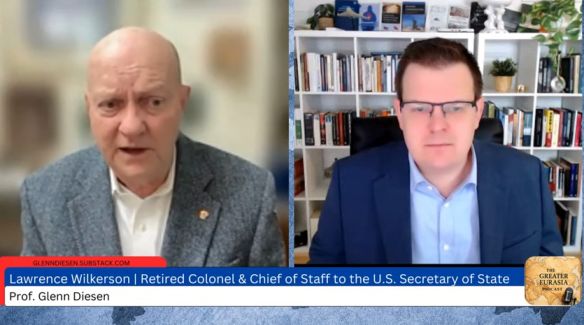
Editor’s Notes: Retired US Colonel and former Chief of Staff to the Secretary of State Lawrence Wilkerson joins Professor Glenn Diesen to dissect Donald Trump’s high-risk approach to the Middle East and Europe. Wilkerson explains why the massive US armada near Iran may be more about coercive diplomacy and reviving a JCPOA-style deal than launching a full-scale war, and how Pentagon planners fear getting bogged down in an unwinnable regional conflict. He lays out why Iran’s missiles are central to its survival, why Israel’s leadership is furious at any US move that limits its freedom of action in Gaza, and how a misstep could drag Washington into a forever war it no longer wants. The conversation then widens to NATO, Ukraine and Europe, asking whether Trump is quietly trying to pull the US back to “offshore balancing” and push Europeans to fend for themselves. (Feb 3, 2025)
TRANSCRIPT:
Trump’s High-Risk Strategy: Force Without Commitment
GLENN DIESEN: Welcome back. We are joined today by Colonel Lawrence Wilkerson, the former Chief of Staff to the US Secretary of State, to discuss some of the possible miscalculations being done. Thank you for coming on.
I wanted to ask you about, as I said, some of the wrong directions which not just the US but NATO might be taking at the moment. Because President Trump appears to be in a very great hurry to reverse the relative decline of the United States. And his secret weapon or approach appears to be to either use force or threaten the use of force to get what he wants.
However, he doesn’t seem to want to be pulled into any costly conflicts. So Panama went quick, just a little bit of threat, so he got what he wanted. Greenland became too complex, so he’s backing away a little bit. It appears when Yemen and Iran didn’t go his way, he pulled out quickly. While Venezuela seems to have been the ultimate success—that is, well, in his view—going in a one-day operation, kidnap the President, and now ideally be able to dictate foreign policy and trade policy.
But from your time in the military and politics, how do you assess this risk of miscalculation? Because he might be getting into a larger war which he doesn’t necessarily want.
LAWRENCE WILKERSON: That’s a lot to unpack. Let me make a few comments about general things like Venezuela, for example. He does not own Venezuela. He owns Maduro and his wife. And I think that’s going to become increasingly apparent over the coming months.
And let me point out something else too. I know you didn’t say this or mention it in this way, but you did say that I had worked for Colin Powell. Do you know Trump had his photograph and his memorabilia and so forth in the Pentagon removed? He’s a black man, so he’s been removed. He’s been expunged.
I’m waiting for them to expunge the wing of the National War College, the most prestigious war college for the armed forces of the United States, which is named after him, was expressly dedicated to him and named after him. That’ll be the next move. This is a reprehensible administration, taking a man like Colin Powell, whose feet Donald Trump isn’t worthy to kiss, and eliminating him from the record for the present. Anyway, I’m sure this will all be reversed if we ever get rid of Trump.
To include the Kennedy Center, which is now going to have a two-year renovation period. I knew they were looking at renovation because I go to the meetings where the leadership talks about what’s happening. But they sped them up two years. They’re going to be out of whack and not doing anything which will be pleasant for the artists and everything, essentially saying they weren’t coming. So this is what Donald Trump is doing now.
The Gaza Farce and Middle East Withdrawal
Now into your questions. Look at what he’s doing right now with the premier instrument of his creation, if you will, and that’s this farce in Gaza. First of all, Netanyahu is still killing at an alarming rate, actually, given that it’s supposed to be a ceasefire and given that we’re supposed to be concentrating on this new organization.
But look at what he’s done with regard to his own national security strategy. You’ve probably read it. You know that it says we’re leaving the Middle East, or we’re going to cut back considerably on what we’re doing in the Middle East. We’re taking on one of the biggest responsibilities. Even if you just read the fine print on this operation, which Trump is going to be in charge of for life, and all these other people were paying a billion dollars to come in, we’re not leaving.
The Iran Question: Farce or Real Threat?
Unless—and now I get to the point—I think this is all farce now about a war with Iran. I think they have clued him in at the Pentagon. I think others in the allied structure, such as it is today, have clued him in. And I think he understands that he is biting off far more than the American military can chew.
And that ultimately, with the midterms coming, if he allows them to happen—and I’m becoming very, very worried about that—they’re going to eliminate his presidency too, if not through impeachment, then certainly through four years and gone. And God bless you and the devil take you.
So we’re at a point right now where what you asked about, I think, is being dealt with in ways that experts and others—I sent you that piece by Anatole. I don’t know what you think about it, but I did. I wasn’t able to get you the comment I made back to Anatole, but the comment was essentially, I think you’re a little bit too positive on both sides.
And what you just said about Russia, I think is an indicator of that. The fact that oil prices have dropped, the fact that inflation might be 12 or 13%, the fact that maybe they might have to start conscripting people and not paying these elaborate fees they pay and so forth—all those things are impactful.
At the same time, I have to admit that Anatole is probably right that as long as Europe and to a certain extent the US continues to fuel what is happening with Zelensky and his ability to do anything to the Russian forces arrayed against him, it could go on forever, or at least a long time. And that would be forever in this context.
Russia’s Real Concerns
Because as I said before, I think Putin is more concerned right now about something you don’t hear anybody talking about. He’s concerned about what Joe Biden and people, even before Joe Biden, when we started this antagonistic approach to Russia, built all this apparatus to get Russia sucked into Ukraine for. He’s concerned about being there. His military is tied up, tied up big time in Ukraine.
And we’re threatening him in other places, largely right now in his face in Iran, because he has a defense treaty with Iran. And we’re threatening to use military force in a very obvious way against Iran. We’ve just used it in a not-so-obvious way, except to those of us who recognize Kermit Roosevelt in 1953, because that’s precisely what we were doing in Tehran and elsewhere in Iran. We were conducting an insurgency and trying to overthrow the regime with Israel as the main hole in the tent.
It’s so confused right now that when people tell me that Epstein is going to bring down Trump, if it isn’t Epstein, it’s the affordability issue with the tariffs not doing anything but ruining it. If it’s not that, it’s the other things that he’s doing that people are finally waking up to. If it’s not that, it’s the incompetence of his crew. If it’s not that, it’s the fact Americans are beginning to understand that there is real threat of an Insurrection Act invocation and troops all over America, particularly in Democratic cities and so forth.
All of that is true, and all of that is building towards the midterms. But he could very well cancel the midterms and get away with it, probably with this supine Congress.
The Domestic Threat Outweighs the External
So I’m looking at this whole situation, Glenn, as far more dangerous domestically than it is externally. Even with Iran standing out there right now looking at any moment like it could go off. I don’t think it’s going to go off. I think they’re talking. I think the talks are making progress. I don’t know what they are going to mean ultimately, but I suspect it’s not going to mean what Trump has said it would mean ultimately, and that is almost a total disarmament of Iran or major military action will be mounted against them.
I think that’s poppycock. I think we’ve moved all these forces around at, incidentally, great expense—and we don’t have a whole lot of dollars to spare these days—for nothing more than Donald Trump’s willingness to try and look like a big-time negotiator again and using the only tools at his disposal: sanctions, ultimately, and military force.
GLENN DIESEN: It seems that he was riding a bit high after the success—well, let’s call it a success in Venezuela if the objective was to simply kidnap the President. But, you know, from his tweets, this is the indication he writes that we have now an even bigger armada than we had when we went towards Venezuela. And ayatollahs, you know, they watched what happened in Venezuela.
But it’s a bit strange argument to make because the success is not transferable. That is, there was no major war with Venezuela. They just sent in troops, kidnapped the president, and then took him back to the US. But this can’t be done with Iran. No one is suggesting that they swoop in with some troops and kidnap the ayatollah. You know, this is not going to happen. So it’s unclear why this operation in Venezuela should give so much confidence in terms of defeating Iran militarily.
LAWRENCE WILKERSON: Sorry, I was just going to say, while you’re on that point, I’m told that finally some congressman’s questioning of a principal cabinet officer in the Trump administration got back to Trump, and that was Rand Paul, who put Marco Rubio on the spot with a simple question: What if someone did that to your boss? No, no, no. What if someone did that to your boss? What would you call it?
Rubio tried to find his a, and Rand pushed in. What would you call it? Wouldn’t it be war? Wouldn’t it be an act of war? Wouldn’t it be something you would respond with war? That got back to Trump, I’m told.
Yeah, well, it should. It should. And there should be more congressmen with those kinds of cojones asking questions like that of principal cabinet officers and just hammering it on. So you’re in a situation right now where Trump has set examples of his international relations policy, if you will, that are going to come back and haunt him big time.
Especially if the Congress finally grows up and finds some moral courage and some political courage. And there are more and more Republicans. Rand Paul, I know, is a rare beast, just like Tom Massie is a rare beast. But there are more and more Republicans—remember, I’m a Republican—they don’t talk to me much anymore, but when they do, they’re grumbling. They’re grumbling. They don’t know. One said something like this: “We got a pig in a poke.” Well, if you know that Southern expression, it simply means you didn’t get what you asked for. You got something far worse.
Venezuela vs. Iran: Why the Comparison Fails
GLENN DIESEN: Well, it’s very strange that there’s not been more pushback against Trump among the Republicans because he is delivering very different from what they asked for. But on the Venezuelan issue, though, it’s also very different from Iran, you know, if you want to go from one success to another.
Because Venezuela really, really did not want to trigger a larger conflict. Again, it’s in America’s backyard. There’s nothing it could win or come out of stronger. So, you know, they took one on the chin and just more or less let it go. But this is not the case for Iran.
This idea that we can do a “bloody nose” attack on Iran, just hit it hard one day and then call it victory and go home—the Iranians seem to have made it clear that this will only encourage the United States and Israel to come back again. So they’ve essentially said, we’re going to hit back with everything, even if it’s a small attack, and it’s going to strike everything in the region. It’s going to be a regional war.
I mean, this is not what Trump wants. It seems he wants that sweet, short campaign in the morning, do some bombing, Iran doesn’t retaliate in the afternoon, they say, “Well, let’s stop it here, we’ll go home,” and then he can claim victory.
But what can he do now? Either he will trigger a major war, or if he walks away with nothing, that doesn’t fit well with the strongman reputation which he’s trying to build up. If there’s nothing to show for it, so how can he get out of this position which he has boxed himself into in a couple of weeks?
Trump’s Shifting Strategy: From Military Threat to Diplomatic Engagement
LAWRENCE WILKERSON: Ago, I would have said you were absolutely right with regard to its most inevitable outcome being some use of force by the United States. In the last 48 hours, I’ve become disabused of that by several people in Iran and several people in the region and several people here in this country who have some insight into what’s going on right now, especially in the military vein.
And what I’m being told is that, as Foreign Minister Arachi said a few hours ago in his CNN interview, though he was veiled in the way he described it, there are substantial talks going on right now, and whether they’re direct or whether they’re going through Omani good offices or whatever, I don’t know. But he talked like they might be direct at a lower level.
And what’s happening in those talks is that they’re making progress. And that progress includes things like, we’re not going to try to take your ballistic missiles away from you. Ultimately, what we want, and this is the kicker, ultimately what we want is the same thing President Obama got in the JCPOA. I mean, that’s the recipe that they’re talking about.
I’m sure that the Iranians would find that palatable. And what Arachi was hinting at was that as long as it doesn’t take our statehood away, as long as it doesn’t take our prestige and our pride away, we can sign up to it. And the impression I got was that he thought that’s the way they were going.
The Armada as Coercive Diplomacy
So if they’re going that way, then what we can look at this armada as an example of is simply Trump’s way of bringing pressure. You might have gotten the same thing if there had been more meaningful talks with Maduro in Venezuela. The problem there, of course, was he was the objective, and I think he intuited that, if not knew it outright. So you can’t negotiate very well if what you’re negotiating is your life and your future going away.
But in this case, it’s Persia and it’s a vast land mass and it’s 90 million people, so forth. And they failed miserably. And Trump’s got to have some kind of appreciation of that. With Bibi’s plan, the plan was to overthrow the regime and Mossad and CIA and Kermit Roosevelt and his boys from 1953, metaphorically, were all in there beavering away, trying to kill Iranians and blame it on the Iranians. They were doing all manner of things.
I’m going to listen to Kinzer. Quincy Institute is putting Kinzer on the third, I think it is, around noon. And I know what Stephen’s going to say pretty much, I think, because he knows that this is what was going on. There’s not a better expert on regime change in the world than Kinzer, especially Iran.
The Failed Regime Change Strategy
So that failed. It failed abysmally. It failed so badly that the Iranians have most of those people in jail or have already dispatched them or whatever. So now there’s nothing left but kinetic, in your face, military action.
And I think the Pentagon has let, even though Kaine probably filtered it majorly, but nonetheless, there are people in the Pentagon who would push, push, push. We don’t want to do this. This is stupid. If we do this, we’re going to be there forever in a day and we’re going to get a bloody nose repeatedly.
And oh, by the way, you’re probably going to have a lot of facilities destroyed. You’re probably going to have Israel existentially threatened. And oh, by the way, there’s a nuclear weapon there that Bibi can use. And oh, by the way, you know, oil. You think Russia’s in trouble now with oil prices dropping? Oil will triple or quadruple and Russia will be held.
So all these things are bearing on Trump right now, and he’s not stupid in that respect. I don’t think he may be growing increasingly demented, but I don’t think he’s stupid yet. So I think we’re talking and I think that’s what he’s looking for. And he’s looking for a deal that he can push around and add to his Nobel Peace Prize list.
GLENN DIESEN: Well, so far it’s the FIFA Peace Prize. But that being said, what deal is there to be made? Because it appears that the objective is to destroy Iran. Well, let’s say regime change, but if—
LAWRENCE WILKERSON: That’s Israel’s objective. I don’t think it’s ever been Donald Trump’s objective. He only had it as his objective because Miriam Adelson told him.
GLENN DIESEN: But even if the objective is regime change, if there’s no replacement regime, then essentially would result in the collapse and fragmentation of Iran. But it just seems that any peace agreement would be a stepping stone towards such a destruction. That is the demand to reduce the ballistic missile or drone stocks, dropping regional allies.
Iran’s Missiles: The Non-Negotiable Defense
LAWRENCE WILKERSON: The missiles are not in the deal. And Arachi as much as indirectly, Arachi as much as hinted strongly at that, that none of that other material that is essential for Iran to maintain its defenses in the region against others, like Saudi Arabia, for example, it doesn’t have any defenses that are like normal defenses, if you will. You know, a big national army, a big navy, a big air force.
Certainly what it has is missiles galore, and that is its principal defense, and they’re never going to give those up. So I think that reality, I know that reality is known well in the Pentagon. We actually argued at one point in time that you can’t, Mr. President, even think about going after that part of Iran’s security apparatus because it’s all they’ve got and they’re in a dangerous region. And the hint there in parentheses was the leading danger is Israel.
So if you disarm them like that, they’ll take—that’s another reason why I still think Israel is our puppet, not the other way around. And I think we’re going to see that big time now, because Netanyahu is furious that we’re doing what we’re doing with this new organization and we are slowing down his ability to kill Palestinians.
But he’s somewhat subdued by the fact that I think even his own military has briefed him. If Iran attacks us again, we may be destroyed. So he knows he would have to go to the nuclear weapon in order to prevent the country from being destroyed were Iran to seriously go after him now.
So you’ve got a real mix there now. And Trump’s got to deal with that mix. And I think he’s come to the conclusion he needs to deal with it through diplomacy.
Building Trust Through Diplomacy
Arachi spoke about that, too. When the CNN guy laid it into him, or just—he didn’t ask it dramatically, roughly. He just asked the question, well, you’ve been cheated before, let’s put it that way. And Arachi rehearsed the cheating in the middle of diplomacy and everything else. They were, in fact, he called it trust, and that’s what the Iranians have been calling it ever since we started this mess.
Ahmadinejad called it essentially trust, a lack of trust. And that’s what Arachi said. How can you get a deal then? How can you talk? How can you get any kind of deal that’ll satisfy both sides? Well, we’re building trust. We’re building trust. Well, one of the ways you build trust is you don’t attack again.
GLENN DIESEN: But it’s still unclear to me then what is there to discuss between Washington and Tehran if, what is it that Iran can give, which Washington wants?
LAWRENCE WILKERSON: I think what you’re looking at is an attempt by Trump by circuitous means, if you will. Maybe I’m giving him too much attribute for skill here, but by circuitous means, indirect means, he’s trying to do precisely what his national security strategy said we were going to do.
GLENN DIESEN: Get out.
Returning to Offshore Balancing
LAWRENCE WILKERSON: Yeah, he’s trying to get the major US commitment out of the region. Not break ties with Saudi Arabia or any of the other countries that have money, but get us out of that region. Because I think he knows and understands, and I think some of the comments he made even before he was elected the first time indicated this, that that’s a stupid place for us to be, that we have no interest in being there other than protecting our interests in the region, which are mostly oil and Israel.
And you can do that without being in the region. My God, we did it for 40 years that way. We didn’t have a single boot on the ground for almost 40 years other than advisors and things like that. We had all of our strategic power offshore, if you will, our power offshore. We called it offshore balancing. And we swore. We swore in the military and our president swore with us. Not a boot on the ground. No rubber on the ground in the Middle East. Well, that’s what he wants to get back to.
GLENN DIESEN: Well, it could easily be the opposite, though. If those missiles start going off, it would be easy for the US to be bogged down there for another decade.
LAWRENCE WILKERSON: Well, whenever you threaten this way, you always have that possibility. You know, I had to tell Ahmadinejad in a meeting with him during the UN General Assembly in New York. It was Frank—God, I forgot his name. Now, his dad was a very famous CIA agent. Wisner, Frank Wisner. He was Under Secretary of Defense for Policy, too, and he was our ambassador to India.
We were up there to ask Ahmadinejad to do certain things if we did certain things. And he was there to ask us or to answer our questions and so forth. And my role was to talk about an incident at sea agreement, you know, INCSEA, like we have with the Soviets, because we were very fearful we were going to have an incident in the Persian Gulf or the northern Arabian Sea and it would lead to war.
The Incident at Sea Agreement Model
So after talking about that for a few minutes, I think all of us, Frank and I talked in the hallway afterwards, and we had the foreign minister from Iran with us who spoke fluent English. And Ahmadinejad had said, you know, as I understand, we have about 1,875 kilometers of shoreline on the Persian Gulf and you have zero, so where’s the problem?
And from that point, we got to a rational way of talking about the problem is we’re always going to have boats at sea. And the problem is, you are always going to have boats at sea in your region as long as you have boats at sea in your region. And we are, let’s just say, happen, chance, freedom of navigation, whatever, going through your region. We need to have an agreement so we don’t slaughter each other and start a war. And we worked it out.
Now, that’s a small incident, but that’s what needs to go on now on a much larger scale. And we need to push our puppet out of the way to do this, because our puppet, principally its leader, Bibi Netanyahu, who is growing more and more strained in his relationship with his people every day, don’t want us to do it. They simply don’t want us to do it.
Because the last item on Bibi’s bucket list is changing the regime in Iran or putting it in utter chaos. And they might both be the same thing. If you change the regime, you’re probably going to have utter chaos, but that’d be fine with Bibi. So Trump’s not going to do that, I don’t think. And we’ll just have to see. I may be dead wrong. I hope not.
The European Parallel: Breaking NATO by Proxy
GLENN DIESEN: You see, this is the same approach in Europe, the desire to just get the United States out. Because I’m thinking if I was—Trump says NATO, well, he said NATO was outdated, essentially. The Europeans should learn to defend themselves. Whenever he talks about NATO success, he’s essentially talking about Europeans spending more on the military.
Now, if I wanted to break NATO, you know, he wouldn’t be able to do it by himself, given that this would be widely unpopular in Washington. However, if you mess things up enough with Europeans, then the thing will fall apart. It’s a good way of doing this. I mean, the whole going for Greenland, I think he genuinely wants Greenland, of course, but it’s a good way of reducing the footprint in Europe if this is the objective.
LAWRENCE WILKERSON: Yeah, you’re right. I think Howie, is that it? Mark Howie, the ambassador in Denmark, who is the guy who covets, along with Peter Thiel, all the minerals underneath the ice cap in Greenland that was supposed to go over there and be the ambassador, present his credentials and say, I want your country, Greenland, I want your state, whatever, I want it.
I understand now they’re talking seriously about an agreement, a written agreement, that would suffice to, say, sidestep NATO and give the United States whatever access it feels it needs and that they will grant. So that problem, I think, is probably being worked out too.
But you’re right, I think Trump would most not aggressively, but by hook or crook or whatever, he would like to be free of NATO other than perhaps the nuclear umbrella commitment, because I don’t think he wants to see a whole lot of countries in Europe thinking they ought to go nuclear.
Trump’s Strategy and the Future of Ukraine
GLENN DIESEN: Well, in terms of this overall strategy, the desire to reduce the footprint in Europe, how do you see this successfully being played out in Ukraine? Because as you said before, things aren’t going well in Ukraine for many of the parties. It’s going worse. That is, Ukraine itself, of course, is struggling big time with manpower, the economy, the infrastructure, especially the energy infrastructure, everything shutting down.
And the Russians also, well, they want to put an end to this whole thing. So it looks as if the slow grinding duration of the war might be coming to an end. And as before recording, I was telling you earlier on today, I was speaking with the former head of the German armed forces, and he was making the point that he believes that if there’s no diplomatic settlement by March, the Russians are going to put a massive push into a massive offensive going for Odessa.
Now, if this is the case, it’s a dramatic escalation, but this sounds about right. They’re bringing Ukraine down to the breaking point and they want to get this war done with. So how does this fit into what America wants? Again, I’m also a bit surprised. If Trump wanted to end this war, he seemed to have had many opportunities throughout the past year.
LAWRENCE WILKERSON: If my history doesn’t fail me, and it might, as I grow older, I forget a lot of it. I think the Curzon line was roughly equivalent to the Molotov-Ribbentrop line. Maybe Putin might go all the way to that. Then they’re going to get a real shock because here’s a man who’s willing to use nuclear weapons to protect what he thinks is his sphere of influence. And he’s been very explicit about that, as has Lavrov.
And here he is taking not only all of Ukraine or most of it, but maybe a little slice out of Poland, too. You notice how the Poles are doing right now? They’re madly trying to get away from anything in their entire political structure that looks like it favors Moscow. They’re trying to eradicate it because they want to hug up so close to Washington. And they feel like, and rightfully so, because our ambassador there is making them feel this way, that they have to do that in order to exist, in order to have a future. They must tie themselves to the United States.
Well, look at what Donald Trump is trying to do. You think Donald Trump wants to have the Poles as a responsibility for his administration? I beg you to differ. I don’t think so. So, I mean, this is a mess. It’s a huge mess. But basically Russia has the advantage and they’ve had the advantage all along in real terms as well as in, I think, futuristic terms.
The problem with Putin, I think increasingly is he realizes we’re doing things to him elsewhere and he needs his armed forces with a little more flexibility even to threaten, even to provide deterrence. It’s very hard to provide deterrence for us playing games elsewhere like in the Caucasus, when the bulk of your ability to do something about it is tied up in Ukraine.
Europe’s Strategy: Keeping Russia Tied Down
GLENN DIESEN: Well, I think the Europeans have been very clear in expressing this as well. That is, they would like to see the war in Ukraine go on simply because it ties the Russians down. The Prime Minister of Denmark said this. The Defense Minister of Sweden made this point as well. If the war ends, it would be very bad. Then Russia would have more troops in the Baltic Sea. You know, this is common theme now. You heard the same from the intelligence chief of Germany.
So as long as the war goes on, Russian forces are tied up. But again, I think the Russians are aware that especially when the world is shifting and changing as much as it is now, and Russia would like some flexibility in case something goes wrong in places like Iran. It’s not ideal to have all their troops tied up. But if you see this as an existential threat, so there’s limits for how much concessions you can give, then the only alternative is to put a quick end to this. But then you have to escalate in quite a dramatic way. So is this what you expect to see now?
Russia’s Strategic Objectives and the Power Shift East
LAWRENCE WILKERSON: Well, if you look at the neocon assessment of Russia’s major strategic objectives, the first one is to destroy NATO, and the neocons would say they’re well on the way to doing that. The second one is to destroy the transatlantic link. These two can be complimentary or they can be separate. I think if you did NATO, you’d probably do the link too.
And the third is to establish better relations with Washington. In other words, they think Russia thinks that there is an impediment, and that impediment is a transatlantic link and NATO in specific, between doing that or against doing that, having better relations with Washington for whatever reason.
The neocons, some of them at least would tell you that there’s ulterior motives on Putin’s part for wanting better relations with Washington because he realizes who’s got the upper hand in the world now. It’s China. So he wants better relations so that he can do what he can from the inside to undermine the empire so that China’s role is a little bit easier.
I don’t buy that, because I don’t buy this comity between China, between Beijing and Moscow, except as a ready expedient to deal with the stupidity of the empire. And I mean that, stupidity of the empire. That’s the only reason China and Russia are together in this sort of tacit alliance.
Now, what’s happening out in the Far East of Russia with China sort of moving in for Lebensraum and such, is okay with Putin right now because he can’t do very much about it. But in the future, that might be a little bit of a problem, too. And one never knows where India and China and that relationship is going.
But as I’ve said before, the fundamental movement of power is away from the West and towards the East. Russia is caught in the middle, being both an Asian power and a European power. So Russia is going to keep its powder dry for which way it ultimately goes as this power shift takes place, realizing it cannot match China, not now and probably not for the next 30 or 40 years, can it match China.
So it’s got a tacit alliance right now, which seems to be working pretty well, and it’s got its eye towards Washington to make sure it can hold its hand as it collapses, as it were, and also to make sure those 5,895, whatever it is, nuclear warheads don’t get launched at it. So this is a kabuki game, but the inexorable movement of power is from West to East, and Putin is caught in the middle, as Russia most often is in the last thousand years or so.
And he’s got to do a tap dance between the two until the resolution of that movement is more visible and more solid. And, you know, we are a Western Hemisphere power only, and not a very powerful one either. Well, if this is playing the long game, I think he’s playing the long game.
America’s Retreat to the Western Hemisphere
GLENN DIESEN: Well, we’ll see if you can afford it. They might not be in Washington that long. But if we look at the national security strategy, this is the last question here, is if that overarching goal is that the world is multipolar, then what do we do? We can’t be everywhere. Let’s at least retreat to the Western Hemisphere and make sure we’re kings over here. At least that is no presence of other great powers. And again, it makes sense, but—
LAWRENCE WILKERSON: Sorry, impossible. 60% of South America, their commerce is already with China. And 60% of their commerce in each individual nation is already with China. You can’t fight that sort of thing except sort of rear guard action, which is what Venezuela was in part, a rear guard action.
GLENN DIESEN: I doubt ability to reverse this, but this will be the region of highest US priority, that is Western Hemisphere and East Asia.
LAWRENCE WILKERSON: But you know, forced upon us. Forced upon us. Oh yeah, not selected. I mean, I can’t make that point too strongly. At least there’s enough sense in the current regime to understand that they don’t have any choice.
NATO’s Future: Two Possible Outcomes
GLENN DIESEN: But given how Europe has been demoted, then how do you see the current problems between the Americans and the Europeans in terms of NATO? You mentioned that NATO would be in some trouble if this, is this a rough spot or do you think this military block will begin, you know, finally to fall apart?
LAWRENCE WILKERSON: I think NATO’s done. I think there are two possible outcomes or variations on these two themes. One, the principal leaders in Europe, we all know who those are. The Germans, the French and the British, although I want to throw the British out these days and maybe put your country in there or something. Someone with a little more, you know, moxie in there than Britain. They just disappoint me majorly.
That choice is the leadership gets together and they create their own security architecture. It can be tied to our nuclear system. It can even be tied to what I would call a late day example of REFORGER. You remember REFORGER, Ready Forces Germany. We had all these units in the United States that were tabbed to flow overseas were the Russians to attack through the Fulda Gap and all that kind of stuff.
It can have dimensions like that, but certainly it would have the nuclear dimension because you don’t want a whole bunch of European countries deciding they’re going to build nuclear weapons. So you have a decent European security architecture that comes up over say a decade period, is funded well and has its own defense industrial base. That’s the good one, I would say, for Europe and maybe for the world.
The other alternative, they fall apart. They could, they simply fall apart. Bite each other, hate each other, fight each other. I don’t mean, I hope, I don’t mean in actual warfare on the ground, but you know, economically, financially, otherwise they just don’t get along and they fall apart and they’re not very powerful.
Remember those books back there about 15, 20 years ago that people were writing about? Europe has a GDP combined the equivalent of the United States. And they are the future. They are the future. So, boy, is that gone out the door.
GLENN DIESEN: Yeah, I remember I bought a book once. Was it 20 years ago? Was “Why the 21st Century Belongs to Europe”?
LAWRENCE WILKERSON: Yes, yes, exactly.
GLENN DIESEN: This is not a book you would write anymore today, though.
LAWRENCE WILKERSON: But it could be good if Europe takes the best part of what it’s done since the war, especially its social systems and its democracies, such as they are, and refurbishes them and builds their own security identity and cooperates in making that a fairly formidable identity. Build the defense industrial base and so forth.
They got to get off the Lockheed Martins of the world, other than, you know, maybe an occasional purchase or whatever, and build their own defense industrial base. If they do that in 10 or 15 years, they could be still pretty formidable. I mean, we talk, what are we talking about? 400 million? Maybe by then, maybe by then, 350 million, because your populations are going down now. So is ours now. Have you seen ours since he stopped the immigration? We have a negative population growth now, or very, very close to negative.
Embracing a Smaller but Stable Role
GLENN DIESEN: Well, I don’t think necessarily a diminished role for Europe would be that bad as long as it’s stable. Because I made the same argument when I was working in Russia. I was saying that Russia should essentially embrace its smaller status in the world as opposed to the previous centuries.
Because, you know, unlike the 19th or 20th century, when Russia both had intentions and capabilities of asserting itself as a hegemon in Eurasia, it would always be the target to be balanced. But these days, you know, the Japanese try to reach out to Russia so they won’t be too dependent on China, so they won’t give away the neutrality in the disputes between China and Japan.
But see, India doesn’t want Russia to be too China-centric, so they want to reach out more to the Russians as well. We even heard before 2022, the Europeans were cautious. Let’s not alienate the Russians too much because then they’ll go too close with China. So it’s nice not to be, they want to be balanced all along so you have some more flexibility if you don’t have to be the biggest guy on the block.
LAWRENCE WILKERSON: And also you’re talking like a sane man.
GLENN DIESEN: Yeah, yeah. They don’t care for that in Europe anymore, though.
LAWRENCE WILKERSON: Is there a sane man or woman in Europe?
GLENN DIESEN: Oh, I think, well, I think this is the problem. They all refuse to accept reality as it is. They all want the ’90s back, but, you know, this is gone. You have to accept the cards you have now and do the best with them, but they essentially want to pretend they’re sitting on something different. So it’s, yeah, very destructive but common.
LAWRENCE WILKERSON: Failing, though, especially when such huge power shifts occur as is occurring today.
GLENN DIESEN: Well, thank you for taking the time. Do you have any final thoughts before we wrap up?
LAWRENCE WILKERSON: No. I hope I’m right, that we aren’t going to drop iron bombs or whatever on Iran. I mean, I just think that would be a disaster, absolute disaster.
GLENN DIESEN: I couldn’t agree more. If I made the point before that Trump built up all his forces in the region, and I think he’s the only one who’s able to pull off just going home without anything in terms of dropping bombs on Iran, that he can just shift the focus to something else.
Because, you know, a week ago we’re talking about invading Greenland, now all this military forces surrounded Iran. He can talk about choking off Cuba tomorrow and the whole Iran thing will go away. So I think it’s the only president who has the professional BS to be able to pull off humiliating withdrawal. But I think at some level, that’s what has to be done.
LAWRENCE WILKERSON: Oh, he’s going to, it won’t be humiliating for him. He’s going to say that he stopped the war and exchanged mechanisms that will keep the peace for forty years. I mean, that’s the way he’ll phrase it.
And maybe, maybe this is all about Epstein. I don’t know. But if you’ve seen any of the revelations that have come out in these pages that were heavily redacted nonetheless, by these idiots who are doing it. People said to me yesterday, well, yeah, but there’s no direct connection between Trump and Epstein. The hell there isn’t. And then you look at some of the things that are being said in the emails and some of the things that you can tell were redacted. This probably is worrying the be Jesus out of Donald Trump and maybe Melania, too.
The Epstein Files and Political Blackmail
GLENN DIESEN: Now, this is quite shocking, this Epstein files. I mean, it’s as if every conspiracy theory ever coughed up is proven now.
LAWRENCE WILKERSON: I heard one this morning that the NKVD, the GRU, whatever the element is called now in Russia, and the Mossad cooked up the whole thing and shared the blackmail apparatus. I said I believe everything there that begins with Mossad and ends with Mossad. I don’t think Russia really had its hand in this. At least I can’t see it anywhere. I see the blackmail taking place, though, and the blackmail that’s taken place, like Ehud Barak before, during the Oslo talks.
GLENN DIESEN: Yeah, I saw that one.
LAWRENCE WILKERSON: Yeah.
GLENN DIESEN: Well, when the dust settles, we’re going to have to talk about the Epstein files, I think, because this is, the political significance is immense.
LAWRENCE WILKERSON: The breadth of them, it’s just astounding how many people were involved in this. You might say the cognoscenti, the rich and famous of two continents. I mean, it wasn’t just Prince Andrew.
GLENN DIESEN: I think every country in the world now is rocked a little bit by which one of the politicians were pulled into this. What is a good word for it? Influence operation.
LAWRENCE WILKERSON: Yeah, Club Med for the world. Only one Club Med?
GLENN DIESEN: Pretty much, yeah. Well, thanks again.
LAWRENCE WILKERSON: Take care.
Related Posts
- Bialik’s Breakdown: w/ Channeler Lee Harris -Part 2 (Transcript)
- Scott Ritter: Russia Threatens Strike on Finland & Baltic States (Transcript)
- PBD Podcast #778: Who Is Sadhguru? (Transcript)
- Larry Johnson: Trump’s Naval Blockade & Ceasefire Collapse (Transcript)
- Prof. Mohammad Marandi: What Really Happened in Islamabad (Transcript)