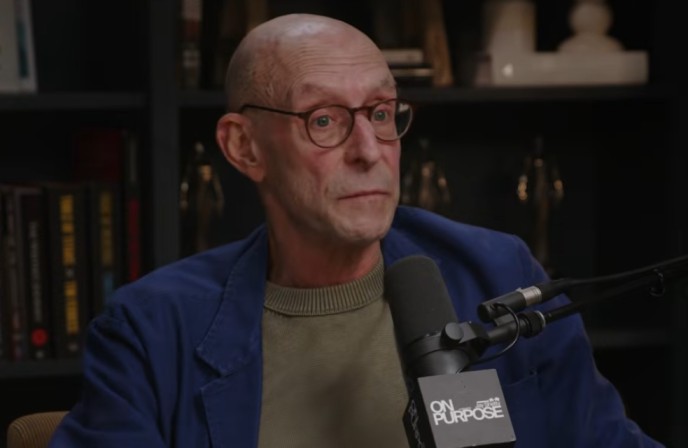
Editor’s Notes: In this thought-provoking episode of the Jay Shetty Podcast, renowned author Michael Pollan joins Jay to delve into the profound mysteries of consciousness and his latest book, A World Appears. They explore how meditation and psychedelics offer unique pathways to understanding the mind, challenging the conventional scientific boundaries of subjective experience. The conversation also tackles the pressing impact of technology and AI on our attention, urging viewers to reclaim their presence and connection to the natural world. From ego dissolution to the interconnectedness of all living things, this discussion provides a deep dive into what it truly means to be a conscious human being today. (Feb 16, 2026)
TRANSCRIPT:
JAY SHETTY: Is there such a thing as a bad question?
MICHAEL POLLAN: No, but some questions are more interesting than others.
JAY SHETTY: How do you decide?
MICHAEL POLLAN: It’s just something that if I really care about learning the answer, and I know other people do as well. When I started writing about food, it began with that very simple question. I realized I don’t know where my food comes from. It’s not the supermarket. How do they produce this thing?
I remember starting out with, I wrote a story about the cattle industry, and I wanted to learn how a steak, a prime steak, gets to a steakhouse in Manhattan. And I followed it all the way back to a ranch in Idaho, and then to a feedlot and then to a slaughterhouse. And I had no idea how many pharmaceuticals were given to these animals, how miserably their lives were when they left the ranch. It was just a revelation.
And if you think about it, it’s such an obvious question. Where does my food come from? And everyone used to know the answer. If you go back 100 years or 150 years, that would have been a stupid question, because everybody either was a farmer or knew a farmer or went to farms. But our food chain got so long and intricate that we lost track, and we don’t know what happens behind the supermarket.
So these are not complicated questions. But the answers end up being very complicated sometimes. And that’s certainly true with consciousness. I got interested in that two ways. One through meditation and the other through the psychedelic experiences I had for my book “How to Change Your Mind.”
And psychedelics and meditation both have a way of kind of smudging the windshield of our consciousness. Because normally we don’t have to think about consciousness. It’s just the water we swim in. But when you smudge that pane, you realize, hey, there is something between me and the world. It’s this way. But it could be that way. It’s subject to change. What is that? And that became the question that drove this new book.
Why Science Has Avoided Consciousness Research
JAY SHETTY: Why do you think science has brushed aside research and exploration of consciousness in the way that you’ve chosen to approach it? What’s been the reason?
MICHAEL POLLAN: Well, science is now all over it, but it didn’t start until around 1989 or 1990, which is incredible.
JAY SHETTY: That feels so late.
MICHAEL POLLAN: This is such a huge phenomenon of our lives, and there are reasons for that. One is it’s really hard. It’s not called the hard problem for nothing. It was considered disreputable if you were a scientist to work on consciousness. It was a little too vague and woo woo.
You can go all the way back to Galileo. And he made a decision that was really fateful for the future of science, which was we are going to focus, and remember the Church was very suspicious of science back then, we are going to focus on objective, measurable third person reality and we are going to leave to the Church the soul, by which he meant subjectivity and personal interior experience. Qualities also, we’re going to do quantities, we’ll leave qualities alone.
He knew those other things existed and were important, but he also knew he’d be stepping on the Church’s toes by getting into it. So he put science on this course which it has followed ever since. It’s been incredibly productive. We’ve figured out all sorts of stuff by using math, which is very good for a lot of things. But along the way we dropped this whole area and it was only picked up in a serious way. I mean, Freud did some work on it, William James did some work on it. But in terms of the physical sciences, it doesn’t really happen.
Until Francis Crick, who was the discoverer of DNA, the double helix with Watson and another colleague, he decided, having cracked the code of heritability in life, that now he was going to nail down consciousness. And he was a very brilliant but also arrogant scientist. And he thought the same reductive science that had discovered the alphabet of DNA could discover the source of consciousness.
And he predicted it would be a group of neurons in the brain that were responsible. And he called these the neural correlates of consciousness. And he worked on that and he wrote some papers and he found correlations between consciousness and certain frequencies of brain waves. But at a certain point I think he realized that it doesn’t really tell you anything.
You’re still facing this huge question like how does three pounds of brain tissue, this gray matter between our ears, generate subjective experience, internal perspective, self awareness and even basic perception? And we still don’t know. And it may not be possible to know, but there’s a flurry of activity and there’s a lot of people working on consciousness now. There are 22 leading theories which sort of tells you the field is lost.
And so that’s what I delved into. Well, what can we say? And I learned a lot of very interesting things along the way.
Why Understanding Consciousness Matters
JAY SHETTY: Why do you think it’s important to understand consciousness, when today people may even feel like we don’t have time for it? We’re just busy at work, we’ve got unlimited amount of entertainment to catch up on. We’re all late on a TV show that everyone else loves. We have families, friends, travel, there’s so much. What would learning about consciousness do for us?
MICHAEL POLLAN: I think learning about consciousness allows us to be more conscious. I don’t think we’re as conscious as we could be if you compare us to any animal and many animals are conscious. That’s one of the things we’ve learned through this research is that consciousness goes way down.
Descartes thought we had a monopoly on consciousness and clearly not the case. I explore plant consciousness in the book, which is, there was a group of scientists who are convinced that plants are conscious. The value of being conscious is this is the space of our freedom, this interiority. Without this, we are zombies and we should be cultivating this space.
It has enormous power to basically allow us freedom from. There are a lot of companies, there are a lot of technologies that want to think our thoughts and occupy our consciousness. When you’re on social media, sure you’re conscious, but minimally so. You’re basically scrolling through and allowing some corporation or some individual or some political ideology to occupy your consciousness. And I think we give up a lot when we do that.
The machines have designs on our time. We have a phenomenon now where people are forming strong emotional attachments with machines, with chatbots. I think this is, and essentially giving away their consciousness in the sense.
JAY SHETTY: Is that worrying?
MICHAEL POLLAN: Very worrying. I mean, we are starting to see, I just read a report on AI psychosis. These are people who have formed stronger emotional attachments with machines than with people.
JAY SHETTY: Why is that? Why is it that we can easily form…
The Danger of AI Attachment
MICHAEL POLLAN: I think we’re desperate for attachment and have trouble finding it in real life. And machines are a kind of a frictionless. AI is a very frictionless way to form an attachment. They suck up to you, right?
JAY SHETTY: I mean, it’s agreeable.
MICHAEL POLLAN: It’s totally agreeable. And it’s telling you how brilliant you are and it never criticizes you. I mean, attachment, relations with real human beings has friction, has complexity, has surprise. Whereas if you’re doing this with a chatbot, it’s basically gratifying every wish you have and telling you you’re brilliant.
But these chatbots have been designed to maximize the time you’ll spend with them, just like social media. And this was especially true of ChatGPT-4, which was very sycophantic. It just sucked up to people in just embarrassing ways, but effective ways. It convinced a couple people to commit suicide, but it also convinced others they had solved problems of mathematics and physics even though they weren’t physicists or mathematicians. It was kind of nuts.
But I think we’re suckers for praise and I think we have a built in tendency to anthropomorphize everything. You think about children with their stuffed animals. They’re alive to them. They speak, they have conversations. I think we’re all animists until it gets drummed out of us in school and then we become these rational materialists. But part of us always wants to go back and these chatbots give us an opportunity to.
So I think we have, we’ve learned about the mental health problems of social media, which are really serious, especially for adolescents. Social media has essentially hacked our attention very effectively. Attention is part of consciousness, but in a way it’s the most passive and easiest part of consciousness to reach. It’s somewhat superficial compared to emotions and attachment.
And so now we’re moving on from hacking attention to hacking attachment, hacking consciousness at a very deep level. And I think that’s very worrying. And I think we need to claim our consciousness for ourselves and think twice before, you’re online at the bank or the supermarket and how do we fill that time? We immediately open our phones and we start scrolling because we have trouble being alone with ourselves.
Our minds can be a scary place in some ways. They’re the source of self criticism and rumination and things like that. But how much better I think was it when we didn’t have that distraction and we’re standing online at the supermarket and instead we’re daydreaming, we’re thinking about what we’re going to make for dinner. We’re looking at the clothes on the person in front of us, we’re overhearing conversation. We’re just present to the world.
And if you think about it, we’re the only species that can afford not to be present to the world. I mean every animal has to be fully conscious all the time they’re awake because they may be turned into food. They maybe prey for something and so they have a level of presence that we’re giving up now.
There are ways to reclaim it. Meditation, of course, is a great way to reclaim it. And you’re kind of drawing a line around your consciousness when you meditate. Right? You’re turning off all other stimuli and being in that space and realizing how interesting and weird it is. You have thoughts that you haven’t really thought. I mean, they’re just popping up. What is that about?
And on psychedelics, too. I mean, you just, there is this flood of mental material, and it seems a shame to not be attending to that and to be attending to Twitter instead.
The Power of Disconnecting
JAY SHETTY: I spend 30 days a year off my phone, and so I just got back from that, and it’s phenomenal what’s possible. I meditate every day. I have a daily meditation practice, but I find that the 30 days away is to having a full work day and everything else that comes with, comes after my morning meditation.
MICHAEL POLLAN: Yeah.
JAY SHETTY: And the 30 days I just spent off my phone, it’s like you just feel completely clearer. I feel thoughts connect better. I feel more effective and productive and…
MICHAEL POLLAN: Present and more aware of nature.
JAY SHETTY: More aware of nature.
MICHAEL POLLAN: I mean, nature has a subtle, quiet voice, and it gets drowned out very easily by our lives and by our technologies. And so I find when I’m off my phone and I do, we do a lot of hiking and won’t take our phone with us, and you can really attend to the kind of subtleties of nature, and suddenly nature speaks more loudly to you.
Daily Meditation Practice
JAY SHETTY: What does your daily meditation practice look like?
MICHAEL POLLAN: My wife and I meditate together. Not very long. 20 minutes in the morning, after we do exercises. We have a long morning ritual, and I find that’s very useful for kind of setting the day. It’s not always great. I mean, I have meditation, there’s a, when you do at the beginning, your to do list is a threat always. So some days I can really quiet it, and some days I can’t. And then sometimes I’ll do a meditation at the end of the day.
I recently did a meditation retreat for the first time, and it wasn’t very long, but I was in, it was a silent retreat for four days. It was only about 30 people, four teachers. It was very privileged in many ways, and I was amazed how far and deep you can go. And that was four days without phones, four days without eye contact.
We were just in this space of our own minds. And we alternated walking meditation with sitting meditation, and we had dharma talks at night and two moments where we could address our teachers and ask questions.
JAY SHETTY: What was the power of the no eye contact?
The Power of Meditation and Dissolving the Self
MICHAEL POLLAN: One of the things you try to do in a meditation retreat is not have any need to socially present the performance. We go through socially all the time when we see people meet people, and these are strangers, by and large, and so it just frees you. I don’t have to be any way for you. I can just be the way I feel. So it goes along with the silence.
And I was also at a Zen center reporting on the book in Santa Fe, Joan Halifax’s Upiah Zen Center. And there, too, there’s silence and no eye contact. And she articulates it is about this, the pressure we have to be a certain way in social situation. And getting away from that is, I found, very powerful. We have so many claims on our attention, and to put them aside for a period of time is incredibly powerful. I mean, I had some real breakthroughs during that meditation retreat.
JAY SHETTY: Yeah. I was just visiting the monastery that I used to live at in India. So I was just there, and I was reminded of the fact that there’s no mirrors there. And it’s just this unbelievable experience of dissolving into that feeling, as you were just mentioning, of not performing or not having to be. And I was thinking about the overexposure we have to our own image.
MICHAEL POLLAN: Image. Yeah.
JAY SHETTY: Whether it’s FaceTime, whether it’s Zoom, you’re always looking at your box in the corner.
MICHAEL POLLAN: Yeah. The selfie.
JAY SHETTY: The selfie. Even FaceTiming, you have yourself back at yourself.
MICHAEL POLLAN: Right. And Zoom. We’re spending so much time on Zoom, and we are always in that box.
JAY SHETTY: And it’s probably the first time in history that we’ve been this overexposed to our own image.
MICHAEL POLLAN: That’s a good point.
JAY SHETTY: So no wonder we think we’re too fat, too ugly, too…
MICHAEL POLLAN: Yeah. Whatever else it is, it will lead to self criticism without question. Yeah. So, I mean, you know, the beauty of meditation, and this is true of psychedelics, is kind of a shrinking of the self and a kind of partial dissolution, sometimes total dissolution of the sense of self. And realizing that our consciousness transcends our self and that you can put down yourself or transcend it in some way and still be very conscious, sometimes even more conscious, because the self or the ego, and I think I use those words interchangeably, builds walls.
It’s a defensive structure. Finally, it’s very useful without question. I mean, it’s what allows me to write books and for you to write books and do podcasts. We get a lot done, and as a unit of social interaction, it’s necessary, but it disconnects us. It makes us selfish.
And so the times I’ve experienced self essentially dissolving or going away, it’s followed by this powerful connection with something larger than yourself. And for me, I mean, I’ll never forget this one experience I had on psilocybin for my book. I had a complete dissolution of self. I just exploded in a little cloud of blue Post-it notes. I wear blue a lot. And then the Post-it notes fell to the ground and coalesced in this pool of blue paint. And I was no more. I was that pool of blue paint. But that seemed fine.
And then I had this experience of merging with something larger, which in this case was a piece of music that my guide was playing, a Bach unaccompanied cello suite. And there was no longer a subject-object distinction. I just was that music. And it was the most profound experience of music I had ever had.
Self is so interesting. We spend so much time, you know, self-confidence is important, self-assurance. And we’re taught to value ourselves. All great. But think about how much time and how many things we do to escape ourselves too. It’s a paradox. I think a self, ego can be very oppressive too. It’s that critical voice. It’s what does the ruminating that you, you know, those spirals of thought you can’t get out of.
So finding, you know, healthy, productive ways to transcend the self or shrink it is, I think, really valuable. I have a good friend who’s a colleague at Berkeley who teaches, who studies awe, Dacher Keltner. And he does a really cool experiment with people where he asked people to draw kind of a stick figure of themselves on a piece of graph paper. Then he gives them an awe experience and it might be video of Yosemite or something like that on a big screen. And then he asks them to draw themselves again and they draw themselves at half the size.
JAY SHETTY: Wow.
MICHAEL POLLAN: So experiences of awe are one way to kind of diminish the claims of the self.
The Paradox of Self and the Meaning of Mantra
JAY SHETTY: Yeah. It’s fascinating what you talked about, the paradox of how we’re infatuated with ourself and there needs to be this focus on the self because that’s all we have. And then we want to achieve and we want to achieve and we need to grow and we need to work towards something in order to pursue meaning. But then you’re saying, actually there’s a part of us, you’re so right, that just wants to relieve and escape.
And I was thinking about the word mantra as you said that, and how “man” means mind and “tra” comes from the Sanskrit “traiyate,” which means to transcend. And so to transcend the mind is what mantra actually means, even though now we use it as affirmation or mantra we use as something repetitive. But mantra in its actual definition means to transcend the mind.
Where did you find that consciousness lives? Because we’ve believed it lives in the brain.
MICHAEL POLLAN: I believe we believe that, but we have not been able to prove it. The assumption has always been that there is some way that a certain arrangement of neurons produces, or consciousness emerges from that complexity. But we haven’t gotten too far figuring out how that might be. What we’ve observed, we know there are correlations between the brain and consciousness and that, you know, if you anesthetize someone, they become unconscious. And if you remove certain parts of the brain, you become unconscious. But we haven’t gotten very far in proving that relationship.
There are other theories that are being more seriously entertained. One is panpsychism. This is the idea that everything is conscious. That in the same way, a couple hundred years ago we realized that there was this other force in the world called electromagnetism and that there are these waves all around us that are passing through us and can carry information, TV and radio waves. Is there another thing we need to add to the stock of reality? And is that psychism or psyche, and that every particle has some incy-beancy bit of psyche and somehow these little bits combine to form the kind of consciousness we have.
It seems really far-fetched. It solves the problem of consciousness in a way. But it creates this new problem of, well, how do they combine then?
There are theories that usually go under the word idealism that consciousness precedes matter and that we are sort of pools of individual consciousness in a larger field. There’s also transmission theories which is that again, consciousness is a field that’s outside of our minds. And what our minds do is channel it. And we are like radio or TV in the same way that radio or TV receivers are picking up something.
If you look at a TV set, you know, the woman doing the weathercast is not in the set. In the same way, consciousness is not in here, it’s channeled. And we let in a certain amount. And this was, there was a French philosopher, Henri Bergson, who developed this theory. And Aldous Huxley actually talks about it a lot. He thought what psychedelics did was open wider the valve so more consciousness gets in. Because in normal times we have this thin dribble of consciousness and that’s all we need to survive. But there’s a lot more out there. And that’s what psychedelics acquaints you with.
You know, it’s a theory, I mean, hard to prove. So there’s a lot of different ideas out there. And one basic idea is, you know, can you have consciousness without brains? And there are people who believe that, that just you should be able to do it on, some people think you can do it on silicon and in computers. And that consciousness is like an algorithm, the brain is like a computer. And you can run that algorithm on different substrates, they’re called, including computer memory. I don’t think that’s true, but that’s a very common belief in Silicon Valley.
Theories of Consciousness and the Universe’s Mysteries
JAY SHETTY: So this is different from the more religious, spiritual understanding of consciousness being this spark that animates the body?
MICHAEL POLLAN: Yes and no. I mean, the religious idea is close to idealism, that consciousness is something larger than us. There’s a giant field or pool of it that we pass in and out of. And if that were true, it would explain things like telepathy or past lives, because time is just a human construct in that idea. And you can go in both directions in the pool of consciousness.
Now that I have trouble believing the theory that brains produce consciousness, I have a very open mind and I think we have to. I don’t think we can say with confidence that any of these supposedly woo-woo ideas are necessarily false. I mean, think about what we’re learning in physics. I mean, what could be more woo-woo than the idea that two particles separated by light years can instantaneously affect one another, as has been proven now? Entanglement. Quantum entanglement. So, you know, I think the universe is a lot stranger than we know.
JAY SHETTY: By February, motivation often fades, not because the dream wasn’t real, but because the path feels overwhelming. This is the point where commitment matters more than excitement. Growth doesn’t come from giant leaps. It comes from staying present and taking the next right step. And that’s why I’m partnering with Shopify to help entrepreneurs do both.
Shopify helps remove the friction so you can focus on showing up consistently. Whether you’re nurturing a simple idea or scaling a growing brand, Shopify gives you the tools to turn intention into action at your own pace. From thousands of customizable templates to AI-powered Shopify Sidekick, it’s like having a co-founder, marketer and finance advisor in one, freeing your energy for the work that truly matters.
Shopify also makes sure your business meets your customers where they are: Instagram, TikTok, Facebook, and now even right in ChatGPT, helping the right people discover and buy your products seamlessly. When we started Joony, Shopify was there every step of the way, supporting us as we built something meaningful. They grow with you, whether it’s your first launch or your hundredth.
Focus less on the complexity and more on showing up for your vision. Shopify gives you the foundation, you provide the commitment. Stay committed to what matters. Start simply at shopify.com/j.
What’s the difference between the consciousness and the mind?
Mind Versus Consciousness
MICHAEL POLLAN: The mind is bigger than consciousness in the sense that it would include everything the brain is doing unconsciously. So your subconscious, you know, probably 90% of what your brain does you’re not aware of. It’s managing your body, which is a big project. It’s perceiving things in your environment you’re not attending to. It’s picking up on homeostasis. You know, is my body at the proper temperature? Do I need food? How’s my blood pressure, heart rate? I mean, it’s just incredible what it’s doing. It’s managing this very complex organism.
We should remember that brains exist to keep bodies alive, not the other way around. And they do that by monitoring things and making adjustments. So that’s the mind. It’s doing all that stuff. Consciousness is this little tip of the iceberg of the stuff we’re aware of.
And the interesting question is, if we can automate all that, why don’t we automate the whole thing? Why aren’t we zombies? Why do we need this space of awareness and decision making? The best guess is because there are, for a creature that exists in a very complex social reality, I mean, we are inherently social beings. We need connection and we die without it. You can’t automate something as complex as social engagement.
You can’t automate things like theory of mind. So I can guess what you’re thinking, anticipate what you’re going to do, and all the little signals that go on in a conversation, you can’t automate that. It’s just too complex. And also, there are certain needs you have that may contradict. Let’s say you’re tired and you’re hungry. Which should you deal with first? You need to make a decision. And those kind of conflicting needs may be what drive us to become conscious because we need that space of decision making. So that’s the best guess. Nobody knows for sure.
JAY SHETTY: Yeah. But I appreciate the openness and the fascinating questions that you ask in the book because to me, I mean, I found that so extremely endearing that you start the book going, you may not know more than you know now. And I was like, what an interesting way to… And I was like, but I love that because it is the only way we can approach these really big questions that are so far beyond us.
MICHAEL POLLAN: Yeah.
JAY SHETTY: And you know, you’re extremely humble in the introduction as well, but just your self-confession of just how, you know, who are we to even ask these questions and qualified to look into it. But I think that is your qualification and that’s why I think you’re such…
Understanding Consciousness Through Personal Experience
MICHAEL POLLAN: Yeah, I wondered about that. Like why me? You know, I’m not an expert. I didn’t know a lot about neuroscience or philosophy when I started. I had to learn whole new fields. But then I thought, well, I’m a conscious human being who’s pretty good at explaining things, so why not me?
I mean, one of the conclusions of science so far, which is really interesting, is that we first approach consciousness with this idea of we’re going to find those neurons, the neural correlates. As time has gone on, there’s been this general recognition that subjective experience is central to this. So what the philosophers call phenomenology, which is a fancy word for human experience, has to be explored and that what any individual is experiencing, what’s going on in their minds, is relevant to the science.
So I thought, okay, I’ll offer myself and I’ll bring whatever I can from my by looking closely at my own experience. That’s why meditation, I think is going to be very useful to the scientists also because you have a group of people and I’m talking not of people like myself, but really experienced meditators. The people who’ve done the 10,000 hours, like presumably you got to that number in three years, would have some insight about consciousness.
And that’s true. There are some interesting experiments going on where there was one. There’s a woman named Kalina Christof who studies what’s called spontaneous thought that I looked at. That includes daydreams and mind wandering, which are very interesting phenomenon where the mind just finds its own path. And she put experienced meditators in an MRI and told them to press a button when a thought arose. They were trying not to have any thoughts.
And she concluded that you can only go about 10 seconds without a thought. But anyway, when people press the button, she saw what was going on in the brain at the same time and the thought arises in the brain. She saw that activity in the memory center which she was looking hippocampus four seconds before the person was aware of it.
So there is a very elaborate and long process before thoughts become conscious. They exist somewhere else and then pop into what we call the stream of consciousness. But that it takes four seconds suggests that something’s going on. Perhaps the thoughts are competing with one another to get into that workspace. That’s one theory, but we don’t understand exactly what’s going on. So that tip of the iceberg metaphor, I think, is really important for consciousness. There’s a lot going on that precedes it. And meditators have, I think, can develop a keener sense of what that is.
Meditation and Psychedelics as Pathways to Consciousness
JAY SHETTY: Yeah, I want to spend the rest of our conversation talking about both meditation and psychedelics, because I think these are both what you’ve shown through your work. Pathways to access to consciousness.
MICHAEL POLLAN: Without doubt. Yeah. In different ways and very similar. And they’re different and similar.
JAY SHETTY: That’s what I was going to ask you. Like, let’s start with the similarities. What are the similarities in what meditation and psychedelics allow us as access into consciousness?
MICHAEL POLLAN: Well, they both take us out of the, they can take us out of the world we’re in and all the kind of distractions. And I mean, there are two ways to use psychedelics. One is, you know, people take mushrooms and they walk out in the woods and they have a profound experience of nature. But in a guided psychedelic experience, you’re usually wearing eyeshades. You have headphones on, so you are closing off the outside senses so you can go inside. More like meditation.
That building of that fence around your consciousness allows certain things to happen. You can really travel. People don’t talk about it nearly enough, but the psychedelic experience has a path, has a trajectory. Right? There’s the onset, the coming on. There’s this period of intense, uncontrollable visual and sensory experience. And then there’s this long tail.
The long tail is a meditation and a really profound one, I find, because I can meditate better in that space than just about anywhere. You’ve regained some control of your mind. You can decide, I want to think about this. But you can do it in a completely undistracted way. You still can close out everything. So that’s one aspect that I think is similar.
There is spontaneous thought. In both cases, things are just arising from who knows where. Maybe your subconscious memories are coming up, fantasies are coming up. So there is that just kind of loosening of constraints on consciousness just to see what arises. And, you know, sometimes in meditation we fight that, but there’s a kind of, you know vipassana meditation. We just openly observe that you can learn to do that in meditation. It’s forcible. And psychedelics, you have no choice. It’s going to happen whether you want it to or not.
The Importance of Intentional Use
JAY SHETTY: What do you wish people who take psychedelics would do differently in their approach to taking them?
MICHAEL POLLAN: Do it more intentionally, I think. I think it’s potentially very powerful. I think that at different points in our lives, we use them in different ways. And sometimes they’re used to just kind of for thrills and to go to concerts and just groove on nature and things like that. And there’s nothing wrong with that. And I know many people who have had really powerful experiences, but I think if you use them more intentionally, they can be incredibly therapeutic. They can teach you things about yourself.
It’s not that the intention always bears fruit. I’ve set intentions. And then something completely different dominated the experience, which has turned out to be very positive. I remember I went into one guided experience about, I don’t know, a year after my father died. And I had this sense that I hadn’t fully grieved his passing and that I wanted to sort of be with him and hear his voice and take his advice and connect with him again, which happens sometimes on psychedelics.
I took my psilocybin and the whole trip was about my mother, who’s still alive. And the message was, your dad’s dead. Here’s your mom. Open yourself to that relationship. Go see her. And the next day was a Jewish holiday, I think it was Rosh Hashanah, and they were having a dinner in New York. I was in Cambridge, and I couldn’t get down because it was a teaching day or something like that. And as soon as the trip was over, I said to Judith, my wife, we’re going in New York. And we completely changed direction.
So there was a case where the intention didn’t work out. But I learned something, and it was a really important lesson that take, you know, don’t take your mom for granted. She’s still here.
JAY SHETTY: Thank you. Thank you for sharing that. That’s such a, that’s such a beautiful experience of something being completely the opposite to what you expected. How does science currently explain that experience? Because that, you know, at least I don’t know the scientific explanation and some asking, but I hear a scientist here that and go, well, you just made that up in your head, that experience.
MICHAEL POLLAN: But you pick everything up in your head.
JAY SHETTY: Yeah. So how does…
MICHAEL POLLAN: What else is there?
JAY SHETTY: So how does science go ahead and explain that?
The Science Behind Psychedelic Experiences
MICHAEL POLLAN: Well, there’s some interesting work. So I’m very interested in the science of psychedelics and I wrote about it and how to change your mind. I also, with Dacher Keltner, who I mentioned earlier, helped start a psychedelic research center at Berkeley where I do work. It’s called the Berkeley Center for the Science of Psychedelics.
There’s a couple theories. I mean, one is that there are top down controls on our consciousness and perception. Most of what we experience is a prediction based on past experience and beliefs. Our senses exist only to correct that. It’s a weird idea, but that the brain is essentially hallucinating reality with this error correction, constant stream of error correction. And psychedelics relaxes those beliefs.
I’ll give you an example. There’s a famous psychological experiment called the rotating mask. You’ve seen it. It’s that mask used when the happy and sad theater image. And it’s concave, right? It’s just the skin. And one of those masks is on a carousel and it turns and first it’s convex and you see it as we normally see faces. And then you go online and find one of these and then you turn it and you start seeing the back of the face, which we’ve never seen in reality.
And you will see what happens. Your mind will refuse to see the back of the face and this will pop out and become convex. And that’s because the brain doesn’t believe faces can ever be concave. And since you were a baby on your mother’s breast, you’ve studied faces and you know they’re always convex. On psychedelics you can see the back, it doesn’t pop out. There’s research showing this.
So what that suggests is that prediction that this is the way a face has to be is relaxed and you’re actually seeing more of reality in a sense because the prediction is not accurate in that case.
JAY SHETTY: That’s so cool.
MICHAEL POLLAN: Isn’t that cool?
JAY SHETTY: Yeah, that’s fascinating.
The Default Mode Network and Ego Dissolution
MICHAEL POLLAN: So your beliefs about how the world is are relaxed, which allows new beliefs to form and it allows more information to come up from the bottom. So that’s one theory. Another is that there’s a structure, a network in the brain called the default mode network, which is really interesting. And it’s in the midline and it connects several different structures, but it’s involved with, it was called that because if you put someone in an FMRI and say, okay, we need a baseline, no task, just mind wander, think that lights up, it’s where we go when we’re not dealing with incoming, a lot of incoming, or outgoing tasks and things like that.
And the default, it connects memory and emotion and a structure called the posterior cingulate cortex. It seems to be where the ego is. If the ego has an address in the brain, it’s in this network. Time travel takes place there. And if you think about it, self depends on time travel. Right. You need a sense of the future and the past to construct. This is who I am. If you let the future and the past go, you sort of dissolve.
It also is where we construct the story of who we are. In other words, we have this narrative of who we are, and everything that happens, we kind of fit into that story. And all this is deactivated during psychedelics. And that probably explains the ego dissolution that happens on a high dose or often happens on a high dose. So that would be another way that the usual structures, things like rumination break down temporarily and the brain is rewired for a time.
JAY SHETTY: And so I assume that’s extremely helpful for people who struggle even with overthinking and exhaustion.
MICHAEL POLLAN: Yes, rumination in particular, and rumination. And that’s getting stuck in a groove of thought. And it’s often negative. I’m unworthy. I’m ugly. I’m too fat. Nobody loves me. People get stuck in these spirals, and by relaxing the default mode network or taking it offline for a period of, you get a relief from that, and that feels really good. And when you come back online, it can change. Same with addiction, which, if you think about it, is a form of rumination. Right. You’re stuck.
JAY SHETTY: I need this. I have to have this.
MICHAEL POLLAN: I can’t live without a drink. I can’t get through life without a cigarette. That these are narratives that our ego is telling us. And they’re deep grooves, and they get deeper the longer we live with them. Psychedelics gives you a path, a temporary path out that can become a permanent path.
A beautiful metaphor that one of the neuroscientists I interviewed said is, he said, think of the mind as a hill covered in snow. And there are all these, and every thought is a sled going down the hill. And over time, the sleds form these grooves. And after a while, you can’t go down the hill without falling into one of those grooves. The psychedelic is like a fresh snowfall. It fills all the grooves and allows you to take another path down the hill. Isn’t that a beautiful metaphor?
JAY SHETTY: Yeah, that is beautiful. I love that. What’s the research that talks about that connection with things like OCD and ADHD. Has there been a lot of research done in that space?
# Psychedelics and Pattern Breaking
JAY SHETTY: Yeah. I mean, yeah, I feel like with what you’re speaking about, I’m thinking about so many of my friends who—and my wife’s friends who are currently struggling with OCD and extreme forms of it. And I’m thinking, you know, this is one thing they haven’t tried. Like, it’s—or maybe it’s not possible in the country that they live in. And if there’s so many great studies that are actually showing the benefits, it’s almost like it may be worth trying because the other paths are definitely not working.
MICHAEL POLLAN: OCD, definitely. I don’t know about ADHD, but OCD is, of course, getting stuck in deep grooves and patterns and habits you absolutely cannot escape. There was a study done at Yale by a psychiatrist named Ben Calmendi with OCD patients on psilocybin, and he got terrific results.
Psilocybin seems to be really good at breaking patterns, all different kinds of patterns. Patterns of depression and anxiety, patterns of addiction, patterns of thought and behavior. Johns Hopkins did some really remarkable work with cigarette smokers, getting them to quit smoking. It seems almost too easy.
I interviewed some of these people for “How to Change Your Mind.” And I would ask them to describe their trip. And this woman who’d smoked for 50 years had this incredible trip. “I went all over the world and all through history, and I went back to Shakespearean England and I went to India, and I went here and there. And I realized there’s so much beauty and so much experience in the world that shortening your life with cigarettes was really stupid.”
Now, I’m sure she’s had that thought at other times, but the thoughts you have on psychedelics have a particular weight or authority that no other thoughts have. William James called it the noetic quality. The idea that this is not just an insight or an opinion, this is a revealed truth that allows you—when you say, when you have that feeling, “I’m done smoking, I want more of my life,” it sticks. It’s sticky in a way resolutions never are. So that seems to be one of the ways.
Critical Windows and Brain Plasticity
We don’t understand why that is. But the brain is particularly plastic during a psychedelic experience and for a period of time after. There’s some very interesting research about what are called these critical windows that open, you know, how kids can learn language very quickly at age 3, 4, and 5. They have a window, a developmental window for learning language. And then adolescents have a developmental window for forming social attachments. And that’s a time when their friends matter more than anything else in their lives.
These windows close. Psychedelics—this is the work of one of the members of the Psychedelic Research Center at Berkeley, Gould Dolan—she has shown that psychedelics can reopen these critical windows and allow people to learn in a powerful way. It’s fascinating research. It’s been in animals so far. She’s done it with octopuses and rats and mice, but now she’s starting to work on humans.
And if you think about it, it has huge implications for possibly things like autism, where the window for forming social connection has closed prematurely. It’s one theory for stroke, recovery from stroke. There’s a window after a stroke for, I think, six weeks where if you do intensive work, you can make a lot of progress and then it closes. Could you reopen that with psychedelics? She’s actually testing that right now.
Safety and Risks
JAY SHETTY: Wow. Are there any known negative impacts of psychedelics on the brain?
MICHAEL POLLAN: Some people have really bad experiences and there have been cases of psychotic breaks. So people have their first psychotic break and they become schizophrenic. Is this a side effect of the psychedelics or is it something that was going to happen anyway? I mean, big experiences lead people to have psychotic breaks at certain windows, like in their 20s. So it isn’t really clear whether the psychedelics are—I mean, they may have precipitated it, but it probably was going to happen anyway.
Then there are people who just have bad trips that can be absolutely terrifying and they’re people who shouldn’t mess around with them. I mean, if you have any risk of schizophrenia, they don’t allow you in these studies. Ditto mania, manic depression, they don’t want you in these studies.
I mean, this sounds really weird, but they’re remarkably safe drugs by the usual standards. The classic psychedelics—psilocybin, DMT, which is in ayahuasca, LSD—they have no known lethal dose, which is extraordinary. I mean, Tylenol has a lethal dose, around 17 pills or something. They’re not habit forming, they’re not addictive.
There is this psychological risk that people who are unstable will get still less stable. So they’re serious, don’t take them lightly. But they have, especially in the context of a guided situation where somebody is with you the whole time, somebody’s prepared you for what to expect and then helps you integrate, which is to say, help you make sense of what can be a very confusing experience—they’re very productive and they may revolutionize mental health.
You know, we’re close to approval on two of them right now. And whatever you think of RFK Jr. and what he’s doing to public health in America, he’s very supportive of psychedelic medicine. And there’s a good chance that both psilocybin and MDMA will be approved in the next years.
The Healthcare Field’s Response
JAY SHETTY: Yeah. I was about to ask how is the world reacting, the healthcare world, reacting to the inclusion of psychedelics in the way they used to?
MICHAEL POLLAN: Well, it’s a great question. You know, I wondered about that too, and I remember interviewing Tom Insel, who was a very prominent psychiatrist. He was head of the National Institute of Mental Health. I called him and I was kind of surprised that when I was writing about it, I wasn’t hearing more resistance from psychiatrists, many of whom have treated people who took psychedelics at one point.
And he said something that surprised me. He said, “You know, the field is desperate for new tools.” That if you compare mental health treatment with infectious disease, cardiology, oncology, they have made huge strides in the last 20 years, actually curing people, extending lives. You can’t say that about mental health treatment. We are really stuck. The last big innovation were SSRI antidepressants, and they don’t work very well, actually. They help some people, but they perform a little better than placebo in head-to-head studies. And he said, so—
JAY SHETTY: Really?
MICHAEL POLLAN: Yeah. Oh, it’s two points better than a placebo. Now, placebos are powerful when you’re treating mental health and they have lots of side effects. People don’t like to take them, they put on weight, they lose their libido, things like that. He said the field is desperate and open for that reason and that this could be a breakthrough.
And the other question I asked him that he had a really interesting answer—I said I was a little suspicious. You’re talking about one drug, let’s say psilocybin, to treat anxiety and depression and OCD and addiction. Isn’t that a little too good to be true? It sounds like a miracle drug.
And he answered my question with a question. He said, “What makes you think those things are all different?” It’s like, they may be products of the same brain, different manifestations of a brain that’s stuck, stuck in grooves, repetitive rumination. And there may be a common denominator, and those just may be symptoms. I was like, well, that’s kind of mind blowing. And in fact, yeah, there is a study going on at Harvard now, Harvard Medical School, looking at this question of rumination in psychedelics and see whether maybe that’s the common denominator that psychedelics addresses.
JAY SHETTY: Wow. I mean, yeah, I feel like with what you’re speaking about, I’m thinking about so many of my friends who—and my wife’s friends who are currently struggling with OCD and extreme forms of it. And I’m thinking, you know, this is one thing they haven’t tried. Like, it’s—or maybe it’s not possible in the country that they live in. And if there’s so many great studies that are actually showing the benefits, it’s almost like it may be worth trying because the other paths are definitely not working.
MICHAEL POLLAN: Yeah, I mean, the first thing I would do is look for studies going on around the country. You know, trials.gov maintains every drug trial going on around the country. And you can search OCD and you can search psilocybin and see if there are follow-ups to that Yale study that might be going on.
And the other alternative is to work with a really good guide and see if that might help because it has helped many people. The Netflix series based on “How to Change Your Mind” has an episode—the second episode is about psilocybin. And there are stories of people whose lives were just changed.
There’s a 30-year-old there who we interviewed who had been just paralyzed by—it really emerged after the birth of his first child and he was just so terrified about doing something wrong and his life was completely paralyzed by OCD. And he participated in this trial and in the course of one afternoon it released its hold on him. It’s kind of extraordinary. It does seem too good to be true. But I’ve interviewed these people and these stories of transformation are just so powerful.
JAY SHETTY: Yeah. Well, the fact that you said that it’s not addictive, it’s not toxic—I mean, those two things make it feel so much better than everything else.
MICHAEL POLLAN: No, I think the risk is low. And it’s lower still when you use a guide. You know, someone who’s—because people do stupid things on psychedelics. People do jump off of buildings every now and then and think that they can fly. And if you’re with someone who’s staying closer to the ground, who’s been around the block, you’re very safe. And the risk, you’ve mitigated the risk to a large extent.
Consciousness and Death
JAY SHETTY: What have you learned about consciousness that most changed your view about death?
MICHAEL POLLAN: One of the more interesting studies of psychedelics that was done early on was giving them to terminal cancer patients. People who had what is called existential distress. They were just terrified of either death or recurrence of their cancer. And over the course of one session, I interviewed people who lost their fear entirely.
And the way this happened, it was different in different people. Some people had a vision of an afterlife and they saw where they were going to go when they died. But I remember this one woman had this experience of again flying through space and seeing all these things and then going underground. And she said, “And then I dissolved in the soil and my spirit was taken up by the plants. And that was fine. If that’s what happened, that was fine.”
She had acquired a sense of herself not as this narrow little thing that was vulnerable to death, but as this energy, as this set of carbon molecules that wasn’t going to die and would go into nature. It’s actually a very realistic take on things, you know, in a way. But to the extent you expand your sense of self, your fear of death shrinks. That was the message that a lot of these people had.
I’m not convinced that consciousness survives death. I think a lot of people subconsciously believe that. I think consciousness, in a way, is the word we use for the soul in our time and it has a lot in common with the soul. That’s certainly what Galileo thought. And the soul is indestructible, right? So there’s a solace in that. Especially as we get older and we sort of feel our bodies falling apart. Our consciousness is intact. It seems like it could transcend the body.
Does it really? You know, I’ve learned to be humble enough to say I don’t really know. Near death experience is a very curious phenomenon. As I said earlier, the universe is stranger and more wonderful, literally full of wonder than we know. My psychedelic experiences have tempered my fear of death, I would say.
JAY SHETTY: Yeah, I’ve always been fascinated by the work of Dr. Ian Stevenson in “Old Souls” and the near death experiences and past life experiences, and always been fascinated by seeing more research in that space because I feel like it’s not really been evolved since then.
MICHAEL POLLAN: He started this little group at UVA. I’ve been there and Stevenson had died when I went. But I met some of the other people there and they have this incredible file on these past life experiences. Near death experience. We have a lot of empirical evidence that contradicts our usual materialist understanding of how the world works.
The way science is supposed to work is when you have empirical evidence that contradicts your paradigm, you have to rethink your paradigm. We’re not doing it. We’re really addicted to this paradigm.
JAY SHETTY: They should all take psychedelics. That might help.
MICHAEL POLLAN: And I wish more research was done on this too. And it’s not taken seriously by most scientists, which I think is a shame because I think they should be open and skeptical. That’s the whole idea of the scientific enterprise. I do see some shakiness in the materialist paradigm. I have talked to scientists, including people, brain scientists, real biologists who have come to the conclusion that materialism can’t explain consciousness and that there’s something else going on.
I have talked to biologists and I interview some of them in a world of peers who believe that biology is shaped not just by environment and genes, but that there are platonic forms that endow living things with a sense of purpose, agency, that in the same way math has certain concepts that seem to be eternal and platonic in that sense, if you have three angles, it’s going to add up to 180 degrees or whatever it is, triangle that there’s something similar governing more of life. This is a very prominent biologist who believes this.
So we may be getting close to a time where reconsidering materialism will happen. Certainly physicists are there. They’re open to some very seemingly exotic ideas that consciousness may have some effect on the world. You know, the double slit experiment suggests that an observer seems to change what happens. I mean, that’s kind of mind blowing.
So biology has been more conservative because they had Darwinism and that kind of explained everything. But I’m starting to see a little crack in the edifice. And it’s the study of consciousness, I think, that is causing it. So we may look back in 50 or 100 years and realize that when we have another paradigm revolution that, oh yeah, there’s something more that maybe we’ll be adding something to matter to what matter is, or maybe it’ll be a whole different idea.
JAY SHETTY: What’s it going to take for that to happen? Because I feel like you said it’s happened in places like oncology or there’s at least evolution. We talked about AI. We’re talking about the fact that you have machines that can think and formulate.
The Threat and Promise of AI
MICHAEL POLLAN: Well, yeah, we didn’t talk about AI. We haven’t talked about AI. I think our definition of what is human is under pressure now in a way that could be very productive and could be destructive. On the one hand, we’re learning we don’t have a monopoly on consciousness. All these animals and possibly plants and bacteria have some very few elemental sense of, I would call it sentience, consciousness being a more complex version of sentience. Consciousness is how humans do sentience.
And maybe all living things have sentience that reanimates the world to a large extent. And that materialist idea that aside from a handful of species, the world is dead matter, that we can do with what we want. That idea I think will be gone.
On the other side, we have this threat to our sense of specialness from AI. And I talk in the world of peers, of people trying to develop conscious AIs, for various reasons, I think it’s very unlikely they’ll be able to. The problem is, though, even if they can’t, AIs will fool us into believing they’re conscious. And of course, we’re seeing that with AI psychosis and people forming these bonds with machines. That is the literal definition of the word dehumanizing. But we’re going down that path.
So who are we? What’s special about us? I mean, I would argue that we have more in common with the animals who, like us, are mortal and can suffer and are vulnerable than we have with the machines. And the machines are really smart. At the level of intelligence, they will outstrip us, I’m sure. I mean, they may have already, but they can’t feel. And I don’t think they’ll ever feel because feelings have no meaning without vulnerability, without our mortality.
JAY SHETTY: And story.
MICHAEL POLLAN: Yeah, right.
JAY SHETTY: Like if you don’t have a story.
MICHAEL POLLAN: Yeah, exactly. And so I think we’re coming to this interesting moment where we will be rethinking what it means to be human. We went through this during the Romantic Revolution. During the Industrial Revolution, there was the rise of Romanticism. And that was really an effort to, like, here’s what we are, here’s how we’re different than machines. And it was the celebration of the human and things like love that machines will never have. As far as I’m concerned.
JAY SHETTY: You believe that machines will never love.
Why Machines Cannot Love
MICHAEL POLLAN: I don’t see how they can unless they become mortal in some ways, like us. I just think so much of who we are is tied to the fact that we are flesh and blood, that will not live forever, and that shapes our lives. And machines don’t do that. And intelligence and consciousness are not the same thing. We all know people who are highly intelligent and marginally conscious and people who are conscious and not very intelligent, they’re just separate.
And I think we make a mistake. We also make a mistake in thinking that brains are like computers and they’re so different in so many ways. There’s no distinction between hardware and software in a brain. Every experience can be found someday, you know, as a set of neurons connecting in a certain way. I mean, your brain is different than mine because you’ve had a different life than mine. They’re not interchangeable the way computer hardware is. I mean, there’s so many reasons for this, but I don’t think that’s in our future. I could be wrong.
But the fact that we will be fooled is problem enough. And I think we’re going to have to deal with all those mental health difficulties. Kids come home from school, I’ve heard stories of this, and they want to tell their chatbot what happened that day before they want to tell their parents, and they formed a stronger relationship with that chatbot. I think that there’s a great line. The sociologist Sherry Turkle says technology can cause us to forget what life is about. And it’s really true, if you think about it.
JAY SHETTY: Wow, that’s, yeah.
MICHAEL POLLAN: When we have a conversation with a machine, which now we do routinely, whether you’re making an airline reservation or dealing with a chatbot, we call it a conversation. But in fact, we’ve grossly simplified what a conversation is. There’s no eye contact. There’s no body language. There’s none of those ineffable, you know, qualities that facilitate human interaction. The emoji is the classic case. Right. I mean, that substitutes for emotion.
So we’re meeting the machines on their ground, and they’re not meeting us on our ground. So, anyway, I think the defense of human consciousness is a really high priority for me.
JAY SHETTY: Yeah. I wonder what that says about our ego’s need for constant validation and reassurance and where that comes from, because.
MICHAEL POLLAN: Well, a hunger. A basic hunger. And probably not having enough love in our lives from our parents or enough. Yeah, there’s a neediness, and we’ll satisfy. You know, look, we use our pets to satisfy it. Right. The unconditional love of our dogs. And now we have these machines who are doing it in an even more sophisticated way.
The Need for Human Connection
JAY SHETTY: And it almost feels like that’s the crux of it. It’s how to love again, because the reason why we choose the chatbot over the person is the person says, well, just go up to your bedroom, do your homework. Or, you know, the parent in that case. Or the parent says something like, oh, just, you know, these things happen, or whatever it may be. And it’s like, but the chatbot’s going to say, well, tell me how you feel. How was your day?
MICHAEL POLLAN: Yeah.
JAY SHETTY: And then you’re going to say how your day was and it was bad, and be like, oh, that’s unfair. That that bully did that to you. And you know, it has the empathy. It has the time to be empathetic.
MICHAEL POLLAN: And it doesn’t have its own interests.
JAY SHETTY: Yeah, yeah.
MICHAEL POLLAN: Like, you know, when you’re having an exchange, that other person might want a little attention and TLC also. Not the chatbot.
JAY SHETTY: Yeah. And what does that say about our need to be self-centered main characters.
MICHAEL POLLAN: It’s not a happy thought. Yeah. But I mean, I think it just speaks to our need and our loneliness. You know, we need more attachment than we have and we have a basic hunger around that. And hopefully we found it from our parents and our partners, but not everybody does. And there are lots of people who live alone, who eat their meals alone and this to them is a solace.
And there’s talk about using robots with chatbots in them to take care of the elderly. And that idea just fills me with creepiness. Yeah, I mean, I get it. We don’t spend enough time taking care of the elderly. But human connection is so important. I mean more important I think than we realize. And there are things going on when humans take care of humans that you can’t quantify, that you can’t digitize. You know, we look into each other’s souls and can you fake that? But I don’t think so.
JAY SHETTY: Yeah. Yeah. You see, even with the experience of animals, as you were saying, and almost because we’ve got so overexposed to humans in maybe uncomfortable ways in that you see humans every day and you take them for granted. And sometimes humans are rude and sometimes they don’t smile. And all the things I remember when I was fortunate enough to go to a trip to Rwanda a few years ago and trek with the mountain gorillas.
And so you’re obviously in their mountains. They’re not in a cage or a, they’re not in a space that’s controlled. It’s their home and you get to visit their home. I have never felt like that emotional around any. Like it was so powerful and special to be that close. And I was just looking my friends in.
MICHAEL POLLAN: Do they make eye contact?
JAY SHETTY: They, they. So you’re told not to make eye contact with them because it could intimidate them.
MICHAEL POLLAN: Right.
JAY SHETTY: But it is beautiful because we were asked to make this sound when we got closer to them. And the sound is. And it’s meant to mean we come in peace. And what’s fascinating is when they first told me this, I was like, okay, whatever. Like I was a bit skeptical, but I did it anyway and they do it back. And that was really special to have that exchange.
MICHAEL POLLAN: It’s like a handshake or something.
JAY SHETTY: Totally. And they were so happy for us to be around them and they didn’t want to push us away. They didn’t try to scare us. Like I was this far away from a silverback and we were just watching one of them, like man spreading like the other ones. The kids were playing around, like mothers were carrying their babies on their back. And you don’t see one or two. There’s families of like 16 gorillas walking together. And it’s truly one of the most beautiful things.
And I was just watching now my friends on safari in Africa with her family and she was just posting these stories of little lion cubs playing together. And I was just messaging going, gosh, this is so beautiful. Like, the ability, what you’re saying is so evident to us that I never feel that way about a machine. I might be blown away by the size of a building or what it can do, but it doesn’t appeal to this heart centered, love centered version of me that is.
A Copernican Moment: Redefining Humanity
MICHAEL POLLAN: You know, I think in the future, I mean, I think we’re going to go through this period of redefining the human, which I think is going to be really interesting. I call it in the book like a Copernican moment. Like when we learned we weren’t the center of everything and it was mind blowing and we had to change everything. And I think we’re coming up on one.
I think the net effect is we will draw closer to the animals who share the ability to feel, who share our mortality, our vulnerability, and in opposition to the machines in defending ourselves against the machines who are trying to form that bond with us. Hopefully that’ll lead to more moral consideration for the animals who we have not treated as we should.
I mean, you know, we think of factory farms. I’ve done a lot of research on the food system, and supposedly, if you’re conscious, we were supposed to give moral consideration. But feedlots are full of conscious beings that we give no moral consideration and in fact treat with incredible cruelty.
So I can see a future where our alliance, we spent hundreds of years defining ourselves as against the animals. We’re the only animal that can do X, Y and Z. Every one of those things has fallen, you know, language culture, tool making, you know, it turns out animals can do it all. So I think we will form more of a bond with animals as we have to deal on the other side with these machines that want our attention and our attachment.
JAY SHETTY: Yeah. Michael, thank you so much. I hope this is the first of many conversations we have because.
MICHAEL POLLAN: I do too. It’s very stimulating.
JAY SHETTY: Yeah, me too. I could go for hours with you. It’s like I’m fascinated, I’m riveted, I’m curious. The way you write is, I don’t know, it also appeals to my heart. And I feel like that’s something I hope we don’t lose in the world as we go into AI. Like the reading of actual thought and work.
MICHAEL POLLAN: And the writing.
JAY SHETTY: And the writing. Yeah. And the writing of it itself. Yeah. It’s so different. And we know, I mean, we can already tell when AI is writing versus a human’s writing. And you can tell the sharing of a story and discovery when it’s AI or not. But, you know, the way you write especially, I feel, is, it almost feels like you’re writing from a meditation or psychedelic. And that’s like a really special experience as a reader to feel like this isn’t just research or thought, it’s revelation and expansion and questioning.
MICHAEL POLLAN: You know, I think AIs have been taught to do answers and humans form questions. And I don’t think AIs are very good at forming questions. So I think.
JAY SHETTY: And that’s the only saving grace I think AI has offered is that we’ll get better at asking questions.
MICHAEL POLLAN: Yes. Because it’s so important to using it well.
JAY SHETTY: Totally. I feel humans have become bad at asking questions over the last, ever since I was born and at school, because it was always about having the answers. And now that we have all the.
MICHAEL POLLAN: Answers, questions are so much more interesting.
JAY SHETTY: Questions are so much more interesting and important today because AI will just give you what you ask it for. And so we have to become better.
MICHAEL POLLAN: I think that’s a great point. But yeah, I tell my students, I teach students writing, and if you can form a good question, you’ve got everything you need to write a great piece because you’ve created a detective story, essentially, how do you answer this question? And that will be the path that leads you through the piece and all the material that you’ve accumulated. So getting good at asking questions is very important.
The Value of Questions Over Solutions
JAY SHETTY: How do you relieve yourself of your, and maybe it’s not yours, but how do you relieve yourself of society’s addiction to solving and conclusions in a world where you’re offering more questions and openness?
MICHAEL POLLAN: Yeah, that’s interesting. I don’t know. So far it hasn’t been a problem. I mean, this is the first time I’ve said at the beginning of a book, you may know less at the end than the beginning as a value proposition. I don’t know how that’s going to work out.
JAY SHETTY: I don’t think it’s true. As a reader, I would say that you are being humble and kind and generous. But the topic affords that humility, as in, I understand why you said it.
MICHAEL POLLAN: But also on the way to answering one question, you learn things you didn’t expect to learn. There’s a ton I learned here. And I did go from wanting to answer the hard question, which is, and I was bringing this very kind of Western male point of view, problem, solution. This is how you frame things, right? This is how we’ve learned to frame things.
And by the end, and I don’t want to give away the end, but I end up meditating in a cave and realizing that, you know, yes, there’s the problem of consciousness. That’s interesting, but much more interesting and important is the fact of it. This amazing gift we have, I got in touch with that and I hadn’t thought when I went into this project that attending to, being present to was really going to be the answer, so it took a turn. So the question gives you the path, but there’s a lot of detours along the way and you learn things you weren’t expecting to learn.
The Final Five
JAY SHETTY: Michael, we end every On Purpose interview. The final five, these questions have to be answered in one sentence maximum. We’ll probably break our rule at some point. So, Michael Pollan, this is your final five. The first question is, what is the best advice you’ve ever heard or received?
MICHAEL POLLAN: I’m going to draw on my father, who’s a very wise person and kind of a, he was a lawyer, but really a life coach. And more often than not people would come to him with a dream. This is not one question, one sentence, that’s fine.
JAY SHETTY: It’s beautiful so far. So please carry on.
MICHAEL POLLAN: I won’t put a full stop anywhere. And they had a dream of some kind. They wanted to start a business, they wanted to have kids, they wanted to get married, buy a house. And his advice was always the same. Do it. And people are held back by fear. And he could see that these people had a dream, but they had a voice in their head that often came from their parents urging caution.
And he would just say, do it. And as my mother reminds me, it worked 90% of the time. People were happier that they did it. The 10% that didn’t work were people who wanted to start restaurants.
JAY SHETTY: That’s so good.
MICHAEL POLLAN: Which is really tough business and maybe you shouldn’t do it. Yeah. So it’s very simple. It’s two word advice. But so many of us are held back and we spend our lives waiting for the right moment and we don’t make, you just have to force the issue sometimes. So do it.
JAY SHETTY: Absolutely.
MICHAEL POLLAN: So that would be my advice. Yeah.
JAY SHETTY: Second question. What is the worst advice you’ve ever heard or received?
MICHAEL POLLAN: Oh, God. Go to law school. That was very common advice for people who weren’t sure what they wanted to do and they’re not going to be a lot of jobs for lawyers.
JAY SHETTY: Yeah. Question number three. I was wondering, did your cover of your book come to you in an experience of psychedelics?
MICHAEL POLLAN: No, but it was very hard won. I love this cover because it suggests that there’s something behind the world that we see. We went through many iterations and then the designer came up with this and I thought, that’s it.
JAY SHETTY: No, I loved it too. It was so unique. I was like, this has to have come from something.
MICHAEL POLLAN: Not psychedelic.
JAY SHETTY: Yeah. Or meditation. Question number four. If you could erase one false belief humans have about consciousness, what would it be?
MICHAEL POLLAN: Well, now, I mean, the false belief used to be that we had, we were the only conscious species and we believed that for a very long time and that this was our privilege. I think it’s getting erased. I think very few people believe that anymore.
JAY SHETTY: I think that’s a good one, though. Still, I feel like it needs.
MICHAEL POLLAN: Yeah, it needs to be.
JAY SHETTY: Because it’s not changing how we behave with.
MICHAEL POLLAN: We still act as though we’re the only conscious being.
JAY SHETTY: That part. Yeah.
MICHAEL POLLAN: And everything else in the world is a resource. It doesn’t have any point of view of its own. And I think we are learning or about to learn that everything has a point of view of its own. Everything has interests and agency, and we have to be more respectful.
I mean that one of the things that came out of writing this book for me was really a re-enchantment of the world. I mean, when I realized that plants were sentient. I mean, you look at a forest differently, you look at a lawn differently. And so we have a long way to go. I think intellectually we know that there are lots of conscious creatures, but we’re not acting that way.
JAY SHETTY: And fifth and final question. We ask this to every guest on the show. I’m excited to hear your answer. If you could create one law that everyone in the world had to follow, what would it be?
MICHAEL POLLAN: Too much responsibility. I hate telling people what to think. I’m not getting, I’m not getting one. I’m going to say, that’s great. I’m not going to do one. I think that, yeah, it’s not for me to say.
JAY SHETTY: I love that because that’s the first time in the history of the show that we’ve had.
MICHAEL POLLAN: Is that right?
JAY SHETTY: Yeah. So I love that answer.
MICHAEL POLLAN: I’m going to have to go back and see what some of the other answers you got.
JAY SHETTY: We’ve had a mix. You get like the, you know, you get the love and be loved. The kindness you get.
MICHAEL POLLAN: Yeah, you get.
JAY SHETTY: And then you get fun ones. Like Trevor Noah said. He said, imagine one day you’d wake up and every day a different person in your community would end up bankrupt. So it could, and it could be you. So how would you treat each other knowing that one of you could lose everything and then.
MICHAEL POLLAN: It’s a complicated law.
JAY SHETTY: Yeah, it’s complicated. James Corden said, you would be blocked out of your phone for every minute that you use it.
MICHAEL POLLAN: Oh, that’s good.
JAY SHETTY: I like that. So there’s, those are some of the other.
MICHAEL POLLAN: Well, here’s one. I think we should have a law against machines talking in the first person.
JAY SHETTY: So how would it talk to us?
MICHAEL POLLAN: I don’t know. Third person. It just wouldn’t say I.
JAY SHETTY: Yes, right.
MICHAEL POLLAN: It could say you. But as soon as machines start using the I, I think we go down a slippery slope.
JAY SHETTY: That’s a great.
MICHAEL POLLAN: Mental illness. Widespread mental illness.
JAY SHETTY: That’s a great one. I love that.
MICHAEL POLLAN: AI regulation, it’s not going to happen during this administration, but it’s going to have to happen eventually.
JAY SHETTY: Yeah, at some point.
MICHAEL POLLAN: You think, oh, absolutely. I mean, look.
JAY SHETTY: But is it going to be too late again?
MICHAEL POLLAN: Yeah, no, I mean, I think it will turn out to be a historical tragedy that AI came of age during this particular administration where there is no interest in regulation. I mean, we made that mistake with social media once. You know, we could have said that companies are responsible for the ages and, yeah, I mean, there’s so much we could have done and now we didn’t know, but now we know we had that experience. Why are we repeating it anyway?
JAY SHETTY: Well said, Michael Pollan. The book is called “A World Appears.” Honestly, it’s, I would encourage and recommend for every single one of you who are fascinated by this conversation, fascinated by Michael’s other work, to read it because it’s the most riveting reading I’ve done in a long time. Open questions, fascinating subject matter, explorations between psychedelics, meditation, consciousness and everything beyond. So, Michael, thank you for this gift.
MICHAEL POLLAN: Oh, thank you, Jay. It was a pleasure to talk to you.
JAY SHETTY: Hope we get to do this lots more.
MICHAEL POLLAN: Yes, for sure.
JAY SHETTY: Thank you.
Related Posts
- Peter McCormack Show: AI’s Five Kings and Their 8 Billion Tenants w/ Liberman’s (Transcript)
- TRIGGERnometry: w/ Sir Antony Beevor on Russian Mindset (Transcript)
- Transcript of John Kiriakou’s Interview: This Past Weekend #661
- PBD #812: w/ Mehdi Hasan – Iran War, Qatar/China DARK Money (Transcript)
- SRS #310: w/ Josh Duhamel – Survival Skills, Off-Grid Living, Billionaires Building Bunkers (Transcript)