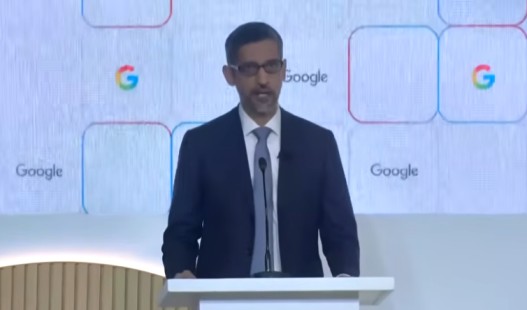
Editor’s Notes: Sundar Pichai, Demis Hassabis, and James Manyika take the stage in New Delhi to lay out how Google and DeepMind see AI transforming India over the next decade—from science and healthcare to jobs and small businesses. They reveal massive new investments in AI infrastructure, skilling programs, and partnerships with the Indian government aimed at making India a “full stack” AI powerhouse. You’ll hear candid answers on AGI, whether AI is a bubble, and how this technology can empower the smallest entrepreneurs as much as the biggest companies. If you want a front‑row seat to how Google plans to shape the future of AI in India and the Global South, this full discussion is a must‑watch. (Feb 18, 2026)
TRANSCRIPT:
Welcome Remarks
UNIDENTIFIED SPEAKER: With that, it is my pleasure and privilege to welcome Sundar Pichai to talk about the opportunity ahead for India and the world. Thank you, Sundar. Welcome.
India’s Extraordinary Trajectory With AI
SUNDAR PICHAI: Good afternoon. Thank you all for coming. It’s terrific. It’s great to be back in India for the AI Impact Summit. Whenever I return to India, I’m struck by the extraordinary pace of progress. Since my childhood growing up in Chennai, India has undergone an incredible transformation.
You’re coming with a very clear message. I believe India is going to have an extraordinary trajectory with AI and we want to be a partner. AI is the biggest platform shift of our lifetimes and one of the most powerful tools to solve problems and improve lives at planetary scale — whether it’s making diseases more detectable and treatable, communities more resilient, or learning more accessible.
For countries like India, AI presents a chance to leapfrog age-old gaps and create new opportunities. These also happen to be the places where we see the greatest adoption and optimism for AI technologies, which I don’t think is a coincidence.
Google’s AI Investment and Search Innovation
Google has been investing in AI for more than a decade because we see it as the most important way to advance our mission. That starts with reimagining the products people use every day.
For example, AI is changing the way people use Google Search. Google AI Overviews is one of the most successful launches in Search in the past decade. AI Mode is now available across 35 new languages and 200 countries and territories. Indian users are among the highest global adopters of voice and visual search.
In the coming weeks, you’ll see an enhanced model that powers Search Live — a real-time voice and camera tool — so more people can search what they see in their own language.
The Gemini App and India’s Growing AI Market
AI is also helping to create net-new experiences that are truly helpful. The Gemini app, our personal AI assistant, is growing rapidly across the world, and India is among our largest markets. It’s available in 10 languages spoken in India.
The $15 Billion AI Hub in Vizag and the India America Connect Initiative
Underlying this progress is our world-class infrastructure. Last year, we announced a $15 billion AI hub in Vizag. This hub will house gigawatt-scale compute and a new international subsea cable gateway. When finished, it will bring jobs and the benefits of cutting-edge AI to people and businesses across India.
Building on this, today we are announcing the India America Connect initiative, which will deliver new subsea cable routes to increase AI connectivity between the US, India, and multiple locations across the Southern Hemisphere.
Ambitious Skilling Programs and the Google AI Professional Certificate
To take advantage of the opportunities this infrastructure creates, we must also invest in people and skilling. Which is why we are announcing some of our most ambitious skilling programs yet. This includes a new Google AI Professional Certificate program to help people master AI in their work.
In India, we are partnering with Badwani AI to reach students and early career professionals. Globally, we’ll partner with governments, educational institutions, employers, and nonprofits. It will be available in English and Hindi, with more Indian languages to follow.
Partnership With Karma Yogi Bharat and Public Sector AI Adoption
To deliver this impact at scale, transformation needs to happen in all sectors. According to the 2025 Government AI Readiness Index, India is in the top tier of nations for public sector adoption, driven by its world-leading digital public infrastructure.
I’m pleased to share our new landmark partnership with Karma Yogi Bharat to accelerate a future-ready civil service. Google Cloud will provide the secure infrastructure for a platform supporting more than 20 million public servants across 800 districts and in 18 Indian languages.
The $30 Million Google.org AI for Science Impact Challenge
AI is fundamentally shifting the pace of discovery, and I’m excited to see how we can continue accelerating science for real-world impact. From advancing quantum computing to predicting extreme weather, AI is giving us the tools to understand the universe in deeper ways and solve hard problems in science.
With this potential in mind, today we are announcing a new $30 million Google.org AI for Science Impact Challenge to support researchers globally using AI to drive the next generation of scientific breakthroughs.
AI has the biggest impact on people’s lives when it’s developed and deployed with the institutions who know these communities best. That’s why we work with multiple Indian government bodies and local institutions such as IIT Madras. And today we are excited to announce a partnership between Google DeepMind and the Indian government as part of the Global National Partnerships Program. This will broaden access to frontier AI capabilities for national priorities. Demis will share more later on.
We are also partnering with Atal Tinkering Labs to bring Gen AI assistance to over 10,000 Indian schools and 11 million students with a focus on robotics and coding in the classroom. Google has a full-stack commitment to India, and I’ve never been more excited about the future we are building together.
Thank you again for coming and for your interest in Google, and I look forward to discussing more. Now I would like to invite Devjani, Demis, and James to join me on the stage.
## AI Nirvana: Three Voices on India’s AI Moment
UNIDENTIFIED SPEAKER: Good afternoon, everyone. Sundar, Demis, James — sitting with the three of you, it feels like I’m in AI Nirvana. The three gods of AI are here. It’s fantastic. And you’ve come to India at a time when the AI fever has just taken over the entire country. As you go into the India AI Summit, what is the one thing, one expectation that you have? I’ll start with the lightning round first. So Sundar, I’ll start with you.
SUNDAR PICHAI: Maybe I’ll say, look, it’s a transformational moment. I’m a bit nostalgic, reflecting on maybe a decade ago, coming to India and seeing the Digital India transition, and the similar excitement there. And it’s been phenomenal to actually see a decade of progress. So in some ways, this feels like the beginning of a decade-long shift with AI — so transformational.
DEMIS HASSABIS: Well, I’ve just come from Bangalore, actually, and giving a talk at the IISc. And I was really impressed with the grad students there, the energy. We had a big lecture — I think 700 students — and the amount of enthusiasm and energy for AI, and excitement about the opportunities they will bring, was really interesting to see. So I think I can feel that all around the summit, really. And it’s exciting to see that.
UNIDENTIFIED SPEAKER: You’re good at thinking exponential, right? Now think 700 exponential. You’re going to see 50,000 people crazy about AI in one place. That’s what you’re going to see. James?
JAMES MANYIKA: I think it’s an extraordinary moment for India and for the Global South to showcase a couple of things. First, that it’s actually quite possible to drive adoption and lead. And also, it’s quite possible to build and innovate in AI. I think all too often we think of these things as not happening in the Global South. I think it’s an incredible moment to showcase that.
## India’s AI Future: The Five-Year Vision
UNIDENTIFIED SPEAKER: Fantastic. Sundar, I’m going to start with you, since my job is about trying to figure out the future. So I’m going to ask you to future-cast a little bit about India. When you think — let’s think five years from now — what will AI success look like for India? Are we going to be the largest user base? Are we going to be builders? Are we going to be rule shapers? And if I may add to that, what is the one thing we have to do now to achieve whatever the goal is that we set for ourselves — that you think we should set for ourselves?
SUNDAR PICHAI: Look, I travel to many countries around the world, and I do think India is uniquely positioned in this moment. I think it has a chance to play a big role in all three. I think of Google as a full-stack company, and I think India, obviously, is going to be a full-stack player in AI.
Laying the Foundation for AI Adoption
**SUNDAR PICHAI:** I think what’s important to be in a position to do that, and I think that’s what this AI summit is about. You have to make sure you’re investing in all the foundational things you need — in the research, in knowledge, in the institutions you have here, the government playing a role in diffusing AI across the country and the economy, and making sure it’s reaching people.
That means you’re adopting it in all the sectors, and in a way that the progress is touching the average person on a day-to-day basis, be it a farmer, be it a student, be it a doctor in the healthcare sectors, et cetera. I think the foundation is being laid, and I can see it. You’ve seen the announcements this week in terms of infrastructure investments alone. So I think that puts India in a good position to get there, but I would say the progress is about diffusing the technology, and I think India can play a role in all three categories. So transforming the lives of the last woman in the food chain — that’s what success should look like, right?
—
AlphaFold and India’s Strategic Bets
**UNIDENTIFIED SPEAKER:** That’s absolutely correct. Okay, wonderful. Demis, I’ll come to you next. I’m a big fan of the work you do, and one of the fascinating things about AlphaFold — it’s not just what it does, but how many researchers, how many scientists it has enabled to actually go out there and discover things that we couldn’t even think of discovering a few years earlier, right? For me, that’s what’s really fascinating.
When you think about all the problems you can solve, but when you think about India specifically, if we have to make one or two strategic bets, what should those be where we really go in with deep investments, commitment, and say that this is a place where we want to be a global leader — healthcare, education? What would be the two things you would prioritize?
**DEMIS HASSABIS:** Well, first of all, we’re very proud of the impact that programs like AlphaFold have had. Over three million researchers around the world make use of it now — actually over 200,000 in India — and almost every biologist researcher in the world. And I think it’s just the beginning of the impact that AI is going to have on the sciences and medicine, and I feel like India can play a very leading role in that adoption of AI to the sciences.
Maybe what I would say for India, but also many countries — I also advise the UK on this — is to double down on the things you’re already strong at and are important to the country. Perhaps it’s agriculture, for example, and then be the leaders in applying AI to that space that you’re already world-leading in. So I think agriculture is something I’ve been discussing with some of the ministers today — for example, making crops resilient to climate change, maybe using things like AlphaFold to help with that.
And then perhaps the other place would be something like Bollywood and the creative industries, making use of the latest AI tools. Actually, James has just been — maybe he can speak to that too.
—
DeepMind’s Partnership With the Government of India
**UNIDENTIFIED SPEAKER:** And how would DeepMind partner with the government of India on these kinds of moonshot projects?
**DEMIS HASSABIS:** Well, we’re partnering in all sorts of ways — all the things that Sundar just announced — and we’re ready and able to partner in much deeper ways if the government wants, whether it’s with Gemini, our main foundation models, our scientific tools like AlphaFold, or our open-source work like Gemma. So I think there’s a range of things that we can help the government of India with.
—
The Jobs Question
**UNIDENTIFIED SPEAKER:** James, I’m going to ask you about the elephant in the room that everyone wants to know, which is jobs, right? Now, I was listening to some of the things you were saying at Davos, and it was very interesting. You were talking about how with every technology shift, there are jobs that change, that go away, and then there are jobs that get created. But they don’t happen at the same time. There’s a lag. So two questions.
AI and Jobs: Tasks, Skills, and Transitions
**JAMES MANYIKA:** One, how do governments deal with this lag, right, especially a young demography like India? And two, what do we have to do to ensure that we come out of this as a job creator?
**JAMES MANYIKA:** No, I think it’s probably one of the most important questions that countries, governments, and society are going to need to think through. And I think it’s important to keep in mind that when you’re thinking about the question of AI and jobs, it’s actually worth thinking about specific tasks as opposed to whole jobs, because most jobs are made up of a constituency of different tasks.
And when you look at that, you suddenly realize that, as you said, you may have some occupations that will decline, many that will grow, and many more that will actually change. And I think it’s important to keep that in mind. So what happens is when you look at these questions sector by sector or occupation by occupation, you see a lot of transitions going on.
But to the question of what should governments do to make sure that, in fact, they are growing jobs and enabling the change that happens — I think one is to focus on skilling. One of the things that happens in all these transitions, whether it’s people who are transitioning out of jobs that are declining, or jobs that are growing, or jobs that are changing, is that the skills required change. So investing in skills and literacy and so forth I think is foundationally important.
The other thing that’s important is also the continued kind of investments that countries and governments like India are doing in infrastructure and innovation, because a lot of the jobs that will grow will come out of those investments in infrastructure as well as investments in innovation. When you grow businesses, you grow companies, and you have innovation in the economy, that’s what leads to job growth. So I think those investments in innovation — both in the infrastructure and innovation, but also in the skills — is what governments need to focus on.
—
**MODERATOR:** I think what you said is so important, that you cannot have a macro view of jobs. You need to start understanding which tasks are going to get impacted, you need to start planning for that, you need to start planning for which sector. So we really have some work to do to figure out where will we get hurt the most, what are the opportunities, and then plan for it. And I think that’s excellent advice. Absolutely.
The AI Bubble Question
**MODERATOR:** Sundar, if I may come back to you — the other elephant in the room: are we going to see an AI bubble, or are we not, right? Now, a lot of CEOs — when you talk to enterprise CEOs — they are worried about really scaling up investments, because they’re worried about whether they are going to be able to justify the cost, what will the board say, et cetera, et cetera. Help us understand, based on your experience, based on Alphabet’s experience, how should CEOs deal with this question and deal with this problem today?
**SUNDAR PICHAI:** You know, we live in a truly global world. I thought if I left the US, I could avoid this question. But look, it shows.
Look, I think it’s an extraordinary moment. I think we are investing to meet that moment, right? I think in some other context, Demis has spoken about this as the industrial revolution, but ten times faster and ten times larger. And if you go back and look at the railroad investments or the national highway system in the US — I mean, these are such leveraged investments, and you drive so much growth and value on top of that. I view this as a transformational moment like that.
As Google, I think we are fortunate that we’ve been focused on this technology for over a decade. And be it Search, be it YouTube, be it Cloud, be it emerging businesses like Waymo or Isomorphic Labs — I think they are all getting better and growing based on this one technology underneath. So we can generate a return there.
Just as an example, cloud alone in the last year, the backlog has doubled year on year to $240 billion. So that shows the potential for return on the other side. And so we are investing to meet that demand. And that’s what makes this an exciting moment. So I think the investment makes sense, given the progress in the technology we are seeing and the opportunities we see on top of it.
## What Is AGI — And Why Are We Building It?
UNIDENTIFIED SPEAKER: Demis, I have to ask you the third elephant in the room, which is, what on earth is AGI? Because we keep hearing about it. And the more we hear about it, the more we feel like we’re trying to build something that is going to control all of us. And then the question is, why are we building it? So what is it? Is it really the end goal to control? Or is the end goal to augment prosperity? Help us understand your take on it. And also, how should India be thinking about AGI? Or if we need to prepare, what should we be doing?
DEMIS HASSABIS: Well, the first thing I’ll say is, the reason I’ve worked my whole career on AI is because I think it could be the ultimate tool for accelerating scientific discovery and areas like medicine. So things like AlphaFold, I hope will be the first of many advances showcasing that. And then we can apply that to help us tackle many of the challenges facing society today — from disease, to climate, to inequality. So I think AI on the upside, the opportunity has an AGI and the limit has that potential.
## Defining AGI — A High Bar
In terms of defining what AGI is, I’ve always defined it with a high bar — which is a system that exhibits all the cognitive capabilities that humans have. Now, the reason that’s important is the human reference point is because the brain is the only evidence that we have, the only existence proof we have that general intelligence is possible.
So we won’t really know we have a fully general system unless it’s able to do a lot of things that we sometimes take for granted. Things like creativity, long-term planning, and better use of memory. And so today’s systems — they’re impressive, but they’re not there yet, in my opinion. I think we’ve still got a way to go, at least another five to ten years.
But certainly in the next phase — the next decade or two decades — I see it as the ultimate enhancement tool for us: human scientists, human experts, but also the youth of today. And this is what was exciting, seeing that in India here on this visit. We’ll have access to these incredible tools. So whatever that means — building businesses, creating art — I think they’ll be almost super-powered to do that with access to these tools that you can access from anywhere. The most cutting-edge tools in the world from anywhere, including from India.
## The Risks We Cannot Ignore
So I think it’s going to be a very exciting moment, but there are also risks too that we have to take into account. You mentioned jobs earlier, but there’s also technical risks — making sure these systems stay within their guardrails and they serve our purposes and what we want as humanity. And then furthermore, the economic question of sharing the benefits that that’s going to bring widely and equally across the world. So these are all big challenges still to come, but the potential is there if we do it in the right way.
## The Role of Humans Becomes More Important
UNIDENTIFIED SPEAKER: Just listening to what you said, something just struck me — we all talk about how, in the world of AI, we’re going to question the role of humans and we don’t know. But what you said sort of told me is that the role of humans is going to become even more important. Am I right in reading that?
DEMIS HASSABIS: I think so. Look, for the next couple of decades, I think that’s going to be the way.
AI Systems Moving From Passive to Proactive
JAMES MANYIKA: If you think about the AI systems today, they’re kind of passive systems. They’re impressive, but the human using it puts in the energy, puts in the question. Even in science, we have to supply the hypothesis and what the right research question is, and then these tools will help us get to those answers more quickly. So I think that’s going to be the next phase of the AI development story.
AI as a Superpower for Small and Micro Businesses
MODERATOR: James, I’ll come back to you. Sundar talked about his vision of success — when the last person in the value chain is empowered. Now in India, we have a very strong SME sector, the small micro businesses. They’re really the backbone of our economy, right? And they always are left behind when it comes to technology adoption. I’ll ask you the same question: what should AI success look like, but with the SME lens? What would your answer be?
JAMES MANYIKA: I actually think this is one of the most exciting opportunities, because I think for the longest time, most SMEs in both developing and developed economies — quite frankly, any economy — have always not had the kind of capabilities and powers that large companies have. And I think this is probably the first technology that fundamentally changes that.
You could argue the internet and mobile and all of that did some of that, but this does it even more. Think about the kinds of superpowers that this technology gives to an SME. Imagine an SME — it could be a trader, it could be a retailer, it could be a small manufacturer doing handcrafts and so forth. Think about the ability to harness technology without having to be a technologist. Think about the small proprietor who can actually describe the technological systems that they want their small business to use in almost vibe code — or describe what they want and these systems build that.
So I think the possibility of these kinds of superpower capabilities being available to small businesses is going to be extraordinarily exciting. And I think the potential for that, particularly for countries like India and countries in the Global South, where the SME part of the economy is actually the biggest part of the economy and touches more people, more lives.
Now, one of the things that we’re hoping we can contribute to — we’re partnering right now with Project Vani, for example, with the Indian Institute of Science. The question is: how do you make these technologies more available and usable in all the languages? So we’re now focusing a lot on the Indic languages and how do you make it possible to just do speech translation directly, without having to go to a keyboard? And we’re already working on that. So I think these are some of the possibilities for SMEs, and I’m very, very excited about that.
India’s AI Leapfrog Opportunity
MODERATOR: We have very little time left, so I’m going to come to you. India has leapfrogged past tech shifts — they went straight to mobile, digital payments, et cetera. Everyone keeps talking about the AI leapfrog opportunity. What does that mean to you? If you had to describe that, what would that look like?
SUNDAR PICHAI: Okay, it’s a great question. And that’s what this opportunity represents. Look, it’s a bit difficult to describe it, but I literally expect every sector, every context, every workflow to be transformed by it.
To me, we are partnering with AIIMS in India, as an example, on how patients can input their symptoms or give information. The AI creates a report to help doctors. We are in the early stages of projects like this. But to me, leapfrog means that in each of these sectors, you radically transform how the workflow happens. How do students learn? How do hospital systems work? How is government made more efficient — in a deep, foundational way?
The Future of Scientific Discovery
**SUNDAR PICHAI:** I do think in areas like science, one of the things Demis and his teams have been focused on is how do you accelerate scientific discovery at a fundamental level? I think we are talking about a technology here which will allow you to create new things at some incredibly fast trajectory. So I think it’s a bit tough to fully envision today, other than we know it’s going to happen in a pretty profound way. But on a practical basis, I expect on a day-to-day basis, people’s lives to be significantly enhanced with it across everything they touch.
Keeping India’s Talent at Home
**INTERVIEWER:** Very last question to you, Sundar. We are known for our talent, our young talent, and we’re very proud of people like you who go out and do such fantastic work. But what has to change in India so that the next Sundar — or Sundar 2.0 — stays here and builds the world’s most magical AI company in India?
**SUNDAR PICHAI:** I think, I mean, it’s already changed. When I look at India, it’s been producing extraordinary companies. When you look at companies like Flipkart, Oyo, et cetera — these are all companies homegrown here, and they’re doing really, really well. The developer energy I find in India every time I travel — you were in Bangalore recently — and it’s second to none. The entrepreneurship ecosystem here is thriving. Even recently, the work Sarvam has done developing local AI models. So I think what you’re talking about is actually happening, and I just don’t see any impediments to that. I think India is very, very well positioned.
Closing Remarks
**INTERVIEWER:** Well, on that note, thank you very much to all three of you. And if I could please request Preeti and Sanjay Gupta, President Google APAC, to please join us. Thank you.
**CLOSING SPEAKER:** Thank you, Sundar, Demis, James, and Devjani for a conversation that grounded AI in something very, very concrete and real-world impact. India is showing what happens when a culture of innovation meets talent and partnership.
For Google, the focus is to build responsibly and work in partnership with India, and translate capability into outcomes that people can see, trust, and use. This summit is about accelerating that journey — moving from experimentation to deployment, and from deployment to broad social benefit.
Thank you to all of you for being part of this conversation today. I look forward to seeing you all at the Google Pavilion between sessions at the AI Summit. Come and see the amazing work Google and DeepMind is doing to benefit humanity and accelerate progress.
Related Posts