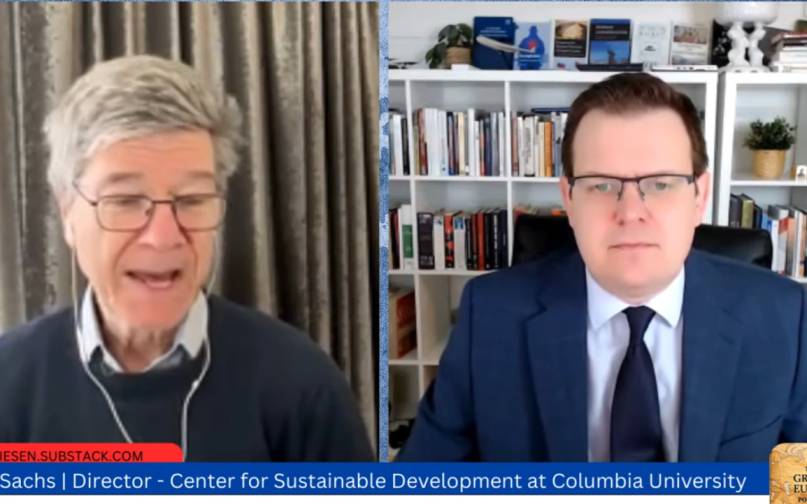
Editor’s Notes: In this compelling interview on Glenn Diesen’s Greater Eurasia Podcast, world-renowned economist Professor Jeffrey Sachs reflects on the four-year anniversary of the war in Ukraine and the broader twelve-year history of the conflict. Sachs critiques the “Western hegemony” mindset, arguing that long-standing U.S. and European policies—such as NATO expansion—have fueled a humanitarian and strategic disaster rather than fostering peace. He offers a provocative analysis of how the war is reshaping the global order, pushing Russia toward Eurasia and accelerating the transition to a multipolar world. Ultimately, Sachs calls for a return to diplomacy and collective security to prevent further escalation and help Europe regain its footing. (Feb 23, 2026)
TRANSCRIPT:
Introduction
GLENN DIESEN: Welcome back to the program. We are joined again by Professor Jeffrey Sachs to discuss the four year anniversary of Russia invading Ukraine. That was on February 24th in 2022. It’s also to some extent the 12 year anniversary of the NATO backed coup in Ukraine on February 22, 2014, which, well, it can be argued triggered this war to begin with. So thank you very much for coming back on the program.
JEFFREY SACHS: Sad that we’re still talking about this war and that it’s still going on after all this time. Really amazing.
GLENN DIESEN: I agree. This war has been just a disaster on all levels. Of course it’s a humanitarian disaster, especially for Ukraine, and it’s also been a strategic disaster that is destroying Europe and will continue to take us closer and closer to a possible nuclear war.
So given that we have these two anniversaries now, why do you think this war is still going on with so much at stake, so much destruction?
The Origins of the Conflict: American Triumphalism and the Illusion of Hegemony
JEFFREY SACHS: Well, the starting point is that the US assumed that it would never get to war. This whole debacle, this whole disaster starts with the ideas in the 1990s that at the end of the Cold War the US reigned supreme and it could bring Russia into a US led world. That was the basic idea.
And in fact, not only could it bring Russia into a US led world, it would reduce Russia to a third rate power, maybe even divide Russia. Zbigniew Brzezinski, who is the most articulate of all of these delusionists, wrote in the 1990s that perhaps Russia would fall apart into three weakly confederated states — a European Russia, a Siberian Russia, and a Far Eastern Russia. This was triumphalism. The idea was that the US was unchallenged and unchallengeable, and that therefore there wouldn’t be war. Russia would accede to whatever demands the United States made.
And when Russia did not accede to whatever demands the United States made, this was the reason that the war went on. When Russia proved that it could resist what the United States and Europe thought would be a crushing blow after 2014, and then after 2022 Russia resisted again, that proved that Western power was less than was thought. This became, in itself, for these politicians the necessary reason to fight on.
Boris Johnson, who is one of the real criminals in all of this, a real culprit of this war, said in an interview that he could not let Ukraine sign a peace agreement with Russia in the spring of 2022 because that would be a threat to Western hegemony. So this is children playing a board game. Of course, it’s not a board game. It’s millions of lives lost, it’s economies crushed, it’s opportunities for life squandered at the hands of a small group who have been playing what they think is a game of Western hegemony.
There have been no stakes in any of this for European or US security. This is not a matter of US or European security. This is a matter of first US and then European dominance.
The Europeans, I should add, are a little strange in this. The US led them into it. The Europeans knew that this was a bad idea. When the US pushed for NATO enlargement to Ukraine, there was a lot of resistance in Europe that this would lead to war. But now that Trump — who has his own set of delusions, just not this one — is interested in other things, the Europeans still can’t find an off ramp because they became delusional themselves. The thinking became: well, if it isn’t the United States that’s going to assert Western hegemony, we’ll do it ourselves.
And so it’s a grudge match of Germany, France, and Britain against Russia that is slogging on, and which prevents these miserable leaders — miserably unpopular with their own people — I’m speaking of Merz, Macron, and Starmer — from telling the truth that this was a bad idea to begin with, that it should end, and that the best thing for Ukraine is Ukrainian neutrality and an end to this war. They just can’t tell the truth.
The Path to a Negotiated Settlement
GLENN DIESEN: So how can we possibly get a realistic negotiated settlement today? Because I see the commentary ranging between optimism and full out rejection that it’s not possible, because the situation is quite complicated.
Russia obviously sees NATO expansion and especially the incursion into Ukraine as being an existential threat, so it has very strong demands. Ukraine also sees itself as facing an existential threat with the invasion, and what they see as the solutions are exactly the opposite. The US seems to hold some keys because it’s worried that this conflict will bog it down in Europe and also push Russia further toward China. But I don’t really understand what the Europeans are doing. As you indicated, it doesn’t make much sense at all to keep this going. What do you see as possible settlements or solutions?
Germany’s Central Role and Its Repeated Failures
JEFFREY SACHS: The real solution here belongs with Germany.
Germany is the key. Germany’s terrible leadership is the reason why this war broke out and why it continues.
It’s very poignant to read the memoirs of Angela Merkel, where she describes the point where Germany gave in to US demands for NATO enlargement at the Bucharest NATO summit in 2008. On the first day of that summit, when George Bush was recklessly pushing NATO to commit to enlarging to Ukraine and Georgia, France and Germany — and I know others, Norway and others — all thought this was a very bad idea. They tried to resist, explaining to Bush that this could provoke war, that this would provoke a crisis in Europe, and so forth.
The United States persisted. This is just an example of the US deep state — in this case, Bush being a very weak president, Cheney being a very dark figure behind him, but really the deep state still pursuing a policy it had already set more than a decade earlier: that yes, NATO would enlarge. They pushed the Europeans to accept it. Merkel resisted on the first day of the summit, but then gave in on the second day.
That, to my mind, is the turning point of Europe. She says, “I salvaged something because we didn’t have a literal plan for accession, only the commitment to accession of Ukraine and Georgia to NATO.” That didn’t make much difference from the Russian point of view, and it didn’t make much difference from the politics that was to unfold afterwards. So Merkel, who was a very decent person in my view as chancellor, gave in. That was her mistake.
Scholz was just impossibly weak and confused. He didn’t utter one sentence of truth or sense about any of this during his time as chancellor. And Merz has been a grave disappointment as well, because when Merz came into office as chancellor, he just beat the drums of war from the first moment. He didn’t say, “Well, I’m newly arrived. I’m going to contact my counterpart, Vladimir Putin, to see whether it’s possible that we work something out.” He just said we’re heading towards an even bigger war.
So German leadership has been terrible, and it’s consequential because Germany is really at the center of this story in a lot of ways.
Most importantly, in 1990, after the fall of the Berlin Wall, when Germany was still divided between the German Democratic Republic in the east and the Federal Republic in the west, Helmut Kohl was chancellor and wanted to move towards fast reunification. That required the approval of the Soviet Union. And to obtain that approval, Kohl explained to Gorbachev on February 10, 1990, that German unification would not threaten Russian national security because, in part, NATO would not move eastward.
That commitment was made by Kohl to Gorbachev, and it was made repeatedly by Hans-Dietrich Genscher, the German foreign minister — publicly, privately, in countless ways. That’s the basis of German reunification.
Merz should understand this. Germany cheated in a very big way. Of course it cheated alongside the United States. It was both Germany and the US that, from 1993 onward, started to push for NATO enlargement. I often talk about the US being the main driver of this, and I think it was. But Germany was an enthusiastic NATO enlarger, even though Germany was the overwhelming beneficiary of the commitment that NATO would not move one inch eastward. This is all well documented.
Merz should know it. Then, to bring us to the anniversary of the Maidan coup, in which the US did a lot to overthrow a neutral government in Ukraine — we should recall that on February 21, 2014, the German, French, and Polish foreign ministers negotiated an agreement with Yanukovych for an end to the unrest on the Maidan, much of it stoked by the United States itself, in return for elections later in 2014. Germany was a party to this agreement. This agreement was also brought to agreement with President Putin and President Obama.
And the next day, the coup leaders stormed the government buildings in Kyiv and overthrew Yanukovych. At that moment, the Western governments should have said, “We don’t accept this coup. Yanukovych is the legally constituted president.” He was in Kharkiv that day. He said, “I’m still president.” But Obama immediately recognized the new government, which was part of the US deep state plan. Germany went along again. This is terrible. Europe failed. Europe had signed an agreement with Yanukovych and then, completely within 24 hours, buckled to the United States.
Then Germany cheated again. In 2015, after the war had broken out, the two oblasts in the Donbas — Donetsk and Luhansk — had broken away and declared that they were not following the coup regime in Kyiv. A war began with the Kyiv government attacking the breakaway regions. And President Putin helped to orchestrate what became first the Minsk I and then the Minsk II agreement.
Most importantly, the Minsk II agreement of 2015 said that the fighting would stop on the basis of political autonomy for the two ethnic Russian and Russian-language regions of Luhansk and Donetsk. The guarantors of that agreement were to be Germany and France. And we now know, by the testimony of both of them, that they did not enforce the agreement, they did not pressure Ukraine to follow through, as was their responsibility.
As Merkel later said in a rather shockingly brazen statement, she regarded the Minsk II agreement as a holding period — a time for Ukraine to build up its strength for war. I don’t know if Merkel meant that at the time in 2015. That’s how she explained it in 2022 and 2023. But in any event, Germany did not fulfill its role.
So to my mind, Germany has the highest responsibility — as the largest country in the European Union, as the one that was at the very center of this story from 1990 onward, and as the one that has failed in its political responsibility at the crucial moments: on the question of NATO enlargement, on the question of the coup on the Maidan in February 2014, and on the enforcement of the Minsk II agreement. Germany failed repeatedly.
For Merz to come into office as chancellor and simply declare that Putin cannot be trusted betrays either a basic ignorance of the key facts of the events of the last 25 years, or a brazen disregard of those facts. I hope that it’s ignorance of them.
The way that one would solve the question of ignorance is through dialogue. Merz should have immediately picked up the phone and called his counterpart and said, “I’m newly elected as Chancellor of Germany. We have a major responsibility to try to find peace. I believe that our foreign ministers should meet and discuss what might be done. Maybe we won’t reach an agreement. Maybe we will, but we should try.”
Nothing of that sort happened. I believe that’s what should happen immediately. I assume that after Mr. Merz hears our interview just now, he will immediately call President Putin and try to find peace.
The Collapse of the Post-Cold War Security Architecture
GLENN DIESEN: I do like your optimism. Well, if the key is Germany, we may have some problems, because some of the most dangerous rhetoric comes from Germany now. And also, as Merz stated at the Munich Security Conference, he essentially denounced the whole efforts by Orbán to talk to Zelensky and Putin — well, Zelensky is okay to speak with, but you can’t talk to Putin. This was essentially immoral, he suggested. So I’m not placing too many bets on this.
But I like the wider perspective you take here, because the Ukraine war is to a large extent about the collapse of this pan-European security architecture. I think this wider context is important. But at that time, at the end of the Cold War, when there was this ambition to have a common European home — a greater Europe from Lisbon to Moscow — there were a lot of opportunities that were not taken.
You were there then, advising. You advised Poland, you advised the Soviet Union under Gorbachev, you advised Russia under Yeltsin. What is it that they wanted, vis-à-vis what the Americans wanted? Why wasn’t it possible to essentially reach a mutually acceptable post-Cold War settlement?
Poland, Russia, and the Rejection of Economic Stabilization
JEFFREY SACHS: I began advising in Poland in 1989. And Poland, of course, entered into a coalition government of President Jaruzelski, who was the Soviet-backed president, with the Solidarity movement, which was the anti-communist movement in 1989, to form a government. And I was very much involved in that and involved in the economics around that.
And when it came to the economics, the point was that Poland was broke. It had no foreign exchange reserves, its currency was collapsing, there was very high inflation, there were shortages of goods. So as a macroeconomist, I was able to devise a program of stabilization that I recommended to the Polish government and to the European governments. And those recommendations, broadly speaking, were endorsed.
And from a practical point of view, Poland was able to end the high inflation, stabilize the currency, and begin after about a year, a process of economic growth that would last for the following 30 years. So it was a very successful transition from a very, very fraught financial situation. And the tools to do that are rather well known, if one studies such crises or has been involved in solving them, as I had been.
When it came to the Soviet Union, the same situation applied, although on a scale that was much larger. So I recommended a similar package, but on a much larger scale. Those recommendations were flatly rejected by the West. The same kind of economic policy that was working for Poland was turned down by the US government.
25, 30 years later, I read the minutes of the White House meeting in which it was turned down. I was shocked by the flippancy and the brazenness and the ignorance of the participants at that meeting. So there was naturally the element of Machiavellianism and the element of bravado of the winners in the Cold War as they saw it. But there was also, Glenn, just stupidity of people who understood nothing about economic stabilization, understood nothing about what it was that Gorbachev’s government needed, and so on. So the incompetence always needs also to be highlighted in this.
Well, it turned out that both for the Soviet case and even after the Soviet Union ended for the Russian case, the West was completely uninterested in even the most routine kind of financial support to end a deep crisis. At the same time, I heard directly from President Gorbachev and from President Yeltsin how what they wanted was the same as what Poland wanted — an end to the divisions, a united European home.
President Yeltsin’s favorite word was “normal.” Russia should be normal. No more revolutions, no more Bolshevism, no more divisions, no more Cold War, just normal.
Hegemony Over Peace
But the United States wasn’t having peace. The US was having hegemony. That’s a difference. Peace means you deal with your counterparts with respect and even help in the short term. Hegemony means you crush your counterparts because your aim is to dominate. And that’s what we got instead.
That’s why NATO enlargement was on the table when Russia was not only no threat — it was saying exactly the opposite. It was asking to join NATO. It was wanting to have a common European security. There was no threat. But the US wasn’t interested in no threat. The US was interested in dominance. And that’s what I witnessed at the time.
The Ukraine War and the Reshaping of the Global Order
GLENN DIESEN: Well, I was going to ask, how do you think now the Ukraine war has reshaped the global order? Because the world doesn’t look — well, it looks very different than it did only four years ago.
JEFFREY SACHS: One of the interesting chapters in Zbigniew Brzezinski’s 1997 book, The Grand Chessboard, asks the question: as Europe and NATO push eastward and surround Russia, what will Russia do? And Brzezinski devotes a chapter to this and he asks, well, Russia might agree, buckle in, or Russia might resist — and could it form an alliance with China, for example, or with Iran?
And Brzezinski analyzes all of this and he declares very confidently, there’s no chance that Russia will do anything but accept its European vocation. Russia has no other option. That proved to be decisively wrong.
Russia said, “Okay, goodbye. We turn towards Eurasia, we turn towards China,” which, by the way, is a great economic fit. Russia and China are very complementary economies, as Russia and Europe were, by the way. That was a good fit too. It was good for Germany and good for Russia. That fit was destroyed by the West through its 20 rounds of sanctions and so forth. But Russia said, “We will look in a different direction — towards India, towards China, towards Central Asia, towards Western Asia, towards Africa.” That’s the world that is being built right now.
A Multipolar World Emerging
So the US thought, “We’re the hegemon, we’ll run the show.” But in fact what we have is a bully in the United States — still very violent and very powerful, no doubt — and a vassal Europe, utterly confused, demoralized and divided. But the US and Europe and Britain and Japan and Korea somewhat, and Australia somewhat, and New Zealand together constitute about 12% of the world population. Maybe, if you’re being most expansive, up to 15% of the world population.
What is taking shape is a multipolar world where increasingly the other 85% of the world population say, “What is this US bullying? What is this US hegemony?”
Now, we’re not past the delusions of the United States. If you were to ask Donald Trump, who is a master delusionist, what is your map of the world, he would say the following. He would say, “We own all the Americas — that’s the Monroe Doctrine, we just own all the Americas, and we proved that. We kidnapped a president in Venezuela. We own all of Europe. We don’t really want it, it’s pathetic, these people are useless, but anyway, we own all of Europe. We own all of the Middle East, and we’re going to prove it because we’re going to go to war with Iran. We own India because India is afraid of China, and we own half of Southeast Asia and the Pacific. So we’re surrounding China. So we’re pretty good. We’re still in charge.”
That’s the American delusional view of the world. Quite dangerous.
And by the way, Africa — I didn’t mention it because the United States doesn’t think about Africa except for getting the cobalt, that’s all, and some rare earths. The US has absolutely no attention span for Africa as Africa. It is only a place where there are some minerals that they want.
Now, if you look at the world from a different point of view, the BRICS countries would say, “Well, we’re basically half the world. We are Russia, India, China, Brazil, South Africa, now Egypt, Ethiopia, United Arab Emirates, Iran, Indonesia. We don’t want to be bullied by anybody. And we’re about half the world population.”
The African Union as a whole — that’s 55 countries with almost 20% of the world population. It’ll be 25% by mid-century. And they don’t want US hegemony. And they’re real. They’re not just a bunch of minerals. They’re real.
And of course the other parts of the world are contested, and Europe once in a while even says, “Do we just want to be pathetic vassals of the United States, or do we have some history, culture, society, different points of view that we would like?” So Europe doesn’t quite totally accept its vassalage.
And I think the fair way to put things is the United States in relative terms doesn’t have anything like the authority, the reputation, or the desire for alliances in the rest of the world. The Western world is a small part of the world, and the vast truth of the 85% outside of the US and Europe and a couple of East Asian countries is they want prosperity, they want to make good trade, they want to advance in technology. And China will be a good partner for them, India will be a good partner for them, Russia will be a good partner for them.
So this is hardly the US hegemony that Trump and the American deep state imagine. That’s how I think is a much more accurate view of the world. The faster the United States gets beyond its delusions — I hope it’s fast enough to avoid a war in Iran, which would be disastrous — the better the whole world will be, including the United States itself. The faster Europe escapes from its pathological Russophobia and says, “You know, we were led down a path that we ourselves chose to walk. It was a mistake. We need to make our continent safe, secure, based on collective security” — the faster Europe can thrive once again.
Biden, Brzezinski, and the Failure to Foresee Consequences
GLENN DIESEN: The chapter of Brzezinski reminds me of a speech given by Joe Biden at the Atlantic Council back in 1997, where he said that the Russians were worried about NATO expansion and they said we might look towards the East, to China. He mocked it, saying, “Yeah, well, if that doesn’t work, you can always work with Iran.” And the whole audience just breaks out in laughter. It’s the funniest joke.
JEFFREY SACHS: That’s it. Yeah.
GLENN DIESEN: It’s the inability to predict possible consequences. What seems awfully patriotic today is a very foolish policy, perhaps, which puts us in a very difficult spot for tomorrow.
JEFFREY SACHS: I recently reread a famous speech of the arch imperialist Joseph Chamberlain, the head of the Colonial Office of Britain, that he gave in 1897. And one of the notable points of a completely obnoxious imperialist speech is he says, “The British realms extend throughout the world. We are a quarter of the whole world. There is no one that can begin to challenge us in all of the future of history as far as we can see.”
And a half century later, it was all gone. And so these predictions, this bravado, this arrogance, this belief that you can run the world — it is the pride before the fall. And that’s been America’s and Europe’s big mistake.
GLENN DIESEN: Well, thank you, as always, for taking the time. I very much appreciate it. And I know you have a big day ahead of you, so I’ll let you go. Thank you.
JEFFREY SACHS: Good. We’ll talk to you again soon. Take care.
Related Posts