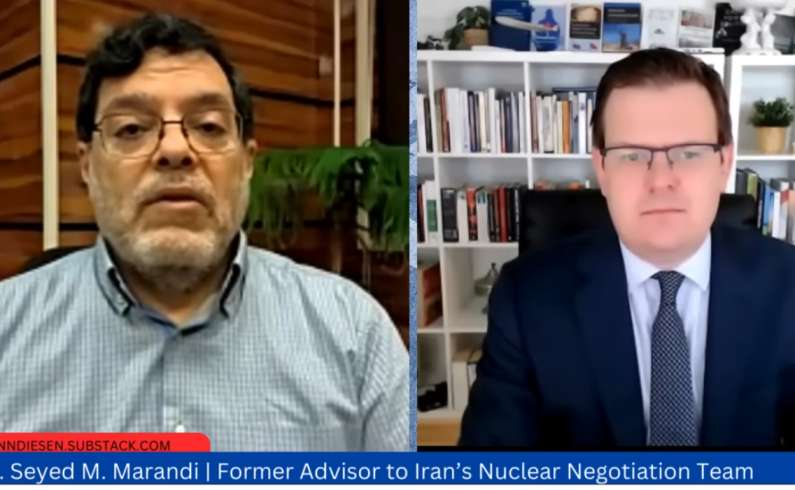
Here is the full transcript of Professor Seyed Mohammad Marandi’s interview on Greater Eurasia Podcast with host Glenn Diesen, January 12, 2026.
Brief Notes: In this intense January 2026 update, Professor Seyed Mohammad Marandi joins Glenn Diesen to provide a firsthand account of the civil unrest in Tehran and the escalating threat of a direct military confrontation with the West. Marandi challenges Western media narratives, detailing how the internet was suspended to thwart foreign-coordinated “terrorist” infiltration while millions of citizens marched in support of the Iranian state. He delivers a sobering warning that Iran is fully prepared for war, predicting that any U.S. or Israeli strike would trigger a counter-offensive capable of devastating the global economy. This discussion offers a critical look at the “psychological warfare” and sanctions currently pushing the region toward a massive conflict.
Introduction
GLENN DIESEN: Welcome back. We are joined today by Professor Seyed Mohammad Marandi, a professor from Tehran University and also a former advisor to Iran’s nuclear negotiation team. So thank you for coming back on.
SEYED MOHAMMAD MARANDI: Hi Glenn, thank you very much for having me. It just shows how much I like your show because I went through a lot of trouble to get online.
The Pattern of Regime Change Operations
GLENN DIESEN: Well, I appreciate it very much. And I guess what you’re referring to is the Internet connections in reference to the different riots which have been going on in different cities in Iran, including Tehran.
Then it does seem though that every time there’s a build up to another regime change operation or invasion, it almost every time follows the exact same script. That is, first you destabilize the society with sanctions and an information war. Then you build on the grievances of the public and instigate violent protests. You announce the intention to help or support the locals in their aspirations for freedom against their own government, of course.
And the rhetoric is always dumbed down to a binary choice. Either you don’t care about the struggle for freedom and the aspiration of brave protesters, or you support the sanctions and or military intervention.
And after the coup or invasion, it turns out the U.S. and its allies actually had some zero sum geopolitical interest and power interest as opposed to solely acting out of altruism and the love of freedom. But almost every time the result is always the same. From the Arab Spring and onward, that is the country which was to be liberated is instead destroyed.
So we’ve all seen this movie before, which is why it’s my position that Iranians can of course protest the government all they want, but this is an internal Iranian issue. And as soon as it becomes an international issue, then you can’t really keep the geopolitics out.
But sorry for the very long prelude to the question. So how do you assess though the situation now there on the ground in Tehran? What are the domestic grievances and what is the geopolitical component here?
The Reality on the Ground in Tehran
SEYED MOHAMMAD MARANDI: Well, you know, first I should point out that every once in a while, every few years, the West, Western media, Western pundits, think tanks, leaders say that Iran is on the verge of collapse. And every time people like myself come and say that it’s not going to happen. The state has popular support, the constitution is something that a very strong majority of Iranians adhere to. And your assessments are based on wishful thinking.
And every time, every single time, they’ll say you’re a mouthpiece for a dying regime or something like that. And then it goes, it’s like a loop. It goes over and over every two, three years, three, four years, four or five years.
Now, what’s happening now is that basically we had a sudden fall in the currency. I don’t know what percent, but let’s say 40, 50% in a somewhat brief period of time, maybe 30%. I’m not sure because I don’t follow the currency rate. But it was a surprise fall, and it turns out that it was managed from abroad. In other words, the United States and its Western allies put pressure on those places that do currency exchange with Iran.
So for a period of time, there was a lot of difficulty. Then because the currency dropped significantly, we had in Tehran and some other places protests, not very large, 2,000, I guess. Again, I don’t know the numbers, but let’s say a few thousand. And they were peaceful.
And why were they protesting? They’re basically business people who had shops who bought and sold. And their argument was that, look, if you don’t stabilize the currency, we’re going to go out of business because we sell goods, and then suddenly the price goes up and we can’t buy new goods to put in our shops, to put it simplistically, because I’m not an economist.
The protests went on peacefully. No one was arrested. No one was hurt. The police did not intervene. Nothing happened.
Violent Infiltration and Terrorism
And then we saw day two. On day two, the protests continued. Probably the same number of people, maybe a bit more, maybe a bit less in Tehran. Not in most cities, but in maybe a couple of the bigger cities. Then we had infiltration.
Suddenly we had these small groups of people, and we had this four years ago as well. Small groups of people, very well disciplined, very well organized, began to infiltrate the protests and began rioting. And they were very violent.
Over the past few days, over 100 officers of the law have been murdered. Some of them have been beheaded or burned alive or smashed, their faces and heads smashed by these people. So in the United States, we have a case where someone came and says, “Internet, okay?” And I say, yes, it’s fine.
So in the United States, you had the case of a woman being shot in the head by an ICE official or officer.
And we saw what happened in the United States. Here, the argument goes that she was about to run him down or run over him. And the argument is whether she pulled to the right or not or not enough for him.
They murdered over 100 officers of the law. They murdered, they burned alive a young woman who was inside a clinic. She was a nurse. They burned down the building. She went to the top floor, but she still couldn’t escape. They burned down a, they murdered a person from the Red Crescent. They murdered a lot of people, ordinary people on the streets, a three year old girl, lots of people. They died. No one knows how they died.
A surgeon told me that a lot of the injuries that he, the injuries that he’s dealt with, because he was a, I don’t know what it’s called in English, but I guess a trauma surgeon or something like that. Anyway, he deals with these things. He said that in his hospital, another physician also said this, that people were shot with handguns, pistols and at short range.
And it was clear that these people were not just burning down buildings. They burned down many public buses, they destroyed many ambulances, but also fire engines. They burned down many. The damage that they caused across the country in just three, a few days and three, four days is massive. And they were very vicious.
Now in the West, they can claim that these are peaceful protesters and they can ignore all the footage that people are putting out. And Western media, of course, is ignoring all of it.
Massive Pro-Government Demonstrations
But today, on Monday, across the country we had demonstrations protesting against the rioters, against the terrorists, and in support of the Islamic Republic of Iran and the Constitution. Anyone can go and look at the footage. These protests were across the country in every single city. So people could not, it wasn’t as if people go from one city to another and gather in one place. Each city has its own.
So people can look at the crowds in Isfahan, in Tabriz, in Ahwaz, in Mashhad and anywhere. And they were unbelievably large. And in Tehran, probably from what I’ve seen, this is the largest gathering of people that we’ve ever had before, quite possibly.
So people can’t deny what was shown on television. They can go to, I mean, they can go to Press TV, the Press TV Twitter account. My Twitter account has a couple. When I got into the, whenever I get into a studio, I, since I don’t have Internet, so we can only get Iranian websites right now. So when I want to tweet, do a tweet, I come to a studio, quickly do it, and then when I go out, I can’t do it anymore. So because I don’t have my own connection for the time being, just like everyone else.
But the point is that despite all the riots and despite the enormous propaganda, you have this empire, media empire in Persian, based in Western countries that include many TV channels, some say in the hundreds, I don’t know, I don’t watch them. They have infinite number of websites, Twitter accounts, they have Twitter armies, they have online armies, they have bots, they have everything and Telegram channels, everything.
They outgun the Iranian state media by far. And I assume every year billions of dollars are invested in it because they pay for three or four thousand people in Albania who are in a camp there, who day and night they’re on Facebook, Instagram, Twitter and whatever else there is out there. I only have a Twitter account. Everything else has been shut down by the, you know, by my Facebook account and Instagram. So I only have Twitter. I don’t know much about the other platforms.
But in any case, the point is they’re spending billions of dollars a year on psychological warfare and they try to create economic hardship. That’s what their maximum pressure sanctions are.
And then today you have these crowds on the streets and Western media tries to hide the facts that many millions of people on the streets today, many millions, I don’t know the numbers, but many millions across the country. Well, no one has to take my word for it. They can just go through the footage, city after city, just look at the crowds and assess for themselves if this is something that happens in their countries or not.
Western Media Blackout
GLENN DIESEN: Yeah, I’ve seen those marches as well, the protests, well, in support of the government. And yeah, they’re huge. Indeed. I haven’t seen them on our news channel here yet though in Europe, but…
SEYED MOHAMMAD MARANDI: Maybe they’re not being shown on any of them.
GLENN DIESEN: Well, again, there’s a narrative control being asserted here and as you said, it’s painting a government as illegitimate for the purpose of toppling it, destroying it. And the people now speaking out the loudest with empathy for the Iranian people, it’s hard to take it seriously because these are the same people who just bombed Iran recently and are all for bombing it again.
And now of course, seeing Iran as an obstacle for geopolitical interest in the region. So this idea that you can just point to some protesters on the street saying, “Well, these are the real freedom loving Iranians and we have to do everything we can to support them,” it’s not genuine.
I mean, one can support or be opposed to the government of Iran, irrespective of that, none of this coverage is authentic or genuine.
Foreign Intelligence Involvement
But what do we know about the involvement of foreign intelligence agencies in Iran to stoke these things? I know that it’s, you know, some parts in the media they say, “Well, this is just normal Iranian propaganda.” However, we do see that Mike Pompeo, the former director of the CIA and under Trump, the former Secretary of State, tweeted, “Happy New Year to every Iranian in the street, also to every Mossad agent walking beside them.”
So we should be worried that the former director of the CIA is participating in Iranian propaganda or, you know, it’s not. It’s become, I think, common knowledge accepted by most. But do you have any, do you have any information or revelations in terms of the extent to which foreign intelligence agencies are involved, in terms of trying to…
SEYED MOHAMMAD MARANDI: Yeah.
GLENN DIESEN: …destabilize the country?
The Reality on the Ground in Tehran
SEYED MOHAMMAD MARANDI: Well, a number of things. One is that, you know, in the rally in Tehran, which I’m sure was well over a million people, I don’t know what the numbers were, but it was just extraordinary. But if you go and speak to these people, they don’t have one political view. Some of them are pro this administration, some are opposed to it, some have their differing views altogether. Some are of one political persuasion, some are of another.
The point is that they support the constitution and the legitimacy of the state, and they’re willing to go to a great deal of trouble to support it. Because you’ve been to Tehran, just get this: today was not a holiday. Just getting there and going back takes hours. And many of the people who participated come from work or they have to go back to work. And it’s a huge city, in other words.
I mean, it’s not like me, like a university academic. You know, my salary is significantly higher than a factory worker or many other people. So in order to get there, they’re spending a whole day effectively to take a stand, to state their position, to make it known that they are against this terrorism, against these riots, and against U.S. and Western domination of our country.
It’s not, you know, in the smaller cities, it’s easier to get to the protests. In Tehran, just getting there is harder than participating in the protest. And getting back is also a challenge in itself. So people are making a clear statement with regards to foreign interference.
Evidence of Foreign Coordination
I think it’s clear as day, not only with regards to what Pompeo said, but also Mossad in, I think, in the Persian language accounts that they have. They also spoke of their agents being involved in Iran. And also a number of Israeli officials have spoken on Israeli TV and said more or less the same.
But just to prove a point, the reason why they brought down the Internet in Iran, they shut it down, was because these rioters were all being coordinated. And they’re from different groups. They’re ISIS. They are the Mujahideen, terror organization based in Europe. They are the Monarchists, they are the Komoleh, which is a Kurdish terrorist group. And all these different groups were active, killing people, destroying clinics, destroying banks, destroying private automobiles, destroying private houses. Real madness.
And some of these people, by the way, were taking drugs. And there’s footage of it. I may have tweeted one of those, one where some lady is passing things out. But in any case, these extremely violent people, when the Internet went out, suddenly it collapsed. Suddenly it all collapsed. Why? Because they could no longer organize across the country. It collapsed.
So that’s why we don’t have Internet. That’s why I came all the way. I went to the rally and I got stuck in traffic, went there, walked around for an hour and a half, went back home, got stuck in traffic, and then came all the way from that side of the city to this studio. So I had to come all the way, like an hour drive just to get Internet so I could speak with you. There’s no Internet for ordinary people unless someone has like Musk’s, whatever it’s called.
The Network Collapses Without Internet
So when they cut off the Internet, suddenly the network collapsed. And as I said, that’s because there’s this huge network that is nationwide and that has been active in different parts of Tehran and in different parts of major cities and in different cities across the country. It suddenly fell apart. Why? Because they were no longer able to coordinate with their paymasters abroad.
And of course, those who were arrested, many of them had guns. They were shooting from within crowds at the police, as I said. Some people, it seems, were being shot from within the crowd. It reminded me of the Maidan, if you recall, in 2014, when the people who are behind the coup, they were shooting both at the police in Kiev, or Kyiv, depending on who controls the city. Next year, we’ll have to decide then what the name of the city will be.
But they were shooting both at the police and they were shooting at the people on the streets. Why? Because they wanted more deaths. But as I said, I think someone like Pompeo, when he, and when Mossad itself gives out a Persian statement saying that “we’re on the ground in Iran,” why should we need to prove anything? They are the ones who are boasting about it.
GLENN DIESEN: That’s fair enough. Well, I saw that Trump, he gave one of the speeches on his plane when which he made the claim that Iran had called yesterday and they want to negotiate again. Sounds like a hostage situation where they’re almost claiming responsibility for what’s happening on the ground. So, yes, Iran wants to negotiate, but I guess there’s something to this. I mean, is this about another nuclear deal? Is it about reducing Iran’s deterrent in terms of its conventional ballistic missiles? Is it about Iran’s support for its partners in the region? What is it that the United States want to negotiate this time?
Trump’s Ignorance About Basic Facts
SEYED MOHAMMAD MARANDI: Well, no one contacted him and his ignorance about the situation, Glenn, which I find, I think you should really take note of this and so should your audience. He said or he tweeted or uploaded on his True Social account, I suppose, that the second largest city in Iran had fallen to the protesters or the freedom fighters or the rioters or whoever it is that he’s, I don’t know what he called them.
Which city? When? Who took it? Not a town, not a village was taken by anyone. If his information, if his knowledge of the situation on the ground is so poor, then who’s giving him intelligence? Who’s feeding him knowledge about events inside the United States, events in Ukraine, events in Venezuela?
I don’t know if you’ve been outside of Tehran. I think he was alluding to the city of Mashad. I don’t know how large it is. It must be three, four million. I don’t know, maybe three, three and a half million people. That would be a very big deal. That would be enormous. But he just says it and then it’s finished.
Either he just retweets stuff or that’s where he, or he believes it. I don’t think he just, I think he probably believes what he, that what he’s being told or he’s watching it on Fox News. I don’t know where he gets that information. But the point that I’m trying to make is that the head of the United States is utterly ignorant about basic facts. And when someone is so ignorant about basic facts, then his actions, his decisions, his policies are all going to be founded upon something that’s absolutely incorrect. And they’re all going to fail.
What Trump Really Wants
So what does Trump want? Trump wants, if you recall, during the 12 Day War, he also tweeted, and again, I’m using tweet in a loose way. I don’t know, was it True Social or where it was. But he tweeted that, what was it he said? What do you call it when someone has to surrender? He used the term like, you know, complete surrender. Iran has to surrender and the country has to surrender.
Why does he do that? I mean, based on what? Who’s giving him that sort of knowledge? Who’s telling him that Iran is in such a bad situation? And then it turns out that, as you know, by the end of the war, the Israelis were begging for a ceasefire. So absolute surrender, I think that’s what he tweeted.
But in any case, I think what he wants is whatever the Israeli regime wants. And what does the Israeli regime want? He wants a broken West Asia and North Africa. He wants a fragmented West Asia, wants to destroy nation states. And I have no doubt that the Israeli regime, ultimately, if it had the opportunity, would do the same to Saudi Arabia as it did to Syria. It would do the same to Egypt, and it would do the same to Turkey.
Erdogan’s Miscalculation
And the foolishness of Erdogan is that he helped bring about this arrogance among Israeli regime leaders by helping along with Qatari regime, both of them, of course, under the umbrella of U.S. policy, Obama policy, of Operation Timber Sycamore, they destroyed Syria, and thus they have empowered the Israeli regime on that particular front.
So Erdogan thought he’s going to sort of create a mini Ottoman empire. Now he has borders with the Israeli regime, and obviously the Israeli regime has the upper hand, because at the end of the day, what Erdogan never calculated was that his ally in the White House is always going to choose the Israeli regime over him and his country any day of the week.
So what the Israelis would like, they would like to see a broken Turkey, Saudi Arabia, Jordan, and of course, Iran. But I think, again, they simply don’t understand Iran. As I said at the beginning of the program, every two, three, four years, they say Iran is about to fall.
The Mahsa Amini Case and Western Propaganda
And by the way, the whole “Woman, Life, Freedom” thing, it was the same thing. It was all fake. Mahsa Amini was taken into a police station. Rightly or wrongly, that’s not the point. And then she died. She collapsed. And then BBC Persian in these, as I said, this empire of media, Persian media in the West, they began claiming that she was beaten and battered to death. And a lot of people believed it.
Now, after three days or so, they put out the footage showing that she was completely okay and that she was not hurt. And then she just fell. And it came out that she had a precondition. She had an operation when she was a child in any case. And the autopsy also showed none of this.
I was on LBC or something a few days ago and the host was saying, “No, there was a UN investigation carried out in Iran.” I said, “Well, name the people in the investigation, the people on the team.” She was just making it up.
So back then they used the same psychological warfare and they created push for riots. And then we had the same process. A lot of people believed that she was beaten. So they came to the streets and protested, much larger, significantly larger than with the economic protests we had last week. But those were peaceful, too. The first couple of days were peaceful, and then we had the infiltration and it became violent.
So back then, they were also saying, “Iran is about to fall.” And then people came to the streets. This time, people came to the streets in a way in which I have never seen them, or at least I don’t recall. So every three or four years, but this time, hopefully it’s going to be the last, because I think the empire is declining so fast that they’re not going to have the ability in three, four years’ time to do anything to the Iranian people again, like they’ve been doing over the past 47 decades.
GLENN DIESEN: What is a dangerous signal? I was going to say it’s very dangerous when one falls for one’s own propaganda in this way. But we often see that this is what happens during conflicts, because there’s a similar thing happened in 2014, that is after Russia took back Crimea.
Falling for One’s Own Propaganda
At that time, President Obama came out and he rejected the Russian reasoning because the Russians had said, “Well, you took Kosovo, they were allowed to secede without the permission of the country, so why shouldn’t Crimea?” And Obama’s reasoning was, “Well, you can’t compare it, because in Kosovo, there was a referendum. You had a lot of international observers observing the referendum, making sure it’s legitimate.” It goes into details almost about how it was carried out. And at the end of it, you know, there never was a referendum in Kosovo.
SEYED MOHAMMAD MARANDI: They just…
GLENN DIESEN: But my point is, no journalist could point that out. Like, wait a second, that never happened. Because then you are backing the narrative of Russia and you can’t do that. So it becomes like the moral obligation of every Western journalist to just pretend as if they didn’t hear this or pretend there was a referendum in Kosovo.
And you see the same with the Ukraine war. Whenever something happens and what the Russians are saying is true, but it doesn’t make Trump or the U.S. or NATO look good, it’s just, well, let’s just go with it. And after a while it deceives oneself.
But I was going to say with Mashad, the idea that this city has fallen, this is the problem of think tanks and all. If you can control the information to the politicians, then you don’t really need to control the politicians, just the people who whisper into their ears.
But the question is always though, is it Trump who’s manipulating his base when he says the second largest city in Iran has fallen? Or is Trump manipulated by his handlers? Or it could just be stupidity. I mean, I’ve seen Trump on more than one occasion claim that Maduro has killed millions of people. That’s quite an achievement for a country the size of Venezuela. But it, no, it is a…
Iran’s Legitimacy and Western Narratives
SEYED MOHAMMAD MARANDI: Because we should be the ones who kill the most. I mean, we’re the evil and the Iranians are the most evil of them all. So it’s offensive for us for Maduro to get to the highest number of murders in the US ranking system.
No, you’re absolutely correct. It’s in the case of Iran, it’s worse than Russia or China. And why? Because Iran supports Palestine. That’s been the issue all along for almost five decades. And Iran sacrifices for the Palestinian people. It’s been doing it for decades.
And despite all the, like Qatar and others and all these oil and gas rich dictatorships promoting sectarianism and trying to create hatred for Iran over the decades, and while the west has been always demonizing Iran, people are now seeing the truth.
And what does this say, Glenn? What does it say about Iran, which after all these economic sanctions, which after all this antagonism with this empire of anti-Iranian Persian media out there in the west and with these rioters that are funded by the west and Western intelligence agencies all working with them? Because Mossad doesn’t work alone. The CIA, it’s MI6, it’s French intelligence, all of them are in bed together. The Western embassies in Tehran, in our neighboring countries, they’re all in it together.
But what does it say about the Islamic Republic of Iran that despite all that, if they ask people to come to the streets, you will see people come in these numbers. Which country can do that? Can France do that? Can Macron do that? Can the British Prime Minister do that? Can the Chancellor of Germany do that? That shows a high degree of legitimacy.
But in the west, they do not want to accept Iran as legitimate because that destroys their whole notion of supremacism, that they are superior to the rest of us, that they have special privileges and rights, that they are more civilized than the rest of us. Of course, that narrative is being demolished because we’ve seen the genocide going on in Gaza and there’s no difference between Trump and AOC.
AOC put out a tweet yesterday saying that we should support the people of Iran. In other words, what intervention? More sanctions? The sanctions are all directed at ordinary people. We know that. So the United States is already at war with women and children in Iran. But what is AOC saying? She is trying to push Trump towards war, towards further confrontation.
This is a uniparty. There’s no difference between any of them. Maybe over some abortion issues or maybe over taxation, but when it comes to the empire, they’re all the same. AOC is one of the leaders of the Democratic Party and she’s supposedly a progressive, and there are many of the progressives that you and I know and respect supported her. And this is what she’s saying now.
So the uniparty, it is basically out there to preserve the empire, but the empire is falling apart. Yet at the end of the day, these people won’t think about it, but others should. Then how is it that today, on Monday, so many millions of people in Iran came to the streets to say, we support the state, we support the Constitution, we support Ayatollah Khamenei and we support Iran’s policies and we condemn the United States, the Israeli regime and the west and those who support the rioters. What does that say about Iran? And what does that say about Western regime and media and think tank narratives about Iran?
Western Hypocrisy on Open Society
GLENN DIESEN: And even if one wanted to stimulate more open society, usually attacking a country is not the way to go.
SEYED MOHAMMAD MARANDI: I mean about open societies. The first day of the protests, there was no violence. But in the UK, if you hold the placard, if an 85-year-old Jewish woman holds a placard saying, “I’m against genocide,” she goes to jail. In Berlin, they’ll batter them just because they wear keffiyeh symbolizing the Palestinian people.
In Iran, the police only got involved after the violence became violent and they were murdering police officers. And we have footage of them murdering police officers. We have lots of footage. They burned two young men in a Mosque, they trapped them inside and started throwing Molotov cocktails and they burned them alive, or that woman nurse.
So the west is in no position to talk about open society. Iranian society is far more open than the West. In the west, they’re carrying out a genocide. In Iran, they’re opposing the genocide. In the west, they arrest people for opposing genocide. In Palestine, not even, you know, it’s not even about their own country. You know, what they’ve done to university students in the United States, the list goes on.
I mean, the facade, the pretense that they were a free and open society, that’s all gone. No one believes it. Western media has been looking away as the genocide’s been going on. It’s been pretending that the riots in Iran are peaceful and that millions of people were supporting it. Now when you have millions of people on the streets in Tehran saying no to the west, they’re all looking away. Again, that’s not a free society, that’s not a democratic society. That’s not a free press. That’s just a facade.
The Threat of Imminent War
GLENN DIESEN: Regarding what you said about AOC though, remind me a bit about a statement by the first president of Tanzania. He said that the United States is also a one party state, but with typical American extravagance, they have two of them. So I thought that was an interesting quote.
But my last question though is where, of course, this could be heading. Because as we know with all previous, well, similar cases of trying to destabilize the country, the goal here is obviously not as altruistic as the rhetoric would suggest. Instead, we heard from Israel and some voices in the United States that were maybe in the cards. Indeed, only yesterday, Lindsey Graham, the US Senator, suggested that they might strike Iran last night or today. So that is imminent. An attack on Iran, but yeah, so bombing Iran to help its people. This is the rhetoric we’re going with. But how likely do you see a war coming now?
Iran’s Preparation for War
SEYED MOHAMMAD MARANDI: Well, that was what this whole thing was about from the beginning. They manipulated the currency in order to create unhappiness and unrest. And then their highly trained teams, very well trained, the police have been saying that this is not like anything they’ve seen before. Their teams went out and systematically started destroying property and killing people.
So this was all about creating, I don’t know, instabilities in Iran or at least a narrative of instability in Iran, let’s say that would be more accurate, to legitimize strikes against the country. And that’s why the CIA and Mossad and others are doing this. They’re trying to create the justification for war.
But Iran is prepared for war. And after the protests that we saw today, the people are behind the scenes, just like during the 12 Day War. These people who carried out the riots, they were not with the people during the 12 Day War. They were opposed. They’re on the other side. They are a small minority. But after today, if the United States strikes, these are the people who are going to be steadfast and standing firm when Iran strikes back.
And Iran may strike first. If Iran sees that there’s some sort of imminent threat, that’s a new policy. The Iranians have said that we may actually carry out, if we feel threatened, we can carry out a strike initially before they do, because Trump has threatened Iran and the Israeli regime has already carried out a blitzkrieg attack.
So Iran today is much more prepared for war. Ironically, the last 10 days have turned out to strengthen Iran rather than weaken Iran. It’s made the population united and angry at these rioters and terrorists and the Westerners behind them because they’ve caused a lot of death and grief and damage.
So I think that the whole objective from day one, which began with the currency manipulation, was to create an environment to justify, and that’s what Trump would do. The Americans would bomb and kill tens of thousands of Iranians or hundreds of thousands of Iranians in an ideal world for them to support these protesters.
But in reality, what will happen is that Iran will hit back the Americans so hard and across the board that it will bring down the global economy and it will bring down the US economy. And, you know, some people in the west say, you know, that’s not going to happen. Well, we’ll see.
We’ll see Iran’s capabilities defeated Israel. Anyone can go look at what Steve Bannon said the day after the ceasefire. He said that the real story is that Netanyahu and the Israeli regime were desperate. They were being hit hard, and they needed a ceasefire during the last three, four days, whatever.
Today, Iran is much more prepared. But more importantly, Iran’s capabilities at hitting the Israeli regime, which are much more significant today than they were seven months ago, that is a sideshow. Iran’s real capabilities are not directed at the Israelis. They’re directed at the Americans. They’re directed at the Persian Gulf, the Indian Ocean, the other side of the Persian Gulf.
Why? Because for three decades, Americans have been saying all options are on the table. So Iran has, for three decades, been preparing itself for war with the United States. And so Iran has many underground drone and missile bases, short range missiles, medium range missiles, which are much more easy to move around and fire than these long range missiles and much more in number.
So Iran can swiftly devastate anything that’s out there. Very swiftly. And under circumstances where the United States wants to wage war on Iran, Iran is not going to hold back. The Americans struck Iran once and Iran destroyed key US installations in Doha with six missiles that struck the base. Americans denied it, if you recall, initially, but then the footage came out.
Americans want to go for war. It’s not going to be like that. The Iranians are going to go all out. And the speaker of parliament said that today and he said it also in Parliament, I think yesterday. So that I think was objective. And I think that’s what the Zionists and the neocons want. But ultimately, if it happens, it will destroy Western economies.
It’s not something that we want. It’s not something that any sane person wants. But the west is in the hands of the Zionists. When AOC and Trump are saying the same thing, there’s a reason for that. Because the people who really have influence and power are telling them to say the same thing.
Regional Implications of War
GLENN DIESEN: Yeah, I do get the impression as well that if they decide to go on another war against Iran, it is looking increasingly likely then it will play out very different this time. But you actually think as well that…
SEYED MOHAMMAD MARANDI: One thing, Iraq. If there’s war in Iran, Iran’s allies in Iraq will take out Americans. And Iran’s supporters in Azerbaijan, they will not remain quiet. The same is true in Yemen. This is not a war that the Americans can win. They don’t have a chance in the world. And this is not the United States of 20 years ago. And this Iran is not Iraq. Iran is not even Vietnam.
So, you know, but again, the Zionists don’t, because they’re Israel first. They don’t care about American interests. They want war because it’s in the interest of the Israeli regime. They don’t care about the results and how it could devastate Europe and the United States and the entire world.
GLENN DIESEN: Well, Professor Marandi, thank you for taking time and you had to travel across town to get to the studio, so I very much appreciate it.
SEYED MOHAMMAD MARANDI: Glenn, when I say always a pleasure, always an honor, I’m always telling you the truth because getting them to let me into this building to do this interview to use the Internet crossing town just shows what a great show you have.
GLENN DIESEN: Well, very much appreciate it.
SEYED MOHAMMAD MARANDI: Thank you.
Related Posts