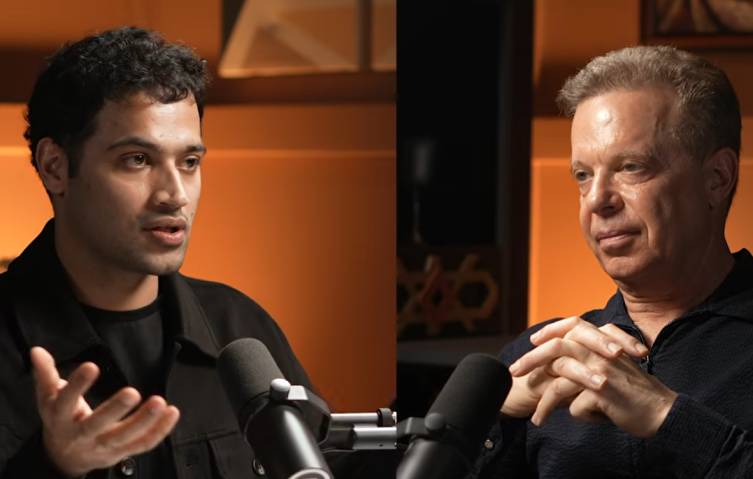
Editor’s Notes: In this powerful episode of the Raj Shamani podcast, Dr. Joe Dispenza explains how you can rewire your brain to overcome fear, anxiety, and self-doubt. He shares practical insights into the science of transformation, detailing how meditation and gratitude can open the door to healing and manifesting a new reality. From discussing the impact of childhood experiences to mastering your emotions, this conversation provides a roadmap for anyone looking to create a future defined by their vision rather than their past. (Feb 24, 2026)
TRANSCRIPT:
Introduction: The Power of Your Mind
RAJ SHAMANI: Coming to today’s episode. What if you could change your entire personality? What if your anxiety, your trauma, the habits you can’t break, the version of you that you really hate — all of that could be changed?
What if you could unleash the power of your mind, of your thoughts, and achieve the absolute biggest goals of your life and be able to achieve all your dreams as well? What if all of that was possible? Our today’s guest is going to tell you exactly how.
Our today’s guest is Dr. Joe Dispenza, the man who proved that your thoughts can heal your body. He has healed so many diseases, he has helped so many people walk again. He’s trained all around the world to do exactly this and unleash the power of your brain. He researches neuroscience, he works with a lot of institutions and tries to understand what your mind can do and what the possibilities are.
So by the end of this episode, you will also understand why you have been stuck and how exactly you can turn your life around.
Let me start with something that I’ve never shared publicly, ever. There are a lot of nights where after I’ve had a great podcast or I’ve won something and it’s been a big day — I’m winning in my life, I’m making money, I’ve done something successfully — even after that, when I go back home, I sit down and I’m almost about to sleep, I have these thoughts: “I’m not good enough. What if tomorrow all of this goes away? What if I can’t recreate this success?”
These spiral thoughts just keep coming in again and again, and I almost doubt myself to the point where it’s 3am or 4am and I can’t sleep and I keep overthinking. I’m sure there are so many people like me who go through the same thing. So what’s going on in my mind? Why am I thinking about all these things even on the days when I’m winning?
Creating From Lack: The Stress Loop
DR. JOE DISPENZA: I think it’s common for people. We create based on lack, right? Many people see something that they want and they realize that they don’t have it. And the natural thing is to create what you don’t have. So it’s natural to create based on lack. Then we have to get up and work really hard to accomplish and produce an outcome.
When we produce the outcome, the experience takes away the lack, because the emotion from the experience fulfills that lack. But then it’s only transient. That lack kind of comes back again, and it causes us to speculate — “What if I don’t succeed?”
It’s common. But what we discovered with people who do this, when we look at their brains in real time, is that when we analyze our life like that and we ruminate, we tend to make our brain worse. By overthinking and overanalyzing, you’re narrowing your focus on something. And you’re doing that because the hormones of stress — the chemicals of stress — are arousing your brain to live in survival and say, “What if I lose everything that I have?”
When you’re thinking within that emotion, you’re actually causing your brain to experience more of those emotions, and you get caught in this loop. So none of that is good for you. In fact, you’re actually turning on the stress response just by thought alone. And those chemicals of stress become addictive.
Not knowing this, many people are doing this just for a rush of adrenaline. And you can do that for hours. Because when you’re in stress and you’re in survival, you actually have to narrow your focus on the cause. People become overly focused, they overanalyze themselves and their lives, and they make their brain worse — even when they have everything that they want.
The big fear is, “What if I lose it?” So the fear is the issue. And I would say to someone like you, you’ve got to face off with that fear and make sure that fear cannot influence your life in any way. That’s the emotion you have to change.
Is Fear a Good Driver?
RAJ SHAMANI: You said that’s the fear I’ve got to influence, and that fear has an influence on my life in some sort of way. Sometimes I wonder if it’s actually a good thing, and I let it drive me. Because I feel like after every big opportunity, I work harder the next day because I overthink about it. I’m really bothered by everything, and that’s why it helps me. Is that a good way of thinking?
DR. JOE DISPENZA: How old are you?
RAJ SHAMANI: I’m 29 now.
DR. JOE DISPENZA: Well, I think it’s normal. And first of all, I think a little agitation or a little fear is a good driver. It motivates us because people don’t want to fail — they want to succeed, they don’t want to do the wrong thing or make the wrong choice. So it’s natural to have a little bit of stimulation like that. When it gets overly active, it gets in our way.
So I don’t think it’s bad. If it drives you to do more, I think it’s great. But I don’t think it’s the ultimate reason why we should be doing things. Your ultimate desire maybe is not to live your whole life in fear, but to live in a state of wholeness, a state of connection, a state of gratitude, a state of love.
At 29 years old, when I was 29, I had a lot of ambition. I still have a lot of ambition, but I have a lot more experience in life now, and that just comes over time. So as long as the fear doesn’t get in the way of creating the life that you want, or you don’t get addicted to that emotion, I think it’s healthy to have a little bit of fear. It kind of drives you, arouses you a little bit — just don’t go too far with it.
How to Stop Overthinking and Negative Emotions
RAJ SHAMANI: But let’s say there are people who are feeling these fears and these negative emotions every night, and they’re overthinking, and it is not helping them in their lives. How do they stop it?
DR. JOE DISPENZA: That’s one of the reasons why we teach people meditation. The reason we use meditation is not to heal, or to create success or abundance, or to have a mystical experience. We use meditation as a way to change.
To become conscious of those unconscious thoughts that you think when you’re feeling fear. It’s so important to become so conscious that you don’t go unconscious to those thoughts again. Just because you have a thought doesn’t necessarily mean it’s true. And if the anxiety and the worry and the fear is something that you experience on a daily basis, then in meditation you have to become so conscious that you don’t go unconscious and let that fear run you.
How do you behave? Do you stay up and ruminate over those “what if” scenarios in your life? You have to become so conscious that you don’t go unconscious and fall back into that habit again. The act of remembering and not forgetting in your meditation is exactly how you change.
So there’s an unlearning process, but that’s only part of it. There’s also a relearning process. You have to break the habit of the old self, but then you have to reinvent the new self. In your meditation, become familiar with the way you think, the way you act, the way you feel. The word meditation means “to become familiar with” — to know thyself.
Then in the reinvention process, ask yourself: “What do I want to think? How do I want to think in that situation?” And the only way you’re going to be able to think those different thoughts is not when you’re struggling in those emotional states. You have to program your brain in your meditation to begin to think in a different way.
“What do I want to believe?” And a belief is just a thought you keep thinking over and over again. So with intention and with your attention, remember what you do want to believe. If you keep thinking that thought over and over again, nerve cells that fire together wire together. You begin to install the hardware in your brain.
But that’s not enough. You have to do it enough times that those circuits begin to fire more automatically — they begin to hardwire. And now that becomes the new voice in your head.
“How do I want to behave or act when I’m feeling fear? What is an alternative? What does greatness look like? What would be loving to myself?”
Let me sit in that state when I’m feeling that fear, go into it, and change it. Let me rehearse in my mind. Let me review how I’m going to behave. Mental rehearsal — the act of closing your eyes and choosing a different behavior. The research shows that if you’re truly present, the brain does not know the difference between the real life experience and what you’re imagining. So the brain begins to fire and wire new circuits to look like you already did the act. Keep doing it and it becomes a software program. It becomes easier for you to behave that way because you’ve primed the brain.
If you don’t prime the brain and you’re struggling, you have no circuitry to use.
Then practice feeling a different emotion. Instead of fear, practice feeling gratitude. See how many times you can bring up the feeling of gratitude. If in your meditation you can bring it up over and over again, you’re making chemicals. Keep doing it, and you can condition your body to feel that feeling more automatically. You can begin to become familiar with a new way of thinking, a new way of acting, and a new way of feeling.
A lot of people think they just have to stay stuck and try to think positively when they’re feeling really negatively. That’s not the solution. The work is: “Now that I’m realizing I’m struggling in the evenings, I’ve got to do the inner work — not when I’m struggling, but when I start my day or before I go to sleep at night.”
Remind yourself where you’re not going to go. Remind yourself what thoughts you’re not going to entertain. Remind yourself that when you feel that fear, you can settle that emotion down. And when you start ruminating and acting that way, remember — that’s how you used to behave.
You’re going to begin to change when you begin to think differently, act differently, and feel differently. Theoretically it sounds easy, but there’s no other alternative unless you rely on something outside of you to change your internal state.
The act of changing from one state of mind and body to another, and priming your brain and body to have the biology, the circuitry, the chemistry in place — if you keep doing it, you’ll begin to choose to think that way more often, act that way more often, feel that way more often. That process takes a little bit of time, but if you keep doing it, people change all the time.
Are We Programmed by Our Past?
RAJ SHAMANI: There are so many things you said right now that I want to go through one by one, pick up each statement and theory and go deeper on each of them. But before we start that — don’t you think these fears and the things that I’m thinking, I’ve been programmed this way since I was a child?
There must be some incident or something that happened when I was 5, and then 10, and then 15, and then my external environment today. There are so many things which have made me the way I am. Is it possible to go back and figure out what happened and how it made me the way I am today?
Healing Trauma and Emotional Numbness
DR. JOE DISPENZA: Well, I’ll tell you how I see it. For the most part, I never really tell people to go back to the event. I don’t think it’s healthy for them to review the event or the experience that caused them to be a certain way.
Insight really doesn’t change behavior. You could say my father was overbearing, my mother was a perfectionist, I didn’t have a parent. The insight doesn’t change the person. But what’s more important is the emotion. That’s what is the residue. Because the end product of an experience is an emotion.
So a person has an experience in their life — let’s just make something up — they have a trauma. And the event causes them to feel differently than they normally feel. The stronger the emotional quotient from whatever the trauma or the betrayal or loss is, the more altered they are inside, the more the brain freezes a frame and takes a snapshot. That’s called the long-term memory. We can remember events better because there are emotions associated with them.
So let’s just say the person has a trauma in their life, and from that trauma they feel fear, or they feel unworthiness, or they feel pain. And you say to them, “Why are you this way?” They’ll say, “I am this way because of this event that happened to me five years ago, ten years ago, fifteen years ago, twenty years ago, forty years ago.” What they’re really saying from a biological perspective is, “I had this experience in my life, and I have not been able to change since that experience because it altered who I am.”
RAJ SHAMANI: Right.
DR. JOE DISPENZA: The challenge is when people have traumatic events, whether they know it or not, when they review the event in their mind — keep thinking about it, keep remembering it — they’re producing the same chemistry in their brain and body as if the event was occurring. And so the body is the unconscious mind. It does not know the difference between the real-life experience that’s creating the emotion and the emotion that person’s creating by thought alone.
The body is being abused, and it’s reliving the experience fifty to a hundred times in one day. It only takes a thought and a feeling, a memory and an emotion, a stimulus and a response. And you can condition the body to become the mind of that emotion. Now the body is literally living in the past, and it’s so objective that it’s constantly believing it’s living in the same past experience.
So then what’s the solution? It’s the emotion. The person must look at that emotion, and they must learn how to transform that emotion into wisdom. Because the memory without the emotional charge is called wisdom.
Now, our data shows just about 100% of the time — and we work with prisoners, incarcerated people, veterans, Navy SEALs, Green Berets, all different cultures — the one thing that resets the baseline for the trauma is when you open your heart.
When you say to a Navy SEAL or a military special ops person, “If you can open your heart, it’ll reset the baseline for the trauma” — and these are trained individuals — when they start practicing breathing and start practicing opening their heart, and they start resting their attention in it, and they start cultivating elevated emotions, there comes a moment where the heart actually begins to beat more orderly. And the moment it starts doing that, it sends a signal right to the brain and tells the brain the event is over.
When that occurs, this little area of the brain called the amygdala — the survival center of the brain — literally gets turned off. And all of a sudden, when the person looks back at the past event, they don’t see it with the same emotional charge. When we master our emotions, we master our creations. That memory, when they look back at it without the emotional charge, is called wisdom. And now they’re no longer living in their past. Now they’re ready to begin to live in their future.
So we discovered that the way out is not trying to go back and figure out, “Why am I this way? It was this person’s fault. It was this experience.” For many people, that actually excuses them from making the choice to change. Because as they review the memory — nerve cells that fire together wire together — and if they can work themselves up into the emotion, their body’s feeling the same emotion from the past. Thoughts are the language of the brain, and feelings are the language of the body. How you think and how you feel is your state of being, and they’re stuck in that past state of being.
So analyzing, thinking, and trying to figure it out never really resolves the problem. We discovered that if you can activate your heart center — and there’s a process that we do with that — if a person is really sincere and starts to practice elevated emotions, the heart tells the brain that the event is over.
Emotional Numbness in the Younger Generation
RAJ SHAMANI: But then, is it working in today’s world? Because the question is, more and more people are facing some sort of emotional decay. You teach people, and your whole work — what you just explained to me — is about the moment you open your heart and have elevated emotions like gratitude, love, and openness. When you have all of these things, you’re able to rewire yourself and change yourself for the better.
But what about a generation that is facing a certain level of — what do I call it — let’s say, emotional amnesia? They’re losing their ability to feel deeply because they’re constantly not thinking, not creating, not feeling. They’re just bombarded from left, right, and center by algorithms and news, feeling negative and nothing else, and they’ve just gotten numb to it. So for the generation that is losing their ability to feel emotions deeply, is it possible for them to feel a certain way and change themselves?
DR. JOE DISPENZA: What generation are you talking about?
RAJ SHAMANI: Gen Z, Gen Alpha, the new ones.
DR. JOE DISPENZA: Well, that’s really—
RAJ SHAMANI: There was research about it. That’s what I’m talking about.
DR. JOE DISPENZA: Yeah, it’s really interesting, because our demographic has changed in the last five years. Our demographic was a lot older in our retreats — we run big retreats — and now our demographic is a much younger one. And it’s really exciting, because many young people are realizing the absurdity of mismanaging their attention and mismanaging their emotions.
They’ve tried everything. A device that’s giving them images and stimulation and messing with their brain chemistry — and they’re realizing that nothing is making that feeling go away. Many people rely on something outside of them to take away this emptiness, or this pain, or this confusion inside of them. So they take something and they notice it makes them feel better. The moment they notice it feels better, they pay attention to what caused it, and they become dependent on or reliant on that substance.
The problem is, whatever that is — even a video game, whatever it is to distract you from that feeling — as you said when we started this talk, the feeling always comes back. It always returns after the high of the drug, or the video game, or the gambling, or whatever they’re doing. That feeling comes back.
And what’s happening with a lot of people is they’re looking for unconventional answers, because they’re not going to find any of the answers out there. So you give a person the understanding that they have the power to change, they have the power to create a better life, that there’s more to reality than all the images and stimulation in the news — the right and left and center. There comes a moment where people are finally going to say, “I’ve had enough.” I think everybody arrives at that point at different times.
But I’m optimistic about this kind of resurgence of interest, where people are really wanting to take their power back and really want to be more involved in creating a life that’s more meaningful. And if you look at the younger cultures — when I talk to our youth community, which is a huge community, especially between the ages of 18 and 30 — their biggest thing is, “There’s no meaning. There’s no meaning out there.” When you lose meaning for life, it becomes a big challenge.
So give a person the understanding that there is meaning, that they can evolve, that they can change, that they can create — that our community of like-minded, like-hearted people can get together and really begin to support one another in that change. I think that’s the future.
My value really around it is community. And our youth community is just amazing. They’ve created healing groups. We now have a new program called Excalibur, which is a kind of elite program where they have to apply and be accepted. They have to fill out applications and interviews, and they have to submit videos. Once they’re accepted, we’re going to fund them into universities, raise money for scholarships, and mentor them with different companies and organizations. The youth are our future, so we’re very involved in that.
The Role of Emotion in Creating the Future
RAJ SHAMANI: But do you think somebody who doesn’t feel that deeply, or is getting emotionally numb—
DR. JOE DISPENZA: Desensitized.
RAJ SHAMANI: Desensitized. Does that affect their ability to create a better future?
DR. JOE DISPENZA: I think emotions can either keep us anchored to the past — when we’re memorized by those emotions — but also, emotions are actually what drive us. It’s the energy to create a new future.
RAJ SHAMANI: Right.
DR. JOE DISPENZA: And if you’re lazy or lethargic or uninspired, or you’ve lost initiative, or you have a desire for sameness, or you’re not creative in any way — because the only way we actually really believe in a future is when we feel the emotion of that future. It’s really hard to believe in a future when you’re feeling the emotion of the past. In fact, many people will continuously tell the story of their past when they’re feeling the emotions of the past.
So that’s what we do in our events. They’re seven-day retreats, and the first couple of days are very uncomfortable. I tell the audience, “You’re going to come right up against yourself. You’re going to sit, and you can’t grab your cell phone, and you can’t open your eyes, and you’re going to have to face off with yourself.” And we give them something to do.
RAJ SHAMANI: Right.
The Transformation Process: From Apathy to Breakthrough
DR. JOE DISPENZA: By the second day, normally maybe the third day in some groups, there’s this huge transformation that starts taking place. There’s a curiosity. We have language specialists that come and study the language of transformation — really intelligent professors and researchers. Many people come to our events with a curiosity. That’s kind of an easy way to say it.
Then we start the event and they’re challenged. Nobody changes unless they’re challenged, period. I’ve been doing this a long time and I can tell you that’s a fact. If you give somebody something to do when they’re challenged — like when you’re challenged, don’t do what you typically do — we’re going to give you a formula that we’ve discovered based on more than 10 years of research. If you just do this and stop doing that, if you can get through this, there’ll be a breakthrough and you’ll start to feel again.
And when you start to feel again, the common language that people use after the challenge is connection. They feel like they connected to themselves, they connected to love, they connected to their future, they connect on some level. Then after the connection, the language is transformation. Like, “I am not the same person. That guy was struggling — I am not him any longer.”
And there’s a sense of temporality. A person says, “The disease that I had, whatever the terminal disease was, the chronic disease — that belongs to that personality. I’m literally somebody else. I’m not that person any longer.” And literally their biology changes.
So the apathy that’s created because we’re desensitized — where there is no meaning, where you don’t really feel like it’s going to matter, that existential kind of crisis — it’s not a bad thing to feel that. I think all of us at this point in history, if you look at the world today, it’s really hard to be inspired because there’s such chaos. And yet I think community is the solution.
A person who joins a community of people where they say, “I need answers — not philosophical, not theoretical, not spiritual. I need answers of what I can do in my life that’s practical, because I don’t want to feel this way any longer. And the pharmaceuticals, the diet, the treatments — none of it is changing me in any way.”
This is the moment of reckoning for many people, because this is when they realize that nothing is making this feeling go away and no one’s coming for them. And they’re like, “I have to choose myself.” When a person comes to that point, and there’s that sense of open-mindedness or open-heartedness or curiosity, it leads them to a place that I think is really healthy.
And the contrast — the lack of feeling — causes many of us to want to feel. So many people say, “I can’t really open my heart.” Well, what emotions do you feel every day? Let’s look at that. You spend the majority of your time feeling this emotion — is that loving to you? “No, I don’t want to feel that way.” Well, let’s not use a drug, let’s not use a computer game, let’s not use your phone or social media. Let’s see if you can change that emotion on your own.
When a person finally frees themselves from the chains of the past, the body is literally liberated. And the side effect of overcoming that emotion — the one many are addicted to — is joy. The body is liberated from being tormented by the same emotion that’s been keeping the person in the past.
Reaching the Lowest Point: The Gateway to Change
DR. JOE DISPENZA: Some people just have to reach their lowest denominator — that point where they’re at their lowest level, where they just can’t go on any longer. And they make up their mind to change. Because when they’re feeling that low, or no longer like themselves, they can actually observe themselves for the first time. They can see how they’ve been thinking. They can objectify their objective self.
And it takes energy and it takes awareness to disentangle from those programs. The beauty behind the research that we’ve been doing is that we now know it’s entirely possible — even for people who have had horrible pasts, brutal pasts, traumatic pasts, abuse of all kinds. Some have witnessed some really horrible things. Thirty hours a week of panic attacks, trying every drug, every pharmaceutical, every therapy, exercising, cold plunges, saunas, diets — nothing was making their trauma go away until they finally sat down and said, “I have to look at myself.”
When people are really willing to see what’s beyond this emotion, what’s beyond this belief, what’s beyond this behavior — “I’m going to sit, and I’m going to work on overcoming myself” — it is the overcoming process that we discovered that is the becoming process.
When people reach the middle of their life — 35, 40 years old — 95% of who they are by that age is a set of memorized subconscious programs. So the only way you’re going to become conscious of your unconscious self is to catch yourself going unconscious. And every time you catch yourself going unconscious and become conscious, you get more conscious and get better at catching yourself.
We discovered that the brain changes the most when you reach that point where you don’t want to go any further and you just don’t think you can. And when you go a little further — that’s when the brain changes the most, because you’re leaving the familiar territory. You’re leaving the known and stepping into the unknown.
RAJ SHAMANI: I don’t want to —
DR. JOE DISPENZA: I don’t want to support the idea that people who have lost their ambition to feel will never feel again. They just have to reach a point where they’ll finally realize, “Is this serving me?” And if it’s not — look, I have to look for solutions.
The Imagination Collapse: Can You Retrain Your Mind to Envision a Better Future?
RAJ SHAMANI: Before we create a new reality, or before we actually change ourselves, we have to think about the future, right? That’s what you’re trying to say — you have to create a new perception or imagination in your head. But what do you think about people who are losing their ability to imagine?
I was reading a study that there’s some sort of imagination collapse happening, because as you grow older, your ability to imagine and create vivid images in your head keeps declining. You must have dealt with so many people in your retreats who have probably forgotten how to imagine a better future, or think about anything, because they’re so caught up with work, jobs, family drama, and toxicity all around them. Their imagination muscle must have either gone or gotten weakened.
Can you retrain yourself to think and imagine a future when you have never imagined or thought about one?
The Science of Brain Coherence and Heart-Brain Synchronization
DR. JOE DISPENZA: Yeah, the answer is yes. And I’ll give two reasons — there are many reasons, but I’ll give two.
Let’s talk about the most obvious. Everybody has a lot going on in their life. Your brain is a record of the past. It’s an artifact of everything you’ve learned and experienced to this moment. It is the repository of the autobiographical self — your Raj. Because you come from a certain country, you have a certain family, you studied certain things, you know certain people, you live in certain places, you own certain things at certain times. And when you meet people, you tell them who you are based on your experience in life.
So you have a neurological network for your mother, a neurological network for your father, a neurological network for your siblings, for your cell phone, for your home — because you’ve experienced all these elements in your life. And because you’ve experienced all those elements, you have an emotion associated with every one of those people, objects, things, or places.
So when a person is out of balance or they’re stressed — stress is when your body and brain are out of balance or homeostasis, and the alarm system, the emergency system, switches on and your brain goes into a heightened, aroused state. Stress is created by not being able to predict something, not being able to control something, or having the perception that something in your life is going to get worse. And when that alarm system switches on, it’s a survival system. What you try to do then is control and predict everything in your life.
So the arousal causes you to shift your attention from one person to another person, to another meeting, to another thing, to another place, to another time. And because you have a neurological network assigned to all of those elements, like a lightning storm in the clouds, your brain begins to compartmentalize, begins to silo, and it begins to fire out of order. If you were to measure the brain when it does that, it’s very incoherent. And when the brain is incoherent, we’re incoherent. The side effect of that is that we begin to become fragmented, we can’t control our mind. And as you said earlier, we get very narrow-focused, we begin to overthink and over-analyze — and that is exactly what drives the brain further and further out of balance.
So what we discovered after years of study is that this kind of narrow, convergent focus that many people are living by means they can’t imagine their future. When you’re living in survival, why would you? It’s not a time to create. When Tyrannosaurus rex is chasing you, that primitive system is switched on and all your attention is on yourself. You become very self-involved, because in survival you have to stay alive — you have to put your attention on your body, on all the elements in your environment, and you’re very obsessed about time.
Broadening Focus: The Path to Brain Synchronization
It turns out that if you do the exact opposite — and this is what our research shows — if you broaden your focus and you begin to focus on space, on nothing, the act of sensing space and no longer thinking, but sensing and feeling space, causes those different compartments that were firing incoherently out of order to begin to synchronize. Those modules begin to form and connect with one another. Larger real estates of the brain begin to fire more coherently. The brain begins to synchronize. And what syncs in the brain links in the brain.
We have fMRI studies on this, we have a lot of quantitative EEG studies on this. It doesn’t matter how old you are, how young you are, what your gender is, what you eat, where you’re from, your socioeconomic status — none of those elements matter. When you do this properly, the brain begins to function more coherently and more organized. And when that happens, the brain gets highly creative. You’re processing a different level of consciousness, a more holistic level of consciousness. That’s called intention. The person can all of a sudden begin to imagine a future because they’ve moved from that survival state into a more creative state.
At the same time, when they do that, you see this psychic union going on between the two hemispheres. Modulation goes down, which means the brain is firing more holistically. The compartments are no longer divided — they’re more unified. When that occurs, the person starts feeling more like themselves. Like, “Oh my God, I forgot — this feels really great.”
The Heart-Brain Connection
At the same time, we see this kind of cooperation with the heart. The heart all of a sudden begins to bloom. It starts to become very coherent as well. Because when we’re living in stress and survival, and a person is distracted — they have kids and obligations and meetings and they’re fragmented like that — the arousal of those stress hormones means the person is not running, not exerting themselves, not fighting, not fleeing. This adrenaline is causing the person to step on the gas and step on the brake at the same time. And the heart is beating against a closed system. So the heart starts to beat out of order. And when it becomes incoherent, incoherent waves cancel each other out and energy leaves the heart. You stop trusting, you stop connecting, you stop communicating, you stop being creative. The heart is the creative center.
So when the brain gets highly organized and synchronized, you see this energy move right into the heart. At the same time, it resets the baseline for the trauma. We’ve seen beautiful brain scans on this. The heart begins to beat like a great drum — very coherently, very orderly — and it tells the brain to get creative. And all of a sudden, like grabbing a big sheet and going like this, it sends a wave of energy right to the brain and the brain moves into alpha.
Now, alpha is the imaginary state. Alpha is when you imagine, when you dream, when you create. You no longer hear the critic in your mind talking to you — “Raj, you should think about this. What if this happens? What if that happens?” That’s the analytical mind. That’s the critic in the brain. That’s beta brain waves. Going into stress, you go into very high beta — now you’re over-aroused, overly alert. That’s not a good brain state to create in. In fact, you’re going to force, you’re going to control, you’re going to fight, you’re going to compete. That’s what you do in that state.
When the heart informs the brain to become creative and the brain moves into alpha, the critic shuts off. All of a sudden your brain starts to see in pictures, starts to see in images. It’s in a flow state — it’s imagining and creating. And there’s this beautiful synchronization that goes on between the heart and the brain. All of a sudden there’s this connection where the heart and the brain start working together.
We discovered that the more a person can relax into their heart — and we can train people to do this — the more energy goes to the brain. You start seeing the brain moving into a really elegant state. You start seeing the baseline of the brain sometimes in theta, which is deep sleep. The person is not sleeping, but there’s a deep resonance to the brain where theta is starting to produce delta, starting to produce theta waves. So there are waves on waves on waves in the brain. When that occurs, the person is feeling really good — relaxed in heart and awake in the brain.
Theta State: Opening the Door to the Subconscious
We discovered that people who do this with training do it really well. It’s not difficult for them to imagine their future — they’re in the perfect state to imagine. The challenge is overcoming their survival tendencies and getting their brain integrated, getting their heart integrated, and getting the two systems working together.
Theta tends to be the place where you’re very, very suggestible to information. That’s when the door between the conscious mind and the subconscious mind is wide open.
RAJ SHAMANI: Open.
DR. JOE DISPENZA: Now remember, 5% of your mind is your conscious mind. 95% is what we program subconsciously. What separates the two is the analytical mind. So as you begin to slow your brain waves down, you get beyond your analytical mind, you open the door, and now you can reprogram — because you’re in the operating system now. You’re in there. Theta is when that veil is completely gone. That’s a hypnotic state. So then you can rehearse a new way of being. You can rehearse a new life. You can decide what emotions you want to feel. The door is wide open. You can begin to reprogram yourself subconsciously.
And when people sustain these states — coherence is when waves are orderly — if waves stay orderly and they begin to interfere with each other, they start building bigger waves. So a person who is really, really practiced at this will have their body in a light sleep, in a liminal state, a non-sleep deep rest state, where the body feels so safe that it can actually rest in that moment. And when they rest into their heart like that, some people have their baseline in theta, and then theta starts carrying alpha, then alpha starts carrying beta, then beta starts carrying high beta, and then high beta starts carrying gamma. And when the person is in gamma, they’re super-conscious — they’re no longer a program. There are waves upon waves. That’s called resonance in the brain. And that’s when we start seeing networks recruiting and organizing. That’s when they’re recruiting a lot more brain power.
How Long Does It Take?
RAJ SHAMANI: How long do you think it is possible for somebody in our generation — who is constantly driven by algorithm and not by imagination, who is feeling 20 things at the same time because of the feed they have curated — to go from that point to a state of nothing, and then to a state of actually imagining and creating a future that you’re talking about? How long does it take if you —
DR. JOE DISPENZA: Come to an event? Two days.
RAJ SHAMANI: Really?
DR. JOE DISPENZA: Yeah, for sure. Yeah, pretty sure.
RAJ SHAMANI: Doesn’t it get really uncomfortable to sit with nothing and think nothing, because you’ve never done it — like most people have never done it?
The Science Behind Teaching Meditation
DR. JOE DISPENZA: I think one of the things that we accomplish really well is that we never, ever, ever give a person a meditation to do without a lot of teaching. I think knowledge and information is the forerunner to an experience. Every time you learn something new, you’re making new connections in your brain. Learning is forging new synaptic connections.
The Nobel Prize researcher Kandel in 2000 found that if people just focus on one bit of information for an hour — one concept or one idea — they’ll double the number of connections in their brain as a result of their interaction with the environment. But here’s the catch. If you don’t review it, if you don’t think about it, and you don’t repeat it, those circuits will prune apart within hours or days. So if learning is making new synaptic connections, then remembering is maintaining and sustaining those connections.
I believe that science is the contemporary language of mysticism. I think science is what demystifies the mystical. So before we ever tell a person to focus on nothing, we explain it. We combine quantum physics with neuroscience and neuroendocrinology and psychoneuroimmunology — the mind-body connection — epigenetics, Newtonian physics, electromagnetism, made really easily accessible.
They understand the information, and then they have to teach that information to the person next to them. They have to remind themselves of what they learned. And if they can remind themselves what they learned, nerve cells that fire together, wire together. If nothing is left to conjecture, to superstition, to dogma, and the person understands exactly what they’re doing and why they’re doing it, the how gets easier.
When the how gets easier — because they understand the what and the why — they assign meaning to the task. And when they assign meaning to the task, they switch on their prefrontal cortex. The boss of the brain. And the boss of the brain wants an outcome. “I’m doing this intentionally because I want an outcome. I’m doing this meditation to make my brain more coherent.”
So now the person is less likely to doubt or disbelieve. If they can’t explain it to the person next to them, it’s not wired in their brain. We do extensive teachings where people have to engage in the information and then teach it back to somebody. Before we get into the meditations, they have to build a model of understanding. It’s so much easier to forget this information than to remember it, so you have to wire it in your brain.
But experience, then, is the great professor. If I can set up the conditions in the environment and give them the right instructions, if they can get their behaviors to match their intentions, if I can get their actions equal to their thoughts, if I can get their mind and body working together, they’re going to have a new experience.
Now, experience enriches those philosophical circuits in the brain. But the end product of the experience is an emotion — not fear, not unworthiness, not pain. The experience causes them to feel gratitude, or appreciation, or love. And the moment they feel the emotion from the experience, they’re teaching their body chemically to understand what their mind has intellectually understood.
So knowledge is for the mind, and experience is for the body. The information is no longer just in the brain — the information is now in the body. They’re embodying the truth of that philosophy, that theory. And the chemical created from that elevated emotion is actually selecting, instructing, and constructing new genes. It’s new information for our biology. That’s what we discovered.
If you’ve done it once, you should be able to do it again. If you can repeat the experience over and over again, neurologically and chemically, you’ll neurochemically condition your mind and body to organize and work together as one. And when you’ve done something so many times that the body now knows how to do it better than the conscious mind, it becomes innate — it’s automatic. You’ve mastered that philosophy. You’ve become that knowledge. It’s a new state of being.
The first couple of days are important because there’s a lot of information. We don’t just say, “Focus on nothing.” We explain what that void or that vacuum is. We give it a quantum understanding. We talk about how our senses plug us into reality. And we design it in a way that’s very engaging so that the average person can follow along.
By the way, we have 8-year-old children, 10-year-old children. We did a 10-day event in Cancun just last week for advanced students, and we had a 13-year-old girl from Italy who went through the whole entire thing and did every meditation. She was spot on.
RAJ SHAMANI: Who’s that?
DR. JOE DISPENZA: Who is she going to be in 10 years from now? We want to give people enough tools so that when they go back into their life, they know exactly what they’re doing and why they’re doing it.
Understanding Brainwave States: Alpha, Beta, Theta, Delta, and Gamma
RAJ SHAMANI: Before I ask you my next question, I want my audience to just revise this one concept — Alpha, Beta, Gamma, Delta, Theta. Explain in one line, in simple words: What is Alpha? What is Beta? What is Gamma? What is Delta? What is Theta?
DR. JOE DISPENZA: Okay, sure. So you and I are talking right now, we’re conscious and awake. Your brain is trying to create meaning between what’s going on out here and what’s going on inside you. Because your senses plug you into your environment, you have to integrate everything you’re seeing and hearing and smelling and tasting and feeling. When the brain is integrating all this information, it goes into a brainwave state called Beta.
So when you’re conscious and most of your attention is on your outer environment, you’re in Beta. If I said to you, “Raj, I forgot to tell you, there’s going to be a quiz at the end of this podcast,” you would kind of perk up a little bit and lean in — you would move into a slightly higher Beta brainwave state. And when you’re really stressed, angry, fearful, frustrated, resentful, or judgmental, you’re in that high Beta brainwave state — three times higher than resting Beta. That’s the alarm system in the brain. Some people get stuck there and need something to bring their brainwaves down.
As you begin to slow your brain waves down and more of your attention goes to your inner environment, you slow your breath down. We discover that slowing your breathing down slows your brain waves down. You start to relax, you take more attention off your outer environment, you close your eyes, and your inner world starts becoming more real than your outer world. That’s Alpha.
You do this when you drive your car. If you’re driving on the freeway for a couple of hours and you’re just glancing straight ahead, your brain typically pauses for a moment and you start seeing images and pictures — you’re naturally going into Alpha. It’s an easy state to get into, and many people can get there pretty naturally. It is the creative, imaginative state.
Theta is when your body is asleep and resting, but you’re conscious and awake — you’re conscious in your subconscious mind. There’s no filter, no analytical mind. Information goes straight in. You can literally drop a program or a new idea into the subconscious mind. Theta is that hypnotic state.
Delta is when your body is in a deep resting state of sleep — almost catatonic — restoring and repairing. We used to think that was the only thing Delta was for. But we have some very advanced students who actually have a baseline Theta where their body looks like it’s asleep while they’re awake.
And then there’s Gamma. Think of Gamma as super-consciousness or super-awareness. You’re very alert, very clear. You’re not in a program. You’re relaxed and awake, instead of stressed out, unconscious, and in a program. Gamma is that elevated state of super-consciousness.
How Long Does It Take to Reach Gamma?
RAJ SHAMANI: How long does it take for somebody to go from Beta to Gamma?
DR. JOE DISPENZA: That’s a great question. They have to drop down into Theta first. Most people have to drop down into Theta and really get into that super-relaxed and awake state. And then once they’re in that Theta state, that’s when they climb up to Gamma.
Some people in our community can drop into that state in 4 seconds, 5 seconds, 13 seconds, a minute. They’ve just practiced it enough times. They know how to do it. And just like anything else, if you practice, you get good at it.
RAJ SHAMANI: How long do you think it takes if somebody has never done meditation before — to go from their current state to this? Is it years?
DR. JOE DISPENZA: No. Okay, so that’s a great question and I want to answer this really objectively. Many times a person’s mother will bring them, or their spouse will bring them, and the person has never meditated before — they’re just like, “I don’t know about this.” When we test those people’s brains, sometimes they have the best brain scans because they have no preconception of what to do.
A lot of men who come with their wives are like, “I don’t know anything about this — tell me what to do and I’ll do exactly what you tell me.” They do exactly what we tell them, and they have really profound experiences. So whether you’re an advanced meditator or not, if you follow the instructions, many people will drop in pretty easily and naturally.
Our data shows that novice meditators — people who have never meditated before, which is usually 75 to 80% of our week-long retreat attendees — at the end of seven days, they look like advanced meditators. Not only in their brain, but in their biology.
In other words, at the end of seven days, they’re producing thousands of metabolites in their blood and gene expression proteins that suggest they’re living in a whole new environment — and they’re in a ballroom. They’re epigenetically changing without relying on anything outside of them. 80% of novice meditators, at the end of seven days, look like they’re living a whole new life. They’re manufacturing all kinds of chemicals that are pro-life, pro-growth, pro-restoration. I’m not saying that — that’s what the data’s saying.
RAJ SHAMANI: Because here’s the thing — last night we were talking as a team, discussing while we were researching for you, and we were all saying that after listening to you so many times, I’m one of those people who is like, “Yes, meditation is a thing,” but I’ve never had that explosion. I’m not there yet. Like, maybe it’s not for me.
The Science Behind Meditation and Identity
DR. JOE DISPENZA: Let me just say one thing about that, just to clarify it. We don’t do any traditional meditation. I noticed that in my own personal teaching experience on my journey. The moment you talk tradition or religion or culture, you’re going to divide an audience. Someone’s going to shut off. You have to use science. That’s the language that we use.
What I discovered in my own personal journey is that if you give people the right information and you make learning fun and you make it easy — our meditations don’t follow any of the tradition. I’m looking at brain scans. I know the words, I know the music, I know the timing. We have studied this so well. I know what works and what doesn’t work. There’s no tradition to our meditation at all.
We do all kinds of meditations. In a seven-day retreat, you’re not just sitting there focusing on your breathing. We were way past that point. We use meditation to change, to go from the old self to the new self. We use meditation to get beyond your body, your environment and time. We use meditation to connect to that invisible field of information — the quantum field that exists beyond the senses — that people really can begin to interact with. And we use meditation to get beyond the analytical mind, to reprogram ourselves.
Our scientists that come from all over the country, they walk in there thinking that everybody’s going to be wearing white and there’s going to be lavender and mist — and it’s not. Our events are very engaging, very contemporary, and they’re fun. Like a rave, they’re very active. I want to make it really reachable for every person. I don’t want it to be so exclusive that you have to work really hard. Now, I’m not saying that you’re not going to have to face off with yourself — for sure. But I’m pretty confident after 64 week-long retreats that the majority of those people, as I said, our data is pretty much over 80% of the population has some type of change.
So we don’t do meditation in the traditional sense. Based on our language specialists, I can tell you that at the end of seven days, a person’s language is different, their voice tone is different, their face is different, their microbiome is different without changing their diet — drastically different. Their brain is different, their heart is different, their blood is dramatically different. Their gene expression is different. Their breath is different, their breast milk is different. Everything changes when a person changes all of this.
RAJ SHAMANI: Okay, if I do this, will I have proof for all of this?
DR. JOE DISPENZA: Yeah, pretty much. I think one of the things that I’m super happy with is the research that we’ve done. We just published a great paper. The research really points the finger at the fact that you can change, and you can do it in seven days.
Helping Others Who Don’t Want to Change
RAJ SHAMANI: That’s super exciting. But I want to talk about a bad habit that I have. It’s almost like a good habit and a bad habit, because I have a problem in my life where I see my friends and family members who are stuck. I get uncomfortable when I hear my loved ones are stuck somewhere — maybe it’s because of money, it’s because of some emotional pattern, maybe it’s because of a bad relationship. Wherever they are, I want them to quit and just start something new and just move on from there.
Sometimes it is great because people have taken my advice and moved on. And sometimes it’s bad because before even trying to fix it, I’m like, “Just get away from this feeling of stuckness.” But what I’ve noticed is that a lot of times people don’t want to get out of it. Is it possible that you can help someone transform where they don’t want to transform?
DR. JOE DISPENZA: Probably not. I think one of the most impossible things in the universe is a closed mind.
You have to honor free will. And I think that comes with experience, or maybe just age. You realize that when the person’s ready to change, they’ll change. In fact, I never offer advice to people in my life unless I’m asked. It’s just a really healthy way to do it. I’ll love them, I’ll be inspiring, I’ll be my best for them, but I won’t offer advice unless I’m asked.
RAJ SHAMANI: Is there a pattern — that they love to be stuck, or they just don’t want to get out of it?
DR. JOE DISPENZA: I don’t think that’s it. I think there are two reasons, and they’re kind of related.
The hardest part about change is not making the same choice as you did the day before. And to unstick yourself means you have to move from the known to the unknown. When you step into the unknown, it’s unpredictable. There’s a lot of uncertainty. Things aren’t familiar. You’re not in the past any longer. And many people would rather cling to their suffering or their challenging life than to take a chance on possibility, because they don’t know what that would bring for them. So they stay there because the unknown is a scary place for them.
Turns out, the unknown is the perfect place to create from. It is the place where we actually can create something new. We can’t create anything new from the known.
The second reason is really just those very strong addictive emotions. The person may be addicted to fear, and they may be using a person or a situation in their life to reaffirm their addiction to that emotion. And in time, they become addicted to a life that they don’t even like.
That’s why change is so hard. Because with any addiction, you overdose. There are bad trips, there’s rehab. When you’re overcoming some type of an addiction, the body is really craving something. So many people can’t move past the addiction to that emotion until it gets really bad. For many people, it’s human nature — it’s got to get so bad, so intolerable, where they finally say, “I have to make another choice.”
Breaking Free From an Identity You Didn’t Choose
RAJ SHAMANI: You say that one of the hardest things to do is breaking the habit of being yourself. But in a society like ours — in Indian society, Asian society — your identity is not only who you are. Your identity is largely decided by where you’re born, the community you are in, the society, the family, or the religion you’re born into. And you don’t have absolute freedom to create your new self.
There are certain expectations from you. There is a certain level of legacy. There are certain rules and regulations of a particular religion or place or community. There are so many things that decide your identity. In some places, your identity is decided even before you’re born. How do you break free of this whole identity which is expected out of you? How do you break free and become free of something you didn’t even choose?
DR. JOE DISPENZA: Every charismatic leader in history was uncompromising. Good or bad, they led because they weren’t going to be defined by any of those things.
To change is to be greater than your environment. That’s what it really means — that no person, no circumstance, no condition would get in the way of your dream. That doesn’t mean you have to be mean-spirited or arrogant or abusive. It’s just that you have to give yourself the freedom to trust yourself to live the life that you want. And for me, that’s a really high value. Because if we allow our culture, our family, our friends, or even our loved ones to decide or control how we’re going to live our life — consciously or unconsciously — we’ll never know freedom, especially if we’re living for someone else’s happiness.
At 29, this is a good question, because you struggle with, “Oh my God, I’m breaking free from my family. I want to go out on my own. I want to do these things my parents may not understand.” My parents just thought I was way out there. But they always kind of supported me. And I wanted to deliver, because I wasn’t doing it for any other reason but to investigate what is the meaning of life.
I think it’s healthy to ask this question right now because of the age you’re at. But if you’re sincere, and you’re kind, and you’re loving, and you make the choice for yourself, you’ll always be respected for that. If you make a choice for another person and you don’t fulfill what you really feel in your heart — or what brings you the greatest joy — you’ll either resent the people that you love, or resent yourself, or shrink into mediocrity, or reach a point where you’re just going to finally make up your mind to do it.
So if it’s something that burns in your soul and it’s something that you really want to follow — I tell my children this all the time — just learn from your mistakes. Dust yourself off if it doesn’t work out. Ask yourself, “If I’m facing this situation again, how would I do it differently? What did I learn from it?” And continue on your journey.
There’s no right or wrong path. For a young person to ask this question means that you’re up against it on some level. And your real question is, you want to have a fulfilling life. And that fulfilling life is your journey.
There are dark nights of the soul in evolution where you realize that nobody gets you, because they’re not you. You can’t go back, because it just doesn’t feel right. And you can’t ask anybody their opinion, because they’re not you. This is a moment of reckoning where you just have to make that choice for yourself.
So it is a challenge to live authentically. But there’s nothing wrong with having an identity or personality — we all do. But when it comes time to create, you have to be able to lay that character down. You have to be able to drop Raj and become pure consciousness. You have to lay down the identity or the character. And that’s exactly what we call getting beyond yourself.
Turns out, when you get beyond yourself, the side effect is that you’re more kind, you’re more caring, you’re more loving, you’re more present, you’re more free. You don’t really care what people think any longer. You’re more tolerant, more patient. It’s the side effect of overcoming yourself.
Cutting Off Toxic Relationships
RAJ SHAMANI: Does that mean that you cut off people who are trying to pull you back? Because sometimes you don’t want to cut them — you love your people — but they are creating an environment which is toxic and pulling you back into the darkness. So you want to break free, but if you break free, there’s a sort of guilt. Am I doing the right thing or the wrong thing?
DR. JOE DISPENZA: Yeah.
RAJ SHAMANI: I mean, do you cut off or not? Do you —
Why People Fail to Change — And What Actually Works
DR. JOE DISPENZA: Then I think there’s only two options. If you can behave differently around those people, or let me say it another way, if you can be less reactionary or less unconscious — and that may take you really thinking about it — I mean, parents and family are the biggest challenge, right? Because they’re so close to us, and they can push buttons automatically.
So if you can behave differently, or not react, or stay conscious around those people, then by all means do it. But also, there may be a period of time where you may have to separate yourself from certain people and certain things at certain times, because they remind you too much of the self that you no longer want to be.
And I’ve done that in my life where I’ve just been like, “I need a break. If they love me, they’ll get it.” And that’s when you just kind of work on you. And then when you’re really happy with you — and this is again what our data shows — when you’re really happy with you, you’re happy with everybody. And your oxytocin levels — we have this research — when your oxytocin levels go up, it’s impossible to hold a grudge. You’d rather feel this way than any other way.
So there’s no right or wrong answer. But I do think if you’re truly in the river of change, if you’re truly wanting to change, sometimes you have to avoid certain experiences with certain people at certain times, at certain places, because you could fall back very easily into the same state.
When you finally make that transformation and change, you’ll know — because when you show up and you’re around them, there’s no longer a charge, no longer a button. That’s how you know you’ve changed.
RAJ SHAMANI: What do you think — why do people fail? There are so many people who do the right thing. You have dealt with thousands of people. They’re doing everything right, but they’re still not able to change and create a new reality. They’re not able to build a better life. What are specifically — if you can give me — the top two or three things that people do wrong, which is why they’re not able to change at all?
DR. JOE DISPENZA: Many people will say, “Oh my God, I’m dedicating 45 minutes a day to my meditations. I haven’t seen much change in my life. I’m happier, I feel better, but I’m not seeing the changes I want in my life.”
It doesn’t mean that the principles don’t work for that person. It means that there’s some blind spot, some place where they’re not seeing themselves, that they need to look. And there are so many variables, Raj.
Some people will get into the routine of doing the same meditation every day, and it’s become such a routine that it has no meaning. They don’t understand the what and the why any longer. It’s just another thing they’re doing — to do the right thing, to please God, to be more perfect, or whatever. None of that matters.
And then other people have a great 45-minute meditation, and then they get up and spend the next 16 hours of their day stressed out, unconscious, and living in a program. So what was the purpose of the meditation? The purpose of meditation is to be more mindful in your life. You practice it so that when you’re in your life, you don’t go unconscious. That’s why you do it.
So the person may have one great 45-minute meditation — it’s happened to all of us — and then they spend the rest of their day living in the hormones of stress, or living in fear, or living out of balance. And you have to do the math: 1 hour, 45 minutes against all that time. You have to get really good at doing it with your eyes open.
Many people who heal from health conditions in our work — it’s really interesting — because that’s exactly what happens. They’ll say, “Hey, I started doing the work. I’m sleeping better, I have less pain, I have more energy, I feel happier, I feel better. But my scans and my blood tests really haven’t changed much.”
They don’t go, “Oh my God, it’s not going to work for me.” What they say is, “Okay, what am I doing here? What am I missing?” And then they realize — every time they do their meditation, they feel great. But then they see their ex, or their co-worker, or their mother-in-law, or their father, or their brother — and they react.
And if they’re reacting and feeling the same emotion, they’ve just defaulted. They’ve returned back to their old self. And it’s seamless — because the moment you feel that emotion when you react, you behave as if you’re in your past, and you believe in your past. It’s so seamless that we can go unconscious in a matter of seconds.
So the person then says, “I want life, I want health, I want healing more than my resentment or anger towards my co-worker. What would greatness look like? What would love do? That means I have to be more kind and more compassionate. I don’t know if I want to — well, if it means my life, I’m going to try it out.”
So then they close their eyes and they start to rehearse. “When I see my co-worker, I’ll remind myself what I’m not going to do. I’m going to remind myself what I am going to do.” And as they rehearse the act in their mind over and over again — as I said earlier — they’re starting to install some circuitry, they’re priming their brain. If they keep doing it enough times, it’s going to become more automatic. It’s going to become more like a software program.
So then they get in the presence of their co-worker, or their ex, or their mother-in-law, or whoever — and they get their behaviors to match their intentions. And when they do, they create a new experience. A new experience produces a different emotion. And they’re like, “Oh my God, I felt compassion and love for that person, and I don’t know what happened. It all shifted for me.”
Now that’s good medicine right there. That’s real medicine right there.
So the person then goes, “Oh my God, now I’ve mastered that emotion and I’ve mastered my creation.” They’re getting really good at evolving themselves.
Certain people may not want to light a match in a dark place and say, “I’m never going to forgive that person. I’m never going to stop hating that person.” Well, the hate that you’re feeling is like drinking poison and hoping the other person is going to have an effect. The only person it is affecting is you — justified or not. The hormones of stress downregulate genes and create disease.
So the person has to say, “I have to change. I have to forgive.” And by the way, if you practice being in your heart, it’s not hard to forgive. When you’re feeling that feeling, it’s very easy to forgive. It’s not like you’re really trying to forgive the person — you’re feeling so good, you’re like, “You’re good, I’m good, let’s go. I’m free.” That’s the side effect of the work when the person is really looking.
So I think sometimes a person defaults automatically and goes unconscious — we all do it. Sometimes people forget why they’re doing it, or what they’re doing has just become another routine. They haven’t really thought it through and said, “Okay, I’m doing this for this intention.”
I think people sometimes give up on themselves, and that becomes a habit. They don’t really get into it. They don’t really invest themselves, because on a deep level, they don’t believe they can change.
Some people only do a short little meditation and think their life is going to blow up and they’re going to be abundant tomorrow. It’s unrealistic. If a person wants to be — let’s just say healthy or abundant — and this is their dream, but this is the personality who is in lack or feeling unhealthy — in order for this person to arrive there, they have to make a lot of different choices, do a lot of different things, and create a whole lot of new experiences. And they’re going to change along the way.
Some people may not be honest with themselves to see if they’re really changing. You know when you’re really changing because you stop talking about it. That’s when you know you’re getting close.
The Truth About Why Most People Stay the Same
RAJ SHAMANI: But 99% of the people — they don’t change.
DR. JOE DISPENZA: That’s true. A lot of people default automatically back to the same personality. But if you give them the information and they understand it really well and they’re practicing — that’s what I think I’m the most proud of when it comes to our community. I think I’m the most proud of our community because we’re doers.
There are just too many stories of transformation that we have now, where the person has changed their life in dramatic ways. I hear it all the time. And they prove to themselves that they’re the creator of their life. That’s what I want for them.
So if you don’t know how to change, and you don’t know what change is, then more than likely you’re going to stay the same person. But if we demystify it, and you understand what change is, and you understand all those things that are subconsciously programmed — I guarantee you that if you’re truly sincere about it, you won’t want to go back, because you’re feeling very differently.
I just think many people simply don’t know. They may know what they want to change, or why they want to change. They just don’t know how to change.
Fear vs. Gratitude — What’s Really Happening in Your Body
RAJ SHAMANI: So explain the differences to me — according to science, what’s going on. I’m going to give you two or three situations. Let’s say there’s somebody who represents 99% of the world — normal people. They get up, they think about a deadline, and they’re thinking, “If I don’t do this, I’m going to lose this opportunity.” They’re emotionally charged about it. They’re operating out of fear.
Versus somebody who is operating out of gratefulness — “There’s an opportunity, I want to do it, and I’ll do it because there’s so much abundance. I want to create my new reality.” All the things that you’re teaching.
What happens when somebody feels “deadline, deadline, deadline, I’m going to get finished” — versus somebody who feels abundance and gratefulness and a great future — in their body, in their mind, in their brain? What is the difference?
DR. JOE DISPENZA: Yeah, it’s really simple. It’s back to that same principle. The person who sees it as a deadline is perceiving reality through the lens of their past, through the emotion that they’re experiencing. And the person who’s seeing the possibility in a state of gratitude is feeling the emotion of the event before it’s happened.
RAJ SHAMANI: But what’s happening in the brain — what’s happening in the body — if I think and operate from the past?
The Default Mode Network and Predicting the Future
DR. JOE DISPENZA: The person who’s operating from the past is usually trying to predict the future based on the past. And they’re working pretty much off a part of the brain called the default mode network. The default mode network is the brain’s predictor. You say, “Okay, I’ve had these experiences, I’ve done these things. It’s never going to change because I know it’s going to be just like my past.” And you don’t do that consciously, you kind of do that unconsciously. Because the default mode network is always trying to lay down a known, trying to predict the next moment.
It’s just like if I tossed you a ball, the default mode network would be like your body just predicting where the ball is going to go, and it just kind of grabs it. It’s that automatic. So the brain is naturally trying to predict the future based on the past. The challenge with that is it consumes an enormous amount of energy in the brain, like almost all the energy in the brain. It takes a lot to shut that thing off.
Our data shows that in seven days, you can shut that part of the brain off. And if you’re not predicting the future, you’re in the present moment. And when you’re in the present moment, you’re way more creative, you’re way more poised, you’re way more spontaneous. The brain is more integrated.
What we discovered is those people that do it — and it’s the majority of the people — when they open their eyes after the meditation is over, that default mode network is still shut off in their brain. So they’re still present as if they’re meditating, but they’re not meditating with their eyes closed. That place is when the brain really begins to reboot itself. That’s when you get creative ideas. That’s when you trust yourself. That’s when you’re excited, enthusiastic, and full of energy about what you’re seeing.
The default mode network is always going to try to predict based on what it knows from the past. And you can’t create anything new that way.
Gratitude Before Bed vs. Scrolling Instagram
RAJ SHAMANI: You’ve said in your research and in your work that the time before we sleep is really important. And if we practice gratitude 10 minutes a day, in just about four days, our immunity system gets 50% better. Is that right?
DR. JOE DISPENZA: Yeah.
RAJ SHAMANI: So that is one case. And a lot of people just use Instagram for 10 minutes at the end of the day. If I practice gratitude before bed for 10 minutes versus using Instagram for 10 minutes, what’s going to be the difference?
DR. JOE DISPENZA: Some people can’t think for themselves because they’re having something think for them. Those images and the stimulation are causing them to expose their brain to information that is causing them to think and feel a certain way. What I’m saying is — think and feel on your own. Think for yourself. People who lose the imagination or the skill of dreaming are just relying on something to think for them.
That’s why nature is so great. Go out and spend three days somewhere in nature. The first day, your brain will be all over the place. The second day, it’ll kind of calm down. By the third day, you’re like, “I’m thinking clearly again.” Because if you don’t have your device and you’re looking at the expanse of the sky, or mountains, or the sea, and you’re opening your awareness, your brain gets very organized.
So a person who understands that when they go to bed at night, their serotonin levels change to melatonin — when you’re in serotonin, you’re in beta. When you’re in melatonin, you start dropping into alpha, theta, and delta, and that’s when the door opens. So what do you want to drop in there? Do you want to drop anything in there that’s going to cause you to be more limited, distract you, or cause you to think and feel a certain way the next day?
Or do you say, by volition, “I’m going to teach my body emotionally what my future feels like. I’m going to keep bringing up this feeling of gratitude because I know that gratitude strengthens my immune system by 50%.” And if you’re having a problem with a chronic health condition or an immune-mediated condition, this would be loving to yourself. So go for 10 or 15 minutes just feeling gratitude, thinking about all the things you’re grateful for. And then think about all the things you’ll be grateful for when they happen. Just let yourself go. Just play.
I promise you, the person who does that after a period of time is going to feel very differently than when they spend 10 minutes watching Instagram. Not that I have an opinion on it — I just know that it’s very seductive and it could cause people to become very dependent on it.
If you understand the science of slowing your brain waves down and what you want to program in there, and if you’re serious about a better life, you would run through a list of things that were really important to you. Remember to think that way, remember to feel that way, remember to behave that way the next day. Or even better — how did I do today? How was my day? When did I react? When did I lose my patience? When did I get frustrated? When did I move out of balance? Did I blame the person or circumstance? Was I greater than that?
Okay, another day, another lifetime, another chance. My mother used to say, “New day.” Another day. How am I going to be if I had the same circumstance in my life? What’s a better way for Raj to be, or Joe to be, the next day? Let me remind myself that I could be that way tomorrow.
I promise you, if you’re sincere, just two or three weeks of doing that, you’ll naturally surprise yourself. Like, “Wow, I really didn’t react to that person. Wow, I noticed that I was way more calm. I noticed that the person who normally pushes my buttons — I didn’t feel that.”
And that’s one of the remarkable things that happens in our community. They return back into their life, and people say, “What happened to you? What did you do? Are you on a new drug? Are you taking a new medication? Did you get some work done? You’ve got a secret you’re not telling me. You look different.” Because they are different. That’s the joy of change.
So the evening and the morning are two times in the day where the door opens. Your brain waves go from beta to alpha to theta to delta in the evening. When you wake up in the morning, you go from delta to theta to alpha to beta. So there are two times where the door between the conscious mind and the subconscious mind opens.
The people in my life who do this — they take their time before they go to bed. They write things down that are important to them, things they want to change. They don’t want to watch TV or get on their device. They really want to invest in themselves. And as a side effect, the opportunities, the coincidences, the synchronicities, the serendipities somehow come to them. It’s not like they’re going out and having to get it — somehow it’s coming to them.
That’s all you need. That’s all you need to believe that you’re the creator of your life. And why is that important? Because you’re going to want to do it again. That’s why our community does the work — because they don’t want the magic to end. They don’t want to jinx it. They’re like, “It’s too good. I’m not going to miss my meditation because too many wonderful things are happening in my life.” Those synchronicities, those opportunities are telling you — you are, in fact, the creator of your life. That’s the side effect.
Practical Steps for Those Who Can’t Attend a Retreat
RAJ SHAMANI: You teach all of these things in your retreats. People come in as somebody and they leave as someone else. But let’s talk about the majority of people who are watching this. They just can’t leave everything and fly off to a retreat. They have family responsibilities, a very tough job, they’re trying to make ends meet, toxic relationships all around, EMIs to pay, and they’re probably financially struggling. They can’t spend thousands of dollars to fly out to another country and spend on a retreat.
So for somebody who can’t do that — what should they do right now, or what should they start doing from tomorrow? They have no money, just 20 minutes in a day, because the rest of the day is very packed. What can they do so that they start seeing some of the change from your work?
DR. JOE DISPENZA: The first step is information. Information is the catalyst to transformation. Whether it’s one of my books to read, a podcast, an online course — whether it’s the Formula, our Progressive Workshops, or our Intensive Workshop — take the time, and if you only have 20 or 30 minutes, sit down and learn the information and start somewhere.
Knowledge really is the most important thing, and it’s the basis. So make the time to learn. When we stop learning and start feeling we’re headed for a genetic destiny. So it’s important to go, “Okay, this makes sense to me.” It may not make sense to everybody, but if it resonates with you and other people are doing it, why can’t you do it? That’s the main question.
Expose yourself to the information, take the time to invest a little bit of your energy into it, and then practice it. The practice is the fun part. But don’t do the practice without understanding why you’re doing it or what you’re doing.
How Do You Know If You’re Truly Changing?
RAJ SHAMANI: A lot of people will watch this, read your book, and then start doing certain things. How do you know the difference between whether you are actually changing, or you’re just doing it for the sake of doing it? Maybe you’re just feeling something, or maybe it’s now cool to do all of these things — be spiritual of some sort and do meditation. I know so many people who do it just for the coolness of it.
DR. JOE DISPENZA: The number one thing we discovered is people feel differently. They say, “Wow, I just don’t feel like that person. I’m less stressed, I’m more present. My rash has gone away, my pain has gone away, I’m feeling differently.” That’s the first signal. They see people differently, they’re less reactionary.
Then the next one is always seeing changes in their life. All of a sudden they start getting breadcrumbs from the divine. “Oh my God, I got this offer, I got this opportunity, I ran into this person and it led to this.” And they know on some level that they took the time to create this. So when you start getting feedback in your life, that’s the important element.
I love synchronicities in my life. I do the work because of the synchronicities, the opportunities, the open moments where something unknown drops in your lap. To me, that’s the exciting part.
The third one, for people in our community, is that transcendental moment — a very transcendental, mystical experience that changes them forever. Where they just go, “Oh my God, I saw beyond the veil. This is not it. This is definitely not it.” And those people’s lives change dramatically after that moment. We see many times after that transcendental moment, there’s a biological upgrade that goes on in that person’s body — instantaneously.
Creating a Future You Can’t Yet See
RAJ SHAMANI: I know my reality, and I’m sitting here with you. I’m not the version of myself who I want to be. I’m not living my dream life. So many people like me must be thinking about some unrealistic version of themselves that they want to become, but they know their reality. How do they think and create that future which they can’t even see? That seems so far-fetched. How do I convince myself that I’m going to be that person who is living a dream life, when I know my reality and nothing seems to be working right now?
The Power of Belief and Self-Regulation
DR. JOE DISPENZA: Well, you have one of two choices. To disbelieve or to believe. That’s really it. That’s it. If you choose to be a chronic disbeliever, then you’ll find reasons in your life to reaffirm that disbelief. A person may say, “I want to be in a loving relationship,” but really, they want to sabotage their life in some way.
RAJ SHAMANI: Right?
DR. JOE DISPENZA: The person who believes in possibility has to believe in themselves. And when you believe in yourself, you believe in possibility. You can’t have one without the other. The challenge is that your belief in yourself must be earned. Nobody’s going to do that for you. And that’s what we discovered.
The person who heals from a chronic health condition — again, I can use these as examples because we have thousands of these — many of them stand on the stage, Raj, and when they tell their story of transformation to an audience of 2,000 or 2,200 people, they’ll say, “You know, I kind of believed in this stuff. I really thought it was super cool. I saw the stories of transformation. I heard the testimonials. I believed in it. I just didn’t believe it could work for me.”
That is a really big moment. That is the moment the person is no longer the philosopher. That’s the moment the person is getting out of the bleachers and getting on the field. That’s the person who says, “I have to prove to myself that this does work.”
Now here’s the deal. Either you believe or you don’t believe. The person who says, “I realize that I believe it worked for everybody else, but I didn’t know if it would work for me. I have to prove to myself that it works for me.” The majority of those people never missed a day in their meditation, because if they missed a day, they knew that they weren’t believing that they were the creator of their life.
Their standard was super high. They didn’t go 50% in, 60% in, checking to see if it worked. Listen closely — it was no longer about results in their life. It was 100% about effort. It was all effort.
They came up against the shadow self. They came up against their disbelief. They came up against their pain. They came up against their fear. They came up against not feeling well, feeling sick. They came up against their self-doubt. They came up against the fact that they didn’t have enough time. But guess what? They did their meditation anyway. And they overcame their fear, they overcame their self-doubt, they overcame their disbelief, they overcame their pain, they overcame their body. They started surrendering to love instead of fear. And their belief in themselves was earned. It was the overcoming — showing up even when they doubted, even when they disbelieved. They showed up anyway.
I was just looking at a testimony the other day. The guy had a nine-and-a-half-inch tumor on his kidneys. Nine and a half inches. I said to him, “Were there days where you didn’t want to do your meditation?” He said, “Oh yeah, I didn’t feel well a lot of those days.” I said, “Did you do it anyway?” He said, “Yep, never missed a day.” I said, “Were there days where you doubted?” He said, “Oh yeah, my family thought I was crazy.” “Did you do them anyway?” “Yeah, I overcame my doubt that day.”
And there are some people I say to them, “Why were you doing your meditations three times a day?” They’ll say, “The chemo wasn’t working, the radiation wasn’t working, the surgeries didn’t work, the drug trial didn’t work, the vegan ketogenic, the intermittent fasting — none of the diets worked. The only thing I was left with was my belief in myself. The reason I did my meditations three times a day is because I started to disbelieve. I had one of two options — die or show up for myself. And I would not get up from that meditation until I believed in my future again.”
Transforming Emotion and the Power of Community
DR. JOE DISPENZA: And the only way, as I said, you can believe in that future is to transform those limited emotions into elevated emotions. The person has to find something in them where they could feel the emotion of gratitude and fall in love with the idea that they could heal. And it’s that thought and that feeling, that image and that emotion, that stimulus and response that can condition their body into the emotion and the mind of their future. And they get up and they believe more in their future than when they started.
Some people finish their meditation and they believe less in their future at the end of their meditation because they never overcame themselves. And this is where the rubber meets the road. Because they’re uncompromising, because nothing else has worked. So to me, that’s greatness. I’d rather sit with that person and talk to that person than any famous person in the world. They know the truth.
They stand on the stage in front of an audience. I’m looking at the audience. They’re telling their story and everybody’s leaning in — because there’s the example of truth. There’s a four-minute mile. There’s someone who broke through a certain level of consciousness or unconsciousness. And they don’t look vegan, they don’t look particularly young, they’re not dressed very well, they’re not fit. They just look like a person you would pass in the grocery store. But they changed their health in some way.
And everybody in the audience is looking at them. I know that some people in the audience are going to identify with that person. They’re going to say, “She doesn’t look particularly different than me. I have the same diagnosis. If she could do it, I can do it.” And that’s the power of community.
Because once it’s in the collective consciousness and you witness it, it’s no longer just theoretical. There’s truth standing there. There’s truth on the stage. They have the scans, they have the blood tests. Tumors are gone, everything’s gone. It becomes very infectious.
We had five people with Raynaud’s syndrome at one event — where you lose blood flow into your extremities — because one person stood on the stage and told their story. Four other people, by the end of that event, stood on the stage. No more Raynaud’s. We had five people that were in wheelchairs with all kinds of conditions — spinal cord injuries, myasthenia gravis, rheumatoid arthritis, lupus, ALS, head traumas. One person stood out of the wheelchair, and four other people stood out. We had two people that were blind. Imagine that. That was a crazy one. Couldn’t see. By the middle of the event, one person stood on stage. By the end of the event, it was two people. It’s insane. That’s the power. That’s the power that lives in every human being.
When you start seeing possibility like that, people only do the best with what they think is available. If you don’t know what’s available, you’ll make the same choice. Once you know it’s possible, you’re not going to be excluded — nobody’s so special to be excluded.
When you’re in a community like that and the person is in their 70s or their later years, and doctors are telling them, “You’re too old,” or “You’re just going to learn to live with that,” those people are like, “No. No, I’m not going to live with this. This is not how it’s going to end for me.” That’s what it takes.
So yeah, there’s too much of, “Oh well, I just can’t muster it up in me.” Well, then what do you want? If you really want it, you’ll find a way.
Emotional Regulation vs. Suppression
RAJ SHAMANI: A lot of this work is related to controlling emotions, right?
DR. JOE DISPENZA: We call it self-regulation.
RAJ SHAMANI: Self-regulation. So regulating the emotions. But when you talk about controlling emotions, a lot of people feel that it’s about suppressing a certain emotion. So what do people do when they go through this process? Let me make it specific. Somebody who has had years of anger and they’ve suppressed it, years of grief and they’ve suppressed it, years of trauma — they’ve not fully allowed themselves to feel. Do you, before they transcend, make them feel that emotion to the fullest? Or do you just suppress it and rewire and do something new?
DR. JOE DISPENZA: A lot of people have strong emotions that are on the surface, and some strong emotions that are buried in there. And I would never say to a person to suppress their emotion. We all react — but the question is, how long are you going to react? Really, that’s the question.
Look at a kid. The child just has a reaction, 10 minutes and they’re over it, and they’re back playing and doing whatever. I think the greatest thing we can teach children is that kind of emotional intelligence — to shorten their emotional responses.
So I never say to a person, “Don’t react.” I will say to them, “How long are you going to react for?” Because if you have an event in your life that creates an emotion and you don’t regulate that emotion, it lasts for hours or days. That’s called a mood. It’s one long emotional reaction. You say to the person, “Why are you in a mood?” “I’m in a mood because of this thing that happened to me seven days ago.”
If they keep the same emotional reaction going on for weeks to months, that’s called a temperament. The person just has an angry temperament. “Why are you angry?”
RAJ SHAMANI: I have —
Training the Body, Taming the Mind
DR. JOE DISPENZA: This event happened to me nine months ago, goes on for years on end — that’s a personality trait. That personality trait is really based on an experience or series of experiences that create that emotion. And then a person just memorizes their emotion. They’re having one long emotional reaction, and now they’re looking for it. They’re looking for a reason to be angry. They’re looking unconsciously for a reason to judge, because it reaffirms their belief about themselves and how they believe what they believe about life.
So when a person’s sitting in a meditation and there are 2,000 people in an audience with their eyes closed, music playing, and they have some instructions — all of a sudden, here comes this agitation, here comes this resentment, here comes this impatience, and the body is revving up. That’s when the person typically says, “I can’t meditate. That’s my mother’s fault. I’m quitting,” whatever.
But if they know what to do and they know how to work with their body — like training an animal — they bring the body back into the present moment. Because the moment they’re feeling that emotion, the body’s in the past. They go, “Oh my God, I’m going into the past. The agitation is turning on the stress hormones. I’m going to go into high beta. I’ve got to settle the body down. I’ve got to tell it it’s no longer the mind.”
And when you do that — when you tell the body it’s no longer the mind — you settle it into the present moment. It liberates a little bit of energy. Then it gets a little agitated again, a little frustrated again. It starts getting impatient, and you’re not going to give up. You work with the body again. You settle it down again. You bring it back into the present moment.
It’s tedious in the beginning, but like training an animal — the body is the animal — sooner or later it’s going to surrender to a new mind. And when it finally does, there’s a huge liberation of energy. The person has literally taken that emotion and gone from particle to wave, from matter to energy. The information that’s stored in the body is being released as energy. Now the person doesn’t have to try to be more patient — they’ve cultivated patience by not letting the body be the mind.
By the same means, if you’re in the habit of picking up your cell phone every five minutes and scrolling through it, and you’re in a meditation — you want to get up and go do something — you notice your body doing that. Most people say, “I can’t meditate. I’m just going to quit.” But if you really want change, you’ve got to execute a will that’s greater than the program. You’ve got to bring the body back out of that predictable future into the present moment. Like an unbridled stallion, it’ll buck and kick. It’ll do everything it can. You just keep bringing it back to the present moment. Sooner or later, it’s going to surrender to a new mind.
The present moment is the unknown. The familiar past of feeling certain emotions and certain memories — that’s the known. Living in a predictable future where you’re always busy, with things to do and people to see and places to go — that’s the predictable future. If you can predict it, it’s known. So if you can settle into the present moment and teach the body to relax into the unknown without it being a scary place, the body finally surrenders and it’s free. Now the person’s ready to create something new.
It just takes a little bit of understanding and a little bit of practice. Once you give yourself numerous times to practice it, it gets easier and easier. Usually by the third day of the event, people sit and they don’t even know how long — they forget that their body no longer bothers them. They’ve just trained it.
And the cool part is when they go into their life — when they’re with their parents or their siblings — they’re smiling, they’re present, and they’re just really happy to see them. The veil is gone. They’re way more present. That’s what the work is for — to live your life and take that into your life and be the person that you want to be.
Now, you said earlier that many people don’t know who they want to be. There’s a trade. And the trade is you’ve got to come up against the person you no longer want to be, and you’ve got to really look. It comes up very naturally and very automatically. A lot of people say they wanted to leave after the first day — it was way too much.
When I looked at the military veterans, the Navy SEALs and the Green Berets, I said, “I want three things from you: courage — courage to feel any emotion; love — that means it’s going to reset the baseline for the trauma, you’ve got to be able to love; and wisdom — the memory without the emotional charge is called wisdom. That’s what you’re going to get out of this. And you can’t give up. You go all in.”
Sooner or later — and we have all shapes, all sizes, all cultures, all races, all pasts — everybody’s able to do it.
On Anger and Emotional Mastery
RAJ SHAMANI: Do you react?
DR. JOE DISPENZA: Yeah.
RAJ SHAMANI: Do you get angry now?
DR. JOE DISPENZA: Yeah. I mean, I react. The question is, how long? I don’t think it’s healthy for me. I’ve done it enough times to know that it just doesn’t serve me any longer. So I really ask myself, “Is this loving to you? Is this going to solve anything for you?” And usually I just go, “Okay,” take a few breaths. Sometimes I dismiss myself from the situation, take a few moments, close my eyes, get back to that place where I want to be. And I think when it’s the hardest, it matters the most.
RAJ SHAMANI: But is there some pattern that you fail to overcome and you keep going back to when you get angry? Like, there are people — anger is such a normal emotion. We all live in an uncertain environment. There are going to be times that you get angry. There are people who raise their voice, people who throw things.
DR. JOE DISPENZA: I’ve never been that person. I’ve never been that person in my life.
RAJ SHAMANI: What do you do when it’s just being angry within yourself?
DR. JOE DISPENZA: If I get angry, I usually dismiss myself. I know I’ve done it enough times in my life that it doesn’t serve me — justified or not. If I’m saying that person or that circumstance is controlling the way I’m feeling and the way I’m thinking, then I am a victim to that person. That person’s controlling my thoughts and feelings. Then I’m giving my power away.
The stronger the emotion I feel towards that person or that problem, the more I’m going to pay attention to them. Where you place your attention is where you place your energy. So do I really want to give my energy and my attention to that person? Normally the answer is no. So I typically just take a moment and reboot.
RAJ SHAMANI: That’s a good way to deal with it.
DR. JOE DISPENZA: That’s a great way to deal with it.
The Book That Changed Everything
RAJ SHAMANI: I was researching about you, and I found out that at 19 you read a book — Autobiography of a Yogi.
DR. JOE DISPENZA: Yes. Yes, I did.
RAJ SHAMANI: And you said something in you changed after that.
DR. JOE DISPENZA: My parents were best friends with this couple, and their son was really good friends with me. We went to graduate school together. The father would make dinners with my parents, they would party together — very festive people. I never really knew this about him, but he handed me this book when I was heading to graduate school.
We were driving from New York all the way down to Atlanta, so it was a long drive. I read the whole book. I had just started doing yoga — I was interested in it, I was doing martial arts at the time. Something very untraditional for a Westerner. I grew up playing very Western sports. I had had my exposure to yoga, and some of the yogis I had met bothered me because I didn’t understand where they were coming from.
When I read Autobiography of a Yogi, I was really moved. It shifted my paradigm quite a bit. I said to myself, “If this is the truth — if this is the absolute truth — how did this person do it? What were they teaching? What is this Kriya breath?” Everything changed for me. My whole life changed.
I started doing — I know this sounds extreme — about three hours of yoga every morning at 4am, Pata yoga, finishing with some very intense breathing. My roommate and I didn’t miss a day for over three years. We were out there at 4 in the morning every morning. I was in search of this understanding. Something lit a fire in me.
The way I saw Western religion changed, and the questions I was willing to ask changed. I sat my father down and said, “Look, if this is the truth, I’m just telling you I can’t continue the way we’ve been raised.” And my father was super cool about it. He said, “Well, if you want to investigate it, let me know what you find out.”
It took me on this whole journey — studying the mind and spirituality, yoga, hypnosis, what was common across them, human potential, and what was possible. I just went a whole unexpected route. Those four years in graduate school, I was very much to myself and really curious about the nature of reality.
RAJ SHAMANI: What specific teaching from Autobiography of a Yogi do you still carry today?
DR. JOE DISPENZA: The mystical, transcendental elements — the Tiger Swami, his teacher, Babaji — and just the way they appeared as mystics and saints and holy people, and what the message really was.
I was also bothered by Paramahansa Yogananda in certain ways. He didn’t look like a yogi to me. And he didn’t do particularly well in school — he didn’t get great grades. I was just, you know, bothered by that. Not to say I was right — I was just naive at the time. I had a picture in my mind of what it should look like.
It took me full circle to really accept that my understanding was so limited. It broke me down. And then I wound up reading a bunch of other really spiritual books that opened my mind as well.
RAJ SHAMANI: So if you got an opportunity — in a hypothetical world — to collaborate with one of these original ancient Indian gurus who followed this work, who would you collaborate with?
DR. JOE DISPENZA: Probably Paramahansa Yogananda.
RAJ SHAMANI: Yeah? Why?
DR. JOE DISPENZA: I think he was just a really kind, generous, and loving human.
Ancient Wisdom, Modern Method
RAJ SHAMANI: You know, there’s also your method — pulling the mind out of your body — that’s based on Kundalini, right? Which is very ancient Indian knowledge. So why don’t you call it Kundalini? Why do you give it a different name?
Renaming Ancient Wisdom for the Modern World
DR. JOE DISPENZA: I discovered that when you name something based on tradition, I’m going to lose people in the audience, or they’re going to say, “I learned Kundalini already.” And they’re going to have their own belief about it. So you’ll never hear me say chakras, you’ll never hear me say Kundalini. I try to stay away from words where people have a stigma or some unconscious belief. So I rename everything.
But I stumbled across my own Kundalini experiences — not because I was trying in any way to have a Kundalini experience. After years of yoga and just all of this kind of control, when I exerted myself and did certain things and breathed a certain way, I would have a dramatic change in my body and in my brain. And I loved that feeling. It was that energy going right to my brain.
So the breath that we teach is just my best understanding of how to liberate that energy — all the energy you use to create a baby, to digest a meal, to run from a predator. Those first three energy centers, instead of releasing the energy out, we draw that energy back to the brain. And our brain scans show that on some level it puts the brain into an altered state.
Validating Ancient Indian Wisdom Through Science
RAJ SHAMANI: So when you do all these researches on 5,000-year-old ancient Indian knowledge, and now you have a lot of science around it and you have done a lot of research, you’ve packaged it in a much more believable way for masses to understand. Do you think that your work and research now validate 5,000-year-old Indian wisdom?
DR. JOE DISPENZA: I think it validates a lot of wisdom — all kinds of wisdom. I was invited to the Parliament for the World Religions, and had an opportunity to sit with a lot of really educated and adept religious leaders. And one of the things I learned in sitting at the table with very affluent people was that it was a language barrier. They were arguing over scriptures that were 5,000 years old. Who knows what a word meant then — or 2,000 years old in another part of the world? The language was contemporary at the time.
So I wanted to make it more approachable for people. I’ve taken all kinds of courses, from Buddhism to the Vedic scriptures, all that. And for a Westerner, it’s very difficult to wrap their mind around some of the concepts. I’ve even sat with teachers and had them try to help me understand the differences — it’s very tedious and very difficult.
So for me, I thought the simplest thing to do is to find a way to understand it and then rename it in a way that everybody just goes, “Oh, okay, that makes sense.” Do you have to know all the details? No — just this is the best name we can give. I’ve always wanted to take very complex ideas or topics, whether spiritual or scientific, and make them really simple and approachable for people — not intimidating, but understandable. And now we have so much science that scientists can actually go way down the rabbit hole with all kinds of great understandings.
What Ancient Cultures Understood That Modern Science Is Still Catching Up To
RAJ SHAMANI: Because I’m from India, I can instantly connect a lot of your work with the Patanjali studies, the Advaita Vedanta, the Vedic scriptures, the Kundalini method. There’s a lot of information in our culture. What do you think those people understood 5,000 years ago — when there was no science — that even today a lot of Western neuroscientists don’t get?
DR. JOE DISPENZA: There wasn’t a lot of technology. Think about living just 300 years ago — it wasn’t easy to be human and survive. So I think certain cultures found ways to become more enlightened. You could even talk about Ayurveda — what do we have in our environment that’s good for the body? Why is it that in the West, meditation is seen as such a strange thing, while in Buddhism or in traditional Indian culture, it’s a way of life? It works — to get your brain and body better, this works. To change who you are, this works.
So it was what they had that sustained the culture in the environments they were in. And it became highly effective and very functional. It was a way of life. And it just happens to be more ancient than most religions and cultures.
Why the West Packaged These Teachings More Effectively
RAJ SHAMANI: Why do you think it was always there in ancient cultures like India, but I haven’t heard of any Indian who was able to package it in a way to expand the blessings and the goodness of these teachings all around the world — or package it in a way which is digestible, which is helping people learn and heal better and overcome their old self and create a new reality? Like, Indians were not able to do it. You are able to do it in a much better way, in a much larger way. What do you think? Where did we lack?
DR. JOE DISPENZA: I think there are a lot of Indians who were able to reach a lot of people. When Indians came from India to the West, they were on talk shows — being buried and then dug up the next day, or putting something through their neck out the other side. The West was mystified because there was really only one person who was able to do anything like that. And this kind of opened people’s minds quite a bit.
So I think there’s a counterculture that has tried to suppress that in a lot of ways, because it goes against a lot of agendas. I do think it may have been a little bit before their time, but they were important elements — important steps for people to understand where we are today. They influenced a lot of people in a really important way, and they were strong seeds that bore a lot of fruit.
But now technology makes it so simple — you can just get on something and see something that wasn’t available to you before. You used to have to go to the top of a mountain in the Himalayas to find some ancient school of wisdom, and be willing to give up your life to learn some of these things. And I do think there were a lot of people who made those journeys that we never saw again — who said, “I’m not coming back to society,” or who transcended in some way.
But I think this is a really important time to be alive. The human race is at a very critical point — we either implode or we evolve. And the coming of this new consciousness is not one person.
A Collective Awakening in Critical Times
RAJ SHAMANI: Yeah.
DR. JOE DISPENZA: It’s got to be a collective network of people. When you live in fear, or you’re watching the news, or you’re seeing all these tragedies, or you’re exposed to different things, it really divides people. When you’re in survival and in stress, nobody wants to connect or trust. Everybody’s got their own way. The best way to keep people divided is to keep them in survival and stress.
So what an important time to be alive. I’ve never felt so much pressure in my lifetime — environmentally, with all the challenges that we’ve had. This is a time where you cannot choose fear, where you can’t choose aggression and hatred, because that would add to the consciousness and further divide. Something has to emerge that’s greater than that. And it’s not easy, especially when you’re threatened in some way, or you don’t have money, or somebody in your family has been injured for some unhealthy reason. It’s a huge challenge.
But this is the time — like, we chose to be here. And I do think everybody has to play their part on some level. Because my interest is this: if I’m working on myself, and you’re working on yourself, and everybody is working on themselves to be a better person, there should be something really emergent that takes place. Because the side effect of that is a kind of empathy that I think is natural in human beings. I think we’re wired to give, to care for one another, to inform, to heal, to connect, to invent, to support. I think we’re wired to be that way.
The Paradox of India: Meditators and Rising Mental Health Crises
RAJ SHAMANI: You will see in India there are a lot of meditators, a lot of people who practice yoga, they go to temples and practice gratitude on an everyday basis. The country has a lot of these people, and yet the depression rates in the country are increasing, suicide rates are increasing. There are more people struggling with diseases, mental health problems, finances — all of this together. What’s going wrong? When the country knows about the value of meditation and there are a lot of people doing it regularly, they’re still not able to achieve a thriving life.
DR. JOE DISPENZA: I think values have changed in the world, and it’s not just in one country or another. I think it’s ubiquitous. We’re seeing a breakdown in so many aspects — politically, in every country; economically, in every country; the food we eat, the healthcare we get, the pharmaceuticals we’re exposed to, the atmosphere, journalism, education, medicine. Everything — the paradigms are collapsing, everything’s breaking down.
And that has to happen for something new to take place. Unfortunately, it’s having an effect on every culture. It’s not just India. In just about every country around the world, there are a lot of self-interests being demonstrated amongst certain people that are really excluding the value of human beings. And so when people are undervalued in every front of how they’re experiencing life, you’re going to see a lot of disease, a lot of people who are unhealthy, depressed, unsatisfied. It’s happening globally right now.
India’s Meditators vs. Its Neuroscientists
RAJ SHAMANI: You study all of this — you study the science of meditation. Why do you think India has a lot of meditators, but not enough neuroscientists studying meditation?
The Science Behind Meditation: Research, Results, and Real Transformations
DR. JOE DISPENZA: Well, let’s see how I can say this. We have a lot of great scientists on our research team, really intelligent people, and they’ve spent the majority of their life studying drugs. That’s their field — drug pathways. And there’s a strong interest in funding drug studies because drugs help people. A lot of drugs do help people.
What’s so unique about our research right now is that we can say that the human nervous system manufactures a pharmacy of chemicals that works better than drugs. That’s what our data shows. And that’s a risk to be able to say that in the world. So we fund our own research, and it’s very expensive. I put a lot into the data collection. We have nonprofits that work to do the analysis. We do blind studies, we do observational studies, we do clinical trials.
We publish papers — and let me give you an example. The paper that we just published in a Nature journal: most scientific articles get about 600 to 900 accesses, which means you publish an article and about 600 to 900 people download it and read it. Where we’re at currently for this article that we just released just a few weeks ago is at 90,000 views. So from 900 to 90,000 views, and it’s still going way up.
There’s a metric called an Altmetric score, which determines the number of news channels, podcasts, and references for the article. A great Altmetric score for a good scientific article is around 20. The last we looked, it was about 156.
So what does that mean? It means that people are looking for the right information. It’s so refreshing to say, “Wow, they’re making their own endogenous opioids. They’re making their own pharmacology of fertilizers that grow new neurons. They’re changing their brain in this dramatic way. The cells are working more efficiently.” There’s just so many things. The default mode network shuts off, and the person looks like they’re on psilocybin — when they’re in meditation, without taking anything.
This is an interest that I think people innately have when they’re not programmed. Because I keep saying to the scientists, “I can’t believe this is the truth. I can’t believe it. It’s crazy.”
And it’s not just 10% of the people we’re studying showing a two standard deviation change in their right parietal lobe in 13 subjects out of 50. It’s not like that. Our data shows 77% of the population, 80%, 84%, 90%, 95%, and in many studies, 100% of the population. That’s crazy.
So if you’re reading that article and you’re a scientist, you’re doing a double take. Now the crazy part is that when we show our data to reputable scientists and they’re sitting there looking at it, the most common thing they say is, “Wait a second — you’re telling me that these changes are taking place in seven days? This isn’t a one-year study. This is seven days.”
RAJ SHAMANI: No way.
DR. JOE DISPENZA: It’s unbelievable, right? And it has to be that shocking to tell a better story. The conversations that I’m having with researchers, physicians, healthcare providers, and scientists are not the same conversations I was having just two years ago. People are lit up — they’re excited about what’s humanly possible.
I believe that on some level, people who get into science are getting into science to discover something new. One of our top scientists — his family is from India — in the beginning, he tried everything he possibly could to break the study. He saw the outcome and said, “No way the body is making something that’s causing the COVID virus to not enter the cell. No way.” And then he tried it another way, tried to disprove it. And every time he ran the studies, he got the same outcome.
I know that in that moment, he’s changing his belief. I know he’s discovering something new. I know he’s thinking, “This is unbelievable.” The cell is actually greater than the environment in this circumstance.
The researchers and scientists in our community who are part of the team have changed dramatically in their beliefs about what is humanly possible. I asked them, “Why do you come to events?” A lot of the postdocs and researchers who are running the trials, looking under the microscope — why are they coming to sit for seven days and do this? They say, “It’s medicine. I’m here because it’s actually medicine.” It’s kind of wild.
We have a lot of papers we’ll be publishing in the next year. Our breast milk study will be the next one, and it will be groundbreaking. We studied women who had gone through a seven-day event and measured their breast milk before and after — and it was completely different breast milk at the end of seven days.
There are factors in their breast milk that will increase wound healing dramatically. There are factors that are anticarcinogenic that were not there before — completely different breast milk. And that’s the information the mother is passing to the infant. That’s the instructions the infant is getting as their first exposure to food.
Meditation and the Psilocybin Effect: What the Brain Scans Revealed
RAJ SHAMANI: Crazy. And what is also crazy — because I was reading a research paper you published two weeks ago with UC San Diego — it’s insane what you guys discovered and wrote down in that paper. Can you explain to my audience what you mean by that? That meditation is able to create an effect in the brain which psychedelics do?
DR. JOE DISPENZA: Yeah, yeah.
RAJ SHAMANI: Like, no shrooms, no substances, no intervention with any stuff.
DR. JOE DISPENZA: Yeah.
RAJ SHAMANI: Maybe some sort of tea you guys give. I don’t know.
DR. JOE DISPENZA: No, exactly. This is exactly the point, because everybody goes, “What are you giving them?” And the answer is nothing.
Our retreats are the perfect scientific environment. Everybody’s getting up at the same time. Everybody’s exposed to the same information. Everybody’s eating at the same time, eating relatively the same food choices, sleeping at the same time. It’s a controlled environment where we can really test all kinds of things. And we’ve got probably the largest database in the world on meditation.
So we decided to do some fMRI studies with novice meditators and advanced meditators. We were looking for a few different things — physiological changes in the brain and anatomical changes.
The first thing we discovered with the advanced meditators is that they actually grew an area of the brain larger. They had more neurons — they were volumetrically larger. Which is insane. And so then we were thinking, are there factors in the bloodstream that could be causing this growth? We discovered all these neurotrophic factors — these fertilizers — that were actually causing the brain to grow.
Now, it’s crazy because I say to the scientists, “Where are those chemicals coming from? The person is not ingesting any neural growth factor.” Their nervous system is manufacturing that particular chemical — that piece of information — that’s causing the brain to flourish, to grow, to expand, to grow new neurons and create new synaptic connections.
Then we saw that default mode network — the brain’s predictor — completely shut off. And if it completely shuts off, that means the brain is not using the same amount of energy any longer. The default mode network and the salient network were shut off to such a degree that it looked like the person was taking psilocybin. It looks exactly the same. But they’re not ingesting any psilocybin — which is crazy.
Is it possible then that if the economy of energy in the brain has been more prioritized, something is happening at the cellular level? We discovered the cells are actually working at a far more efficient level — like the difference between burning a log and burning jet fuel. The cell is just way more efficient in the way it processes energy.
Then, as we started looking for those endogenous opioids — natural pain relievers — since everybody had noticed a decrease in pain, 100% of the people we measured were making their own natural pain relievers. The cells were deconstructing and reconstructing at the same time. There was an enormous amount of change going on at a cellular level — pro-inflammatory and anti-inflammatory factors happening simultaneously. The cell was regenerating in real time.
And then we saw those different compartments of the brain that were divided and segregated and compartmentalized, firing in a more unified way. The modulation, the compartments, were more holistic — not just in a few people, but in the majority of those people.
Those are just a few of the dramatic changes we observed. There are more. And we published the paper, and as I said, it’s gotten such great acclaim in a very short amount of time.
No matter where we are in the world, by around the fifth day — the fifth day seems to be unanimous — right around that point, everybody is beaming. Everybody is joyful, loving, kind, caring, connected, supportive. You see people change people. Everybody’s grateful. Everything that their survival instincts brought with them somehow seems to be gone. There’s this kind of euphoria where they’re very present, very relaxed, and very awake.
When the language specialists interview people who have had these transcendental moments, the most common word that comes up is “I felt it” or “I feel it.” The feeling is the most pronounced word. And it’s divided into two categories.
One feeling is very somatic. They say things like, “I could feel it in every cell of my body,” or “I could feel like the top of my head blew off,” or “There was energy like lightning coming out of my fingers,” or “My heart exploded — or turned on like an engine.” It’s very somatic. They’ll say, “That was nothing I’ve ever felt before,” and they can only use metaphors to explain the moment.
The other side is very emotional. They’ll say, “I’ve never felt love like this in my life. I thought I knew what love was. This is next level. It’s not chemical — it’s something else.” And they cannot find the words to describe that feeling. They’ll say things like, “It was connection, but it’s not quite that. It’s like I remembered that I was — I forgot that I’m love.” They just try to find the words.
And as I said, there’s this sense of change that takes place where you don’t feel like the same person any longer. Many times, as a side effect of that, a person has a very dramatic change in their health. Something they had, they no longer have. Like the body’s been lifted by a new energy. They’ll say, “I had Parkinson’s — I no longer have it,” or “I had eczema all over my body — I don’t have eczema anymore.” Whatever it is, they experience some type of change in their health too.
Unbelievable Transformations: Stories That Defy Explanation
RAJ SHAMANI: I’ve read the testimonials. I’ve read all of these things, and I’ve heard about it from so many people who have attended your retreats as well. People say that tumors have disappeared, cancers have gotten better, diseases have been reversed — so many wild things.
What is one transformation which you feel, even till date, even you can’t believe? An unbelievable transformation story where you don’t have a justification yourself?
DR. JOE DISPENZA: I can think of two.
RAJ SHAMANI: Okay.
The Power of Healing: Miraculous Recoveries
DR. JOE DISPENZA: Now, one is from a young man from India that was diagnosed with muscular dystrophy. Now, if you get on the Internet today and you Google muscular dystrophy and you look at Reuters or you look at Medscape, or you look at any of the references, they’ll tell you that there is no cure. There is no cure for muscular dystrophy.
This guy came in a wheelchair. He came into London, and he left the event walking. And I watched his testimonial — in one week, I must have watched it 50 times, because I just could not believe this guy’s story. And he was so authentic in the way he was saying, “The way I feel right now, I haven’t felt this way in 14 years.”
A young guy, and his parents didn’t want to tell him he had muscular dystrophy when he was young because they didn’t want to ruin his life. And then as he got older, he started falling, and then he couldn’t walk. And then he wound up in a wheelchair. And then the doctors told him, “You’re going to have this, it’s going to get worse.” And he was just on this search and this journey, and then he came to London in a wheelchair, and he’s walking around in his life right now. I mean, it’s insane. That’s one story.
And then we had a woman that was diagnosed with colorectal cancer. And the typical procedure for that is to surgically remove the colon and the rectum. So they took out 9cm of her colon and rectum. Now, when you lose that part of your body, you have to have a bag because you can no longer control your bowel function. And on some level, you lose your dignity, right?
And so she spent the majority of her time next to a toilet. Her whole life, she couldn’t walk. She told me she couldn’t be more than three or four meters from the toilet because she had to go back there and sit on it all the time. Anyway, they told her, “You’re going to live with this. You’re too old. Don’t expect any change.”
She didn’t accept that. This is a crazy story because it has challenged my belief. She told me that she started doing the work and she thought, “Maybe I could grow my rectum and my colon back.” And everybody told her she was crazy, right? And she did the work. She did the work. She did the work.
At a certain point she told me she was able to do — she told me, “I couldn’t do a meditation and get through it. I’d have to go to the toilet in a minute or two minutes. Then I would just do my meditation on the toilet.” And she said, “One day I was able to do my entire meditation without using the toilet.” That’s all she needed. That’s all she needed.
And then the next thing you know, she was able to become more mobile. And then she decided to come to a week-long retreat and she just thought, “I don’t know how I’m going to do this, but I’m going to come.” She sat through every single lecture and every single meditation without using the toilet.
She went back to her doctor after that and she had grown 5cm of her colon back on the scan. But I’m not done. She continued to do the work and continued the process, and she sat on the stage and she had grown 10 centimeters of her rectum and colon back — after she had 9 centimeters of her colon and rectum surgically removed.
Now, what does that mean? That means the human body has the innate capacity to regenerate itself at any age if it’s given the right information. I mean, growing tissues that are part of an organ that have been surgically removed, growing that back. I didn’t even want to say anything publicly about that because it’s not easy for people to wrap their mind around it. But no different than a salamander or an octopus, she was able to restore tissue on her body. And she just came to an event a few months ago and she’s living her life. That’s a strong footprint in consciousness, because that means that if she —
RAJ SHAMANI: — can do it, how is that possible?
The Science Behind Regeneration
DR. JOE DISPENZA: Well, what’s happening? I do think that it’s a very long journey. I mean, it took her a few years to do, but she never gave up.
When you’re in the meditative state, if you know exactly how to do this, if you can open the door between your conscious mind and your subconscious mind — and your subconscious mind is your autonomic nervous system. Autonomic meaning automatic or autonomous, it’s functioning independently of your conscious mind. It has an innate intelligence to restore and repair and regenerate.
So if the door is open and you’re able to provide the autonomic nervous system with the right information — and intention is that information — the intention will serve as information and the autonomic nervous system will take that information and begin to manufacture chemicals and hormones that begin to restore and repair the body, to regenerate it on some level. And it’s got to be very specific.
And I saw the scan. It’s not like a rectum and colon that has scar tissue and is partially developed. This is like a brand new, regenerated, juvenile, opalescent, beautiful tissue. It’s crazy.
RAJ SHAMANI: Yeah. Why aren’t they teaching this in medical schools then?
DR. JOE DISPENZA: Well, it’s really interesting because you have —
RAJ SHAMANI: — a lot of data and a lot of research to prove it now.
Bridging Meditation and Medicine
DR. JOE DISPENZA: Yeah, well, the conversations I’m having with universities are very different now. The department head, the chair of the department of anesthesiology at the University of California, San Diego — we’re talking about doing a course for medical students at the school there on the mind-body connection.
And the reason that’s important to me is that this work is not for everybody. You know, some people — my mother was into traditional medicine. She just believed in her doctor and whatever her doctor said she would do. And I don’t want to force this down anybody’s throat.
But the faculty there is thinking in a really profound way. Because let’s say you decide to become a plastic surgeon, or you become a brain surgeon, or you become an oncologist, right? And you’re exposed to the course that we teach where you see all this incredible evidence. And then you have a patient that shows up in your clinic and the person says, “I was diagnosed with this condition. I want to try this meditation while I’m getting my treatments. I want to work with you.”
The doctor is not going to say, “That’s not realistic,” or “That’s junk,” or discourage the person. The doctor is going to say, “You know what? I saw the data when I was in medical school. I saw what’s possible. I don’t know enough about it, but I’ll help you if you want to do it. Let’s just make sure we test you every few months. Let’s make sure that you’re progressing in the right direction.”
Now the doctor is encouraging the patient and engaging them in a way — “Go ahead, but let’s do what we do and let’s see if we can go from point A to point B.”
So many doctors now, when they see their patient show up, they all say the same thing. When they do this, they see the scans, they all say the same thing: “I don’t know what you’re doing, but whatever you’re doing, keep doing it.” That’s what they tell their patients now. And now we’re having enormous amounts of physicians and researchers showing up at our events. They’re just blown away. It’s a pretty exciting time.
Meditation, Consciousness, and the Fear of Death
RAJ SHAMANI: Yeah. When you do more meditations — I was reading somewhere that when you get closer to all of this, you start to develop a good relationship with death. You are not scared of it anymore. So are you scared of death?
DR. JOE DISPENZA: Not really. No.
RAJ SHAMANI: What has changed between when you were young and not exposed to all of this, and probably 40 years later today?
DR. JOE DISPENZA: God, I’ve lived so much life. I do think — it’s taken me a while to believe that I’m eternal, but I do believe that we’re eternal. And if you’re eternal, what is there to be afraid of when it comes to death, right?
I’ve had some mystical experiences that have changed my view of death in some ways. I think what we’ve been programmed to believe about death — death is not what it really is.
One of the things that I’ve always been fascinated with, from the time I was 18 years old because my dad asked me to read this book, is these near-death experiences. Where people have a near-death experience, they review their life, they see their life from a different perspective, and they come back and tell their story of what their experience was.
I’ve never heard a person who had a near-death experience say that it was horrible. 100% of the time they said there was so much love, and they felt they were bathed in some light or some frequency that was profoundly healing to them. And it changed the way they saw life when they came back.
So I think we have to redefine our programming around what we think death is. And I think the more you interact in consciousness, the more we see it differently.
RAJ SHAMANI: At what point do you think intentions, meditation, the power of the practice of what you do, will be able to defy death? Will it ever? Can thoughts delay death?
DR. JOE DISPENZA: I think there are timelines — more probable timelines for certain people. I think there’s a soul that’s involved in our life, and I think the soul negotiates certain things before we enter this life.
But I do think people change timelines when they decide to change. In other words, in some way they’re reborn as a new person in the same life without having to die. And they become somebody else, right? In a way, that birthing process is sometimes uncomfortable, it’s painful, and they kind of emerge as a different person.
And so they’re on a different timeline than the timeline where they were diagnosed with a certain condition — or a certain timeline where they’re going to have a certain experience in their life that could lead to their death. They’re on a whole different timeline that can change their future in all of eternity.
And I do think there’s a realistic element of the soul where it negotiates certain things, and people have to fulfill those obligations.
Abundance, Money, and Letting Go of Financial Guilt
RAJ SHAMANI: Let me ask you something which a lot of my friends and I struggle with. It’s a personal thing. I grew up seeing a lot of problems in my family with regards to finances. We almost grew up with financial insecurities. I’ve seen my dad struggling to the extreme. We had nothing. We had to change houses. There were fights in the family over finances. The moment they had a little money, we had to leave the house and live in a very small apartment — me, my mom, my dad, my brother — and break up a joint family. Then we came back. Then my father started making a little money, and then his factory got burned. There was a fire in the factory. So then we lost everything again.
I’ve seen a lot of turmoil and a lot of fights in the family. And now in the last couple of years, I’ve seen a lot of abundance — where I’ve started making a good amount of money, my father has started making a good amount of money. We all live a good life where finances are no more a problem.
But still, there’s some sort of financial insecurity in my head. And that tells me that I want to make more money, and I’m completely honest about it. But then it’s almost like when you say that you want to make more money, people try to put guilt on you.
So let me ask — am I allowed to say that? By doing all the practices that you talk about, by doing meditation, imagining a better future for myself, by creating the abundant self — if I use these techniques, strategies, practices, and meditations to attract more abundance, is that wrong?
The True Meaning of Abundance
DR. JOE DISPENZA: I don’t think in terms of right and wrong most of the time. I think that you either believe that you’re the creator of your life or you don’t. And I really don’t care. People come to our work for all kinds of reasons. They come to get healthy or to heal. They come to become wealthy or abundant. They come for love, a relationship. They come for a new life, a new career. They come for a mystical experience. They come for community.
It doesn’t matter to me why people come. I think the divine accepts all possibilities. But what is important is for them to learn how to create. And if it’s abundance, so be it. If it’s health, so be it. If it’s romance, so be it, it doesn’t matter.
But what I will tell you is that most people who actually create the life that they want, and they finally reach the life that they want, the first thing they do when they reach that life is they become very generous. They want to give everything that they’ve worked so hard to create to someone else, or make a difference in someone else’s life. To make a difference, to have a vision or a mission or a purpose that’s bigger than them.
So what we discovered, though, is the reason that people really come, more than anything else, is for wholeness. Imagine you feel so whole that you no longer want. Imagine you feel so whole that you no longer have that lack where you feel like you need to make more money. So wholeness — how could you want when you feel whole? It’s impossible. And that’s kind of a great state to be in.
Because when you feel whole, that’s when you no longer have to get up and work so hard to do something to get what you want. When you feel whole, somehow things come to you. Instead of creating from lack or separation, creating from wholeness just shortens the distance between the thought of what you want and the experience of having it. And when you’re shortening those distances, you’re proving to yourself on some level that you’re the creator.
How Childhood Programming Shapes Our Relationship with Money
Now, to answer your first question — children and young people that are exposed to their environment, which is primarily their caregivers, whether it’s their parents or their grandparents. We have neurons in our brain called mirror neurons. And mirror neurons are empathy neurons. When you feed a baby, you kind of pick the spoon up and you go like this, and the baby opens their mouth. You don’t think you’re doing that, but you’re doing that. And the baby is actually modeling your behavior.
RAJ SHAMANI: Yeah.
DR. JOE DISPENZA: So that’s a fundamentally simple one. A lioness who’s training her cubs how to hunt — when she’s stalking the prey, the same circuits in the brain that the lioness is using to stalk the prey, the same circuits are being primed in the three cubs. She’s priming the brain for that behavior.
You’re exposed to your parents and you see a lot of financial hardship. That is what’s going in. The younger you are when that happens, the more it starts to program people subconsciously. Why? Because when you’re a child, your brain waves are a lot slower. In the first 7 to 12 years of your life, you’re not in beta — you’re in delta, theta, and alpha. So there’s no editor. Everything’s going in without being encoded in any way. It’s just going straight in.
RAJ SHAMANI: Right.
DR. JOE DISPENZA: Everything is going in unencoded, making its way subconsciously right back to the subconscious mind. So — “money is the root of all evil,” “we never have enough money,” “we have to work hard to be a success.” That is the information that’s going in subconsciously, programming a person.
So a person who’s exposed to that may make up their mind and say, “I will never ever live my life in lack. I don’t care if I have to study and get 10 degrees. I don’t care what I have to do. But I’m never going to live like my parents lived in lack like that.” Other people just go, “This is normal. This is what my reality is. And I can’t get any better than this.” It’s programmed in their subconscious.
It turns out the subconscious mind runs the show. So the person may consciously want to be wealthy or abundant, but they’re subconsciously programmed into the experience of lack. So what is the soul’s journey then? You may think, “Oh, the person should become abundant.” No — what it really is, is the person should change the program. And when they change the program from lack and they’re no longer in that state any longer, the abundance is the side effect of their change.
RAJ SHAMANI: Right.
Redefining Abundance Beyond Financial Wealth
DR. JOE DISPENZA: I have no opinion on abundance. I think everybody should be abundant. But what is your definition of abundance, really? For me, it’s having more than I need. So much more than I need that when I give you something, it’s not a big deal, because I know that I have way more, or I can make more or create more. So I don’t have a problem giving. Abundant people do not have a problem giving.
Now, some people may have a definition of abundance where they want to be able to do whatever they want, with whoever they want, as many times as they want, wherever they want. That’s totally fine with me. But in time, if you’re truly on the path, your definition will always change.
RAJ SHAMANI: Right.
DR. JOE DISPENZA: Because you think abundance is just about an abundance of money — what about abundance of time? What about abundance of freedom? What about abundance of love? What about abundance of friends? What about abundance of mystical experience? Abundance of opportunities? You don’t need money, you need opportunities. Abundance of synchronicities, abundance of virtue. We should never limit our definition of abundance to just be about financial wealth.
People say to me, “Well, I have this great idea and I want to create this business, but I don’t have any money.” And I always say to them, “Why do you need money? You need opportunity. What’s the opportunity that you need? Focus on the opportunity. Forget the money.” People just have it framed in a certain way.
And then the last point is your relationship with money. I have a great relationship with money. I’ve always felt like I could create money. It was never a thing for me. But I have a good relationship with money because I’m really clear. And what I want to do more than anything else is I want to be loyal to the people that are loyal to me — my team, my staff.
RAJ SHAMANI: I grow.
DR. JOE DISPENZA: You grow. That’s my — I want everybody around me to love their job. I want my children to feel like they have more than they need. They’re adults now, but I want them to understand how to create that. And I want to be able to have people who love their job and work for me, share the same mission and vision. Like, we’re making a difference in the world. That’s a vision that’s bigger than me. It’s not about me any longer.
I never want this to be about me. I want it to be about you. I want you to prove to yourself that you can do it. And when you arrive there, the first thing you’re going to do is you’re going to go into your parents’ home and say, “Take this,” and you’re going to see your family and say, “I want to do this for you.” And that’s exactly what abundant people do.
I’ve watched it happen. People in our community that were bankrupt, that were running from the authorities, that came out of jail, that didn’t have $2 to rub together — these are words they all used — now multi-million dollar people.
I was at a restaurant with one of them. This guy was in trouble, he was running, and he just had a huge change and created all this abundance. And he was wearing this beautiful gold and diamond necklace. And the waiter was watching him the whole time. At the end of the meal, he took the necklace off and he handed it to the waiter. He just winked at him. The waiter was freaked out. And I looked at him, and he said, “Create another one. What’s the big deal?”
So your definition of abundance should never stop evolving as you evolve. Frame it in a way that’s inclusive. Everybody that’s created abundance in our work realized, “Oh my God, I just thought it was about money.” When I started thinking about what I wanted to create for everybody, it was no longer a selfish motivation. The highest form of motivation is duty motivation or mission motivation — where you’re considering the whole, making a difference, and it’s not about you. When you get up in the morning and you have a mission, it’s very different than when you get up in the morning and you have to make money.
The Burden of Responsibility and the Evolution of Giving
RAJ SHAMANI: You know, I’ll tell you the definition I have with abundance. Sometimes I think about — I’ve created this where I give a lot to my parents, to my family, to the people who are working with me. But then I also take that as a duty and a responsibility that I need to be working so much and I need to create so much more so that I can probably give it to more people and help more people. And it’s almost like a constant battle where on one side I’m like, “I’m doing it for people and it’s good that I’m creating more wealth for everybody around me.” And then at the same time I’m like, “If not me, then who will do it?”
DR. JOE DISPENZA: Yeah. And I think you’ll evolve with that. I mean, I’m a very generous person, but I only will do it when I feel like a person is ready, or they appreciate it. And I think the greatest form of gratitude that you’ll ever receive in your life is when you receive gratitude from somebody else. That’s the greatest feeling — when a person authentically says, “My God, you changed my life.”
So I think there’s timing and there’s order. Because human nature is such that people become dependent on those who give, and then that doesn’t feel good any longer. So I think you’re young enough and open enough where you’ve created a certain amount, but your discernment — knowing when to do that and who to do it with — will just continue to evolve.
Because sometimes it’s not about family. Sometimes it’s just finding somebody on the street and saying, “Hey, come on, let me just buy you a cup of coffee and feed you.” When I study near-death experiences, when people review their life, the most important things they say are not the amount of money they made or any of that. It’s just that moment where they changed someone’s life — where that person was struggling and they just said the right thing or did something for them at the right time. And they saw how that changed that person, and how it changed how they were with their children, and how the children changed, and how their timelines changed — everything changed because of that one moment.
So I think it works in mysterious ways. It doesn’t only have to be with taking care of the people that we love. Because if we’re doing it out of obligation, or for any other reason than to truly give, I think it’ll ultimately change it.
Do Elite Performers Practice Inner Work?
RAJ SHAMANI: Do you think the top 0.01% — the top athletes, the World Cup champions, the Olympic winners, the entrepreneurs, the multi-billionaires — do you think these people go to retreats like these, practice gratitude, meditation?
DR. JOE DISPENZA: I can tell you that for a fact. Absolutely.
RAJ SHAMANI: Or are they wired differently to just keep winning certain things and be obsessed with what they have, and don’t even care about all of this?
DR. JOE DISPENZA: It’s very difficult to categorize at this point. But I will tell you — I’ve sat with billionaires, more than one. And the first thing they said to me is, “We are miserable. We are in agony. We can’t even enjoy a sunset.”
And I have sat with professional athletes that have come to our work, who have a standard of excellence that is so high and so precise, and they’re still unhappy in their life. And I say, “Take that same discipline and turn it in on you. Not on your craft, not on your sport — turn it in on you. When I tell you to open your heart, when you get your brain organized, take what you’ve developed in terms of great habits and skills to get you where you are, and now turn it in on you. Make yourself a work of art. Make yourself your project.”
The Mindset of Champions and the Power of Change
RAJ SHAMANI: I’ve interviewed a lot of these people and I asked them these questions, and a lot of them believe in visualization, but almost nobody has talked about anything beyond that. Is there a reason they don’t talk about it, or do you think they don’t do it?
DR. JOE DISPENZA: Are you talking about athletes or just anybody?
RAJ SHAMANI: Just anybody who’s at least in the top 0.01% of their game, whatever game they’re playing.
DR. JOE DISPENZA: I think the majority of those people spend a certain amount of time alone, which I think is so healthy. I spend a lot of time alone. I need that because the rest of the time I’m serving. And they’re always learning and always going back, breaking down what they’ve done and going at it again, rebuilding it again.
They have a model and they just say, “I’ve done this really well. How am I going to get to the next level?” For me, it’s no longer about who I’m competing against, it’s about me.
If you just use a professional athlete as an example — you have a professional athlete run a 40-yard dash, the majority of them run pretty much close to the same speed. But what makes that very small percentage of a professional athlete great is their mind. It’s just that willingness to stay a little longer, go again, work it out, not get frustrated.
The athlete who loves the game, like really loves the game — when they have a great shot, they love the game. When they have a bad shot, they just say, “I still love the game. I’m going to try again.” They don’t undermine themselves with a bad attitude or a reaction. And that’s been cultured in them.
What comes with that is a lot of humility, instead of arrogance. What comes with that is a certain level of self-awareness. What comes with that is an uncompromising will. What comes with that is understanding that you have to put in your time. And where you may want to stop may not be the point to stop.
RAJ SHAMANI: Right.
DR. JOE DISPENZA: There’s just that next level, and we’ve all done this in our life, where you’re just like, “I’m not satisfied. I’ve got to go again.” And I think that’s how people heal also. It’s the same thing. It’s the same principles at work.
One Thing to Take Away
RAJ SHAMANI: Okay, here’s my last question. It is lovely talking to you. If somebody’s watching this right now, wherever they are — in maybe a good state or a miserable state — if you want them to just pick up one thing from this entire podcast, what would it be? And what would you want them to feel, not think, not believe — what do you want them to feel after listening to this conversation?
DR. JOE DISPENZA: Maybe this: nothing changes in our life until we change. And change is the most constant thing in the universe. You could either wait for the crisis, the trauma, the diagnosis to change. When you’re at your lowest level, you can learn and change in a state of pain and suffering, or you can learn and change in a state of joy and inspiration. Either way, the model is that when you change, your life changes.
So if you can invest a little time in your life asking yourself the important questions — Who do I want to be in my life? How do I want to live my life? What do I want in my life? — instead of turning on your cell phone and getting distracted, discipline yourself to take an hour to answer those questions. Write it down, review it, change it, get very clear on it, and spend a certain amount of time nurturing whatever that dream is.
Think of the people in your life that you admire and start behaving differently. Start making different choices. Think about the choices that they may make and how you may want to make those choices. And then, at a certain level, you’ve got to trust the unknown. Because for most people, it’s a scary place. But the unknown never lets us down, especially if we believe in ourselves.
I don’t think anybody is so special as to be excluded from this. You can’t tell me you’re too old to do this work — I’ve seen our elders with beautiful brain scans, beautiful heart scans, beautiful biological changes. You can’t tell me you’re too sick — I’ve seen really sick people heal from all kinds of conditions. You can’t tell me you’re too broke — I’ve seen people manifest all kinds of wealth in their life. You can’t tell me you’ve never meditated before — I’ve seen people who never meditated before have beautiful changes in their biology and in their life. And you can’t say, “I’ve had a miserable past, my life is falling apart, and it’ll never work,” because I’ve seen people come from really, really horrific paths and live a completely different life.
So try it out. Just dedicate a certain amount of time to investing in yourself and believing in yourself. Be defined by that vision of your future instead of the memories of the past. Make time to tell the story of your future instead of the story of your past, and see where that leads you. One coincidence, one synchronicity, one opportunity is going to prove to you that you are the creator of your life.
Closing Reflections
RAJ SHAMANI: Thank you so much.
DR. JOE DISPENZA: You’re welcome.
RAJ SHAMANI: Thank you so much for doing this. Thank you so much for doing the work that is impacting millions of lives. There are so many people who are seeing magic happen because of what you teach and what you do. So thank you so much — keep doing it.
And I just want to say this: maybe during the conversation, I must have come across as a cynic at some point, but I’m a big believer in visualization. I’m a big believer in creating your new reality. I sit down with myself very often, almost every day, where I think about how I’m going to create my future and what that reality looks like. In fact, before every podcast, I was almost rehearsing in my own brain, and I could see you doing certain things — like the snapshot and all of that — and it happened. I’m a big believer in visualization. It has impacted my life a lot.
DR. JOE DISPENZA: Of course you are. I mean, you’re the example of it. I think you were speaking to the critics who will argue for their limitations on some level. And it’s healthy to do that because I’m a practical person. My mother was a very practical person. It has to be practical. You have to, on some level, understand it — that it could possibly be the truth.
And what if it was the truth? What if it was the truth that you could create your life, or uncreate something in your life and recreate something else? What if it’s the truth? I appreciate that. I understand why you do it, and I’m aware that you are.
RAJ SHAMANI: Thank you so much.
Related Posts
- How Elon Achieves the Impossible w/ Eric Jorgenson (Transcript)
- Michael Singer: How to Let Go of Everything That’s Hurting You (Transcript)
- Dr. Gabor Maté: Link Between Your Childhood and Why You’re Addicted to Approval (Transcript)
- Bialik’s Breakdown: w/ Holistic Psychologist Dr. Nicole LePera (Transcript)
- RiseGuide: Cancel vs Unsubscribe vs Delete (What Each One Does)