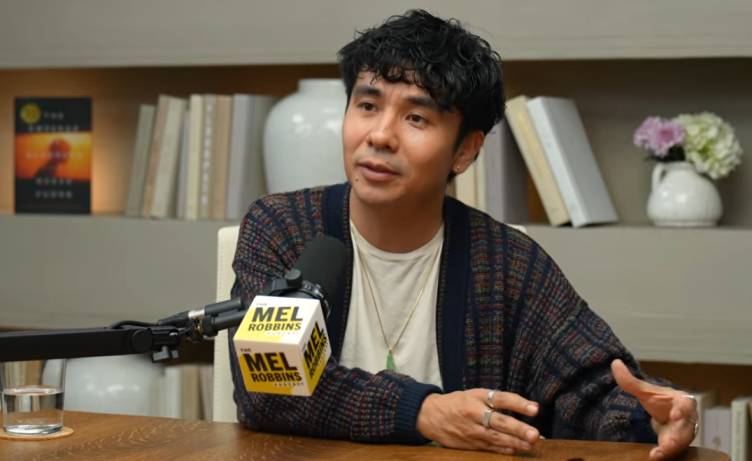
Editor’s Note: In this moving episode of the Mel Robbins Podcast, award-winning poet and best-selling author Ocean Vuong shares his journey from being a Vietnamese refugee to becoming a world-renowned writer, offering a profound perspective on finding purpose in the face of shame and poverty. Together, they explore how to reclaim your dignity and use language as a tool to rediscover your sense of self and community. This conversation serves as a beautiful reminder that a meaningful life isn’t about proving your value to others, but about finding power and grace exactly where you are today. Whether you are feeling lost or searching for more significance, this interview provides a heartfelt roadmap for transforming your relationship with yourself through kindness and attention. (Jan 26, 2026)
TRANSCRIPT:
Welcome and Introduction
MEL ROBBINS: Ocean Vuong, welcome to the Mel Robbins Podcast.
OCEAN VUONG: Thank you so much for having me.
MEL ROBBINS: I am so excited to meet you. I loved your book so much. I’ve given it to so many people and I was absolutely honored when you said yes and said that you would come on and talk about purpose and feeling lost and about your work and the themes in your work. So thank you for being here.
OCEAN VUONG: Oh, thank you so much for recognizing what I’m trying to do. It’s a deep, deep honor to be here and to share with this beautiful audience all around the world about what at the heart of what I’m trying to do.
What Is a Meaningful Life?
MEL ROBBINS: Well, let’s talk about that. Let’s talk about what is at the heart of what you’re trying to do. And if I really listen and take in everything that you will teach me today, how could my life change?
OCEAN VUONG: I hope people realize that, if they don’t already, that a meaningful life is not a life that you use to prove to yourself or others that you are valuable. A meaningful life is finding the power and the value where you are.
MEL ROBBINS: What I love about that is that you’re inviting us to consider that wherever it is that you are, even if you envision some possibility beyond where you may be, that there is a way to feel dignity.
There’s a way to feel proud of who you are and what you’re doing, that there’s beauty in the life that you’re living right now, even though you may have a hope in your heart that things might change or move in a different direction, that learning how to reclaim that sense of self is really at the heart of your work.
Reclaiming Language and Dignity
OCEAN VUONG: 100%. And so much of language in our world and our culture has been captured to humiliate us. If we look at advertisements, political campaigns, if we look at emails, corporate messages, we’re bombarded by language that tears us down and says we are not good enough. We are constantly humiliated and debased in the way we experience language.
And the work of—I’m already getting emotional talking about this—the work of poetry and language arts is to reclaim the strangeness and the beauty of language so that the wonder and awe at the heart of it is recycled and reclaimed back to everyday use.
Language is a strategy that has always been historically used to control people. And so when you realize that, oh, so much of this thing I use every day, when it goes into the hands of corporations and politicians, it’s manipulating me, then you realize if I speak and use this material with deliberate attention and intention, then I can reclaim a portion of myself.
And part of that is dignity. And a lot of my work is I’m interested in using language as a way to reconfirm self and communal dignity.
MEL ROBBINS: What does the word dignity mean to you?
OCEAN VUONG: The ability to live without shame and to be proud of parts of your life that people think are failures. Because in my short journey, I’ve learned that all the struggles that me and my family have gone through, they were all also sites of innovation and creative struggle.
So to me, I think dignity is about looking at what people have said to you that you should discard and realizing that it’s always part of you and being proud of that as a process of who you are, so owning all of your parts and not having to walk around with that shame. That, to me, is what dignity is.
And to me, it’s like you’re told that you got to go up, go up the mountain and there’ll be a light that will heal everything. And what I realized was how long and inefficient realizing that is.
I was raised by illiterate women, and because they were illiterate, they knew how powerful reading was. It was like sorcery to them, because it’s like we don’t know what it is, but we know how powerful we know the world runs with language. So you have our blessing to go off and figure that out.
I never had a mother that forced me to do this or that. She said, “Son, go off and learn what you can. And if you can’t, there’s always a seat next to me at the nail salon.” So you go off, you go get your education.
And for me, it took—it was a long, circuitous path. It took me six years to get my undergraduate. I went to four institutions, community college, business school, dropped out, what have you. But you go off and then you tell yourself. And I think this is particularly true of the immigrant and the refugee, but I think it’s true for all children of the working poor.
You tell yourself, I’m going to go. I’m going to go into that institution and I’m going to figure it out.
So it’s kind of this mining, and you realize that knowledge is so inefficient and it takes so long. Meanwhile, destruction is so efficient. Our social services are gutted overnight by the stroke of a pen. Entire city blocks could be blown apart by weapons. It will take decades to heal and repair them.
Destruction is so darn efficient. I think human beings, one of our worst inventions was that we have found out, we have found the way in the 20th century to make instant ruins. Before that, ruins took thousands of years to create. But now we can make ruins instantly. And we are still living in the aftermath of that.
And I think that’s also a metaphor for reparative learning, which is what so much of class, being a class outsider is, right? You’re brought up with so much shame.
The Weight of Shame and Poverty
MEL ROBBINS: What did growing up and feeling that shame that you feel when you’re poor, when you’re an outsider in a new country, what did that teach you about how to live in a world that is constantly sending messages that we don’t support you, we’re against you, there’s something wrong with you. What did that teach you about life?
OCEAN VUONG: Shame is so perennial for so much of American life. It’s very much true for the poor. I remember being in Stop and Shop, local grocery store, and my mother counting how many tomatoes she could afford.
And I just think you’re, as a kid, you’re sitting there, you’re standing in line, and you’re watching the cashier, who’s not that older than you, look away. Because we’re all in one ecosystem. They’re not making that much money. So it’s just like poor folks together.
But what’s unspoken is that deep shame, and none of us knew why or how to ameliorate it. And so you’re sitting in line, and you’re watching your mom push two little plum tomatoes back in the conveyor belt, and you’re watching this kid who’s probably four years older than you look away, because he knows, out of respect again, that dignity, offering each other a little bit of dignity to look away. I’m sorry.
MEL ROBBINS: Why are you apologizing?
OCEAN VUONG: Because I want to be clear, and my voice wobbles.
MEL ROBBINS: You’re very clear.
OCEAN VUONG: Okay, thank you.
MEL ROBBINS: And I’ve had the experience, but only I’m the mother with the kids standing next to me. And I had the line rehearsed for when the credit card would not go through. And I would always cock my head and kind of look surprised and go, “Well, that’s weird, because it just worked at the gas station.”
OCEAN VUONG: Yeah. Wow.
MEL ROBBINS: And then I’d say, “Come on, kids.” Let’s go out to the car.
MEL ROBBINS: “I’ve got another card out there.” Which I didn’t. And you don’t forget that. But everybody knows, and nobody knows how to talk about it, how to make it right. And looking away in that moment is a form of respect, because you don’t want the person who’s dealing with that heaviness to feel the weight of your judgment either.
OCEAN VUONG: Yeah.
MEL ROBBINS: And so please don’t apologize for speaking and telling us the truth of your experience. Because, you know, for the person who doesn’t know you, you’re, in my opinion, one of the most decorated and awarded writers alive right now.
The American Book Award, the Mark Twain Award, the T.S. Eliot Prize, the New England Book Award, the MacArthur Genius Grant, you are a professor at NYU. And so while your story began growing up in Hartford, Connecticut, immigrating here from Vietnam, your mom and the women around you being illiterate and working in a nail salon, you went on to take back language and write about dignity in the human experience.
Moving Through Class Systems
OCEAN VUONG: Gosh, Melissa, thank you so much for that counter and that opening. I’m so grateful for that moment of grace, because I think one of the things about moving through class systems is that you always assume what you’re going to say is going to be not legible.
And I feel like both you and I know, and maybe a lot of your audiences know, too, where you walk into a room and you say, “Well, do I really say it like it is? And if I do, are they going to look at me like I’m crazy, or am I just outside the frame of understanding?”
And so you try to assume that what you’re saying is a breach. So you have to apologize for that breach. Right? “Oh, I’m sorry. I’m going to go here, but I feel like we need to go here.”
And you gave me such a beautiful moment of grace that I don’t really experience in the spaces that I now traffic in. But I think there’s two types of shame. There’s the shame of who you are, which is ontological.
MEL ROBBINS: What does that word mean? It’s a big word.
OCEAN VUONG: The shame of yourself, right? So people, for queerness, many people shame us for ourself, our ontological presence, our being, which we cannot change.
And then there’s the shame of action, of conduct, which I think can be really fruitful. It would be great if a lot of our politicians felt a little bit of shame, right? Because that means they’re recognizing that you can act on it, you can do something, you can repair something.
And so I think in many cases, so much of my childhood was about both of those shames. The shame of being poor, which you had no control over. Then the shame of being queer, which you have no control over. And then the shame that what you’re doing is not enough. So the shame of action.
It’s like, “Oh, I work so hard, but I’m not feeding my family. I work so hard, but I’m still stuck in this tenement.”
And my mother told me, I remember she got—we were just talking one day before bed, and I just like to just talk to her before bed. I was like 10 or 11. And she turned to me and she said, “I’m so sorry that our family is so stupid we couldn’t make it. It’s been 10 years in this country, and other folks have started businesses that are lucrative. They’ve gone off to Houston and LA, other Vietnamese communities. They bought homes, and we can’t figure it out. I’m sorry that we’re just so dumb.”
That gets the heart of what it means to be poor is that you start to feel that you’re not a good person because other people could afford to give. Right? The heroes in our public discourse are the ones, the entrepreneur, the ones that can donate and give and rescue children and rescue the people.
But when you don’t, when every day you don’t have enough to even be the hero of your family, that you start to feel like you’re the villain of your community.
And so when I was a kid, in that moment by my mother’s bed and in that moment by the grocery store, seeing to the day I die, I’ll see those plum tomatoes roll back on this dirty conveyor belt. You realize I told myself, I’m going to use the shame, and it’s going to propel me to understand it.
So shame became my propulsive force. I was like, I’m going to use this to, as wind to find out, because this can’t be. There has to be a root to all this.
A Message for Those Feeling Lost
MEL ROBBINS: What would you say to somebody who’s listening right now and is in that place where they are feeling a tremendous amount of shame and feeling very lost?
Whether it is because of very similar life experiences that you’ve had, or maybe it’s somebody who’s feeling a lot of shame because their marriage blew up or they got a health diagnosis and they’re having a lot of trouble, really just getting through the day, or they’ve really made some terrible decisions in their life, they’re beating themselves over the things in the past.
What do you want to say to that person about how to really think about where they’re at and how to shift their relationship with themselves?
The Power of Language to Transform Your Life
OCEAN VUONG: Yeah, for me, as a writer, it all begins with language. You know, often when we talk to each other, we use fluff language to get by. You know, oh, how’s the weather? How about them Patriots? You know, what’s going on? How so and so. And sometimes we don’t answer that question. We say yes, but it’s just a muscle memory. How are you doing? Great. Good.
And I think giving yourself permission to break, to break the norm of hiding and using language to obfuscate and just say, I’m not okay. Or changing the question. When was the last time you felt joy? Now you’re in a different linguistic space and you realize that people actually really hunger for that, but they don’t want to burden you with that.
And they don’t. We don’t have the words to open the doors. We only have the words to move outside the doors. And so when the words change. So disruptions in linguistic patterns, which is what poetry and novels do, right? Because they’re disruptions. We don’t pick up a novel to confirm what we know. We pick it up to learn something new. In a way, we’re disrupting ourselves.
MEL ROBBINS: Oh, that’s so cool. Yeah, I never even thought about that. But you’re right, because I didn’t pick up the Emperor of Gladness because I thought I knew everything was in there. I picked it up to be transported and to use your word to disrupt my day to day life and open myself up to something different.
Is there some recommendation that you would have? If you’re trying to disrupt the language you use around yourself and you find yourself saying, I’m not enough, it’s never going to work out. I’m not good enough.
OCEAN VUONG: Yeah, yeah. Well, my very rudimentary practice when I was a young poet and I still do this, is write, just copy down your favorite poems and your favorite texts because now you’re in someone else’s head. So I would do that with Federico Garcia Lorca, Toni Morrison, Mary Oliver. You know, and when I’m stuck and when my language is running my life and it’s toxic, I can just take another poet and I would just open up the book, put in my journal, and just copy and feel.
You know, that’s the beautiful thing about language is that it’s the most democratic tool we have because everyone can use it.
A Simple Tool to Override Self-Defeating Language
MEL ROBBINS: I want to make sure that as the person’s listening to you or they’re watching on YouTube, that I highlight this tool that you spoke about. And I want to expand it a little because you gave us this offering that I think is really important to make sure the person as you’re listening that you really get that you could do this.
You said that if you’re really feeling a sense of shame or if you are using your own words against yourself, I am not good enough. I have failed. I will never amount to anything. I’m not smart. Whatever those words are that you beat yourself up with, you said one tool is that you would open up a line from one of your favorite poems and then you would write that line and trace those letters and you start to then basically borrow those words in order to override and to teach yourself a new language.
And one of the things I want to say that I think people do instinctually is a lot of people save quotes they see online. And that’s another way to do exactly what you’re talking about. That if you are stuck with really self defeating language and you know you’re beating yourself up, if there are famous quotes, if there are lines from a book, if there is something that has lifted you up or you’ve saved in a little folder somewhere on your phone, you could do exactly what you just said, which is write that out every day. And as you’re tracing the shape of those letters, really imagine that those are the words that you say to yourself.
OCEAN VUONG: Yeah, it’s like secular prayer. Yes, right. It’s a form of prayer that you choose. You get to curate a kind of bibliography or bible for yourself. Right. And you don’t have to be religious to do it. And in fact this is what the early monks did. They would trace and replicate psalms and the Bible by hand. Right. And so that was kind of a meditative practice.
And also imagine visualization, imagine the people around you. Right. Using the language, even just saying that, I hope my sister has a good day. Recenters us because there’s. In Buddhism we have this idea. In Buddhist psychology we have this idea called sequential thinking.
MEL ROBBINS: What is that?
Sequential Thinking: You Can Only Hold One Emotion at a Time
OCEAN VUONG: In Buddhist psychology we do not believe that you actually feel two things at once. One can only hold one emotion at a time. So it’s like holding a ball. If you’re holding the ball of hatred and whether it’s for others or self hatred, the only way to have another thought is to put down that ball. You can’t just grab another. Right. You have to put down that ball and then hold something else.
And in meditation practice we usually do a check in with ourselves. And often, particularly nowadays, I sit down and something in me said, this is going to be a bad session. I can’t do it. My knees hurt, my ankles hurt. There’s too much going on in the world. That email is bothering me. I really got to get back to that. There’s so much. And it’s all about I’m holding my own suffering.
And what we do in Buddhism is that we start to displace our suffering with other people’s suffering. So we start to think about the people closest to us and then we radiate outwards. Oh My brother’s having a bad day today. I remember now he’s really struggling. My brother works retail at a sporting goods store and you know, it’s wage work, you know, sometimes it’s hard, people yell at him, it’s. And he’s his very stressful job.
And so I’m holding him and all of a sudden it’s really. I don’t know why this is but when we hold our suffering, we suffer more. When we hold someone else’s suffering, we have compassion. It’s amazing. Why I would love someone much smarter than I to figure that out. But that’s always the case. It’s very hard to continue to suffer when you’re holding someone else’s suffering because something like love starts to come out of that.
Some days I can’t do it. Some days I’m like, I just don’t have enough to go there. But just even saying that word, the phrase, I hope you know the people in my community can find safety. I’m going to work towards that. I’m going to work towards securing their safety. And then you start to, all of a sudden you visualize what you can do, how you can volunteer, how you can help.
And all of a sudden you remove from yourself. And when you come back because it’s all cycle, you come back to yourself and you say, gosh, I don’t know how to pick up that ball anymore. I see it, I see self hatred, I see envy, I see bitterness, I see self loathing, it’s all there. But I can’t really pick it up. Before it was stuck, it was glued to my palms. But for some reason moving outward has cleansed and now I can’t pick it up if I wanted to.
MEL ROBBINS: It’s so effective and it’s so simple. As you were talking and explaining this, I just did it say more. So my mom and dad just lost a very, very good friend and it was very sudden and really tragic thing that happened. And the second you started talking about your sister, I thought, oh, you know, I hope my mom and dad are having an okay day today. I hope that they are surrounded by friends today. I hope that their heartache is getting the support, you know.
And then I thought, oh, I need to call them as soon as we’re done talking. And everything that was self centered disappeared from my mind. And there was this big expansion that happened.
And as you’re listening or watching, I want you to think about somebody that you love, that you really do hope with all of your heart that they are having a good day that they are getting the support that they need. And if you truly step into this invitation, I think you will feel exactly what Ocean’s talking about. That somehow there was something you were holding inside yourself, even in the subconscious. But when you direct that attention and focus outward, something expands and lightens inside of you.
OCEAN VUONG: Because you can only hold one thing.
MEL ROBBINS: Because you can only hold one thing. You know, I want to ask you a question because I loved your New York Times blockbuster, best selling, profound novel, the Emperor of Gladness. And when I opened up the first page to chapter one and I read the first sentence, I thought, if I ever meet Ocean, I want to ask you about what this means.
And the sentence is, “the hardest thing in the world is to live only once.” What does that mean?
The Hardest Thing in the World Is to Live Only Once
OCEAN VUONG: You have to make account what does it mean to live and owe something to the people you love, your obligation to them, to your community, and to live with that kind of care? Because the other side of that is YOLO. You know, you only live once. Enjoy it. Smash it all. And look where it’s gotten us. Ecological despair, corporate greed, plundering our environment, our planet, just for profit. That’s a lot of YOLO.
Another side of YOLO is that, well, if you only live once, how do you live in a generative way? How do you live with care and consideration, with the meditative practice you just did? You don’t have to be a monk and sit there and go home and do chanting. You can actually do it while listening to someone talk. Right?
MEL ROBBINS: I want to unpack this even deeper. The hardest thing in the world is to live only once. And you said to you, that means you have to make it count. And what I would love to hear you talk a little bit about, because never asked anybody this question, but as a professor, I bet you are witness, front and center to this sense of pressure and urgency that is not only inside your students, but it is 1000% inside every character in your book.
But this pressure that I think is almost universal, to make something of yourself, to make your life count. And for somebody who’s listening right now, who heard you say, oh, well, you have to make it count. And they now feel like, but I’m not Ocean. Like, I’m still. I’m stagnant. I’m working in this restaurant job. I didn’t expect I would be here. It doesn’t feel like it’s counting at all.
OCEAN VUONG: Yeah, yeah, yeah.
MEL ROBBINS: What would you say to the person that’s in that space? Because I think the pressure you feel to want it to count is a really good sign.
OCEAN VUONG: Yeah, yeah.
MEL ROBBINS: Of this sense inside you that there is something more for you. Does that make sense?
The Alternative Count: Defining Success on Your Own Terms
OCEAN VUONG: Absolutely, absolutely. And I think for me there’s two. There’s what society counts. And often because we don’t know any better, we’re told that we are. It’s almost like a download. Society downloads the set of values into us and then we say, “Well, I need to get a good job. I need to get out of here.”
And that’s why, like this novel, there is no escape plot. These are working poor people. They remain so, but it doesn’t mean that their lives are doomed. I reject this idea that a story about down and out poor people is only valuable if they can escape it because there’s plenty of films, plenty of novels about that.
And I think as Americans we fetishize rescue. I think there are more Americans rescued in American films than actual Americans. And yeah, it feels good to watch that movie. “Oh, gosh, look, they rose out of it.”
And then there’s the other part. There’s an alternative count, which is your obligation to yourself and your life and your community, regardless of what that means in the CV, in the social standards and what have you.
And I think what I learned working in fast food and the tobacco farms growing up and what I wrote about is that in those spaces there’s something really, really humbling and powerful. If you walk into NYU, where I now work, if you walk into a doctor’s office, a dentist’s office, a law office, everybody who’s there worked and wanted to be there. They might not like their job, fine, but they all deliberately work to get there.
But the folks in the fast food restaurant, they never want to be there. That’s not their final goal. They are deferring something else. What’s so humbling and powerful about that is that everybody, you realize there’s another dream. And when you work enough hours, it becomes really, it looms large and you start to really want to find ways to find out that dream.
You have these kind of probing conversations. “What do you do after? What do you do before this? What do you do? What are you doing after that? You do a night class?” All of a sudden these spaces open up in these restaurants and corporations that were not meant to be there. They’re kind of subversive utterances.
And so to me, I think what I mean by the hardest thing in the world is to live only once, is to live according to your values. Again, dignity and what you owe to yourself, your family and your community, however that means to you, and wrestling yourself away from the standards of ultimate success or what have you.
I am lucky to be a successful author and a professor, but I live in New England still because nine of my family members still live there. They’re all refugees. They came with me. I don’t have enough generational wealth to liberate them from the working poor. So my family still work at Amazon warehouses, nail salons. And I’m there. I’ve had job offers in lovely places. Paris, Germany. I said, as soon as they come in, I said, there’s no way. Because I got to take my aunt to her doctor’s appointment. I got to do her taxes. I have to help my cousin go into a psych ward once in a while.
And that’s not a burden to me. And I want to make that clear. That’s a privilege. I get to. It’s a privilege to be able to sacrifice. I get to help them. Because when I was growing up, you needed your tooth extracted. Chaos. You had to call a loan shark. We had to call a local Vietnamese grocery store to borrow money from God knows who, don’t ask, don’t tell, just to get little things done. So it was like the end of the world when those things happen.
And now I can. Every emergency my family has, I can take care of. And I’m proud of that. And to me, if that’s what I’m doing with my one life that I’m given, then I’m really, really proud of that.
And I think having the courage to break away from the social expectations of count and then realigning what counts for you, it’s hard work, though. It took me 20 years, and this is still new to me. This is a new feeling. I don’t want folks to have this understanding that I just, like, I’ve always had this. I’m developing it as we speak.
MEL ROBBINS: What I’d love to have you do is if you could speak directly to the person who’s really resonating, because I know so many people will. And maybe they’re in the job and they thought they’d only work at the restaurant for two or three years, and they’re just getting by and they’re starting to feel that dream of a different life slipping away. What do you want them to know?
The Myth of Yourself
OCEAN VUONG: I think for me you have a myth of yourself. And the myth for myself was to be a business person because that’s just what I thought more money was. So when I was 15, I thought I was working at a tobacco farm for cash. It was no Uncle Sam, no taxation under the table, $9.50 an hour. Way better than minimum wage, which is $7.15.
And it was so interesting because we lived in HUD housing, Section 8. And my mother sat me down one day and said, “Son, I crunched the numbers and you need to get a job. You’re about to be 16, but you got to just work at McDonald’s.”
So can you imagine what happened to American dream, upward mobility, do what you want, follow your destiny? I’m like, “What? Excuse me?” And she’s like, “No, no, no. You can’t even be the manager. You need to just be minimum wage because if you make any more, we’ll be kicked out and we won’t be able to afford an apartment on the open market.”
So upward mobility could render you homeless. And then it clicked. I said, “Oh, no wonder every other teenager in my neighborhood is a drug dealer.” Because if you’re a child to a single mom, and there were daughters and sons in that too, if you’re a child to a single mother and you want to help her out to get a job, if you get too much money, you’re going to lose your housing.
So what are you going to do? Sell weed on the side, get cash, put it on the mattress, mom pays the light bill with her checks, you take her to the grocery store. And I have seen folks do that. And I don’t condone drug dealers. I’ve seen folks do that and move out and move on and stop that and have relatively economically successful lives. I’ve seen folks do that and end up in jail and die. So it’s just a complete crapshoot.
And so I went into the farm as a way to help my mother. But I had this myth that I would go out and be the one who has a degree. I was going to study international marketing and really be the superhero of my family.
And then I got to the school in New York to study and I studied for just four weeks before I dropped out. And all that myth of who I am to myself crumbled. And I often say this, and not in any tongue in cheek way. I said, I became a writer out of failure and more. So I became a writer out of shame.
I could have went home to my mom and said, “Mom, I tried. I can’t do it. I’m not cut out to go to Chase JP Morgan like all my colleagues are with their suits.” I don’t have a suit. We have one suit. It’s called the funeral suit. That’s all I had. I didn’t even bring it. I was optimistic. Going to New York, I was like, “I’m not going to bring my funeral suit.” I went to enough funerals, so that’s all I had.
And I didn’t even conceive that you had to wear a suit for an internship. I was so out of place that I just, I felt like a fool and I didn’t have the wisdom I had. Now I couldn’t show up to that place and just see how much of an outsider I was. So I dropped out and I roamed the streets, couch surfing, doing open mics.
And someone would say, “Why don’t you just go home?” And if I went home, my mom would say, “Sit on down. I save you a seat at the nail salon. Pick up the filer, let’s get to work.” But I didn’t do that because I was too ashamed to go to her and say, “I failed you. I’m the only one that knows English. I’m the only one that can read. I’m the only one that could potentially have a college degree, and I’m going to come back empty handed.”
I could not live with myself, so I stayed in the city. I stayed in Penn Station for two weeks trying to figure things out.
MEL ROBBINS: Meaning you actually slept in Penn Station?
OCEAN VUONG: Penn Station, yeah. Right under Madison Square Garden. It was the warmest place. But Penn Station is open 24 hours and you can stay near the Long Island Railroad. Eventually I became a student at Brooklyn College. I pursued a degree in literature, but it was because I was too ashamed. I would prefer to be homeless, then go home and say, “Ma, all your dreams.”
Because I knew she had, I knew. Even though she said, “Don’t worry about it,” I knew she had dreams for me. I couldn’t face her and say, “All that is over.” So shame is a powerful thing. If you can transform your shame into action and then motivation, it could be the foundation for you to alter your sense of self.
Transforming Shame Into Action
MEL ROBBINS: What would you say to a student that came to your office hours and, “Professor Vuong, I am so full of shame. I do not belong here. I have really screwed up.” And the shame is not motivating them in a positive direction. It is drilling them into a hole. So if you had a student sitting in your office hours who was really pummeling themselves with shame, what would you say to them?
OCEAN VUONG: Every semester.
MEL ROBBINS: Every semester, this happens.
OCEAN VUONG: Oh, my goodness. Especially in the creative arts, we have students who come from all over the world. Some of the most exciting work in Anglophonic literature right now is coming out of India and Nigeria. And I have a lot of students from India and Nigeria. And, boy, imposter syndrome runs very, very deep.
And here they are in NYU. They’re following their dreams. Meanwhile, these are the students, the most successful ones. They’re ticking the boxes of their dreams. Nothing has gone awry, and they still feel this. And I relate to that immensely. So for me, I told them, I said, “Look, I share the same shame and doubt that you do.”
MEL ROBBINS: But you believe.
The Imposter Immune System
OCEAN VUONG: I have a sense that you believe that there is a kind of comfort and agreeability to being in the center of power in institution, that that’s what people, normal people have. They don’t feel like they’re imposters. They feel like they belong here, that they should be here.
But I tell them, I said, “The day that I feel that I belong in institutional power is the day my creativity dies. I never want to feel comfortable here.” And we turn that into a pathology. We say, “You are ill. You have a syndrome.” But I refuse to believe that. To me, it’s an immune system. I have imposter immune system.
MEL ROBBINS: What does that mean, imposter immune system?
OCEAN VUONG: It means that when I’m in the center, I don’t believe that being in the center alone is anything valuable or dignified. You have to still have conduct. You still have to have behavior and ethics. And also that when you realize, you go into these spaces and you realize, actually what I learned back there in my hometown that I thought I was escaping from was much more useful for me than what I’m seeing here.
That this charade of power and belonging is truly a hallucination. There’s people who feel comfortable here because they have been given this path. Their parents gave them this path, their grandparents gave them this path, that they were following a trajectory that was carved for them. So of course they feel like they belong.
But do you really want that? Do you want that path for yourself? Because that’s also the denial of your own creativity. You need that kind of friction, that vigilance.
Finding Purpose in the Space Between
MEL ROBBINS: Well, I think what you’re getting at is applicable to anybody. Because let’s say you get a divorce and now you’re single, and your friend group disappears. And as you start to insert yourself into other social groups or you see old friends, you will feel that separateness, and you will feel that sense of, I don’t belong here.
And if I listen very closely, what you’re saying is that that separateness and that friction is a very important and necessary ingredient to you being able to do the work, to grow into or to be the person you’re supposed to be. Whether it’s the friendships you’ve outgrown or the places that you are never going to quite feel like you belong in, or the work you need to do to build the skills so that you don’t even think about it anymore because you now have the skills to belong.
OCEAN VUONG: Yeah.
MEL ROBBINS: And so I think it’s applicable to all of us. I’m wondering if there’s one thing that you would recommend to begin seeing the beauty in your life, even if you’re really struggling right now, especially if they’ve related to a lot of the various things that you’ve gone through. What would the one step forward you would want somebody to take?
Bringing Your Younger Self Into the Room
OCEAN VUONG: At the end of my semester, in every class, I have my students do something very simple, and I do it as well. And you’ll be surprised that many of them have never done it. And what I do is I tell them, think about your intention. Why are you here? Why did you sacrifice so much?
And I tell them, go back to that person that first found this art. The person who read a poem and said, just like Emily Dickinson said, “my head is taken off,” right? And then decided that they want to do that for other people. Write a work that transforms and affects people’s lives that way. Maybe it was just two years ago, maybe it was 10 years ago. Maybe they were just seven or 20.
Go back, find that person and collaborate with that person. Bring that person into the room. Because often in our linear progress in professional life, we often think our older self is not smart enough, naive. Leave him back there. But bringing that person in the room and asking that person, how are you so strong? And how was that intention so powerful that you didn’t even know how to get here.
You didn’t know how to get to NYU, but you sent me. You, my younger self, sent me here, like that little pebble in the pond. I am the ripple. You are the pebble. I’m the ripple that have come from you. So I need you. When I am inundated by the pressure, when I’m asking, why am I doing this? What is it for? What’s the point? Why am I in this rat race when I’m about to give up, when I’m fading, I need to bring…
So I tell them every time you write, every morning you wake up, bring that person, have them sit right next, because they know more than you do. They got you here without even knowing what a professor is, without knowing what the New Yorker is, without knowing what a curriculum vitae is, right? They just had that boom, and you are on the journey they set.
So what you need to do is say thank you to that person. So at the end of the class, I tell all my students, on the count of three, you say thank you to yourself aloud. And you need to say that every day because no one else is going to say that for you, for this journey. So we close and we, one, two, three. Thank you, Ocean. And it’s an amazing thing. Thank you, Ocean. Thank you, Mel. Saying that to yourself.
MEL ROBBINS: I am the ripple, you are the pebble. I felt this huge chill when you said that. This idea that your younger self was the pebble that had an intention, whether you were present or not to it, that set in motion this ripple that created the you that you are today.
If the person listening does not know what their intention is, they do not know what age or what scene of their life that pebble was cast. Is there anything that they can do that could help them find that center of intention to begin with?
The Power of Attention
OCEAN VUONG: I think paying attention to the world and yourself and again, seeing what you owe. Eventually, Simone Weil says, “the most generous thing we can ever give is attention.” And I think paying attention to the world, often we think it’s about giving attention, but in fact, we are also discovering ourselves when we look carefully at the world.
And I never knew I was going to be, when I was growing up, it was factory worker, nail salon, the army job corps, right? Or long haul trucker. Those were the things. Or jail, right? Those were the things that was available and what was happening around me. And so I never, no one ever said, you can be a professor.
In fact, I didn’t even know poets were something you could become. I thought it was, like, preordained by the government. I thought like the president signs, like a list, you get in the mail, and it’s like, you get to be a poet. Then they give you a cabin in Vermont. You go there, you scribble away. Then you send your piles of paper to Barnes and Noble, and they go out in the back, they make a book, and they wheel out a cart of books. How else would it happen?
And so the idea that one could be a poet is a complete journey of failure, of objection, of shame. And so I’m 37. Half of my life have been in nowhere land. Absolute loss, absolute objection. And I would never have told you that I was going to be a professor or write books.
You know, to me, I am miraculously in the whipped cream of my life. And I’ve been in it for 20 years. I’ve been able to do what I love, but it was not a life that I thought I could afford in any sense of the word.
MEL ROBBINS: So the pebble, if I’m really like, I just felt like I should say the pebble is, though that deep intention buried within you to be in the whipped cream of your life, to know the truth, that there is something that is meant for you, that there is power, that there’s dignity, that there’s beauty and this sense that you were going to figure it out.
The Pebble That Started It All
OCEAN VUONG: And it was something much more materially fundamental in that I wanted to take care of my family. I knew I was the only one. I looked, I looked long and hard at their life, and I said, all right, they’ve been in the factories. I mean, I went back to that moment with me and my mom at her bedside when I was 10. And when she said, “I’m sorry we’re so stupid.”
MEL ROBBINS: That was the pebble.
OCEAN VUONG: I didn’t know it then. That was my, so it wasn’t be a poet. I say that to my students, that we’re in poetry class, right. It gets too existential. Beyond that, right. But for me, that was a pebble. It was whatever I was going to do to take care of my mother and my brother and my aunts. That was what I was going to do.
And when I realized that I could take care of my mother and be an academic and a poet, then that was when it was like seventh gear. I became kind of ruthless in my pursuit of my craft because I knew it was something that would then support my family. That was my motivation.
So now I say, oh, I was given that my objection was a motivating factor. Without them, I don’t think I would have worked as hard. I would not work as hard for myself, I’ll tell you that, Mel. I would not study as hard. I would not read as many books. I would not write as many drafts without the pressure, knowing that they really depended on me to get them a better life.
MEL ROBBINS: Thank you for sharing that. Because it was so helpful to see that your pebble actually wasn’t this epiphany. I want to be an artist or a poet. That your pebble was something so much more deeply connected to your value of taking care of your family. And that shifted for me the way I think about, I am the ripple, and my former…
OCEAN VUONG: Self is the pebble.
MEL ROBBINS: The intention is the power, and it’s there. And I really, I got a lot out of that story.
OCEAN VUONG: Thank you.
MEL ROBBINS: Thank you. So, you know, one of the things I was also curious about because you’ve been a professor for 11 years now.
OCEAN VUONG: Yeah.
MEL ROBBINS: What is the thing that’s really holding your students back more than anything right now from being themselves?
The Fear of Humiliation and Cringe Culture
OCEAN VUONG: The fear of humiliation. We call it cringe culture. We can call it, fear, authorial hesitation, whatever you want to call it. I’ve had the great luxury of being a professor only to Gen Z. My entire career has been educating Gen Z, from the very oldest now to the very youngest. I’ve watched this generation grow, and I’ve watched the horrible public precarity that they have to navigate.
You know, when I was a kid in the 90s, you do something silly and your class makes fun of you. Worst case, your school makes fun of you. And then after summer break, all is forgotten, right? And then you kind of cleanse by the amnesia of summertime.
But now you do something out of the norm, as much many children are inclined to do. Your kids, your brain is developing. You can be filmed without your permission, and a week later, an entire country that you have never stepped into is laughing at you. And then years later, you become a meme, a symbol that is completely extracted from your personhood.
So the meme is one of the most brutal realities of our 21st century mode of communication, because it transforms a human being with a historical life and a personality into a communication object, into a sign, which now serves somebody in a group chat.
So by the time I get them, I teach a graduate program, so they’re 22, 23. And we get the ones who have already committed themselves to art practice. So we get the ones that are kind of professionalizing, but without fail, every year at the first day of class, you can see by the body language in the room how deeply beaten down and afraid my students are for being a poet.
So I tell them that the classroom is a laboratory of failure. This is a place to fail. This is a place to be embarrassed and I’m not going to critique you for the first few weeks, and we’re not going to critique each other.
We are a culture obsessed with static truths. We have a word for a bud and then a word for rose. Rose, bud, rose. But there are infinite moments in between. There’s a moment where the rose just starts to tear. And if you zoomed in enough, you don’t even know what you’re looking at. It’s still part of it, but we don’t have a word for that.
And to me, so much of life actually exists in this liminal, monstrous, undefinable space in between the two definitions of rosebud and rose. And so I tell them, I said, you are now in the space between the rosebud and the rose. That’s what these 14 weeks are. We don’t have a word for that. Sorry. Doesn’t matter, though.
So normalizing the idea of failure as a necessary procedure of growing as a human being and not using judgment as a punishing tool of progress. What a lot of students want from the classroom is a factory. They’ve been taught that I’m going to go to NYU. I’m going to feed my weak poems into the NYU factory, and a professor and my peers are going to fix everything, right?
It’s all about this false idea that if I just keep working, a finished, brand new, T Model Ford poem will come out at the end of it. And it’s a completely false fantasy. So it’s introducing to them the larger reality that all of this will come through error and errancy. But in fact, error and errancy is part of being alive. And not only that, but part of innovation. That’s the daringness.
And when I set that up as the, elaborate that as the, what the classroom is for, you see the body language change, and I’m like, oh, there you are. There you are.
Normalizing the Human Experience
MEL ROBBINS: What I love so much about your work and about the way that you think and the way that you talk about your experience is you have this unique ability to dig deep into these subtle moments in people’s lives. And I feel like you’ve got this ability to really normalize what is a experience that so many people feel but don’t have the words to describe.
And the message that your work carries in it is the opportunity for all of us to not only create that space for ourselves. Wherever you are right now, because being in a moment in your life where shit is still and you don’t feel like it’s going anywhere.
OCEAN VUONG: Yeah.
MEL ROBBINS: And you are feeling like this is really what it’s going to be. Am I really making my life count? Especially as you get older.
OCEAN VUONG: Yeah.
MEL ROBBINS: I think everybody’s had that experience.
The Weight of Working-Class Life
OCEAN VUONG: And imagine being raised by someone like that. Imagine being surrounded and multiply. If you’re in a community like that or a family, everything you said multiplied by eight or nine, everyone around you feels the same way. Right. And the deep resentment, the deep sadness.
But also like, again, like, my stepdad wore that. Standardyne. He worked at a place called Standardyne. He made a screw his whole life for like 30 years. He made the screw that went into gas pumps. And that company shut down. It went overseas.
So he’s uneducated refugee from Vietnam, spent seven days in a boat and went to a refugee camp, then came to Hartford, met my mother, and he spent 30 years making a screw. And now he doesn’t make a screw anymore. What does he do? You know?
So he goes to work at Colt, which is a gun factory, and also in Connecticut, Newington. And he makes a smaller screw that goes into the Colt Magnum. And gas pumps and guns is the most quintessential American story.
Every day after work, he hung up his uniform in our living room on a thumbtack because we didn’t own it. So we could not put anything on the walls. We couldn’t paint it. We had to get permission. It’s a bureaucratic nightmare just to paint your walls.
He hung his shirt there because on the right chest it said N, G O, C. His name with the diacritic stitched in beautiful blue thread. And every time someone come over, he would point to that. I said, “I work at Standard Eye. I have health care.” That’s how low the bar was. Right. It’s like. And we’re still feeling that bar.
It’s a big thing to say. I have health care. It’s a big thing to say. I have a salary. It’s a big thing to say I belong to a place with a uniform. They believe in me enough to give me a uniform with my name on it.
I looked at that for years, similar to how you describe your family in the farm. And I saw that. And I told myself, that can’t be my American life. This man works from 3pm to 12am. I never see him. I look into his room. I see a tuft of black hair out of his blanket. That can’t be me.
But if you asked him, how did you spend your American life? He’s retired now. He would have said that is his absolute triumph. That was he. He lucked out, right? He would tell us this. He said, “I.” He would convince me to go work. And he said, “Gosh, it’s amazing. This is it. Not everybody.” And he’s wasn’t wrong. He was not wrong.
Writing About Poverty Without Escape
So I think that’s why I wrote this book, because I think everyone around me wanted stories about poor people who got out of their situation so that the reader feels good. I just was not interested in writing a novel where, like, to make rich people feel good about poor people, right? Or, you know, it’s all worfit or creating poverty porn to build sympathy.
I say no, this is just American life. And in fact, we want the story of escape. Our history books are filled with stories of escape, of revolutions, of people who overthrew things. But history itself is predominantly people who are stuck. Stuck in marriages they never want to be in, stuck in wars they did not choose to fight in, stuck in coal mines, right? They never thought they’d be in. And some of them, you know, stuck in lives, they never chose.
None of us are chosen to be born, but we stay. We stay around because we realize there’s love here. That’s what I’m interested in. None of us chose to be here. None of my characters chose to be here. But they stay because they discover love.
And it doesn’t make poverty better. It doesn’t make it even tolerable, but it gives your life a kind of significance when you realize that you are you, if nothing else. If nothing else, nothing improves, which for the most part in this book, spoiler alert, nothing much does. You are still capable of giving and receiving love. And that’s no small thing to me. It’s a huge significant part of one’s life.
The Smallest Moments Matter Most
Especially after watching my mother die. You know, when. When she was. We knew it was terminal. She spent months bedridden breast cancer, most likely from all the chemicals she breathed. It has eaten into her spine, stage four metastatic into her brain. You know, she. From diagnosis to death was six, seven months.
And when I asked her, “What, what do you want? What do you need? What was your life?” She just told me the smallest moments. “Oh, you remember when we used to go get chicken nuggets after work and we sit in the parking lot. That was nice.”
I didn’t even remember that. That’s completely her memory. Then when she said it, I said, “Oh, yeah, gosh, I haven’t thought about it all this time.” I couldn’t believe she held that. It was such a an edifying moment.
2019. I started this book in 2027 weeks after she died. And I thought, oh, gosh, it’s not about the big things. It’s not. It’s about eating frickin chicken nuggets in a McDonald’s parking lot with your son.
And I thought, if I am a writer worthy of my salt, I have to use what I’ve learned and my skill and talent to hold that. Let me, if nothing else in my one life, the hardest thing is to live only once. Let me use what I’ve developed all these decades to make that shareable with a reader, because I just wasn’t seeing it in the media that I was told I should consume.
MEL ROBBINS: Well, it absolutely comes through.
OCEAN VUONG: Thank you.
MEL ROBBINS: It absolutely comes through. And, you know, it reminded me of a lot of periods in my life where I was rushing through it, hoping to get somewhere else and, you know, help me slow down and, like, really reflect on what was right there.
Changing How We Connect
OCEAN VUONG: And sometimes you need the other person to say it because you don’t know. Yes. And how incredible if. If my only, like, contribution to your beautiful podcast is just to get people to change the way they say hello, that would be amazing.
You pick up a phone and instead of saying, “Hi, how are you? Good, good, good.” Just say, “Hey, what’s the last thing that made you joyful?”
I wish I knew that a lot sooner. I would have very different conversations with my mother and the friends I lost, you know, to the overdoses and suicide. I would do it all over. But, you know, you learn things so slow. But every time we pick up the phone, we have the opportunity to switch the gears. It’s always in our hands because we’re just holding one at a time, one feeling at a time.
MEL ROBBINS: Well, I also think that this is an enormous invitation to ask yourself that question. When was the last time that you felt joyful?
OCEAN VUONG: So I play in a queer basketball league with my brother.
MEL ROBBINS: I’m trying to imagine that, by the way.
OCEAN VUONG: Yeah, it could be hard. It’s hard for me to imagine until I’m there.
MEL ROBBINS: Well, I immediately went to costumes and of course, and I was thinking of the scene in the book, which is one of my favorite scenes, where one of the characters, BJ, has this dream of becoming a regional champion in wrestling, and everybody piles into a car and goes to her match and things go horribly awry, but you feel the love of friendship as they surround her in this moment where she’s basically humiliated. And so I thought of costumes and the energy, and it’s very similar yeah, well, hopefully not a lot of humiliation.
A Beautiful Athletic Carnival
OCEAN VUONG: Oh, well, depends, you know, joyful humiliation. There’s a, you know, the body humbles you, especially at 37. But I play in this league with my brother and I’ve always feel so much joy because I never thought that you could participate in a very competitive, historically very competitive cutthroat like in my, I grew up with like street ball N1, mixtapes, skateboarding culture and it was like, it was beautiful, but it was also like filled with hyper masculine aggression and toxicity and being in a queer.
And when I say queer, I mean like, you know, all genders, all bodies, all experiences, all hair colors. Like hats bring it, like cost like you, you’re, you’re on it. You got the right image. Like it’s, you know, we look like a beautiful athletic carnival and it’s amazing and I look forward to it every Sunday.
MEL ROBBINS: A beautiful athletic carnival. That is a mouthful of amazingness. That’s all.
OCEAN VUONG: I’m going to tell that to the NBA, you know, but just moving my body next to my, my brother, I felt so much joy and I think it’s, I’m proud of him, you know, I think he’s the one that I go to first when I do that meditation is my brother. Okay? You know, he’s always. We’re 10 years apart. So I’m like a weird gay brother, father, you know, but you embrace it. You don’t. Not a nuclear family. What’s a nuclear family? It’s just family. It’s what you owe to me.
Like that’s. This book is about who owes who what. And I. What do these characters do for each other? They pile into a van off the clock and they go watch their manager wrestle at a bar to catastrophic, you know, results. And then they say, “You’re still our manager” because that’s what I witnessed, you know, and that’s what we remember.
What We Remember at the End
You know, if we’re lucky, if we are so lucky, we will get a deathbed. A lot of people don’t get a deathbed. And when we get that deathbed, we will remember these moments when people were kind to us, when they offered us grace and attention.
And I wanted to just. What a miracle to have the technology of the sentence. Put that in a book and then just throw it in the world and say, “Do you get it? Do you get where I’m coming from?” And then unbeknownst to me, so many people saying, “Me too.”
MEL ROBBINS: So do you think the thing that you owe one another is kindness and grace and attention.
OCEAN VUONG: All three kindness Grace and attention. Absolutely. Because kindness is thrown around a lot, right? It’s like, “Oh, be kind, be kind.” But what I love about it, I love kindness even more than the other word that gets trafficked a lot, which is empathy.
Because empathy can still be static in a way. It could also be dangerous and let render us complacent. To me, kindness is such a powerful testament to what it means for us to act on our debt to each other. Kindness is now empathy via action.
And a lot of times growing up, we knew there was. We’re not going to get anything back right away because we couldn’t. You know, the characters in this book don’t have anything to really give each other but each other.
You know, there was a line from, I believe it’s the Bible. I read it’s a religious text. I don’t know if it’s the work of St. Augustine or the Bible where the line was “We are given ourselves.” That is the gift of life is that we, we get our. We are given thisness.
And I, you know, I’m not a Christian, but I really love that idea that, that, oh, I’m taught by this country that I’m out, I need more, I need to go out and grab more. But this ness myself was already this invaluable gift and then to then gift myself to others through service and kindness.
The Gift of Ourselves
MEL ROBBINS: I love that statement “given to ourselves” because, you know, a lot of people are searching for purpose. And I’ve always thought purpose is when you recognize that you’ve been given to yourself, but your purpose is then to give yourself to other people in service, in kindness, to give other people the dignity and grace that you have to give.
OCEAN VUONG: Yeah, Empathy as an end game is a trap. It’s about how it can be put into action. Empathy is a procedure into the solution that we all really hope for.
MEL ROBBINS: You have shared so much today, and one of the things that I would love to ask you is for the person who’s listening, who wants to build a meaningful life, one that has room for joy, for connection, for dignity, for grace. What do you hope they take from this conversation today and from your work?
Finding Meaning Where You Are
OCEAN VUONG: I hope people realize that if they don’t already, that a meaningful life is not a life that you use to prove to yourself or others that you are valuable. A meaningful life is finding the power and the value where you are.
And I say this, and I know for some it might sound like a bunch of hullabaloo, but I say this as someone who, if nothing else, I’m someone who have trespassed these class layers by no plan of my own. You know, I went from the projects as a refugee, and now I’m in billionaires’ mansions begging for funding for my students. So now I see a whole different world.
And I say this because I think it’s easy to fall into the trap of, oh, my achievements are me. They’re just what I do, right? And to me, it’s like you’re told that you got to go up. Go up the mountain and there’ll be a light that will heal everything. And that’s what you’re told as a little kid.
And it’s interesting because, like, being from the working poor, we were so naive. Our parents were so naive about education and professionalization because they were never part of it. So they thought it was a panacea. They actually gave it more credence than it deserves, that if I can just…
MEL ROBBINS: Get you there, the there will take…
OCEAN VUONG: Take care of itself. And little did they know that there’s nepotism, greed, payoffs, nefarious shenanigans, and in a way, it was just another wasteland. And that’s been my experience.
You go up the mountain, and then there’s a plateau, and then there’s an award ceremony. Then you look around, say, oh, gosh, there’s a lot of skeletons here. It’s just smoldering. And then they said, whoa, no, no, there’s another one, another level right this way. Keep on working.
And you get up that one, you say, okay, maybe I’ll see things differently from up there. And you get up to that platform, you say, oh, my gosh, it’s a graveyard. There’s just bitterness, envy, jealousy, hatred, pettiness, everything I thought I was escaping down there. It’s still here, but even here, there’s nowhere else to go. You know, it’s either you go up or you get pushed off.
Coming Down the Mountain
And eventually I realized that it wasn’t about going all the way up. It’s about using that as a way to build a life for yourself and then coming back down. How do you come back down from the mountain? My whole life changed in the past five years realizing that because I’m like any American, I was told, go on, move on up. Go, go, go, go. Get them, get them. One award. Great. That will launch you. You know, like, these are strategic, that you get an award now you can apply to a tenure track job.
MEL ROBBINS: Yeah.
OCEAN VUONG: Then you have to do service. You go to your deans, you look at all the awards I got. Can I get a raise? You know, then can I get a load off my teachings so I could do research? Can I get research fund? So all these strategic, they’re not nothing. But then eventually you look around, you said, when is it going to end?
And now I realize if I don’t come off this mountain and find my people, my brother, my aunts, my family, I’m going to be buried up there. And that was the most liberating thing. You can go into these spaces now. And I say, I don’t belong here, but I have work to do here.
MEL ROBBINS: I love the visual and the metaphor of coming down the mountain because for me, it feels like grounding back into ourselves and into the things that are truly meaningful, that we take for granted, into the beauty that is right in front of your life.
Instead of thinking that more of anything other than what you said, if you have safety and if you can pay your bills and you have something that you can wake up and do, that adds a little value to your life, even if that means you wake up and you drive your grandmother to her doctor’s appointment, then where you are, you have enough.
And if you can start there, you actually are grounded into your values, and that’s where your power is, because you know who you are when you can do that. So I love the metaphor of, like, dropping down.
OCEAN VUONG: Do you feel that’s where you are now?
Having Enough
MEL ROBBINS: Oh, 100%, yeah. 100%. Like, everybody always asks me, oh, my gosh, you know, the book and the podcast and the this. And, you know, what’s more? And I’m like, more? Yeah, like, I have more than I ever thought I would ever have. I want more time. I want to be present with the people I love.
My parents are getting older. I’d like to spend more time with them. And they don’t live near me. I am more certain of what’s important in life because all the things that you see right now happened after I almost lost everything that was important.
And you don’t forget what it’s like to roll two tomatoes back across a dirty grocery store conveyor belt. And you don’t forget what it’s like to think that your family’s about to be torn apart or you’re about to lose the house or whatever.
And so I am more certain of who I am and what matters. And that gift that you have been given ourselves during this lifetime, that it’s the most powerful place you could possibly be. And so I got so much out of your book. I have loved meeting you and talking to you. And Ocean man, what are your parting words?
Parting Words
OCEAN VUONG: You should try to scare yourself, but don’t be scared of yourself. It’s important to scare yourself. It’s okay to scare yourself, but don’t be afraid of yourself. And I think we could talk a lot about ambition and craft, but the core of it is the daringness. Try risk. Don’t be afraid to be humiliated, but don’t be scared of yourself.
MEL ROBBINS: Thank you.
OCEAN VUONG: Thank you.
MEL ROBBINS: Thank you for your beautiful and life changing work. Thank you for writing. Thank you for everything that you are doing to help us find joy. Even in those moments where we are deeply struggling. Your work really matters. It’s made a huge impact on me. And I know that our conversation today is going to make an enormous impact on the person who’s listening right now and who they share it with.
OCEAN VUONG: I’m so honored. Thank you. I hope so too. Thank you so much.
MEL ROBBINS: You’re welcome. And I also want to thank you. Thank you for taking the time to listen to our conversation today. Thank you for watching on YouTube. I am certain that you are as moved by what we discussed as I am.
And I just wanted to tell you in case no one else tells you today, as your friend, I love you. I believe in you and I believe in your ability to create a better life. And I hope one of the things that you’ll really take away from this is that you already have a beautiful life. You already have so much that you can be joyful about. You have so much that you can be thankful for.
And when you hold space for that joy, when you hold grace for yourself, your life instantly becomes a little better. Exactly where you are. Alrighty. I’ll see you in the very next episode. I’ll be waiting to welcome you in the moment you hit play.
Related Posts
- Transcript: Dr Sahar Yousef Interview – Guide To 10X Your Focus & Memory – FO559
- Transcript: Why Working Harder Won’t Make You Rich – Codie Sanchez on Modern Wisdom
- Transcript of Communication Coach Vinh Giang Interview: On Purpose Podcast
- Transcript of Seth Godin Interview: Diary Of A CEO Podcast
- Transcript of David Senra Interview: 14 Patterns Behind the World’s Greatest Minds