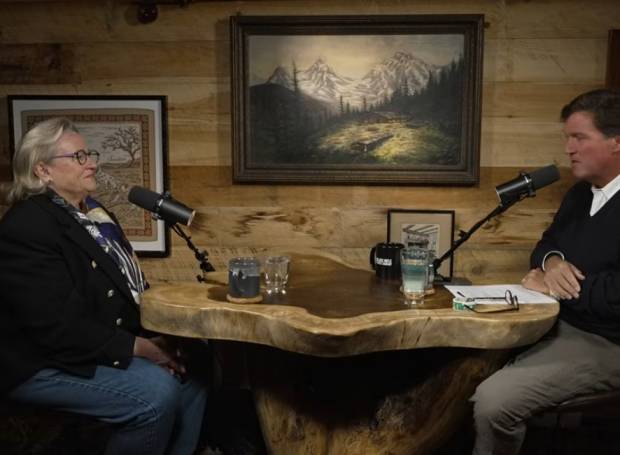
Editor’s Notes: In this compelling interview, Tucker Carlson sits down with Catherine Austin Fitts to explore the rapid emergence of a “control grid,” a digital infrastructure designed to monitor and regulate every aspect of human life. Fitts breaks down the dangers of programmable money and digital IDs, revealing how central banks are leveraging these tools to bypass traditional governance and enforce social credit systems. The discussion highlights the critical importance of maintaining analog systems like cash to preserve individual freedom in an increasingly digitized world. Ultimately, Fitts offers a powerful call to action, urging viewers to move beyond fear and focus on building independent, resilient communities for the future. (Feb 27, 2026)
TRANSCRIPT:
Introduction
TUCKER CARLSON: Catherine Austin Fitts. Thank you for doing this.
CATHERINE FITTS: Tucker, thank you for doing this.
TUCKER CARLSON: The first time we did an interview, over a year ago, different worlds completely. I remember thinking, wow, I’ve really spoken to anyone who thinks in such big terms. I mean, that is a compliment. I wonder if this is all true. I think time has proven you right. We’ve had a couple of meals in the subsequent months, and so I’m just. I just want to say I think you’re really wise and I’m grateful to have you.
CATHERINE FITTS: So I want you to know it was only 10 months ago, but it seems like such a long time. Time is flying.
TUCKER CARLSON: Man. Yeah, I meet people in airports all the time, are like. I used to think I was a conspiracy theorist, but now I was right, you know, but it’s kind of a variety of that. But last time we had lunch a couple months ago, you were telling me about, and I wish we had this on tape. Maybe we can recreate it here about the control grid, a concept that you had explained when we last did an interview, and how it was, as you said at lunch, snapping into place. Can you, just, for people who haven’t seen your previous talk, explain what the control grid is, what it looks like, and what it means?
What Is the Control Grid?
CATHERINE FITTS: So the control grid is a process or an infrastructure that allows digital technology to be used to assert physical, phenomenal surveillance and control of people. And at the very heart of it is what I call programmable money. So it’s money that is no longer just a currency. It’s money that comes with a set of rules that can be surveilled, enforced.
So imagine back in the pandemic, if your money. If I said, okay, you’ve got to lock down and your money won’t work. If you leave your house, you can’t buy gas in your car because your money is programmed with AI and software to enforce a whole set of centralized rules. And programmable money allows the bankers who’ve been running monetary policy to now control fiscal policy and essentially replace legislatures and executive branch by making and enforcing the rules through the money.
Now, that requires a large infrastructure of surveillance. So you need digital IDs, and then you need the hardware locally and globally to do the surveillance and implementation. So, for example, if you look at the local hardware, and now people are seeing it, you know, now that it’s material, they’re beginning to see it snap into place.
I don’t know if you know flock cameras, but there are many communities across the United States that are entering into contracts paid by the taxpayers to put up cameras all around their neighborhood that track license plates and keep that data and share it with a variety of people. Or you have the FCC is trying to overrule local controls on cell towers, so they can literally put cell towers every 400 to 700 feet so that they can have the kind of invasive surveillance you need. Or you have satellites now that can literally beam in Wi-Fi so that whether you have Wi-Fi in your home or not, they can start to track you.
And all those systems put you in what I call the panopticon. So we saw in the Middle East with the first war with Iran, we saw 11 leaders out of 12 sort of top leaders in science and government assassinated, because they’re literally tracking everyone. And they can identify them and track them. And then you have invisible weaponry that can then take them out or can identify missile strikes.
The 12-Day War Against Iran and Digital Targeting
TUCKER CARLSON: May I ask you. So you’re talking about the 12 day war against Iran in June of 2025.
CATHERINE FITTS: Correct.
TUCKER CARLSON: We were led to believe, just as newspaper readers or news consumers, that those 11 Iranian officials were targeted with human intelligence, that Israel had spies inside of Iran. But you’re saying that was done digitally?
CATHERINE FITTS: I would assume that that’s probably true because you always want to get human confirmation of what the systems are telling you. It’s always better if you have both. But we are now moving into building out the kind of surveillance systems that can literally track, identify, and integrate with not only our existing weaponry, but ultimately autonomous weaponry.
So anyway, so let me step back. You’ve got three parts to the control grid. One is the local hardware and infrastructure, and that includes the data centers. Because if you.
TUCKER CARLSON: Data. I thought those were for AI.
CATHERINE FITTS: They are. Because if you look at what it takes to apply the equivalent of a social credit system to people’s money. So the social credit system I apply to you is different than the one I apply to me. And if you look at the data I need to track you and test whether or not you’re following the rules I’ve given you and enforce those rules.
TUCKER CARLSON: Spatial control. Movement control.
Spatial Control, Kill Switches, and 15-Minute Cities
CATHERINE FITTS: Yeah. So turn off the car. So Congressman Massey is trying to kill the kill switch in your car. That’s because spatial control means I can turn off your car or I can set it so your money won’t work more than a mile from your home or a 15 minute city. So you literally, you’re not allowed to leave your 15 minute city and your transportation and your money won’t work outside of that area.
So let me step back. What is AI good at? AI is very good at tracking things that can be expressed mathematically, and financial transactions and spatial movement can be expressed mathematically. And so what the AI centers are for primarily is to build that digital control grid and to manage that data. And now it can be used for many other purposes too. So it’s not just going to be used for control, but to me that’s the primary purpose.
And if you look at the cameras, if you look at the cell towers, if you look at the satellites and then the AI, the data centers, those are all component pieces of the local hardware. So there are three sort of pillars that I track. One is the programmable money, and that’s what we at Solari are trying to stop. The second is the digital ID, because you need digital ID systems that are interoperable globally. And then the local hardware. And those are sort of the three pillars.
And what’s interesting is there’s phenomenal development of all three. We have commentary at Solari where we track, it’s called the Fast Approaching Digital Control Grid. And every week we update all the things that are being done to build those three pillars and have them integrate with each other. And ever since the inauguration it’s been moving very, very quickly.
Now it’s both sides of the uniparty, they come at it in different ways and they do different things. But this is, ultimately, what this is doing is this is going to a point where the central bankers, whether they do it with a central bank digital currency or private stable coins and asset tokens, are setting the world up so that they can control your financial transactions literally in real time with the equivalent of a social credit system.
Biometrics and the Digital ID System
TUCKER CARLSON: I have so many questions. I probably been in six or seven, eight countries in the last month and I think in every single country I had biometrics taken, either fingerprint or facial recognition. What role do biometrics play in the control grid?
CATHERINE FITTS: That’s part of the digital ID system and that facilitates the surveillance. And it’s interesting. So we do a lot to promote cash because I think there are many things we can do to slow down or stop the digital control system, but one of it is by embracing analog and keeping analog alive. Because to go to a really serious programmable money, you need an all digital financial system.
So we do a lot with cash, but people will tell you if you go to Walmart. You leave your phone in the car and you use cash. You come out having made a purchase, and the next thing you know, the next day on your phone, you get a text from the company of the product you bought at Walmart. So they were able to identify you. It’s because of the biometrics. They have your facial recognition.
The War on Cash: Nudging and Bank Restrictions
TUCKER CARLSON: I had a crazy experience with cash. I thought of you right before Christmas. I wanted to pay employees a bonus in cash, which you always do. And so I asked my wife to go to the bank. She did a Wells Fargo branch not far from her house. I want to take out this amount. Pretty large amount, but not crazy, right? And they said, no, we can’t give you the money. And why? Because we think that you are being scammed, that there’s probably someone outside with a gun demanding that you withdraw cash. And she’s like, what? No. So she called me. Anyway, I finally went into the bank and got upset. It wasn’t their fault. They were being told, I think, by federal regulators not to give me cash.
And I said, I thought the point of a bank was to hold my money. You loan it out at interest, I get less interest from you, so you make the money. But my money’s safe. But I get it when I want because I made it at my job. And they’re like, we’re so sorry. We’re so sorry. But they wouldn’t give me the cash. Took two weeks to get the cash. What is that?
CATHERINE FITTS: It’s called nudging. Do you know what nudging is?
TUCKER CARLSON: No.
CATHERINE FITTS: Oh. There’s a whole science of nudging. So if you’re the central bankers and you want to take cash down to zero, what you do is you create lots of different kinds of rules and regulations that nudge people in that direction. Okay? So that’s one of the things that’s happening. And you use these things as an excuse. Now there’s something else happening.
TUCKER CARLSON: So that’s not my imagination. That’s part of a strategy to give me a.
CATHERINE FITTS: Part of what was happening was nudging. Now, if you look at the person who implemented that, they’re getting a rule. They’re just doing their job. And one of the reasons they’re getting the rule and one of the things they use to do the nudging with is if you look at the amount of cybercrime and financial fraud that’s happening, that is causing people to go down and get cash, it’s real. And the banks are losing a great deal of money on it. And it’s a serious problem, particularly because if you look at the technology used to implement it, I believe they’re using neuro warfare. So they get these people very addicted online and they get them doing sort of crazy financial things.
I was trying to wire, I was in the Netherlands. I was trying to wire €5,000 to one of the people who works for me. And my bank stopped it because they felt that I was a victim of a romance crime.
TUCKER CARLSON: A romance crime.
CATHERINE FITTS: A romance crime. I said, no, I assure you, this person writes my loving art column. It’s not a romance. I mean, there’s a romance with art here, but it’s not with each other.
From Monetary Policy to Fiscal Control
TUCKER CARLSON: Well, you would think that banks beset by cybercrime would want to encourage the use of cash.
CATHERINE FITTS: So, you know, the banks are in a movement for more and more central control. Again, the financial system for 20 plus years has been steadily moving in all different layers, from regulatory to these kinds of things. From a world where the bankers control monetary policy to a world where they control fiscal policy. And that’s all the nudging is all part of moving.
TUCKER CARLSON: Can you explain the difference for those of us who are not economically fluent?
The Federal Reserve, Fiscal Policy, and the Push for a Digital Control Grid
CATHERINE FITTS: Okay, so since 1913, the United States has had a governmental structure where the central bank, the Federal Reserve, which is the Board of Governors in Washington, and the 12 central banks manage monetary policy. So they basically, working with the banks, run the financial transactions. The New York Fed runs the governmental accounts, they control the government bank accounts. And their policies of fed funds, interest rate and money onto the reserve tracks affects the money supply and, basically the money supply and how the money works.
Okay, so it’s more complicated than that because they have lots of regulatory functions, but the people vote for their representatives. So whether it’s the State House or the Congress, they vote for elected representatives from their jurisdiction and area. And those people decide fiscal policy, which is what taxes do we collect, what tariffs do we collect, what bonds do we sell and raise money, and how does that money get spent?
So my representatives, your representatives, are determining fiscal policy and the bankers are determining monetary policy. And it’s a balance of power between the people and the bankers. Now with the digital control grid and programmable money, the bankers can assert control of fiscal policy and they can just decide what the taxes are and take them out of your account. And they can essentially determine the rules of how it all gets spent.
And so it’s a very, it’s sort of a financial coup d’état that over time, they want to assert complete control of fiscal and monetary policy. And essentially the legislatures will go to being sort of show and tell or go out of business.
TUCKER CARLSON: We’re moving quickly in that direction where the legislatures in every country are becoming less powerful, in many cases irrelevant.
The Seven Countries, Central Banks, and the Rockefeller-Rothschild Model
CATHERINE FITTS: So here’s my theory though. If you go back to 9/11, and when Wesley Clark said we’re going to invade seven countries in five years, what you were talking about were the countries where those central banks were not on board to do programmable money and their governance structures were not on board with. Essentially because of Epstein, I’ll call it the Rockefeller-Rothschild model, there was an effort to say, okay, we’re going to basically assert control of the central banks in those countries. That’s my interpretation.
And I think one of the reasons we’re seeing so much tension around Iran is because Iran right now is the big leakage in the system.
TUCKER CARLSON: How. Wait, it’s not about their nukes?
CATHERINE FITTS: No. Well, Iran’s central bank counts. One of the reasons it counts is because their oil and energy is very important, including for China. And that’s very important in the BRICS system. What the BRICS system is trying to do is to create independent payment systems. But if you’re going to come out with programmable money with digital IDs that are interoperable globally and programmable money that controls in each jurisdiction centrally, you can’t afford leakage.
And so you’ve got way too much leakage in the system to proceed with what they’re trying to do. And the BRICS nations are a sticking point. And certainly Iran’s oil feeding China gives China greater independence.
TUCKER CARLSON: So you think that one of the motives behind toppling all these governments was the creation of the control grid we’re talking about now.
CATHERINE FITTS: Right. So if you go back. So you had the wonderful Richard Werner on your show and Richard has a book called the Princes of the Yen, which is about the sort of effort to take over the Japanese central bank. And I think what you’re looking at, I think part of the state of play with both Russia and Iran is how are you going to make sure that those central banks are entirely in the system.
The Suppression of Richard Werner’s Book
TUCKER CARLSON: Yeah, that was an amazing interview. And he told the story about writing this book on the Japanese central bank. I can’t imagine a more obscure topic from my non economically minded standpoint. It’d be like writing a book on postcards from the Falkland Islands. It’s like, okay, a book on the Japanese central bank. And he said, well, actually they suppressed it. I couldn’t get it published in the United States and you can’t get a copy and that’s checkable. So I checked it. You can’t get a copy of that book. It’s really hard.
CATHERINE FITTS: I think you can order from his publisher right now.
TUCKER CARLSON: Okay, but I mean, why would someone try to suppress a book?
CATHERINE FITTS: Because it shows you the true. It takes you right into the secret governance system and it shows you the primary mechanism by which they implement policy.
TUCKER CARLSON: Yeah, well, it’s always the things you’re not allowed to say are probably the important things. Right? I mean, whenever they penalize you for having a thought, you’re probably on the right track.
The Third Rail: How Central Banking Mechanisms Stay Hidden
CATHERINE FITTS: Well, it’s one of the critical train tracks of control. So it’s what I call the third rail. So I used to finance transit systems and train systems. So a lot of these systems have two tracks that the wheels go on and then they have a third rail that the power line runs on and you get a train trap that flips over and sucks the energy from the third rail. So a lot of the things that really operate the third rail are very invisible.
And for example, in central banking, to talk about tier one and tier two and tier three capital at the BIS and the banks. There’s nothing more boring. It’s designed to. Absolutely.
TUCKER CARLSON: I just fell asleep in the middle of that sentence. Right, exactly, exactly.
CATHERINE FITTS: Right, right.
TUCKER CARLSON: Is it boring by design?
CATHERINE FITTS: The way you’re taught to talk about it is boring by design. But it’s like the mechanisms of the legal system. If you look at the mechanisms of civil procedure or criminal procedure and you get into the weeds on it, it can be very boring unless you understand the application. And that can make it very interesting. But most people don’t understand the capital regulatory system. And yeah, it can get very, very boring.
Stablecoins, the Genius Act, and the Coming Financial Tsunami
TUCKER CARLSON: So back to programmable digital currency. Of all the features that you’ve described so far of the control grid, that’s the one that has not been fully implemented. Would that be fair to say?
CATHERINE FITTS: So let me describe. Yeah, not at all. And it’s important to be talking about this now because imagine a tsunami approaching us. There is a tsunami approaching us right now. If you look at the traditional financial system, we’re talking about hundreds of trillions of dollars. Stocks, bonds, global stocks and bonds market, the crypto market, or money is issued on a distributed ledger is tiny. So maybe it’s $4 trillion compared to $250 trillion, just counting stocks and bonds. And then we have the currency market, which is bigger.
So in the traditional financial system, look at the distributed ledger system and say it’s tiny, it’s tokens. Last year we passed the Genius Act. So have you heard of the Genius Act?
TUCKER CARLSON: I have, yeah.
CATHERINE FITTS: Okay.
TUCKER CARLSON: Quite a bitter fight over it too.
CATHERINE FITTS: There was a bitter fight. The big bitter fight right now is over the Clarity Act. So the Genius Act created a regulatory framework for stablecoins and I’ll explain stablecoins in a second. The Clarity Act was passed in the House last year. Its complement in the Senate is called, it’s a discussion draft called the Responsible Financial Innovation Act. And so the final act’s name, I’ll call it the Clarity Act, but I don’t know which it will be. The Senate and the House have not agreed and that has become a very bitter fight.
The reason the Genius Act and the Clarity Act are very, very important is there has been a push to say we don’t want central bank digital currency because we don’t want the central banks putting the banks out of business and controlling centrally. What has happened though, is now they’re doing a form of private. Think of it as private CBDC stablecoins and digital assets and tokens that can essentially implement the same social credit and control system, but through private issuers.
So let me turn to stablecoins for a second. Because the Genius Act has passed, they’re working on regulations that’ll come out at the end of this year or the beginning of next year. If a stablecoin is issued, it’s a crypto issued on a distributive ledger. And it’s basically the money that is received to buy the stablecoin is reinvested in either treasury bills that are 93 days or shorter in maturity, high quality bank deposits. So cash. So basically it’s 100% collateralized. So when you have a stablecoin, it’s like having a little treasury bill, a dollar of treasury bill. So think of yourself as using a treasury bill.
TUCKER CARLSON: It’s not so different from US currency.
CATHERINE FITTS: No, certainly in terms of value. And the reason you call it a stablecoin is you’re hoping, theoretically a stablecoin could be done on other currencies as well, but you’re hoping that a dollar stablecoin will not be volatile in price the way many cryptos are volatile in price. So it’s designed so the price is stable.
Okay, so one of the hopes and one of the reasons that we’re issuing stablecoins is as foreign purchases of Treasuries diminish, we’re hoping that you can put out stablecoins worldwide and attract retail money into the treasury market. So the wholesale market is rejecting you. And so now through the mobile payment systems, you can put out stablecoins.
TUCKER CARLSON: So it’s another way of propping up U.S. debt.
CATHERINE FITTS: It’s another way of preserving U.S. dominance, dollar dominance. Okay. But the danger, of course, there are two dangers. One is if everyone in your town in Maine pulls their money out of the bank and puts it on their mobile payment stablecoin, all the loan market and the credit creation market in your town is going to collapse. Right, because they’re leaving your local economy and going into the treasury market to finance the feds.
TUCKER CARLSON: So what Amazon did to retailers in towns, stablecoin could do to banks in
CATHERINE FITTS: towns, to community banks and credit unions. Now they can also issue stablecoins. But again, that money’s going to go into the treasury market rather than multiply on Main Street.
Centralizing Power: The Quiet War on Local Economies
There’s been a real quiet war over the last 20, 30 years because the federal regulators have pushed the community banks and credit unions to not make loans on Main Street, but put their money in the investment portfolio where they do buy Treasuries. And this is all part of getting your local economy more and more dependent on federal money.
TUCKER CARLSON: I’m seeing this. Yes, there are only like four trends in the modern world. And this is one of them. Power, money centralized. Go to the national capital away from the provinces. It’s like it’s happening everywhere.
CATHERINE FITTS: Well, but here’s the thing, and this is the little secret to real solutions. If you look at the last 50 or 70 years since World War II, every effort has been made through taxes or credit or various financial mechanisms to get all the money to go into central and come back down. Right? And now if you go into most communities, so America’s 3,100 counties, most counties, 40 or 50% of the income in that county is coming through. You know, it goes up to Wall Street or Washington and comes back down. And so you end up with more and more central control.
Now, here’s the little secret. It’s economically insane. If you could do more money going around, you could make the pie much bigger.
TUCKER CARLSON: Well, of course, just like power transmission, the longer you have to move power along lines, the more power you lose.
CATHERINE FITTS: Exactly. And technology should advantage the little guy, not the big guy. So go back to.
TUCKER CARLSON: Wait, can you just pause there? Thank you for. I mean, it just shows how old I am that I know what you’re talking about because that was the original promise.
CATHERINE FITTS: Right.
The Internet, Accountability, and the Community Wizard
TUCKER CARLSON: I mean, it’s hard to believe now, but 30 years ago, when the Internet was being introduced to the public, the idea was, this is empowering for the average person.
CATHERINE FITTS: So when that happened, that was when my company — this was the fight I had with the Department of Justice. We build software tools. We had one software tool called Community IPO in a box to help everybody locally facilitate equity stock markets for local areas. But we build a software tool called Community Wizard. And you could dial in and say, my neighborhood is my county or my zip code or my congressional district. And you could map out the sources and uses of all federal credit and money in your community.
So you could get the equivalent of a financial statement for the jurisdictions in which you vote for political representation. So you could really hold your congressman accountable because you could see a financial statement for your jurisdiction. And the Department of Justice seized our offices, seized the software. It took me six years to get it out from the courts. And when I got it out from the courts, it was missing all the most important pieces.
TUCKER CARLSON: It’s funny they’d want to discourage accountability.
How Federal Money Flows Away from Main Street
CATHERINE FITTS: Well, what I discovered when I was in the administration was that if the local business people could see how the money works around them, they could get back in the game. So we regularly saw — I told you this before — we regularly saw communities where HUD was spending $250,000 per unit to build public housing, and $50,000 would buy and rehab a single family foreclosed property in the same four block area.
But it was the same with jobs. We were paying a contractor in Washington $100, $125 per hour to do something that we could keep local. You didn’t need to send it all the way up there so that a big corporate contractor could do it.
So there was a great story during the financial crisis where a woman lost her job. Very responsible, hardworking, couldn’t find another job, ultimately had to take food stamps, which was a matter of great shame for her. And so she had a problem and called tech support and got a woman in India working for JPMorgan Chase, who had at that point 37 of the state food stamp programs they were managing. And she said, “Wait a minute, I could do this job. And if I was doing this job, I wouldn’t need food stamps. So why are we sending it to India with a big markup for a big bank when I could just do this job and then I wouldn’t need food stamps?”
TUCKER CARLSON: It’s hard not to see malice in there somewhere.
Wall Street, Capital Gains, and the Giant Sucking Sound
CATHERINE FITTS: Oh, there’s total malice. So, I mean, here’s the thing. If I have a publicly traded stock and it’s trading at a price earnings ratio of 10, just to make it simple, if I make a dollar, my stock goes up $10. Now, if government intervenes to take a million dollars of income that Main Street is making and shift it into a publicly traded stock, that stock will go up $10 million. What’s the biggest source of political contributions? Capital gains. So the more I shift money out of Main Street into publicly traded stocks, the more I get the pop on the stock, and the more investors of real estate capital gains or company enterprise capital gains, the more money they’ll give.
So in Washington, there’s this giant sucking sound. So let’s go back to the pandemic. Remember the pandemic?
TUCKER CARLSON: Yeah, vaguely.
CATHERINE FITTS: You shut down Main Street, which is not publicly traded, and suddenly all their market share has to go to publicly traded stocks, either online companies or the big box stores. So I’ll never forget there’s a wonderful moment during the pandemic when Rick Santelli is standing on the floor of the New York Stock Exchange, and Andrew Sorkin is up in the studio, and Santelli says, “This makes no sense. I’m going to the mall. All the little companies are closed. Costco’s next door, and the parking lot’s packed, and Costco’s packed. It doesn’t make any sense why the little guys have to be shut down for the virus. But it’s okay next door, because the parking lot’s packed. People are all congregated in — they’re all together.” And Sorkin says, “The virus can’t go in Costco. It can’t go in the big box stores. That’s science.”
TUCKER CARLSON: Well, because Sorkin believes in science.
CATHERINE FITTS: But here’s the thing. If you look at how much money was made by Wall Street, it was a giant sucking sound of market share into publicly traded stocks. And then the capital gains go back around for the political contributions.
The Book They Didn’t Want Published
So I told you I have an online book that explains how this works, which I’ve tried to publish three times, and each time it’s gotten sabotaged. The last time, they threatened somebody in my family. So I backed off and never published. It’s online, it’s not censored, but I’ve never put it in hardback. And I’m waiting for everybody to die. And then I’ll publish it again. I’ll try again. I’ll try for the fourth time.
But it shows you exactly how the game works on a private prison company that my old firm had financed. So I show you — I get out all the SEC documents and I show you the game and how it works, how it translates into capital gains.
TUCKER CARLSON: Could you just summarize it really quickly?
CATHERINE FITTS: Yeah. So we started a movement in the early 90s to privatize a portion of the prison system.
TUCKER CARLSON: I remember.
CATHERINE FITTS: And it’s economically insane.
TUCKER CARLSON: I think I was for it. For the record, I’ve had so many dumb positions over the years that I think I was for that.
The Private Prison Racket
CATHERINE FITTS: So at the time that I wrote the analysis, the best figures I could get from the General Accounting Office was it was costing — the whole criminal justice system was costing $154,000 per person per year. And one of the reasons was the construction of all these private facilities as well, one of my theories. But what I showed you was the stocks were trading on a per bed basis. So if you could get a law passed that mandated longer sentences, the stocks would go up because you get to get a bigger PE per bed.
TUCKER CARLSON: Come on.
CATHERINE FITTS: Yeah. And literally what they did was they started the companies and then they started a program to drop SWAT teams into neighborhoods to literally drop in and round up kids who could be dealing drugs or not — who was stealing the, bringing in the drugs? It wasn’t the kids. And literally, they cut off in D.C. the money to the public defender’s office. So the kids had to all cop pleas. And that would stuff the prisons.
And at the same time, what they did is they created a company at the Department of Justice called Unicor that could market prison labor to corporations for tiny dollars. No, really, it’s a slavery system. Obviously, it’s a slavery system.
And the book describes — it’s called Dillon Read and the Aristocracy of Stock Profits — and explains how the whole system works, who made money, how they made money. And what’s sad about it is my guess from doing that analysis is that many of the people making money on it are the same people who are making money bringing in the drugs.
I describe all those things and the power of the book. It took me a year to write it, and I was living in Montana, and you couldn’t walk in my house — you could only step on piles of SEC documents — and there are literally hundreds of thousands of pages of documentation behind it because I had to prove all the different pieces of the financial ecosystem. So we put up all the documentation and it was quite astonishing because it really helped people who had trouble understanding the growing central control. It helped them to see that it was very intentional.
FASB 56: The Earthquake Nobody Noticed
TUCKER CARLSON: In order to implement any big society-wide change — and I think your COVID example is a perfect one — you really have to construct a crisis, and the change is a solution to whatever the problem you created is. So like, if you want to create a new federal agency, you probably need a 9/11. If you want to make biometrics the rule, you probably have to push AI and make the case that we don’t know who anybody is because everything’s a deepfake. So you have to have biometrics in your Twitter handle, et cetera. What will be the crisis that justifies digital currency?
CATHERINE FITTS: So let me step back for a second because what I see is the crisis is only the apex and the third act. To get the crisis working, you have to get thousands of things in place. So for example, coming into COVID, I don’t think you could have done COVID without, for example, getting Federal Accounting Standards Advisory Board Statement 56 into place in 2018 and then having the central bankers meet and approve the going direct.
TUCKER CARLSON: I’m not familiar with that.
CATHERINE FITTS: I would be delighted to tell you about that.
TUCKER CARLSON: Thank you.
CATHERINE FITTS: This is one of those things that sounds very boring, that is like a 10 Richter earthquake. So for many, many years, there was a group of us who were trying to bring as much transparency to the fact that there was serious criminality going on in the federal accounts and $21 trillion was missing. And that was happening because the federal government refused to obey the financial management law.
So they are required — you’re a citizen, you pay your taxes, they’re required to — you give them your 1040 and they’re required to give you back and say, “Okay, here’s how we spent your money.” And that’s required in the Constitution and the financial management laws. The federal government has, since the mid-90s, been in complete violation of those laws.
So there was a lot of pressure that was brought to bear when Dr. Mark Skidmore with Solari published his report on the $21 trillion missing. And so pressure, pressure, pressure — the dodge, keep saying we can’t pass an audit, we’re not going to pass an audit. And then 2018 — remember the Kavanaugh hearings?
TUCKER CARLSON: Very well.
CATHERINE FITTS: Okay. Everybody was very busy watching the Kavanaugh hearings. The federal government — the House, the Senate and the White House all together — October 2018 published an administrative policy called FASB 56 that basically said, in violation of the Constitution, the financial management laws and the financial management regulations, that they could set up a secret group of people by a secret process and pull things out of the government’s financial statements and keep them secret. Not just for the 24 covered agencies, but for 150 plus related governmental entities. And when you take in the national security and classification laws, that means also that the big banks and contractors working for the federal government can do the same.
TUCKER CARLSON: Right. That’s Deloitte and JPMorgan. Right.
CATHERINE FITTS: And what that means is basically the entire large cap stock and bond market in the United States is secret. The disclosure is meaningless. It doesn’t mean anything. And if you go to Solari, we have a missing money section and we have extensive, not only descriptions of FASB 56, but what it means to investors.
TUCKER CARLSON: On what grounds could the federal government declare private businesses — the whole of itself, all kind of off limits to disclosure?
The Black Budget and Hidden System of Finance
CATHERINE FITTS: They have no legal basis because this is in violation of the Constitution, the financial management laws and the financial management regulations. We have a section at Missing Money with seven briefing papers. It took me two years working with our attorneys to do it that describe all the financial management laws of the United States, so that you can see.
And luckily, one of the interesting things that happened when FASB 56 passed is Matt Taibbi picked up on it and wrote an article about it. It’s funny, he emailed me, he said, “Okay, I got the briefing papers. Thank God.” Because it’s very, if you’re someone like Matt Taibbi, it’s very hard to sit down and learn the financial management laws of the United States. That’s why we did the briefing paper, so that any reporter could get into this and master it in a reasonable period.
TUCKER CARLSON: Was this a — or just a regulation? Was this voted on?
CATHERINE FITTS: This is administrative policy. So in law, there’s the Constitution, there’s the financial management laws, there’s a regulation, and then there’s the administrative policy. So this is the total inversion. This is an administrative policy saying we can break the Constitution, the financial management laws and the regulations by administrative policy.
But the House, the Senate and the White House all agreed. So it was a joint — and they tried to sneak it through. And I was very lucky because there was a guy at the time who worked for the American Federation of Scientists who literally read the Federal Register. And I had signed up for his newsletter because I didn’t want to, but I trusted him to do it and he would keep an eye on the black budget issues. A guy named Steve Aftergood. Very good. And he, in his newsletter, he read it and he understood what it meant because it’s so boring, nobody would understand it.
TUCKER CARLSON: Well, that’s exactly right.
CATHERINE FITTS: Right.
TUCKER CARLSON: What’s not boring? And I just — I’m sorry to keep interrupting you, but I don’t want anything to fall through the cracks. The black budget issues — what black budget? What is the black budget? And what was he looking at? And why should we care?
The Covert Economy and the Hidden System of Finance
CATHERINE FITTS: So we have an overt economy. We have a covert economy. The covert economy is driven by a series of pools of money and cash flows. The first one — Joseph Farrell calls it the hidden system of finance. The first one started with all the seizures during the wars.
So during World War II, a great amount of assets were seized, and that created a pool of money that was available for covert operations. So there’s a wonderful story in Christopher Simpson’s first book about how the money they had seized had been moved into the Exchange Stabilization Fund, which is the mother of all slush funds, that’s managed by the Secretary of Treasury, managed by the New York Fed for the Secretary of Treasury.
So the money had been moved in, and the Dulles brothers are sitting at Sullivan and Cromwell, and they use that money to rig the ’48 elections in Europe at the request of the Vatican. Anyway, so this is the — so we have this seizure pool. Then what happened? We passed the National Security Act in ’47, and then in ’49, we passed the CIA Act, which was very fractious. It literally took assassinating Forrestal to get that done.
TUCKER CARLSON: Who was thrown out of a window.
CATHERINE FITTS: Yeah, yeah.
TUCKER CARLSON: So that’s at Bethesda Naval Hospital. He’d been the Secretary of War, and —
CATHERINE FITTS: He was very opposed to the creation of the black budget and the creation of Israel.
TUCKER CARLSON: And so who killed him? And why don’t people understand that the Defense Secretary, the Secretary of War, was murdered? I don’t think one in a hundred people know that.
CATHERINE FITTS: So he was a Dillon Read partner. So I knew that because I used to stare at his painting in the partner’s boardroom or dining room. And they would, you know, they would always train you by telling you if you’re not careful in Washington —
TUCKER CARLSON: It’s funny, there are two books that I have read on it, both of which cost like a hundred bucks a piece on eBay, because they’re — it’s just —
CATHERINE FITTS: Have you read David Martin’s book?
TUCKER CARLSON: I don’t know. I have two. They’re in my office. I read them.
CATHERINE FITTS: You want to read Dave Martin. We have a great interview with Dave Martin, and let me finish.
TUCKER CARLSON: Both were written in the ’60s, but really quickly — I mean, his murder —
CATHERINE FITTS: His murder was part of a deal to get the ’49 Act passed, is my theory.
TUCKER CARLSON: Okay.
The CIA Act, the Black Budget, and Corporate Contractors
CATHERINE FITTS: And the creation of Israel. So it was both the black budget and Israel that were — and they needed to get him out of the way. So we have a big interview on it. And I’ve looked into it very deeply. I was very interested in Forrestal anyway.
But the ’49 Act was the CIA Act. So you have the National Security Act of ’47, the CIA Act. What the CIA Act authorized was the ability to appropriate money to different agencies and then claw it back secretly to a black budget. So now we have the hidden system of finance with the pools of seized money, and we add to that a layer of money that can be appropriated and clawed and used secretly, only subject to very limited oversight by a committee in Congress. So the appropriations committees wouldn’t see that money, only this one committee that oversaw the black budget.
And if you look at those two pools, the next step happened in ’81, when Bush comes in. Bush comes in as Vice President under Reagan. And his deal with the Reagan folks during the campaign was — because he’d run the CIA — he’ll run intelligence and enforcement. And the Bushies were very, very good at the nuts and bolts of the mechanics of government and the legal system and money.
He got an executive order done that said, essentially, you can use this secret money, the black budget money, and you can use it to hire corporate contractors who can now do highly classified projects. Now, let me explain what this means as a financial matter. So we were talking about the stock market going up. You can now take the most secret, powerful technology in the world and pay corporations to learn and end up owning that technology secretly in a way that drives their stock to the moon. So now you’ve connected the US Treasury market directly, like a pipe, into companies and drive their stock up almost to an infinite amount. As a financial mechanism, it’s one of the most powerful things that ever happened in our history.
The Federal Budget and the Missing $21 Trillion
TUCKER CARLSON: What percent — so we have the federal budget, which we can look up online, but after —
CATHERINE FITTS: FASB 56, it’s totally meaningless.
TUCKER CARLSON: Okay, so it’s meaningless because we don’t know where the money is actually going. Is that why?
CATHERINE FITTS: No, because the most important pieces of money — we don’t know what’s been taken out. We don’t know what’s been made secret. So you can see what’s there. And you can see, for example, I can see by looking at the HHS budget how much we’re spending to poison America. So I can see a lot.
TUCKER CARLSON: A lot, a lot.
CATHERINE FITTS: Yeah. No, it’s huge. And we’re bankrupting the country, poisoning America, but I don’t know what’s not there. In other words, a secret group of people, by a secret process, have taken out whatever they want, and I don’t know what they’ve taken out. I don’t know. Doesn’t mean anything to me.
TUCKER CARLSON: I mean, would it be possible to audit the federal budget?
CATHERINE FITTS: You would have to audit the bank statements. People say, “We want to audit the Fed.” No, you want to audit the federal accounts at the New York Fed and you want to audit the Exchange Stabilization Fund at the New York Fed. That’s what you want to audit. And what you want to find out is where did the $21 trillion go or come in?
The federal government has refused to balance its accounts since the mid-’90s. And we know that there are inexplicable, undocumentable adjustments of enormous amounts. And the only way you can figure out what happened is to go into those bank accounts and figure out what came in and what went out and to actually map out the actual cash. And you have to do it not just in the — so the New York Fed is depository for the US Government, so you have to do it in those accounts, but you also have to look at the borrowing accounts and the slush fund accounts, which is the Exchange Stabilization.
TUCKER CARLSON: Has anyone attempted to do any of that?
CATHERINE FITTS: So Rand Paul and his father and Congressman Massie have talked about auditing the accounts. And it’s funny because Massie and I were at a great conference once and he was talking about shutting down the Fed. And I kept saying, “No, no, you don’t shut it down until you get the $21 trillion back. Otherwise they get to keep the $21 trillion.” So Thomas was up giving a wonderful speech and he said, “I think we should shut down the Fed.” And then he looked at me and he said, “After we get Catherine’s money back.”
Thomas Massie and the Fight for the Rule of Law
TUCKER CARLSON: Can I ask just quickly about Massie? He’s obviously gotten into a very personal altercation with the President, ongoing. There’s the question of AIPAC. He was one of the few people who didn’t take AIPAC money, but the all-out effort to destroy him — I just feel like there’s something more than just getting in a tiff with Trump for not taking AIPAC money.
CATHERINE FITTS: So here’s what’s at the heart of Massie’s fight. Are we going to be run by the rule of law or are we going to be run by a secret governance system, essentially consolidating things into what I would call the mega rich who are above the law? This is fundamentally about whether there is going to be the rule of law or not.
The thing I love about Massie — he’s an engineer. And if you talk with him or listen to him about a wide range of subjects, starting with food and agriculture, he is ruthlessly focused on what is productive, on what makes economic sense. And what he knows is that the centralization of control is destroying productivity, it’s destroying wealth. And he knows that whether it’s family wealth or community wealth, you cannot have a civilization if you have a society that is this enormously destructive of individual sovereignty and individual and family wealth.
And so he’s literally, if you look in all these different areas, he’s just constantly moving out, trying to do what makes sense. And his understanding — because he’s been an entrepreneur and a small businessman and a farmer and a rancher — he understands the economics bottom up. One of my favorite Thomas Massie stories I heard on your show, which was an amazing interview. I always make young people watch at least the second half of your interview with Massie.
TUCKER CARLSON: The off-grid part.
CATHERINE FITTS: Yeah. When he’s talking about how he busts — he’s the county magistrate essentially. And he busted the prisoners out of the jail to help them install a new hot water heater because they can’t afford to buy — they have to buy a used one, they can’t —
TUCKER CARLSON: Afford to buy a new one.
CATHERINE FITTS: Okay. So that’s, you know, that’s exactly the story. That’s a building-wealth story. Right.
TUCKER CARLSON: Yeah, yeah, yeah. What’s happened is so sad. It’s hard to believe. It’s one of the finest people I’ve ever met in Washington. And it’s just gone in this direction. That’s not helping anybody, you think? Well, you know, I tend to have a pretty shallow analysis. So when I say it’s helping no one, I’m not confident it’s helping no one.
CATHERINE FITTS: Our number one problem is the secret governance system.
TUCKER CARLSON: I agree with that.
CATHERINE FITTS: And he’s going right at the heart of the issue. Not because he wanted to, but because he’s trying to do all these fundamentally productive things in five or ten different —
TUCKER CARLSON: None of us wanted any of these fights, actually.
CATHERINE FITTS: Right.
TUCKER CARLSON: I think it’s fair to say he didn’t really want these fights either.
Dual Citizenship and the Secret Governance System
CATHERINE FITTS: Right. Well, here’s the thing. If suddenly tomorrow I was in charge — I was the dictator in charge — first thing I’d do is I’d outlaw dual citizenship in an important governmental position, obviously. And that goes to the heart of the secret governance system and backdoor control.
TUCKER CARLSON: How does dual citizenship go to the heart of secret governance?
CATHERINE FITTS: Because the secret governance system controls through allowing people to operate above the law or have different incentives that put them outside of the system. And I think the dual citizenship is part of that process.
TUCKER CARLSON: At the most obvious level, you can be indicted for a crime in the United States and flee to the other country whose passport you hold, right?
The Rothschild Network and Programmable Money
CATHERINE FITTS: So look at the sex offenders who literally have done terrible things with children in this country who’ve flee to Israel under protective.
TUCKER CARLSON: Dozens and dozens and dozens and dozens of them, not just a few. We had a high profile example of this recently, but it’s been going on a really long time. That’s the most shocking kind of, wait, wait, how do you get to try to molest a child and then flee to our closest ally and stay safe? But you’re saying that this same principle applies to financial crimes and governance.
CATHERINE FITTS: So I suspect one of the things I’ve never known is what is the full benefits of dual citizenship. But I suspect there are financial benefits as well.
TUCKER CARLSON: Tell me what that means.
CATHERINE FITTS: So it could mean many things. It could be the ability to keep money in Israel or through Israel off books, not subject to taxes. It could mean many things. It could just mean financial rewards that are completely, on the face of it, legal.
But I’ll give you an example. We’ve just seen two arrests in the UK coming out of the Epstein files, not for anything to do with sex, but the fact that they had compromised state secrets. So, but presumably they did that in exchange for various benefits of being part of the network.
TUCKER CARLSON: What is the network in that case?
CATHERINE FITTS: Well, I would call it the Epstein network, but I’d really call it the Rothschild network.
TUCKER CARLSON: So, big picture, the takeaway from my perspective from the Epstein cursory reading of 2 million pages is that there’s a government or a governance structure above governments.
Epstein and the Origins of Programmable Money
CATHERINE FITTS: So I would say that there are investment networks. And if you look at what Epstein — if you come to Solari, we have a commentary up called “Was Jeffrey Epstein the Father of Programmable Money?” Which I believe the answer is yes, or certainly one of them.
And if you read — we’re pointing to a substack series written by a guy who writes anonymously under the name Escape, as in Escape Esc. And it’s a marvelous thing, very well documented, back to the Epstein files that we’ve now received, describing how Epstein, who I believe was laundering money, was allocating that money to all these different projects that helped develop crypto and programmable money.
But what he describes in the process of one of those substacks is traditionally, historically, for the last 150 years, how the Rothschild networks — and I would include Rockefeller and Rothschild as a sort of central banking network together — how they operate both the family and then people who are sort of calls in the switchboard, the agents who sort of coordinate between the different houses and the network. And in one sense it’s a very informal network, but because it has the blessing of the central bankers, it receives a lot of protection from the intelligence agencies and it’s a networking function.
And he does a very good job of describing how it operates as a functional matter. And everything he writes is exactly what I saw on Washington and Wall Street. You have a layer of equity pools in and around the central banks that are engaged in trying to build forward in a variety of ways and position money and manage risk. And they are literally increasingly above the law.
TUCKER CARLSON: And they don’t seem directly tied to any particular country. They’re sort of above countries.
CATHERINE FITTS: Yeah. They can operate within a country sphere. But Epstein was basically global. And if you look at the programmable money and what he was doing to build programmable money, that requires operation in both Europe, the United States and around the world.
China as a Roadblock
TUCKER CARLSON: Can I ask you a question that occurs. So if you — China’s economy is now bigger than the United States is. Clearly China is going to be at some point likely the dominant world power.
CATHERINE FITTS: I don’t necessarily believe that.
TUCKER CARLSON: You don’t?
CATHERINE FITTS: No.
TUCKER CARLSON: Okay. Well, the nature of the Chinese government and civilizations seem to make it kind of impervious to this sort of stuff. Like China’s an ethno state.
CATHERINE FITTS: Right.
TUCKER CARLSON: A Han Chinese ethnostate. So I don’t think they’re going to be doing a lot of dual citizenship type stuff in China.
CATHERINE FITTS: No.
TUCKER CARLSON: And I don’t believe the Chinese government is going to allow its authority to be challenged by international pools of capital, at least in the east, because it’s going to control the East. Right?
CATHERINE FITTS: Right.
TUCKER CARLSON: I think.
CATHERINE FITTS: Right.
TUCKER CARLSON: So China is like a roadblock to these forces.
CATHERINE FITTS: So the question is, China was developed by Europe and US Capital.
TUCKER CARLSON: Right.
CATHERINE FITTS: And so the question is, what obligations does China have to European and US Capital? And I don’t know the answer.
China’s strength is, if you look at what they’re doing with technology, their innovation and speed is astonishing and very, very impressive and is racing by the United States right now. If you look at their demographic issues — and they have very serious demographic issues and they have a very serious real estate crisis to be managed that has profound implications with a demographic problem, because a lot of the retirement saving was put in real estate. And now that real estate is down and they have an aging population, they’ve got some real issues.
So they have a lot to manage. And a lot of how they do depends on how successful their Silk Road innovation sort of investments work out for them. But I’m not convinced that they necessarily have to end up as the dominant world power.
They’ve worked very hard for the last 10 to 15 years to make their currency acceptable as one of the basket of reserve currencies. And yet if you look at how much the market share, it’s limited. And I think one reason is the distrust of the Chinese is extraordinary because they are deeply, deeply committed to the superiority of the Han people. And so if you look at different experiences people have had with the Chinese, I think they have a real challenge to build trust.
Now the US was able to build that kind of trust. Now we’re blowing it. So the question is, how fast can they build it versus how fast are we going to blow it?
Programmable Digital Currency and the Stablecoin Framework
TUCKER CARLSON: I want to get back to programmable digital currency really quick. How far are we from universal adoption in the west? And when and if that comes, what will it mean for the average person?
CATHERINE FITTS: Okay, so let’s go back to the Clarity Act. So stablecoins are the — trading the treasury bills.
TUCKER CARLSON: Yep.
CATHERINE FITTS: And I think Treasury’s hope is that they can attract anywhere from 4 to 10 trillion dollars into the treasury market with this mechanism by offering it globally. And if it’s very successful at a retail level, it’s going to pull a lot of money out of local banking systems all over the world.
TUCKER CARLSON: What’s the advantage to using a stablecoin?
CATHERINE FITTS: Stablecoin proponents will say that it lowers transaction fees, which will probably be true internationally. But frankly, I can’t think of one reason why I would ever — I have no intention of using any of them. So the last thing I would —
TUCKER CARLSON: Well, you’re against it, philosophically and for the reasons you’ve articulated. But it’s like Amazon. Amazon’s obviously bad, but everyone uses it because there are clear benefits. It’s cheap, it’s fast.
CATHERINE FITTS: Right.
TUCKER CARLSON: Are there clear benefits to the consumer in stablecoin?
CATHERINE FITTS: So what will really come down is if you want to use a system on your mobile payment phone, which will be better? Venmo or the stablecoin. And it depends, a lot of that depends on what comes out in the negotiation next. And I’ll get to that in a second. If the fintech firms can offer rewards and interest, then they can make it very attractive to use a stablecoin. But it’s not clear how that’s going to sort out.
TUCKER CARLSON: Sounds like the US Government needs the stablecoin in order to keep Treasuries selling.
The Clarity Act and the Risk of Total Financial Control
CATHERINE FITTS: If you look at how much they say they’re hoping to get, it’s not going to make the big difference.
Okay, now let’s talk about asset tokens, because that’s where the big float is going to come. So the Clarity Act is what is creating — as the Genius Act created the framework for stablecoins — the Clarity Act and its Senate version is creating the framework for digital assets and digital tokens.
Now, Larry Fink and BlackRock have said they’re planning on trading all stocks and bonds using tokens or digital assets. They have not been clear operationally exactly how this is going to work. But what it means is this is going to be potentially a 100, 200, $300 trillion market if they do it. And what that means is they want to be able to trade all financial assets worldwide on a distributive ledger that can be turned into programmable money.
Now, if you talk to the people who are issuing stablecoins now or working on the Clarity Act, they say, “Oh, we would never do that. That’s CBDC.” But in fact, if you look at the stablecoin bill, the Genius Act — and we have a big article about this on Solari — it is set up so that all stablecoin issuers have to plug into the Treasury’s pipe, where the Treasury applies its know your customer, money laundering and sanctions. And if you look at that pipe, that pipe can be integrated with a full social credit system.
So whereas CBDC applies the rules through the central bank, the stablecoins apply the rules through the Treasury. And so if we are working with states — Solari has model legislation on stopping programmable money from being misused — and what we are saying to the states is, look, before the horse leaves the barn, you have to put the bridle and the saddle on the horse. And so states can outlaw this. And we’re trying to get the states to make sure, because Treasury’s saying, “Oh, we would never do that,” or the stable companies are saying, “Oh, we would never do that.” And we’re saying if you would never do that, you don’t mind if we pass a law that says you can’t do that, right?
TUCKER CARLSON: Do they mind?
CATHERINE FITTS: They don’t seem to be enthusiastic about it. And one of the interesting things is the Clarity Act has a provision that outlaws central bank digital currency. It’s been thrown out of the Senate version. Apparently they want to reserve the right of the central bank to do that.
And apparently congressmen have said that both in the NDAA and another piece of legislation, the Speaker — Speaker Johnson — has stopped their amendments to stop central bank digital currency. They said he promised them that he would outlaw it. The President had an executive order, promised — they believe they were promised — that it would be turned into law. Johnson has blocked it both times.
So I’m deeply suspicious, because if you look at what you can do with stablecoins and digital tokens and digital assets, you can implement all programmable money. But if you leave the authority open to do CBDC at some point, the central banks can come along once the system has gotten going.
And so my attitude is, look, if you guys say you’re not going to do this, we can outlaw it now. Again, put the bridle and the saddle on the horse before you leave the barn. And if you end up with $250 trillion outstanding and you haven’t put the bridle and saddle on, you’ve got a problem.
The Endgame: A Digital Slavery System
TUCKER CARLSON: What would be the effect if we wind up with digital programmable currency?
CATHERINE FITTS: So if we wind up with a 100% digital system, no cash, no paper money —
TUCKER CARLSON: We’re moving there fast.
CATHERINE FITTS: We’re moving there, although we’re trying to slow it down. So remember, if millions of Americans start using cash in size, it can absolutely revolutionize what happens. So I recommend it.
But if we move there, then if I want you to not be able to leave your home, your money won’t work if you leave your home. If I want you to only be able to eat certain foods — and if I want you to be able to eat foods made with insects and not be able to buy real meat — your money won’t work to buy real meat. If I want you to take a vaccine a month and I mandate vaccines for you and your family, if you don’t, I’ll turn off your money.
So I have complete control of your food, your healthcare, your spatial travel, everything. So you are no longer in a democracy or a democratic republic. You are in a slavery system. If I want your kids to leave their home and go to a boarding school where I control their education, if you don’t agree, I turn off your money.
TUCKER CARLSON: Can I just ask the dumbest question? Why would anybody in authority want that level of control? What’s the impulse there? Why would you want to do that to people?
The Control Grid and the Ruling Class
CATHERINE FITTS: With that kind of control, I can bring out phenomenally powerful technology without worrying about it being weaponized. So I can bring out breakthrough energy technology and not worry that I can’t control how it gets used. I can manage a large population in a world where technology is changing without losing control. So a small group of people can control the many.
And also, if I believe that with life science I can live forever or for much longer lifetimes, I can either depopulate or control people who are angry that I’m living to be 145 and they’re not. And I can basically keep them in check. So the mega rich can live a very different luxurious life and control or shrink the rest of the population without fear because they have complete control.
TUCKER CARLSON: So bottom line, in a time of radical technological change, which we’re living through right now, the first result is societal chaos and revolutions and wars. And that’s why you got the Bolsheviks, et cetera, et cetera. The people pushing this technological change or watching it from positions of authority know this. And so the control grid would allow the transition to whatever this technological future is without the downside of like a Bolshevik revolution.
CATHERINE FITTS: In my experience, the people who run the financial system are first and foremost risk managers. They don’t think in terms of making money. They print money out of thin air. But they’re very deeply careful about risk and they’re very afraid of the guillotine. They’re very afraid of the crowd. They should be, they should be.
But it’s hard to manage people. And if you look at coming into the development of digital technology and globalization, they had two choices. They could use this technology to build something that allowed explosive new decentralized wealth to be created. At which point how did they make sure they stay in control? Especially because you have so much going on that’s secret. So how do you stay in control?
And can you create a bottom up structure that will behave responsibly? And the hard part of behaving responsibly is you as a manager of society have to turn the aircraft carrier before you hit the iceberg. You don’t trust the crowd to care until you hit the iceberg and then it’s too late. So you decide, okay, we need a meritocracy. We can’t trust the people. Now I disagree with that. But that was the model I was working on when I was making all this software. So I was saying we can have a bottom up structure that does the risk management, but builds the explosive wealth and it can work. But then you don’t have an Uber class.
TUCKER CARLSON: No, you don’t.
CATHERINE FITTS: But I think they decided, okay, the only way — we find managing the general population very frustrating. And it’s back to the red button story. We find them very hypocritical and irresponsible and frustrating. We are just going to go to complete control. And they had to choose one or the other and so they chose complete control. The problem is once you get into complete control, you get an Uber class of people who literally think of themselves as a different species.
Attitudes of the Elite
TUCKER CARLSON: And they may be actually. Sorry, excuse me. I have my suspicions. Partly confirmed. But anyway. But you’re absolutely right, the attitudes change. When you go from being an egalitarian society, or at least a society that sees egalitarianism as the goal, a Christian society, to something else, then the attitudes of the people in charge just become so bad. I see it well.
CATHERINE FITTS: But here’s what’s interesting. Because I have had a very unique life. And so I’ve had the privilege of living at the top, in the middle and the bottom. And what’s amazing, when you go back and forth between these different groups, the people at the top have no clue why the people at the bottom are behaving the way they behave. The ignorance between the different groups is unbelievable.
TUCKER CARLSON: It’s funny. I’ve spent my whole life in that group, but with sojourns into other groups. And the people at the top, especially now more than ever, believe that all criticism of them is hate. It’s just fundamentally unreasonable. They hate us because they always hate us because they’re hateful people. And that hate is based basically on envy because we’re so great, we’re so successful, we’re so smart. Successful people are always hated because of their success.
CATHERINE FITTS: You know what’s funny about that?
TUCKER CARLSON: It’s like those divorces you see where one person is totally convinced it’s 100% the other person’s fault and you’re like, no, it’s a marriage, it’s both your fault.
CATHERINE FITTS: Well, but here’s what’s funny. I live in the United States. I live in Hickory Valley, Tennessee. And I will tell you I’ve said many times if I have to go down the river, I want to go with people from Hickory Valley, Tennessee instead of —
TUCKER CARLSON: Of course I agree.
CATHERINE FITTS: There’s a whole world of people who’ve got 180 IQ in Silicon Valley and they are stupid as a tack because they float on rigged black budget and federal government money. They have no insight into fundamental economics. That’s why I love Massie, because Massie understands bottom up economics. And we have such a huge — we have cycled brilliant people through universities and put them into places where they are so divorced from fundamental economics or the math of time and money because they are floating on a sea of black budget and government money.
TUCKER CARLSON: I completely agree. And it does have a corrosive effect on that class. And then it reaches its kind of ugliest conclusion with Epstein, who, in addition to everything else, is kind of dumb. I read — Epstein is illiterate. Certainly illiterate. I mean, I read his emails and I’m like, this guy, I wouldn’t hire someone like that under any circumstances. These are the people who are telling us they’re geniuses and we’re mad at them because they’re so smart. I don’t think so.
The Pam Bondi Moment and the 401k Bargain
CATHERINE FITTS: Well, but I think they think — here’s the thing — they think that many people are stupid because they let them get away with it. There hasn’t been the pushback and so the more we allow it to go on, the less they respect.
TUCKER CARLSON: That is such a deep point, what you just said.
CATHERINE FITTS: There was a magical moment when Pam Bondi was testifying. The Attorney General was testifying on Epstein and she said we should be talking about the Dow being over 50,000.
TUCKER CARLSON: Let me correct you, she said over $50,000.
CATHERINE FITTS: Yeah.
TUCKER CARLSON: So what does that mean? The Dow at $50,000?
CATHERINE FITTS: What she meant was — so I don’t know if you —
TUCKER CARLSON: But it means she doesn’t know what the Dow is, right? I mean, it’s not $50,000, is it?
CATHERINE FITTS: Right, right. I’d forgotten that she said dollars, but here’s what was magical about that. Do you remember the red button story I told you about?
TUCKER CARLSON: Yes.
CATHERINE FITTS: She was basically saying, as long as we keep your 401ks up, we can do all this stuff. And it’s okay with you because historically that is the truth. God bless her.
TUCKER CARLSON: The problem is — I feel sad for Pam Bondi. I don’t think she’s thriving. I don’t think she’s happy.
CATHERINE FITTS: No.
TUCKER CARLSON: But live by the Dow, die by the Dow. I mean, so if that’s the measure, if all things are okay in a bull market, then what is a bear market? What does that suggest? Do you know what I mean?
CATHERINE FITTS: Right. But here’s the message of what she brought up. If people will allow you to poison and abuse and rape their children in exchange for keeping their 401ks up, you have no reason to respect them.
TUCKER CARLSON: I agree. And I don’t respect them, so I’ll say that I feel the same way.
CATHERINE FITTS: Right. So in that sense, we all got ourselves into this mess together.
TUCKER CARLSON: I totally agree with that. I completely agree. I think that about China, I think that about Epstein. There’s a lot of hate toward this or that group. And it’s like — no, no, it’s like a marriage. We’re all implicated in this.
Corrupt and Incompetent Leadership
CATHERINE FITTS: And here’s the most frightening thing that I find. Because it’s one thing to be in your town and make a mess. It’s another thing to make a mess and not notice that the enemy’s at the gate.
TUCKER CARLSON: Well, that’s right.
CATHERINE FITTS: So if you look at how we’ve allowed ourselves to fall behind in technology and in national security and in all the areas that matter to be strong on the outside, we’ve put ourselves — it’s one thing to have a corrupt leadership. It’s another thing to have a corrupt, incompetent leadership. And what I would say is our leadership has not done — you know, if you disrespect the hoi polloi and you say, okay, I want to be the elite and have total control, well, then you need to be competent at your job. And they’re not.
TUCKER CARLSON: And the question is why? And I vehemently agree with you. I gave this speech at dinner the other night to a bunch of people. Every society in history is run by a tiny elite. Often they’re foreigners, by the way. That’s true now in many different countries. I mean, El Salvador is run by a Palestinian. Peru was run by a Japanese guy. I mean, this is — okay, that’s not uncommon. And there’s always a Brahmin class. Always. I’m not mad about any of that, actually.
What makes the West so different, the English speaking countries, is that their populations are all dying. So it does seem like it’s more than incompetence. It seems like hate to me, at least as measured by its results.
CATHERINE FITTS: Right, right. So there is definitely a targeting and a destruction of that.
TUCKER CARLSON: That’s the way it seems to me. It’s like, okay, so you’re in charge. We make a bunch of money. You get the most of it because you’re in charge. That’s corrupt. Yes, but it’s also just the rule. I can live with that. But if you’re trying to kill me even as you’re extracting the fruit of my toil, then it’s like, no, this is an undeclared war against me. That’s what I perceive. That war is on.
CATHERINE FITTS: But if you look at who’s implementing that war, they don’t have a culture, an ethic, or a Mandarin class that can go the distance.
The Mandarin Class and the Failure of the Ruling Elite
TUCKER CARLSON: I agree with that strongly. Can you flesh it out a little bit?
CATHERINE FITTS: Yes.
TUCKER CARLSON: Our ruling class isn’t designed to survive and thrive. Is that what you’re saying?
CATHERINE FITTS: They’re going to fail. I’m sure they’re going to fail. Now, I don’t underestimate the damage they can do before they fail. But one thing I will say about China, if there’s an argument for China’s success, it is because it has a Mandarin class and it has a tradition of hundreds of years of that Mandarin class, and that’s what you need.
The reason I left Washington in 1998 and said, “I’m out. These guys are going to fail,” is whether it’s the group destroying our equivalent of the Mandarin class or the Mandarin class itself — they did not have a culture, an ethic, a vision that could go the distance. They weren’t good enough to build an advanced civilization. They didn’t have what it took.
TUCKER CARLSON: What an interesting observation. So what does a successful ruling class have? What is the culture that we don’t have that China does?
CATHERINE FITTS: It has a culture. It has a commitment to the long term, so it has a long term arc. And it has the discipline to achieve that by making each individual sovereign with integrity. But discipline to the vision and the order, so it doesn’t let the power go to its head.
I’ll never forget when I first went to Washington, I had been trained my whole life to deal with massive amounts of financial power without letting it go to my head. And you got to Washington and you could look around the room and you could see the people who also had that training. They knew this was not their money or their credit. It belonged to the country. And they were there as a fiduciary for a temporary period of time to manage it. And they took the time to understand the laws and the rules and to collaborate with other people to do so.
You got other people who were there, didn’t have that background or training, and suddenly it’s my money, it’s my portfolio, it goes to their head. And they literally get drunk on power and they can’t handle it. It’s like looking at an electrical system that can’t handle that voltage and they melt down.
TUCKER CARLSON: It burns the house down.
The Limits of Control and the Power of Faith
CATHERINE FITTS: It burns the house down. And what you had, you’ve gone through a process in Washington where I saw all the people who had been trained the way I had been trained, who got pushed out because they wouldn’t break the law and they wouldn’t do stupid things and they got pushed out. And you just got yes men. Yes men. And now you’ve got something that has no, it doesn’t have a culture that can handle the voltage.
TUCKER CARLSON: So I feel like you see this even now. I noticed this during the trans thing. I felt like our leaders were pushing the transgender lunacy on everybody. But then I noticed that their own children, probably in higher proportion, were also falling prey to it. Same with drugs. They push drugs on the population, but their kids OD too, right? So it’s like they kind of believe these lies. It’s not just an effort to genocide the population, which it is as well.
CATHERINE FITTS: Well, because you’re not talking about the top guys, you’re talking about the sort of the middle, the implementers. Right. So, yeah, they’re in the trance too. And everybody’s thinking they’re a genius because they’re.
TUCKER CARLSON: Where does this go over the next 10 years?
An Unpredictable Future
CATHERINE FITTS: You know something, we are in a very interesting position. I said it to the Solari team at the beginning of the year. Our motto for this year is rock and roll. Because the disruption is not only so chaotic and unpredictable, it’s impossible to predict it. Because when you have, if you go back and you look at, when information technology innovates dramatically, like the telephone or the telegraph, what happens is you not only dramatically improve or speed up the innovation in each area, but the connections and integration between areas in ways that it’s beyond our, you couldn’t anticipate, you can’t anticipate, you can’t predict it.
And so if you look at the speed of change, but I think if you look at every group I watch geopolitically or financially, events are going to outrun us all and they’re going to surprise us all. And so we’re going into an out of control situation. Now, the people who run, in my experience, the people who run the financial system, always have a plan B, C, D, and have thought things ahead. How they’re going to manage this, I don’t know.
TUCKER CARLSON: So how does the average person respond to it?
CATHERINE FITTS: With faith.
TUCKER CARLSON: With faith.
CATHERINE FITTS: Yeah.
TUCKER CARLSON: Faith in faith.
CATHERINE FITTS: So I believe so. I told you I was going to give you some homework. So here’s my.
TUCKER CARLSON: I welcome it.
A New Science of Heaven and the Living Universe
CATHERINE FITTS: Here’s my favorite new book. It’s called, we’re just about to publish an amazing interview with the author. It’s called A New Science of Heaven by Robert Temple.
TUCKER CARLSON: Okay.
CATHERINE FITTS: And it’s about plasma. Our annual wrap up is, and we’ll send you a copy, is on plasma. I’m writing it down, okay? Now, 99% of the universe is made up of plasma. And if you go back, I’ll confess.
TUCKER CARLSON: I have no idea what plasma is.
CATHERINE FITTS: Don’t ask me to explain it.
TUCKER CARLSON: Well, it’s about 90% of the universe.
CATHERINE FITTS: 99.
TUCKER CARLSON: 99%.
CATHERINE FITTS: 99%. And if you go back and listen to people like David Bohm, the great physicists, they would sort of intimate this. But Temple, Dr. Robert Temple, has now written a book that really goes through all the science of it. And what Temple says is that plasma is alive and intelligent, okay. Which brings all new meaning to the notion of “he lives.” What he’s saying is the universe is alive and intelligent. Now, throughout my history and at Solari,
TUCKER CARLSON: You feel that, don’t you?
CATHERINE FITTS: It is true. I’m sure it’s true. Yeah. The universe is alive. The universe is intelligent. Whether it’s the plants, the animals, the people, we share intelligence. And it’s not through our brain, it’s through our whole body, through our energy, everything. So anyway, but the New Science of Heaven is really about plasma and how it’s alive and intelligent.
Now, what I’m going to tell you, I don’t care how much programmable money you have, how many biometrics you have, how many digital IDs you have, how many drones. You know, DOD is going to buy a million drones a year. How many drones you have flying overhead, I don’t care. There’s no way you can control the entire universe. Do you know what I mean? And if you understand what Temple and Bohm and these guys are saying about how the universe works, it’s out of control. Now, what you can do is you can interact with it with love and intention and integrity, but it’s out of control. And I absolutely believe that. And that’s why I think this whole digital control model is going to fail. I just want to make sure.
TUCKER CARLSON: You’re describing the Tower of Babel. You’re describing, like, the limits of human power and foresight and technology. And technology.
CATHERINE FITTS: If you understand life, the whole thing is nuts. Now, if you look at the leadership, I can absolutely, because they’re hyper materialists, I can absolutely believe that they would think they can control it. And I can understand, as risk managers, why you might want to.
Hyper Materialism and the Invisible World
TUCKER CARLSON: What’s a hyper materialist?
CATHERINE FITTS: A hyper materialist is somebody, so if you and I were going to make a taxonomy of all knowledge in our world, there is knowledge that relates to things that we can see. So this table or this wall or this painting, you know, it’s real. We can see it. It’s concrete. Okay, so there’s a material world, but then there’s a whole world that’s invisible, either because it’s spiritual or it may be material. But it’s like the Wi-Fi in the room. We can’t see it.
So there’s a whole part of our reality, whether it’s what I call the morphogenic field, so shared intelligence, or your energetic body or my energetic body or the Wi-Fi in the room. Whether it’s material or spiritual, there’s a whole world that’s invisible. And what you see in sort of in the American culture in my lifetime is people become more and more focused on what they can see that’s material. The only invisible thing they relate to is money. Money isn’t invisible. Finance isn’t invisible.
TUCKER CARLSON: So money is their God.
CATHERINE FITTS: Only a hyper materialist could allow money to become their God. Because if you understand, but if it’s
TUCKER CARLSON: the only invisible thing you believe in, it’s your God.
CATHERINE FITTS: But they don’t know. They literally don’t know how intelligence works and how power works in the universe. They are completely ignorant of the real power lines because they can’t see the invisible. It’s phenomenal. It’s like walking around in a, so imagine an orchestra trying to play music, and everybody’s in the dark and nobody can see the score. And that’s why it sounds like that.
TUCKER CARLSON: That’s why it’s so discordant.
CATHERINE FITTS: Yeah, yeah. It’s just completely.
TUCKER CARLSON: It’s like, stop it with the kettle drum. Right. It’s time for the strings.
CATHERINE FITTS: Right?
TUCKER CARLSON: Yeah.
Building a Balanced Map for the Next Generation
CATHERINE FITTS: So we have, you know, so we’re very excited. Because we’re doing this program called the Young Builders. It’s one of the reasons I’m in Florida. And one of our challenges is can we help this group of young people to get a good enough map of both the visible and the invisible, so that they can, you know, they have a balanced map and can live a balanced life and access the power to be accessed from, you know, from really understanding and seeing the invisible and knowing that it’s very real and not falling prey to being a hyper materialist.
TUCKER CARLSON: What are the power lines you just described?
CATHERINE FITTS: So our freedom comes to us by divine authority. And if you look at what you know, there’s a, one of my favorite scriptures in the Bible is “the prayers of a righteous man availeth much.” And one of the things I’ve learned in my life is that, you know, so I was an investment adviser and all my clients would show up and say, we want you to help us use our money to keep them safe. And what I would tell you is in this kind of environment, with this kind of change, you can only be safe if you have spiritual protection, if you have spiritual intelligence, if you have spiritual authority, and if you can relate with other people in a way that you can build relationships of trust and that kind of integrity and trust is invisible, you know.
But if you look at what can endure during periods like this, that’s what endures. That’s what you can’t, you know, Corinthians says faith, hope, and charity, those are the things that endure that you can’t lose, and they’re real. It just takes many years of living and living around people who do it to see that it’s real. So I know you know what I mean by this.
TUCKER CARLSON: I know exactly what you mean, and I agree so vehemently. I wish I was as articulate as
Spiritual Protection and the Guys with the Blue Light
CATHERINE FITTS: you are, but I literally had experiences where I was going to be dead in five seconds and a miracle happened and it saved me. And it was, you know, so I used to always say I had one amazing deposition where I had a major spiritual protection and experience. It was one of the most amazing experiences of my life. It’s happened on several occasions.
And I said to, you know, I call the people who, so I’m assuming it’s angels or guardians or whatever you want to call it, and I said, I call them the guys with the blue light. And I said, don’t worry about protecting yourself against the bad guys. Worry about getting in good with the guys with the blue light. So, yes, yeah, if you, if you just, you know, there’s not enough time to do all that risk management against the bad guys. If you just focus your energy on getting in good with the good guys, you will get protected.
TUCKER CARLSON: I think this is like the gospel, basically. Yeah.
CATHERINE FITTS: So I took, I once, you know, when the litigation began, I took a full one year Bible course, which was one of the most amazing courses I ever took in my life because the teachers were fantastic and it was riveting. It was on Monday night after work and when I first got there, there were like 200 people. And I thought, this is never going to last. Nobody in Washington’s going to show up on Monday night again and again during the winter. Every week it got bigger. The class grew because the teaching was so amazing. But it really is all in the Bible. It’s amazing.
Art, Culture, and the Financial System
TUCKER CARLSON: My favorite parable, I think, is the guy who was a good year with his crops, so he builds new storehouses to store them and then he finishes them, fills them full of crops and says, I’m going to take a year off and just enjoy my bounty. And then he drops dead immediately. So you made reference a minute ago to art and that you just ran a piece on art, appreciating art, loving art. Given your background in monetary policy, finance, why are you commissioning pieces about art? What does art have to do with anything?
CATHERINE FITTS: Okay, so I’m going to go way out and come back in. If you want to have a successful society and a successful financial system, one of the most important questions in a financial system is who or what enforces, you know, who makes the rules, who enforces? The only way to have a really successful financial system is to have enforcement done primarily by culture.
TUCKER CARLSON: Yes.
CATHERINE FITTS: Okay, so the question, so self restraint
TUCKER CARLSON: as opposed to restraint.
The Power of Culture, Art, and Daily Choices
CATHERINE FITTS: Right. And respect for the rules. And respect. Respect. You know, I give you an example from Bible class. I once had my teacher in Bible class ask me about the Solari model and I explained it to her and she said, “Oh, you’re making it much too complicated. It’s in Leviticus. It says we have to take care of ourselves, we have to take care of the land, and we have to take care of each other.” And I said, “That’s it, there you go.” So she was right. But that’s an example of enforcement by culture. The obligation that I have to take care of myself, but I also have to take care of the land and the people around me. So that’s an example of enforcement by culture.
Anyway, so I decided, okay, at the Solari Report, we have to do something to help build the culture. And I brought you the Coming Clean book, and that is a sort of an overview of all the things we think are important. If you want to build a culture that will do a really good job of taking care of yourself, but in a way that takes care of others and the land.
But I was thinking, okay, what can we do with the Solari Report to help people really understand and relate to culture? So I was out in California and I had a dear friend, Nina Heinrich, who had just left this big high power job at publicity at one of the studios. And I said to her — she was thinking about, what do I do next? — and I said, “If you could do anything you wanted, what would you do?” And she said, “I would travel the world, going to museums and writing about it.” And I said, “You’re hired.”
So she started a column called Food for the Soul and she started writing these. We would pay her budget to go travel the world and see the museums. She’s Polish, and so she has an apartment in Warsaw and goes back and forth between Europe and California. And she started writing these columns. And it turns out Nina’s absolutely brilliant. I mean, just off the charts brilliant, and understands the economic and the history of all the different art she’s writing about and the periods. And these columns are absolutely fascinating.
And we started to write it and after a couple years, all these sort of major periodicals started to do the same thing. Nina would get very upset and she said, “They’re copying me.” And I said, “That’s a compliment, Nina. That’s great.” Anyway, so it grew and grew.
And what happened is the Solari team would start going to the museums with her when she was in town. So when she came to Europe when we were celebrating the year of da Vinci in 2019 — I’m a huge da Vinci fan — the Rijksmuseum in Amsterdam had all the Rembrandts. And then we went to all the things in Italy and then to the Louvre for da Vinci. And the Solari team started coming and then their wives or husbands started coming, and we all started going with her.
And so we started doing interviews about art and why it was relevant — why da Vinci was relevant, or why Vermeer was relevant, or the golden age of the Dutch painters. We have a company in the Netherlands. Anyway, it grew and grew and finally we said, we did a wrap up called Visions of Freedom, which she wrote, of all the arts that inspired freedom and talked about freedom and encouraged freedom. And that was very, very successful.
And so we decided now we would roll it up into Loving Art. And the young builder — she’s teaching one of the courses for the young builders — because we think art is incredibly important to encouraging culture and helping people sort of connect to both the material and the non-material. Anyway, so.
Art and Music as Bridges to Culture
TUCKER CARLSON: Well, it is the bridge, right?
CATHERINE FITTS: I mean, that’s it. You know, I love music too. So every week we have a Music of the Week on the Solari Report. I think music is a bridge, but I think art is a bridge. She, because of her history in the movie industry, she also is one of the people who votes for the Academy Awards. So she sees everything and she’s very good at tipping us off to what movies we want to show.
TUCKER CARLSON: So if art can edify and uplift a culture, it can also degrade and fracture a culture.
CATHERINE FITTS: I would think so. Very famous story. I had a dear friend in Washington who ran the Confederate Museum and he was giving a speech on Southern culture at the Smithsonian. And right in the middle, some young man stood up and said, “Why should I care about any of this?” And John Edwards said, “Young man, culture is the integration of the divine in everyday life.” And I later said to him, I came back and I said, “John Edwards, you forgot to warn me. It could also be the integration of the demonic in everyday life.”
TUCKER CARLSON: Yes, right.
CATHERINE FITTS: And that’s — if you read Coming Clean — the critical issue is, are you doing everything you can to remove the demonic from your everyday life and integrate the divine in your everyday life? And the more people who do that, by doing that, I protect myself and my family. And as I detox the evil from my life, I deny the evil the energy and the food I’m giving it, which helps everybody else.
Coming Clean: A Personal Detox from the System
TUCKER CARLSON: Well, that’s my favorite principle ever. So just to reduce it to its tritest form, change starts with you.
CATHERINE FITTS: The power we have. I’m not saying that the political mechanism isn’t an opportunity to make change, because I think in an election year it is. The greatest power we have is how we use our time, how we use our attention, and how we use our money in our daily lives. And if we will revolutionize that by coming clean — think of this as a detox. If you will get — I call the system, the centralizing system, the tapeworm — if you will get the tapeworm out of your life, not only will you get stronger, but you will help everybody else get stronger because you’re denying the energy to the tapeworm.
TUCKER CARLSON: So what kind of daily rituals make that work?
CATHERINE FITTS: So the first thing you do is you start with faith, because everybody’s different. And so if you read Coming Clean — and I should say, it’s up on our website, it’s public, anybody can get the PDF — everybody’s different. And so it’s very important that you apply the mathematics of your time and money in a way which is energizing for you. It’s got to be practical.
But the first thing you can start to do — for example, and I’ll talk money, because that’s my love — you can use cash, okay? And you can stop shopping. You can stop using the banks. So if you’re banking with one of the big banks that created the great financial crisis, that’s an opportunity for you to get your money out of those. But you can bank with a bank that didn’t cause the financial crisis and is helping your local community be successful. So there are good banks and there are bad banks. You can shift your money into a good bank.
You cannot shop with the companies that are basically building the control grid, and you cannot finance them. If you look at most people’s 401ks right now, they’re very over-concentrated in 7 to 10 stocks that are basically making money by building the control grid.
Now, many, many years ago, I was an investment advisor and I changed my company to investment screens. And we were very quiet about it because I wanted to make sure that we could find plenty of companies that are not engaged in what I would call systemic organized crime or building the control grid. There are hundreds of them. There are hundreds of great companies that are just doing the work of the world and are not engaged in organized crime. You can invest in them. You can invest in local farmers to get your food. There are many different things you can do, but you can make sure your time and money is going to support the things that are good for you.
One of the most important is health. So if you look at what bankrupts families in America, it’s poor health. And that comes from poor nutrition and from getting involved in the medical system in a way that’s unhealthy for you. And what I used to find when I was an investment advisor is people would tell me — who were millionaires and had a sizable fortune — they would tell me, “I can’t afford biodynamic organic food.” I was like, you can’t not afford that. If you have millions of dollars in your brokerage account and you are eating cheap food, you are making a terrible financial decision.
Anyway, so there are 25 items in Coming Clean and you can go through all of them. But they’re all about whether it’s your time, your money. One of them, of course, is getting good intelligence. So if they’re watching Tucker Carlson, they already know what to do. But I can’t tell you how many times I had clients who would watch the major networks and just have a bad map of the world and make terrible mistakes because they weren’t getting good intelligence.
TUCKER CARLSON: Very smart, very successful people who have no idea what’s happening.
CATHERINE FITTS: Right.
The Threat to Free Speech and the Open Internet
TUCKER CARLSON: So can I — I’ve interrupted you like a hundred times during this conversation. But there are so many interesting places to pause. Information and the means by which it’s disseminated and we consume it — we’re at a period of real openness right now because the old media have collapsed. How long can that last, where you can say whatever you think on the Internet and read other people’s unfiltered views on the Internet? That’s such a challenge to power that I’m skeptical it can last for much longer.
CATHERINE FITTS: So if you look at the infrastructure that’s being put into place — DoD says that they’re going to buy a million drones a year. If you look at what has been — I don’t know if you saw the latest testimony about an ICE whistleblower claiming that he was trained to teach ICE agents how to break the law. So if you look at the drones, if you look at what’s happening with the local control grid, with the flock cameras, the satellites, everything they’re looking to put into place — the hardware where they can shut down free speech.
Now, are we going to let it go into place? If you look at the pushback, the pushback is extraordinary. And so it’s not clear to me that they’ll succeed in doing that. I don’t know. But I will tell you now, if we don’t push back hard now and keep pushing back, they will shut down free speech. The control grid will shut down the First Amendment, the Second Amendment. It’ll rip the Constitution to shreds.
TUCKER CARLSON: It seems like the reason that everyone you run into at this point is reassessing all previous assumptions is because you can read whatever you want now online. It does seem like that has been the pivotal change in the last 10 years. Nobody watches CNN, everyone reads X, and that makes the difference.
CATHERINE FITTS: Well, I think what happened — and I think most people — so I call it this way. If I have a computer and I have 50 databases and you bring me a database that says I’ve got to change my operating system, that’s too hard because I’ve got to change 50 databases and everything. I think when — a friend of mine used to call it getting hit by the smite button — when the system betrays you in a way that is very harmful to you, whether because you’re injured by pharmaceuticals or the medical system, or your money is stolen in the financial crisis, when the system does something that really harms you, it forces you to change your operating system. And I think the financial crisis harmed a lot of people, but then the pandemic really harmed a lot of people.
TUCKER CARLSON: Yeah, that’s right.
CATHERINE FITTS: And I will tell you, Tucker, we were warning people from the beginning: don’t take the shot. Don’t take the shot. Don’t take the shot. And then at the end of 2022 — I were big Wim Hof fans. Do you know who Wim Hof is in the Netherlands?
TUCKER CARLSON: Yeah.
CATHERINE FITTS: Okay, so we’re huge Wim Hof fans.
TUCKER CARLSON: Yeah. We’re pro Northern Europe in my house. Yes, of course we know who Wim Hof is.
Optimism for the Future: The Year of the Fire Horse
CATHERINE FITTS: So at the end of 22, Wim Hof had just published the Wim Hof Method. And I sent an email to everybody at Christmas time, and I said, if you’ve been harmed by Covid, let us know, and we will send you a free copy of the Wim Hof Method, because we think this can really help.
And we ended up giving away 250 copies because we would get these letters, they would write in and they would say what had happened to them as a result of the lockdowns and losing their job or the shot. Tucker, I’m not a sentimental person. I would burst into tears reading these stories. It was so horrible.
And we just kept buying books and giving them away because I would get these letters that say, “This is the first time anybody’s done anything nice to me for three years.” And it was so helpful to people. And Wim Hof is such a loving presence in people’s lives, and he makes you laugh. And the method really helps. So we just kept getting more books and giving them away because it was so horrible.
And I think the pandemic shifted a lot of people because they realized our leaders not only don’t care about us, they are absolutely willing to kill us.
TUCKER CARLSON: Yeah. I think it imbues them with a feeling of godlike strength.
CATHERINE FITTS: Right.
TUCKER CARLSON: They like it. Yeah. People love killing. I mean, that’s why they always have. That’s why they continue to do it. They pretend they don’t love it, but they do love it. And I know people who do it, and they love it.
CATHERINE FITTS: Yeah. But I have to tell you that if you look at the joy that comes from that kind of power. If you look at the joy of creating life.
TUCKER CARLSON: Exactly.
CATHERINE FITTS: It’s so much more powerful.
TUCKER CARLSON: I couldn’t agree more. Right, last question.
CATHERINE FITTS: You got to plug into that invisible to discover it and use it and know it.
TUCKER CARLSON: Yeah. God creates, Satan destroys. It’s really simple.
CATHERINE FITTS: Right.
TUCKER CARLSON: Pick God’s team. You said at the outset of this year, I think a lot of people approached it with trepidation, feeling like the foundations are definitely trembling in the West. You approached it with excitement. You said rock and roll was your rock and roll. So what’s that? Why are you optimistic and everyone else is panicked?
Building Something New
CATHERINE FITTS: This is the year of the Fire Horse in Chinese New Year. So we’re right in Chinese New Year now. And it’s the year of the Fire Horse. And the Fire Horse is a symbol of great change, but it’s great strength. So I just bought a new mug. That’s the Fire Horse mug from one of these British porcelain companies. Makes beautiful China.
So I live in Friesland in the Netherlands, in the north. And the horses are the Friesian horses. They’re the beautiful black stallions. So every year in Leeuwarden, and I was up with Michael Yon and his wife Moussako in Leeuwarden for the Friesian Stallion Show. And these horses are just beautiful. So that’s my image for this year.
TUCKER CARLSON: Because I was with Michael Yon at the Friesian Stallion Show.
CATHERINE FITTS: Yeah.
TUCKER CARLSON: Can’t believe I missed that one.
CATHERINE FITTS: Put it on your bucket list. These horses are the most beautiful horses in the world. And it’s an amazing, amazing show. It’s every January in Leeuwarden. I will take you.
TUCKER CARLSON: I’m so conventional. I think of myself as free thinking. I didn’t even think about the Friesian Stallion Show.
CATHERINE FITTS: Oh, well. But the Friesians, these are the horses that knights would ride. They’re chargers. They have huge hearts and they’re very powerful. And that’s the energy you have to go into this year.
Because, remember, I agree with this. If the world is alive and intelligent, if it’s a plasma world, then we have to attract to us the energy we need to build. Everything’s thrown up and now we have to build it. We have to create it. That’s why we’re calling the young builders builders. Everything’s being thrown up in the air. And the question is, what will you build? So I love it.
TUCKER CARLSON: Catherine Austin Fitts, thank you very much.
CATHERINE FITTS: God bless you. God bless you.
Related Posts
- Peter McCormack Show: AI’s Five Kings and Their 8 Billion Tenants w/ Liberman’s (Transcript)
- TRIGGERnometry: w/ Sir Antony Beevor on Russian Mindset (Transcript)
- Transcript of John Kiriakou’s Interview: This Past Weekend #661
- PBD #812: w/ Mehdi Hasan – Iran War, Qatar/China DARK Money (Transcript)
- SRS #310: w/ Josh Duhamel – Survival Skills, Off-Grid Living, Billionaires Building Bunkers (Transcript)