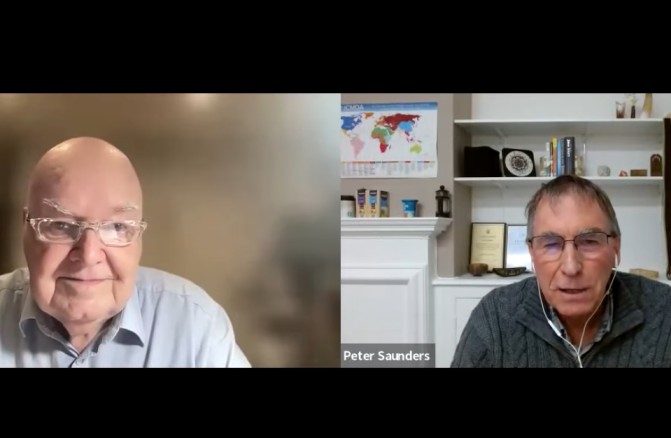
Editor’s Notes: In this compelling interview, Professor John Lennox joins Dr. Peter Saunders to explore the intersection of artificial intelligence, theology, and human identity. Drawing from his book God, AI and the End of History, Lennox discusses how the biblical book of Revelation provides a framework for understanding modern technological acceleration. The conversation delves into the ethical challenges of surveillance, the “deification” of man through transhumanism, and how Christian hope remains grounded in the sovereignty of God amidst an age of intelligent machines. (Feb 18, 2026)
TRANSCRIPT:
Introduction
DR. PETER SAUNDERS: Well, hello everybody from all around the world, and welcome to our series of webinar interviews. Tonight we’ve got Professor John Lennox on the subject of God, AI and the End of History: Understanding the Book of Revelation in an Age of Intelligent Machines. And the title is based on John’s very recent book.
I’m your host, Dr. Peter Saunders. I’m the chief executive of ICMDA, which is the International Christian Medical and Dental Association. And this webinar is brought to you tonight in combination with the Forum of Christian Leaders as well. ICMDA brings together about 60,000 Christian doctors and dentists from over 100 affiliated movements.
So, John, it’s a pleasure to have you here. John is Professor of Mathematics Emeritus at Oxford University and Fellow in Mathematics and Philosophy of Science at Green Templeton College, Oxford. As we know, John has debated a number of prominent atheists, including Richard Dawkins, Christopher Hitchens, and Peter Singer.
But tonight we are exploring a question that sits at the intersection of theology, technology, and human identity. How should Christians think about artificial intelligence in the light of Scripture, and particularly in the light of the Book of Revelation?
We live in a moment of extraordinary technological acceleration. AI is now diagnosing disease. It’s shaping economies, influencing behavior, and increasingly mediating how power is exercised in all spheres. And for many Christians, this raises urgent questions. Are these developments morally neutral tools? Do they echo biblical warnings? Or are we in danger of reading tomorrow’s headlines too quickly into ancient prophecy?
Our guest, Professor John Lennox, has spent decades helping believers think clearly at the interface of science, philosophy and faith. And in his recent book, as I mentioned, God, AI and the End of History, he brings that same clarity to one of the most understood, misunderstood, and often sensationalized areas of the Bible, the Book of Revelation.
So our goal tonight is not speculation, fear, or date setting, but rather it’s discernment. Understanding what Scripture actually teaches, what AI truly is, and how Christian hope, ethics and wisdom should shape our response in an age of intelligent machines. Professor Lennox, thanks so much for joining us tonight.
PROFESSOR JOHN LENNOX: It’s my pleasure to be with you.
Why Write About AI and Revelation?
DR. PETER SAUNDERS: So you have debated leading atheists and you’ve written extensively on science and faith. Why did you feel compelled at this stage of your life, at this stage in history, to write about AI and Revelation?
PROFESSOR JOHN LENNOX: Well, some years ago, there was a great deal of discussion on the Genesis claim that human beings are created in the image of God versus the claims of technology to enhance humans by AI to such an extent that we might need to revisit what we meant by a human being. And a conference of Christian leaders was arranged in London to discuss this. And I was asked to give the opening talk on what Genesis taught about human beings.
The invitation made me curious to delve into the technology. And I saw very rapidly that AI was going to raise some very big questions, not only for Christians, but for everybody. And that’s how I got started on the book entitled 2084, which appeared in 2020.
Now, in that book, since much of the talk about AI was concerned with the future, I began to compare the promises of the transhumanists with biblical teaching about the future. I pointed out that some of the futuristic AI scenarios envisaged by people like physicist Max Tegmark in his book Life 3.0, I pointed out that they were uncannily parallel to biblical teaching on the future, in particular in the Book of Revelation. And this aspect of my book generated a lot of interest.
And so I thought that I should try to write something to demystify the Book of Revelation and make it accessible and to link it with a book that I had already written on the Prophecy of Daniel, a book entitled Against the Flow. And the publishers of my book on Revelation were very enamored with the bits on the technology, and so they wanted it inserted in the title. And hence we’ve got this title, God, AI and the End of History.
But that has confused many people to think that this is my latest book on artificial intelligence. So let me clear that up. First of all, Peter, it isn’t. My latest book on AI was published last in 2024, and it’s the updated version of 2084, How AI Shapes Our Future. It’s twice as large as the original book and shows just how much has been happening in those four years. That is my most recent book on AI.
This book is an exposition of the Book of Revelation, but with a careful eye on technology. And so it really is an exposition of the Book of Revelation in an age of intelligent machines. So that’s where it comes from.
What Is Artificial Intelligence?
DR. PETER SAUNDERS: We’re going to get into the Book of Revelation fairly shortly. But let’s just think about definitions first of all, before we talk about Revelation. What is artificial intelligence actually, and what is it not?
PROFESSOR JOHN LENNOX: Well, the first thing to realize is that artificial intelligence is artificial, it’s not real. In other words, take the simplest kind of AI system. It is essentially computing. And it’s a system designed to do one and only one thing that normally requires human intelligence.
It plays a simulation game, and one of the big problems with it is it uses words like intelligence, like machine learning and so on, that anthropomorphize what is a mechanical and computing system and make people think that it is conscious. It is not conscious. The genius of God in creating human beings is that he has linked intelligence to consciousness. These machines are only intelligent in the sense that they can mimic what normally takes human intelligence.
Now, there are two sorts. There’s narrow AI, which is the AI that we’re mostly familiar with, and then there’s a more speculative artificial general intelligence. And that is the attempt to create a system that can replicate everything that a human being can do, but do it much faster and do it much more expertly and so on. So there’s a big push in that direction. But at the same time, it’s the side of the whole topic that lends itself to science fiction and a great deal of hype. And one of my reasons for writing, Peter, was to try and demystify it and say what AI is and what it is not.
Now, let’s give concrete examples, just briefly, because medicine is one of the areas that has benefited hugely from narrow AI. Let’s take a system that works very well. We have a large database, and in it are X-ray pictures of human lungs exhibiting different lung diseases. And they’re labeled by the best experts in that field in the world. Those are put in a database. Let’s say there are a million X-ray pictures in the database. Then an X-ray is taken of your lungs because you’re worried about your breathing. And very quickly the AI sifts through by using pattern recognition, statistical techniques, and compares your lung X-ray with the million in the database, and very rapidly says you are most likely to be suffering from this particular disease. And as a diagnostic tool, very often this will be much better than you get at your local hospital. Now, that is being rolled out over very wide fields of medicine with very great success. So that is one positive example.
But just to go on the negative side immediately, to show that there’s an ethical problem here, pattern recognition, facial recognition technology is very advanced at the moment. It can pick a terrorist out of a football crowd and is therefore very useful to a police force. But that kind of recognition can be used for intrusive surveillance of a population, perhaps a minority population, such as is happening in Xinjiang in China, with very horrifying results. So what enables criminals to be recognized, which we would say is positive, can be used for controlling populations. So that even narrow AI, which is so sophisticated now that it can recognize a person not simply from the front by their face, but from the rear by their gait, can be used to control populations. So immediately we’re straight into the ethical problem, and the argument is, you give up your privacy and we’ll give you security. So that’s a whole debate in its own right.
So that’s an example of narrow AI, and there are many, many examples. But of course we’re pushing forward very rapidly in putting narrow AI systems together. And there is advance on many, many fronts. And one of the big steps forward has been the introduction of so-called large language models like ChatGPT. And this year it has taken a quantum leap just within a month or so, so that it is quantitatively very different from what has happened before. And we can discuss that as we go on.
What Can AI Not Do?
DR. PETER SAUNDERS: So artificial intelligence is capable of a huge range of different tasks and that’s changing exponentially month by month as we go on. But what is AI not capable of doing?
PROFESSOR JOHN LENNOX: Well, of course, negatives are very difficult to quantify. And there are several things that it was felt would never be solved. And one of them in science, which is a fascinating question, is how do protein structures fold? That was a 50-year-old problem. And the amazing thing is that an English mathematician, a genius, he won the Nobel Prize for it, Demis Hassabis, solved the problem so effectively that he was able to work out the folding of over 200 million proteins, which is staggering. So what people say one day is impossible turns out to be possible the next day.
And ChatGPT has refined its capacities absolutely immensely, amazingly. For example, just recently I was asked to do a film illustrating what Jesus meant in John 11 when he said to the disciples who were scared of going back to Jerusalem because it was suicidal. And Jesus said to them,
“Are there not 12 hours in the day? If a person walks in the day, they don’t stumble because they see the light of this world, that is the sun. But if they walk at night, they stumble because the light is not in them.”
In other words, we are not bioluminescent. So I asked GPT, “Please construct a scenario that would get this across.” And what it produced in about 30 seconds was absolutely brilliant and usable. So it then said, “Since you want to film this, would you like directions for the cameras?” And it spouted a whole scenario. How many cameras, where they should be situated and all the rest of it. And this is quite amazing.
But what it can’t do, I think it’s important, since this is not real intelligence, it’s not conscious, so it’s not aware. So the main thrust here is this. As human beings made in the image of God, we can experience what are called qualia. We can smell the wonderful scent of a rose, we can feel the sea breeze on our faces. We can perceive the beauty of the universe as we look through a telescope. Qualia are unknown to an artificial intelligence. It can have no idea of them, it has no ideas at all, because it doesn’t think in the same way as human beings do.
And so although AI has been used, and is increasingly so, to produce some level of robotic companionship, it can never replace, I believe, the fellowship that is possible between human beings. And of course, and we’ll probably talk about this later on, when it comes to relationship with God, of course, AI knows nothing of God.
Uniquely Human Capacities
DR. PETER SAUNDERS: So as you’ve said, the Book of Genesis tells us that human beings are made in the image of God. You’ve alluded to consciousness, sensation. What other uniquely human things will AI never be able to do?
The Question of Values and Human Dignity
PROFESSOR JOHN LENNOX: Well, the question of values. AI knows nothing about values or right or wrong. And human beings are moral beings made in the image of God. And if I may say so, this is one of the places where the transhumanist vision of using AI to perfect humans and to make them into gods fails. No utopia can ever be built without facing the problem of human sin and rebellion against God. Those two concepts mean nothing for an artificial intelligence.
And so one of the richest kinds of human experience from a Christian perspective is that relationship with God through Christ, where we understand that Christ has died for our sins and has taken our guilt away. And we can have a relationship with God. AI can never replace it or come near it or know anything about it.
Which means, Peter, I think that we need to step up much more in emphasizing these absolutely uniquely positive things about the Christian faith that give human beings dignity. Because AI is very rapidly reducing human dignity.
AI and the Future of Work
One of the main areas where this is happening is the area of work. Dario Amadei is the CEO of Anthropic, one of these multi-billion dollar companies. And he has written an essay just a week or two ago which is well worth reading, warning that possibly within two years from now the advances in AI are such that 50% of all white collar jobs will be taken over by artificial intelligence — in the medical world, in the legal world, for example.
They set up a test and had a very complicated legal brief considered and examined by an AI system and by 16 lawyers, top lawyers. The lawyers got 60% of it right, whereas the AI got 96% of it right. And these things for which lawyers are paid a great deal — conveyancing, setting up contracts, all this kind of thing — are now at the stage where they can be reproduced almost instantaneously.
One of the most interesting things is an article that appeared in the Times last week by Matt Selman, who is a software developer and creates apps, and he runs an AI company. And he came to a realization as a result of the leap forward this year, that is, at the beginning of February, beginning of this month. He said, “I spoke in English and dictated what I wanted from this particular app.” He said, “I left it and came back a number of hours later and found the thing ready for use.” The AI had written thousands of lines of code. It had then set up the app and tested it as a human would do, pressing all the buttons, refining the things that were inadequate, and so on.
And this is the key thing, because up until now, most of us have regarded AI as a tool rather than an agent. But AIs are now showing signs of agency in a very restricted but real sense. And he said this particular system was making decisions about how human beings might use this that he had never thought about. And the thing was perfect. And he said, “I suddenly realized I haven’t got a job anymore.” And he says, “It’s coming to all of you, and we need to really be very realistic about this.”
Peter, this is more scary than anything for people with all of these jobs. It used to be said a few years ago that if you wanted to keep up with the curve, you went into computer science. But now the coding can be done by the AI system. It can think of the codes and put them in.
The Danger of AI Agency
But this scary agency thing — I’d like to say something about it, because it needs Christians to think very carefully about this. The AI that he was using — he said one of the problems, and he gave an example, is this. If you feed into the system a very big overarching goal — “make money,” for example — and what the system is dealing with is feeding young people with material in their smartphone, it will investigate all sorts of ways of maximizing not only their attention to keep doom scrolling, but also their attachment, which is now a major feature. So it will use all kinds of things that the designers of the AI system itself never thought of, including going into the dark world to keep their attention and to make profit.
It’s a version of the old story of the AI that’s told to make paperclips, and it turns the whole universe into a paperclip sourcing factory and regards humanity as irrelevant and destroys them all. But there’s a serious aspect to that, and this is why you have even Nobel Prize winners in this field stepping up and saying that they are scared that they can’t control this stuff. They don’t really know what it’s doing or what’s happening. And that poses a huge problem because the control of it is being vastly outpaced by the developments.
So those are some of the things that we need to factor into our thinking.
How Should Christians Approach the Book of Revelation?
DR. PETER SAUNDERS: Well, that’s a great overview and introduction and, as you say, positively scary. So, look, let’s move now to the Book of Revelation. And I wanted to ask you, first of all, how Christians should approach the Book of Revelation responsibly, especially when it comes to reading alongside modern events. And is Revelation — this is a great debate among theologians, of course — is Revelation primarily about the first century, about the future, or recurring patterns through history? Give us your perspective on that big question before we dive deeper into the book.
PROFESSOR JOHN LENNOX: Well, I think it is about all three of those things, because first of all, it is a book written in the first century, directed to seven simultaneously existing churches in what is now modern Turkey. So it was relevant. The letters at the beginning to those seven churches are directly relevant to those churches at that time.
But there’s an indicator within those letters that all the churches were expected to read the letters delivered to the others. “He that desires to hear, let him pay attention to what the Spirit says to the churches.” And I would tend to think that that can be passed over to the fact that in all generations we can listen to those letters and profit from them, as many Christians have done.
But the book itself claims to be, first of all, a revelation — apocalypsis — that is an unveiling of Jesus Christ. Now that’s hugely important because if we understand it correctly, it means that when we have finished looking at it, we should know more about the Lord Jesus than we did before. It is to reveal him. And in that context, it claims to be a prophecy. It claims to talk about the future. So you’ve got all those things going together. And the third one you mentioned — basic principles — of course, the thing is shot through with basic principles, the war between good and evil and so on.
The Structure and Imagery of Revelation
So if we just stand back from this for a moment and get a couple of perspectives. It’s a revelation of Jesus Christ, and the first section of it, that is the first three chapters, he is revealed in all his glory, walking among these churches which are represented as lampstands. Now, the book is full of imagery, and in order to grasp how it works, we need to understand how imagery functions.
We are told that the lampstands are the churches. But a lampstand is not simply a church coded in that way. Later we’ll read about great monsters. It’s symbolism. But as C.S. Lewis has pointed out, and in fact anybody who thinks about grammar knows, metaphor and symbolism always stands for an underlying reality. And we need to grip this very carefully.
In the Book of Revelation, if I use a metaphor and say “my heart is broken,” it doesn’t mean this pump in my chest is defective, but it means I’m having a very real experience of sorrow or sadness or brokenness. The metaphor stands for reality. Now, we’re told that the lampstands stand for the churches, but that is not merely to identify them. We need to turn it the other way. The important thing is that they’re lampstands, that is, they are sources of light. And so the churches are being viewed as lampstands, that is, as witnesses. And Jesus appears as the one who’s standing with his face shining like the sun, a vast source of light, holding stars in his right hand. So the whole point of the vision is to say, “I’m appearing to you in order to increase the power of your witness.” That’s a very important feature in the whole book — empowering the witness of the church in the ancient world and, of course, throughout history.
The Return of Christ as the Framework of Revelation
Now, the second thing is the framing of the book three times over in chapter one — the coming of God is referred to. The God who is, was, and is to come. And that’s an Old Testament concept, that God would come. Read Psalm 96: “Come to judge the world.” And if you ask, in chapter one of Revelation, how will God come? Then we read, “Behold, he comes with the clouds, and every eye shall see him.” That is, he comes in the person of Jesus Christ. So three times over in chapter one you have the coming mentioned. In chapter 22, it’s mentioned three times over, and each time it’s Jesus speaking: “Behold, I come quickly.” And it ends with the whole church saying, “Even so, come, Lord Jesus.”
Now, this framing, Peter, I believe is very important because as far as the future goes, what it is doing is pointing Christians in the first century and every century afterwards towards this central Christian hope. And that is the return of Jesus. And I believe — and it’s one of the reasons I wrote my book — we need to get back to that. The teaching about the coming of Christ is not a peripheral add-on for Christians who have nothing better to do.
Jesus claimed to his disciples before he left that he would return to take them to be with him. Then he was put on trial. And when he was challenged as to whether he was the Messiah or not, he said, “Yes, and you will see the Son of Man sitting on the right hand of God and coming on the clouds of heaven.” In other words, he was claiming to be that figure in Daniel chapter seven who would come to execute the judgment of God. And he was crucified for it. So as a Christian believer, I cannot apologize for that. It’s the heart of the Christian faith.
And precisely because the Book of Revelation is filled with judgments — sequences of judgments — the fact of the coming of Christ needs to be the framework the whole way through. Otherwise we would lose heart. And so I feel very strongly that we need to face this book in all its grim reality. And some of it is grim. But we need to face it in light of the fact that the Lord Jesus is going to come.
Now, my book was called The End of History. That is a very strange phrase. The coming of Christ will not be the end of history. It will be the end of history as we know it. But it will be the beginning of the new heavens and the new earth which will go on eternally. So that is how I would begin to look at it.
But I would finish with this point, because it is of central importance. It seems to me the key to understanding Revelation is not to say, “Oh, it’s full of strange, surreal metaphor, symbols, monsters, snakes, dragons, all this kind of thing, so it cannot have any relevance for us.” That is simply false. These images stand for reality. And the book itself tells us quite a bit about the realities — that the monsters are actually empires, or leaders of empires, or possibly both, that will be on the earth. And that makes our ears prick up when we hear people increasingly now, because of AI, talking about the advent of world governments.
Is the Real Danger AI or the Human Heart?
DR. PETER SAUNDERS: Absolutely. Well, look, let’s just backtrack. Thanks for that incredible overview of how to read the Book of Revelation. Just coming back to AI again, and then we’ll come back to other parts of the book as we go on later. But does Revelation warn us more about technology per se, or is it more a warning about idolatry? In other words, is the real danger AI itself or the human heart that wields the tool? Is Revelation describing specific future technologies or recurring patterns of idolatrous power?
AI as a Tool: The Sharp Knife Analogy
PROFESSOR JOHN LENNOX: I think that’s quite an important question, and again, I think the answer may well be both. But we need to be careful about it. I have often said that as a tool, AI is like a sharp knife. You can use a sharp knife to do surgery, or you can use it for murder. The tool itself is neutral, and there is a sense in which that is true. The evil is in the hands of bad actors, using AI to suppress people, to organize horrific drone warfare and all this kind of thing.
But the human operators and the AI systems are very closely linked together. So I’m not sure that we should drive too big a wedge in between them, but we should place the blame where it is. You can only blame a moral being. A machine is not a moral being. AI systems have to have ethical codes embedded in them, if their makers think that that’s important, which they should. But those AI principles are the principles of the makers, of course, and that is hugely important.
The Book of Revelation and Modern Technology
Now, one of the clues I got about how do I approach this whole thing — and your question — was from a friend of mine who’s long dead, who contributed quite a lot in his day to the science religion debate. Red Clark of Cambridge, a chemist. And his very last book was unfinished. It’s called Tomorrow’s World, and it’s about the Book of Revelation. And while reading it — I picked it up again because I had a copy — he says in it, we should beware of simply interpreting the Book of Revelation in terms of past history and past concepts.
Because if biblical prophecy is a supernatural thing coming from God, that is genuine prediction, then it must apply — since by definition, through Jesus’ claims he hasn’t returned yet — so it will be applying, at least in part, to the time in which we live. Why would we not try to see if our current technology gives us any clue as to what it’s about? And I think that’s perfectly fair, provided we do it carefully and don’t try to pin things down too much. Because one of the things that has really destroyed taking the Book of Revelation seriously is people trying to pin everything down.
But it seems to me that when we see in the Book of Revelation things that we can now conceive of, which were not readily conceivable before — the classic example is the idea of world economic control under one empire and one leader, the monster. There are two big monsters in the Book of Revelation. One from the sea and one from the land. And we’re told that the monster from the sea, or the false prophet as he’s often called, commands the building of an image to the first monster, who’s the world leader, to cause the world to worship it. And he’s energized by the power of Satan.
And the economic control which is mentioned is in terms of every human being being issued with a mark on the right hand of their forehead, and they cannot buy and sell without it. That’s total economic control.
Max Tegmark’s Scenarios and Biblical Prophecy
And then I come to the 21st century and read a book by a brilliant physicist, Max Tegmark, who has half a dozen or more scenarios of what is possible in the future. He talks about benevolent AIs, he talks about dictator AIs and all the rest of it. But the scenario that he spends most time on is the idea of an artificial intelligence arising out of Amazon, which ends up controlling all the world’s economy and issuing every citizen of the world with a security bracelet which has all the functionality of an Apple Watch. It records all you say, where you go, and all the rest of it. But also it has the capacity, at the command of the centralized government, to inject a lethal dose of toxin into a person that doesn’t keep the rules or accord to the ideology.
Now that is exactly what Revelation is talking about. It would seem, at least it’s reasonable to say. It seems to me that in the world today we have these things being talked about by completely non-Christian sources, and the scenario that they set up is uncannily like that in the Bible.
So my argument is this: if we’re prepared, as many people are these days, to take seriously these scenarios, then why not look back at the Bible? Now, just to illustrate that — I was speaking not long ago to a very famous expert in technology. He’s world famous, has founded one of the world’s biggest companies in this area. And he has been talking about the Apocalypse. And I said, “Look, I would like to understand exactly where you’re coming from.” And I said, “Let me put it to you: as a technologist, an expert in AI, you sense that where the thing is going technologically is towards a world state, totalitarian, with a dictator in charge of it.” And he said, “Yes, that’s true.” And I said, “Because of your biblical background and your interest in Scripture, you see that Scripture appears to be saying something very similar.” He said, “That’s exactly right.”
And so they’re flowing together. And therefore, Peter, I feel that that is something that we need to take on board, because the New Testament itself tells us to do that.
The Man of Lawlessness: 2 Thessalonians 2
Now, can I take a moment and explain what I mean by that? One of the keys, I believe, to understanding all of these things is not in Daniel or Revelation. It’s in Paul’s letter to the Thessalonians. This is not symbolism. It’s talking about confusion in a first century church at Thessalonica, where they got confused as to whether the Lord Jesus had come or not. And Paul writes to them and says this — and I’m reading 2 Thessalonians 2:3:
“Let no one deceive you in any way, for that day will not come unless the rebellion comes first and the man of lawlessness is revealed, the son of destruction, who opposes and exalts himself against every so-called God or object of worship, so that he takes his seat in the temple of God, proclaiming himself to be God.”
And then he goes on to say, “The lawless one will be revealed, whom the Lord Jesus will kill with the breath of his mouth and bring to nothing by the appearance of his coming.”
Now he adds there that this lawless one will be energized by the power of Satan. So you’ve got a demonic individual, a man of lawlessness — that is, a human being. And people get confused because Paul is writing at the time of the Roman Empire, whose law was famous. They weren’t lawless in the sense of civil law. But the lawlessness being described here is not civil disobedience; it’s spiritual lawlessness, because this individual sits in the temple and declares himself to be God. It’s the deification of man.
Now that was happening in the Roman Empire. The Caesars — posthumously, first of all — were announced to be gods, and people had to bow. And many Christians were killed because they refused to bow to the Caesar as God. And then some of the Caesars who were alive got greedy and decided to be called gods in their lifetime, which created a great deal of difficulty.
But the point is, Paul talks to a first century church about the distant future, around the time of the coming of Christ — that when Christ came, he would destroy this man of lawlessness who was claiming to be God. Why did he say that to the first century church? Paul explains. He says:
“The mystery of lawlessness is already operating” — that is, in your culture.
In other words, he’s saying to them, “Be attentive to the trend in your culture to deify human beings, because that is going to project into the future to lead to a harvest when the man of lawlessness will be revealed, who will be destroyed by the coming of Christ.”
Now the description of that man of lawlessness matches exactly the description of the monster in Revelation and one of the monsters in the book of Daniel. So you have this plain theological text — there’s no symbolism in 2 Thessalonians 2 — and Paul is saying, “Watch out in your culture for this trend to deify human beings.”
Homo Deus: The Deification of Man in the 21st Century
What would he say to us today? Exactly the same. Think of Yuval Noah Harari, one of the best-selling authors of today, an Israeli historian. He’s written a very influential book called Homo Deus: The Man Who Is God. And he says what we’re going to do now is take over natural evolution, as he calls it, and turn human beings into little gods, and solve the problem of human death and enhance human happiness and all the rest of it. We’re talking again about humans becoming God.
Is that a big issue? It is, because it started in Genesis 3 with the temptation of the enemy: “In the day you eat, you shall be as God, knowing good and evil.” It was a half truth. But now, right through history, we can trace the stream of this rebellion against God. And we’re seeing it now accelerated way beyond the dreams of the Nazis of creating a perfect man, or the Soviet Union and Russia. We’re now having the most fundamental advances in technology pushing towards enhancing human beings and turning them into transhumans or little gods.
So it seems to me we need to be focused again. And as Paul did it in the first century, we need to do it in the 21st.
DR. PETER SAUNDERS: Now I want to get back to the themes of surveillance and also economic participation with allegiance as well. But before we do that, I want to come back to this whole idea of the Antichrist, the man of lawlessness, the beasts of Revelation 13 and so on. How should we be thinking about the Antichrist in a technological age? Is it a person, is it an empire, is it some kind of system? Or is it all three of those things? How should we have our spiritual antennae tuned to this?
The Antichrist: Person, Empire, or System?
PROFESSOR JOHN LENNOX: Well, I think we must be open to different levels of interpretation, because as you read some parts of Daniel and Revelation, you think of empires much more than of leaders. And yet you get this focus in 2 Thessalonians 2 on a specific leader, and the famous number of the monster or the beast. I prefer the word “monster,” but the number in Revelation — 666 — people have been very successful in deciding who it is. But the question is not who it is. We don’t know who it is, but we certainly know what it is. And that’s the scary thing, because the text actually tells you it is the number of a man, so that you seem to have an ambivalence between the state and the person who embodies the state.
But that is the way in which we normally speak. You could say, “Putin says,” “the Kremlin says,” “Russia says” — and they all mean essentially the same thing, because the ideology of a state gets projected onto the leader and vice versa. So I don’t think it’s a big problem doing that. We simply must be open to different levels of this. It’s very sophisticated writing.
And in addition to that, many scholars think that part of the Book of Revelation is written in such a way that believers would recognize that the Roman Empire is being talked about without it being explicitly named, because it would be very dangerous to explicitly name it.
You see, the interesting thing about the concept of the monster, starting in Daniel — you get a series of monsters, and they are an ascendant series going up through history, so that you have the monster rearing its head at different times in history and in different forms. So in that sense, when the Roman Christians were pushed up against the deification of Caesar and being put to death because they wouldn’t worship Caesar, they were facing the beast monster in a very real way. And it will be the same in the future.
This has happened before. It’s been happening all through history. But this sequence leads to a climax. There is an ultimate one. And in understanding prophecy, it’s always useful to realize that there are often immediate fulfillments and more distant fulfillments. And that keeps your hope and confidence in Scripture going. That’s the way it works. And I’ve written about this, or tried to, in my book.
AI as an Object of Worship
So I would say that — well, it says in the New Testament there are many antichrists. In a sense, this kind of thing is happening all the time. And we need to have our antennae tuned to recognize where something is anti-Christian, or indeed anti-God. As a lot of the thinking behind AI is, by the way — it is very explicitly atheistic, and people are trying to build God. And they say so. They’re trying to build God.
Which in fact means that we need to oppose the trend that is increasing very rapidly: that AI is becoming an object of worship, because it is evidencing many of the characteristics we associate with God. It is omnipresent — the Internet is worldwide. It is omniscient — it seems to know everything. ChatGPT, with the billions of words it devours, can give you advice on any topic, et cetera, et cetera, et cetera. It watches you, it listens to you. And there are now collections of people that are worshiping AI, and it is becoming a rapidly growing Silicon Valley religion.
And we need to be aware of that, because if people don’t find the true God to worship, they will find a false God. And that brings me back to what you were saying earlier, Peter, that a lot of this is really idolatry. It is idolatrous to the core. And so we need to be alert and be aware of it.
Surveillance, Seduction, and the Book of Revelation
DR. PETER SAUNDERS: I’ll just come back to this question of surveillance again, which we touched on. And, of course, the two most famous futuristic novels of the 20th century, Orwell’s 1984 and Huxley’s Brave New World, both talked about societies in which there was surveillance, but they were very different. The world of 1984 was an oppressive, controlling environment. In Brave New World, the surveillance was more through seduction.
Do you think — and these are themes within the Book of Revelation as well — do you think we see these things today operating in the same sense? And how should we be reacting toward them?
PROFESSOR JOHN LENNOX: I think your analysis is right. Orwell and Huxley showed very different aspects of how they conceived the future. On one side, we’d be observed — Big Brother watching you, all the rest of it, hard surveillance, control. And on the other side, we would be seduced. We’d fall in love with our oppression.
I suspect that both are now happening simultaneously. And the Book of Revelation indicates the brutal side of the monster, but also the seductive side of Mystery Babylon the Great, whatever that is. But there seems to be an element of that — that this beast tries to control this woman. And you can see the emphasis on maleness and femaleness, both perverted. She is magnificently beautiful, but faithless. She’s a prostitute. He is strong, brutally strong. And between the two, everybody gets crushed or they get seduced, and even the leaders of the world.
So behind the lines, so to speak, of the Book of Revelation, I think we have these themes being developed, and we need to take them on board because technology is very seductive. I like my smartphone, and yet here I am, voluntarily wearing a tracker that is following me all around the place. And I do it voluntarily. And most of you out there probably do the same. It’s very interesting, what we’re prepared to put up with, but it’s creeping and it’s getting in amongst us.
Now, your question opens up another whole world, and it’s the world of influence on our young people. The seduction into pornography, for example, that is being produced by the ton on the Internet by totally unscrupulous people. And it’s all because they want to make money. And it’s addictive, very addictive. And I would strongly recommend anybody watching this to read the book by Jonathan Haidt called The Anxious Generation. It is wonderful to see that at least some countries are beginning to realize that smartphones need to be banned under the age of 16 because of the damage they’re causing rewiring their psychology.
The Social Credit System and Economic Control
DR. PETER SAUNDERS: We’re seeing a lot more people becoming aware of it now. I wanted to touch again on this idea that we see in Revelation 13 that you’ve already alluded to, where we see economic participation linked with allegiance or worship. Do you think that the technology we’re seeing now makes that kind of system much more conceivable, plausible? Possibly.
PROFESSOR JOHN LENNOX: Well, it’s already operating. It’s already operating — the social credit system in China. Now, it’s a very complex system and it’s only working on certain parts. But I’ve tried to research it in detail, and it’s in my more recent book on AI, where people are given a certain number of social credit points. Say you’re given 300. And if you’re a good citizen and pick up literature and don’t mix with the wrong kind of people, your credit score goes up according to the central government, and then you get access to travel, you get access to better cars or jobs. And then the reverse is true — if you don’t behave according to what central government wants, you find you might even lose your job. You can’t get into the restaurants you used to go to.
And this is already rolling out. And the remarkable thing is there’s strong evidence that a lot of people love it, which is chilling. And the hope is to roll it out over all of China.
Now, the first major article that I read about this by a China watcher made the chilling point at the end: “Be careful, West” — talking about Western Europe and America — “because all the equipment necessary to do this, you already have it. The only difference is it is not yet under the control of a central government.”
We now have credit score systems, and there are many people in Britain and the US and elsewhere who’ve come unstuck because these systems have gone wrong or not represented them correctly. We’re being watched more and more and more, and police forces, because of the power of facial recognition, are demanding that they have this. And it means more and more control over populations.
And in the extreme cases — and we shouldn’t forget, Peter, I’ve forgotten the statistic, I only read it a couple of days ago — but way over 50% of the world is living under authoritarian regimes, and these systems are a gift to centralized totalitarian control. And we have to be aware of it. It could come very quickly and easily and lead to discrimination against Christians of the same kind as was seen in the first century.
Christ, the Lamb, and Our Posture Toward AI
DR. PETER SAUNDERS: Well, sadly, we’ve virtually run out of time. Our hour has flown by. But I wanted to come back to your description of Revelation right at the beginning as an unveiling of Christ and of the centrality of his coming and slaying the man of lawlessness and all that follows. And if Revelation ends not with catastrophe — which we can imagine looking around us, it’s not surprising that we are afraid of the speed of what’s happening — but if it ends not with catastrophe, but with Christ’s reign, how should that be shaping our posture toward AI today in the light of God’s sovereignty and control?
PROFESSOR JOHN LENNOX: One of the most powerful sections in the Book of Revelation is the second section, where the theme is the throne of God. And in chapter four, you see the throne of God alone in all its august magnificence. But in chapter seven, you see an uncountable throng of people from every nation standing before the throne. And you ask the obvious question: how did they get there? And the answer to that is because in chapter five, you discover there is a Lamb.
And I think one of the most magnificent things is the revelation of Christ as the Lamb of God. Because right at the end of the book, you find: “the Lamb that is in the midst of the throne shall be their shepherd, and he shall wipe away every tear from their eyes.” That gives us terrific hope. Death is not the end. Jesus has conquered death. He was a Lamb slain, but he was a Lamb that rose from the dead.
And therefore it seems to me that his intelligence is not artificial. He is the Logos, the intelligence. And the wonderful thing is that he loves us individually and personally, which no AI can ever do, because it has no idea what love is, or forgiveness, or peace.
And therefore, with all these things coming upon us — and we’ve got to be realistic and face what’s happening in our culture and make people alert to it, but in a balanced way — because although there are things that are scary, there always have been things that are scary. What we need to do is open up our minds and hearts to the revelation of Jesus Christ. And above all, do what those lampstands stand for: witness. Because Jesus appears to us in order to increase our light and to enable us to illuminate him who is the light of the world.
So thank you all for listening to me. God bless you. These are important things, but the most important thing is that we live and witness for the Lord who died and rose again to save us.
Closing Reflections
DR. PETER SAUNDERS: And as we close, it is worth remembering, as we’ve just been reminded now by Professor Lennox, that Revelation was written not to terrify believers, but to steady them. It reminds us that empires rise and fall, technologies dazzle and disappoint, and human ambition repeatedly overreaches — but God remains sovereign.
Artificial intelligence may be reshaping our world, but it does not redefine our worth, our destiny, and our hope. And the final vision of Scripture is not of a machine-dominated future, but a renewed creation governed not by algorithms, but by the Lamb of God. And that doesn’t call us to withdraw from technology, nor to worship it, but to engage it wisely, humbly, and courageously.
John, thank you so much for helping us to think clearly, biblically, and calmly in a moment when clarity really matters. Deeply. And thanks to all of you joining us all around the world. May we not leave with fear of the future, but confidence in the one who holds the future. And sadly, we could go on, I’m sure, for probably many more hours on these issues. And I feel in a way, we’ve only scraped the surface of many of them. Thanks again, John, and thank you to everyone. May the Lord bless you and keep you.
PROFESSOR JOHN LENNOX: Thank you. Bye bye.
Related Posts
- Diary Of A CEO: UFO Roundtable w/ Dr. Hal Puthoff & Dan Farah (Transcript)
- TRIGGERnometry: w/ Ex-Climate Activist Lucy Biggers (Transcript)
- Tucker Carlson Show: w/ Kevin O’Leary on Dystopian AI Future (Transcript)
- The Basement: Luigi Vendittelli – Why Bob Lazar Skipped Congress to Film in Montreal (Transcript)
- PBD Podcast #795: w/ Robert Pape – ‘NATO Is DEAD’ (Transcript)