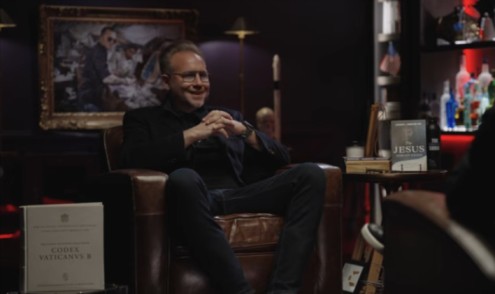
Editor’s Notes: In this special Easter episode of the Shawn Ryan Show, Dr. Jeremiah Johnston joins Shawn to explore the intersection of historical evidence and faith, focusing on the profound scientific mysteries of the Shroud of Turin. Dr. Johnston, an expert in Christian apologetics, presents compelling research from physicists and mathematicians that suggests the shroud is a unique “resurrection cloth” marked by an inexplicable burst of energy. The conversation also delves into ancient biblical texts, the reality of spiritual warfare, and the historical reliability of the resurrection. It is a deep, truth-seeking journey designed to offer hope and perspective during the Easter season. (April 2, 2026)
TRANSCRIPT:
Welcome and Introduction
SHAWN RYAN: Dr. Jeremiah Johnston, welcome to the show.
JEREMIAH JOHNSTON: Thanks for having me, Shawn.
SHAWN RYAN: You’re welcome. It’s an honor to have you. We’ve been looking at you for a long time, and I just thought this would be the perfect interview for Easter. So we do a Christmas interview, Thanksgiving interview, Easter interview. We embrace all the holidays here. And we really try to do something really meaningful, especially on Christmas and Easter. And the Shroud of Turin is something that I’ve been interested in for a long time. In fact, our mutual friend Lee Strobel, I believe, is the first person that brought it up to me.
JEREMIAH JOHNSTON: Right.
SHAWN RYAN: And I was just fascinated. So thank you for coming.
JEREMIAH JOHNSTON: Absolutely. And he is risen, brother.
SHAWN RYAN: That’s right. You want to start with a prayer?
JEREMIAH JOHNSTON: I would love that.
SHAWN RYAN: How about you lead it?
JEREMIAH JOHNSTON: I would be honored.
SHAWN RYAN: Perfect.
Opening Prayer
JEREMIAH JOHNSTON: Jesus, you’re King of Kings and Lord of Lords, and what we’re about to discuss has utterly transformed my life. I pray for every person watching and listening that they would find the hope that the tomb is empty, that you’re alive forever, and so we can have a living, undying, undiminished hope.
I pray, Lord, that in this conversation I can minister to Shawn. I pray you’d bless him and meet him at his greatest point of need right now. And Father, we pray that as we share, we would know, Lord God, that it’s not by might, it’s not by power, but it’s by your Spirit, saith the Lord of Hosts.
So we start now by just giving you the glory and asking you to bless this conversation, especially at this wonderful Easter season. And Lord, we say, come soon, Lord Jesus. And we quote John 14:19, you said, “Because I live, you will live also.” So thank you for everything you’re going to do. We know that this conversation is going to impact the world. We’re excited about it. In Jesus’ name. Amen.
SHAWN RYAN: Amen.
JEREMIAH JOHNSTON: Thank you. Thank you.
Guest Introduction
SHAWN RYAN: So let me give you an introduction here. Dr. Jeremiah Johnston, president and founder of Christian Thinkers Society, and serves as a pastor of apologetics and cultural engagement at Prestonwood Baptist Church near Dallas, Texas. PhD from Middlesex University in the United Kingdom, where you completed your doctoral residency at Oxford. An elected member of Studiorum Novi Testamenti Societas, the most prestigious New Testament scholarly guild in the world.
Author of 15 books, including Body of Proof: The 7 Best Reasons to Believe in the Resurrection of Jesus, and the brand new release — congratulations —
JEREMIAH JOHNSTON: Thank you.
SHAWN RYAN: — The Jesus Discoveries: 10 Historic Finds That Bring Us Face to Face with Jesus. Examined ancient manuscripts with your own hands all around the world. You’re married to Audrey. You’re the father of 5 children, including triplet boys.
JEREMIAH JOHNSTON: I haven’t slept in 9 years since they were born.
SHAWN RYAN: I was one. I got 2 and I haven’t slept. And I already said this, but Lee Strobel — I believe you consider him a mentor.
JEREMIAH JOHNSTON: A dear friend.
SHAWN RYAN: I do, too. And Lee is awesome. In fact, there’s this —
JEREMIAH JOHNSTON: I saw that.
SHAWN RYAN: You saw the book up there?
JEREMIAH JOHNSTON: I saw a swag up there.
SHAWN RYAN: Right on, man. And yeah, once again, we’re releasing this on Easter. And it’s all about the resurrection.
JEREMIAH JOHNSTON: That’s right.
SHAWN RYAN: So this is really the perfect episode for that.
Speaking at Davos and the World Economic Forum
SHAWN RYAN: So before we get too into it, I found out you spoke at Davos at the World Economic Forum. How the hell did you get invited to that place?
JEREMIAH JOHNSTON: I mean, I probably shouldn’t say this, probably get blasted, but I’ve been blessed.
SHAWN RYAN: Jesus just doesn’t get mentioned much at the World Economic Forum. In fact, I don’t think there are very many people over there that believe in him.
JEREMIAH JOHNSTON: Well, you did a really great show recently with the Exorcist, and he mentioned the Antichrist quite a bit. And my wife let me know that at Davos I was giving the gospel to all the people that are going to work with the Antichrist someday.
SHAWN RYAN: Pretty much. That’s what I think.
JEREMIAH JOHNSTON: I was invited by Rich Strombach. He leads the USA House. So he brought the administration there. Trump, the State Department, 80 heads of state were there. And it was started in 1971 by, of course, the corrupt Klaus Schwab. They just replaced the current president for being in the Epstein files as well. So they’re without a president.
And Mr. Strombach, who is a dear friend, had seen my material on the resurrection of Jesus, and he had a conversion in 2022. He used to do — I mean, Vanity Fair covered Rich. He’d do billionaire hot tub parties. I mean, he’s Mr. Davos himself. He’s a connector. But he had a conversion. He had an experience with Jesus Christ in 2022 that changed his life.
So he sent me a message and he said, “I want you to bring the gospel and the evidence and the receipts for the resurrection to Davos.” And so Gillian Tett, editor of Financial Times, provost of King’s College, Cambridge University, interviewed me at USA House.
And I gave all the evidence for the resurrection of Jesus. And I made this point because these are crypto CEOs, some of the best businesses, and also some of the most corrupt people on earth. I learned at WEF that it’s really not governments that run the world. It’s these multinational companies that run the world, not governments.
But I wanted to make it clear that this idea of forgiving debts, this idea of free enterprise, these ideals that built Western civilization come from one event horizon — the physical bodily resurrection of Jesus Christ. That message rehumanized humanity. Ideas of loving your enemies, forgiving debts — that didn’t come from Marxism, that didn’t come from socialism. Of course, they’re all looking at me like this in Davos. I said that the event horizon is the resurrection of Christ.
SHAWN RYAN: Wow. How do you think — they invited you back next year?
JEREMIAH JOHNSTON: They want me to run the whole faith section for next year. They have a faith section now. So that’s awesome. I felt like Paul on the Areopagus. If you’ve read Acts 17, if you’ve been to Athens, some mocked, but some believed.
SHAWN RYAN: How did it feel? I mean, did you —
JEREMIAH JOHNSTON: Well, how did it feel? First off, I have a chapter in one of my books, “Why I Don’t Feel My Faith,” because my feelings betray me all the time. I had to just keep following truth because I had more demonic spiritual warfare on me that week than I’ve ever had. I gave 3 presentations at WEF and could not wait to get home.
SHAWN RYAN: I’ll bet. What kind of spiritual attacks? You want to talk about any of that?
JEREMIAH JOHNSTON: Anxiety.
SHAWN RYAN: Yeah.
JEREMIAH JOHNSTON: Wanting to deliver, wanting to get done and make sure that I said everything I wanted to say for the Lord, understanding that this is the first time in 55 years Jesus has ever been mentioned at the World Economic Forum, and just the weight of that. But greater is he who is in me than he who is in the world, 1 John 4:4. So I later watched it. I don’t even remember answering the way I did. It was just the Holy Spirit.
SHAWN RYAN: Right on, man. Well, I would say mission accomplished if there is a faith sector at the World Economic Forum.
JEREMIAH JOHNSTON: Everyone needs the gospel. No one is beyond God’s reach. That’s the thing. Even the people at WEF, they all need to hear the truth of the gospel.
SHAWN RYAN: Man, good for you.
JEREMIAH JOHNSTON: Well, praise God. But I wanted them to know these ideas, these amenities — I drove here in an awesome rental car, I stayed at a nice hotel last night with air conditioning. These amenities that we enjoy in free enterprise have not always been there. They come out of a worldview and they come out of the cut and thrust of the resurrection.
And that’s why the conversation we’re having right now is so important for people to get what rises and what falls. What are the stakes of what we’re talking about? This is not some kind of religious exercise we’re doing just because it’s a holiday and it’s Easter. What rises and falls — the stakes of if Jesus rose from the grave — is the greatest X factor the world has ever known.
SHAWN RYAN: I love that. Love that. Let’s talk about the Shroud.
The Shroud of Turin
JEREMIAH JOHNSTON: Okay.
SHAWN RYAN: What is it? I know you just — we have it right out there. You just ran me through the whole thing and it is, I mean, it’s breathtaking. It’s like a once in a lifetime opportunity.
JEREMIAH JOHNSTON: Right.
SHAWN RYAN: For most of us here. Can you just talk about what it is? And I’m sure we’re probably going to overlay some of the stuff that we just talked about in there. But let’s do it again.
Gifts and the Spear of Longinus
JEREMIAH JOHNSTON: Okay. I’ve got some gifts for you. Can I begin with the gifts? Is that all right? Because it goes right with the shroud.
I am gifting you, Shawn. Let me hand this to you. I want you to take this. What you’re holding in your hand is a replica of the spear that pierced our Lord’s ribs through rib 5 and 6. John’s Gospel accurately records that blood and water spewed out. And that is an exact replica of a Roman spear. Can you imagine that being thrust through rib 5 and 6?
And the signature of that wound I just showed you is on the Shroud of Turin. You can actually see it. It almost looks like a figure-8 blood pool. It’s postmortem blood. The blood is already separating because it’s dead blood. And that is a gift for you to always remember that he did that because he loved you so much.
SHAWN RYAN: Man, and the weight of it too. And of course it would have been sharper. Wow. Thank you.
Papyrus 52 — The Oldest New Testament Fragment
JEREMIAH JOHNSTON: Absolutely. And I’m not done. My spiritual gift is giving. So also, one thing I love about your program and love about you in particular is you are addicted to truth and you’re willing to share the truth no matter the cost. I have huge regard for you for that because so many people are weak, especially people in the Christian faith. They’re so weak. They won’t come on your show. They won’t speak boldly for their faith.
And so I have in my hand a facsimile of the most priceless New Testament fragment on earth. But there’s a reason I’m not just giving it to you because it’s priceless. I’m not just giving it to you because it’s the oldest. I’m giving it to you because of what it says.
This is called Papyrus 52. P52. The Gothic P just means papyrus because it is clearly written on papyrus paper. This was found in the dry sands of Egypt. Of course, it would last 2,000 years. But this is the conversation, Shawn. This is the oldest that we have. It’s dated to 125 AD. And if you know when the Gospel of John was written, the Gospel of John was written in the 90s. So I’m talking about the autograph, the one he actually wrote. So this is a copy of that that was likely circulating when John’s Gospel was circulating.
And what this records — and I find this fascinating — here we are on Easter for an Easter broadcast. This is the conversation. And it flips around because again, it’s written on both sides, the recto and the verso. Can I read it to you in Greek?
SHAWN RYAN: Yes.
The Shroud of Turin and Ancient New Testament Fragments
JEREMIAH JOHNSTON: This is the conversation Jesus is having with Pontius Pilate. And do you remember he asked Jesus, what is truth? And Jesus responds right here, “Ek teis aletheios.” Everyone who is of the truth hears my voice. And that is the oldest fragment that we have of the New Testament. I’ve visited, I’ve studied it. It’s in the University of Manchester. It’s in Manchester at the John Rylands Library.
So we had this made for you in this frame, but I’m giving it to you because I have such— and I join millions of others, I echo what they say— thank you for being fearless about seeking truth. Thank you for asking all the hard questions that nobody else will. I know the price that you pay for that in your family. So I hope that this will inspire you because truth never dies. Jesus— I spell truth J-E-S-U-S, by the way. So this is for you. Man, those who are of the truth hear my voice.
SHAWN RYAN: Thank you.
JEREMIAH JOHNSTON: Absolutely. Of course, Pilate was the first postmodern relativist because he doesn’t use the definite article. He said, what is truth? And that’s where so many are today. And that’s why your program is so important.
SHAWN RYAN: Thank you.
JEREMIAH JOHNSTON: I’m not done yet. One more gift.
SHAWN RYAN: One of my favorite quotes is, “The truth is like a lion. Set it free and it’ll defend itself.” Exactly.
JEREMIAH JOHNSTON: Last gift for you. And this is an ode to my time in Oxford. And this is a chapter in Jesus Discoveries. This is— and you got to say it like you’re a snob from Britain. Okay? So we Americans would say Magdalen College. You got to say like you’re a Brit. Maudlin College. This is where C.S. Lewis taught. And of course, all of his colleagues hated him because he wrote popular books. You know, this is the criticism I get. You know, we academics, we write for dozens, you know, the 12 people in the world that care about our specialty. But now we write all these. I’ve taken from Lewis, you know, Lewis comes to Christ and averages one book a year for the next 30 years of his life.
And remember, he writes that wonderful book, The Screwtape Letters, and I don’t know if you remember who he dedicated the book to.
SHAWN RYAN: I don’t.
JEREMIAH JOHNSTON: Tolkien. And Tolkien, of course, the author of The Lord of the Rings, was actually offended. He thought, why is this lowbrow, non-academic book that’s going to make no impact being dedicated to me? Well, of course, then it makes Lewis a wartime celebrity in America, The Screwtape Letters.
So Lewis taught at Maudlin College. That’s why I’m sharing all this. This is the— I’ve just given you the oldest fragment. This is the second oldest fragment, which I held in my hands for the first time in 2009. And the shame— and I want to get into this— the shame about all these fragments is so few people actually ever see them. When I signed my name to see it, I was like the second person in a year who had seen this.
SHAWN RYAN: No kidding.
JEREMIAH JOHNSTON: So this is called the Jesus Fragment. I have a whole chapter of it in The Jesus Discoveries. This was found in 1901. And it’s called the Jesus Fragment because this is the first New Testament fragment that we have that actually has the name of Jesus on it. It’s the earliest witness to Matthew’s Gospel that we have. And again, speaking of Easter, this is the conversation of what we call the Words of Institution. This is the Last Supper. So all of this is germane to what we’re talking about, and it’s dated to the 2nd century. So my last gift for you is P64, or what we call the Jesus Fragment. Wow, man.
SHAWN RYAN: Thank you.
JEREMIAH JOHNSTON: Oh, my pleasure.
SHAWN RYAN: This is amazing.
JEREMIAH JOHNSTON: And that’s the size. That’s an actual facsimile. These amazing scraps found in the dry sands of Egypt, literally in trash heaps that are now priceless.
SHAWN RYAN: Wow.
JEREMIAH JOHNSTON: But I’ve got more cool stuff. We’re going to do all kinds of show and tell. People got to watch this whole broadcast and then share it with everybody. You got something right next to you right now that nobody in the world has, which I’ll share later. So back to your question about the Shroud. You said, what is the Shroud?
SHAWN RYAN: What is it?
From Skeptic to Believer: The Shroud of Turin
JEREMIAH JOHNSTON: Okay. Well, I used to be the biggest skeptic of the Shroud. So I did my PhD on the resurrection of Jesus, what they call a 93,000-word Überlieferungsgeschichte of resurrection. That’s German for a history of resurrection belief in the Judeo-Christian motif. So I have traced belief in resurrection from the earliest parts of Hebrew Bible through late Second Temple Judaism, through the intertestamental period, through the New Testament, and then where it finds its fullest expression in second century Christianity. So I’m an expert in resurrection belief.
Okay, I’m already putting you to sleep just explaining that. But that’s my academic pedigree in that entire training. Where at Keeble College I would attend faculty of theology. I defended my thesis to Professor William Telford, who began my viva. You know, everything’s in Latin in Oxford. He began my viva by saying, “Jeremiah, let me just get one thing straight. I’ve read your whole—” every other word he’s saying is Latin, and I’m not sure what he’s saying, but he was complimenting it. But he said, “I have to ask you one question. Do you actually believe the physical bodily resurrection of Jesus happened?” And he paused. And he said, “Or is that just imaginative storytelling?”
And I said, “Professor Telford, thank you for the question. David Hume said wise men choose probabilities. Without a doubt, I believe Jesus physically, bodily rose from the grave. I can’t believe it otherwise. The evidence compels me to believe it.” And he sat back. This is a Bible scholar. And he said, “I don’t see it that way. Let’s start your viva.” And he later passed me with commendation.
So in that entire history of being in Oxford 3 years, I was conditioned that the Shroud was a Catholic relic with no scientific backing that was 700 years old based on a carbon-14 dating. It turns out when you look at it, the Shroud of Turin is scientific proof of the physical bodily resurrection of Jesus Christ. And I believe that based on the evidence and the 102 academic disciplines that have studied over 600,000 research hours in it. I believe that because I’m not irrational. Wow. So I went from skeptic to believing in it based on the science. And here’s what I like to tell people.
SHAWN RYAN: How long did that take?
JEREMIAH JOHNSTON: That took 3 years for me because I had to do the research. A lot of us were YouTube smart. We know a soundbite, but we don’t know the substance. And so I would call up the scholars. I’ve flown all over the world. I’ve met with the physicists. I’ve met with the mathematicians. I’ve met with the world’s elite scientists. Shawn, they don’t have a theological ax to grind. They’re not pastors. They don’t want it to be true. They’re just following the evidence where it leads.
And that’s why when I meet with Bruno Barberis— and by the way, the irony of his name is not lost on me. I mentioned that in The Jesus Discoveries. Bruno Barberis sounds like Barabbas, who Jesus took his place on the cross. Bruno Barberis is a mathematician. He’s seen the Shroud over 100 times in Turin. It’s in Turin. We should mention that it’s in northern Italy. You can fly into Milan, take the train an hour, see the Alps. Beautiful. Enjoy a train ride. And all of a sudden you’re in Turin, Italy, where the Shroud is at the Saint Giovanni Cathedral.
So there’s Bruno Barberis. He takes all of the information that I just showed you on the cross, the wound patterns, the crown of thorns, and he assigns as a mathematician a probability to it. And Bruno says, “Jeremiah, there is a 1 in 200 billion chance it is not the historical Jesus.”
SHAWN RYAN: 1 in 200 billion.
JEREMIAH JOHNSTON: Billion, based on his mathematical probability. And so then I asked him, because, you know, people are dumb and sometimes you have to ask questions to bring your audience along, or they just need to hear it a different way. I said, “So Bruno, are you saying that you believe that this was the Jesus of the Bible? Who was crucified and who this image is?” He said, “Yes. How can I not believe that? The probability compels me to believe.” He put his hands up like that.
The Burial of Jesus and the Shroud
And so the Shroud is mentioned in all four Gospels. All four Gospels tell us that Joseph of Arimathea and Nicodemus, two members of the Sanhedrin, ask Pilate for the body of Jesus. Pilate is shocked that he is so quickly dead. We can talk about the brutality of crucifixion later if you want to. And this was an amazing act of courage and faith because according to Jewish tradition, if the Sanhedrin condemned a criminal to death, it was on the Sanhedrin to bury that criminal.
Jesus is not buried honorably, but he’s buried properly. Does that make sense? He’s not given an honorable burial. He’s given a proper burial. And Joseph of Arimathea, who is a wealthy man, has a linen shroud of fine linen. He didn’t go out to Walmart. You know, Walmart or Target wasn’t open on Friday afternoon before Shabbat and Passover, okay? He had already purchased this for his own death planning. In fact, he said, “Better yet, we’ll use my family tomb.”
So they wrap— a lot of this was just expediency because according to Jewish burial traditions, which I’m an expert in, you had to bury on the day of death before nightfall. This is Shabbat. And this is Passover. That’s how we can date. We can talk about how we can date the crucifixion. We know the exact date of it. So they wrap Jesus’s body in this fine linen shroud, which is called sindon in Greek, according to the Greek New Testament. Then they use a thonia. That’s another Greek word, strips. So they wrap the whole body with fine linen, one continuous sheet, and then they wrap the feet and the hands and probably even the face just to— to dignify the body. They place that 200 feet away in Joseph of Arimathea’s family tomb.
A Nuclear Event: The Science Behind the Resurrection
He’s in the tomb for 39 hours, Shawn. And then something absolutely miraculous and powerful happens. According to my other friend Paolo De Lazzaro of INEA Laboratories outside of Rome, the amount of energy it would take to see what I just showed you on the Shroud, an image that is superficial— it’s only 0.02 microns thin. We could shave it off, Shawn, with a knife. That’s how superficial the image is. Science has proven it’s not paint, it’s not pigment, it’s not dye. There are no brushstrokes. It doesn’t absorb like the blood does. Why? The blood was there before the resurrection. This superficial image is there.
Paulo took 5 years. Of course, I’ve met with him, interviewed him, and Paulo says, “Jeremiah, it would take 34,000 billion watts of energy traveling at 1/40th of a billionth of a second to change the chemical makeup of a fine linen shroud to leave that image.” And he said, “We don’t have that power on Earth.”
So a nuclear event happens on Sunday, April 5th, AD 33. And that’s why I tell people the Shroud of Turin is not a death cloth, it is a resurrection cloth. And better yet, it is an itemized receipt of how much Jesus loves you, Shawn.
SHAWN RYAN: What do you mean by a nuclear event? What do you mean by that? You mean he just dissipated out of the—
JEREMIAH JOHNSTON: That is a great question. What I mean by a nuclear event, I’m saying that in short form because according to the physicists, the amount of energy it would take— because there’s no pigment, because there’s no dye, because there’s no paint— science has proven and published that.
SHAWN RYAN: We—
JEREMIAH JOHNSTON: Science has to ask, how is this image there? And there was a chemical change to the Shroud that if it would have lasted longer than 1/40th of a billionth of a second, it would have just— it would have scorched, scorched. It would have just burned up. It would have been gone. And so what— for the physicists watching, this is called—
SHAWN RYAN: Did you just say 1/40th of a billionth of a second?
The Scientific Evidence: Blood Type, Pollen, and the VP-8 Image Analyzer
JEREMIAH JOHNSTON: 1/40th of a billionth of a second. So it was a cold power — faster than a blink of an eye, 1/40 billionth of a second. But it was the amount of energy, 34,000 billion watts. And he has a weapons clearance, Paolo De Lazzaro. So he works with one of the most powerful lasers on Earth.
And I actually have — they grew fine linen, they grew a sample. It took 5 years to get a first century model of a shroud. And they would beam their lasers and they were only able to change a postage stamp size. You just looked at a 14 by 14, 3 by 7 full shroud that has an image on it. We don’t have that power on Earth.
So here’s how I like to put it. If the Big Bang created the Earth, the resurrection of Jesus Christ was the Big Bang that resurrected and redeemed the Earth. And you and me. That’s what I mean by a nuclear event. It’s the best way to explain it.
And so I’ve met with the scientists — you would love this — from Sandia Labs. I’ve met with the scientists from Los Alamos Laboratories.
SHAWN RYAN: No kidding.
JEREMIAH JOHNSTON: The Jet Propulsion Laboratories. These are the greatest scientists on Earth. So in the Shroud, one of the really fascinating things that I’ve not been able to share on other shows is we have to ask, what kicked off the scientific exploration of the Shroud? Do I have a minute to share this? Is that all right?
SHAWN RYAN: Absolutely.
JEREMIAH JOHNSTON: Because this is unbelievable. In 1976, two physicists are at Sandia Labs, Eric Jumper and John Jackson. They’re at the Air Force Academy. They’re physicists, they’re professors. They have a VP-8 image analyzer. Have you ever heard of a VP-8 image analyzer?
SHAWN RYAN: I have not.
JEREMIAH JOHNSTON: Okay, a lot of people haven’t. This is where the nuclear bombs are being developed, and with more precision. The VP-8 image analyzer is designed to study what happens to the surface of the earth after a nuclear explosion. It actually looks at depths of the light field, topography, all of that.
Well, this guy has a VP-8 image analyzer and he takes a photo of the Shroud from 1931 — the Henri photo, I had mentioned, we’ll talk about the different photos that have been taken of the Shroud. So he doesn’t have the actual Shroud. He just has a photo of the Shroud that he puts through the VP-8 image analyzer in 1976.
Shawn, they are blown away because there is a 3D encoding on the Shroud. There is a topography, almost a holographic nature to it that shows depths of light even where there shouldn’t be, where the body wasn’t even touching the Shroud. Then they put a picture of their grandchildren through it. It’s a distorted image. No other image on Earth has 3D encoding that is holographic in nature. And that is what kicked off the scientific study in 1978.
SHAWN RYAN: Just a picture.
JEREMIAH JOHNSTON: Just a picture. Incidentally, here’s a cool factoid.
SHAWN RYAN: So was that picture a miracle, or could you — I mean, the whole thing is, right?
JEREMIAH JOHNSTON: Well, yeah, any photo.
SHAWN RYAN: So we could take one right now and it would do this same thing?
JEREMIAH JOHNSTON: It would do the same thing with a VP-8. There are YouTube videos — you can watch Peter Schumacher, great YouTube videos to watch him doing this — where he can show the depths of light, the topography.
And this is where I’m so thankful we have this time because sometimes I don’t have time to get to this, how wild this is, how unique it is, how unbelievable. How I explain it is this: it is a natural effect. The Shroud is of the supernatural event of the physical bodily resurrection of Jesus, and science proves that. We’re not talking in some kind of theological Christianese right now. I’m quoting physicists.
And so that happens in 1976, which the whole world sees and says, what is this? We cannot explain how a 2,000-year-old burial cloth has 3D information encoded in it that looks like a holograph. This is like something out of Star Wars.
SHAWN RYAN: Yeah, no kidding.
The STURP Team and the Blood Evidence
JEREMIAH JOHNSTON: So 2 years later, in 1978, the STURP team — the Shroud of Turin Research Project — comprised of 33 scientists, they go to Turin, Italy. They have approval to study the Shroud for a little over 100 hours. There are pictures of them literally sleeping on cots. So they take pictures of it, they get pollen spores, they get all of the samples, and they look at it and their minds are blown away.
Barry Schwartz, who I talked to on the phone — he’s now dead — he was a Jew, and he came to believe that the Shroud was authentically Jesus.
SHAWN RYAN: No kidding.
JEREMIAH JOHNSTON: And it took him 17 years, Shawn, after taking the photo in 1978. So he tells me this firsthand. He says, “Jeremiah, we’re down in the lobby of the hotel having drinks and just laughing, thinking, man, we got a free trip to Italy out of this deal. Give me 15 minutes and the scientific method and we will prove the Shroud is a forgery.”
After 15 minutes and after one day, no one was laughing. They slept next to it. They said, “We can’t explain this.”
But what got Barry — and so Barry gives the TED Talk on the Shroud. I called — literally the TED Talk on the Shroud was given by Barry Schwartz. That’s how I got my replica. I acquired my replica of the Shroud from Barry Schwartz. God bless him.
But what turned him and convinced him was the blood type. I just showed you that there is blood all over the Shroud. Do you want to know what the blood type is?
SHAWN RYAN: What’s the blood type?
JEREMIAH JOHNSTON: Type AB blood.
SHAWN RYAN: What’s the significance of that?
JEREMIAH JOHNSTON: The significance is if there was ever a priestly line of blood, it would be Type AB blood. The fewest amount of people in the world have Type AB blood. It’s Semitic. It’s only 6% of the world’s population. It’s human blood.
And what’s even crazier is I have a chapter — actually a chapter contributed at the end of the book by my friend scholar Doug Powell. We have the face cloth of Jesus, which I can get into if you want. It’s been in Oviedo, Spain. It’s called the Sudarium. That’s another Greek term — face cloth that wrapped the face of Jesus. Guess what the blood type is on the Sudarium that’s been there since the 7th century?
SHAWN RYAN: AB.
JEREMIAH JOHNSTON: AB blood. So if you’re a medieval forger, how are you going to know about AB blood? How are you going to be able to — you would have to kill someone, Shawn. You would have to torture them.
The hematological reports — you’re getting me all excited now in this conversation. It gives me chills to this day because it does take your breath away. The hematological reports that have studied the blood, the peer-reviewed journals show that Jesus — who I believe is the man of the Shroud — he was experiencing high levels of ferritin, so much so that he was experiencing organ failure before he even got to the cross. His creatinine was off the charts. It is a miracle he even made it to the cross based on the demonic flogging that he experienced. And so all of this is there.
Pollen Evidence and the Crucifixion Date
There’s a criminologist by the name of Max Frei, and he takes pollen samples from the Shroud. And do you know what he finds out? There are 58 pollens on the Shroud. 38 of them are from Jerusalem. They only bloom in springtime during Passover. The rest of the 20 pollens follow the provenance of where the Shroud has been for the last 2,000 years.
Are you serious? Yes, according to Max Frei. So 38 of the 58 pollens on the Shroud only bloom in springtime. We know Jesus is crucified — it’s the best established fact of the ancient world — on April 3rd, AD 33.
Shawn, if we cannot believe that Jesus was crucified under Roman crucifixion based on the sources and evidence, we shouldn’t believe that Caesar crossed the Rubicon in 49 BC. Jesus’ death and resurrection is the best evidential fact established from late antiquity, and the evidence bears that out.
SHAWN RYAN: Wow, man, that is — I want to go back to the nuclear —
JEREMIAH JOHNSTON: Yes, please.
SHAWN RYAN: I mean, they didn’t lift the shroud up. It was a nuclear event in 1/40,000,000th of a second.
JEREMIAH JOHNSTON: Correct. According to them.
SHAWN RYAN: And then he’s out.
JEREMIAH JOHNSTON: Right.
SHAWN RYAN: Where does he go?
The Resurrection Morning: What Happened at the Tomb
JEREMIAH JOHNSTON: So this is what happens early Sunday morning. The women are coming to the tomb. We know from the Jet Propulsion Laboratory — again, this is April 5th. And what’s cool about our broadcast this year is Easter Sunday happens to be April 5th. So we’re talking about the exact day, man. 2033 — probably not a coincidence. I’m here to blow your mind, by the way. I’m here to blow everyone’s mind because the truth of the resurrection should blow our minds.
So the women are going there. We know according to the Jet Propulsion Laboratory that sunrise on that Easter Sunday would have been a crisp morning in Jerusalem. And the women are hurrying to the tomb. Why? For Jewish burial traditions. Jesus was buried with such haste. He dies at 3, sundown 6:00 PM. Joseph of Arimathea and Nicodemus only have 3 hours to get his body off the cross, to get it buried, and to get it in the tomb. So they did not have time to complete the bodily washing. That’s why the women are going to the tomb Sunday morning.
Sunrise is at 5:43 in the morning according to the Jet Propulsion Laboratory on Sunday morning, April 5th, AD 33. They’re going there very, very early. They’re shocked because the tomb cover — which would have weighed 2,750 pounds — I’ve seen a similar one right down from the King David Hotel where Mary Omni was buried. It wasn’t good to be one of Herod the Great’s wives. He loved to kill his wives. One said it was better to be Herod the Great’s pig than a member of his family because he was such a paranoid person who would kill his family.
So rich tomb covers are like that. They’re hard to move. The women of this day would have been 4’11”, 90 pounds. Remember, they’re worried, Shawn — “Who will move the stone away for us?” Jesus — it’s kind of shocking — he’s buried in a rich man’s tomb, a new tomb. This was Joseph of Arimathea’s tomb. They get there, the cover has been blasted away. And I think that’s part of what happened. I think the energy, this nuclear event that brought Jesus’s physical body back to life, just blew the tomb door wide open.
And so Jesus emanates. I want to make this very clear because I had to understand this. I’m thinking to myself, okay, does he raise from the dead and then, like Lazarus, have to take off his grave clothes? No, his body literally emanates through the Shroud. So the Shroud — we’ve actually created this in AI — the Shroud would have just kind of collapsed. And he would have looked down and seen the Shroud, walked right out of the tomb.
The Appearance Tradition and the Living Hope
And he starts what we call the appearance tradition. This is the eyewitness appearance tradition. So we have the empty tomb tradition for Easter and we have the appearance tradition. We have two lines of witness of the physical bodily resurrection of Jesus.
Of course, he appears to the women first. And Shawn, this is what I write about in my book. If you and I wanted to invent a religion, if we wanted to write the resurrection story, the Gospels, we never would have written it the way it’s written because everything about it is humiliating and embarrassing.
SHAWN RYAN: Good point.
JEREMIAH JOHNSTON: I actually give a paper: “If the gospel writers invented the story of Jesus, one that would have been culturally acceptable, they did a terrible job.” So Jesus appears to women. Because remember, Jesus will rehumanize people. This is the beauty of the gospel. Everybody watching right now, whatever you’re going through, Jesus will rehumanize you. He will give you a hope that never dies.
1 Peter 1:3 says that because of the resurrection of Jesus, we have a living hope. And that’s something I need right now. I need a living hope. I don’t need something that I can vibe. I need a living hope. And there’s something about the fact of the resurrection that gives us hope.
The Greek word for hope is elpis. It’s used in the Greek New Testament 100 times, and it’s always tied to the fact — not the feeling — to the fact of Jesus’s resurrection. There’s something about the resurrection that energizes us, so much so that 1 Corinthians 15:58, after 57 magisterial verses on the resurrection, Paul says, “Therefore be strong, be vigilant.” Why? Knowing that your labor in the Lord is not in vain because of the resurrection. Everything we do for Christ matters.
SHAWN RYAN: That’s beautiful, man. Where are we going from here?
JEREMIAH JOHNSTON: I’m just —
SHAWN RYAN: Yeah, you’re just going, so I’m along for the ride here.
The Crown of Thorns and the Price of Love
JEREMIAH JOHNSTON: Well, so the Shroud— what I want everyone to know, 102 academic disciplines have studied it. And the reason that I say it is an itemized receipt of how much Jesus loves us is because financial terms are used Easter weekend. The scriptures say that we’ve been ransomed. It says we were bought at a price, and oh, what a price it was—the blood of Jesus. It says we’ve been redeemed. It says we were bought. These are all financial terms.
I don’t know if you remember, Shawn, the last word of Jesus on the cross. We hear it in his native Aramaic tongue. Tetelestai. That’s a financial term. Paid in full. And so when I look at the Shroud, when I study the brutality of what Jesus did for you and for me on the cross, I am stunned. It’s an itemized receipt of how much Jesus loves us.
It brings to mind Romans 5:8. But God— and this is what people don’t know because they don’t know the Greek New Testament. It is written in the continuous present tense. Romans 5:8 says, “But God continues to show his love for us in that when you and I were sinners, he sent his best, Christ, to die in our place.”
That’s the beauty of the gospel. Jesus is treated as if he lived your life and mine so God can treat us as if we lived the life of Jesus. Man, that’s what we call grace. It doesn’t make sense. It’s too good to be true. And that’s why it’s good news. That’s why it’s the gospel. And so what a demonstration it was.
And what I want you to know, Shawn, what I want, what I’m praying, and was praying this morning, is that I want you personally to have a new understanding of how much Jesus loves you. Because that’s what it did for me. It took my breath away. We all need reminders. Does God really love me? I mean, I’ve sinned for the 7,000th time. You know what Paul said in Romans 7? The things I hate to do— this is what I’ve printed on my golf balls, by the way— I do what I hate, I don’t do what I want to do. I print them on all my golf balls. Romans 7. But that’s Paul’s frustration, right? We’re still sinners. We need forgiveness. And we need to be reminded.
And if we’re not careful, Easter can be so— oh, it’s another Easter egg hunt. Going to go to church? No. You have to be reminded of how much God loves you.
And so I brought something that I want to hand you. Now, when I was at the World Economic Forum speaking, people were looking at me weird and I was wondering why. And I didn’t realize that I had punctured my hand with the crown of thorns. So I’m sitting here speaking, lecturing, and I have blood dripping down my hand. So I want you to be careful. Okay.
SHAWN RYAN: I thought you were going to say you have all this stuff and they’re all wondering where your statue of Baphomet is.
The Crown of Thorns: A Helmet of Pain
JEREMIAH JOHNSTON: We are so influenced by medieval Christian art, unfortunately. The effeminate Jesus, the meek Jesus, the weak Jesus, the Jesus with no beard. He’s not a Jewish Jesus. We don’t realize how influenced we are by medieval Christian art. Jesus was a man’s man. He traveled over 20,000 miles in his ministry, probably weighed 180 pounds, physically fit man, 5’10” to 6 feet. By the way, we have tombs with much taller men from the first century. So these people that say, oh, that’s too tall for Jesus. No, actually in the Tomb of Jehohanan, we have someone who’s taller than Jesus who is crucified.
So in medieval Christian art, I don’t know if you’ve seen this before, but we see this crown of thorns and it’s like a wreath. It’s like a sweatband, something you’d wear working out. And we think, oh, that’s cute. No, the Romans wanted to humiliate Jesus. Not only is he crucified completely naked, but the scriptures tell us that they fashioned a crown of thorns. And this is a crown. This is a helmet. This is a— this is truly a dome, a cap of thorns.
And this is what puts it beyond all doubt. I’m an expert in Roman crucifixion. We have one exemplar of all the crucifixion examples that we have from antiquity. We have only one exemplar of someone that was crucified with a crown of thorns, and that’s Jesus of Nazareth. These are 3-inch Bethlehem thorns, Shawn. They’re extremely sharp because when they dry, they’re as sharp as nails.
So I’d like to hand it to you, and I just want to describe it to you while you process it. The scriptures say that sacrifices and offerings you did not require, but a body you prepared for me. And this is a replica which matches because we have 30 to 50 puncture wounds on the head and the scalp of the crucified man. I often joke with people, yeah, try it on, see if it works. It definitely does. Those wounds— those are Bethlehem thorns as sharp as nails. And they are. This is what was thrust on Jesus’ head.
I want to make sure and remind you, Shawn, of the chronology. Jesus is first flogged. He’s beaten. Well, I have the flagrum here. I’ll show you 700 times. Then they put the crown of thorns on his head. Pontius Pilate stands up next to Jesus. Remember, his wife warned him in a dream, have nothing to do with this man. And yet Pilate says, “Ecce homo” in Latin, behold the man. And the crowd full of Jews began to yell, crucify him, crucify him, crucify him. They want him dead.
Keep in mind, they had just seen Lazarus raised from the dead. This is why the most dangerous place you can get is to stop seeking truth. That’s why I love your program. You show us truth no matter the cost. They put this on him. And can you imagine the humiliation, the pain?
SHAWN RYAN: And this is so nasty, I don’t think humiliation would even be in my mind.
JEREMIAH JOHNSTON: But you know what I see? So painful. I see love, because it should have been my head in that crown, but it wasn’t. I have 4 sons. I would die for them. I certainly wouldn’t give them for anyone. And yet the Bible says Jesus loved me so much when I was at my worst, God sent his best for me, who put his head in that crown that I deserved. And that is the beauty of the gospel. That is the beauty that the gospel sets us free of our sin and we live on purpose for a purpose because we know that this life is not what we’re living for. We’re living for the new heaven, the new earth, the resurrected King. Man. Tell me what you’re thinking, holding that.
SHAWN RYAN: I’m thinking about how bad this would— how painful this would be.
JEREMIAH JOHNSTON: And I know you know pain.
SHAWN RYAN: Stuffing it on their head, on his head, you know, like just—
JEREMIAH JOHNSTON: You know violence, you know pain. I want to get your impression of it.
SHAWN RYAN: I mean, look at that. Yeah, you know how much force they would have to do just to get that around your head? I mean, wow.
The Crucifixion Nail: An Instrument of Torment
JEREMIAH JOHNSTON: Now I have something very cool to show you because this is Easter weekend. I’ve just acquired this. This, Shawn, is an actual crucifixion nail from the first century that was used to execute criminals of Rome. And when you hold it, I want you to do what I’ve done. I want you to put it at your wrist.
These spikes are interesting because they were so valuable to the Romans. They were often reused. It’d be like if you could reuse bullets to kill someone, they would reuse these again and again. Far more valuable than the criminals they executed. It’s amazing what a man can do to another man in violence. And when I look at this, I see an excruciating instrument. That’s, by the way, that term excruciating, Latin, is from crucifixion, the cross.
But I want you to notice something. I mean, can I hand you this? I want you to hold this one. As you’re holding that, I want you to notice that it has a square shaft. So without a doubt, that’s first century. This was unearthed in Jerusalem. Jerusalem was the Syrian province of Rome. We have 21 different evidences of individuals being nailed to the cross. The top of the nail would have been square at one time, but it’s been hammered so much into its victims, it’s almost been circularized.
But Shawn, if you look closely, do you notice how there is a bend in the nail? Do you know why that is?
SHAWN RYAN: Why?
JEREMIAH JOHNSTON: The Romans wanted to minimize movement but maximize torment on the cross. So if they were crucifying you, they would often adjust the nails while you were on the cross just to inflict greater pain. So after crucifying, I don’t know how many victims, this nail, this iron spike, over time begins to wilt even under that pressure.
I want you to put it against your wrist and just imagine, and I want you to let some scripture wash over you. Think about the Messianic Psalm 22:16. “They pierced my nails and my feet.” David sees that prophetically 1,000 years. Of course, this is before crucifixion was even invented. We see this in Isaiah 53, and you’re holding in your hand a nail.
And you know what struck me as I researched this? The nails that Jesus died with were probably— they had probably been used on other people that did deserve it. These were nails that had been used to kill others, but he was not deserving of death. There’s DNA on it. There’s rust in his sinless blood.
And here’s the beauty of it. Those nails did not keep Jesus on the cross. His love for you and me kept him on that cross.
SHAWN RYAN: What do you mean by that?
JEREMIAH JOHNSTON: Jesus could have called down a legion of angels at any moment, but he wanted to go to the cross. The Bible says in Luke that he set his face like flint to go to Calvary. This was no accident. Jesus came and he gave that message, the greatest mission message. “I have come to seek and save all who are lost.” He said, “If I be lifted up, I will draw all men to myself.” And he was lifted up in a torturous way. So no, the nails— people think that kept the author of life up there. But no, it was really his love.
The Passion of the Christ and the New Film
SHAWN RYAN: You know, when you were describing all the Shroud to me, you talked about how they did the feet, right? Could you go through that now?
JEREMIAH JOHNSTON: Yes, this is very important. May I have it back? So I love The Passion of the Christ. Actually, I just showed it to my triplets who are 9. Mel Gibson got so many things right, but not everything is correct.
SHAWN RYAN: And the new one, the new one’s coming out. I can’t wait. Next year, bro.
The Brutality of the Crucifixion
JEREMIAH JOHNSTON: Filming it right now. Yes. And again, Hollywood Resurrection. Yeah. And I love that. And I love Dallas Jenkins, The Chosen. I have no problem with creative license, but people need to know that’s just an approximation. They don’t realize. And that’s why this conversation needs to be shared. People need to know the brutality of what Jesus went through for us.
There was no pedestal that he was standing on. My friend Scott Stripling, the archaeologist who endorsed my book, The Jesus Discovery, has proven and shown that the victims— forgive me for holding up my foot— they were crucified through the calcaneus, directly through it. So if the cross is in the middle, they essentially straddled the cross and the nail goes through the calcaneus all the way through and pins him to the cross.
How do we know this? We have in the Israel Antiquities Museum, we actually have the heel bone of poor old Yehohanan, John, Johan, John, and Jonathan, who was crucified under the reign of Pontius Pilate. They had to get him buried before nightfall, Shawn. They couldn’t get the nail out of the calcaneus, out of the heel bone. And so finally they just said, “Forget it, it’s nightfall. Just bury the nail with the heel bone and throw it in the ground and throw it in the tomb.”
So in 1967, we unearth the heel bone with a wood washer. I have a photo of it that we can show your audience right now that very few people in the world have seen. There’s an olive wood washer showing that, yes, they straddled the cross. So we’re actually talking about 4 nails. We’re talking about 1, 2, 3, 4. Through the heel bone, through the heel bone, through the calcaneus. And that shows you what experts they were because our heels are very brittle. These men knew how to crucify you. The Romans didn’t invent crucifixion. They perfected it.
And so when Jesus dies, yes, he dies by asphyxiation. But based on the hematological reports, he also died of a massive heart failure, which is interesting to think about. The blood loss, heart failure. “Father, into your hands I commit my spirit. No one takes my life from me. I give it willingly.” But people need to understand the brutality of it. And this shows that.
First-Century Dice and the Gambling at the Cross
There’s something else, because we can get so calloused. Can I show you something else?
SHAWN RYAN: Of course.
JEREMIAH JOHNSTON: I’ve just acquired these. Romans loved to gamble. Gambling was a huge issue in the first century. And I don’t know if you remember, all four gospels record— so these executioners, they’ve got Jesus on the cross. Never mind, it’s about to go dark for 3 hours. The rocks are getting ready to cry out. An earthquake’s getting ready to happen. The veil is getting ready to be torn in two. All of this is lost on them. They’re so jaded to crucifixion, and so many Christians can get very desensitized to it.
I want you to hold in your hands first-century dice. Those are dice unearthed in Jerusalem. Now, I’m not saying those were the dice used at Jesus’s crucifixion, but these are dice from the first century. They’re made from bone. We were in the drive-thru of Cane’s the other day. My triplets and I and Jax— my triplets said, “Dad, these stink.” “Son, they’re 2,000 years old. They’re made from bone.” But do you see the numbers punched on them?
SHAWN RYAN: Yeah, they’re exactly— it’s the same as today’s dice.
JEREMIAH JOHNSTON: And so I want you to think about that. The Romans who had just nailed Jesus, the author of life, to the cross, are sitting there gambling. You remember what they’re gambling for? His clothes. They want his tunic. They want his fine linen garment. And they’re gambling. They’re casting lots with bone dice, just like what you’re holding in your hand. And again, it reminds me of the cost of what Jesus went through and how for some people, though, Shawn, no evidence is enough for them to believe.
The 30 Pieces of Silver
Man, so Judas betrays Jesus, and I want to show you something else. This is very important. He is betrayed for the price of a slave. Judas, 30 pieces of silver. Have you ever held a Tyrian silver before? A piece of Tyrian silver?
SHAWN RYAN: I don’t believe I have.
JEREMIAH JOHNSTON: So this is 14 grams. This was also the temple tax. So I want to explain it to you, but I want you to hold it. This is a full 14-gram shekel. Hold that in your hand. Extremely valuable. That is not a replica.
So there’s two things that are important here. Number one, that was the currency of the temple. So if you and I were going to pay our temple tax, we would have to go change out whatever currency we had into Tyrian silver that was made in Tyre, and we would have to pay our temple tax. Now, I don’t know if you travel internationally, but the worst place you can change money at is like the airport— the exchange rates rip you off. Well, that times 100 is what was happening on the southern steps in Jerusalem. And so Jesus comes through and he overturns the tables because they’re ripping everybody off. They’re doing ridiculous currency exchanges, but that’s the currency that you had to pay your temple tax in.
That, incidentally, is also the silver piece, 30 of which were paid to Judas to betray Jesus on that Easter weekend. Wow. And you feel the weight of it. So we know that this was in circulation at the time of Pontius Pilate in the 20s AD.
The Final Thing That Made Jeremiah Believe in the Shroud
SHAWN RYAN: I don’t know where you want to go from here, but I’m interested in what was the final thing that made you a believer in the Shroud? The final—
JEREMIAH JOHNSTON: That’s a great question. It took me 3 years to go from a complete skeptic because I thought it was a Catholic relic, not an artifact. And it’s very important. The Shroud is an artifact, and it is an artifact of the death, burial, and resurrection of Jesus. And nothing outside of the Bible does that, which is fascinating.
What took me from skeptic to believing that the Shroud is authentic, because I’m not irrational, is the fact that the greatest scientific minds in the world cannot explain or replicate how there is an image in the Shroud that coincides, that coincidentally matches with 1-to-1 correspondence the exact way that Jesus of Nazareth was crucified. Man.
SHAWN RYAN: I mean, you had talked to a bunch of scientists through that 3 years, right? So what was the fight? What was the last thing— it was obviously a challenge for you to believe. And so I mean, I would like to talk about the whole journey, but the final— I’m just curious, the final thing.
The Moment Everything Came Together in Jerusalem
JEREMIAH JOHNSTON: Well, so that’s really interesting. You should ask this. So my pastor, Jack Graham, challenged me to speak about what I was learning at our Friday morning men’s Bible study, and my son was there, Justin, and he really clued in because this kind of what we’re talking about in your program right now— evidence for our faith, reasons to believe— this is what’s going to reach the whole next generation. They want to know tangible proof in understandable terms why Jesus is the greatest evidence person of late into antiquity, why Jesus’ death by crucifixion and resurrection is something we should believe is the best established fact of the ancient world.
And I saw my son clue in on it. My greatest passion in life is passing on faith to my children, a true faith. I can’t believe for them, but I can put them in proximity to believe with all the power that I have. So I shared that day at the men’s breakfast, and at that point, Shawn, I was like, “No, I don’t want to put my academic reputation on the line, but let me just share with you what I’m learning so far.” I was hedging myself a little bit.
Fast forward to just before the Hamas attack, October 7th. I’m in Jerusalem. Shawn, I’ve been in more tombs than any guest you’ve ever had and probably any person you’ve ever met. I have filmed in more tombs than anyone else I know in the world. I’ve filmed in the tomb of Lazarus in Bethany. I filmed in the tomb of the Church of the Holy Sepulcher. I filmed in the Garden Tomb. I filmed in the tombs at Emmaus, Nicopolis. I filmed in all kinds of tombs. I know tombs. I know death chambers. I know how people die.
I had a day off in Jerusalem. This is just days before the October 7th attack. And I heard about this Shroud Museum that my good friends at Athonia put on at Notre Dame— not in Paris, at Notre Dame in Jerusalem. And I walk through the exhibit. Nobody’s there. There’s not a guide. But the Holy Spirit is good at his job, it turns out. And the Holy Spirit was with me.
And I walked through the exhibit just like these things that I’m showing you. And do you know what it was? When I saw the helmet of thorns, it literally took my breath away. It was like everything I had learned, my PhD journey, everything I had learned about Jewish burial traditions, it all came to that moment. And I thought, “This is authentic based on the evidence.” And it physically took my breath away.
Wow. We say with the writers of the New Testament, “What manner of love is this?” There’s no equation for it. And that’s what was transformational. And so now this message, this itemized receipt of the Shroud of how much Jesus loves us, we’ve taken this message around the world.
If you would have told me then you’ll bring the Shroud with you to WEF— I had the Shroud with me at WEF. And people are stunned. I had Oswald Boateng, my dear friend, who’s like one of the finest designers in the world. I said, “Oh, you like linen? You like garments? Let me show you Jesus’s burial garment.” And wow.
The Provenance of the Shroud
SHAWN RYAN: Where was it found? The Shroud itself?
JEREMIAH JOHNSTON: Yes. So the provenance of the Shroud is fascinating. And I have a wonderful schematic that hopefully I can show in this in B-roll. The Shroud is taken, obviously immediately. Nobody would have left it. And I’m actually working right now on an article. This is interesting. This might blow your mind a little bit. Now, this is speculative, but we have to ask ourselves— in John 20, it says something very interesting. In John 20, verse 8, John says that he saw and believed.
By the way, 11 times in John 20, we’re told people saw things. When we talk about faith, we’re not talking about faith in nothing. Faith is only as good as its object. And this is what I love. Idon, this Greek word to see, it’s used 186 times in the New Testament. And so I’m hoping that this broadcast opens people’s eyes to the amazing enormity of the evidence of Jesus’s resurrection.
We have 45 sources for Jesus’s life, death, burial, and resurrection with over 129 facts. In Jesus Discoveries, I show how we can build 65 facts about the life, death, burial, and resurrection of Jesus before we ever open our Bibles. I want to unlock this for people, the gravity and the enormity of it. And when I saw that, it all came together for me and it just took my breath away.
SHAWN RYAN: Let me ask you a question. Do you think that Jesus wanted to leave that behind? God, that was the whole plan, you think?
JEREMIAH JOHNSTON: I do. Absolutely.
The Resurrection Residue on the Shroud
Yes, and this is what I’m working on. I believe that the Shroud was still glowing in the tomb when it says that he saw and believed. I believe there was a resurrection residue on the Shroud, because what else did he see and believe? He says when he saw the linen cloths lying there, he saw and believed. If you read the whole passage, John 21:1-8, it’s very clear he’s looking at the Shroud and it says he saw and he believed. I believe he saw the image glowing.
SHAWN RYAN: Who’s he?
JEREMIAH JOHNSTON: John. John’s Gospel. John. Remember, there’s a footrace. The women in the appearance tradition— Mary Magdalene, she runs back, she says the tomb’s empty. “I’ve seen him, come and see, the Lord is alive.” I preached this passage 3 times at the Holy Sepulcher Church when I filmed there.
And so John and Peter have a footrace to the tomb. And I love this right there in the Gospels. We’re told that— you know, every runner loves to tell you they’re a runner. Have you ever met a runner that doesn’t love to tell you they’re a runner? I think John was a runner because he said he outran Peter to the tomb. He’s sitting there waiting for Peter before he goes in. And he goes in. And it’s one of the greatest verses in all the Bible. He saw the Shroud and believed.
So you say, “Well, Jeremiah, did he not believe in Jesus before that?” Well, sure he did, but we can believe more. This broadcast right now is strengthening faith, and it’s also reaching the most ardent skeptic right now, because to not believe in the Shroud, you have to not take into account 102 academic disciplines.
I flew here on an airplane for this interview. I don’t know who invented the airplane. I mean, I have an idea. I don’t really understand aerodynamics, but I understood enough to get on board the flight and fly here. We have so much more evidence for Jesus’s resurrection. What is it going to take for you to believe that he rose from the grave and commit your life to him?
Faith, Evidence, and the Resurrection
SHAWN: That’s actually kind of why I’m asking. I don’t— are we supposed to have proof? Because it’s all about faith, right? It’s all about— putting such a great question.
JEREMIAH: And yes, we need proof. Are we better than the—
SHAWN: Let me tell you, I guess what I’m asking is I do. I almost feel like leaving proof behind is almost a contradiction.
JEREMIAH: Yeah, it’s not. And I’d like to tell you why. There would be no such thing as Christianity if those disciples did not see Jesus physically alive after he was dead. They had all given up hope. Luke 24:21. Remember Cleopas? We think it’s his wife Mary. Is on the way to Emmaus, a 7-mile walk. And they don’t realize they’re walking with the resurrected Christ and they’re dejected. And they say, “Oh, we had hoped he was the Messiah, but he was just killed. We had hoped.” They’d given up hope. The disciples had scattered.
No one expected the Messiah to rise from the dead. There could not have been a worse talking point to start a new religion than resurrection. No one believed in resurrection in the first century. Even people that say, “Well, Jews believed in it,” they believed in a general resurrection, like way out into the future. Resurrection meaning that someday all Jews would be resurrected by the Messiah. They didn’t believe in an individual messianic resurrection. No one saw that coming.
4Q285, which is a Qumran Dead Scroll, they talk about literally the Jews killing the Roman emperor. Their idea was that the Messiah would come and vanquish a corrupt priesthood, cleanse the temple, and kill the Roman emperor. That was the Messiah that Jews were looking for in the first century. And I think this is why Judas fell out of the boat. Incidentally, nobody expected him to die on the cross.
Remember Matthew 16:20? Jesus has just literally— Peter has just said, “You are the Christ, the Son of the living God.” And Jesus is like, “That’s right, I’m going to go die on the cross now.” And Peter rebukes Jesus and says, “No, you’re not going to go to the cross.” And do you remember what Jesus says to Peter? He says, “Get behind me, Satan.” He literally calls him Satan. Get behind me. It was always the point that he would go to the cross.
So these people all give up hope. They go back to fishing. We need to make sure that our faith is not more pious than the first Christians. The first Christians needed proof to believe in. Faith is not faith in faith, Shawn. It is faith in evidence. It is faith in the facts of the gospel and the person who completed our salvation for us.
So I really help pious believers that are like, “Oh, I just believe it because the Bible said.” Well, you’re better than all the first century Christians. They would have given up without proof. This is why the Bible says he showed himself to be alive by many infallible proofs.
There’s this word called incipit in Latin. You have a scroll over here that we’re going to talk about soon, and you can see that I’ve got this beautiful title, I’ve got this beautiful cover to my book. It was designed, it kind of gives you an idea of what the book is about. Well, scrolls, you had to say what it was about in the incipit. The first 2 or 3 lines had to say what, because otherwise— I mean, that’s 24 feet long next to you. That’s 24 feet long, which we’ll get to. So it’s like, “Bro, you got to tell me in the first sentence or two if I’m going to go to the effort to unroll this whole thing,” because it takes an effort.
And then Luke’s incipit, which just in Latin means “here it begins.” Remember, Luke says, “I want to share with you, I’ve put together the evidence of—” and he uses the word autoptes in Greek, which is the word we get autopsy from. “We were eyewitnesses of these things so that you can have a certainty to your faith.” So that’s the kind of faith we’re called to— certainty based on eyewitness testimony and evidence.
So let’s not think that faith is like something we drum up or we vibe or— “Oh, I just need more faith, man.” No, faith is knowledge. The more you know about God, the more you know about the facts that we’re discussing for the resurrection, your faith will naturally become stronger. Does that make sense?
Faith is only as strong as its object. I’m sitting in this chair right now. I believe it’ll hold me up based on the evidence. That’s all faith is. No one’s going to be commended for their amount of their faith. So often I’m like the dad in Mark 9. Do you remember the dad in Mark 9 who looked at Jesus and said, “Lord, I believe, help my unbelief”? “Lord, I believe.” That was enough faith for Jesus to act. That’s enough faith for anyone watching right now to say, “Lord, I believe, help my unbelief.” Jesus will act on your behalf because it’s faith in him based on evidence.
So that’s why I have this ministry called Christian Thinker Society. Jesus said, “Love me with your heart, love me with your soul.” He quotes the Shema, but only, only can Jesus messianize the Shema. And he says, “Love me with your mind.” Love God with all your mind. It’s faith in evidence.
SHAWN: Okay, that does make sense. What are we going— where are we going next?
The Roman Flagrum and the Scourging of Jesus
JEREMIAH: Well, where we’re going next, my friend, is I do want to make sure— I want to end— I want to make sure since this is an Easter episode that you do understand the flagrum. Can I hand you this? This is a replica of a Roman flagrum.
The scriptures say, and it’s one of the most overlooked passages in the Gospel of John, it says, “And Pilate had Jesus flogged.” And because of our historical distance, we simply cannot appreciate or understand the cruelty, the demonic intimacy. That is rawhide, and those are lead balls fastened to those 3 cords. That is a Roman scourge. And we know based on the evidence that he was scourged with 2 executioners. And that is when Jesus endures 700 lashes. 700. We have counted on the Shroud 372 lashes, but we do not have the lateral sides. So we estimate, and by the way, every part of his body was flogged, including his pelvic region. There’s not an area on his body that wasn’t flogged. In fact, there’s evidence that one of those balls came around the face of Jesus, the man who’s crucified in the Shroud, and literally blinded one of his eyes.
SHAWN: Man, I mean, these things are sharp too, where they put the holes through so they can get the leather through there. Then you have this wire holding this up.
JEREMIAH: Was this— I mean, yes, it could have been bone too, but we’re confident that lead balls are what was used. Barbells. Would these balls penetrate that? Oh yeah, they would puncture. Absolutely. And that’s where you have the blood. That’s where you see bone. You could probably see bone. It’s amazing. Many victims never even made it to the cross, when they’re flogged. And this is where we know Jesus loses one-third of his blood volume from that flogging. 700 lashes. And that’s why Isaiah 53, which is right next to you, says, “By his stripes we’re healed.” Isaiah sees that prophetically 700 years earlier.
The Great Isaiah Scroll
SHAWN: What do we have here?
JEREMIAH: Okay, Shawn, the Great Isaiah Scroll is right next to you right now. This is a facsimile because the Israelis have not allowed anyone to see it since 1968, by the way, the actual thing, until just recently, like within the last few days. So from— since anyone who’s been to Israel to the Shrine of the Book, my good friend Aldofer Reutemann used to be the curator of the Shrine of the Book. So I know this because I’ve been there and knew the curator. The facsimile, what you see in the Shrine of the Book, is a facsimile. This is a facsimile that my friends at Facsimile Editions produce in London.
And it is— I want you to touch it. It’s open to Isaiah 53. That is column 44 of Isaiah, of the book of Isaiah. And you’re looking at chapter 53, which most Jews won’t read in the synagogue, because it’s so prophetically accurate about what happened to the Messiah. That’s the entire book of Isaiah found in Qumran Cave 4.
And this facsimile, from what I know, what we have here at your studio can only be seen in the Vatican right now. It can be seen at the Bibliothèque, the National Library in Paris. It can be seen at the Museum of the Bible. So we have the same facsimile they have at the Museum of the Bible in D.C. And we’ve got it right here at the Shawn Ryan studio right now. Holy cow.
So the value of it is off the charts. It’s 24 feet long. Of course, it’s found at Qumran. It antedates Jesus by 200 years, 250 years. And that is the oldest witness that we have to the Book of Isaiah. Again, showing the stability of the text. The next book that we have of Isaiah is 1,000 years later, and it’s essentially word-for-word correspondence. And this also shows how long books lasted. So this was at Qumran for 250 years before Jesus.
So these apostate Bible scholars who act like the New Testament would have just evaporated— one said, “Oh, within 20 years we would have lost the autograph”— that just flies in the face of the facts. That’s fake news. And so you read from right to left, “To whom has our report, to whom has the arm of the Lord been revealed?” And that entire column you’re looking at is Isaiah 53.
SHAWN: These are sewn together?
The Shroud of Turin: Ownership, Fading, and Public Access
JEREMIAH JOHNSTON: Yes, with linen. And by the way, that’s why that facsimile, I think, is better than the one they have at the Israel Antiquities Museum at the Shrine of the Book. You can feel the linen that binds the parchment together. Isn’t that amazing?
So if you kept going, you would— by the way, if we kept unraveling it, we would get to Isaiah where Jesus— do you remember when Jesus preaches in his home synagogue in Luke 4? He goes up and he preaches Isaiah 60 and he says, “I’ve come to heal, to help the oppressed.” And he says, “Today this is fulfilled in your midst.” And he sits down after reading Isaiah 61:1-2. He reads all of Isaiah 61:1-2 except the last verse, “The day of vengeance of our God.” He sits down and he says, “This is fulfilled in your midst.” And in his own hometown, they want to kill him because they immediately knew that he was quoting Isaiah 61, claiming to be the Messiah.
So if we kept unraveling, we’re at Isaiah 53, we would get to Isaiah 61:1-2. Isn’t that marvelous? It is. Extremely rare. But I wanted to bring that for you to have just an appreciation of the incredible reliability and authenticity of what happened to Jesus and an appreciation. I mean, this is written Isaiah 700 years before Jesus. So that’s the Great Isaiah Scroll. 700 years before Jesus. And then that scroll itself would date to 250 years before.
This stuff is fascinating. Well, I’m just trying to up the game. I’ve got to raise the stakes on any other guests you have after me.
Now, I think you’ve done it. I’m scared to touch some of this stuff, but I want our audience to see. Do you realize that archaeology is Christianity’s closest cousin? As I point out in my book, Jesus Discoveries, whereas every other religion on earth, Islam included, avoids any interaction with archaeology, Christianity says, “Test our beliefs against history.”
If Jesus died and rose from the grave, everything he said is true and validated in an absolutely devastating text, 1 Corinthians 15:7. If Jesus did not rise from the dead, people should feel sorry for us, but Paul says in verse 20, “But he has risen from the dead.” Remember, Paul saw him on the way to Damascus.
The Light Factor and the Resurrection
By the way, can I mention something about the light factor? Back to the nuclear moment, we were talking about 34,000 billion watts of energy for the Shroud image. Every time Jesus manifests himself in the New Testament, he manifests himself with brilliant light. Think about this for a minute.
Transfiguration, brilliant light. Everybody wants to stay there. They want to hang out there. Paul gives his testimony. He’s on the way to Damascus and he’s going there to kill Christians. And do you remember he has a vision of the physically resurrected Jesus? And in the Book of Acts, it says it was brighter than the noonday sun. Do you remember that evidential detail? I have stood in first century roads and filmed on them, and it is hot. You’re under the sun. It is bright. So he sees Jesus, and Jesus is brighter than the noonday sun.
In the Book of Revelation, the Bible says in the new heaven and the new earth, we’ll have no need of the sun because Jesus will give light to everything. So isn’t that fascinating? It is. We get just a glimmer, just a signpost of that magnificent light that’s left behind.
And I do believe, Shawn, that there is a new revelation tied to the emergence of technology as we get closer to the second coming of Jesus Christ. In other words, did God plan for this to happen? I think so. I mean, photography is not invented till the 1840s. Seconda Pia takes a picture in 1898 and sees the Shroud image in its negative. I’ve actually seen his camera. It was on these big glass plates. The exposures took 14 minutes and 20 minutes each. There was no power in the church, so they had to use generators for the flash photography of 1898.
He was a lawyer. He was a Christian. He develops it. And never more appropriately, when he sees the face of Jesus in the negative, which is actually the photo positive, he goes, “Oh my God,” because he believed he was looking at the face of Jesus for the first time since the apostolic era.
SHAWN RYAN: Wow. Where is the Shroud now?
Where Is the Shroud of Turin Today?
JEREMIAH JOHNSTON: It’s in Turin, Italy. It’s not in the Vatican. It’s in Turin, Italy. It’s in a reliquary. That’s what they call it. This is kind of interesting. The same company in Turin that develops the materials for the International Space Station built the box, which we call a reliquary. It’s a religious term. The Shroud is totally unraveled. It’s in this reliquary that’s about 15 feet long by about 4 feet wide. And it’s 99% argon gas, 1% oxygen.
And I have news. I have breaking news for your show. The image is fading.
SHAWN RYAN: What does that mean?
JEREMIAH JOHNSTON: The image is going away. Why? Light and oxygen are its greatest enemies. And so this is why the Catholic Church is reticent. This is why they say they’re reticent to show it to the public. This is why during the recent Catholic Jubilee, the Shroud was not brought out. We had to look at a video of it. For those that went to Turin, the Shroud has not been on display very often.
The Catholic Church has never actually come out— and I’ve published this, this is accurate— and said that they actually believe it was Jesus’s burial cloth. They’re supportive of it to an extent. I asked to interview Archbishop Rapole when I was in Turin. I was turned down because I wanted to ask, why aren’t we showing this? I believe the Shroud is the greatest scientific evidence that we have for the resurrection of Jesus.
SHAWN RYAN: I mean, the whole point is to evangelize.
JEREMIAH JOHNSTON: Why would you hide it? Why would you not let people see it?
SHAWN RYAN: If you didn’t believe it was his, then why would— I mean, definitely, why wouldn’t you expose it to the public?
Who Really Owns the Shroud?
JEREMIAH JOHNSTON: Right. And this is where I want to help correct people. People give the Catholic Church a little too much credit. The Eastern Orthodox Church protected the Shroud for the first 1,000 years in Constantinople and beyond. The Shroud did not come into Catholic possession until 1985.
SHAWN RYAN: Are you serious?
JEREMIAH JOHNSTON: Yes, I’m dead serious. I publish all of this in The Jesus Discoveries. It was bequeathed to Pope John Paul II upon the death of the Savoy family, and they literally gave the Shroud to the Catholic Pope to be the custodian of it. So the Shroud technically does not belong to the Catholic Church. It belongs to the Pope himself.
I happened to be there at conclave, which was a unique experience in Turin because the Shroud was essentially orphaned at that point. I met with Enrico, who changes the gas twice a year in the Shroud, and even the blood is fading. And so they’re very concerned about that. They’re concerned about the image fading.
But still, why wouldn’t you just bring it out and show it? I mean, we have all this technology now. We have lights that are— I mean, there’s ways we can do that. And this is where I’m so thankful that your show is bringing exposure. You have the greatest evangelism discipleship tool on earth, the Shroud of Turin, and the public needs to see it. Anyone can do a ChatGPT search and say, “Show me the exact days that the Shroud has been publicly displayed,” and they’ll be shocked. It’s fewer than 30 days over the last several hundred years.
SHAWN RYAN: Fewer than 30 days in over 100 years?
JEREMIAH JOHNSTON: So I would encourage the Catholic Church and Pope Leo, who I signed a letter to, to bring it out, let people see it, let people make up their own minds and not allow the Centro— that’s the group in Italy that gives leadership to who sees it and who doesn’t. So I’m very concerned about it and I want it to be shown.
And by the way, I want to say this: the Shroud doesn’t belong to the Catholic Church. It belongs to the unified church. It belongs to every believer in Jesus Christ. So it did not come into— and Barry Schwartz made this clear. I was the editor of an academic journal, which I summarize in my book. And Barry made that very clear. It is not a Catholic relic.
So many people, especially what you might call Protestants or evangelical Christians, they don’t want to know anything about the Shroud because, “Oh, that’s a Catholic relic.” No, it didn’t come into the hands of the Catholic Church until the 1980s. I don’t believe the Catholic Church would have ever allowed it to be studied. Remember, it was still in private family hands in 1978 when the Shroud of Turin Research Project studied it. The family that owned the Shroud allowed it. And that’s not my opinion. That was Barry Schwartz’s opinion, who I now believe, having met everyone. So if you have this great tool, why not make it available?
SHAWN RYAN: That’s a great question. I mean, I wonder what else they’re hiding.
JEREMIAH JOHNSTON: Yes.
Raising Awareness and Taking the Shroud to the Public
JEREMIAH JOHNSTON: And why not use it again? So I want to say that— and there are amazing Catholic people out there, like my friends at Athonia, who have great exhibits, who I partner with. I mean, there are people out there trying to change this, but they’re all dying, Shawn. I mean, I spoke at the annual scientific— it was at the Augustine Institute, the International Shroud of Turin conference. I was honored to be asked to speak, and everybody there is much older than us. So all of these scientists are beginning to die, and their knowledge is dying with it. So that’s why I’m doing everything in my power to raise up this information.
SHAWN RYAN: Thank you. Thank you for what you’re doing.
JEREMIAH JOHNSTON: Thank you for letting me bring this information. I was a skeptic. I’m not now. And I’m also thrilled that I’m not the only Bible scholar that’s believing in it. My doctor father, Craig Evans, who’s the finest Jesus scholar in the English-speaking world— he has 700 publications on Jesus— without a doubt believes in the authenticity of the Shroud. Archaeologist Scott Stripling, who has the largest archaeological dig in Israel, without a doubt believes that the Shroud is authentic. Paul Foster, the greatest Bible scholar in Britain— Bart Ehrman told me that— believes that the Shroud is authentic.
What’s weird, though, is so many Bible scholars are agnostic about the Shroud because they’re minimalists and they’ve never really looked into the data. They stay in their academic silos and they don’t get out of it. And so I’m also speaking to all those Bible scholars out there. Come on, man, bro, we’ve got more evidence for the resurrection. We have scientific evidence.
And what’s cool, so we have traveled— Christian Thinkers— we’ve been on a tour. We did the display at Prestonwood. Tens of thousands of people showed up at my church. So I thought, like the Braille system, if it works here, we ought to take this everywhere. So whether it’s WEF, whether it’s Lubbock, Texas, whether it’s Nashville, Tennessee, I’m going to be at a great church this weekend with 50 artifacts. We never charge a dime for it. It’s all free. People come every day. They can bring their friends and their neighbors. We have pop-up banners. We have a bronze statue of Jesus that is just beautiful. We have what you just saw. We have the actual shroud, then we have the Isaiah scroll. We have other things as well. And people can see it for themselves.
And I’ve seen children come to faith in Christ. And I have seen the jet propulsion scientist when we were at Greg Laurie’s church in Southern California, walk through and say everything you said here is accurate. He’s working on the Mars project, by the way.
SHAWN RYAN: How many people have you seen this convert?
The Shroud’s Carbon Dating Controversy
JEREMIAH JOHNSTON: Thousands. Thousands. I have been in the game in ministry for a long time, and I’ve been privileged to travel the world. As you mentioned in the intro, I’ve probably held more Bible manuscripts in my hand than 90% of the Bible scholars alive today. I worked in the Griffith Papyrology Lab at the Ashmolean. We can’t call it the Sackler Library anymore because of the Sackler OxyContin family. They took the name off it. So but it was the Sackler when I was there back in 2009 to ’12. I’ve held great Bible manuscripts. I’ve seen what you’re holding. It’s so inspirational, but nothing like the Shroud has ever had the conversion rate ever that I’ve been part of.
It is the greatest discipleship tool, meaning if you’ve read the Bible 1,000 times, you’re going to learn more about how much God loves you. But if you’re a skeptic who needs proof like we all do, I wake up every day as a skeptic and I need to be reminded of God’s love for me. And I need to be reminded of the proof of the resurrection, the many infallible proofs of the resurrection. You walk out of there utterly convinced.
We were just at an event in Cincinnati. I’ll never forget this man weeping, physically shaking, saying, “It’s true. It’s true. I never— I never saw it.” It’s a calculation and it all comes together. And this data has been suppressed. I want to make this very clear.
Something I also learned — my friend Tristan Casablanca gave his life — you’ll find this interesting, Shawn. The British Museum suppressed the raw data of the carbon dating for 27 years. So the carbon dating is done in 1988. We do need to mention this because all the people who comment, “Well, what about the carbon dating?” No one should use the carbon dating from 1988 as a reason to think that the Shroud is a hoax.
So in 1988, carbon dating is done on the top left corner of the Shroud. I showed you the top left corner of the Shroud, the Reis fragment area. The scientists said, “Please date it, but whatever you do, don’t use the edges. Don’t use the fringes.” I don’t know if you could tell, even on our replica, we actually reinforced it with gaff tape because it’s a shroud. It will fall apart. It needs to be patched. And so we know based under the microscope that there are cotton fibrils that are weaved in with the fine linen to keep it from just totally— but it’s fine linen throughout it. But the edges they had to reinforce.
7 laboratories were supposed to do the carbon dating. Only 3 did: Zurich, Oxford, and Arizona. Why 7? We don’t know. Then they get up on the chalkboard and they write 1260 to 1390, and one of the guys just sits there like this. One of the guys got a $5 million endowed chair immediately, by the way, after this. You can look it up for yourself. Very specious. Why did he get a $5 million endowed chair after 1260 to 1390? Somebody should find out. Someone should do a PhD on that.
So they write that, and then the British Museum suppresses the raw data of the carbon dating for 27 years. And Tristan, my buddy — he’s a French guy, amazing man, great scholar — he does the equivalent of a Freedom of Information Act to finally get the data, the raw data, to know what did you test, how did you test it. And do you know what he published? He published — and I want to be technical — the samples they used for the carbon dating are not homogeneous with the Shroud itself. What do you mean? We don’t even know if they tested the actual Shroud.
Are you serious?
Yes. Tristan Casablanca pointed this out. So in a 2019 Journal of Archaeometry, published in Oxford — people can go look this stuff up. This is not conspiracy stuff. Go be a reader, learn from everyone, but don’t let anyone think for you. Go read the 2019 Journal of Archaeometry where they say we can no longer take any value. There is no value to the carbon dating because it was so corrupted. It was so poisoned. They probably used a patch sample that is not homogeneous with the Shroud that we have.
So again, if you’re a thinking person, that’s a demonic attack in itself. It is. Why the suppression from the British Museum? Why does the Catholic Church not show the Shroud more often? They need to. This is scientific proof of the resurrection. And so I think it’s why every time now I mention the Shroud, it goes viral. There is a hunger for this information. There is a hunger in the algorithm. People want proof, and that’s okay. And we have it. Why do you think—
The Fading of the Shroud
SHAWN RYAN: When did we find out that the image on the Shroud is fading?
JEREMIAH JOHNSTON: I just found that out in Turin last May when I went and met with Enrico, who changes the gas. I have it on video.
SHAWN RYAN: When did they figure this out?
JEREMIAH JOHNSTON: I didn’t ask when, but he — and again, I haven’t checked that. That was the reason that I was upset that they were not showing the Shroud publicly. And again, I asked to meet with Archbishop Repole and was declined an interview. So I have this on my YouTube channel where Enrico says that the blood is fading, the image is fading. I have Bruno Barberis saying there’s a 1 in 200 billion chance. I have Paolo de Lazzaro saying the 34,000 billion watts of energy. It’s great stuff, but that’s where I learned that the image is fading. And so what are we going to do? Just let it fade away before we show it to the next generation?
SHAWN RYAN: I mean, it’s just— I find it odd.
JEREMIAH JOHNSTON: It’s bizarre because scientists will at me and be like, “Well, you have to know, oxygen and light are the greatest enemy.” Well, oxygen and light are the greatest enemy of any artifact. Should we just not show any artifacts? But it’s been here for 2000 years. Yeah, it’s bizarre.
And so it took a family, a wealthy family, by the way. The Catholic Church did nothing for the Jubilee, and the family who — they’re incredible, an amazing family, and I’m trying to remember their name. I apologize, I can’t. They put together an amazing exhibit, a private, wealthy Catholic family in the courtyard of Turin where they created a virtual experience of the Shroud because the Catholic Church didn’t do anything for it.
Bone Boxes and the Evidence for Jesus
SHAWN RYAN: Explain why bones, bone boxes matter for reading the New Testament.
JEREMIAH JOHNSTON: Okay. I love bone boxes. If you go to the land of Israel, if you go to the Mount of Olives, one of the most famous spots, you’re going to see the beautiful Mount of Olives. You’re going to see the Dome of the Rock. You’re going to see the Kidron Valley. You’re going to see the Eastern Gate, which the Muslims walled up because they know that when Messiah returns, he’s going to step foot on the Mount of Olives and go through the Eastern Gate and proclaim himself the Messiah, as he should.
So there are bone boxes all over the Mount of Olives, 150,000. A bone box is a box that you put bones in. It’s called an ossuary. And the Jews practice a process which I point out because I have a whole chapter, because we believe we have James, the brother of the Lord’s bone box. This is another evidence for Jesus outside the Bible. It says “James the son of Joseph, the brother of Jesus.” No other bone box would say who your brother was. And this is incised. It was discovered in 2002, and of course made massive headlines. We actually have James’s bone box.
And so here’s what would happen, Shawn. If you and I were brothers and I died, you would put me in a tomb. And about a year later, on the anniversary of my death, when my flesh had decayed, you would collect my bones in a process called osselegium. That’s Latin. That literally just means bone collection. And you would put my bones in our family bone box. Guess how long the bone box is? It’s as long as your femur, the longest bone in your body. Turns out the family buried together stays together. And so you would bury me with like Dad and maybe a sister or brother, and that process is called osselegium.
Burial was a sacred tradition in Judaism. And so that’s why you have these bone boxes, these ossuaries. I have filmed in the church, the Teardrop Church on the eastern side of the Mount of Olives with all of these bone boxes. I think it’s ground zero for Matthew 27 when other Christians came out of the tomb besides Jesus.
And so why that matters for Jesus and for the New Testament helps us understand that Jesus was buried properly in a known tomb. People would have known where he was buried. They mourned the dead for 7 days. Shiva, they would worship. All first-century tombs, by the way, look like my hand. If you enter, you’d put the stone here, you would worship inside, and then the niches are where the bodies would be laid.
And we actually have James. Think about this. James was a skeptic of his brother Jesus. Do you have a brother by chance? I don’t want to do— Okay, so I have 4 sons. What would it take for you to believe your brother was the Son of God? It would take a lot. People always normally laugh when I ask this. I have 4 boys. I break up anarchy on a daily basis. None of them think that the other one’s the Son of God.
And this was true in Jesus’s day. In Mark 6, they literally think Jesus is insane. In Mark 3:21, they take offense at him. They actually accuse him of being a bastard, a son of iniquity. In John 7:5, it explicitly says, “Not even his brothers believed in him.”
So here’s what we have to ask ourselves. This is one of the proofs of the resurrection. How do people go from being hostile to Jesus to being willing to die for the belief that he physically rose from the grave? 1 Corinthians 15:7 says, “And he appeared to James.”
I love this appearance. I could see it in my mind’s eye. You know, James has always been humiliated by older brother Jesus. Crazy guy. Thought he was a messiah, got crucified. And James is just working in the woodshop, the stone shop. And all of a sudden Jesus appears before him. “Bro, bro, check out my side. They got me good. Check out my wrists.” James becomes what Paul says, a pillar of the church. He becomes the pastor of the Church of Jerusalem, which probably ran 10,000 to 20,000 people.
Josephus, a first-century historian, tells us in AD 62, James, the brother of Jesus in Antiquities 20, dies believing his brother is the Son of God. Why? Because he saw Jesus physically alive after he was dead. Man, that’s why bone boxes are important. And we have James’s bone box, and that’s one of the top 10 discoveries in my book that bring us face to face with Jesus.
Magic Texts and the Name of Jesus
SHAWN RYAN: What other kind of discoveries do you have in there?
JEREMIAH JOHNSTON: Dude, magic texts. Jesus’s name. Can we talk about healing and exorcism for a minute?
SHAWN RYAN: Oh, yeah.
The Jesus Cup and the CIA Method of Bible Reading
JEREMIAH JOHNSTON: Okay. This is so cool. I’ve never actually had— this is really fun to talk about because, you know, you write a book. Have you written a book before? You probably have.
SHAWN: I have not written a book.
JEREMIAH JOHNSTON: Okay, well, you need to. The whole time you’ll wonder, like, will anyone ever read this? Does anyone care? Well, this book is already made. No. Yeah. Okay. We need to change that. We need your book. We need you in the author space.
But what’s cool about these discoveries is so many of them have already made headlines. I mean, Popular Mechanics did a story on one of the discoveries of my book, and it was the Jesus Cup. Have you heard of the Jesus Cup?
SHAWN: No, I haven’t.
JEREMIAH JOHNSTON: Frank Baggio, who I have total permission— and by the way, this book is so cool because my 9-year-old’s looking at it and there’s pictures in it, which was a total labor of love to get these pictures. But I want to show you, I want to hand you this because I want you to see a picture of what I’m talking about. This is so cool, man. So look, can I hand you this book? I want you to see the picture of the Jesus Cup.
You are looking, Shawn Ryan, at the earliest artifact that we have of the name of Jesus on it. It dates to AD 50. It was just discovered in Alexandria by Frank Goddio, who is a marine biologist. He does archaeology underwater.
And that cup, if I can say it in Greek, if you don’t mind, says, “Hou goestes die Christou” — “Through Jesus the enchanter or the magician.” Jesus’ name is so powerful that it was actually inserted in pagan charms, spells, and incantations because his name was known in his lifetime throughout the Mediterranean world, that if you just insert this name of Jesus, demons are afraid and healings happen.
And that is a convivial cup. You notice that it looks like one of the handles has been broken off. So this could have even been used in paganism. But they literally, through Jesus the magician, be healed. And so I explain that. And that cup, the actual incised cup, dates to AD 50. That’s before the gospels are written.
SHAWN: Wow.
JEREMIAH JOHNSTON: And then if you flip a few pages, we have other magic spells that insert the name of Jesus in incantations. If you wanted to give your boss insomnia, you would put a phylactery in his house, and in the name of Jesus, you’re going to have insomnia. Or if you wanted a woman to fall in love with you, they would insert the name of Jesus to try to get a woman.
The point is, Jesus is made famous because he was a miracle worker and an exorcist. Remember, Jesus could exorcise demons even over long distance. He could heal people over long distance.
John the Baptist’s Doubts and the CIA Method of Bible Reading
And so what’s fascinating about this — remember Luke 7:22 — talk about someone who needed proof. This is very important. Again, we cannot read the New Testament with Western 21st century eyes. We have to— this is what you and I— what I’m trying to do is take you on a journey. We’re doing experiential archaeology right now. I want you to experience the context, the CIA method, by the way, of Bible reading. Oh boy. Can I give you the CIA method of Bible reading since you’re CIA?
SHAWN: And I’m not CIA.
JEREMIAH JOHNSTON: Don’t start spreading that around. I’m kidding with you.
So CIA method of Bible study. This is so helpful. This is how you always read the Bible: context, interpretation, application. What’s the context? Get me in the world of Jesus. What’s the— then I’ll know the interpretation. So then I can apply it to my life. That’s what you should ask yourself every time you read the Bible.
So we’re doing context right now. Luke 7:22. Josephus tells us that John the Baptist is being held in prison at Machaerus. The Bible doesn’t tell us that. Josephus, the first century historian, does. Remember, John the Baptist was the forerunner who literally baptized Jesus and said, that’s the Lamb of God. This is Isaiah 40, by the way. If we go right to Isaiah 40, it’s amazing how much Isaiah shows up in the New Testament. “Behold the Lamb of God who takes away the sins of the world.”
But he’s having doubts, Shawn, like we all do. And here’s what I want to tell people: never shame someone who’s having doubts. Sharpen them.
John the Baptist’s disciples come to Jesus. And do you remember what they say in Luke 7:22? John the Baptist is wondering if you’re really the guy, bro. What does Jesus say? He doesn’t shame him. He sharpens him. He said, let him know I’m doing my work. The blind see, the deaf are healed, and the dead — nekros agairo — the dead stand up alive.
And so Jesus, remember, this is known as a famous exorcist, a miracle worker. Shawn, 25% of the Roman Empire was sick, dying, or in need of immediate medical attention on any given day of Jesus’s ministry. No wonder the crowds flocked to him to be healed.
So he’s known as an exorcist. He’s known as a famous healer. Where would people go? You’d have to pay for your healing. If we didn’t know Jesus and we’re brothers in the first century, we got to go to that Temple of Asclepius. That’s where we get the medical symbol of the staff and the snakes — that’s all from Asclepius. You had to pay for healing and do crazy chants. And you mean Jesus heals people for free? You mean he doesn’t use another name? He just says, come out, shut up. Demons fear him and he doesn’t charge.
Wow. That’s how he became famous.
Documented Miracles in the Modern Era
And so my second discovery that brings us face to face with Jesus is it brings us face to face with a Savior who heals. And there have been more documented miracles in the last 50 years than the previous 300 years combined. My citation on that is Craig Keener, and he’s a classicist, dear friend of mine, two-volume work on miracles. You should have him. He’s amazing. And also J.P. Moreland. We’ve had more documented miracles in the last 50 years than probably the last 300 years combined.
SHAWN: What’s the one that stands out to you the most, if there is one?
JEREMIAH JOHNSTON: I have two. May I share two?
SHAWN: Absolutely.
JEREMIAH JOHNSTON: My wife and I couldn’t get pregnant for 5 years, and God blessed us with 5 kids. I think people prayed too hard because we have triplets now. So that’s a miracle.
And then secondly, my dad, who’s my best friend, was within days of dying. He went from being fine, running, and he was calling me, and, “Dad, your face is red and you don’t look good.” And I have one of these concierge doctors because I travel all the time. When I need meds, I need them now. So it’s like, “Dad, you need to talk to my doctor.”
He had stage 4 lymphoma and was within days of death. And his doctor looked at him and said, well, I think you’re going to die, sir. And I won’t tell you what I said in my mind, but I said, you’re fired. I transferred my dad to the Med Center in Houston, and I saw God heal my dad of stage 4 cancer.
SHAWN: No way.
JEREMIAH JOHNSTON: And he’s doing amazing now. And he had days to live. I don’t know if you’ve ever been in a situation — this was odd for me, I hadn’t been — where doctors tell you not to leave town because I was living in Dallas, and I’m in Houston with my dad, and they’re saying, you can’t leave, he may not make it. And I saw God heal my dad.
SHAWN: Wow.
JEREMIAH JOHNSTON: So I’ve seen miracles in my own life, but the greatest miracle of all is the physical bodily resurrection of Jesus. That’s what they all emanate from.
Coins, Stones, and Governors: Everyone Who Wanted to Kill Jesus
SHAWN: Let’s talk about coins, stones, and governors.
JEREMIAH JOHNSTON: Okay, let’s talk about everybody who wanted to kill Jesus, shall we? Right. So I have here— and by the way, I have some cool friends like you. I have a good friend named J.R. Bizzle. He’s like a treasure hunter. I’m going to shout out to him because finding artifacts is not easy. There’s not a manual on this. You have to make sure they’re authentic. Sometimes you’ve got to get them through Zurich for different reasons. And it’s just an interesting world of antiquities, by the way.
Like ISIS made $100 million selling stolen artifacts on the black market. I don’t know if you knew that.
SHAWN: I didn’t know that.
JEREMIAH JOHNSTON: Yeah. In fact, when I was a professor in Canada at Acadia, I had a CBC reporter who was embedded with ISIS clandestine, and she sent me a picture of a Jewish magic book. It had a bunch of Jewish spells and it had a mummified bat that ISIS had stolen and was trying to sell. So the whole antiquities market is challenging. That’s where you need experts like me that can check authenticity.
So I have here some coins that I want to show you of all the people that tried to kill Jesus. I have Herod the Great, I have Augustus, I have Tiberius, and I want you to hold these in your hand. Because here’s why coins are important. Let me just show you this. This is so amazing.
SHAWN: You call them the social media of the old world or something, right?
Coins as the Social Media of Jesus’s World
JEREMIAH JOHNSTON: Coins are the social media of Jesus’s world. I love this because if you and I went back in time right now, we don’t have a reel. We don’t have a feed to tell us who’s in power or who the local deity is, the local god. We don’t know who’s enslaved. We don’t know who’s in charge. And so all I had to do if I got some money in my hand, I could immediately say, oh, okay, Augustus. Oh, okay, Tiberius.
I want you to hold these. These are gold aureuses. Check these out. These are legit. These are very expensive, not cheap. And what’s fascinating about them is those— Augustus is the Roman emperor who Luke names. He is emperor when Jesus is born. We know that from the Gospel of Luke. Tiberius is the emperor who crucifies Jesus of Nazareth.
Now, Shawn, this is what is so cool about doing experiential archaeology. So right now you’re looking at the social media of Jesus’s day. If you look at the Tiberius one, it literally says in Latin, “Tiberius, son of Augustus, son of God.” On the backside of the Tiberius coin. I don’t know if you can make it out. Pontiff Maxim. Can you kind of make that out around the circle? Pontiff Maxim of the Tiberius one. Pontifex Maximus. Yeah. What does that mean in Latin? High priest.
So when I open up the Greek New Testament, which I have Codex Vaticanus here, I’m going to show you in a minute. When I open up the Greek New Testament and I read the first verse of the Gospel of Mark, which was the first gospel, “The beginning of the Gospel of Jesus Christ, the Son of God.” Do you realize if you and I were in town in the first century, there was only one Son of God and it was Tiberius. To say anyone else was the Son of God would be to sign your death warrant.
And Mark comes along and he says in our kain, euangelion, “the beginning of the good news of the gospel of Jesus Christ, the true Son of God.” You talk about a seditious thing. That’s how he started his gospel, bro. It was like, no, Tiberius isn’t the Son of God. And then you flip the coin and you see he’s called the high priest. Wait a minute. No, according to the New Testament, Jesus is our great high priest. According to Hebrews, he ever lives to make intercession for us. Jesus is the true chief priest, not Tiberius, not Caesar.
The word gospel is a Roman term. It’s not a Christian term. We literally hijacked it. If you wanted to hear the gospel in the first century, we’d see something like nailed to a tree. “This is the gospel of Tiberius or Augustus. This is an important good news announcement.” No, the true gospel is that Jesus died according to the scriptures, that he was buried and on the third day rose from the grave, as the scriptures say.
Are these originals? Yes. That’s why they’re so expensive. So that’s gold aureus. 27 BC to 14 AD. That was in circulation. Yeah. Those are not replicas. AD 14 to 37. Right.
The Denarius and the Eye of the Needle
And so now we’re going to keep going here. Now, this one is so cool. I just got this. I haven’t had a chance to— All right. So do you remember the passage when Jesus says, “Render to Caesar what Caesar’s?” Remember that? Can I hand you an actual denarius? So that’s an aureus. That’s gold. I want you to compare it. Hold on to these. This is a denarius, silver, also of Tiberius.
Okay, so what’s cool about that, Shawn? You’re holding in your hands a from the time of Jesus in circulation, a denarius. It’s denarii in plural, but denarius singular. And that has the likeness. Do you remember Jesus holds it up and he says, “Whose likeness is on this?” And the crowd says, “Well, Caesar’s.” And that would have been Tiberius, literally. And that one is really nice. Props to J.R. for finding it to me. I don’t know if you notice, has almost like a green hue to it, like a frame. It’s got— it’s very, very valuable, and that is from the first century reign of Tiberius, because that’s Tiberius on it.
Here’s the message. Yeah, that’s, that’s the— that likeness is Tiberius. But do you remember what the Scripture says? You and I, we are made in the image of God, not Tiberius. So render under Caesar what Caesar’s, but give me— this is Jesus talking— your life. Isn’t that powerful? Yeah, sure. Pay your taxes to Caesar. Give God your life because his likeness, my likeness, is stamped on you. Jesus was a great teacher.
I want to hand you something else. This is so cool. I just got this, bro. Can I hand you something else, Shawn? Absolutely. We’re doing experiential archaeology. Hold this. Again, not a replica, from my antiquities dealer Zach in Jerusalem. I want you to look. You are holding a Roman needle. Okay. Do you remember Jesus? Now, do you— I want you to hold it vertically. Do you see the circle there? Yeah, right here. Yep. That’s called the eye of the needle.
Have you heard when Jesus is asked how can anyone be saved? How can we be forgiven? Jesus says it’s easier for a rich man— or he said it’s easier for a camel to go through the eye of a needle than for a rich man to enter the kingdom of heaven. And they ask, “Well, then who can be saved?” He said, “With man it’s impossible, with God all things are possible.” And he’s talking about the miracle of grace. You can’t earn it. You can’t deserve it. He paid the debt that we could never pay for a debt he did not owe.
And you’re holding in your hand the eye of a needle. Isn’t that powerful? We put our place— now we’re doing CIA. We’re putting ourselves in context. We’re interpreting it right now, saying there’s nothing I could do. A camel can’t go through the eye of the needle. I am desperate for what God has done for me already. This is why I spell the gospel done, D-O-N-E. It’s not religion. It’s not ritual. It’s faith and trust in an event that happened 2,000 years ago. Jesus’ death and resurrection on the cross.
SHAWN RYAN: So when he said rich man, he was just— he was talking about everyone.
Grace, Context, and the Danger of Heresy
JEREMIAH JOHNSTON: Everyone. Because why did he use that? Well, rich, because there was a lot of health and wealth prosperity gospel in the first century. If you were— this is why people didn’t believe Paul was an apostle. He had so many problems. If you read 2 Corinthians 1, Paul is like, “I have the sentence of death within me. I don’t even want to go on living right now.” This is why we can be honest about our pain. We don’t live in our past, but we learn from it. We can be honest about our suffering.
Paul had so many problems that they accused him of not really being an apostle, because how can God be with you? You have so much adversity in your life. Because in Judaism of that time, only the righteous were blessed. If you had adversity, do you remember when they bring the— this is a perfect example. John 9: “Teacher, who sinned, this boy or his parents, that he was born blind?” John 9:3. Yeah. Jesus says, “Neither, but that the power of God could be made manifest among you.”
And so there was a lot of health and wealth gospel, which I detest to this day. And Jesus is saying, if a rich man can’t pay for it, nobody can. Only my grace makes it possible. Wow.
So this is why context— we have so many heresy happens in some churches every Sunday. Give me Jesus in no context or the Bible in no context, and I immediately become a heretic. That’s why my job is to build all of these portals to the past to help us have a greater exegetical precision so we can apply it to our life more easily.
This is where the bone boxes are important. I don’t know if you remember the part in the Gospels when Jesus says to the young man, he wants to stay and bury his father, and Jesus is like, “No, you need to follow me now. The dead will bury their dead.” Remember, he says that like we haven’t because of our historical distance. We’re like, wow, that’s kind of rude, Jesus. Let him bury his dad. No. He was wanting to wait a year to follow Jesus so he could collect his dad’s bones and put them away. He was delaying his obedience.
The only reason we know that is I just gave you the context of archaeology. Oh, now I get it. He was using that as a delay mechanism. And Jesus is like, “No, today is the day of salvation. You need to follow me right now.” Doesn’t that help?
SHAWN RYAN: It does. It does. Where are we going next, dude?
The Christ Solidus and the Shroud
JEREMIAH JOHNSTON: I haven’t even started yet. This is amazing. This is a true story. Okay, I got to tell you this. I love stories. So, yeah, I’ve met so many awesome people with the Shroud, and I have a really good friend, Bob Chitwood. So he walks up to me one day and he said, “I got into buying gold during COVID.” And he said, “I bought some gold and can I just show you this coin?”
Because I had just bought a Herod bronze coin. That is a bronze coin of Herod the Great from 37 BC. He was the first one who tried to kill Jesus. And it’s bronze, it’s not gold, but it says Herod the Great. That’s an important thing I need to tell you. All of these coins are in the genitive, meaning they literally belong to the king. We’re just kind of passing them back and forth. Literally, this coin is his. You just get to use it as currency. That’s an important point. That’s where Jesus wants possession of us. He wants our life. That’s a little footnote.
So I think I’m cool because I’m handing Bob my bronze coin of Herod the Great, and he hands me this. This is nicer than what they have at the Hagia Sophia. Okay? This is the amazing Roman solidus from the late 7th century. This is a solidus. That has 200 points of congruence, correspondence, comparability with the face of the man of the Shroud.
I want you to look at this. So Bob hands me this. I said, “Bob, that looks just like the face in the Shroud.” He’s like, “Oh my gosh, how did I not notice that?” Look at that face and tell me if that does not look— and so Alan Wagner, by the way, notice I keep citing myself. I talk— and by the way, I have a whole section in The Jesus Discoveries. This is the first coin that ever had the face of Jesus on it, and it matches the face of the Shroud. And again, this is 700 years before the carbon dating. Okay, so what was their source material if the Shroud didn’t exist?
And there’s 200 points of congruence. And Alan Wagner from Duke University proved that. Remember sketch artists? Like, if you’ve committed a crime, they do a sketch. This goes way beyond what’s accepted in the court of law to compare the face on this Justinian Roman solidus with the face of the Shroud.
So again, it’s just yet another— we’ve talked about pollen, we’ve talked about the correspondence with the Gospels, we’ve talked about AB blood, we’ve talked about the VP8 image analyzer, we’ve talked about the corruption in the data, the suppression of the carbon dating. And now I’m showing you the social media of the late 600s, which is the coin, the Christ Solidus, that matches the face of Jesus in the Shroud. How much more proof do you need?
SHAWN RYAN: What is this on the back here?
Justinian, Islam, and the Defense of the Faith
JEREMIAH JOHNSTON: That’s actually Justinian. That’s, that’s his humility. He’s saying Christ is Lord of all. I’m just his servant. He would later die. And by the way, he’s facing the Islamic conquest at this time. Big time, where Islam is killing every Christian they can in the late 7th and early 8th century. The Umayyad dynasty then puts together the Quran, of course, that falsely claims Jesus was not crucified in Ayah 4, Surah 157, Surah 157, Ayah 4. So that’s very important to point out what he was facing culturally. And this is where he was also likely protecting the Shroud from Constantinople. And he was bold enough to put Jesus on the money and say, “No, Jesus is Lord of all, not the caliphate.” Pretty epic, isn’t it?
All these stories. And yet all I’m doing is guiding you by the hand. And right now we’re not— last I checked, we’re not in some kind of Christian trance. We’re not privileging these things. We’re looking at these critically. We’re looking at these through the lens of history. We’re not doing Christian history. It’s like the Battle of Franklin. I used to live in Franklin, Tennessee. And what do we know? How do we know about the Battle of Franklin? Bloodiest 5 hours of the Civil War. 6 Confederate generals are killed. Well, we have evidence and we have eyewitness testimony. We have more evidence and eyewitness testimony that Jesus rose from the grave than we do the Battle of Franklin.
SHAWN RYAN: No kidding. Is that true? What about all the bones and belt buckles and helmets and bullets and eyewitness testimony?
An Embarrassment of Riches: The Evidence for Jesus
JEREMIAH JOHNSTON: We have an embarrassment of riches of 5,800 fragments and manuscripts of the New Testament. We have all of these archaeological finds. We have actual testimony from the eyewitnesses who were hostile to the events. It is on the same level as even the Caesars. That’s what I’m trying to get people to understand.
We have early eyewitness testimony of Jesus. We have 45 sources for Jesus of Nazareth that prove over 129 facts about him within— and I’ll use Bart Ehrman’s skeptical— within 100 years of the event. Sheesh.
SHAWN RYAN: So yes, it is true. Roger that. Truth is stranger than fiction sometimes.
Codex Vaticanus: One of the Oldest Bibles in Existence
SHAWN: I think people are finding that out every day since COVID. Wow. What’s this book here?
JEREMIAH JOHNSTON: Oh my gosh. So is this— what is this? I cannot wait to show you this. Can’t believe what I went through to get it. Shawn Ryan, this is, I think, could be likely the oldest Bible that we have. This is Codex Vaticanus. Now, this is a facsimile. You can’t hardly see the real one in the Vatican Library, but 450 exact facsimiles were issued and signed by Pope John Paul II on Christmas Day in 1999. And we just acquired the facsimile of this ancient Greek Bible that dates to 330 to 325. It is the entire Bible in Greek, Old Testament, most of the New Testament. I think it stops at Hebrews. Probably we just lost some pages.
And we have— and this again shows the amazing stability of our text. If I open this and read it alongside your English Bible, there would be very few differences or what we call variants, certainly no contradictions. I want you to hold this in your hand. Very few people have ever held it. Weighs 16 pounds. Are you ready for this? Yeah. There we go. Hold that baby and open it up.
SHAWN: Oh, man, this is cool.
JEREMIAH JOHNSTON: So we believe the Catholic Church— we don’t know how they came into possession of it, but it might go back to 1450s that we know they had it. They were very cagey about Constantine Tischendorf and others seeing it. And so that’s why they finally issued these facsimiles, which, I mean, have the holes in the pages. You can see the colophons. It’ll say kata Markon, you know, according to Mark, kata Lucan, according to Luke.
So you’re holding in your hands a Bible that is dated within 5 years of the Council of Nicaea. Shawn, do you realize that this is the time of Constantine? This is the time that for 300 years Christians have been persecuted. The bishops have been killed, the buildings have been destroyed, the Bibles have been burned. And this is why we have Constantine’s mom who goes to restore the holy sites. One of the things that came out of the Council of Nicaea— and by the way, this would have been like a martyrs club. They would have hobbled in there. They would have had scars from the persecution they faced for their faith.
And this is Codex Vaticanus, which again shows us the amazing reliability of our text. Wow. And there’s only 450 of these in the world. And the sad part about it, why facsimiles are important, so few libraries allow individuals, pedestrians, laymen, non-experts to see these great artifacts of our faith. And so that’s why having it today on the Shawn Ryan Show is so epic, so next level. I mean, I don’t know of any other podcast that would actually have Codex Vaticanus signed by Pope John Paul II hanging out.
SHAWN: What are these stamps here? I don’t want to hold this up. I’m scared.
JEREMIAH JOHNSTON: You know what those are? This is hilarious. I’m so impressed that you noticed that.
SHAWN: Are those authent— like some kind of authentic—
JEREMIAH JOHNSTON: The Vatican librarian decided to stamp every page of the original Codex Vaticanus. Can you believe that?
SHAWN: Are you serious?
JEREMIAH JOHNSTON: Yes. Do you remember in Indiana Jones and the Last Crusade, the guy who’s like stamping and you keep hearing things. I often think of that. Yes. Can you imagine that? And so it’s one of the great jokes. And why did they do that? Belongs to the Vatican. Okay. Thank you for stamping every page of the most priceless Greek Bible we have in Christendom.
So I’m glad you noticed that. It’s just, again, one of the funny things about biblical scholarship. So that would be the Old Testament. And then to the right would be the New Testament. It’s fascinating. The ending of Mark, which I could find, ends at verse 8, not at verse 20.
SHAWN: Can you read all this?
JEREMIAH JOHNSTON: Oh, absolutely. So how does this—
SHAWN: I mean, how does this translate? Have you done that exercise?
The Scholarship Behind the Text
JEREMIAH JOHNSTON: I have to. Yeah. To do what I do, I have to. So this is written in Greek uncial. These are majuscules. That’s again how we date it. So what I am an expert in is codicology and paleography, how we date manuscripts based on handwriting style.
So previously unprovenanced— I can try to find it for you. Previously, like my PhD was in a previously unprovenanced second century fragment called the Gospel of Peter, the Akhmim Gospel Fragment. And so notice there’s no chapters and there’s no verses and there’s no spacing between the words. And it’s all written in Greek capitals. This tells us the antiquity of the text. The chapters don’t come around until— I think it’s Stephen Langton, the Archbishop of Canterbury, in like 1227. He’s the first one who actually adds chapters to the Bible. And then we don’t get versification of the Bible until the 1500s.
So yes, I can read it. And the beautiful thing about it is it’s just like the modern English translations that we have. No kidding. Oh yeah. But like, I mean, think about this, what you’re holding in your hand. I mean, some of the greatest Christian thinkers of all time would not have even known it existed. They would not have had this. I mean, the King James Bible, which Erasmus put together, is based on the Textus Receptus, which was like 6 Greek fragments. I mean, it’s amazing.
This is why I say the embarrassment of riches that we have in the textual tradition of the Bible. This is where I say that if we cannot believe in the reliability of Jesus and the eyewitness testimony, we should not believe that Caesar crossed the Rubicon in 49 BC, because we have better evidence for it. Wow.
SHAWN: Where did he sign the— where did he sign?
JEREMIAH JOHNSTON: It’s in the Prolegomena, which is the book that came with it. It explains what it was, why it was done, why there are only 450 in the world. They’re very difficult to come by now. Yeah, I’ll bet they are. Amazing.
So this is Codex Vaticanus B. The only competitor as far as maybe the— is Codex Sinaiticus, which you can go see in the British Library for free. Although a ceiling fell down in St. Catherine’s Monastery and more of Codex Sinaiticus was found in Egypt. So that’s the— and that one is 4 columns, whereas you saw that one’s 3 columns. So they compete with each other as far as which may be the oldest.
But the point is, we have this amazing tradition. This would be, you know, 200 years before the Ge’ez, the Ethiopic Bible. I mean, we have just such a great manuscript tradition. We have a great text basis for our faith that gives us, again, early eyewitness testimony of Jesus. And when I’m doing historiography, I’m looking for early eyewitness testimony, not certainty. I’m looking for probability.
SHAWN: You just brought up the Ethiopian Bible. Yes. I’m going to give this back to you. Okay.
The Nomina Sacra and Scribal Tradition
JEREMIAH JOHNSTON: I’ve got to show you. Can I show you one thing, Shawn? This is so cool. All right, let me just see here. Every time a book begins— oh, this is so cool. It has a start with the color. Yeah, there’s the crazy Vatican stamp on every page.
SHAWN: Yeah, it is on everything.
JEREMIAH JOHNSTON: I mean, literally, we know it’s at the Vatican. Thank you. We understand. Yeah, it’s just amazing. And we have these colophons on here. One of the really fascinating things is called the Nomina Sacra. These are called sacred names. You’ll often see the first letter and the last letter of Iesus or Christos. And it’s like an abbreviation. And they would only put it for— like me would be like J and H, Jeremiah, my first letter, last letter of my name with a line over, and that’s a nomina sacra or nomen sacrum in singular.
It was a sacred name, so they wouldn’t write it all the way out just out of deference for the Spirit, God, Jesus Christ, Kyrios, the Lord. And that’s how we know, oh, they’re talking about Jesus here. Isn’t that cool? So there’s a whole scribal tradition that goes along with this beautiful text.
And so, I’m so glad that we’re actually going to have this on display over Easter at Prestonwood. And you can see there’s even holes. I don’t know if you noticed that. Where? We don’t know how it got there. But it did. Yeah, just absolutely amazing. Thank you for—
SHAWN: Thank you for breaking all this down.
JEREMIAH JOHNSTON: Oh my gosh, it’s my pleasure. Thank you for letting me show the world this. So this is Codex Vaticanus B. People need to know how special our scriptures are. That people bled and died so we could have the Bible. So you might want to bring it to church with you. You might want to open it once in a while. It’s amazing. If you read the Bible 4 days a week, it radically changes your life.
The Impact of Reading the Bible Regularly
SHAWN: I can’t remember what I was watching, but it just— or maybe— you know what, I think it was at church and I can’t remember exactly what they— what he was saying, but he was talking about like, I think it was like percentage of, like, depression maybe or something. And he had it broken down where if you read it once a week. Yes, that’s accurate. You know, if you read it twice a week— and that’s a very real— 4 times a week was the key number.
JEREMIAH JOHNSTON: That’s right. And it only takes 70 hours to read the whole Bible, just so you know.
SHAWN: It’s taken me a lot longer than that.
JEREMIAH JOHNSTON: All right, though, no shame in the game. You can read the whole thing in 70 hours. And I remember the first reading—
SHAWN: It’s not the problem for me, it’s comprehending what is being said.
JEREMIAH JOHNSTON: That’s why you just need to have me back more often. I’ll guide you by the hand.
SHAWN: All right, I will make that happen.
The Ethiopian Bible
SHAWN: But I wanted to— the Ethiopian Bible, I’ve heard about it. Yeah, it sounds like there’s maybe some conspiracies around it or something. What is it? What’s— what makes that so special? What— why do people— why is there so much interest in that?
The Ethiopian Bible, the Apocrypha, and the Book of Enoch
JEREMIAH JOHNSTON: I don’t know why, to be honest with you, but I can share some speculative ideas. Those of us that know, that study scripture tradition, know that there are unique and interesting expressions of Christianity all over the world. The Ethiopic and Coptic Christians, which are so similar, and even Syriac Christians have unique traditions to their Old Testament canon.
When we talk about the Bible, we’re talking about a library, Shawn, and we’re talking about a very carefully chosen library. But we’re also talking about even a canon within a canon. Let me give you a couple of examples.
If you go to Bethlehem to the Church of the Nativity, many people miss this. And if you go downstairs, there’s a little grotto, and that is where Jerome in the late 4th century translates what becomes the Bible of 1000 years. It’s called the Latin Vulgate. Who knows what manuscripts he would’ve had in the 300s to work from. But the lingua franca became Latin. It was Romanized. And he is going back and forth with the Pope because there are these books called the Apocrypha that the Pope really wants included.
And they were important windows — I want to be very clear — into 300 years, 2nd century BC to 100 AD, what we call the intertestamental period, right up to the age of the New Testament. They were interesting windows into that time period, but they’re not historical by any means. I want to make that very clear.
There was a very interesting Jewish mystical tradition, and that’s where we get Jubilees and Tobit and Enoch, the Book of Enoch. And so Jerome is going back and forth with the Pope, and finally they compromise. And he includes the Apocrypha as an appendix in the Latin completed Bible.
A lot of people might not be aware, the original King James Version that we all love from 1611 actually includes the books of the Apocrypha. It’s 11 to 13, depending on how you count them. So it’s a library. So that’s context.
Okay, so the Ethiopian tradition is interesting. Because they include 1 Enoch, which is 108 chapters, the first 37 of which are called the Book of Watchers. And it gets really into some very speculative ideas about the Nephilim, which is this interesting race mentioned in Genesis 6, which, by the way, those first few verses — and you can quote me on this — in Genesis 6, is the weirdest part of the Bible. We do not have that much information.
Of course, in Hebrew, if you know your Hebrew, naphal is the verb that means fallen. So that’s where we get this idea of maybe they’re demons, maybe they’re just angelic beings. So Nephilim is the plural noun of naphal in Hebrew. I don’t know if that was ever explained to you from a word study. So that’s where we get this idea of this sentient race that copulates with women to produce this hybrid race. We don’t know anything about it besides the first 5 or 6 verses of Genesis.
Perhaps — and again, we speculate — fast forward to 300 BC. Okay, so what? I mean, are we 3,000 years later? Are we 6,000 years later? We’re in 300 BC. We’re in this unique milieu of Jewish mystical writing. And the Book of Enoch begins to speculate for 37 chapters about who this race was, who these giants are. And it’s really fun and interesting and maybe even perhaps edifying for certain groups. But it’s not historical as far as helping us understand.
What I would say is this very clearly: 1 Enoch specifically, which is in the Ethiopian Bible, from a historical perspective, from a scholarly perspective, and from an archaeological perspective, does nothing to help us understand Genesis 6 and the Nephilim at all.
SHAWN RYAN: What does it say in Genesis 6? That the—
JEREMIAH JOHNSTON: Essentially that this race, this angelic race, may have created offspring with females that hastened the judgment of God, the flood that we see right after that passage. We just don’t know. That’s the thing. We don’t have to do CIA — context, interpretation, application. That’s all we know. It could be legendary. It could be mythology. It could be true. It could be the way that humans raced into sin. That’s one speculation. Like, how did we become such great sinners? Maybe through this race.
But there’s no connection between Goliath and the Nephilim. We know now we have a Hebrew text of 1 Samuel that’s cleared it up. Goliath is 4 cubits and a handbreadth. He was probably 6’6″ or 6’10”, which was huge for his day. But he’s not 10 feet. He’s not 6 cubits. We have an older manuscript that clears that up for us.
Christianity in Ethiopia and the Concept of Canon
SHAWN RYAN: When did Christianity reach Ethiopia? I mean, it’s just such an odd location.
JEREMIAH JOHNSTON: Well, actually, there are a lot of odd — I mean, just to continue, there are connections with Solomon and the Queen of Sheba. There’s thought to even be several from Africa in his. We do know that he had 700 concubines. So there’s a lot of apocryphal, mystical, legendary stories that come out of the connection of Sheba with Solomon. There’s no history behind it. It comes from the intertestamental period. These are legendary stories.
When I lived in Oxford, I took my daughter Lily and my wife Audrey to Glastonbury. Glastonbury is where a big musical fest is. We didn’t go to that, but I went there because there was a legend that Joseph of Arimathea had brought Jesus to Glastonbury in England. It’s just a total legend. Right by King Arthur, by the way, where King Arthur was buried and the Knights of the Round Table. Different Christian communities developed these unique legendary, almost fanatical perspectives that are based on their ethnicity, where they’re from, what they’re facing.
And so what you have though, 1 Enoch was never removed from our Christian Bibles. It was part of the canon or library of Ethiopian Christians because their texts developed in much more isolation — because it’s amazing there are any Christians at all in Ethiopia after the Islamic conquest.
So it’s just important to help people understand the concept of canon rule. You know what we call canon? The Bible is a library and we have to always make sure we keep it. There are genres of our library. There are books, there are biographies, there’s poetry, wisdom literature. Half of the Psalms are psalms of lament. So there’s nothing hidden. We’re not missing out.
Now, when I teach — and I was a Division I professor for over a dozen years — do I tell students to read them? Sure, read them. As soon as you read them, you’re going to realize why they’re not in the Bible. We need to give first-century Christians a little bit more credit. You know, there’s a reason. I encourage people to just read them. You’ll see.
My expertise is what we call extra-canonical gospels. And in Oxford, you couldn’t call them apocryphal because it was seen as pejorative, that I was privileging the biblical text. So I call them extra-canonical. They get the rivers wrong. They get the names wrong. There are alien things in them. They don’t get the language right.
Richard Bauckham did a book called Jesus and the Eyewitnesses where he points out that all you have to do is read them — there are like 70 gospels outside of Matthew, Mark, Luke, and John within a 400-year period after Jesus. All you have to do is read them and you’ll figure out why they’re not in our Bibles.
The Gospel of Peter has a giant cross that follows Jesus out of the tomb and starts talking. You have polymorphic Christology in the Gospel of Peter. We have only one witness to it. By polymorphic Christology, Jesus is a giant, the angels are a giant, and you have a hovering talking cross. And some people wanted to call that the fifth gospel. A hovering talking cross. The Cross Gospel. John Dominic Crossan wrote about it.
We have one witness to it, P. Cairo 10759, which, by the way, does include some aspects of Enoch and some other things. So again, these are libraries that traveled together. The church was very intelligent in that they recognized immediately the sacredness of Scripture. So Jerome would have said in the Latin Vulgate, these books are sacred. The Apocrypha is helpful for helping us understand — and I want to be very clear — it helps us understand the world in which they were written and appreciated.
Bishop Serapion at Rassas read the Gospel of Peter in his Christian community along with the Gospels. So you just have this emergence of unique traditions with some of these different Christian communities. That’s all there is. And we’ve known this forever. And by we, I mean Bible scholars.
So when I hear this fascination with Enoch and giants, there’s no connection, Shawn, between Goliath or giants today with the Nephilim, which again is the plural form noun of naphal, to fall. We just don’t have enough information. So I’m never going to go beyond the context of what we actually have. And certainly I’m not going to build my theology on Enoch or on any of these intertestamental books. They were inspiring books, but not theologically beneficial.
SHAWN RYAN: I think a lot of people will appreciate that. Because there’s a lot of stuff going on about all of that.
A Challenge to Bible Enthusiasts
JEREMIAH JOHNSTON: Can I issue a challenge? All of these people — and I’m kind of tired of answering questions about Enoch and these books. And I want to say this — I don’t mean that like bored right now, I just mean I get asked this question on every show I do. And if people would take the energy that they use to study these unique, interesting, fanciful, intertestamental books and actually apply that to studying Greek and Hebrew and what we actually have in the Scripture, they would be a lot closer to Jesus and a lot more firm in their faith.
For example, we have 138,000 words in the Greek New Testament. Shawn, if I got you to memorize just 300 Greek words — just 300 — you yourself would be able to recognize 8 out of 10 word occurrences in this Bible right here. No kidding. That’s Koine Greek. The Bible is not written in hidden esoteric language. One thing that Alexander the Great gave us was this beautiful common Greek language.
So, man, if you took all your effort and took a class on Greek — if I just learn 300 words, I’m going to recognize 8 out of 10 word occurrences in the Greek New Testament. Take all this energy. These are like Christian comic books, essentially. Christian Avengers or whatever. Same with the New Testament. They’re called pseudepigraphal writings. Enoch. I mean, we actually had to turn down someone for an MA thesis who tried to tell us Enoch wrote the Book of Enoch. No, that did not happen.
The Ark of the Covenant and Ethiopia
SHAWN RYAN: I’ve heard — is there some rumors that the Ark of the Covenant is in Ethiopia? You heard this? Yes. What is that? Is that true? No.
JEREMIAH JOHNSTON: What is the Ark of the Covenant? The Ark of the Covenant is fascinating. In fact, my dear friend Dr. Scott Stripling is the excavator at Shiloh in Israel. The rest of the world calls it Shiloh. And this is where the scripture tells us that Joshua brought the Ark of the Covenant and it was there for 305 years, according to Dr. Stripling. And so we have actually the actual spot. It’s being uncovered. It’s being excavated. I encourage people to go there and check it out. So that was the home of the Ark.
SHAWN RYAN: Currently being excavated?
JEREMIAH JOHNSTON: Currently, yes.
The Ark of the Covenant and Its Significance
JEREMIAH JOHNSTON: They’re almost done. I believe they’re in season 7. And way to go, Dr. Stripling. And he endorsed my book, which I really appreciate having his scholarly endorsement as an archaeologist.
And the Ark was the meeting place of the people of God with Yahweh himself. One day a year, on the Day of Atonement, the high priest would make atonement on the mercy seat, the Ark of the Covenant. Held the Ten Commandments, Aaron’s rod that budded, manna in there. And that was the— what’s that? Manna that had fallen down from heaven to feed the Israelites in the wilderness. Remember, it would go bad because you had to trust God every day. And so this was essentially them. And then between the cherubim and you had to have blood on it. This was all symbolically pointed to Jesus of Nazareth. But there’s a huge fascination with where it is right now. And I put zero credibility into thinking that the Ethiopian church has it.
SHAWN RYAN: What happened? I mean, there’s a lot of— it’s probably all bullshit conspiracy, but I mean, there’s a lot of fear of opening it, of being around it. Is there any validity to any of that?
JEREMIAH JOHNSTON: We should have no fear of it. Jesus is our Savior. All it did was point to Jesus. Jesus fulfilled it all. If we found it, I would pop it open in a second. Sit on top of it. I would carry it around like Jesus is my Savior. It all pointed at him anyways. That— I believe that’s why we don’t even have it anymore. It’s pointless at this point because Jesus fulfilled it in his death, burial, and resurrection.
Wow. You think they’re going to find it? No, but it’s the same. This is where we have to be careful, and I appreciate you having thinkers on your show. This is the same group that says we have chariot wheels in the Red Sea. Anytime you see that, it’s just clickbait. We don’t have chariot wheels in the Red Sea from the Exodus. If we did, they would be at every museum in the world. We do not have that. So—
SHAWN RYAN: Or stuffed at the bottom of the Vatican.
JEREMIAH JOHNSTON: Yeah. Or in the Pergamon Museum. It turns out the Nazis were really good at stealing stuff too. The Ishtar Gate is from Babylon that Daniel would have walked through is at the Pergamon Museum in Berlin. Roger that.
8 Reasons Jesus Rose from the Grave
SHAWN RYAN: Well, I think that’s the perfect way to end this.
JEREMIAH JOHNSTON: I have to tell you, though, I want to tell you the 7 reasons I believe that Jesus rose from the grave. And I can do it in 60 seconds or I can do it in 60 minutes. You tell me what you want. Let’s just go.
SHAWN RYAN: Okay, let’s go longer than 60 seconds.
JEREMIAH JOHNSTON: Okay, I can do it in 60 seconds. But what I want people to know is, based on the evidence, Jesus’s resurrection is the only way that we ultimately make sense of the suffering in our lives. Romans 8:18, Paul said, “All the sufferings I endure now cannot compare with the glory that will be revealed to us someday.” That’s the number one reason I believe in the resurrection. Suffering doesn’t make sense without it.
Number two, Jesus called it. He foretold it. You’ve heard of Babe Ruth calling his shot, Joe Namath calling his shot, Muhammad Ali. Nobody called their shot like Jesus did. Jesus was constantly predicting his death, burial, and resurrection. Mark 8:31, Mark 9:31, Mark 10:33 and 34. This is where Jesus said the Son of Man, which was his favorite self-designation that comes out of Daniel 7. He uses it 69 times. Remember, Shawn, we only have 89 chapters in the Gospels. We have parts of 26 days of the life of Jesus. One-third of the Gospels is what this program has been about. The death, burial, and resurrection. It all points to that fact that energized the church in Acts 17:6 to turn the world upside down. So it’s the only way we make sense of the suffering in our world. Jesus foretold it.
Jesus also adumbrated it. He showed he had power over death. Mark 5, he raises Jairus’s daughter from the dead. Luke 7, he raises the widow of Nain’s son from the dead. And then, of course, John 11, he raises Lazarus from the dead. I’ve been in Lazarus’s tomb in Bethany. Many Christians don’t go there because it’s West Bank or whatever. I had a great time there. I got all the way down to the tomb, Shawn, and I literally yelled out, “Lazarus, come forth!” Just because I wanted to be like Jesus. It would have sounded “duro exo,” literally “stand up, walk out” in Greek. So Jesus showed he had power over death.
Fourthly, this is really fascinating. All of the textual and archaeological evidence authenticate the resurrection accounts that we have in the Gospels. Jody Magnus, who is an atheist archaeologist from the University of North Carolina, when studying the death, burial, and resurrection passages in the New Testament — guess what she says? The Gospels get it right.
Fifthly, this is unique. I just co-authored it with Craig Evans for Macmillan Interdisciplinary Textbooks on Philosophy of Religion. There is no psychological reason in Judaism to invent the Jesus story unless it actually happened. It is not, as I mentioned earlier, what any of his disciples would have expected. I already mentioned 4Q285, where it’s seen that Jesus would kill the Roman emperor.
Sixthly, you cannot explain the conversion of hostile witnesses to Jesus apart from the resurrection. Jesus appeared to those who loved him. Jesus appeared to those who were indifferent to him. And Jesus appeared to those who hated him. Look no further. We’ve talked about James and then the Apostle Paul.
The 7th fact is huge. Everywhere the gospel goes, society is brought freedom. Not perfection, but freedom. The gospel rehumanizes people. The gospel brings freedom. Galatians 3:28 says — and this was seditious for Paul to say this — “In Christ there is neither Jew nor Gentile, there is neither slave nor free, there is neither male nor female. We are all one in Jesus Christ.” He said that when Rome was at its highest, 40% of the empire were slaves. The gospel rehumanized women and children.
There’s an ancient fragment that I’ve published called Pioxy 744. It’s a love letter written in Greek from Hilarion to his wife Alice. This is what the world was like before Christianity. People don’t realize it was hell on earth. There was something about the X factor of the resurrection that was a game changer. This is what Hilarion writes. I’m going to say it in Greek. “Eon, en teleia ek bale.” This is what he wrote to his wife. Beautiful love letter. And his wife will give birth to their child before he returns home. And what I just quoted in Greek verbatim was, “If it is a boy, keep it. If it’s a girl, throw it away.” And no one would have batted an eye. You and I would not have batted an eye. That was the 1st century BC.
Jesus comes on the scene. “Let the children come to me.” He rehumanizes children. You have literally rescue missions saving children from the Christian movement. In one of my books, Unimaginable, I give 12 ways the world would be radically different tomorrow if there were no Christians. And listen, I don’t worship Christianity. I don’t worship the Bible. I don’t worship the church. I worship the risen Christ. I want to make that very clear. But I also want to make it clear the church is the greatest force for good on planet Earth. And we don’t talk enough about what the Jesus Movement does. All the idiots get the clickbaits, the people that fall, the people that can’t keep their life straight. But there’s an army of believers out there doing amazing work. They’re the front people on the front line. And every time there’s a disaster, they want to help people. They want to love their enemies, pray for those who persecute them. And just be there. My daughter’s in Montreal right now serving Canadians, loving Jesus, freezing her tail off just to tell people about Jesus with a group from our Christian Academy. This is what is the most underreported phenomenon, is the impact that the gospel made.
And of course, then the 8th reason is the Shroud of Turin. So I’ve just given you the top 8 reasons of why I believe Jesus rose from the grave and why it matters today.
What Is the Church?
SHAWN RYAN: Thank you. Thank you. What does the church mean? The church mean? Yeah.
JEREMIAH JOHNSTON: What is it? The church is beautiful. Well, it’s ecclesia. It just means gathering. It’s very similar to the synagogue. The church is the bride of Christ. We will be together for all eternity. We will all look different, sound different. We’ll have resurrected bodies. We’ll know each other then. But the church is the bride of Christ. The church is not a building, an edifice, an organization. The church is believers who come together to worship the Lord in spirit and in truth.
The church is essential. We don’t worship it, but it’s essential. There’s no such thing as an isolated Christian. We appreciate internet church. We appreciate online services. But there is a power when we come together collectively. This is where the ordinances of communion and baptism are so important.
This is what was crazy about our federal government. I just preached Sunday on religious freedom. The fact that liquor stores were essential but churches weren’t in New York City during COVID — are you serious? No wonder. It turns out we destroy ourselves without God. I make this point. There’s a fascinating book, The Plot to Kill God, about what happened in the Soviet Union after the Bolshevik Revolution and the communist takeover. They all started to kill each other a lot more. Turns out if you want to kill people, get rid of God and get rid of Jesus in society. It’s a lot easier to kill people that way, man. So that’s what the church is.
SHAWN RYAN: Love that. Thank you. Last thing, I got a hot question here.
JEREMIAH JOHNSTON: Let’s go.
What Does the Bible Say About Hell?
SHAWN RYAN: People describe hell through near-death experiences, visions, and even movies and games like Constantine, Doom, and Diablo. But what does the Bible actually say hell is? Where is it?
JEREMIAH JOHNSTON: And what will it be like? Yeah, so important. The Bible uses hyperbolic language to describe something that is unimaginable. If I were to tell you I’m from Kansas City, and so I’m a humongous Kansas City Chiefs fan, it’s my one addiction in life. I’m a Chiefs fanatic. Right on.
SHAWN RYAN: You’re from Kansas City? Sir, I’m from Kansas City.
JEREMIAH JOHNSTON: Are you really? I am.
SHAWN RYAN: I was born in Blue Springs, dude.
Hell, Choice, and the Call to Seek Truth
JEREMIAH JOHNSTON: Overland Park, Kansas, right here. So you’re on the Missouri side? I’m on the Kansas side. Right on. That’s crazy. How random is that? Are you a Chiefs fan? I can’t— I’m going to get up and walk out of this interview if you’re not. Oh man. Did you go to Blue Springs High School? No, no, I was just down there. Okay, so they’re actually a football powerhouse.
If I were to tell you the Chiefs killed the Raiders, like, because, you know, I hate the Raiders, every Chiefs fan does, you know, I’m speaking in a language that means something different. This is hyperbolic language. We don’t have language to describe what a life completely apart from God would be like. It will be conscious torment. I don’t believe that the Scripture teaches annihilationism. Although some fine Christians do.
I don’t believe that Jesus wants you to know that you choose. Lewis gives a great, great book where he talks about the fact that you’re on a school bus and ultimately hell is what you decide. God doesn’t design us to go to hell. He designed us to have a relationship with him through faith in Jesus Christ.
So anyone right now who wants to become a Christian, they can just say, “Jesus, come into my life, change my life. I trust in you to forgive me my sins and give me eternal life. I trust in you to do that.” If you said just that prayer and you meant it in your heart, you’re forgiven immediately. You have peace with God immediately. Romans 5:1 says, “Therefore, having been justified by faith, we have peace with God through our Lord and Savior Jesus Christ.” That’s a shalom that never ends.
Hell is when people say, “No, God, I don’t want you in my life.” And God gives you what you choose. He didn’t create it for you. He created hell for the devil and his demons. God doesn’t want them part of him for all eternity.
So hell, is there fire? Is there burning and gnashing of teeth? This is language like when I say the Chiefs killed the Raiders. It’s something far worse. We don’t have words to describe what absence from Jesus will be like. We have glimmers of it. You can go to parts of the world where people hate God, hate Christians, try to control what people think. It’s evil.
And what’s scary about it is, I don’t know if you’ve ever been to a concentration camp. Audrey and I were just at Buchenwald, and the evil that a man can inflict on another person or a child — that’s just a glimmer of what hell will be. And people are there right now who chose to not follow Jesus.
And this is the thing: I can share all of this evidence with you. And there are still people — and this is the most dangerous place someone can get — is when you stop seeking truth. Lazarus had been resurrected in John 11, and the Pharisees, the Jews, still refused to believe that Jesus was the Messiah. They had resurrected Lazarus in front of them, and they were still wanting to kill Jesus. So for some, no evidence is enough.
And so we should all check our heart this Easter season. Am I addicted to truth? Am I willing to follow truth wherever it leads? Because if I lose my grasp on truth, truly I lose my grasp on God, because God is truth.
Closing Prayer
SHAWN RYAN: Man, I love that. Thank you. I think we should end this in another prayer.
JEREMIAH JOHNSTON: I would love that. Thank you, Shawn. Thanks for having me.
SHAWN RYAN: And thanks for the great questions. My pleasure. Thank you for coming. Jesus, we just want to pray that this, that this interview, this discussion, this talk gets to anybody, anybody who’s on the fence of coming to you. And we just want to wish everybody a happy Resurrection Day. Yes, Lord. And a happy Easter. And we just want you to continue to be our guiding light into Father, to give us what we need to bring more people to you. Thank you. Amen.
JEREMIAH JOHNSTON: Amen. Amen. Great prayer, and thank you for having me.
SHAWN RYAN: Thank you for coming. God bless you, and happy Easter.
JEREMIAH JOHNSTON: Lord bless you. He is risen, brother. Cheers. Cheers.
SHAWN RYAN: No matter where you’re watching The Shawn Ryan Show from, if you get anything out of this at all, anything, please like, comment, and subscribe. And most importantly, share this everywhere you possibly can. And if you’re feeling extra generous, head to Apple Podcasts and Spotify and leave us a review.
Related Posts
- DEBRIEFED # 83: w/ Former Area 51 Employee Bob Lazar (Transcript)
- COL. Douglas Macgregor: The Pentagon’s Terrible War Planning (Transcript)
- Transcript: Trump Is the Greatest At One Law Of Power — And It Could Destroy Him w/ Robert Greene
- Transcript: Evil People Don’t Go To Hell w/ Suzanne Giesemann @ Bialik’s Breakdown
- Transcript of Prof. Jeffrey Sachs: Is the War Over?