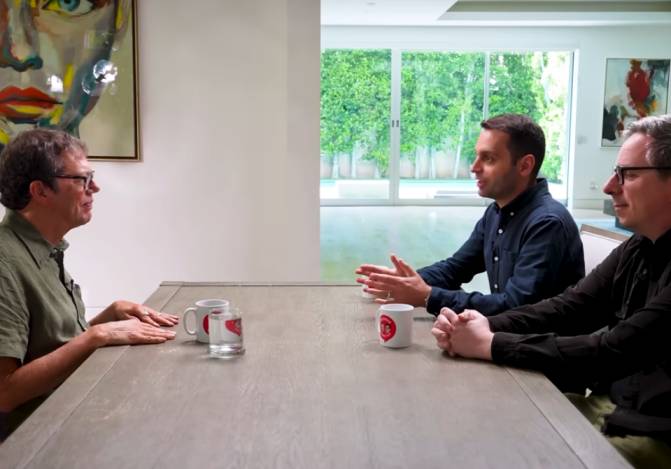
Editor’s Notes: In this episode of Triggernometry, renowned author Robert Greene joins the show to explore the intricate nature of human motivation and the relentless pursuit of power. Greene breaks down the psychological drivers behind influential figures like Donald Trump and Elon Musk, explaining how the management of appearances and the mastery of attention can both build and potentially destroy a legacy. The conversation also delves into the “madness” of the modern world, examining how social media and shifting global paradigms are fueling a collective sense of powerlessness and a search for higher meaning. Finally, Greene shares a personal look into his upcoming book, The Law of the Sublime, and the incredible physical and mental journey he underwent to write it following a life-altering stroke. (April 22, 2026)
TRANSCRIPT:
The Core Motivations Behind Human Behavior
KONSTANTIN KISIN: Robert, welcome to Triggernometry.
ROBERT GREENE: Thank you for having me.
KONSTANTIN KISIN: We’ve been keen to get you on the show for a long time. As you know, you’ve written a large number of books exploring human nature, what motivates people in their actions, the nature of power. And that’s a fascinating subject. What are the key things that motivate people to do what they do?
ROBERT GREENE: Well, it’s complicated, obviously, but people obviously want power. That’s why I wrote my first book. I speculate or believe that the sense that you don’t have any power in your life, any control over, any influence over your spouse, over your children, over your friends, over your colleagues, over your boss, is deeply, deeply miserable for the human animal.
So we want to be able to have a sense of feeling that we have some power over our environment, over the people around us. Now, you can get power in various ways. You can use manipulation. You can play a softer, more seductive game. But it is my opinion that a great majority of people’s behavior and actions are motivated by this desire to feel like there’s a degree of control over their environment.
And if you deny that need, if you can’t seem to get it, if you don’t have that power in your life, if you feel powerless, you can turn to some very negative forms of behavior. So I try to say that to be able to understand the game of power, to be able to feel like you can control people, you can influence them, you can move them in your direction, will save you a lot of energy in life, save you a lot of drama, save you a lot of self-loathing and all kinds of bad patterns that you can fall into.
The other motivating factor is every human being needs a degree of validation. We’re a social animal. We don’t really— our idea of existence as an individual is kind of a myth. It’s sort of an illusion. We are social animals. Everything we think is reflected through the eyes of other people. And so if people are alone, if they’re isolated, their kind of sense of being a human being can dissolve, can fall apart. So we can’t get validation or attention or love from ourselves. We need it from other people.
So the sense of getting recognition, people validating you for your experience, for being who you are, is a deeply, deeply powerful motivating factor in human nature. I mean, these are generalizations. There are other things we can go into, but those, I would say, would be the two main things.
Gender Differences in Power Dynamics
KONSTANTIN KISIN: And I’m not an expert in this, obviously, but I imagine— would it be fair to say there’s a significant gender divide in how this manifests itself? Men operate in a slightly different way to women on this, or not? You’re shaking your head.
ROBERT GREENE: Well, I believe the desire, obviously, for validation and recognition and attention crosses all gender barriers. I do believe power is the same. How men and women get power, how they feel towards it, is different. Of course, that changes. Some men are more like women, some women are more like men. But women tend to have a more sort of social approach to power, which often can make them better leaders in some ways. They’re more sensitive to what other people are feeling, what other people are thinking, which in some ways makes them a more powerful person in the power game the way it is in 2026.
But oftentimes, and once again we’re generalizing, women aren’t so comfortable with the hard game of power, with the manipulating part, with the deception part, which is an elemental part of it. There’s a hard part of power, there’s the hard game, and there’s the soft game. Women are excellent at the soft game, and sometimes they’re a little bit intimidated by the hard game. Now, as I said, that can change from individual to individual.
But like my wife, for instance, she’s a film director, and it’s a brutal, brutal business. It is perhaps one of the most Machiavellian environments you can be in, comparable to the music industry, which is probably worse.
FRANCIS FOSTER: Right.
ROBERT GREENE: And she’s a very sensitive person. I’m a very sensitive person, but she’s very sensitive, and it’s very difficult for her handling some of the games that people are playing with her. So of my books, her favorite, because we’ve been together throughout all of my books, is the war book, oddly enough, because that has helped her a lot in dealing with the film business and dealing with all of the kind of weird things that people— because directing a film is like being a general in an army, you know, you’ve got 40, 50 people, you’ve got a lead. And it is incredibly complicated and difficult. So she found the War Book very helpful.
So I believe that the need for power, the desire for control, the desire to be able to not be vulnerable to everything that people are doing to you, to not feel weak, crosses all ethnic, all barriers.
Social Media and the Laws of Power
FRANCIS FOSTER: And Robert, social media must have changed that enormously because power now comes with having a large social media account. If you’ve got a large social media account, that means that you can influence, you can change the way people think, you can put your message out there, you can create things that were previously unimaginable. Certain political movements, etc. Do the laws of power change when it meets the social media age?
ROBERT GREENE: Well, you can also deceive and manipulate on a grand, grand scale. No, human nature is human nature. Look, we evolved from our ancestors— you can go back millions of years, but let’s say Homo sapiens, 100,000, 500,000, 50,000 years ago. Our brains are wired a particular way. I wrote a very thick book, I’m afraid to say 600 pages, on the laws of human nature. These go back to our earliest ancestors. We all feel envy. We all have an irrational side. We all tend to be self-absorbed.
All that social media does is it accentuates all of those qualities in human nature. It makes them worse. It makes them more extreme. So if I know what everybody in the world is doing right now, if all my friends— I see all their photographs of their wonderful holidays they’re taking, the beautiful women they’re dating, all the fabulous things going on in their lives, because people curate their social media. They don’t let you know about terrible, boring, banal things in their life. Envy. I feel envy. Social media is this machine for creating vast amounts of envy. Also for creating irrationality.
So the laws of power of human nature don’t change. It’s just that the tools that they’re giving us make it easier for us to manipulate, to deceive, to create impressions and images. One of the laws of power is court attention at all costs. Now, you know, you can court attention.
KONSTANTIN KISIN: I can think of some examples.
ROBERT GREENE: Yeah, you just have much more power to be able to do that. But I can’t think of anything of a new law that I would write based on social media. If you could tell me one, I’d be happy to consider it.
The Performance of Virtue in the Social Media Age
FRANCIS FOSTER: But I think one of the things that social media has done— and look, this has always been true, but we now see more and more people obsessed with appearing to be a good person. To be moral, to be virtuous, in the way that I didn’t see as much in the ’90s before social media. I saw it because I was raised Catholic. So I saw the priests and the people who worked in the church and saw some people on a Sunday wishing to appear holier than thou. But it now seems that’s the game everyone’s playing.
ROBERT GREENE: Yeah. Well, power is mostly about appearances. It’s managing your appearances so you seem powerful. Now, you can feel powerful, but it’s more important to appear powerful. This is a very Machiavellian concept. Always say less than necessary. Law number 4. A powerful person, if they talk a lot, they appear kind of weak. You don’t look like you’re in control of yourself. You’re talking too much. You’re going to say something stupid.
So power is a game of managing the appearances because we’re a social animal. I don’t judge you on— I can’t see your character. I can’t see deep inside of you. I can’t read your thoughts. I can see how you look, how you appear. If I appear to be a certain thing, if I appear to be virtuous and good, you’re going to judge me as someone who’s virtuous and good. You don’t know that deep down inside I’m actually a really nasty, evil, Machiavellian character. This isn’t— I’m not talking about myself personally here.
So social media gives you this tremendous power to curate your own appearance, how people see you, how people judge you. And you’re going to put out the things that are going to get positive attention, like you’re virtuous, like you’re in favor of all of the great causes. Or nowadays, that you’re actually kind of so authentically angry and you’re full of rage and you can be a bit nasty and people can even admire you for nastiness.
But it’s an invisible realm. I can’t see all of the people who are emailing me. They present this certain facade about who they are, or on my Instagram feed or whatever. I can’t really see who they are. And that gives them tremendous power to create these kinds of impressions. It’s a very, very dangerous world because it’s not real. When I see you two, I can get a feel for who you are. I can see the humanity.
KONSTANTIN KISIN: You can tell we’ve only just met.
ROBERT GREENE: I’m speculating. I get a sense because we’re animals after all. I mean, I know that we’re animals. I don’t think there’s disagreement there. We have a feel for what people are. We can sense their energy. We can sense their nonverbal cues. We can sense if they are a tricky, deceptive person, we can see through it. And so on the internet, you can’t see any of that. It’s very deceptive and it can be very troublesome and it’s creating a lot of mental illness right now, I believe.
Knowledge vs. Power: Where Does the Truth Lie?
KONSTANTIN KISIN: This thing that you and Francis have just been talking about is a thread that runs through a lot of your work, which is the idea that what people present and what they are is different and necessarily so in some ways. And I wanted— I don’t know if you’ve watched Game of Thrones, but there’s a scene in which this kind of conversation about power is shown very well in an interesting way, where there’s a character whose primary access to power is through knowledge and spying, Petyr Baelish, and he’s arguing with Queen Cersei and he says, “Knowledge is power,” and she gets her four-armed guards to almost kill him, and she says, “Power is power.”
So where is the balance between those two points of view? Or where’s the truth, rather, is what I’m actually trying to ask. Where’s the truth between those two things? Because you mentioned appearing powerful is more important even than being powerful. Whereas what she’s saying is actually, no, being powerful ultimately at the end of the day is the thing that determines how much power you have.
The Appearance of Power and Real Leverage
ROBERT GREENE: Well, they both go together. I mean, if you try to pretend that you’re a godlike creature, that you have all this power but you have nothing behind you, you’re going to be exposed, right? So it depends on where you are in life and how people will view you.
But if I appear to be confident — so let’s take confidence as a very important component in the power game, right? So if I convince myself that I am powerful, that I am confident, that I am worthy of attention and getting things that I want, creates this kind of self-fulfilling dynamic. People read off of you that you’re confident, and they assume that it comes from something real. And so you can get power just by creating this facade, right? And it can be very real.
I think of someone like Elon Musk. We can say whatever we want about him, but he’s very brilliant at the marketing side of things, right? So here he is, he’s got Tesla Motor Company, which has just started out. And to start your own automobile company is incredibly difficult. It requires an awful lot of capital. And you’re starting a new kind of electric cars, et cetera. And so he creates this myth that he is this incredibly innovative, forward-thinking person. I’m not saying it’s completely unreal, but he creates this myth, this aura around him.
That aura now creates this dynamic where people want to fund his company. He goes public and he gets massive amounts of capital from the aura, the appearance he creates of somebody who is very future-oriented. That appearance translates into millions, billions of dollars coming into his company from his stock, which now allows him to build the company, to make it more powerful. So the appearance of power can draw power to you.
Now, if somebody has a gun and you’re pretending to be something that you’re not, and then they can go ahead and shoot you. Of course they’re the ones in control. It’s very important. I talk to this a lot about people. What is your leverage in a situation? If you have no leverage over somebody, then you have no power. So in all negotiations and things like that, you have to make this kind of calculation of: this is where I do have actual real power. It’s not bullshit. And these are things that I can leverage.
So one thing that’s very important in that kind of situation is to be willing to walk away, to say that there’s a limit. I’m only going to go this far. And I’m going to blow the whole thing up. And if I walk away, fine, I don’t care. That gives you power, that gives you leverage. So leverage can be something that’s very psychological.
KONSTANTIN KISIN: No, you absolutely are answering my question. And it’s a fascinating answer.
ROBERT GREENE: Sorry, I got a little convoluted there.
KONSTANTIN KISIN: No, not at all. I think smart people will be able to follow exactly what you said there, which is that there are situations —
ROBERT GREENE: I don’t know if I could follow what I just said.
KONSTANTIN KISIN: Well, I certainly thought that I could. I think the point you’re making is there are certain situations in which confidence and the presentation of power attracts things that actually make you powerful, but there’s also other situations where if you don’t have the hard leverage that you need, then you can’t get any further because the other person has leverage over you. That makes perfect sense to me.
Finding Leverage Even When You Feel Powerless
ROBERT GREENE: You always have some kind of leverage. There’s always something you can do. You can always take a little bit of the power that you have and you can use it in some way. We’re talking in abstractions, but when people come to me with problems in a situation like this where they don’t feel like they have power, I always try and step back and analyze. You do have power. There is something you can do. You have leverage. It’s small, but you can use it.
KONSTANTIN KISIN: Can you give us an example of that?
ROBERT GREENE: Well, so they have the company or the people that are above you, they control it. They own what you’re doing, right? But if you have the attitude — simply the attitude — that I’m going to walk away from this whole project, right? It doesn’t mean that much to me. You’re playing all of these games. You’re using all of this power on me. I feel kind of weak in comparison to you, but I’m not going to show that. I’m going to say, look, I don’t care anymore. I’m walking away. I’m finished. I don’t want to deal with this project anymore.
They have invested a lot of time and energy in it as well, right? And they don’t feel like you’re somebody who will do that. But if you show them that at some point it doesn’t matter to you, that you don’t care about the money — this is a negotiating play. You do care about the money, but you’re presenting this: I don’t care about it. It’s not worth it to me to do exactly what you want. It’s more important for me to feel like I have integrity. I’m walking away. I don’t care. Goodbye.
At that moment, even though you don’t feel it, you actually feel like, Jesus, I don’t want to lose this project. If you project that, they’re suddenly back on their heels. They’re going, hmm, I didn’t see that in you. Well, we’ve invested a lot. All right, well, we don’t want to blow this whole thing up, so maybe we’ll give in on a couple of small points, and that’s all that you’re after.
So in these situations, you have to be clear about who has the power, what the dynamic is, what your leverage is, and what your goal is in the end. So if they are imposing on you all of the control and they’re trying to mess with you and trying to push you around, you want to get them to back off a little bit, right? That’s all you want. And by showing that you don’t care, that you’re willing to walk away from it, that gives you power and control.
I watched this when I wrote a book with 50 Cent, the rapper, called The 50th Law, right? And he told me this. This is his ploy all the time. He appears completely uninterested in some deal somebody is going to make, even though he’s very interested, right? And the appearance of not really caring puts them on their heels. They go, hmm. Well, maybe we have to try harder to please 50. Maybe we have to give him more of what he wants. That’s all he’s after, right? It’s a negotiating ploy.
So the sense that you’re signaling to the other side that you can walk away, that it’s not so important to you, is something very powerful to give and can give you power even though you don’t have any power. That’s the magical thing about playing the game. According to what I wrote in that book, you may not have any power at all in this world, but if you know how to use these small little things, you can take what is your weakness and you can turn it into strength.
Why People Play Political Games
KONSTANTIN KISIN: Very interesting. And just coming back to the example you gave about people working on a particular project who have their different agendas playing all these games, why do people do that? Because, for example, Francis and I, we run this YouTube channel. It’s a small business. We employ people, whatever. What we found is the best game to play is a collaborative game, where the mission is more important than the people involved. You seem skeptical now.
ROBERT GREENE: Well, I want to introduce you guys to the real world, okay?
KONSTANTIN KISIN: Please do.
ROBERT GREENE: The real world doesn’t operate according to your ideal little utopia, which is a beautiful ideal and I don’t knock it at all. People have egos, they are political. This is the human animal as it is. It’s not something I’ve just dreamed up.
FRANCIS FOSTER: Sure, of course.
ROBERT GREENE: Right. So you’ll be in a company. I worked for a company years ago before I wrote books, a television company, a terrible, terrible television show. I wouldn’t even tell you the name of it. I was a researcher on it. The researcher, you were considered successful by how many stories you actually found that got made. I had the highest percentage of this team of a dozen researchers by far. But then I got fired. Why did I get fired? Because I was too good at the job. I wasn’t playing the political game. I wasn’t brown-nosing — sorry, that expression — with the boss, right? I had a bit of an attitude. But the results — who the f* cares about my attitude? I gave you results. And yet I was fired because of people’s stupid, stupid egos and stupid political games that they play.
They don’t care about results. They care about how they feel about themselves, about their ego, about how people think about them. That’s more important than results. And it crosses the line in business, in warfare. General Patton, the great American general who had some of his own issues and problems, he was kind of sidelined from the war effort in World War II because he was kind of abrasive and difficult. He was going, but man, I marched through Sicily. I marched through Italy. I defeated the Nazis here and there. What difference does it make? Well, no, even in warfare, he got sidelined because he wasn’t playing the political game.
In entertainment, in law, in business, in government, in sports. I can give you examples because I deal with a lot of athletes and managers and coaches who come to me with their problems. This goes through sports. It goes through everything. It’s a theme through everything. So you two, I love the fact that you collaborate, but I can guarantee if you brought a third person in that you were working with, all of a sudden egos and political games will start emerging. Maybe not, but probably, because that is human nature.
KONSTANTIN KISIN: And I think it’s also maybe a question of scale. I remember reading something — I don’t remember the name of this concept — but once a business gets beyond a certain number of team members, that’s when people start caring more about their position in the hierarchy than the mission, which is why maybe it’s good to keep things small where that collaborative attitude is possible.
ROBERT GREENE: Yeah, definitely. Obviously the larger the group, the more the politics arrive, the more egos that are involved. But even among two people, even in a couple, a married couple, power games are being played.
KONSTANTIN KISIN: Oh yeah. Well, thank God we’re not married.
ROBERT GREENE: People feel like, well, I’m having to do all the chores and you’re not doing so much. I don’t feel like I have as much power in this relationship. So you put two people together. It doesn’t have to be a thousand. You’re going to get these egos clashing because that’s who we are.
Power, Shakespeare, and Self-Destruction
FRANCIS FOSTER: And it’s fascinating talking about power because I love Greek myths and I love Shakespeare. And a lot of Shakespeare’s plays are about the lust for power and how ultimately it destroys you. Think about Macbeth, for example. At what point does the desire for power ultimately become self-sabotaging?
The Limits of Power: When Manipulation Backfires
ROBERT GREENE: Well, a lot of the laws that I talked about in the book are about knowing your limits. Like, Law 47, I believe, is “In victory, know when to stop.” So you can go too far. And when it becomes the fact— look, power is— we’re a social animal. It’s a people’s game. If you offend too many people, if you make so many enemies, it’s going to come back and hurt you in the end. You’re not going to get very far.
So if you have this attitude where I’m going to screw everybody around me, I’m just going to manipulate them, I’m going to control them, I’m going to push them around. You can get away with it for a while, while you have power. But the moment that power stops, starts to diminish, we see this in history all of the time. Suddenly people turn against you. It caused the French Revolution, for God’s sake. When people smell that a powerful person who has been evil and pushing people around is now in a slightly weakened position, oh my God, they all turn into lions and they pounce on you. Because they hate you.
You can go too far. So power is a game of getting people on your side, and they don’t even realize why they’re on your side. That’s the seduction part of the game. But if you’re pushing everyone around— and we’re seeing this in American politics right now. Donald Trump is screwing all of these other leaders. Look what he’s doing to European leaders in NATO. He’s humiliating them. And now he’s asking them to help him out in this war with Iran, and they’re giving him the finger, obviously, in their own way. Because look, you’ve offended us, you’ve humiliated us, you want our help, you’re not going to get it.
And so power is a game of using your allies, of creating as many allies as possible. If you go so far where you alienate everybody around you, then the game will turn against you. It’s delicate. It’s a delicate game.
Trump’s Greatest Weapon: Humor and Its Limits
FRANCIS FOSTER: It’s a great point because you look at Trump and his greatest weapon, I think, is his sense of humor.
ROBERT GREENE: Sense of humor.
FRANCIS FOSTER: His sense of humor is that whenever he’s in—
ROBERT GREENE: Never heard that before.
FRANCIS FOSTER: Yeah. Whenever he’s in a position where it looks like he’s on the back foot, he’s very sharp with a quick comeback. He makes people laugh. Laughter resets the room. People momentarily lose where they are.
ROBERT GREENE: Yeah.
FRANCIS FOSTER: And then he can pivot out of it.
ROBERT GREENE: Yeah.
FRANCIS FOSTER: And the humor is great. The problem is with humor is that invariably there needs to be a victim. So whilst it can appeal to your base, it can also antagonize the victim of your punchline.
ROBERT GREENE: Right, right.
FRANCIS FOSTER: And it’s really interesting to see that dynamic. What do you make of that, the use of humor, and particularly when it comes to power and being powerful?
ROBERT GREENE: Well, what’s important— so a huge motivating factor among the human animal is envy. Our brains operate through comparison. That’s how the human brain operates. We take in information and we compare it to other pieces of information, and we go, “This is what this means.” It’s a machine. Our minds are machines for comparing things. And we do the same with other people. We’re constantly comparing ourselves to others. Does that person have more power? Why is she making more money than me? Why does he have more respect than me? Constantly. I have it. Everybody has it. It’s natural.
So when you’re a powerful person, people envy you. They envy your power. Having a sense of humor, a self-deprecating sense of humor, is very powerful because it can lessen that envy that people have. And I mentioned in my Power book and other books, figures like that who had that kind of self-deprecating humor. Abraham Lincoln was a sort of a master of it. It makes you human. You can make fun of yourself.
The problem is Donald Trump never makes fun of himself. His humor is at the expense of other people. And that can wear on others. It can appeal to those who have that kind of slight cruel streak to them, to those who hate all the wokeness. And there’s, you know, I can understand that a bit as well. But he never makes fun of himself. That’s a different kind of humor. It’s always at the expense of other people. And I think eventually that can wear very thin.
Trump’s Fatal Flaw: The Inability to Think Ahead
FRANCIS FOSTER: And when you look at Trump, do you think that he’s a man who uses these laws of power effectively, or is somebody who is ultimately setting himself up for a fall?
ROBERT GREENE: Well, I don’t have a crystal ball. I’m not Nostradamus. I don’t know what’s going to happen in the next few years, but I know that he has a very powerful character flaw, and the character flaw is going to constantly get in his way.
So he’s absolutely brilliant at one law of power. It’s the source of all of his power. And I can’t think of anybody in history who’s ever been better at it. “Court attention at all costs.” Law number 6. I remember years ago, about 8 years ago or so, I was traveling. I think I was in Singapore. Everybody was talking about Donald Trump. Everyone around the world is obsessed with him. I’m obsessed with him. He’s in my head all of the time. He courts attention at all costs. He’s brilliant at that. He knows how to turn everything that looks like a negative into some kind of marketing and publicity thing. He’s very, very good at the attention game, not just at getting attention, but how to use that attention to his advantage.
That has brought him a lot of power. But there is a limit to that because that isn’t enough. That isn’t power by itself. And so one of the most important things in the power game— as I say, it’s a delicate game— is the ability to think ahead, plan all the way to the end, which is Law 28 or something like that. “Plan all the way to the end.” Think not just this move, this immediate move, but 2, 3, 4, 5 moves in advance, like you do in chess. If you’re a good chess player, you’re 10 moves ahead further than your opponent is.
It’s an extremely important part of power because it means you see the longer vision. And when things start interrupting your vision, when all kinds of circumstances arise that you hadn’t expected, you know how to deal with it because you have your endgame. If this occurs, well, you tack a little bit in this direction, but eventually you have to head there. It gives you strength. It gives you this kind of anchor in life.
This is a man who, because of his character, because of his ego, because of his extreme narcissism— I’m not trying to be political here because I think everybody sees his—
FRANCIS FOSTER: Of course.
ROBERT GREENE: —incredible narcissism. He can’t get out of the moment. He can’t get out of how people are reacting against him. He can’t get out of his rage, his resentment, his anger, his bitterness, and see the bigger picture.
If he came into power in 2025 and he moderated some of the things that he ended up doing, if he was more attentive to the larger picture— his power base brought in Latinos, Black people, people who weren’t part of the Republican base ever before. If he moderated, if he was smart, if he could think ahead, he would be doing really well right now. He’d be very popular. Unfortunately, he would be. But he can’t think that far ahead. He can only think in immediate terms. “This person insulted me. Well, I have to humiliate him. I have to try and sue him and get him put in prison.” He can’t see the larger picture, and that is a very, very limiting factor in power.
He’s like a cat with 9 lives. He keeps escaping things, and you think he’s done, he’s finished, he pops out of another bag and he’s fine. I think that eventually it’s going to catch up with him, but as I said, I don’t know.
Powerlessness and Its Consequences: From Passive Aggression to Guerrilla Warfare
KONSTANTIN KISIN: Now, I want to come back to something you said at the beginning, because I think it ties potentially with politics as well, which is you mentioned that when people feel like they have no power, there is a whole swath of negative behaviors that they can exhibit. And we see on both sides, I would argue, of the political spectrum, people who feel like they have no power burning things down— metaphorically speaking— wanting to tear down certain things about the society they live in. What happens when people feel at the individual level, but also at the collective level, that they don’t have the power that they want or should?
ROBERT GREENE: Well, you can’t deal with that feeling. It’s unbearable. So you’re going to try and get power some way that you can. On the individual level, you’ll find people play negative power games. They’ll become passive-aggressive. That happens a lot in individual relationships where one person doesn’t feel like they have the power, but they don’t feel strong enough to directly attack or deal with the person, so they become indirect. They become passive-aggressive. We’re British.
FRANCIS FOSTER: You don’t have to explain that to us.
ROBERT GREENE: Okay. National pastime. Yeah. Sorry. Americans can be very passive-aggressive too. You’re right.
So when you feel like you have no power, you’ll turn— you won’t be aggressive. You’ll be passive-aggressive. On a collective level— I mean, we can see countries around the world that have felt disrespected and screwed and humiliated on the world stage. And it creates a kind of a similar dynamic to the passive aggressiveness. “We’re going to get back at you some way. You can’t control us completely.”
And even to some degree— this is maybe a horrible way to put it— but with Iran right now, they obviously don’t have the power that the United States military has, but they can certainly be very passive-aggressive. When you’re weak, this is the whole origin of guerrilla warfare and terrorism. Guerrilla warfare is one of the most powerful strategies ever invented in military history. It’s one side that has no power, but they use their lack of power to torment and torture the other side. And as the phrase goes, the weaker side doesn’t have to win. They just have to survive.
So they’ll play games like that. But if you don’t have power, you’re going to find it somehow, some way, in some manner. You’re going to do whatever you can to change that dynamic.
Grievance, Resentment, and the Politics of Power
KONSTANTIN KISIN: Well, it’s interesting you mention the geopolitical side of it. Because I would argue, from direct experience in Russia and also from history that I know, that whipping up— or at least addressing, and both can be true— the sense of loss or resentment or grievance or envy that people have and channeling that is a very powerful tool. I mean, in Russia right now, the narrative is the evil Americans took advantage of us in the ’90s and we have to secure our border, take control of our neighborhood, et cetera. Hitler likewise whipped that up. It’s a very powerful tool for political leaders to achieve their objectives, isn’t it?
The Danger of Riding the Tiger: Populism, Demoralization, and the Loss of Control
ROBERT GREENE: Yeah, very much so. I mean, it’s definitely what Putin is doing with Russia right now. And in the end, I don’t know how successful that is because you can— it’s kind of like you’re riding a tiger. You’re creating so much anger and resentment. Can you control it? You know, where is it? Are you in control of it, or is it leading you around?
Appealing to people’s basest emotions is a very, very powerful political weapon, right? But it can hurt you, and it can bite back and hurt you in the end. Because you can’t really control it. So I see what you’re saying, and the sense of a country feeling that kind of grievance is an incredibly powerful motivating factor. And I see that around the world right now.
We’re living through a very chaotic moment in history. I read a lot of history. I don’t know a lot of things about this world, but I do read a lot of history. And it’s a very strange moment. It’s one of those transitional moments where the world, the paradigms are shifting. What we used to believe in doesn’t seem to work anymore. And it makes people go crazy. I feel like sometimes— I was on a bike ride the other day and I was thinking, sometimes I feel like I’m living in an insane asylum. Like people are literally going mad. And I include myself in that. I don’t separate myself from that.
And so when people feel like they have no control, mostly over their pocketbook, which is happening a lot now, but also a sense of the future, my values, what matters, they go a little bit crazy. And it creates incredible space for demagogues to use that kind of confusion, to use that sense of powerlessness to whip people up into a frenzy to get control of them. And it’s a very dangerous time because you’re seeing a steering towards authoritarianism all around the globe. And what’s going on here? Why is this happening now? It happened in the 1920s and the ’30s, but seems to be happening now. And I think there’s this overall sense that people feel like we’re losing control over their own lives, over the lives, the future of their country, their children. It’s a very strange, dark moment, I think.
KONSTANTIN KISIN: And to your point, this is something you see across Europe, across the political spectrum, by the way. You see populist left parties rising very quickly and populist right parties.
ROBERT GREENE: Where are the populist left parties?
KONSTANTIN KISIN: Well, the party with the biggest momentum in the UK right now is the Green Party. Is that right? Yeah. And also it’s not just about political parties, it’s also now increasingly about influencers. If you start a YouTube channel in Britain now talking about how you’ve been screwed by the rich and the billionaires and tax the rich and all of this, you’re going to do extremely well because there is ample ground for that sentiment, which is rising very quickly. And likewise on the right, you know. And by the way, both of these can be somewhat true. Inequality is a problem. On the right, of course, mass immigration, the way that we’ve had in Britain, bothers a hell of a lot of people, as I think it does probably in your country, although it’s different here. And those are things that are creating these, on both sides, a rising populist tide, I think. And that speaks very much to what you’re saying. Yeah, yeah, I agree.
France, Identity, and the Opening for Ugly Politics
ROBERT GREENE: I mean, if you feel like— I was in France. I have a kind of a long love affair with France. I’m sorry to say that. Yeah, I love England.
KONSTANTIN KISIN: Now we’re disappointed. Yeah. And the interview. Yeah.
ROBERT GREENE: I lived there and I studied the language and all that. But I remember I was there about 12 years ago. And I was going through Paris and I’m actually somebody who’s very open to immigrants and to their plight. But I was thinking France is in trouble because they’re losing a sense of their identity. And a country like that has a very, very powerful sense of identity because it’s a country that’s actually a feudalism that’s kind of disguised as a nation. And people like de Gaulle had to struggle to create this kind of national unity around Joan of Arc and around these various myths and Louis XIV and on and on, Napoleon, etc. Very powerful myths of identity of this is who the French are.
And I could sense that there was something very dangerous going on because they were going to lose that sense of who they were with all of the immigrants that were pouring in at this time. And I can empathize with that to a point where you have this sense of what your country is and you’re losing that, right? So it creates an opening for some ugly kind of politics, I’m afraid.
FRANCIS FOSTER: And when we’re talking about people who live in these countries where things aren’t as good as they used to be. They feel under the— things feel on the decline socially, economically. What we’re talking about, and what I feel in the UK, is demoralization. Yeah. And when people are demoralized, that’s a very, very dangerous space for a populist to be in.
ROBERT GREENE: Yeah, yeah. I mean, what are you referring to?
FRANCIS FOSTER: It’s particularly, for instance, in the UK where people feel that things are getting worse and they’re not going to get any better. And we’re on a current downward trajectory. And if you look at the economics of the situation, that would bear it out. If you look at it culturally, societally, it would bear it out again. I think once you hit that, that’s when people become incredibly vulnerable.
KONSTANTIN KISIN: Yeah, well, it speaks to your point, doesn’t it, about when people don’t feel that they have the power. And particularly in the UK, a lot of people feel that voting a certain way and even electing parties that say they will deal with certain problems doesn’t actually produce the results. And I imagine based on your analysis, that would be, like Francis says, quite a dangerous place to be, right?
Politicians, Globalism, and the Limits of Power
ROBERT GREENE: Yeah, I mean, politicians don’t really control as much as they think they control. And as much as Donald Trump rails against globalism and wants to go back, it is an interconnected planet. And you don’t have control over forces. You see in the war going on right now how this is rippling across, particularly across Asia. And who knows in a few months or years the kind of dynamic, the kind of problems that is going to set off in countries where the populace feels so diminished in their power that all kinds of rebellions— History is weird because what’s happening in the moment, you don’t know. You don’t see the seeds of the kind of ugliness or bad things that could be happening in a year or 2 years from now.
And a simple thing like cutting off oil and making the price of oil go up has a rippling effect that can create a revolution in some Eastern Asian country that then triggers a world war or something. I mean, I’m being apocalyptic here, but you don’t know these little effects. And political leaders, as I said, it was kind of like riding a tiger. They feel like, I can get to power using all of this resentment and grievance and anger and bitterness, but I can’t control it because I can’t really deliver what I’m promising I’m going to deliver. So yeah, it’s a very dangerous game.
FRANCIS FOSTER: Do you think— for instance, if a politician came out and actually said, look, there are things that I can control, or that we can control, there are things that we simply cannot control. Yeah. As a result of that, this is the path that we’re going to plot. Would that be more appealing to people? Or do people— what people actually desire deep down is a strongman to come in and go, I’m going to sort it out, this is what’s going to happen.
The Demand for Simple Solutions in a Complex World
ROBERT GREENE: Yeah, I mean, we talked earlier about social media and part of the problem that’s going on is people think in very simplistic terms, right? Things are delivered in a way like there’s no nuance anymore. It’s just it’s this way or it’s that way kind of thing. So if a political leader came about now who was very realistic and very honest— Biden was a little bit like that, and he got chewed apart. He got decimated. He wasn’t very effective, but he was trying to be honest and say, this is what I can do. This is what I can’t do. I don’t think people want to hear that right now. They want to hear easy, simple solutions.
I mean, if you look at the global stage right now, it’s startling. It’s really startling because 70 years ago, you would see leaders who— and parties that would stay in power for decades, sometimes through corruption, I don’t deny. But there was a consistency, right? And now it’s like it’s turning over by the month, practically. You said the Green Party. Well, 3 months ago it was Farage and I forgot the name of his party, but the Reform Party. And in 3 months it’s going to be some other party. The volatility is out of this roof. And that’s why I said there’s a kind of madness going on in the world, a kind of madness where people’s opinions are shifting so quickly like that. There’s no anchor. There’s nothing kind of holding it all together where this politician, I believe, can solve my problems. I’m willing to wait. I’m willing to be patient with him or her and give him or her 3 years, 4 years for you? No, that can’t happen.
I was on the board of directors of a publicly traded company, American Apparel, right, which no longer exists. And I saw upfront how the business world operates, and it was startling to me. So this is a company that was probably expanding way too fast, right? And of course, it went public, and that’s when I was brought onto the board of directors. And I was foreseeing long-term problems. He had created this brand that was all about sexiness for young women. Based on the ’80s aesthetic, the kind of short workout shorts sort of thing. And I was seeing there’s a shift going on in people’s taste. This is 2009 or so. I feel like in a couple years it’s not going to be the aesthetic. It’s not going to be the ethos anymore of young women because that’s who the company was appealing to. And I was trying to tell the director there, I was thinking, we’ve got to make a shift in the brand. You’ve got to be more forward thinking.
But the pressures of Wall Street and the quarterly report were so powerful that you could not think long term. You could not project 6 months in advance because you had to make a quarterly report that showed Wall Street that you were making, that you were growing, right? That was the growth. New markets, getting market share. And if you did that, then you’d get more money coming in. But you couldn’t raise your head this much above the moment to think in advance. That’s the business world that we live now in the United States. And I think it’s creating a lot of problems.
KONSTANTIN KISIN: It’s interesting you say that, because there are people who’ve offered to invest in our show and help, and it’s not really ever appealed to us because we know that if that happens, we no longer can have the conversations we want. We have to have the conversations that are going to get views. Yeah, and then that would ruin the whole thing that we do because it works because we— it’s authentic. Yeah. And if you try and create something fake, then you make more, you get more clicks, but then the people who actually watch the show in the beginning don’t want to watch it anymore, and we’d hate our job as well. But I can see how that would affect a business. Yeah, to the point where it’s no longer actually fulfilling its mission, it’s now just trying to make money. Yeah, and making bad decisions, and then goes out of business. Yeah. Is your point.
The Hunger for Meaning and the Sublime
ROBERT GREENE: Yeah. If I would advise you guys, I would say stay small. When he started this business, I’m talking about American Apparel, he had one store here in Los Angeles when I first met him. And then it got like 10 stores and 20 stores, but it was solid. It had a, it had, I could see the point of it. By the time he expanded to 300 stores around the world, it lost its meaning, it lost its brand, it lost what it was. And then forget it, you’re never going to get it back.
KONSTANTIN KISIN: It’s interesting as well, something you mentioned. I just remembered Desmond Morris, who is a writer — of course, I’ve read a lot with Naked Ape, Human Zoo, and a bunch of others. But one of the things he talked about is the length of women’s skirts goes up, so the skirts get longer when economic times are bad. So 2009 would have been exactly the right time to pivot to longer rather than shorter.
ROBERT GREENE: Yeah, it was right after the financial crisis. Yeah.
Power, Secularism, and the Spiritual Void
FRANCIS FOSTER: Does it help in a society where power is shared? So for instance, is part of the problem with our society is that it’s become ever more secular? So we don’t — most — there’s a lot of us who are not religious. There’s a lot of us who don’t believe in God. And as a result of that, we, instead of looking maybe to the church or to the mosque or whatever it may be, we now look only to our political leaders.
ROBERT GREENE: That’s a very good point.
FRANCIS FOSTER: Well, you’re a Catholic, right? I was raised Catholic. It never leaves you. The guilt is always there.
ROBERT GREENE: I’m Jewish, so I know this.
KONSTANTIN KISIN: I know what that means.
ROBERT GREENE: My new book that I finished the last chapter a month ago, and I’m almost finished with the introduction. So I’m almost there. It’ll be out in November. It’s kind of dealing with that because we humans have a spiritual side to us. We have a hunger for something larger than just our egos, than just making money, than just surviving. We need to feel connected to something larger. It’s part of our nature. And in my book, I explain where that comes from. And that never goes away. I don’t care how sophisticated we are. I don’t care if it’s 3,000 years in advance and we’re all like Borgs, we’re part cyborgs, etc. It’s still a part of human nature. It isn’t going away.
And so organized religion was sort of the main source of that for centuries. And it kind of became dead in a way. It wasn’t really connected to people’s authentic experience anymore, particularly as we became technologically so sophisticated. It seemed like something kind of superstitious, something from the past. And also it wasn’t appealing to our lived experience.
I remember as a child going to the synagogue. And it’s just like, what does this have to do with my life here in Los Angeles? It is the ’60s, and people are going nuts in the streets, and the Vietnam War, and sex, and everything. And here, there are these prayers. It had no connection to my life as a child and to my world. So I could not understand organized religion.
But people still have this need. They still have this hunger. They still are looking for some kind of a meaning. They want to connect to something bigger than just their egos. And there’s nothing out there that’s supplying that, I think. And you find, because of that, a lot of people are going into these sort of niche spiritual worlds that at least feel a little more direct and part of their everyday life, but aren’t connected to anything larger, any kind of movement.
And so it shifts. Now it’s, I’m interested in this little form of Buddhism. Then in 6 months, it’ll be, I’ll be getting drug therapy, and then in 6 months, it’ll be something else. So there’s nothing kind of solid, and it’s a very — and it’s an emptiness that people feel. And so the book that I wrote was trying to deal with that kind of emptiness and how you as an individual or we as a collective can find our way back to finding this kind of higher meaning in our life.
The Arrogance of Abandoning Religion
FRANCIS FOSTER: But yeah, so carry on. No, no, I was saying, but it also speaks to a kind of — we were having a conversation, Konstantin and the rest of the team, last night, literally about this topic. It speaks to a kind of arrogance, doesn’t it, particularly in the West, that somehow we superseded religion, we don’t need it anymore because we’re so smart, we have this amazing technology. It’s stupidity.
ROBERT GREENE: I’m reading quotes from Albert Einstein, probably the most brilliant scientist of our era. And he believed in what he called cosmic religion. And he said mysticism is as much a part of the arts as it is of the sciences. And if you can’t feel awe in front of this universe that we have, then you might as well be dead. So you can mix science, technology, and sophisticated thinking and 21st century thinking with something spiritual. You can. It can be done.
But the idea that everything has to be rational, everything has to be data, algorithms, program, etc., is just creating deadness in people. It’s making them insane because that’s not how the human animal is. We need something else. So yes, it is very arrogant to believe they can just get rid of religion.
Sorry to say, but Nazism was a religion. Chinese communism and what Mao had was a religion. Stalin had a religion without religion, but it was still based on that kind of form. That’s what happens when you get rid completely of things that meant so much to people.
FRANCIS FOSTER: Absolutely, because look, we respect science, we respect data, we respect all of those things. Those things are highly important. But let’s be very real about it. If you’ve had a diagnosis, a terrible diagnosis, let’s say you’ve got stage 4 cancer, data and science are not going to keep you warm at night. There’s going to be something else that we’re going to reach towards, and that transcends intelligence or everything. We need something else.
Confronting Death and What Really Matters
ROBERT GREENE: I had a stroke about 8 years ago. That’s why my hand is like this and why I can’t walk very well. I came this close to dying. And I had — I didn’t have a near-death experience, but it was close to something like that. And it shook me up. It changed me.
And so in my book that I’m writing, the last chapter is about death and people who had near-death experiences. And there was this theme of, I was diagnosed with stage 4 cancer, as you mentioned. I have only 3 months to live. I’ve never felt more alive than in these 3 months. I don’t have to think about social media. I don’t have to think about my ambition. I don’t have to think about all these other little problems. Suddenly the world opens up to me and I’m thinking about what really matters, about what really life is about. Because no amount of technology is going to keep me alive. And even if it does, the cancer will come back. And so you’re forced to think about what really matters to you. And that’s what death can do for you.
We’re taking away things that really matter to human beings and we’re paying a price for it. And so we have to find a way back to some of these things that our ancestors understood about the human animal and how we need an anchor in our lives.
KONSTANTIN KISIN: What’s interesting is you see both in this country and in many other countries now, actually religious attendance at church at least is actually, or other religions, is on the rise slowly, particularly among young people. So it may be happening voluntarily. Which is how you’d hope it happens, really, I guess.
Rob, it’s been an absolute pleasure. Thank you for coming on. What is your book called? And you mentioned it comes out in November.
The Law of the Sublime
ROBERT GREENE: When will people be able to preorder it? I don’t know when they’ll be able to preorder, probably fairly soon, like within a month or two. I think it’s been announced. It’ll be out in November. And the title? It’s called The Law of the Sublime.
The book is about the sublime. And the idea is when we, as a human animal, as a social creature, we live with certain conventions and limits and codes that tell us this is how we’re supposed to think, this is how we’re supposed to live, this is how we’re supposed to behave. And the sublime are experiences that lie outside that circle, that kind of expand our consciousness.
And I say that there’s a lot of things going on in science that should naturally do this. Like the nature of human consciousness, like the origin of the universe and the origin of life and all of these amazing discoveries going on that should be expanding our minds outside this circle. And as the mind expands, you naturally feel this kind of awe, this kind of cosmic sense that was once a part of religion.
But at the same time that science is expanding this, and we should be going, “Whoa, whoa,” social media is doing this to us. The mind is getting narrower and narrower and narrower. What is she having for breakfast? What do we know? All these sort of trivial, banal things that we’re worried about. And so I’m trying to explode all of that and get you back into thinking about what lies outside that circle. And that’s what I call the sublime.
KONSTANTIN KISIN: We’ll put the link in the description if it’s available when this episode comes out. Before we ask you questions from our supporters, the final question we ask all our guests is what’s the one thing we’re not talking about that we should be?
KONSTANTIN KISIN: If you had to add new or amend existing laws from the ’48, what changes would you make?
FRANCIS FOSTER: Critics of your book have suggested you’re teaching people to be coldly manipulative.
KONSTANTIN KISIN: What do you say? What’s the one thing we’re not talking about that we should be?
ROBERT GREENE: Well, about my book, I guess.
KONSTANTIN KISIN: We just did.
Seven Years of Overcoming: Writing Through Adversity
ROBERT GREENE: Because of my stroke, I had to — I can’t type. So I had to handwrite this entire book. And that means handwriting it, then doing another notebook and editing it in another notebook, then editing it in another, then editing and editing. And then finally dictating it into the computer, and then trying to edit it with one hand.
And then I couldn’t take a walk if I needed to clear my mind. I’m sort of trapped in my office, and I’m somebody who loves exercise, loves hiking, being out in the world. And whenever with my other books, I felt blocked, I would go on an amazing hike and all these ideas would come to me. I was trapped in this world and I couldn’t — I had to handwrite everything.
And yet the book is about the sublime. I had to feel it. How am I going to feel it when I’m like a bird in a cage? I had to overcome all of these things in my head and in my body. And so it took me 7 years to write this book, almost 7 years.
I don’t care if it doesn’t sell a single copy. I’ve never felt more pride in myself that I overcame all of this. And there were difficult moments where I was like crying, like, I can’t do it. It’s not working. But I did it. And it’s a sense of achievement that I’ve never had before. So I don’t know, maybe that’s something I just wanted to share.
KONSTANTIN KISIN: Yeah, that’s really special. Well, thank you for coming here and talking to us about it.
Related Posts
- Transcript: World’s First AI Actress Interview on Piers Morgan Show: ft. Tom Conti, Tom Bilyeu & Prof Jiang
- In Vivo Podcast: w/ Cathy Tie and Prof. Jiang on Editing Embryos (Transcript)
- Transcript of Evy Poumpouras Interview: Read People, Spot Lies & More – FO563 Raj Shamani
- DOAC AI Emergency Debate: ft. Ed Zitron, Andrew McAfee, Nate Soares & Roman Yampolskiy (Transcript)
- Transcript of Norman Finkelstein Interview: Tucker Carlson Show