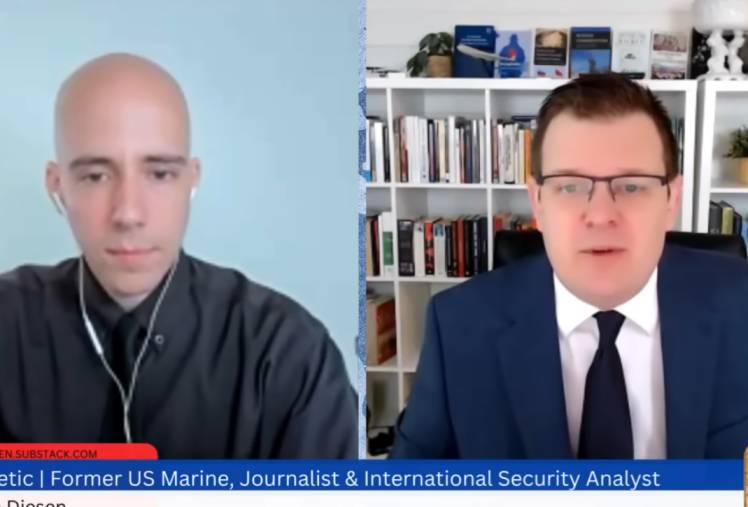
Editor’s Notes: In this interview, political analyst Brian Berletic joins Glenn Diesen to discuss the intensifying conflict in the Middle East and its broader geopolitical implications. Berletic argues that the current war with Iran is a calculated step within a long-standing U.S. strategy to maintain global primacy by targeting key Eurasian powers. The conversation explores how these regional tensions serve as a precursor to direct confrontations with Russia and China, while also examining the strain on the U.S. military-industrial complex. Additionally, the two analyze the shifting nature of international relations as the world moves toward a multipolar distribution of power. (Mar 19, 2026)
TRANSCRIPT:
Introduction
GLENN DIESEN: Welcome back. We are joined today by Brian Berletic, a former U.S. Marine, political analyst, author, and also host of the New Atlas. So it’s been a while. Thank you very much for coming back on the program.
BRIAN BERLETIC: Thank you so much for having me back.
Trump’s Strategy and the Middle East Escalation
GLENN DIESEN: So I, we often found ourselves a little bit on the different sides of the fence. I think I was a little bit more optimistic about Trump than you. That is, I kind of bought into some of the rhetoric because it seemed simply that this was in the interest of the United States to adjust to the multipolar distribution of power. Again, political realists, we tend to see this is what rational states do to optimize their own security.
And indeed, if the US would continue attempting to restore US hegemony in a multipolar distribution of power, one would assume that the US would exhaust itself. It would be collectively balanced by the other great powers. It would invite huge wars. In contrast, if the US would pull back and be one among many centers of power, it would have an opportunity to recover its strength, make America great again. Some might say also the large Eurasian powers would at least soft balance each other to make sure that one doesn’t become too powerful compared to the rest. And of course, the US could avoid all these wars, which also the society has grown quite wary of.
So I was optimistic about Trump for this reason, that is that he kept making the point that he would no longer have any wars, he would restore fiscal responsibility. And indeed, when this new national security strategy came out in December, it more or less confirmed these ideas. That is, if America can’t be everywhere in the multipolar world, it should focus on the home base, which is the Western Hemisphere and East Asia where its main peer competitor is. But in other words, they have to reduce his presence in Europe and the Middle East.
But a year plus, we’re still into this. US is still a leading actor in the war in Ukraine in terms of the logistics, weapons, intelligence, targeting. And of course, now Trump has taken Middle East wars on steroids. This is Iran, of course, can’t even be compared to countries like Iraq, and of course setting the whole region on fire.
So I guess, how are you assessing now what is going on, especially with the Middle East? Was this always destined to be, or was Trump pulled into this? How do you see the American strategy? Is this essentially now America First becoming restoring hegemony instead, or what do you make of all of this? Unfortunately, you were right and I was not.
The Structural Nature of U.S. Foreign Policy
BRIAN BERLETIC: So just to add this point, if it makes you feel any better, I desperately wish that I was wrong about all of these things, because as we can see, there is a global crisis taking shape that’s going to affect every single one of us, you and I, our families, our friends, our communities. And no matter who is watching this, almost certainly they will begin feeling the effects of all of this as well.
Now, unfortunately, I was right. And I warned people months before the 2024 election that it didn’t matter who was elected, because it is all about the structural nature of the US system. It is controlled by large corporate financier interests. They are predicated on the constant expansion of profit and power. That is what they do in terms of a business, and that is what they do in terms of a nation state system that they have captured and control, and have done so for decades and decades.
And I constantly refer back to the policy papers which wrote this out in excruciating detail years and years ago, especially this conflict taking place against Iran right now. I always refer to the Which Path to Persia Brookings Institution paper from 2009. And chapter by chapter, word for word, the United States from the Bush Jr. administration all the way up to this current Trump administration, they have executed every single option that they laid out.
And it wasn’t about any single one option being used and succeeding against Iran. They always assumed that they would have to be used in conjunction with one another, creating synergies between them and weakening, hollowing out, and then toppling Iran in the same way that the US has done to other countries.
Syria at the end of the Biden administration, which by the way, deliberately set the stage for this current war taking place under the Trump administration. I warned the moment Syria collapsed and the US and Israel were taking out Syria’s integrated air defense systems that they were clearing an air corridor that was called for by that Brookings paper. All the way back in 2009, they were obsessed with clearing out air corridors so that they could strike Iran directly. And as soon as they did that, you saw first Israel strike at the consulate in Damascus. That was kind of a test run. And then there was a missile exchange there.
And again, the same policy paper all the way back in 2009 talked about using Israel as a means of provoking this war, getting it started in the first place, doing all of these things to prepare for it, and then using Israel as a means of triggering it to both absorb most of the retaliation and the blame for the conflict.
Again, I just want to impress upon people that was all the way back in 2009. And you can see the current Trump administration, Trump supporters, the Western media, doing this exact technique that was laid out in this policy paper. President Trump blaming Israel for striking the energy production sites in Iran. This is obviously a joint US-Israeli operation, but they’re blaming Israel just as the policy papers laid out.
So understanding the structural, material reality of how the United States operates as a nation state, or as a captured state of corporate financier interests, will give you infinite insight into what it’s doing and why. And essentially, it is a giant geopolitical virus expanding for profit and power, which is why it could never, ever accept a multipolar world, because then it would mean constraining its constant need to expand power and profit, which is just fundamentally against its nature and an impossibility as long as the interests running the US right now continue running the US.
So unfortunately, this was all inevitable. That’s why people could just go back to my videos actually, years ago, warning about all of this. And that’s why it has unfolded in the way that it has. Not because I’m able to predict the future, but because the corporations run US foreign and domestic policy. They come to a consensus using these policy papers. The policy papers are taken by lawyers and turned into bills, but also strategists and turned into war plans in the Pentagon and in Washington. And then the corporate media sells this policy to the public and tries to convince them corporate interests are also American interests.
And this is why it never ends, no matter who you vote for, because ultimately, all of these politicians, they got into power in the first place through huge lobbying money and campaign donations, mostly coming from large corporations and entire blocks of industries.
Iran as a Stepping Stone Toward China and Russia
GLENN DIESEN: Yeah, well, I guess it’s important to see this in the wider context because geopolitics, as you know, is how geography impacts politics. In geopolitics, the main focus has always been Eurasia, since at least Mackinder’s days. And they’ve always been the focus then on these three main powers, on the Russians, the Chinese, and in the south, of course, the Iranians.
And it does appear we entered a new game because, as you just said, they always look for some synergies. You know, if you weaken one, push them apart. And yeah, so you can see in the war planning that there is an effort to see all of this combined.
And in this new great game, however, we see that there’s something very different than what you saw in the 19th or the 20th century, which is the desperation, the risk taking, the willingness to engage even in self harm, the willingness to throw away all rules, essentially embrace complete anarchy as we see now with the energy markets, and the preparedness to destroy the global economy. This is something new though, it feels.
But do you see the attempt to destroy Iran as also then being an effort, like a stepping stone, another stepping stone to go after China and Russia? Similar as, as you said, it was quite predictable when Syria was taken down, that Iran will be next. I mean, you said you only need to predict the future, you can read the documents from the think tanks and all these intelligence agencies which essentially run some of them.
But also you have people like General Wesley Clark who kind of outlined exactly the scenario. He outlined his seven countries to take out, with Iran being the grand finale. So this is hardly a secret anymore, how it’s set up. But do you see Iran then being a stepping stone towards the Chinese or the Russians, or both?
The Arab Spring as a Blueprint for Encircling Iran
BRIAN BERLETIC: Both. And as a matter of fact, if you looked all the way back to 2011 and the so-called Arab Spring, which was actually engineered by the US years in advance, and there is documented evidence proving all of this, the whole point of the Arab Spring was to reconfigure the Arab world into a united front against Iran, to encircle, contain and then collapse Iran. And then the goal always was — and if people think back to 2011, people like John McCain and probably Lindsey Graham and that circle of people, they all openly, publicly and repeatedly said the Arab Spring is taking down the Arab world today, it’s going after Iran tomorrow. And the final destination is Moscow and Beijing. They were very open about this.
And you can see from then until now the very deliberate coordinated steps taken, spanning administrations, Republican or Democratic, did not matter. And they did it step by step by step. Tangling Russia up in Ukraine — again, going to the RAND Corporation paper from 2019, Extending Russia — that was all about weakening and tying up Russia. And if you look in that paper, they talk about targeting everything that we now see them targeting. Russian energy exports, Russian energy production, tying them up in a proxy war inside of Ukraine, causing trouble all along their periphery. But they also put in options in there like sending more weapons to Syria, because Russia was desperately trying to stabilize Syria.
And then we can see that eventually all of these put together on Russia weakened and distracted Russia. They were forced to make a decision — they decided Ukraine was the priority. Syria collapsed. But as you can see, Syria was in itself a stepping stone towards encircling, containing and launching war against Iran. And of course all of this is aimed at China.
The Closing Window on China’s Rise
The United States knows that China is on the rise, that it probably has 5 to 10 years — 10 years at absolute most, most likely somewhere around 5 years — before China will irreversibly surpass the United States in ways that will make it impossible for the United States to ever try to slow down or stop its rise.
In particular, in terms of energy independence — if people look at what China has been doing over the last several years, in addition to the Belt and Road Initiative to create land routes to circumvent potential maritime oil blockades, which China has always been aware of and preparing for, they themselves domestically have been ramping up coal-to-liquid industrial processes to take coal and turn it into an alternative for the fuel they’re still importing from the Middle East. They have been building these pipelines with Russia, importing huge amounts of energy into China from Russia, and they plan on bringing in even more. There’s been a rush for nuclear power and of course solar and other renewable power.
China is by far the largest adopter of all of these sources of energy than anyone else on Earth. Nuclear, renewables — doesn’t matter. China is in the lead by far. And that is because they are trying to achieve energy independence. It was probably around 2030 that they would have achieved that. And so the United States had a very tiny closing window of opportunity to try to disrupt China before they made that final transition.
The Global Oil Blockade Taking Shape
This is why they’ve struck at Iran. And you can see what has happened. Not only did they attack Iran, but before that they invaded and kidnapped the President of Venezuela and are now holding hostage the remaining Venezuelan government. They have stopped energy from flowing from Venezuela to China. They are — as the New York Times has reported, and as was always obvious all along — the CIA is behind these long-range drone strikes deep into Russian territory, striking Russian energy production. And the CIA is also using these maritime drones to strike at tankers carrying Russian energy.
In addition to that, for years the US has been sabotaging Belt and Road Initiative infrastructure in Myanmar and in Pakistan. There is a pipeline that is moving hydrocarbons across Myanmar to China. It’s been attacked many times by US-backed militants. So as you can see, the US has already been setting up what is essentially a global maritime oil blockade on China.
And if you look at their plans spanning many years, they always assumed that they would want to do it in the Malacca Strait and in the Asia Pacific region, because if they did that they would still be able to export energy from the Middle East to all of their proxies and keep their global network of proxies viable while only selectively strangling China. But that is not possible anymore because of China’s military rise. People say, where’s China’s military? Why aren’t they helping Iran? It’s in the Asia Pacific region. This is why the US cannot strangle China in the Asia Pacific region.
And so they’ve decided — because of things that myself, you and many others have been talking about in terms of the US military-industrial base and its inability to produce the amount of munitions it requires for its global war against, I would say, multipolarism and ultimately China — they don’t have the munitions to take out Iran, continue pressuring Russia, and also fight a large-scale war against China anywhere in the Asia Pacific, proxy or directly.
So I honestly believe that what they have now done is attempt to solve two problems with one war: try to destabilize and topple Iran, and also create the conditions in the region that ultimately start choking exports from the Middle East and then close them off altogether.
People are saying that tankers are getting through, that Iran is letting tankers go through to China. That may be true, but as we see, the US and Israel have struck energy production in Iran, and that is going to impact the energy Iran is able to export to China. There have been attacks on energy production in Qatar, in Kuwait, in Saudi Arabia. All of these places are shutting down production. Qatar shut down all of its LNG production, which contributed to the exports going to China. So even if the ships can get through because Iran is letting them, what are they carrying? The production is down to zero or reduced to 50%.
So this is already taking shape into a global oil blockade on China. And this is the one last area from which China was receiving these exports. And the US is incrementally closing it down. And the way they’re doing it is acting as if they had no plan, and this is spiraling out of control — and it just so happens that it’s cutting China off slowly but surely. And they’re bringing more assets into the region to keep the war going and make it worse and worse. Because if they openly said they’re going to impose a global maritime blockade on China, that would be an internationalized act of war, and they’re trying to avoid that.
The American System and China’s Economic Architecture
GLENN DIESEN: I often make the point that the geoeconomics, if you will, of China, has a lot in common with what was the American System in the beginning of the 19th century. That is, when the Americans wanted economic independence from the British, they built the American System on these three pillars. They wanted manufacturing — that is, the technology and industry. They wanted the transportation under control, which was roads and ports and later on became railroad. And the third was the financial power — a national bank. And this kind of laid the economics for sustaining American independence after freeing themselves from the British.
The Chinese are more or less following a similar path. They have the same three pillars. They have the technological leadership and industrial base. They have this transport corridor — essentially a Belt and Road Initiative connecting the world. And they also have these financial instruments of power: internationalizing their currency, a new payment system, development banks, all of this.
And it looks as if this is what the US has been trying to go after — that is, to roll back its rise. Again, the US is very open about this, so again as I said, it’s hardly a conspiracy theory. Roll back its technological development, disrupt supply chains to undermine its industrial power, disconnect it from energy sources like oil — as we see now with Venezuela — shut off these transportation corridors, which is also important. Trumpists are open about the preparedness to punish any country in BRICS who tries to de-dollarize, again undermining these alternative development banks. So across the board, this is what’s been done.
But the main reason it doesn’t work is because none of these countries stand alone anymore. You have these Eurasian powers cooperating. And I guess the concern is, if the US does not get to achieve its objective through economic warfare, then it will transition into a military approach instead, where all-out war is the only alternative to sustain dominance. It’s hard to not consider that possibility now with this massive war spreading very, very fast.
Diplomacy as Pretext for War
But I did want to ask you about how you see the possibility now for diplomacy, because it’s often pointed out that diplomacy — and even when the US speaks about peace — is often deceptive. As we saw, there have been two surprise attacks on Iran during these negotiations. But it’s also about escalation control, because you mentioned the South Pars, the largest gas field in the world, which the US attacked. I see only a few hours ago Trump came out on Twitter, or Truth Social, and he posted that, you know, “we didn’t want this, we don’t want an energy war, it was Israel. Let’s not do this to the poor consumer.” However, if Iran retaliates, then “we’ll burn everything down.”
I mean, this is what you do for escalation control. You escalate a bit and then you convince the other side not to do the same. And then you can go up and down and punish without them retaliating. It just seems this is something that Iran, if it accepts, is finished. But do you see any links then to Russia? Because this is also what the US is doing there. As you say, they keep talking about peace, but they’re also behind attacks on Russian ships, they’re still doing the targeting within Russia, they’re still supplying the weapons. Is there any point anymore to this diplomacy, or is it pure deception for the purpose of escalation dominance?
BRIAN BERLETIC: It’s an important question. And the answer is the US has no interest in diplomacy. It wants primacy over the planet. Nobody is going to accept that. Everyone is going to attempt in their own way to resist against it. And what the United States uses diplomacy to do — and what it has used diplomacy for specifically against Iran — is to advance continuity of agenda in a way that is not openly obvious. They want it to look like they’re trying to be reasonable, and that these are just unfortunate developments or unfortunate breakdowns in diplomacy that force them to resort to military force, when in reality they’re not using diplomacy in any shape, form or way to try to avoid war. They are deliberately using it as a pretext for war.
And again, not to beat this horse to death, but the Path to Persia paper back in 2009 had a whole chapter about diplomacy. And if you read through the chapter, they basically say this option is the best option for launching a regime change war against Iran because it’ll convince the world that they wanted diplomacy and it was Iran that brought this all upon themselves. And so that is the game that they’re playing.
They’re also — if anyone in any of these capitals actually buys into what the US is saying in terms of diplomacy — deceiving their opponents in this game. But ultimately it is to create a pretext, not prevent war. And so this is why I think Russia is playing its own game. China also playing its own game. I don’t know about Iran, but I would say almost certainly they were just trying to buy time, playing their own game. I think they’re all well aware of this. This is why Russia has never made any sort of concession at all in the diplomacy that they’ve engaged in with the United States. They’ve never made any concessions at all, because they know it’s just going to be Minsk 3.0, even if everyone in the US government swears and promises that it won’t be.
Selling the War as Defensive
GLENN DIESEN: Yeah, well, right before the US invaded, there were reports in Politico where people in the White House or Pentagon — someone they interviewed at least — made the point that it would be better if Israel would attack first, because then when Iran retaliates, the US can come to Israel’s assistance — protect its right to exist, so to speak. In short, it could be sold as a defensive war. So this was seen as ideal because one has to manage the narrative as well. Eventually they didn’t go with this option, which could probably have been better managed.
But I wanted to shift a bit to the more specifics of what’s happening in Iran now, because this seems like a war intended to exhaust each other. That is, both sides want to bring pain to the other, and they also have to be able to absorb the pain. What do we know so far about the capabilities of each side and the extent to which it has been degraded over the past — we’re in the third week now, I think.
U.S. Strategy: Wearing Down Iran and the Limits of American Power
BRIAN BERLETIC: Yes, almost three weeks. Almost three full weeks. And so this is what the U.S. is doing. They tried a very quick, overwhelming attack, hoping that maybe it would cause a chain reaction and everything would unravel. But I don’t think by any stretch of the imagination they had a plan B.
They had to have known. Mosaic Defense is something that is mentioned throughout policy papers spanning decades in the collective West and in the U.S. specifically. So they had to have known how resilient Iranian command and control was, how decentralized it was. They already waged this, at least an early phase of this war. I would connect the violence last year against Iran to the conflict taking place right now. It’s one single war of aggression just being launched in phases with brief pauses in between to reorganize, regroup, rearm.
So they had to have known that. And so what they’re trying to do now is wear Iran down economically. They’re starting to hit infrastructure that is essential for the civilian population of Iran, 93 million people. They depend on exporting hydrocarbons. Half of government revenue comes from those exports. And so the U.S. attacking that, and then of course blaming Israel for it, that is threatening the livelihoods of 93 million people in Iran. It is not about just targeting the government or the military.
But again, I honestly believe this is also about just closing the Strait of Hormuz. I believe one of the possibilities of this Marine Expeditionary Unit making its way to the Middle East right now from the Asia Pacific region is to engage in interdiction of ships that are allowed to pass through the Strait of Hormuz. I believe the United States at least wants to have the capability of doing that in the area. And that is exactly one of the capabilities the Marine Expeditionary Unit gives the U.S. in that region.
And so I believe they want to continue the war, but I believe they want it to continue to spiral out of control and very gradually, and in an apparently natural way, just close off all exports one way or the other. Mutually assured destruction of each other’s energy production. It’s already happening. It’s already reducing the amount of exports going to China. They want to topple the Iranian government. That is a prerequisite for isolating Russia and China and then eventually working on Russia and China on their own without their allies and partners. But I think it’s also about cutting China off. So we have to just keep an eye on that.
Depleting U.S. Air Defense Munitions
The problem the U.S. has is they have a very limited amount of anti-missile munitions. We’ve been talking about this for years in regards to the proxy war against Russia in Ukraine. Even before the conflict in Ukraine escalated in 2022, there was already a shortage of Patriot missiles because of the U.S. proxy war against Yemen being fought through Saudi Arabia. Saudi Arabia was running out of Patriot missiles and the U.S. wasn’t able to supply them anymore at that time. They had to borrow from their neighbors. And so that was the situation all the way back then.
Imagine how bad it is now with the conflict in Yemen continuing, the conflict last year, the war of aggression launched against Iran last year, and now this year they’re running very low on these interceptors. And you can see that Iran has begun pacing its missile launches every day — about 20, 30 launches a day. They’re not out of missiles. They’re still launching them at a steady rate and more of them are getting through. So what does that mean? It means that the air defense munitions are running out and there are gaps in the air defenses.
We saw Iran taking out extremely valuable, almost practically irreplaceable radars for the THAAD system. I think there are like 13 in all of existence and three to five of them are already destroyed in just this fighting alone. So that is significant.
So the U.S. is working against all of that. It’s got all of these warplanes it’s bringing in. It has naval vessels that are all either already hitting maintenance walls or going to hit maintenance walls. We see the USS Ford essentially retreating to Crete to get repaired. And I highly doubt the damage that is being described on the USS Ford can be repaired at that facility. They’re almost certainly going to have to go back to the United States to get repaired.
So that’s what they’re running. They’re overstretched. They want to wage this global war against multipolarism, but they don’t have the infinite resources to do it. Multipolarism in and of itself continues to grow and expand and get stronger. And there’s just this inflection point where the U.S. is going to end up exhausted and overextended, like all empires before it.
And we’ll have to wait and see what they then do. They have nuclear weapons, which is something the British Empire didn’t have when it reached its limits. What is the United States going to try to do at that inflection point? What will happen if Iran does begin to atrophy and topple because its own military capabilities are exhausted? I don’t know. It is a very dangerous situation because ultimately it’s all aimed at both Russia and China, which are both nuclear-armed nation states. So there’s just no good way for this conflict to go.
The Role of Rare Earth Minerals and U.S. Intentions
GLENN DIESEN: At this point, in terms of the capabilities of the United States — you mentioned all these radars which are being destroyed. Several of them have cost hundreds of millions, and more importantly, the resources required to build them. You need, for example, gallium to build these. And 98 or 99% of the gallium production happens to occur in China. Which means if the U.S. wants to continue this war heading towards China, it needs the help of China. And one sees the problems already, but of course it’s much wider.
A lot of people in the United States are waking up to the challenges of not having any of these rare earth minerals. And if you want the artillery and the missiles, you also need the antimony — again, always China as well. And the Chinese appear to have woken up to this. They would like to demilitarize the U.S., but they put caps and limits on these minerals which can be used for war, given that the U.S. war machine is obviously targeting China as well.
So what does all this tell you about the intentions of the United States? I think that’s kind of clear for anyone who reads all these policy papers, especially out of think tanks like RAND. But to what extent do you think these intentions can be met with the actual capabilities? Because I don’t think the U.S. probably planned for all the difficulties it’s facing now. I do believe that from Biden to Trump, when they boast about how we’re the greatest country, the most powerful military in the world, we can take on everyone at the same time — almost a direct quote from Biden, by the way — to what extent do you think they overestimated their capabilities here, and what happens when they run into a wall?
Overreach, Desperation, and the Race Against China
BRIAN BERLETIC: I don’t think that they actually overestimated their own abilities. I think they understand where the deficiencies lie, and I think that’s why we’re seeing what is obviously a very rushed process. They’re not even trying to dress any of this up anymore.
You have people like President Trump saying, “We’re going to take Cuba.” Who talks like that? That’s like a movie villain talking. You don’t see real leaders in the real world talking like that because it’s so blatant, so inappropriate, so obviously illegal and wrong on all levels. But they’re not even trying to conceal what it is that they’re doing, because that is what they’re doing. They’re just seizing nations.
They are at war with multipolarism. The message to all other nations in the world investing in multipolarism right now — which is a growing list of countries — they’re saying: “If you continue to do this, we will do to you what we’ve just done to Venezuela. We will kidnap your president, we’ll kill hundreds of people in your capital city, we’ll hold your government hostage, and we will strip mine the resources out from under your feet, and there’s nothing you can do about it.”
And that is something President Trump, people in his administration, and people in the Western media have said — there’s nothing you can do to stop it. It’s this open global thuggery. It’s almost mafioso. This is the whole message they’re trying to send to the world. By knocking over Cuba, they’ve got these low-hanging fruit they think they can make examples out of to try to scare everyone else back into line.
They want to try to strangle the Chinese economy, undermine Chinese economic growth, to try to scare them maybe back into line, or at least give themselves a little bit more time on the clock. Because ultimately, China is about five years from irreversibly surpassing the U.S. in all metrics, in ways the U.S. can never stop or reverse. And so this is what they’re racing against.
And from their point of view — honestly, look at the U.S. corporate financier elite, even the political class. Have any of them been held accountable for anything since Bush? Just talking about the 21st century, from Bush Jr. all the way up until now — no. Who’s paying the price for all of this? People in the Middle East who are being killed, including American soldiers, by the way. They’re also being killed in all of this. Consumers all around the globe who are watching fuel prices rise, and then the prices of everything else dependent on fuel rise. They’re the ones all paying the price for this. Not Washington. Not Wall Street. They’re not paying the price.
They see no downside to this last-ditch gamble to try to reassert primacy over the planet. And they may even go as far as believing — just like during World War II — “We can flatten Eurasia in a gigantic, continental-wide conflict, or even beyond continental-wide conflict. We can flatten it and we will emerge virtually untouched because we have two oceans between us. Just like World War II, we will come out the other end after everyone is exhausted by our wars and our proxy wars.” And this is what they think — then maybe they have a chance to reassert themselves. Maybe they will come out on the other side of this stronger relative to, say, China.
It’s their only hope. Because as things are right now, China is inevitably going to surpass the U.S. and the entire collective West entirely. Unless they do something drastic, there is nothing else they can do to stop it.
Escalation Options and How Long the War Could Last
GLENN DIESEN: How long do you think then this war could last? Because Trump made the point that they will start to hit harder, but at the same time he also recognizes that there aren’t that many more military targets to hit. So if one wants to escalate, one can go in other ways. One can of course go after the civilian population — the hospitals, critical infrastructure — to put pressure on the people. One can go after, as we saw, the gas fields and the oil, to cause an energy crisis and economic problems within. One can also attack nuclear power plants. We saw that now with the attack on the Bushehr nuclear power plant. And a little nuclear attack could, of course, also go into an actual nuclear attack. So what does going up the escalation ladder mean now, you think, for the United States? And how long can this last?
The Limits of US Military Escalation Against Iran
BRIAN BERLETIC: Yeah, so in the very beginning, the resources that they started this war of aggression against Iran with — that was probably like two or three weeks. They could have gone real intense like that, but you could see even maybe a few days or maybe a week before they reached that limit, they were already bringing in additional resources. They were already bringing in another carrier. They were flying warplanes from the US to Europe and then bringing them into the region.
And so now they probably have resources to have this drag on another one or two months, maybe even longer at a very intense tempo. And of course, if they feel they’ve degraded Iranian capabilities, but they just can’t destabilize and topple the government, they can have a very reduced tempo, and they can maintain that almost indefinitely, especially if they’re able to fly even over just sections of Iran without really worrying that much about Iranian air defenses. They could keep this going for a very, very long time.
Again, their limits are the interceptors and Iran’s ability to constantly fire ballistic missiles every single day. If they significantly run low and there’s huge gaps in interceptors, and Iran really begins dismantling the US military infrastructure across the region — which includes Israel’s, essentially an unsinkable US aircraft carrier just pushed up right against the region — they could start dismantling that and causing real, real trouble. Of course, the US can move its resources, its assets back and launch attacks from a distance, but every time you move further back, you’re putting greater maintenance strain on your aircraft, your refueling capabilities, and everything like that. So there’s a lot of dilemmas.
I think you hit on a really good point. The US is already striking at civilian infrastructure, essential economic infrastructure. They will continue to do that, and I’m almost certain that they’re going to start stopping tankers that Iran is allowing to go through the Strait of Hormuz. They will almost certainly start seizing that, and it can escalate out of control.
The thing that I worry about the most is the very blatant way the US uses Israel as the ultimate scapegoat. They can do anything through Israel and then convince large sections of the public that it was Israel and there was nothing the US could do to stop them — and that goes up to and including nuclear weapons. They have nuclear weapons. If the US wanted to use nuclear weapons on Iran for some reason, they would just have Israel do it and then President Trump would just sit there on Truth Social and say, “I told them not to do it. I didn’t know they were going to do it. And they just did it.”
Again, there’s a whole chapter in the Which Path to Persia paper from 2009 titled “Leave it to Bibi.” And it’s all about using Israel as a disposable proxy to advance US interests in a regime change operation against Iran. And so I do believe those are all possibilities, which is why this conflict is so dangerous. But again, the US is in this rush. They are desperate. A desperate, wounded empire is the most dangerous empire imaginable.
Political Cohesion and the Ability to Sustain the War
GLENN DIESEN: No, I agree. I think, yeah, they’re not going to go down without swinging. But in terms of how long this can go on, or where it might break on either side — because Iran could break, the US could break as well — we don’t only measure this in military capabilities. So it’s also about the ability to weaken the economics of the other side, the political cohesion, the societal support.
I mean, for example, the resignation by Joe Kent — I thought this was quite significant in terms of undermining public support for the war. But how do you see it happening on both sides? How capable are they of withstanding it, if we look besides the actual military capabilities — the economics, the political, and the social issues?
BRIAN BERLETIC: Well, on Iran’s side, they have been very resilient for decades and decades. The eight-year war was a tremendous tragedy for the Iranian nation, imposed on it again by the US through Iraq. And they were able to survive through that and then move past that. And that was, again, eight years — hundreds of thousands of people dying on both sides for eight years straight. Tremendous damage dealt to Iran, to its economy, to its energy production infrastructure. They were losing ships, and they were able to weather that.
Then they’ve weathered tremendous pressure by the US ever since then, because this has been a constant process of trying to wear down and topple Iran since the late 1970s — since the Iranians rightfully ousted the US client regime that was installed on top of them. And so they’re very resilient, but there’s always limits we don’t know where those limits are.
They have already demonstrated tremendous resilience throughout this current phase of this war. How much longer can they go? Especially if the US begins dismantling the economic infrastructure — they already hit water supplies. They could start hitting energy production, wide-scale blackouts, electricity production, also energy production, all kinds of infrastructure, hospitals. They already blew up a girl’s school and then lied about it and then blamed it on Iran. Whether it was deliberate or not, this is what happens when you wage a war of aggression — things like that happen. So whether you deliberately meant to do that or not, things like that are going to happen, which is why you don’t launch a war of aggression in the first place. So they’re responsible for all of that, and that is what they’re doing to Iran. When does that actually break Iran? I don’t know.
In terms of US political cohesion — again, this is what I was warning about before the 2024 elections. There is no opposition. The Democratic Party, the Republican Party, everybody in between in Washington is working for Wall Street. And no matter what theater they perform in front of the American public, they’re always going to work for Wall Street. This is what they’ve always been doing. This is why from George Bush Jr., you watch them go step by step by step up towards this war — one administration setting the stage perfectly for the next administration to advance towards this war of aggression against Iran that’s now taking place.
Joe Kent resigning — I would be very careful about this, because the whole purpose of him resigning was not to criticize the Trump administration. It was to blame Israel. So again, go back to that policy paper from 2009 — “Leave it to Bibi.” Use Israel as a disposable proxy to execute your war of aggression against Iran.
This is a war that may go badly for the United States. We don’t know. We don’t know at this point. I think it’s still too early to tell. It’s definitely, no matter which way it goes, destroying the global economy. And so if you could, wouldn’t you want to blame it on somebody else and flush all of that down with somebody else and then emerge on the other side of this with your hands relatively clean — or at least some people believing you’re relatively clean from all of this?
So that’s what he is doing. Even when he was condemning this and blaming Israel, he was still acting as if Iran was some sort of threat, or that they were killing Americans for years and years. But he doesn’t mention that these are Americans that were illegally invading the region specifically to encircle and contain and threaten Iran’s own existence. If it was the other way around, Americans would have done the exact same thing. He doesn’t talk about all of that.
So he is an establishment figure doing damage control and scapegoating. I’d be very careful about this. And the American political system is designed specifically to compartmentalize, damage control, scapegoat, divide, distract, and continue continuity of agenda. That is what it is designed to do. It is very good at doing that.
Iran’s Strategy: Targeting Energy Infrastructure
GLENN DIESEN: In terms of lacking proper opposition, I think — yeah, that’s one of the lessons of this war as well. Trump — he seemed the ultimate populist, the one who challenged the establishment, the political establishment, even within his own party, the media, going against these forever wars, all the cows you weren’t allowed to touch. But now, of course, one gets the impression it doesn’t really matter who you vote for — it would have been the exact same policies of the other side.
But how do you see Iran playing its cards now? Because again, yesterday they struck — that is, the US or Israel, or US-Israel — struck the South Pars gas field in Iran. And throughout the night, as we slept, we saw that Iran hit Qatar, some of its gas fields. It hit Saudi Arabia — I thought it was interesting — but it hit the refinery and ports on Saudi Arabia’s western coast, that is on the Red Sea, which then blocks off this side as well.
So it appears to be recognizing what kind of fight it’s in and sees energy as the main area to reciprocate. And you can also — I guess it’s not unthinkable — that Yemen would then join in and try to close off the strait to block off the Red Sea. That could bring down the Gulf states altogether. Or given that the Iranians see the same as everyone else, how do you think they’re going to play this? Is this what they’re going to do — more or less just give this ultimatum to the Gulf states: either we shut you down completely, or you decouple from America? What’s the game the Iranians are playing here?
BRIAN BERLETIC: Well, I can’t really be sure. The problem with that strategy — if that’s their strategy — is that these Arab states are essentially politically captured. They’re essentially in the same situation Ukraine is in. Ukraine couldn’t do anything if they wanted to — they have been put in this impossible position that serves US interests completely at its own expense. And that is what’s happening to these Arab states right now, all of them.
I don’t know how they could ever have possibly honestly believed that they were getting American protection and that the US was a reliable partner. Although, I don’t know — there could be people out there that gullible — but they had to have known that they were proxies and that they were always essentially riding the tiger and there was no graceful way to get off of it. And I think that’s where they are right now. They’re maybe tempted to get off, but how do you do that? There really is no way to do that.
And so Iran is trying to impose the maximum cost on the US and its proxies in the region as much as possible. I don’t think they imagine these Arab states are going to force the US out. Think about that — how exactly would they go about doing that? I mean, I’d be very surprised if it happened. If it did happen, that would be great news — it would be a revolution in geopolitical developments. But I just don’t see it happening any more than I see Ukrainians rising up and saying, “No, we don’t want to be part of this proxy war anymore.”
I think because they’re politically captured from the top down, they’re just going to continue. The US is going to use them down to the last piece of infrastructure, the last Arab fighting their war against Iran. And they’re actually doing the same thing with Israel, too. A lot of people think this is a reverse situation, but right now Israel’s also getting hit by ballistic missiles every single day, and now rockets from Hezbollah, and they’re sending their troops into Lebanon and they’re unable to make progress against Hezbollah on the ground in southern Lebanon.
And so everybody in the region, because of this relationship and this servitude to the United States, they are now trapped in this war. And their only hope is the US being able to finally degrade Iranian military capabilities and topple the government. That’s really their only hope. I don’t see any of them ever telling the US, “No, we don’t want to do this anymore — please get out of our country.” I just don’t see them being able to do that.
A lot of the Arab states — their internal security was built up and is partially run by the United States and its other Western partners. So I don’t know how they would even begin to think about getting rid of the United States.
The Captured States: Proxies, Depletion, and the Path to Multipolarity
GLENN DIESEN: Yeah, on the Ukrainian issue, it always surprised me that old information is more or less accessible even in Western media, from the New York Times to the Washington Post. They confirmed a lot of things over the past years. Now they confirmed many things.
One was that the US captured the intelligence services from the first day after the coup. This has been confirmed. We learned from the general prosecutor in Ukraine that they are the one who picked, had to pick and get to choose everyone who was going to be in government. So they captured a political system.
We know that they built their own military force. That is, the far right groups were trained, armed by the American intelligence services, and not just to fight dissidents like in Donbass, but also to put a veto power on Kyiv if they would ever think about making peace. We know from the temporary hiccup with the defunding of the NGOs that the NGOs financed, or more or less represent, now American NGOs working with the intelligence services that represent the civil society in Ukraine. We know that they finance 85 to 90% of the Ukrainian media.
And so, yeah, it’s a good point. The societies are captured. And again, as we saw in 2019, when the Ukrainians could actually vote and 73% voted for a peace platform, how quickly that was shut down. The same NGOs backed up by the American trained right wing groups who put down these red lines, essentially all the things you ran on, the entire platform, everything is a red line. You don’t cross any of this. And he reversed himself. I mean, this is a captured state.
So it’s a good point, but it’s the same rhetoric, I feel, that we still talk about. No, we have to help Ukraine. Ukraine gets to decide. We don’t do anything, we don’t agree to anything unless Ukraine decides. But Ukraine doesn’t decide anything. The decisions are made in Washington and other places.
But I guess this is my point. If the Arab states do not decouple from the US, it looks like the Iranians could destroy them. That is, not the civilian population or the civilian population centers. But if they could cut off the desalination plants, for example, there’s no more water. Most of them are living in what is essentially desert. So is this the end of the Gulf states? Or is that, I guess, overly ambitious for the Iranians?
Iran’s Resilience and the Depletion of American Power
BRIAN BERLETIC: So far they’ve been reciprocating. So they’re not doing this themselves initially. They are responding to what is being done to them. But almost certainly they have to know that what is being done to them is done knowing full well that they will reciprocate. And of course the United States doesn’t care about anyone in the Arab world or even in Israel. They don’t care about that entire region. They are all proxies, they are all expendable, just like Ukraine.
Does anyone honestly believe the US cares about anyone in Ukraine, anything about Ukraine, except for its utility in advancing US geopolitical objectives vis-à-vis Russia, and in this case vis-à-vis Iran? So that Iran, Russia, China, they’re all in a terrible position because they are surrounded by proxies the US ultimately sees as expendable. And no matter how much damage they do to these proxies, the source of the problem is still the United States on the other side of the planet. This is a huge problem.
But if you could eliminate these proxies or seriously degrade these proxies, you would in a way be degrading America’s ability to menace you with these proxies. The weaker and more destroyed they are, the harder it is for the US to use them against a targeted nation.
But also, just the nature of this conflict alone, the amount of munitions the US is burning through, not just anti-missile munitions, but long range precision guided munitions. I think you remember me talking about strategic sequencing and how the US was sending weapons to Ukraine that it actually was never ever going to use in a potential war they were going to provoke with China in the Asia Pacific. But the weapons they’re using on Iran right now are absolutely the type of weapons they were saving for a potential war they wanted to provoke with China in the Asia Pacific.
So they’re depleting their inventory. They have no way of refilling these depleted stocks. It will take them years and years. They’ve gone through years of Tomahawk cruise missiles and JASSMs — they’ve just gone through years of them, years of production in just a couple of days, the opening phase of this operation.
So in a way, Iran just surviving and absorbing all of this and wearing down the inventories of the United States seriously inhibits them right now. The US is on this global war of aggression, murder, kidnapping spree — it’s just on a global criminal rampage. But they cannot do that forever. And the longer Iran holds out, the more depleted the United States will be, and the less capable the US will be to just go to the next targeted nation and continue the momentum of this spree that it’s on right now.
I would say this started at the end of the Biden administration and then it was supercharged during the Trump administration. And again, it always, always by plan — the attack on the Iranian consulate. I mean, that was the beginning of this whole process. And if you understand that this whole process is aimed at both Russia and China at the same time as Iran, then you can understand how serious this conflict is now that this has all led to. And they knew it was going to lead to this and they did it anyway.
So at the end of the day, they’re depleting themselves and they’re limiting their ability to pivot from here, no matter what the outcome is with Iran, to menace anyone else, anywhere else. If there’s a silver lining.
Frontline States and the Failure to Learn from Ukraine
GLENN DIESEN: Yes, that is a silver lining. But not only are they depleting the military resources, but it’s also creating some shocks to countries, I guess, like South Korea, who’s seeing now all their air defenses being pulled out to be sent to Iran. I mean, at some point you would think that the proxies or the frontline states in East Asia and Europe would look towards the Gulf states and think, oh, we could be next.
But again, this might be overly optimistic. I see here in Scandinavia, there are now, after being neutral or semi-neutral or at least managing the security competition cautiously for all these decades, they’re now opening US military bases and very enthusiastically embracing the role as frontline states, even as they are scared to death of Trump’s erratic behavior. So they should be looking at Ukraine or the Gulf states and asking, are we going to be the next frontline states to fight for the empire? But that doesn’t appear to be happening, not yet at least.
But yeah, as you said, if this continues over a longer period of time, maybe someone will begin to question some of the assumptions that haven’t been allowed to be questioned so far. Any final thoughts before we wrap up?
Political Capture, Multipolarism, and the Path Forward
BRIAN BERLETIC: Yeah, actually, regarding South Korea — South Korea really doesn’t need those interceptors. Who are they really worried about attacking them out of the blue? Nobody. Nobody is ever going to attack South Korea. North Korea and South Korea, at times, relations were warming up, and it took the United States to interject into the process to freeze it again. South Korea and China do tremendous amounts of business. And that’s all China wants to do with South Korea, is to do business with South Korea. They don’t want to invade, they don’t want to shoot missiles at South Korea.
The only reason they would need those missiles is if the US provoked a war. And then South Korea, as a result of that war being provoked, ended up having missiles fired at it because it’s hosting US military bases, exactly like the Arab states.
And unfortunately, whether it’s the Arab states, Ukraine, South Korea, Japan, the Philippines recently, or northern Europe — these are all politically captured. The top levels of the government have been captured. They work for Washington gladly. They know they’re insulated from the consequences of all of this. They will perform theater to make it seem as if they’re trying to look out for your best interests.
If people start to see through this, and ultimately I think that’s what it’s going to take — it’s going to take a combination of people inside these countries waking up to this, realizing that their political system is not even broken. It’s a system of control, not self-determination. And then they need to decide how do we change that?
But also, multipolarism continuing to build up itself faster than the US is able to destroy it. And as we’re watching, the US is severely depleting itself in these wars of aggression, one right after the other, multiple wars at one time. At some point there will be an inflection point where yes, the multipolar world can build itself up faster than the US can destroy it.
But we all have to do our best to wake people up to that. That’s what’s happening. Let’s not myopically focus on just Iran or just Ukraine or just Venezuela and Cuba. The US is at war globally against multipolarism to maintain its unipolarity. So we have to realize that, expose it, wake other people up to it, and start thinking about what we can do to ensure that multipolarism, a fair balance of power around the world, prevails over this abusive, obviously out of control, unipolar world order.
The Historical Pattern: Peace as a Threat to Hegemony
GLENN DIESEN: Well, you would think South Korea would be aware of this. Because if you go back to after World War II, in 1956, that is when the Soviet Union and Japan were close to a peace — they signed this joint declaration, they might solve the territorial issue. And it’s interesting, in regards to what you said, what happens if relations warm up — the US actually went into a panic that peace might break out. Because if peace breaks out, that is, the Soviets and Japanese make peace in 1956, then that undermines the foundation for the hegemony. Because if you’re a hegemon, you need the alliance systems. If there’s no tensions, then the adversary can’t be contained, and your proxy won’t remain loyal.
So you need to have the simmering tension, otherwise under control of course. Otherwise, Japan would start to exercise some autonomy, its own thinking, and the Soviet Union wouldn’t have the same containment in the Pacific. So we’ve seen this movie many times before, and yet we are surprised when we see it again. Well, thank you very much for taking the time.
BRIAN BERLETIC: Thank you so much for having me.
Related Posts
- Transcript of Elizabeth Lane Interview on Propaganda Network: Tucker Carlson Show
- Transcript of Justice Ketanji Brown Jackson Interview: IMO Podcast
- Transcript: Mary Talley Bowden Interview on Tony Fauci’s Diary @ Tucker Carlson Show
- Transcript of CIA Whistleblower Jim Erdman Interview: Tucker Carlson Show
- Transcript of Shawn Ryan Interview: Trump’s Betrayal – Tucker Carlson Show