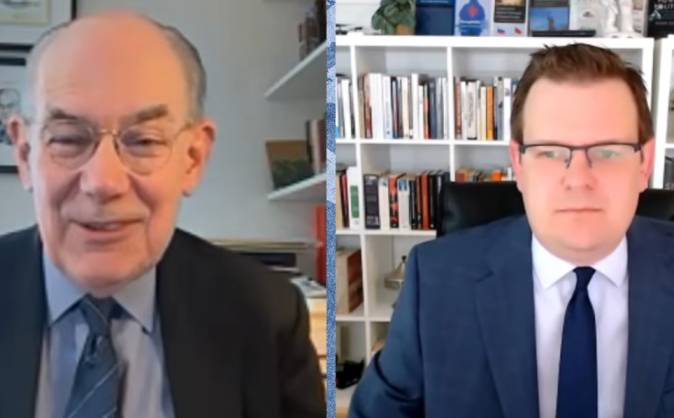
Editor’s Notes: In this episode, Glenn Diesen is joined by Professor John Mearsheimer to dissect the shifting dynamics of U.S. strategy in the Iran war and its broader implications for global stability. They explore the complexities of President Trump’s “unique style of diplomacy,” particularly the tension between his need for an exit strategy and the domestic and international pressures keeping the conflict alive. The conversation also delves into the “divorce” between the U.S. and Europe, as shifting American priorities toward East Asia leave European allies to navigate the Ukraine conflict with diminishing support. Together, they analyze whether a new global equilibrium can be reached or if these multi-dimensional flashpoints are destined for further escalation. (April 22, 2026)
TRANSCRIPT:
U.S. Expands Iran War & Divorces Europe
GLENN DIESEN: Welcome back. Today is the 22nd of April, 2026, and we are joined by Professor John Mearsheimer. Thank you again for coming back on, my friend. It’s always good to see you.
JOHN MEARSHEIMER: Good to see you, Glenn, and glad to be back.
Making Sense of U.S. Strategy in the Iran War
GLENN DIESEN: So I’m trying to make a bit of sense out of the US strategy in the Iran War because it seems to me that Trump was in a difficult spot and he needed an out, so he accepted the ceasefire conditioned on Iran’s 10 points as a starting point, at least for negotiations. Then he finally had it, but he then moves forth with this blockade on Iranian ports. And then there appears to be a sabotage of the Islamabad talks.
I’m trying to make sense of this. I mean, is this — was this only to get breathing space to rearm and regroup, or did the Israelis intervene to keep the war going, or is this just a unique style of diplomacy that Trump is pursuing?
JOHN MEARSHEIMER: It is a unique form of diplomacy. There’s no question about that. Whether it makes any sense is another matter. And I think it’s quite clear it doesn’t make any sense.
I mean, the bottom line here is that Trump needs an exit strategy. He just has to put an end to this war sooner rather than later. And the reason for that is that he has no military strategy that he can turn to that can allow him to win the war. There’s just no military option here. As we’ve talked about before, if you go up the escalation ladder, it’s the Iranians who prevail, not the Americans. So there’s just no military option.
Furthermore, the world economy is teetering, and the longer this goes on, the more damage that’s going to be done to the world economy. And by the way, if you do go up the escalation ladder, that’ll really be another hammer blow to the world economy. And this has political consequences inside the United States for President Trump, not to mention the fact that it has huge economic and social consequences for countries all over the world.
So he’s under tremendous pressure to come up with some sort of agreement with Iran that allows us to walk away from this. The problem that he faces is that he’s incompetent. The administration is incompetent when it comes to diplomacy. And the best example of this is a subject you and I have talked about ad nauseam, which is the Ukraine-Russia war.
You want to remember that President Trump promised when he came into office that he was going to settle that war. And in fact, he said that he might even settle it before he moves into the White House. And he’s made a complete hash of those diplomatic negotiations with the Russians. It’s really quite remarkable, as you have recorded in a whole slew of different interviews with a variety of people over the past year or so. It’s really quite amazing.
So why would anyone expect him to be any more adept in negotiating with the Iranians than he has been in negotiating with the Ukrainians and the Russians? He’s just not a good diplomat by any stretch of the imagination.
Israel’s Role and the Limits of U.S. Diplomacy
And to add to the trouble, he’s got to deal with Israel and the Israel lobby. And this is a very important issue, Glenn. The fact is that the Israelis understand that up to this point in time, we’ve lost the war. We — meaning the United States and Israel. We had a set of goals going into the war, four main goals, as you know: regime change, getting rid of Iran’s nuclear enrichment capability, getting rid of their long-range missiles, and getting them to stop supporting Hamas, Hezbollah, and the Houthis. We failed on all counts.
And on top of that, as everybody knows, the Iranians, who did not control the Strait of Hormuz before February 28th and did not have a toll booth located in the middle of it, now control the Strait of Hormuz and have a toll booth located right there. So the Iranians have won.
From an Israeli point of view, this is a disastrous situation because the Israelis view Iran as an existential threat. You and I can disagree with the Israelis, but that doesn’t matter. They think it’s an existential threat. And of course, the lobby here in the United States goes along with Israel no matter what. So the end result is that Israel wants to continue the war. It’s just very important to understand that they want us to continue hammering away at Iran to try to beat them into submission. And if we don’t beat them into submission, well, we’ll just destroy them — do what we did in Gaza to Iran. That’s the Israeli view, and that’s the Israel lobby’s view.
So if you think about the situation in Ukraine, going back there, and then you think about the situation with regard to Iran, you see inept diplomacy on the part of the Trump administration in both cases.
So Trump is veering back and forth between two positions. One, which is pushed forward by the economic realities and the realities of what has happened in the actual fighting, to work out some sort of deal. He has powerful incentives because of the state of the world economy and because of what’s happened in the fighting to cut a deal. He understands he has no military option. He understands we’ve effectively lost, and he understands the damage that could be done to the world economy. That tells him, let’s cut a deal.
But on the other side, he has the Israelis and he has their minions here in the United States. And they are powerful and they’re honeycombed throughout the entire administration to put enormous pressure on him not to cut a deal and instead to play hardball with the Iranians.
So what you see him doing is wavering back and forth between these two positions. And in the end, we have been unable to get a ceasefire, much less meaningful negotiations started.
You want to understand, we don’t even have a ceasefire yet because a ceasefire involved shutting down the fighting in Lebanon between the Israelis and Hezbollah, which has kind of been done. And number two, opening the strait. And the strait opened for one day, and then because President Trump wouldn’t take off the American blockade of the strait, the Iranians put the blockade back on. So we haven’t even fulfilled all the conditions that were required for a ceasefire, much less begun to move seriously towards an agreement. And all the time this is happening, the clock is ticking on the world economy, and this is a very dangerous situation.
The Ceasefire as a Tool for Escalation Control?
GLENN DIESEN: Is it possible though with the ceasefire that this could be a way for the United States to get Iran to fight the war on America’s terms? Because this appears to be one of the things that has failed since the beginning. That is, when the US attacked, it looked as if Trump would have favored to do a little bit of bombing and then stop. And the Iranians essentially didn’t want to give him this kind of escalation control, and they made it clear that any attack would get a massive response.
So shutting down the Strait of Hormuz, attacking the Gulf allies — essentially denying the US this kind of escalation control. Now, in the ceasefire, it seems to follow the same logic. Yes, initially the US appeared to agree to this 10-point plan, at least as a point of departure to start discussions, but then it seems to be this incrementalism. Well, the US should be allowed to put a blockade on Iran, Israel should be allowed to bomb a little bit in Lebanon, the US should be able to seize or fire on some Iranian ships, and to keep it, I guess, low intensity.
I mean, is it possible that it’s just to get the war under control, or is it the ceasefire gone wrong? Because I think Iran will probably interpret this as a wider effort. Well, whatever minor escalation there is now, the overarching objective would be the effort to destroy their nation or wipe out their civilization, to use Trump’s language.
So do you think this has anything to do with how the war is fought, or just to bring down the intensity of it and limit the targets that Iran are targeting?
U.S. Military Options Against Iran
JOHN MEARSHEIMER: Yeah, I think it’s a great question. And let me give you my two cents on it. I think that what Trump wants to do here is he wants to use military leverage to get the Iranians to agree to a ceasefire and then to come to the negotiating table. And he wants to use that military leverage to get a good deal, not a great deal. He’s not going to get a great deal. He wants, I think, to get something that’s better than the JCPOA. The IAEA when it comes to the nuclear enrichment issue. But he thinks he needs military leverage to do that.
So let’s talk about military leverage. My view is that any country has, any great power I should say, has 3 levers that it can use, 3 military instruments that it can use to get what it wants, either through coercive purposes or by fighting the actual war. And one is air power, two is ground power or land power, and three is naval power. Those are the sort of three instruments that a state has.
And we started the war on February 28th and waged it before the ceasefire largely with air power. We struck Iran from the air and we struck them with naval aircraft, but we didn’t have a blockade on at that point in time. It was all about air power. And that air power campaign, Glenn, failed. And that’s why you moved to a ceasefire. And that’s why we can say today that up to this point, Iran has won the war. The air power campaign failed. And by the way, everybody knew. Or let me put it differently. Everybody should have known beforehand that air power alone is not going to defeat Iran. The historical record is clear here.
So that’s air power. Then there’s ground power. And here we’re talking about using ground forces for invading, for the purpose of invading Iran. This is not a serious option. First of all, we don’t have many combat troops at all in the region. There’s talk about 50,000 American troops in the region. Only a small slice of them are combat troops. And the idea that even if all of them were combat troops, you could invade Iran and do something to end this war is not a serious argument. We don’t have the combat forces there to launch a ground invasion.
Furthermore, President Trump is allergic to boots on the ground. Furthermore, the American people are not willing to tolerate the kind of pain that would be required if you’re going to launch a full-scale invasion of Iran. Just think about how deeply concerned we were about the life of that pilot who was shot down, right? The idea that he might be killed was a horrible thought. Our tolerance for pain over the Iran war is not very high. The idea that you’re going to launch a massive ground offensive into Iran, suffer lots of casualties, have soldiers coming back in body bags, that’s just not possible. It’s just not going to happen. And it seems to me that President Trump, although he occasionally hints it may be a tiny ground force incursion, the ground land force option is just not a serious option.
The Naval Blockade and Its Limitations
So what I’m telling you is up to now, the air power option was tried and failed. We have no serious ground power option or land force option. And unsurprisingly, what have we turned to? We’ve turned to the naval option and we have a blockade on the strait. Furthermore, we’re running around the world hunting down ships carrying Iranian oil way out in East Asia or Southwest Asia. And the question you have to ask yourself is whether or not you think this blockade is going to bring the Iranians to their knees.
And I would say to you, first of all, Glenn, if the blockade is such a war-winning weapon or is an effective war-winning weapon, why didn’t we turn to it earlier? Why are we only turning to it now? And the answer is it’s not a war-winning weapon. First of all, I don’t think the US Navy can sustain a blockade for a long period of time. We have a limited number of ships. The wear and tear on our ships is enormous. I think a lot of ships, based on what I read, are getting through the blockade. We run the risk at some point that the Chinese will escort ships into the Strait of Hormuz, which will put us in a very difficult position, because then we’ll have to face the fact that we might have to attack Chinese ships if we want to prevent those Iranian cargo ships or oil tankers from going into the Gulf. I mean, there’s all sorts of trouble that one can imagine with this blockade.
And I think very importantly, what you saw today is that the Iranians have captured two ships in the Persian Gulf. They’ve seized two ships in retaliation for the two ships that we have seized. So they’re playing tit for tat. Moreover, the Iranians have made it manifestly clear that if you want to come back to the bargaining table, you have to put an end to the blockade. So at some point, Trump is going to have to end the blockade just to go back to the bargaining table. He can’t dilly-dally forever and ever. We have to get negotiations going here. And that means he’s going to have to take the blockade off at some point.
But my previous point is the blockade’s not going to be that effective. Is it going to inflict some pain on the Iranians? Yeah. But the Iranians have demonstrated that they have a high tolerance for pain, a much higher tolerance for pain than we do. So the naval option is not a war-winning option. We have no war-winning option.
President Trump talks about sort of going back to air power. And a lot of people say we’re going to go in and bomb this and bomb that. That’s not going to work either. If it was going to work, he would have done it. We tried bombing, it didn’t work. What’s the new formula that’s going to allow us to succeed? Oh, we’re going to go in and destroy all of their energy infrastructure and basically make Iran unlivable. That’s not going to work. Everybody knows that because the Iranians can retaliate.
So we’re out of options. And what he has to do here is he has to get a ceasefire in place ASAP, and then they have to start negotiating, and he has to come up with a clever set of proposals that he can work on with the Iranians so that we can work out some sort of deal and shut this down as much as possible and rescue the international economy before it goes off a cliff.
Iran’s Escalation Options
GLENN DIESEN: Well, this tit for tat, so this has been one of the interesting ways this war has developed. That is, whatever the US does, it appears that the Iranians can mirror it and go up that escalation ladder with the Americans. But that’s why I’m wondering, if this is what the US will do, what do you expect on the Iranian side? Because there doesn’t seem to be a diplomatic path here, at least it seems to be too far apart at the moment.
The US, again, it might do this heavy air campaign and then complement it with the sea blockade. Some people like Keith Kellogg are arguing for a land campaign as well, that is to seize islands and these kind of things. But what do you see Iran possibly doing? I know the IRGC has suggested that they could do things like cut undersea internet cables or they could shut down the Red Sea. Indeed, Yemen has more or less said that they’re prepared to enter the war now. But what is the secret weapon you think of Iran? If the US, let’s say, pursues this strategy of just bombing Iran, inflicting as much pain as possible, and then, yeah, either in perpetuity or just until they decide to leave. What do you expect to see from the Iranians?
JOHN MEARSHEIMER: Well, if you’re describing a situation where the United States goes back to a massive bombing campaign where they’re attacking energy infrastructure, bridges, and doing enormous amounts of damage inside Iran, including killing many, many thousands of civilians. I think what Iran will do is that it will shut down the Persian Gulf completely. It will shut down the Red Sea, and it will attack energy infrastructure and desalination plants all across the Gulf. It will do everything it can to wreck the Gulf.
It’s what I call the Gader Dameron response. We’re going to bring everybody down with us, right? The idea that you’re just going to inflict punishment on Iran and get away with it, and everybody else is going to be able to stand idly by while our country is destroyed, is not in the cards. We are going to take others down with us. We will take every state in the Gulf down with us, and we will wreck the world economy. And we will do that by shutting down the Red Sea and the Persian Gulf. And this will have disastrous consequences over the long term.
And surely everybody understands that. That would be the threat that I would make if I were playing their hand. And I believe it is a very formidable threat. And I believe the people in the Trump administration and people all around the world understand this is what is likely to happen if the United States turns the dogs loose and really goes after Iran’s infrastructure and its population in a major way. And that’s why I think it’s not going to happen. This is why I say if you go up the escalation ladder, the Iranians hold all the cards. You can do enormous damage to Iran, but the fact is they can do even greater damage to the world economy and to states in the region.
The Risk of Economic Catastrophe
GLENN DIESEN: But I was wondering though, sometimes you get some commentary that, well, yes, that this could melt down the global economy. But do you think there’s anyone, that there would be some in the administration who would think, so what, because the US isn’t dependent on the Strait of Hormuz, the US doesn’t have to be reliant on energy from the Middle East. Is it some, I guess, based on history of World War II that the whole world burned down, but the US remained and now it was the last one standing. Do you think there’s anyone who would, maybe not welcome such a scenario, but who would be willing essentially to sacrifice the Gulf states if it meant weakening or destroying Iran and weakening, for example, China significantly? Or do you think that’s over the top?
JOHN MEARSHEIMER: No, I think that Israel and its supporters will be inclined to adopt the position you just described. Again, it’s very important to understand that from Israel’s point of view, Iran is an existential threat. And they thought that when we went to war against Iran on February 28th, that the end result would be that Iran would suffer a staggering defeat. We would win. We meaning the United States and Israel. And the exact opposite is happening.
And what we’re talking about here, Glenn, is working out some sort of agreement that reflects the fact that Iran won. We may get certain concessions from the Iranians, but they won the war and they’ll do very well in these negotiations. That’s just the way it works. The winners on the battlefield are the winners at the negotiating table. Common sense tells you that, but the Israelis definitely don’t want that.
So they’re going to push very hard for us to start the war up again, and the Israelis and their supporters in the United States will be inclined — not all will buy this argument, but they’ll be inclined to make the argument that we can withstand the response that Iran comes up with after we turn the dogs loose. And I think that at that point, I think President Trump will side with common sense, and he will go to great lengths to tell the Israelis that they just have to accept the fact that we lost and that we’re going to work out a deal with Iran.
Because President Trump has a deep-seated interest in avoiding an economic catastrophe. I mean, there are all sorts of people who are students of international economics who say that if this one spins out of control militarily and economically, that you could end up in a situation analogous to what you had in the 1930s. You could have a Great Depression. And there’s some people who argue, and these are not foolish people, these are smart people who argue you could have an economic depression worse than you had in the 1930s. Is that for sure? Of course not, because we don’t know exactly where this train is headed. We live in an uncertain world and how it all plays out is very hard to say.
But it just seems pretty commonsensical that if you shut down the Gulf completely, you shut down the Red Sea and you wreck all of those GCC countries, that the economic consequences worldwide would be just enormous. It’s not only gas and oil, it’s the fertilizers that come out of the region, out of the Middle East, out of the Gulf, out of the Red Sea. It’s the aluminum, it’s the helium. It’s just hard to imagine us doing anything to create a situation like that and it would just seem to me that we will go to great lengths to avoid that. But again, I think there’ll be pressure from Israel and from its supporters in the United States to really go after Iran and to not reach any sort of agreement that gives them concessions, major concessions.
The Strait of Hormuz and U.S. Strategic Dilemmas
GLENN DIESEN: Well, I think one of the reasons why we got locked into this war and not able to pull out, even now that the war has been lost, is or even predict the consequences that will come. You mentioned a global depression, we have the possibility of a famine, because in human nature, there’s always the assumption that the present era is permanent. You know, it’s only been 35 years since the Soviet Union collapsed. The current era, the conditions of it, it hasn’t been here for very long, and the assumption that it would stay like this forever is quite extraordinary.
So you often get the impression that politicians, Americans aren’t ready to make the necessary adjustments because they don’t appreciate or recognize the severity of the situation. But on that though, how willing do you think, how long do you think, how far do you think Trump is prepared to go to put an end to this thing? Because let’s say he goes in, just takes what remains of American missiles and just carpet bomb what they can of Iran, but they can’t achieve what they want. Is it just pulling back then and going home?
I mean, do you think it’s possible for the US to leave the Middle East without having the Strait of Hormuz open? Because this seems so critical. If the Iranians can hold the Strait of Hormuz, we’ve already seen more or less what they can do to dismantle the US presence in the Middle East. They can collect their, you said a toll, but yeah, that would be reparations as well. They would be able to, I think the UAE already said that they might start to sell some of their oil in Chinese yuan or they’re open to it.
There could be efforts to pressure these countries to scale back the presence of these US military bases in the region, something that I’m sure some of them are already discussing if that invites conflict instead of bringing security. It seems like a massive cost for the US to leave without the Strait of Hormuz being open. But again, if it can’t be achieved, what do you do? Do you think it’s possible for the US just to leave? I know Joe Kent advocated for this, but is it possible?
Iran’s Leverage and the Toll Booth in the Strait
JOHN MEARSHEIMER: Well, there’s a difference between the United States leaving with the strait closed or open, versus the United States leaving with Iran in control and with a toll booth on the road or in the strait. I think that Iran is going to end up controlling the strait and it’s going to have a toll booth in the strait. I think it’s linked in good part to the business of reparations and sanctions.
I think that it’s hard to imagine the United States and Israel, certainly Israel, but the United States even paying reparations to Iran for all the damage it’s done. And in terms of sanctions relief, it’s going to be almost impossible to get the American sanctions off of Iran because that would have to go through Congress and Congress is anti-Iran in the extreme. They may get the international sanctions off, but given the problem that we’re going to face with sanctions relief for the Iranians and given that we’re not going to pay meaningful reparations, they’re going to want to keep the toll booth in place for a long, long time.
Furthermore, they’re going to want to control the strait just because it provides them with huge amounts of coercive leverage. Anytime the United States or Israel in the future start to play tough or threaten to play tough with Iran, I think Iranians will just remind the United States and Israel that they control the strait. And they will shut things down once again. That’s a powerful deterrent.
So I think no matter what, Iran’s going to end up with control of the strait in a very obvious way, and they’re going to end up with a toll booth in the middle of that strait. And it may be that boats or ships traversing that strait, or they’re going through that toll booth, will have to pay in yuan. Who knows on that count?
But so I think that’s a given, but the question that you raise gets at the fact that we’re at a very plastic moment here. And what I mean by that is that there are just so many different issues on the table and how they’re all resolved, how they all fit together, is just very hard to say.
If you ask me where is this train headed, what does this all mean for the US military presence in the Gulf? I don’t have a clear answer. I’d be curious to know what you think, but do you think we’re going to go back to the naval base at Bahrain? Do you think we’re going to go back to any of those bases in the Middle East that have been either destroyed or badly damaged? Do you think that the Gulf states that hosted those bases are going to want us back?
And what about the negotiations? How do the bases play in the negotiations? Do we make concessions on the bases so that we can get a better deal on the nuclear enrichment issue? In other words, will the Iranians be more willing to accommodate us on nuclear enrichment if we are willing to put an end to the bases in the region? I’m not saying that will happen for one second, but this all remains to be determined.
I mean, this is what the negotiations will hopefully resolve. And if they don’t resolve these issues, this conflict will just go on and on forever. And that will not be a good thing, obviously. But what I’m saying here, Glenn, is you raise a great set of questions, but what the answers are are just not clear here.
The Multipolar Shift and the Decline of U.S. Hegemony
GLENN DIESEN: Well, I think a lot of the conflicts we have today, be it with Russia, Iran, China, many of them have some of the same origin. That is the wider transition of the world order. That is, we’re shifting a distribution of power from unipolar to multipolar.
Now, in the hegemonic system, I think the hegemon will have an interest in building alliances. That is a good way of maintaining a hegemony. That is, like in Europe, divide the continent into dependent, thus loyal allies, and the weakened adversaries. You kind of see the same dynamic in the Middle East when the Chinese try to negotiate some more improved relations between the Saudis and Iranians. This essentially could become a situation where, you know, peace breaks out and what’s going to happen then? The Saudis will be less loyal or obedient and Iranians won’t be contained. So one does need an alliance system to preserve a hegemonic position.
And I think as the world becomes multipolar, many of these states probably have an interest to have a more independent political position, but then you need to diversify your ties. That is not to tie yourself too much down with one actor. So I think from Saudi Arabia, Turkey, across the region, many countries are now looking to diversify and decouple a little bit from these alliance systems.
And especially if you have a declining hegemon, not saying that the US is finished. People ask me how I compare it to Britain in 1956, but I think by no means the US will remain a massive power. But relative decline, I think, is important, because if a power is in relative decline, the alliance system, instead of being a form of monopolizing of security — everyone wanted to tie their security to the US in the ’90s — but if it’s a declining hegemon and it might use the frontline states to weaken its opponents, you see this in the Gulf states, they have to question whether or not this is a good position still to be in. I mean, it’s not the 1990s.
I know they’re talking about this in East Asia, in South Korea, because whenever one enters an alliance, yes, one gets security, but one can also provoke a response. And at the moment, the security gain seems to be reducing while provoking, for example, China isn’t worth it. And at some point, I think the Europeans will talk about this as well.
But I think this is an overall shift in the international distribution of power. So I think at the end of the day, the US will have less interest in the Middle East simply because it has better priorities. The Middle Eastern countries will have to diversify and the Saudis will have to hedge a bit. And yes, I think there will be no going back to the way things were.
I mean, these are historical times. You can’t have a country, for example, like China, with this spectacular rise and the world order will remain the same. There has to be massive changes. And I think that’s what we’re undergoing. Some of them will be born through blood and fire essentially instead of through diplomacy. But no, I don’t think we’re going back to where we were.
A Multipolar World: Existential Threats and Endless Conflicts
JOHN MEARSHEIMER: Yeah, no question about that. Let me just tell you how I sort of think about the world at a macro level to try to make sense of it. And I’m not arguing that this is an approved solution, but it’s just my sort of simple framework for thinking about how the world looks today.
Of course, up until about 2017, certainly through all the 1990s and the first decade and a half or so of the 21st century, we lived in a unipolar world. And in that unipolar world, the United States was by definition the only great power. That world went away, in my opinion, in about 2017. And we now live in a multipolar world.
And what’s very important to understand about that multipolar world is that for the United States, the most important region in the world is East Asia because China is a peer competitor in the sense that China is a rising great power that threatens to even be more powerful than the United States. I’m not saying that will happen, but China is a formidable adversary for the United States. So you now have this multipolar world where East Asia is of paramount importance for the United States. And the United States still cares about two other areas of the world. One is Europe, and then the third is the Persian Gulf. So that’s sort of the macro view I have at the highest level.
But then if you look at the Ukraine-Russia war and you look at the Iran war, what you see is that these two conflicts almost are guaranteed to never go away. And to have, to create a poisonous security environment in both Europe and in the Gulf.
And why am I saying that? It’s very important to understand, I think, that from Russia’s point of view, the situation in Ukraine is an existential threat. From Ukraine’s point of view, Russia is an existential threat. I fully understand why both actors in that conflict, Ukraine and Russia, view the other as an existential threat. And Europe has piggybacked with the Ukrainians to the point where the Europeans think Russia’s an existential threat, and the Russians think the Europeans and the Ukrainians together are an existential threat. And when you have two sides that both think the other side is an existential threat, how do you shut that down in any meaningful way? So I think you’re going to have huge problems in Europe moving forward, mainly based on the Russia-Ukraine conflict.
Turning to the Gulf, as I said to you before, the Israelis view the Iranians as an existential threat. And Israel’s supporters in the United States view Iran as an existential threat. And Iran views the United States and certainly Israel as an existential threat. But let’s just focus on Israel and Iran. Those two view each other as an existential threat. How are we ever going to get a meaningful ceasefire between Israel and Iran, especially when Iran supports Hezbollah, Hamas, and the Houthis and has no intention of giving up that support. And the Israelis view Hamas, Hezbollah, and the Houthis as not as dangerous as Iran, but almost as dangerous as Iran and joined at the hip with Iran.
So what you’re going to see moving forward, even if we get some sort of agreement between the United States and Iran, is a permanent state of hostility between Israel and Iran in the Persian Gulf or in the Middle East. And then back to Europe, you’re going to see endless trouble moving forward, a poisonous relationship. You and I have talked about this before, between the Russians on one side and the Ukrainians and the Europeans on the other side.
So again, just to go back to where I started, you have these three great powers in the system now, who compete with each other in all sorts of different ways. And with regard to the US-China conflict, from an American point of view, China is the principal threat. East Asia is the number one area of the world. But if you look at the other two areas of the world, Europe and the Middle East, you have this very dangerous situation that doesn’t seem to look like it’s going to go away in both of those areas.
And my final point would be to you, Glenn, you can tell all sorts of stories about how you hook the Chinese up to what’s going on in the Gulf. Very easy to do. And the Russians, of course, were already involved in Europe. They’re one of the principal participants in the war in Ukraine. And the Russians, of course, are involved in the Gulf. They’re helping the Iranians. Both the Russians and the Chinese are helping the Iranians. And the Chinese obviously because they fear an American containment strategy in East Asia. The Chinese have a vested interest in seeing the Ukraine war go on and seeing the Americans pinned down in Europe. And in a certain way, they even have a vested interest in seeing the United States remain militarily in the Persian Gulf because that means they won’t be able to go to East Asia to contain China.
So what I think you see with this rather simple framework that I’m putting on the table is that we live in a very dangerous world and there’s not much prospect that I can see. I hope I’m wrong, but there’s not much prospect of creating a more peaceful world moving forward.
The US Strategy in Europe: Buck Passing or Perpetual War?
GLENN DIESEN: No, I’m not sure how the new equilibrium will be established, but I’m curious though, what the US goals then would be towards Europe, because if you have the world becoming multipolar, the US can’t be everywhere, it has to make priorities. So the US more or less prioritizes the Western Hemisphere and East Asia, where you said its peer competitors. Well, then the US has to get out of the Middle East and Europe. Again, this is why the Iran War doesn’t make much sense in the wider strategy.
But in Europe, it seems even more important to get out of because they consume a lot of resources. But more importantly is perhaps by having a too heavy American footprint in Europe, they’re pushing the Russians closer to China. So when Trump said, “I want to put an end to this war in 24 hours,” which was never realistic, but at least it seemed to reflect that he recognized how the distribution of power was shifting.
But that being said, I kind of assumed that he wanted to put an end to that war. But now we see these new statements. I did send you a link earlier on with the Undersecretary of War for Policy, Elbridge Colby, was making some remarks. It didn’t sound like he wanted to put an end to the war. On the contrary, he called for the Europeans to essentially step up to the plate. It sounded not to end the war, but to outsource the war to the Europeans. So while the Europeans would like to pull the Americans deeper into the war, it seems the Americans want to outsource it to the Europeans.
But do you read it the same way, or do the US want to put an end to it, or just to make it a — because if it’s a European war, then they can continue to contain the Russians, and it’s the Europeans’ problems. And the Russians, for their part, signal they’re willing to improve bilateral ties with the Americans even though the US is still involved in Ukraine in terms of intelligence and sending weapons. But do you see a willingness to end the war, or is it like perpetual war, forever war, which is possibly a strategy just to drain the Russians and make sure that the Europeans do it on their own?
Elbridge Colby’s Speech: America Divorcing Europe
JOHN MEARSHEIMER: Well, you should put that speech that Elbridge Colby gave in Europe up on your website so that people can access it. Glenn sent it to me — I’m talking to the audience here — Glenn sent it to me earlier today and I read it very carefully. And of course, Elbridge Colby is a very important figure in the Pentagon. And his statement that Glenn sent me on April 15th is, I think, enormously important.
And my interpretation of it, Glenn, is it said nothing about solving the war or shutting down the war in Ukraine. This was all about what I would call buck passing, shifting the responsibility for security in Europe at the conventional level almost completely over to the Europeans and shifting responsibility for supporting Ukraine in the Ukraine-Russia war almost completely over to the Europeans. And this was a case of moving almost completely away from the Biden approach to dealing with Ukraine, where we were fully involved in the process and committed to fight till the end.
And I think it’s very clear that what’s going on here is that the United States is deeply committed in Iran and in the Iran War, and we are using up significant amounts of our weapons inventory in the Middle East in this Iran War, and that is weakening our position vis-à-vis the Chinese. If you look at the numbers of THAAD missiles and Patriot missiles and smart bombs and Tomahawk locks that we’ve expended in Iran.
And by the way, Glenn, just to get off the subject that we’re talking about for one second, one of the reasons that President Trump does not want to start the bombing campaign again and start the war up — because it would involve Iran retaliating against Israel and the Gulf States — is that he would have to use up more of the American inventory of weapons. They don’t want to use any more weapons than they have to in a future conflict in the war against Iran. So we have very powerful incentives not to start the war up again against Iran because we have so depleted our inventory of weapons. And this has huge consequences for East Asia where we’re supposed to be in the process of containing China, the principal threat to the United States.
So what Elbridge Colby is saying very clearly to the Europeans is, “We can’t provide the weapons anymore for you to give to the Ukrainians. You Europeans have to develop the necessary weapons and you have to do it quickly for Ukraine. We can’t do it because we have other responsibilities.”
So this is, I think, the Colby speech, a clear statement of the Americans divorcing themselves from Europe at the military level. It’s basically saying to the Europeans, “You deal with the Ukraine war.” They’re not saying you shut down the Ukraine war. In fact, I think the document reads like, we expect the war to go on and on, and that’s hardly surprising. We failed to shut the war down. They’re not going to shut the war down. In fact, they have no interest in shutting the war down. The Europeans want this war to go on forever and ever. And the end result is that Ukraine is going to have to be supplied with lots of weapons. And the question is, where are they going to get those weapons?
And up to now, it’s been pretty much a case where the Europeans buy the weapons from the United States and then give them to the Ukrainians. And what Colby is saying is, “The cupboard’s bare. There are no American weapons we can give you. We’re running through weapons in the Gulf at an incredibly rapid pace. And that’s having huge consequences for East Asia, which is strategically the most important area of the world.”
So in a very important way, what Colby is doing is divorcing the United States from Europe, especially at the conventional level. That’s the way I read it. Do you disagree with that?
Europe on the Brink: Escalation Without American Backing
GLENN DIESEN: No, I think they’re, yeah, they’re handing it over or cutting their ties further. I think this also could be a consequence of the Iran War as well. The fact that Trump has put a lot of rhetorical efforts to blame the whole thing on the Europeans, that could provide a reason, or at least to get mobilized some support from decoupling the US a bit more from the Europeans.
But that also puts the Europeans in a — well, puts us much closer to war, I think, here in Europe, because with the lack of American weapons, the situation is going more and more in Russia’s favour, and the Europeans will have to escalate in a big way, which you see all these drones being made and sent and the very openness about our participation in this war. And at the same time, the reports now of the Baltic states and/or Finland, allowing their territory to be used to strike Russia.
At some point, the escalation will put more pressure on the Kremlin to respond, and there is a growing pressure. And all of this is happening at the same time that Americans are divorcing themselves. So now the Russians would have less constraints to retaliate. I mean, why would they fear striking some German logistics centre if America is not standing behind? Is it the same as the Baltic States? The reason they’ve been behaving this way is you had always, big bad Uncle Sam standing behind you. If Uncle Sam’s not there anymore, and instead of toning it down, they have to escalate, I think we’re looking at a recipe for war.
The Fracturing of NATO and Escalating Middle East Tensions
JOHN MEARSHEIMER: But yeah, I mean, this gets to this whole point we were making before about what a plastic moment this is. I mean, just listening to you talk, what about the American security umbrella, the American nuclear umbrella over Europe, especially over Eastern Europe? If something happens in one of the Baltic states, what are we going to do? We meaning the Americans. It’s really hard to imagine the United States getting into a fight with the Russians in one of the Baltic states at this point in time. So I think the Russians are kind of flexing their muscles these days vis-à-vis the Baltic states because they understand that.
The other thing is, Glenn, I wonder what’s going to happen when Ukraine finally loses this war. I mean, it’s hard to say what the final arrangement is going to look like, but at some point the shooting is going to stop, number one. And number two, the Russians are going to end up controlling a huge slice of Ukrainian territory, which they’ve already annexed. I mean, they’ve annexed 4 oblasts and Crimea. And this is going to be seen as a devastating defeat for NATO, right? NATO lost.
And President Trump will blame the Europeans. And if you think about Colby’s speech, Colby’s speech is putting President Trump in a position where it will be easy to blame the Europeans. Because the Ukrainians have lost, not lost now. We’re divorcing ourselves. And at some point the Ukrainians are going to lose. And when they lose, Trump will be able to say, we shifted the burden almost completely onto the shoulders of the Europeans. We were doing well, or the Ukrainians were doing well up until that happened. And then Ukraine fell apart. And of course it’s because of those pathetic Europeans. Who wouldn’t help us in the Gulf? Who wouldn’t help open the Strait of Hormuz? Or who wouldn’t unilaterally open the Strait of Hormuz? Of course, this is all nonsense, but this is the rhetoric that he’ll use. And this’ll just further tear at the seams of the alliance. It’ll just make a bad situation worse.
So I think what you’re going to get in Europe, and I’d be curious to know what you think about this. I think you’re going to get a situation where the United States is much less committed to Europe and to NATO. And at the same time, the relations between the Russians on one side and the Ukrainians and the Europeans on the other side are going to be even worse in the future than they are now.
GLENN DIESEN: No, I agree. I think it was also very predictable. Indeed, on this podcast, I interviewed the German general, General Harald Kujat. He was the head of the entire German army, and he also had the highest military position within NATO. I forgot what it’s called. Yeah, and anyways, my point is, 3 years ago, he made the point that, you know, he was speaking very openly about what was actually happening, unlike the rest of his countrymen. He was making the point that, yes, the US and the British sabotaged the Istanbul Agreement, all of this, but he also made the point, again, 3 years ago, that we’re losing this war.
As you and I were saying back in those days, but the consequence is at some point the US, when it’s being lost, they will have the common sense to pull away. And at this point, we, that is the Germans, will stand to face a very angry Russian, or Russia, all by ourselves. And I thought that was interesting. That was one of the reasons I wanted to talk to him as well. And I think that’s where we are now. The war is being lost. The US is handing it over to the Europeans. And now we’re going to face a very angry Russia, and instead of seeking to make a peace, we’re making it much worse because many of the European leaders seemingly genuinely believe that Russia is an existential threat, so they don’t have any political imagination for peace, so it’s only escalation.
But I think on the wider— I think there’s also mutual divorce because you mentioned before the missiles being depleted. Once missiles or weapons are being depleted, people lose trust in alliances. That is, you know, the South Koreans are asking, you know, why did the Americans pull out their THAAD and the Patriots? In Europe, they’re saying, oh, all these missiles we’re supposed to get to fight the Russians being delayed or diverted. Even in the Gulf states, they’re saying, oh, why are the air defenses, you know, Israel’s being prioritized? So you’re seeing this side distancing themselves.
And on the other side, you see the Americans who are essentially blaming some of the partners. You know, they’re not a force amplifier anymore. They’re drained on US resources. They’re not going to be able to look after their own backyard or go contain China. And, yeah, all of the failings are their faults. I mean, Europeans, they’re the ones to blame for Ukraine, for Iran. So I think you see a mutual split. And, again, I don’t know what would follow though.
Europe’s Flashpoints and the Threat of Future Conflict
JOHN MEARSHEIMER: Just one other dimension to this, Glenn. I like to say that when you think about the poisonous relationship that’s going to exist between Russia on one side and Europe and Ukraine on the other side, that there are 6 other potential flashpoints that are loosely associated with Ukraine. And of course, the Ukraine war could start up again. We’ll get some sort of frozen conflict, but that could start up again. But then there are the sort of other potential flashpoints that I focus on, or I have focused on. One is the Arctic, two is the Baltic Sea, three is Belarus, four is Kaliningrad, five is Moldova, and six is the Black Sea.
But if you think about it, we’re talking about not the Baltic or Kaliningrad, we’re talking about the Baltic States themselves and potential trouble in the Baltic States. So you could add that as a 7th category, but all of this just goes to show that the potential for really big trouble in Europe moving forward is really enormous.
And I would argue that you and I like to say that there’s no real Russian threat there and that the Germans and the Europeans in general, especially the West Europeans, are hyping the threat. This is, you know, classic threat inflation. But if the Russians were to go into one of the Baltic states with military force or into Kaliningrad, there was a fight over Kaliningrad or something in the Baltic Sea, this would really give the Europeans cause to think that the Russians are coming. This is the second coming of the Soviet Union, and that would just make a bad situation worse. Anyway, all of this is just to say, you can tell all sorts of stories about how a conflict down the road just takes the present situation, which is very bad, and makes it even worse.
GLENN DIESEN: Yeah, well, if someone would have asked me a few years ago, or only last year, if a Russian attack on Estonia is likely, or the Baltic States, I would say, you know, it’s crazy talk. But there is the security dilemma. Now I’m not so sure anymore, because after all that Estonia, for example, has been doing, having this geographical position there as well on the Baltic coastline, I think it’s become increasingly likely that the Russians will do something in retaliation. It’s probably going to be more something where they can have some plausible deniability, but overall I think we’re moving in that direction.
But that goes back to the whole idea, what is the security? Because the Europeans are recognising that things are, all these flashpoints we’re talking about, but their assumption, the cause of this conflict is, well, it’s the Russians wanting to restore empire. Okay, we can have security, but then we have to defeat the Russians. I think it’s just the wrong— we would trigger a security dilemma. We need to bring it down. I think this is the problem. Anyways, I think we run out of time. Do you have any final thoughts before we wrap up?
The Complexity of the Israel-Iran Conflict
JOHN MEARSHEIMER: I just make one final point. It’s kind of a big point, but it’s just worth throwing out on the table when we’re talking about the big picture here and just to segue away from Europe, back to the Middle East. If you look at the Israel-Iran conflict, in recent times I’ve focused on trying to think about how you could settle that conflict. And I focused mainly on Iran and Israel. But what I’ve come to realize over the past week or so is that that’s not the right way to think about it, because it’s not just Iran and Israel that you have to deal with if you want to come up with a settlement. It’s also Hezbollah and Hamas.
I think the Houthis are much less of a problem, but Hamas and Hezbollah are inextricably linked with Iran. And of course, for Israel, Hezbollah and Hamas, especially Hamas, matter enormously. So if you’re going to work out some sort of modus vivendi between Israel and Iran, you have to include Hezbollah and Hamas in the equation. And how do you do that? I don’t know. So it just goes to show that these conflicts that we’re talking about, you know, whether you’re talking about the Russians and the Ukrainians in Europe, or whether you’re talking about the Israelis and the Iranians in the Middle East, are multidimensional, right? It’s not just those two players who matter. They have all sorts of interests and they’re linked to all sorts of other flashpoints in ways that make it very difficult to think about how you shut down the conflict either in Europe or in the Middle East.
Shifting Alliances and the Search for a New Equilibrium
GLENN DIESEN: I agree. And yeah, thanks for bringing back to the original point, the Middle East, because I think this can, well, can spin out of control. You know, often people assume that the alliances are also written in stone, but a lot of the countries which have been hostile to Iran, be it Saudi Arabia and maybe to a lesser extent Turkey, you know, if Iran would weaken, they, you know, their position would change as well. The Saudis aren’t that comfortable with Israel’s territorial ambitions. Turkey is also very aware of the hostility of Israel towards Turkey. So if you lose your Iranian boogeyman, then suddenly you’re next on the chopping block, perhaps.
So, you know, you don’t necessarily want to defeat your enemies. So I think that instead of having this zero-sum thinking, there might be countries in the region who want to find a new equilibrium, something that puts a check on the Iranians, but also on the Israelis. So essentially move away from this hegemonic vision, of a US global primacy or Israeli regional primacy. I think the alliances can switch more, that the stability we see in the alliance systems throughout the Cold War probably is a thing of the past. Again, anything can happen now, as they say.
JOHN MEARSHEIMER: It is a plastic moment, as we were saying before, and it is hard to predict exactly where this train is headed. But what’s so depressing, Glenn, is that we can tell just, you know, one horror story after another. I mean, hopefully, you know, cooler heads will prevail and we won’t have any really disastrous conflicts down the road, but it’s going to take a lot of luck and a lot of smart policymaking and a lot of diplomacy to avoid trouble moving forward.
GLENN DIESEN: Well, I’m not looking towards our political leadership, at least with great confidence, but maybe new people will come in. Anyways, John, thank you so much for taking the time. I know you have a big day there in Chicago, so I appreciate it.
JOHN MEARSHEIMER: My pleasure, Glenn, as always.
Related Posts
- Transcript: President Trump Remarks at Wheeler High School in Marietta, GA
- Transcript: What It’s Really Like Inside Trump’s World w/ Maggie Haberman & Jonathan Swan
- Transcript of Rolling Stone Interview: Zohran Mamdani
- Transcript of Tucker Carlson Interview: The Mishal Husain Show
- Transcript: President Trump Speaks at FIFA Reception in New York City