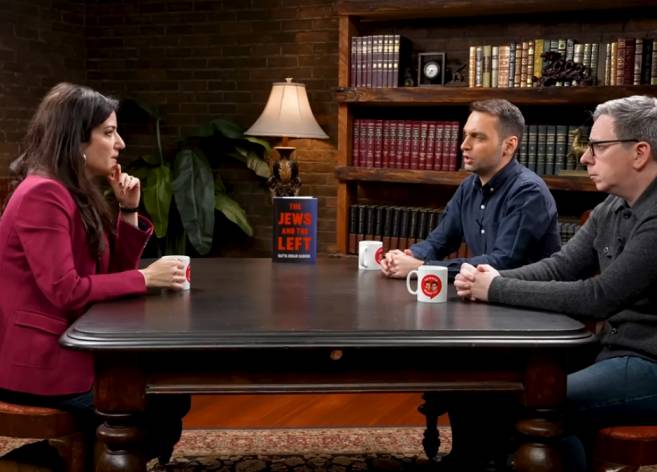
Editor’s Notes: In this episode of Triggernometry, hosts Konstantin Kisin and Francis Foster welcome back journalist Batya Ungar-Sargon to debate whether the online “podcast sphere” is truly representative of the American electorate. They dive into the growing divide between content creators and mainstream MAGA voters on issues like foreign policy, Israel, and the war in Iran. The conversation also explores the rise of anti-Semitism, the failures of elite discourse, and the shifting geopolitical landscape under the Trump administration. (April 8, 2026)
TRANSCRIPT:
Welcome and Introduction
KONSTANTIN KISIN: Batya, welcome back to TRIGGERnometry.
BATYA UNGAR-SARGON: Thank you so much for having me. I’m so honored to be here.
KONSTANTIN KISIN: Oh, it’s great to have you back. Last time we had you on, that episode was really informative, absolutely crushed as well. Thank you.
And the reason we wanted to have you back is you and I keep having a private debate in our DMs about some things that I actually think is really relevant to a lot of the stuff that we see, particularly online at the moment. And I guess the main thing that you keep saying to me is all of these podcast wars and, you know, Tucker Carlson versus Ben Shapiro and all of this stuff is not really remotely reflective of what’s actually happening in America, which I find an interesting perspective.
Because on the one hand, I think it’s kind of hard to believe. On the other hand, when we see Americans talking about British politics, which increasingly happens, I’m like, yeah, okay, I can see how people from afar might be directionally somewhat accurate, but kind of also not fully present to the realities on the ground and get a skewed perspective.
So give us your perspective on where you think a lot of this kind of online chatter is not reflective of reality.
The Podcastariat vs. The MAGA Base
BATYA UNGAR-SARGON: I think what we’ve observed over the last year is that in issue after issue after issue, the podcastariat has been radically out of touch with where the vast majority of MAGA voters, Trump voters, Republicans are at.
So what you have in America, particularly when it comes to an issue like antisemitism, is this has always been relegated to the elites. Since the founding of this country, there was something in the soil that just rejected the idea of hating Jews. There are Jews here since 1654, and in one of the massive betrayals, American Jews see themselves as an immigrant community when actually we were inextricably part of the founding of this country.
That elite discourse has trickled down in a very big way on the left. So the mainstream Democratic voter is very deeply influenced by their mainstream media. The same cannot be said about the right, where the content creator class, which was a very welcome breakaway from the mainstream media, which is so liberal and so anti-Trump and so anti-MAGA and so anti-religious, anti-American, that podcast sphere is just so totally divorced from where average people are at.
And you see this come up on Israel, you see it come up on Epstein, you see it come up on Iran, you see it come up on foreign policy again and again and again, where the people who claim to be the influencers of the right simply have no influence, neither on the president nor on his voters. And the polling just keeps bearing this out. And honestly—
KONSTANTIN KISIN: Well, give us your data points on that.
Polling Data: Republicans and the War in Iran
BATYA UNGAR-SARGON: Okay, let’s take the war in Iran, right? Something everybody’s talking about right now. I think it’s safe to say that the majority of the podcast world is very against it. There’s a lot of talk and chatter about this being Israel’s war. You hear this a lot on the podcast sphere. I can’t think of a single sort of content creator, podcaster aside from Ben Shapiro, who sort of supports the war.
Okay, so we have polling. How do Republicans feel about this? Well, the polling shows that between 80 and 90% of Republicans back the president’s war. So the mainstream media is too happy to take the podcasters’ word for it that there’s a MAGA divide. But if you look at people who call themselves MAGA Republicans, the numbers are even higher. 90% support for the war, 93% support for US-Israel alliance. That’s not a divide. That’s a divide between the podcasters and the content creators and then the mainstream voters.
KONSTANTIN KISIN: That’s really interesting. I guess the counterfactual might be you say the influencers have no influence. I wrote a joke about it at the time. I said every time Tucker Carlson goes in the White House, Donald Trump bombs something. So whatever he’s doing there is clearly not working, or working, as I just said in my joke.
But I also think, you know, you see the president now openly responding to what is happening in this. So how can you really say it’s not having an influence if he’s taking a side basically in this? He’s coming out against Megyn Kelly and Tucker Carlson in favor of Mark Levin. Et cetera.
BATYA UNGAR-SARGON: You mean the fact that he’s been forced to weigh in on it shows that it matters?
KONSTANTIN KISIN: Well, if the president of your country feels like it’s an important thing to comment on. I mean, President Trump is a little bit, you know—
BATYA UNGAR-SARGON: He talks about a lot of things.
KONSTANTIN KISIN: Yeah, yeah. But still, I think you have to concede that clearly it has risen to such prominence that even the president is talking about it.
Tucker Carlson, Nick Fuentes, and the Closing of Ranks
BATYA UNGAR-SARGON: I mean, for any other president, that would be true. I’m sorry, but Trump talks a lot of shit.
I think the reason he weighed in is because, when Tucker Carlson had Nick Fuentes on his show, there was a huge backlash on the right, a closing of ranks around him in a way that you would never see on the left. When Kevin Roberts, the head of Heritage, a legacy conservative institution, came out in support of Carlson, there was a closing of ranks against Roberts, a mass, mass exodus from Heritage. You had Republican senator after senator after congressperson coming out and saying, “This is unacceptable, this is not who we are, this is not who our voters are, this is not what they want,” in a way that you would never see on the left.
The only person who refused to do that happens to be the vice president of the United States, who’s very close with Tucker Carlson. And I think that the president is trying to address that issue, which is an issue of great concern to a lot of people on the right in terms of there being this one exception to what is a rule at this point.
I can’t tell you how many senators have texted me privately and said, “I just do not know what’s happening here with Tucker Carlson. He was such an institution.” I mean, he was good to me personally. This has been heartbreaking for me. He put me on the map in many ways. He had me on his show on Fox News. I feel very, very grateful to him still. But this is just so divorced from where the average Republican voter, MAGA person, Trump supporter is at, what they want their domestic policy and their foreign policy to look like.
JD Vance and the Question of the Heir Apparent
KONSTANTIN KISIN: Okay, but within your answer is something, and I’m about to, as you know, I’m stress testing your argument in order to understand it better, right?
BATYA UNGAR-SARGON: Oh my God.
KONSTANTIN KISIN: Yeah, cool. All right, good.
BATYA UNGAR-SARGON: I love the debate.
KONSTANTIN KISIN: I’m just so, I’m so used to—
BATYA UNGAR-SARGON: If you go easy on me, that’s bad on me.
KONSTANTIN KISIN: Yeah.
BATYA UNGAR-SARGON: Because then I’m not going to convince anybody. So, you know.
KONSTANTIN KISIN: Okay, well, let’s try again then. I mean, within your answer is contained something which I’ve been thinking about for a long time because I think it’s very clear to anyone paying attention that the vice president and the president come from very different political points of view. And it’s very clear that JD Vance is very, very clever and he’s very cleverly saying all the right things now so that he can then divorce himself from the Trump project.
BATYA UNGAR-SARGON: Very astute analysis of what is happening.
KONSTANTIN KISIN: Right. If I wanted to put distance between myself and say the war in Iran, what I would say is, “We have the best president in the history of this country. I’m with the president. The president knows what he’s doing. The president, yes, of course we’ve had foreign wars that have gone badly, but we didn’t have such a smart president back then.” The president, the president, the president, and all the time you’re doing this and sort of leaning out of show, right?
BATYA UNGAR-SARGON: 100%.
KONSTANTIN KISIN: Right? It’s very clever if you’re in that position. But the fact that the vice president, and frankly, let’s be honest, the heir apparent — I mean, I think the heir apparent, from what people say to me, you’ll know better, represents the Tucker Carlson wing of this conversation. Isn’t that in and of itself evidence that this is actually a real divide within MAGA?
BATYA UNGAR-SARGON: So first of all, I would say there is daylight between Tucker Carlson and JD Vance. I think it’s not really fair to say that they are identical in their foreign policy. JD Vance is pro-Israel. He has said that many times. He’s not an isolationist. He just has a higher bar for foreign intervention. It’s his view that that is where the young people are, the energy is at, the MAGA energy is at. In my view, he spends too much time on Twitter, which is why he thinks that.
Now, the fact — on the one hand, yeah, he’s the vice president, right? What he thinks matters. But on the other hand, as the polling shows, the fact that he’s hedging his bets right now does not mean that he’s actually more aligned with where the base is at. But I totally agree with you about what his intention is right now. I just don’t agree with what it signifies.
I do think that he will not be the nominee if he cannot distance himself from someone like Tucker Carlson in time. I know a lot of Republicans who this is a deal breaker for them, and I know a lot of Democrats who would very happily vote for Marco Rubio. So I just think this notion that he’s the heir apparent is totally false. It’s obvious Trump doesn’t see it that way. He wants a robust — he likes a fight, “The Apprentice,” right? He doesn’t want a coronation. He wants to see them duke it out, which is very healthy for the nation. Again, something you don’t see on the left anymore.
So I recognize what you’re saying. I don’t want to sound like I’m saying he’s insignificant. He is the vice president. But I think his analysis is wrong.
Antisemitism, Young People, and the Right
FRANCIS FOSTER: And Batya, are you concerned when you look at young people, the rising tide of antisemitism, which I think is pretty undeniable at this point? Like, I’m shocked when I talk to young people about the way that they see Jewish people in Israel in particular. Is that a concern?
BATYA UNGAR-SARGON: It’s not to me. I mean, the polling on the right has not changed. In fact, a new NBC poll shows that Republicans are more supportive of Israel now than they were in 2013. It went up from 67% to 69%.
Young people tend to be leftist. And we are seeing right now that there is a lot of sort of right coding among the young people. But that tendency to see systemic problems, to blame your failures on a larger institutional problem, to be anti-establishment, that’s what young people do. A lot of the people you guys will end up talking to are young people in college, and young people in college especially tend to end up being Democrats. Whatever they’re telling you, who they’re voting for now or what have you, I just don’t see that as the future of the right.
You look at polling from Turning Point USA, for example, 87% see Israel as an ally, 72% call themselves pro-Israel. So I just think that we’re misreading this. The average conservative does not go to college. And therefore doesn’t hate Israel and doesn’t hate the Jews.
And I would even say further, I mean, you do have to separate anti-Zionism from antisemitism.
KONSTANTIN KISIN: Absolutely, of course. It’s very important to.
FRANCIS FOSTER: Yes.
BATYA UNGAR-SARGON: It’s very important. People on the left who are anti-Israel don’t think Israel has a right to exist. People on the right who are anti-Israel don’t think Israel has a right to our taxpayer dollars. Like, that is a completely different thing.
You ask young conservatives who are anti-Israel, “Do you think Israel has a right to exist?” Of course. They just are anti-foreign aid. They’re sick of being dragged down by the needs of other countries whose benefit they can’t see. And honestly, I think that’s a conversation we should be absolutely having. I think Israel has been hurt by the foreign aid that we give them more than it’s been helped. Its own military-industrial complex has suffered. We’ve gotten a lot out of it, but if our elected officials have not made that case to young people, it is not on them to give the benefit of the doubt on something like that when they can’t afford homes. That is a legitimate argument. It’s a good argument. So it’s just a very different tenor when you get into it a little bit more.
The Threat of Antisemitic Terrorism
FRANCIS FOSTER: I guess the thing that has skewed the way that I see this issue, and a real concern of mine, is the growing rise in antisemitic terrorist attacks that we’ve seen. I think it was only a couple of weeks ago, this could have been one of the most awful terrorist attacks in history on the synagogue. I think it was in Michigan.
BATYA UNGAR-SARGON: Yeah.
The Threat of Islamist Terrorism in America
FRANCIS FOSTER: And thankfully, the man was incompetent and it didn’t work out. But the reality is, you’re seeing these attempts happening again and again and again.
BATYA UNGAR-SARGON: Something that occurred to me as I was watching with horror that situation unfold, nobody for a second thought that it was a white supremacist who drove into that synagogue. No one. It was a Muslim. There’s a global wave of Islamic terrorism. I totally grant you that. America suffers from it a lot less than other countries, I think, because the Muslims who move here tend to be middle class. They tend to assimilate much better because they are middle class, because America is the Golden Medina, as we call it, the golden land where people sort of find their way into the nation.
So we’re suffering from this a lot less than Europe, a lot less than Canada. But it is a problem. I wouldn’t say that that’s an American problem though. Certainly not a right-wing problem, it’s a left-wing problem.
FRANCIS FOSTER: But also as well, I mean, you’re saying that it’s a problem, but it seems to be growing all the time. Like when we were in Austin last week, we got told, and I wasn’t aware of it at the time, that there was a shooter with a t-shirt with a pro-Islamic sentiment, or pro-Islamist sentiment, I should say rather. And you go, this is happening, seems to happen more and more and more. The attempted nail bomb in New York. This is a very real concern. And as someone from the UK, unless America starts to talk about it honestly, these things can spiral.
BATYA UNGAR-SARGON: And what’s even more horrific is that the 5 Islamic terrorist attacks that happened in March, every single one of them was by a naturalized US citizen. This is horrifying and this is a conversation I’m not sure we were ready to have, but this is an immigration problem.
And the open border side, there was this amazing clip, I’m sure you saw it. So the IEDs that didn’t explode by the grace of God in New York City by these two young sort of ISIS wannabe immigrants, children of immigrants to the United States, they, I think they too were naturalized because their parents, they were 18 and 19 and their parents came here 10 and 15 years ago. So I believe they’re also naturalized citizens. They were at a counter-protest to an anti-Muslim protest. So these guys showed up to protest Mamdani and the “Muslim takeover” of New York. I find that hateful, but it is—
KONSTANTIN KISIN: For people listening, using inverted commas, the “Muslim takeover,” right?
BATYA UNGAR-SARGON: It is protected speech, hateful protected speech. So there was a big leftist protest that organized to oppose them. And these two young ISIS wannabe terrorists showed up with bombs to throw the bombs at the far-right protesters. And the footage of the moment that the bomb was thrown is incredible. And I urge everybody to look it up.
You have a left-wing protester on a megaphone saying, “I was born in New York and every person is welcome here.” And as he finishes saying “here,” the ISIS team uses his body as leverage to jump over him and literally throw the bomb. You don’t live in New York. You’re coming to New York to tell people who belongs in New York and who doesn’t belong in New York. We were born—
FRANCIS FOSTER: I was—
BATYA UNGAR-SARGON: We were born and raised in New York, and we want everyone here to stay in New York. You don’t get to come from outside and then tell everyone else. That’s the problem. Yeah, that’s the problem right there is the useful idiots of the left with their open border policy who do not understand what a nation is and why it’s worth protecting. And then the people willing to take advantage of that and cause immense amounts of suffering.
Media Silence and the War with Iran
KONSTANTIN KISIN: I think you make a very good point. And actually, one of the things when we were on Rogan, I kind of said this. I don’t understand why — actually I do understand because we saw it in the UK and in Europe. Basically, your media will pretend there isn’t a problem until it’s too late. That’s what’s going to happen here. Because you’ve had actually a sequence of Islamist terrorist attacks in this country, the shooting in Austin, the synagogue attack, the nail bombs, and others, and they are not being covered at a national level like a real problem. And that’s exactly what we had in the UK, and that’s exactly what we had in Europe. You just pretend there isn’t a problem, and then you get to a point you actually can’t do anything about it.
But just coming back to our discussion and stress testing the arguments more, I mean, one of the things — we’re recording this, it’ll go out in a couple of weeks, so who knows what else would have happened with the war in Iran. My big concern is whatever you think about this war and the reasons for it, I think if it goes badly, the narrative that this was Israel’s war will only get stronger. And I think Israel will end up being blamed for this war, especially if it doesn’t go very well. If it goes well for the United States, President Trump will get all the credit. I think if it goes badly, Israel is going to get all the blame. Don’t you think?
BATYA UNGAR-SARGON: To me, it is so clear that this war is about energy dominance, making America the global superpower again that it once was. It’s about China. It’s not really even about the Middle East. It’s so clear that Saudi Arabia was an equal force pushing this, that the Qataris now are on board.
KONSTANTIN KISIN: Sure.
BATYA UNGAR-SARGON: We’re starting to think about the Abraham Accords expanding immeasurably. It’s so obvious. And the fact that Iran made the dumb decision to actually attack the UAE more than Israel, the whole concept of what the Arab street is — it’s just over. I mean, when you think about what Trump has managed to accomplish with these strikes, isolating China from 20% of its oil, I mean, they simply cannot afford to take Taiwan anymore. Literally can’t afford it.
KONSTANTIN KISIN: I was with you until there. Sorry to interrupt, Batya, because I agree with you that yes, of course it’s true. But the thing is, that’s not what people talk about, right? People don’t know any of the stuff that you’re saying, that it was actually as much the Gulf Arabs that wanted President Trump to do this as Israel.
BATYA UNGAR-SARGON: So if you get your news from Twitter and you live in a foreign country, yeah, this is not a prevalent narrative. But if you sit in a bar in, you know, the middle of America, you’re going to hear regular people like plumbers and electricians and truck drivers be like, “Iran? You mean the people who took our hostages, who want to wipe us off the face of the planet. Iran, which gives all its oil to China.” Like, you will hear this stuff from people who just have a much more intuitive sense of who the good guys are and who the bad guys are, and don’t have their brains scrambled by the online digital incentives of producing content for platforms that are available to 2 billion Muslims, who are desperate for high-quality content delivered by blonde bombshells that are, you know, anti-Israel, right?
Are Podcast Audiences Really Anti-Israel?
KONSTANTIN KISIN: Hold on. So are you saying — I mean, if you look at the biggest new media outlets in America, they, as you said yourself, would all, I think, be anti-Israel and have these narratives, you know, Tucker Carlson, Megyn Kelly, et cetera. Are you saying their audiences are Muslim?
BATYA UNGAR-SARGON: I’m saying that a lot of the audience is Muslim. We know that a lot of the audience is like Nick Fuentes. There was a study that found that 50% of his engagement is foreign bots. So we have data backing this up. But also we know even more importantly that 80% of Americans who get their news — of Americans who voted for Donald Trump, who get their news from podcasts — support the war in Iran and support the US-Israel alliance. So meaning it’s kind of going in one ear and out the other. Even the people who get their news from Tucker Carlson totally disagree with him on this issue, no matter how many times he says it’s Israel’s war.
KONSTANTIN KISIN: Does that make sense to you? Of course. How much content do you watch that you vehemently disagree with?
BATYA UNGAR-SARGON: Oh, I watch a lot of content that I vehemently disagree with.
KONSTANTIN KISIN: Yeah, fair, because you are in this game.
BATYA UNGAR-SARGON: No, I’ll tell you why. Because I think, with the mainstream media, if you’re sort of a college-educated person who’s watching MSNBC and it makes you feel superior to your neighbor, the Republican dork who watches Fox News, right? You take everything they say as fact.
KONSTANTIN KISIN: Okay.
BATYA UNGAR-SARGON: When you’re getting your news from a podcaster, I think your instinct when you hear something is, “Huh, that’s interesting. I wonder if it’s true.” I just think that people are not — people on the left have this fantasy that people on the right consume content in the way that people on the left want their content to be consumed. Like, you know, like Torah, L’mosheh, Mishnah, like, you know, the Bible handed to Moses as truth. It just doesn’t work that way. People are much more skeptical because they’re getting their news from new media.
But yeah, I mean, that’s what the polling is. I was very delighted to see that the majority of Candace Owens’ listeners, podcasters, audience, pro-Israel. Study from Ruffini. He’s a good guy. Echelon Insights. They’re no joke, you know? So I feel pretty sanguine about all of this.
KONSTANTIN KISIN: I don’t get how.
BATYA UNGAR-SARGON: Because it’s entertaining. It’s just entertainment.
KONSTANTIN KISIN: Okay, but the thing is, anecdotally — obviously anecdotally is not statistics. Statistics isn’t always necessarily that reliable either, in my experience. But we know, we have met — we don’t know them personally necessarily — lots of people. I mean, Francis keeps going on dates with girls who watch Candace Owens.
FRANCIS FOSTER: That sounded like an accusation. He keeps going on dates.
BATYA UNGAR-SARGON: I want to hear — sorry, the whole show put on politics.
KONSTANTIN KISIN: Over to you, mate.
FRANCIS FOSTER: Over to me.
BATYA UNGAR-SARGON: This is so interesting.
Dating, Candace Owens, and the Palestine Question
FRANCIS FOSTER: All right, this has taken on a sinister turn. Anyway, but yeah, I go on dates and then they go, “Oh, I’m really into politics.” I’m like, “Great.” “Like Candace Owens.” I’m like, “Yeah, I like comedy too.” And then invariably what happens is, they don’t see it as entertainment per se. They see her, and this is very interesting, as being a kind of investigator who goes down these kind of rabbit holes in order to get to the truth. And a lot of them, when you talk to them about Palestine, it’s Palestine, then genocide, and that’s where the date ends. Because I go, “Well, what do you mean by genocide?” It gets cold and I go, “Check please.” But in all seriousness—
BATYA UNGAR-SARGON: Francis, that’s so sweet.
FRANCIS FOSTER: Is it? It means a lot to me.
BATYA UNGAR-SARGON: What, the fact that you cockblock yourself over Palestine? Yeah. It’s getting old. I’m getting old.
BATYA UNGAR-SARGON: You put it in the sack, you know? But would you call them — are they on the right or on the left?
The Epstein Files and Podcast Obsession
FRANCIS FOSTER: Oh, some of them are on the right. I would say center-right in terms of things like economics, in terms of things like the way that the country should be run, in terms of culture. But if you talk to them about, for example, the trans issue, then no way are they progressive or liberal. But when it comes to Israel, and maybe it’s a UK thing, I don’t know, but I’ve actually found it quite shocking.
BATYA UNGAR-SARGON: Oh, this is in the UK? Yeah. Oh, you guys are screwed. I mean, I’m not going to defend us.
KONSTANTIN KISIN: No, no, no, no, no, no. But the challenge to your argument that I’m making and using Francis’ example is the idea that people watch this stuff for entertainment and they don’t buy into it.
BATYA UNGAR-SARGON: Oh, sorry. I only meant here.
KONSTANTIN KISIN: I am not defending that. But why would here be any different to the UK?
BATYA UNGAR-SARGON: That’s my whole point in my book and my whole point of my— that’s— it just is. It just is. The first Jew to step foot on American soil, the first thing he did was sue an official for insulting him. And he won.
KONSTANTIN KISIN: Forget about Jews. I’m talking about Erica Kirk killed Charlie Kirk. These women believe it.
FRANCIS FOSTER: Yes.
BATYA UNGAR-SARGON: The thing that makes Francis refuse to go to bed with a woman who says free Palestine.
KONSTANTIN KISIN: I don’t think he refuses.
FRANCIS FOSTER: I think it’s them that refuse.
KONSTANTIN KISIN: I see it as, you know—
FRANCIS FOSTER: That’s the difference between men and women. Yeah, I see it as, you know, we agree to disagree. They don’t.
KONSTANTIN KISIN: They do.
FRANCIS FOSTER: And I don’t learn my lesson.
KONSTANTIN KISIN: Do you not think it’s a little— I’m just asking the question and I respect your view a lot, but do you not think you’re being a little bit wishful thinking here in this idea that people don’t take this stuff seriously?
BATYA UNGAR-SARGON: Give me some data. Every day I’m like, that is my biggest fear. Am I just a Pollyanna? I am. Am I just like atrociously, like unbelievably committed to this country, jingoistic to the nth degree about like, American supremacism and that this is the greatest country on earth, unsurpassed. I am. But that doesn’t mean that every day I’m not reading the polls and waiting to see. Give me data. Like, the fact that you’re saying, is it not just wishful thinking? That’s not data. Give me the evidence. You’re bringing me the evidence. I’m saying, well, it’s not that. That evidence isn’t this. That isn’t— all the evidence backs up my insane jingoism that this country is absolutely exceptional in the history of humanity.
KONSTANTIN KISIN: Well, I’m not questioning this country. This country is wonderful.
BATYA UNGAR-SARGON: And I’m saying what it does is, when Candace Owens holds up a book that says the Talmud Jew, people are like, I’m out, you know?
KONSTANTIN KISIN: But they still watch and they don’t take anybody in.
BATYA UNGAR-SARGON: They don’t do a lot of stuff for fun. I’m sorry, I will admit it. There are things that I hate watch that are like, you know, too extreme for me, but I chuckle.
KONSTANTIN KISIN: Patrick comes out as a fan of Nick Fuentes.
BATYA UNGAR-SARGON: I mean, we can all admit he’s funny, right? He is a funny guy.
KONSTANTIN KISIN: Yeah, you can’t deny that.
BATYA UNGAR-SARGON: I know a lot of Jews who watch it and think he’s funny. They’re like, haha. Like they’re not agreeing with him. I know a lot of young Jews, guys who are like, funny guy, you know, enjoy the content. And it doesn’t mean that they agree with it. We don’t agree with him about the Jews, obviously. I don’t watch him, by the way. He’s not the one I was thinking about because, you know, the jokes are not for my age group, but.
FRANCIS FOSTER: That’s a very politically correct way of putting it. But what’s interesting is I think what you’re going to see because of this war is there’s going to be a refocus on Israel. And there’s already— you’re starting to see people talking about it as Israel’s war. And the longer it carries on, I think the more negative people are going to view the war.
BATYA UNGAR-SARGON: Maybe. I think the opposite is going to happen. I think Trump’s going to get out soon. He understands that this was a huge political risk. He does not want to lose the House in the midterms. He knows he’s got like a week left. He’s got, you know, maybe 10, 12 days left.
KONSTANTIN KISIN: So by the time this episode comes out, this should have already happened then, because this episode will go out in a couple of weeks. So hopefully as you’re watching this or listening to this from your perspective, he’s already ended it, right?
BATYA UNGAR-SARGON: I think probably. Look, has Trump ever been wrong about his base? He’s not.
FRANCIS FOSTER: I mean, the Epstein files.
BATYA UNGAR-SARGON: Wrong.
FRANCIS FOSTER: Because he was talking about not releasing them, and then he called his fans, the MAGA, the people in the MAGA base, stupid. There was that fallout.
BATYA UNGAR-SARGON: Nobody cares. Nobody cares about Jeffrey Epstein. This is another thing the podcast world was obsessed with because, again, 2 billion Muslims would love to hear about Jews being pedophiles, you know. But it was nothing. There’s nothing in the files to implicate anybody else of any criminal wrongdoing except Jeffrey Epstein, which Trump knew.
KONSTANTIN KISIN: What about Arnolds?
FRANCIS FOSTER: What about Prince Andrew?
KONSTANTIN KISIN: Alleged nonce. What about Prince Andrew?
BATYA UNGAR-SARGON: Oh, selling secrets. You see how the media tried to make it sound like the crime there was like a sex crime, but it wasn’t, right? It’s an— he was— he’s accused of giving secrets to him, right?
KONSTANTIN KISIN: But he’s also in a photo with like 17-year-old girls.
BATYA UNGAR-SARGON: But that’s not why he was arrested.
KONSTANTIN KISIN: No, I’m not talking about arrested. I think there are the things you can criminally prosecute someone for. And then there’s like, well, why are all these people on that island?
BATYA UNGAR-SARGON: Because rich people like to hang out with rich people and hookers. But if they weren’t underage, there’s no crime. Like the whole—
KONSTANTIN KISIN: Do we know they weren’t underage?
BATYA UNGAR-SARGON: We know that the— I mean, show me again. There’s 3 million documents have been released.
KONSTANTIN KISIN: That’s only half of the ones that are there.
BATYA UNGAR-SARGON: Okay.
KONSTANTIN KISIN: So why haven’t the other 3 million been released?
BATYA UNGAR-SARGON: See, this to me is like, okay, like I’m just asking questions. Oh, I know. All of the crimes are in the— again, I could be wrong. I could be wrong. I’m very open to being wrong, but I think Michael Tracy really nailed it on this. He was a skeptic from the beginning and was like, you know, it’s always like, oh, the next tranche will have all the crimes we promised you that he was, you know, that Israel was using him to blackmail heads of state into being pro-Israel by having them have sex with underage girls when just like, you know, no evidence of a list, of a blackmail, of nothing.
FRANCIS FOSTER: I mean, the counterargument to your point is the Queen did pay, I think, £12 million to Virginia Giuffre to essentially make the case go away.
BATYA UNGAR-SARGON: But Virginia Giuffre admitted to lying on multiple occasions. She had to settle with Alan Dershowitz out of court because she accused him of lying. I mean, she accused him and he forced her to admit that she was lying.
FRANCIS FOSTER: Yeah.
BATYA UNGAR-SARGON: Not to speak ill of the dead, but she—
KONSTANTIN KISIN: Yeah, I don’t know how qualified we are to debate the Epstein thing because—
BATYA UNGAR-SARGON: Yeah, no, and I don’t find it interesting.
KONSTANTIN KISIN: Because I actually, for that very reason, I’ve never found it super interesting. You’re right, we all know some wealthy people and they do like to hang out together and some of them do like to do it with young women there and whatever. I don’t mean underage women, but you know, some of them are like— I try and stay away from those people personally.
BATYA UNGAR-SARGON: But I will just tell you like an anecdote that I think really sums this up. I was sitting in my local bar, you know, a lot of like— it’s a cop bar, a lot of cops, like, you know, firefighters, just working class dudes. And one guy came over to me, you know, he follows the news pretty closely. And he said to me— this was over the summer and he was like, “All right, who is Jeffrey Epstein again? And why do all the podcasters want me to care about this guy?”
FRANCIS FOSTER: Mm-hmm.
BATYA UNGAR-SARGON: Like, this is a very far right guy. Trump 3 times, like MAGA, MAGA, MAGA, could care less about this. And suddenly all the podcasts he listens to are like obsessively talking about it. It didn’t make him obsessed with it. It made him go to Batya, the journalist, you know, and be like, “Why won’t they shut up about this?”
The Iran War and Trump’s Foreign Policy
FRANCIS FOSTER: Okay, fair. So let’s come back to the war. So you say that there’s a week left essentially before Trump exits.
KONSTANTIN KISIN: Sorry to be a pain. I’m just reminding everyone this episode won’t go out for a couple of weeks.
FRANCIS FOSTER: Yeah.
BATYA UNGAR-SARGON: Okay. Before he starts to lose a lot more, a lot of the support he has right now.
FRANCIS FOSTER: Yes. But I mean, that’s going to be a real challenge, isn’t it? Because if you’re looking at what’s going on with the Strait of Hormuz, the blockades, the fact that petroleum’s not being allowed, the oil’s not being allowed to get through, other important resources aren’t being allowed to get through. I mean, we are approaching crisis point, aren’t we?
BATYA UNGAR-SARGON: I don’t see it that way. I think it’s going really well for America and Israel.
FRANCIS FOSTER: Okay, tell us how.
BATYA UNGAR-SARGON: They’ve basically taken out Iran’s entire ballistic missile program. They’ve taken out their ability to do what— the goal here was— it’s been Marco Rubio’s view for at least 5 years now that what they were trying to do was to build a nuclear program and then surround that with a kind of protective mechanism of ballistic missiles so that anybody trying to get them off the nuclear path, it would be too costly to do that. So they were doing that. And then of course they always had the Strait of Hormuz in their back pocket. They knew that they could just shut that down. That for them is like the last resort, the only— and we see now that’s the only card they have left in their pocket, so they’re playing it.
But I just read this morning that the UK is offering now to help. Trump is trying to cobble together an international force in order to basically take that last remaining card away from them. The leadership of the Iranian Guard is decimated. The new ayatollah is in a coma. The ballistic missiles are gone. It seems to me like it’s going really well. And the question is just how do they get that 60% enriched uranium out of Iran? And the fact that Putin offered to do it and Trump said no suggests to me that he feels very confident about their chances of, you know, striking a deal with a new moderate leadership in the near future. I could be very wrong about that, but—
KONSTANTIN KISIN: Where do you get new moderate leadership when you’re bombing a country? Where do you get it?
BATYA UNGAR-SARGON: What do you mean?
KONSTANTIN KISIN: If someone bombed America to get rid of Donald Trump because there was anti-ICE protests, would the people who are anti-Trump rise up and overthrow his regime, or would they go, “America’s been attacked, we need to fight back?”
BATYA UNGAR-SARGON: You think that the Iranian people are going to side with the Ayatollah because Trump took—
KONSTANTIN KISIN: I don’t think they’re going to side with the Ayatollah. What I think is the 30,000 people who were willing to challenge the regime got killed. And what you’re left with now is a country that is, A, being attacked, and B, lacks that passionate counter-regime force. And on top of that, when a country is attacked, people tend to rally round. I mean, that’s what they do. This is what America did on 9/11. It’s what, you know, countries do all the time. It’s what the Ukrainians did when they were attacked by Russia.
So I am totally open and actually very hopeful because where I am as we sit here today, by the time this episode goes out, probably a different place, is your point about, you know, when has President Trump made mistakes? And I think up to this point, I’ve actually agreed with like 95% of his foreign policy.
Iran, Israel, and Trump’s Foreign Policy Strategy
(Advertisement removed)
BATYA UNGAR-SARGON: That’s not what I said. I didn’t say, do you agree with it? I said, when has he been wrong about the base?
KONSTANTIN KISIN: The base, right. But the base may turn very quickly if it turns out that this is not a quick get-in, get-out successful operation, but rather a protracted engagement that does in the end mean actually if you want to get that nuclear material, you have to put boots on the ground.
BATYA UNGAR-SARGON: I totally agree, but I don’t think he will do that.
KONSTANTIN KISIN: No, I don’t think he will do that.
BATYA UNGAR-SARGON: I think what you’re pointing to is the difference between the Israeli position and the American position. The Israelis want a full-on regime change.
KONSTANTIN KISIN: Yeah.
BATYA UNGAR-SARGON: Trump wants a Dulce Rodriguez. He wants somebody who’s of the regime but going to be nice to us.
KONSTANTIN KISIN: And where are you getting out one of them? In an Islamic regime?
BATYA UNGAR-SARGON: Oh, I mean, first of all, look at the whole Gulf. Like, it’s full of people like that. Did you think MBS 15, 20 years ago was going to be that person? No, but he is that person. Sure. So when they real, you know, you’re saying, well, you have to give them honey to make them do this.
KONSTANTIN KISIN: And I’m not saying this is sort of the Dave Smith argument, right?
BATYA UNGAR-SARGON: If you bomb somebody, you’re going to just increase the resistance to you.
KONSTANTIN KISIN: But I think you are. Yeah.
BATYA UNGAR-SARGON: So I don’t agree with that.
KONSTANTIN KISIN: But did we bomb MBS into position? Did we bomb MBS into position?
BATYA UNGAR-SARGON: We didn’t, but they were not, I mean, well, first of all, in a way we did, right? We had the war in Iraq, right? We had the war in, we went after the people who did 9/11, right? And then we stayed too long and then we, you know, the whole thing went up in smoke and it was a huge loss of life and treasure and a total waste.
KONSTANTIN KISIN: You mean Afghanistan? Because Iraq had nothing to do with it. Sorry, sorry, Afghanistan.
BATYA UNGAR-SARGON: Yeah, Iraq had nothing to do with it. But I think, you know, you have to understand Trump in the, back during the war in Iraq, the war in Afghanistan, he would call in like in 2008, 2009, like my boss remembers Trump calling him up and being like, what are we doing there?
He truly does hate war. He truly does understand his base, and he truly does understand the political and the foreign policy calculus. Those are not separable to Donald Trump. So everything he does in terms of foreign policy is meant to increase the safety, security, and prosperity of the United States.
And you see that whether it’s the tariffs, and you see it whether it’s the immigration, and you see it whether it’s the way that he negotiated the ceasefire in Gaza, the way that he went to his partners in the Middle East, not just Israel, but he went to the Arabs and he said, look, I’m on your side too, and convinced them that he’s on their side too.
So he’s really got a very good handle on this. I could be totally wrong. He could be planning to put boots on the ground, but that just seems to me like unthinkable given what I know about him.
KONSTANTIN KISIN: I don’t think, I think it would be insane to put boots on the ground, and for that reason, I doubt he would do it. But I think his, even if we accept your framing, which is he is someone who’s incredibly very well-intentioned. That doesn’t mean that the war in Iran will produce the results it’s intended to produce or that it will be successful.
BATYA UNGAR-SARGON: I think he would not have gone in if he didn’t have intelligence from the Israelis that there was something there along the lines of a Dulce Rodriguez that he could reasonably be assured would be ready to take the helm. Now, I could be wrong.
KONSTANTIN KISIN: It’s quite an assumption. I mean, what a different version of that might be — he was given intelligence, as we understand was given intelligence, that there was an opportunity to take out the entire leadership of the IRGC and the Ayatollah.
BATYA UNGAR-SARGON: We know that 3 weeks before this started, he told his internal circle of advisors, I don’t want to do this unless I know it will be successful. We know that he had enormous resistance to doing this at the wrong time.
KONSTANTIN KISIN: But the success objectives, as we understand them, is to deal with the nuclear program, to deal with the ballistic program, and at this point regime change because you’ve killed the current regime leaders, right? So you’re going to—
BATYA UNGAR-SARGON: Well, it depends how you define regime change.
KONSTANTIN KISIN: Regime adjustment.
BATYA UNGAR-SARGON: Yeah.
The Nuclear Question and the Strait of Hormuz
KONSTANTIN KISIN: I keep calling what happened to Venezuela regime adjustment. So on the nuclear stuff, it’s becoming very clear that in the 12-day war, they didn’t get the nuclear material, right? Otherwise, why would we have this war? If we got the nuclear material back then, clearly we didn’t — we wouldn’t be able to do it.
BATYA UNGAR-SARGON: Well, what they would say, I don’t know, you’re probably right, but what they would say is that, no, we got it then.
KONSTANTIN KISIN: So there’s satellite images of a ton of trucks leaving those facilities the day before the bombing happened.
BATYA UNGAR-SARGON: Right. So the uranium still exists.
KONSTANTIN KISIN: The enriched uranium still exists. I also think it’s fair to say as we sit here today, who knows what will be the case by the time this episode goes out, that they still haven’t got the nuclear material, otherwise why are they still bombing?
So on the nuclear stuff, we don’t know what the hell’s going to happen. On the regime change stuff, I don’t think we know what, I mean, yes, we had Richard Mineta on our show break the news that the Americans had given the Israelis a no-kill list, which means that they have a bunch of people in mind to be the potential new Ayatollah, but maneuvering those people into position and them having the ability to shut down Iran’s defense is a highly questionable thing.
Particularly because we know that the people who are holding the Strait of Hormuz locked down, and by the way, it’s not actually locked down, we’ll get to that. The ones that are doing that, they have complete autonomy of control. They have standing orders from the dead Ayatollah telling them, you have, you must continue this irrespective of what else happens.
And then on top of that, your point about this is about China — China’s still getting the oil because the Iranians are letting it through. They’re not letting Western ships and allies’ ships through, but they are letting Chinese and Indian vessels through.
BATYA UNGAR-SARGON: Right, so they are now, but that’s actually good for us as well because that means that the cost of gas is going to go down, right? So Trump doesn’t actually, he wants China to succeed. He just wants them to stop thinking that this is going to be the Chinese century.
So he wants leverage when he goes in to meet with Xi Jinping. So he wants to have control over the Strait of Hormuz before that meeting, which is why they’re pushing that meeting off. I don’t disagree with anything you said. I think it, you know, it’s all a question of whether he can pull it off.
If he can’t pull it off, he will start to lose support in 8, 10 days, 2 weeks, whatever. So I think we’re seeing the same thing and analyzing it in the same way. I just think that he would not have done this if he didn’t think that he could do it successfully.
KONSTANTIN KISIN: And it could still go to, you know, like I said, I don’t disagree with that either, Batya, but what I’m saying is just because someone thought they’d be successful doesn’t mean that they will be successful.
BATYA UNGAR-SARGON: Right, totally. He does have a pretty good track record though.
KONSTANTIN KISIN: I completely agree with that, which is one of the reasons I’ve said about this, the coin is in the air, we don’t know which way it’s going to land. However, the more time we spend in the US and the more people we talk to who know, I won’t go into more details than that. I mean, the phrase “he was on a bit of a sugar rush from Venezuela” has been used. There is a narrative building that actually this wasn’t a deeply strategically planned operation. This was someone who kind of got a little bit overexcited here. Is that impossible?
Trump’s Motivations and Political Risk
BATYA UNGAR-SARGON: Nothing’s impossible with Donald Trump, but that’s not what I’m seeing from his, the way that he’s talking about it, the way that he’s been handling himself, he seems to feel very sure that this is going the way that they expected it to go.
They have these backup plans. I think that he saw Venezuela taking that oil, releasing it onto the free market when it had been going to China for $15 less a barrel because it was a repayment for Chinese loans, that that was sort of a protective mechanism with which to ensure that gas didn’t get too much more expensive. So I think this is all part of a sort of larger global game that he has. But I could be wrong, you know, it’s a — I don’t know Trump, I’ve never spoken to him.
I mean, I — this is just my analysis from what I’m seeing, the way that he’s talking about it, the way he’s handling it. I do think that at the State of the Union, I think that — this is just like my personal analysis — but I think he looked at the Democrats refusing to stand up for all of these heroes, and he just was filled with disgust. And I think he thinks that it’s beneath him to fight people like that anymore.
Like, I think his — how can you fight with people? How can you think it is a noble goal to fight people who will not stand for a 7-year-old girl whose brain was bashed in by an illegal? And I think that there was, you know, you could see it in his face, like just this, like, this is our opposition really? And I think maybe that’s why he’s so focused on the foreign policy piece.
But I think again, you know, he’s got a lot of grandchildren and I think he knew this was a political risk and he took it anyway. And he took it even though he knew that this might hurt. He said this, he said, “Of course I knew it might hurt me politically. I had to do the right thing.”
Again and again, he proves the people who say, “Oh, he’s only helping his rich friends,” wrong, like, “Oh, everything he does is to help the billionaires.” You know, billionaires really don’t like tariffs, you know, they like profits, you know. Like, here again, he did something that he thought was the right thing to do despite the fact that it was a political risk. And I think that that is something worthy of admiration.
America and Israel: Diverging Goals in the War
FRANCIS FOSTER: So let’s take a step back and let’s look at both America and Israel, because this is very fascinating from a military and a geopolitical point of view, because they kind of have — although they’re allies, they want different outcomes for this war. So let’s talk about, we’ve spoken about what you think the Americans want, but what do the Israelis want?
The Iran Question and Netanyahu’s Relationship with Trump
BATYA UNGAR-SARGON: It’s funny, I really have been surprised because Trump does seem to have brought Bibi Netanyahu to heel. Netanyahu has really had his way with a lot of other presidents who found it very hard to — of course, Obama was able to overcome his opposition with the Iran deal. But Netanyahu does seem to be very much taking his orders from Trump.
But they, of course, want a deep-seated regime change. They want the protesters to win. They want their representatives in government. They want to see a completely different Iran. And I don’t think Trump has the stomach for that, and I don’t think he has the political bandwidth for that.
So they would be, I think, willing — their people are much more in support of this, obviously, because they feel they face a much more immediate threat from Iran. When you’re sitting in a bunker and they’re bombing your children, you’re willing to put up with that for much longer than we are, safe in America. So I think they have a much higher appetite for this going on for longer than we do, and they want a much deeper thing than we would be happy to settle for.
Trump doesn’t see foreign policy through a kind of moral lens, I don’t think. He sees it through interests. He wants to create value. He doesn’t want to export our values. He’s very interested in positioning us in a way that will bear fruit for our children and grandchildren. But I don’t think he’s interested in taking a country that’s under a theocracy and saying, “Oh no, you’re not going to be a theocracy, you’re not going to be a monarchy, you’re going to be a democracy or what have you.” He has no interest in that whatsoever.
FRANCIS FOSTER: So the name that keeps getting bandied around is Reza Pahlavi. And apparently the Israelis, their dream scenario is to install him as the de facto leader of Iran.
KONSTANTIN KISIN: Transitional.
FRANCIS FOSTER: Yeah. Do you think that’s likely to happen?
BATYA UNGAR-SARGON: No.
FRANCIS FOSTER: Why not?
KONSTANTIN KISIN: Because Americans don’t want it.
BATYA UNGAR-SARGON: No, exactly. Same reason they didn’t put María Machado in charge of Venezuela, because they don’t want to see a coup of the generals. They don’t want to see massive bloodshed in the streets. That’s just not what Trump is interested in.
And honestly, I want the protesters to win, but I don’t know that I’m willing to sacrifice our boys for that. I don’t think you can give people freedom. I think they have to take it and win it for themselves. And I feel the same way about the Taliban and the women. My heart breaks for them. It’s horrible. But you can’t give people civil rights. Their men have to be willing to fight for it. It’s a horrible, horrible thing, but I think that’s true, and I hope that doesn’t sound too heartless.
FRANCIS FOSTER: No, I don’t think it does, and I agree with it. Someone of Venezuelan origin — everyone can now drink, since that’s what we do. But yeah, I agree, you have to be able to overthrow the government, otherwise it doesn’t work. We’ve seen it time and time and time again, this utopian way of thinking, particularly when you apply it to the Middle East. Unfortunately, in the case of Afghanistan and Iraq, at least the disastrous consequences.
BATYA UNGAR-SARGON: Exactly. And I think I would go even further and say, if the Israelis feel so strongly about this, let them put boots on the ground. Why should we do it? We’re not the ones who are going to suffer from it, one way or the other, the way that they would. So I kind of resent a little bit the implication that it’s our job to free the world.
Israel, Lebanon, and the Limits of Intervention
FRANCIS FOSTER: And also, we’re looking at Israel with Lebanon, and there’s talks of boots on the ground in Lebanon, and you think, well, this is an escalation. What do you think is going to happen there? And do you just see this as Israel thinking to themselves, “This is our chance, this is our one chance to cleanse as much as we can of the region of Islamism and these fanatical people?”
BATYA UNGAR-SARGON: I don’t think so. Like I said, I think Netanyahu is very much taking his cues from Trump, which I’ve been very heartened to see. I don’t know what the endgame in Lebanon is. I really don’t quite understand the relationship between Hezbollah and the government. I find it very hard to read who has the power and who is in charge. And when the government says we’re in talks with the Israelis or we’re against Hezbollah, but then they don’t do much — so I don’t really understand it well enough to say what the outcome is. I think the Israelis really are just trying to protect their civilians.
FRANCIS FOSTER: And do you think there will come a point where, as happened with the war in Gaza, where the rest of the world steps in and goes, “Right, enough is enough now?”
BATYA UNGAR-SARGON: This is something that I really have noticed, which is that there does not seem to be the same kind of hysteria online as during the Gaza War.
KONSTANTIN KISIN: Well, because you’re not seeing civilians killed in those numbers, I would imagine.
BATYA UNGAR-SARGON: But civilians are being killed. Not in those numbers, but many are being killed in Lebanon and in Iran. There are hundreds.
KONSTANTIN KISIN: So you seem to have a point with all of this. What are you saying?
BATYA UNGAR-SARGON: Well, I think that we’ve reached a turning point. I think that somehow when it was Gaza versus Israel, people got so consumed by the narrative. But now that it’s the US and Israel versus Iran, there is a sort of almost a bashfulness in the liberal media when they seem to be sort of cheering on what is in effect the Ayatollah, even though Hamas is worse than the Ayatollah. But yeah, it’s interesting. I have noticed that.
Why Palestine Dementes the Media
FRANCIS FOSTER: Do you know what I think it is? I think there are certain issues in the media that just dement people. And I think Palestine is one of them. I don’t know what it is about the Palestinian cause. I have family in Lebanon and they seem to be far more objective about it than people in the West who seem to lose their minds. And I don’t know what it is about that particular issue, but it seems people are incapable of being objective about it.
BATYA UNGAR-SARGON: Well, allow me to suggest a new book on this exact subject.
KONSTANTIN KISIN: So why is Palestine so demented?
BATYA UNGAR-SARGON: I do think that it brings a lot of the issues together in relief that really animate the left, which is of course this worship of weakness. They worship abjection because they cannot admit that they are affluent and privileged. So they have what is basically oppression envy. And when you say, “Because I am a white person, I have no moral authority, I can only have the authority to cede my power to the oppressed,” doing so gives you that hit of moral authority that we all crave, which is to be seen as good. And I think that that is addictive.
The Irish, the Troubles, and Oppression Politics
FRANCIS FOSTER: It’s also, you look at — and this is going to get me in trouble — you look at the Irish. The Irish have been nuts on this. I think as well, it’s if you see yourself as being oppressed —
KONSTANTIN KISIN: And the Irish have some reason for it.
FRANCIS FOSTER: Yeah, they do, they do, to be fair to them. Yeah, then they won’t stop banging on about it. But yeah, they do have it. You start to see yourself as being quasi-Palestinian in a weird way.
BATYA UNGAR-SARGON: Totally.
KONSTANTIN KISIN: Talking to Irish people, actually, it’s funny because we’re supposed to be like these controversial people. I have never had anyone come up to me ever in the street and say anything critical ever, except one time, and that was an Irish person who said, “Oh, I used to love you and you’ve changed.” And I was like, “For the better?” He was like, “No.” And what he was saying is basically you haven’t gone along with the sort of, you know, “Palestinians are poor oppressed people.” And I think for a lot of Irish people, it seems like it just triggers the trauma that they have from the Troubles and before that.
BATYA UNGAR-SARGON: Do you know, in the same bar that I go to, there’s this guy — shout out to Eamon — an Irish guy who’s in his 50s, late 50s. When I first met him at the bar, I said, “Oh, you’re Irish, you must have been around during the Troubles. That must have been so difficult.” And he looked at me and he went, “It’s the best time of my life. I was 15. There were no rules. You would get into fights whenever you wanted. You could do whatever you wanted. One of your friends would die, and then the next day you’d go and fight again. There were no rules.”
He was like, the high of being a teenage terrorist, basically. He was like, “I will never feel that again. And I think about it all the time.” And it just hit me really hard. There’s something about that. You’re a teenage boy, you’re full of that teenage boy energy. There’s a fight of good guys versus bad guys. Everything is permitted. You’re always on the right side. The whole community is with you, hiding you against people who are legitimately — it was very —
KONSTANTIN KISIN: It was a great time. Never heard anyone say that personally, but there you go. But it’s interesting because I think you make a point — it’s something I’ve thought about as well — because the Palestine cause really speaks to a lot of things, and one of them, and I think unfortunately this is increasingly true, is that really what this radical leftist worldview is about is also about justification of violence.
BATYA UNGAR-SARGON: Oh yeah.
The Left’s Justification of Violence
KONSTANTIN KISIN: And so here are these poor oppressed brown people —
BATYA UNGAR-SARGON: That is smart —
KONSTANTIN KISIN: Who are fighting back. And look, October 7th — yeah, maybe, yeah, no rapes happened, none of this happened, none of this happened. But really, “We are allowed to be violent to our oppressors. We are allowed. It’s justified.”
And I think — I mean, you see it now all the time. The left — I don’t hesitate to say this. Francis and I really, really strive to give each side the due respect and try and have a balanced perspective on things. And people will — some people on the right think we’re on the left, people on the left think we’re on the right, whatever. But I think it’s very, very clear that there is now a rhetorical structure of justification for violence on the left.
BATYA UNGAR-SARGON: That’s very deep.
KONSTANTIN KISIN: And you see it. And I think the Palestine issue is where it really fundamentally takes its force, because that is why the whole Piers Morgan “Will you condemn Hamas?” thing became such a big deal — because they won’t.
The Psychology of Leftism and Political Violence
BATYA UNGAR-SARGON: Right.
KONSTANTIN KISIN: Because they believe that that level of violence and horrific attacks against civilians, violence against Charlie Kirk, who’s a civilian who just speaks his mind about an issue, is justified.
BATYA UNGAR-SARGON: And you’re hitting on something very important, which is it’s not really about the Jews. And this is something I try to tell Jewish people a lot in America. It’s not about you’re getting the white treatment, you know. They don’t treat white Christians any better than they treat you. So stop acting like we’re some oppressed minority. We’re not. We should stand proudly with the majority in this country of working-class people who have our backs, who get the same treatment.
And I’ll just tell you personally, I used to be woke. This is one of my value adds — I can remember what it feels like to think those things. And I remember when I would write an article and I’d get a massive pushback from the right. If you just say, look, they hate my opinion and so they’re attacking me because they hate my opinion — that doesn’t feel good. But if you say they’re coming for me because I am a Jewish woman, you get a hit and you get so much support from all the other Jewish women and all the other people want to defend you for being a leftist Jewish woman and what have you. It creates this enormous jouissance almost of being oppressed.
And it takes so long to be like, no, that’s freaking lame. You put your opinion out there because you’re privileged enough to have that as your job and they don’t like your opinion. And so they’re calling you fat and that’s fine. You know, that is okay. It’s not about some — you’re not oppressed. And it’s so hard to unlearn that because if you’re like me and you spent 12 years in the academy imbibing this, that is virtue. You don’t get to be virtuous for saying, “I will be good and not bad.” You can only be virtuous by saying, “I defend people whose skin color is darker than mine.” You learn that, you unlearn that.
And coming back to that photo of the protester who the ISIS guy used to leap over and throw that IED, somebody had a long — I wish I remember who it was — a long tweet thread about it where she was saying, psychologically, so much of leftism is unlearning natural instincts. When you see a threatening person on the street, you’re not allowed to — as a woman, you’re supposed to — if that person has dark skin color, you have to unlearn the instinct to sort of try to get away from a threatening looking person.
KONSTANTIN KISIN: You have to walk straight towards them and lift your miniskirt.
BATYA UNGAR-SARGON: Exactly, exactly right.
KONSTANTIN KISIN: For diversity.
BATYA UNGAR-SARGON: Exactly. But I think this thing about justifying violence is really deep.
The Inevitability of Violence and Political Hatred
KONSTANTIN KISIN: Oh yeah. I mean, the entire structure is designed to create the permission to do that. And you see the worst people online now actively encouraging it. And I think it’s inevitable. Look, I’ve been saying this for many years. If you teach people to hate their own country, eventually the consequences of that becomes true. So if you teach people to hate the other side, the consequences of that will come through.
And I think there are people on the right certainly who teach people to hate the other side as well. And we’ve had some of them on the show and talked to them about it. There are people who say, “My motivation in life is I hate the left.” Is that constructive? Probably not. Even if you disagree very strongly with the left. But once you create a justification structure, violence is inevitable.
BATYA UNGAR-SARGON: Yeah.
KONSTANTIN KISIN: It’s inevitable. And this is why Palestine is such a great cause for them.
BATYA UNGAR-SARGON: But what’s very funny in America, I’ll just say this very briefly, is one side of the political aisle is very heavily armed and the other side has started to justify immense violence. When they do that, they’re tacitly admitting that the other side is not going to fight back.
KONSTANTIN KISIN: Mm-hmm.
BATYA UNGAR-SARGON: Because they know that they’re not going to pick up their AR-15s and turn them on their leftist neighbors.
KONSTANTIN KISIN: Mm-hmm.
BATYA UNGAR-SARGON: And there’s something about that that is just unbearable in the irony of it, that one side is violent and is using the other side’s nonviolence and Christian virtue in order to attack them and kill them, basically because they know that they will not use their arms against them.
Batya’s Journey Away from Wokeness
KONSTANTIN KISIN: But Batya, coming back to — I must have missed the part of your life journey when you were woke. How did that happen?
BATYA UNGAR-SARGON: Well, I got a PhD in English literature.
KONSTANTIN KISIN: So it comes with the woke stamp.
BATYA UNGAR-SARGON: So it comes with the — yeah, somebody recently asked me, “Why did you become a leftist?” And it’s because you imbibe this — if you spend a lot of time in the academy, that’s how you show that you’re a good person: you’re a leftist. And of course a lot of the left is built around compassion. The problem is that the way that they implement that compassion incentivizes immense amounts of suffering.
So open borders where you have 30% of the women making the passage through the Darién Gap admitting that they were raped — so you can imagine what the number actually is, probably above 90% — because they incentivize this kind of cruelty in the name of compassion. “Oh, we should welcome in the global indigent.” Stealing from working-class Americans to give limitless A+ healthcare to illegals when their neighbor, when their cleaning lady cannot afford to get her child braces. But yeah, I was totally woke until 2018, 2019.
KONSTANTIN KISIN: And then what happened?
BATYA UNGAR-SARGON: I feel like I told this story the last time I was here, no?
KONSTANTIN KISIN: We talked about it briefly, but tell us more.
BATYA UNGAR-SARGON: Well, my breaking point was this 2018 study I found from Yale. And the study found that there was a difference between how white liberals and white conservatives talk to Blacks. And I remember I looked at the headline and I was like, “Ha ha ha, we got ’em.” So then you read down and it’s actually that when white liberals talk to Black people, they dumb down their vocabulary. It’s called presenting lower competence. They use words with fewer syllables than when they talk to other whites. And white conservatives don’t do this.
And I remember looking at that and being like, “My whole worldview is racist.” I had printed it up. I took the study, I put it in a drawer in my office. I closed the drawer and I said, “I’m not ready to deal with what this means. I’ll come back in 3 months,” because it just hit me. I immediately recognized everybody I knew, the whole left, the whole worldview — that people of color somehow need our beneficence in order to thrive. It’s just despicable.
And I called up a friend of mine, a Black friend, and she was like, “Oh yeah, we know. We know that they do that. Everybody knows that.” That was the first moment I remember thinking, “I might be wrong about everything.”
Open Borders and the Betrayal of the Working Class
FRANCIS FOSTER: Yeah, it’s so — I mean, we’ve talked about this ad nauseam, but when you talk about open borders, the old left never — I know these are figures from the UK, but like Tony Benn.
KONSTANTIN KISIN: Yeah, but Bernie Sanders.
FRANCIS FOSTER: Yeah. Nobody wanted open borders because it’s —
KONSTANTIN KISIN: Clinton and Obama.
FRANCIS FOSTER: It’s completely antithetical to the rights of workers. It’s completely in opposition.
BATYA UNGAR-SARGON: Obviously so. Obviously wage theft of working-class Americans. And it’s because these elites would rather die than clean a toilet. So they imagine that any white person would rather die than clean a toilet. So let’s bring in people from the third world from failed socialist states to clean our toilets, who will be so grateful for the opportunity to clean our toilets — when the truth is millions and millions of working-class Americans get a lot of dignity from cleaning toilets because that used to be a dignified job. And the thing that makes it undignified is that it doesn’t pay a living wage.
I always say this — most of us would probably rather die than be a proctologist. I know I would. But we don’t consider that to be an undignified job because they make a lot of money. And it’s insane that we’ve just decided that that job is disgusting but dignified, and we’re going to pay them a lot of money. Why don’t we have open borders for doctors? I would totally get behind that. Let’s get their wages down to $20 an hour. Our healthcare would be much better. No, you would never see that because the elites protect their own.
FRANCIS FOSTER: And it seems to me as well, and it goes back to the Palestine issue, that the left seems to be in love with these kind of romantic myths, which actually, when the rubber hits the road, they don’t work.
The Over-Credentialed Proletariat and the Future of Work
BATYA UNGAR-SARGON: Yeah. And what’s so funny is now you’re going to see an actual over-credentialed proletariat because AI’s wiping out entry-level white-collar jobs. This would be the perfect moment for those people with these degrees that are worthless who are in debt to come together, to band together with the working class around reasonable reforms — strong borders, no more immigration, let’s fund vocational training. But they won’t because they would rather die than be an electrician because they still think they are so much better and deserve so much more than their working-class neighbors.
FRANCIS FOSTER: And it’s getting to the point now where you look at the wages of an electrician or a plumber and they’re far superior —
BATYA UNGAR-SARGON: They’re doing great.
FRANCIS FOSTER: Yeah, to white-collar workers.
BATYA UNGAR-SARGON: But that’s because of Trump. A lot of what he did created — even in the first administration, in his first term — a big boom for people in the bottom 25% of wage earners whose wages went up by double the percentage of what people in the top 25% went up by, because tariffs and a closed border create a labor shortage for working-class people. For illegals, that’s really good for working-class wages. But it’s not great for the elites, which is why they hate him.
Can the Democrats Reform Themselves?
FRANCIS FOSTER: And do you think the Dems are actually going to get on board with this? I mean, they’ve gone through the woke insanity, and hopefully maybe they’ve learned their lesson. I don’t know. Do you think they’re actually going to start to go back to what the left used to be?
BATYA UNGAR-SARGON: So the answer is no, but it’s not going to matter if the right elects JD Vance because we will still end up with President Gavin Newsom.
KONSTANTIN KISIN: So they won’t, because you think Newsom will be —
BATYA UNGAR-SARGON: Yes, but the right is not going to — they always, the Republicans always manage to seize defeat from the jaws of victory. It’s not going to matter. The Democrats are going to keep getting worse and the Republicans are not going to realize. They still don’t understand why Trump is so great. They do not understand what he has given the American people. And yeah, I think the answer is no.
KONSTANTIN KISIN: But one of the concerns somebody expressed to us — who is a skeptic of the war in Iran — is that if it goes badly it lets the left off the hook. Because if it goes well, it’s a win. Americans love winning. It’s wonderful. That gives the Republicans a really good shot at the next election, at the midterms, et cetera. But if it goes badly, the left gets let off the hook and they don’t have to reexamine all the ways that they got to where they got to, which was defeat. And they can just carry on as they were before and double down on the trans and the open borders and all of that.
BATYA UNGAR-SARGON: Yeah, it’ll be very bad if it goes badly.
KONSTANTIN KISIN: That’s a fair point. Well, on that happy note, Batya, we’re going to head over to a Substack with questions from our supporters. But before we do, what is the one thing we’re not talking about that we really should be?
There is a sort of resurgence of patriotism and pride and pride in masculinity and pride in being able to make things and build things and this feeling like we’re trying new things and we’re going to get back. And it’s a very cool time to be an American. Always a good time to be an American, but especially now.
And I think that’s very much lost on people who don’t live here and who truly hate him so much that they can’t get this external perspective of what people feel like when they’re walking down the streets. And with that, I will say, God bless and protect you both. And thank you so much for having me.
KONSTANTIN KISIN: That’s very kind of you. Thank you. Head on over to triggerpod.co.uk where Batya’s going to answer your questions. Why do leftist liberals now push neo-racism, radical gender ideology, and regressive antisemitism? What is it that they really want?
Related Posts
- Tucker Carlson Show: w/ Ken Silva – Attempts on Trump’s Life (Transcript)
- Pod Force One Interview: w/ Donald Trump – June 2, 2026 (Transcript)
- Jimmy Dore’s Interview on Tucker Carlson Show, June 5, 2026 (Transcript)
- Transcript: Trump Remarks on American Agriculture at Wisconsin Roundtable
- President Trump Remarks on Beautiful, Clean Coal – June 4, 2026 (Transcript)