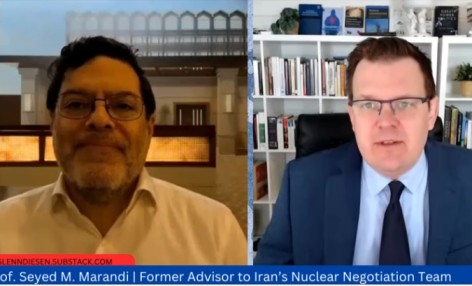
Editor’s Notes: In this episode, Glenn Diesen is joined by Professor Seyed Mohammad Marandi, who provides a firsthand report from Islamabad on the sudden collapse of peace negotiations between the United States and Iran. Marandi details how the talks broke down due to what he describes as “thuggish” American demands for Iranian capitulation and open threats directed at the Iranian delegation. The discussion explores the high probability of a return to active warfare and the potential for a global economic depression if hostilities resume in the Strait of Hormuz. Marandi also offers a brief behind-the-scenes look at the shifting dynamics between U.S. negotiators like JD Vance and the more hardline members of the Trump administration. (April 12, 2026)
TRANSCRIPT:
Negotiations Have Collapsed
GLENN DIESEN: Welcome back. Today’s Sunday, the 12th of April, and we are joined by Seyed M. Marandi, who is in Islamabad, where the negotiations are taking place between the United States and Iran to try to transition from the ceasefire to an actual peace agreement. Could you share with us how the negotiations are going?
SEYED M. MARANDI: Well, the negotiations have collapsed. And as I think most Iranians expected, the United States was behaving as it usually does. In other words, with arrogance and without any regard for sovereignty and for the independence of nations.
The Trump regime has basically attempted to dictate terms to the Iranian people. And obviously, that is something that is unacceptable. They failed during 40 days of war. And they cannot win at the negotiating table, meaning forcing Iran to lose.
And we’re seeing the United States turning into an openly extremist regime where even the media now is calling for the murder of the negotiators — the Washington Post. And Western elites, think tankers, and others are naming individuals — naming me, naming others as targets — which is not going to have any impact on the way in which Iran conducts itself. It’s only exposing the United States and the empire even further. So we are on our way back and we’ll have to see what happens.
The Breakdown: US Demands Iranian Capitulation
GLENN DIESEN: Yeah, I saw the same article in the Washington Post and this rhetoric coming from leaders — that the best way to put pressure on Iran to accept America’s terms is to essentially threaten to kill all the negotiators and the people there in Tehran, as well as the political leadership. This is quite a thuggish language.
But do you know why or at what area did the negotiations run into an end? Because what I understand is, well, from what I understood, there were 3 rounds and they all broke down. And Vance made some comments that Iran failed to meet America’s demands. Where was the most difficult point to make a deal?
SEYED M. MARANDI: Well, the United States simply does not accept Iranian sovereignty. Iran’s nuclear program is legitimate, legal within the framework of international law. And the United States wants capitulation. The United States wants control over the Strait of Hormuz. And there are a host of different issues.
The point is that the United States was not serious at all. In fact, from the beginning when we were on our way here, the belief was that this is probably a ploy to have more information about the whereabouts of different people. But the Iranians felt that even if the negotiations have no use, it is important for the Iranian people and for the people across the world to see that the Islamic Republic is engaging and that it is seeking solutions — because the same Washington Post that is calling for the murder of our delegation would also say, if we did not come to Islamabad, that the Iranians do not want a solution.
So I think the negotiators, Dr. Vannevar, the Speaker of Parliament, made the right move. But my opinion — and I said so before and so have others — was that these negotiations will lead nowhere. And I think those who’ve been following me yesterday at the media center on the sidelines of the negotiations saw that I was highly skeptical.
But in any case, I think the chances for renewed aggression are very high. We see that the Israeli regime is slaughtering innocents in Lebanon and in Gaza every day. And the Western media and Western governments are looking away because, of course, they support these genocidal attacks. And I think it’s quite probable that a renewed assault on the Iranian people will begin in the not-so-distant future.
The Threat of Renewed War
GLENN DIESEN: So there’s no fallback option here. Does this mean going back to war, or will they wait out the ceasefire period and then go back to war, or do you expect the hostilities to possibly start immediately — with the US possibly targeting the Iranian delegation there in Islamabad as they all headed back home?
SEYED M. MARANDI: Well, first of all, do show this a few hours after I leave so it doesn’t cause distress for our families. But I think that anything is possible. The United States may attack today, attack tomorrow, next week. The Israeli regime — they can attack at any time — because these are regimes that have no dignity, no honor, no sense of morality.
The last two wars — the 12-day war that we had last year was a blitzkrieg assault that happened as we were negotiating, as you know. And it was intended to catch us off guard, which wasn’t really the case. I mean, this is a myth that has been spread around. Iranians were expecting an attack. But of course, their weapon systems are advanced, and so they struck and hit before, without us being able to defend ourselves properly.
And the recent war — if you can hear me — the recent war was the same. We were negotiating, the foreign minister of Oman — again, sorry for being repetitive — but he spoke of significant progress and then we were attacked again.
So there’s no reason to imagine that Trump and Netanyahu will wait for 2 weeks. If they do, it’s only to rearm themselves. But of course, Iran is also rearming.
I mean, some people say you should not wait and you should continue the war and not accept the ceasefire. Actually, I think that that’s not really a strong argument. If you recall during the 12-day war, or after the 12-day war — when, after Netanyahu was begging for a ceasefire for the last 3 or 4 days — ultimately we accepted, and people were saying, why didn’t Iran just continue?
Well, back then Iran knew that if the war continued, the United States would join. And we had significant shortcomings in the way in which we were fighting the war, because we’d never fought a war in this new era with the new technologies. And so during those 8 months between the two wars, Iran made many changes. And during this 40-day war — roughly 40 days — the Iranians emerged much stronger than during the 12-day war, even though the aggressor was much larger.
The Israeli regime cannot be compared to the United States. And whatever the Israeli regime has, of course, is from the United States and the West. But the point is that Iran spent that time wisely to reorganize and to prepare itself and to be able to both improve its defensive and offensive capabilities. So I think that right now, as we speak, the Iranians are preparing themselves as well.
Of course, we’re not aggressive. We don’t initiate wars. We’ve never initiated a war since the revolution. We’ve been attacked by the West 3 times. Saddam Hussein, when he invaded, the West supported him. They gave him chemical weapons. And during the last few months, the US entered the war directly. Then, of course, the 2 wars that we’ve seen in the last year or so.
We’ve never initiated hostility, and we’ve always been responding. And even during this war, every time the US and the Netanyahu regimes escalated first, then we would respond. But we never escalated. So we didn’t begin the war. We didn’t escalate initially. Every time, in response to their escalation, we would escalate. I’m just saying this — I know you know this, but I just want your viewers to keep all this in mind. These are, I think, significant points.
So those who are saying that Vance is different from Witkoff and Kushner — no, there are no differences. He’s just as captured by the forces that dominate US politics just like everyone else. And I think it’s extremely naive for people to think that there are factions in the Trump regime that are more distant from the Zionist lobby and factions that are closer. These negotiations showed quite clearly that the intention of Vance and his two bodyguards was not to find a solution.
The Strait of Hormuz and Reparations
GLENN DIESEN: I got the impression one of the sticky points around the peace agreement would be how to resolve the issue of the Strait of Hormuz. That is, Iran — possibly with participation of Oman — would set up essentially a toll to get reparations. First, I got the impression the US opposed it, and then the US at least wanted to participate in it, to get in on the action. Again, I’m not sure how much of this is correct and to what extent this impacted the negotiations.
SEYED M. MARANDI: Well, I haven’t been — actually they’re in a meeting now where they’re discussing what took place. And I’ve been very busy with media, so I’m not up to speed on these issues. But you’re correct. That’s more or less what happened. And of course, next time — if God willing, if I’m around — I’ll get more information and I’ll let you know on the way back. I’ll probably get a fuller picture of what’s going on, if that’s any use.
But of course, reparations are legitimate. This was a war of aggression and it was unprovoked. And Iran’s control of the Strait of Hormuz is in accordance with international law — even though international law doesn’t exist anymore because we now live with the law of the jungle.
But the point is that there are multiple areas in which Vance was basically demanding capitulation. And the step of capitulation is not working. Iran did not lose the war. And in any case, Iran is a sovereign country. It didn’t carry out aggression against anyone. So the demands made by the empire are, for us, totally unacceptable at multiple levels.
Iran’s Principles and Growing Regional Support
Iran is not like any other country, perhaps on this planet — it is fearlessly defended. It has principles. I would argue vehemently that the Islamic Republic of Iran is by far the most principled state. And despite all the Western propaganda, the reality is beginning to show.
Here in Pakistan, the West and their proxies in the Persian Gulf have tried for decades to create hatred towards Iran, largely by spreading extremist ideologies here. But the Iranian delegation is treated as celebrities by people, as heroes. And it’s amazing how much loved Iran is across the country and across the different communities and different segments of society. So reality is shining through.
I have no doubt that the United States is not going to succeed in their hegemonic ambitions towards Iran and the Axis of Resistance. I do not believe that the Israeli regime will succeed against Hezbollah — the most heroic force in all of this struggle to draw Israeli forces away from Gaza during these 2 and a half years. And ultimately they made huge sacrifices.
And I think after what has happened in Syria, increasingly the documents are coming out and the policies of the Al-Qaeda regime in Damascus are becoming clear. Hezbollah — I think for anyone who used to make claims against it — has been vindicated. And its course of action in Syria was absolutely correct in opposing ISIS and Al-Qaeda. And they made the greatest sacrifices for the people of Palestine and the people of Gaza.
So people are waking up to this reality that the Western narratives, and Qatari, Erdogan, and Emirati narratives are not reliable. And I’m optimistic that despite the painful days ahead — and sorry if I’m not focused because I’m constantly looking to see if they’re moving the vehicles to leave — but I’m very optimistic about the future of this region. And I’m sure that the empire will be defeated across the region, and the Islamic Republic of Iran is going to emerge as a big power in Western Asia, greatly standing up against ethno-supremacism.
What Cards Does the US Have Left?
GLENN DIESEN: Yeah, I know you have to get on the plane any second. So please let me know if you have to go. But let me just ask you — if the US has walked away from the negotiations, what cards do they have to play if they’re going back into war?
Because as the negotiations were going on, Trump was taking to social media arguing that they were already clearing out mines in the Strait of Hormuz — because the Iranians didn’t know where they put the mines, apparently. Well, again, we don’t have to take him on his word. And then also that American warships were already sailing through the Strait of Hormuz. And if Iran wouldn’t essentially abide by US demands, the US may put up a naval blockade. The last one — I’m not sure it came from Trump, that could have been the media. But what do you think the Americans are going to do if they go back now to the military option?
The Negotiations and Their Aftermath
SEYED M. MARANDI: Well, it’s quite possible that they’ll still go after the infrastructure or humanity, but Iran will immediately retaliate and destroy the oil and gas and infrastructure in the Persian Gulf region because those regimes are complicit. And right now, if the United States strikes Iran, it still has to do it through these countries. So when Iran strikes back, then there will be no more oil and gas, whether from the Red Sea or the Persian Gulf. And that will be permanent. And if they blockade Iran, that oil too will no longer be contributing to the market. So it will create a further crisis, further energy crisis.
I think Trump is moving towards destroying the global economy and pushing the world towards a global economic depression, not recession, but a depression. And we’re already moving in that direction, as you know, and hardship is coming, but it’s not something that happens overnight. It’s not as if, it’s not like when they bomb apartment blocks in Tehran or Beirut or Gaza where people are crushed underneath immediately.
What these wars are doing is that they’re creating massive shortages of energy and of petrochemicals and fertilizer and so on. And other problems that are multilayered. The money that these Arab dictatorships make, they go to the U.S. stock market, the bond market, they purchase U.S. goods. These are no longer happening like before. And so I think that the problems that this is going to cause will be not sudden overnight, but because we’re already moving towards crisis mode, it will be quite quick.
But I think that Trump mistakenly thinks that he can work wonders and that Iran will capitulate or that he’ll defeat Iran overnight with his overwhelming force. Or that if he destroys Iran’s electrical power plants or whatever, that the Iranians will come and submit. It’s not going to happen. We saw what happened during the last 40 days. It was exactly as we had predicted. And this is something that you and I have been talking about for a very, very long time now. Since the beginning when I had the pleasure of being on your show.
So I think that Trump is going to cause great harm to the global economy unless of course something happens where he backs off, which at the moment, because he is surrounded by Israeli cursors, I don’t see that happening because their priorities are not the United States. Kushner, Witkoff, the Zionist lobby, the Israeli regime. Their priorities are not the American people. Their priorities are not the global economy. They’re not India or Brazil or South Africa. They’re the Israeli regime. And so they will sacrifice whatever they feel is necessary for the Israeli regime.
As Joe Kent pointed this out very openly in his resignation letter, the second highest-ranking, I think, intelligence officer appointed by Trump, in his resignation letter said, “This is all about the Israeli regime and the Zionist lobby. Iran is not a threat. Iran is not making a nuclear weapon, but they want this war and it’s not for America, it’s for the Israeli regime.”
The Tone of the Negotiations
GLENN DIESEN: Just my last question though. Do you know anything about the mood or the tone of the negotiations? In the media, of course, we see the direct threats against killing of the Iranian leadership and the delegation there with you. But do you know how it was with Vance and American negotiators? Was it hostile or professional? Do we have any other information about how these negotiations went?
SEYED M. MARANDI: Well, right now, if I was over there, if I was 20 or 30 meters away from where I am now, I would probably be able to answer that question. But I’ll get more of that and I’ll let you know because they’re actually discussing it. Last night, since it was very late at night, they were awake till morning. And then of course, when Vance decided to leave, the plans changed.
So I don’t know the tone, but my understanding is that they were basically dictating terms. They were making demands and they expected capitulation. And to me, they’re living in an alternative universe. They have no idea what Iran is, or they do, and yet they’re saying, “Who cares? Who cares if the global economy crashes?”
GLENN DIESEN: Yeah, I was surprised by the language as well. When I heard that “the Iranians failed to meet our demands,” I thought, this sounds as if they were coming there expecting capitulation. So they didn’t meet our — oh well, anyways, I know you are rushing out of Islamabad there, so thank you very much for taking the time.
Final Remarks from Islamabad
SEYED M. MARANDI: Sorry about that. Let me ask the journalist right now. Just one moment. Vance was much more positive than Kushner and Witkoff, but then suddenly their tone changed. That’s what she tells me right now, but I’ll get more information later on. We are live, so I just asked, she gave a very short explanation of two or three sentences, and I’ll try to get more from her and others, and the negotiators later for you.
GLENN DIESEN: We’ll have a time to speak later. So thank you for taking the time, and have a safe trip back.
SEYED M. MARANDI: Thank you. Have a good day, Glenn.
Related Posts